Background
In the 1980s, while completing a book on education and literacy in late medieval England, I ran across a manuscript housed at the University of Nottingham containing fair copies, synopses, and selections of letters and household accounts from the family of Sir Francis Willoughby (1546/7–1596) of Wollaton Hall outside Nottingham. A descendant, Cassandra Willoughby (1670–1735), composed this ‘Account of the Willoughbys of Wollaton’ between 1695 and 1721. In 1687 she had moved into Wollaton Hall, a family residence that had been mostly deserted since a fire in 1642. There she took it upon herself to investigate the library. In the process she copied down (partially or fully or in summary form) in two volumes a cache of family letters and household accounts dating from the 1540s until 1690. The second volume of her ‘Account’, hereafter The Continuation of the History of the Willoughby Family, which picks up the family history with Percival Willoughby (c.1560–1643), Francis's son-in-law, was edited and published in 1958 by A.C. Wood.Footnote 1 The first volume of Cassandra's ‘Account’ (hereafter Account), which includes letters, accounts, and genealogical materials prior to the 1630s and comprises nearly 200 folio pages, provides one of the most extensive and intimate portraits of an Elizabethan family that survives. It has never been published in full, although it has recently garnered attention particularly in regard to a growing interest in letter writing in Elizabethan England.Footnote 2 Cassandra concentrated her efforts on recording personal letters between Sir Francis, his wife, his sister, his father-in-law, his six daughters, and various sons-in-law and prospective sons-in-law. The letters describe events, relate casual gossip, and record opinions on such varied themes as love and marriage, household management, social expectations, and the everyday concerns (including intrigues) of servants, relatives, neighbours, and members of the Elizabethan court. The collection especially sheds light on the experiences of the Willoughby women (eight of the main correspondents are women). Overall the letters provide portraits of a range of romances and marital experiences, and of private concerns and personal struggles within an upper-gentry family with significant connections to the court.
The marriage between Francis Willoughby and Elizabeth Lyttleton, which began in 1564 when they were 17 and 18 years of age respectively, was stormy and unstable, and the couple was given to impassioned confrontations and accusations.Footnote 3 A dominant thread running through the letters is the refusal of Elizabeth Lyttleton Willoughby to obey her husband and his efforts to force her obedience through appeals to her father, public shaming, imprisonment within the household, and, finally, banishment from the house and family. Remarkably, these letters reproduce a number of quotations from their conversations written to provide correspondents with detailed evidence of indignities suffered at the hands of their spouse or other household members. By contrast, the marriage of their daughter Bridget to a cousin, Sir Percival Willoughby, was a solid, even happy one; their early letters reflect this in delightful expressions of love, while their mature correspondence reveals trust and respect despite difficult financial situations. Other daughters had more problematic marriages, also detailed to some degree in this Account. Overall, the letters describe a range of marital experiences in the Elizabethan context from companionable, such as that between Bridget and Percival, to troubled, such as that of Bridget's parents and several of their other daughters. They afford us rare and detailed insights into the social and emotional dynamics of a long-standing, wealthy, and well-connected household during the reigns of Queen Elizabeth I, her predecessors and successors.
The letters enrich our knowledge of early modern childhood, education, marriage and marriage settlements, the roles of wives, daughters, husbands, and fathers, and the activities of servants. They provide insights into Queen Elizabeth's role in supporting disadvantaged women, the social dynamics of Elizabethan marriage, and the functions of a large Elizabethan household with an extended social network. They also offer a rich source for studying the culture of letter writing and of literacy (especially female literacy). Less discernible are the religious dynamics of this extended family in the wake of the Reformation. It is possible that the various correspondents purposefully avoided mention of religious issues at a time when Catholics and Catholic sympathizers (for example, the Lyttleton family, and certainly one of the prospective sons-in-law) were in retreat and those with Calvinist tendencies (such as, apparently, Sir Francis) were not in accord with the Elizabethan settlement of the Church.
In the first part of the introduction I look at Cassandra Willoughby (her life and her role in preserving the letter collection) and follow with a brief investigation into the rise of the Willoughby family in Nottinghamshire, concluding with the context for the Elizabethan Willoughbys and a description of the edited text.
Cassandra Willoughby as Transcriber and Editor
Without Cassandra Willoughby, the letters that passed between Francis Willoughby, his wife, their daughters, sons-in-laws and acquaintances, would have been lost to time. With one exception the original letters have not survived,Footnote 4 apparently thrown away in about 1832 when the sixth Baron Middleton, Henry Willoughby, built a new strongroom for his personal papers.Footnote 5 We can, however, reconstruct the process Cassandra followed in her compilation and judge the extent to which we can use her account in reconstructing the lives of her great-great-grandparents and great-grandparents/aunts/uncles.
Cassandra Willoughby was the only daughter of Francis Willoughby (the naturalist) (1635–1672), and the great-great granddaughter of Sir Francis Willoughby (known as the builder) and his wife Elizabeth Lyttleton.Footnote 6 (See Table 1.) Cassandra was an educated, well-travelled, one might say scholarly woman.Footnote 7 Her upbringing, interrupted by the death of her father when she was two years of age, was in a household that included John Ray, her father's collaborator and her brothers' tutor. Then, in 1676, when Cassandra was six years of age, her life was interrupted again when her mother, Emma Barnard, married Sir Josiah Child, moving with her children (but not with Ray) from the family home in Middleton, Warwickshire, to Essex.Footnote 8 By all accounts the relationship between the children (Cassandra and her two brothers Francis and Thomas) and their stepfather was strained.
Genealogy of the Willoughby Family.

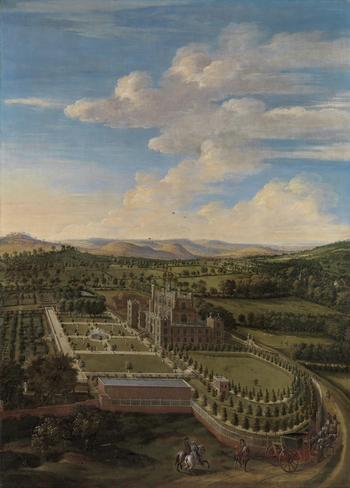
In large part due to these strains, Cassandra's brothers and soon Cassandra herself moved from Essex, settling at Wollaton Hall in Nottinghamshire (Figure 1), the other Willoughby family home, which had not been kept up, had been partially burnt down in 1642, and had been used to house Parliamentary forces during the Civil War.Footnote 9 It was in 1687, when Cassandra was not more than 17 years of age, that her older brother Francis asked her to join him at Wollaton to preside over its rehabilitation. She went, ‘thinking it would be no small pleasure to me to be Mistress of Wollaton and to doe whatever I had a mind to’.Footnote 10 They proceeded to repair, renovate, redecorate, rebuild, and restore order to the estate.Footnote 11 Francis died in 1688; Cassandra, however, remained at Wollaton and was joined by her younger brother, Thomas, and his tutor Thomas Man (c.1655–1690), who was a physician.Footnote 12 Dr Man, with whom Cassandra shared an interest in gardens – especially the physic garden kept at Wollaton for Dr Man's use – continued at Wollaton and seems to have been the third part in the family nucleus.Footnote 13 Cassandra, Thomas, and Dr Man restored and labelled her father's cabinet of specimens, both honouring and continuing his work.Footnote 14 When Man died in 1690, he left his books to Thomas and a writing desk to Cassandra.Footnote 15 Cassandra continued (on and off) at Wollaton, helping to oversee the house and estate, run the household and, after his marriage in 1691, raise her brother's family and continue to advise him. Cassandra also travelled with her brother ‘to visit the family estates and check on their condition’, suggesting that she played a role in managing the Willoughby estates.Footnote 16
Jan Siberbrechets, Wollaton Hall and Park, Nottinghamshire (1697), oil on canvas, in colour online, Yale Center for British Art, New Haven, CT. This painting illustrates Wollaton Hall at the time when Cassandra and her brother Thomas were in residence.

Cassandra also spent time in the old family library and among its neglected family papers. There she found deeds, wills, marriage settlements, and other, mostly legal, papers dating back to the twelfth century, sixteenth- and seventeenth-century family letters, copies of orders for running the household from the sixteenth century, and sixteenth- and seventeenth-century household accounts and inventories.Footnote 17 Cassandra then proceeded to copy down some of these materials. Cassandra also kept a journal from 1692 to 1718.Footnote 18 She wrote poems and essays, and produced at least two letter books with copies of outgoing and some incoming letters from 1713 to 1735.Footnote 19 In 1713, at the age of 43, Cassandra married her first cousin, James Brydges, who, by 1720, had been made duke of Chandos. Moving from Wollaton to her husband's house in Stanmore, Middlesex in 1713, Cassandra took on numerous social obligations and ongoing financial concerns as well as responsibilities for her husband's children from a previous marriage, his extended family and a household of upwards of ninety members, including a chaplain and a librarian. James Brydges was a notable patron and collector of art, and Cassandra herself was an ‘amateur but expert’ artist, particularly involved with painting portraits of family members.Footnote 20 Together, they patronized a number of artists, including the women artists, Maria and Adriana Verelst.Footnote 21 Rosemary O'Day describes the emergence of several elite ‘crazes’ of the time: ‘for family history, genealogy, and for likenesses of living family women and art […] for collecting, classifying, and recording, and for touring and topography [… and] gardening’.Footnote 22 Cassandra was accomplished in all of these, but for the most part used her talents toward serving the needs and memorialization of her family.
As duchess of Chandos, Cassandra lived a socially active life; her correspondence, which was largely but not exclusively with women, shows Cassandra involved in matchmaking, acting as a godparent, shielding her husband from importunate relatives, discussing her health (which was often problematic) and that of her correspondents, attending to properties, handling requests regarding stocks (for example, the stock of the South Sea Company) and positions, and coping with her husband's debts. Her interests ranged from finance to medicine, to patronage, to painting and architecture, to parliamentary elections. Cassandra took particular care to keep in touch with relatives and also friends, for, as she says in one of her early letters, ‘I take too much sattisfaction in hearing from my friends, to lose it by a neglect of my own.’Footnote 23
Cassandra was, to a very great degree, self-effacing. One must examine minutely everything she touched to find her imprint. She managed and consulted on properties and stock purchases; she planned and executed architectural renovations, based on knowledge acquired through her travels surveying English architecture and gardens. She managed her own finances with care but also took on advising members of her family and sometimes helping to support them. She was a noted musician, textile artist, and portrait painter, who, however, seems to have put everyone else's interests first and desired, above all, to be useful. As Cassandra herself put it, when explaining her reasons for marrying, ‘I had no concern so much at my heart as what might tend to the good of the family.’Footnote 24 When she died in 1735, James Brydges wrote to his nephew that it was ‘a loss whereby I am deprived of one of the most excellent persons of the age’.Footnote 25
Despite these many activities, and despite bouts of ill health, Cassandra continued to work on her Account, or at least on the second volume, until the 1720s.Footnote 26 In preparing it she was working with a very large cache of letters and accounts, some of which were in poor shape and difficult to read. She praises the letters written by Bridget Willoughby Peckham (c.1600), half-sister of Percival Willoughby, to Bridget Willoughby as:
well writ, the hand fine, and the manner of expression so agreeable to the present stile and mode of writing, that I should not have thought a letter of hers had been writ more days then it had been years. And indeed many of those letters which are above a hundred years old, are expressed in very much the same manner, that the way of writing letters now is, and much more like the present English than some of those letters which are in the Library at Wollaton, which are of a later date.Footnote 27
With or without regard to the quality of older handwritings, Cassandra's accuracy in copying letters and overall believability must be assessed.
Nearly all the materials transcribed by Cassandra in her preparatory notes or in her final family history have been lost. In the interest of time, perhaps, and certainly in the face of some difficulty in reading the materials, Cassandra paraphrased, provided a précis or truncated her sources.Footnote 28 Regarding this practice, for example, while introducing letters relating to Margaret Willoughby, Lady Arundell, Francis Willoughby's older sister, Cassandra wrote, ‘I shall shew by copying part of a letter from her to her Brother’.Footnote 29 Concerning the description of a conversation between Lady Arundell and Squire, one of Elizabeth Willoughby's servants, Cassandra wrote, ‘There is a very long dialogue writ down by Squire, too much to copy’.Footnote 30
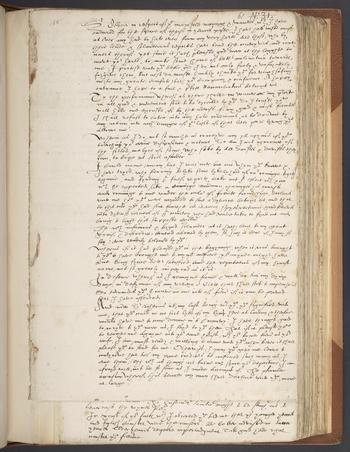
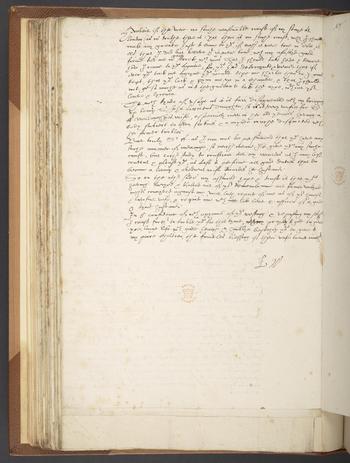
Looking to what she does include, we can judge how accurate Cassandra's transcriptions are by examining the surviving original letter.Footnote 31 (See Appendix to this Introduction.) Elizabeth Willoughby wrote this particular letter toward the end of 1585, at a time in the lives of Elizabeth and Francis when they had been separated for a number of years and she was appealing to return to the marriage and his house. The final transcription by Cassandra, while accurately paraphrasing some of the letter and, at times, copying it word for word, omits significant portions.Footnote 32 Cassandra softens Elizabeth's accusation that Francis was spying on her or believing slanders being bruited around about her. Cassandra also excludes a segment of the letter that relates to Lady Willoughby's expenses while in London and her reluctance to return to Francis for fear she would lose the small living she was currently allowed. In the original letter, but not in the copy, Lady Willoughby writes that she was warned that Francis had determined and vowed, should she return, to lock her in a chamber and not allow her to go out, even into the garden, without his leave and licence. She mentions ‘her old yeares’ and her body now subject to sickness and her mind disquieted with her former troubles, none of which is in the copy letter. She then promises to:
study to conforme all my wordes as I may best content & please yow, as also to performe all good duties that do become a loving & obedient wife towardes her husband. So on the other side my assured hope & truste is that yow having buryed & blotted out of yor remembrance all former unkyndnesses contryved againste me, will both repute of me as of yor honest & lawfull wife, & requite me wth all like love & offices of a good & kynd husband
most of which is not included in Cassandra's copy letter. While copying accurately the material she includes, Cassandra excludes materials that describe a deeper chasm and greater suspicion between Elizabeth and Francis than is evident from what she repeats or retells. It may be that her sensitivity as a descendant moved her to exclude some of the more emotionally difficult or dramatic passages. As she notes in her account for 1578, when copying down a heated (and public) conversation between Francis and Elizabeth: ‘Many more spitefull disrespectfull speeches she [Elizabeth] made which are there copied, but this I think is sufficient to shew the nature of their uneasiness, and too much to be noted down by a Granddaughter in the fourth descent from this Lady.’Footnote 33
There are also occasional differences between the draft notes for Cassandra's Account, held in the Huntington Library, and her fair copy, edited here.Footnote 34 In her earlier notes, when describing a letter from Francis Willoughby to his father-in-law, Sir John Lyttleton, she wrote:
In this letter he writes that being to goe to London he [Sir Francis] set down directions for his Men to observe in ordering his family in his Absence […] viz That Joahn should look to the ordering of the Children, to which she [Elizabeth] said who ever should take upon them to order her Children in her Presence she would Mischief, she said Joahn was his Whore and that she would not be left amongst such Villains, but would goe into the Town […] which Sr F:W: denying her she fell into very pashonate expression and sitting down called for a Knife threatning to make away with herself, and the Knife being denyed her she would have struck her Self in the Belly with her Scisors if she had not been prevented, ^then she^ said she would never eat or drink more, but with the same Knife she was next to eat with would Kill herselfFootnote 35
The fair copy omits the comment about Joahn being Francis's whore as well as the passage where Elizabeth says she will never eat or drink again but would use the knife to kill herself.Footnote 36 Throughout this edition any differences between the draft notes and the fair copy of Cassandra's Account are referenced in the footnotes or, for longer passages, included in brackets and italics in the text itself.
There is also a problem of dating in Cassandra's Account. Cassandra clearly tried to copy the letters in chronological order, although at one point she skips from 1575 back to 1572. There are letters, however, that are undated, or only partially dated. In particular, the letters from Lady Margaret Arundell, sister to Francis Willoughby, are mostly dated by month and day, but not by year, although they do mention where she is at the time of writing.Footnote 37 Cassandra has had to contextualize Lady Arundell's letters in terms of what she knows of her interactions with her brother, her travels and the world around her in order to guess how to place her letters.
Despite dating difficulties and Cassandra's practice of excluding information or paraphrasing her materials, she is remarkably accurate in what she reports and never manufactures content.Footnote 38 Her accuracy is evident in a letter that she copied from Queen Jane to Edward Willoughby in 1537, which is a near duplicate of an original letter from Jane Seymour to Edward's brother John Willoughby.Footnote 39 In addition, toward the beginning of her two volume account of the Willoughby family, Cassandra includes many pages of descriptions of the account books of George Medley, gentleman, brother-in-law, and executor of Henry Willoughby, father of Francis Willoughby, covering legal and other expenses as guardian of Sir Henry Willoughby's children from 1549 to 1562.Footnote 40 Cassandra's account echoes very exactly the surviving account books.Footnote 41 For example, when Cassandra notes ‘by a book of Medeleys accounts for the childrens cloaths etc. […] I find that his Nephew Francis Willughby and his Neece Margaret removed to Tyltey April the 21th 1550’, she is quoting exactly from Medley's book of accounts for 1550 where there is a memorandum ‘that my Nepveu Fraunces Willoughbye and my nece Margarett Wylloughbye his syster came to Tyltey the xxith of Apryll’.Footnote 42 When Cassandra notes on folio 46 that the cost of Francis Willoughby's board at St Anthony's School in London was £2 16s 0d, she had correctly added the boarding expenses listed in the Medley Account book dating from 18 January to 13 June, 3 Mary [1554/5], although she does not mention Master Lyse, the name of the schoolmaster.Footnote 43 Similarly accurate is her calculation of the boarding expenses for Margaret Willoughby at Tilty from 9 May to 11 July 1555.Footnote 44
In a second surviving account book in George Medley's hand, Cassandra's excerpts on fo. 52 of her Account once again accurately reflect the original, including the final summation of expenses at the very end of the manuscript.Footnote 45 Where this account book notes, in 1553: ‘To the Clarke of the Signett for the chargez of Wryting and the Seale of Lycence for my coosyn Thomas Wylloughbye to goe over the seaez to the universitye of Parys to studye […] vi s viii d’ Cassandra copies: ‘After this there is set down 6s 8d paid to the Clerk of the Signet for the writing, seal and lycence for his Cousin Thomas Willughby to goe beyond sea to the University of Paris to study.’Footnote 46 With regard to a third household account book, copied down in part by W.H. Stevenson and dated 1587, Cassandra, who excerpts the same account book on folios 127v, 129–129v and 130v, includes nearly identical information with minor discrepancies.Footnote 47 Finally, for the years 1596–1599, Cassandra transcribed coal accounts, including coal receipts. There is a single surviving summary account for eleven months ending 27 August 1596 that supports her figures.Footnote 48
If further evidence is needed to confirm the accuracy of her reporting, we find that Cassandra describes a letter:
from Edward Willoughby to his Brother Sir Percivall [the son-in-law of Francis] dated November 1588, in which he […] tells this story of Alderman Catcher and Alderman Skinner, that they were both by order of the Privie Counsel committed to the fleet, for whiping two Gentlewomen in Bridewell as common whores, and it was supposed it would cost them 2000li before they got out, the Queen taking the matter hardly against them, their fine was like to be the greater. One of these Gentlewomen was Wife to him that sue'd to be Lord Latimer, the other was Captain Nunames Wife.Footnote 49
This same episode is described in another letter, not copied by Cassandra, sent from John Adams to his brother-in-law Percival Willoughby in the same year:
I am more sory that Mr. Catcher the Friday next after this terme was fined for the whipping of Mrs. Newnam and Mrs. Nevill in BridewellFootnote 50 to the Queene CCCCCli and CCli to the ii gentelweomen, on hundredli apeec, and his fellow Skinner to on thowsand markes to the Queene, and CCCCli to the two gentelweomen […]They have besydes as parte of theyre judgment iii monthes imprisonment, and to aske the gent[lewomen's] forgiveness at theyre house at the Counter and at Bridewell.Footnote 51
Finally, there is a surviving draft letter transcribed by W.H. Stevenson from Percival Willoughby to Lord Burghley dated 1597 and a companion letter from Percival to Burghley, described by Cassandra in her Account and dated October 1597 regarding the wardship of the daughter of Sir Francis Willoughby by Dorothy Tamworth, Lady Wharton, his second wife, whose daughter had been born on 3 May of that year. They echo one another in their concerns for the overreaching of Lady Wharton, her machinations through her stepfather Sir Mychell Molins, and Percival's own poor estate, although Cassandra truncates her copy:
There is the copy of a letter from Sir Percivall Willoughby dated October 1597 to the Lord Burghley, then Lord high Treasurer of England, who had given the wardship of that child [the youngest daughter of Sir Francis Willoughby] to his Son the Secretary. In this letter Sir Percivall desired the Lord Burghley that for the avoiding of the malice of his adversaries, and the better establishing of his perplexed estate he would vouchsafe so far to recomend his humble sute to his Son, that he might have the wardship of the child, for the land only, for such considerations as should seem good to his Honour. And that he might the better judg of the value of it, Sir Percivall writ that he had inclosed the particular of those lands, and by that particular, he would also see what lands this Lady the widow of Sir Francis Willughby, by the help of Sir Micheal Molyns, and the rest of their accomplices, had got for herself and her heirs, though her usages of Sir Francis had been such, that she had ill deserved it.Footnote 52
In this particular case and in much of the other material she copied and paraphrased, Cassandra included sufficient material for the reader to conclude that, while sometimes excluding material that she regarded as superfluous, too much to copy, or too damaging to the reputation of her ancestors, she is a trustworthy witness who was not averse to describing the dramas and difficulties between Elizabeth and Francis or between other members of the family, including the servants, all of which make her Account so interesting. Rather than setting this correspondence aside because of its transmission through Cassandra's pen, it is best to study the materials we have while recognizing the problems associated with their second-hand survival.
Cassandra was also willing to draw conclusions. Her assessment of Sir Francis Willoughby's character is a sympathetic one. She notes that he appears to have been of a very mild, sweet disposition, and a lover of hospitality, but a little too apt to be imposed on by stories from his servants.Footnote 53 This portrait is somewhat belied by what appears to have been an overly suspicious character and one who not only fell out with his wife but also with his children and his son-in-law and heir, Percival Willoughby. In addition, there was at least one illegitimate child by Sir Francis, baptized in 1584/5 in the West Riding of Yorkshire,Footnote 54 while a draft will of Sir Francis in 1579, although perhaps patterned after other puritanically inclined wills, exhibits an extreme sense of sinfulness.Footnote 55 Finally, in a household where family, servants, and other hangers-on jockeyed for influence, it is telling that Sir Francis left them all in a state of limbo, having written at least four drafts of his will but dying intestate, for, as Percival Willoughby wrote to his wife in 1588, ‘[Francis] was every day in a thousand minds what to doe with his estate.’Footnote 56
Cassandra concludes that Lady Willoughby seems to have been a woman of wit and virtue but of a turbulent spirit and ungovernable passions. In support of her assessment of Elizabeth, she copies down a number of letters and dialogues, one of which, to the London Alderman Catcher, in the early 1590s, certainly bears out Cassandra's description:
You causlessly condemn me of unkindness to Percivall Willoughby. I will forbear to repeat his unfriendly behaviours, because I will not disclose his faults to a babling fool. Expecting no better than the worst you can practice, I stay my own trouble, and stay you your tongue for al = be = it, I am Fatherless, I am not Husbandless nor friendless, but
A Dispiser of vain Fools
Elizabeth Willughby.Footnote 57
It is probable that Elizabeth used this same sharp reproachful tone with her daughters as several of them, as we will see later, accused her of misusing them. Cassandra, however, does not copy down some of those letters that might offer more insight into her troubled relationships with her daughters. On the other hand, one must keep in mind that Elizabeth, who was often ill, had had at least twelve pregnancies between 1565 and 1579, with six surviving daughters and a son (her last child) who lived to approximately two years of age.
The information in the letters that Cassandra provides offers sufficient material for the reader to conclude that issues of obedience were central to the difficulties between not only Elizabeth and Francis, but also in the lives of their daughters. Cassandra, reading these letters over a century removed, appears not to have reacted negatively to Francis's expectations of obedience from his wife and his actions and threats to curtail her freedom. Indeed, in a 1730 letter, written to a newly married niece, Cassandra advises, ‘I think the best way for a wife to secure her own happiness is by striving to render her husband's life as happy as is in her power.’Footnote 58 A reader today, however, might find herself more sympathetic to Elizabeth, despite the sharpness of her language, and less inclined to view Francis as mild in his demands of her, particularly in the face of her many reported illnesses, recurrent pregnancies, and our knowledge (which Cassandra knew and Elizabeth must have known) of his infidelity in the marriage. Similarly, the control over their daughters that both Francis and Elizabeth exercised, while perhaps unremarkable for the period, produced some very unfortunate results, and issues of abusive husbands, and obedient or disobedient wives and children continue to surface in the correspondence of the next generation.
The reader of these letters must also realize that he or she may be getting only one side of the story, perhaps deliberately constructed to produce a certain response from recipients; in addition, the letters, while ostensibly private, could be expected to be read, and commented on, by others.Footnote 59 An instructive example of the problem is the description Cassandra gives, based on her reading of many family letters, of the relationship between Frances, the youngest daughter of Sir Francis and Elizabeth, and her husband Montague Wood. Cassandra notes,
By many other letters one may believe that this Mountague Wood of Lamley was a very ill man, as well as a very ill Husband to this Frances Willughby […] I believe very soon after they married, he began to use his Wife very ill and continued to doe so as long as she lived. There are many letters from her to her Sisters which give an account of his barbarity to her viz: that he turned her out of doors, beat her, and made her suffer the want of the necessarys for life, and other of her letters complain of the unkindness of his relations to her. So that upon the whole, one may judg that she had a very miserable life.Footnote 60
In letters not copied down by Cassandra, however, Montague Wood, writing in 1600 to Abigail Willoughby, one of Frances's sisters, offers a different side of the story:
Good Sister I had thought not to have written unto you, untill I had sent you sum good news, but sutche occasions have happned of late, that I am forced to send you as ill news, as ever you herde and worst to me then to all the worlde besides. Soo it is that foure my last goinge to London, your sister Fraunces, by the evill perswationes of sum dishonest people hathe acquainted herselfe, withe a coople of gentlemen bothe strangers to her before nowe and to me, bothe unmaried men and of notorious fame, and hathe yelded soo mutche to her pleasures as she hathe not refused to goe to taverns, to foll withe them, I knowe not howe often, and to staye at the taverne, whole nights withe them, she hathe ridden, to one of there howses, and hathe sent awaye her servaunte for the space of three dayes not sufferinge soo mutche as her mayde to staye withe her.Footnote 61
Clearly, both partners in this marriage were using letters to construct a case against each other and were expecting a sympathetic response from their correspondents. One also notes, since it is entirely likely that Cassandra had access to the letters of both Montague and Frances, that Cassandra may have chosen to present Frances's complaints but not those of her husband. She appears to be similarly one-sided regarding the correspondence from Dorothy Willoughby complaining about her husband Henry Hastings, although Henry appears to have tried, at least at the beginning of the marriage, to justify himself to Francis Willoughby.Footnote 62
Generally, Cassandra seems concerned to detail cases in which the women about whom she writes were constrained or troubled in some ways, as she continues to do in the second volume of her Account, copying down Frediswith (Phridelwide/Frediswide) Willoughby Adams's complaints of not being allowed to travel,Footnote 63 detailing the financial and familial struggles of Bridget Willoughby, the problems Bridget's daughter Lettice had with an unwanted suitor, extended letters regarding arrangements and concerns about the wedding of Cassandra's grandparents (Francis Willoughby and Cassandra Ridgeway), a fall and illnesses of her grandmother Cassandra, the financial difficulties, widowhood and illnesses of her aunts, the marital explorations of her father, the pity she felt for her mother's troubles between her children and their stepfather with the jointure in her mother's remarriage, Cassandra's own trauma in losing her older brother, and her strangely strained reaction to her younger brother's marriage, at which point she abruptly ended her account.Footnote 64
Cassandra, for the most part, ignored the political, financial, economic, and material aspects of the Elizabethan Willoughbys. A.C. Wood, who edited and published Volume II of Cassandra's Account in 1958, was dismissive of her perspective:
It cannot be claimed that her narrative throws any light on the general history of the period it covers […] The explanation of so much omission must surely lie in the fact that she was a woman; a man would hardly have turned his back on the dramatic political scene in this way. We can only conclude that her sex, and the conditions of life in which women lived in the seventeenth century, narrowed her world and vision.Footnote 65
While Cassandra did include some household accounts and a few political references, but in no systematic fashion, it is clear that she was primarily concerned with the family archive of personal letters and that she was keenly interested in the family's genealogical history and extended family ties. Rosemary O'Day has described Cassandra as being ‘obsessed with ancestry, descent and connection’.Footnote 66 This genealogical interest is evident in the first 38 folio pages of her Account where she mistakenly begins with one William Willoughby, temp. Edward I.Footnote 67 Here she partly attempts to contextualize the early history of the family in relationship to some of the more dramatic moments in medieval English history, viz. the Baronial Revolt of the thirteenth century, some of the military excursions to the continent, the Wars of the Roses, and the revolt of Lambert Simnel under Henry VII. In these cases she largely relied, sometimes verbatim, on the published chronicles of William Dugdale, William Camden, and Richard Baker, as well as on the manuscript mentioned above written by her father.Footnote 68 These first 38 folio pages are largely derivative and not included in this edition, although it is noteworthy that she spends time detailing the marriages, not only of the sons of her Willoughby ancestors, but also the daughters who, for the most part, drop out of the standard genealogies of the time. As she moves forward in her Account, however, and begins to focus on family letters, she does not attempt to contextualize her notes in terms of national politics, nor does she try to follow the financial vagaries of Francis Willoughby's ill-conceived schemes for manufacturing woad, glass, or iron;Footnote 69 she does not focus her attention on the building of Wollaton Hall, a project that has interested a number of scholars;Footnote 70 nor does she dwell on the declining profits of the Willoughby coal mines by the 1590s,Footnote 71 although she must, perforce, mention the financial difficulties that seep into the personal letters of Francis and Elizabeth and dominate the lives of Bridget and Percival. Instead, she organized her Account around the personalities involved, beginning with the marriage of Francis and Elizabeth and then systematically collecting information and copying letters relating to each daughter in turn. She saves, however, much of what she has to report about Bridget, the oldest daughter, and her husband Percival Willoughby, for the second volume where she continues the Account through her grandparents, parents and her own generation.
Cassandra's interest in the interpersonal relations of her ancestors has fortunately left us with a rich portrait of a family dominated by the discourse of women intersecting with the demands of husbands and would-be husbands who were at times and by turns affectionate and controlling. In the final analysis, however, they were not often capable of understanding or coping with the strong-willed Willoughby women – women who sometimes chose what, in patriarchal Elizabethan society, could only be destructive behaviour and ended up leading, as Cassandra put it, ‘very unhappy lives’.
Willoughby Family Background
The Nottinghamshire Willoughbys of Wollaton would have been aware, in the seventeenth century, that their family could be traced to one Ralph Bugge (d. c.1250), a wealthy Nottingham wool merchant and Derbyshire lead mine owner who flourished in the early thirteenth century and is first mentioned in Nottingham records c.1209.Footnote 72 Modern research has so far been unable to push the lineage further back. Ralph Bugge built up a landed estate in Willoughby-on-the-Wolds in Nottinghamshire and left it to his youngest son Richard.Footnote 73 Within three generations the heirs of Ralph Bugge through Richard had climbed through land acquisitions and fishing rights on the Trent, profits from mining, military experience, legal careers, wealth-building marriages, and local office holding into the ranks of the upper gentry and had taken as part of their name the place name of Willoughby (spelled variously Willughby, Wylughby, Wilubee and so forth).Footnote 74
At the time of the 1362/3 death of Sir Richard de Willoughby, chief justice and the fifth in descent from Ralph Bugge, Richard held manors in Nottinghamshire, Lincolnshire, Derbyshire, Leicestershire, and four other counties, overall holding lands in nineteen counties worth between £500 and £700 annually.Footnote 75 This placed the Willoughby wealth somewhere between that enjoyed by the lay barons and the greater knights of the shire.Footnote 76 Richard also appears to have been the first of the family to exploit coal mining at Cossall and Wollaton and perhaps elsewhere. Subsequently coal, in addition to rents, agricultural profits, benefits deriving from local and national positions of responsibility, and profitable marriages undergirded the family's wealth.Footnote 77
The Willoughbys were unusually fortunate throughout the fourteenth and fifteenth centuries. During a time of recurrent plague, wars with France, and internal conflicts, they nonetheless managed to secure their inheritance intact through male descent from the time of Ralph Bugge until the generation with which this book is concerned.Footnote 78 Regarding the final failure of the Willoughby family line in the male line at the end of the sixteenth century, Simon Payling notes that out of 45 knightly families in Nottinghamshire in 1325, 13 had failed in the male line by 1400, another 18 in the fifteenth century, and 8 in the sixteenth century. By 1700 there were only three knightly families in the shire that still continued in the male line.Footnote 79
By the end of the fifteenth century, the Willoughbys were poised to move into the higher ranks of the aristocracy. Why they did not do so rests, in part, on the careers of two of the sixteenth-century Willoughby heirs – Henry (1451–1528) and Francis himself, as well as the involvement of the family in the ill-fated effort to place Lady Jane Grey on the English throne in 1553 and the subsequent conservatism of Queen Elizabeth, who raised only a small handful of her closest advisers to the peerage.Footnote 80
Henry Willoughby inherited substantial lands, including the manor of Middleton in Warwickshire from his father's estates in 1474, and, with his mother's death in 1490/1, Wollaton. He also married four times; at least two of his wives were sole heiresses.Footnote 81 He came to maturity in the confusing political period of the Wars of the Roses and survived serving under Lord Hastings and then the duke of Buckingham, both of whom were executed by Richard III.Footnote 82 After Richard's defeat at Bosworth Field in 1485, Henry Willoughby supported Henry VII, serving him well throughout his reign, moving in the highest circles, and benefiting from his close relationship to the Crown; Henry VIII may not have valued him, however, to the extent that his father did.
Locally and regionally, Henry Willoughby was high sheriff of Lincolnshire (1491, 1501/2), high sheriff of Nottinghamshire and Derbyshire (1495/6), high sheriff of Warwickshire (1505/6; 1519–1520, 1526), and justice of the peace in Lincolnshire and Warwickshire, and, for more than thirty years in Nottinghamshire (1492–1528), among other offices and responsibilities.Footnote 83 Alan Cameron points out how important a personage Henry was with several examples, perhaps the most telling of which is that the Nottingham Borough took care to present Sir Henry with a suitable gift (usually wine) when he attended quarter sessions.Footnote 84
Henry was an enthusiastic if somewhat conventional CatholicFootnote 85 who could afford to pay for a chantry at Wollaton church and many additional indulgences and engage in lavish almsgiving to scholars, friars, anchorites, players, poor men, and others.Footnote 86 Already by 1497/8, his income ‘was comparable with that of most contemporary noblemen’.Footnote 87 Henry was the beneficiary of dowries from his marriages, from a variety of land purchases and perhaps from some foreclosures and some possibly illegal seizures of land.Footnote 88 His income from the coal pits at Wollaton, receipts from which rose steadily up to 1510, was substantial.Footnote 89
With all this, however, Sir Henry never rose to noble status. The reasons are not entirely clear. It would appear, from scattered references, that Henry Willoughby could be quarrelsome and had certainly fought with the Stanhope and Plumpton families, as well as with Lord Grey of Codnor, and even with his own mother.Footnote 90 In 1518, however, Sir Henry received, by letters signet from King Henry VIII, an appointment as captain to raise and equip soldiers, notwithstanding the Statute of Retainers. Toward the end of his life, in 1525, he also received a commission under the signet ring to repress riot in Coventry.Footnote 91 Henry Willoughby died in 1528, by which time he had rewritten his will numerous times.Footnote 92
Henry Willoughby married off his children with great care,Footnote 93 and the alliances contracted had the potential to raise the Willoughbys into the very highest ranks of the nobility, had it not been for the damning involvement of the Grey family in the politics of royal succession and the too rapid deaths of Henry's heirs – his three sons (Edward Willoughby in 1541, Sir John Willoughby in 1548/9, and Sir Hugh Willoughby the navigator in 1554), his grandson Henry Willoughby in 1549 and his great grandson Thomas in 1559Footnote 94 – three generations within the space of eighteen years. In 1559 the inheritance was left in the hands of Henry's great-grandson Francis (the last remaining heir in the male line), who was between twelve and thirteen years old at the time, and those who held his wardship.Footnote 95
John Willoughby, Sir Henry's eldest son and heir, had married Anne Grey, eldest daughter of Edward Grey, Viscount Lisle.Footnote 96 This marriage placed the Willoughbys close to Sir Edward Seymour, later duke of Somerset and protector of King Edward VI, as Anne was co-heiress with her sister, who married Edward Seymour. Alan Cameron characterizes Sir John Willoughby as ‘Undoubtedly the wealthiest layman resident in the county [of Nottinghamshire]’, with a gross income ‘of the order of £1,800 per annum’,Footnote 97 an estimated £600 to £750 coming from coal receipts.Footnote 98 He was the protector and seneschal of two monastic houses – Lenton and Beauvale – with which the Willoughbys had had long-standing connections. In 1505 John and his wife Anne received a letter of fraternity from the hospital of Holy Trinity, Wolsoken (Walsingham?) in the diocese of Norwich, and in 1521 John was made a Knight of the Holy Sepulchre.Footnote 99 Sir John Willoughby's religious beliefs seem to have been, like those of his father, strongly Catholic; he was associated with his father in several of their religious affiliations and there is evidence that he went on two pilgrimages – one to Saint James of Compostela (Santiago de Compostela) and the other to Rome.Footnote 100 Post-Reformation, however, John Willoughby apparently accommodated to the changes,Footnote 101 although, in the wake of the dissolution of the monasteries, the Willoughbys profited very little.Footnote 102
John was 47 when his father died in 1528; he then died on 10 January 1548/9 without heirs.Footnote 103 Since his younger brother and heir, Edward, had died in 1541, the Willoughby estates descended to Edward's son and John's nephew Henry. This Henry had married Anne (another Anne Grey) daughter of the second marquis of Dorset, once again strengthening Willoughby ties with the Grey family.Footnote 104 At the beginning of Cassandra's Account, she writes,
This was the fourth time that the Willughbys had matched with this family of the Greys, which had made a very great intimacy between the two families, as appears by many of the old papers. In the books of accounts there is often mention made of Sir Henry Willughby's being at Bradgate [the home of Henry Grey, 3rd marquis of Dorset, later duke of Suffolk and also Henry Willoughby's brother-in-law] for severall days together, and in the account book of bills of fair for [the] Wollaton family (which shews what company daily came to Wollaton) I often find some of the family from Bradgate set down.Footnote 105
The Children of Henry (c.1510–1549) and Anne Grey Willoughby (c.1519–1547/8) and the Childhood of Francis Willoughby
Henry was a young husband with three small children when he was killed in the 1549 commotion of Kett's rebellion. The rebellion was brutally suppressed by an armed force under the leadership of the earl of Warwick, and one of the casualties in the earl's forces was Henry. At this point Cassandra's Account provides a great deal of information, mostly drawn from old papers, a few letters, and account books. She notes: ‘This Sir Henry Willughby was one of those gentlemen that went to appease the rebels in Norfolk who had got together under Robert Ket, a tanner, upon a grievance on account of inclosures, and was killed at Norwich, August the 27th, 1548 [sic]. He and his lady both lye buried in the Church at Wollaton, where there is a monument for them.’Footnote 106 Henry had enjoyed his inheritance for less than a year. He and his wife Anne Grey, who had died the year previously (3 January, probably 1547/8), left two sons and one daughter, all very young. Thomas, the eldest (b.1541), was eight years of age and Francis, the youngest (b.1546/7), only two years old; Margaret Willoughby, the daughter, was apparently about three years older than Francis (b.1543?). Cassandra notes that, ‘It appears by some of the old papers that Sir Henry Willughby left these three children to the Marquis of Dorsets care, and that the three executors of his will were George Medley and Gabriell Barwyke, esquires, and John Hall, gent:.’Footnote 107 The children were put in the care of Anne's brother Henry, 3rd marquis of Dorset and duke of Suffolk, at BradgateFootnote 108 but were soon transferred to the guardianship of George Medley, who owned or leased a house in Tilty, in Essex, and partially owned a London house in the Minories.Footnote 109
There is a letter from George Medeleye dated from London in February 1549 [1549/50], in which he writes that the Marquis of Dorset, being now daily to attend the King, he intended to remove his family from Bradgate to London, and therefore ordered that 12 horses should be sent for from Wollaton and a cart and horses from Middleton to come up to London with Mrs.Footnote 110 Margaret and little Mr. Francis Willughby. Attended thus, a servant to carry Master Francis before him, another servant to carry Mrs. Margaret, and another servant to carry little Whytneye, a horse for Mrs. Lenton [the governess], another horse for the maid, and 4 for the four men to wait upon them, a man to lead a horse to carry the male [a travelling bag], and two more servants to take care of the horses. It does not appear where these children were after this journey, till by a book of Medeleys accounts for the childrens cloaths etc. from the 4th of Edward the 6th to the 1st of Elizabeth [1550–1558], I find that his Nephew Francis Willughby and his Neece Margaret removed to Tyltey, April the 21th, 1550 […] I don't find where Mr. Thomas Willughby was when his Brother and Sister removed to Tiltey, but in Mr. Medeleys account book there is set down 20sh for Mr. Thomas Willughby's board with him from May the 27th to June the 11th that year and 10s for Mr. Thomas Willughbys mans board the same time. And again the same sume is set down for his and his mans board with Mr. Medeley from November the 3d to the 18th, which day I find by the book of houshold expences for the family at Tyltey Mr. Thomas Willughby went to Cambridg.Footnote 111
Thomas Willoughby, by then no more than nine or ten years of age, must have boarded at one of the several grammar schools in Cambridge, preparatory to attending the University.Footnote 112 This absence of his older brother (particularly after 1551 during which year Thomas had returned for twenty weeks because of the ‘swett’ at Cambridge) and the rapid change of residences, in addition to the deaths of his father and mother, must have impacted Francis's life dramatically at a very early age. It is also clear from the notes that Cassandra took, that life at Tilty was something of a social whirlwind, with visits from Lady Jane Grey, first cousin to the Willoughby children, and the princess Mary Tudor, among others. All of this was cut suddenly short by the elevation of Lady Jane Grey to queen for nine days and, in the wake of Wyatt's Rebellion in January 1553/4, her execution, along with the execution of her husband, Lord Guildford Dudley, and her father, Henry Grey, who was also the maternal uncle to Thomas, Margaret and Francis. In the wake of this tragedy, the older son Thomas's wardship, which had been given to the marquis of Dorset, was transferred to William, Lord Paget, and Thomas joined his household.Footnote 113 There was discussion of sending Thomas to school at Paris, but by 1558, at the age of seventeen, he was admitted to Lincoln's Inn. More importantly, George Medley, who now had wardship of Francis and Margaret, was, as the half-brother of Henry Grey and half-uncle to Lady Jane Grey, suspected of involvement in the plot to bring Lady Jane Grey to the throne and in Wyatt's Rebellion. In addition, his brother-in-law, Thomas Dannett, may have conspired with Henry Grey, perhaps agreeing to bring 400 men to his aid at Leicester. Although Dannett, in the end, did not supply the expected troops, he was nonetheless suspected, captured, and placed in the Tower for a month before being released and going into exile on the continent.Footnote 114 As Cassandra writes, ‘I believe about this time [1553–1554] Mr. Medeley and the whol familie at Tyltey were involved in great troubles upon the Duke of Suffolks account, who was beheaded upon the 23rd of February [1553/4] following. Mr. Francis and Mrs. Margaret were removed to the Minoryes, [just outside Aldgate near the Tower of London] with their servants, I believe a house where Mr. Medeley used to live.’Footnote 115 As a result, George Medley also spent time in the Tower, and his lodgings in the Minories were searched by Bishop Gardiner.Footnote 116 From February and into April executions of large numbers of the rebels took place, with bodies publicly displayed throughout London. Thus, by the time that Francis Willoughby was eight years of age, he had lost his mother and his father; his cousin, Lady Jane Grey; and his uncle Henry Grey (as well as one other of the Grey uncles) had been executed;Footnote 117 he and his sister and their household had been moved about several times, and his guardian, foster father and uncle, George Medley, was under suspicion and briefly imprisoned, as was Medley's brother-in-law. In addition, the children may have been traumatized by the numbers and brutality of the executions taking place throughout the city. Then, when Francis was between twelve and thirteen, his older brother Thomas died, and Francis became heir to the Willoughby name and estates.Footnote 118
Francis had received the kind of education that would stand him in good stead as heir to the Willoughby estates. Beginning in 1550, when Francis was three years old, his governors spent 20d for a ‘pounde of sugere plate and greate comfettes to make hym larne his booke’. They also purchased two ABCs for 1d. Later in 1550 additional ABCs were purchased for 2d.Footnote 119 In 1552 the accounts mention costs of a Greek and a Hebrew grammar book for Francis; in 1553 the accounts list two French books for MargaretFootnote 120 and other books for Francis as well as moneys ‘to Mystris Lenton for teaching and lokyng to’ Francis and Margaret for a year and a half.Footnote 121 The 1554 accounts of George Medley record the purchase, for 3 pennies, of Evaldus Gallus's Pueriles Confabulatiunculae, a book of Latin dialogues.Footnote 122 In 1555, Francis was going to school at Saffron Walden in EssexFootnote 123 but by early 1556 he was boarding at St Anthony's grammar school in London where he remained through the first half of the year.Footnote 124 By summer 1556 he had transferred back to Saffron Walden.Footnote 125 There Francis received a thoroughly humanist and elitist education that was gradually becoming part of the grammar school curriculum in England's best schools. His studies involved learning Cato's Disticha, a first reading text of Latin moral sayings, Cicero's Letters, Vives's Colloquies, and a Latin–Greek dictionary by Ambrose Calepin (printed in Strasburg in 1537), a dictionary in English (probably the dictionary of Thomas Elyot), Erasmus's De Copia and his Adages, Lorenzo Valla's De Elegantia Linguae Latinae, Ceporinus's Greek grammar, the Acts of the Apostles in English and with notes to sing and play, Mathurin Cordier's Libellus de Corrupti Sermonis Emendacione, the Floures for Latine Spekynge perhaps by Nicholas Udall, and Richard Sherry's Treatise of the Figures of Grammar and Rhetorick. Footnote 126 The accounts record payments to a writing master teaching Francis to write, as well as the cost of a ‘Terence’ and a Latin psalter.Footnote 127 By 1557 Francis was learning to write the Italian hand; he was also being taught ‘arethmetick’ by Master Horseley.Footnote 128 There are numerous notations in George Medley's account book of costs for teaching Francis and Margaret to play upon the virginals.Footnote 129 An entry of 1557 is particularly interesting in that it concerns a book which was purchased for the young Francis to notate his musical studies.Footnote 130 A much later surviving shelf list of books includes a 1552 copy of Galigai's Practica d'arithmetica which may also have been one of Francis's school texts.Footnote 131 Instructed in Greek, Latin and Hebrew grammar, writing, arithmetic, Latin rhetoric, and music, Francis was sufficiently educated to be considered a cultured man. In 1558 he went ‘to Cambridge to schole wyth docketer Carre’.Footnote 132 But with his brother's death in 1559, Francis Willoughby's wardship became valuable, and in 1560/1 it was formally assigned to Sir Francis Knollys,Footnote 133 with the proviso that an annuity of £100 was to be set aside for Francis's education.Footnote 134
Knollys was a committed Protestant who was married to the daughter of Mary Boleyn, Queen Elizabeth's cousin and reputed by some to be her half-sister. Knollys was vice-chamberlain of the royal household and a member of Elizabeth's Privy Council; as a result, Francis would have spent time with the Knollys family at court. In June 1564, at the request of Francis Willoughby himself (now 17 years old), however, the wardship was reassigned from Sir Francis Knollys to Henry Medley, Gabriel Barwick, and John Hall, the original executors of Henry Willoughby's estate, or, in the case of George Medley, to his son after Medley's death in 1562/63.Footnote 135 The cost of this transaction was £1,500. Among other reasons for this transfer, Francis had refused to marry Elizabeth Knollys,Footnote 136 the daughter of his guardian, who was, at the time, about 15 years of age. One also wonders whether Francis shared the strongly Protestant beliefs of the Knollys family that had sent them into continental exile under Queen Mary. As an adult Francis does seem to have been a committed Protestant. Alice Friedman speculates that Francis was not comfortable with the court life into which he had been thrust through Knollys.Footnote 137 Perhaps the traumas of his early childhood experiences led him to be wary of the court.Footnote 138 On the other hand, perhaps he already had another marriage in mind.
The Willoughby Letters: Sir Francis Willoughby, his Marriages, and the Next Generation
Most of the information about the Willoughbys thus far, Cassandra had copied from old papers, a few letters and account books she had found. Although Cassandra continued to draw from these account books, at this juncture she moved on to the family letter collection at the point where Francis Willoughby decided to marry.
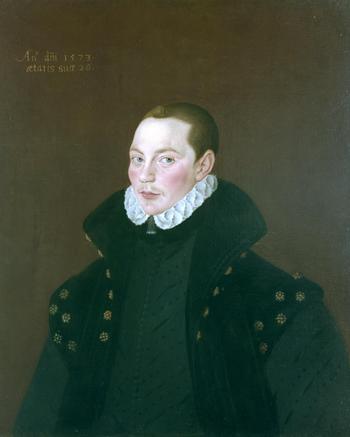
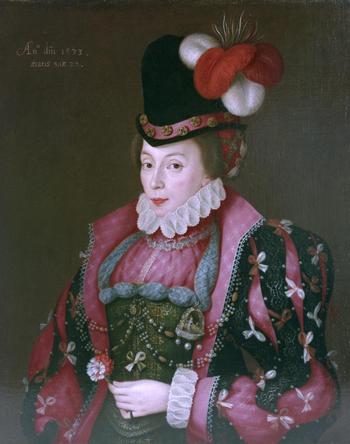
Very shortly after Francis Willougby's release from his wardship with the Knollys family he began negotiations for a marriage with Elizabeth Lyttleton of the Lyttleton family of Frankley.Footnote 139 At the time (1564) Francis was 17 years of age (Figure 2). Elizabeth Lyttleton was born in 1546 and was 18 years of age (Figure 3).Footnote 140 Francis was attracted to Elizabeth in part because she was the daughter of a neighbouring family with estates in Worcestershire not far from Middleton in Warwickshire. Although Francis does not say so, the fact that the Lyttletons owned coal and limestone on their estate at Halesowen may have attracted him.Footnote 141 There were strong family connections; the dowry promised (£1,500) was unusually substantial and was complemented with an offer to board the couple, their horses and six servants for three years.Footnote 142 Francis was to promise his wife a ‘very reasonable’ jointure and settlement of ‘but one-third’ of his estate on heirs male by her.Footnote 143 As Francis put it in a letter to his uncle the Lord John Grey of Pirgo, ‘After good deliberation it had pleased God to give him a liking to the young Gentlewoman, who had had a good education and was descended from a house of great antiquity, well friended and alyed, dwelling near his house of Middleton. And Mr. Lyttleton's offers with his Daughter being reasonable, could he have his Lordships favour he was fully minded to match himself to her’.Footnote 144
Francis Willoughby, age 26 (1573), in colour online. Reproduced by permission of Lord Middleton and the University of Nottingham Library Manuscripts Collection.

Elizabeth Willoughby, age 27 (1573), in colour online. Reproduced by permission of Lord Middleton and the University of Nottingham Library Manuscripts Collection.

Francis entered into this negotiation with the support of some of his advisers but without consulting his sister Margaret and her husband, Matthew Arundell.Footnote 145 Francis consulted, instead, Lord Dudley, earl of Leicester,Footnote 146 and others; he also received approval from Lord Grey.Footnote 147 His sister accused him of following the advice of George Willoughby, an illegitimate uncle,Footnote 148 who had ties to the Lyttleton family.Footnote 149 It is possible that George Willoughby, perhaps in consultation with the Pagets, promoted the Lyttleton arrangement because of the shared Catholic leanings among them.Footnote 150 On the other hand, Dudley would not have shared these religious proclivities, and John Grey, at least in 1560, was denouncing the ‘Pagetyan’ faction at court.Footnote 151
The marriage agreement was drawn up on 20 November 1564. Almost immediately, in 1564, Matthew Arundell made clear his opposition to the marriage, and Lady Arundell ‘used her outmost’ to break the match.Footnote 152 The promise that Sir John Lyttleton made, of a dowry or portion of £1,500,Footnote 153 was generous by the standards of the time,Footnote 154 and it was backed up by an agreement by Sir John and his son Gilbert to pay £2,000 if they did not perform the covenants agreed upon. Nonetheless, Margaret and Matthew Arundell were suspicious of Sir John's promises, as it turned out for good reason.Footnote 155 In 1566 and 1567 it appears that Francis and Elizabeth were living with her family, per the marriage settlement, since there are letters between Francis and Sir John Lyttleton that seem to have been written while Francis was away from Frankley, but from 1568 forward, when Francis was 21 and had come into control of his estates, they set up an independent household.Footnote 156 In 1569 Sir John Lyttleton sent Francis £110, apologizing for not paying the whole sum of money due.Footnote 157 By perhaps 1572–1574 Francis writes to his sister that the bargain between his father-in-law and himself is broken off, because he can have no good assurance for the money, and he fears he shall be compelled to sue him.Footnote 158
Elizabeth Willoughby took it amiss from the very beginning that she did not have the favour (but rather the disfavour) of her sister-in-law; this rift was never healed. Indeed, relatively early in the marriage Elizabeth wrote to her brother-in-law Matthew Arundell making it clear that she did not desire her sister-in-law's presence in her home. The language is strong: ‘she is resolved never to stay in the house where his Wife is’.Footnote 159 While in the beginning, Francis Willoughby defended his wife,Footnote 160 eventually he began to blame her.
Marriage, in Elizabethan England, was not normally only (and sometimes not ever) a matter of the heart; it was an economic decision with status implications and normally effected in the midst of consultations and, very commonly, with go-betweens.Footnote 161 This upset between brother and sister, which produced a good many letters between them, seems to have set the tone for a destructive and long-lasting antagonism between Margaret Willoughby Arundell and Elizabeth Lyttleton Willoughby. In the event, Francis Willoughby never did receive the full amount of the dowry promised him by Elizabeth's father.Footnote 162 This not only confirmed Margaret's suspicions but may have led Francis to value his wife less, as appears to be the case already by c.1570.
The marriage between Francis Willoughby and Elizabeth Lyttleton was not a success, as the letters make clear.Footnote 163 The decision to marry seems to have been taken in some haste,Footnote 164 and the marriage suffered from the relatively young age at which they wed, a point that Elizabeth Willoughby makes clear later with regard to her own behaviour. A further exacerbation in the marriage was the number of children Elizabeth Willoughby bore, and the toll that it took on her health. While we know of six living children, all female, and one male child who perhaps lived to the age of two,Footnote 165 Elizabeth also had a number of miscarriages.Footnote 166 In a letter to her husband c.1579, she notes that she had borne him 12 children.Footnote 167 Whether it was on account of her constant pregnancies, on account of Francis's constant ‘dealing’ with her (as she put it),Footnote 168 or due to reasons that we cannot now access, Elizabeth seems to have become easily angered.
By c.1572 Lady Arundell was recommending that the next time Elizabeth Willoughby fell into one of her rages Francis and Elizabeth should repair to Elizabeth's father's house ‘till such time as she should have lost her willfullness, and would apply herself to please him’. Another solution she suggested would be for Francis to leave his wife and spend time at her household.Footnote 169 By March 1573 the letters report that Elizabeth Willoughby was very ill and in London for help. Since Francis could not accompany her, he appealed to Thomas Willoughby (father of Sir Percival, their future son-in-law), living apparently in Kent, to help his wife in London.Footnote 170 At about the same time letters detail a plot on the part of at least six of Francis Willoughby's servants to defame Lady Willoughby.Footnote 171 Meanwhile Lady Arundell did her best to question the servants in order to pick up information she could use against Lady Willoughby. One particular defamatory piece of information that Cassandra records is Elizabeth's friendship with a Mistress Haddam [Juliana Stanhope, wife of John Hotham].Footnote 172 She is represented by Margaret together with the ‘cabal’ of servants as ‘a vile woman’ and, a little later on, as a dishonest person.Footnote 173
During the 1570s Francis and Elizabeth lived handsomely, with their wealth coming from rents and fines,Footnote 174 coal receipts,Footnote 175 wood sales, and interest on loans to others including a loan of £1,900 to the earl of Huntingdon. They were also buying land, making charitable gifts (e.g. to the poor, to prisoners and to widows) and maintaining a lavish style of living and hospitality.Footnote 176 They most likely hosted Queen Elizabeth at Middleton in 1575, and they regularly dined with thirty to forty friends and neighbours, including the earls of Rutland and Huntingdon. Cassandra lists forty-eight servants at this time; she also records one account of household expenditures of approximately £1,400 over fourteen months, costs that were recorded by only one of their household accountants. One such account book provides extremely detailed expenses paid by Thomas Shawe between November 1572 and February 1575. Included, for example, are necessities for the children, payments to Elizabeth Willoughby (for example, £40 in November 1572), payments for doctors’ visits and various medical and herbal concoctions, alms to the poor, payments for everyday things like reeds, horsemeat and the shoeing of horses, for musicians, supplies for the dogs, books and paper, wages for the servants, etc.Footnote 177 The totals for the month of November 1572 were £111 3s 2d, while the weekly sums for November 1574 were between £30–£40.Footnote 178 Francis lived the life of a country aristocrat, despite belonging to the upper gentry, spending
somewhere in the region of £1,200 per annum on household expenses […] In November 1572 a bill paid to a London grocer amounted to £22 8s 10d, with an extra 6d paid out in tolls for the three horses which carried the goods to Nottingham. The order contained luxury spices including pepper, nutmegs, ginger, cinnamon, mace, cloves, dates, prunes, raisins, currants, liquorice, aniseed, almonds, and rice as well as 190 pounds of sugar of varying quality […] Fish and wine were brought in from Hull, but much of the produce which ended up on Sir Francis's table would have come from his own lands […] Sir Francis spent at least £20 a year on musicians’ wages and occasionally had companies of visiting players under noble patronage perform at Wollaton Old Hall.Footnote 179
Letters between Francis and Elizabeth do not appear in this collection until 1574, at which time Elizabeth was in London in poor health and Francis had remained behind to attend to ’earnest business’. The very first letter we have from Elizabeth is a dramatic notice of her health, where she states that she would prefer death to living continually sick. Shortly thereafter, Cassandra notes that these and many more letters in the library show that Sir Francis and his Lady lived very unhappily together, a conclusion she repeats concerning their correspondence in the summer of 1575.Footnote 180
By 1575 Elizabeth Willoughby was increasingly not at home, neither at Wollaton, at their property in Middleton, nor wherever else they owned houses. Francis, while concerned for her health, was also concerned with his expenses maintaining her journeys and separate stays ‘in other mens houses’.Footnote 181 He was also considering an alteration in their marriage settlement.Footnote 182 By now George Willoughby, who had helped arrange the marriage, was recommending that Francis banish Elizabeth.Footnote 183 In very many letters at this time, Francis writes of his wife's wilfulness.Footnote 184 In a letter to John Lyttleton, Francis says that he expects to meet his wife at Middleton, ‘where, (if she would goe thither) she should be used as became Sir John Lyttletons Daughter and his Wife, but if she refused, she should have but small maintenance or comfort from him’.Footnote 185 The father, intervening, assures Francis that he ‘hoped [she] would suffer reason to take place, for she had now faithfully promised that she would be directed by her Husband as duty required, and that she would refer her self and cause to him, to order as he should think well off [of], and that at her return from BuxtonFootnote 186 she would come to Middleton to him, and remain there, or at any other place, where he should think good, not weighing her health, or life, so much as contenting him’.Footnote 187
In the summer of 1575 Francis Willoughby was knighted. On 20 July 1575 Lord Burghley wrote that the Queen, after her progress to Kenilworth, planned to visit Wollaton; at the same time Sir Francis Knollys wrote to Francis to give him notice of the Queen's coming to Wollaton: ‘Her Majesty is determined to tary two days at your house that is to say tomorrow night and Thursday all day, whereof I thought good to advertise you betimes’. Instead she seems to have visited Middleton Hall rather than Wollaton. John Nichols, in his standard work on Queen Elizabeth's progresses, notes that ‘whilst the Queen was at Kenilworth, we are told […] that she had invitations to visit Lichfield, Worcester and Middleton. There are accounts of her being at the two first of these places, but I cannot find that she was at Middleton’.Footnote 188 Mary Hill Cole, in a recent study of Elizabeth's progresses, concludes that from 28 to 29 July 1575 Elizabeth did visit Francis at Middleton, where he was knighted.Footnote 189 Although Cassandra thinks that, during this interlude in 1575, the marriage returned to relative calm, it did not remain so.
By late 1575 Francis had become extremely disenchanted with his marriage. In a letter to his father-in-law he charges Elizabeth with ‘froward humour’ and particularly with preventing Lady Arundell from visiting over the past eight years and when she did visit, Elizabeth had called her names and refused to eat, drink or sleep until she was revenged of her.Footnote 190 Cassandra writes that, ‘There are many letters which shew that towards the end of the summer An.D. 1575 Sir Francis Willughby and his Lady lived very unhappily together.’Footnote 191 One letter, in particular, written by Sir Francis to Sir John Lyttleton in 1575 is full of complaints:
amongst other things he writes that one day at Wollaton, as he was talking with Mary his fool of going to Kinsbury, his Wife answer'd she would not goe thither, upon which he asked her if she would stay at Wollaton, or goe to Middleton. She answer'd that she would not stay there, and that if she had not been lately very sick; he would not have found her there, for she would have gone before he had returned. He asked her whither, to which she answer'd, her friends would not see her destitute, and she would not bear so much as she had done, and that she would not with her good will tarry any longer with him, who she said kept her but as a fool, to jest, and flout at.Footnote 192
Between 1575 and 1578, it is not clear exactly where Elizabeth Willoughby was, but the letters suggest that she may have gone back to her parents’ household part of this time, although her father was, at times, considering disowning her. In early 1578, at Kingsbury Hall, Warwickshire, Francis Willoughby confronted his wife in the Gallery in front of influential friends and servants after a dinner that was originally designed to reconcile them. A long written account of what happened, abbreviated by Cassandra, reported:
after they had supped at Kinsbury Sir Francis Willughby sent to his Lady (who had before refused to come to supper) to requir her to speak with him. She sent word she would speak with him in the Gallery, where they all went. What Sir Francis said at first going into the Gallery was not heard by the company, but his Lady answer'd in great coller, I will blaze your armes and make you better known. Sir Francis pressed her to be reconciled to his Sister, which she refused. He then asked her if in all other things she would be ruled by him, to which she answer'd she would not be ruled by him. Upon which Sir Fowlk Grevell [1st Baron Brooke] said why, Madam, will you refuse to be ruled by your husband. She answer'd she was the Queens sworn servant and knew not but Sir Francis might command her something against her Majesties proceedings, to which Sir Fowlk said that was an evil objection for a Wife to lay to her Husband.Footnote 193
She answered that ‘her heart was hardned against Sir Francis, and she could not love him as she had done’.Footnote 194
Matters went from bad to worse as Elizabeth Willoughby became convinced that some of the servants were out to murder her; nor would she stay alone in the house with Joahn, one of the servants, whom she claimed was Francis's whore.Footnote 195 In February 1578 she was threatening suicide if she could not leave the house and go to an inn. Francis, as a result, placed her under close watch by the servants; she was not allowed to see her friends or to have anything to do with the children. She could not discharge or receive any servant or send any servant with a message to any place. She could not order any horse for her use or buy anything. Francis further ordered ‘That she have no authority to command any thing in the house except necessary diet for herself’.Footnote 196 In response, she left the house to confer with her brother and other friends and relatives, was locked out by the servants and forced to move to a house provided for her by the Mayor and Aldermen of Coventry.Footnote 197 By her account, she was also pregnant at the time. From this point forward Elizabeth seems to have returned briefly to her father, then to have moved to Berkswell, Warwickshire, the home of Thomas Marrow, her brother-in-law, wandered ‘from place to place’ and finally settled in London, by which time she had given birth to their son.
Despite very many letters in which Elizabeth Willoughby alternately offers her submission, asks for an allowance and complains about her daughters being taken away from her, Sir Francis was unwilling to help or take her back. Subsequently her cause and a request for allowance from Francis was to be heard by the earl of Leicester and Sir Francis Walsingham and brought to the Queen.Footnote 198 Lady Arundell subsequently reported, in an undated letter, that Elizabeth brought witnesses up before the Secretary, Walsingham; she urges Francis to provide a catalogue of his wife's faults to send to Walsingham and Leicester to prevent them from interceding with the Queen on his wife's behalf.Footnote 199 In response to Elizabeth's request for support, Lord Burghley's secretary, Sir Michael Hicks, wrote:
according to ye ordinance of God and the covenants of your marriage, yow [must] endevor to subdue and submytt yor will to ye plesure of yor hedd, in all honest and lawfull things seking rathr to wynne his good will wth covering his faultes, and bearing with his infirmyties, then to wreste hym to your owne […] the wch although it may seme hard to fleshe and bloude, yett is it warranted by ye woorde of God, wch byndes all women […] to yelde due benevolence and obedyence to their husbands.Footnote 200
By 1582, it appears that Queen Elizabeth had responded positively to Elizabeth Willoughby's request, for Francis was obliged to allow her £200 a year for separate maintenance.Footnote 201 But already, in December 1580, their young son had died and Lady Willoughby was requesting to return to Francis with the hope that, although approaching forty years of age, she might still bear him a son. It is very likely that by this time Francis was no longer faithful to the marriage. There is evidence for at least one illegitimate child by 1584/5 – a William Deverell alias Willoughby, son of Katharine Deverell.Footnote 202 Now that Francis had turned against his wife, she had very little male support during their separation, a serious concern in a patriarchal society. With no sons to buttress her position, a father who was maintaining his distance from her, and no male in-laws in evidence to help her, she was dependent on friends and possibly her brothers, none of whom was sufficient. Elizabeth badly needed to return to Wollaton.
In 1585 an exchange of letters took place between Elizabeth Willoughby and Francis, one of which is copied in its entirety in the appendix to this introduction. These letters were designed to produce amity between them; but it was not until early in 1588 that Elizabeth finally returned to Francis and to Wollaton Hall.Footnote 203 Subsequently, there are far fewer letters between them leading up to her death in 1595.Footnote 204
The subservience Francis expected from a wife with a sharp tongue and strong sense of her own entitlement resulted in a thoroughly unhappy marriage; it was Elizabeth Willoughby, however, who suffered the most as a result. In addition to her twelve pregnancies and the deaths of six of her children, she had an unfaithful husband whose correspondence suggests a too ready willingness to believe the worst of people and a hardness of heart toward his dependents as well as his own children, a meddling and ill-disposed sister-in-law, threats and the actuality of imprisonment in her own home, ten years of banishment with, much of that time, an inadequate allowance, and many years of sickness and separation from her children. During all this time, Elizabeth Willoughby alternately refused obedience and promised submission to her husband.
Cassandra's Account, in addition to detailing the story of a dysfunctional marriage, tells us a great deal about the role that servants played in a large household (including copying down several sets of orders for the servants to follow), a bit about the cultural interests of Sir Francis, and about the relationship of the family to the court; it also provides information, unsystematically, on various detailed land transactions and marriage settlements. What her account does not tell us is about Sir Francis's entrepreneurial efforts,Footnote 205 his building of Wollaton Hall or the various local and provincial offices and responsibilities that Francis held.Footnote 206
Although Francis, in 1575, understood that ‘his estate was very well know[n] both to Her Majesty and the whol Cownsel to be nothing inferiour to the best’Footnote 207 – to the point that Lord Burghley thought to include him as a possible peerFootnote 208 – , he ended his life in serious debt. He ran into financial difficulties in the 1580s in the building of Wollaton Hall, in the costs of some of his entrepreneurial enterprises that failed and generated legal costs, and in paying dowries for three of his daughters in the 1580s.Footnote 209 By 1581 he was already beginning to borrow rather than lend money, first £300, then £500, then £2,181, £1,468, and then £2,007 between 1581 and 1585.Footnote 210 By 1587–1588 a list of debts to be paid off that year amounted to £11, 956.Footnote 211
Cassandra estimated the cost of building Wollaton Hall (Figure 1) to have been £80,000 – a stupendous figure if anywhere close to accurate.Footnote 212 P.E. Rossell, who has studied the annual building expenses from 1581–1588, has figures that add up to £5,763 and estimates that the total may have been as high as £8,000,Footnote 213 a far more reasonable estimate although probably too low.Footnote 214 Francis also had to consider the cost of having six daughters at a time when there was considerable inflation in the cash dowries required for marriage.Footnote 215 Francis compromised his estates even further after Elizabeth's death in June, 1595 when he precipitously married a recent widow, Dorothy Tamworth,Footnote 216 by August 1595. In this hasty marriage, performed before any settlement could be drawn up,Footnote 217 Francis planned to provide her a jointure of several lordships worth approximately 2,000 marks a year. She, however, ‘liking the land tyed for her security better than the joynture which was to have been settled upon her, took care to prevent that settlement from being made’.Footnote 218 Sir Francis seems to have leased out (for up to three lives) the greatest part of his estate, the properties at Wollaton, Cossall, Trowell, Middleton and Kingsbury that were to be settled on Sir Percival Willoughby as his heir. The money from these leases, as well as from the sale of other lands and woods, Francis secured for his new wife. The result was a series of bills in chancery between Sir Francis and Sir Percival. In 1595 John Spencer wrote to Sir Francis to remind him that interest was due on £22,000 by All Saints Day.Footnote 219 For the year 1596, Cassandra writes, ‘thus having charged his estate with as much money as it could bear […] to raise a great sum of money for his Lady, he fell very sick. There is a tradition in the family that his friends suspected his Lady had given him poyson, but whither that was so, or not, is uncertain’.Footnote 220 Francis Willoughby died in November 1596 and was buried quickly and unceremoniously at St Giles Cripplegate, London, on 16 November 1596.Footnote 221 Percival and Bridget Willoughby greatly feared that Dorothy Tamworth Willoughby, now widowed but pregnant, would give birth to a male heir. In the end she gave birth to a daughter, Frances, but she nonetheless kept possession of all the revenues from the estates that Sir Francis Willoughby left. Percival and Bridget, thenceforth, were involved in many costly law suits against Dorothy Willoughby, one consequence of which was that Lady Willoughby (very shortly thereafter Lady Wharton because of a third marriage) bribed the Lord Chancellor Francis Bacon to the amount of £310, and this became one of the charges against Lord Bacon that brought him down.Footnote 222 Percival was left with debts of £4,000 for the portions of three of Francis's daughters, £1,786 in debts that Sir Francis owed, £3,050 for iron works that Percival was bound to pay, £1,370 of interest due on loans that Sir Francis left, and a debt of £21,000 that Percival was bound for based on Francis's promise to leave to him and his wife the whole remainder of his estate. The cost to Sir Percival to regain his inheritance at court was £3,000. As Cassandra sums it up, ‘Thus when Sir Percivall first enjoy'd Sir Francis Willughbys estate he found himself engaged in excessive troubles, for from those 5 Lordships which were settled upon him he could receive but 550li—16sh—0d per annum, and those Lordships were charged with the debt of 35156li’.Footnote 223 She aptly describes the estate that Sir Percival received as ‘shattered’.
Cassandra's assessment of Francis was that he was a man of great piety and learning. He had a substantial library of the most valuable books of his time, of which only a handful remain, including, among the medieval manuscripts, an Anglo-Norman penitentiary and a book of sermons, several French romances, fragments from the South English Legendary, the Confessio Amantis of John Gower, and a Middle English Speculum Vitae and The Lay Folks’ Catechism.Footnote 224 Cassandra saw many notes and remarks in Francis's books as well as several other small manuscripts and ‘pious discourses’ written by Francis on theological subjects, some of which ‘seem to have been heads of sermons for his chaplains to preach upon’.Footnote 225 Francis's surviving lute book includes forty-seven pieces of music, three of them written by Francis;Footnote 226 he also translated at least a portion of De Re Metallica by Agricola from the Latin into English.Footnote 227 The surviving sixteenth-century printed books that Francis owned, and in which he wrote marginal notes are: Elyot's The boke named the Gouvernour (1531); John Brentius, In evangelii quod inscribitur, secundum Lucam, duodecim priora capita Homiliae centum et decem (1537); Breviarium seu Portiforium ad usum ecclesie Sarisburiensis (1561); Les oeuvres de Clement Marot (1564); The works of Thomas Becon (1564); Raphael Holinshed, The first volume of the chronicles of England (1577); Wolfgang Musculus, Common places of Christian religion (1578), and three volumes of Richard Hakluyt, The principall navigations, voiages and discoveries of the England nation (1589).Footnote 228 There may have been a Romance of Godfrey of Bologne, printed by Caxton in 1481, also in the library.Footnote 229 There are extant notes in Francis Willoughby's hand from John Foxe's Book of Martyrs, a copy of which may also have been in the library.Footnote 230 Alice Friedman has estimated, based on a c.1690 shelf list and a much later sale catalogue, that Francis had a library of roughly two hundred fifty volumes.Footnote 231 The Christie's sale catalogue, from 1925, included a copy of Erasmus's Apophthegms (1542) with the signatures of both Francis and Elizabeth,Footnote 232 as well as a copy of Foxe's Ecclesiasticall History (1570 edition) with the initials FW in it. Friedman remarks ‘that a number of Willoughby's speeches before the Quarter Sessions included quotes from this volume’.Footnote 233 W.H. Stevenson describes a few additional books that are now not in the Middleton archives, viz. a c.1400 manuscript of John of Trevisa's Polychronicon with the signatures of Master Gabryell Barwyke and Alys Jeaycoote, a fifteenth-century manuscript of Lydgate's translation of John Bochas's Book of Princes, and a 1520 copy of the Sarum Antiphonale, printed in Cologne and given by Henry Willoughby to his chapel of St Thomas.Footnote 234
Drawing upon the late seventeenth-century catalogue from Wollaton Hall and looking for those books with sixteenth-century imprints, Friedman notes the marked emphasis on English language books and a focus on mathematics, geography, natural science, and law, including books on mechanics and experimental science. Among the sixteenth-century imprints were a collection of books on medicine, popular works, some twenty or thirty books on religious themes, some Latin works of philosophy and literature, a few advice handbooks, four primers or dictionaries, and, as might be expected from someone who invested in the significant and advanced architectural programme of Wollaton Hall, a number of books on art and architecture.Footnote 235 One cannot assume, however, that the sixteenth-century imprints were all collected in the sixteenth century, although one book listed, the Historie of Man, Sucked from the Sappe of the Most Approved Anathomistes, written by John Banister, surgeon and physician to the Willoughby household in the 1570s, includes a dedication to Sir Francis in which he praises Sir Francis for his scholarly seclusion ‘in Ciceros ocium’.Footnote 236
Sir Francis's papers feature charges by him as justice at the Quarter Sessions, examinations of witnesses and notes on his reading.Footnote 237 In one of these papers, Francis addresses Justice: ‘Justice is as a magistrate whose office is to give to everye man his owne, to defend the godlye, and to punishe the wicked. The mouth of justice is the true witnes giver, who speaketh nothinge but truth itselfe’. Witnesses, according to Francis, sometimes speak too much while others speak too little, ‘[they] halte betwixt trueth and lyinge: [they] denye God, dissemble with the truth, & deceave men’. Francis goes on to discuss the role of the jury and the magistrate, impediments to the truth, causes for assembly of the Quarter Session, referencing at points Alexander the Great, Solomon and Moses ‘the magistrate’.Footnote 238 In other notes of charges, Francis cites the example of Numa Pompilius, presumably invoking Livy's History of Rome, citing a king who was skilled in both human and divine laws, perhaps, as John Hayden suggests, championing the Elizabethan Settlement with this parallel.Footnote 239 In a third document Francis brings in ‘good king’ John to support the need for law and order.Footnote 240
One of the tasks of the justices of the peace was to remove recusants from office. On 22 October 1592 the Privy Council wrote to Sir Francis, Thomas Markham,Footnote 241 Sir Thomas Stanhope and others to remove, as justices of the peace, anyone refusing an oath to her Majesty's supremacy, not participating in common prayer at divine service and not attending church. The names of those who refused were to be furnished to the Lord Keeper.Footnote 242
Surprisingly, the letters offer very little insight into the religious sensibilities of Francis, his wife or their children.Footnote 243 This correspondence suggests that religious differences, for the most part, were of less importance than local and kinship connections.Footnote 244 Although religion may have been a positive consideration in the marriage of Margaret Willoughby to Matthew Arundell, a family with strong Catholic connections at the English court,Footnote 245 Catholicism would appear to have been a negative consideration a few decades later in the marriage of one of the Willoughby daughters, Margaret, described below.Footnote 246
Elizabeth Lyttleton Willoughby came from a family with Catholic leanings. Her father, John Lyttleton, had enjoyed influence at the court of Mary Tudor, and Gilbert, his heir and her brother, had married into an influential Catholic family (Coningsby of Hampton Court, Hereford).Footnote 247 According to one study, John Lyttleton remained a Catholic sympathiser to the end, and seems to have used his position in the county ‘to soften the impact of anti-Catholic legislation on his neighbours’.Footnote 248 At the same time, in his position as custos rotulorum in 1581, he was involved in proceedings against recusants,Footnote 249 and he was on good terms with Bishop Babington of Worcester, including inviting him to hunt.Footnote 250 His youngest son George was a Catholic recusant, and his grandson, Humphrey, was executed in 1606 for his participation in the Gunpowder Plot.Footnote 251 Francis Willoughby, on the other hand, seems to have been resolutely Protestant, quite likely influenced in this direction by the Grey family and perhaps also during the four years (1560–1564) he spent as a ward of Francis Knollys, whose fervent evangelical Protestantism entailed spending much of the reign of Queen Mary in exile.
While, as noted above, Francis wrote sermons or sermon headings for his chaplains to preach, none of these survive. The best testimony of Francis Willoughby's commitment to Protestantism is the marginalia in his copy of Musculus's Commonplaces of Christian Religion, where he shows particular interest in the sections relating to free will, election, and the sacraments (particularly the eucharist or lord's supper). Also, in a separate page glued onto the back cover of a 1542 copy of Erasmus’ Apophthegms, along with the names of Francis and Elizabeth Willoughby is a fragment ‘regarding wealth’ with Calvinist language.Footnote 252 The preamble of his 1572 will is further suggestive of strong Protestant sensibilities: ‘first I bequeath & commend my soule & all that I am & shallbe unto the great mercye of my savior & redeemer Jesus Cryst by whose death & passion I trust to be part taker of the kingdume prepared for god hys elected’.Footnote 253 His 1578 draft will has an even more lengthy Protestant preamble, but this seems to have been copied from the will of the earl of Essex.Footnote 254 In 1583, and again in 1592, Sir Francis was among the JPs and ‘persons of great calling’, passing guilty judgments and committed to safekeeping recusants in the shire.Footnote 255 And yet, the family had long-lasting ties with Catholic families – the Pagets, Catesbys, Lyttletons, Markhams, Arundells, and also George Willoughby, who is listed from 1593–1595 in the Recusant Rolls.
There are suggestions of anti-Catholicism in a series of exchanges between the Willoughby and Markham families, when Margaret Willoughby, the third daughter of Francis and Elizabeth, and Griffin Markham, a cousin and suitor to Margaret, were engaged in marriage negotiations. They were kinsfolk as Margaret Markham was the first wife of Henry Willoughby (d.1528) and the great-grandmother of Francis Willoughby. The families had spent time together when the children were young, and Griffin, writing from Gonville & Caius College, Cambridge c.1585/6 had high hopes for and expectations of a marriage with Margaret.Footnote 256 His many love letters to her, signed ‘Yours to command while life doth last’ or ‘yours to trust until he be dust’, detail his infatuation with and commitment to her. Although there is some suggestion, by Cassandra, that Francis Willoughby did not like the terms of the marriage, a letter from Elizabeth Willoughby to her daughter makes clear that religion was at the bottom of it, and that the Markhams were suspected of popery.Footnote 257 From the extended exchange of letters regarding the possible match, it appears that Margaret, while protesting her constant obedience to her father and her commitment not to proceed without his consent, may have given Griffin hope. Elizabeth Willoughby was, however, completely opposed to the marriage, writing,
I desire the Almighty to bless you, and continue you in that faith which your Father and I carefully desired you should learn from your cradle, and as a Mother I charge and exhort you not to enter into any union which may draw you from the same. Marriage is honourable, but if religion fail on the one party, it is in my opinion a wicked joyning of the faithfull with the ungodly. I write this because I hear of a marriage motion'd to you, which for the religion suspected, or professed, is not to be received. I also hear that to procure your good will tokens have been given you which are markes and signs of popery, I mean crucifixes and such like. Either you must in time go back or God hath lost a servant, and my self a Daughter.Footnote 258
In the end Griffin's mother Mary, heiress of Rice Griffin of Braybrooke and Dingley, Northamptonshire, also ruled against the match, noting that having Margaret Willoughby in her home would disturb her devotions.Footnote 259 Whatever Margaret's feelings, she was constrained by having to show her father any letters between herself and Markham and to divulge any conversation they may have had.Footnote 260
The subsequent marriage of Margaret with Robert Spencer in 1587 seems to have been, as far as Cassandra can judge (and as far as we can see) a happy marriage.Footnote 261 The same cannot be said for Dorothy Willoughby, Francis and Elizabeth's second daughter who married Henry Hastings, nephew of his namesake, the third earl of Huntingdon, after negotiations that lasted from 1584 to 1587.Footnote 262 Cassandra copies part of a communication from one of Francis Willoughby's friends listing ten considerations against the match.Footnote 263 Once they were married, however, Sir Francis was more than a little reluctant to provide a property to Dorothy and Henry, and Henry Hastings, perhaps due in part to their straightened circumstances and Francis's unwillingness, for years, to part with a property called the Woodland, ’used his Wife very ill’.Footnote 264 By the period 1615–1628, thirty to forty years into the marriage, Dorothy writes a great many letters to Bridget and Percival WilloughbyFootnote 265 on business and family matters, but interspersed among these letters she writes at some length that her husband threatens to lock her up and use her like a dog; her children dissemble with her to their own advantage; the people around her, as well as her husband, will poison her before long; they write letters in her hand which she never saw; her husband gives her nothing but meat and drink and neither cloths nor money, threatens to lock her up, and refuses to let her use the coach except to go to church on Sunday. Cassandra concludes that ‘By some of the old letters one may believe that the first cause of the unhappyness of Mr. Hastings and his Lady might proceed from his desiring to have her estate in land sold, and her unwillingness to part with it.’Footnote 266
Winifrid Willoughby, the fourth daughter, fared equally poorly. Cassandra did not choose to copy the ‘many letters which shew that Lady Willughby used her Daughter Winifrid with very great severity’.Footnote 267 By 1589 Edward Willoughby, the brother of Percivall, was pursuing a marriage with Winifrid ‘his beloved mistris’ but could not gain Lady Willoughby's consent. ‘And for fear least Winifrid should steal away and marry him privately, she [Lady Willoughby] kept her locked up, by such hands as he could not convey a letter to her, or get one from her.’Footnote 268 By 1590 Edward's concern for Winifrid reached such a pitch that he found a way of getting her away and marrying her privately without the consent of either Francis or Elizabeth; the result, however, was that even after Elizabeth Willoughby's death, Sir Francis refused to see his daughter or to admit her to his house, refusing also to provide the £40 yearly support that was due her. By 1600 Edward Willoughby was in debtor's prison.
The fifth daughter, Abigail, took care of her mother during her final illness and managed the household after her death. A few years after her father's death Abigail married William Pargiter, a Northamptonshire gentleman. About this marriage Cassandra seems to have little information. At the end of this volume, her attention turns to Frances, the youngest daughter, who fled Wollaton on the eve of her mother's death and whose marriage with Montague Wood, probably in 1597,Footnote 269 was preceded by the cruelty with which she was treated by her mother and an investigation in 1595 by the ecclesiastical High Commission into whether she had had an affair with John Drake,Footnote 270 as well as the loss of both parents soon after she left.
By far the greatest attention Cassandra paid to the daughters of Francis and Elizabeth Willoughby is to the oldest, Bridget, who married her cousin Sir Percival Willoughby of Kent; these were Cassandra's great-grandparents. Bridget seems to have been a refuge and help to her sisters whenever possible. Cassandra follows the story of Percival and Bridget in great detail in this volume and in the second volume edited by Wood. In addition, there are a number of original letters not copied by Cassandra and still in the Middleton archival collection at Nottingham University Library as well as lost letters that were copied down by W.H. Stevenson. They had, by all accounts, a companionate marriage (a marriage with strong ties of affection),Footnote 271 enduring together a long series of law suits, particularly in their attempt to retrieve the Willoughby lands from Sir Francis's second wife. This marriage of equal partners stands out in contrast to the dysfunctional marriage of Francis and Elizabeth and Francis Willoughby's insistence on obedience in the marriage, a sentiment that, however difficult the lives of Bridget and Percival may have been, never enters into the correspondence between them.
Amy Louise Erickson, in her book on Women and Property in Early Modern England (1993), concludes that early modern women in England did not write about their own experiences, and the best avenue that one can find to determine their attitudes towards people and property is through legal documents. Cassandra Willoughby's project of telling the story of the Willoughby women who preceded her by copying down or abstracting many of their letters, however, has provided a window into a quite complex marital world where pre-marital settlements were essential, personal relationships determinative, and propertied or monetary support crucial and fought for tenaciously. The Willoughby marriages resist any particular marriage model, and the women often acted in ways that defied prevailing patriarchal sentiments of female obedience to a husband or father.Footnote 272 In the case of Elizabeth Willoughby, however, her unwillingness to any longer obey a husband she no longer loved resulted in years of banishment from her family, harsh treatment by her husband, alienation of her daughters, and a great bitterness of spirit as she aged.
APPENDIX
An illustration of how Cassandra calendared the letters from the family archives can be seen by comparing an extant letter in the British Library with her Account. The sections not included in her Account are in bold (Figure 4 and 5).Footnote 273
Letter from Lady Elizabeth Willoughby to Sir Francis Willoughby (1585), in colour online. Reproduced by permission of the British Library from Lansdowne MS 46/31, fo. 61r.

Reverse of letter from Lady Elizabeth Willoughby to Sir Francis Willoughby (1585), in colour online. Reproduced by permission of the British Library from Lansdowne MS 46/31, fo. 61v.

62v: My Lady Willoughby to Sr. Fr. Sent about ye end of 1585
61r: Sr: Albeit in respect of ye manifold wronges & wantes, wch I have endured for the space of theise 7 yeares paste, I have has [sic] iuste cause as ever any had to hate even from my very harte, all those who by their lewde & sclanderous reportes have bene the contryvers and contynuers therof. Yet since it hath pleased god now at the lengthe to move yor harte, to make some showe of better inclination towardes me, I protest unto yow before god I do not only frely & unfaynedly forgive them, but also do mooste humbly thanke yow for vouchsafing me (to my greate comforte) both yor company & conference. A happy entraunce I hope to a full & perfett reconciliation betwixt us.
To the performance wherof, as there shalbe no wante on my parte in all good & convenient sort to be dyrected by yow. So I truste yow will hold me excused, if by the advise of my good & wise freindes I shall refuse to enter into any hard condicions, or be drawne by any action into any danger of ye losse of that litle poore lyving yow allowe me.
Wherin as I do not so muche as conceyve any yll opynion of yow towching yor owne disposition & nature, so am I not ignorant of the setled malyce of some, who seke by all driftes & devises they can, to kepe us still asunder.
I could name many, but I will note but one whom yow knowe & I have tryed, who fearing belyke some lykelyhood of our cominge together againe, and fynding yt false reportes tooke not yt effect wth yow wch he expected, like a conninge woodman, channges his course, and comminge to me under the coulor of greate freindshipp, declared unto me how yow were mynded to sue a dyvorce betwxt us, and that to this end yow had sent fourthe as it were spyes certaine good fellowes into dyverse corners of ye countrey, who had undertaken to fynd out and bring to light this supposed childe.
The wch infamous & forged sclaunder as it hath bene to my greate greif & discreditt, bruted abroad by them,Footnote 274 so, hath it bene if I may so say) ever readily beleaved by yow.
Wheras if it had pleased yow in the begyninge, when it was brought to yow, to have brought me to myne answere, yor mynde might have bene long synce better satisfied, and the reputation of my honest name not so greatly impayred as it is.
In defence whereof as I remayne firme & will do till my dying daye, in defyaunce of any villeyn or varlet that shall seek to impeache it. So towardes yow I crave no one iote of favor if it can be proved that I have offended.
And now Sr whereas at my last being wth yow, yow signified unto me, that yow could in no sort lyke of my lyving here at London & therfore would have me to come downe in to ye country: I have thought good to wryte to yow now as I sayd to yow than, that if it please yow to receyve me agayne into yor owne howse, wth yor former favor as yor wife, I am moost ready & willing to come unto yow, when soever it shall please yow to send for me. Otherwise I pray yow geve me leave to contynewe here till my pore crediters be answered such mony as I owe them, the wch as thinges are faline out synce yor departure, I am afrayd will not be so sone as I made accompt of. The particuler occasion wherof this bearer my man shall declare unto yow, more at large.
61v: Howbeit if ther were no suche reasonable cause of my staye at London (as in truthe there is) yet there is no suche cause why I should make any greate haste to come to yow, if eithr it were true in dede, or els that I did but beleve yt it were true, wch my aforsayd good freind told me in great secrete, wch was that I should take hede & beware how I come to yow againe, for yow had determyned & vowed that if ever yow took me agayne, yow would kepe me shorter than ere I was kept, that yow lock and pynn me up in a chamber, & that I should not go so muche as into the garden to take the ayre, wthout yor leave & lycence.
The wch kynde of usage as it is farr desagreable wth my bringing up being Sr John Litteltons daughter, so it is very unfitt for Sr. F Willoughbyes wife, especially now in her old yeares, having a body subiect to often sicknes & a mynde muche disquieted wth her former trobles.
But truly Sr F. as I can not be persuaded that yow have any suche manner of meani[n]ge, so neither meane I to give yow any suche cause, but rather study to conforme all my wordes as I may best content & please yow, as also to performe all good duties that do become a loving & obedient wife towardes her husband.
So on the other side my assured hope & truste is that yow having buryed & blotted out of yor remembrance all former unkyndnesses contryved againste me, will both repute of me as of yor honest & lawfull wife, & requite me wth all like love & offices of a good & kynd husband.
In ye confidence of wch opyniones of yow resting & reposing my self, I cease further to troble yow for this tyme, [illeg. word crossed out] praying to god to give yow, longe life wth good health, & humblye besechi[n]g yow to geve to my poore children, the fruitles blessing of their unfortunate mother.
E.W.