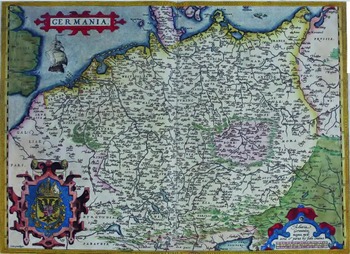
The documents edited in this volume were written during or shortly after missions from Elizabethan England and Jacobean Scotland to the Protestant princes of the Holy Roman Empire and Denmark. Through the particular perspectives of their authors, these accounts provide helpful if general descriptions while offering minute but critical details of two countries hitherto relatively unfamiliar to most sixteenth-century Englishmen and Scots.Footnote 1 Much of the intelligence and many of the observations contained in these materials also remain obscure to modern scholarship. This edition is intended to highlight the importance of such information not only to the formation and execution of government policy but also to the intellectual formation and professional trajectory of the authors themselves. Because these documents are relevant to a number of distinct yet related fields of current scholarship, the following introduction offers an overview of English and Scottish diplomacy with Germany and Denmark before addressing the specific missions and authors, trends in diplomatic history, and the nature and purpose of travel writing during the late sixteenth and early seventeenth centuries. The introduction closes with a discussion of the documents as sources of intelligence, their significance, their locations, the editorial conventions, and the critical apparatus.
Elizabethan and Jacobean Diplomacy with Germany and Denmark
The extraordinarily complex nature of politics and religion in the Holy Roman Empire during the second half of the sixteenth century made for often difficult and sometimes impossible diplomatic relations. The variety of perspectives and motives among the territorial princes at any given time, in addition to the shifts from one generation to the next, meant that achieving consensus and unity of purpose was more often an ideal than a reality. Political differences among the Protestant electors, dukes, landgraves, and so on often centred on the degree to which they were involved in affairs outside their own territories; and in this respect the relative proximity to conflicts in France and the Netherlands were a primary criterion. Religious disagreements among these same princes, despite their common Protestantism, dated back to the lack of unity among Lutherans during the 1540s and 1550s; and from the 1560s forward these disputes took a more fractious and severe turn, such that, although strict Lutherans in Saxony would have little to do with French Huguenots or the Dutch Reformed, more Reformed-minded princes in the Palatinate and Hesse were more inclined to lend support to the Protestant cause elsewhere. The labyrinthine, shifting nature of politics and religion in the Empire, therefore, caused considerable problems for any attempts (English, Scottish, or otherwise) to secure the co-operation of – or a confederation with – the princes, who were also prohibited by the imperial constitution from creating alliances with powers external to the Empire itself. Put lightly, establishing and fostering productive diplomatic relations with the Protestant princes of Germany (and to a lesser extent Denmark) was an uphill battle, but these challenges did not mean such a relationship was not worth the undertaking.
English relations with Germany during the reign of Elizabeth built upon foundations laid decades before when her father, Henry VIII, entertained ideas of allying with the Lutherans of the Schmalkaldic League.Footnote 2 Although the Elizabethan regime and Lutheran princes were Protestant, and at times vigorously opposed to Catholicism and its political manifestations, Anglo-German diplomacy was most often characterized by general consensus on principles but hesitation on formal, written agreements. Seeing eye to eye and collaborating casually during the wars of religion was one thing; signing names to a treaty and announcing it to the world was another. Nor were religious issues the only matters of contention, for commercial disagreements between the English Merchant Adventurers and German Hanseatic League arose time and again, particularly during the 1590s. Indeed, in some respects commercial disputes were just as significant and consistent a theme as religious collaboration among powers in England, Germany, and Denmark.Footnote 3
Henry Killigrew's embassy of 1569 was but one link in a chain of diplomatic exchanges between Elizabeth and the Protestant princes of Germany. In fact, the queen had sent Killigrew once previously; during the winter of 1558–1559, his charge was ‘to win the minds of the German princes, out of their affection to the purer religion’, and to negotiate ‘touchinge a league to be made betwene her Majestie and them’.Footnote 4 During the ten years between Killigrew's missions, embassies and a string of correspondence continued to build bridges, as did regular letters of intelligence from the queen's resident agent in Germany, Christopher Mundt, and the general and sincere agreement to oppose the Council of Trent. After the lack of concrete agreement in 1569, Anglo-German diplomatic relations became increasingly complex due to the hardening of Lutheran orthodoxy among many (though not all) of the Protestant princes. As some in Saxony, Brandenburg, and Württemberg became more theologically and politically exclusive, others in the Rhenish Palatinate and Hesse continued a moderate and collaborative perspective open to dialogue with Protestants outside a theologically narrow furrow.Footnote 5 The culmination of theological disputes and political wrangling among the German princes culminated in the Formula of Concord (1577) and Book of Concord (1580), but the English did not cease in their efforts to ally and work with Protestants in the Empire on behalf of Protestants in France and the Netherlands. Although the authors of the Formula of Concord had intended primarily to be unitive (while condemning outsiders), others saw it as discordant. Daniel Rogers relayed in 1578 that some in Germany were talking not of the Formula Concordiae or Corpus Doctrinae, but of the Porcus Doctrinae, so it made sense from the English perspective to continue diplomatic links and dialogue with those willing to listen.Footnote 6
During the 1580s and early 1590s, Elizabethan foreign policy as directed towards Germany adapted to the new and ever-changing situation; and the queen, her councillors, and her ambassadors learned the best avenues to pursue. Embassies in both directions between England and Protestant Germany continued, as did friendly correspondence and useful intelligence. Some Germans helped the cause in France and the Netherlands directly by way of cash, supplies, and their own forces, while others preferred indirect involvement by prohibiting Catholic powers’ levying troops and securing loans in Germany. A full confederation and formal league was usually the goal (from Killigrew's first mission to the 1590s); this alliance, however, was not an end in and of itself but rather a means to support other Protestants in France and the Netherlands. If parties could not agree on the particulars of a written agreement, then less co-ordinated means of support would (and did) serve the same purpose.Footnote 7 In many respects the Cologne War, 1583–1589 (the longest time span suggested, though various historians date the end of the war differently), brought Europe's wars of religion home to the Empire; and after the death in 1586 of the champion of the Formula and Book of Concord, August, Elector of Saxony, a renewed sense of purpose came to a greater number of Protestant princes than had been so inclined previously. The result of these developments during the 1580s was a meeting and agreement in January and February 1591 at Torgau, just north-west of Dresden, where English hopes dating back to Killigrew's first mission equalled German resolve among a new set of confederates alongside long-time stalwarts. Due to various logistical and financial problems, however, what the English ambassador, Horatio Palavicino, dubbed ‘the finest army Europe had seen for fifty years’ turned out to be little more than a distraction for the Catholic League in France.Footnote 8 The young elector of Saxony, Christian, died during the campaign and his death was compounded shortly afterwards by the expiry of Queen Elizabeth's two key allies dating back to the 1560s – Wilhelm, Landgrave of Hesse, and Johann Casimir, Count Palatine and Administrator of the Palatinate. Although the war raged in France for several more years, the sour experience of 1591–1592, along with a more settled situation for the Dutch Republic, meant that Anglo-German diplomacy for the cause of religion fell into abeyance. Regarding the first document edited below, ‘the state of Germany’, the importance of German allies to English efforts elsewhere on the European mainland after 1569 ensured that intelligence like that contained in the account was integrated into the formulation and implementation of Elizabeth's foreign policy. Anglo-Danish relations similarly warmed during the 1580s, but the lasting significance of ‘the state of Germany’ cannot be applied to the second document below, the ‘discourse’ on Denmark, after 1588.
Denmark was one of the first countries to send an ambassador to Queen Elizabeth after her accession on 17 November 1558. The envoy, Johannes Spithovius, had formerly been tutor of Greek and Latin to Princess Elizabeth, but he was now Professor at the University of Copenhagen. He came to convey congratulations from Queen Dorothea of Denmark and to assess the likelihood of an alliance between the two countries. In London in 1559 on two separate missions, Spithovius renewed friendships with William Cecil and others while sending back intelligence to Denmark and hinting at (then proposing) the marriage suit of the young King Frederik II. Nothing concrete came of the proposal and these two embassies, though they are to some extent suggestive of later Anglo-Danish relations.Footnote 9
After the auspicious beginnings in Elizabeth's reunions with her tutor, diplomacy with Denmark for the next two decades was most often concerned with commercial disputes, fishing rights, maritime piracy, and the Sound dues payable to the Danish king.Footnote 10 The last of these issues was the most troublesome, particularly after 1567, when King Frederik finalized the lastetold, which resulted in English and Dutch cloth merchants’ being taxed at a significantly higher rate. The 1560s and most of the 1570s represented a hiatus in warm relations and diplomacy from religious causes, but from 1577 onwards Anglo-Danish connections found renewed vigour in Frederik II's inclination to stand with Elizabeth in opposition to the Formula of Concord.Footnote 11 Just as Elizabeth's Church of England was broadly and inclusively Protestant, Frederik's Church was moderately Lutheran; and just as Elizabeth looked to quell discord among Protestants, so too did Frederik. Accordingly, the king viewed Gnesio-Lutheran theological innovations (such as the Ubiquity of Christ, a doctrine espoused by Luther and later developed by Johann Brenz) and confessional condemnations (against other Protestant denominations) as destructive to the unity of the Holy Roman Empire, of which he was a prince due to his territories in Holstein. During the 1580s Anglo-Danish diplomacy continued to be troubled with financial and maritime disputes, but the bond of religious solidarity grew into an increasingly personal warmth between the two countries.
Frederik II was invested with the Order of the Garter in 1582 by Peregrine Bertie, Lord Willoughby. Bertie again visited the king and negotiated particulars of military collaboration with some success in the winter of 1585–1586. The embassy of Thomas Bodley earlier in 1585 was also suggestive of the increasingly friendly ties between England and Denmark. Bodley's mission, like Bertie's second, was to secure military aid to the king of Navarre by warning Frederik of the dangers to the Protestant International and urging him to forge a more specific agreement.Footnote 12 As Bodley's letters back to England detailed, his experience in Denmark was a good one and representative of the culture of the king's court. He had been feted with banquets, cannon shot, and lots of alcohol; for as Lockhart notes, ‘as was customary at the Danish court, alcohol – provided in literally staggering quantities – served as both equaliser and social lubricant’.Footnote 13 In addition to Bodley's ‘drunk talk’ with Frederik, current and useful information on the king and his councillors was conveyed in Bodley's reports. Although Anglo-Danish spirits were at an all-time high, and despite an increasing number of embassies between the two countries since 1577, the amount of information on Denmark possessed by English authorities was significantly less than what they had on Germany. This deficit was a major reason Daniel Rogers wrote his ‘discourse’ in September 1588, but circumstances outside English control – Frederik II's death and the Danish regency's retreat from foreign affairs – meant that his account simply was not as useful during the 1590s as ‘the state of Germany’ had been during the 1570s. Indeed, if ‘the state of Germany’ was the harbinger of Anglo-German diplomacy to come, then the ‘discourse’ on Denmark signalled the conclusion of Anglo-Danish relations during the reign of Elizabeth.Footnote 14 Looking to the north, however, James VI of Scotland was only getting started.
Scotland's international relations during the 1580s and 1590s have not attracted the same attention as England's, but as Cynthia Fry has correctly noted, ‘whilst a comprehensive survey of James's foreign policies is lacking, the waters are not altogether uncharted’.Footnote 15 Due to James's eventual accession as king of England, his relationship with Queen Elizabeth has long attracted interest, as have his relations with Denmark, especially in the context of his marriage with Anne of Denmark late in 1589.Footnote 16 Scottish military involvement and diplomatic contacts with the Dutch Republic have also been of interest to scholars in both the nineteenth and twenty-first centuries, though links with Germany have been comparatively little studied outside trade or special case studies.Footnote 17 The third document included below, the journal written by John Skene in 1590, relates to many of these issues due to the nature of his mission.
James's long entertainment of the idea of a marriage with Anne of Denmark needs little rehearsing here, but worth bearing in mind are his discussions with Danish and German powers while he was in Denmark, as well as the fact that marriage to Anne meant that James was brother-in-law not only to her brother, Christian IV, but also Heinrich Julius, Duke of Brunswick-Wolfenbüttel, who married Anne's older sister, Elizabeth, early in 1590.Footnote 18 From 1586 forward, James's dealings with foreign powers cautiously attempted to situate the young king as an up-and-coming advocate for the Protestant cause, a supporter who would and then did marry into one of the wealthiest and strongest royal families in Protestant Europe, corresponded with the Dutch and Henri of Navarre (including letters about a match with Catherine de Bourbon, Henri's sister, in 1587), and eventually would accede to the English throne upon Elizabeth's death.Footnote 19
Before Skene's mission, much of James's energy was directed towards Denmark, but James viewed King Frederik's mediation efforts during the 1580s, when the Dane tried to bring peace to the Anglo-Spanish war, as a model of sorts for his own involvement in 1590. Indeed, just as Frederik had wanted (with decidedly Protestant sympathies) to bring peace to the conflict between England and Spain, so too did James.Footnote 20
The mission by Skene and Colonel William Stewart was explicitly intended to bring peace to the Netherlands and France; if a coalition of Scots, Danes, and Germans could not broker an end to conflict, though, a Protestant alliance was then to serve Henri IV and Elizabeth of England. Implicit though hardly less important was James's desire to secure Danish and German support for his eventual accession. Skene's collaboration with the English was therefore intended to show the queen that James was on her side from the very beginning of the mission, and the daily account of the embassy illustrates this very point. Later during the 1590s, two key episodes demonstrate James's continued fostering of relations with Denmark and Germany while displaying his Protestant credentials. First, in 1594, the baptism of his firstborn son, Henry Frederick, drew representatives from Denmark, Germany, and England to Edinburgh and Stirling to enjoy the celebrations. Second, in 1598, James sent ambassadors to Denmark and Germany in an effort to (re-)secure their support for his right to the English throne and against any claim from Spain.Footnote 21
Relations and diplomatic contacts between Elizabethan England, Jacobean Scotland, Oldenburg Denmark, and the various princes of the Holy Roman Empire were necessarily intertwined with the Protestant cause elsewhere in Europe. The documents included in this volume help to demonstrate these internal and external complexities, and they show how the experiences and perspectives of individuals could be rendered useful to the state. The value of these accounts to future foreign policy studies conducted in a rather traditional mould will be clear, but those engaged with more recent scholarly trajectories will also find useful the details of diplomacy and personal contacts.
Missions and Authors
The first account was written between June and November 1569, when the author was unofficially attached to Henry Killigrew's embassy to the Protestant princes of Germany. Killigrew's mission to forge a Protestant league among the German princes and Queen Elizabeth is well known, so there is little need to go into detail here.Footnote 22 To rehearse the outlines, though, Elizabeth sent Killigrew to the Palatinate early in 1569 in response to initiatives taken in Germany the previous year, when the Elector Palatine's representative, Johannes Junius, had been sent to England and sought funding from the English for sending an army into France; this army was to be led by Johann Casimir, the second son of Elector Friedrich III. Killigrew, along with Christopher Mundt, spent much of the year negotiating with German princes and their representatives in the Palatinate and Saxony. Although the longed-for military confederation with written articles did not come to fruition, some positive results emerged, and the Elizabethan regime continued to learn a good deal about the contours and fractures among the German Lutherans and Reformed.
The base of English intelligence on Germany prior to 1569 was not inconsiderable: Killigrew had previously served in Germany for the Marian and Elizabethan governments, so the territory was not new to him, while Mundt (a native of Cologne with a Koblenz accent) had been the English agent in Germany since the 1530s; additionally, although Roger Ascham's knowledge of the Empire was dated (and Ascham died in 1568), a precedent had been established in his letters of intelligence.Footnote 23 Similar to a previous mission in 1562 from Elizabeth to the Germans (when union in opposition to the Council of Trent and support of the Huguenots were the primary motives), Killigrew's and Mundt's charges in 1569 were to negotiate with the Protestant princes regarding an anti-Catholic league and learn as much as possible about the inclinations and administrations of the princes, while assessing how much cash they were willing to contribute. According to Killigrew's instructions, after meeting Elector Friedrich III, Killigrew was to ‘remember in this parte the continuall good reportes that our servante and agent Doctor Mounte ordinarelie maketh vnto vs of the ouertures of the said Palsgrave and of the like good offers which Casimire his sonne hath made vnto vs at his last being in fraunce’. After laying out the call for ‘a common league’ with the Protestant princes to support the cause of religion in France and the Netherlands, the instructions directed Killigrew to inform the elector that Elizabeth was ‘well content to consente to haue a good league and confederation’ including the elector of Saxony; landgrave of Hesse; dukes of Württemberg, Zweibrücken, and Brunswick; the Free Cities of the maritime coasts; and the kings of Denmark and Sweden. Additionally, Killigrew was to see what assurances Elizabeth would have from the elector regarding her loan (of 200,000 or 300,000 crowns).Footnote 24 The desired league with the German princes did not ultimately come about because of theological and political disagreements among the princes, and due to the fact – ever in the background – that the regional princes of the Empire were officially forbidden from concluding treaties with foreign powers. In sum, however, the mission of 1569 represented the most significant Anglo-German effort to build the alliance during the first decade of Elizabeth's reign. Similarly, the first treatise below, ‘the state of Germany’, moved beyond previous reports of news and intelligence; just as Killigrew's embassy was the most systematic and thorough to date, so too was the treatise written during it. ‘The state of Germany’ also differed because it was written by neither Killigrew nor Mundt, nor any other English ambassador of the 1560s. The authorship of this account, unlike the later two in this volume, has not been previously established and needs discussion here.
Although the author did not leave his name, it was almost certainly Robert Beale. The vast majority of scholarship on Beale has focused on his various roles as ‘parliamentarian’, ‘puritan’, ‘citizen’, and ‘librarian’ during the 1570s and later.Footnote 25 Beale's international movements and activities prior to becoming one of Francis Walsingham's secretaries in Paris in 1570, however, were crucial to that appointment, and as has been pointed out, ‘It is the beginning of wisdom to understand that Beale was anything but a little Englander.’Footnote 26 Beale's educational pursuits during the 1550s included a period in Strasbourg learning at the feet of men like John Hales and John Aylmer, as well as Peter Martyr and Johannes Sturm. At the University of Wittenberg, where he matriculated in 1560, Beale met among others, Hubert Languet, one of the best-connected scholar-administrators of his age internationally, and who would become Beale's ‘intellectual and spiritual mentor’.Footnote 27 These pursuits were complemented by his unofficial training in Paris during the 1560s. Although he had returned to England at some point in the early 1560s at the behest of Hales, Lord John Grey, or the earl of Hertford, he was soon back in France as a casual informant unofficially attached to the English embassy.Footnote 28
In Paris Beale frequented the house of André Wechel (the publisher later responsible for an anthology of Spanish writings in Beale's libraryFootnote 29 ), and Beale started taking cues from the serving English ambassador, Sir Thomas Smith, whose ‘the state of the realme of ffrance’ Beale received from Smith himself in 1566.Footnote 30 During the next couple of years, when religious conflict in France and the Netherlands forged evermore vitriolic anti-Catholicism and drives for pan-Protestant alliance, Beale wrote to Elizabeth's Principal Secretary, William Cecil, and sometimes travelled into Germany and sent newsletters back to Hales in England, where Hales shared them with Cecil.Footnote 31 One report from January 1568 is worth considering here because it provides context for ‘the state of Germany’.Footnote 32 After assessing the situation in France, these ‘advertisements from Germany’ detailed the potential roles that the German Protestant princes could play in the struggle. Beale noted the considerable military capabilities of August, Elector of Saxony, and the position of Friedrich III, Elector Palatine, as the ‘arbiter of the hole cause’ in France.Footnote 33 Additionally, he relayed that Christoph, Duke of Württemberg, regularly informed other princes of his correspondence with the duke of Alba, particularly when any threat to Protestants was likely. Beale then commented on the activities and persuasions of various other Lutheran princes in Saxony, the Rhineland, Zweibrücken, Holstein, and Brunswick; throughout, his focus remained the likelihood of their assisting Protestants in France during the second War of Religion – despite the princes’ own political rivalries and the fact that, in Beale's words, ‘the princes agre not very well about religion, as Wurteburg [and] Bipont with the Paltsgrave’. Overall, and considering the possibility of a long-drawn-out battle across Europe, Beale felt that, ‘As the papists have theiyr ligue, so were yt not amiss that the princes protestants for theyr defence had the like.’
It seems almost certain that Beale knew something of the Palatine proposals in England in December 1568, for he was in Heidelberg in February 1569. When Killigrew arrived on 31 March, it is likely that Beale was staying with his friend, Girolamo Zanchi, and although he was not officially part of Killigrew's mission (just as he was not formally attached to the English embassy in Paris), it is clear that he was deeply interested.Footnote 34 In Heidelberg at the beginning of Killigrew's mission, Beale was also with the Elector Palatine at the end of it. In fact, Killigrew had left weeks before Beale carried Elector Friedrich's letter to Elizabeth dated 28 September 1569 at Neuschloß, just north of Heidelberg.Footnote 35 By the middle of October, Beale was back in England, but like Smith's ‘the state of the realme of ffraunce’, and building upon his own ‘advertisements from Germany’, ‘the state of Germany’ was written both during the summer and after Beale's return to England.Footnote 36
The case for Beale's authorship of ‘the state of Germany’ can be summed as follows. Beale was in Germany and in exactly the same places as Killigrew at several points, and he had training in (and a history of) writing pieces of intelligence for English policymakers back home. In addition, the religious persuasions evident in the treatise cohere with Beale's religious formation in exile during the reign of Mary, and they are consistent with his later convictions in favour of a pan-Protestant alliance.Footnote 37 Furthermore, internal evidence on mining connects Beale explicitly, as he wrote a discourse on mining in Saxony for Sir Thomas Smith in 1573.Footnote 38 The extant manuscript versions of ‘the state of Germany’ can also be indirectly linked to Beale, for a later copy survives among Beale's papers in the British Library, while another imitating Beale's hand survives among the papers of George Talbot, 6th Earl of Shrewsbury, in Lambeth Palace Library; it is important to note, however, that these later copies were probably added to these collections after Beale's and Talbot's deaths.Footnote 39 Finally, no other candidate is as probable as Beale. The author was not Killigrew, as he is named explicitly as someone with whom the author visited a mine; nor was it Mundt, who was not in all the locations named in the account, and who would have certainly mentioned this treatise in his correspondence with Cecil.Footnote 40 Although we hesitate to confirm with 100 per cent confidence that Beale was the author, the current editor is all but certain.
The second account edited in this volume was written in September 1588 by Daniel Rogers after returning from his embassy to Denmark. Rogers's charge that summer had been to deliver Queen Elizabeth's condolences for the death of King Frederik II, to negotiate matters of commerce and piracy with the regency government (Christian IV then yet a minor), and – by Elizabeth's private command – to assess the likelihood of military aid from Germany; an added issue during the summer of 1588 was, of course, the Spanish Armada.Footnote 41 As with several of the previous missions Elizabeth had sent to Denmark, the embassy of 1588 was to stress the amity between England and Denmark and their informal league, as well as how Denmark could play a role in getting the more cautious (and theologically divisive) Lutheran princes of Germany to shrug off the prohibitions of the Empire against such alliances. During the course of Rogers's negotiations that summer, he discussed these issues with a wide range of Danish councillors and other ambassadors from the German princes and elsewhere, and in doing so he was echoing many of the same arguments he had made the previous winter when he met with King Frederik at Haderslev.
Rogers, having been the most recent English envoy to Denmark, was the most logical choice of ambassador in summer 1588. He also, however, possessed a literary talent that previous Elizabethan ambassadors to Denmark simply could not claim, notwithstanding Peregrine Bertie's scientific interests and Thomas Bodley's later bibliophilia.Footnote 42 Rogers's earlier international experience and education are important here. Like Beale, Rogers had spent time in Wittenberg before entering public service; indeed, Rogers's links were more intimate because he had been born there and studied under his father's friend, Philip Melanchthon – in addition to Languet and Sturm.Footnote 43 Also, owing to the family connections of his mother, Adriana van der Weyden of Antwerp, Rogers was related to Abraham Ortelius, whose map of Denmark (included in the Theatrum Orbis Terrarum) Rogers apparently did not think much of in his ‘discourse’.Footnote 44 Also, like Beale (and Killigrew), Rogers had served in Walsingham's household in Paris during the early 1570s and cultivated a wide circle of friends and correspondents sharing his generally Reformed but broadly pan-Protestant proclivities, not the least of whom was the poet-courtier, Philip Sidney. Further continuing the parallel with Beale, Rogers had served as one of Queen Elizabeth's ambassadors to Germany in 1577 and again in 1580. In both instances he had been sent for the purpose of solidifying an Anglo-German Protestant alliance, though in the latter mission he was arrested by soldiers in Spanish pay and held captive by Captain Martin Schenk's men for four years.Footnote 45 In 1587 Rogers joined Beale as one of the clerks of the privy council.Footnote 46 In 1588 Rogers was aware that, until his own ‘discourse touching ye present estate and gouuernement of the kingdomes of Denmarke and Norwegen’, the English government had little systematic information on Scandinavia. During his time in Denmark that summer, he sent intelligence and lists of councillors to Walsingham and Burghley, but the ‘discourse’ was his final attempt at a summary of these lands. It is clear that he took this relation very seriously, as the sole surviving manuscript includes minute emendations as well as marginal annotations, and the final signature in his own hand.
The third account in this volume was written during the summer and autumn of 1590 by John Skene during his mission from Scotland to Germany and Denmark (and the Dutch Republic). Skene, along with Colonel William Stewart, was sent by King James VI to negotiate with the Protestant princes on how to bring peace to the conflicts in the Netherlands and France, and central to the mission was the construction of an alliance against Philip II of Spain. The Scottish ambassadors were to open discussions with Christian IV of Denmark and the regency government, then to proceed to Brunswick to meet with several German princes celebrating the marriage of Duke Heinrich Julius to Anne of Denmark's older sister (and thus James's sister-in-law), and then to continue to other princes’ courts. The instructions for the embassy relayed the traditional threats posed by Catholics – going back to the Council of Trent – as well as the notion that King Philip was the principal menace. If possible, Skene and Stewart were to arrange mediation among Protestant and Catholic forces in the Netherlands and France, but the instructions were clear in the anti-Catholic tone employed; clearly this mission would not be as even-handed or moderate as James's later, more ‘pacific’ inclinations. It may be obvious that this embassy was a manifestation of King James's stepping onto the international stage – and an opportunity to gain support for his eventual accession to the English throne – though it is also important to note that this embassy from Scotland was in collaboration with Elizabeth and Burghley. Indeed, the queen had full authority to alter the instructions and advise Skene and Stewart as she saw fit. Overall, and emphasizing the militant Protestantism and anti-Catholicism of the mission, James informed his ambassadors that they should ‘lett your chiefe travell be that a league, at least defensive, if forder maie not be obteyned, be firmelie promitted’.Footnote 47 Skene and Stewart were to travel significantly farther than almost any previous ambassador from England (or Scotland) to Germany or Denmark – save perhaps Beale when he visited several courts in 1577.Footnote 48 Unlike the previous two documents edited below, Skene's is not a synthetic discussion or overview of German or Danish politics and religion. Rather, it is a day-by-day journal (or report) of his travel from Edinburgh to London, to the Danish regents and council, to an array of territories in Germany, to the Dutch Republic, back to London, and finally home to Edinburgh. Along the way Skene and Stewart negotiated with the princes and their representatives at their courts, where the Scots were sometimes entertained with large banquets and given lavish gifts; but as with earlier English attempts to confer and ally with the Protestants of Germany and Denmark, the Scottish mission did not bear the full fruit longed for. The insights and experiences noted in Skene's journal, however, offer the perspective of still another ambassador who had significant international experience prior to his public service.
Skene's education and travel before his mission of 1590 were similar in many ways to Beale's and Rogers's.Footnote 49 After beginning his studies at Aberdeen during the 1550s, he moved on to earn his MA at St Andrews, where he became the Regent of St Mary's College. Starting in 1567, he travelled widely on the European mainland, visiting Norway, Denmark, Poland, and Switzerland, and studying law briefly at the University of Paris. Like Beale and Rogers, he settled for a time at the University of Wittenberg, where he matriculated in 1570.Footnote 50 In 1574 Skene returned to Scotland, and it seems likely that he left Wittenberg because August, Elector of Saxony, was purging his territories of Melanchthonian and crypto-Calvinist theologians and councillors like Hubert Languet, and giving more power to the hard-line or strict Lutherans.Footnote 51 This development was significant and representative of how many English and Scots would come to view more obstreperous Lutherans: as Henry Killigrew wrote from Scotland, ‘by one that came from Wittenberg [possibly Skene himself] yt is brought that thelector of Saxon hath baunished out of his court & councell [. . .] his chief ministers for Calvenisme by the curches perswasion, & much discord [has arisen] in those partes about the sacramentaries as they terme them’.Footnote 52 Before he left Saxony, Skene had become fluent in German and befriended several princes and the learned men at their courts.Footnote 53
Before selecting Skene for the mission in 1590, King James called on him in 1589 to negotiate with the Danes regarding the royal marriage contract. James had been assured of Skene's qualifications as well as linguistic and legal knowledge by Sir James Melville (another Scot with extensive knowledge of Germany), who stated that Skene ‘was best acquanted with the conditions of the Germanes, and culd mak them lang harrangues in Latin, and was a gud trew stout man, lyk a Dutche man’.Footnote 54 James clearly thought highly enough of Melville's recommendation, as Skene's signature is on the contract dated at Kronborg.Footnote 55 After Skene's first high-pressure mission to the Danes for marital causes, James's choice of Skene for matters martial was easy.
The ‘New Diplomatic History’
A good deal of scholarly attention has been paid to the ‘new diplomatic history’, a phrase popularized in 2008 by John Watkins.Footnote 56 Put another way in 2008, ‘the revitalization of diplomatic history’ has focused less on high politics, watershed events, significant treaties, and wars than did more traditional diplomatic history as represented by Garrett Mattingly and M.S. Anderson.Footnote 57 As one of the practitioners of the new approach put it in 2014,
The new diplomatic history is grounded in the investigation of foreign relations and diplomatic practice via the insights of social, intellectual, and cultural history, as well as the engagement with social scientific and literary theory. [. . .] [And it] views diplomacy as a culturally inflected activity carried out by multifaceted individuals whose own biographies, priorities, and personal relationships shape their understandings of the world and how its various parts should fit together, affecting in turn their diplomatic activities in fundamental ways.Footnote 58
Incorporating aspects of social and cultural history in studies of diplomacy and international relations is not quite as ‘new’ as some may claim, but recent efforts have more explicitly highlighted issues only implied in the ‘old’ diplomatic history, one of the most important being inter- and transnational views and developments.Footnote 59
A key distinction between the ‘old’ and ‘new’ approaches is that the latter emphasizes broader cultural developments and affiliations among intellectuals across national boundaries rather than more narrowly conceived priorities or structures of the state. Put another way, instead of focusing on nationalistic attitudes and the results of diplomatic activity, most studies are now interested in the international character and processes of diplomacy. It is no longer so much a question of how a particular treaty favoured one country or another, for example, but rather which personalities were involved in reaching the agreement, through what mechanisms negotiations were carried out, and what the treaty suggests about ideologies and identities of the period. Such studies are sometimes interested in the international networks and budding ‘cosmopolitanism’ of particular princes, ambassadors, or courts; but they have also shown that the early modern period was characterized by both national interests (sometimes for concrete political purposes) and international allegiances (often for religious and ideological purposes).Footnote 60
Additional aspects stressed by scholars in the late twentieth and early twenty-first centuries include art and material culture, the role of women, diplomatic ceremonial and performance, literary adaptations and translations, and gift exchange.Footnote 61 Also, in contrast to more conventional foreign policy studies and international relations studies focusing on Europe's great powers, interests have now migrated to smaller or second-tier territories, as well as non-Western states. Osborne's study of Savoy and that by Riches on the electorate of Brandenburg and Sweden are exemplary, as are Daniela Frigo's edition of essays on Italian city-states and the volume edited by Gábor Kármán and Lovro Kunčević on Europe and the Ottoman Empire.Footnote 62 The attention paid to these territories is mirrored by some scholars’ concentration on second-tier personalities such as the ambassadors themselves, other members of their embassies, and travellers as cultural mediators. By focusing on the mental and material worlds of the envoys, their correspondents, and other hangers-on, a fuller and sharper picture of early modern European diplomacy is emerging.
The documents edited below help to illustrate some of these points. ‘The state of Germany’ was written by a lower-than-second-tier member of Killigrew's entourage, and it was the result of the author's own interest and initiative. It includes insights into court ceremony and administration in the Palatinate and Saxony, illuminating the role of these two territories in wider European affairs in 1569. The ‘discourse’ on Denmark was penned by the ambassador himself, and it incorporated an impressive amount of research conducted while negotiating with the Danes. Furthermore, it demonstrates the importance of not only geographical but also historical and broader cultural knowledge (or ‘chorographical’ descriptions) to English foreign policy during the 1580s. Finally, the journal of 1590 was kept by the ambassador himself, but it too was intended to serve as a formal report for his superiors in Edinburgh. It describes instances of international networking, privately motivated travel and education, court protocol and gift giving, and the importance of covert Anglo-Scottish collaboration. Insights into the evolving nature of European diplomacy, however, represent only part of these documents’ significance. Because of the prior experiences and motivations of all three of the authors, these accounts also fit into the wider genre of early modern travel.
Travel, Travel Writing, and the Beginnings of a Tradition
The ‘Grand Tour’ of young aristocrats and other well-to-do wanderers of the seventeenth and eighteenth centuries has long attracted scholarly attention, as have the printed publications that sometimes arose from such peregrinations.Footnote 63 Rather early in the genre was Fynes Moryson's massive Itinerary of travels throughout much of mainland Europe (and elsewhere), published early in the seventeenth century and in some ways representing a harbinger of things to come.Footnote 64 In England as elsewhere, the affluent and fashionable often would take an early modern ‘gap year’ (or significantly more) to leave their native land and sample the fruits, witness the customs, and see the sights of foreign countries. Similarly suggestive of English and wider European currents were the publications by Richard Hakluyt, especially his collection of others’ materials, The Principall Navigations, which catalogued the exploration and travels by Englishmen for the ‘1500 yeeres’ preceding its publication in 1589.Footnote 65 Hakluyt's magnum opus looked forwards and inspired countless young travellers of the seventeenth century, but as a compilation of existing sources it also represented the apogee of Elizabethan travel and travel literature.Footnote 66
The resurgence of scholarly attention paid to early modern travel is analogous to the focus on international networks and interdisciplinarity in the ‘new diplomatic history’.Footnote 67 These works, addressing issues such as identity and rhetoric, often aim to dive more deeply into the sources to uncover more than simply the itineraries travelled and personalities met. Sources consulted by scholars often include the printed publications of the period, and in this regard Germany was not entirely terra incognita to the English during the 1590s and later. William Phiston's book on Germany, published in 1595, was a compilation of two other works in Italian and Latin, but its general, didactic information on the history and administration of the Holy Roman Empire was of the sort that previous English ambassadors sometimes noted in their correspondence.Footnote 68 A more genuine English source originally composed for purposes of intelligence, the account of Germany by Roger Ascham was written as a series of letters during the early 1550s, published about 1570, and took the form of a political history evaluating the key princes and their courts.Footnote 69 Throughout the sixteenth century, Englishmen and Scots had been drawn to Germany because of the University of Wittenberg (and here Beale, Rogers, and Skene were not exceptional), but increasingly during the reign of Elizabeth these men travelled equally for non-academic reasons.Footnote 70
In addition to those who wished to learn at the original citadel of Protestantism, Wittenberg, others were involved in musical or theatrical groups, while still others were simply curious about the Empire and the lands to the north and east. English musicians and actors, some with noble support, were well known in Germany during the later decades of Elizabeth's reign, and their presence in northern cities and Denmark has long provided fodder for speculation about Shakespeare's sources for Hamlet.Footnote 71 Philip Sidney, it has been claimed, performed ‘what might be considered the first fully-formed Grand Tour by an Englishman, and one which included, in its wide geographical range, excursions to Vienna, Prague, and Cracow’.Footnote 72 Like Moryson's fame, Sidney's travels and career as poet-courtier are well known, but slightly less so are the activities and writings of men like Stephen Powle, Henry Wotton, John Peyton, William Smith, Edwin Sandys, and Edmund Tilney.Footnote 73
During the second half of the sixteenth century, it became clear to many that a position in the ranks of government could be earned by privately motivated foreign service. The authors of the accounts edited below were not exceptional in this regard.Footnote 74 From a small sample of others, a distinct pattern emerges: By travelling overseas, learning other languages and about other cultures, and by writing newsletters, wide-ranging accounts, and histories that were then sent back to their friends or patrons in England, these men sought to prove their abilities and loyalties to the powerbrokers in the government who could supply them with jobs after their travels; after their return home, their expertise and personal networks on the mainland would provide the government – it was hoped – with intelligence otherwise unavailable.Footnote 75 Stephen Powle wrote to Burghley while touring Switzerland, the Rhineland, and Paris between 1579 and 1582, and upon his return to England he entered Burghley's employ. Henry Wotton spent the early 1590s in Vienna, Geneva, and Italy, where he built an impressive network of contacts and intelligencers, and for his expertise and ability to digest considerable information into comprehensive surveys he was eventually employed by Robert Devereux, Earl of Essex.Footnote 76 John Peyton (b.1579, d.1635) also went on the Elizabethan Grand Tour, ‘a peculiar mixture of visiting European countries for culture, education and intelligence’, and travelled widely in central Europe during the late 1590s before writing his multiple accounts of Germany, Bohemia, and Poland; like Powle and Wotton, Peyton found patronage in the government, this time under Robert Cecil.Footnote 77 William Smith, who had lived in Nuremberg during the early 1580s, held deep interests in topography and chorography, so when during the 1590s he sought a position in the College of Arms, he wrote a description of Nuremberg including discussions of the customs and ceremonies of the city; he was wise to dedicate one copy to Sir George Carey, who helped to secure Smith as Rouge Dragon Pursuivant.Footnote 78
Two further examples help to make the point that writing detailed accounts of foreign lands could secure government employment. Sir Edwin Sandys (b.1561, d.1629) was the son of the Archbishop of York and served as a minor MP during the early and mid 1590s, but his public service picked up considerably after his journey to France, Geneva, and Italy between 1596 and 1599. Upon his return, Sandys wrote an account of the state of religion in Europe (rather than a particular country) and dedicated it to John Whitgift, Archbishop of Canterbury, in 1599. Sandys's moderation in religious matters was evident throughout the account, but his thoughts on divides between Gnesio-Lutherans (or Lutherani rigidi) and Philippists (or molles Lutherani) made it clear that his sympathies lay with the latter.Footnote 79 Finally, Edmund Tilney's case is atypical due to his lack of extensive travel (if any at all) outside England and his failure to secure a desired position after writing his own ‘topographical descriptions’ of several countries.Footnote 80 Nevertheless, his encyclopaedic account was intended to serve as a diplomatic manual or reference book of sorts for English foreign policy during the late 1590s and upon James I's accession, when Tilney presented a second, finished copy to the king.Footnote 81 That the account was never disseminated or published should not detract from its suggestive position alongside the accounts by Peyton and Sandys representing the maturity of a tradition of writing on foreign states.
Tilney's access to a range of materials on foreign countries highlights the international character of the book trade in London and beyond, and manuals for budding travellers are no exception. By the early seventeenth century, enough instruction had been published in England for people from a range of backgrounds to make trips abroad with sufficient knowledge and, failing that, confidence. Indeed, an early modern cast of travelling characters could include editors, pilgrims, errant knights, merchants, explorers, colonizers, captives or castaways, ambassadors, pirates, scientists, and more.Footnote 82 One example of a travel manual written in English was by Thomas Palmer, who sought in 1606 to help make his countryman's travels ‘more profitable and honourable’ not only to the traveller himself but also to his country, particularly if he were an ‘intelligencer’.Footnote 83 If one searches for earlier English manuals or models for the peregrine, the most significant would be translations from other languages from the 1570s forward; worth remembering here are Hakluyt's first two publications, both of which were drawn from foreign sources.Footnote 84 The first guidebook was Jerome Turler's The Trauelier of 1575, and it is suggestive that manuals for travel like this one (and the genre known as ars apodemica) originated in Germany.Footnote 85 Turler, a Saxon, had previously travelled around Germany, Italy, France, and England, and it seems likely that after the publication of his book in Strasbourg, he sent a copy of the Latin text to a contact in London. The second manual was Albrecht Meyer's Certaine briefe, and speciall Instructions for Gentlemen, published in 1589.Footnote 86 Meyer had been supported and commanded by the German-born Danish Statthalter in the Duchies, Heinrich Rantzau, to write the book in 1587, and given Daniel Rogers's close contacts with Rantzau the next year, Rogers (or someone in his retinue) probably brought the book back to London, where Philip Jones then translated it under Francis Drake's patronage. Indeed, from even a brief survey of the book, it almost looks as if Rogers had it close by when he wrote his ‘discourse’ on Denmark and Norway in September 1588.Footnote 87
As with publications on travel, so with roadmaps and cartography. The English trailed the Germans when it came to aids for the traveller. Richard Rowlands (alias Verstegan) translated and adapted a German travel guide that included routes between various cities, publishing it as The Post of the World in 1576.Footnote 88 The original ‘high Almaine’ text appears not to have been reissued, but another German travel guide with routes started at Dresden and covered ‘gantz Deudschlandt’ as well as other realms and lands. First published in 1577, this text was improved and reissued a dozen times by the end of the century, and it seems likely that English ambassadors to Germany would have had access to it from 1577 onwards.Footnote 89 Although printed maps were not used much by ambassadors or travellers, Daniel Rogers's comment in his ‘discourse’ on the dearth of accurate ‘geographicall Cardes’ of Denmark suggests an awareness of the information lacking in England.Footnote 90 Again German models led the way and – over time – were adopted in England and elsewhere.Footnote 91 To take one example most relevant to Rogers, the map of Denmark completed by Marcus Jordanus in 1585 had been commissioned by Heinrich Rantzau, the same nobleman behind Albrecht Meyer's book, and its inclusion in the fourth part of Braun and Hogenberg's Civitates Orbis Terrarum in 1588 would have served to vindicate Rogers's narrative descriptions of the isles of Denmark.Footnote 92
International travel is, at least, a two-way street. Travel by Englishmen and Scots in the Empire and Denmark was in some ways matched by Germans and Danes who made their way to England and Scotland. In addition to the usual ambassadors from the German princes and king of Denmark, occasionally princes themselves came to tour the country and, if possible, meet Queen Elizabeth. Johann Casimir, Count Palatine of the Rhine, came to London for his investiture into the Order of the Garter in 1579. Over the course of nearly a month in the capital, the count enjoyed great entertainment, the defraying of all his charges, and countless other courtesies from the queen, various nobles, and the City of London.Footnote 93 In 1584 and 1585 the Pomeranian noble, Lupold von Wedel, took a detour from his mainland European travels to visit England and Scotland.Footnote 94 In 1592 the soon-to-be duke of Württemberg, Friedrich, toured London, Windsor, Oxford, Cambridge, and elsewhere, and five years later he too was invested into the Order, though under very different circumstances.Footnote 95 About the turn of the century a series of travellers from greater Germania came to England and recorded their journeys. Paul Hentzner visited in 1598; Thomas Platter did so in 1599; the baron of Waldstein, a Bohemian nobleman, saw the sights in 1600; and in 1609 with Camden's Britannia in hand, Georg von Schwartzstät, Baron of Offenbach, covered much of the same ground as the others had.Footnote 96
English and Scottish travellers on the European mainland used the sources available to them, as well as personal contacts and networks, and often the latter involved visiting or collaborating with expatriates who had settled abroad. For some Elizabethans, their familiarity with German lands was aided by the experience of the Marian exiles, most though not all of whom rushed home to England shortly after Elizabeth's accession. (Beale, for example, appears not to have been in a rush.Footnote 97 ) For Germans of the period, the impact of emigration to England during the Interim was not as significant, but a German presence in Elizabethan England was another matter. In addition to the Hanseatic merchants who had long been in London and elsewhere, groups of miners and other technical experts from German lands settled in various pockets of England. Indeed, the English government actively sought such expertise, and from its very beginnings, the Company of Mines Royal relied heavily on skilled German labour (here Beale's involvement should be remembered).Footnote 98 The significance of British contacts in Germany and German ones in England, however, should not be overstated, for these were small numbers compared with a later period, and immigration from other countries, like France and the Netherlands, had a more direct impact on London and wider English society.Footnote 99
Overall, the travels and writings of the authors below should be considered alongside other peregrinations and accounts of the period. The documents edited here were produced by men with similar, cosmopolitan inclinations to those who travelled later in the sixteenth and seventeenth centuries. These accounts were produced in (and cannot be taken completely out of) their diplomatic contexts, but they also reflected certain motivations and perspectives common to others who wrote back only to family and friends, or kept private diaries strictly for their own purposes. The treatises by Beale (if indeed he was the author), Rogers, and Skene thus contribute to the history of travel just as they do to the study of international networks, but let us turn to the documents and their primary function as sources of government intelligence.
The Documents as Intelligence and their Significance
The principal context for these documents was international support among Protestants, and each one is a fine example of early modern information gathering. The Elizabethan accounts are of one particular genre, the Jacobean of a different kind. Elizabethans were hardly the first to write surveys of foreign lands while travelling for this purpose. William Thomas and Roger Ascham had written on Italy and Germany during the 1540s and 1550s, as others had done for still other lands.Footnote 100 During the Wars of Religion in France and the Netherlands, however, the pressing need for intelligence and the development of espionage reached new heights in England and across Europe. Ambassadors, agents, and spies were sent to international friends and foes alike, and networks of intelligence reported regularly on military movements, political proceedings, and religious rivalries. In England, the expansion of observation of foreign affairs was best represented by the network organized by Francis Walsingham, but intelligence gathering in the field was never an easy process no matter where an operative was working.Footnote 101
Another factor in how intelligence was gathered, synthesized, and delivered to the state was the Venetian model, the relazione, which was an explicit exercise of a state-appointed ambassador rather than a narrative or account written by a traveller or agent on his own initiative. Although the overlapping purposes of relazioni and some travel writings – especially those for purposes of secret intelligence – is plain, the origins of the documents themselves are distinct. As Mattingly argued decades ago, the beginnings of ‘modern diplomacy’ began in Italy. His emphasis was predominantly on the office of the resident ambassador, but the evolution and spread across Europe of the report or ‘relation’ of the ambassador was no less important, for ‘by way of emulation, diplomats of other powers were moved to try their hands at something like the Venetian model’.Footnote 102 Sir John Neale's assertion that George Carew's relation on France in 1609 was the first English imitation of the relazione tends to confirm that English foreign policy and intelligence gathering lagged significantly behind the trends and techniques of mainland Europe.Footnote 103 Finding a genuine Elizabethan example of an Englishman imitating the Venetian model would, therefore, be striking. The accounts of 1569 and 1588 reproduced below fit precisely this pattern.Footnote 104
The evolution of the Venetian relazione occurred between the late fifteenth and late sixteenth centuries, as did more general treatises on the office of the ambassador. The latter aimed to describe the functions, privileges, and duties of the official ambassador, as well as what could make one envoy better than another; his behaviour, education, and manners were of the utmost importance.Footnote 105 These general treatises on the diplomatic representative were often printed, were popular among statesmen across Europe, and represented to some extent the maturation of specialized diplomacy in early modern Europe, just as similar accounts by Robert Beale and Nicholas Faunt crystalized the office of Principal Secretary in England.Footnote 106 The works on the ambassador sometimes touched on diplomatic dispatches and final reports. The written report of the ambassador upon his return from duty abroad, the relazione as it was in Venice, was not simply a detailed retelling of what the envoy did and with whom he spoke while abroad, but a more synthetic survey of the country and prince to whom he was sent. As Ottaviano Maggi advised in his book published in Venice in 1566, of particular importance was the strength or power of the country relative to others; its jurisdiction, administration, and finances; marriages, rivalries, and other significant relationships; and the nature and customs of the prince, along with an assessment of how other princes viewed him.Footnote 107 The typology of this final relation, along with its humanistic influence, was described during the 1560s or 1570s, and can be summed up as follows:
First, the orator should discuss the site, giving the ancient and modern names of the place, its boundaries and subdivisions, its most important cities, famous ports, fortresses, episcopal sees, principal rivers, mountains and forests. He should then proceed to deal with the climate, temperature and rainfall, fertility of the land, its mineral resources, the animals found there, the distribution of population, mountains, plains, woods and swamps, and any other noteworthy effects of nature. The people should also be described at length, their customs and habits, their appearance and stature, their attitudes and religion, their organization and preparation for war by land and sea, their crafts, commerce, exports and imports, and the riches of the nobility and people. Finally, of course, he must not forget the prince, his ancestry, his person, his life and customs, whether he is loved by his subjects, his income and expenses, and the guard that he keeps, the grandeur of his court, and with what princes he has friendships and enmities.Footnote 108
This range of topics could be addressed in a flexible manner and in as much or little detail as the author wished, for each ambassador (Venetian or otherwise) exercised considerable freedom concerning the form and flow of his relazione. Most important, though, was the general, synthetic, and didactic nature of the information. This sort of intelligence was – if seemingly puerile today – crucial to the formulation and execution of foreign policy (again, in Venice or elsewhere).
Despite the fact that the Venetian government was one of the most secretive and protective of its records during the sixteenth and seventeenth centuries, documents leaked and found wide circulation. In one instance from 1616, the Venetian representative in England was shocked to find a large volume of relazioni in manuscript; more astonishing and suggestive was that the volume was in the Bodleian Library at Oxford where many would-be statesmen could consult it at leisure.Footnote 109 Long before 1616, however, a black market had existed for those interested in purchasing copies of such relations. Demand was so strong that many and various relazioni, along with other diplomatic materials, were compiled into printed volumes of tesori politici or ‘political treasures’, as happened in Cologne and elsewhere.Footnote 110 Because relations or reports following the Venetian model were recognized as the ‘state of the art’, their authors (who were sometimes ghostwriters for the ambassadors to whom they were attached) sometimes wrote them with an eye to advancement within government ranks, just like the ambassadors themselves. Such accounts would demonstrate the political scrutiny and acumen of their authors, as well as their loyalty to the home state and its foreign policy goals.
It will not be surprising to learn that Robert Beale had an especial appreciation of the didactic nature of Venetian relazioni. In his treatise on the office of councillor and principal secretary, written in 1592, Beale advised that any prospective councillor should have a sound understanding of the English government, its geography and cities, its noblemen, revenues, lands and customs, as well as various maps of the country. Regarding foreign lands and the sending and receiving of ambassadors, Beale recommended that a councillor or principal secretary know ‘how the State wherto [an English envoy] is directed is divided or affected in warr or otherwise. Ande heerin perhapps your Italian Relationi may stande you in some steede for the knowledge of forraine Estates’.Footnote 111 It is suggestive that Beale felt safe to assume that a prospective principal secretary (Edward Wotton in this case) would have his own relazioni to consult, though the assumption seems justified given Beale's own collection.Footnote 112
Like their Venetian counterparts, the authors of the accounts written in 1569 and 1588 (most probably Beale and most certainly Daniel Rogers), sought professional advancement and patronage in exchange for their treatises of intelligence and fidelity to the state. The accounts were based on the best sources available – written, published, or oral – and many of these authorities were only available in Germany or Denmark.Footnote 113 The most up-to-date cartographic information, regional news, and rumours regarding personalities at foreign courts were only available in situ, so recording and relaying that intelligence for the Elizabethan state was a key function these envoys arrogated to themselves. Of particular concern to the Elizabethan government were the financial abilities of (and potential contributions from) the Protestant princes of Germany and Denmark, so the inclusion of detailed information along these lines in the accounts of 1569 and 1588 is unsurprising. Because of the considerable amount of work put into these English digests, their authors probably assumed that their accounts would be graciously received and filed along with other state papers relative to Germany and Denmark, made available to counsellors and future ambassadors, and even circulated given sufficient interest. If the current assessment is correct that Beale wrote ‘the state of Germany’, then Beale's most immediate audience would have been John Hales and William Cecil, this given his previous newsletters on German affairs during the late 1560s. As for Rogers, in light of his letters to Walsingham and Cecil during the summer of 1588 (and closer association with the former for years previous) it seems most probable that his ‘discourse’ was written principally for Walsingham.Footnote 114 In the case of ‘the state of Germany’, it seems that the account was copied and circulated to some extent, but such appears not to have been the fate of Rogers's ‘discourse’ on Denmark. The two manuscript copies and one printed version of ‘the state of Germany’ vary to such a degree as to suggest a wide circulation, and because of the increasingly important role played by the Protestant princes of Germany in Elizabethan foreign policy, this dissemination may not be surprising. Additionally, Beale (if indeed he was the author) lived another thirty-two years after it was composed, and presumably he would have been reasonably eager to inform others of his expertise in German affairs. The one known copy of Rogers's ‘discourse’, however, reflects Denmark's fall even farther into the background on the international stage after the death of King Frederik II. Put simply, Denmark did not matter to English foreign policy after 1588 nearly as much as the Protestants of Germany did after 1569. Furthermore, Rogers died in 1591 and had been unable to advance further than clerk of the privy council.Footnote 115 The journal of John Skene was a different type of report not intended for a wider distribution than the highest of government officials, such as King James VI's Lord Chancellor, John Maitland (elevated to the peerage as the first Lord of Thirlestane on Anne's coronation day, 19 May 1590).
Unlike the two synthetic overviews of Germany and Denmark, Skene's journal falls into the genre of the diplomatic report known as a mémoire or procès-verbal. This form of report was particularly characteristic of diplomatic practice in France and the Low Countries, and several (such as Jean Malliet's) survive from the 1580s.Footnote 116 During Daniel Rogers's mission in 1588, his French secretary, Josias Mercier, kept a similar journal noting Rogers's negotiations on a daily basis, and this report has been used extensively in the edition of the ‘discourse’ on Denmark below.Footnote 117 The official nature of Skene's report is replicated in Mercier's, as both recite their departures (from Edinburgh and London) and various locations during the embassy, and they both include the specific names (and character evaluations) of key councillors and ambassadors. Because Skene was himself one of the two ambassadors, however, the substance of his and Colonel Stewart's discussions with German princes and personalities is covered in greater detail than in Mercier's account; indeed, Skene's journal is considerably longer than Mercier's. English examples of such reports were similar though not as formulaic in structure and purpose. The earliest relevant journal by an Englishman was Walsingham's kept between 1570 and 1583, but it lacks the specificity supplied in Skene's and the French examples.Footnote 118 The earl of Leicester kept a record of daily occurrences during his time in the Netherlands, a short sample of which ‘jornall’ exists for December 1585 to November 1586 among Beale's papers. Following Leicester's is Beale's own ‘jornall’ for his time in the Netherlands in 1587.Footnote 119 Simultaneous to Skene's mission were the isolated journal entries of Thomas Wilkes while in serving with Thomas Bodley in the Dutch Republic. Again, these entries are not as complete as the established model nor do they follow it, though Wilkes's entries are best understood to sit alongside various letters and papers of the period.Footnote 120 A final example would be Thomas Parry's ‘Memoires of occurents and advertisements’ written between 1603 and 1605 when he was resident ambassador in Paris.Footnote 121 These English journals written during embassies (and the letter-books to which they were intimately connected) were part of a wider set of developments in Elizabethan diplomacy, and as such they can be seen as complementary to the wide-ranging overviews edited below.Footnote 122 Skene's journal was different in that it was significantly more official and more refined than these English examples. Like Mercier's and Malliet's accounts, Skene's report was written with the specific intention that it would serve as the formal and signed relation of the embassy from his leaving Edinburgh on 9 June 1590 to his return that December.Footnote 123 In addition to the strict purpose of the report, the candid observations from the first-person perspective of the ambassador himself offer a glimpse into the dangers and difficulties, the pleasantries and positives of sixteenth-century diplomacy.
As examples of English imitation of relazioni, as a snapshot of the intimate but international world of a Scottish ambassador, these documents are significant both as markers of the authors’ professional trajectory in a rapidly changing diplomatic world, and for the information they contain. Scholars have not completely overlooked these documents, so none can claim to be a genuine ‘discovery’, but the relatively little use of them made thus far signals their wider import. E.I. Kouri noted that, in its description of Dresden, ‘the state of Germany’ included
the most detailed description of the Saxon Elector ever written in English. This document would, no doubt, support the idea of the persönliches Regiment des Fürsten. Augustus [. . .] is described as making all the most important decisions alone and consulting one or two of his closest councillors only when strictly necessary. [. . .] As for the conduct of foreign policy, the personal negotiations with him were, due to his poor knowledge of Latin, more difficult than at most other European courts.Footnote 124
Due to the similarly detailed descriptions of the Elector Palatine and his court, Kouri's appreciation for ‘the state of Germany’ could have extended further.
At the other end of the spectrum is Arthur Slavin's admiration for Rogers's ‘discourse’ on Denmark. Claiming discovery of the treatise, Slavin refers to the context of ‘metaphor of union’ that Rogers hoped to bring about, the ‘elaborate metonymical praise’ of King Frederik's religious policy, the overall ‘manner of presentation’, and Rogers's position as ‘an icon of reformation’.Footnote 125 Slavin was certainly not wrong to draw attention to the account, but his emphasis and speculations on Rogers's biography and motivations detract from the wider significance of the ‘discourse’ in the context of diplomatic history, and from the importance of Denmark as a northern European power during the 1580s.
Finally, Skene's journal of 1590 has attracted notice but limited use. Athol Murray noted its existence but does not appear to have consulted it much for his biography of Skene.Footnote 126 Judicious but restricted use of the journal was made by Paul Lockhart, who consulted it for Skene's negotiations with Heinrich Rantzau and Niels Kaas. Considering that Lockhart's discussion focuses on regency Denmark and its retreat from international causes, the limited use is understandable.Footnote 127 Cynthia Fry notes Skene's account in her study of James VI's foreign policy. Due to the broad geography addressed, however, only slight discussion is afforded apart from a list of the lands to which Skene had been directed.Footnote 128 Because the journal offers keen insight into the daily experiences and negotiations of one of Scotland's most experienced international travellers, and because the mission of 1590 to Denmark and Germany represented James's largest diplomatic foray into the Holy Roman Empire to that date, it is surprising that comparatively little significant use has been made of Skene's report.
Shelf Mark Details and Locations
‘The state of Germany’ and Appendix: ‘The tenn circles’
The British Library Catalogue of Additions to the Manuscripts: The Yelverton Manuscripts, Part 1: Descriptions (London, 1994), 173.Footnote 129
British Library [London], Additional MS 48062, fols 184r–227v: description of the political structure of Germany, including detailed accounts of the Palatinate (fols 188v–193*r) and Saxony (fols 193r*–202r), followed (fols 214r–227v) by tables showing the number and cost of soldiers each Circle of the Empire was required to contribute to the imperial army; July–Nov. 1569. Copy, 17th cent. The unidentified author may have been associated with Henry Killigrew's mission to the Palatinate in 1569 (on which see Miller, Sir Henry Killigrew, 101–122); see his reference to a visit to the Freiberg mines with Killigrew, 21 June 1569, f. 195.
Catherine Jamison, rev. E.G.W. Bill, A Calendar of the Shrewsbury and Talbot Papers in Lambeth Palace Library and the College of Arms, I: Shrewsbury MSS in Lambeth Palace Library (MSS 694–710), (London, 1966), 103.
Lambeth Palace Library [London], Shrewsbury MS 703: Folios 1r–22v. Description of the political and religious state of the Empire, written in English between 21 June and 3 October 1569 [but this copy is c.1600]. The author accompanied Henry Killigrew but could not be Christopher Mundt. The treatise is in the following sections,
-
An account of the spiritual and temporal Electorates and of the Free Cities in the Empire (fols 1r–3r).
-
A detailed account of the Palatinate (fols 3r–5r).
-
A similar account of Saxony (fols 5r–8r).
-
Note on the custom relating to the inheritance of land (fol. 8r).
-
Description of the Free Cities (fols 8v–11r).
-
The state of religion (fols 11v–13v).
-
The assessment of the ten Circles to provide horsemen and footmen for the defence of the Empire (fols 14r–22v).
-
Belonged to Nathaniel Johnston. [see Bernard, Catalogi Librorum Manuscriptorum, 1697, tom. ii, part i, 100].Footnote 130
English Short Title Catalogue (accessed via http://estc.bl.uk and compared with Early English Books Online at http://eebo.chadwyck.com)
Wing (2nd edn, 1994), C4503: Clarke, Samuel, 1599–1682, A briefe and yet exact and accurate description of the present state of the great & mighty empire of Germany, both touching the formes of their civil government, and profession in religion. Taken by a diligent and faithfull surveyor of it, with much paines travelled over that whole country to informe himself and others of these things. Now published by Sa. Clarke, somtime pastor in St. Bennet Fink, London, for the publick good. London, Printed by A.M. for William Miller at the Guilded Acorn in St. Pauls Church-yard, near the little north door, 1665. 4oFootnote 131
‘A discourse touching [. . .] Denmarke and Norwegen’
Huntington Library, San Marino, CA, USA, Ellesmere MS 1608: ‘A discourse touching ye present estate and gouuernement of the kingdomes of Denmarke and Norwegen, with a description of the said realmes, and Dominions appertayninge vnto them. written in September, Anno 1588’. 10.25 fols. [Secretary hand with Rogers's editorial interventions and signature at end.]Footnote 132
‘Ane account [. . .] by [. . .] John Skeen’
Catalogue of Manuscripts Acquired since 1925: Volume II (Edinburgh, 1938), p. 133.
National Library of Scotland [Edinburgh], MS.2912: EMBASSY TO THE PROTESTANT PRINCES. ‘Ane account of ane Embassie performed by William Steuart [Stewart], Commendator of Pittenweim, and Mr. John Skeen to England, Denmark, and the Princess [Princes] of Germanie in Anno 1590’, written by Skene (afterwards Lord Curriehill) (see f. 42v). The mission was to the Protestant princes, and its object was to bring about peace treaties between England and Spain and between France and Spain, or, failing that, an alliance of Denmark, Scotland, and the Germans which should assist the peaceful party against the obdurate. See Calendar of the State Papers relating to Scotland. . .1547–1603, 1898–1963, Vol. x, p. xvi. The journal covers the mission of Stewart and Skene to England, Denmark, and Germany, from 9 June to 20 September, and that of Skene alone to Holland and England, from 20 September to 26 November. Skene gives an account of their visits to different courts (England, Denmark, Mecklenburg, Hesse, Saxony, Brandenburg, etc.), reports fully their conversations with rulers and with the Dutch States General, and describes the persons whom they met, the entertainment which they received, and the towns, buildings, etc. which they visited. His conversations with the Dutch Government deal in part with the arrears of pay claimed from it by Stewart.
The manuscript is a copy of about the end of the seventeenth century, by the antiquary Robert Mylne. In several places a blank is left for a word.
From notes found loose in the manuscript (ff. iv–v), James Dennistoun appears to have contemplated publishing it.
v + 44 ff. Sm. octavo. Bought, 1938. Reid Fund.Footnote 133
Editorial Conventions and Apparatus
The editorial conventions employed in this volume do not in every respect follow the guidelines set out in R.F. Hunnisett, Editing Records for Publication (London, 1977). In general, additional punctuation and expansion of common abbreviations have sometimes been inserted to aid the reader, but capitals, elisions, and broken words have more often been retained. Similarly, the letters ‘u’, ‘v’, ‘i’, ‘j’, ‘c’, ‘t’ (and so forth) have been reproduced as found in the documents. The editor has preferred to preserve the flavour of the sixteenth century rather than force the documents to fit the tastes of 1977. Also, because the documents differ significantly in punctuation and orthography, an individual approach has seemed most appropriate. What follows are the particular conventions employed for each account.
‘The state of Germany’
A more complex set of conventions than is usually desired is necessary here because of the collation of three different texts. The ‘BL’ copy serves as the primary text because it is the most complete and is in a clean state. ‘LPL’, by contrast, is severely damaged at the beginning and end. ‘Wing’, from internal comparisons, appears to be printed from a later copy. Original spelling, punctuation, and capitalization have been retained throughout the transcription, though full stops, commas, and parentheses have occasionally been added. A strict, purist approach would place additional punctuation in square brackets, but for reasons stated below using more brackets would only distract the reader. While the BL copy overuses commas and lacks full stops, LPL contains comparatively little punctuation, and Wing falls somewhere in the middle. Additionally, abbreviations have for the most part been silently expanded; exceptions include &c. and vizt. An initial ‘ff’ in the manuscript has been maintained but signifies a capital, as in ‘F’, and the predominance of the capital C (as represented by a hot cross bun, as it were) has also been maintained. Superscript letters have been brought in line with the text, though superscripts following Roman numerals (e.g. vith) have been maintained to avoid confusion. Slight differences in spelling between BL, LPL, and Wing are not noted, but where a word omitted or altered in BL arises in the LPL or Wing texts, it is supplied in curly brackets for LPL (e.g. {who serve the ffrench king.}) and angle brackets for Wing (e.g. <by turns>). Significant differences of spelling are found in the notes. From such differences, it appears the BL copyist corrupted some words, especially German places and names, the LPL copyist lacked familiarity with Latin and Greek, and the Wing editor (Samuel Clarke) modernized language to suit conventions in 1665.
‘A discourse’
The sole, authentic version of this account makes for comparatively simple conventions. Contractions have for the most part been silently expanded (e.g. Matie is now Majestie and yt is now yat; but viz is still viz), and superscripts after Roman numerals have been retained (e.g. viijs for 8 shillings). Marginal notes in the manuscript are placed in the footnotes. Punctuation is largely left intact, though alterations have been noted in square brackets. Full stops before and after Arabic numerals (e.g. .13.) are not included. Words in italics, other than those in Latin, have not been maintained because the frequency of italicization in the manuscript would otherwise distract the reader.
‘Ane account’
The transcription of Skene's report has been complicated by the corrupt status of the sole existing copy, which was transcribed by Robert Mylne. As detailed below, his mistranscriptions and omissions have been corrected where possible, though his spelling has largely been retained. Based on his sometimes glaring errors and misspellings, it seems clear that Mylne could not read old Scots with consistent accuracy. A century after Skene's mission of 1590, Mylne simply did not always know what to do with conventional abbreviations and older words, but the present editor has gone to considerable lengths to clarify Mylne's confusion. An English comparison of the period would be Samuel Pepys's judgement of Elizabethan handwriting. When presented with naval documents and letters of the period, Pepys remarked ‘Lord, how poorly methinks they wrote in those days, and in what plain uncut paper’, and as C.S. Knighton has observed, ‘Pepys was initially put off by the horridness of sixteenth-century script’, though he eventually overcame his ‘aversion to secretary hand’.Footnote 134
Many though not all contractions have been silently expanded. Expanding ‘wch’ to ‘which’, ‘yt’ to ‘yat’, ‘yr’ to ‘yer’, ‘oyr’ to ‘oyer’, ‘prinll’ to ‘principall’, ‘Matie’ to ‘Majestie’, or even ‘Edr’ to ‘Edinburgh’ is straightforward enough. The ‘y’ in ‘oyr’, for example, should be read as ‘th’, thus ‘other’, as ‘ye’ is universally recognized as ‘the’. Mylne's substitutions of ‘g’ for ‘qu’ and early modern Scots spellings, however, have been retained to reflect the corrupt nature and origin of the account; Anglicizing ‘glk’ to ‘which’ and ‘gll’ to ‘quhill’ or ‘until’ seems inappropriate. The abbreviations ‘qrof’ and ‘grof’ have been expanded to ‘querof’ and ‘gerof’; in each case ‘whereof’ is to be understood. Much like the substitution of ‘g’ for ‘qu’ in some instances, the careful reader will notice that sometimes ‘after’ is employed while at others ‘aster’ is found, and while this latter variation is clear in the manuscript, the obvious reading is ‘after’. The sometimes stilted sentence structure of the account reflects the fact that this report was sometimes written in a type of shorthand rather than full and formal prose; this structure has not been altered. Accent marks included above ‘u’ have not been retained. Full stops have been retained after Arabic numbers noting the day of the month at the beginning of a sentence (e.g. 16. Weddensday), but dropped before and after numbers when they occur mid sentence (e.g. .6. wagons). Marginal notes in the manuscript are preserved in the footnotes, and punctuation has been left largely intact, save for elements in square brackets. Latin words and phrases are not italicized in the manuscript, but italics have been employed to aid the reader here. Finally, Mylne's copy of the account is imperfect due to blank spaces, obscured words written, and peculiar spellings (which in many instances are probably transcription errors by Mylne or a previous copyist). A literal representation has been preserved where transcription errors are suspected to have occurred, though in some places the editor has been successful in ascertaining the most likely ‘correct’ reading; these instances are noted in square brackets or in the footnotes.
For Scots words that may cause confusion for some modern readers, definitions and variants have been provided by A Dictionary of the Older Scottish Tongue, 12 vols (Oxford, 1931–2002); online at www.dsl.ac.uk. References to distance in miles are discussed by Skene himself below on p. 190, where he notes that ‘dutchie Myles’ each consist of at least four Scots miles, which were not yet standardized in 1590 but in general slightly longer than English miles. The distance of a German mile varied considerably from one region to the next (in some instances three times as long as the Scots mile, in others five times), so Skene's loose approximation of 4:1 was appropriate.
Appendix: ‘The tenn circles’
As for ‘the state of Germany’, the BL text serves as the primary. Minor variations are not noted, though more significant differences are found in the footnotes. The appendix is a fairly close translation of Hernach volgend die Zehen Krayß, wie vnd auff welliche art die inn das gantz Reych außgethaylt, vnd im 1532 jar Röm. Kay. Maye. hilff wider den Türcke[n] zu geschickt haben. Auch welliche Ständ in yeden Krayß gehörend nach altem herkommen (Augsburg, 1532) (VD16 Z 230). Comparing the English accounts (BL, LPL, Wing) with several examples of the printed German text of 1532 (VD16), however, it appears that the former differ occasionally in figures of horse and foot, the former are updated with personalities of 1569 (e.g. ‘Augustus’ is mentioned as the head of Saxonia Superior), and the text is simply more complete (the German publication does not include Saxonia Inferior). Indeed, in a copy of the printed text at the Bayerische Staatsbibliothek, Signatur Res/4 Eur. 333.45, a sixteenth-century reader wrote in the margin of sig. Cir, where figures for Niedersachsen should be included, ‘Multa de Saxonia inferiore omissa sunt’. Accordingly, it seems likely that the translator/author (i.e. Beale – if in fact he was the author of the treatise of 1569) was working from a better text than that which survives from 1532.
Apparatus Criticus
The apparatus criticus for these documents is extensive. Apart from a small handful of modern historians of England and Scotland, few scholars will be familiar with many of the personalities, events, and details mentioned in these accounts. Indeed, in many respects, scholarship on English and Scottish relations with Protestant Germany and Denmark has a long way to go. Basic or particularly relevant biographical information is included in the notes, though the reader is also directed to biographical dictionaries (e.g. ODNB, NDB, ADB, DBL) for further material; in the interest of brevity, these citations are kept simple. Although the notes are sometimes limited and point to standard reference works, at other times the notes are significantly more comprehensive. A rather thorough apparatus has seemed appropriate because of the nature of the documents themselves. The accounts of 1569 and 1588 were intended to serve as synthetic but exhaustive relations on the current state of Germany and Denmark, and the report of 1590 was written by a man with a similar sense of detail. Only a correspondingly extensive editorial attempt would do justice to the authors’ intentions. The present editor can only hope to have served the authors well.
Dates in these documents follow the Old Style, Julian, calendar, but the year is taken here to begin on 1 January unless specified otherwise. England, Denmark, and Protestant territories in the Holy Roman Empire and the Netherlands held fast to the Julian calendar, as observed by John Skene in his account (see pp. 192, 204).
Map of Germania in Abraham Ortelius, Theatrum Orbis Terrarum (Antwerp, 1570), following fo. 13. Reproduced by permission and with the courtesy of the Norman B. Leventhal Map Center at the Boston Public Library, Boston, MA.