

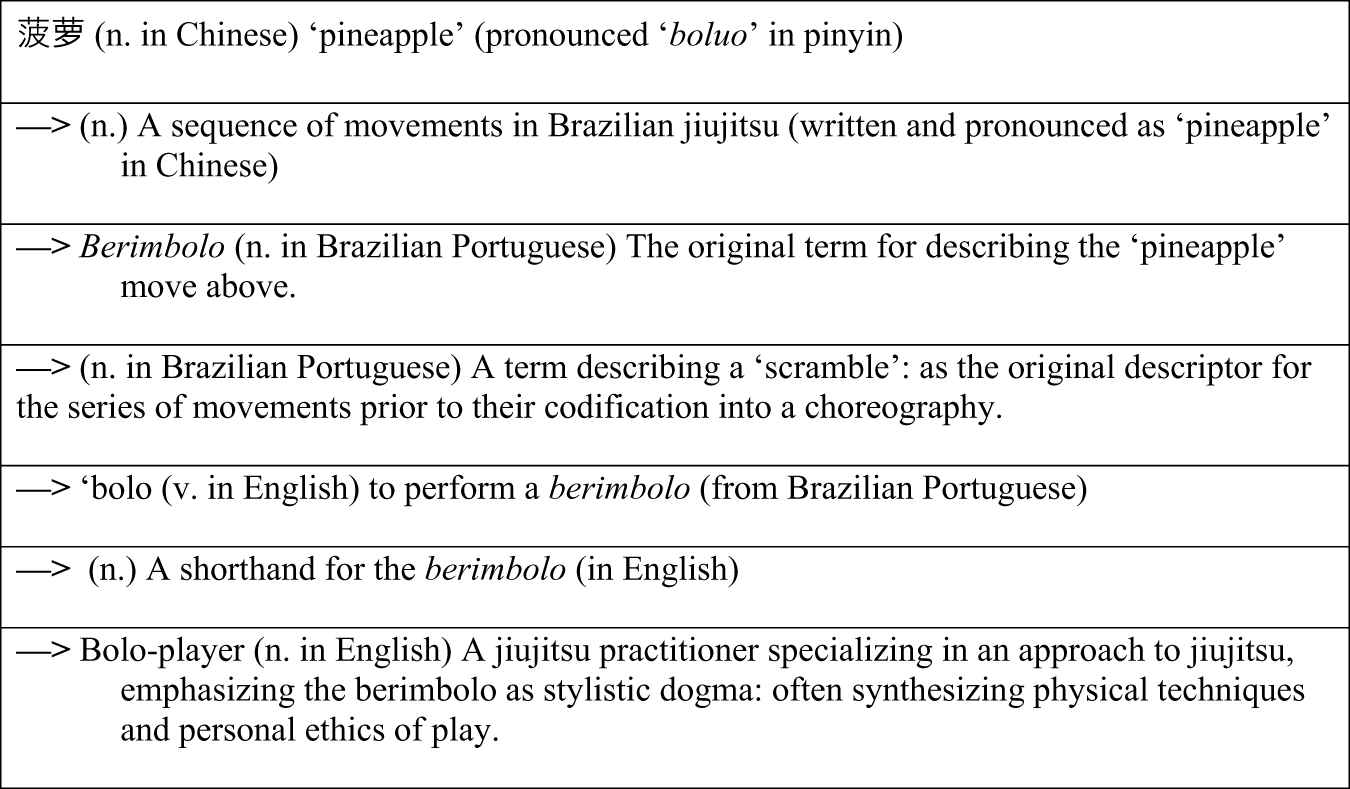
菠萝: (n.) pineapple (pronounced “Bōluó” in Chinese)
(n.) A sequence of movements in Brazilian jiujitsu (written and pronounced as “pineapple” in Chinese)
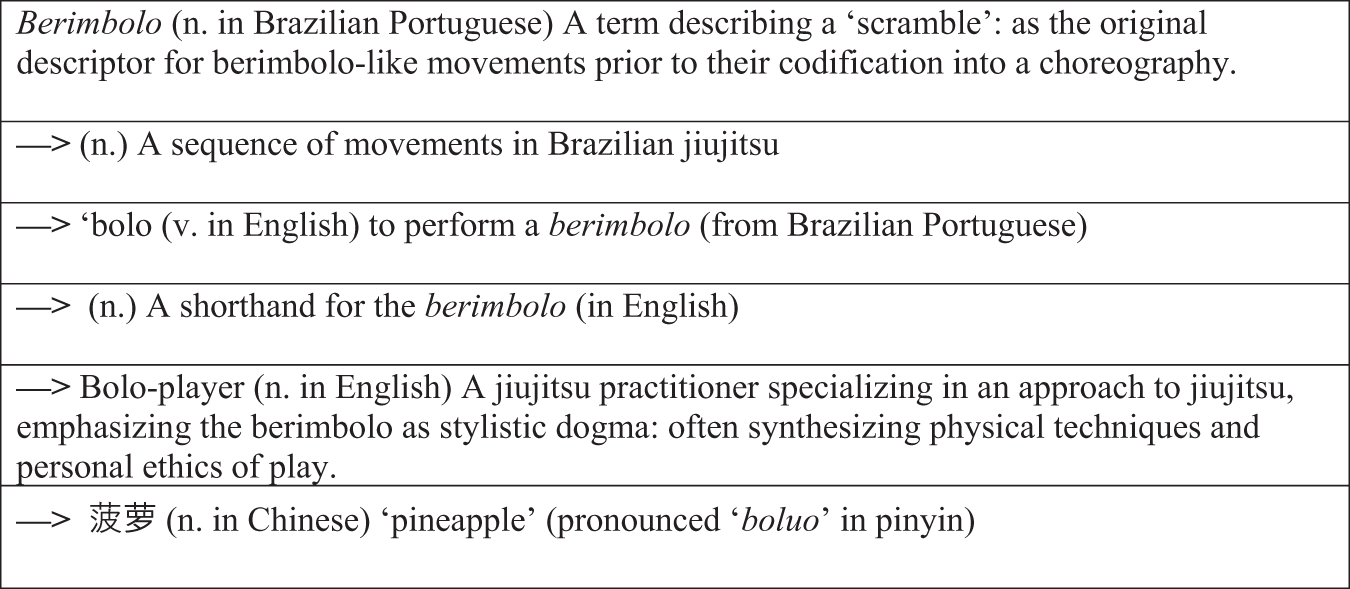
Berimbolo: (n. in Brazilian Portuguese) A slang term within Brazilian jiujitsu communities around Rio De Janeiro and Sao Paolo describing a “scramble”: as the original descriptor for a relatively undefined set of movements prior to their codification into a choreography.
‘bolo’: (v. in English) to perform a berimbolo (from Brazilian Portuguese)
(n.) A shorthand for the berimbolo (in English)
(adj.) Pertaining to a style of play or aesthetic in Brazilian jiujitsu.
Bolo-player: (n. in English) A jiujitsu practitioner specializing in an approach to
jiujitsu, emphasizing the berimbolo as stylistic dogma: often synthesizing
physical techniques and personal ethics of play.
One spring morning in 2025, I received a text in my WeChat feed from a person named “Shark.” There are a number of men with apex predator nicknames in the jiujitsu community worldwide, with Shark being likely one of the more common epithets. I had asked, in a jiujitsu community group chat, about whether there was a way to attend a training session in any of the local gyms that afternoon, since—at the time—I had to prepare for an upcoming competition. Shark, whom I had not met yet, explained that he knew of a secret “open mat” with a group of serious players if I was interested. In any other situation, I would have been exceedingly cautious in interactions with strange men named after apex predators with profile pictures of people strangling one another. Having come to terms with some fairly odd social dynamics within this community, I considered the possibility of an ethnographic adventure and expressed my interest. Shark sent me a general location link and instructed me to take an elevator to the fourth floor once I got there, again not only should I have been considering the possibility of encountering an organ harvesting syndicate, a casting audition for an underground adult film also seemed entirely plausible (the fourth floor is often cheaper to rent on account of the number four’s homophonic relationship with the character for death: sì 四 [4] four versus sǐ 死 [death]). Again, I made myself somewhat vulnerable to unforeseen outcomes, hedging that, as long as I kept my wits about me and reported my location to my nearest of kin, the worst that might happen would be a slightly awkward encounter. To be sure, as an adult male subject participating in a male-dominated sport in urban China, I could (perhaps delusionally) assume a degree of safety in this scenario that would require access as a female ethnographer to be considerably more meticulously managed and prepared.
I arrived a few hours later at the secret location on the fourth floor of the address that Shark had sent me. Most of the office areas were still under construction, which seemed to have been halted five years before. There was a great deal of concrete and metal debris lying around, with torn plastic sheeting covering rubble and adorning a few entrances to empty offices—all adding tension of the kind one expected from a late twentieth-century American slasher movie. The exception was Shark’s gym as the sole occupied space that did not have a patina of abandoned construction dust. Shark, whose appearance I recognized as the perpetrator of the strangulation on his profile picture, and his friend Bing were there warming up while we were waiting for a few more people to (hopefully) show up. Shark, by way of sizing me up (as the only non-Chinese who would be participating in the session), suggested we have a friendly warm-up round. I knew about his skills via others in the community as a regular competitor in top tournaments across Asia. Though I outweighed him by about 10 kg, he was 70 kg of lean muscle mass, a 27-year-old full-time competitor, and covered in a wide array of tattoos from neck to calf. Thus, on appearance alone, there was an intimidation factor along with the knowledge that he was known to be skilled at leg attacks, focusing on leg-crippling submissions like “heel hooks,” “toe holds,” and “knee bars.”
Within seconds of bumping fists for the start of our round, Shark sat to the ground and hooked his left leg around the outside of my right knee, then somehow off-balancedFootnote 1 me and performed a kind of elaborate forward roll with our legs entangled, lifting my hips toward my head while pinning my shoulder to the ground. All of this led to him seemingly teleporting himself behind my back and locking in a strangulation hold. As stars began to appear before my eyes—the result of blood being interrupted to my brain—the controlled vulnerability I had assumed from the outset of this adventure had now transformed into an unanticipated violability in which I now faced the very real possibility of dying at the hands of Shark in this abandoned office building, should he feel the need to not let go. I tapped, indicating my submission, hoping this gesture would activate the fragile ethical imperatives of our art. Shark immediately released, with Bing smiling and commenting offhandedly: “he really likes pineapples.”
What on earth did Shark’s enjoyment of pineapples; my near strangulation out of a mostly unintelligible scramble; and a social context that necessitates my acceptance of vulnerability in tandem with Shark’s cultivated awareness of violability, all have in common with one another? As I came to learn, these—at first disjunctive—moments would intelligibly diagram an entire trans-national cosmology of personhood and competitive ethics: around a connected set of movements that had transformed from their characterization as a “scramble”—in their original Brazilian inception—to being codified into a sophisticated choreography associated with particular identities, persons, teams, and nationalities. What emerges in this interaction with Shark seems at first like a chain of non-sequitur-like “events”—that is, discursively boundable, reflexively transmissible, and retrospectively referable chronotopes of interaction. What I will demonstrate, however, is not only a means by which interactional non sequiturs can be connected through modes of ethnographic attention that operate at multiple scales of physical and intimate intensity. I also hope to demonstrate a more generally semiotic insight around enregisterment as a kinesic process that operates in a contrapuntal relationship with an array of sensory and discursive motion texts.
My use of motion text in what follows builds partially on a mid-20th century literary critique and semiological tradition that, in retrospect, is understood to have been kicked off by philosopher Jacques Derrida. For Derrida (Reference Derrida1976), “text” profoundly reaches beyond a graphological ideology in that “text” is not fixed, not stable, and fundamentally unbound from any singular or linear discursive medium.Footnote 2 Deconstruction, the method by which Derrida arrives at this understanding of text—through a method not unlike Buddhist scholar Nagarjuna’s Tetralemma (Westerhoff Reference Westerhoff2009) or Ludwig Wittgenstein’s (Reference Wittgenstein1998) exploration of unstable sense and reference in Western analytical philosophical reasoning—identifies continuously unfolding chains of reference, rather than intrinsic meanings, as the foundational process holding meanings and meaning-making together. Contemporaneously with Derrida, anthropologist Michael Silverstein (Reference Silverstein, Basso and Selby1976) elaborated an empirical method built around an attentiveness to metapragmatic and metasemantic aspects of human communication, with a reflexive anthropological focus on semiotic and linguistic systems within cultures and societies. Working from Russian formalist (Bakhtin Reference Bakhtin and Holquist1981; Jakobson Reference Jakobson1971) and American pragmatist (Peirce Reference Peirce, Hartshorne and Weiss1932) observations that converged on the kinds of textual and semiological systems that Derrida and Lévi-strauss (Reference Lévi-strauss1969) were respectively attempting to develop, Silverstein pursued an empirical understanding of the kinds of “textual” phenomena that these kinds of scholars were exploring in metaphysical and phenomenological domains.Footnote 3
Building on Silverstein’s location of “textual concerns” in the empirical realm, I seek to identify a sensorial, kinesic, and motile dimension to interpreting textual phenomena in enregistered, interpersonal interactions. Here, the making, identification, and enregisterment of personae out of coordinated, “embodied” activities permits an insight into mobility, motility, and motion as semiotic processes that resist simplistically dualistic spatiotemporal characterizations of diachronic and synchronic sign phenomena.
Contrapuntal non sequiturs
There is a poignant moment in Keith Basso’s classic, Wisdom Sits in Places (1996), where he meditates on his incapacity to discern a vernacular setting in which text and actions, while intelligible to him in their emergent and immediate surface representations, ultimately become non sequiturs unless one understands them within a longer chronotopic durée of their entextualization.
My bewilderment stems not from a failure to understand the linguistic meanings of the utterances comprising the interchange; indeed, their overt semantic content is simple and straightforward. What is perplexing is that the utterances arrive as total non sequiturs, as statements I cannot relate to anything that has previously been said or done. Verbal acts without apparent purpose or interactional design, they seem totally unconnected to the social context in which they are occurring, and whatever messages they are intended to convey elude me entirely. (Basso Reference Basso1996, 113)
Here, Basso is confronted with figures and forms that he is unable to order in spite of his years of Apache language study and decades of lived experience in this community’s cultural and linguistic calibrations of their material environment. Through inquiry and an elaborate exercise in historical sleuthing (of the kind that most contemporary ethnographers have little patience, time, or inclination for), Basso is eventually able to unravel the complex historical and cultural ecology that lends vernacular specificity to the otherwise intelligible but intractable sentences spoken by his Apache interlocutors. Through considerably less sleuthing, the sentence “He really likes pineapples” as well as why pineapples are funny became clear only when I came to discern the transnational context and co-texts out of which the sentence emerged. As in Basso’s case, “He really likes pineapples” does not stand alone as a non sequitur but rather emerges contrapuntally within an array of variously sensed and embodied “texts” (cf. Silverstein Reference Silverstein, Summerson Carr, Gal and Nakassis2023): like the dangerous intensity of my imminent strangulation; including the historical and ethnographic movement processes that led to this event—all with various segments of independently incomplete interpretability.
A few days following my bout with Shark, I encountered him at an open mat: This is a more informal setting in which jiujitsu practitioners—often from different gyms—can come together and either do sparring rounds or work on specific skills with training partners seeking to do the same. One could think of this as a tutorial group or study meeting outside of formal technique or competition classes. Shark was training with another practitioner, and they were doing a competitive round. In a flurry of legs and hips, Shark was on his opponent’s back, strangling him nearly unconscious. Another onlooker shouted: “Wa, bolo!” (trans. “Wow, pineapple!”). Seeking to unravel a correlation, I went to speak with Shark about his love of pineapples at the end of the round. He laughed at my confusion and pulled out his phone, opened his VPN, and accessed YouTube in order to show me a video titled, “Berimbolo Doesn’t Work.Footnote 4” Australian grappler Levi Jones-Leary was being interviewed about something called a berimbolo. “I’m out here doing berimbolos all day,” he notes. The interviewer asks: “So, it works?” “Yeah,” Jones-Leary responds wryly, “I think it semi-works.” A sequence of images, unfolding to the groove of German rapper Peter Fox’s (Reference Fox2008) Alles Neu followed. They were videos of jiujitsu competitors performing movements similar to Shark’s: not mutually identical, but I was beginning to discern a patternistic sense of their commonality.
So many questions needed to be answered. How could I learn this berimbolo? Why did Jones-Leary need to motivate that the berimbolo worked? What was compelling about the berimbolo as a “style” of play as well as an emblem of personal attributes? It mattered to both Shark and Levi-Jones Leary that the latter was a bolo player. I began my tutelage and research on the subject in earnest. The berimbolo or berimbolar, I came to learn, was derived from a narrow vernacular slang in urban Brazilian Portuguese-speaking jiujitsu communities. It initially meant (loosely) “to scramble”—a messy, seemingly indiscernible flurry of movements leading to the addressor of the berimbolo “taking the back” of their opponent addressee. I further came to learn that particular genealogies of teachers and students subsequently formalized the berimbolo as a systematic approach to jiujitsu.
The respective Mendes brothers (from Art of Jiujitsu or AOJ) and Miyao twins (from Unity Jiujitsu)—all fighting out of Brazil—are credited with demonstrating competitive success with the berimbolo at the highest levels of the sport. The story behind Jones-Leary’s insistence on the efficacy of this technique is a tale of competitive intrigue involving at least one of these genealogies. As the Miyao brothers were blowing out jiujitsu competitions and cementing the hegemony of Brazilian competitors, an American competitor named Keenan Cornelius was—perhaps not so—quietly formulating an approach to jiujitsu that was meant to negate the dominance of Brazilian champions in the sport. His approach emphasized control and a deliberate shutting down of the agile, creative approaches that characterized—or stylistically enregistered (Agha Reference Agha2007, 185)—Brazilian play. He and the Miyao twins entered into a rivalry that was substantially escalated through Cornelius’s virally circulated coining of two phrases that made him a controversial figure among the then Brazilian gatekeepers of formal competitions. The first, “American jiujitsu,” was Cornelius’ characterization of a divergence from an almost sacred kinship of the sport as the product of one Brazilian family—the Gracies; the second, a direct provocation of the Miyao twins and their New York-based academy, Unity: “The Berimbolo Doesn’t Work.” Levi Jones-Leary, though a more recent addition to Unity, as well as an Australian grappler, was also a product of the Miyao brothers’ lineage, school, teachers, as well as a high-profile exponent of the berimbolo approach developed within this genealogy. In this light, the YouTube video Shark had shown me not only featured Jones-Leary as a vindicator of the Miyao legacy but also featured several students of the Mendes brothers (AOJ) all having new success with the same bolo approach.
Through this indexical juxtaposition of texts—including Peter Fox’s liberatory statement Was Sie nicht gefällt, mach neu! (Gr. If it doesn’t please you, make it new!)—the video diagrams how the berimbolo can be understood as being politicized in a contestation between families, schools, and nation states (Brazil versus US). More than merely representing style contrasts in American versus Brazilian jiujitsu, the divergence in an approach to jiujitsu diagrams figures of personhood that scale up into “national” and “cultural” stereotypes of identity: agile, crafty, and stylistically creative Brazilians versus American players deliberately sabotaging the former’s flair with a control-based, often brutal, approach characterized by a targeted shutting down of their opponents’ attributes. To be sure, nationhood is not the only vector of identity being enregistered through jiujitsu competitors’ encounters.
Gay guards and manly passes
As my research continued in jiujitsu communities in the US, China, and elsewhere, I came to understand the berimbolo’s style contrast with “top-heavy” or “passing” styles to additionally entail gendered and sexualized dimensions. These dimensions become foregrounded in the context of a highly intimate sport where techniques of the body explicitly encounter a friction with sensoria and forms of physicality that are experienced as outstripping apprehension: In the ways language can be experienced as gendered or sexualized only when language itself becomes segmentable. By analogy, a recognition or meta-awareness of the “segmentability” of jiujitsu—what Edward Sapir (Reference Sapir1921) might express as its form-feeling—includes a communicative medium and its “parts” that become imbricated in the very process of identity-formation within the jitsuverse.
In this context, the berimbolo—through the labor of players associated with particular teams and countries—becomes stereotyped as emblematic of an approach to jiujitsu that falls within the broader characterization of “guard” play. In a jiujitsu encounter, there is in every instance a division of labor between two distinct participant roles: guarding and passing. The former can be understood as occupying “bottom” position, while the latter can be understood as playing “top.” To be sure, the affordances of engendering and sexualization of these approaches are embraced along predictable lines. The sentence, “I don’t pull guard, because I’m a heterosexual male,” quickly engenders a divided response within the transnational jiujitsu community. Here, “pulling guard” is the action of going to ground in the context of a jiujitsu match, without having been “taken down.” In competitive settings, it refers to an unforced choice to sit to ground at the moment of making haptic contact with an opponent—taken as signifying the opposite of dominating and imposing one’s will on one’s adversary. One could characterize the language of critique around guard play—particularly in the jitsuverse’s Anglosphere—as diagramming a predictably generic “alpha male” ethics. As an insider sentiment among some practitioners—that “pulling guard” symbolizes a questionable masculine ethics—it certainly finds its counter in an irreverent and playfully antagonistic queering of this position by an equally popular demographic of trickster-like competitors like Craig Jones:
We have an epidemic of Alpha Males in this sport. A lot of people think our sport is gay, because it looks gay, and obviously I contribute to making it gay. But literally, there’s nothing gayer in the sport, than the thousands, potentially hundreds of thousands, of middle-aged men posting pictures of lions, sharks, and other apex predators with quotes from fucking 21st century movies on there that is literally the gayest thing we have to battle every day in this sport … Some of these quotes are so gay … [like] “A king only bows to his queen.” That’s serious … these guys are posting this serious. They have the old favorite: “The ground is my ocean. I’m the shark. And most people don’t even know how to swim”… Guys you’re a 30-year-old IT worker with three kids. You’re not a member of the Gracie family.Footnote 5
(Jones 2023Footnote 6)
Jones, who popularized a rainbow-colored jiujitsu rashguard (upper body garment worn by jiujitsu players) with the words “Keep Jiujitsu Gay,” frequently identifies as bisexual and openly mocks expressions of toxic and fragile masculinity among leading figures in the sport. He has also campaigned for equitable pay in women’s jiujitsu and has vocally condemned predatory practices as well as sexual abuse in jiujitsu gym culture. In the context above, Jones is pragmatically deploying “gay”—in a polyvalent manner—to criticize alpha males, who he frequently caricatures as homophobic, for their homoerotic infatuation with kitsch masculinist aesthetics; as well as reflexively indexing an external perception of the sport of jiujitsu as “looking very gay” on account of its apparent physical intimacy.
Here, Jones is a figure who has not only popularized guard play, but in fact has leaned into an anti-Alpha persona through his self-branding as jiujitsu’s second best grappler and a member of jiujitsu’s second best team, the B-Team. This kind of playful rejection of “top” play and “top” position contests the kinds of unironic celebrations of domination and endangerment that might, for instance, inspire a gym owner to have “stay on top” as a WiFi password. In a humorous Instagram short video titled, “Why People Who Make Fun of Pulling Guard are WRONG”Footnote 7 jiujitsu influencer, Beatrice Jin (AKA berimbozo) pokes fun at this phenomenon, presenting four highly enregistered stereotypes of subjects who would make fun of pulling guard: 1) “Three hundred pound Jim who thinks size doesn’t matter”; 2) “Bowling ball guy with no neck”; 3) “Joe from the office who watches UFC [and does not train jiujitsu]”; and 4) “Your coach who won the NAGA [North American Grappling Association] Masters division [for grapplers over the age of 30].” Among my own encounters with guard play critics, one fellow Masters competitor—Vladimir from Russia—checked three of the boxes: Weighing in at around 300 lb, and shaped like a neckless bowling ball, he had won a number of Masters tournaments with a top-heavy style, driving fellow elderly grapplers into the floor. However, Vladimir insisted that it was because he was an alpha male with a will to kill, and that his success at crushing my own guard game with overwhelming pressure was due to his excellent technique rather than his frame and late-life steroid regimen (jiujitsu tournaments are unregulated for substance abuse at the Masters level).
It is within an ecology of co-texts and personae, then, that the berimbolo is not just one move among many arbitrary possibilities of motion—in the same way in which “top” and “bottom” are not neutral propositions of scale, degree, or orientation in space. Ethnographically, one might say that connecting these encounters around the unravelling of this technique was the beginning of a form-feeling consciousness around the berimbolo in terms of both its physical “repertoire” (cf. Cohen Reference Cohen2021)—the unlimited potential permutations of a limited set of affordances; as well as its mass-mediated chronotopes (Agha Reference Agha2007b)—the virtual and boundable space-time within which recognizable, discursive as well as embodied, repertoires are able to unfold and be discerned. Within this repertoire and its chronotopes, then, the motion text called a bolo or berimbolo was beginning to emerge as an enregistered style (Agha Reference Agha2007; Nakassis Reference Nakassis2016), where the subject of the video—Levi Jones-Leary—was clearly an initial personification of, or “icon of personhood” (Carr Reference Carr2010) for, jiujitsu’s berimbolo.
Kinesic enregisterment
Anthropologist Asif Agha defines enregisterment as a “[process] whereby diverse behavioral signs (whether linguistic, non-linguistic, or both) are functionally reanalyzed as cultural models of action, as behaviors capable of indexing stereotypic characteristics of incumbents of particular interactional roles, and of relations among them” (Agha Reference Agha2007, 55). Following this understanding, the berimbolo, while referring to a series of distinguishable techniques and reactions, comes to stand for more than a set of isolated bodily actions, but rather a more holistic set of personal attributes (cultural and stereotypical) that are recognizable within a community aligning with these actions, along with an array of co-texts—including a (re-analyzable) meta-language through which the berimbolo, its execution (requiring recognizable interactional roles), and its social after-effects (emerging from assumed social relations) diagrams an ecology of personhood (along with distinguishable cultural models) within the broader jitsuverse.Footnote 8
Levi Jones-Leary, in his ordinary life, is many different things and likely occupies a diverse set of participant roles. Within the jitsuverse’s ecology of personhood, however, he is one of the personifications of a bolo-player, referred to frequently as the Xanadu God and sporting a wide array of striking hair colors with often matching fingernail paint. In a short documentary featuring his first two years competing at black belt, Jones-Leary’s eccentric personality—as a stereotype of bolo-players—is on display, with unfiltered public statements like: “It’s kind of weird, seeing something so much in your head and for it to all come to fruition. I almost feel like I can see the fucking future or something or that I’m a psychic god. I mean that sounded a bit hubris—I apologize.Footnote 9” This statement, and others like it, can be contextualized with reference to Jones-Leary’s narration of his own journey as a competitor in which he credits his discovery of fantasy and visualization as coping mechanisms for dealing with five years of disappointing losses at the international competition level. The Xanadu God, on the one hand, could be seen as an “alter ego”; but on the other as a dissociation from a self that needs to bear the incredible psychic burdens of either failure or success. Shedding light on both the origin of the Xanadu God and the source of his possible need for a self that could stand in for self-dissociation, Jones-Leary narrates a shift in mindset earlier in his career:
I’m like one of the most competitive people ever … I wanted to win so bad … I never lost and didn’t cry … it took me like five years to win worlds [the IBJJF world championships] … It was like my only goal to win worlds…and it wasn’t until brown belt … where I changed my mindset … Instead of wanting to win it, I just pretended to myself like I had already won everything. I was like fuck this … I think I wanted it [to win worlds] so bad, that I was like, ‘look, there’s things I can’t control out here, in the world … maybe – if I can’t attain it [winning worlds]
– I’ll just fucking imagine I have.Footnote 10
Xanadu, what Jones-Leary understands as “paradise,Footnote 11” is a chronotope of sublimation in which he is the master of a realm, in which all scripted outcomes come to fruition—a zone in which effort is rewarded and invulnerable personae are realized. As a being from a time existing out of time, the Xanadu God is invulnerable to the contingencies of a precarious life, in a precarious sport, unfolding in a precarious world. Thus, when Jones-Leary began to experience substantial success from brown belt onwards, eventually winning world championships did feel like self-fulfilling prophesies and the Xanadu God was in fact realized.
For Levi Jones-Leary to be the Xanadu God of berimbolos, the berimbolo—whatever it may be—must be rendered efficacious. This gets at the heart of why Jones-Leary was being asked whether the berimbolo works in Shark’s YouTube video: there is a contingent relationship between the efficacy of the bolo (as Jones-Leary’s approach and path to victory) and the maintenance of Xanadu and its God. In this way, the berimbolo—as an approach re-popularized by Jones-Leary—becomes associated with a kind of transgressive eccentricity in the sport: a self-apologetic hubris that rejects top-play in favor of an “aesthetic” jiujitsu that is oriented around highly choreographed, “beautiful movements”—in the words of another well-known bolo-player and teacher, Margot Ciccarelli. Describing the technique of the berimbolo, Ciccarelli diagrams a sophisticated linguistic scaffolding that acts as a mnemonic for diachronically narrating the berimbolo as a kinesic event that will ultimately be apprehended as a non-diachronic motion text:
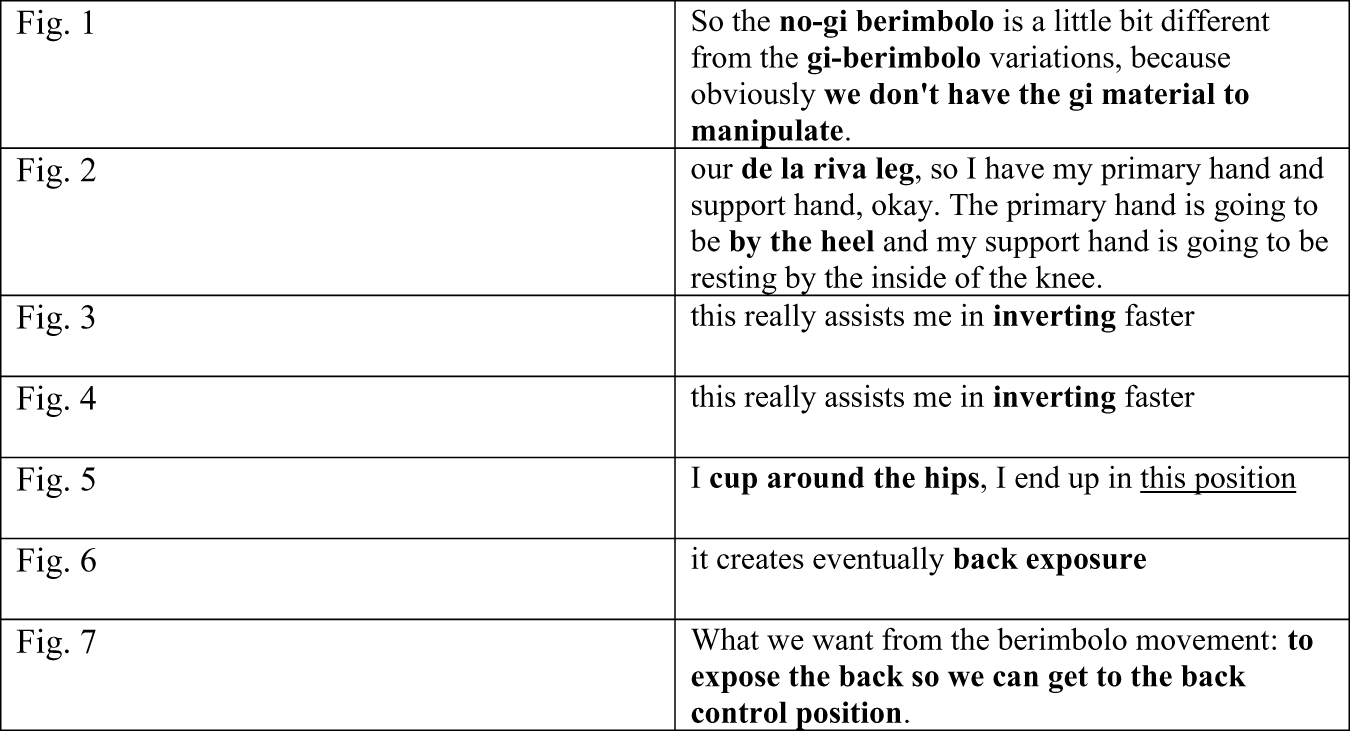
So the no-gi berimbolo is a little bit different from the gi-berimbolo variations, because obviously we don’t have the gi material to manipulate. What I recommend from here, again this is going to be our de la riva leg, so I have my primary hand and support hand, okay. The primary hand is going to be by the heel and my support hand is going to be resting by the inside of the knee. As I go to adjust, same as the gi-variations, I’m always adjusting the level of the height of the knee. So [my] primary hand, support hand, the back of my leg is putting a little bit of almost kneebar-like pressure, but not so much that the leg is in full extension. Open the elbow from the leg hug, again I’m balancing between my elbow and here because this really assists me in inverting faster as well … What I can do from here as well is use my de la riva leg to create a little bit more internal rotation. Why do we do this? Because when I create this length, again if I turn the knee, this starts to turn the hip. If I exaggerate this again, as I turn the knee it turns the hip, it creates eventually back exposure which is exactly what we want from the berimbolo movement: to expose the back so we can get to the back control position. From here I cup around the hips, I end up in this position where I’m cupping around her hip here… So from here I’m looking to pinch my knees as tight as possible. There’s a few different scenarios that we can go for. So my primary hand, my support hand, I push the leg away, leg hug, foot to bum here, I go back to the knee line again, I brace. From here I’m going to cup the hips so she’s here.
(Ciccarelli 2022Footnote 12)
To demonstrate that Ciccarelli’s diachronic narration of the berimbolo is in many ways interpretable as a generic text artifact in the pedagogical universe of jiujitsu—as a motion text that can be rendered portable across space, time, and events of social decoding among members of an international jiujitsu community—I recruited one of my coaches in Hangzhou, Marco “Marcola” Alvarado, to participate in an ethnographic experiment in which I would cold call him to teach the same technique as above. Here, I had Alvarado’s partner, Katreena Dyrek, both take a video of him teaching the move, as well as letting him direct action shots of moments in the performance of a berimbolo that he felt were most germane to teaching the move from a photographic record. With the exception of some nuanced technical details and Ciccarelli’s expert execution, there was a clear transposability between Alvarado’s photographic and Ciccarelli’s verbal texts in spite of a radical divergence in their real-time reference subjects and contexts.
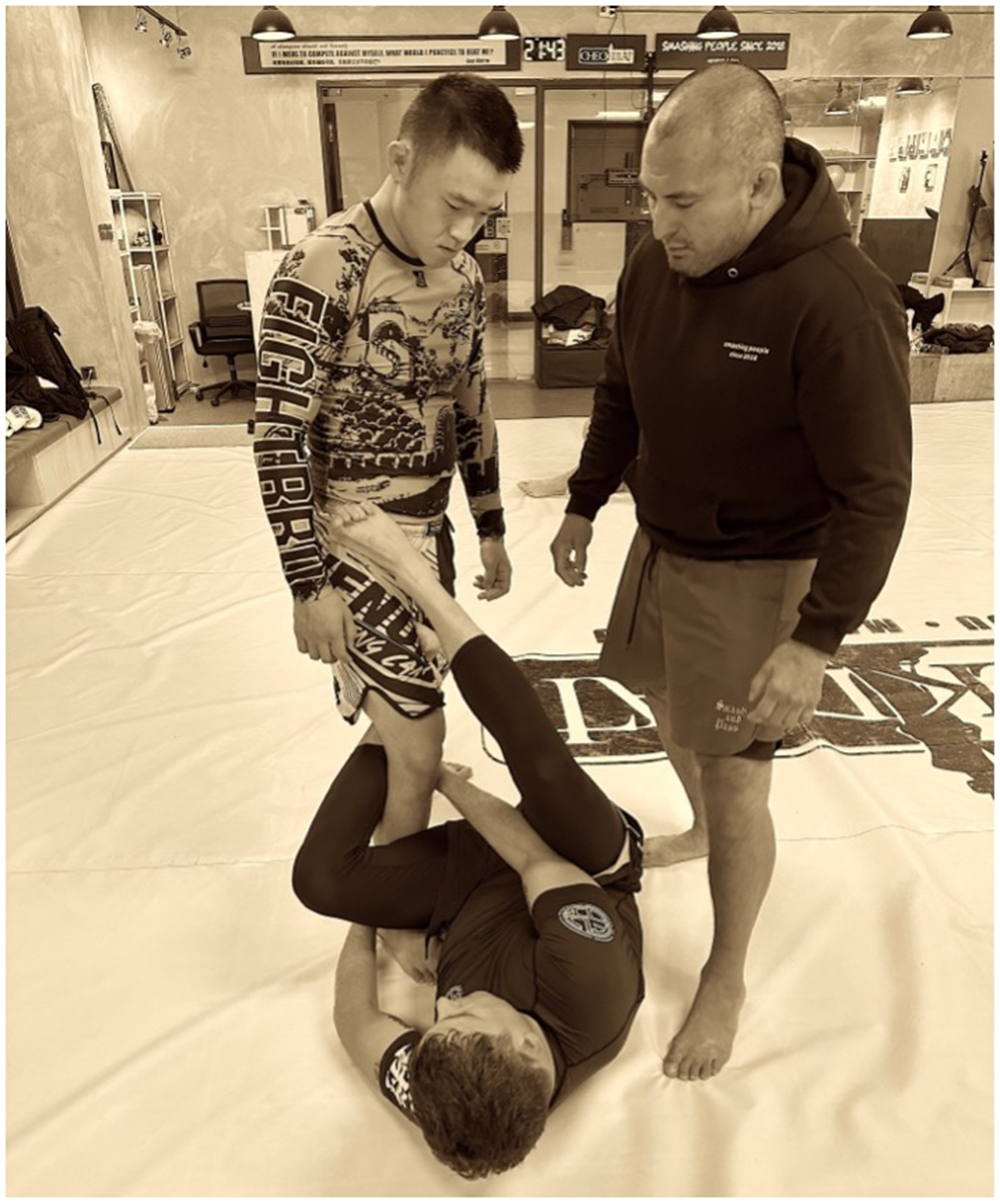
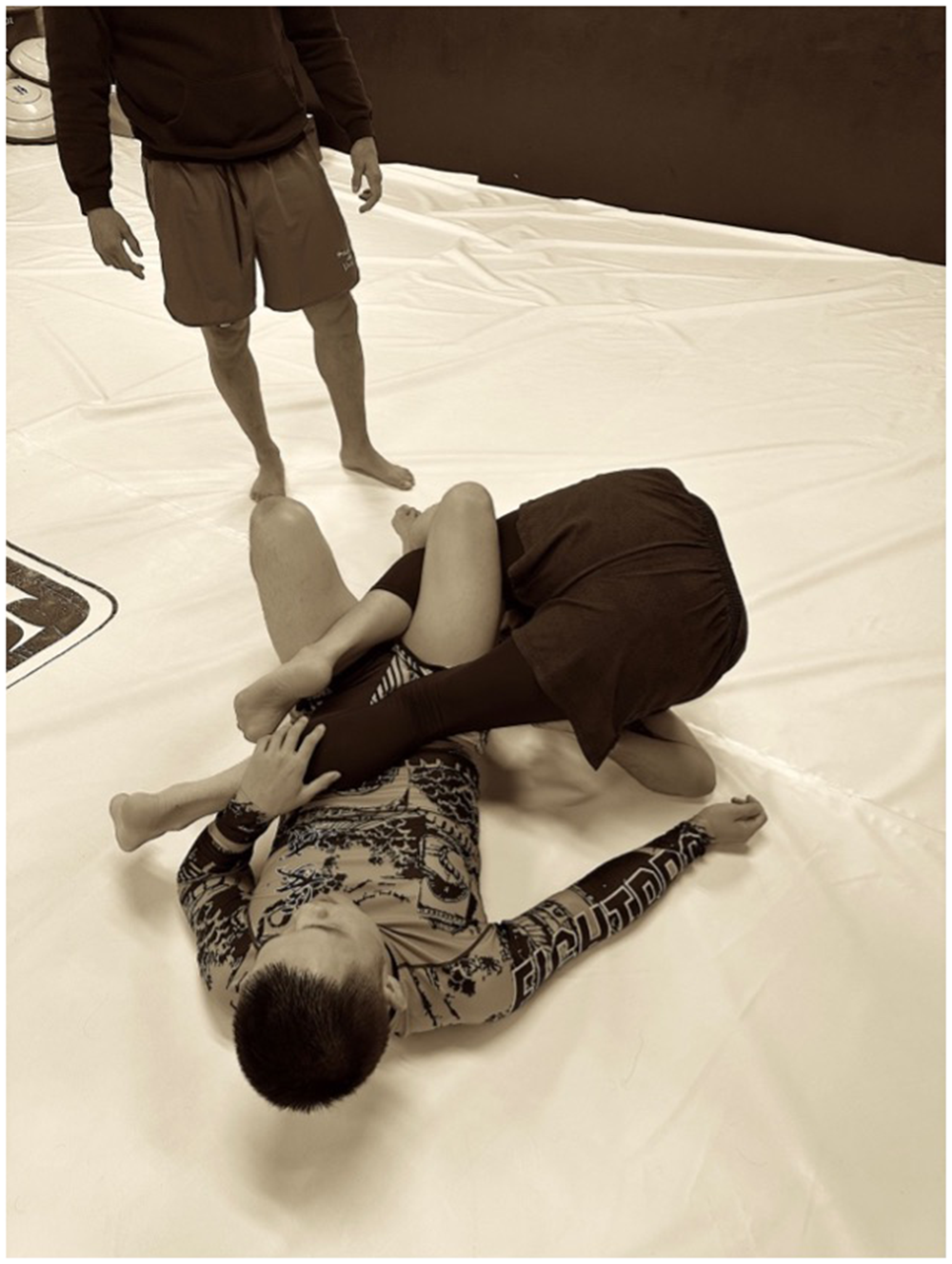
In Figure 1, my training partner Yifei Mo and I are clearly wearing rash guards while performing a more contemporary variation of the berimbolo. This is referred to as “no-gi” in Ciccarelli’s transcript, because we are not wearing a traditional gi—the type of uniform that will be familiar to readers as a “judo” outfit and which is worn in many competitive gi-jiujitsu settings. As Ciccarelli points out, the no-gi bolo-player has to use grips on the leg in the absence of the lapel, belt, and pant grips they are able to utilize in the gi (where the technique was initially developed).
Setup for no-gi berimbolo with author; training partner, Yifei Mo; and Coach Marco (Photo Credit: Katreena Dyrek).

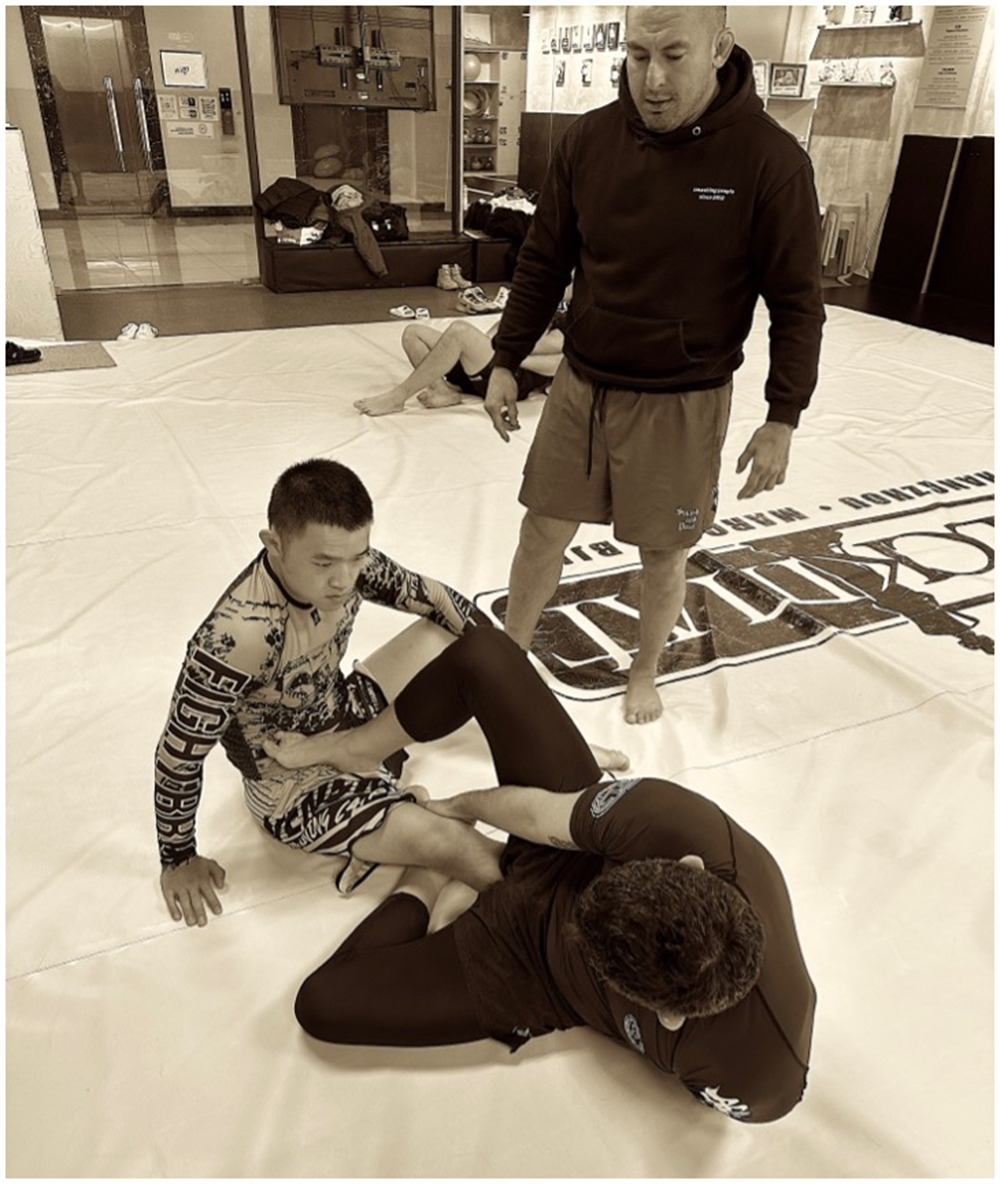
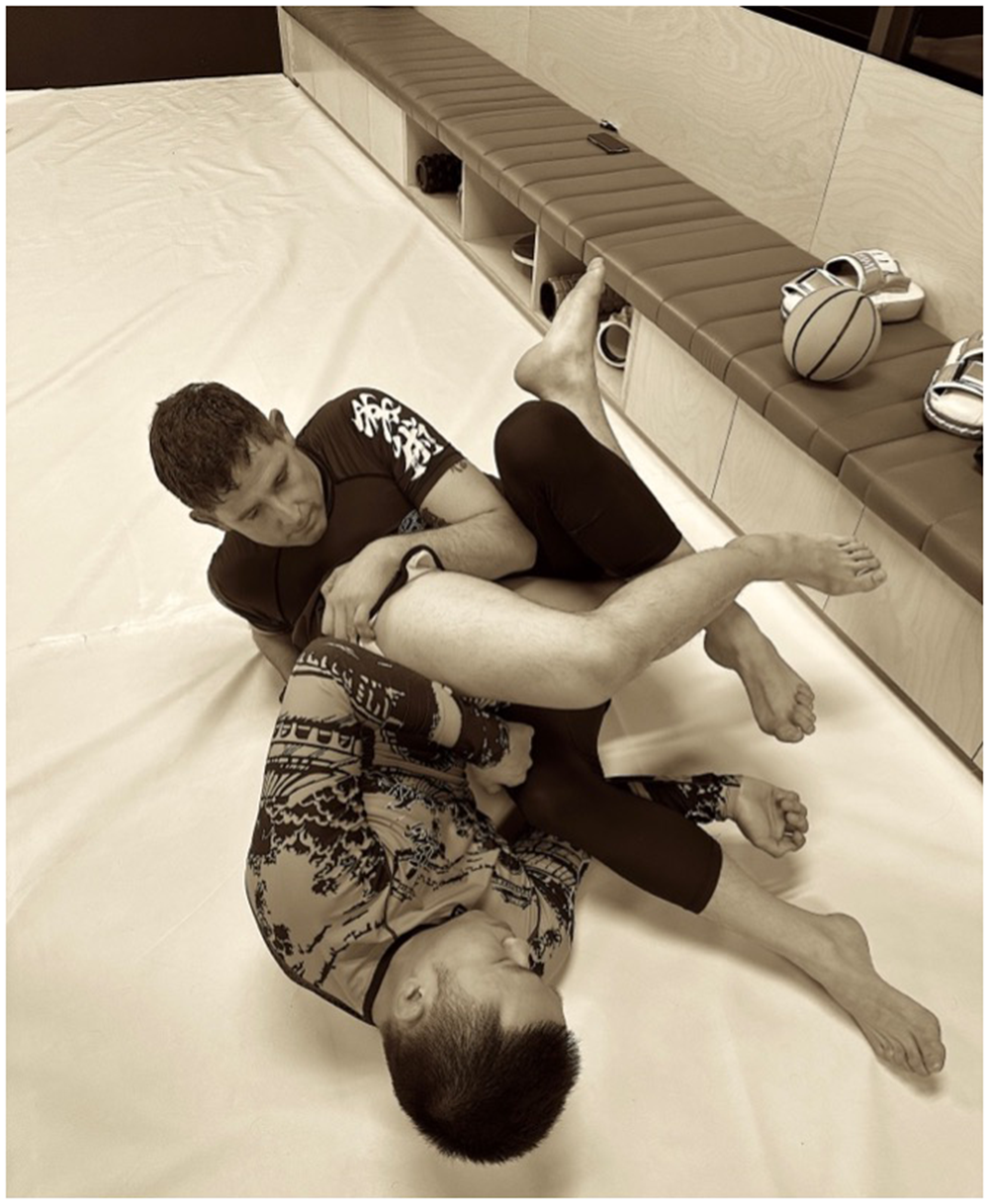
Having set up the De La Riva hook (my left leg/foot hooked behind his right knee) in Figure 1, I use my ankle grip and right foot on Yifei Mo’s hip to bring him to the ground in Figure 2. Though some of the details in Ciccarelli’s transcript have been skipped here, I do still have the De La Riva hook in place, with my foot position and ankle grip serving as a setup for the sequence of bodily inversions that will follow into the back-take:
Author off-balancing Yifei Mo using De La Riva hook (with left leg); ankle grip with left hand; and right foot on Yifei Mo’s hip.

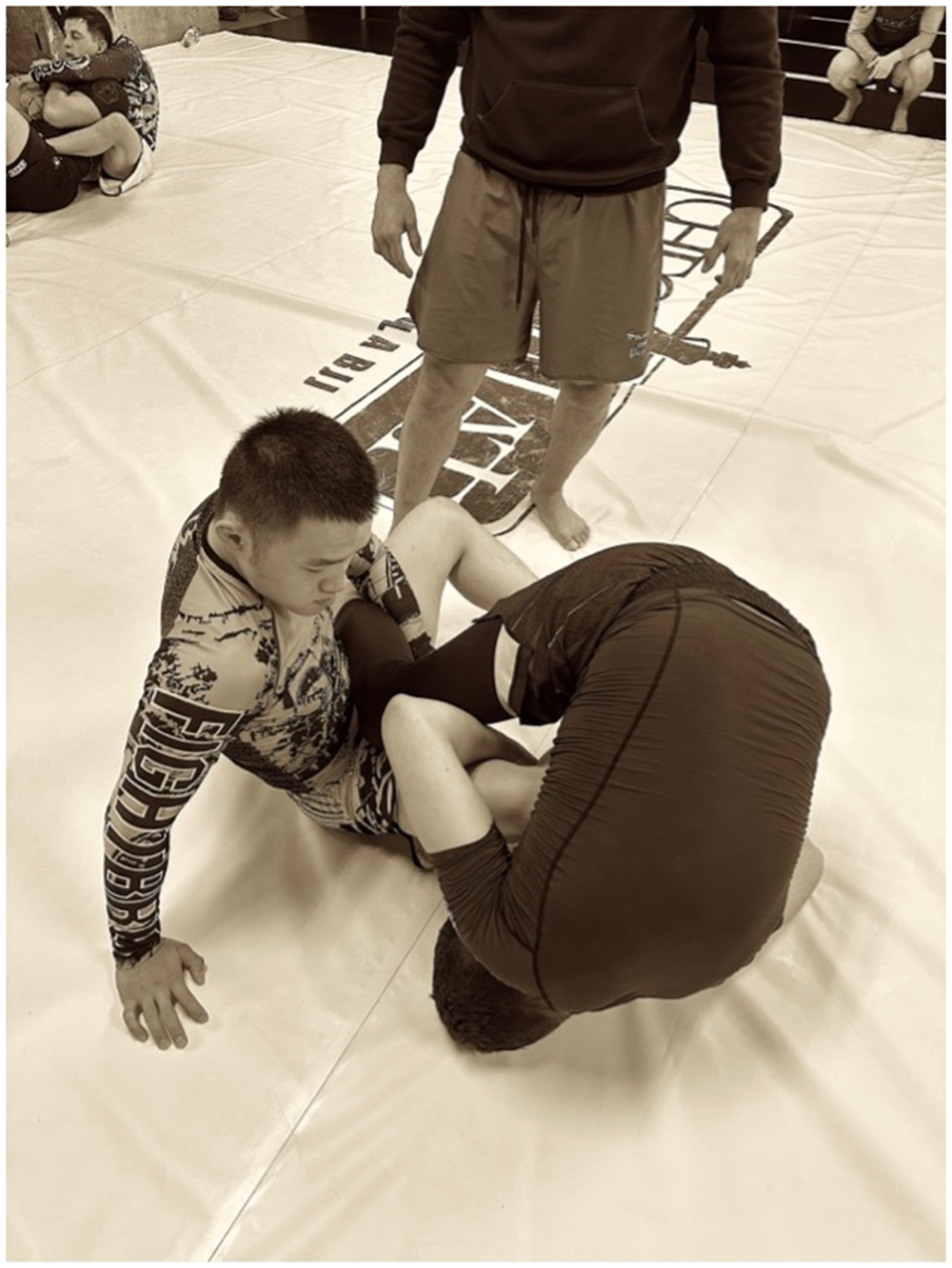
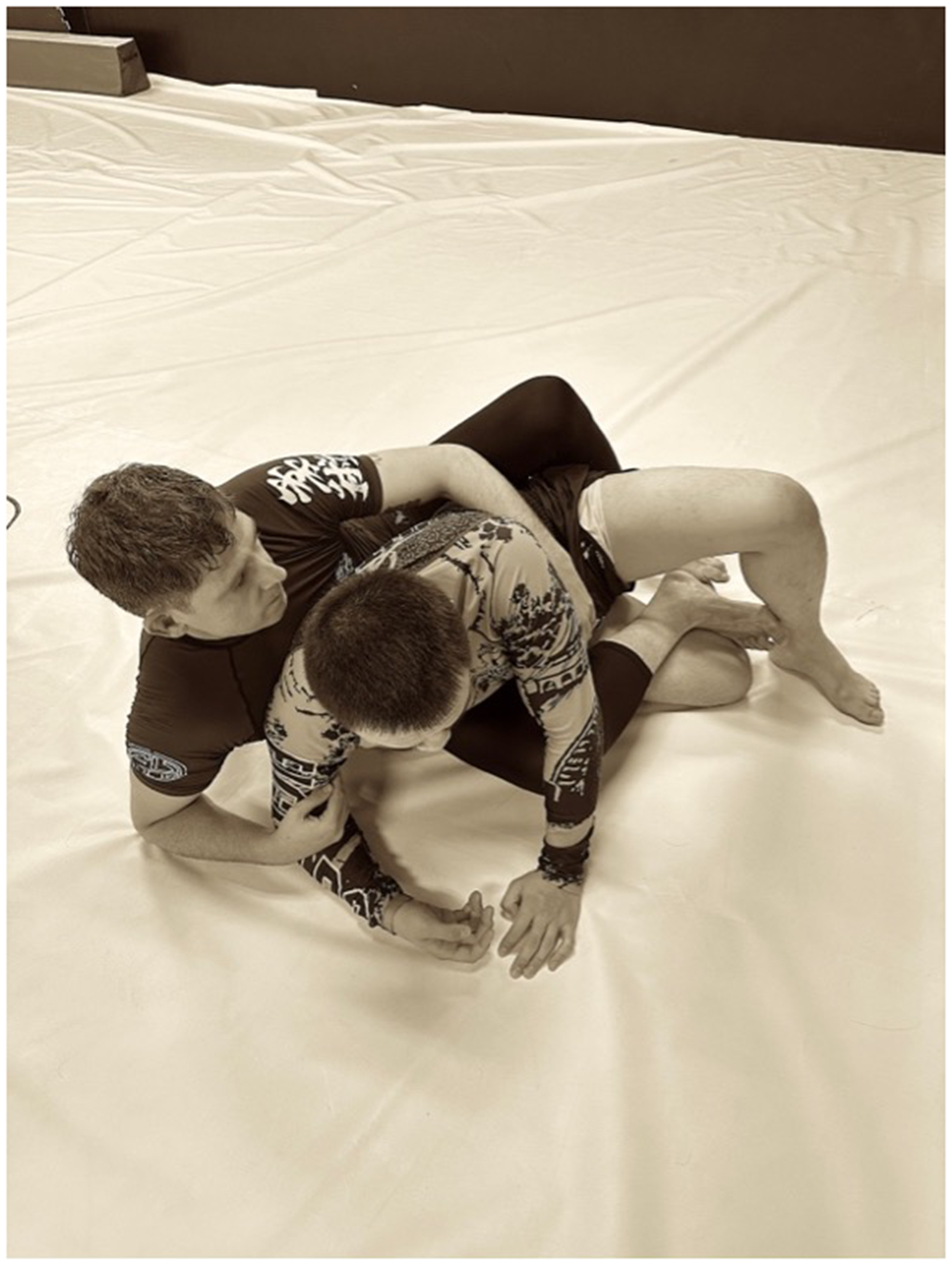
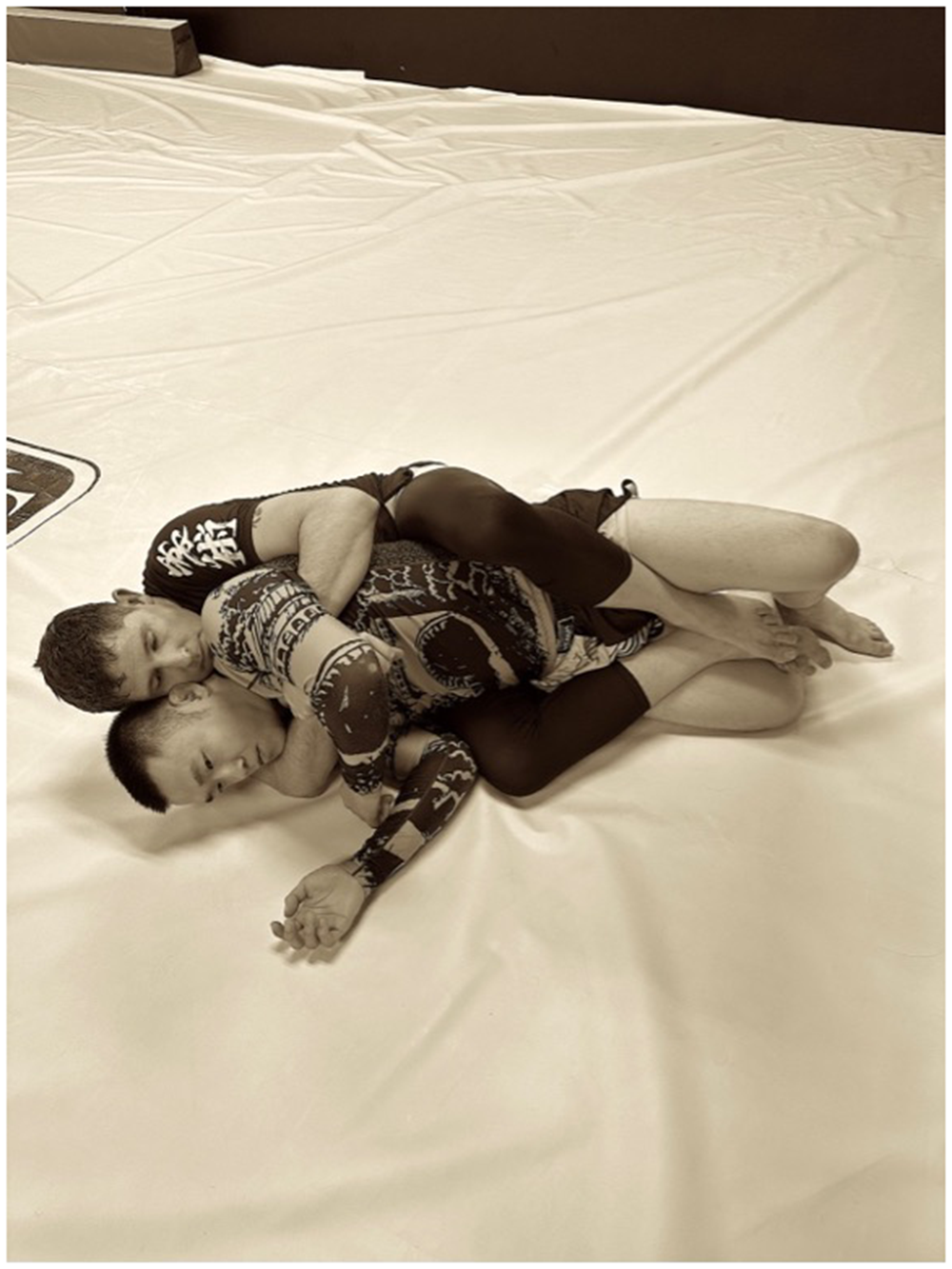
In this sequence (from Figures 3 and 4), I invert and roll toward Yifei’s head, cupping his left hip with my left hand, thus partially lifting his hips off the ground and pinning his back to the floor. The speed of the inversion that Ciccarelli emphasizes is necessary for generating momentum that can allow the lifting of Yifei’s hips so that an opportunity to take his back arises. Of course, not all berimbolos require this momentum dependency or, in fact, the use of inversion, but in both Alvarado and Ciccarelli’s texts, this is a fairly consistent approach in executing a “standard” no-gi berimbolo.
Author beginning inversion using De La Riva hook and right foot across Yifei Mo’s hips.

Author completing inversion using De La Riva hook and right foot across Yifei Mo’s hips.

Here, in Figure 5, the ultimate goal of performing the berimbolo is beginning to emerge: back exposure. As Ciccarelli emphasizes, “what we want from the berimbolo movement [is] to expose the back so we can get to the back control position.” This sequence is completed in Figures 6 and 7:
Author makes use of cupped left hand and Yifei Mo’s raised hip to gain back exposure.

Establishing back control and setting up a choke or other potential submission threats consolidating back control: the goal of the berimbolo.

Consolidating both back control and a choke submission: completing a berimbolo sequence.

Both Alvarado and Ciccarelli utilize diachronic narration, and thus diachronic texts, in teaching techniques like the berimbolo (see Figure 8). In fact, the capacity to state where a berimbolo begins or ends as a boundable event, or to apprehend it as a learnable choreography, will entail diachronic conceptualization. However, comprehending its execution, permutations, and stylistic features as a motion text requires a mode of kinesic enregisterment that—while presuming a diachronic referentiality—anticipates a complete and non-linearly derivable sense of completeness through an acquired form-feeling: In the same way one can complete or correct an incomplete or incorrect sentence as a native speaker without knowing grammatical rules; In the same way one does not work from the top left portion of a sheet of paper to the bottom right corner when drawing a vase of flowers; Or in the same way one knows where one is going to finish the song, Happy Birthday no matter at what point in it one begins singing.
Marco Alvarado’s visual text (left); and Margot Ciccarelli’s verbal text (right).

Similarly, Marco Alvarado and Margot Ciccarelli’s respective visual and verbal texts, while linearly diachronic in their narration, are ultimately derived from endless permutations, countless exceptions, and diverging executions of the no-gi berimbolo. Even while both instructors share a linear pedagogical language reflecting a commonality across sensory modalities and chronotopes, both understand the broader mass-mediated chronotope of berimbolos and their bolo-players to be a somewhat less tractable, but not semiotically elusive zone of encounter—for the berimbolo and the bolo player can be recognized even if both might be tricky to thwart. Here, the commonality between Alvarado and Ciccarelli’s pedagogical approaches, as well as the recognizability of berimbolos and their players across contexts, emerges from the berimbolo’s reiterability and transposability as a repertoire segment across space and time. This is what I understand through its propensity as a motion text; a boundable repertoire segment—kinesically recognizable as a complete and referable bodily movement or choreography—that thus becomes portable across discursive modalities and remote space-times of its emergence. Here, understanding the berimbolo as a transposable motion text, and the bolo-player as an icon of personhood (Carr Reference Carr2010; Ke-Schutte Reference Ke-Schutte2019, Reference Ke-Schutte2023) necessitates understanding the berimbolo—a segmentable kinesic event—as being part of a semiotic register:
a repertoire of performable signs linked to stereotypic pragmatic effects by a sociohistorical process of enregisterment. To speak of ‘a register’ (to use the count noun) is to speak of a sociohistorical phase, a moment-interval of a process of enregisterment; the term ‘enregisterment’ (a deverbal noun of process) makes reasonably transparent the fact that a register’s existence is mediated by activities which make known (or ‘enregister’), and thus make usable, facts of semiotic value associated with signs. (Agha Reference Agha2007, 80)
For a motion text to “move” across space and time, a sociohistorical and cultural infrastructure must be understood to be present, so as to render its intelligibility—however partial or remote. The sociohistorical phase that then permits enregisterment across space-times thus is a space-time in itself which reaches across bounded event-chronotopes: As Agha (Reference Agha2007b) has also suggested, mass-mediated chronotopes can imbricate or connect disparate face-to-face space-times, even while face-to-face space-times—as spatiotemporal nexuses that ground virtual and real-time interactions—are dialogistic portals into other sociohistorical phases that afford or evade recognition at various scales of reflexive awareness (Silverstein Reference Silverstein1981).
Thus, this understanding of motion text needn’t pertain only to the motion of physical human bodies in martial encounters, but also to the motion of discourse that in its flow must be apprehended as existential, sequential, diachronic, and linear; yet can evocatively be encoded in sensorially impossible space-times: emptiness, nothingness, infinity, multiversality, the void, or even within dialectical and dialogical chronotopes. A more general, less-obviously embodied, expression of the contrapuntal nature of motion texts can be demonstrated in the contrast between the ethnographic space-time of my berimbolo research (Figure 9) and the account of historical space-time I was able to diagram from it (Figure 10).
Ethnographic motion from bolo to bolo-player.

Historiographic motion from berimbolo to bolo-payer.

In the diagram above, the segmentable diachronic phases through which I encountered the berimbolo and bolo-player, as a researcher, differ from the segmentable historical phases of their emergence that I was able to retrospectively reconstruct through the research process (in the diagram below). The ability to conceive of bounded space-times outside of diachronic time, only to re-order them again in a different diachronic time of reception, requires not only a chronotopic capacity to bound and move encodable events across time—in the Bakhtinian sense—but also a form-feeling-like anticipation of historical and cultural motion—in the metacultural sense (Urban Reference Urban2001)—that permits a coherent reception of seemingly incoherent experiences, sensory impressions, and events.
The respective ethnographic and historiographic motion texts above—while seemingly diachronic in their narrations—will, in retrospect (that is, after reading), interweave in all kinds of ways with the reader’s own transtemporal associations of discursive and sensorial experience. As the berimbolo and the bolo-player emerge as robust, kinesically enregistered motion texts and ecologies of personhood that are recognizable as semiotic totalities outside of the diachronic segments that choreograph their technical mechanics and social histories; so too ethnography and historiography must be comprehended as robust, polychronic totalities even while their initial apprehension unfolds in seemingly diachronic, linear segments.
Conclusion
In retrospect, the disconnect between impressions of events that had set this research in motion, sketched in surface detail in the opening vignette, served as the inspiration to pursue a deeper understanding of the ecology of personhood that initially engendered the David Lynch-like sense that something holds all of these ethnographic moments (including the broader mass-mediated jitsuverse) together even while fragmentation seemed to characterize the presented set of impressions. Disconnected events with strange people in strange places, punctuated by confounding punch lines like “he really likes pineapples,” compounded this initial sense of disconnection that obscured a connection. Staying patient with disconnection, however, permitted an elaborate process of interpersonal maintenance and communicative infrastructure to become discernible. This discernibility underpinned a sense of precarious togetherness that, like a house of cards, presents an intelligible but fragile diagram of a given social world: In this case the jitsuverse and its maintenance through transnational strangers on the fourth floor of an abandoned office building in urban China—sharing techniques acquired through accessing illegal VPNs; transmitted via fractured translations; and maintained through interpersonal curations, refinements, and continuous kinesic enregisterments. An elegant and semiotically complex process underpins the multi-channel and -modal ways in which the meaningful and the sensorial are imbricated processes in distilling both the relationship between and the differentiation of personae, their communicative infrastructure, as well as the material universe. These are at one scale imbricated, and yet at another required to be differentiated so as to maintain a mirage imagined to be an unchanging cosmic order—a cosmic order we, as natives to our respective cultural worlds, presume upon only on the basis of enregistered stereotypes (of persons, movements, and seemingly immediate sensoria); even while the enregisterment process (that renders the perceived stability of these) ultimately emerges as a chimeric illusion.
What linguistic anthropologists then understand by grammars, phonemes, lexemes, morphemes, personae, institutions, and referential systems are all precariously “ligatured” at the edge of emptiness.Footnote 13 Here, I suggest that a disentanglement toward understanding these relations becomes possible through ethnographies attuned to kinesic and semiotic convergences, on the one hand, and a re-thinking of “text” beyond a graphic and existentially diachronic ideology of time, space, and personhood. To this end, I hope to have contributed another way of understanding the imbricated relationship between—or “total semiotic factuality” (Nakassis Reference Nakassis2023) articulating—text, indexicality, and the enregisterment of personae, events, and institutions.

 Open access

