

Wouldn’t the bodies (human, living, plus those of a few dogs) that move about down there, in the car-wrecked swarming whole, impose a law? Which one? … The hands that move about, the limbs, do not amount to signs, even though they throw out multiple messages. But is there a relation between these physical flows of movements and gestures and the culture that shows itself (and yells) in the enormous murmur of the junction?
—Henri Lefebvre (Reference Lefebvre2004, 33)For the past several decades, there has been an explosion of interest among linguists, psychologists, and anthropologists in whether and how (multi)modality effects our general understandings of language, communication, and interaction.Footnote 1 As part of this broader trend, the motor activity of the hands have been foregrounded analytically. Psychologists, for example, have demonstrated that the hands can offer a window onto the mind (Reference McNeillMcNeill 2005; Gunderson et al. Reference Gunderson2015) and can serve as a facilitator of thought (Abrahamson et al. Reference Abrahamson2014; Rueckert et al. Reference Rueckert2017). Linguists have shown how the affordances of the hands are seized upon for phonology (Reference SandlerSandler 1996; Reference BrentariBrentari 1998; Reference MorganMorgan 2015), lexical semantics (Hwang et al. Reference Hwang2017; Martinez del Rio et al. Reference Martinez Del Rio2022), depiction (Reference DudisDudis 2004; Hodge and Reference HodgeJohnston 2014), co-language gesture (Reference OkrentOkrent 2002; Reference LiddellLiddell 2003; Reference EnfieldEnfield 2009), and language use in interaction (Enfield and Levinson Reference Enfield2006; Reference ShawShaw 2019; Reference CasillasCasillas 2022). Linguistic anthropologists have started instead with a broader range of interacting semiotic processes and have shown how the hands play an integral role therein.Footnote 2 The aim of this article is to build on linguistic anthropological approaches by focusing on the hand-environment relation.
The argument I present here emerged out of interactions with DeafBlind people in Seattle in a historical moment when access to the environment was severely restricted for them, due to social constraints on touch.Footnote 3 Because touching people and things was considered inappropriate by sighted people in public, and because DeafBlind people in Seattle (at that time) were still adhering to those sighted norms, it was difficult for them to form an impression of the place upon entering a home, a place of business, or a public event.Footnote 4 To address that issue, sighted people like me were asked to describe what they saw. The description was usually unhelpful at first. The sighted person might say, for example, “We are at a party now.” But that just tells you what kind of place you are in, not what this place is like. In my experience, these encounters were most successful when the DeafBlind person micromanaged my attention, asking increasingly detailed questions before forming an impression of their own (as opposed to taking my word for it).Footnote 5 For example, after receiving a description of the environment, one person had a habit of asking me, “How do you know?” This was an efficient way to prompt a more detailed description, which would nonetheless be tied to the previously given type-level characterization. The process was recursive, and I regularly found myself in the midst of a fascinating but wholly unfamiliar interpretive process, which often ended up focusing on the hands of others. This makes sense if tactile access to others in public places is highly restricted by sighted social norms, leaving the hands alone to function as a signal-emitting center around which social spaces are organized and imagined. In what follows, I will argue that this particular mode of interpretation suggests that we can read the ambient environment off of the responses that hands have to it. This essay is an attempt to explore some possible implications of this insight for our understandings of how the human hand communicates.
Hands Don’t Wink
There are many filmic and photographic representations of DeafBlind people in circulation, but one of the most common is the sentimental close-up of hands touching. Lee, a DeafBlind friend of mine, hates those close-ups. When she catches someone trying to take one of her, she swats their hand away or glares and says, “No.” In 2004, Lee made a movie about herself. The opening scene is her facing the camera juggling a cup of coffee, a cigarette, and her cane. She downs the coffee, throws the cup away, and folds up her cane, freeing her hands so she can explain to the viewer: because she is a lesbian, DeafBlind, a smoker, and a person who requires a lot of beverages, special pressures are exerted on the functionality of her hands. That is why, she says, that while vision and hearing are totally unnecessary, a life without hands is unimaginable.
Lee, like many members of the Seattle DeafBlind community, was born deaf and has been slowly becoming blind. In a world like hers, where visual qualities are always receding and social restrictions on touch are always encroaching, the hands not only take on additional functionality, they can also become crucial evidence for theories, prompts to speculate, or triggers to imagine. Helen, another DeafBlind friend, and I have always developed theories about the people we meet. We imagine their secret lives, their private thoughts, their undisclosed attachments. But when Helen started losing the last of her vision, her standards changed. Claims about people were only interesting when substantiated with facts about their hands. When Helen told me that she thought Jodi might be interesting, for example, she provided evidence: the skin on Jodi’s arms, she said, is soft all the way down, but when you get to her palms and fingers, they turn rough. Something is going on at Jodi’s house that makes her hands feel like that—there is more to Jodi than there seems. Jodi is interesting. It’s what we don’t know about her home life. It’s her discrepant textures.
If I couldn’t tell Helen something about a person’s hands, Helen wasn’t interested. And yet, I had trouble imagining that faces were totally irrelevant, so I asked her, “What about winking?” Helen explained that winking is important but not interesting. If you want to solicit donations from a sighted person, remembering how to wink could come in handy, and if a sighted person winks at you, you should have some idea of how to respond, so one should take time to notice how and when people wink. But, Helen said, as though it were self-evident, “Winking could never be interesting, because hands don’t wink.”
Spending time with Helen has made me realize that paying attention to other people’s hands prompts us to imagine things about their inner lives, but it also prompts us to make sense of places. In the summer of 2006, I engaged in a series of people-watching activities with Helen. We went out to places in Seattle where we might have gone anyway—a farmer’s market, a restaurant, the dog park—and I would describe what I saw, adjusting the focus of description as instructed. On one such outing, we were wandering around in Seattle’s Capitol Hill neighborhood when we happened upon an art opening. The room was full of large sculptures: slowly turning gears, barely swinging hammers, buckets moving in slow motion up and down on ropes from the ceiling to the floor. After the event, I recorded the following account in my fieldnotes:
I started with the hammers. Helen said not to bother. She was interested in people’s feet. So we found a corner and started with the feet, which required attention to the legs. “The toe is planted and the heel is swiveling right to left and back again,” I say. “I don’t understand, show me,” Helen says. So I plant my toes and swivel my right foot. Helen pats down my leg while I continue. She makes it down to the toes and back up again, and then says she gets it. She imitates me and asks if that’s it. I confirm.
“Woman or man?” she asks.
“Woman,” I say.
“Is she talking to a woman or a man?”
“Man.”
It turns out that that woman was not the only woman talking to a man and swiveling one of her feet back and forth, pivoting on the toes. There were others. Helen says that when a woman flirts, she is likely to engage in this particular movement of the foot. I move to the right. Two men are next to a very large sculpture of gears. They are facing each other, feet anchored.
“They’re not moving their feet at all?” Helen asks.
“Nope.”
“Men or women?”
“Men.”
“What about the rest of their bodies? What are they doing?” Helen asks.
“Their hands are in their pockets, their heads are nodding, and they’re looking at the floor. Every once in a while, they look at each other and then quickly back to the floor,” I say.
“They’re looking at the floor and their hands are in their pockets?” Helen asks. “Yep.”
As we made our way around the room, it became clear that these men were not the only ones with their hands in their pockets. There were others. In fact, this was almost an entirely generalizable feature of the room. It was a room in which hands were pocketed.
“Feet anchored, eyes averted, hands in pockets.”
“Left foot anchored, right foot swiveling, hands in pockets.”
And it goes on like this, until Helen becomes concerned. She says, “What are they doing with their hands in their pockets? Isn’t this a party?” She hadn’t remembered that hearing people can stand around with their hands in their pockets since they’ve got their mouths and their eyes for talking and seeing. She said she must have known that before she was blind. We went over the room again, scouring for hands caught mid-activity, and there were almost no cases to report. She accused them of being devoid of feeling. She accused them of being cold. But after thinking about it longer, she said, “Those poor people! They have too many limbs! They don’t know what to do with them!”
Here, the hands reveal less about the particular people they are attached to and more about the social environment those people inhabit; it is as if the people are an effect of the room, each individual instantiating a single subjectivity—cold, devoid of feeling, or perhaps (through no fault of their own) burdened with an excess of limbs. Their bodies are affected from without, not expressive tools, transmitting messages from within. The sighted people at the art opening probably had idiosyncratic aims; they were focusing on what they were going to say next, how they were going to build rapport, save face, survive the interaction, get a plastic cup of champagne. Meanwhile, pressure was building, and their hands were responding—not to anyone in particular but to the environment as a whole. Registering excessive and publicly circulating awkwardness, the hands pocketed themselves.
Depersonalizing the Hands
When we move away from thinking about the body as a mechanism for the transmission of communicative content and begin to think of it as an integral part of complex interactional and social processes, the hands appear in all sorts of relationships. Think of Charles Goodwin’s (Reference Goodwin2010) archeologists, whose limbs take up shifting roles in coordinated ecologies of action. One of the things their limbs do is point inward toward the center of the “ecological huddle” where they emit continuously available signals, telling all involved: We are all still doing this. While the hands do respond to commands from the individual in these scenarios—Point to that patch of dirt. Trace the structure you see with that trowel—they also register the status of the collective to the collective. In much the same way, the pocketed hands that Helen found so disturbing register the status of the sighted collective to the sighted collective: We are all still here, and it is still awkward.Footnote 6 Insofar as embodied orientation is reciprocal, the hands of many people participate in one coordinated feedback loop, continually giving off signals that maintain the group’s grasp of itself as a coherent whole. Jakob von Uexküll provides us with a compelling image for drawing out the similarities in these two cases. It is the “reflex arc” (Reference Uexküll1934, 8). A reflex arc involves the reception of an external stimulus, which is “converted into nervous excitation” and then passes through several “stations” before producing a stimulus-elicited response (8). According to Uexküll, some animals have external organs—mobile mouths, independent spines—that contain complete reflex arcs of their own and are not under the control of a central organ (32). This kind of organ is called a “reflex person” (32). Reflex persons are independent, and yet they operate in coordinated ways among themselves. Uexküll explains:
Sea urchins, like porcupines, carry a large number of spines which, however, are developed as independent reflex persons. Besides the hard, pointed spines, which are attached to the lime shell by means of a ball bearing and are able to turn a forest of spears against any stimulus-emitting object that approaches the skin, there are delicate, long, muscular tube-feet for climbing. Furthermore, certain sea urchins have four kinds of claws (cleansing claws, clapping claws, snapping claws, and poison claws or pedicellariae) scattered over their surface. … Although some of these reflex persons act in unison, they work quite independently of each other. Thus in response to one and the same chemical stimulus emitted by the sea urchin’s enemy, the starfish, the spines part, the poison fangs spring forth in their stead and bury themselves in the enemy’s suction feet. … We may therefore refer to a reflex republic in which, despite the utter independence of each reflex person, absolute domestic peace reigns. For the tender tube- feet are never attacked by the sharp snapping fangs, which normally seize every approaching object. This peace is not dictated by a central organization. (32–34)
Like the sea urchin’s spines, human hands are attached to arms, but the arms are mobile. When subsumed by a collective archeological task or exposed to an awkward public event, the hands of many people can respond in unison—turning inward toward the center of the huddle or plunging into nearby pockets. In this sense, the hands can act as a kind of reflex republic— responding in coordinated ways to common environmental signals, without direction from a centralized source (fig. 1).
The hands as reflex republic
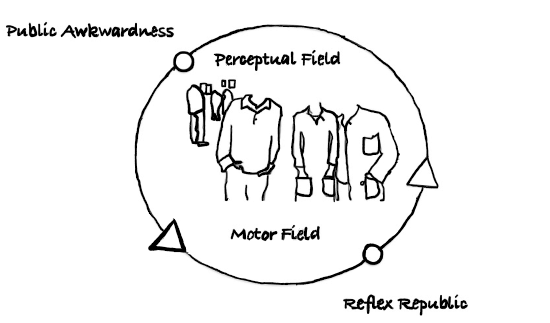
The reflex republic is not a model for, or explanation of, the semiotic processes described above. Rather, as an image, it draws our attention to the irreducible relation between life and communication and the fact that the movements of mobile appendages only become meaningful against this backdrop.
Uexküll says that a life is formed in the embodied interaction of the organism with its environment, so that different bodies yield different forms of life. When we step into a meadow and see it as it is experienced by the animals who live there (a burrowing worm, a butterfly, a fieldmouse), the meadow “is transformed. Many of its colorful features disappear, others no longer belong together but appear in new relationships. A new world comes into being” (Reference Uexküll1934, 5). What the sighted creature sees, for example, as a darkening of the horizon feels to a sea urchin like “a wad of cotton passing lightly over its photosensitive skin.” The sea urchin does not project darkness outward into space; indeed, “it has no visual space” (34–36). Differences like these can appear at the level of the species, but they can also be found among members of the same species, whose bodies differ. Uexküll gives the example of visual impressions produced by the adult human eye, compared to those produced by the child’s eye (26–27). Due to differences in how distance is perceived at different stages of development, adults interpret people who look small as being far away, while children interpret them as being small. Filtered through a different body, the world rearranges itself.
One time, Helen and I were on vacation together. We had rented an apartment, and on our first night we cooked dinner. Just as we were about to start eating, the smoke alarm went off. It was so loud that I lost all ability to think. I cupped my hands over my ears and waited. The stove was off, but the smoke kept coming and it didn’t stop until, eventually, the fire department showed up. They determined that the stove was broken and found someone who could fix it, and the alarm finally stopped sounding. A few months later, Helen and I were at a small gathering and one of the DeafBlind guests, Marco, asked if Helen and I ever noticed that we were different. Directing the question to Helen, he said, “Like do you think of Terra as hearing?” Helen responded with the following story:
One time, I was on vacation with Terra. We cooked dinner and we had just sat down to eat, when out of the blue, she leapt up and started frantically turning around in jumpy circles. I tried to ask her what she was doing by calmly sliding my hand down her arm and under her hand, but her arms wouldn’t move. They felt rigid and her hands were stuck to the sides of her head like suction cups. Later, two men showed up to help, and when Terra explained the situation to them, I finally understood that the smoke alarm had gone off and she couldn’t get it to stop. So I guess there was a sound and it went floating through the air, hit her on the shoulder and found its way up into her ear, where it crashed around, rattled her brain, and made her jumpy.
At the end of the story, she jabbed her finger in Marco’s ear and wiggled it around aggressively to depict a loud sound and then shook his upper body back and forth to show the effects of the sound. Marco and I both collapsed into laughter. The story was hilarious. In the short time it took to tell that one story, I had gone from being a civilized guest at a party, responsive to all kinds of meaningful signs in my environment, to a different type of animal, whose environment contained strange and invasive signs that transmit information through the air and, without warning or any possibility of being stopped, can penetrate the inside of the ear.
Helen understands the kind of creature I am (“hearing”) by understanding how my environment speaks to me. She understands how my environment speaks to me by analyzing the responses of my hands to it: In response to an external stimulus, they suction-cupped themselves to my ears. There are many images of animal life that might help us reconsider multimodal communication by foregrounding the organism-environment relation. For example, Roland Barthes (Reference Barthes2012, 38), in a catalog of “novelistic simulations of some everyday spaces,” offers us another image that could be of some use: “Here we have what appears to be the perfect image of Living-Together, one that would appear to effect the perfectly smooth symbiosis of what are nevertheless separate individual beings. I’m referring to a school of fish.”
Schools of fish are suspended in water, and water has its own dynamics. The idea of water, transposed onto a human collective, might conjure the dynamics of crowds. For example, subway trains sometimes stop running and people accumulate on the platform, where they are pressed too hard against each other and the mass (its parts having become indistinguishable) can move dangerously close to the platform’s edge, no one person capable of preventing impending disaster. The mystery in such cases is: “Why would people choose to move in such a dangerous direction?” And the answer is that the individual body is not moving in response to an individual’s decision to act. Rather, their independent movements are coordinated by the crowd’s directional teleology. Elias Canetti explains: “Direction is essential for the continuing existence of the crowd. Its constant fear of disintegration means that it will accept any goal” (Reference Canetti1960, 29). The urban planner knows this sort of thing. They also know that when the trains are running on schedule, the individual can dissolve into a rhythm of foot-stepping and that that activity is tracked along invisible, tightly controlled lines. In the winter, as we step onto the subway station escalator, warm arm air surges up from inside the tunnels, signaling to us that we must choose: stand or walk briskly. Standing people move to the right. Walking people move to the left, where they feel compelled to maintain a particular pace. The limbs are held in close to the body, either static or swinging in a narrow arc. A snag of any kind causes individuals, or rather, individuation, and this is to be avoided. The urban planner knows about these dynamics, and yet the fine-tuned coordination of limbs cannot be the urban planner’s doing. In cases like these, the reflex republic might function as an organizing image, drawing our attention to the hand-environment relation in new and productive ways.
The Hands as Reflex Republic
In this article, I have explored the role of hands in organizing a world where access to the bodies of others was severely restricted by antitactile social norms. From this perspective, the hands of many people appeared strangely coordinated, as if they were responding in unison to a single environmental stimulus. This suggests an approach to the gesturing hands that focuses more on the environments in which hands move than on the aims or capacities of the individuals to whom the hands are attached. Biosemiotic theory offers us something in this context because it foregrounds the organism-environment relation more than relations between interactants, language users, or communicators. The image of the reflex republic, in particular, prompts us to consider not only what the hands grasp, express, or reveal, but also what they are grasped by, caught up in, and moved to respond to. DeafBlind observers of interaction have made a similar move, and it has yielded great insights about people and the worlds they inhabit. The DeafBlind poet John Lee Clark (Reference Clark2017) even wrote a mythical origin story in the form of a poem, titled “Our Treasure”:
Our treasure is to be together. We used to be filthy rich. We had it as good as a ball of worms. We squirmed happily together in caves. We had it so good. We had our old curved nails tearing into pomelos. It was almost too much. One day a cluster wandered off and found something in the forest. It was too much. It splintered their souls into a million toothpicks. Some of them tried to come back. They stabbed us. They tried again and again until it was too many toothpicks to hold together against. We have never forgotten. Every time we snuggle against a wall we feel it. Every time we dig into a pomelo we feel it. Every time we wrap our legs around each other to talk we feel it. Our lost wealth. We want it back. We want it all back. The best way to get rid of a million toothpicks is by fire.
I think Helen, John Lee Clark, and many other DeafBlind thinkers would agree with Barthes when he says, “Clearly: one should never seriously compare traits of animal ethology with traits of human sociology, never infer one order from the other. … Ethology supplies images, not explanations” (Reference Barthes2012, 37). In this essay, I have argued with DeafBlind interlocutors that images of animals are good for finding new ways of thinking about gesture and multimodal communication. When Helen says that sighted people “have too many limbs,” or when she works backward from my suction-cupped hands, she is turning the communicative activity of the hands into a biosemiotic problem. She is asking: in what world would this motor activity count as a meaningful response, and what, more specifically, is it a response to? Starting there, the hands appear not only as a window onto the mind, as a facilitator of thought, and as an articulator of signs but also as a kind of appendage to the self—like cilia, left out in the world to register the dynamics of social life.



