


%20--%3e%3c!DOCTYPE%20svg%20PUBLIC%20'-//W3C//DTD%20SVG%201.0//EN'%20'http://www.w3.org/TR/2001/REC-SVG-20010904/DTD/svg10.dtd'%3e%3csvg%20version='1.0'%20id='Layer_1'%20xmlns='http://www.w3.org/2000/svg'%20xmlns:xlink='http://www.w3.org/1999/xlink'%20x='0px'%20y='0px'%20width='64px'%20height='64px'%20viewBox='5.5%20-3.5%2064%2064'%20enable-background='new%205.5%20-3.5%2064%2064'%20xml:space='preserve'%3e%3cg%3e%3ccircle%20fill='%23FFFFFF'%20fill-opacity='0'%20cx='37.785'%20cy='28.501'%20r='28.836'/%3e%3cpath%20fill='%23595959'%20d='M37.441-3.5c8.951,0,16.572,3.125,22.857,9.372c3.008,3.009,5.295,6.448,6.857,10.314%20c1.561,3.867,2.344,7.971,2.344,12.314c0,4.381-0.773,8.486-2.314,12.313c-1.543,3.828-3.82,7.21-6.828,10.143%20c-3.123,3.085-6.666,5.448-10.629,7.086c-3.961,1.638-8.057,2.457-12.285,2.457s-8.276-0.808-12.143-2.429%20c-3.866-1.618-7.333-3.961-10.4-7.027c-3.067-3.066-5.4-6.524-7-10.372S5.5,32.767,5.5,28.5c0-4.229,0.809-8.295,2.428-12.2%20c1.619-3.905,3.972-7.4,7.057-10.486C21.08-0.394,28.565-3.5,37.441-3.5z%20M37.557,2.272c-7.314,0-13.467,2.553-18.458,7.657%20c-2.515,2.553-4.448,5.419-5.8,8.6c-1.354,3.181-2.029,6.505-2.029,9.972c0,3.429,0.675,6.734,2.029,9.913%20c1.353,3.183,3.285,6.021,5.8,8.516c2.514,2.496,5.351,4.399,8.515,5.715c3.161,1.314,6.476,1.971,9.943,1.971%20c3.428,0,6.75-0.665,9.973-1.999c3.219-1.335,6.121-3.257,8.713-5.771c4.99-4.876,7.484-10.99,7.484-18.344%20c0-3.543-0.648-6.895-1.943-10.057c-1.293-3.162-3.18-5.98-5.654-8.458C50.984,4.844,44.795,2.272,37.557,2.272z%20M37.156,23.187%20l-4.287,2.229c-0.458-0.951-1.019-1.619-1.685-2c-0.667-0.38-1.286-0.571-1.858-0.571c-2.856,0-4.286,1.885-4.286,5.657%20c0,1.714,0.362,3.084,1.085,4.113c0.724,1.029,1.791,1.544,3.201,1.544c1.867,0,3.181-0.915,3.944-2.743l3.942,2%20c-0.838,1.563-2,2.791-3.486,3.686c-1.484,0.896-3.123,1.343-4.914,1.343c-2.857,0-5.163-0.875-6.915-2.629%20c-1.752-1.752-2.628-4.19-2.628-7.313c0-3.048,0.886-5.466,2.657-7.257c1.771-1.79,4.009-2.686,6.715-2.686%20C32.604,18.558,35.441,20.101,37.156,23.187z%20M55.613,23.187l-4.229,2.229c-0.457-0.951-1.02-1.619-1.686-2%20c-0.668-0.38-1.307-0.571-1.914-0.571c-2.857,0-4.287,1.885-4.287,5.657c0,1.714,0.363,3.084,1.086,4.113%20c0.723,1.029,1.789,1.544,3.201,1.544c1.865,0,3.18-0.915,3.941-2.743l4,2c-0.875,1.563-2.057,2.791-3.541,3.686%20c-1.486,0.896-3.105,1.343-4.857,1.343c-2.896,0-5.209-0.875-6.941-2.629c-1.736-1.752-2.602-4.19-2.602-7.313%20c0-3.048,0.885-5.466,2.658-7.257c1.77-1.79,4.008-2.686,6.713-2.686C51.117,18.558,53.938,20.101,55.613,23.187z'/%3e%3c/g%3e%3c/svg%3e)
%20--%3e%3c!DOCTYPE%20svg%20PUBLIC%20'-//W3C//DTD%20SVG%201.0//EN'%20'http://www.w3.org/TR/2001/REC-SVG-20010904/DTD/svg10.dtd'%3e%3csvg%20version='1.0'%20id='Layer_1'%20xmlns='http://www.w3.org/2000/svg'%20xmlns:xlink='http://www.w3.org/1999/xlink'%20x='0px'%20y='0px'%20width='64px'%20height='64px'%20viewBox='5.5%20-3.5%2064%2064'%20enable-background='new%205.5%20-3.5%2064%2064'%20xml:space='preserve'%3e%3cg%3e%3ccircle%20fill='%23FFFFFF'%20fill-opacity='0'%20cx='37.637'%20cy='28.806'%20r='28.276'/%3e%3cg%3e%3cpath%20fill='%23595959'%20d='M37.443-3.5c8.988,0,16.57,3.085,22.742,9.257C66.393,11.967,69.5,19.548,69.5,28.5c0,8.991-3.049,16.476-9.145,22.456%20C53.879,57.319,46.242,60.5,37.443,60.5c-8.649,0-16.153-3.144-22.514-9.43C8.644,44.784,5.5,37.262,5.5,28.5%20c0-8.761,3.144-16.342,9.429-22.742C21.101-0.415,28.604-3.5,37.443-3.5z%20M37.557,2.272c-7.276,0-13.428,2.553-18.457,7.657%20c-5.22,5.334-7.829,11.525-7.829,18.572c0,7.086,2.59,13.22,7.77,18.398c5.181,5.182,11.352,7.771,18.514,7.771%20c7.123,0,13.334-2.607,18.629-7.828c5.029-4.838,7.543-10.952,7.543-18.343c0-7.276-2.553-13.465-7.656-18.571%20C50.967,4.824,44.795,2.272,37.557,2.272z%20M46.129,20.557v13.085h-3.656v15.542h-9.944V33.643h-3.656V20.557%20c0-0.572,0.2-1.057,0.599-1.457c0.401-0.399,0.887-0.6,1.457-0.6h13.144c0.533,0,1.01,0.2,1.428,0.6%20C45.918,19.5,46.129,19.986,46.129,20.557z%20M33.042,12.329c0-3.008,1.485-4.514,4.458-4.514s4.457,1.504,4.457,4.514%20c0,2.971-1.486,4.457-4.457,4.457S33.042,15.3,33.042,12.329z'/%3e%3c/g%3e%3c/g%3e%3c/svg%3e)
%20--%3e%3c!DOCTYPE%20svg%20PUBLIC%20'-//W3C//DTD%20SVG%201.0//EN'%20'http://www.w3.org/TR/2001/REC-SVG-20010904/DTD/svg10.dtd'%3e%3csvg%20version='1.0'%20id='Layer_1'%20xmlns='http://www.w3.org/2000/svg'%20xmlns:xlink='http://www.w3.org/1999/xlink'%20x='0px'%20y='0px'%20width='64px'%20height='64px'%20viewBox='5.5%20-3.5%2064%2064'%20enable-background='new%205.5%20-3.5%2064%2064'%20xml:space='preserve'%3e%3cg%3e%3ccircle%20fill='%23FFFFFF'%20fill-opacity='0'%20cx='36.924'%20cy='28.403'%20r='28.895'/%3e%3cpath%20fill='%23595959'%20d='M37.442-3.5c8.99,0,16.571,3.085,22.743,9.256C66.393,11.928,69.5,19.509,69.5,28.5c0,8.992-3.048,16.476-9.145,22.458%20C53.88,57.32,46.241,60.5,37.442,60.5c-8.686,0-16.19-3.162-22.513-9.485C8.644,44.728,5.5,37.225,5.5,28.5%20c0-8.762,3.144-16.343,9.429-22.743C21.1-0.414,28.604-3.5,37.442-3.5z%20M12.7,19.872c-0.952,2.628-1.429,5.505-1.429,8.629%20c0,7.086,2.59,13.22,7.77,18.4c5.219,5.144,11.391,7.715,18.514,7.715c7.201,0,13.409-2.608,18.63-7.829%20c1.867-1.79,3.332-3.657,4.398-5.602l-12.056-5.371c-0.421,2.02-1.439,3.667-3.057,4.942c-1.622,1.276-3.535,2.011-5.744,2.2%20v4.915h-3.714v-4.915c-3.543-0.036-6.782-1.312-9.714-3.827l4.4-4.457c2.094,1.942,4.476,2.913,7.143,2.913%20c1.104,0,2.048-0.246,2.83-0.743c0.78-0.494,1.172-1.312,1.172-2.457c0-0.801-0.287-1.448-0.858-1.943l-3.085-1.315l-3.771-1.715%20l-5.086-2.229L12.7,19.872z%20M37.557,2.214c-7.276,0-13.428,2.571-18.457,7.714c-1.258,1.258-2.439,2.686-3.543,4.287L27.786,19.7%20c0.533-1.676,1.542-3.019,3.029-4.028c1.484-1.009,3.218-1.571,5.2-1.686V9.071h3.715v4.915c2.934,0.153,5.6,1.143,8,2.971%20l-4.172,4.286c-1.793-1.257-3.619-1.885-5.486-1.885c-0.991,0-1.876,0.191-2.656,0.571c-0.781,0.381-1.172,1.029-1.172,1.943%20c0,0.267,0.095,0.533,0.285,0.8l4.057,1.83l2.8,1.257l5.144,2.285l16.397,7.314c0.535-2.248,0.801-4.533,0.801-6.857%20c0-7.353-2.552-13.543-7.656-18.573C51.005,4.785,44.831,2.214,37.557,2.214z'/%3e%3c/g%3e%3c/svg%3e)
%20--%3e%3c!DOCTYPE%20svg%20PUBLIC%20'-//W3C//DTD%20SVG%201.1//EN'%20'http://www.w3.org/Graphics/SVG/1.1/DTD/svg11.dtd'%3e%3csvg%20version='1.1'%20id='Layer_1'%20xmlns='http://www.w3.org/2000/svg'%20xmlns:xlink='http://www.w3.org/1999/xlink'%20x='0px'%20y='0px'%20width='64.000977px'%20height='64px'%20viewBox='0%200%2064.000977%2064'%20enable-background='new%200%200%2064.000977%2064'%20xml:space='preserve'%3e%3cg%3e%3ccircle%20fill='%23FFFFFF'%20fill-opacity='0'%20cx='32.064453'%20cy='31.788086'%20r='29.012695'/%3e%3cg%3e%3cpath%20fill='%23595959'%20d='M31.943848,0C40.896484,0,48.476562,3.105469,54.6875,9.314453C60.894531,15.486328,64.000977,23.045898,64.000977,32%20s-3.048828,16.457031-9.145508,22.513672C48.417969,60.837891,40.779297,64,31.942871,64%20c-8.648926,0-16.152832-3.142578-22.513672-9.429688C3.144043,48.286133,0,40.761719,0,32.000977%20c0-8.723633,3.144043-16.285156,9.429199-22.68457C15.640137,3.105469,23.14502,0,31.943848,0z%20M32.060547,5.771484%20c-7.275391,0-13.429688,2.570312-18.458496,7.714844C8.381836,18.783203,5.772949,24.954102,5.772949,32%20c0,7.125,2.589844,13.256836,7.77002,18.400391c5.181152,5.181641,11.352051,7.770508,18.515625,7.770508%20c7.123047,0,13.332031-2.608398,18.626953-7.828125C55.713867,45.466797,58.228516,39.353516,58.228516,32%20c0-7.3125-2.553711-13.484375-7.65625-18.513672C45.504883,8.341797,39.333984,5.771484,32.060547,5.771484z%20M44.117188,24.456055%20v5.485352H20.859863v-5.485352H44.117188z%20M44.117188,34.743164v5.481445H20.859863v-5.481445H44.117188z'/%3e%3c/g%3e%3c/g%3e%3c/svg%3e)
To the memory and inspiration of Vicente Rafael
This article explores how people imagine a 21st-century “persona-indexing register” as emanating from a 19th-century “person-indexing register” (Nakassis Reference Nakassis2025). The persona in question is the Philippine conyo, regarded as spoiled, empty-headed, rich kids who speak a distinct style of “Taglish” (Tagalog-English). The person in question is José Rizal, one of the most celebrated Filipino historical figures. Drawing on ethnographic and media data, I trace how Rizal is regarded as “the original conyo,” as its first author or animator (Goffman Reference Goffman1981). Examining how this type-token interdiscursive link between persona and person plays on the inversion of a chronotopic frame (Bakhtin [1935] Reference Bakhtin and Holquist1981; Inoue Reference Inoue2004; Silverstein Reference Silverstein2005), I consider what conceptualizing elite historical continuity accomplishes socially and economically. I argue that citing Rizal creates a channel to move value.
I wish to clarify from the outset that my article is less about how a register indexes a person and more about how a person is incorporated into a register that indexes a type. As people link Rizal to conyo across discursive events, Rizal (presented as image, voice, etc.) becomes another enregistered sign in a repertoire of forms that points to conyo. At the same time, the conyo register can also come to index Rizal insofar as he is recognized as a token of the conyo type. I thus demonstrate how a person becomes, on the one hand, a sign that indexes, and on the other hand, an object that is indexed. In the latter case, it’s not that the conyo register indexes only Rizal, it’s that it indexes also Rizal—i.e., conyo is less a person-indexing register and more a persona-indexing register with Rizal now a token of the type. Yet people position Rizal as not just a conyo, but the original conyo—i.e., conyo is imagined as having once been the person-indexing register of Rizal alone.
This article traces these push-pull dimensions of person-persona enregisterment within and across events of semiosis. As Nakassis (this issue) argues, person-indexing registers and persona-indexing registers should not be viewed
as two distinct kinds of registers but intertwined dimensions of enregisterment. They should be thought of as insistent, ever-present tendencies of enregisterment towards individuation, or rigidification (reportive-calibrating metapragmatic regimentation), and generalization, or typification (nomic-calibrating metapragmatic regimentation), whose mediating interface is the event itself, that is to say, reflexive-calibrating metapragmatic processes of shifting.
This article explores such tensions within registers as they individuate and generalize across linked events in the performance of social action (Wortham and Reyes Reference Wortham and Reyes2015).
Register, emanation, inversion
To speak of a register is to speak not of a stable language variety but of an extracted moment within larger-scale processes of register formation, or enregisterment. According to Agha, enregisterment names the “processes whereby distinct forms of speech come to be socially recognized (or enregistered) as indexical of speaker attributes by a population of language users” (2005, 38). Enregisterment gives rise and shape to personae (or figures or models of personhood) through metadiscursive processes that assign them recognizable qualities and propel them into circulation within specifiable social domains.
Silverstein (Reference Silverstein2023) emphasizes the importance of emanation in any theory of enregisterment. In addition to the processes of signification (or entextualization) and circulation (or interdiscursivity) that contribute to the formation of registers, emanation refers to the “central sites of value-creating ritual, often a regime of multiple centers and peripheries of signifying value always, inevitably in flux” (Reference Silverstein2023, 139). Emanation is the shifting collection of propulsive forces driving register formation. Language standardization, for example, can emanate from top-and-center institutions (such as governments and schools) and everyday ritual sites (such as business meetings and family dinners).
Illustrating how “emanations proceed simultaneously from many competing centers of regimentation” (Reference Silverstein2023, 212), Wortham (Reference Wortham, Fleming, Harkness and NakassisIn press) examines the heterogeneous, person-centered enregisterment of Allie, a Mexican American girl. He traces how divergent sites of emanation fuel the production of emerging registers in Allie’s local immigrant community. Enregisterment, in Allie’s case, is not about linear sign repetition but about intersecting registers emanating from numerous institutional sites: family, school, church, and community organization. Wortham reveals how Allie draws on multiple, competing registers of recognizable Mexicanness in the creation of her individuated register.
In this article, key institutions of emanation that motivate conyo enregisterment are private schools and social media, sites that are sometimes coordinated, sometimes conflicting. I investigate both. These two centers become the main propulsive forces, as conyo commentary can perform valuable work for actors in both realms: protecting wealth and status of the upper classes, and generating capital and fame for media producers. In Silverstein’s model, this is emanation: the interested sites and rituals that propel enregisterment.
But centers of emanation can also be fabricated. Inoue’s (Reference Inoue2004) concept of “indexical inversion” helps theorize this point. Indexical inversion describes how an established indexical order points to an origin that does not exist. Tracing the emergence of Japanese schoolgirl speech in the late 19th century, Inoue finds that it is not that schoolgirls started speaking a certain way which led to the creation of schoolgirl speech; rather, male intellectuals, who wrote about schoolgirls they claimed to overhear, invented schoolgirl speech as an object of perception. Similarly, in this article, while people propose that Rizal gave rise to conyo speech, this linearity is, in fact, inverted: contemporary discourses do not describe but create Rizal as the original conyo. To suggest that conyo began with one of the most venerated leaders of colonial resistance is to suggest that Philippine nationalism is a center of emanation for conyo. I explore how this assertion instead benefits the contemporary elite and aspirational classes who are protecting and generating capital through educational and media institutions, the primary sites propelling conyo enregisterment.
Conyo as persona
In contemporary Philippines, the term conyo can be multivalent. Conyo is often understood as deriving from the Spanish word coño, a term for female genitalia that is also a common curse word. Since at least the 1960s and accelerating through the 2000s, conyo can also refer to both an elite type of person and an elite type of language, particularly among private school-educated youth in Manila (Garvida Reference Garvida2012).
To be clear, conyo is best understood as an object of discourse: not a “real” person or language, but a figure of personhood and a register of speech that are constituted, brought into being, through chains of discursive events across which sets of indexical signs come to presuppose conyo as a recognizable social type (Agha Reference Agha2005). Conyo discourses circulate because they help social actors define eliteness and place it elsewhere: inventing a fictive figure toward which ire can be directed, thus shielding the economic structures that benefit the wealthy (Reyes Reference Reyes2017).
Conyo people are viewed as the young, self-absorbed members of either the affluent, land-owning upper classes or the striving, status-conscious middle classes. They are often ridiculed for being “try-hards”: pretentious, superficial, and concerned with luxury, trends, and appearance (e.g., clothing, eyewear, hairstyle). Conyo language—often viewed as an immoral blend of Tagalog and English, or “Taglish”—is recognized through various emblems, some enjoying enduring indexical salience, such as the tautological phrase: “like parang” ‘like like’ (Reyes Reference Reyes2017).
During ethnographic fieldwork at a private university in the Philippines in 2015–2017, my research participants often described conyo as fake, mixed, and excessive, qualities that extend to other postcolonial elite figures around the globe, such as “fresa” in Mexico (Mendoza-Denton Reference Mendoza-Denton2008), “Peter” in India (Nakassis Reference Nakassis2016), and “nose brigade” in Zimbabwe (Mlambo Reference Mlambo2009). Viewing postcolonial elites as inauthentic, hybrid, and unrestrained positions them as mimics and frauds, as enviably doubled or indecently contaminated, as participating too enthusiastically in colonial models of behavior that are seen as overly modern and a national betrayal (Reyes Reference Reyes2021). Yet these supposedly artificial, polluted, and surplus modes of postcolonial being and speaking can be reviled as much as admired, avoided as much as anxiously aspired to, particularly from a striving middle-class positionality or a competing elite subjectivity.
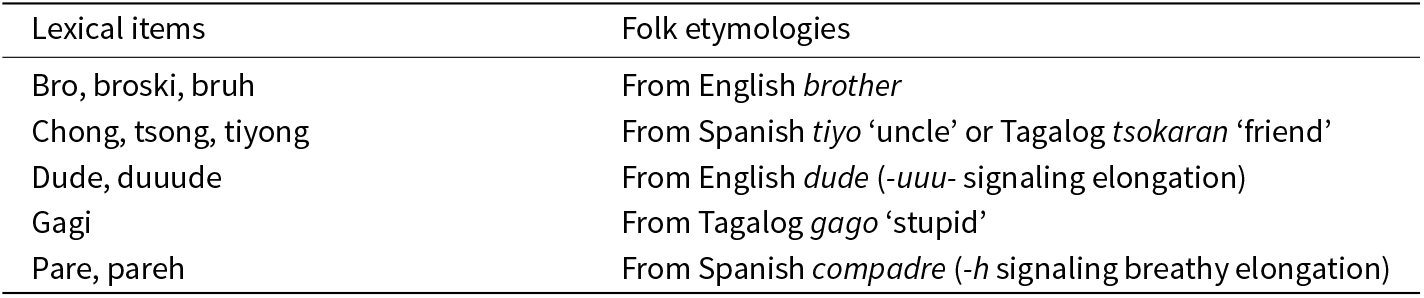
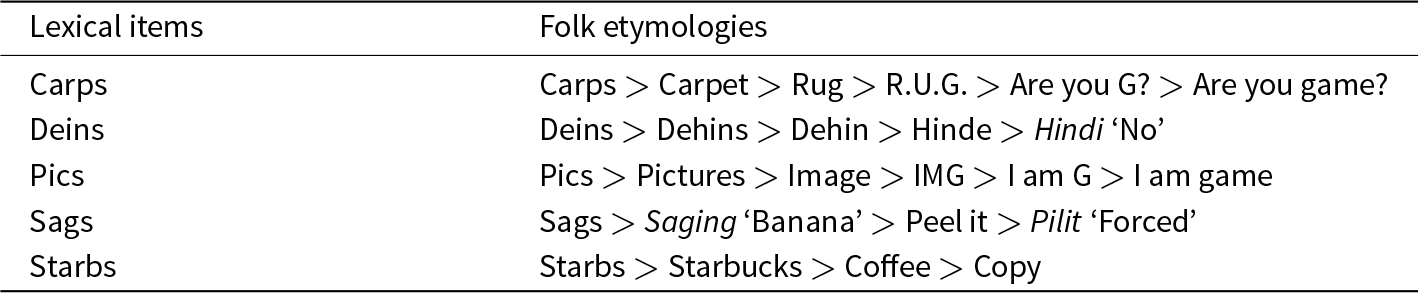
Filipinos of any gender can be regarded as conyo, but this article focuses on the male conyo figure and register. Although conyo language is portrayed similarly regardless of gender, male conyo speech is often distinguished in two main areas: vocatives and slang. Drawing on examples that appear in this article, Table 1 lists vocatives linked (though not exclusively) to male conyo, and Table 2 lists slang terms linked exclusively to conyo, primarily male conyo. These vocatives and slang terms have been enregistered across circulating conyo commentary as highly emblematic of how male conyo speak (Reyes Reference Reyes2017).
Conyo masculine vocatives

Table 1 Long description
The table pairs several masculine vocatives used in Conyo speech with their suggested folk etymologies. English-derived items include bro, broski, and bruh from brother, and dude and duuude from dude, with duuude marking elongation. Spanish-linked items include chong, tsong, and tiyong from tiyo meaning uncle, and pare and pareh from compadre, with pareh marking breathy elongation. One Tagalog-based example is gagi from gago meaning stupid, and chong, tsong, and tiyong are also linked to a Tagalog source tsokaran meaning friend. Overall, English and Spanish are the most common proposed sources, with Tagalog appearing as either a direct origin or an alternative explanation. These are folk etymologies, so they reflect popular beliefs about origins rather than confirmed historical derivations.
Conyo masculine slang

Table 2 Long description
The table pairs five masculine slang lexical items with their folk etymology chains, showing step-by-step transformations in spelling, sound, and meaning. Carps is traced through Carpet, Rug, the letters R U G, then “Are you G?” and ends at “Are you game?” Deins shifts through several spellings to Hindi “No.” Pics moves from Pictures to Image to the abbreviation IMG, then “I am G,” ending at “I am game.” Sags is linked to the Filipino word for banana, then “peel it,” ending at the Filipino word meaning “forced.” Starbs goes from Starbucks to Coffee and ends at “Copy.” These are folk explanations rather than verified historical origins, so they should be read as playful narratives of how speakers reinterpret words.
Enregistered conyo masculine vocatives presuppose how male conyo address male peers. Table 1 features the word formation processes for these vocatives as explained by the 1993 Tagalog Slang Dictionary.Footnote 1 That these vocatives are glossed in a dictionary of slang terms gathered through “student assignments” (1993, v) at a private university suggests that these terms were widely recognized by college students, whether or not directly linked to conyo. Since 1993, numerous conyo glossaries have recontextualized these vocatives as emblematic of how male conyo address male peers in ways that are friendly (e.g., “pare”), familial (e.g., “bro”), and playful (e.g., “gagi”), thus rhematizing a link between the relaxed and jocular speech and behavior of male conyo (Reyes Reference Reyes2017).
Enregistered conyo masculine slang terms presuppose how male conyo interact with peers. Table 2 features the word formation processes for these slang terms as explained by students at a private university in their 2016 publication, Libro ng Conyo sa Ateneo ‘Book of Conyo at Ateneo.’Footnote 2 For example, the “carps” entry in Figure 1 is short for “are you game?,” a phrase used to invite someone to agree or join in some endeavor. The entry explains that “carps” is shortened from “carpet,” which is synonymous with “rug.” If read as an initialism, “rug” becomes “R.U.G.,” which can stand for “are (‘R’) you (‘U’) game (‘G’)?” The entry includes a sample sentence: “Boy1: Palamig tayo sa Rizzie, carps?” ‘Let’s chill at Rizal library, ok?’ Enregistering such vocatives and slang terms as emblematic of male conyo (“Boy1” as token of type) presupposes the kinds of interactions they typically engage in: chummy exchanges with college buddies.
Carps.

Although conyo as a term for an elite figure and register did not likely circulate prior to the mid-20th century, this does not prevent Filipinos in the 21st century from imagining how elites in the 19th century were conyo, spoke conyo, or created conyo. In fact, one conyo origin myth, which grounds itself in the 1800s, steadily rearticulates across several contemporary domains, including my ethnographic research site (Reyes Reference Reyes2017). This narrative tells of Spanish colonists frequently using the curse word coño, which somehow caused Filipinos to refer to the Spanish as conyo. The conyo label then expanded to include new groups based on incremental degrees of proximity to the sources of colonial power: referring first to the Spanish (Spanish born in Spain, or Peninsulares), then to the creole (Spanish born in the Philippines, or Insulares), then to the mestizo (mixed race, typically some combination of Filipino, Spanish, and Chinese), and finally to the broader Philippine elite (particularly affluent or aspirational youth).
Rizal as person
If conyo is imagined to exist in the 19th century, who from the 19th century is linked to conyo? José Rizal, a Filipino national hero from the late 1800s, is often entertained as one of the earliest conyo authors or animators.
José Rizal (1861–1896) was a Filipino-Chinese mestizo doctor, writer, and nationalist. He was part of the ilustrado ‘enlightened ones,’ upwardly mobile male intellectuals, many of whom were educated in private schools in Manila and then abroad in Europe, where several were politically active. Working in Spain alongside other Philippine expatriates, Rizal was a prominent member of the Propaganda Movement and La Solidaridad, an organization and newspaper that advocated for political reforms under Spanish colonialism (1565–1898). He is celebrated for speaking 22 languages and for mobilizing through intellect rather than violence. His two novels, 1887’s Noli Me Tangere ‘Touch Me Not’ and 1891’s El Filibusterismo ‘The Reign of Greed,’ which he wrote in Spanish, were seen by colonial officials as treasonous in their portrayal of a corrupt Spanish government. Rizal was convicted of rebellion during the Philippine Revolution (1896–1898) and was executed by firing squad at the age of 35.
Not unlike the creation of Hồ Chí Minh as a moral and linguistic exemplar in Vietnam (Sidnell Reference Sidnell2024), José Rizal, too, emerged as an enduring model for the Philippine people. Rizal is a complex semiotic object, seemingly within reach because he is often taken to indexically and iconically represent contemporary actors in both causal and comparable fashion: they are Filipino because of him (the indexical ground); they are like him in body and speech (the iconic ground). He is not only an exemplar but also widely regarded as the “first Filipino” (Anderson Reference Anderson1998) and “father” of the nation (Rafael Reference Rafael1990), responsible for birthing a range of cultural forms, perhaps even conyo. Conyo, after all, are also viewed as an elite racial and linguistic mix like Rizal.
With Rizal as exemplar, the qualities of hybridity and multiplicity—that is, racial and linguistic amalgamation and plurality evidenced by his mestizoness and polyglotism—are often framed as favorable, enduring characteristics of Philippine national formation (Reyes Reference Reyes, Alim, Reyes and Kroskrity2020). As Rafael notes, “to occupy the position of mestizo/a is to invoke the legacy of the ilustrados, the generation of mostly mixed-race, Spanish-speaking, university-educated nationalists from the Chinese mestizo Jose Rizal to the Spanish mestizo Manuel Quezon—both credited with founding the dominant fictions of Filipino nationhood” (Reference Rafael1995, 104–05). Even a famous Tagalog poem, Sa Aking Mga Kabata ‘To My Fellow Youths,’ which is attributed to Rizal and revisited annually across Philippine society to encourage linguistic pride and unity during National Language Month (Buwan ng Wikang Pambansa), can be recontextualized to question the Herderian ideology of one nation-one language. As one journalist concludes her interpretation of the poem in a 2024 article, “Whether speaking pure Filipino, regional dialects, or even Conyo Filipino, the essence of Rizal’s message remains clear: love and value the language that binds us as a nation.”Footnote 3
During ethnographic fieldwork, my participants would also situate conyo elites relative to Rizal, ilustrados, and the Spanish colonial era, echoing the conyo origin myth discussed above. For example, when I interviewed Ph.D. student GemmaFootnote 4 about conyo, she said: “I wouldn’t be surprised if it’s like a really early term, maybe that’s what the Spanish called Filipinos who were trying hard to be Spanish, I don’t know. I wouldn’t be surprised because it sounds like an insult.” Gemma then brought up the ilustrado: “Maybe if you have a positive term like ilustrado, ‘oh, you’re an ilustrado,’ and they look up to you, maybe there’s a negative, like another side of the coin being a conyo.” Gemma, who also referred to Rizal as “the epitome of ilustrado” earlier in our conversation, contemplated the existence of conyo and ilustrado in the same historical moment, but drew them into a relation of contrast: conyo as the “negative version” of ilustrado, and by extension, Rizal.
Other research participants, including undergraduates Gigi and Nell, also brought up Rizal in their conversations about conyo. As Gigi was interviewing Nell for me, they both regarded Rizal as the author of perhaps the first literary representation of conyo: the character Doña Victorina in his 1887 novel Noli Me Tangere, which remains widely known, read, and adored in the Philippines (Anderson Reference Anderson1998). Gigi explained how conyo can be a “negative term,” offering this example: “I’m a Filipino back in the Hispanic times. I was able to social climb myself up to their status because I married this rich old guy. Like I remember the example given was like Doña Victorina in Noli Me Tangere. She just married a Spanish guy.” Nell added: “She’s a fraud and wears makeup all the time, tries to act all Spanish, but she’s not really a Spaniard. She and her husband, you know Don Tiburcio is a fraud doctor.” Referring to Doña Victorina, a character in Rizal’s novels, as an example of the social-climbing conyo, Gigi and Nell repeat Gemma’s “negative” assessment of conyo as an emergent category not only in Rizal’s time but also in Rizal’s writings about the social conditions under Spanish empire.
Like most of my participants at the private university where I did fieldwork, Gemma, Gigi, and Nell would alternate between mocking and defending conyo within and across interactions and interviews. But they display no such ambivalence here. When it comes to discussing conyo in relation to Rizal, my participants emphasize “negative” conyo characteristics (e.g., “trying hard,” “social climb,” “fraud”), qualities they position in contrast to the “positive” ones displayed by the intelligentsia of yesterday (ilustrado) and today (themselves). Thus, discussions of conyo relative to Rizal also serve to solidify their aspirational alignment toward Rizal as an exemplar.
Rizal as conyo
Rizal’s conyo connection emerges not only in my ethnographic research but also in social media data. As online discourses about conyo began accelerating in the 2010s, Rizal often appeared in comments, images, and videos about conyo. However, unlike my participants, who view Rizal’s relationship to conyo as one of contrast (Gemma) or author (Gigi and Nell), many online users envision Rizal as animator.
To be clear, I am not interested in how Rizal “really” spoke, but in how present-day college students and media producers describe or perform Rizal’s language use. Tracing this metapragmatic realm of reported speech, I examine an approximately decade-long moment in the early 21st century in which people recuperate Rizal’s image and voice to perform social action. This article is thus concerned with how people imagine history, how people project meaning and value onto the past to do contemporary work.
This invention of tradition, as it were, is paired with a channel that is equally resistant to linear progression: memes (Blommaert and Varis Reference Blommaert and Varis2015). The memes I consider here are widely circulating online images and videos that combine two popular genres. The first genre is the temporal mashup, which places at least two distinct temporal modes into the same chronotopic frame. In the data below, the temporal mashup takes the form of envisioning historical actors (e.g., Rizal) engaging in contemporary modes (e.g., podcasting). The second genre is the origin story, which explains a phenomenon by establishing a set of prior events as relevant context (like the conyo origin myth discussed earlier). Similar to how my ethnographic participants assert a link between conyo and Rizal, the media data below trace the origins of conyo to Rizal, as if he were a central node in its making.
In these mashup origin memes, voicing Rizal as conyo takes on a burlesque quality, maneuvering citational and interdiscursive processes to pick out a high cultural form (e.g., a national hero) and place it into a low vernacular genre (e.g., speaking slang). These parodic reanimations demonstrate personification as a creative process, aligning with the capitalist project of self-celebrity in which one benefits from an origin story and, in constructing one, invents—reshapes, revivifies—a new figure to behold, whether conyo as type, or Rizal as token of the type.
Figure 2 features some of these memes as “image-texts,” where “images are entextualized and interdiscursively taken up by variously interested projects to various effects” (Nakassis Reference Nakassis2019, 71). The image furthest to the left (image A) is a cropped picture of a widely reproduced photograph of Rizal taken in Madrid in 1890, his last studio portrait (Rafael Reference Rafael1990). This photograph is one of dozens taken of Rizal during his lifetime, from age 12 until his death at age 35. Rafael explains how Rizal’s “images have clung to the national consciousness,” as “his photographic likeness has adorned everything from stamps to currency notes, matchboxes to amulets, book covers to postcards” (Reference Rafael1990, 610). Among all of the photographs of Rizal, image A has circulated perhaps the farthest and longest: from printed copies during the 19th-century revolution to digital versions across 21st-century media. This photograph is also the one most often chosen to alter when refashioning Rizal as conyo. For example, image B is the doctored photograph that once appeared as the profile picture for the Coños of Manila @ManilaConyos Twitter account, which was opened in 2014. The three main alterations are a new hairstyle, trendy eyewear, and a black blazer with no high-collared shirt underneath. Image C is the updated profile picture that accompanies that account (now on X, 651K followers, last posted in 2021), with Rizal in another new hairstyle and a COVID-era face mask. Image D was created by Raco Ruiz, who impersonates Rizal as if he were conyo in a 2022 TikTok video (to be analyzed below). Image D modifies image A by adding aviator sunglasses and a sepia tone.
Conyo Rizal images.

Not only is Rizal’s image manipulated to produce a conyo effect, but so too is his language. Figure 3 captures some of these linguistic representations. The image on the left (image E) appears in both a 2015 online quiz, “Yes or No Are You a Conyo”Footnote 5 (created by the now-defunct Philippine website Snackvox), and a 2015 Cosmopolitan Philippines article, “13 Signs You’re a Conyo of Manila.”Footnote 6 It adds two features to image B (in Figure 2): a new background that makes it appear as if Rizal is at a crowded live music event; and a speech bubble with the words “TUS, BRO!” as if spoken by Rizal. Combining Filipino slang, tus (an interjection signaling disapproval), with a conyo masculine vocative, “bro” (see Table 1), Rizal is depicted as a conyo out partying and playfully chiding a friend.
Conyo Rizal language.

Figure 3 Long description
The layout is a two-part, side-by-side meme-style infographic about Conyo Rizal language. The left part shows a man with the face covered by a pixelated block. A speech bubble reads: TUS, BRO! The right part shows an illustrated scene with two men in formal clothing. Multiple speech bubbles and word bubbles appear around them. The visible text includes: you know like?, Deins, pics, starbs, pare, carps, duuude, sags. A monument and paper documents are shown in the background.
Image F appears in a 2024 Daily Tribune (Philippines) article, “Love your wika, pare! Lessons from Dr. Jose Rizal on loving our own language” (see footnote 3). The title includes a direct address in conyo speech, “Love your wika, pare!,” showcasing conyo Taglish by combining English, Tagalog “wika” ‘language,’ and a conyo masculine vocative, “pare” (see Table 1). Moving from second-person (“your”) to first-person (“our”), the title recruits the reader as conyo, as friend, and as fellow citizen in need of linguistic pride. The two images of Rizal in image F are taken from different sources: the one on the right is a mirror image of image A (in Figure 2); the one on the left is a cropped and colored image of a photograph in which Rizal poses with two other ilustrados: Marcelo H. del Pilar and Mariano Ponce. Also pictured are images of Rizal’s two novels and the Rizal Monument, which stands in Rizal Park in Manila. Although the text of the article does not position Rizal as conyo, this image in the article does. Like image E, image F uses speech bubbles to portray Rizal as speaking conyo language—“pics” and “duuude!”—while surrounded by conyo language: “pare,” “you know like!,” “starbs,” “deins,” “carps,” and “sags” (see Tables 1 and 2).
Not only is Rizal reimagined as conyo across media sites, so too are other Filipino historical figures: for example, General Antonio Luna (1866–1899), leader of the Philippine Revolutionary Army during the Philippine-American War (1899–1902), and Manuel Quezon (1878–1944), second president of the Philippines. In Figure 4, the two images on the left depict the transformation of Antonio Luna (image G) into “Tony Moon,” a conyo in stylish shades (image H), taken from the same video where image D (in Figure 2) appears. In the two images on the right, Manuel Quezon (image I) turns into a conyo (image J) through explicit metapragmatic descriptors—“RAYBAN,” “PUSHED BACK HAIR,” “PORMA” ‘style’—and quoted speech—“DEINS, BRO!!!”—using the familiar speech bubble convention to combine conyo masculine slang, “deins,” with a conyo masculine vocative, “bro” (see Tables 1 and 2). Image J appears on the cover of #CONYONATION, a class project publication created by private school students in Manila in 2015.Footnote 7
Conyo Luna and Quezon.

Among all of the historical figures who are reimagined as conyo, however, Rizal is one of the earliest and, by far, most common.Footnote 8
Conyo Rizal on video
This section discusses two video memes and their comment threads in which Rizal appears as conyo. The first video was created by Jico Umali, described as a “viral content creator” in his 2022 Manila Bulletin profile.Footnote 9 Private school-educated in Manila and creating conyo videos since 2021, Jico also goes by “Jiconyo,” given his work on these videos. The second video was created by Raco Ruiz, described as an “artist and content creator” in his 2024 Lifestyle Inquirer profile.Footnote 10 Like Jico, Raco was also private school-educated in Manila and rose to fame by posting conyo videos since 2022. Although Jico and Raco create conyo videos on a wide range of subjects (e.g., how conyo work, date, travel, speak), the two videos they created below are about portraying Rizal as conyo.
What motivates Jico and Raco to generate conyo videos? This question is linked to how value moves. Conyo memes mobilize many kinds of value online: not just economic value, but also social value and their mutual constitution. I will take each in turn. First, as a thoroughly mediatized institution that “links processes of communication to processes of commoditization” (Agha Reference Agha2011, 175), contemporary media economies have given rise to Jico and Raco’s occupation of “content creator” (or “influencer”), which generates monetary value through various mechanisms (e.g., advertising revenue, channel memberships) based on a range of closely monitored “metrics” (e.g., views, followers). If conyo memes attract online traffic, then workers like Jico and Raco will make them. It’s a hustle. Second, by creating conyo Rizal videos in particular, Jico and Raco also help recalibrate the social value of the ridiculed figure of conyo (as empty-headed and spoiled) by placing it in relation to the revered figure of Rizal (as intellectual and heroic). Although this juxtaposition may heighten their difference (and is likely the point and source of the humor), claiming that conyo emanates from Rizal also builds on an established indexical and iconic link between Rizal and contemporary Filipinos discussed earlier. Reiterating this continuity between the venerated ilustrado and the derided conyo entertains contemporary elites as possible national heroes whose status should also be protected. Value then moves toward conyo elites, which includes two groups: those already in the upper classes, and those aspiring to be, including Jico and Raco and other precarious subjects of the influencer economy. For both groups, a fundamental economic motivation for discussing and elevating conyo drives long-term and short-term capital flow, respectively. The intertwining of social and monetary values is thus reinforced across conyo Rizal memes, as his personhood is enregistered in the conyo repertoire of signs.
Jico as J-Riz
In 2022, PGAGFootnote 11 posted the one-minute video, “POV: Conyo si Jose Rizal” ‘Point of view: José Rizal is conyo,’ on Facebook (see Figure 5).Footnote 12 The video, which received 4.4 million views, features Jico Umali impersonating Rizal: using conyo language; wearing a black blazer and necktie, white t-shirt, and fake moustache; and standing in front of backdrops featuring colonial-era streets and buildings in the Philippines. Jico as Rizal appears alone in the video and does not address the viewer. Instead, he directs his gaze to the side of the camera as he talks to co-present, but offscreen, interlocutors in late-1800s Manila. The videoFootnote 13 begins:

J-Riz.

Voicing Rizal as attending to how he is referred to, Jico opens the video by placing forms of personhood within a spatiotemporal frame: “you” now in the Philippines (circa 1890s) vs. “they” then “in Spain” (circa 1880s). Rizal is pictured in late-19th-century Manila using an informal modern greeting, “Yo,” to initiate an interaction with “U” (“you,” an offscreen addressee). Rizal asks “U” to “call me J-Riz” (or “Pepe,” Rizal’s nickname). The term “J-Riz” is likely formed through a clipping of “José Rizal” that is a play on the slang term “rizz” (from charisma). J-Riz then acknowledges that “they” (“in Spain”) call him “Conyo.” Both worldly and naïve, Rizal is portrayed as aware that people in the metropole recognize him as conyo, but unaware why, expressing in conyo Taglish: “in Spain nga eh,” “di ko lam why.”
The proposition that people in 19th-century Spain called Filipinos conyo echoes what my ethnographic participants discussed above. Gemma, Gigi, and Nell suggested that “in the Hispanic times,” “the Spanish called Filipinos who were trying hard to be Spanish” conyo as an “insult” to “frauds” who “social climb.” Even though Rizal was part of the male intelligentsia, he is portrayed in this video as unable to escape being interpellated as the “negative” conyo rather than the “positive” ilustrado (as my participants framed it), to his befuddlement.
After these opening lines, J-Riz directly addresses other offscreen interlocutors: “Andres B” (Andres Bonifacio [1863–1897], revolutionary leader of the Katipunan), “shawties” (also “shorties,” a term of endearment), and “bro” (see Table 1). With female addressees, J-Riz incessantly flirts: asking them to come close and take a ride in his “kalesa” ‘horse-drawn carriage.’ With male addressees, J-Riz talks about courting women and socializing with friends. In the last 20 seconds of the video, J-Riz is portrayed as lightheartedly negotiating with the firing squad before his execution. Rizal is thus portrayed as displaying several characteristics of the conyo type: speech (conyo language, slang), behavior (clueless, cocky, status-conscious), and interests (dating, partying).
In the first 200 of 10,000 comments sorted by “Most Relevant,” the majority praised the video, and a few elaborated on Rizal as conyo, including the three comments in Table 3.
J-Riz video comments

Here, Rizal is called “the original conyo.” But what does “original” mean? Historically first? Best example? Original animator? Original author? This indexical ambiguity begins to dissolve as the poetic patterning across the video and comment threads reveals an emergent meaning for “the original conyo.” First, in addition to being called “the original conyo,” commenters say that “Jose Rizal can actually be referred to as today’s colloquial ‘conyo’” and “Rizal also speaks the way a modern conyo/coño does.” Positioning Rizal as “the original conyo” of the “modern conyo,” Jico and his commenters map two temporal moments onto one another: “at the (ilustrado’s) time” (late 1800s) and “today” (early 2000s). Through these emergent oppositions—“original” vs. “modern”; “at the time” vs. “today”—“original” gains meaning as historically first. But by comparing Rizal (cherished national hero) with conyo (vapid social climber), online users draw “the original conyo” “at the time” into a relation of similarity with the “modern conyo” of “today.” This is accomplished through an engaged audience that presupposes not only the humor (“funny”) of the video, but also its truth (“fun fact,” “according to one historian”).
Raco as Joe Rizzle
In 2022, just a few months after Jico posted the video above, Raco Ruiz posted on TikTok “The La SOLIDaridad Podcast,” a two-episode series in which Raco impersonates Rizal as a podcaster (see Figure 6). In these sepia-filtered videos, Raco voices Rizal using conyo language and wearing a black blazer and fake moustache (like Jico), as well as sunglasses and a white hoodie. In the first episode, which has the running title “Conyo Jose Rizal”Footnote 14 (38 seconds long; 91,000 likes; 1,100 comments), Raco animates Rizal as recording the introduction to his podcast: speaking into a microphone, wearing headphones, and addressing the viewer. In the second episode, which has the running title “Conyo Jose Rizal; Ep 02—feat. Tony Moon”Footnote 15 (59 seconds long; 37,000 likes; 392 comments), Raco animates Rizal as introducing and conversing with his first guest: “Tony Moon” (General Antonio Luna [1866–1899], see Figure 4), also played by Raco. The first video begins:

Unlike in Jico’s video, Raco as Rizal looks straight into the camera to directly address the viewer of the podcast. Thus, the “you” in Raco’s video is “you,” who is watching the podcast. But similar to Jico, Raco voices Rizal as greeting his audience with “yo” before confirming a contemporary nickname: “Joe Rizzle,” which might also be a play on rizz or perhaps the -izzle morpheme attributed to American rapper Snoop Dogg at the turn of the 21st century. As a podcaster speaking to his viewers, Raco animates Joe Rizzle (and later Tony Moon) with numerous emblems of conyo language, including “like parang,” and several conyo male vocatives, including “pareh,” “dude,” “bro/broski,” “gag111” (“gagi” in algospeak), and “chong” (see Table 1). Like J-Riz, Joe Rizzle displays bravado (e.g., “you know me”), shows interest in women (“shawtiiies” and “binibinis” ‘young ladies’), brags about riding in a kalesa, and parties in trendy neighborhoods.
Joe Rizzle.

In the 1,492 comments across both episodes, the majority praised the videos, and a few elaborated on Rizal as conyo (as they did in Jico’s J-Riz video comments), including the 7 comments in Table 4.
Joe Rizzle video comments

Supporting the assertion that Rizal is “the ultimate conyo with (h)is 22 languages,” several commenters mention “the fact” that Rizal attended Ateneo,Footnote 16 a private school often regarded as having the most conyo language and people (Reyes Reference Reyes2017). Similar to the J-Riz video comments, these comments also frame Rizal as a “conyo nung araw” ‘conyo back then,’ rooting this elite type in the 1800s, a truth they can “definitely see” and “wouldn’t be surprised” by.
Citing Rizal in conyo video memes—positioning him relative to conyo, relative to other characters in the videos, relative to the social actors voicing him, and relative to the viewers—creates tensions and possibilities for the production of semiotic relations between everyday Filipinos and exemplary Rizal. Modes of addressivity—e.g., an offscreen “you” who is not the viewer (as in Jico’s video), and a directly addressed “you” who is the viewer (as in Raco’s video)—construct a chronotopic frame where co-presence (indexicality) and likeness (iconicity) between Rizal and “you,” the broader Filipino public as onlooker or interlocutor, is entertained. These parodic images of Rizal may thus point to Rizal, but they may also point to any contemporary Filipino. If Rizal speaks how we speak, looks how we look, lives how we live, then anyone could be him, anyone could strive to be the upwardly mobile conyo. The categories of author and animator might thus dissolve as lines bleed between who authors what forms and who animates them. Such ambiguities might in turn become useful: is conyo a character in Rizal’s novel, is conyo him, is conyo us? Is conyo still an abject figure, or has its value shifted given its proximity to Rizal? Rizal may make conyo less negative, thereby making the upper classes and their aspirants more admirable, perhaps transferring and transforming the conyo figure and register. Citing Rizal thus creates a different channel to move value, both from and to conyo.
Conyo person-persona emanation and inversion
The circulation of online material, including conyo commentary and performance, is shaped by a media economy that is thoroughly monetized, moving both economic and social value. Conyo memes circulate because there is an appetite for conyo “content,” an appetite fueled by Philippine anxieties and aspirations, most notably the political economic interests of the upper classes and aspiring middle classes (Reyes Reference Reyes2017). The people posting these humorous (and “fact(ual)”!) imaginings of Rizal as conyo amuse audiences through creating juxtapositions and continuities between the two. Meanwhile, Rizal’s “aura” as exemplar only seems to increase, precisely because of, not despite, its reproduction, unlike Benjamin’s (Reference Benjamin and Arendt1935) prediction. In contrast to the supposedly durable and longstanding phenomena of Rizal and conyo that online users trace, social media stardom is often precarious and short-lived, driven by the principle and algorithm of capital. Yet even commercial ventures that lack a clear political commitment do not operate outside of ideology. So what ideological projects and economic interests do these conyo Rizal discourses advance?
Across these various data, participants imagine Rizal as “the original conyo,” positioning him as the point of emanation of the “modern conyo.” These discourses presuppose a person-indexing register for Rizal that is not only similar to (iconic), but also causal of (indexical), a persona-indexing register of conyo: Rizal is both conyo likeness and conyo genesis. Whether locating Rizal as author (ethnographic data) or animator (media data), participants agree that conyo begins with Rizal: in his personhood, in a character in the novels that he wrote, or in relation to the ilustrado of which he was a prominent member. Yet across conyo Rizal memes, conyo does not so much index Rizal as it does incorporate Rizal into its repertoire, as sites of emanation (i.e., schools and media) continue to propel conyo enregisterment.
Conyo Rizal discourses interdiscursively link persona (conyo) to person (Rizal), type to token, by asserting a temporal linearity: first Rizal, then conyo. Not unlike Inoue’s (Reference Inoue2004) indexical inversion, however, these discourses might operate in reverse of what they propose: i.e., not from Rizal to conyo, but from conyo to Rizal; not from person to persona, but from persona to person; not from past to present, but from present to past. This tension between the origins and endpoints of time-space-personhood informs the chronotopic fantasies surrounding conyo. When, where, and who is conyo? In which time, in which place, and in which body? Is conyo a break from or an extension of the colonized elite under Spanish empire?
A metapragmatic orientation toward conyo, which traces discourses about this type and its tokens, reveals an emergent axis of differentiation organized along a temporal distinction (Gal and Irvine Reference Gal and Irvine2019). This axis enables contrast and comparison of its components: past, present; Rizal, conyo; person, persona; “original,” “modern.” Although Rizal and conyo are both regarded as elite, the humor of these images and videos relies on the presupposition of their difference: Rizal as intellectual, conyo as vacuous; Rizal as mastering languages, conyo as mangling languages; Rizal as leading a revolution, conyo as following fashion; Rizal as caring about the nation, conyo as caring about themselves. In other words, how comically absurd to have national hero Rizal, of all people, imagined as a silly, selfish conyo? “I’ll watch that!”
Yet these images and videos also open up the possibility that conyo—and perhaps all contemporary Filipinos—might, in fact, be like Rizal; there might be a lineage, a connection between them. Maybe conyo are, or have the potential to be, national heroes too. If conyo are connected to Rizal, whom the nation and people adore, maybe conyo—and the Philippine elite in general—are not so bad after all; maybe they have the interests of the nation and its people at heart. This might be where the workings of ideology protect the political economic interests of the elite, by poking fun at their personhood but not poking holes in their pockets.
Inventing and interdiscursively linking a persona-indexing conyo register and a person-indexing Rizal register connects a ridiculed category to a revered individual. This link creates a type-token relation, enabling admirable qualities of a token to leak onto a type through a chronotopic inversion. If conyo emanates from a national hero, then contemporary elites must be pretty fantastic too.
Acknowledgements
Earlier versions of this article were presented at the Person-centered Enregisterment Workshop at Boston College in 2025 and at the Franz Boas Seminar in the Department of Anthropology at Columbia University in 2026. I thank the following individuals for their generous feedback on earlier drafts: Asif Agha, Naor Ben-Yehoyada, Hannah Chazin, Elaine Chun, Luke Fleming, Ilana Gershon, Nicholas Glastonbury, Mara Green, Courtney Handman, Nicholas Harkness, Adrienne Lo, James Meador, Rosalind Morris, Constantine Nakassis, Julien Porquet, Paloma Rodrigo Gonzales, Stanton Wortham, Chip Zuckerman, and an anonymous reviewer. All remaining weaknesses are mine alone.


 Open access

