


Introduction
This study uses a systematic review and meta-analysis of the Benazir Income Support Programme (BISP), Pakistan’s largest unconditional cash transfer (UCT) programme, to assess its impact on poverty reduction and women’s empowerment. BISP currently benefits approximately nine million families, each with an average household size of seven, making it one of the largest UCT initiatives globally. This research is significant because UCTs are widely recognised as key interventions for alleviating poverty and advancing women’s empowerment (Barrientos and Hulme, Reference Barrientos and Hulme2009; Pega et al., Reference Pega, Liu, Walter and Lhachimi2014; Bastagli et al., Reference Bastagli, Hagen-Zanker, Harman, Barca, Sturge and Schmidt2016). In recent decades, many countries have shifted from macro-structural poverty reduction strategies to UCT programmes, based on the premise that such initiatives enable individuals to build human capital and enhance their overall well-being (Fraser, Reference Fraser2013; Marcenò, Reference Marcenò2018). A growing number of developing and less-developed countries have adopted UCTs to address poverty and promote gender equity (Bahle et al., Reference Bahle, Pfeifer, Wendt, Castles, Leibfried, Lewis, Obinger and Pierson2010; Leisering, Reference Leisering2018; Hickey et al., Reference Hickey, Lavers, Niño-Zarazúa and Seekings2019). Understanding how the available quantitative evidence on a flagship programme such as BISP fits together is therefore directly relevant for both national policy and global debates on social protection.
Previous studies, including several systematic reviews, have primarily focused on assessing the overall effectiveness of cash transfer programmes across multiple countries rather than evaluating specific national programmes in depth (Pega et al., Reference Pega, Liu, Walter and Lhachimi2014; Bastagli et al., Reference Bastagli, Hagen-Zanker, Harman, Barca, Sturge and Schmidt2016). For instance, Pega et al. (Reference Pega, Pabayo, Benny, Lee, Lhachimi and Liu2022) found that unconditional cash transfers in low- and middle-income countries modestly increased the use of health services and dietary diversity, although clinical health outcomes remained inconsistent. Bastagli et al. (Reference Bastagli, Hagen-Zanker, Harman, Barca, Sturge and Schmidt2016), in a review of fifty-six programmes, reported improvements in school attendance, food security, and household consumption, with considerable variation influenced by programme design and local implementation contexts. Leight et al. (Reference Leight, Hirvonen and Zafar2024) highlighted the long-term benefits of cash transfers, such as economic empowerment and child well-being, particularly when combined with complementary interventions like skills training. Other reviews have assessed the broader impact of cash transfers in low- and middle-income countries, including their relationship with gender equality and health inequalities (Hillier-Brown et al., Reference Hillier-Brown, Thomson, McGowan, Cairns, Eikemo, Gil-González and Bambra2019; Perera et al., Reference Perera, Bakrania, Ipince, Nesbitt-Ahmed, Obasola, Richardson and Yu2022). Owusu-Addo et al. (Reference Owusu-Addo, Renzaho and Smith2018), for instance, found that conditional and unconditional cash transfers improved maternal and child health outcomes in sub-Saharan Africa. In Pakistan, BISP survey data have been used by several researchers to conduct stand-alone impact evaluations using a range of empirical approaches. However, these studies are typically interpreted individually and use different outcomes, specifications, and samples. This study therefore uses a systematic review and meta-analysis of BISP to provide a programme-specific synthesis of the evidence base and examines how its reported impacts relate to those found in the wider UCT literature.
While existing literature provides valuable insights into the general effectiveness of cash transfers, global reviews cannot determine whether average effects across UCTs and CCTs apply to a specific national programme with BISP’s design and implementation context. This matters because BISP exists within its own unique context and socio-political conditions. It is a large, women-targeted but relatively low-value UCT operating in a context of constrained social protection spending, targeting challenges and entrenched gender inequality (Mumtaz, Reference Mumtaz2026). BISP’s design features create competing expectations about its likely effects. Directing transfers to women may plausibly improve women’s mobility, decision-making, and control over household resources, particularly in a context where women’s economic agency is often constrained. At the same time, the low real value of the transfer, limited integration with complementary services, targeting challenges, and Pakistan’s entrenched patriarchal norms may restrict the programme’s ability to produce larger or more transformative effects on poverty reduction and women’s empowerment. Notably, no study to date has undertaken a systematic review and meta-analysis of Pakistan’s BISP, despite its scale and significance. This represents a gap in the literature that this study seeks to address.
The paper makes an empirical and synthesis of the evidence base contribution to the cash-transfer literature. Empirically, it provides the first systematic review and meta-analysis of quantitative evidence on BISP’s effects on poverty reduction and women’s empowerment, which remains one of the world’s largest cash transfer programmes. Conceptually, it uses BISP as a country-specific case to examine whether assumptions and average effects from the wider cash transfer literature hold true for a women-targeted, low-value UCT operating in Pakistan’s fiscal, institutional, and gender context. The paper applies established robust variance estimation methods to a fragmented evidence base in which studies report multiple, partly dependent outcomes. Given that each welfare policy operates within a distinct socio-political and economic context, BISP’s effectiveness cannot be assumed from outcomes observed elsewhere (Mishra, Reference Mishra1999).
From a policy perspective, a national focus enables more informed programme design, optimises resource allocation, and supports the development of gender-sensitive policies by evaluating BISP’s effectiveness in reducing poverty and enhancing women’s agency (Ambler and de Brauw, Reference Ambler and de Brauw2017; Cheema et al., Reference Cheema, Farhat, Hunt, Javeed, Keck and O’Leary2016). The evidence generated through this review can inform the scalability of the programme, align with national priorities such as Sustainable Development Goal 5 (Gender Equality), and equip policymakers and advocates with the tools needed to strengthen and refine Pakistan’s social protection framework.
The rest of the paper is structured as follows: the next section provides a brief overview of UCTs and their role as instruments of social change, followed by a discussion of BISP. Section 4 outlines the review methodology, followed by the presentation of results. The final section offers conclusions and discusses the study’s limitations.
Cash transfers, poverty reduction, and women’s empowerment – a theory of change
Cash transfers are direct payments provided by governments or organisations – local or international – to individuals or households, primarily aimed at alleviating poverty and offering social protection by assisting low-income and vulnerable groups (Bastagli et al., Reference Bastagli, Hagen-Zanker, Harman, Barca, Sturge and Schmidt2019). There are two types of cash transfers: Conditional Cash Transfers (CCTs) and UCTs (Tesliuc et al., Reference Tesliuc, del Ninno and Grosh2009). The key distinction is that UCTs provide cash without any conditions, while CCTs require specific behaviours, for instance, maintaining 80 per cent school attendance. Factors like monitoring levels and transfer amounts can also influence their outcomes (Baird et al., Reference Baird, Ferreira, Özler and Woolcock2013). Cash transfers are generally issued in small monthly amounts to designated households (Leisering, Reference Leisering2018; Slater, Reference Slater2011), though in some cases, aid is delivered as a one-time lump-sum payment (Haushofer and Shapiro, Reference Haushofer and Shapiro2016). For example, during the COVID-19 pandemic in Pakistan, a lump-sum payment was provided to households under the UCT ‘Ehsaas’ programme.
A growing body of literature explains the rationale behind cash transfers and how they are expected to create change. Barrientos (Reference Barrientos2012) suggests that cash transfers can enhance household productive potential, leading to increased consumption and economic growth. This aligns with the idea that an increase in household income from cash transfers induces an income effect, increasing the resources available for consumption, investment in health and education, and other household priorities. This effect not only raises the share of income controlled by each household member, including women, but also increases overall spending, particularly on health and nutrition (Glassman et al., Reference Glassman, Duran, Fleisher, Singer, Sturke, Angeles and Koblinsky2013). The main argument for UCTs is that the key constraint for poor people is a lack of money, not knowledge. Therefore, they are best positioned to decide how to use the cash (Barrientos and Hulme, 2010). Additional income enables them to invest in health, education, and other areas that are most important to them (Sabates et al., Reference Sabates, Bhutoria, Sabates-Wheeler and Devereux2019).
While many cash transfer programmes globally are based on similar assumptions, each operates within a unique context, meaning the theory of change for each programme may differ (Browne, Reference Browne2013). Empirical evidence across various cash transfer programmes generally supports the theory of change. Kabeer and Waddington (Reference Kabeer and Waddington2015), in their systematic review, show that cash transfer programmes have increased household consumption and investment while reducing child labour. Similarly, Baird et al. (Reference Baird, Ferreira, Özler and Woolcock2013), in their systematic review of such programmes in Asia, Latin America, and Africa, demonstrate a positive effect of cash transfers (both conditional and unconditional) on school enrolment. Manley et al. (Reference Manley, Balarajan, Malm, Harman, Owens, Murthy and Khurshid2020) also show a positive linear effect between cash transfers and child nutritional outcomes in developing countries with eligible programmes.
Barrientos (Reference Barrientos and Bandyopadhyay2023) argues that UCTs have expanded across low- and middle-income countries since the early 2000s, significantly reducing poverty in many nations. Prominent anti-poverty programmes include Mexico’s Oportunidades, Brazil’s Bolsa Escola/Familia, South Africa’s Child Support Grant, Ethiopia’s Productive Safety Net Programme, India’s National Rural Employment Guarantee Scheme, China’s Minimum Living Standard System (Dibao), and Pakistan’s BISP (Leisering and Barrientos, Reference Leisering and Barrientos2013; Mumtaz et al., Reference Mumtaz, Roumpakis and Sumarto2023). However, challenges remain in achieving adequate coverage due to limited financial and administrative capacity, issues with targeting, and weak organisational infrastructure in many low-income countries (Ferguson, 2015; Schüring, Reference Schüring and Schüring2021; Banerjee et al., Reference Banerjee, Hanna, Olken and Sverdlin-Lisker2022). Low fiscal transfers to households also hinder the achievement of UCT objectives (Mumtaz and Whiteford, Reference Mumtaz and Whiteford2017; Mumtaz and Roelen, Reference Mumtaz and Roelen2025).
BISP – Pakistan’s largest UCT programme
Launched in 2008 to mitigate the economic strain caused by soaring inflation and rising food and oil prices, the BISP has become one of South Asia’s most prominent and Pakistan’s largest UCT initiatives. Initially supported by the World Bank, the United States Agency for International Development (USAID), UK Department for International Development (DFID), and the Asian Development Bank (ADB), BISP began with a budget of PKR 34 billion to provide social safety nets to 3.5 million vulnerable families (Mumtaz and Whiteford, Reference Mumtaz and Whiteford2017). The programme prioritised cash disbursements to female heads of households to reduce poverty and promote women empowerment as its main objectives (Durr-e-Nayab and Farooq, Reference Farooq2014; Cheema et al., Reference Cheema, Binci, Farhat, Asmat, Javeed and O’Leary2020).
The early beneficiary selection process relied on recommendations from parliamentarians, which led to allegations of political bias – particularly the preferential treatment of regions such as Sindh over opposition strongholds like Punjab (Cheema et al., Reference Cheema, Farhat, Hunt, Javeed and O’Leary2014, Reference Cheema, Farhat, Hunt, Javeed and O’Leary2015; Mumtaz and Whiteford, Reference Mumtaz and Whiteford2017). To address these concerns, BISP adopted a Proxy Means Test (PMT) in 2010–11 through the National Socio-Economic Registry (NSER), which surveyed 27 million households (Cheema et al., Reference Cheema, Farhat, Hunt, Javeed and O’Leary2015). This reform enhanced targeting transparency by setting a PMT cut-off score of 32 (37 for households with disabled members) to identify the poorest 25 per cent of the population (Mumtaz and Whiteford, Reference Mumtaz and Whiteford2017; Mumtaz, Reference Mumtaz2022; Cheema et al., Reference Cheema, Binci, Farhat, Asmat, Javeed and O’Leary2020). By 2016, BISP transitioned to digital payments via biometric-enabled debit cards, streamlining disbursements and reducing leakages (Cheema et al., Reference Cheema, Binci, Farhat, Asmat, Javeed and O’Leary2020). Between 2019 and 2021, the NSER was updated through door-to-door surveys and desk-based registration to ensure accurate targeting. Quarterly payments are now verified at biometric ATMs or designated retail outlets (Mumtaz, Reference Mumtaz2022; Cheema et al., Reference Cheema, Binci, Farhat, Asmat, Javeed and O’Leary2020).
By 2023, BISP’s budget had increased to PKR 471 billion, covering 9.3 million families across all provinces and territories, including Punjab, Sindh, Balochistan, Khyber Pakhtunkhwa, Azad Jammu and Kashmir, and Islamabad. The programme has introduced complementary initiatives such as Benazir Nashonuma for nutrition support and Benazir Kafaalat. BISP stipends were raised from PKR 7,000 to PKR 13,500 per quarter (approx. 48 USD, average household size of seven) by January 2025 (BISP, 2025).
BISP’s women-focused approach delivers payments directly to female beneficiaries to promote financial autonomy in patriarchal contexts without imposing behavioural conditions, unlike conditional programmes such as Mexico’s Prospera, and Chile’s Sistema de Protección Social, and minimum-income schemes such as China’s Dibao (BISP, 2025; Fiszbein and Schady, Reference Fiszbein and Schady2009; Reininger and Castro-Serrano, Reference Reininger and Castro-Serrano2021; Solinger and Hu, Reference Solinger and Hu2012; Tunio et al., Reference Tunio, Tunio and Bhutto2020). At the same time, several challenges distinguish BISP from other cash-transfer programmes and warrant viewing it more closely as a specific case. These include data inaccuracies in the NSER, allegations of political interference, corruption and weak linkages to broader social services. BISP’s expenditure remains modest – under 0.2% of GDP – while Pakistan’s total social protection spending does not exceed 1.9% of GDP, covering only 9.2% of the population, one of the lowest rates in the region (Ministry of Finance, 2021; Mumtaz, Reference Mumtaz2022; Mumtaz and Roelen, Reference Mumtaz and Roelen2025). Taken together, this combination of women-labelled but low-value transfers, targeting limitations and political–institutional constraints mean BISP’s impacts may not closely resemble average UCT effects, and underscores the value of a country-specific systematic review and meta-analysis to cut through disparate findings and clarify the change the programme has achieved.
Methodology
The study employs a systematic review combined with meta-analysis to assess the impact of the BISP on poverty reduction and women’s empowerment. A systematic review is a structured and transparent method for identifying, appraising, and synthesising all relevant empirical evidence addressing a clearly defined research question, using pre-specified protocols to minimise bias and ensure reproducibility (Munn et al., Reference Munn, Peters, Stern, Tufanaru, McArthur and Aromataris2018). This approach differs from narrative reviews, which are more interpretive and lack explicit search and synthesis criteria, and from scoping reviews, which map the breadth of evidence without undertaking detailed appraisal or quantitative synthesis (Ghosh and Choudhury, Reference Ghosh and Choudhury2025). Meta-analysis, frequently integrated within systematic reviews, is a statistical technique that quantitatively combines results from comparable studies to estimate pooled effect sizes, accounting for study weights and variance, and is particularly appropriate when heterogeneity across studies is anticipated (Borenstein, Reference Borenstein, Cooper, Hedges and Valentine2009).
This methodological approach was selected because the study synthesises and evaluates evidence from all relevant impact evaluations of BISP rather than generate new primary data. Alternative approaches, such as conducting original surveys – whether nationally representative (e.g. large-scale household surveys such as the Pakistan Social and Living Standards Measurement Survey) or sub-national field studies – were considered but deemed less suitable. While such approaches could yield context-specific insights, they would require substantial resources, and time, and would largely replicate individual impact evaluations without addressing the broader need to integrate and appraise the extensive and fragmented body of existing research on BISP. In contrast, a systematic review with meta-analysis enables a rigorous aggregation of findings across studies, providing a comprehensive and evidence-based assessment of overall programme impacts while accounting for variation in contexts, methodologies, and time periods (Petticrew and Roberts, Reference Petticrew and Roberts2006; Muka et al., Reference Muka, Glisic, Milic, Verhoog, Bohlius, Bramer and Franco2020).
Other competing methodological options include standalone quantitative impact evaluations using econometric techniques such as regression discontinuity designs or propensity score matching on new or existing datasets or qualitative and narrative syntheses. Although standalone evaluations are valuable for identifying causal effects in specific settings, they often have limited external validity and do not resolve inconsistencies across the broader literature. Narrative reviews, while offering interpretive insights, lack the transparency and quantitative precision required to minimise bias and estimate pooled effects (Higgins et al., Reference Higgins, Li, Deeks, Higgins and Green2019). Following a review of the BISP evidence base, which comprises numerous independent evaluations using survey data and econometric methods (e.g. Cheema et al., Reference Cheema, Farhat, Hunt, Javeed, Keck and O’Leary2016), a systematic review combined with meta-analysis was identified as the most appropriate strategy. Despite the richness of individual studies, the absence of a comprehensive synthesis for Pakistan represents a clear gap that this study addresses by generating replicable, pooled estimates of BISP’s impacts.
Systematic reviews and meta-analyses are well established in the evaluation of large-scale social protection interventions, particularly cash transfer programmes in low- and middle-income countries. For example, McGuire et al. (Reference McGuire, Kaiser and Bach-Mortensen2022) applied this approach to assess the effects of cash transfers on child nutrition, while Little et al. (Reference Little, Roelen, Lange, Steinert, Yakubovich, Cluver and Humphreys2021) examined gender empowerment outcomes, demonstrating how synthesis methods can uncover patterns and heterogeneity not evident in isolated studies. More broadly, systematic reviews are valued for their capacity to integrate evidence from diverse sources (Bigby, Reference Bigby2014; Xiao and Watson, Reference Xiao and Watson2019), and meta-analyses for increasing statistical power through pooling (Crowther et al., Reference Crowther, Lim and Crowther2010). Comparable syntheses of conditional cash transfer programmes, such as Mexico’s Progresa/Oportunidades (later Prospera), have informed policy design and scaling by identifying consistent poverty-reduction effects alongside context-specific variations in empowerment outcomes (Fiszbein and Schady, Reference Fiszbein and Schady2009).
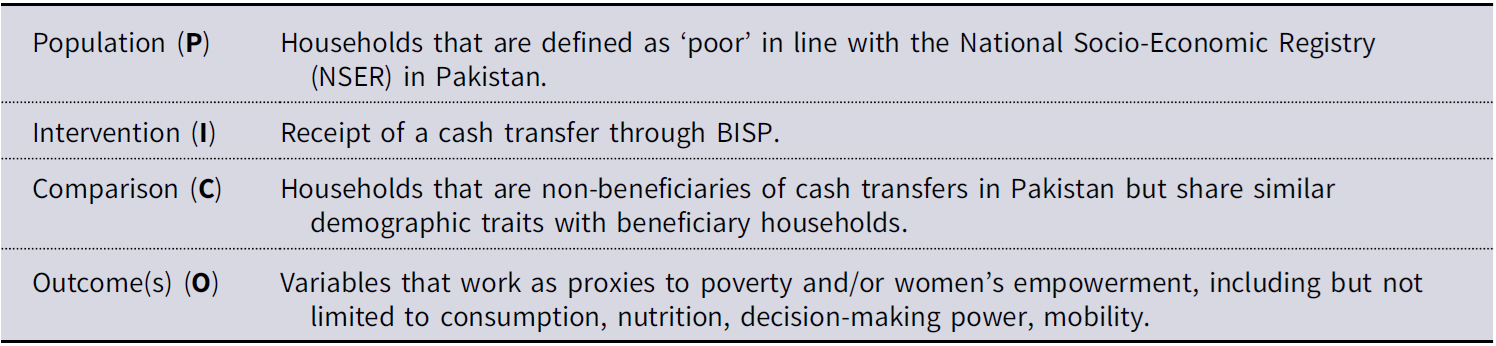
Despite these strengths, systematic reviews and meta-analyses have recognised limitations. Their validity depends on the quality, availability, and reporting standards of the underlying studies and may be affected by publication bias or heterogeneity arising from differences in study design, populations, or outcome measures. In this study, these risks are mitigated through the use of a PICO (Population, Intervention, Comparison, Outcome) framework to structure evidence selection (Chandler et al., Reference Chandler, Cumpston, Li, Page and Welch2019; McKenzie et al., Reference McKenzie, Brennan, Ryan, Thomson, Johnston, Thomas, Higgins, Thomas, Chandler, Cumpston, Li, Page and Welch2022), and through a risk-of-bias assessment and sensitivity analysis. Nonetheless, limitations remain if primary studies fail to report disaggregated outcomes or underrepresent specific sub-populations, such as rural or urban women, potentially obscuring nuanced impacts. Moreover, while meta-analysis assumes a degree of comparability across studies, it may not fully capture contextual factors unique to Pakistan, including social and cultural norms shaping women’s empowerment. To ensure transparency and replicability, the inclusion criteria (Table 1), search strategy, data extraction procedures, meta-analytic methods, and heterogeneity and sensitivity analyses are detailed in the sections that follow.
PICO map of the review question

Table 1. Long description
A table titled PICO map of the review question with four rows and four columns. The columns are labeled Population (P), Intervention (I), Comparison (C), and Outcome(s) (O). Row 1: Population (P), Households that are defined as poor in line with the National Socio-Economic Registry (NSER) in Pakistan. Row 2: Intervention (I), Receipt of a cash transfer through BISP. Row 3: Comparison (C), Households that are non-beneficiaries of cash transfers in Pakistan but share similar demographic traits with beneficiary households. Row 4: Outcome(s) (O), Variables that work as proxies to poverty and/or women’s empowerment, including but not limited to consumption, nutrition, decision-making power, mobility.
Population
Eligibility for cash transfers in Pakistan is determined through a test score, determined through the NSER as discussed earlier. Any study evaluating a household that was classified as poor through PMT, a potential recipient of a cash transfer, was considered a legitimate population for this review. All individuals within the household were considered eligible for inclusion, as the transfers are made at the household level.
Intervention
We included studies that evaluated only UCTs under BISP. Other complementary government schemes, such as the Waseela-e-Taleem conditional cash transfer scheme, which provides top-up payments for education, were excluded. However, studies that evaluated conditional or other transfers alongside BISP UCTs were included, provided their effects were reported separately and not combined. Additionally, studies evaluating UCTs other than BISP were excluded, as they do not provide insight into the effectiveness of these specific transfers, despite offering broader insights into cash transfers.
Comparison
Since the objective of this study is to examine the impacts of UCTs in Pakistan, only studies that matched treatment groups to justifiable control groups were considered for inclusion. While randomisation was preferred for its ability to mitigate issues of endogeneity (Shadish et al., Reference Shadish, Cook and Campbell2002), it was not a strict requirement. Many studies used pre-existing randomised surveys collected for BISP, while others relied on comprehensive national household surveys or conducted primary surveys. All were included, provided they offered a reasonable justification for how they matched treatment and control groups. As a result, only studies employing quasi-experimental techniques were included, or at least those that devoted some portion of their research to such methods (e.g. mixed-method studies with a quasi-experimental quantitative section). Randomised controlled trials (RCTs) were eligible, but none were found evaluating BISP.
Outcome(s)
We included all studies that assessed the impact of BISP on poverty alleviation and women’s empowerment. Recognising that both outcomes are multi-dimensional and can be interpreted through various lenses, we included studies that suggested or implied improvements in the conditions of the poor and/or women through a proxy, provided the study itself made this link. For the poverty domain, we focused on studies reporting primary outcomes that directly captured the level or incidence of poverty or material deprivation (e.g. poverty headcount, multidimensional poverty, per capita consumption, or clearly specified poverty proxies) and that estimated BISP’s average effect on these indicators. Studies whose outcomes related only to BISP’s role in mediating the impact of external shocks (or other adjacent factors), without estimating main effects on such poverty measures, were treated as outside the scope of the quantitative synthesis.
Similarly for empowerment, we included studies that examined direct indicators of women’s empowerment, such as decision-making, mobility, and aspirations. Studies linking cash transfers to broader household outcomes without directly addressing women empowerment were excluded. Context-specific studies, like those on nutrition during climate disasters, were assessed case by case based on the authors’ inferences, as detailed later and in Appendix Section A. Given the review’s scope, qualitative studies were excluded to maintain analytical depth.
Search strategy
We adopted a broad search strategy to capture all relevant studies on cash transfer programmes in Pakistan. Pilot searches showed that many valuable BISP-related studies would be missed with narrower search terms. Since our review focused on impact, not qualitative synthesis, a wider net helped ensure comprehensive coverage (Booth et al., Reference Booth, Noyes, Flemming, Gerhardus, Wahlster, van der Wilt, Mozygemba, Refolo, Sacchini, Tummers and Rehfuess2018). Although this approach retrieved some irrelevant results – e.g. other uses of ‘BISP’ or ‘Ehsaas’ – excluding them risked missing key studies that didn’t mention ‘Pakistan’. Including ‘Ehsaas’ was also necessary due to the programme’s temporary rebranding in 2021.
We searched the following electronic databases: Web of Science, MEDLINE, EconLit, EBSCOHost, Scopus, and Ovid. To reduce publication bias (Winters and Weir, Reference Winters and Weir2017), we also included grey literature from the 3ie evidence portal and ProQuest Dissertation & Theses Citation Index. In addition to peer-reviewed sources, we reviewed research by non-government organisations (NGOs) and government agencies in Pakistan, especially those linked to BISP in the government’s fifteen-year report – such as the World Bank, Foreign, Commonwealth and Development Office (FCDO), and ADB – by searching their own portals. As BISP began in 2008, our search covered studies from 2008 to December 2024. Table 2 presents the exact search syntax used. We made extensive use of truncation and Boolean operators such as ‘OR’ and ‘AND’ to broaden the search and account for spelling variations (Siddaway et al., Reference Siddaway, Wood and Hedges2019). We also searched the UN iLibrary and ADB databases; however, these yielded no results despite multiple iterations of search terms.
Search syntax used for each source

Table 2. Long description
A table with two columns: Source and Full search string. The Source column lists different databases including EBSCOHost, Web of Science, Scopus, Ovid, ProQuest Dissertations & Theses Citation Index, 3ie Portal, and World Bank Open Knowledge Repository. The Full search string column contains specific search terms and syntax used for each database. The table has seven rows, each corresponding to a different database and its respective search string. The search strings include terms like ‘Benazir Income Support Program’, ‘BISP’, ‘Ehsaas’, ‘Social Safety N’, ‘Emergency Cash’, ‘Cash Transfer’, and ‘Pakistan’.
Study selection, data extraction and synthesis
We used Rayyan, an AI-enabled systematic review tool, to compile and screen all search results. Duplicates were removed using Rayyan’s in-built AI, followed by title and abstract screening, then full-text review. This review focuses on two broad outcomes: poverty alleviation and women’s empowerment. Studies were categorised accordingly, with one study addressing both included in both groups. We synthesised findings within each group through meta-analysis (Deeks et al., Reference Deeks, Higgins, Altman, Higgins, Thomas, Chandler, Cumpston, Li, Page and Welch2022). All search syntax and details on excluded studies are provided in line with best practice (Siddaway et al., Reference Siddaway, Wood and Hedges2019).
Meta-analysis
Effect sizes
Each study assessed outcomes using different scales and samples, so the first step in statistical synthesis was to standardise effect sizes. Reporting formats varied: some studies lacked separate treatment and control group data, others reported treatment effects without correlation coefficients, and few provided exact p-values or t-statistics. However, all studies reported at least the standard error of the treatment effect and the full sample size.With the goal that effect sizes must be comparable, computable, reliable, and interpretable (Lipsey and Wilson Reference Lipsey and Wilson2001; Higgins et al., Reference Higgins, Li, Deeks, Higgins and Green2019), and given the limitations of reported data, we made use of all available data to standardise effect sizes to Cohen’s dFootnote 1 (Larkens, Reference Lakens2013). We used Wilson’s effect-size calculatorFootnote 2 (Reference Wilson2023), which is available as an open-source online tool to calculate the effect sizes for all studies barring one, for which a manual calculation was undertaken given the non-segregation of control and treatment group, this is given in Appendix Section B. One included study was excluded from the meta-analysis due to the non-reporting of the standard error or any other complementary figure that could have been used to calculate Cohen’s dFootnote 3 . All effects, once standardised to Cohen’s d, were tabulated in Excel, which was then exported to RStudio version 2024.04.2, wherein a meta-analysis was undertaken. Separate Excel files for outcomes of interest, poverty alleviation, and women empowerment are given in Appendix Section G.
Robust variance estimation (RVE) model
Several studies in this review (a) reported multiple relevant outcomes, (b) used proxy measures rather than identical outcomes, and (c) sometimes relied on similar datasets. These factors made traditional meta-analysis approaches like fixed-effects or unadjusted random-effects models unsuitable (Tanner-Smith et al., Reference Tanner-Smith, Tipton and Polanin2016). We therefore used an RVE model (Hedges et al., Reference Hedges, Tipton and Johnson2010), which adjusts for dependent effect sizes and allows inclusion of all relevant outcomes without bias (Pustejovsky and Tipton, Reference Pustejovsky and Tipton2022). RVE is particularly useful when exact covariance structures are unknown and can be used with as few as five studies, especially when combined with a small-sample correction (Tipton and Pustejovsky, Reference Tipton and Pustejovsky2015). Our study far exceeded this threshold. Meta-analysis was conducted in R using the 2023 robumeta package (Fisher et al., Reference Fisher, Tipton, Zhipeng and Fisher2023), with code provided in Appendix Section F for replicability of results.
Where multiple estimates existed, we prioritised the most recent, robust, and methodologically consistent results. For example, regression discontinuity design (RDD) studies often reported results across bandwidths, but all included a fixed 5-bandwidth effect, which we selected for consistency. Studies were weighted using inverse variance with Cochran’s ANOVA estimate of τ2 (DerSimonian and Kacker, Reference DerSimonian and Kacker2007; Moreno et al., Reference Moreno, Sutton, Thompson, Ades, Abrams and Cooper2012), and a within-study correlation (rho) of 0.8 was assumed, following Tanner-Smith and Tipton (Reference Tanner‐Smith and Tipton2014). A full sensitivity analysis for varying rho values is included in Appendix Section C. A correlated effects model was chosen over a hierarchical model due to the repeated use of outcomes from the same studies (Hedges et al., Reference Hedges, Tipton and Johnson2010).
Heterogeneity
We assessed statistical heterogeneity using the I² and Tau² statistics through an RVE meta-regression model in R for both outcomes – poverty alleviation and women’s empowerment. Sub-categories were created within each outcome to test whether specific study groups were driving the results. I² indicates the proportion of variability due to heterogeneity rather than chance, while Tau² estimates the variance across studies (Deeks et al., Reference Deeks, Higgins, Altman, Higgins, Thomas, Chandler, Cumpston, Li, Page and Welch2022). Given the relatively small number of studies, which can overestimate heterogeneity (Moeyaert et al., Reference Moeyaert, Ugille, Natasha Beretvas, Ferron, Bunuan and Van den Noortgate2017), we also ran a standard random-effects meta-analysis for comparison. Results are provided in Appendix Section D, with R code in Section F. While high heterogeneity is acknowledged as a limitation, the use of small-sample adjustments helps ensure that estimates remain approximately unbiased despite low degrees of freedom (Tipton, Reference Tipton2015).
Quality appraisal and robustness checks
To check for study quality, we conducted a risk-of-bias assessment following the approach used by Baird et al. (Reference Baird, Ferreira, Özler and Woolcock2014) in their systematic review of cash-transfer programmes. Each included study was coded across five domains: selection bias and confounding; spillovers, crossovers and contamination; outcome reporting; analysis reporting; and other risks of bias. For each domain, studies were coded as ‘Yes,’ ‘No’ or ‘Unclear’. Following Baird et al. (Reference Baird, Ferreira, Özler and Woolcock2014), studies were classified as low risk of bias if four or five domains were coded ‘Yes,’ medium risk of bias if three domains were coded ‘Yes,’ and high risk of bias if two or fewer domains were coded ‘Yes’. The full study-level assessment is reported in Appendix Section H.
To examine whether the pooled estimates were sensitive to study quality, we also conducted a quality-based sensitivity analysis. The main RVE models were re-estimated after excluding studies classified as ‘high risk’. This test was conducted separately for poverty reduction and women’s empowerment, and the results are reported in Appendix Section H.
Results
The search strategy yielded a total of 488 results, which were reduced to 329 after screening for duplicates using Rayyan’s built-in duplicate detection tool, followed by manual verification. Initial abstract and title screening led to 279 exclusions. In cases where the title and abstract were unclear, making it difficult to determine if they met the inclusion criteria, the studies were moved forward for full-text screening. Three studies could not be retrieved despite attempts to contact the listed authors, leaving a total of forty-seven studies for inclusion criteria screening. At this stage, thirty-one studies were excluded for reasons discussed in detail in the next section.
Additionally, comprehensive impact evaluation reports commissioned by the Pakistani government [to an independent organisation] were identified on the BISP website. These reports were reviewed in full, and a decision was made to include only the final report in this review. However, this final report (Cheema et al., Reference Cheema, Binci, Farhat, Asmat, Javeed and O’Leary2020) could not be included in the meta-analysis due to the non-reporting of critical numbers required to extract the effect size, a problem that also affected previous editions of the report. Multiple attempts to contact the authors and organisation to retrieve the relevant data were not successful. One relevant study was identified by searching the references of included studies and was included in the full-text review stage.
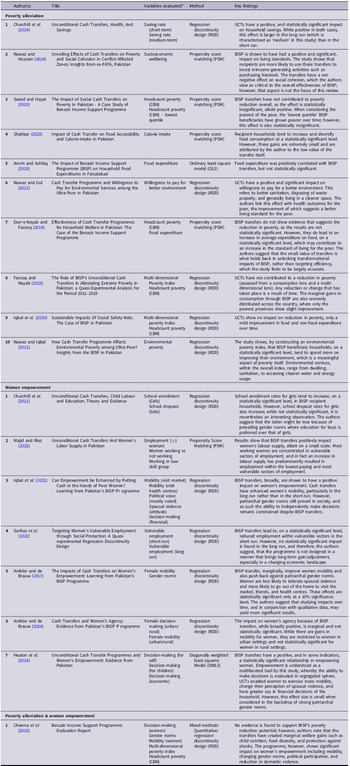
These results are summarised in the Preferred Reporting Items for Systematic reviews and Meta-Analyses (PRISMA) flow diagram (Figure 1). Given the nature of BISP, where there exists a cut-off score demarcating those who receive the treatment and those who do not, most included studies employ an RDD, while some opted to employ a Propensity Score Matching (PSM) technique. Leight et al., (Reference Leight, Hirvonen and Zafar2024) theorise the existence of downward pressure on effect sizes in RD designs, while our analysis did not reveal a meaningful difference in effect sizes between studies employing a PSM approach and those employing an RD approach. Table 3 summarises all included studies, their designs, and key reporting features, ordered by this review’s outcomes of interest. The design and reporting characteristics captured in Table 3 also informed the formal risk-of-bias assessment reported in Appendix Section H.
PRISMA 2020 flow diagram.

Summary of all included studies

Table 3. Long description
A table titled ‘Summary of all included studies’ with 20 rows and 5 columns. The columns are labeled ‘Study’, ‘Design’, ‘Outcomes’, ‘Notes’, and ‘Key Findings’. The table lists various studies along with their respective designs, outcomes of interest, notes, and key findings. Each row provides detailed information about a specific study. The designs include various methods such as randomized controlled trials, propensity score matching, and regression discontinuity. The outcomes and key findings vary across studies, reflecting different areas of interest and results. The notes column provides additional context or specific details about the studies.
* Not an exhaustive list of effects calculated or discussed in a given study, rather those variables that have been extracted for this review.
The risk-of-bias assessment classified nine studies as low risk of bias, seven as medium risk of bias and two as high risk of bias. The evidence base is therefore largely composed of low- and medium-risk studies, reflecting the predominance of RDD and PSM designs among BISP evaluations.
Characteristics of excluded studies
Many studies screened at the abstract and title level were unrelated to the review topic, which was expected due to the use of abbreviations like ‘BISP’ and ‘Ehsaas’ as search terms. For example, terms like ‘Benign infantile spindle-cell proliferation’ (Khurana, Reference Khurana2001), ‘biometrical smart pen’ (Bashir and Kempf Reference Bashir and Kempf2012; Takita et al., Reference Takita, Hangai, Kempf, Hook and Scharfenberg2007), ‘energy harvesting shock absorbers’ (Hajidavalloo et al., Reference Hajidavalloo, Cosner, Li, Tai and Song2022), and ‘electro-hydraulic actuators’ (Bertolino et al., Reference Bertolino, Jacazio, Mauro and Sorli2017) appeared frequently but were irrelevant. Next, many papers were excluded because they assessed outcomes outside this review’s focus (e.g. political impacts of cash transfers), evaluated different interventions, or used non-experimental designs. Some full-text studies met inclusion criteria but did not directly evaluate key outcomes like poverty or women’s empowerment. For instance, Qayyum and Nigar’s (Reference Qayyum and Nigar2023) study on cash transfers protecting against shocks was excluded because it examines BISP’s role in buffering idiosyncratic and covariate shocks rather than estimating the programme’s average impact on poverty status or core poverty indicators. Conversely, Nawaz and Gul’s (Reference Nawaz and Gul2022) study on household willingness to pay for environmental expenses was included because it linked spending to poverty effects. All such borderline cases and their rationales are detailed in Appendix A. Finally, despite searching grey literature databases like 3ie and ProQuest, no unpublished or non-governmental reports met the criteria, as these often lack the rigor needed for critical evaluation (Duflo and Banerjee, Reference Duflo and Banerjee2011). For example, Bastagli et al.’s (Reference Bastagli, Hagen-Zanker, Harman, Barca, Sturge and Schmidt2016) extensive systematic review found most reliable evidence in peer-reviewed journals.
Effects on poverty alleviation
Figure 2 depicts the results from the RVE meta-analysis for studies relevant to poverty alleviation. The dashed line represents the average total effect, 0.18, which is significant within a 95 per cent confidence interval between 0.0271 to 0.333 (margin of error = 0.031). The positive value, the fact that it is statistically significant, and that the confidence interval does not include 0 suggests that, on average, BISP has a positive effect on poverty reduction, albeit extremely modest. Most effect sizes hover close to zero, and most measures of viewing poverty through a comprehensive index such as the multi-dimensional poverty index (MPI) and the cost-of-basic-needs (CBN) assessment show a negligible or negative effect. This is consistent with individual study findings reported in Table 3.
RVE Forest plot for BISP effect on poverty alleviation.

Figure 2. Long description
A forest plot representing the effect sizes of different studies on poverty alleviation. The horizontal axis shows the effect size ranging from -1 to 1, with a vertical dashed line at 0 indicating no effect. The vertical axis lists the studies and their specific outcomes. Each study is represented by a square box, with the size of the box indicating the weight of the study. The horizontal lines through the boxes represent the confidence intervals. The studies include various metrics such as Food Expenditure, Medium-term Savings Rate, Short-term Savings Rate, Headcount Poverty, Multi-dimensional Poverty Index, Willingness to Pay for Better Environment, Socioeconomic Wellbeing, Environmental Poverty, and Calorie Intake. The effect sizes vary, with some studies showing positive effects and others showing negative or negligible effects. The plot includes a diamond shape at the bottom, representing the overall effect size and its confidence interval.
Heterogeneity
When testing for heterogeneity,
 {I^2}
= 98.8 and
 {\rm{Ta}}{{\rm{u}}^2}
= 0.054. The high value of
 {I^2}
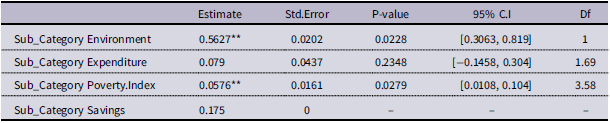
suggests substantial heterogeneity, as observed in the forest plot where effect sizes vary considerably across studies. This implies that a large part of the observed variability is due to differences between studies rather than sampling error and therefore warrants further investigation. To check whether heterogeneity reflects differences in the way poverty is measured, we ran a meta-regression that grouped outcomes into comprehensive poverty indices, expenditure-based measures, environmental indicators, and savings. The results are reported in Table 4. This specification contrasts more direct poverty measures (such as CBN and MPI) with outcomes that capture reductions in the adverse impacts of poverty, such as environmental improvements.
RVE meta-regression across four sub-categories

Table 4. Long description
A table with four rows and five columns comparing estimates, standard errors, p-values, 95% confidence intervals, and degrees of freedom across four sub-categories. The sub-categories are Sub_CategoryEnvironment, Sub_CategoryExpenditure, Sub_CategoryPoverty.Index, and Sub_CategorySavings. Row 1: Sub_CategoryEnvironment, Estimate 0.5627**, Std.Error 0.0202, P-value 0.0228, 95% C.I. [0.3063, 0.819], Df 1. Row 2: Sub_CategoryExpenditure, Estimate 0.079, Std.Error 0.0437, P-value 0.2348, 95% C.I. [-0.1458, 0.304], Df 1.69. Row 3: Sub_CategoryPoverty.Index, Estimate 0.0576**, Std.Error 0.0161, P-value 0.0279, 95% C.I. [0.0108, 0.104], Df 3.58. Row 4: Sub_CategorySavings, Estimate 0.175, Std.Error 0, P-value -, 95% C.I. -, Df -.
The
 {I^2}
value here goes down to 94.8 but is nevertheless substantial. The results of an analysis across various categories are not very meaningful given that the degrees of freedom (Df) are <4 for all. This is likely because the number of studies and outcomes evaluated are not sufficiently large, even while the model is run with small sample corrections. Running a mixed-random effects model to test for heterogeneity confirms the same, returning an
 {I^2}
value of 98.82, and a statistically significant (at 1 per cent) value of Q. The full table for this test can be checked in Appendix Section D. Given that the meta-regression indicated comparatively larger effects for environmental poverty (Table 4), we conducted an additional test in which all environmental outcomes were excluded, and the RVE model for poverty was re-estimated on the remaining outcomes. In this sample (thirteen outcomes from eight studies), the pooled effect remained positive and statistically significant (effect size = 0.08; 95 per cent CI 0.03 to 0.13; p = 0.006),
 {I^2}
still above 95 per cent. This suggests that the modest average effect on poverty reduction is not solely driven by environmental measures, although outcome choice remains an important source of heterogeneity.
We also conducted a quality-based sensitivity check by re-estimating the poverty RVE model after excluding the study classified as high risk of bias in the formal risk-of-bias assessment (i.e. Amrin and Ashfaq Reference Amrin and Ashfaq2020). The pooled effect remained positive and statistically significant (effect size = 0.187; 95 per cent CI 0.0177 to 0.356; p = 0.0344). This indicates that the modest positive poverty finding is not driven by the study with the weakest counterfactual basis, although heterogeneity remains high and the result should still be interpreted cautiously.
Publication Bias
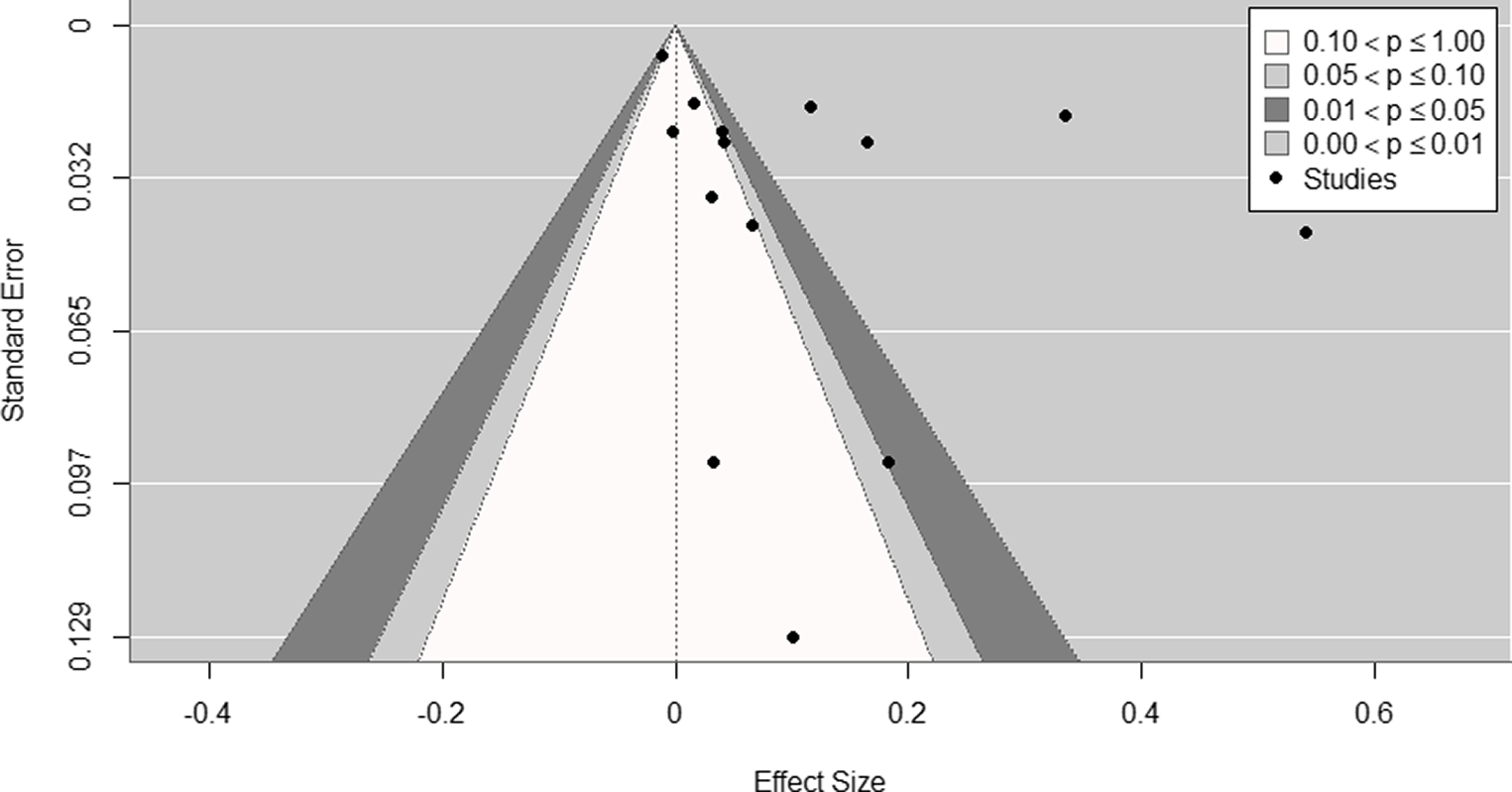
Figure 3 depicts the funnel plot for BISP’s effects on poverty alleviation reported in the included studies. The plot does not reflect significant asymmetry; however, there does seem to be a small degree of bias towards the publication of studies with positive effects. But given that many reported effects edge towards the centre, and various effects are reported without statistical significance suggests that there is little evidence to support systematic publication bias. This conclusion is supported by Egger’s test (Pustejovsky and Rodgers, Reference Pustejovsky and Rodgers2019) as well, returning a z-value of −0.09, and a p-value of 0.92. A high p-value suggests low evidence to reject the null hypothesis of the existence of systematic publication bias (Lin and Chu, Reference Lin and Chu2018).
Funnel plot for studies evaluated for poverty alleviation.

Effects on women empowerment
Figure 4 depicts the results from the RVE meta-analysis for studies relevant to the second outcome of interest, namely women empowerment. Across the included evaluations, empowerment outcomes cluster into three broad domains: women’s mobility and social participation, intra-household decision-making, and labour market participation/control over economic resources, with a small number of indicators capturing attitudes and gender norms (Table 3; Table 5). For instance, indicators such as whether women can visit relatives or move outside the home are viewed as mobility and social participation, items on who decides about children’s schooling, health care or major purchases are classified as intra-household decision-making, and measures of women’s paid work or self-employment are coded as labour/economic outcomes.
RVE Forest plot for BISP effect on women’s empowerment.

RVE meta-regression across three sub-categories

Table 5. Long description
The table presents the results of a meta-analysis on women empowerment, focusing on three sub-categories: decision-making, mobility, and other. It includes four rows and six columns. The columns are labeled Estimate, Std.Error, P-value, 95% C.I, and Df. The rows are labeled Sub_CategoryDecision making, Sub_CategoryMobility, and Sub_CategoryOther. Each row provides specific values for the respective sub-category. For Sub_CategoryDecision making, the values are Estimate: 0.122, Std.Error: 0.0634, P-value: 0.255, 95% C.I: -0.339, 0.582, Df: 1.33. For Sub_CategoryMobility, the values are Estimate: 0.229, Std.Error: 0.1479, P-value: 0.298, 95% C.I: -0.641, 1.099, Df: 1.52. For Sub_CategoryOther, the values are Estimate: 0.303, Std.Error: 0.169, P-value: 0.17, 95% C.I: -0.232, 0.839, Df: 3.03.
The dashed line (Figure 4) represents the average total effect size, 0.237, which is not significant within a 95 per cent confidence interval between −0.0275 to 0.501 (margin of error = 0.264). This means that there is not enough evidence to suggest a positive correlation between BISP transfers and women’s empowerment. Furthermore, the fact that the confidence interval is quite wide and includes 0 illustrates the difficulty in associating a net positive effect of BISP transfers in empowering women. These findings are inconsistent with what is reported by most papers evaluating BISP’s effect on women, which are detailed in our descriptive findings presented in Table 3. While most papers suggest a positive correlation, some have flagged their results to be approached with caution given the nature of available data. For example, Ambler and de Brauw (2017 and Reference Ambler and de Brauw2024) suggest that their insights are limited by the questions asked in the surveys conducted, making it tough to draw broad insights. The strongest suggestion that BISP empowers women is made within the impact evaluation report authored by Cheema et al., (Reference Cheema, Binci, Farhat, Asmat, Javeed and O’Leary2020), which does not report the standard error for their results in their RDD analysis. The fact that our findings suggest the absence of strong evidence in favour of women empowerment implies that even in the presence of a real positive effect on women, it is at best likely to be extremely marginal or negligible.
Heterogeneity
When testing for heterogeneity,
 {I^2}
= 95.99 and
 Ta{u^2}
= 0.064. The high value of
 {I^2}
suggests substantial heterogeneity, as shown in the forest plot where the variance between effect sizes is high. This implies that observed variability is largely due to differences between studies rather than sampling error, warranting further investigation. Given the high variability in effect size and weights, visible in Figure 4, the first test we conducted here, unlike the one in the earlier section, was to check for outliers, remove them, and then re-estimate the RVE model. We used Cook’s distance (z-scores) to identify influential outcomes (Cook, Reference Cook1979) and remove them. These were ‘decision-making (urban)’ and ‘mobility (urban)’. Heterogeneity continued to be substantial after making this adjustment (
 {I^2}
= 98.77,
 Ta{u^2}
= 0.152). We have reported this in Appendix Section E. Next, we created sub-groups for the selected outcomes in the original model (all outcomes included) and ran a domain-based meta-regression, grouping empowerment indicators into decision-making, mobility, and ‘other’. These results are reported in Table 5.
The
 {I^2}
value here remains high, at 96.38, thereby validating the earlier claim of high heterogeneity. Furthermore, no definitive conclusion can be drawn across these categories given that the Df are < 4 for all. The mixed-random effects model to test for heterogeneity confirmed the same, returning an
 {I^2}
value of 98.71, and a statistically significant at 1 per cent value of Q. The full table for this result is produced in Appendix Section D. Although some domain-specific point estimates (for example in mobility and decision-making) are positive, confidence intervals are wide and overlapping, and the domain-level RVE results do not indicate systematic gains in any single empowerment domain. Furthermore, we repeated the same quality-based sensitivity check for women’s empowerment by excluding the study classified as high risk of bias (Heaton et al., Reference Heaton, Kashif and Mukhopadhaya2024). The pooled estimate increased slightly (effect size = 0.275; 95 per cent CI −0.0445 to 0.594; p = 0.0758), but the 95 per cent confidence interval still included zero. This suggests that the absence of a statistically significant pooled empowerment effect at the 5 per cent level is not simply a consequence of including the lower-quality study. Instead, it appears to reflect the wider heterogeneity of empowerment outcomes, measurement approaches, and study contexts. Given the current state of the evidence base, there is no clear evidence of a statistically significant relationship between women’s empowerment and BISP transfers, and this finding should be interpreted cautiously in light of high heterogeneity.
Publication bias
Figure 5 depicts the funnel plot for BISP’s effects on women’s empowerment reported in the included studies. The plot does not reflect significant asymmetry, and it cannot be said from this that there is a bias towards publishing positive and/or significant results given the high variance of reported effects and the high number of non-significant results reported. This conclusion is supported by Egger’s test (Pustejovsky and Rodgers, Reference Pustejovsky and Rodgers2019) as well, returning a z-value of 0.32, and a p-value of 0.75. A higher p-value suggests low evidence to reject the null hypothesis of the existence of systematic publication bias (Lin and Chu, Reference Lin and Chu2018).
Funnel plot for studies evaluated for women’s empowerment.

Discussion
These results indicate that the impact of BISP on poverty reduction, while positive, is at best modest. Several factors may contribute to this limited effect. For instance, the cash transfers received by households through BISP amount to less than 10 cents (USD) per day (see Mumtaz and Whiteford, Reference Mumtaz and Whiteford2017, Reference Mumtaz and Whiteford2021; Mumtaz et al., Reference Mumtaz, Roumpakis and Sumarto2023), which is unlikely to be sufficient for meaningful poverty alleviation without additional support. Furthermore, the studies analysed in this paper use various poverty measures, some more robust than others. The MPI (Alkire and Santos, Reference Alkire and Santos2010, Reference Alkire and Santos2014), for example, assesses poverty across three dimensions – health, education, and living standards – classifying households as either ‘deprived’ or ‘non-deprived’ based on specific indicators. A person is deemed multidimensionally poor if they are deprived in at least one-third of the weighted MPI indicators (Alkire et al., Reference Alkire, Kanagaratnam and Suppa2021).
Three studies using the MPI to evaluate BISP’s impact produced statistically insignificant results, indicating insufficient evidence that BISP transfers have meaningfully reduced poverty in Pakistan. However, research focusing on specific consumption categories, such as food or calorie intake, shows a positive association with BISP transfers. Similarly, studies examining more narrowly defined aspects of poverty – such as environmental factors or household savings – report improvements linked to BISP assistance (see Table 3). These findings suggest that while UCTs with low transfer values may not lift individuals out of poverty – especially when evaluated using comprehensive indices (see, for example, Mumtaz, Reference Mumtaz2022) – they can still improve the lived experiences of those in poverty. Comprehensive meta-analyses of cash transfer programmes in low- and middle-income countries, including Crosta et al.’s (Reference Crosta, Karlan, Ong, Rüschenpöhler and Udry2024) Bayesian synthesis of UCTs and Kabeer and Waddington’s (Reference Kabeer and Waddington2015) review of CCTs, generally find clear positive effects on household consumption, income and, in some cases, asset accumulation. Against this backdrop, BISP’s pooled poverty effect appears towards the modest end of the range of economic gains typically observed for cash transfers, which is consistent with its relatively low benefit level and limited integration with complementary interventions.
Regarding women’s empowerment, this study finds no evidence that BISP has led to improvements, despite its explicit focus on empowering women. As summarised in Table 3 and grouped in the domain-level meta-regression (Table 5), the empowerment indicators used across studies fall into mobility and social participation, intra-household decision-making and labour/economic domains, with a small number of measures of attitudes and gender norms. These effects vary depending on geographic context and the type of decision – e.g. financial versus non-financial. For instance, women in Punjab – a relatively less impoverished region – experience greater improvements in decision-making than those in other provinces. Cheema et al. (Reference Cheema, Binci, Farhat, Asmat, Javeed and O’Leary2020) report that decision-making gains are more pronounced in matters like visiting family than in major household purchases. Similarly, Heaton et al. (Reference Heaton, Kashif and Mukhopadhaya2024) found stronger effects in personal decisions, such as social interactions, than in financial ones. Impacts on women’s labour supply are concentrated within more vulnerable sectors of the economy rather than across the board (Sarfraz et al., Reference Sarfraz, Kamran, Khan, Khalique and Andlib2022). No study reports a significant shift in entrenched patriarchal gender norms. Consistent with the domain-based RVE results (Table 5), these patterns suggest no systematic improvements in any single empowerment domain, and the pooled empowerment effect remains indistinguishable from zero.
It is important to note that many observed impacts on women’s empowerment are non-monetary, such as increased mobility and participation in household decisions. The assumption is that the mere act of transferring cash to women should enhance their voice and social standing. Nonetheless, even in these areas, there is no robust evidence indicating meaningful progress. This pattern is consistent with wider syntheses of cash transfers and women’s empowerment, which find clearer effects on economic welfare than on gendered power relations: for example, Leite et al. (Reference Leite, Moraes, Marques, Caetano, Braga and Reichenheim2019), in their systematic review on cash transfers in Latin America and South Africa, report no consistent impact on intimate partner violence, and Molyneux and Thomson (Reference Molyneux and Thomson2011) argue that cash transfers in Latin America rarely challenge prevailing norms without broader structural change. Crosta et al.’s (Reference Crosta, Karlan, Ong, Rüschenpöhler and Udry2024) meta-analysis similarly shows that while targeting women tends to increase consumption and income but does not by itself guarantee transformative shifts in agency. In Pakistan, official BISP evaluations and political narratives often present the programme as a success story for women’s empowerment (e.g. Cheema et al., Reference Cheema, Binci, Farhat, Asmat, Javeed and O’Leary2020; Memon, Reference Memon2018); by pooling the available quantitative evidence, this review cuts through those competing claims and shows that, at scale, there is no clear net empowerment effect, underscoring the need for approaches that go beyond cash alone to achieve transformative improvements in well-being (Ferguson (Reference Ferguson2020)).
We included only studies with credible counterfactual designs, alongside a formal risk-of-bias assessment. This assessment classified nine studies as low risk of bias, seven as medium risk of bias, and two as high risk of bias. The quality-based sensitivity checks showed that excluding high-risk studies did not materially alter the main findings: the poverty effect remained positive and statistically significant, while the women’s empowerment effect remained statistically indistinguishable from zero at the 5 per cent level. Study quality is therefore incorporated through design-based inclusion criteria, formal appraisal, and robustness checks. Nevertheless, uneven reporting of diagnostics and persistent heterogeneity across outcomes mean that the pooled estimates should still be interpreted cautiously.
Conclusion
This study systematically reviewed and meta-analysed the impact of Pakistan’s largest UCT programme, the BISP, on poverty reduction and women’s empowerment. As the first systematic review and meta-analysis of quantitative evidence on BISP, it fills a critical gap in the literature by synthesising quantitative evidence on one of the world’s largest women-targeted UCTs within Pakistan’s unique socio-economic and political context. The contribution of this study lies in its programme-specific synthesis of BISP’s quantitative evaluation literature and its methodological rigor. By using RVE meta-analysis, it accommodates dependencies in effect sizes and variations in measurement tools across studies. The analysis provides a pooled synthesis of reported BISP impacts across included evaluations, offering a broader view of the available evidence than any single evaluation or official report. At the same time, the evidence synthesised here reveals high heterogeneity across the included studies, suggesting that BISP’s effects vary substantially by context, region, and methodology. This variation underscores the value of country-level syntheses alongside cross-country meta-analyses and highlights the need for nuanced, context-specific assessments rather than generalised conclusions.
We conclude that BISP has a modest but statistically significant effect on poverty alleviation. However, there is no statistically significant evidence that the programme has improved women’s empowerment. In comparative perspective, this poverty effect appears at the lower bound of what recent meta-analyses of UCTs and CCTs typically report for household consumption and related economic outcomes in low- and middle-income countries, where average impacts are generally positive and often larger in magnitude (Kabeer and Waddington, Reference Kabeer and Waddington2015; Crosta et al., Reference Crosta, Karlan, Ong, Rüschenpöhler and Udry2024). Likewise, our null findings on women’s empowerment sit alongside a wider literature in which cash transfers may improve specific dimensions of empowerment but frequently fall short of shifting underlying gender norms or reducing risks such as intimate partner violence (Perera et al., Reference Perera, Bakrania, Ipince, Nesbitt-Ahmed, Obasola, Richardson and Yu2022; Leite et al., Reference Leite, Moraes, Marques, Caetano, Braga and Reichenheim2019; Molyneux and Thomson, Reference Molyneux and Thomson2011). These results therefore both challenge more optimistic claims from individual BISP evaluations and official reports and underline that a women-targeted UCT, on its own, may not be sufficient to generate meaningful gains in women’s agency, decision-making, or labour market participation in Pakistan’s socio-political context. In line with existing evidence on cash-transfer design, we interpret this impact as plausibly related to the very low real value of transfers (Ambler and De Brauw, Reference Ambler and de Brauw2017) and to the deep-rooted patriarchal norms that constrain women’s autonomy, particularly in more impoverished and rural regions, while recognising that these mechanisms cannot be fully tested within the present quantitative synthesis.
From a policy perspective, these findings suggest that while BISP provides a basic income floor for ultra-poor households, its current design is unlikely to generate large reductions in poverty or broad-based gains in women’s empowerment. In line with wider evidence on cash transfers, our results are consistent with the possibility that relatively low transfer values, limited links to complementary services, and persistent patriarchal norms could constrain programme impacts; however, we do not test these mechanisms and therefore present them as hypotheses and priorities for future evaluation rather than firm causal conclusions.
Lastly, since this review synthesises only quantitative impact evaluations, it should be read as a summary of measured outcomes rather than a complete account of implementation and lived experience. A separate qualitative evidence synthesis (QES) on recipients’ experiences, delivery processes, and local power dynamics read alongside country-specific systematic reviews and RVE meta-analyses such as this one, would provide a fuller picture of BISP’s impacts and their implications for other large cash-transfer programmes.
Supplementary material
The supplementary material for this article can be found at https://doi.org/10.1017/S1474746426101547.
Acknowledgements
None.
Author contributions
Zaid Abro: Conceptualization, Data curation, Methodology, zahid Mumtaz: CRediT contribution not specified.
Financial support
This research received no specific grant from any funding agency in the public, commercial, or not-for-profit sectors.
Competing interests
Both authors declare that they have no conflicts of interest.
Ethical approval
Not applicable. This study did not involve the collection or use of primary data and therefore did not require ethical approval.







 Open access

