


Introduction
It is well known that Japan and South Korea (Korea hereafter) have shown the fastest population ageing across the globe due to an unprecedented decline in their total fertility rates (TFRs). Given the rising prevalence of non-marriage in both countries, even compared to their regional neighbours (see Table 1), their future TFRs are likely set to continue on a downward trajectory. This is because marriage rates are a strong proxy indicator of future birth rates due to an extremely low out-of-wedlock childbirth rate, with 2.4 per cent in Japan and 2.5 per cent in Korea as of 2020, compared to the Organisation for Economic Co-operation and Development (OECD) average of 43 per cent (OECD, 2022).
The percentage of unmarried individuals in their 20s and 30s in East Asia, 2000–2020

Table 1. Long description
The table presents the percentage of unmarried individuals in their 20s and 30s in East Asia from 2000 to 2020. It is divided into two main sections: Men and Women, with data for China, Japan, Korea, and Singapore. The table has 12 rows and 12 columns. The columns are labeled with age groups (20-24 year-olds, 25-29 year-olds, 30-34 year-olds, 35-39 year-olds) and years (2000, 2010, 2020). Row 1: Men, China, 20-24 year-olds, 2000, .; 2010, 89.8; 2020, 94.0. Row 2: Men, China, 25-29 year-olds, 2000, .; 2010, 44.8; 2020, 57.5. Row 3: Men, China, 30-34 year-olds, 2000, .; 2010, 13.3; 2020, 21.9. Row 4: Men, China, 35-39 year-olds, 2000, .; 2010, 5.3; 2020, 9.4. Row 5: Men, Japan, 20-24 year-olds, 2000, 92.9; 2010, 94.0; 2020, 95.7. Row 6: Men, Japan, 25-29 year-olds, 2000, 69.4; 2010, 71.8; 2020, 76.4. Row 7: Men, Japan, 30-34 year-olds, 2000, 42.9; 2010, 47.3; 2020, 51.8. Row 8: Men, Japan, 35-39 year-olds, 2000, 26.2; 2010, 35.6; 2020, 38.5. Row 9: Men, Korea, 20-24 year-olds, 2000, 97.5; 2010, 98.8; 2020, 99.2. Row 10: Men, Korea, 25-29 year-olds, 2000, 71.0; 2010, 85.4; 2020, 92.2. Row 11: Men, Korea, 30-34 year-olds, 2000, 28.1; 2010, 50.2; 2020, 65.9. Row 12: Men, Korea, 35-39 year-olds, 2000, 10.6; 2010, 26.7; 2020, 37.8. Row 13: Men, Singapore, 20-24 year-olds, 2000, 95.2; 2010, 97.6; 2020, 98.3. Row 14: Men, Singapore, 25-29 year-olds, 2000, 64.2; 2010, 74.6; 2020, 81.6. Row 15: Men, Singapore, 30-34 year-olds, 2000, 30.7; 2010, 37.1; 2020, 41.9. Row 16: Men, Singapore, 35-39 year-olds, 2000, 19.7; 2010, 20.4; 2020, 22.6. Row 17: Women, China, 20-24 year-olds, 2000, .; 2010, 80.1; 2020, 87.2. Row 18: Women, China, 25-29 year-olds, 2000, .; 2010, 29.1; 2020, 40.6. Row 19: Women, China, 30-34 year-olds, 2000, .; 2010, 7.3; 2020, 12.6. Row 20: Women, China, 35-39 year-olds, 2000, .; 2010, 2.7; 2020, 5.7. Row 21: Women, Japan, 20-24 year-olds, 2000, 88.0; 2010, 89.6; 2020, 93.0. Row 22: Women, Japan, 25-29 year-olds, 2000, 54.0; 2010, 60.3; 2020, 65.8. Row 23: Women, Japan, 30-34 year-olds, 2000, 26.6; 2010, 34.5; 2020, 38.5. Row 24: Women, Japan, 35-39 year-olds, 2000, 13.9; 2010, 23.1; 2020, 26.2. Row 25: Women, Korea, 20-24 year-olds, 2000, 89.1; 2010, 96.0; 2020, 98.0. Row 26: Women, Korea, 25-29 year-olds, 2000, 40.1; 2010, 69.3; 2020, 82.0. Row 27: Women, Korea, 30-34 year-olds, 2000, 10.7; 2010, 29.1; 2020, 46.0. Row 28: Women, Korea, 35-39 year-olds, 2000, 4.3; 2010, 12.6; 2020, 23.3. Row 29: Women, Singapore, 20-24 year-olds, 2000, 83.8; 2010, 91.8; 2020, 95.9. Row 30: Women, Singapore, 25-29 year-olds, 2000, 40.2; 2010, 54.0; 2020, 69.0. Row 31: Women, Singapore, 30-34 year-olds, 2000, 19.5; 2010, 25.1; 2020, 32.8. Row 32: Women, Singapore, 35-39 year-olds, 2000, 15.1; 2010, 17.1; 2020, 19.3.
Sources: China Statistics Press (2010, 2020), Statistics Korea (2022), Department of Statistics Singapore (2024), Ministry of Health, Labour and Welfare of Japan (n.d.)
Notes: China’s data refers to urban areas only. The symbol ‘.’ indicates that data is not available.
While declining marriages in high-income countries are considered a consequence of changing sociocultural and gender norms, increasing evidence points to non-marriage in Japan and Korea being driven by financial struggles, particularly those associated with insufficient housing resources. This is evident in the 2021 Japanese national survey, where financial issues, particularly ‘costs of wedding and starting a new life’ and ‘housing’, were identified as the biggest barriers to marriage, irrespective of gender (see Figure 1). Similarly, in the 2023 nationwide survey from Korea, ‘a lack of funds for marriage and housing’ was cited as the predominant reason for not getting married by both men and women, surpassing even ‘not feeling the need to get married’ (see Figure 2). This is not surprising insofar as housing tenure has been widely used as a proxy indicator of the readiness for marriage in both countries (Forrest and Izuhara, Reference Forrest and Izuhara2013).
The main obstacle(s) for marriage in Japan in 2021.
Source: National Institute of Population and Social Security Research (2023).
Notes: The total number of survey participants was 14,660. The survey asked 4,083 unmarried individuals aged between nineteen and thirty-four to choose ‘up to two main obstacles for marriage within the next year’ out of nine options.

The main reason for not getting married in Korea in 2023.
Source: Statistics Korea (2024b).
Notes: The survey participants were those aged thirteen and above from 18,576 randomly selected households. The survey asked 4,681 unmarried participants to choose ‘one main reason for not getting married’ out of ten options.

Following the discovery that the increasing number of unmarried young adults is associated with housing issues, expanding marriage-related housing policy has increasingly become a national exigency. This is evident in Korea’s 2015 Basic Plan for Low Fertility and Ageing Society, which highlighted ‘a paradigm shift from alleviating the childcare burden for already married couples to addressing housing and marriage costs’ in order to raise the marriage rate by 10 per cent and the TFR to 1.5 within five years (Government of the Republic of Korea, 2015: 37). Similarly, Japan promulgated the 2016 Basic Plan for Housing and Living to ‘establish a housing environment that enables young adults wishing to marry and have children… to contribute to the achievement of a desired TFR of 1.8’ (Ministry of Land, Infrastructure, Transport and Tourism, 2016: 6). Consequently, couples intending to marry and those recently married – henceforth collectively referred to as newlyweds – have emerged as a priority category for housing support. In 2020, Korea further outlined increasing housing provision and financial support for 754,000 newlyweds and families with children aged below six for the next five years (Government of the Republic of Korea, 2020). Shortly after, in 2023, Japan also set out a plan to secure 200,000 units of public rental housing and an additional 100,000 units of private housing over the next decade through the utilisation of vacant homes, with priority given to newlyweds and households with children (Children and Families Agency, 2024b).
Accordingly, the body of research on marriage-related housing policy has grown in both countries. Some studies measured the effects of housing circumstances on marriage statistically (Kang and Song, Reference Kang and Song2022; Iwasawa and Yoda, Reference Iwasawa and Yoda2024; La, Reference La2025). While these studies reaffirmed housing as a key determinant of marriage, their focus on the relationship between housing tenure or prices and the binary outcome of marriage or non-marriage tended to flatten complex housing issues in individuals’ decisions around marriage. Policy implications were therefore confined to general measures, such as tackling housing price fluctuations and increasing the housing supply. Other studies surveyed young adults to assess perceptions of their housing circumstances and/or preferences of housing policies in relation to their marriage decisions (Ronald and Nakano, Reference Ronald and Nakano2012; Park et al., Reference Park, Bang, Choi, Jeong, Kim and Choi2019; Jeong et al., Reference Jeong, Shin, Lee, Kim, Kim, Park and Moon2023; Children and Families Agency, 2024a; Kim and Jang, Reference Kim and Jang2025; Kim et al., Reference Kim, Kim and Jang2025). While they assessed how marriage-related housing policies were arranged in more detail, perceptions and preferences are also too inherently malleable and subjective to be considered systematic indicators for policy assessment.
Despite the burgeoning marriage-focused housing policies and the increasing number of relevant studies, a fundamental question remains insufficiently addressed: to what extent are existing housing policies for newlyweds arranged to enhance individuals’ capabilities to marry, if they have reason to value this life trajectory? To address this gap, this article begins by contouring the landscape of housing policies for newlyweds in Japan and Korea. It then proceeds to introduce Amartya Sen’s capabilities approach (CA), which helps clarify how housing shapes individuals’ marriage capabilities and outlines which dimensions of housing policy matter in this context. These dimensions serve as an evaluative framework for comparing housing policies for newlyweds in the two countries. Synthesising the findings, this article discusses their merits and demerits in strengthening individuals’ marriage capabilities. It concludes with implications for future policymaking and further research.
Overview of housing policies to support marriage in Japan and KoreaFootnote 1
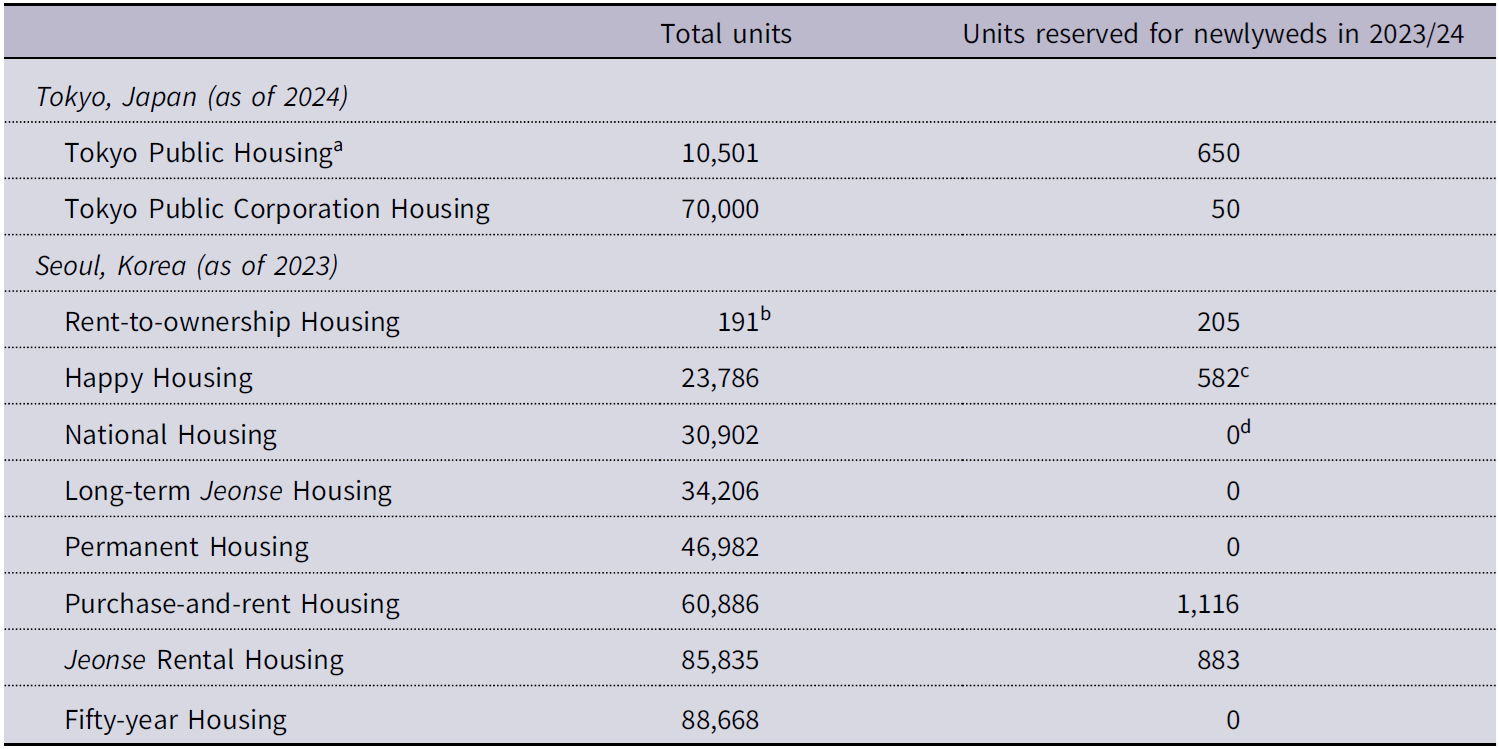
Marriage-related housing support in Japan and Korea is twofold: direct housing provision and financial assistance. Looking into Japan’s direct housing provision first, the overall plan is formulated by the central government, but local governments have discretion over its operation and management. Taking Tokyo as an example, Public Housing (都営住宅) is offered at below-market rates and functions as a critical safety net for low-income households. Within this system, priority allocation is granted to newlyweds. In addition, Public Corporation Housing (公社住宅), managed by the Tokyo Metropolitan Housing Supply Corporation and fully funded by the Tokyo Metropolitan Government, is available at lower rents than those found in the private market. These units come with preferential application procedures and rent incentives for newlyweds. Korea offers three types of public housing, which apply uniformly nationwide. The first type encompasses Fifty-year Housing (50년 임대주택), Permanent Rental Housing (영구임대주택), Happy Housing (행복주택), National Housing (국민임대주택) and Purchase-and-rent Housing (매입임대주택), all of which are offered at a more affordable rental price than the market rate and grant newlyweds priority access. The second, Rent-to-ownership Housing (분양전환임대주택), similarly provides more affordable rental units but allows tenants to acquire ownership rights after a prescribed rental period. The last type, Jeonse Rental Housing (전세임대주택) and Long-term Jeonse Housing (장기전세주택), is grounded in Korea’s unique jeonse system, where tenants pay a large lump-sum returnable deposit (generally half of the property’s value) on housing in lieu of usual monthly rents. The applicant is required to put down a large deposit that is lower than the market rate. Table 2 provides an overview of public housing available for newlyweds in the two countries’ capital cities for a more equivalent-level comparison.
Direct housing provision for newlyweds in Japan and Korea in 2023/24

Table 2. Long description
A table comparing the total units and units reserved for newlyweds in Tokyo, Japan, and Seoul, Korea. The table has two main sections: Tokyo, Japan (as of 2024) and Seoul, Korea (as of 2023). For Tokyo, it lists Tokyo Public Housing with 10,501 total units and 650 reserved for newlyweds, and Tokyo Public Corporation Housing with 70,000 total units and 50 reserved for newlyweds. For Seoul, it lists various types of housing including Rent-to-ownership Housing with 191 total units and 205 reserved for newlyweds, Happy Housing with 23,786 total units and 582 reserved for newlyweds, National Housing with 30,902 total units and 0 reserved for newlyweds, Long-term Jeonse Housing with 34,206 total units and 0 reserved for newlyweds, Permanent Housing with 46,982 total units and 0 reserved for newlyweds, Purchase-and-rent Housing with 60,886 total units and 1,116 reserved for newlyweds, Jeonse Rental Housing with 85,835 total units and 883 reserved for newlyweds, and Fifty-year Housing with 88,668 total units and 0 reserved for newlyweds.
Sources: Authors’ summary based on policy information and housing application notices provided by the Korean Ministry of Land, Infrastructure and Transport (https://www.myhome.go.kr), the Korean Land and Housing Corporation (https://apply.lh.or.kr/lhapply/main.do), and the Tokyo Metropolitan Housing Supply Corporation (https://www.to-kousya.or.jp/index.html).
Notes: The Korean data is the authors’ estimation based on the 2023 public housing tenant recruitment announcement.
a This information is limited to Tokyo Metropolitan Housing and does not include public housing provided by individual wards or municipalities.
b Since Rent-to-ownership Housing allows tenants to acquire ownership rights after a prescribed rental period, the stock of the remaining units is small.
c In principle, 80 per cent of new units are reserved for newlyweds.
d In principle, 30 per cent of new units are reserved for newlyweds.
Regarding direct financial assistance for newlyweds, Japan offers subsidies for the acquisition of newly constructed, child-friendly, and carbon-neutral housing through the Childcare Eco-home Support Programme (子育てエコホーム支援事業). Local governments also cover some rent and house relocation fees through the Marriage New Life Support Programme (結婚新生活支援事業), which is partially subsidised by the national government. Indirect financial assistance includes a Mortgage Tax Deduction (住宅ローン減税), through which newlyweds are eligible for a higher borrowing limit, and the Flat 35 Child-rearing Plus (フラット 35 子育てプラス), which offers a fixed-rate mortgage for an agreed period with additional interest rate reductions for households with newlyweds and families with children. Korea’s national-level financial assistance mainly comes in the form of loan-based support with preferential interest rates for newlyweds to support homeownership: Stepping Stone Loan (디딤돌대출) and Bogeumjari Loan (보금자리론). Similarly, the Newlyweds-exclusive Jeonse Loan (신혼부부전용 전세대출) comes with a lower interest rate than that of standard bank loans.
Overall, newlyweds have clearly emerged as a central target group in both countries’ housing policies, despite differences in their types, levels, and administrations. For their systematic assessment, the next section introduces the CA, which helps define why housing policies matter in individuals’ marriage capabilities and why the mere availability of these resources does not automatically ensure such capabilities.
Rethinking marriage and housing through the lens of the CA
Originally developed by Amartya Sen (Reference Sen1999) and advanced by Martha Nussbaum (Reference Nussbaum2011), the CA, as its name implies, focuses on the capabilities that individuals have. Simply put, capabilities refer to being capable of achieving a range of functionings. At first glance, the concept of functionings is ambiguous and technical, but it refers to being able to function in activities that can expand the opportunities of who people ‘can be’ (being) and what people ‘can do’ (doing). The CA is also built on three other key concepts. The first is resources, namely, various economic and social means that people have access to in order to achieve essential capabilities and achieve desired functionings. However, equal access to resources per se does not guarantee equal capabilities and functionings. To explain this, the CA introduced the concept of conversion factors to refer to a range of individual characteristics, societal norms, and environmental contexts, which altogether facilitate or hinder the conversion of the resources into actual capabilities and hence functionings. These elements as a whole influence individuals’ agency, which refers to the real choice they have. Overall, the CA’s primary concern lies in the substantive freedom individuals have in making life choices (Robeyns, Reference Robeyns2017).
Rethinking marriage through the lens of the CA offers two compelling insights. Firstly, marriage can be a central component of individual capabilities because, as Fineman (Reference Fineman2001) wrote, it is not merely a formally recognised union between two individuals. It is rather, if chosen freely, a privileged sexual affiliation, a romantic ideal, a societal status, a transition to an economically productive and reproductive unit, and ultimately, a means of self-fulfilment. Marriage can thus enable several central human capabilities coined by Nussbaum (Reference Nussbaum2007), particularly bodily integrity (e.g. having opportunities for sexual satisfaction and choice in matters of reproduction), emotions (e.g. being able to have attachments to others), affiliation (i.e. being able to live with and toward others), and material well-being. Secondly, the decision whether to get married is not exercised in isolation but is shaped by a range of individual characteristics (e.g. personal beliefs, physiological health conditions and financial stability), socio-cultural settings (e.g. gender norms and religious convention), and institutional factors (e.g. macro-level economic conditions and government policies) (Becker, Reference Becker1973; Cherlin, Reference Cherlin1981; Smock and Manning, Reference Smock and Manning1997; Buss, Reference Buss2003; Gibson-Davis, Reference Gibson-Davis2009). Revisiting the latest survey results from Japan and Korea, housing is a primary determinant of individual financial stability and hence marriage capabilities. This positions housing policy as the central mechanism through which these capabilities are affected.
Intriguingly, housing is one of the most actively explored policy areas in studies adopting the CA (King, Reference King2003; Frediani, Reference Frediani2007; Evangelista, 2010; Nicholls, 2010; Fitzpatrick et al., Reference Fitzpatrick, Bengtsson and Watts2014; Batterham, Reference Batterham2019; Kimhur, Reference Kimhur2020, Reference Kimhur2024). While the analytical focus of such studies has typically been on homelessness, they nonetheless lend broader implications for the role of housing in the expansion of capabilities of people to choose a life they have reason to value. The key takeaways are threefold. Firstly, the central capabilities for human functionings – including not only bodily health but also bodily integrity, emotions, affiliation, and material wellbeing – are ‘situated’ in that they must be done somewhere (Evangelista, 2010; Nicholls, 2010; Batterham, Reference Batterham2019). This suggests that one does not have the substantive freedom to achieve valuable functionings unless there is ‘somewhere’ where central capabilities can be developed and exercised; and thus, individuals have a ‘right to be’ somewhere (King, Reference King2003; Nicholls, 2010; Fitzpatrick et al., Reference Fitzpatrick, Bengtsson and Watts2014). Secondly, while this necessitates state intervention, the provision of housing resources does not inherently ensure that individuals can convert them into capabilities due to conversion factors and interpersonal disparities therein (Kimhur, Reference Kimhur2020). For instance, individuals may have socioeconomic and familial status that disqualify them from accessing the resources. Even if they are qualified, the available public housing units may be insecure or located too far away from their workplaces. They may also be unaware of the options available to them. For this reason, the CA warns of the danger of evaluating housing policies based on material or monetary indicators of housing wealth, housing prices, and dwelling units. Thirdly, matrices of housing satisfaction and preference fulfilment do not serve as a firm base for policy evaluation because of their malleability; people tend to adapt to perceived possibilities (Kimhur, Reference Kimhur2024). Overall, for the housing policy assessment, these insights call for moving beyond existent resource- and utility-based approaches towards considering the extent to which their arrangement actually ensures individuals’ capabilities to freely pursue marriage.
Analytical framework and approach
How can we proceed from the current normative debates to an actual policy-evaluative framework? This question is challenging: if the lack of a specifically defined set of capabilities has allowed scholars to understand the complex relationship of housing to human flourishing (McCallum and Papadopoulos, Reference McCallum and Papadopoulos2020), this very malleability has simultaneously rendered an overly flexible space for their normative debates (Robeyns, Reference Robeyns2006, Reference Robeyns2017). The limited data available in the housing domain further complicates their empirical translation and application (Kimhur, Reference Kimhur2020). However, despite these challenges, Alkire (Reference Alkire2007) identified five heuristic tools that are widely used, often in combination, to develop dimensions to monitor and evaluate a particular policy domain: (i) utilisation of existing data; (ii) application of normative assumptions; (iii) use of internationally agreed standards (e.g. human rights) or public consensus; (iv) collective identification based on group discussions; and (v) inference from existing studies. Irrespective of the method(s) being used to generate the set of domains, Robeyns (Reference Robeyns2003) underscored that the generation of measuring dimensions should be transparent and open to scrutiny.
Guided by these analytical insights, this article has adopted the following steps to develop and select dimensions to evaluate housing policy for newlyweds. Firstly, from existing literature, it has identified and inferred normative dimensions of housing policy that affect central human capabilities. These are: the extent to which individuals have equal access to valued housing options (housing opportunities), the degree to which their housing situation remains stable and protected from uncertainties associated with tenancy, housing costs and the basic management of a home (housing securities), and whether they have housing literacy by accessing appropriate information to improve their housing situation (housing abilities) (Evangelista, 2010; Batterham, Reference Batterham2019; Kimhur, Reference Kimhur2020, Reference Kimhur2024).
While these normative debates are insightful in understanding the complex relationship of housing to human flourishing, they are too broadly defined to capture the arrangement of housing policy necessary to support individuals’ marriage decisions. Hence and secondly, the existing normative dimensions have been elaborated on by reviewing survey- or interview-based empirical studies from the last ten years on the decision-making of marriage and young newlyweds’ experiences of housing policy in Japan and Korea (Hirayama and Kawata, Reference Hirayama and Kawata2015; Ronald and Izuhara, Reference Ronald and Izuhara2016; Byun et al., Reference Byun, Cho and Lee2018; Izuhara, Reference Izuhara2018; Park, Reference Park2018; Cho et al., Reference Cho, Byun, Kim and Kim2019; Park et al., Reference Park, Bang, Choi, Jeong, Kim and Choi2019; Jeon et al., Reference Jeon, Jeong and Kim2023; Kim and Park, Reference Kim and Park2023). These are:
-
• accessibility of housing support without hurdles in gaining relevant information (knowledge accessibility), significant restrictions based on demographic, social, and economic conditions at personal and household levels (statutory accessibility), and complicated and lengthy procedures (administrative accessibility)
-
• generosity of the support in terms of both length of provision and how affordable it makes housing costs
With regard to direct housing provision, specifically:
-
• adequacy of the supplied housing unit (related to spatial size, noise levels, winter heating, health, and safety) and its surrounding environment for a couple to live and have a child, if they wish
-
• proximity between the unit and the recipient’s workplace and essential facilities
-
• inclusivity of residing in the unit without negative social labelling
Lastly, existing studies, government policy documents, and statistical data on direct housing provision and financial assistance have been reviewed in order to define the analytical scope and select practically measurable and cross-nationally comparable dimensions. Consequently, the analytical scope is confined to national programmes, which encompass not only those that are directly designed and implemented by the central government but also those for which local governments are responsible under the direction of and with resource allocation from the central government. Since the type, eligibility criteria and levels of support often varied by region, housing programmes available in Tokyo and Seoul – where population density is highest and housing issues are thus most pronounced – were used as the basis of the comparative analysis. Hence, for Japan, the analysis includes Tokyo Public Housing, Tokyo Public Corporation Housing, Childcare Eco-home Support, Marriage New Life Support, Mortgage Tax Deduction, and Flat 35 Child-rearing Plus. For Korea, Happy Housing, National Housing, Purchase-and-rent Housing, Jeonse Rental Housing, Bogeumjari Loan, Stepping Stone Loan, and Newlyweds-exclusive Jeonse Loan are included in the analysis.Footnote 2
The comparison is based on three of the five identified dimensions. The first is accessibility, which is assessed by examining the five most widely used eligibility criteria in housing policy for newlyweds in Japan and Korea: age, income, assets, legal marital status, and parental status (i.e. whether the applicant has a child, and if so, how many). The second dimension is generosity. While housing cost as a proportion of household income following the application of housing support is used as a standard measure, the varying types of support in the two countries make it difficult to conduct a uniform comparison. The relevant comparable data are also incomplete. Hence, for direct housing provision, the percentage of public housing rents relative to private market ones, along with the maximum tenancy duration, is used as a proxy indicator. Generosity in financial assistance is assessed through a comparison of structural policy features: direct cash transfers are examined by their amount and period of provision, whereas special mortgage schemes are evaluated in terms of their loan limit, repayment period, and the preferential interest rate offered to newlyweds. The last is the adequacy of direct housing provision. While both countries have nationwide survey data on living conditions of public housing, it is not standardised and thus does not allow for direct cross-national comparisons. Nevertheless, those that entail key aspects of housing adequacy are incorporated in the analysis wherever possible. These include the number of rooms, the size of the dwelling space, the age of the housing, and resident-reported issues with living conditions.
Comparative analysis
Table 3 summarises housing policies targeting newlyweds in Japan and Korea in terms of accessibility and generosity, where the indicators are directly comparable. The following analysis provides a detailed cross-national comparison across these two dimensions and adequacy.
A summary of national housing policy programmes targeting newlyweds in Japan and Korea as of 2024

Table 3. Long description
A table comparing housing policies for newlyweds in Japan and Korea. The table has 15 rows and 3 columns. The columns are labeled Accessibility, Generosity, and Policy Name. Each row represents a different policy. Row 1: Tokyo Public Housing, Accessibility: <=39 (<=44 for those with 3 or more children), <=3.51M (equivalent to 31% of AHI)a, none, no, no, Generosity: 29% of the market rate, 10 years (extendable until the youngest child turns 18, if any). Row 2: Tokyo Public Corporation Housing, Accessibility: <=39, earning at least 4 times the monthly rent, none, no, no, Generosity: N/A, depending on property. Row 3: Childcare Eco-home Support, Accessibility: <=39, none, none, no, no, Generosity: ¥300,000-1m, one-off. Row 4: Marriage New Life Support, Accessibility: <=39, <=¥6.7M (equivalent to 128% of AHI), none, yes, no, Generosity: ¥300,000 (¥600,000 for those aged <=29), one-off. Row 5: Mortgage Tax Deduction, Accessibility: <=39, <=¥22M (equivalent to 420% of AHI), none, yes, no, Generosity: Tax deduction applicable to loans up to ¥50m by 0.7% for up to 13 years. Row 6: Flat 35 Child-rearing Plus, Accessibility: <=39, none, none, no, no, Generosity: Loan limit up to ¥80m, <=35 years, interest rate reduction by 0.25% for the first 5 years. Row 7: Happy Housing, Accessibility: <=39, <=110% (120% for dual-earners) of AHI, <=¥345M, yes, no, Generosity: 60-80% of the market rate, <=10 years (14 years for those with a child). Row 8: National Housing, Accessibility: None, <=80% (80% for dual-earners) of AHI, <=¥337M, yes, yes, Generosity: 60-80% of the market rate, <=30 years. Row 9: Purchase-and-rent Housing, Accessibility: Type 1: none, <=70% (90% for dual-earners) of AHI, <=¥337M, yes, yes, Type 2: none, <=100% (120% for dual-earners) of AHI, <=¥345M, yes, yes, Generosity: Type 1: 30-40% of the market rate, <=20 years, Type 2: 70-80% of the market rate, <=10 years (14 years for those with a child). Row 10: Rent-to-ownership Housing, Accessibility: None, <=100% (120% for dual-earners) of AHI, <=¥215M, yes, yes, Generosity: 90% of the market rate, 5 or 10 years with an option of homeownership. Row 11: Jeonse Rental Housing, Accessibility: Type 1: None, <=70% (90% for dual-earners) of AHI, <=¥337M, yes, yes, Type 2: None, <=100% (120% for dual-earners) of AHI, <=¥345M, yes, yes, Generosity: Type 1: N/A, <=20 years, Type 2: N/A, <=10 years (14 years for those with a child). Row 12: Bogeumjari Loan, Accessibility: None (<=49 for a 40-year loan or <=39 for a 50-year loan), <=¥85M (equivalent to 118% of AHI), <=¥469M, yes, no, Generosity: Loan limit up to ¥360M (¥420M for first-time homebuyers), <=50 years, interest rate reduction by 0.3%. Row 13: Stepping Stone Loan, Accessibility: None, <=¥85M (equivalent to 118% of AHI), <=¥488M, yes, no, Generosity: Loan limit up to ¥250M (¥300M for first-time homebuyers), <=30 years, interest rate reduction by 0.2% for the first 5 years. Row 14: Newlyweds-exclusive Jeonse Loan, Accessibility: None, <=¥75M (equivalent to 104% of AHI), <=¥337M, yes, no, Generosity: Loan limit up to ¥300M, <=10 years, interest rate reduction by <=0.6% depending on income and loan.
Sources: Authors’ own summary based on official websites of housing policy in Japan (https://www.mlit.go.jp/index.html; https://www.to-kousya.or.jp/index.html) and Korea (https://www.myhome.go.kr).
Notes: ‘H’, ‘DF’, and ‘IF’ refer to direct housing provision, direct financial assistance, and indirect loan-based financial assistance, respectively. ‘N/A’ indicates a lack of available data. ‘AHI’ stands for average household income by household size. Income and asset thresholds are annual ones. ‘M’ denotes million.
a This is the authors’ own calculation based on the 2022 Employment Status Survey on the median annual income for two-person households headed by individuals in their thirties living in Tokyo.
b No residential assets are allowed. In the case of Tokyo Public Corporation Housing, building ownership is allowed if it is sold, is located far away, or its ownership has been transferred to another person.
c This is the authors’ calculation based on the 2023 Housing and Land Survey.
d Rental units managed by the Housing Supply Corporation generally require no key money, agent fees, or renewal fees, which are typically charged in the private rental market. Furthermore, a 20 per cent rental discount for three years is available for couples aged forty-nine or younger.
e The interest rate reduction increases with the number of children in the household.
f The preferential interest rates offered under this programme cannot be directly compared to rates available for other population groups. Therefore, the interest rate reduction was calculated by subtracting the interest rate for this support programme (1.9–3.3 per cent depending on the income level and the loan amount) from the interest rate of the Beotimmok Jeonse Loan (2.5–3.3 per cent), a similar state-supported loan programme aimed at promoting the residential stability of low- to middle-income households.
Accessibility
Comparing the key eligibility criteria governing housing programmes for newlyweds, Japan and Korea reveal more differences than similarities. Firstly, all examined housing programmes in Japan are strictly subject to an age limit of thirty-nine in order to maximise the policy’s pronatalist effect. Tokyo Public Housing and Tokyo Public Corporation Housing and the Marriage New Life Support, in particular, require both the applicant and their partner to be aged thirty-nine or below. In contrast, in Korea, no age restriction applies, with the exception of Happy Housing.
Secondly, and conversely, Korea applies stricter asset eligibility criteria than Japan. Applicants in Korea must not only own no residential property but also meet an asset ceiling of ₩345 million (€217,350) to qualify for direct housing provision – except for Rent-to-ownership Housing that requires a lower limit – and ₩488 million (€307,440) for a special loan programme.Footnote 3 However, with average net household assets of individuals in their thirties – the age group with the highest frequency of marriage – estimated at ₩254 million (€160,020) in 2024 (Statistics Korea, n.d.–a), the asset requirement is not stringent. Japan tends to be less strict when it comes to income-related conditions as well. Although Tokyo Public Housing sets the household annual income ceiling at ¥3.51 million (€21,060) – which is equivalent to 31 per cent of median household income for two-person households headed by individuals in their thirties living in the region, Tokyo Public Corporation Housing only requires applicants to have a monthly income approximately four times more than rent. Childcare Eco-home Support and Flat 35 Child-rearing Plus are also open to all income groups. Conversely, in Korea, access to all examined housing support programmes is conditional on a means test and is available to households whose combined household income does not significantly exceed the national average. While public housing programmes in Korea allow dual-earner families to benefit from a 10 to 20 per cent higher income ceiling, this adjustment is generally far smaller than the additional income generated when a second household member enters the workforce.
In Japan, legal marital status generally does not affect accessibility to housing support for newlyweds. Except for the Marriage New Life Support and the Mortgage Tax Deduction, not only couples who are engaged but also those in a de facto relationship, including a locally recognised same-sex partnership, qualify as long as they provide proof of cohabitation. This goes contrary to Korea, where housing support is only accessible to couples who are already legally married or provide legal proof of marriage upon receipt of the support, thereby excluding de facto married heterosexual couples and those in a same-sex relationship whose marriage is not legally recognised.
Compared to Japan, Korea also takes parental status into account more rigorously in determining eligibility. In both countries, parental status does not systemically limit access to housing support. However, in Korea, direct housing provision programmes – except for Happy Housing – give priority in ballot allocations to newlyweds with a child (including those unborn), depending on the number of children. This means that parental status de facto affects accessibility, although the government has sought to move away from the focus on alleviating the child-rearing cost of already married couples to addressing housing issues that impede couples from marrying (Government of the Republic of Korea, 2015).
Generosity
When it comes to direct housing provision, Tokyo Public Housing in Japan is offered on average at 29 per cent of the market rate for ten years or until the youngest child turns eighteen. This is comparable to National Housing (offered at 60 to 80 per cent of the market rate for up to thirty years) and Purchase-and-rent Housing (provided at 30 to 40 per cent for up to twenty years) in Korea, while the generosity of other options is more limited, with rents typically set at 60 to 80 per cent and tenancy periods capped at ten or fourteen years for households with children.
The cross-country differences are more pronounced in terms of financial assistance. Firstly, Japan has Child Eco-home Support (up to ¥1 million or €6,000) and Marriage New Life Support (up to ¥300,000 or €1,800, which is doubled for those aged under twenty-nine), while Korea lacks an equivalent mode of national support. Both are direct one-off cash payments for renting and/or homeownership, which are contingent on the allocated budget and end once the budget has been exhausted. Mortgage programmes in both countries offer a long-term and fixed-rate mortgage for newlyweds with further preferential interest rates depending on the number of children. While preferential interest rates for newlyweds (reduced by 0.2 to 0.3 per cent) are typically temporary in both countries, Korea’s Bogeumjari Loan is offered at the reduced rate during the entire loan period of up to fifty years. However, it is noteworthy that in Korea, the income threshold is set lower at ₩85 million (€53,550), compared to Japan’s ¥22 million (€132,000). Given that the 2023 average combined income of first-time newlywed dual-earner couples was nearly ₩90 million (€56,700) in Korea (Statistics Korea, 2024), the current income threshold is unfavourable to such households. Korea also has a substantially lower loan ceiling than Japan. Taking Korea’s Bogeumjari Loan as an example, the loan limit is ₩360 million (€226,800) or ₩420 million (€264,600) for first-time homebuyers, whereas Japan’s Flat 35 Child-rearing Plus allows borrowing up to ¥80 million (€480,000). This is incongruous considering that the median price of apartments (the most common form of housing in urban areas) reached ₩983 million (€562,590) in Seoul and ₩572 million (€360,360) in the Seoul Metropolitan Area in 2024 (Kookmin Bank, n.d.) – surpassing that of Japan, where the median price of newly built apartments stood at ¥89 million (€534,000) in Tokyo’s twenty-three special wards and ¥56 million (€336,000) in the Tokyo Metropolitan Area in the same year (Real Estate Economic Institute, 2025). Although the Newlyweds-exclusive Jeonse Loan is also available in Korea, the limit of ₩300 million (€189,000) for housing does not adequately reflect the recent surge in median jeonse price of ₩420 million (€264,600) in Seoul in 2022, for example (Statistics Korea, n.d.–b). The loan limits below the actual housing and jeonse price make these mortgage programmes impractical for households without large savings and/or financial contribution from their families.
Adequacy
While the 2023 Japanese survey conducted by the Ministry of Internal Affairs and Communications on public housing conditions does not provide detailed data by type of housing and residents, the aggregate results still offer useful insights into the adequacy of housing provision for newlyweds (Statistics Bureau of Japan, 2024). In Tokyo, the dwelling space and number of rooms were 16.0 m2 and 1.7 per resident, respectively, which did not significantly differ from those of private housing – 15.2 m² and 1.3 per resident, respectively. However, approximately 40 per cent of Tokyo Public Housing and 60 per cent of Tokyo Public Corporation Housing are aged over fifty years (Tokyo Metropolitan Government Office, 2021), while the average lifespan of Japanese residential buildings is approximately twenty-five years (Wuyts et al., Reference Wuyts, Miatto, Sedlitzky and Tanikawa2019). Generally, older public housing in Japan tends to suffer from physical deterioration and maintenance challenges (Kadowaki et al., Reference Kadowaki, Fukao and Arahira2005), both of which make it less desirable for couples starting a new life together.
According to the 2023 Korean survey on public housing provided for newlyweds from the Land and Housing Institute (Chin et al., Reference Chin, Jeong and Kim2023), the average per-resident dwelling space varied: 13.6m2 for National Housing, 16.8m2 for Happy Housing, 20.5m2 for Jeonse Rental Housing and 24.1m2 for Purchase-and-rent Housing. These were approximately 19 to 45 per cent smaller than that of private properties occupied by households in the lowest income quintile. Among newlyweds who participated in the survey, 4 per cent and 7 per cent of those living in National Housing and Happy Housing, respectively, resided in units that even fell below the legally mandated minimum housing area per person. Owing to Korea’s relatively late initiation of public housing development, its public housing stock is considerably newer than Japan’s, with the majority built within the past twenty years. Nevertheless, 48 per cent of newlyweds experienced heating issues, while 31 per cent reported condensation issues (e.g. dampness, leaks and mould), 28 per cent air quality issues (e.g. odours from sewage), and 19 per cent health and hygiene issues (e.g. rodent and insect infestations).
Discussion
How is one to make sense of the findings, and what kind of implications do they have for individuals’ marriage capabilities? Revisiting the arrangement of direct housing provision first, Japan demonstrates strength in inclusive accessibility. Specifically, both Tokyo Public Housing and Tokyo Public Corporation Housing are accessible irrespective of legal marital status – encompassing both heterosexual and homosexual couples – and parental status. They target couples in different economic situations, with the former accessible only to those earning not more than 31 per cent of the average household income and the latter without income and asset ceilings. This arrangement can effectively improve marriage capabilities of newlyweds who, while not the most disadvantaged, still lack sufficient housing resources. Another strength is generosity, as evidenced by Tokyo Public Housing’s guarantee of a decade-long tenancy at only 29 per cent of the market rate. An option to extend the tenancy until the youngest child turns eighteen can help individuals not only form but also expand the family. However, it is important to note that both Tokyo Public Housing and Tokyo Public Corporation Housing require the applicant and their partner to be thirty-nine years of age or below, which dovetails with the legitimisation of marriage-related housing support as a pronatalist measure. However, given the increasing share of first marriages and childbirths among individuals in their forties in Japan (Statistics Bureau of Japan, 2019), such a focus on reproduction may constrain not only the improvement of individuals’ marriage capabilities but also the achievement of the intended population goal. The limited adequacy of living conditions in public housing units – associated with their ageing – can further hinder the actual utilisation of this accessible and generous policy resource.
A key merit of Korea’s direct housing provision lies in diversity: Happy Housing, National Housing and Purchase-and-rent Housing as standard options; Rent-to-ownership Housing that allows purchase after a prescribed rental period; and Jeonse Rental Housing for newlyweds who can pay a large lump-sum deposit in lieu of monthly rent. While generosity also varies, the options most conducive to long-term family development are National Housing, available for up to thirty years at 60 to 80 per cent of the market rate, and Purchase-and-rent Housing, offered for as long as twenty years at 30 to 40 per cent of the market rate. This mode of housing support falls short in accessibility, however. Indeed, the eligibility criteria across all five programmes explicitly delineate one particular family type that the Korean government deems deserving of housing support: legally married heterosexual couples whose household income level does not exceed the average by a large margin. Furthermore, although housing is the largest barrier for couples entering marriage prior to having a child, except for Happy Housing, families with children are prioritised in ballot allocations. This reveals a structural contradiction: while secure housing is considered a prerequisite for marriage, housing support, in practice, prioritises those who are already married and have children. Another key limitation lies in inadequate living conditions, evidenced by small dwelling spaces and experiences from newlywed residents.
In terms of financial assistance, a key strength of Japanese programmes lies in their provision in the form of both standard mortgage-based support – Mortgage Tax Deduction and Flat 35 Child-rearing Plus – and direct cash transfers – Childcare Eco-home Support and Marriage New Life Support – for renting and homeownership. Direct financial assistance can provide immediate and flexible relief for households who struggle to afford housing on a transitory or intermittent basis, face long waits for public housing, or lack access to standard mortgage-based financial assistance due to precarious employment (Herbert and Tsen, Reference Herbert and Tsen2007; Bogle et al., Reference Bogle, Williams, Braswell and Fung2022). However, the key limitation of the Japanese direct housing-related cash transfers lies in their one-off and discretionary nature, which makes such support unstable and unreliable. Furthermore, because these measures are not means-tested, in practice, their capacity to enhance the marriage capabilities of low-income individuals – who are most likely to lack housing resources – may be limited. Despite such drawbacks, Japan, once again, demonstrates strength in inclusive accessibility in its financial assistance, as evidenced by the fact that Childcare Eco-home Support and Flat 35 Child-rearing Plus do not require legal heterosexual marriage or parenthood. Furthermore, the high loan limit of Flat 35 Child-rearing Plus, set near the median price of newly built apartments in Tokyo’s twenty-three special wards, can broaden homeownership options for newlyweds with limited initial capital. Yet, as with direct housing provision, all financial assistance programmes exclude those aged over forty, reaffirming the misalignment between the eligibility requirement and the actual life trajectories of the targeted populations whose marriage and childbirth are increasingly postponed.
Korea’s financial assistance programmes for homeownership – Bogeumjari Loan and Stepping Stone Loan – are both indirect and mortgage-based. The former, in particular, can foster long-term family development, beyond marriage, by offering a preferential interest rate reduction of 0.3 per cent that lasts throughout the entire loan period of up to fifty years. In regard to renting support, compared to Japan’s one-off Marriage New Life Support, Korea’s Newlyweds-exclusive Jeonse Loan provides a preferential interest rate for the deposit of up to ten years. However, accessibility is, once again, constrained by assumed legal-heterosexual marriage in eligibility. Equally importantly, the borrowing limit of all of these mortgage programmes is set far below the median apartment and jeonse prices in Seoul and therefore cannot be utilised by newlyweds to enhance their marriage capabilities unless they are able to secure additional funds. This is ironic in that the household income thresholds are set near the national average and apply equally to both single- and dual-breadwinning newlyweds. That is, newlyweds may necessitate dual incomes due to the discrepancy between the mortgage ceiling and actual housing prices, but doing so may render them ineligible for the assistance.
Conclusion
Despite some merits, the arrangement of housing policies for newlyweds in Japan and Korea exhibits several drawbacks in enhancing marriage capabilities. Four policy implications can be drawn. First, notwithstanding substantial differences, the eligibility conditions of these policies, unsurprisingly, reveal that their ultimate goal lies in raising childbirth numbers in both countries. This is more pronounced in Korea, where they are accessible to legally married heterosexual couples, especially based on the number of children. In Japan, despite a departure from promoting legal-heterosexual marriage as the moral foundation of family formation, accessibility remains confined to young couples to maximise the policies’ pronatalist effects. Given that family types and life trajectories are diverging from the traditional pattern where men and women marry at a young age and have children within marriage, policies should adopt more inclusive eligibility frameworks. Second, Japan offers both low-income-targeted and income-irrelevant programmes, whereas Korea concentrates all of its support on those earning the national average or below. Universalism and selectivism have their respective strengths and weaknesses, complicating any definitive conclusion. However, at least for policies targeting lower-income households, it is important to reflect the increasing necessity of dual incomes to afford high housing costs and therefore to set more generous household income thresholds for dual-breadwinner couples. Third, in Japan, public housing units offer adequate living space but are old, whereas in Korea, they are relatively newly built but tend to be small and already exhibit various issues with living conditions. These environments are undesirable for couples starting a new life, especially those intending to have a child. This underscores that increasing investment in renovating existing public housing stock is as important as increasing the supply of adequate housing for newlyweds. Last, financial assistance is channelled through mortgages in both Japan – considering that its direct cash transfers are one-off and discretionary – and Korea. For newlyweds whose precarious employment limits their utilisation of this policy resource but whose income is not low enough to qualify for housing benefits, both countries could consider providing periodic direct cash payments.
Finally, overall, this article demonstrates the value of the CA as an evaluative space in understanding why the availability of marriage-related housing policies does not automatically enhance individuals’ marriage capabilities and in unpacking what dimensions affect its translation into such capabilities. Having said that, among the five developed dimensions, this research only focused on statutory accessibility, generosity, and adequacy due to limited data. Future studies could build on this research by collecting and examining data on the excluded aspects and dimensions – knowledge and administrative accessibility, proximity, and inclusivity – which would allow for a more nuanced understanding of the gap in the arrangement of housing policy to support marriage.
Funding statement
This research did not receive funding.
Competing interests
The authors declare none.
Permission to reproduce material from other sources
This article does not include any materials that were reproduced from other copyrighted resources.




 Open access

