In the clinical assessment and treatment of anxiety problems, the presentation of stimuli related visually, verbally or imaginatively to the original anxiety-related stimuli would have the same effect as the physical stimuli themselves (Barlow, Reference Barlow2002; Friman, Hayes, & Wilson, Reference Friman, Hayes and Wilson1998). The assessment of specific phobias has been centered on three characteristic responses (Lang, Cuthbert, & Bradley, Reference Lang, Cuthbert and Bradley1998): Subjective anxiety responses (anxiety levels, fear or anticipation) recorded with self-reports and questionnaires, physiological responses (such as electrical skin responses, heart rate responses or myographic responses) recorded through polygraphs and clinical instruments, and avoidance motor responses (such as denial at being faced with a stimulus, a short latency, or the complete elimination of the stimulus) recorded through observation using the Behavioral Avoidance Test (BAT). Because of these three types of characteristic responses (physiological, cognitive and avoidance or escape), three measures should be used simultaneously for the complete assessment (Dymond & Roche, Reference Dymond and Roche2009; Eyfert & Wilson, 1991; Gamez, Kotov, & Watson, Reference Gamez, Kotov and Watson2010; van Overveld, de Jong, & Peters, Reference van Overveld, de Jong and Peters2011).
Generally, the clinical assessment of phobias is conducted with questionnaires (only the verbal-cognitive component). In experimental studies, the physiological or observational data are sometimes collected. It is necessary to use the most objective and reliable instruments possible in the clinical context. The presentation to the individual in an evaluation probe of various aversive visual stimuli (such as images and videos) will elicit the same physiological responses (which can be measured with instruments), the same verbal responses of distress (on which the individual can report), and provoke the same avoidance responses to eliminate that stimulation. Some studies and authors have noted that latency or response time can measure the degree of avoidance (Borkovec & Craighead, Reference Borkovec and Craighead1971; Eifert & Wilson, Reference Eifert and Wilson1991; Haynes, Reference Haynes2001; Krypotos, Effting, Arnaudova, Kindt, & Beckers, Reference Krypotos, Effting, Arnaudova, Kindt and Beckers2013; Tolin, Lohr, Lee, & Sawchuk, Reference Tolin, Lohr, Lee and Sawchuk1999). All of these types of responses are measured by the automatic instrument we tested in this study.
The specific problem of phobia to blood-injury-injection (BII) has not been widely studied in the general population, especially compared to other more common phobias, such as those of animals, spaces and situational conditions. Differences have been found between these subtypes of phobias in terms of their prevalence inside the phobia spectrum (between 4.2% and 9.07% for BII). Among the pencil-and-paper questionnaires, the most commonly used is the Blood-Injection Symptom Scale and the State Blood-Injection Symptom Scale (BISS and SBISS; Page, Reference Page1999), which are scales focused on blood and injections, with three factors: Fainting, anxiety and tension. The Multi-Dimensional Blood-Injury Phobia Inventory (MBPI; van Overveld et al., Reference van Overveld, de Jong and Peters2011), which has 40 items, evaluates several kinds of stimuli in five response categories (fear, avoidance, pain, disgust and fainting). The 70-item Medical Fear Survey (MFS; Kleinknecht, Kleinknecht, Sawchuck, Lee, & Lohr, Reference Kleinknecht, Kleinknecht, Sawchuk, Lee and Lohr1999) also includes other medical fears, and it has high reliability and convergent validity with other medical questionnaires. From the same author is the Blood-Injury Questionnaire (BIQ; Kleinknecht, Reference Kleinknecht1994), a filter questionnaire about fainting, avoidance and discomfort related to blood and injury.
The physiological measures are less frequent in the clinical setting due to their technical difficulties, but in addition, because they are controversial, they do not always present a correlation with other anxiety responses, and they have great variability. Electrical skin responses (resistance and conductance) and heart responses (electrocardiogram, pulse or blood pressure) are the most common, and only a few studies use myographic and breathing responses. Some researchers have tried to clarify the relationship among different measurements, but a correlation does not always appear among the physiological, emotional and behavioral responses (Aue, Hoeppli, & Piguet, Reference Aue, Hoeppli and Piguet2012; Ollendick, Allen, Benoit, & Cowart, Reference Ollendick, Allen, Benoit and Cowart2011).
One of the observational analogous measurements is the behavioral avoidance test (BAT). It usually measures the duration of time that a person can be in front of an anxiety stimulus, the response frequency of avoiding touching or looking at the stimulus and the exact distance the participant maintains from the stimulus; the subjective anxiety grade is also measured using a Likert scale. Burchardt and Lewis (Reference Burchardt and Lewis1977) were the first to show the utility of using slides for the assessment of rat phobia in a BAT procedure in which pressing the button triggered an approaching image of a rat. Hayes, Nelson, Willis, and Akamatsu (Reference Hayes, Nelson, Willis and Akamatsu1982) also validated a BAT presentation of snakes through slides. Rainwater and McNeil (Reference Rainwater and McNeil1990) used scenes from movies showing anxiety stimuli for the assessment of dental phobia, claustrophobia in a submarine, and snake phobia. In a similar study, Hepburn and Page (Reference Hepburn and Page1999) also used images of blood and injury to observe the effect of fear and disgust. Brandon and Kleinknecht (Reference Brandon and Kleinknecht1982) used a videotaped simulated dental operation as a BAT to assess dental fear via self-report and physiological palmar sweating. Capafóns, Sosa, Herrero, and Viña (Reference Capafóns, Sosa, Herrero and Viña1997) carried out a study to validate an analogous observation with flight videos; they used subjective measurements, heart rate and temperature. This system identified people with or without a flying phobia and showed sensitivity to the treatment’s effects.
Vansteenwegen et al. (Reference Vansteenwegen, Vervliet, Iberico, Baeyens, van den Berg and Hermans2007) used snake videos to evaluate the effect of exposure to multiple situations. Olatunji, Ciesielski, Wolitzky-Taylor, Wentworth, and Viar (Reference Olatunji, Ciesielski, Wolitzky-Taylor, Wentworth and Viar2012) have also used videos in BATs, measuring subjective and avoidance responses, to determine if the emotional situations of disgust might influence phobia problems. Armstrong, Hemminger, and Olatunji (Reference Armstrong, Hemminger and Olatunji2013) used images with the measurement of ocular movements to study the influence of attention bias in blood, injury and injection phobias. Meng, Kirkby, Martin, Gilroy, and Daniels (Reference Meng, Kirkby, Martin, Gilroy and Daniels2004) created a standardized BAT on a computer for the assessment of snake phobia, which showed sensitivity in participants with and without the phobia and showed convergent validity with other questionnaires. With the same kind of phobias, Cochrane, Barnes-Holmes, and Barnes-Holmes (Reference Cochrane, Barnes-Holmes and Barnes-Holmes2008) used an automated BAT to record the time participants could keep their hands in a semi-transparent jar with snake images on the outside of the jar. The experiment of Najmi, Kuckertz, and Amir (Reference Najmi, Kuckertz and Amir2010) used an automatic avoidance procedure with pictures for the assessment of approach-avoidance behavior of participants with obsessive-compulsive problems about contamination. They had to pull a joystick towards or push it away to create distance from or approach those pictures, so the movement and distance showed the avoidance of the contamination stimuli. Additionally, in phobia treatments, it is typical to use videos, augmented reality or virtual reality as analogous to real exposure, as it yields the same results (Botella et al., Reference Botella, Quero, Baños, García-Palacios, Bretón-López, Alcañiz and Fabregat2008; Quero et al., Reference Quero, Nebot, Rasal, Bretón, Baños and Botella2014).
In accordance with the context of this topic research, this study proposes to develop and prove the psychometric characteristics of an instrument such as the BAT for the assessment of specific phobias to blood, injury and injections. The idea is (a) to evaluate its psychometric properties, in terms of both reliability with internal consistency and convergent validity with other pencil-and-paper instruments, (b) to provide clinical criteria that can be used to identify people with this specific phobia and (c) to provide visual stimuli and obtain participants’ ranking of the stimuli for use in subsequent exposure treatment.
Method
Participants
The sample was 160 participants, with 55 men (34.4%) and 105 women (65.6%). They were mostly single university students (84.4%) with a mean age of 28.6 years (SD = 10.3). Of these, 34 participants (21.3%) had negative experiences with blood, injury or injections in their life; 15 (9.4%) were receiving medical treatment, and 10 (6.3%) were declared some psychological problems. Only one participant had previously received a blood phobia diagnosis.
Instruments
Several kinds of instruments and questionnaires were applied to validate this study. On the one hand, the Multimedia Behavioral Avoidance Test (MBAT) software for anxiety caused by blood, injury and injections was used, and the heart rate was recorded as a physiological response. Pencil-and-paper questionnaires on general and specific anxiety were also used to obtain convergent validity.
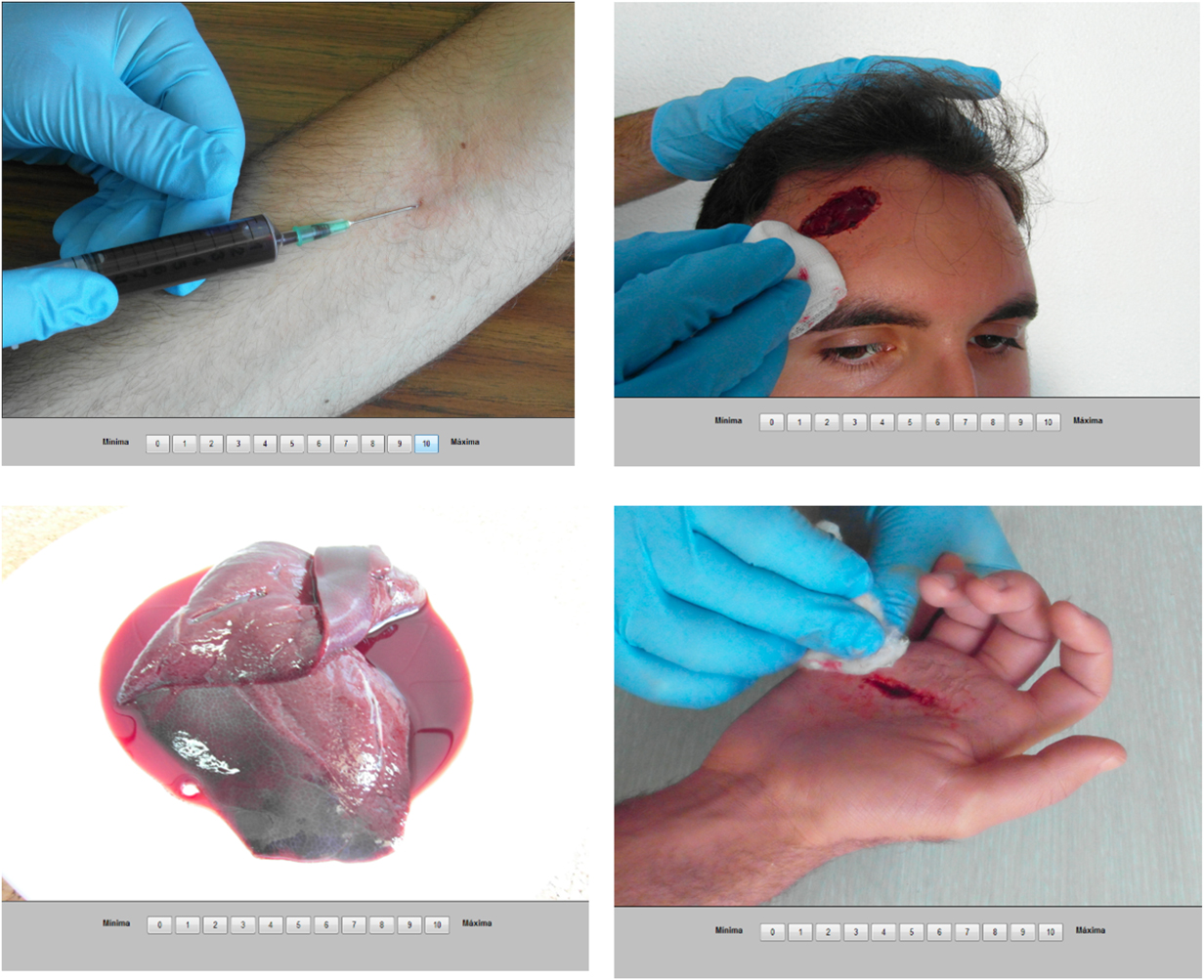
The Multimedia Behavioral Avoidance Test (MBAT) is a reactive test where diverse visual stimuli are presented to the participant. Thirty photos and 30 videos showing scenes of injections, injuries, extractions, blood donations, hypodermic needles, dressings and the use of hospital equipment were created. Each video had a 30-second duration. Two software programs were created through Visual Basic and NeoBook languages (see Figure 1): One to present images (MBAT-I) and the other to present videos (MBAT-V). The programs and instructions were operated using a laptop with Windows 7, a Canon screen projector, and a wireless mouse to facilitate the response selection.
An example of some of the screened images and the recording of subjective anxiety, from the Multimedia Behavioural Avoidance Test Software.

In addition, the software of the MBAT measured the response latency in milliseconds (seconds in data analysis), that is, the time the participants took to click the key for valuation in each stimulus. This latency was the behavioral parameter of the avoidance degree, so it is assumed that lower latency indicates greater avoidance in the participants (Borkovec & Craighead, Reference Borkovec and Craighead1971; Krypotos et al., Reference Krypotos, Effting, Arnaudova, Kindt and Beckers2013; Tolin et al., Reference Tolin, Lohr, Lee and Sawchuk1999). Each image or video was on the screen continuously until the participant made his/her valuation, and then another stimulus appeared.
On the other hand, the maximum heart rate was measured with pulse (Pulsioximeter MD–3002). A member of the research team observed and recorded the largest value, which appeared on the pulsioximeter during the time between the appearance of the stimulus on screen and the auditory click associated with the participant’s response.
The State-Trait Anxiety Inventory (STAI) (Spielberger, Gorsuch, & Lushene, Reference Spielberger, Gorsuch and Lushene1986; Spanish adaptation from Seisdedos, Reference Seisdedos1982) is a general instrument allowing for the self-evaluation of anxiety. It has 40 items and 2 subscales: state anxiety and trait anxiety. Both subscales showed high internal consistency, between Cronbach’s alpha = .93 and .87.
The Medical Fears Survey (MFS) (Kleinknecht et al., Reference Kleinknecht, Kleinknecht, Sawchuk, Lee and Lohr1999; Spanish version from McCabe, Antony, and Ollendick, Reference McCabe, Antony, Ollendick and Caballo2005) contains 50 items related to medical settings, such as injuries, hypodermic needles, operations, and mutilations. It has five factors: Fear of mutilated bodies, fear of blood, fear of hypodermic injection and blood extractions, and fear of medical examinations and physical symptoms. In the original studies, it has a reliability between Cronbach’s alpha = .84 and .94.
The Blood-Injection Symptom Scale (BISS) (Page, Reference Page1999) was translated by the research team into the Spanish language for previous clinical cases. It asks about the sensations that participants have in situations related to blood and injections. It has four subscales: fainting, anxiety, tension and fear. The original study showed a reliability of Cronbach’s alpha = .86 for the total scale and between .56 and .86 for the subscales.
The State Blood-Injection Symptom Scale (SBISS) (Page, Reference Page1999) was also translated into the Spanish language for previous clinical cases. There are three subscales on this questionnaire: Fainting, anxiety and tension. Its internal consistency was Cronbach’s alpha = .94 for the total scale and between .83 and .86 for the subscales.
The Blood and Injection Phobia Inventory (BIPI) (Borda, López, & Pérez, Reference Borda, López and Pérez2010) has eighteen items. The participants must indicate the frequency with which they present any of the 32 symptoms related to anxiety in the cognitive, physiological and avoidance responses included in this instrument. It has a reliability of Cronbach’s alpha = .98.
The Hierarchy of Blood Phobia (JFS) (Valero-Aguayo, Reference Valero-Aguayo2014) is a scale of 25 items that include a series of situations related to blood donation, extractions, injuries, surgical operations, and seeing bloody films. The participant must indicate the anxiety or degree of discomfort he/she has in facing the situation presented in each item. Information on its reliability has not been obtained because members of the research team created it as a clinical instrument for hierarchy exposure treatment in other clinical cases.
Procedure
The initial sample consisted of psychology students who received a point related to the practical component of one of their subjects. Other participants were ordinary people recruited through poster ads and social networks. They were informed about the purpose of the study, the tasks needed for completing the questionnaires and the valuation of images that might cause some discomfort to them but do not have any other consequences. After this explanation, they signed the informed consent form. All of the participants who volunteered finished all the tests. There were no dropouts caused by the nature of the images.
The study was carried out in a 2 x 4 meter laboratory at the Psychology School. The participants were seated at a table in the center of the room and placed one hand on the mouse and the other on the pulsioximeter. The images and videos were projected onto a 2 x 1.5 meter screen in front of them. They were told that they could respond at any time once the images and videos appeared. Each session’s information was stored with all the variables recorded but did not contain any identifying personal information. The file was then uploaded to SPSS–23 statistical software. Each participant’s evaluation lasted approximately 30 to 40 minutes.
Results
The reliability of the MBAT was calculated for the subjective measures of anxiety, both for MBAT-Images and MBAT-Videos. Cronbach’s alpha statistic was used for internal consistency. The values for subjective anxiety were Cronbach’s alpha = .98 for the MBAT-I and Cronbach’s alpha = .98 for the MBAT-V. Therefore, the MBAT showed a high internal consistency through the videos and images selected for the instrument.
A factorial analysis was completed in both programs related to the anxiety responses, in a search for a cluster of items in accordance with other studies. A unique factor grouping all the stimuli was discovered, with self-correlations between stimuli from r = .76 to r = .89. In this instrument, although the stimuli were mixed, there were not different factors for blood, injections or injury.
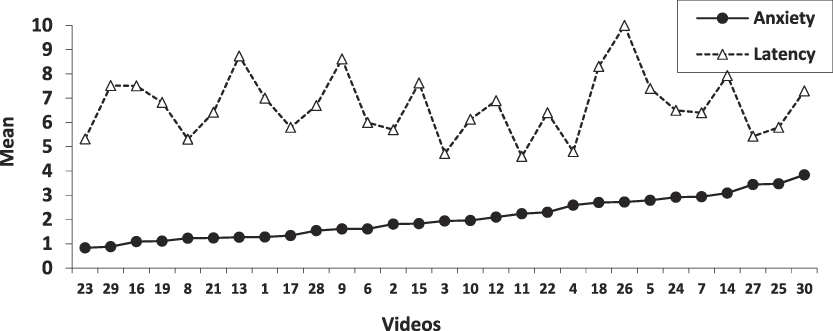
To determine which stimuli in the MBAT-I and the MBAT-V caused more anxiety for participants and to obtain a hierarchy of stimuli for later exposure treatments, a progressive scale according to the anxiety valuation was developed. With this scale, the latencies and heart rate were re-ordered. Figure 2 shows that for the MBAT-I, the higher the anxiety was in the hierarchy of stimuli, the less latency there was. The heart rate was variable among the items. For the MBAT-V, the trend was similar but with a smaller slope (see Figure 3).
Anxiety and latency in seconds for each image of the MBAT-I. (The images are ordered by the mean anxiety intensity in this study sample)

Anxiety and latency in seconds for each video of the MBAT-V. (The videos are ordered by the mean anxiety intensity in this study sample)

To verify the possible relationship between the stimuli in the MBAT-I and the MBAT-V, Pearson’s correlations were computed (see table 1). They were r = .96 (p < .001) for subjective anxiety, r = .21 (p < .006) for response latency, and r = .82 (p < .001) for heart rate. In all cases, the correlations were statistically significant, so we can assume that there is a strong relation between both the BAT programs and those participants’ responses to the photo stimuli were very similar to their responses to the videos, even though they were longer. However, in all cases, the responses in the MBAT-V were higher than in the MBAT-I; there were higher means in the videos (M = 2.05; SD = 1.84, and M = 6,680.05; SD = 3671.38) than in the images (M = 1.95; SD = 1.83, and M = 2,908.31; SD = 913.68). Student’s t-tests revealed significant differences in subjective anxiety responses (t = –2.90, df = 159, p < .005) and latencies (t = –13.30, df = 159, p < .001). This is a logical result because the videos lasted 30 seconds and the participants delayed for some seconds in watching the videos; additionally, no significant differences in heart rate were recorded.
Correlation Coefficients between the MBAT-I and the MBAT-V for the Three Parameters Measured

* p < .05. **p < .001
To verify the nature of the relationship between the parameters in each program, other correlations were later computed. In the MBAT-I, the anxiety response was related directly to latency (r = .25; p < .001), so greater subjective anxiety was similar to a greater response time. The correlation was small but significant. The correlation between anxiety and heart rate was not significant. However, in the MBAT-V, a high subjective response was inversely related to latency in the participant response time. The correlation was low but significant (r = –.17; p = .024). Therefore, in this case, as the theory predicts, when the participant has more subjective anxiety, they eliminate or escape quickly from that anxiety stimulus, and the latency is shorter. Heart rate did not correlate with latency or anxiety.
We can take as an indicative value of phobic problems (i.e., those participants with probabilities of needing psychological intervention) the scores on the MBAT that are over two standard deviations from the mean. In this way, the clinical criterion would be a score of 5.21 points (1.95 ± 2SD) for images and 5.73 points (2.05 ± 2SD) for videos. Using this principle, 12 people in the sample had phobic problems and should receive treatment (scores higher than 6.51), and 10 of them had the same diagnosis if the videos criterion had been used (scores higher than 6.91). According to the scores in this sample, the MBAT can diagnose blood, injury and injection phobias that need treatment.
To identify whether any individual variables might be related to the anxiety responses, differences in age, studies, family and work situation were compared. The only significant differences emerged from Student’s t-test for latency responses between males and females on the MBAT-I (t = 2.056, df = 158, p = .041) and on the MBAT-V (t = 2.482, df = 158, p = .026). In both cases, it appears that men look at the images for longer (M = 3.1; SD = 1.1) than women do (M = 2.8; SD = 8.1) and watch the videos for longer (M = 7.6; SD = 4.3) than women do (M = 6.2; SD = 3.2). It is possible that the women had higher avoidance responses, but there were no significant differences in subjective anxiety. In the sample, 34 participants reported negative experiences with this kind of stimuli. In Student’s t-test, there were significant differences between both groups in subjective anxiety and latency in both images (t = –5.764, df = 158, p < .0001) and videos (t = –5.220, df = 158, p < .0001). This finding implies that participants with a previous negative experience with blood, injury or injections have a greater susceptibility to the test.
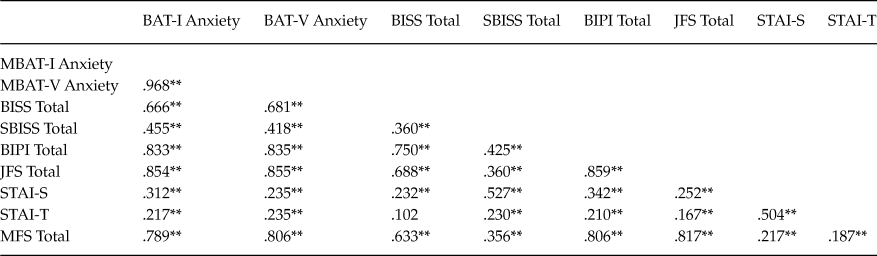
To verify the convergent validity of the computerized MBAT, a correlational analysis of those results and those of the other anxiety questionnaires (the BISS, SBISS, BIPI, JPS, STAI-S and STAI-T) was carried out. In Table 2, those correlations can be seen to be statistically significant and the highest in all cases (except for the STAI-T with the BISS). Both the MBAT-I and the MBAT-V present high correlations with the BIPI (between r = .83 and r = .83), JFS (between r = .85 and r = .55), and MFS (between r = .78 and r = .80). This finding indicates that the MBAT is similar to other specific questionnaires for the assessment of blood, injury and injection phobia. They measure the same psychological problems. In addition, medium but significant correlations appeared with regard to the BISS and SBISS (r = .41 and r = .68). Lower but significant correlations appeared with the other general anxiety questionnaires, such as the STAI-S and STAI-T (r = .21 and r = .31).
Correlation Coefficients between the MBAT-I and the MBAT-V and the Different Anxiety Questionnaires

*p < .05. **p < .001
As shown in Table 2, there are significant correlations among the questionnaires. It could be argued that this finding is logical because the questionnaires are all specific instruments for the assessment of anxiety and phobias. Therefore, a reliability analysis of each questionnaire and subscale was also implemented. With this sample, the BISS had a Cronbach’s alpha of .88, the SBISS had a Cronbach’s alpha of .86, the BIPI had a Cronbach’s alpha of .98, the JFS had an Cronbach’s alpha of .96, and the MFS had a Cronbach’s alpha of .96. These results indicate that all the pencil-and-paper questionnaires also have high reliability.
Discussion
The instrument presented here (the MBAT) has achieved excellent internal consistency, both with the MBAT-I (images) and the MBAT-V (videos). In addition, it had a high correlation with other kinds of pencil-and-paper questionnaires used for the assessment of blood, injury and injection phobia, so it had excellent convergent validity. In accordance with the results, we can say that it is a reliable and valid instrument for the assessment of this kind of phobia. We have obtained a unique factor that groups all the items. We did not find differences between stimuli, and there was only one factor for all images and videos. Other pencil-and-paper instruments found differences between medical fears and blood and injury (Kleinknecht, Reference Kleinknecht1994; van Overveld et al., Reference van Overveld, de Jong and Peters2011). In this study, the participants responded similarly to images and videos and in a similar way to images with blood, wounds, injuries, cuts or injections.
However, we did not find a relationship between subjective anxiety and heart rate. Unlike the studies of Gamez et al. (Reference Gamez, Kotov and Watson2010), we found congruence between avoidance responses and self-informed anxiety, but not between avoidance responses and heart rate. This physiological measurement seems more stable. Other studies did not find exact correlations among physiological, emotional and behavioral responses (Aue et al., Reference Aue, Hoeppli and Piguet2012; Ollendick et al., Reference Ollendick, Allen, Benoit and Cowart2011). Subjective anxiety is directly related to latency in images, with a longer time of anxiety time in seconds, but in the videos, the correlation was inverted, that is, higher anxiety with fewer seconds of response latency. Due to the 30-second duration of the videos, the latency was always greater than in the images. In addition, women had a shorter length of latency than did men. This finding may indicate that they have higher avoidance, but they reported the same subjective anxiety.
Additionally, with these data, we have determined the cut-off levels or criteria that indicate the need for clinical intervention. This sample of possible phobic problems also had higher scores on pencil-and-paper questionnaires, and most of them had previous or aversive experience with blood and injury. This software is of great use to clinicians in quickly detecting people with possible blood phobia. Additionally, the latencies to each image or video offer a hierarchy or order regarding the aversiveness of the stimuli presented. Therefore, the clinician could plan the progression of exposures to phobic stimuli to be specific for each person. The software output offers a hierarchy of items, based on latency or subjective anxiety, to aid in the planning of an idiographic exposure treatment.
This study used a small sample of 160 young to middle-aged participants, so it can be argued that the older population is not represented and that the sample is sub-clinical. In future research, we plan to extend the sample to older members of society and to clinical populations who already have diagnoses for specific phobias. At the same time, the results showed that heart rate, as measured with a clinical pulsioximeter, is relevant as a variable and can help identify higher or lower anxiety. This finding suggests that another physiological measure could be more sensitive to this kind of anxiety. However, a different instrument could be more difficult for clinicians to use.
We have not attempted in this study to elucidate the behavioral conception of anxiety that would be most appropriate; rather, we have created an instrument that scientifically measures the different responses of anxiety. As such, we have proven that aversive stimuli related to blood, injury and injections produce a diversity of responses, including those that are physiological, avoidance and privately verbal in nature (Barlow, Reference Barlow2002; Eifert & Wilson, Reference Eifert and Wilson1991; Lang et al., Reference Lang, Cuthbert and Bradley1998), which are relevant to the assessment of clinical anxiety problems. The data also showed that when stimuli are formally similar to the original, they can also elicit diverse anxiety responses. The participant responded to the images and videos in the same way they would with real blood or injury situations. Furthermore, we showed that the latency of responses could measure the degree of this approximation-avoidance conflict in front of aversive stimuli (Dymond & Roche, Reference Dymond and Roche2009).
We think, according to the criteria established by Haynes (Reference Haynes2001), that we have provided reliability, validity and utility for a new clinical instrument. In short, the BAT is a clinical and standardized instrument with results similar to those of the first experiences of other authors (Brandon & Kleinknecht, Reference Brandon and Kleinknecht1982; Hepburn & Page, Reference Hepburn and Page1999). This instrument has the following features: It offers quicker evaluation, the images and videos have been pre-tested, the instrument is standardized for use in a clinical context, it is an easy-to-use instrument for clinicians to use, and it can detect individuals who need psychological treatment for BII phobia. Additionally, the BAT as a software package can be used included by clinicians, and the same software can be used as a multimedia exposure treatment. Finally, the software and images could be freely available upon request.
This research has not received a specific grant. None of the authors have conflicts of interest. All the experimental procedures with participants are in accordance with the ethical standards of the Spanish University of Malaga and Professional Association of Psychology (COP) and the 1964 Helsinki declaration of ethical standards. All participants were informed about the objective, procedure, bloody images, and anonymity and privacy of data. All participants signed an informed consent form to participate in the study. Exclusively, the three authors created the study: the first author was an experimenter, programmer and writer; the second author was an experimenter, data analyst and writer; and the third author was created the photos and videos. This study does not contain any other data or studies from different authors.