When addressing the subject of students’ study and learning processes, it is common in educational practice to adopt the false belief that the key to learning is to teach traditional study techniques, in other words, to teach students to summarize, draw diagrams, underline, etc. This approach overlooks the necessarily active role of students as well as their overall development, which is achieved when students plan, monitor and regulate their cognitive, behavioral and affective-motivational activity (García & Pintrich, Reference García, Pintrich, Schunk and Zimmerman1994). This oversight is even greater, if possible, in the case of the last of these three components, and it was on this that we primarily focused our attention in this study.
In addition to cognitive and behavioral strategies, students can also use affective-motivational strategies to facilitate their learning process. The purpose of using such strategies is to help students cope with the emotions and motivations that arise in the context of their learning process and, as with all the other cognitive strategies, this kind of strategies may be automatic or controlled by the student (e.g., Suárez & Fernández, Reference Suárez and Fernández2011a, Reference Suárez and Fernández2013). However, unlike other strategies, affective-motivational strategies are not directly related to processing content, although they do promote states that are favorable to engagement with learning, and help prevent undesirable events and unfavorable results. In other words, students’ use of affective-motivational strategies has motivational, cognitive and affective consequences which may be positive, neutral or negative for progress in the learning process. Each type of affective-motivational strategy involves obvious implications for learning behavior (García & Pintrich, Reference García, Pintrich, Schunk and Zimmerman1994; Vermunt & Verloop, Reference Vermunt and Verloop1999), as we shall see later when discussing some of them.
Affective-motivational strategies include actions such as creating a learning intention, making prospective and retrospective attributions, avoidance of effort and use of coping strategies to modify stressors and to reduce negative emotions. In two studies conducted by Suárez and Fernández (Reference Suárez and Fernández2005, Reference Suárez and Fernández2011a), different types of affective-motivational strategies were identified that students can use in the course of their study and learning process, two of which are defensive pessimism and generation of positive expectations.
Defensive pessimism is an anticipatory strategy that emerges when negative self-schemas are activated, but which entails a high level of effort. Students who use this strategy activate a negative self-schema (for example, “I’m bad in this subject” or “this task is very difficult for me”), thereby motivating themselves to exert more effort in order to compensate for these unrealistic and low expectations. Thus, these negative expectations and the anxiety expressed are used to increase their efforts and thus achieve good outcomes (Cantor, Reference Cantor1990; Norem & Cantor, Reference Norem and Cantor1986; Suárez & Fernández, Reference Suárez and Fernández2005, Reference Suárez and Fernández2011a, Reference Suárez and Fernández2011b). Typically, these students are often characterized by low levels of positive affect when faced with a challenge, although they show more rational task planning than in the case of other affective-motivational strategies (Eronen, Nurmi, & Salmela-Aro, Reference Eronen, Nurmi and Salmela-Aro1998). They are also characterized by voicing complaints and protests about how unprepared they are and how difficult the task is, by the high levels of effort they make to obtain above-average results and by their perception of the environment as competitive. Defensive pessimism is associated with fear of failure and negatively, with self-concept, enjoyment and the desire to participate (Ntoumanis, Taylor, & Standage, Reference Ntoumanis, Taylor and Standage2010).
In contrast, through the generation of positive expectations strategy, students generate thoughts and beliefs anticipating successful achievement of the task. To do this, they can employ three different points of reference. First, their own personal experiences of success; second, the characteristics of the task itself; and third, their own characteristics as a student in terms of both their cognitive capacities and their capacity for effort. These three points of reference can be combined in thoughts such as: “These kinds of task are not difficult for me; in fact in other similar situations I worked hard and completed them very well “. All this creates a feeling of optimism when faced with a task that obliges them to invest the necessary cognitive-motivational resources and to implement any other resources they need.
It is worth noting that generation of positive expectations strategy is a strategy of setting high expectations and feel calm, that is next to strategic optimism (Spencer & Norem, Reference Spencer and Norem1996) but doesn´t includes avoid reflecting about outcomes. It is also worth noting that there is a strong relationship between the expectations of students, parental expectations and academic performance (for example, Zhang, Haddad, Torres, & Chen, Reference Zhang, Haddad, Torres and Chen2011).
Optimism and pessimism have traditionally been considered as psychological traits that characterize people, and they are defined on the basis of the person’s beliefs that positive or negative events will occur (for example, Scheier & Carver, Reference Scheier and Carver1985). Thus, defensive pessimism and the generation of positive expectations are strongly related to conceptual models of pessimism-optimism, among which the model proposed by Scheier and Carver is particularly relevant (Scheier & Carver, Reference Scheier and Carver1985; Scheier, Carver, & Bridges, Reference Scheier, Carver, Bridges and Chang2001). According to these researchers, behavior is strongly influenced by the expectations of individuals with regard to the possible outcomes. Thus, when they consider that the outcomes are desirable and achievable, individuals strive to achieve them, even though the process may be difficult and slow. In contrast, when the outcomes are seen as unattainable, individuals tend to give up and do not engage with the task. Consequently, optimism and pessimism can be defined as generalized outcome expectations that may be positive or negative and there are good reasons for considering the value of a domain-specific approach (Chang, Bodem, Sanna, & Fabian, Reference Chang, Bodem, Sanna and Fabian2011).
In addition, optimism about future outcomes is associated with better physical and psychological conditions than pessimism (Gallagher & Lopez, Reference Gallagher and Lopez2009; Scheier & Carver, Reference Scheier and Carver1985; Scheier et al., Reference Scheier, Carver, Bridges and Chang2001) and, intuitively, is recommended because its affective benefits (Sweeny & Shepperd, Reference Sweeny and Shepperd2010). Nevertheless, people´s orientations are associated with the functional value of the adopted perceptions. Thus, those concerned with growth and advancement prefer being optimistic and perform better when adopting an optimistic outlook, and those concerned with safety and security prefer being pessimistic and perform better when adopting a pessimistic outlook (Hazlett & Molden, Reference Hazlett and Molden2011).
Moreover, it has also been suggested that some pessimists may use this pessimism to mitigate potentially debilitating situations of anxiety, thus improving their performance (Norem & Illingworth, Reference Norem and Illingworth1993). Bearing the above in mind, in this study we examined the possibility that students who use defensive pessimism may show similar levels of motivation and use of learning strategies to those of students with positive academic self-schemas, namely students who use the generation of positive expectations strategy. If this were so, it would indicate that high motivational and strategic levels need not always imply high and appropriate expectations and self-perceptions, as has often been reported. However, it is also to be expected that different expectations will be reflected in affective-motivational and strategic differences in relation to academic activity. The research reported here focused on the study of both these hypotheses.
The principal objective of this study was to identify the strategic and motivational characteristics of learning which differentiated the student typologies identified on the basis of the self-reported use of defensive pessimism and the generation of positive expectations.
Method
Participants and procedure
The target population consisted of secondary education students from all over Spain. A convenience sample was used and participants volunteered to participate in the present study. The inclusion criterion was that participant students were from the third year of compulsory secondary education to the second year of non-compulsory secondary education (known as Bachillerato in Spain).
A total of 1753 students participated (44.8% were male and 54.2% female) with an average age of 15.77 years (SD = 1.436 years). All of the students completed the generation of positive expectations and the defensive pessimism scales from the Motivational Strategies for Learning Scales-Secondary Version (MSLS-SV). And they completed, randomly, the motivational component (660 students) or the strategic component (1098 students) of the Spanish version of the Motivated Strategies for Learning Questionnaire (MSLQ) (Pintrich, Smith, García, & Mckeachie, Reference Pintrich, Smith, García and McKeachie1991).
Variables and instruments
The main variables considered in this study were of three types. First, affective-motivational strategies involving the generation of positive expectations and defensive pessimism. Evaluation of these strategies provided the information necessary for the subsequent classification of students according to their tendency to employ optimism or defensive pessimism in their learning process. The strategies were evaluated using the respective scales included in the Motivational Strategies for Learning Scales-Secondary Version (MSLS-SV) (Suárez & Fernández, Reference Suárez and Fernández2011b). The measure of generation of positive expectations (e.g., “When I face a difficult task I think about similar situations in which I was successful”) and defensive pessimism (e.g., “I have the habit of putting in the worst of the situations with regard to the qualifications I can obtain, which I use to strain more in the study”) in this scales is next to the previously measures of defensive pessimism and optimism (Norem, Reference Norem and Chang2001; Spencer & Norem, Reference Spencer and Norem1996), although the strategy of generating positive expectations does not includes avoid reflecting about outcomes. When analyzed for reliability and construct validity, the scales used in this study obtained a Cronbach’s alpha of .70 and a total explained variance of 45.12%.
Second, variables related to students’ academic motivation. The variables included here were academic goals (see next paragraphs), self-concept and self-efficacy in performance (e.g. “I think I will receive a good grade in this class”), control beliefs and self-efficacy in learning (e.g. “I’m certain I can understand the ideas taught in this course”) and anxiety in examination situations (e.g. “When I take a test I think about how poorly I am doing”).
Third, variables related to the learning strategies employed by students. These included different types of cognitive strategies, specifically, repetition (e.g. “When I study for a test I try to remember as many facts as I can”), organization (e.g. “When I study for a test, I try to put together the information from class and from the book”) and elaboration (e.g. “When I study I put important ideas into my own words”); metacognitive self-regulation strategies (e.g. “Before I begin studying I think about the things I will need to do to learn”); and resource management strategies, specifically, time and effort management (e.g. “Even when study materials are dull and uninteresting, I keep working until I finish”), and help-seeking (e.g. “When I don´t understand any content of a subject I ask for help from a fellow”).
Data on strategic and motivational variables were collected using an adapted Spanish version of the Motivated Strategies for Learning Questionnaire (MSLQ) (Pintrich et al., Reference Pintrich, Smith, García and McKeachie1991). This adaptation used the same items as those in the MSLQ, with the exception of items referring to intrinsic and extrinsic goal orientations, which were eliminated. In their place, Skaalvik’s Goal Orientation Scales (1997) were incorporated. This instrument consists of four scales that measure task orientation (e.g. “At school I like to learn something interesting”), self-enhancing ego orientation (e.g. “I feel successful at school when I do the work better than other students”), self-defeating ego orientation (e.g. “When I answer questions in class I am occupied by how I am perceived by other students”) and avoidance orientation (e.g. “At school I like to do as little as possible”).
For all three instruments, a five-point scale was used. When this adapted version of the MSLQ was analyzed for reliability and construct validity, the motivation component obtained a Cronbach’s alpha of .76 and a total explained variance of 60.75%, while the strategies component obtained a Cronbach’s alpha of .86 and a total explained variance of 46.88%.
Data analysis
A series of descriptive and correlational analyses were performed in relation to the generation of positive expectations and defensive pessimism strategies and also to the rest of the cognitive-motivational variables studied. Subsequently, a Student’s t-test was performed to study the existence of gender differences in relation to the two types of affective-motivational strategies studied. Effect size measures are calculated using Cohen´s d.
Next, in order to obtain different groups of students according to their self-reported use of the defensive pessimism and generation of positive expectations strategies, we conducted a Quick Cluster Analysis. This non-hierarchical method was selected because it is a person-centered analysis and it enabled us to reassign individuals to another group in a determined step of the analysis process if this optimized the selection criterion.
Lastly, we performed two ANOVAs, using the Tukey method as a post-hoc multiple comparison test, in order to determine whether there were statistically significant differences between the groups referred to above in relation to the motivational variables (academic goals, self-efficacy in performance, control beliefs and anxiety) and the strategic learning variables (repetition, organization, elaboration, metacognitive self-regulation, time and effort management, and help-seeking) that characterize the activities of learning and study.
Results
Use of the strategies of generation of positive expectations and defensive pessimism and their relationship with other cognitive-motivational variables
As can be seen in Table 1, the mean score for self-reported use of the defensive pessimism strategy coincided exactly with the mean score of the scale (from 1 = never to 5 = always). The mean score was higher in the case of the generation of positive expectations strategy (optimism) and the self-reported use of both strategies presented a positive and significant correlation.
Means, standard deviations and correlations regarding the generation of positive expectations and defensive pessimism strategies and the cognitive-motivational variables

* p < .05. **p < .01.
Furthermore, both affective-motivational strategies correlated significantly and positively with the vast majority of cognitive-motivational variables (task orientation, self-enhancing ego orientation, self-efficacy in performance, control beliefs and self-efficacy in learning, anxiety, repetition, organization, elaboration, help-seeking and metacognitive self-regulation). On the other hand, they only correlated significantly and negatively with the avoidance orientation. Only two variables were not included in these relationships common to both strategies, one of which was a motivational variable, the self-defeating ego orientation, and the other a strategic variable, time and effort management. Thus, the strategy of defensive pessimism correlated positively and significantly with both the self-defeating ego orientation and time and effort management, while the generation of positive expectations (optimism) correlated negatively and significantly with time and effort management.
Gender differences in the use of the generation of positive expectations and defensive pessimism strategies
With regard to gender, we only found significant differences between genders for the defensive pessimism strategy, whereby female students scored significantly higher for this variable than male students (Table 2); although the obtained effect size might be considered a small effect (d = .12).
Mean difference between genders with regard to the generation of positive expectations (optimism) and defensive pessimism strategies

An analysis of the correlations studied in the previous paragraph, this time considering the students’ gender, revealed that the significant positive correlation between the strategy of defensive pessimism and the self-defeating orientation (Table 1) was only obtained for female students (r = .283; p < .01), whilst the significant positive correlation between the defensive pessimism strategy and time and effort management (Table 1) was only obtained for male students (r = .167; p < .01). The significant negative correlation between generation of positive expectations (optimism) and time and effort management was also only obtained in the case of female students (r = –.085; p < .05).
Groups of students according to the self-reported use of the defensive pessimism and generation of positive expectations strategies and cognitive-motivational differences in their learning
We considered several solutions for the possible number of clusters based on the self-reported use of defensive pessimism and generation of positive expectations strategies, ranging from 2 to 5 groups. The optimal number of groups was selected on the basis of various criteria, such as that of differentiating the student groups in a way that was most susceptible to theoretical interpretation, that of characterizing the groups according to different levels in the variables mentioned above or that the solution obtained required the lowest possible number of iterations. The results of the cluster analysis subject to the criteria mentioned above suggested a solution of four clusters (Table 3). Thus, the scores obtained for each of the variables in the four clusters presented a mean standard deviation from the mean of the variable in question. This enabled us to categorize each of the scores obtained by cluster analysis as a high or low score, as corresponded. Moreover, this solution was obtained after 8 iterations.
Cluster analysis of the affective-motivational strategies of defensive pessimism and generation of positive expectations

Cluster 1: Low level of defensive pessimism, high generation of positive expectations
Cluster 2: High level of defensive pessimism, high generation of positive expectations
Cluster 3: High level of defensive pessimism, low generation of positive expectations
Cluster 4: Low level of defensive pessimism, low generation of positive expectations
Using the solution of four clusters, we obtained a first group of students with a low level of defensive pessimism and a high level of generating positive expectations, a second group with a high level in both variables, a third group with a high level of defensive pessimism and a low level of generating positive expectations, and lastly, a fourth group with a low level in both variables. Cluster 1 can be characterized as a group of students in which the generation of positive expectations predominated. Cluster 2 can be described as a group of students with high positive and negative expectations. The Cluster 3 group can be characterized by the predominance of negative expectations, and lastly, students in cluster 4 were characterized by low levels in both types of expectations.
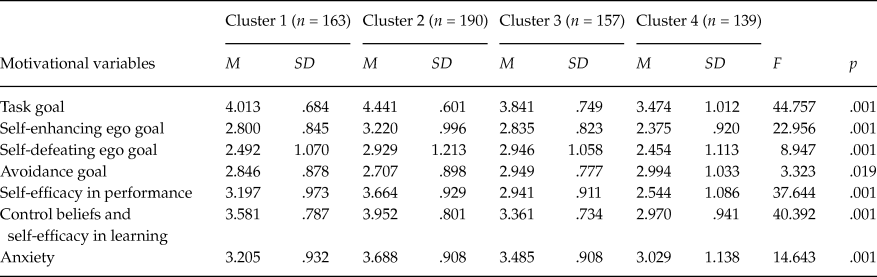
The ANOVAs performed (Tables 4 and 5) indicated that it was the second cluster of students, which was characterized by high levels of both defensive pessimism and generation of positive expectations, which obtained significantly higher scores for all the motivational variables (using effect size as a complement in the interpretation of the results, we observed that obtained effect sizes supported these results). The differences were only non significant with respect to the third cluster and for the variables self-defeating orientation and anxiety. The only exception to this pattern was obtained for the avoidance orientation, in which the second cluster obtained the lowest score, although this was only significantly lower compared to the fourth cluster.
Mean difference between the groups of students identified in the cluster analysis with respect to motivational variables

Mean difference between the groups of students identified in the cluster analysis with respect to strategic variables

In turn, it was the fourth cluster of students, which was characterized by low levels of both defensive pessimism and generation of positive expectations, which obtained significantly lower scores for all the motivational variables. The differences were only non significant with respect to the first cluster and for the variables self-defeating orientation and anxiety. The only exception to this pattern was obtained for the avoidance orientation, in which the fourth cluster obtained the lowest score, although this was only significantly lower compared to the second cluster.
Lastly, it should be noted that statistically significant differences between the first and third clusters were only obtained with respect to the self-defeating variable, for which the third cluster obtained higher scores than the first.
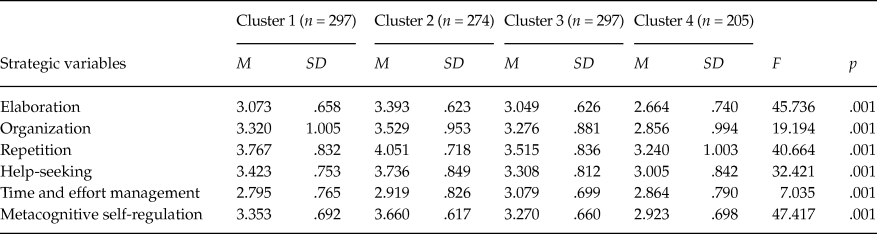
As regards the strategic variables studied, we obtained a similar pattern in that it was once again the second cluster which obtained significantly higher scores for all the learning strategy variables (again, using effect size as a complement in the interpretation of the results supported these results). The only exception was for the time and effort management strategy, for which the third cluster obtained the highest score. Although this score was not significantly higher than that of the second group, there were statistically significant differences with respect to the first and fourth clusters.
Meanwhile, the fourth cluster obtained significantly lower scores for all variables. The only exception was for the time and effort management strategy: in this case, although the students in the fourth cluster did not obtain the lowest score, neither was their score significantly different from that of the group which did obtain the lowest score.
Lastly, it should be noted that statistically significant differences between the first and third clusters were only obtained with respect to the strategies of repetition and time and effort management. Thus, the first group obtained higher scores for the strategy of repetition and the third group for the time and effort management strategy.
Discussion
The results obtained indicated greater use of the generation of positive expectations strategy compared to use of the defensive pessimism strategy, and showed that the use of both strategies correlated positively and significantly. In other words, greater use of one strategy was associated with greater use of the other, which contradicts a possible contrasting argument based on the defensive pessimism-optimism dichotomy. In turn, this suggests the possibility of the generation of various expectations, both positive and negative, in the same student and the consequently prominent role of students in the self-regulation of their motivational strategies.
In addition, both strategies correlated similarly with practically all the cognitive-motivational variables studied here, indicating that the use of both strategies was associated with adequate student motivation and with the use of learning strategies. This suggests that adequate levels of motivation and use of strategies need not necessarily be associated with positive expectations in students, and that different expectations imply motivational and strategic differences. On the other hand, we did observe gender differences in terms of use, whereby female students used the defensive pessimism strategy to a greater extent than male students.
Obtaining different groups of students according to their use of both strategies has enabled us to go beyond the initial parallelism between defensive pessimism and the generation of positive expectations. Thus, we obtained a clear differentiation of four student typologies according to their use of both strategies. Two of the groups were in line with the points made so far, namely, two groups of students in which the first was characterized by high use of both strategies and the other by low use of both strategies. Both groups were characterized, again in line with what we have been discussing, on the basis that the use of both strategies was related to adequate student motivation and the use of learning strategies.
However, to the above two groups can be added two new groups, characterized by alternating between a high level in the use in one of the two strategies and a low level in the use of the other strategy. These two groups were located at an intermediate level with respect to the first two groups in terms of adequacy of student motivation and their use of learning strategies. In terms of their cognitive-motivational characteristics, these two new groups could be differentiated by the fact that students in the group which obtained a high level of defensive pessimism and a low level of generating positive expectations showed greater concern, on a motivational level, to avoid looking foolish to others and, on the strategic level, a higher level in managing their time and effort and a lower level in using the strategy of repetition. Therefore, it could be said that this group of students, in which the defensive pessimism strategy predominated, was a little more competent at a strategic level and a little less competent at a motivational level, with the implications that this type of goal often entails (Fernández, Anaya, & Suárez, Reference Fernández, Anaya and Suárez2012a, Reference Fernández, Anaya and Suárezb).
In this way, these different groups may involve differences on academic performance through their influence on cognitive and motivational variables. As a consequence of the previous, although we concluded earlier that adequate levels of motivation and use of strategies need not necessarily be associated with positive expectations in students, we should clarify that when not associated with the highest motivational levels, motivational level is most adequate when positive rather than negative expectations are deployed (considering the self-defeating ego goal an undesirable feature), while the use of strategies is most adequate when negative rather than positive expectations are displayed (considering the time and effort management strategy a positive feature and repetition strategy an undesirable feature). Thus, for these two groups of students alone, the different types of expectations do imply motivational and strategic differences.
Lastly, addressing the subject of future work in this line of research, we believe that it would be of great interest to conduct a combined study of various aspects in the generation of both positive and negative expectations in relation to effort and adjustment to reality. According to this approach, students might generate positive expectations that lead to increased effort and conform to reality (based on their previous experiences, their own characteristics as students or the characteristics of the task they are facing), but these positive expectations could also lead to decreased effort due to overconfidence and a misinterpretation of reality. On the other hand, students could also generate negative expectations that lead to increased effort (defensive pessimism), but which may also lead to decreased effort due to a feeling of being unable to change negative events (giving up) or to a mismatch with reality (surprise at obtaining an unexpected positive result). The results obtained in this study for the four groups might even be related to this interpretation, whereby the group with high use of both the defensive pessimism and generation of positive expectations strategies includes students who generate positive and negative expectations which are adequately orientated. In other words, students generate positive and negative expectations that are adapted to their environment. Therefore, it is necessary to carry out more research in order to study this hypothesis in more depth and also to conduct a longitudinal study that would enable us to gain a better understanding of the relationship between the use of the strategies studied here and past events and future outcomes, and thus a greater knowledge of these psychological processes.