Research on the effect of age on learning a second language (L2) has consistently shown that L2 learners who are immersed in a L2 at a younger age produce more targetlike phonology—in particular, more nativelike accents—than those immersed in the L2 later in their life (Asher & García, Reference Asher and García1969; Flege, Munro, & MacKay, Reference Flege, Munro and MacKay1995; Flege, Yeni-Komshian, & Liu, Reference Flege, Yeni-Komshian and Liu1999; Huang & Jun, Reference Huang and Jun2011; Moyer, Reference Moyer1999, Reference Moyer2004; Munro & Mann, Reference Munro and Mann2005; Oyama, Reference Oyama1976). The age of learning variable remains the most powerful predictor of a nativelike accent, even after controlling for potential confounding variables, such as L2 learners’ educational attainment and their amount of exposure to the L2 (Flege et al., Reference Flege, Yeni-Komshian and Liu1999). Researchers have argued that L2 phonological production is strongly constrained by the age of learning variable because of the neuromuscular demands involved in producing targetlike phonology (Scovel, Reference Scovel2000). To produce nativelike phonology, it is hypothesized that the cutoff age is around 6 for segments and 12 for suprasegments (Long, Reference Long2005).
Empirical studies that examine the age effect on L2 phonological production generally use human judgments to determine L2 learners’ outcomes, particularly in the domain of the degree to which learners have foreign accents (FAs). On the basis of the inferences drawn from analyses of raters’ ratings, researchers then test or formulate theories of language learning. However, although research in the fields of speech processing and oral language assessment has revealed robust differences among raters, rater differences have received little attention in research on the age effect. In the following sections we first summarize the speech processing and language assessment literature before reviewing in more detail studies relating specifically to the focus of the present study—namely, age of learning effects and the effects of rater differences. We then describe the methodology of the current study and report the results. We conclude with a discussion of the implications of rater differences for the age of learning research and provide suggestions for future research.
BACKGROUND
Rater Differences in Speech Processing and Oral Language Assessment
Research on speech processing and oral language assessment has generally shown that raters’ or listeners’ native language background and language experience can influence their perception of FAs, their ratings of the intelligibility and comprehensibility of nonnative speech, and their judgments of nonnative speakers’ (NNSs’) language proficiency (e.g., Bradlow & Bent, Reference Bradlow, Bent, Solé, Recasens and Romero2003; Brodkey, Reference Brodkey1972; Gass & Varonis, Reference Gass and Varonis1984; Huang, Reference Huang2014; Winke & Gass, Reference Winke and Gass2013; Winke, Gass, & Myford, Reference Winke, Gass and Myford2013; Xi & Mollaun, Reference Xi and Mollaun2011). The influence of raterFootnote 1 differences has been an important topic in the study of speech processing because this topic addresses fundamental questions about human perception and learning (see Carey, Mannell, & Dunn, Reference Carey, Mannell and Dunn2011, for a thorough review of dominant theories). It is also one of the most heavily surveyed areas in oral language assessment due to its direct implications for the reliability, validity, and fairness of assessments (Bachman, Lynch, & Mason, Reference Bachman, Lynch and Mason1995; Kunnan, Reference Kunnan2000).
Turning first to the effects of raters’ native language background (native speaker [NS] vs. NNS) on ratings of nonnative speech, results from empirical research are quite mixed. In terms of rank ordering nonnative speech, Derwing and Munro (Reference Derwing and Munro2013), for example, found that the rank-ordering patterns of highly proficient NNS raters closely paralleled those of NS raters. Ratings by highly proficient NNS raters also significantly correlated with those of NS raters. In terms of the numerical ratings assigned to nonnative speech, some studies have found NS raters to be more lenient than their NNS counterparts (e.g., Caban, Reference Caban2003; Fayer & Krasinski, Reference Fayer and Krasinski1987), whereas others have observed no significant differences between the two groups (Kim, Reference Kim2009; Zhang & Elder, Reference Zhang and Elder2011). However, analyses of interviews and raters’ written comments have revealed that NS and NNS raters may weigh various features of speech samples differently in the justifications of their ratings (Kim, Reference Kim2009; Zhang & Elder, Reference Zhang and Elder2011). To illustrate, Kim (Reference Kim2009) conducted a mixed-methods study to assess how NS and NNS teachers evaluate students’ oral English performance. Both NS and NNS teachers judged 10 Korean students’ English speech samples on a 4-point scale and provided written comments to justify their ratings. Although quantitative analyses of teacher ratings revealed no significant group differences, NS teacher raters commented most frequently on overall language use, pronunciation, and vocabulary, whereas NNS teachers emphasized pronunciation, vocabulary, and intelligibility. Native speaker raters also provided more elaborate comments on speakers’ pronunciation and grammar than their NNS peers, suggesting potential qualitative differences in the two groups’ rating behavior.
An additional problem in investigating the influence of rater experience concerns how experience is defined and operationalized, which varies substantially across studies (Isaacs & Thomson, Reference Isaacs and Thomson2013). Some studies have defined it as the exposure to foreign-accented speech in controlled experiments (Bradlow & Bent, Reference Bradlow, Bent, Solé, Recasens and Romero2003, Reference Bradlow and Bent2008; Clarke & Garrett, Reference Clarke and Garrett2004), some have appealed to raters’ professions (e.g., second or foreign language teachers or speech therapists vs. undergraduate students without any linguistics training) as a proxy (Carey et al., Reference Carey, Mannell and Dunn2011; Kennedy & Trofimovich, Reference Kennedy and Trofimovich2008), some have relied on participants’ self-reports of familiarity with foreign accents (Munro, Derwing, & Morton, Reference Munro, Derwing and Morton2006; Winke et al., Reference Winke, Gass and Myford2013), and still others have used some combination of these different criteria (Huang, Reference Huang2014). There is also much variation in basic research design across studies. Whereas some have utilized experimental methodology to test the effects of perceptual training on the intelligibility and comprehension of foreign-accented speech (e.g., Bradlow & Bent, Reference Bradlow, Bent, Solé, Recasens and Romero2003, Reference Bradlow and Bent2008; Clarke & Garrett, Reference Clarke and Garrett2004), others have used quasi-experimental designs to examine the effects of language experience by studying different rater groups (e.g., Brodkey, Reference Brodkey1972; Huang, Reference Huang2014; Isaacs & Thomson, Reference Isaacs and Thomson2013; Kennedy & Trofimovich, Reference Kennedy and Trofimovich2008; Major, Reference Major2007; Munro et al., Reference Munro, Derwing and Morton2006; Xi & Mollaun, Reference Xi and Mollaun2011).
Despite differences in design and in the definition and measurement of language experience, the overall picture emerging from this body of work suggests that raters’ language experience facilitates their comprehension of nonnative speech. Language experience has also contributed to modifying raters’ perceptions of FAs and judgments of L2 speakers’ proficiency, though the relationship between the degree of severity in the rating and the raters’ experience remains unclear. Some studies have found that experienced raters tend to be more lenient than linguistically naïve raters in their ratings (Barnwell, Reference Barnwell1989; Carey et al., Reference Carey, Mannell and Dunn2011; Hsieh, Reference Hsieh2011; Winke et al., Reference Winke, Gass and Myford2013), but others have found the opposite to be true (Galloway, Reference Galloway1980; Hadden, Reference Hadden1991). Furthermore, studies comparing specific features used by raters (e.g., global proficiency, pronunciation, or fluency) have also shown that language experience may play a significant role in their decision-making processes (Chalhoub-Deville, Reference Chalhoub-Deville1995; Hsieh, Reference Hsieh2011; Winke & Gass, Reference Winke and Gass2013; Xi & Mollaun, Reference Xi and Mollaun2011).
Rater Differences in the Age of Learning Effect Research
We found a total of nine studies that examined rater differences in the assessment of the age effect,Footnote 2 and all of them included rater differences as a secondary research question rather than as the primary focus.Footnote 3 There was also much variation across studies in the specific background variables examined, which included the investigation of NS raters with mainstream versus regional accents (Bongaerts, Reference Bongaerts and Birdsong1999b; Bongaerts, Planken, & Schils, Reference Bongaerts, Planken, Schils, Singleton and Lengyel1995), NS raters with and without experience in teaching and linguistic training (Bongaerts, Mennen, & van der Slik, Reference Bongaerts, Mennen and van der Slik2000; Bongaerts, van Summeren, Planken, & Schils, Reference Bongaerts, van Summeren, Planken and Schils1997; Nikolov, Reference Nikolov2000, Study 1; Thompson, Reference Thompson1991), NNSs with limited versus substantial exposure to the target language (Flege, Reference Flege1988; MacKay, Flege, & Imai, Reference MacKay, Flege and Imai2006), and children versus adults (Nikolov, Reference Nikolov2000).
Bongaerts and colleagues (Bongaerts, Reference Bongaerts and Birdsong1999b; Bongaerts et al., Reference Bongaerts, Mennen and van der Slik2000; Bongaerts et al., Reference Bongaerts, Planken, Schils, Singleton and Lengyel1995; Bongaerts et al., Reference Bongaerts, van Summeren, Planken and Schils1997) conducted a series of empirical studies to identify highly advanced late L2 learners with nativelike proficiency. The main purpose of their work, a test of the critical period hypothesis, was to determine whether late L2 learners can “beat the odds” of a late start and achieve nativelike proficiency in their L2. In an initial study, Bongaerts et al. (Reference Bongaerts, Planken, Schils, Singleton and Lengyel1995) found that NS raters from northern England who were unfamiliar with regional British accents judged the speech of NSs of British English with regional accents to be less nativelike than that of Dutch learners of British English with training in Received Pronunciation. These curious results led the authors to conduct a subsequent study, published in the same paper, in which they substituted NSs of regional British accents with NSs of neutral accents and included NS raters both with and without experience in language teaching and linguistics. Bongaerts and colleagues compared ratings by two NS rater groups (experienced vs. inexperienced) and found that they were not reliably different from each other. Using a widely adopted nativelikeness criterion (Abrahamsson & Hyltenstam, Reference Abrahamsson and Hyltenstam2009)—namely, the criterion of two standard deviations within the mean of the NS control group—the authors identified five late Dutch learners of British English who were perceived as speaking with a nativelike accent. With evidence of late learners having achieved nativelike proficiency, the authors argued against the critical period hypothesis. In another study, Bongaerts (Reference Bongaerts and Birdsong1999b) examined a different first language (L1)–L2 pairing (Dutch learners of French) and again included both experienced and inexperienced NSs of French as raters. The researchers replicated their previous finding, showing no reliable differences between the judgments of the experienced and inexperienced raters. The results also revealed three adult learners who demonstrated a nativelike accent in their L2 French.
In contrast to these findings, Bongaerts and colleagues found discrepancies between the judgments of raters with and without linguistic experience in a fourth study (Bongaerts et al., Reference Bongaerts, Mennen and van der Slik2000). In this study, two groups of Dutch NSs, experienced and inexperienced, rated the speech production of L2 learners of Dutch and of Dutch NS control participants. Experienced raters were, again, trained L2 teachers, whereas inexperienced raters lacked any experience in language teaching or linguistics. Using the nativelikeness criterion derived from experienced raters’ average ratings, the researchers identified four late L2 learners with nativelike accents, but only two of them were also perceived as nativelike based on inexperienced raters’ ratings. The researchers combined the results and made inferences from the two, instead of four, nativelike cases as evidence against the critical period hypothesis.
In an attempt to replicate the work by Bongaerts and colleagues, Nikolov (Reference Nikolov2000) also found raters’ behavior to vary as a function of linguistic experience. She included L2 learners of Hungarian (Study 1) and English (Study 2) as well as NSs of each target language as control participants. For both studies, Nikolov included three groups of NS raters in the respective L2, one adolescent and two adult groups. In Study 1, the adults were either university students or language teachers, whereas both groups of adults were postgraduate students in Study 2. Results from the two studies showed that adult raters rank ordered the speakers in a similar manner. Adolescents’ ratings, in contrast, were not as highly correlated with the adults’ ratings. Crucially, in Study 1, Nikolov found that teacher raters, compared with university students, were better able to distinguish NSs and NNSs.
In line with these studies showing positive rater differences, Thompson (Reference Thompson1991) investigated factors predicting Russian immigrants’ degrees of FA in English by assessing the judgments of two groups of English NSs varying in their experience in language teaching and their contact with Russian immigrants in the United States (experienced vs. inexperienced). The results revealed that, compared to inexperienced NS raters, experienced NS raters were more lenient and more reliable in their assessment of FAs. It is worth noting that Thompson did not use the commonly adopted nativelikeness criterion to identify nativelike L2 learners. Instead, she examined mean ratings and found two nativelike speaker participants with perfect scores.
In a study examining the effects of the amount of L1 use on Italian immigrants’ L2 pronunciation outcomes, Flege, Frieda, and Nozawa (Reference Flege, Frieda and Nozawa1997) also included two groups of English NSs as raters. One rater group was from Alabama, United States, and self-reported having limited exposure to FAs; the other rater group was from Ottawa, Canada, and reported having regular exposure to a variety of FAs, including Italian-accented English. To our knowledge, this is the only study in the age effect literature that includes detailed background information about the raters employed. The speaker participants in the study included two groups of Italian L1 immigrants who differed in the amount of their L1 use (high vs. low), and one control group of Canadian English NSs. Flege and his colleagues found that the two groups of raters were not reliably different in rank ordering the talkers (NS > low L1 use > high L1 use). However, raters from Ottawa were better at detecting the FAs of Italian immigrants to Canada and at distinguishing NSs and NNSs. Flege and his colleagues attributed this advantage to the Canadian raters’ experience and familiarity with the specific type of FAs under investigation.
All seven of the studies just described used NS raters. The only two studies that included NNS raters were those reported by Flege (Reference Flege1988) and MacKay et al. (Reference MacKay, Flege and Imai2006), who examined NNS raters’ ability to gauge FAs in their L2. Flege (Reference Flege1988) included four speaker groups of Chinese learners of English who varied in their age of arrival (AoA) and length of residence in the United States and a group of English NSs as controls. Three groups of raters were recruited to judge the FAs of these speakers: one English NS group and two NNS groups with 1 and 5 years of residence in the United States, respectively. Flege found that the two groups of NNS raters rank ordered the speakers in a similar manner as the NS raters. However, NNS raters with longer residence in the United States were better at distinguishing between NSs and NNSs than were NNS raters with shorter residence. The ratings of NNS raters with longer residence also did not reliably differ from those of the NS raters. The combined results suggested that experience (from longer residence) may afford the NNS raters perceptions of the L2 sounds that are more similar to those of NS raters. A major limitation of the study was that most of the raters were drawn from the speaker participants and thus rated their own speech, which raised concerns about the validity of their ratings.
Similar to Flege’s (1998) study, MacKay et al. (Reference MacKay, Flege and Imai2006) evaluated NNSs’ ability to scale L2 speakers’ FAs.Footnote 4 However, unlike the NNS raters in Flege’s study, who shared the L1 (Chinese) of the NNS speakers, the NNS raters in MacKay et al.’s study spoke a different L1 (Arabic) than the NNS speakers (Italian). The experiment involved English NS control speakers and four groups of Italian learners of English, differing in their AoAs and L1 usage (early AoA–low L1 use; early AoA–high L1 use; late AoA–low L1 use; and late AoA–high L1 use). Two groups of raters, one English NS group and one NNS group with an Arabic L1 background, evaluated all speakers’ speech samples. The NNS raters themselves had AoAs of 15 and older, and their average length of residence was 3 years. Results from the study revealed that NNS raters’ ratings were highly correlated with those of NS raters, suggesting that even NNS raters who do not share the L1 of the NNS speakers can reliably scale the speakers’ FAs.
In summary, existing studies paint a mixed picture about the role of language experience in rating behavior;Footnote 5 some have suggested that NS raters’ language experience may lead them to be more lenient (Bongaerts et al., Reference Bongaerts, Mennen and van der Slik2000; Nikolov, Reference Nikolov2000; Thompson, Reference Thompson1991) or may help them distinguish NSs from NNSs (Flege et al., Reference Flege, Frieda and Nozawa1997; Nikolov, Reference Nikolov2000). Other studies, however, have found no such effect (Bongaerts Reference Bongaerts and Birdsong1999b; Bongaerts et al., Reference Bongaerts, Planken, Schils, Singleton and Lengyel1995; Bongaerts et al., Reference Bongaerts, van Summeren, Planken and Schils1997). Two studies that compare NNS raters with NS raters have found that NNS raters can scale the FAs of L2 speakers as well as their NS peers (Flege, Reference Flege1988; MacKay et al., Reference MacKay, Flege and Imai2006), but these findings await replication. It is also unknown how NNS raters compare to NS raters in terms of the degree of severity in their judgments and their ability to distinguish between NSs and NNSs.
By systematically investigating the effect of rater differences on the assessment of FAs, the present study aims to clarify how raters’ language experiences affect their judgments of foreign accents. In particular, we focus on raters’ L1 background and their experience with FAs and language teaching, using a quasi-experimental design. This included comparison of three groups of raters: advanced nonnative English speakers (advanced NNESs), inexperienced native English speakers (inexperienced NESs), and experienced native English speakers (experienced NESs). Our research questions focused on whether raters’ L1 and linguistic experience influenced any of the following:
1. The reliability of their foreign accent ratings.
2. Their scaling of L2 speakers’ degree of foreign accents.
3. The degree of severity in their ratings of L2 speakers’ FAs.
4. Their ability to reliably distinguish NSs from NNSs.
METHOD
Participants: Speakers
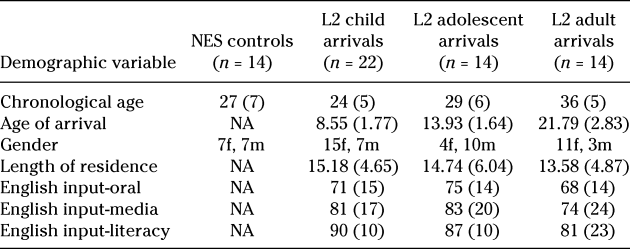
Four groups of speakers participated in the study: three L2 learner groups, varying in AoA (child arrivals, adolescent arrivals, and adult arrivals), and one NES control group (n = 14). The L2 learner groups immigrated to the United States either in childhood (ages 5–11; n = 22), adolescence (ages 12–16; n = 14), or adulthood (ages 17–25; n = 14) and had lived in the United States for at least 7 years. They all spoke Mandarin Chinese as their L1 and were at least college educated or were undergraduate students at the time of testing. To control for amount of L2 input, we matched the three groups on their length of residence (LoR) in the United States and their self-reported English input in the past 5 years (estimated as a percentage) in three different domains (oral, media, and literacy).
All of the NES control speaker participants were NSs of American English and had no significant exposure to a L2 other than formal foreign language instruction in high school. To avoid any dialectal differences, we screened and selected participants without a noticeable regional accent. See Table 1 for a summary of the demographic information for all speaker participants.
Means and standard deviations (in parentheses) of demographic information by speaker group

Note. NES = native English speaker; f = female; m = male; NA = not applicable. Chronological age = current age in years; age of arrival = age at which the participant arrived in the United States; length of residence = length of stay in the United States in years; English input-oral = self-estimated English exposure in oral domain (i.e., listening or speaking) in the past 5 years in percent form; English input-media = self-estimated English exposure via media (i.e., TV, radio, movies) in the past 5 years in percent form; English input-literacy = self-estimated English exposure in literacy domain (i.e., reading or writing) in the past 5 years in percent form. One-way ANOVAs revealed no significant differences among the three groups in LoR, F(2, 47) = 0.42, p = .657, and English input in the oral domain, F(2, 47) = 2.98, p = .060, the media domain, F(2, 47) = 1.09, p = .346, or in the literacy domain, F(2, 47) = 1.88, p = .165.
Participants: Raters
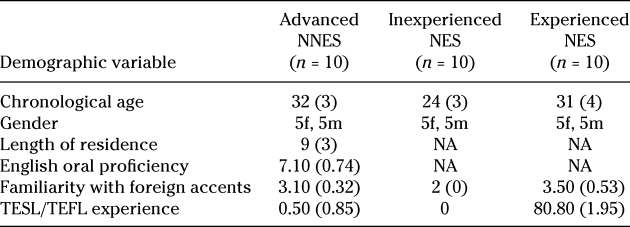
Three groups of raters participated in the current study: advanced NNES, inexperienced NES, and experienced NES raters. All raters were at least college educated or were current undergraduate students at the time of testing. They reported normal hearing and no history of hearing or speech problems.
We carefully screened all potential rater participants via a survey instrument before inviting them to participate in the study. We used different screening criteria for each of the three groups. Advanced NNESs were required to (1) speak Mandarin Chinese as their L1, (b) have come to the United States after college and have lived in the United States for at least 7 years, (c) self-report high levels of oral English proficiency (at least a rating of 7 on a scale of 1–9), and (d) self-report high levels of familiarity with FAs (at least a rating of 3 on a scale of 1–4). Almost half of the advanced NNES raters had also taught English as a foreign language in their home countries. Both inexperienced NES and experienced NES rater groups were required to be NSs of American English and to speak without a noticeable regional accent and to have had no significant exposure to a L2 prior to high school. Inexperienced NES raters also met the following criteria: (a) They did not speak any L2 or foreign language fluently at the time of participation, (b) they had not taken any class related to speech or phonetics, (c) they lacked any experience in language teaching or the rating of nonnative speech, and (4) they self-reported little familiarity with FAs. To qualify for the study, experienced NES raters were required to (a) be current or past English as a second language (ESL) teachers or speech therapists,Footnote 6 (b) have worked in that profession for at least one full year, and (c) self-report high levels of familiarity with FAs (at least a rating of 3 on a scale of 1–4). Three of the experienced NES raters also had knowledge of Mandarin Chinese via either formal language classes or self-study. See Table 2 for a summary of the demographic information of all rater participants.
Means and standard deviations (in parentheses) of demographic information by rater groupa
Note. NNES = nonnative English speaker; NES = native English speaker. English oral proficiency = self-rated English oral proficiency on a 1-9 scale (1 = poor, 9 = nativelike); familiarity with foreign accents = self-rated familiarity with foreign accents on a 1-4 scale (1 = not familiar at all. I am not able to tell whether the speaker’s first language is English or other languages, 2 = somewhat familiar. I can sometimes tell whether the speaker’s first language is English or other languages, 3 = moderately familiar. I can often tell whether the speaker’s first language is English or other languages, 4 = very familiar. I can always tell whether the speaker’s first language is English or other languages); TESL/TEFL experience = years of experience in teaching learners of English as a second/foreign language. One-way ANOVA revealed a significant group effect, F(2, 27) = 47.90; p < .001 , and Bonferroni post hoc tests suggested that both advanced NNES and experienced NES groups reported significantly higher familiarity with foreign accents than inexperienced NES group (both p < .001). Experienced NES raters reported slightly higher familiarity than advanced NNES raters, though the difference was only marginally significant (p = .054).
Procedure
Collection of Speech Samples
All speakers were recorded reading a paragraph in a quiet room at a university laboratory or their private residences (Weinberger, Reference Weinberger2014; see the Appendix for the paragraph). They were given 1 min to review the paragraph before recording and were instructed to read at their own pace. Recordings were completed using a high-quality head-mounted microphone (Shure SM 10A) in the program Audacity (Audacity Team, 2000, Version 1.2.5) on a laptop (IBM Thinkpad x60s).
Collection of Ratings
We normalized the intensity of all speech files (75 dB) using PRAAT (Version 5.0, Boersma & Weenink, Reference Boersma and Weenink2009) and assigned an identification number by the order of speakers’ AoAs. We then generated two lists of randomized orders using an online number randomizer (Urbaniak & Plous, Reference Urbaniak and Plous2013). The two orders were then balanced within each rater group. The average length of the speech files was approximately 28 s (range = 22–40).
Each rater participant rated all 64 speech files in a single 30–40 min session. There were two data-collection sites: one was a university laboratory and the other was a quiet office in a research institution. Following previous research (Bongaerts, Reference Bongaerts and Birdsong1999b; Bongaerts et al., Reference Bongaerts, van Summeren, Planken and Schils1997), rater participants were not informed of the purpose of the study but were told that they would listen to and rate speech samples produced by unspecified proportions of NSs and NNSs of American English. No practice or training was provided. Rater participants listened to each speech file via headphones (Sennheiser HD 203) on a laptop (IBM Thinkpad x60s). Speech files were played via the MATLAB program (Version 6.5.1). Rater participants were instructed to judge the degree of FAs using a 1–9 scale (1 = strong FA, 9 = native English speaker).
To standardize the rating procedure and condition across the two sites, we used the same models of headphones and laptops and the same presentation program. The two researchers working on the project also adhered to the same script when giving instructions to the rater participants. The distribution of raters from the three rater groups was roughly equal between the two sites.
The current study presents several methodological improvements from previous research. First, to understand the comprehensive picture of rater effects, the study included speakers with a range of AoAs; second, it also controlled for speakers’ input, which was operationalized as a combination of LoR and amount of L2 input. Previous studies either focused only on adult learners (Bongaerts, Reference Bongaerts and Birdsong1999b; Bongaerts et al., Reference Bongaerts, Mennen and van der Slik2000; Bongaerts et al., Reference Bongaerts, Planken, Schils, Singleton and Lengyel1995; Bongaerts et al., Reference Bongaerts, van Summeren, Planken and Schils1997; Nikolov, Reference Nikolov2000) or included child and adult learners, but not adolescent learners (Flege, Reference Flege1988; MacKay et al., Reference MacKay, Flege and Imai2006). In an earlier study that covered a range of AoAs (Thompson, Reference Thompson1991), the researcher did not control for learners’ input, making the interpretations of the results difficult. The current design permits investigations of the potential interactions between speakers’ AoAs and differences in behavior among raters. Additionally, we carefully screened the raters to ensure they met our selection criteria, and we used a larger sample of raters than that of most previous studies. We also chose a paragraph that contained the full inventory of American English phones to elicit read-aloud production. Compared to the sentence-level productions used in previous research, the production of paragraph-length samples provided more speech materials for raters to evaluate, which in turn afforded us better chances to identify possible differences among raters’ perceptions. Finally, the current study adopted a broader definition of language experience and used a combination of both objective (raters’ profession) and subjective (self-reports of familiarity with FAs) measures of language experience.
RESULTS
To examine interrater reliability and determine whether it was statistically appropriate to combine rater participants’ FA ratings, we calculated average absolute agreement using a two-way mixed intraclass correlation (ICC) for each rater group. The ICC measures were .92 (95% CI [.88, .95]) for the advanced NNES raters, .95 (95% CI [.92, .97]) for the experienced NES raters, and .97 (95% CI [.95, .98]) for the inexperienced NES raters. The ICCs were all very high across rater groups and were comparable to the values reported in previous studies that used ICCs as an interrater reliability index (e.g., Derwing & Munro, Reference Derwing and Munro2013; MacKay et al., Reference MacKay, Flege and Imai2006; Munro et al., Reference Munro, Derwing and Morton2006; Trofimovich, Lightbown, Halter, & Song, Reference Trofimovich, Lightbown, Halter and Song2009). We thus computed the average of these ratings within each group to use as dependent variables in the statistical models. The confidence intervals suggest a narrow interval around the ICC point estimates and indicate that the only difference (based on the confidence intervals) was between advanced NNES and inexperienced NES raters.Footnote 7 We also examined the correlation matrix to substantiate the ICCs, and we found that the coefficients were consistent and large (smallest r = .49) within each rating group. However, the average Spearman’s rho correlation coefficients were smaller for the advanced NNES raters (ρmean = .61, s = .01) than for the experienced NES raters (ρmean = .86, s = .01) and the inexperienced NES raters (ρmean = .87, s = .01).
We then conducted the traditional 4 (between, or speaker group, factor) × 3 (within, or rater group, factor) MANOVA to assess the effect of raters on the dependent variable, rater FA ratings. This multivariate model rests on the following assumptions: homogeneity of variance, equality of covariance matrices, multivariate normality, and independent errors. Although preliminary analyses revealed these assumptions were met when excluding the NES speaker group from the analyses, the inclusion of this group violated the equality of covariance matrices and the homogeneity of variance assumptions, as the estimated standard deviations were much smaller for this group. These findings were expected, given that the NES speaker group should have much higher ratings and less variability among raters than the other speaker groups. Consequently, including this group in the model biases the test statistics (i.e., it underestimated the standard errors and, therefore, the test statistics) and statistical inferences by violating the statistical assumptions of the model (i.e., overall MANOVA and pairwise comparisons). Although one conventional approach is to transform the dependent variable, these assumptions remained violated after conducting Box-Cox transformations. To resolve these concerns, we elected to employ robust analyses that use nonpooled standard errors and did not rely on traditional model assumptions.
Empirical evidence suggests that the approximate degrees of freedom (ADF) tests are relatively robust for tests of mean equality when the aforementioned assumptions are violated (for a review, see Keselman, Algina, & Kowalchuk, Reference Keselman, Algina and Kowalchuk2001; Lix & Keselman, Reference Lix and Keselman1995). Moreover, the statistical power of these ADF tests is generally comparable to traditional multivariate and univariate mixed ANOVA approaches, even when model assumptions are satisfied. Especially important for this study is the observation that the ADF tests are also more powerful than traditional tests when both variances and group cell sizes are unequal. For these reasons, we conducted a 4 (speaker group) × 3 (rater experience) mixed ADF ANOVA followed by robust Welch-James ADF pairwise mean comparisons. Recall that the Welch-James ADF pairwise comparison procedure does not pool the variances; thus the smaller variances for the NES speakers will not influence the standard errors when comparing means across the other groups.
Effect sizes (i.e., Cohen’s d) were calculated differently depending on whether the pairwise comparison was a between- or within-groups comparison, as within-groups comparisons should take into account the correlation between variables (Lipsey & Wilson, Reference Lipsey and Wilson2001). Therefore, the between-group effect sizes were calculated by taking the mean difference (M 1 − M 2) and dividing by the pooled standard deviation (s p). The within-group effect sizes were computed using the following equation: t c[2(l − r)/n]1/2, where t c is the t statistic (or square root of the F statistic in Tables 3 and 4), r is the correlation coefficient, and n is the sample size (see Dunlap, Cortina, Vaslow, & Burke, Reference Dunlap, Cortina, Vaslow and Burke1996).
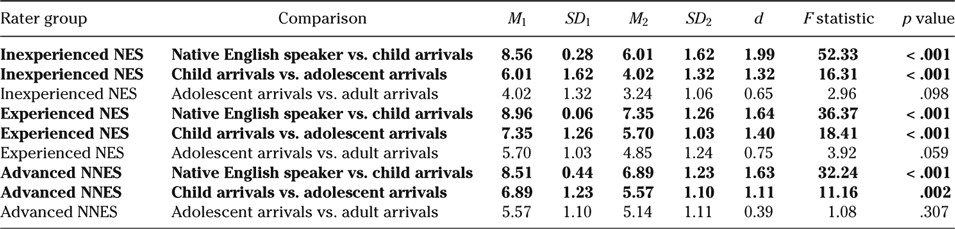
Mean, standard deviation, effect size (d), the robust Welch-James ADF pairwise comparison (F statistic), and the corresponding p value by rater group
Note. NES = native English speaker; NNES = nonnative English speaker. M 1 and SD 1 as compared to M 2 and SD 2 are the means and standard deviations of ratings for the first and second speaker group in each comparison. Nonbold comparisons were not statistically significant after the Bonferroni adjustment (α = .05/21 = .002) for Type I error.
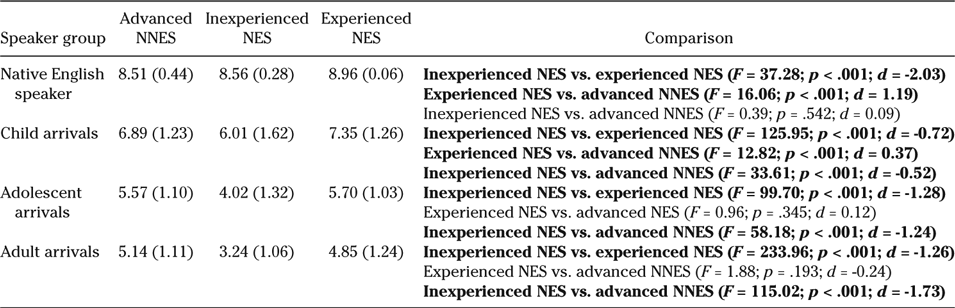
Mean and standard deviation (in parentheses) of the three rater groups’ ratings for each speaker group, along with the robust Welch-James ADF pairwise comparison results by speaker group
Note. NNES = nonnative English speaker; NES = native English speaker. Nonbold comparisons were not statistically significant after the Bonferroni adjustment (α = .05/21 = .002) for Type I error.
Approximate degrees of freedom mixed ANOVA analyses revealed a statistically significant main effect of rater group, F(2, 38.63) = 225.19, p < .001,  ${\rm{\eta }}_{\rm{p}}^{\rm{2}}$= .87, and speaker group, F(3, 116.20) = 116.20, p < .001,
 ${\rm{\eta }}_{\rm{p}}^{\rm{2}}$= .69, and a rater experience by speaker group interaction, F(6, 32.45) = 45.09, p < .001,
 ${\rm{\eta }}_{\rm{p}}^{\rm{2}}$= .40. Based on Cohen’s (Reference Cohen1988) tentative standards (small
 ${\rm{\eta }}_{\rm{p}}^{\rm{2}}$= .01; medium
 ${\rm{\eta }}_{\rm{p}}^{\rm{2}}$= .06, large
 ${\rm{\eta }}_{\rm{p}}^{\rm{2}}$ = .14), the effect size was large for each of the main effects and interaction. To better understand these differences, in particular the significant interaction, Welch-James ADF pairwise comparisons using a Bonferroni adjustment (α = .05/21 = .002) were conducted. Note that, to reduce the probability of a Type I error, not all mean comparisons were conducted. Instead, only means of interest were tested for statistical significance (see Tables 3 and 4).
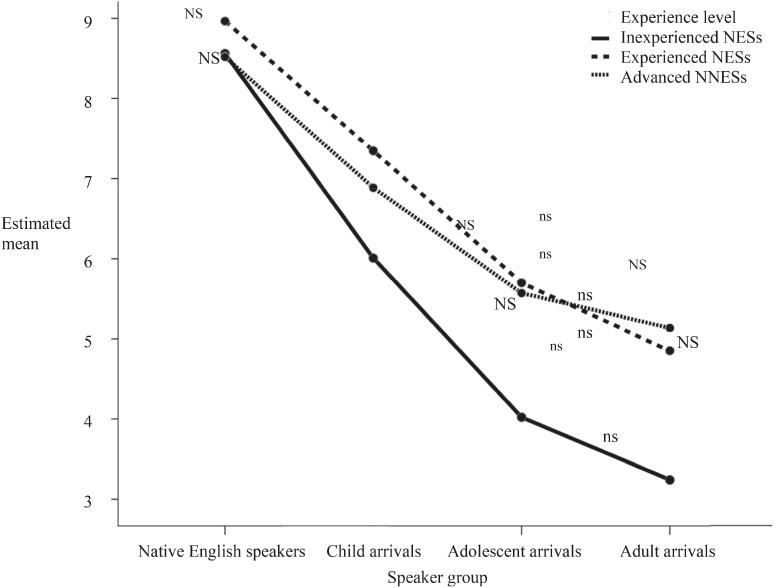
Pairwise analyses comparing differences among speaker groups at each rater group (see Figure 1 and Table 3) revealed that NES speakers received higher ratings than child arrivals, and child arrivals received higher ratings than adolescent arrivals, regardless of rater groups. However, no difference between adolescent arrivals and adult arrivals emerged, regardless of rater background. When comparing rater groups at each speaker group level (see Figure 1 and Table 4), analyses indicated that advanced NNES and experienced NES raters overall assigned higher scores than inexperienced NES raters, with a much smaller difference between advanced NNES and experienced NES raters. It is worth noting that experienced NES raters assigned significantly higher ratings to NESs than both inexperienced NES and advanced NNES raters, but the ratings for NESs did not significantly differ between inexperienced NES and advanced NNES raters. These results suggest that experienced NES raters were better at identifying NS norms than the other two rater groups.
Estimated means from the ADF mixed ANOVA by rater group by speaker group. NS denotes nonsignificant within-group (rater group) mean differences, whereas ns represents nonsignificant between-groups (speaker group) mean differences, for those means nearest to the corresponding labels. All results are based on the Welch-James ADF pairwise comparison tests. NES = native English speaker; NNES = nonnative English speaker.
As seen in Figure 1 and Table 4, the following three nonsignificant rater group differences emerged: inexperienced NES versus advanced NNES raters at the NES speaker group and experienced NES versus advanced NNES raters at the adolescent and adult arrivals groups. For rating L2 speakers, whereas the experienced NES and advanced NNES raters had relatively consistent downward rating trends with the increase of L2 speakers’ AoAs, these downward changes were much steeper for inexperienced NES raters. This implies that inexperienced NES raters tend to provide lower ratings, with these ratings decreasing at a greater rate than for the other two rater groups. Although slight differences existed between experienced NES and advanced NNES raters at times (see NES and child arrival comparisons), they were relatively small, especially for adolescent and adult arrivals.
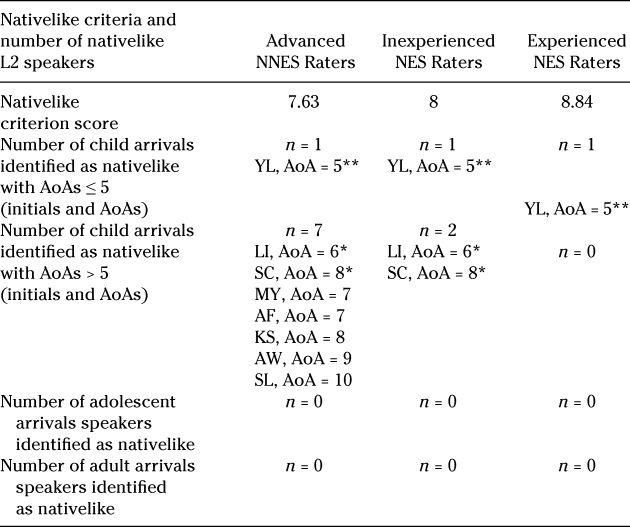
To determine whether the three groups of raters identified the same L2 speakers as having achieved nativelike proficiency, we adopted the common nativelikeness criterion in the literature—that is, within two standard deviations of the average ratings assigned to NES controls—and we called the value derived from the criterion a criterion score. Judging from the ratings assigned to NES control speakers, experienced NES raters appeared to be better able to distinguish between NSs and NNSs and assigned the highest ratings to NES control speakers of the three rater groups. Experienced NES raters also exhibited the least variation (M = 8.96, SD = 0.06); thus their criterion score was the highest among the three groups (8.84). Advanced NNES raters’ mean ratings of NES control speakers (M = 8.51) were similar to those of inexperienced NES raters (M = 8.56) despite their nonnative background. However, there was less variation among inexperienced NES raters (SD = 0.28) than among advanced NNES raters (SD = 0.44). Advanced NNES raters’ criterion score was thus the lowest (7.63).
We identified the most nativelike cases using advanced NNES raters’ criterion score and the fewest cases by experienced NES raters’ criterion score (see Table 5). Critically, no L2 speakers with an AoA of more than 5 were identified as nativelike by the experienced NES raters’ criterion score, suggesting a potential terminus of plasticity at the age of 5. However, by the criterion score of the inexperienced NES rater group, two additional L2 speakers beyond the AoA of 5—one with an AoA of 6 and the other of 8—met the nativelike criterion. According to the advanced NNES raters’ criterion score, five L2 speakers with an AoA of more than 5 (including one child arrival with an AoA of 10) qualified as having obtained a nativelike accent.
Nativelike criteria and the number of nativelike L2 speakers by speaker group by rater group
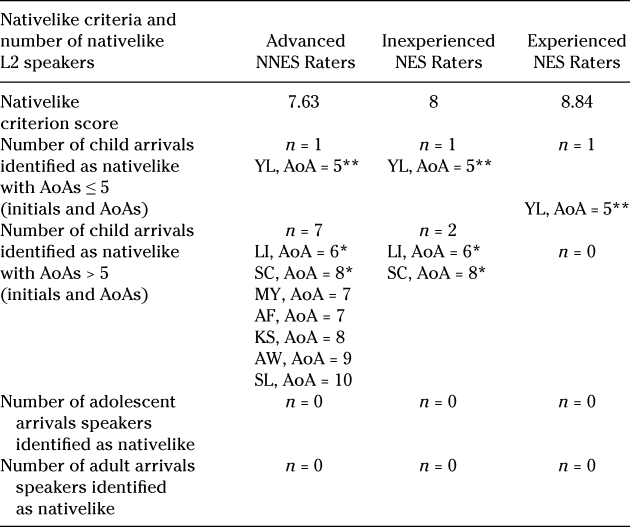
Note. NNES = nonnative English speaker; NES = native English speaker. ** = nativelike cases identified by all three rater groups; * = nativelike cases identified by two of the three rater groups.
DISCUSSION
The current study set out to address a methodological gap in the literature on age of learning effects on L2 production outcomes, specifically focusing on rater differences in the assessment of FAs. The study provided a systematic and detailed comparison of the judgments of three groups of raters with different L1 backgrounds and language experience. Using a 1–9 numerical scale, all raters judged the degrees of FAs in the paragraph read by 14 NES control participants and 50 L2 speakers with varying AoAs. To examine differences across rater groups in interrater reliability, two reliability measures were calculated for each rater group and were compared across groups. Approximate degrees of freedom mixed ANOVA analyses were conducted to examine the differences in raters’ scaling of the speakers’ FAs, the severity of ratings, and their ability to distinguish NESs and NNESs.
Results from the interrater reliability analysis showed that advanced NNES raters were the least reliable among the three rater groups, but the two NES rater groups exhibited similar degrees of rating consistency. These findings contradicted the results of Thompson’s (Reference Thompson1991) study, in which experienced NES raters were much more reliable than their inexperienced NES peers. Although a direct comparison of the current study with that of Thompson is not possible, we speculate that the discrepancies between the two may be attributed to the differences in the AoA ranges of the speakers, their level of proficiency in the L1, or the rating scales. The AoAs of the L2 speakers in Thompson’s study ranged from 4 to 42, but the distribution of the AoA range was not specified. It could be that the majority of the speakers in Thompson’s study were in a similar AoA range, which made it easy for raters to reach consensus on the speakers’ FAs. In contrast, the current study included approximately equal numbers of participants in each AoA bracket. Furthermore, Thompson included only Russian learners of English who still maintained a high level of proficiency in their L1 and suggested that this may have resulted in heavier FAs. In contrast, the speakers in the present study self-reported substantial exposure to their L2 and may thus have lighter, and therefore harder-to-discern, FAs. Finally, the wider range of the scale (1–9) used in the current study may also lower the interrater reliability more so than the 1–5 scale in Thompson’s study.
The results revealed no significant differences in raters’ rank orders of the speakers’ FAs; the three rater groups rank ordered the speakers in a similar manner (NES > L2 child; L2 child > L2 adolescent; L2 adolescent = L2 adult). This finding replicated previous research (Derwing & Munro, Reference Derwing and Munro2013; Flege, Reference Flege1988; Flege et al., Reference Flege, Frieda and Nozawa1997; MacKay et al., Reference MacKay, Flege and Imai2006) and suggests that raters can reliably evaluate the relative degrees of FA among speakers regardless of their own L1 backgrounds and language experience, even when the speech material is a paragraph rather than a single sentence.
Despite the similarities in their rank orders, the raters diverged in the severity of their ratings of L2 speakers’ FAs. The analyses of their aggregated ratings revealed that, in general, inexperienced NES raters were consistently stricter (i.e., assigned lower ratings) than experienced NES raters and advanced NNES raters when judging L2 speakers’ FAs. The discrepancies between experienced and inexperienced NES raters’ severity corroborated previous research by Thompson (Reference Thompson1991) but contradicted Bongaerts (Reference Bongaerts and Birdsong1999b) and Bongaerts et al. (Reference Bongaerts, van Summeren, Planken and Schils1997). The results were also consistent with previous research on oral language assessments showing that experienced NS raters were more lenient than inexperienced raters (Fayer & Krasinski, Reference Fayer and Krasinski1987; Hsieh, Reference Hsieh2011) but contradicted the findings of Hadden (Reference Hadden1991), which found the opposite effect.
The discrepancies between the three groups’ severity in ratings may be attributed to a cognitive or exposure-based account, a social account, or a combination of both. Usage-based models emphasize the importance of experience and exposure in language acquisition (Kuhl, Reference Kuhl2004; Tomasello, Reference Tomasello1992); learners start with extracting phonemic prototypes or lexically specific schemas from the linguistic environment. Repeated exposure to the same prototypes or schemas then facilitates the development of phonetic categories and eventually mental grammar. Speech processing research (Bradlow & Bent, Reference Bradlow, Bent, Solé, Recasens and Romero2003, Reference Bradlow and Bent2008) also provides some support for this account by demonstrating that, with exposure to foreign-accented speech in a controlled experimental session, listeners can adapt to nonnative speech and can improve intelligibility and comprehension of the accented speech. Due to prior language experience or exposure to FAs, experienced NES and advanced NNES raters in the current study may thus have developed phonetic categories for the accented speech, making it easier for them to process it. It is therefore possible that the higher ratings assigned by some raters reflected this ease of processing.
Furthermore, experienced NES and advanced NNES raters may also have been more lenient than inexperienced NES raters because they were familiar with a fuller range of FAs, having encountered L2 speakers with stronger FAs and more limited proficiency than those of the advanced L2 speakers in the current study (who were all long-term U.S. residents). Experienced NES and advanced NNES raters may have thus used the relatively lower proficiency L2 speakers from their prior experience as a baseline for comparison, a rating strategy documented in prior studies (Isaacs & Thomson, Reference Isaacs and Thomson2013). It is worth noting that two recent studies have found that NSs’ level of education and professional training influence their linguistic skills (specifically lexical knowledge and speaking proficiency; Mulder & Hulstijn, Reference Mulder and Hulstijn2011) as well as their judgments about the structure of long-distance dependencies (Dąbrowska, Reference Dąbrowska2010). These findings seem to corroborate the cognitive or exposure-based account beyond the domain of speech perception.
Alternatively, even if the required cognitive effort were equal, experienced NES and advanced NNES raters may have been more sympathetic with and favorable toward NNESs due to their familiarity with the NNESs’ FAs (the advanced NNES raters were themselves NNESs). In other words, teaching experience and accent familiarity may have helped these raters recognize the NNESs’ country of origin and ethnicity, or it may have even directly activated raters’ favorable attitudes toward NNESs, leading to more lenient ratings. This can be illustrated in a qualitative study that investigated the effect of raters’ familiarity with speakers’ FAs on their rating process. Winke et al. (Reference Winke, Gass and Myford2013) asked heritage language speakers of Mandarin Chinese, Korean, and Spanish to rate ESL speech samples from speakers who had one of these three languages as their L1. The rating session was video recorded, and raters later watched these videos and discussed their decision-making processes. The heritage language speaker raters often claimed to recognize the L1s of some ESL speakers and reported that their ratings of them were more lenient as a result. To tease these two accounts apart, and to understand raters’ cognitive processing and reactions to nonnative speech, future studies may utilize the sort of think-aloud protocols that are commonly employed to examine decision-making processes (e.g., Ericsson & Simon, Reference Ericsson and Simon1980; Pressley & Afflerbach, Reference Pressley and Afflerbach1995).
Although there were no significant differences between the aggregated ratings of experienced NES and advanced NNES raters in most pairwise comparisons in the current study, experienced NES raters were significantly more lenient when rating child L2 speakers compared to advanced NNES raters, but not reliably so when rating the adolescent and adult L2 speakers. The results suggest that raters’ behavior varied by speakers’ proficiency. We argue that our experienced NES raters’ leniency may be attributed to their language experience as well. As previous research comparing teacher and nonteacher raters has shown, teachers are generally more lenient toward L2 learners than nonteachers (Fayer & Krasinski, Reference Fayer and Krasinski1987; Hsieh, Reference Hsieh2011). Although the experienced NES raters in the current study did recognize the slight FAs in the child L2 speakers, their ratings may reflect knowledge of these speakers’ likely improvement from some previous state.
Turning now to the results regarding the ability to distinguish between NESs and NNESs, experienced NES raters were, as a group, better at distinguishing native and nonnative speech, consistently assigning the highest ratings to NESs. This particular finding is in line with what Flege et al.’s (Reference Flege, Frieda and Nozawa1997) study revealed about the perceptual differences between NES raters in Alabama and those in Ottawa. It is likely that experienced NES raters’ ESL or English as a foreign language teaching experience, combined with their familiarity with FAs and NES speech, facilitated the identification of NS norms. In line with the cognitive or exposure-based account, their experiences could have provided them with useful knowledge about variation in both NES and NNES speech, resulting in increased accuracy in distinguishing the two. In contrast, inexperienced NES raters have little experience with the speech variation in L2 speech, possibly leading them to interpret L1 variants as FAs (Markham, Reference Markham1997). Therefore, advanced NNES raters and inexperienced NES raters did not differ reliably in their ratings of the NES speakers. We interpret these results as evidence supporting the hypothesis that NNSs, particularly those with substantial experience and high proficiency in the target language, can develop phonetic representations that are identical to some of those possessed by NSs of the target language. It is important to note that we are not arguing that NNSs can achieve nativelike mental representations of all of the segmental and suprasegmental features in the target language. In fact, the perceptions of FAs may involve potential paralinguistic cues such as speakers’ confidence and both segmental and suprasegmental deviations (Piller, Reference Piller2002). Research on crosslinguistic speech perception has shown that even early L2 learners with near-native proficiency in the target language may not achieve nativelike segmental perception (Navarra, Sebastián-Gallés, & Soto-Faraco, Reference Navarra, Sebastián-Gallés and Soto-Faraco2005; Pallier, Bosch, & Sebastián-Gallés, Reference Pallier, Bosch and Sebastián-Gallés1997; Sebastián-Gallés & Soto-Faraco, 1999). Nonetheless, corroborating findings on the perceptions of regional dialects and FAs (Baker, Eddington, & Nay, Reference Baker, Eddington and Nay2009; Flege et al., Reference Flege, Frieda and Nozawa1997), our results also demonstrate that NNSs can develop global sound representations of the target language resembling those of linguistically inexperienced NSs before developing the ability to produce these sounds in a targetlike way.
The discrepancies in the raters’ ability to distinguish NS and NNS speakers resulted in different criteria for determining cases of nativelike L2 speakers. Because the experienced NES raters were better and more consistent as a group in identifying NSs, their nativelike criterion score was the highest among the three rater groups. Using their criterion, no L2 speakers with an AoA of more than 5 were identified as speaking with a nativelike accent. In contrast, several L2 speakers with an AoA of more than 5 met the nativelike criteria by both inexperienced NES raters and advanced NNES raters. One child L2 speaker with an AoA of 10 also qualified as a nativelike learner based on the advanced NNES raters’ criterion score, though not by the other two NES rater groups’ standards. The discrepancies in the number of nativelike cases can have important implications for the theories about age effects in L2 acquisition. Such discrepancies, particularly those between the two NES rater groups, would lead to different conclusions about the terminus of the critical period for L2 speech production. If we adopt experienced NES raters’ criterion, the cutoff age would be around 5, which is close to Michael Long’s (Reference Long2005) proposal of age 6. However, using the other two rater groups’ criteria would result in different conclusions because the upper limit of nativelike cases increased to 8 for inexperienced NES raters and 10 for advanced NNES raters.
The implications of the current study are thus multifold. First, the results suggest that, for future assessment tasks involving only rank ordering of speakers, advanced NNSs can be just as competent as NSs. Native speakers have long served as the norm for language instruction as well as assessment, and their evaluations have been regarded as more valid and informative than those of NNSs (Munro et al., Reference Munro, Derwing and Morton2006; Zhang & Elder, Reference Zhang and Elder2011). However, the current results show that the evaluations of NNSs with advanced proficiency are not reliably different from those of NSs in the scaling of L2 speakers’ speech production. The NNS raters’ degrees of severity in rating also closely paralleled those of experienced NS raters, except for the child L2 speaker group, which was judged less favorably by NNS raters than by the NS raters. In other words, the evaluations of advanced NNS raters resembled those of experienced NS raters in both rank ordering and overall severity. The results spell good news for the large number of NNS teachers worldwide and reassure that their evaluations and feedback to their L2 students are valid and meaningful.
Additionally, the discrepancies in the raters’ severity, particularly those between experienced and inexperienced NS raters, have implications for the validity of research comparing L2 speakers’ outcomes across studies. Recently, meta-analysis research has been gaining popularity in L2 acquisition research (Norris & Ortega, Reference Norris and Ortega2000), as it illuminates and advances the field by systematically synthesizing the evidence across empirical investigations. However, given the rater differences evident in the current study, future metasynthesis of age effect research would need to take into consideration the fact that such differences may constitute a confound. Inferences drawn from cross-study comparisons that fail to take rater backgrounds into account are therefore tenuous.
Finally, the existence of divergent rating outcomes between experienced and inexperienced NS raters also raises concerns about the native speaker construct. Native speakers have traditionally been defined as speakers of the standard variety of the language (Davies, Reference Davies1999), but this definition lacks specificity. Researchers have challenged the absolute distinction between NSs and NNSs, arguing against such a simple dichotomy (Davies, Reference Davies2003; Faez, Reference Faez2011). As revealed in the current study, NSs’ language and teaching experience, or lack thereof, may also influence their speech perception and judgments of NNSs’ L2 proficiency. The current conceptualization of NSs thus fails to appreciate the variation in L1 proficiency among even NSs themselves (Cook, Reference Cook1999; Davies, Reference Davies2003).
In addition to serving as the benchmark for comparison in L2 acquisition research, NS norms have also been used widely in language teaching and testing. The lack of detail in the current definition, however, raises questions about who the ideal NSs actually are. Would simultaneous bilinguals (those who have been exposed to two languages since birth) of the standard variety of both of their languages be regarded as NSs of both languages? Would second-generation immigrants whose exposure to the target language began at school age but who have become dominant in the target language be considered NSs? If not, would the construct of NSs and NNSs become one of monolinguals and bilinguals? Although we agree on the necessity of concrete and well-defined benchmarks in empirical research, we urge researchers to acknowledge the complexities of the NS construct, to provide justifications for their decisions, and to include detailed descriptions of any raters (NSs or NNSs) their study employs. In a review of factors that affect L2 FAs, Piske, MacKay, and Flege (Reference Piske, MacKay and Flege2001) discussed the potential rater effect in the literature and proposed that researchers include a representative sample of raters from different backgrounds rather than one particular type. The proposal appeared to be a feasible and balanced solution. However, we would like to suggest that researchers also evaluate the purpose of their own study before making a decision on the specific type of raters to include. For example, if the purpose of the study is to evaluate the L2 speakers’ FAs as perceived by NSs living in metropolitan cities (who are presumably familiar with FAs), then it would make sense to include judgments by experienced NSs rather than those of inexperienced NSs. Conversely, if the intent is to assess L2 speakers’ FAs as perceived by NSs with limited exposure to L2 speakers, using inexperienced NSs would provide more informative assessments than would using experienced NSs.
We suggest several directions for future research. First, although the size of the current rater sample (n = 30) is reasonable and relatively large for studies on age effects and experimental or quasi-experimental L2 acquisition research in general, it is not sufficient for more sophisticated statistical techniques that also take into account variation on the speaker level, such as multifaceted Rasch models (Hsieh, Reference Hsieh2011; Isaacs & Thomson, Reference Isaacs and Thomson2013; Winke et al., Reference Winke, Gass and Myford2013) or G-theory (Xi & Mollaun, Reference Xi and Mollaun2011). Future researchers may want to include a larger sample and to utilize such advanced analyses. Additionally, in the present study, we included only one type of speech stimuli—namely, the production of a read-aloud passage. Previous research has also shown that speakers’ proficiency may vary depending on the type of L2 tasks under study (Moyer, Reference Moyer2004; Thompson, Reference Thompson1991); future work investigating the effect of task types will advance our understanding of the matter. Finally, further research is also needed to better understand the roles of other rater background variables, such as gender and attitudes toward NNSs, and to assess the interaction between such variables and task types.
CONCLUSIONS
To conclude, the current study found that L1 background and language experience significantly influenced raters’ rating scores and ability to distinguish NSs from near-native early L2 learners. However, such experience was not found to predict raters’ scaling of L2 speakers’ proficiency. Results from the current study therefore demonstrate that differences among raters have important implications for studying age of learning effects and should be controlled for in this line of research. The results also indicate that rater differences can affect the number of nativelike L2 learners identified. Although no prior research has yet adapted NNSs’ ratings as criterion scores to determine the cutoff age for the critical period, NNSs have been included as raters in several studies investigating age effects on L2 acquisition (Flege, Reference Flege1988; MacKay et al., Reference MacKay, Flege and Imai2006). Additionally, as discussed in the literature review section, information about the experience level of NS raters included in age effect research is generally very limited. The current study revealed variation among NS raters’ judgments, which can potentially lead to different conclusions about the terminus of the critical period. This particular finding thus highlights critical implications for theories of L2 acquisition.
Rater differences also impact the severity of ratings, rendering comparisons or synthesis across studies problematic. In addition, the findings raise questions about the general reliability and validity of instruments used in measuring L2 outcomes. We hope that this study will draw researchers’ attention to the methodological issues in L2 acquisition research and that more research will be conducted to help ensure the reliability and validity of the inferences informing L2 acquisition theories.
APPENDIX
READING PARAGRAPH FOR SPEECH ELICITATION
Please call Stella. Ask her to bring these things with her from the store: Six spoons of fresh snow peas, five thick slabs of blue cheese, and maybe a snack for her brother Bob. We also need a small plastic snake and a big toy frog for the kids. She can scoop these things into three red bags, and we will go meet her Wednesday at the train station.