





Introduction
While natural language processing (NLP) has been expanding rapidly with far-reaching implications across multiple disciplines, its integration into (applied) linguistics remains challenging due to the programming expertise required for its use. Moreover, the majority of NLP research done in (applied) linguistics has centered on only a few languages, such as English, neglecting most others. Korean is one such underresearched language, even though it is gaining global popularity as a second language (L2). The 2025 Duolingo Language Report, based on one of the most widely used free learning applications, shows that Korean ranks sixth globally in terms of learner enrollment (Blanco, Reference Blanco2025). Further, Korean has numerous linguistic features that distinguish it from languages like English. Syntactically, it is a head-final language, with subject-object-verb word order, and it employs case markers to specify the grammatical case of arguments within a clause, as illustrated in (1).Footnote
1 Morphologically, it is an agglutinative language, characterized by a range of content morphemes (e.g., verb stems) and function morphemes (e.g., case markers), each conveying distinct meanings and functions (Sohn, Reference Sohn1999). These characteristics, along with the rising global interest in learning Korean, create a need for specific measures that can assess the proficiency or development of Korean as an L2.
(1)
Sensayngnim-kkeyse
haksayng-eykey
pheyn-ul
kenney
teacher-HON.NOM
student-DAT
pen-ACC
hand.over
cwu-sy-ess-ta.
give-HON-PST-DECL
‘The teacher handed over the pen to the student.’
Recent research has started to address this need (e.g., H. Hwang, Reference Hwang2024; H. Hwang & H. Kim, Reference Hwang and Kim2024) and to offer practical tools for researchers and educators within the complexity, accuracy, and fluency (CAF) framework (Housen, Kuiken, & Vedder, Reference Housen, Kuiken and Vedder2012). According to this framework, language proficiency comprises three key dimensions. The first is complexity, which encompasses two subdimensions: (a) global or system complexity, referring to “the degree of elaboration, size, breadth, width, or richness of the learner’s L2 system or repertoire” (Housen et al., Reference Housen, Kuiken and Vedder2012, p. 25) and (b) local or structural complexity, which reflects either the transparency and multiplicity of form-meaning relationships or the number of discrete elements comprising a linguistic form. In this study, both types of complexity are considered at different linguistic levels. Specifically, morphological complexity is examined as a form of global/system complexity in order to capture morphological diversity, operationalized here as the breadth of a learner’s L2 morphological system. This focus is particularly appropriate given the agglutinative nature of Korean and is therefore more suitable than lexical diversity. As a form of local/structural complexity, syntactic complexity in this study is operationalized as the number of specific syntactic units produced in the data; the syntactic indices of interest include per-sentence counts of morphemes, eojeols, coordinate phrases, relative clauses, adjunct clauses, verbs, nominal particle types, classifiers, tense markers, and honorific markers. The second is accuracy, which refers to “the extent to which an L2 learner’s performance […] deviates from a norm” (Housen et al., Reference Housen, Kuiken and Vedder2012, p. 4). In the present study, accuracy is measured via the ratio of error-free sentences. The last is fluency, i.e., the ease, eloquence, and smoothness with which language is produced, reflecting the speaker’s or writer’s ability to communicate in a natural manner (Tavakoli & Skehan, Reference Tavakoli, Skehan and Ellis2005). This construct in the present study is defined in terms of the fluent and productive use of linguistic units at the morphological, eojeol,Footnote 2 and sentence levels.
Building on Lu’s (Reference Lu2011) syntactic complexity indices for English, H. Hwang and H. Kim (Reference Hwang and Kim2024) proposed seven syntactic complexity indices for Korean, which were measurable via software they developed and called the Korean Syntactic Complexity Analyzer (KOSCA). Their analysis found that all seven indices, including language-independent measures (number of morphemes per sentence, number of coordinate phrases per sentence, number of relative clauses per sentence, number of adjunct clauses per sentence, number of verbs per sentence) and Korean-specific measures (number of eojeols per sentence, number of nominal particle types per sentence), contributed to predicting L2 Korean proficiency. In a follow-up study, H. Hwang (Reference Hwang2024) focused on complexity in the morphological domain, developing another software, the Korean Morphological Richness Analyzer (KOMORA). Using this tool, she showed that the diversity of function morphemes and the diversity of content morphemes develop at different proficiency levels.
While existing research using NLP has shown the usefulness of certain indices in explaining L2 Korean proficiency, its focus has been limited to complexity alone, neglecting accuracy and fluency. Therefore, a more holistic approach is required, one that takes into account all these different components of proficiency. This approach would allow for a deeper understanding of L2 learners’ production performance by reflecting their ability to produce sophisticated, accurate, and fluent language (Kuiken, Vedder, & Gilabert, Reference Kuiken, Vedder, Gilabert, Bartning, Martin and Vedder2010). Furthermore, the lack of user-friendly tools for analyzing Korean has made it difficult for researchers and educators to assess large amounts of Korean learner data. To address these issues in the present study, we develop K-text (https://k-text.com), a publicly available website that computes various CAF indices based on Korean language data entered by website users. We also test the preliminary validity of the indices available on K-text by assessing their ability to predict overall criterion-based proficiency, following one of the approaches adopted in previous studies (for an overview, see Kyle, Sung, Eguchi, & Zenker, Reference Kyle, Sung, Eguchi and Zenker2024; e.g., Bulté & Roothooft, Reference Bulté and Roothooft2020; Treffers-Daller et al., Reference Treffers-Daller, Parslow and Williams2018). To this end, we use a large dataset of L2 Korean essays (n = 45,855), which is at least twice the size of datasets employed in prior research in this area (e.g., H. Hwang & H. Kim, Reference Hwang and Kim2024).
Overall, this study makes both theoretical and practical contributions to the field of applied linguistics. First, the study introduces K-text, a valuable new resource for researchers, language educators, and learners, which will allow them to delve deeper into language use patterns. In addition, the study proposes and validates several new CAF indices, proving them effective in predicting Korean proficiency and thus useful in various research contexts, including language testing and education. In the long term, these indices could also contribute to the development of automated essay scoring systems for Korean.
K-text
K-text is a user-friendly and publicly available website that measures Korean language proficiency (see Figure 1). Over a period of ten months, its development process unfolded in three stages: first, creating Python scripts for analysis of Korean language data; second, testing the scripts using diverse text samples; and third, developing and releasing K-text using the Python web framework “Django” (https://www.djangoproject.com/) with the help of a web designer. The website features six sections dedicated to morphological complexity, syntactic complexity, accuracy, fluency, topic modeling, and a user-defined index. This study will focus on the sections related to morphological complexity, syntactic complexity, accuracy, and fluency. To analyze text, users can either enter Korean text in its original script (i.e., Hangul) directly into a text box on the website or upload up to 50 text files. Once the data is processed, the website presents the results in a tabular format, which can also be downloaded as a CSV file.
Graphic user interface of K-Text.

Figure 1. Long description
The image consists of two panels.
Left panel: A landing page for the Korean Text Analyzer K-text. The background is a dark field of stars. At the top, a navigation bar includes options for Morphological Complexity, Syntactic Complexity, Accuracy, Fluency, Topic Modeling, and User Index. In the center, the text reads K O R E A N T E X T A N A L Y Z E R followed by K-T E X T in large bold letters. Below there is a blue button labeled Authorize to get access.
Right panel: The Morphological Complexity dashboard. The top navigation bar is identical to the first panel, with Morphological Complexity highlighted. Below the title, a description mentions the use of K o N L P y and lexicalrichness packages. The interface is divided into three numbered sections:
1. Input text: Contains buttons for Type text and Upload text files, with a large text box below.
2. Select morpheme type: Includes checkboxes for Select/deselect all, All morpheme type, Content morpheme type, and Function morpheme type.
3. Select index: Features checkboxes for various linguistic metrics including T T R, R T T R, C T T R, Herdan’s C, Summer Index, Dugast’s k, Maas’s a, M S T T R, M A T T R, M T L D, and H D-D.
K-text is able to measure 20 indices, which are outlined in Table 1. Note that most of these indices use the sentence as the unit of analysis. This decision was made to account for unique features of Korean structure that complicate clause- or T-unit-based analysis. Because Korean is head-final, frequently omits subjects, and makes extensive use of connective endings to link clauses, identifying clause boundaries is often difficult. These factors render the sentence a more practical and consistent unit for analysis than the clause or T-unit. For the complexity and fluency indices, K-text makes use of the “Kkma” parser from the “KoNLPy” module to identify morphemes and their part-of-speech (POS) tags within each sentence (see http://kkma.snu.ac.kr/). This parser was selected over alternatives like Hannanum, Stanza, and UDpipe due to its excellent Python compatibility. It is also the parser that most comprehensively covers POS categories for Korean morphemes. Crucially, the parser is known for its high tagging accuracy, achieving 93.88% for morphemes in first language (L1) Korean data (Min, Lee, & Lee, Reference Min, Lee and Lee2022) and an F1 score of .91 for L2 Korean data (H. Hwang, Reference Hwang2024).
Complexity, Accuracy, and Fluency Indices in K-Text

Table 1. Long description
The table is organized into three main columns: Construct, Subconstruct, and Index.
1. Complexity Construct:
- Morphological complexity subconstruct includes indices for Moving-average type-token ratio (M A T T R) and Measure of textual lexical diversity (M T L D) for all morphemes, content morphemes, and function morphemes.
- Syntactic complexity subconstruct includes indices for the number of morphemes, eojeols, coordinate phrases, relative clauses, adjunct clauses, verbs, nominal particle types, classifiers, tense markers, and honorific markers per sentence.
2. Accuracy Construct:
- This section contains a single index: the ratio of accurate sentences to total sentences.
3. Fluency Construct:
- This section includes three indices: the number of morphemes per text, the number of eojeols per text, and the number of sentences per text.
To assess accuracy, K-text employs the open-source Korean Automatic Grammatical Error Annotation System (KAGAS; Yoon et al., Reference Yoon, Park, Kim, Cho, Park, Kim, Seo, Oh, Rogers, Boyd-Graber and Okazaki2023). Built on the Korean-specific KoBART Transformer model (Katsumata & Komachi, Reference Katsumata and Komachi2020), KAGAS is currently the most accurate system for automatically correcting grammatical errors in Korean. What makes the system particularly appropriate for our purposes is that it maintains high accuracy across different types of data: 93.93% on data from L1 Korean speakers and 87.34% on data from adult L2 learners (see Yoon et al., Reference Yoon, Park, Kim, Cho, Park, Kim, Seo, Oh, Rogers, Boyd-Graber and Okazaki2023).
Of the 20 indices, 13 were derived from prior research (H. Hwang, Reference Hwang2024; H. Hwang & H. Kim, Reference Hwang and Kim2024), and 7 were newly developed for K-text: 3 for syntactic complexity (number of classifiers per sentence, number of tense markers per sentence, number of honorific markers per sentence), 1 for accuracy (ratio of accurate sentences to total sentences), and 3 for fluency (number of morphemes per text, number of eojeols per text, number of sentences per text). The following sections describe each of the 20 indices and present the reliability of these indices.
Complexity
Morphological complexity
K-text assesses morphological complexity using six indices proposed by H. Hwang (Reference Hwang2024), which are founded on two established lexical diversity measures: the moving-average type-token ratio (MATTR; Covington & McFall, Reference Covington and McFall2010) and the measure of textual lexical diversity (MTLD; McCarthy & Jarvis, Reference McCarthy and Jarvis2010). These measures are applied three times to each of three morphological categories: all morphemes, content morphemes, and function morphemes. Using a subset of the Korean Learner Corpus (National Institute of Korean Language, 2020) consisting of 863 narrative essays (13,551 sentences; 125,939 eojeols), H. Hwang’s research showed that overall morphological complexity (MATTR and MTLD based on all morphemes) improved with L2 proficiency primarily at lower levels. However, further analyses revealed that while the MATTR and MTLD for function morphemes increased faster at lower proficiency levels, the MATTR and MTLD for content morphemes increased faster at higher proficiency levels. These results suggest that a comprehensive measurement of morphological complexity should account for the differences between content and function morphemes, treating them as distinct categories.
-
• Moving-average type-token ratio. K-text includes three MATTR-based indices: MATTR for all morphemes, MATTR for function morphemes, and MATTR for content morphemes. Unlike the traditional type-token ratio (TTR; Johnson, Reference Johnson1944), the MATTR is less susceptible to the influence of text length. TTR, which is calculated by dividing the frequency of word types by the frequency of word tokens, has been widely used to measure lexical diversity. A well-documented limitation of the traditional TTR is its tendency to decrease as text length increases, suggesting that it conflates lexical diversity with text length. To address this issue, McCarthy and Jarvis (Reference McCarthy and Jarvis2007) introduced the MATTR, which provides a more nuanced measure of lexical diversity. The MATTR calculation involves segmenting a text into overlapping windows of a specified length and computing the TTR for each window. The final MATTR score is the average of these individual TTR values. Following Zenker and Kyle (Reference Zenker and Kyle2021), K-text employs a window size set at 50 and computes the MATTR three times: once for all morphemes, once for content morphemes, and once for function morphemes. A higher MATTR score is indicative of a greater diversity of morphemes within a text, which in turn reflects the text’s level of morphological complexity.
-
• Measure of textual lexical diversity. K-text also employs three MTLD-based indices: MTLD for all morphemes, MTLD for function morphemes, and MTLD for content morphemes. MTLD measures the average number of sequential segments in a text that satisfy a certain value of TTR. In K-text, the value is set to .720, in accordance with the method described by McCarthy and Jarvis (Reference McCarthy and Jarvis2010), and the MTLD is computed three times: once each for all morphemes, for content morphemes, and for function morphemes. Just like the MATTR indices, a higher MTLD value indicates a greater variety of morphemes within a text.
Syntactic complexity
For syntactic complexity, K-text incorporates 10 indices. Seven of these are syntactic measures derived from H. Hwang and H. Kim (Reference Hwang and Kim2024). The researchers analyzed 20,223 written essays and 1,102 oral interview samples produced by L2 learners of Korean with diverse L1 backgrounds. They confirmed that all seven syntactic indices they proposed are valid measures of overall Korean proficiency; all showed an increase in value alongside the development of proficiency. A brief description of each index is provided below.
-
• Number of morphemes per sentence. This index quantifies the average number of morphemes per sentence by dividing the total morpheme count by the total sentence count in a text. The measurement counts morphemes of both types: (a) content morphemes, such as nouns (e.g., chayk “book”) and verb stems (e.g., ha- “do”); and (b) function morphemes, such as demonstrative pronouns (e.g., ce “that”), particles (e.g., nominative case particle -i/ka), and sentence enders (e.g., declarative marker -ta). This index score is predicted to increase as learners demonstrate the ability to combine multiple morphemes in a sentence to convey more sophisticated meanings.
-
• Number of eojeols per sentence. This index computes the mean number of eojeols per sentence. Consistent with the number of morphemes per sentence, this index score is expected to increase as learners develop the capacity to combine multiple eojeols within a sentence, resulting in more elaborate expressions.
-
• Number of coordinate phrases per sentence. This index calculates the frequency of coordinate phrases marked by conjunctive particles, such as -ko “and” and -[u]na “but”, and then expresses this value as a proportion of the total sentence count. A higher score on this index indicates that the learner has a greater capacity to add new information and combine diverse pieces of information.
-
• Number of relative clauses per sentence. This index specifically examines the use of relative clauses, which serve to add descriptive details or provide further information about a noun (person or thing) mentioned in the sentence. The index quantifies the use of relative clauses by measuring their frequency per sentence. It involves identifying specific relativizers, such as -(u)n/nun, -l, and -ten, within the text and then calculating their occurrence as a ratio of the total number of sentences. Prenominal adjectives were also included in this calculation, following the syntactic account that analyzes adjectives as reduced relative clauses (M-J. Kim, Reference Kim2002; Y-K. Kim, Reference Kim1997). A higher score on this index suggests that the learner can better elaborate on nouns using sophisticated structures for modification.
-
• Number of adjunct clauses per sentence. This index focuses on the use of adjunct clauses, a type of subordinate clause introduced by adverbializers like because and if. The index calculates the frequency of subordinating morphemes (e.g., -e/aseo “because”, -(u)myen “if”) by dividing their total count by the total number of sentences in the text. The higher the score on this index, the better the learner is at elaborating on a main idea and establishing logical connections between different concepts.
-
• Number of verbs per sentence. Recognizing the crucial role of verbs in conveying core sentence information and argument structure (Hovav et al., Reference Hovav, Doron and Sichel2010; Levin, Reference Levin1993), this index measures verb usage. It counts all types of verb stems in Korean: typical verbs (e.g., ha- “do”), adjectival verbs (e.g., yeyppu- “beautiful”), auxiliary verbs (e.g., cwu- “give”), and copulars (e.g., -i- “be”). The index is then calculated by dividing the total verb count by the total number of sentences in the given text. An increased score on this index indicates that the learner demonstrates the ability to pack more actions and states into a single sentence.
-
• Number of nominal particle types per sentence. This index evaluates the use of nominal particles per sentence, which is vital for understanding argument structure in Korean. Due to Korean’s flexible word order, particles provide key morphosyntactic and semantic cues that clarify the grammatical relationships between nominal elements in a sentence (M. Lee, Reference Lee2019). The index is computed by dividing the count of distinct nominal particle types by the total number of sentences in the given text. The computation process incorporates all types of nominal particles, including the nominative case particle -i/ka; the accusative case particle -ul/lul; the genitive case particle -uy; the complement particle -i/ka; the adverbial particles, including the locative particle -eyse and -(u)lo and the comparative particle -pota; the quotation particle -lako; and the auxiliary particles, including the topic marker -un/nun and the focus marker -to. A higher score on this index suggests that the learner has a greater command of the morphosyntactic and semantic information associated with nouns.
Complementing the indices reviewed above, this study proposes three new syntactic complexity indices, which are expected to provide a more comprehensive understanding of L2 Korean production and L2 Korean development.
-
• Number of classifiers per sentence. This index is computed by dividing the count of classifiers by the total number of sentences in the given text. Classifiers, often referred to as numeral quantifiers, are a required element in noun phrases that include a numeral in Korean. These classifiers categorize the associated noun based on its characteristics, such as shape, material, type, or function (Gao & Malt, Reference Gao and Malt2009). Modern Korean employs 93 classifiers (S. Hwang, Kwon, & Yoon, Reference Hwang, Kwon and Yoon2010); for example, kwon is used for books (e.g., chayk han-kwen book one-CL), while tay applies to machines, instruments, and vehicles (e.g., cha han-tay car one-CL). Because classifiers must grammatically agree with their associated nouns, their use involves syntactic rather than purely lexical knowledge, making them particularly challenging for L2 learners. In fact, E. Lee and Lardiere (Reference Lee, Lardiere and Stringer2016) found that even fairly high-proficiency L2 learners of Korean did not reach target-like performance in judging the grammaticality of sentences with classifiers; however, the learners showed evidence of improvement with increasing proficiency. Therefore, we hypothesize that more advanced learners will use a greater number of classifiers in each sentence.
-
• Number of tense markers per sentence. This index is calculated by dividing the count of tense markers by the total number of sentences in the given text. Conceptualizing and using tense in an L2 can be challenging, especially for learners of an agglutinative language like Korean, where tense is marked by an explicit morpheme that appears after the verb stem and before the sentence ender. Hahn (Reference Hahn2005), in her analysis of written narratives by L2 learners of Korean, observed a gradual increase in the use of past tense markers as learners progressed in proficiency. Based on this finding, we predict that learners with higher proficiency will demonstrate the ability to use a greater number of tense markers in each sentence.
-
• Number of honorific markers per sentence. This index is computed by dividing the count of the honorific marker -(u)si- by the total number of sentences in the given text.Footnote 3 This unique Korean morpheme type is added to verbs to indicate honorification of the subject. Specifically, when the subject refers to an honorable person, such as grandfather or teacher, the verb should syntactically agree with the subject through the use of the honorific marker -(u)si-. L2 learners of Korean often struggle with the acquisition and processing of honorific markers. For example, Mueller and Jiang (Reference Mueller and Jiang2013) found that, unlike L1 speakers of Korean, L2 learners did not show sensitivity to honorific markers in a word-by-word self-paced reading comprehension task. However, there is evidence that some advanced learners do succeed in mastering the honorific system (J.-B. Hwang et al., Reference Hwang, Ahn, Han, Lim, Hong and Sim2008). Thus, we hypothesize that more advanced learners will be able to use a greater number of the honorific marker -(u)si- in each sentence.
Accuracy
K-text follows the convention of measuring accuracy with a single, global metric, in this case, the ratio of accurate sentences to total sentences (e.g., Larsen-Freeman, Reference Larsen-Freeman2006; Vercellotti, Reference Vercellotti2017). Our use of only one index was primarily motivated by the fact that this study constitutes an initial attempt to automate accuracy assessment in Korean; for this reason, we adopted the most traditional global measure as a starting point. A further practical consideration was that our accuracy measurement depended on the sentence-based grammatical error correction system (i.e., KAGAS; Yoon et al., Reference Yoon, Park, Kim, Cho, Park, Kim, Seo, Oh, Rogers, Boyd-Graber and Okazaki2023), which did not facilitate the ready computation of other accuracy indices, such as error-free morphemes or error-free eojeols. KAGAS is designed to generate grammatically correct sentences after identifying a range of errors related to word insertion and deletion, spacing, word order, spelling, punctuation, and shortening, as well as errors involving verbs, adjectives, nouns, particles, enders, modifiers, and conjugations. By processing each sentence through KAGAS, K-text coded sentences containing any of the specified errors as 0, while coding error-free sentences as 1. The accuracy index is finally calculated as the sum of these codes divided by the total number of sentences in the text.
Fluency
For assessing fluency, K-text’s indices are based on production length, following Barrot and Agdeppa (Reference Barrot and Agdeppa2021), Choi and Sung (Reference Choi and Sung2020), and Wolfe-Quintero, Inagaki, and Kim (Reference Wolfe-Quintero, Inagaki and Kim1998). Faerch, Haarstrup, and Phillipson (Reference Faerch, Haarstrup and Phillipson1984) and Hedge (Reference Hedge2000) maintain that fluency is closely linked to the ability to effectively make use of linguistic resources for successful communication. When learners can seamlessly combine linguistic units, they achieve a state of communicative fluency. From this viewpoint, each linguistic unit represents a distinct reference, idea, or message, and the number of units employed by a learner can be taken as an indicator of their fluency level (Barrot & Agdeppa, Reference Barrot and Agdeppa2021; see also Foster, Tonkyn, & Wigglesworth, Reference Foster, Tonkyn and Wigglesworth2000; Fraser, Reference Fraser, Muller, Adamson, Brown and Herder2014). It is important to note that length-based indices have sometimes been treated as measures of complexity. Yet, longer sentences or texts do not necessarily demonstrate greater syntactic complexity, which means that such indices fail to represent the nature of complexity (e.g., Bulté, Housen, & Pallotti, Reference Bulté, Housen and Pallotti2024). To measure the construct of fluency, we propose and test the three indices below.
-
• Number of morphemes per text. This index is computed by counting the total number of morphemes in a given text. It aims to provide information about a Korean learner’s fluency in using morphemes.
-
• Number of eojeols per text. This index is calculated by counting the total number of eojeols in a given text. Its purpose is to provide insights into a Korean learner’s fluency at the eojeol level.
-
• Number of sentences per text. This index is a traditional, large-grained measure of the overall length of a text. For the calculation, K-text tokenizes a text into individual sentences and then counts the total number of sentences.
Reliability analysis
To analyze the reliability of the K-text indices, we partially adopted an approach from prior research (Mizumoto, Reference Mizumoto2025; Polio & Yoon, Reference Polio and Yoon2018). For this analysis, two independent human coders with graduate training in applied linguistics and expertise in Korean grammar manually coded most syntactic complexity, accuracy, and fluency indices; for MATTR and MTLD, the coders instead counted the token and type frequencies of all morphemes, content morphemes, and function morphemes, since these measures depend primarily on those counts. Before the coding process started, the author had individual meetings with the human coders to explain each index in detail using the information presented in the previous sections, without providing details of how K-text automatically calculates each index. There was no separate written coding manual.
The data were then coded by human coders across three rounds. For this purpose, a total of 54 essays were selected from the written section of the Korean Learners’ Corpus (National Institute of Korean Language, 2025), with the number determined on the basis of practical feasibility. The sampling procedure was carried out using the RAND() function in Excel so as to secure both random selection and coverage of different genres and proficiency levels, with the top three essays selected from the randomized list for each genre and proficiency level. As a result, the subset of data for reliability analysis included three essays from each of three genres (argumentative, descriptive, narrative) and from each of six proficiency levels (see Section “Method”). In the first round, two coders independently coded 11 sentences from one randomly chosen sample. After examining and comparing the final output, the author identified areas of disagreement, shared these with the two coders, and provided further guidance so that agreement could be achieved. For example, the first coder was told that the ratio of accurate sentences to total sentences should be determined according to descriptive, rather than prescriptive, grammar, and the second coder was instructed to include all relative clauses, as some had not been counted. In the second round, two coders independently coded 263 sentences from 17 essays. In the third round, Coder 1 coded the remaining 248 sentences from 18 essays, while Coder 2 coded a separate set of 264 sentences from another 18 essays.
Inter-rater reliability was then assessed using a two-way mixed-effects model for all indices calculated for each essay from the coding of individual sentences. As shown in Table 2, these analyses showed that intraclass correlation coefficients (ICCs) between the two human coders ranged from .784 to .998 across all indices for 18 essays measured in the first two rounds of coding, indicating substantial agreement (i.e., above .61) and, in most cases, excellent agreement (i.e., above .81; see Fleiss & Cohen, Reference Fleiss and Cohen1973). For the reliability analysis of the K-text indices, ICCs were calculated by comparing them with the average measures of the two human coders for 18 essays from the first two rounds of coding and with the measures of either Coder 1 or Coder 2 for 36 essays from the final round of coding. The overall reliability of the K-text indices fell within the substantial-to-excellent range (range of ICCs: .768–1.000).
Reliability of Indices/Measures for K-Text

Table 2. Long description
The table consists of three columns and twenty rows of data.
1. Token frequency of all morphemes: .985, .997.
2. Token frequency of content morphemes: .971, .985.
3. Token frequency of function morphemes: .976, .987.
4. Type frequency of all morphemes: .983, .922.
5. Type frequency of content morphemes: .974, .914.
6. Type frequency of function morphemes: .976, .907.
7. Number of morphemes per sentence: .984, .921.
8. Number of eojeols per sentence: .997, .930.
9. Number of coordinate phrases per sentence: .805, .851.
10. Number of relative clauses per sentence: .978, .953.
11. Number of adjunct clauses per sentence: .868, .772.
12. Number of verbs per sentence: .947, .898.
13. Number of nominal particle types per sentence: .974, .825.
14. Number of classifiers per sentence: .784, .857.
15. Number of tense markers per sentence: .982, .987.
16. Number of honorific markers per sentence: .911, .938.
17. Ratio of accurate sentences to total sentences: .979, .768.
18. Number of morphemes per text: .985, .995.
19. Number of eojeols per text: .998, 1.000.
20. Number of sentences per text: .998, .964.
The present study
This study aims to validate 20 complexity, accuracy, and fluency indices measurable through K-text. Specifically, it examines whether these indices can predict overall criterion-based Korean language proficiency based on L2 learners’ essays. The following research questions (RQs) guide the present study.
RQ1: Do the individual K-text indices for complexity, accuracy, and fluency significantly predict L2 proficiency?
RQ2: What is the overall contribution of the complete set of K-text indices in explaining variance in L2 proficiency?
Method
Data
The preliminary validity of K-text’s indices was assessed using the most recently updated version of the Korean Learners’ Corpus (National Institute of Korean Language, 2025). This corpus comprises both written and spoken data from learners of Korean, representing a wide range of L1s, including (in order of representation in the corpus): Mandarin Chinese, Vietnamese, Japanese, Bengali, English, Cantonese, Thai, Russian, Mongolian, Indonesian, Spanish, French, Arabic, Swedish, and others. The corpus provides information about each contributor’s levels on the Test of Proficiency in Korean (TOPIK), which is a standardized assessment that measures the overall listening, reading, and writing proficiency of L2 learners of Korean (https://www.topik.go.kr/). The levels of proficiency span from beginner at level 1, equivalent to the A1 level of the Common European Framework of Reference (CEFR; Council of Europe, 2020), to highly proficient at level 6, equivalent to the CEFR C2 level.
The analysis focused on written texts within the corpus, which were composed in approximately 60 minutes. These texts include various genres, such as argumentative essays, autobiography, descriptive essays, letters, narratives, and travelogues, and they cover diverse topics, like future plans, success, environmental conservation, economic development, shopping, water pollution, and leisure activities. Out of 53,070 written texts, we extracted 50,865 essays of argumentation, description, and narration, as these genres are the most common in the corpus. The corpus background information sheet suggests that each text was given a unique sample ID and that each participant contributed one text. Of these, 238 essays were excluded because the writers’ proficiency information was unavailable or unclear. We further excluded 4,712 essays that contained fewer than 50 morphemes, as this is the minimum amount needed to calculate the MATTR. Finally, 60 more essays were removed from the dataset due to a probable error in which the writers’ L1 was listed as Korean. The final dataset included 45,855 essays from 45,855 learners, which had a total of 705,132 sentences (M = 15.38; SD = 7.08).
An a priori power analysis (Soper, Reference Soper2025) indicated that the model for a preliminary analysis for RQ2—with more variables than that for RQ1—required a sample size of 162 to reach the target power level of 0.8. The size of the dataset was thus considered adequate to detect the effects to be tested. Table 3 provides a summary of the dataset, detailing information for the three genres and six proficiency levels.
Summary of the Data Used in the Present Study

Table 3. Long description
The table is organized by Proficiency levels 1 through 6 in the first column. The subsequent columns are grouped by Genre.
* Argumentative Genre:
- Level 1: 431 samples, mean 17.56 sentences (S D 7.62).
- Level 2: 737 samples, mean 14.39 sentences (S D 7.34).
- Level 3: 1722 samples, mean 15.51 sentences (S D 6.34).
- Level 4: 4034 samples, mean 13.87 sentences (S D 4.85).
- Level 5: 4370 samples, mean 14.39 sentences (S D 4.38).
- Level 6: 2382 samples, mean 13.52 sentences (S D 4.61).
* Descriptive Genre:
- Level 1: 2311 samples, mean 19.40 sentences (S D 8.03).
- Level 2: 3860 samples, mean 15.82 sentences (S D 5.58).
- Level 3: 2494 samples, mean 14.50 sentences (S D 5.66).
- Level 4: 1255 samples, mean 15.19 sentences (S D 5.74).
- Level 5: 858 samples, mean 14.44 sentences (S D 5.17).
- Level 6: 270 samples, mean 13.41 sentences (S D 5.26).
* Narrative Genre:
- Level 1: 5323 samples, mean 16.99 sentences (S D 8.30).
- Level 2: 6366 samples, mean 14.60 sentences (S D 7.09).
- Level 3: 5527 samples, mean 14.74 sentences (S D 6.90).
- Level 4: 2624 samples, mean 16.16 sentences (S D 9.99).
- Level 5: 761 samples, mean 19.52 sentences (S D 12.49).
- Level 6: 530 samples, mean 18.91 sentences (S D 12.03).
Analysis
The complete R code, as well as the dataset, used for our analyses is accessible at https://osf.io/e28qy. For statistical analyses, we partially adopted the approach of H. Hwang and H. Kim (Reference Hwang and Kim2024) and Kyle and Crossley (Reference Kyle and Crossley2017). As a preliminary step, we converted proficiency levels into continuous scores from 1 to 6 in line with the practice of treating ordinal variables with more than four levels as continuous (e.g., Robitzsch, Reference Robitzsch2020). In addition, we identified and removed outliers for each index based on a threshold of ±3 standard deviations (e.g., Kisselev, Klimov, & Kopotev, Reference Kisselev, Klimov, Kopotev, Leńko-Szymańska and Götz2022), which led to the removal of 11.80% of the written data in total. To normalize the data, we rescaled the indices using a combination of log-transformation and Laplace smoothing, specifically applying the formula log(index score + 1). The resulting normalized values were then rounded to three decimal places for precision. Following this data preparation, we proceeded to examine the data in relation to our two RQs, as detailed in the subsequent sections.
Mixed-effects linear regression: Contribution of each K-text index to predicting proficiency
We addressed RQ1 by running 20 separate mixed-effects linear regression models in R (R Core Team, Reference Team2025) using the “lme4” package (Bates et al., Reference Bates, Machler, Bolker and Walker2015). Each model included one of the indices as a fixed effect, genre and learners’ L1 as random effects on the intercept, and proficiency scores as the dependent variable. Because 20 models were constructed on the same dataset, a Bonferroni correction was applied, and statistical significance was interpreted at p = .0025 (.05/20).
Stepwise linear regression: Contribution of the complete set of K-text indices to predicting proficiency
For RQ2, we conducted a forward stepwise linear regression analysis to determine the extent to which the K-text indices, as a group, explain learner proficiency, with all complexity, accuracy, and fluency indices considered as predictors. In this analysis, it was essential that the final stepwise model include only unique explanatory variables. To reduce the chance of incorrectly identifying significant results from certain indices (Type I error), we initially fitted a mixed-effects regression model with proficiency as the dependent variable, including all indices simultaneously as fixed effects to control for one another, and genre and L1 as random intercepts. Indices that were not significant at the p < .05 level were subsequently removed from the stepwise model. To further address multicollinearity issues in the final model, we iteratively removed the indices with the highest Variance Inflation Factors (VIFs) until all remaining indices had VIFs of less than 4, a commonly used threshold above which predictors are considered correlated with one another (e.g., Fox, Reference Fox1991).
After refining the index set, we conducted a stepwise regression analysis based on the Akaike information criterion (AIC) method (Akaike, Reference Akaike1974), utilizing the “olsrr” package in R (R Core Team, Reference Team2025). This analysis begins with the strongest predictor and refines the model by adding variables one at a time. The variable that most reduces the AIC is added at each step. The process stops when no remaining variable can improve the model’s predictive power. To confirm the robustness of the stepwise regression model, a 10-fold cross-validation was performed via R’s “caret” package. The dataset was randomly divided into 10 approximately equal folds. For each iteration, nine folds were used as the training set and the remaining fold was used as the validation set. After completing all ten iterations, the performance estimates were averaged across the ten folds.
Results
Contribution of each K-text index to predicting proficiency
This section reports the results of a series of linear mixed-effects regression analyses conducted to examine whether individual K-text indices of complexity, accuracy, and fluency significantly predict L2 proficiency (RQ1). As detailed in Table 4, the results indicate that all 20 indices are significant predictors of learner proficiency scores under the Bonferroni-corrected significance threshold (all ps < .001). Visual representations of these relationships in Figure 2 show that as learners became more proficient, the majority of the indices also increased. However, the ratio of accurate sentences to total sentences and the number of sentences per text show an inverse relationship, decreasing with higher proficiency.
Linear Mixed-Effects Model Output for Each K-Text Index

Table 4. Long description
The table contains 9 columns: Category, Index, b (unstandardized coefficient), 95% C I, S E (standard error), t, p, R super 2 sub M (marginal), and R super 2 sub C (conditional).
1. Complexity Category:
- Moving-average type-token ratio for all morphemes: b 14.99, 95% C I [14.58, 15.40], S E .21, t 71.55, p < .001, R super 2 sub M .07, R super 2 sub C .47.
- Moving-average type-token ratio for content morphemes: b 3.82, 95% C I [3.56, 4.08], S E .13, t 28.43, p < .001, R super 2 sub M .01, R super 2 sub C .47.
- Moving-average type-token ratio for function morphemes: b 11.25, 95% C I [10.99, 11.52], S E .14, t 83.20, p < .001, R super 2 sub M .10, R super 2 sub C .49.
- Measure of textual lexical diversity for all morphemes: b 1.44, 95% C I [1.40, 1.48], S E .02, t 69.71, p < .001, R super 2 sub M .07, R super 2 sub C .47.
- Measure of textual lexical diversity for content morphemes: b .35, 95% C I [0.33, 0.38], S E .01, t 29.68, p < .001, R super 2 sub M .01, R super 2 sub C .47.
- Measure of textual lexical diversity for function morphemes: b 1.85, 95% C I [1.81, 1.89], S E .02, t 87.15, p < .001, R super 2 sub M .11, R super 2 sub C .49.
- Number of morphemes per sentence: b 2.33, 95% C I [2.29, 2.37], S E .02, t 117.24, p < .001, R super 2 sub M .22, R super 2 sub C .50.
- Number of eojeols per sentence: b 2.29, 95% C I [2.25, 2.33], S E .02, t 113.90, p < .001, R super 2 sub M .20, R super 2 sub C .50.
- Number of coordinate phrases per sentence: b 1.76, 95% C I [1.71, 1.82], S E .03, t 62.39, p < .001, R super 2 sub M .06, R super 2 sub C .46.
- Number of relative clauses per sentence: b 2.08, 95% C I [2.05, 2.12], S E .02, t 107.40, p < .001, R super 2 sub M .19, R super 2 sub C .48.
- Number of adjunct clauses per sentence: b 2.03, 95% C I [1.99, 2.09], S E .02, t 82.15, p < .001, R super 2 sub M .10, R super 2 sub C .48.
- Number of verbs per sentence: b 2.29, 95% C I [2.24, 2.33], S E .02, t 100.32, p < .001, R super 2 sub M .15, R super 2 sub C .50.
- Number of nominal particle types per sentence: b 2.55, 95% C I [2.49, 2.62], S E .03, t 76.15, p < .001, R super 2 sub M .10, R super 2 sub C .46.
- Number of classifiers per sentence: b .85, 95% C I [0.71, 0.98], S E .07, t 12.34, p < .001, R super 2 sub M .00, R super 2 sub C .47.
- Number of tense markers per sentence: b .59, 95% C I [0.53, 0.64], S E .03, t 20.38, p < .001, R super 2 sub M .01, R super 2 sub C .48.
- Number of honorific markers per sentence: b 3.32, 95% C I [2.66, 3.98], S E .34, t 9.85, p < .001, R super 2 sub M .00, R super 2 sub C .47.
2. Accuracy Category:
- Ratio of accurate sentences to total sentences: b minus 1.37, 95% C I [minus 1.45, minus 1.29], S E .04, t minus 32.30, p < .001, R super 2 sub M .01, R super 2 sub C .47.
3. Fluency Category:
- Number of morphemes per text: b 1.41, 95% C I [1.37, 1.44], S E .02, t 78.90, p < .001, R super 2 sub M .10, R super 2 sub C .48.
- Number of eojeols per text: b 1.42, 95% C I [1.39, 1.45], S E .02, t 81.38, p < .001, R super 2 sub M .10, R super 2 sub C .48.
- Number of sentences per text: b minus 0.29, 95% C I [minus 0.33, minus 0.25], S E .02, t minus 15.10, p < .001, R super 2 sub M .00, R super 2 sub C .46.
Note: Model formula: lmer(Proficiency ~ Index + (1 | genre) + (1 | L1)); b = unstandardized coefficient, SE = standard error, R 2 M = marginal R 2, R 2 C = conditional R 2.
Relationship between proficiency and log-transformed scores of K-text indices.

Figure 2. Long description
A multi-panel grid containing 20 violin plots arranged in 7 rows. The x-axis for every plot represents proficiency levels from 1 to 6. The y-axis represents the log-transformed score for a specific K-text index.
Row 1 contains:
- mattr_all_morphemes: Scores range from 0.45 to 0.65 with stable distributions across levels.
- mattr_content_morphemes: Scores range from 0.4 to 0.7.
- mattr_function_morphemes: Scores range from 0.3 to 0.6.
Row 2 contains:
- mtld_all_morphemes: Scores range from 3.0 to 4.5.
- mtld_content_morphemes: Scores range from 3 to 5.
- mtld_function_morphemes: Scores range from 2.0 to 4.0.
Row 3 contains:
- number_of_morphemes_per_sentence: Scores range from 2.0 to 3.5.
- number_of_eojeols_per_sentence: Scores range from 1.5 to 3.0.
- number_of_coordinate_phrases_per_sentence: Scores range from 0.0 to 0.9.
Row 4 contains:
- number_of_relative_clauses_per_sentence: Scores range from 0.0 to 1.5.
- number_of_adjunct_clauses_per_sentence: Scores range from 0.0 to 0.9.
- number_of_verbs_per_sentence: Scores range from 0.5 to 2.0.
Row 5 contains:
- number_of_nominal_particle_types_per_sentence: Scores range from 0.4 to 1.6.
- number_of_classifiers_per_sentence: Highly bottom-heavy distributions ranging from 0.0 to 0.4.
- number_of_tense_markers_per_sentence: Scores range from 0.0 to 0.8.
Row 6 contains:
- number_of_honorific_markers_per_sentence: Extremely bottom-heavy distributions ranging from 0.00 to 0.12.
- ratio_of_accurate_sentences_to_total_sentences: Scores range from 0.0 to 0.6.
- number_of_morphemes_per_text: Scores range from 5.0 to 6.5.
Row 7 contains:
- number_of_eojeols_per_text: Scores range from 4.0 to 5.5.
- number_of_sentences_per_text: Scores range from 2.0 to 3.5.
Across most indices, the median scores and distribution shapes remain relatively consistent across the six proficiency levels, though some indices like number_of_classifiers_per_sentence and number_of_honorific_markers_per_sentence show very low frequency with most data points clustered at zero.
In sum, the findings provide preliminary evidence that all K-text indices are valid for predicting the overall criterion-based L2 proficiency of Korean learners. However, the relationship between these indices and proficiency is not consistent in our research context, as seen in the case of the ratio of accurate sentences to total sentences and the number of sentences per text, which tend to decrease as proficiency increases.
Contribution of the complete set of K-text indices to predicting proficiency
This section presents the results of a stepwise regression analysis conducted to evaluate the overall contribution of the complete set of K-text indices in explaining variance in L2 proficiency (RQ2). Based on our preliminary analyses, 11 indices were eliminated prior to the stepwise linear regression to control for Type I errors and multicollinearity. First, the mixed-effects regression model incorporating all 20 indices showed that the number of eojeols per sentence (p = .210), number of nominal particle types per sentence (p = .693), number of classifiers per sentence (p = .238), MATTR for content morphemes (p = .927), MTLD for all morphemes (p = .372), MTLD for content morphemes (p = .056), and number of eojeols (p = .178) did not have significant effects on proficiency. Further, the following indices showed VIF values higher than 4: number of morphemes per text (VIF = 2080.45), number of verbs per sentence (VIF = 7.60), number of morphemes per sentence (VIF = 6.29), and MATTR for function morphemes (VIF = 4.78). The process of removing these indices ensured that all of the remaining nine indices had VIFs lower than 4.
The results of the stepwise regression, presented in Table 5, showed that the final model was statistically significant: F(9, 40,438) = 3602.07, p < .001. This model explained 44.50% of the variance in proficiency scores (R 2 = .445). The model’s robustness was confirmed using a 10-fold cross-validation, which revealed that the model accounted for 44.50% of the variance in proficiency scores (R2 = .445).
Stepwise Multiple Regression Model Output

Table 5. Long description
The table consists of nine columns: Step, Effects, A I C, R super 2, b, 95% C I, S E, t, and p.
* Step 0: Base model (intercept); A I C 147127.29; R super 2 .000; b -4.93; 95% C I [-5.21, -4.64]; S E .14; t -34.11; p < .001.
* Step 1: Number of relative clauses per sentence; A I C 129638.44; R super 2 .351; b 2.02; 95% C I [1.97, 2.07]; S E .03; t 80.52; p < .001.
* Step 2: M T L D function morphemes; A I C 126431.08; R super 2 .401; b .96; 95% C I [0.90, 1.03]; S E .03; t 28.25; p < .001.
* Step 3: Number of adjunct clauses per sentence; A I C 125379.42; R super 2 .416; b 1.05; 95% C I [0.99, 1.11]; S E .03; t 33.62; p < .001.
* Step 4: Number of sentences per text; A I C 124376.41; R super 2 .430; b .70; 95% C I [0.66, 0.74]; S E .02; t 35.85; p < .001.
* Step 5: Ratio of accurate sentences to total sentences; A I C 123833.52; R super 2 .438; b -.97; 95% C I [-1.05, -0.90]; S E .04; t -24.17; p < .001.
* Step 6: Number of coordinate phrases per sentence; A I C 123467.21; R super 2 .443; b .58; 95% C I [0.52, 0.65]; S E .03; t 17.92; p < .001.
* Step 7: Number of tense markers per sentence; A I C 123396.55; R super 2 .444; b -.22; 95% C I [-0.28, -0.17]; S E .03; t -8.21; p < .001.
* Step 8: M A T T R all morphemes; A I C 123357.27; R super 2 .445; b 2.04; 95% C I [1.43, 2.66]; S E .31; t 6.50; p < .001.
* Step 9: Number of honorific markers per sentence; A I C 123332.58; R super 2 .445; b -1.68; 95% C I [-2.32, -1.04]; S E .33; t -5.17; p < .001.
Note: AIC = Akaike information criterion; b = unstandardized coefficient; CI = confidence interval; SE = standard error.
With all nine indices identified as significant predictors, the number of relative clauses per sentence contributed the most to the final model, as evidenced by the largest decrease in AIC compared to the initial model (i.e., 147127.29 – 129638.44 = 17488.85). The remaining indices, ranked by their predictive power, were MTLD for function morphemes (AIC = 129638.44 – 126431.08 = 3207.36), number of adjunct clauses per sentence (AIC = 126431.08 – 125379.42 = 1051.66), number of sentences per text (125379.42 – 124376.41 = 1003.01), ratio of accurate sentences to total sentences (AIC = 124376.41 – 123833.52 = 542.89), and so forth.
To summarize, our stepwise linear regression analyses, using a substantial learner dataset, demonstrated that indices related to complexity, accuracy, and fluency all significantly predicted proficiency. These findings provide preliminary support for the validity of the K-text indices in explaining the overall criterion-based L2 proficiency of Korean learners.
Discussion
Theoretical implications
Our mixed-effects linear regression analyses of K-text’s indices using a large number of essays demonstrated that each index assessing specific dimensions of complexity, accuracy, and fluency significantly contributed to predicting overall criterion-based L2 Korean proficiency. First, for complexity, all 10 syntactic indices were found to be significant predictors of overall L2 Korean proficiency. Three of these 10 indices were newly introduced in this study, and these indicated that higher-proficiency learners used more classifiers, tense markers, and honorific markers per sentence, suggesting their greater command of the grammatical resources needed to classify nouns with numerals and to express tense and politeness through verb morphology. In addition, all six morphological indices were identified as significant predictors of L2 Korean proficiency. Regardless of the specific measure of morphological diversity (e.g., MATTR, MTLD), higher-proficiency learners exhibited greater diversity in using morphemes overall, while showing more varied use of both content and function morphemes.
As for fluency, the number of morphemes and the number of eojeols per text were significant predictors of L2 Korean proficiency. Higher-proficiency learners demonstrated better mastery of morphemes and eojeols, as evidenced by their ability to incorporate greater numbers of these units into their texts, thereby enhancing the overall smoothness of their writing.
Somewhat counterintuitively, the sentence-level fluency index and the single accuracy index revealed inverse relationships with overall proficiency, with higher-proficiency learners exhibiting lower scores on these measures. This pattern may be understood with reference to the presumed developmental sequence whereby complexity emerges before accuracy and fluency. In particular, learners at higher proficiency levels may prioritize the production of more complex language, and such development in complexity may temporarily outpace gains in accuracy and fluency. As they experiment with more complex grammar, including adjunct and relative clauses, their production may become more intricate and longer but also more error-prone and less sentence-dense. From this perspective, the observed trade-off may reflect not regression, but a developmental focus on greater linguistic complexity at higher proficiency levels.
Furthermore, the nuanced and dynamic relationship between accuracy and proficiency observed in this study aligns, at least in part, with findings from previous research, which suggest that accuracy does not necessarily improve in tandem with proficiency. For instance, Brown and Iwasaki’s (Reference Brown and Iwasaki2013) research showed that L2 Korean learners’ accuracy with the postpositions -eyse and -ey decreased before increasing in both spoken and written production, forming a U-shaped developmental pattern. Similarly, Yadollahi, Moloodi, and Rahimi’s (Reference Yadollahi, Moloodi and Rahimi2024) study on L2 English writing showed complex patterns in the development of accuracy. They found a U-shaped trend in punctuation accuracy; however, article and number agreement accuracy showed a different pattern, with significant improvement from beginner to intermediate levels, but little change from intermediate to advanced levels, indicating a more stable pattern at higher levels of proficiency. These findings underscore the importance of developing and testing more fine-grained accuracy indices that target specific linguistic features, such as case particles, to provide a more detailed understanding of L2 learners’ accuracy in the Korean language.
The final stepwise regression model, incorporating the complete set of CAF indices, explained 44.50% of the variance in overall proficiency. Importantly, the model retained at least one index from each dimension—complexity (e.g., number of relative clauses per sentence), accuracy (e.g., ratio of accurate sentences to total sentences), and fluency (e.g., number of sentences per text)—highlighting the unique contribution of each to overall proficiency. These results align with the CAF framework, which posits that “L2 proficiency is not a unitary construct but […] is multicomponential in nature, and […] its principal components can be fruitfully captured by the notions of complexity, fluency and accuracy” (Housen et al., Reference Housen, Kuiken and Vedder2012, p. 3). By empirically testing the preliminary validity of indices that capture these components, the current study contributes to addressing the CAF framework’s core question as to how L2 proficiency can be adequately measured.
Notably, the stepwise regression process resulted in a final model containing nine indices. Five of these were syntactic complexity indices, such as the number of relative clauses per sentence (rank 1), number of adjunct clauses per sentence (rank 3), number of coordinate phrases per sentence (rank 6), number of tense markers per sentence (rank 7), and number of honorific markers per sentence (rank 9). The strong predictive power of the first three indices, which all relate to connecting different linguistic units for elaboration, indicates that higher-proficiency learners are better able to organize and expand their ideas (e.g., Jiang, Bi, & Liu, Reference Jiang, Bi and Liu2019; H. Hwang & H. Kim, Reference Hwang and Kim2024), using a wider range of syntactic tools, like relativizers, subordinators, and coordinators. The last two syntactic complexity indices pertain to the use of verb morphemes, which are difficult to master in agglutinative languages. This result indicates that higher usage of verbal morphemes is closely tied to higher proficiency, which is in line with the findings of Hahn (Reference Hahn2005) and J.-B. Hwang et al. (Reference Hwang, Ahn, Han, Lim, Hong and Sim2008).
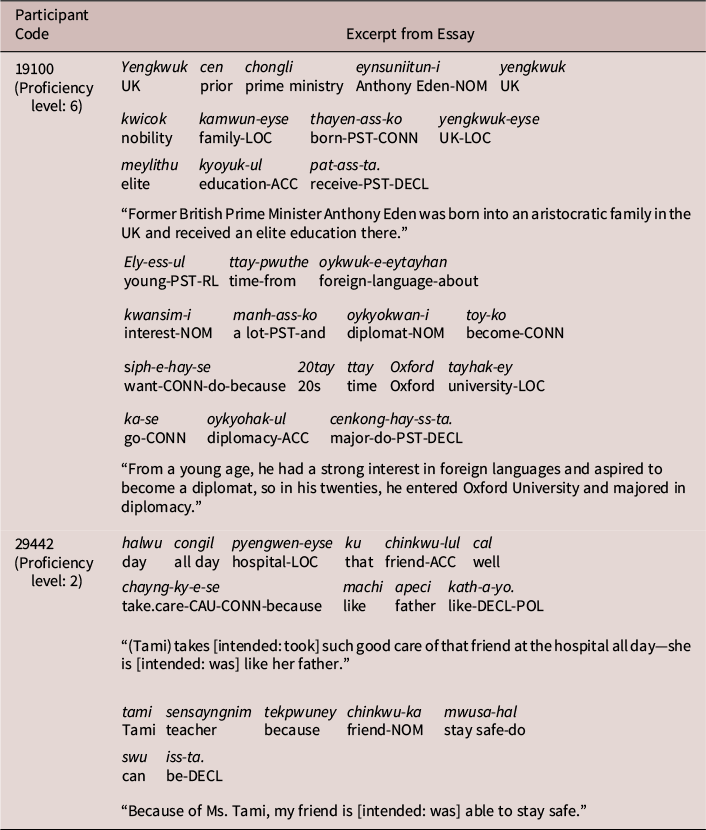
To further explore the usage of verbal morphemes, we conducted a qualitative analysis of descriptive essays on the topic of an admired person. This analysis showed that more advanced learners consistently used correct past tense markers, whereas less advanced learners often omitted the past tense marker where it was warranted, as illustrated in Table 6.
Excerpts from Descriptive Essays by Two L2 Korean Learners at High and Low Proficiency Levels

Table 6. Long description
The table consists of two rows of data.
* Row 1: Participant Code 1 9 1 0 0 with a proficiency level of 6. The excerpt describes former British Prime Minister Anthony Eden. It includes the Korean text, word-for-word linguistic glosses, and a full English translation. The text explains that Eden was born into an aristocratic family, received an elite education, and majored in diplomacy at Oxford University due to his interest in foreign languages.
* Row 2: Participant Code 2 9 4 4 2 with a proficiency level of 2. The excerpt describes a person named Tami taking care of a friend at a hospital. It includes the Korean text, linguistic glosses, and English translations with bracketed corrections for intended tense. The text compares Tami’s care to that of a father and credits her for the friend’s safety.
Besides the accuracy index (ratio of accurate sentences to total sentences, rank 5) and the fluency index (number of sentences per text, rank 4), the stepwise regression model revealed that two morphological complexity indices (MTLD for function morphemes, rank 2; MATTR for all morphemes, rank 8) were significant predictors of L2 Korean proficiency. These findings emphasize the unique characteristics of Korean, where meaning is densely packed through the combination of content and function morphemes. Relying solely on English-based measures, like the subordination ratio, risks overlooking this key aspect of L2 Korean development. The current study therefore argues that incorporating language-specific indices is crucial for a valid assessment of L2 proficiency and recommends this approach in future research across diverse languages.
Practical implications
This study demonstrates the soundness and utility of K-text’s indices for research, assessment, and pedagogical purposes. While previous work (e.g., H. Hwang & H. Kim, Reference Hwang and Kim2024; H. Hwang, Reference Hwang2024) offered downloadable software for analyzing some of these indices, software is susceptible to issues related to operating system upgrades and computer architecture differences. To address these limitations, K-text was developed as a website platform that functions efficiently across different computer environments. This makes K-text a valuable and accessible resource for the automated computation of linguistic indices, removing the burden of manual calculation from users (e.g., Y. Kim, Nam, & Lee, Reference Kim, Nam and Lee2016; Seo, Reference Seo2009).
In terms of language assessment, the K-text indices enable a nuanced evaluation of L2 Korean proficiency, encompassing the distinct aspects of complexity, accuracy, and fluency. By examining a range of indices, each targeting a specific component of proficiency, assessors can develop a detailed profile of a learner’s language abilities, which may then be used to estimate their overall proficiency. In the long term, the theoretically grounded indices proposed in this study could contribute to the development and improvement of automated essay scoring (AES) systems. Unlike many current AES systems that rely on nonlinguistic features, such as character count, our approach, based on interpretable linguistic features, should help create more transparent and explainable AI systems for essay assessment and proficiency prediction.
Pedagogically, the K-text indices may offer a useful tool for teachers, allowing them to identify specific areas for improvement in their students’ language production. By analyzing weaknesses in particular dimensions, whether complexity, accuracy, or fluency, or in certain subcomponents, like the use of function morphemes, teachers can develop more targeted interventions and refine their teaching materials. In this way, K-text’s use could contribute to a higher quality of education that is tailored to students’ individual needs and developmental levels, thus promoting more effective teaching and learning.
While not central to this study, tools for topic modeling and user-defined indices are also provided by K-text. In particular, the user-defined index feature allows users without programming skills to create custom indices by selecting part-of-speech (POS) categories from a dropdown menu. For example, users can analyze nominal and accusative case particles separately from all case particles to gain a deeper understanding of how their usage varies by type. This user-friendly application of NLP techniques has the potential to advance theoretical and methodological innovation, benefiting the academic community interested in Korean language production.
Limitations and future directions
One limitation of the present study is the reliance on TOPIK-based proficiency scores as the dependent variable in the regression models conducted. These scores represent an aggregated measure of multiple language skills, including reading, writing, and listening, whereas the current study is primarily concerned with proficiency constructs in writing. As such, there is a mismatch between the construct being predicted and the construct the study seeks to validate. This means that predicting general TOPIK level from writing features cannot be taken as direct validation of writing proficiency indices. To address this issue, future work should employ independent assessments of writing proficiency that closely match the focus of the analysis.
Also, the texts in the dataset differed in genre and topic across proficiency levels. Specifically, lower proficiency learners produced relatively more narrative essays, whereas higher-proficiency learners produced more argumentative essays. Such an imbalance in genre and topic distribution may have affected the findings of the present study, and so they should be interpreted with caution.
pt?>A further limitation concerns the treatment of outliers. While outliers were removed in accordance with common practice in the field to ensure the validity of the statistical analyses, the exclusion of 11.80% of the data may have influenced the distributional properties of the dataset across the six proficiency levels. Further research should examine the extent to which different outlier-treatment methods influence the results.
Regarding the NLP-based analysis, POS tagging can be sensitive to spacing, morphological, and orthographic errors in learner Korean, particularly at lower proficiency levels. These deviations may compromise tagging accuracy and, as a result, affect the computation of certain K-text indices. To partially address this issue, we investigated discrepancies between K-text and the human coders by proficiency level, drawing on the available reliability data. Our preliminary analysis showed that most indices were reliable across the proficiency levels considered, with values above .61, suggesting substantial agreement (Fleiss & Cohen, Reference Fleiss and Cohen1973; see Figure A at https://osf.io/e28qy). However, several indices showed relatively lower agreement for certain proficiency levels: number of eojeols per sentence for level 5 (ICC = .564), number of coordinate phrases per sentence for level 2 (ICC = .476), number of adjunct clauses per sentence for levels 3 (ICC = .545) and 4 (ICC = .541), number of nominal particle types per sentence for levels 4 (ICC = .591) and 5 (ICC = .500), and ratio of accurate sentences to total sentences for level 6 (ICC = .451). These results suggest that the effects of these indices in predicting overall proficiency may partly reflect NLP-related errors rather than genuine developmental patterns. Nevertheless, all the indices at issue fall within the moderate reliability range of .41 to .61 (Fleiss & Cohen, Reference Fleiss and Cohen1973). Also, their relatively low reliability may be attributable to the small number of essays examined because an ICC analysis was based on only nine essays per proficiency level—a sample size not recommended for reliability analysis. In comparison, when a greater number of essays was analyzed (n = 18) across the three genres (argumentative, descriptive, and narrative), all indices showed at least substantial reliability, with values above .61 (see Figure B at https://osf.io/e28qy). Accordingly, this issue warrants further investigation in future research.
From a linguistic standpoint, the scope of K-text could be expanded to include other levels of analysis, such as discourse. Currently, its indices primarily focus on morphology and syntax when assessing complexity and fluency. Furthermore, some indices are rather coarse-grained as noted by reviewers. Regarding the number of relative clauses per sentence, several possible patterns are identifiable, such as (a) traditional relative clauses (e.g., (2)), (b) fact-S type clauses (e.g., (3)), (c) headless relative clauses (e.g., (4)), and (d) coreferent-opaque clauses (e.g., (5)), where the embedded predicate may take either a verbal (e.g., (2a)) or adjectival from (e.g., (2b)), with (e.g., (2c)) or without a modifier (e.g., (2b)) (Sohn, Reference Sohn1999). For accuracy, K-text only measures the overall proportion of error-free sentences. The coarse-grained nature of this single metric may be associated with the observed trade-off between complexity and accuracy. Incorporating alternative accuracy indices, such as morpheme-based or eojeol-based measures, could yield a more comprehensive understanding of how accuracy evolves alongside complexity, as these are likely to be less influenced by variations in sentence length and complexity. In addition, reliability analyses comparing K-text with the human coders showed relatively lower agreement for the ratio of accurate sentences to total sentences, especially at level 6 (see above). Moving forward, we plan to develop more fine-grained indices that capture complexity, accuracy, and fluency at diverse linguistic levels while building a deep learning-based system specifically trained to judge accuracy in learner data. This approach will allow us to capture a more detailed picture of L2 Korean production and development such that different types of relative clauses may follow different developmental paths across proficiency levels, and morphological accuracy may emerge before sentential accuracy.
(2)
a.
nay-ka
manna-n
yeca
I-NOM
meet-RL
woman
“the woman whom I met”
(adapted from Sohn, Reference Sohn1999, p. 310, (79a))
b.
yeypp-un
yeca
beautiful-RL
woman
“the woman who is beautiful”
c.
acwu
yeypp-un
yeca
very
beautiful-RL
woman
“the woman who is very beautiful”
(3)
nay-ka
yeca-lul
manna-n
sasil
I-NOM
woman-ACC
meet-RL
fact
“the fact that I met a woman”
(adapted from Sohn, Reference Sohn1999, p. 312, (83a))
(4)
Minho-nun
thayngkhu-ka
ka-nun
kes-ul
po-ass-ta.
Minho-TOP
tank-NOM
go-RL
fact-ACC
see-PST-DECL
“Minho saw a tank going.”
(adapted from Sohn, Reference Sohn1999, p. 313, (85a))
(5)
na-nun
kapcaki
koki
kwup-nun
naymsay-lul
math-ass-ta.
I-TOP
suddenly
meat
bake-RL
smell-ACC
smell-PST-DECL
“I suddenly smelled the smell of (somebody) broiling meat.”
(adapted from Sohn, Reference Sohn1999, p. 314, p. 86)
Finally, future research would benefit from taking a longitudinal approach to the study of Korean proficiency development. Such a design would allow researchers to track changes in learners’ complexity, accuracy, and fluency over time and to gain deeper insight into the developmental trajectories of these constructs within the same learners.
Conclusion
The current study introduces K-text, a user-friendly website designed to measure a range of complexity, accuracy, and fluency indices from user-inputted data. Through a large-scale learner corpus analysis, the study offers preliminary evidence supporting the validity of the tool’s indices, demonstrating their individual and combined contributions to predicting overall criterion-based proficiency. This finding underscores the utility of K-text and its associated indices. We expect that both the tool and the insights derived from this study will inform future research, enhance language assessment practices, and support pedagogical improvement.
Data availability statement
The complete R code, as well as the dataset, used for our analyses is accessible at https://osf.io/e28qy.
Acknowledgments
The data used in this study were drawn from the Korean Learner Corpus. I am grateful to the National Institute of Korean Language for making the data available. My thanks also go to Joonhee Kim and Yena Lee, who worked as coders for the reliability analysis. Generative AI tools (e.g., Gemini 3 Pro, GPT-5.1) were used between May 1, 2025, and August 18, 2026, via the https://chat.chatbot.app/ and https://www.genspark.ai/ platforms to review grammar and proofread selected draft sections that were originally written by the author.
Funding
This research was supported by the 2025 Korean Studies Grant Program of the Academy of Korean Studies (AKS-2025-R-018).
Declaration of Competing interests
The author declares none.
Ethics approval
The research procedure was approved by the Survey and Behavioural Research Ethics Committee at the Chinese University of Hong Kong (Reference No.: SBRE‐24‐0530).



 Open access

