




No CrossRef data available.
Article contents
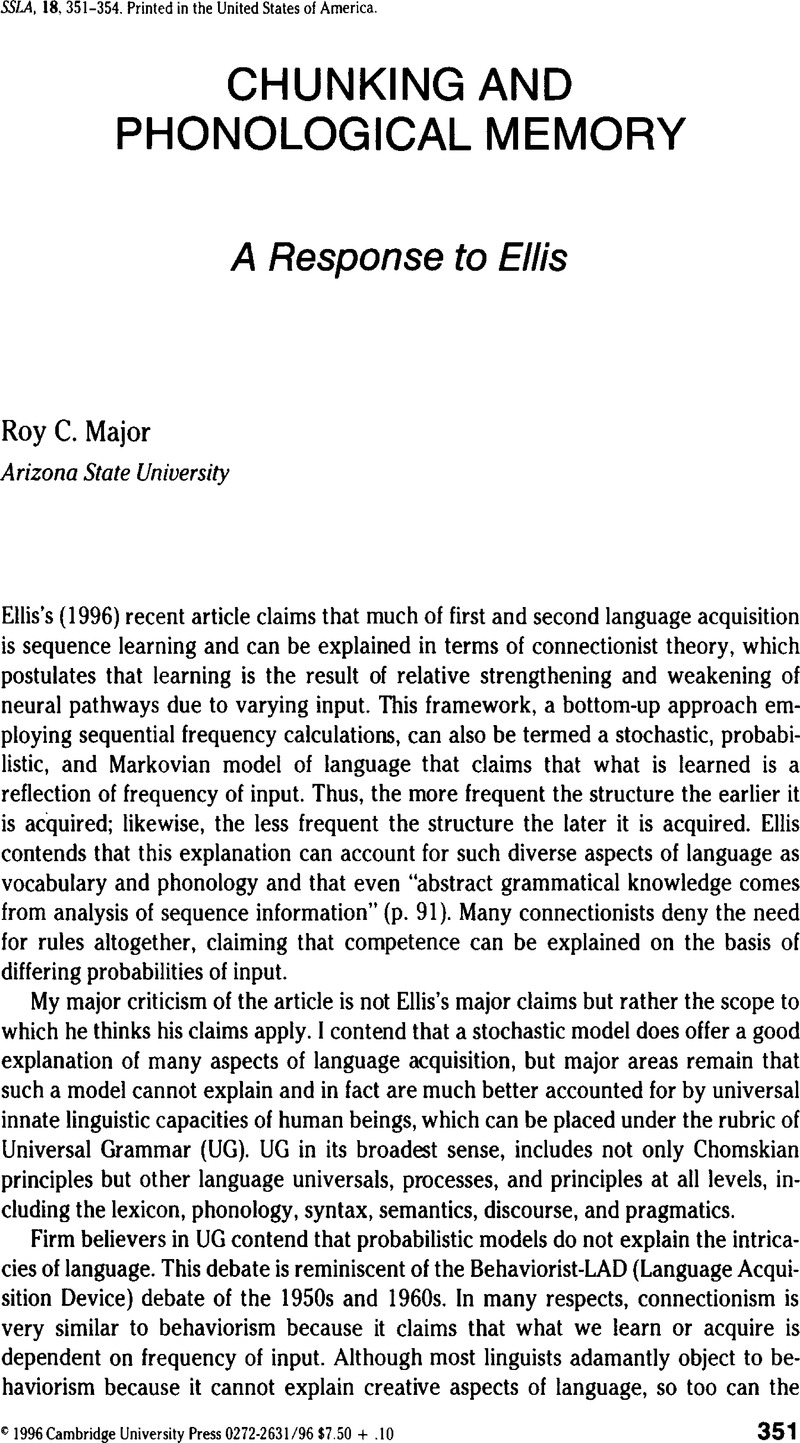
Chunking and Phonological Memory: A Response to Ellis
Published online by Cambridge University Press: 07 November 2008
Abstract
An abstract is not available for this content so a preview has been provided. Please use the Get access link above for information on how to access this content.
Information
- Type
- Responses
- Information
- Copyright
- Copyright © Cambridge University Press 1996
References
REFERENCES
Angelica, J., & Ney, J. W. (1995). Linguistic ambiguity in a connectionist model for grammatical studies. Language and Communication, 15, 227–240.CrossRefGoogle Scholar
Broselow, E. (1983). Non-obvious transfer: On predicting epenthesis errors. In Gass, S. & Selinker, L. (Eds.), Language transfer in language learning (pp. 269–280). Rowley, MA: Newbury House.Google Scholar
Ellis, N. C. (1996). Sequencing in SLA: Phonological memory, chunking, and points of order. Studies in Second Language Acquisition, 18, 91–126.CrossRefGoogle Scholar
Labov, W. (1987, 10). How is meaning maintained? The role of probability matching. Paper presented at the Eastern States Conference on Linguistics,Columbus, OH.Google Scholar
Lakoff, G. (1995). Embodied minds and meanings. In Baumgartner, P. & Payr, S. (Eds.), Speaking minds: Interviews with twenty eminent cognitive scientists (pp. 115–129). Princeton, NJ: Princeton University Press.Google Scholar
McClelland, J. L. (1995). Toward a pragmatic connectionism. In Baumgartner, P. & Payr, S. (Eds.), Speaking minds: Interviews with twenty eminent cognitive scientists (pp. 130–144). Princeton, NJ: Princeton University Press.Google Scholar
- 2
- Cited by