




No CrossRef data available.
COGNITIVE ABILITIES, CHUNK-STRENGTH, AND FREQUENCY EFFECTS IN IMPLICIT ARTIFICIAL GRAMMAR AND INCIDENTAL L2 LEARNING: REPLICATIONS OF REBER, WALKENFELD, AND HERNSTADT (1991) AND KNOWLTON AND SQUIRE (1996) AND THEIR RELEVANCE FOR SLA
Published online by Cambridge University Press: 07 June 2005
Abstract
This paper reports replications of studies of implicit artificial grammar (AG) learning and explicit series-solution learning with experienced second language learners in order to examine their population and content generalizability. As found by Reber, Walkenfeld, and Hernstadt (1991), there was significantly greater variance in explicit compared to implicit learning. In contrast to Reber et al.'s findings, intelligence quotient (IQ) was significantly negatively related to implicit learning. As found by Knowlton and Squire (1996), chunks that appeared with high frequency (high chunk-strength) in AG training influenced incorrect acceptance of ungrammatical transfer test items containing them but did not affect the judgments of grammatical items. In a third experiment, learners semantically processed sentences in Samoan, a novel language for this population. This experiment found little evidence for the content generalizability of these AG findings to the incidental learning of Samoan. Implicit AG and incidental Samoan learning had different patterns of correlation with cognitive abilities (IQ, working memory, and aptitude) and differed in sensitivity to chunk-strength. As found for AG learning, high chunk-strength negatively affected correct rejection of ungrammatical Samoan transfer test items. Additionally, high chunk-strength negatively affected correct acceptance of grammatical items. For these grammatical items, the number of chunks they contained—not their frequency during training—positively influenced grammaticality judgments.I gratefully acknowledge the helpful comments and advice on this paper given by the editors of this special issue, Jan Hulstijn and Rod Ellis, and also by Nick Ellis, Barbara Knowlton, and two anonymous SSLA reviewers.
Information
- Type
- Research Article
- Information
- Copyright
- © 2005 Cambridge University Press
GENERALIZING FINDINGS FROM COGNITIVE PSYCHOLOGY TO SLA
As supporting evidence for various positions, discussions of the role of implicit and explicit learning and knowledge in SLA often invoke empirical findings from the broader field of cognitive psychology, in general, and studies of unaware, unintentional learning of complex rule-systems, in particular. However, are empirical findings from these studies replicable with experienced second language (L2) learners? If they are, are these findings demonstrably related to their learning of natural L2s? To address the first of these two important generalizability issues, I report results of replications of two oft-cited studies of implicit artificial grammar (AG) learning, using, for the first time, experienced L2 learners as the subject population. Arguably, L2 learners who have achieved some level of success are a different population from those so far used in implicit AG learning studies; their strengths in sets of cognitive abilities—or aptitudes—for learning natural L2s distinguish them from other populations (Robinson, 2001). The first study (Reber, Walkenfeld, & Hernstadt, 1991) showed that implicit learning displayed little population variance and was unaffected by individual differences in intelligence quotient (IQ), in contrast to explicit learning. The second study (Knowlton & Squire, 1996) showed that AG learning depends on implicit acquisition of both abstract rules and exemplar-specific information about chunk frequencies. To examine the generalizability of these findings not only to experienced L2 learners (population generalizability) but also to learning of natural L2s (content generalizability), I added a third condition to the implicit and explicit conditions of these studies, in which the same learners semantically processed sentences in a novel language (Samoan) while incidentally learning constraints on its grammar.
BACKGROUND TO THE REPLICATED STUDIES AND THEIR RELEVANCE TO SLA
Replication 1 (Reber et al., 1991)
Individual Differences in Implicit and Explicit Learning.
Reber (1993) argued that implicit (unaware, unintentional) learning and memory processes are primary. This argument was based on the observation that what can be learned and also remembered implicitly often appears to exceed what can be learned and remembered explicitly (intentionally, with awareness). Implicit processes are primary in the sense that they evolve earlier in childhood and are more immune than their explicit counterparts to the effects of age-related declines in cognitive function. Reber et al. (1991) explained these findings in evolutionary terms: Implicit learning and memory are the “functional instantiations of a phylogenetically primitive system that developed before the emergence of conscious functioning” and are dissociable from conscious cognitive processes “such as problem solving, decision-making, recognition and recall from short- and long-term memory … and so on” (p. 888). Reber et al. argued that implicit processes should therefore display the following properties that reflect this dissociation: Implicit processes should (a) be more robust in the face of psychiatric and neurological insult than explicit processes, (b) display fewer individual differences and tighter population variances, and (c) operate largely independently of standard measures of cognitive capability, such as IQ.
To test the latter two claims, Reber et al. (1991) asked 20 undergraduate psychology majors to take part in an AG implicit learning task and a series-solution explicit learning task during which participants searched for rules.1
Reber et al. (1991) defined unaware, unintentional implicit learning as “the process whereby a complex, rule-governed knowledge base is acquired largely independently of awareness of both the process and the product of acquisition” (p. 888), claiming that the AG learning task “is a near optimal technique for obtaining implicit learning, and that the knowledge base it yields is predominantly tacit in nature” (p. 890). In contrast, aware, intentional explicit learning is a process that results from “conscious code-breaking and problem-solving strategies” (p. 890) and—in contrast to the AG learning task—they claimed that the series-solution task is “a compellingly explicit task” that requires subjects to use such conscious strategies.
Relevance to SLA Theory and L2 Pedagogy.
What are the patterns of cognitive abilities—or aptitude complexes (Robinson, 2001)—that facilitate incidental L2 learning? Reber's (1993) position, described previously, is that the abilities drawn on in implicit AG learning are nonconscious and evenly distributed in all populations: There is no aptitude for implicit learning. Very similar claims to those of Reber have been made by Krashen (1982) and Zobl (1995) with regard to adult L2 learning. Unconscious acquisition of natural L2s exceeds what can be learned consciously, and acquisition is insensitive to measures of the conscious cognitive processes assessed via various language learning aptitude tests, such as the Modern Language Aptitude Test (MLAT; Carroll & Sapon, 1959). By acquisition, Krashen meant incidental learning while processing comprehensible input for meaning, during which L2 learners unintentionally pick up knowledge of the constraints on grammar. However, it is likely that the learners become aware of these constraints to some extent during the process. Reber conceded that “incidental learning is not identical to implicit rule or pattern learning, but it is similar in the sense that it is unintentional and uncontrolled” and reported a number of studies of incidental learning that also show it to be “unrelated to gross measures of high-level cognitive function” (Reber & Allen, 2000, p. 238). Reviewing studies of incidental learning that require “processing of verbal or complex material” and thus greater depth of processing, Reber and Allen conceded that individual differences (IDs) in cognitive abilities might influence learning in these domains. However, they noted that “the issue of individual differences in implicit learning has gone almost completely unexplored” (p. 239), and there is currently no research that enables a direct comparison of the influence of IDs in cognitive abilities on implicit and incidental learning.
Therefore, to directly examine the generalizability of Reber et al.'s (1991) finding for implicit AG learning to incidental natural L2 learning, I added a third experimental condition to the implicit and explicit conditions of the Reber et al. study. In this condition, learners processed sentences in a novel language (Samoan) for meaning and assessed the extent to which they had learned aspects of grammar as a result. As described subsequently, learners first rote-learned the meaning of Samoan words and were then directed only to answer yes/no questions about the meaning of sentences containing the words. They were not directed to learn the rules of Samoan grammar and morphology, and any learning of these was therefore incidental to the intentionally primary experimental goal of comprehending the input to answer the questions. In addition to the measure of WAIS-R IQ that Reber et al. obtained, I added a measure of language learning aptitude (Language Aptitude Battery for the Japanese [LABJ]; Sasaki, 1996). This consisted of subtests of grammatical sensitivity, paired-associate rote memory, and phonemic sensitivity and pattern analysis. I also added a measure of working memory capacity, assessed via a reading-span test (Osaka & Osaka, 1992). These additional individual difference measures enabled the comparability of learning in the implicit and incidental conditions to be made not only with respect to the influence of IQ but also with respect to other variables that are more likely related to incidental L2 learning, thus examining Krashen's (1982) claim about the aptitude independence of acquisition.
Rationale for Hypotheses.
Hypothesis 1 (Population generalizability): Reber et al.'s (1991) finding will be replicated. It is likely that the population in this replication and Reber et al.'s undergraduate psychology major participants differed in terms of the strength and patterning of some cognitive abilities drawn on in learning natural L2s. However, the two populations had almost identical mean IQ scores. I therefore expected that implicit AG learning would be nonsignificantly correlated with IQ, whereas explicit learning would be significantly positively correlated with IQ and display significantly greater variance than implicit learning.
Hypothesis 2 (Content generalizability): AG learning and incidental L2 learning will be unrelated. I did not expect implicit and incidental learning to show very similar effects for learners. I expected that scores on transfer tests of implicit and incidental learning would be nonsignificantly correlated, given that the content domain of the AG and natural language as well as the processing conditions these domains implicate are very different. Artificial grammar letter strings are free of semantic content. Processing AG stimuli can therefore be expected to result in predominantly bottom-up, shallow data-driven processing and maintenance memory rehearsal of the contingencies between letters in the strings presented during training. There can be no doubt that the associative learning and memory that such processing leads to contributes to SLA to some extent, as it does in incidental first language (L1) learning (Saffran, Newport, Aslin, Tunick, & Barrueco, 1997). However, processing sentences of a natural L2 for meaning additionally requires explicit, top-down conceptually driven processing of their semantic content and the subsequent encoding and elaborative rehearsal of this content in episodic and working memory (Craik & Tulving, 1975).2
A. S. Reber (personal communication, August 5, 2004) made essentially the same point made here: “… implicit and explicit mechanisms play a complex synergistic dance in L2 acquisition. It is certainly a very different process from L1.”
Both of these kinds of processing, although differing in the extent of their joint contribution to AG versus incidental natural language learning, are similar in important respects. Both require attention (Hsiao & Reber, 1998; Schmidt, 2001).3
A. S. Reber (personal communication, August 5, 2004) stressed this point: “No one argues that implicit acquisitional mechanisms operate in the absence of attention. The key issue is to what aspect of the display are the individual's attentional resources being devoted?”
Hypothesis 3: Individual differences in cognitive abilities will not influence AG learning. In line with this account, AG learning demands attention but not the higher-order cognitive abilities that are drawn on in conceptually driven processing of semantic content. Learning the constraints on sequencing the AG stimuli should therefore take place independently of the influence not only of IQ but also working memory and the LABJ measure of aptitude.
Hypothesis 4: Individual differences in cognitive abilities will influence incidental Samoan learning. Although individual differences were not expected to influence AG learning, I expected significant positive correlations of aptitude and working memory with incidental learning of Samoan. This expectation is based on the reasons given previously, as both working memory and the grammatical sensitivity and paired-associates subtests of aptitude (although not the phonological sensitivity subtest) are measures of ability to process and elaboratively rehearse semantic information.
Replication 2 (Knowlton & Squire, 1996)
Chunking, Frequency, and Exemplar-Specific Implicit Learning.
Within the field of SLA, N. Ellis (2001) has argued that chunking in working memory—facilitated by frequency of exposure to instances of L2 input—is one of the basic processes that gives rise to L2 learning, as it does to the learning of many other kinds of category and concept. Others have argued that the availability of domain-specific representations in the form of abstract rules, such as those characterized in Universal Grammar (UG) approaches to SLA, are needed to explain much of how L2s are acquired. Such rules can be triggered and set by a single exposure to a domain-specified class of language input (see White, 2003). This debate concerning the nature of representations (are they rule- or instance-based, domain-specific or not?) is currently ongoing in many other areas of cognitive psychology (see Pothos, in press). The second study described here (Knowlton and Squire, 1996) addressed this issue. According to Knowlton and Squire's study, implicit AG learning gave rise to abstract rule-based as well as instance-based representations. They argued that instance-based representations were facilitated by their manipulation of the frequencies of specific chunks in the input during AG learning, whereas the abstract rules learned were independent of these manipulations. In replicating their experiment, I was interested in adapting their methodology to also examine this issue in the context of incidental natural L2 learning.
Knowlton and Squire (1996) operationalized chunk-strength following proposals by Servan-Schreiber and Anderson (1990) and the similar proposals of Perruchet and Pacteau (1990), which argued that the process of competitive-chunking was responsible for the learning that occurred during the implicit conditions of Reber's (1976) experiments. Chunks were operationalized as bigrams (pairs of letters) and trigrams (sets of three letters) occurring together in training set examples, and chunk-strength was calculated by weighting chunks for their frequency of occurrence throughout the period of exposure during training.4
Knowlton and Squire's (1994) operational definition of chunk-strength, as used to calculate chunk-strength of grammatical and ungrammatical items in the transfer test of their 1996 experiment replicated here, was defined as follows: “Chunks were defined as letter bigrams and trigrams in accordance with Servan-Schreiber and Anderson (1990). Thus the letter string MVXRV contained the bigram chunks MV, VX, XR, and RV and the trigram chunks MVX, VXR, and XRV. The associative strength of a chunk was defined as the frequency with which the chunk occurred in the 16 items of the training set” (p. 85). As one anonymous SSLA reviewer pointed out, using this procedure to calculate chunk-strength for natural language data ignores phrase structure. An important further extension of the procedure replicated here would therefore be to adapt Knowlton and Squire's operational definition to accommodate phrasal boundaries.
Relevance to SLA Theory and L2 Pedagogy.
The issues raised by Knowlton and Squire's (1996) study are also important for SLA theory and pedagogy. N. Ellis (2002, this issue) has argued that frequency effects and chunking in working memory are both powerful influences on the nature and extent of both implicit and explicit SLA. If so, then chunk-strength during naturalistic exposure to L2 input and manipulations of it during controlled instructional exposure should both facilitate further L2 learning. Providing L2 learners with an input flood that contains frequent instances of a particular form has in fact been proposed as an implicit technique for inducing attention to form and subsequent internalization and use of the targeted form during classroom instruction (see Doughty & Williams, 1998).
However, if L2 learners in the present replication display the same influence of chunk-strength on grammaticality judgments in both AG and incidental L2 conditions, as Knowlton and Squire's (1996) participants did, there are interesting implications for these theoretical and pedagogic proposals. This would imply that manipulations of chunking and frequency in the input contribute to the development of L2 knowledge but that other processes resulting in rule-based abstraction also take place independently of these. It would also suggest that although pedagogically manipulating the frequency of a chunk of input to learners can lead to knowledge of collocational restrictions and lexical learning (N. Ellis, 2002; Mintz, 2003; Robinson, 1989, 1990) and promote automatic access to and recognition of these (Logan, 1988; Robinson, 1997a; Robinson & Ha, 1993), it might be relatively ineffective in developing knowledge of which sentences are grammatically acceptable (as revealed by the poor performance of Knowlton and Squire's participants on the ungrammatical items in the grammaticality judgment transfer test). Therefore, to directly examine the generalizability of Knowlton and Squire's finding to natural L2 learning, I also assessed the effects of chunk-strength on transfer test judgments in the third Samoan learning condition.
Rationale for Hypotheses.
Hypothesis 5 (Population generalizability): Knowlton and Squire's (1996) finding will be replicated. I expected chunk-strength to negatively influence accurate judgments of ungrammatical but not grammatical AG transfer test strings.
Hypothesis 6. Effects of chunk-strength on AG learning will be unrelated to individual differences in explicit memory and grammatical sensitivity. Knowlton and Squire (1996) found a similar influence of chunk-strength on AG learning by amnesics and a control group with intact explicit memory abilities. Therefore, I did not expect measures of working memory or rote memory to correlate significantly and positively with transfer test judgments of AG items with high chunk-strength. Effects of chunk-strength on semantics-free implicit AG learning do not strongly implicate higher levels of explicit memory encoding necessary for deep semantic, conceptually driven processing. Rather, these effects are attributable to shallow data-driven processing and lower-level associative memory processes (Craik & Tulving, 1975; Graf & Ryan, 1990; Robinson, 1995). Similarly, I expected grammatical sensitivity to the rules of natural languages to be nonsignificantly correlated with learning rules of semantics-free AGs. The MLAT and LABJ tests of grammatical sensitivity do not measure simple pattern recognition but, rather, the ability to identify and discriminate between the grammatical roles (e.g., subject) and their relationship to semantic roles (e.g., agent), which jointly determine whether word orders in presented sentences are similar or dissimilar.
Hypothesis 7 (Content generalizability): The same effect of chunk-strength will be found in AG and incidental Samoan learning. In line with claims by N. Ellis (2001) about the psycholinguistic plausibility of chunks as the units of language on which processes in working memory operate and the subsequent contribution of their frequency in the input to SLA, I expected chunk-strength to influence incidental natural L2 learning.5
If they are to be available to learning processes, chunks and other fragments in the input must be initially attended to and noticed (Schmidt, 2001) during the semantic processing that incidental L2 learning requires. In this view, explicit knowledge is the initial content on which subsequent learning processes and mechanisms operate. These processes and mechanisms are unconscious, but the content they operate on is not (Perruchet & Vintner, 2002).
Hypothesis 8: Effects of chunk-strength on incidental natural L2 learning will be related to individual differences in explicit memory and grammatical sensitivity. I further expected that the effect of chunk-strength would be strongest for those with high explicit rote- and working-memory abilities. Additionally, I expected that measures of these explicit memory abilities would correlate significantly and positively with correct acceptance of high-chunk grammatical incidental learning transfer set sentences. Finally, I expected individual differences in grammatical sensitivity to correlate significantly and positively with correct judgments of all sentences (grammatical or ungrammatical; high in chunk-strength or not) during the incidental learning transfer test.
THE PRESENT STUDY
Participants
Participants were 54 undergraduate third- and fourth-year students at Aoyama Gakuin University in Tokyo, aged 19–24 years. All were experienced L2 learners taking English-medium course work in the English department. Most were English majors, although some were education majors with an interest in teaching English. There were 37 participants in the experimental group (12 male, 25 female) and 17 participants in the control group.6
The first 20 participants were assigned to the experimental condition and following that, participants were randomly assigned to experimental (n = 17) or control (n = 17) conditions.
Measures and Procedures
Learning Task Sequences.
Participants in the experimental group completed three experimental tasks. The first two tasks, replicating the tasks presented to participants in Reber et al. (1991), included an explicit and an implicit learning task, described in the following subsections. Order of presentation of these tasks, which took around 40 minutes to complete, was counterbalanced as in Reber et al. Following this, the third incidental learning task began on a separate day. This task involved an initial vocabulary learning phase, followed by two separate training sessions on separate days, followed, finally, by a series of three posttests (immediate, 1-week delayed, and 6-month delayed). The control group performed only the vocabulary learning phase and the immediate posttest of incidental Samoan learning. All of the training tasks and transfer tasks as well as the explanation of task procedures were administered via Macintosh computers. In each case, the researcher was on hand to clarify any questions participants had about these procedures.
Explicit Learning Task.
This was the forced choice, series-solution problem task used by Reber et al. (1991, p. 891). As in Reber et al., 12 series-solution problems were randomly selected from a set of 21 and presented in a fixed random order (see Appendix A). Participants were told they would see a series of letters and that they should choose the letter that best completed the series. Two problem types were randomly interspersed to make the task more demanding (although participants were not made aware of this during the orientation phase). Alphabetic problems (e.g., ABCBCDCDE_; D* or C) depend on repeating alphabetic sequences, ABC, BCD, CDE, in which the last two letters of one triplet are repeated as the first two letters of the following triplet. Nonalphabetic problems (e.g., CDEADCA_; E* or D) depend on mirroring or reversing pairs of letters in the sequence, CD, EA, DC, AE. Six questions of each type were included and were presented on a computer screen. Participants responded by keyboard letter-stroke to complete the series with one of the two choices presented. As in Reber et al., no feedback was given, and following answers, the next problem appeared. As in Reber et al., percent-correct scores for this task were calculated.7
Reliability of the explicit learning task using a matched-item, split-half correlation corrected with the Spearman Brown prophecy formula was .68 (see Table 2). Reliability of the implicit learning transfer test using split-half, odd-even correlation corrected by Spearman Brown prophecy formula was .52; for the immediate incidental learning grammaticality judgment task, it was .72. The reliability of the implicit transfer test is almost identical to the .51 reported by Reber et al. (1991), who argued that it “indicates that the well-formedness test is a reliable instrument” and that “… such a value argues that we can have confidence in the reliability of our observed individual differences, and that the observed patterns of rs are unlikely to be due to attenuated or truncated variance in the implicit task. That is, our observed variance is not attenuated in the sense that the real variance is actually large and our procedure somehow squeezed it down; it is small because the underlying factor being assessed actually shows little in the way of individual variation.” (p. 893)
Implicit Learning Task.
Training. As in Reber et al. (1991), participants were told that they were taking part in a memory task. During training, participants viewed strings of letters generated by a miniature artificial “Reber” grammar. These were presented for 3 seconds each (in Times font, size 14). After viewing each string, participants were instructed to write it down on a piece of paper in response to the prompt “Now write down the letter sequence you saw.” After writing down each sequence, they then pressed any key in response to the “Press any key to continue” prompt, and a new sequence appeared for 3 seconds. The paper sheets were removed immediately following each of the two training trials, giving no opportunity for analytic study. In each training trial, participants saw 26 strings (e.g., XXVT, VXJJJJ, XXVJ, XXXVTV) generated by the rules of the AG. Reber et al. did not report their transfer and training set stimuli strings.8
The AG stimuli were English letters, as used in Reber et al. (1991) and Knowlton and Squire (1996). It is possible, as one anonymous SSLA reviewer pointed out, that the L1 Japanese participants are used to treating such letters more explicitly than native English speakers. This must be borne in mind in comparing the results of the findings for AG learning in this study with those of the original studies.
Transfer and chunk-strength. As in Reber et al. (1991) and Knowlton and Squire (1996), participants were told after training that the strings they had viewed followed a set of rules and that they would then see some more strings. They were asked to decide if the strings followed the same rules. If so, participants were instructed to press C for “correct,” and if not, to press M for “mistake.” This was not a speeded task. There were 32 transfer set items (see Appendix B). As in Reber et al. (1991) and Knowlton and Squire (1996), percent-correct scores for this task were calculated.
Transfer set items were of four types: grammatical high and low chunk-strength and ungrammatical high and low chunk-strength. Chunk-strength of these items is reported in Appendix B. Chunk-strength was calculated by Knowlton and Squire (1994, 1996) on the basis of whether a transfer set string contained bigrams (e.g., XV) or trigrams (e.g., XVT) that had appeared in the input during training and the frequency with which those bigrams and trigrams had appeared in the two training trials. “The associative strength of a chunk was defined as the frequency with which the chunk occurred in the 16 items of the training set” (Knowlton & Squire, 1994, p. 85). So, if a string XVTX occurred in the transfer set, and only the above bigram XV and trigram XVT chunks had occurred in training, with frequencies of five and two times respectively, then the chunk-strength for that transfer set item was 7. “The mean associative strength of the chunks in each test item was then calculated by averaging the obtained frequency scores across all of the chunks in the item” (Knowlton & Squire, 1994, p. 85). Therefore, the mean associative chunk-strength of the item XVTX, with two chunks, occurring a combined total of seven times during training, is 3.5. The same procedure was followed in determining the chunk-strength of the incidental transfer set items.
Incidental Learning Task.
Training. The 10 training trials were spread over a number of days. The first phase involved learning new vocabulary and was followed by two training sessions (each session contained five trials) spread from 2 to 5 days apart, depending on participant availability. An immediate posttest followed the second training session.
Vocabulary learning. Participants were asked to memorize the meanings of 27 new Samoan words: 1 article, 15 nouns, and 11 verbs. Samoan was a language unknown to the participants. English and Japanese translation equivalents, written in English and Japanese, were provided on a study sheet—for example, taalo “play, asobu”; faitau “read, yomu”; tusi “book, hon” (see Appendix C). Participants were asked to study them until they could recall all translation equivalents on a test.
Processing for meaning. After successfully completing the word list memorization test, participants completed 10 training trials. During each trial, participants viewed 45 Samoan sentences of three types (450 presentations total, with 150 tokens of each type). These types corresponded to three different rules of Samoan (see Appendix D). The first rule, which marks the ergative, inserts a particle e before the subject of a transitive verb, as in (1).

The second rule marks adverbial phrases with a locative marker, i, as in (2).

The third rule allows direct object nouns to incorporate directly into verbs, as in (3).9
Samoan is a verb-initial language, with both Verb Subject Object (VSO) and Verb Object Subject (VOS) as very common word orders. Head-direction in Samoan is the same as in English; verbs and prepositions occur before their noun complements. This contrasts with Japanese (the L1 of the participants), in which noun complements precede verbs and prepositions. For fuller discussion of Samoan and of these surface structure rules, see Robinson (1994, 2002a).

Sentences were presented without the English glosses given here. Training set sentences appeared for 10 seconds on the computer screen. During the orientation phase, participants were asked to try as hard as possible to understand the meaning of each sentence. No grammar explanation was provided. During training, to test comprehension following the 10-second presentation of each stimulus, participants were asked to respond to yes/no comprehension questions. For example, on screen 1, they saw taalo le tama i le paka for 10 seconds. On screen 2, they saw Does the boy swim in the sea? for which there was no time limit for responding. Finally, on screen 3, they saw Correct/incorrect. Press any key to continue. Again, there was no time limit for responding. Participants responded by pressing C for “yes” or M for “no,” whereupon feedback regarding the correctness or incorrectness of the response appeared, followed by the next stimulus sentence. The mean error rate on the first trial was around 15%; on the last trial round, the mean error rate was around 1%. Each trial took around 15 minutes. Total time spent in training, including vocabulary learning, was around 3 hours 15 minutes.
Transfer: Immediate Posttest.
Computerized grammaticality judgment test and chunk-strength. After completing the last training trial, participants were informed that they would then see more sentences on a computer screen and that they must decide if the new sentences followed the same rules as those seen during training. The transfer set consisted of 27 items with the following distribution: 9 old items viewed in training (3 for each rule described previously), 9 new grammatical items (3 for each rule), and 9 new ungrammatical items (3 for each rule). Participants responded by pressing C for “correct” (grammatical, same rules) or M for “mistake” (ungrammatical, different rules). Each item remained on screen until a response was made, whereupon the next item appeared. Response time and accuracy of response were calculated. This transfer test was unspeeded, as in the implicit conditions of Reber et al. (1991) and Knowlton and Squire (1996).
The chunk-strength was calculated for the 18 new items in the transfer grammaticality judgment test following the same procedure described by Knowlton and Squire (1994, 1996) for calculating mean associative chunk-strength of AG transfer set items. For example, the new grammatical transfer set item taalo le tama i le fale contained 4 bigrams (taalo le, le tama, tama i, and i le) that had occurred with the frequencies of 7, 36, 8, and 11 times in the input over the 10 training trials, respectively. Additionally, the item contained three trigrams (taalo le tama, le tama i, and tama i le) that had occurred with the frequencies of 7, 8, and 8 times in training, respectively, giving this specific item 7 chunks that had occurred with a combined frequency of 85 times in the input. Averaging the frequency scores (85) across the number of chunks in the item (7), as Knowlton and Squire (1994, 1996) did for their AG transfer items, gives it a mean associative chunk-strength of 12.1.
Low-chunk-strength items contained a total of 22 bigrams and 10 trigrams that had appeared in the training set (32 chunks). High-chunk-strength items contained 23 bigrams and 11 trigrams (34 chunks; see Table 1). Although the low- and high-chunk-strength transfer items were therefore almost exactly matched in terms of the number of previously occurring chunks they contained (i.e., their similarity to the training set), they differed with respect to the frequencies with which the chunks they contained had occurred in training (determining the associative strength of the chunks). The mean frequency of occurrence of these bigrams and trigrams in training was 62.5 times for high-chunk-strength items and 22.6 times for low-chunk-strength items. The mean associative chunk-strength for the high chunk-strength ungrammatical transfer set items, calculated following the procedure described previously, was 24.8; for the low-chunk-strength ungrammatical items, it was 5.6; for the high-chunk-strength grammatical items, it was 24; and for the low-chunk-strength grammatical items, it was 6.8 (see Table 1 and Appendix D).10
Because, as in Reber et al. (1991), Knowlton and Squire (1996) had only two trials of implicit AG training (during which a total of 52 items were presented), the relative frequencies of chunks in the AG transfer set items encountered during training, and contributing to their chunk-strength, is, of course, much lower than the frequencies of chunks in the incidental training transfer set encountered during training because incidental training items were presented in 10 trials of 45 items (a total of 450 items). Nonetheless, the discrepancy between low-chunk-strength and high-chunk-strength items in the implicit and incidental transfer sets is clear in both cases. Furthermore, it is important that chunk-strength was not confounded with similarity, either for the AG transfer set items (in Knowlton & Squire and the present study) or for incidental transfer set items (in the present study); that is, the total number of chunks encountered during training that the low and high chunk-strength items contained were matched (see Table 1).
Number of chunks contained in new items, both high and low in chunk-strength, in the incidental learning transfer grammaticality judgment test

Listening grammaticality judgment test. After the grammaticality judgment test, participants completed a listening grammaticality judgment test. For this test, the same 27 sentences that had been presented during the first grammaticality judgment test were presented aurally in a different fixed random order. Participants wrote C or M on a piece of paper after hearing each item. Sentences were taped and spoken at normal speed. A 5-second pause occurred between each sentence. As such, this was a speeded test because participants had less than 5 seconds to respond in each case.
Guided sentence production. Following the grammaticality judgment tests, participants were given sets of words, written on separate pieces of paper and stored together in four separate packets. Participants were asked to empty the words from each packet and arrange them to make a sentence. The packets of words to complete the first three sentences (one of each ergative, locative, and incorporated rule type) were presented separately. For example, for the first ergative sentence, the words fau “build”, fale “house,” e (ergative marker), le “the,” tama “boy,” and le “the” were emptied in a jumbled order from a packet. If participants correctly ordered them to make the sequence fau e le tama le fale, they were given one point. Following this, they replaced the words in the first packet and then emptied and arranged the words in the second and third packets. Following the first three sentences, words for the second group of three sentences (locative, ergative, and incorporated) were emptied simultaneously in jumbled order from the fourth packet, making the second part of the production task much more demanding. On the basis of these responses, participants were coded as 0, 1, or 2 for production of each rule and from 0 to 6 overall for production.
Transfer: 1-Week and 6-Month Delayed Posttests.
Between 5 and 7 days after the immediate posttest, participants completed an unexpected delayed posttest. They were given time to look again at the word lists. When they demonstrated that they still remembered the meaning of these words by making 10 successive correct responses to requests for Samoan translation equivalents, they again completed the grammaticality judgment, listening grammaticality judgment, and guided sentence production tests. After 5 to 6 months, participants completed another unexpected posttest that consisted of only the grammaticality judgment and sentence production ability tests. Of the 54 original participants, only 26 returned to complete the 6-month delayed posttest.
Individual Difference Measures.
Intelligence test. As in Reber et al. (1991), a short form of the WAIS-R was used (Japanese version; Shinagawa, Kobayashi, Fujita, & Mayekawa, 1990). The full form has an extremely high reported reliability, r = .97 (Kline, 2000, p. 451). Reber et al. used a short form that consisted of picture arrangement, block design, vocabulary, and arithmetic. This short form correlates highly with the full test, with a validity and reliability coefficient of r = .95 to .96 (see Cyr & Brooker, 1984, p. 905; Reber et al., p. 892). Because some participants had already been exposed to the picture arrangement subtest during participation in an unrelated research project, it was decided to drop scores for this subtest and use a triadic WAIS-R short form (vocabulary, arithmetic, and block design), which Cyr and Brooker (p. 905) also reported as having a high validity and reliability coefficient of r = .94. As in Reber et al., I used the conversion tables in Brooker and Cyr (1986; see also Cyr & Brooker) to convert short-form scores to scaled IQ scores. Using this triadic short form, participants had a mean IQ of 113, which is almost identical to Reber et al.'s participants' mean of 110 measured using the tetradic short form (vocabulary, arithmetic, block design, and picture arrangement). However, the standard deviation was much narrower (SD = 8.2, kurtosis = 1.7, skewness = −.8) than Reber et al.'s (SD = 21.2), as was the range of scores, from 88 to 132 compared to 73 to 151 in Reber et al.'s study.
Aptitude test. The LABJ consists of three subtests: rote memory for 24 paired-associates, grammatical sensitivity to grammatical patterns in a new language, and phonemic sensitivity (the ability to match sounds and symbols). This took about 30 minutes to administer. The mean score for the 60-item test was 46.6 (SD = 8.2, kurtosis = .48, skewness = −.69). Reliability for this test was .85 (KR21).
Working-memory test. The reading-span test of working memory took about 40 minutes to administer. Participants were presented with sets of Japanese sentences written on cards and were asked to read the sentences aloud. After reading them aloud, participants were asked to recall individual words underlined in each sentence. The sets increased from two to five sentences throughout the test. I scored this using total number of correctly recalled words. The mean score on this 70-item test was 44.8 (SD = 9.3, kurtosis = −.74, skewness = −.1). Reliability for this test was .83 (KR21). All individual difference measures were administered following the 1-week delayed incidental learning posttest, at times convenient to participants.
RESULTS
Replication 1: Individual Differences in Implicit and Explicit AG Learning
Hypothesis 1.
Hypothesis 1, which predicted a replication of Reber et al.'s (1991) results, is confirmed for the major finding of that study. The mean percent-correct scores for implicit learning in this replication are somewhat lower than in Reber et al.'s study, and the mean percent-correct scores for explicit learning are higher (see Table 2). As Reber et al. found, an F-test of the variance in scores for implicit and explicit learning shows a significant difference, F(36, 36) = .502, p < .05, with variance in implicit learning being lower than in explicit learning. There are no significant differences between variance in implicit and incidental learning, F(36, 36) = 1.162, p = .65, or explicit and incidental learning, F(36, 36) = .583, p = .11.
Mean accuracy, variance, and reliability for implicit, explicit, and incidental learning: present study and Reber et al. (1991)

However, as Table 3 shows, implicit learning is significantly negatively correlated with IQ, r = −.34, p < .05, whereas explicit learning is nonsignificantly correlated with IQ, r = .3, p = .06, in contrast to the findings of Reber et al. (1991). Table 4 shows that the two IQ subtests that measure verbal abilities—vocabulary and arithmetic—contribute most to this significant negative correlation of IQ and implicit learning. Both are significantly positively correlated, r = .33, p < .05, and both are negatively correlated with implicit AG learning, significantly so in the case of arithmetic, r = −.39, p < .05, but not vocabulary, r = −.29. The performance measure of fluid intelligence—block design—is not strongly related to implicit learning, r = .05.
Intercorrelations of implicit, explicit, and incidental learning and individual differences in aptitude, IQ, and working memory

Intercorrelations of IQ subtests with implicit AG, explicit series-solution, and incidental Samoan learning

Hypothesis 2.
Hypothesis 2 predicted that implicit AG learning and incidental Samoan learning would be unrelated. This is confirmed. As Table 3 shows, implicit AG learning is nonsignificantly correlated with performance on all three of the immediate posttests of incidental Samoan learning: grammaticality judgment, r = .06; listening grammaticality judgment, r = .1; and sentence production, r = .28. However, incidental learning of Samoan is not uniform with respect to the three targeted rules, as assessed by the immediate grammaticality judgment and listening grammaticality judgment tests. On both the immediate posttest transfer grammaticality judgment test (see Figure 1) and listening grammaticality judgment test (see Figure 2), items encountered during training (ergative, incorporated, and locative rule types) are correctly judged grammatical at high levels of accuracy. In contrast, for new items, it is those conforming to the locative rules—rather than ergative or incorporated—that are most accurately judged grammatical or ungrammatical.

Mean percent-correct on Samoan sentence types (with standard deviation bars) in the immediate grammaticality judgment posttest.

Mean percent-correct on Samoan sentence types (with standard deviation bars) in the immediate listening grammaticality judgment posttest.
On the immediate grammaticality judgment test, a repeated-measure analysis of variance (ANOVA) shows significant main effects for type, F(2, 72) = 67.096, p < .001 and rule, F(2, 72) = 41.743, p < .001, and a significant interaction of type and rule, F(4, 144) = 28.332, p < .001. Chance performance on items of each type (old, new grammatical, and new ungrammatical) and rule (ergative, incorporated, locative) is between 41.8% and 58.2% correct. As Figure 1 shows, accuracy is high and above chance on old items for each rule. For new items, grammatical locative sentences are correctly accepted (87%) and ungrammatical locative sentences are correctly rejected (59%) at above-chance rates. New ungrammatical incorporated sentences are correctly rejected at above-chance rates (76%), but new grammatical sentences are wrongly rejected, and accuracy is at only 22% on these items, suggesting that participants adopted a strategy of rejecting most new examples of incorporation, whether grammatical or ungrammatical. Performance on new ergative sentences is above chance, but incorrect and consequently accuracy is low on both the new grammatical (28%) and new ungrammatical (32%) items. Only the locative rule accompanied by memory for old instances of all rule types has been most clearly learned by the group overall.11
A control group of 17 participants completed the incidental vocabulary learning task and then the transfer grammaticality judgment task. Effect size (Cohen's d) was .978 for the immediate grammaticality judgment incidental Samoan learner posttest-control group comparison. The probability of chance performance calculated using chi-square (see Robinson, 1996, p. 125) shows that mean performance for the control group is at chance (53% accurate) and accuracy for each rule type is almost identical (ergative, 52.9%; incorporated, 53.6%; locative 53.6%). An ANOVA shows that the immediate grammaticality judgment posttest performance of the experimental Samoan incidental learning group is significantly better than that of the control group, F(1, 52) = 12.535, p < .001. The experimental group's performance on the 1-week delayed grammaticality judgment posttest is also significantly better than the control group's performance, F(1, 52) = 12.535, p < .001. However, the performance of the experimental group on the 6-month delayed grammaticality judgment posttest does not differ significantly from the control group's performance, F(1, 42) = 3.566, p = .06.
On the immediate listening grammaticality judgment posttest, the repeated-measure ANOVA also shows significant main effects for type, F(2, 72) = 34.888, p < .0001, rule, F(2, 72) = 13.261, p < .0001, and a significant interaction of type and rule, F(4, 144) = 10.997, p < .0001. As on the computerized grammaticality judgment posttest, performance on old items is above chance and accurate for all rules; for new items, performance on ungrammatical incorporated sentences (73%) and grammatical locative sentences is above chance (69%). However, performance on ungrammatical locative sentences, in contrast to the grammaticality judgment test, is at chance. As with the grammaticality judgment test, performance on both grammatical and ungrammatical new ergative sentences is above chance but inaccurate (38% and 34%, respectively).
It is possible that hypothesis 2 might be true for some of the rules but not others and that the processes leading to AG learning would show more commonality with implicit learning of these rules. However, this is not the case. Implicit AG learning correlates nonsignificantly with grammaticality judgment performance on the ergative, r = −.01, incorporated, r = .16, and locative rules, r = .04, and with listening grammaticality judgment performance on the ergative, r = −.04, incorporated, r = −.05, and locative rules, r = .21. Hypothesis 2 is therefore clearly confirmed.
Hypothesis 3.
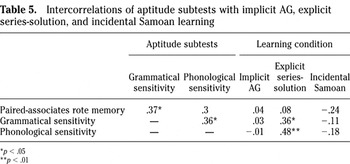
Hypothesis 3 predicted that individual differences in working memory and the LABJ measure of aptitude would not influence AG learning. Table 3 shows that working memory is not significantly related to either implicit or explicit learning and that although explicit learning is significantly positively related to LABJ scores of language learning aptitude, r = .38, p < .05, implicit AG learning is not, r = .03, p = .8. With respect to the LABJ subtests, Table 5 shows that the paired-associates rote memory and grammatical-sensitivity subtests are significantly and positively correlated, r = .37, p < .05, as are the grammatical sensitivity and phonological sensitivity subtests, r = .36, p < .05. Both grammatical sensitivity, r = .36, p < .05, and phonological sensitivity, r = .48, p < .01, are significantly positively correlated with explicit learning, although no subtest shows significant correlations with implicit AG learning. Hypothesis 3 is therefore clearly confirmed.
Intercorrelations of aptitude subtests with implicit AG, explicit series-solution, and incidental Samoan learning
Hypothesis 4.
Hypothesis 4 predicted that individual differences in cognitive abilities would influence incidental Samoan learning, in contrast to implicit AG learning. As Table 3 shows, aptitude and IQ are not significantly correlated with scores on any of the three immediate incidental Samoan learning posttests, although the working memory and listening grammaticality judgment test scores are significantly and positively correlated, r = .42, p < .01. As Table 6 shows, working memory is also positively and significantly correlated with listening grammaticality judgment test accuracy on the 1-week delayed posttest, r = .48, p < .01, and with performance on the two delayed posttests of guided sentence production, r = .33, p < .05 and r = .44, p < .05, respectively. However, grammaticality judgment task performance on the two delayed posttests is also uninfluenced by individual differences in aptitude, IQ, or working memory. The only correlation of aptitude with the immediate or delayed posttests is with guided sentence production on the 6-month delayed posttest, r = .56, p < .01. Intelligence quotient is unrelated to incidental Samoan learning posttest performance on any test. Hypothesis 4 is therefore only partially confirmed. Individual differences in working memory positively influence immediate and posttest performance, whereas aptitude does not have a strong influence on incidental Samoan learning.
Intercorrelations of aptitude, IQ, and working memory with measures of incidental learning over time

Replication 2: Chunk-Strength and Implicit AG Learning
Hypothesis 5.
Hypothesis 5 predicted that Knowlton and Squire's (1996) finding for the negative influence of chunk-strength on correct rejection of ungrammatical AG transfer set strings would be replicated. This hypothesis is confirmed. As Table 7 shows, Knowlton and Squire found that chunk-strength did not influence judgments of grammatical AG items because low-chunk-strength and high-chunk-strength items were correctly accepted at very similar rates (62% and 64% correct, respectively). However, high chunk-strength influenced learners to wrongly accept ungrammatical AG items (45% correct), in contrast to ungrammatical items low in chunk-strength (72% correct). In this replication, high-chunk-strength ungrammatical AG items are also incorrectly accepted (34% correct), in contrast to low-chunk-strength ungrammatical items (65% correct). However, chunk-strength does not influence correct acceptance of grammatical items. A repeated-measure ANOVA shows a significant main effect for grammaticality, F(1, 36) = 7.91, p < .01, and chunk-strength, F(1, 36) = 33.269, p < .0001, and a significant interaction of these, F(1, 36) = 33.305, p < .0001, reflecting the fact that chunk-strength exerted most of its effect on ungrammatical items.
Accuracy of transfer test grammaticality judgments of high- and low-chunk-strength items in Knowlton and Squire (1996) and the implicit and incidental conditions of the present study

Hypothesis 6.
Hypothesis 6 predicted that the effects of chunk-strength on AG learning would be unrelated to individual differences in explicit memory and grammatical sensitivity. This hypothesis is confirmed. There are no significant correlations of working memory, paired-associates rote memory, or grammatical sensitivity with accurate judgments of grammatical or ungrammatical AG items—either high or low in chunk-strength.
Hypothesis 7.
Hypothesis 7 predicted that chunk-strength would exert the same influence on incidental Samoan learning as it does on AG learning. This hypothesis is only partially confirmed (see Table 7). Just as in the AG transfer test, in the incidental transfer test, high chunk-strength also leads learners to wrongly accept ungrammatical items (49% correct) in contrast to ungrammatical items low in chunk-strength (65% correct). However, unlike the findings for AG transfer test performance in Knowlton and Squire (1996) or this replication, high chunk-strength influences incidental learners to wrongly reject grammatical items (35% correct), in contrast to grammatical items low in chunk-strength (61% correct). A repeated-measure ANOVA of mean percent-correct scores on high- and low-chunk-strength grammatical and ungrammatical items shows a main effect of grammaticality on incidental Samoan learners' transfer test performance that approaches significance, F(1, 36) = 3.940, p = .055, and a significant main effect for chunk-strength, F(1, 36) = 49.09, p < .0001, but no significant interaction of grammaticality and chunk-strength, F(1, 36) = 2.627, p = .11. Confirming the difference in performance on high-chunk-strength grammatical items (35% correct) versus high-chunk-strength ungrammatical items (49% correct), a repeated-measure ANOVA of responses to the grammatical and ungrammatical high-chunk-strength items shows a significant main effect for grammaticality, F(1, 36) = 6.867, p = .01. In contrast, an ANOVA of responses to the grammatical (61% correct) and ungrammatical (65% correct) low-chunk-strength items shows no significant main effect for grammaticality, F (1, 36) = .480, p = .5.
High- and low-chunk-strength items were matched for the number of chunks they contained that had previously occurred during training and differed only with respect to the frequency with which these chunks had occurred (see Table 1). However, given that the mean associative chunk-strength did not show the same effects on incidental learning as it did on implicit AG learning in both Knowlton and Squire (1996) and this replication, it is possible that similarity (the number of chunks a transfer set item contained that had appeared in training) and raw frequency have separate influences on incidental learning of Samoan.
As Table 8 shows, there is no significant correlation of accuracy on any of the new (grammatical and ungrammatical) items in the grammaticality judgment transfer test with either the number of chunks transfer set items contained, r = .28, p = .25, or the frequency with which the chunks they contained appeared in training, r = −.19, p = .45. However, for new grammatical items in the transfer set, the number of chunks those items contained is positively and significantly correlated with accuracy of response to them, r = .68, p < .05. New grammatical items that contained more chunks that had appeared in training also received more accurate responses. The frequency of these chunks in the training set was not significantly related to accuracy of response to these items, r = .04, p = .9. In contrast, for the new ungrammatical items in the transfer set, neither the number of chunks they contained that had appeared during training, r = .22, p = .56, nor the frequency with which the chunks they contained had appeared during training, r = .45, p = .2, was significantly correlated with accuracy of response to these items.
Correlations of accuracy of response to incidental Samoan learning grammaticality judgment transfer set new items with number of chunks they contained and with the frequency of prior occurrence of the chunks during training

Hypothesis 8.
Hypothesis 8 predicted that the effects of chunk-strength on incidental Samoan learning would be greatest for those participants with high explicit rote and working memory abilities and that grammatical sensitivity would exert a positive influence on accurate responses to all transfer set items. This hypothesis is not confirmed for working memory, grammatical sensitivity, or paired-associate rote memory. Working memory is only significantly positively correlated with accurate judgments of ungrammatical items low in chunk-strength, r = .33, p < .05. There are no significant correlations of LABJ or its subtests with accuracy of grammaticality judgments of items high or low in chunk-strength.
DISCUSSION
AG Learning by L2 Learners: Population Generalizability
Do the cognitive abilities that experienced L2 learners bring to AG learning tasks differentiate their transfer grammaticality judgment task performance from that of Reber et al.'s (1991) participants? In line with Reber et al.'s findings, this study also revealed significantly greater variance in explicit compared to implicit learning (see Table 2). However, in contrast to Reber et al.'s findings, learners with higher IQ scores were less accurate on the implicit AG transfer task than those with lower IQ scores (see Table 3). Although the negative correlation of IQ and implicit learning reaches significance, in contrast to the positive correlation of IQ and explicit learning, it must be noted that the correlation coefficients and variance accounted for by IQ in both conditions are almost identical. An obvious interpretation of the finding for IQ and AG learning is that learners in this study approached the AG task in a much more analytic way than the learners in Reber et al.'s study—particularly those with higher IQs, who did more than passively memorize the training set items and actively tried to understand what regulated the sequences of letters presented during training. Given the complexity of the rules governing the display, this attempt was unsuccessful. This analytic problem-solving approach interfered with the passive aggregation of associative knowledge that contributed to more successful AG learning for those lower in IQ, who did not adopt the same approach. As shown in Table 4, it was particularly those abilities measured by the verbal subtests of IQ (vocabulary and arithmetic)—abilities expected to be strong in English majors—that negatively correlated with implicit AG learning, in contrast to the abilities measured by the performance subtest (block design) of fluid intelligence.
The positive correlation of explicit learning and IQ was lower in this study than that found by Reber et al. (1991), possibly for a similar reason. Learners used the abilities measured by IQ—this time with greater chances of success— to solve the series-solution problems. They were more successful on the task than Reber et al.'s subjects (see Table 2), and, consequently, there was less variance in their scores on the explicit task, reducing the possibility of a significant correlation between IQ and success. Although the positive correlation of IQ and explicit learning did not reach significance, the correlation with aptitude did (see Table 3), and this is attributable to differences between learners in grammatical sensitivity, a measure of the ability to identify word order patterns in a novel language, and phonological sensitivity, a measure of pattern recognition involving sound-symbol correspondences (see Table 5). Those who scored higher on these measures were more successful on the explicit series-solution task, which similarly required the identification of patterns in repeated sets of letters.
The findings of Knowlton and Squire (1996) were exactly replicated. In this study, chunk-strength exerted the same influence on L2 learner judgments of ungrammatical AG transfer set items that it did on Knowlton and Squire's participants' judgments but did not affect judgments of grammatical items (see Table 7). The influence of chunk-strength on the knowledge acquired during AG learning is the same for Knowlton and Squire's amnesics and controls as it is for L2 learners and, therefore, appears to have its effects independently of individual differences in explicit memory (which amnesics lack). In line with this, hypothesis 6 predicted that the influence of chunk-strength during AG training and its subsequent effect on transfer test accuracy would be unrelated to measures of explicit memory (working memory or paired-associates rote memory) or grammatical sensitivity. This hypothesis was confirmed. Working memory and paired-associates rote memory and grammatical sensitivity are nonsignificantly related to the AG learning of items high or low in chunk-strength.
AG Learning and Incidental Learning: Content Generalizability
How similar are the effects of and the processes underlying implicit AG learning and incidental L2 learning? Although there is some support for the population generalizability of the original findings for AG learning replicated here to experienced L2 learners, there is much less evidence for content generalizability. This is a fundamentally important empirical and explanatory issue for any claims about SLA that use evidence from implicit AG learning experiments to support them. For reasons given in the rationale for hypothesis 2, I predicted that implicit AG and incidental L2 learning would not be significantly correlated. Table 3 shows this hypothesis to be confirmed. There are no significant correlations of implicit AG learning with incidental Samoan transfer test performance on any of the three immediate posttests. However, I argued (hypothesis 7) that chunk-strength would influence incidental Samoan learning, in line with claims by N. Ellis (2001) that chunking, compounded by frequency of exposure, can be expected to have important measurable effects on SLA. Table 7 shows this to be confirmed, but, as can be seen, the findings differ from those for the effects of chunk-strength on AG learning. Although high chunk-strength negatively influences learners to wrongly accept ungrammatical items in both AG and incidental transfer grammaticality judgment tests, it additionally negatively influences incidental learners to wrongly reject grammatical sentences.
I explain this finding in the following way. During AG learning and the data-driven processing it encourages, the number of chunks an item contains and the frequency of these chunks in the input act in concert (their mean associative chunk-strength) to promote associative learning. In contrast, during incidental L2 learning, the number of chunks an item contains and the frequency of occurrence of these chunks in the input are more dissociated in their effects, exhibiting separable influences on learning. As Perruchet and Vintner (2002) argued, it is the chunks (bigrams and trigrams) that are attended during AG learning and form the explicit knowledge base on which implicit associative learning mechanisms operate, and these chunks are unitized to different degrees (strengths) by different amounts (frequencies) of exposure. However, other information (e.g., the semantic salience—or not—of chunks, which is not a factor during AG learning) is available in the event-scene during incidental learning and can also contribute to this unitization process. This additional information can influence the subsequent memorability of chunks, independently of frequency alone (cf. Higham, 1997). Chunks of natural language are more than the explicit content on which data-driven associative learning processes operate; other semantic aspects of the chunks are noticed and learned (while they are conceptually processed for meaning) and contribute to their episodic and semantic memorability.
If this is so, then the number of chunks an item in the incidental learning grammaticality judgment transfer set contained that had previously occurred in the training set (i.e., its global similarity to previously encountered instances) would influence grammaticality judgments, but the raw frequency of occurrence of these chunks in training exposure alone would not. Table 8 shows this to be true. Accuracy of response to grammatical (but not ungrammatical) items in the incidental grammaticality judgment transfer set is positively and significantly correlated with the number of chunks they contain that had appeared during training. Those with more chunks (making them more similar) are those that are more accurately endorsed as grammatical. Simple frequency of occurrence of the chunks an item contains does not correlate significantly with responses to grammatical or ungrammatical items.
Cognitive Abilities, Chunk-Strength, and Incidental Learning
Do individual differences in aptitude and working memory affect incidental language learning, in contrast to the findings for null effects of these on AG learning reported previously? Furthermore, do individual differences interact with the effects of chunk-strength to affect the extent of incidental learning? Although I did not predict that individual differences in working memory, IQ, and aptitude would influence AG learning or interact with chunk-strength during AG learning, I expected individual differences in working memory and aptitude—but not IQ—to differentiate the extent of incidental learning (hypothesis 4) and interact with chunk-strength to affect accuracy of immediate posttest grammaticality judgments (hypothesis 8). Hypothesis 4 is only partially confirmed. As predicted, IQ is not significantly related to performance on any of the immediate or delayed posttests on incidental Samoan learning (see Table 6). However, contrary to hypothesis 4, there are no significant positive correlations of aptitude and accuracy of performance (see Table 3) on the immediate grammaticality judgment posttest, and no effects were found for the predicted positive influence of rote memory and working memory on responses to high-chunk-strength items in the grammaticality judgment posttest (disconfirming hypothesis 8). Aptitude is not related to the listening grammaticality judgment transfer test performance, either. The only significant positive correlation of aptitude and incidental learning is shown in performance on the 6-month delayed guided production posttest (see Table 6).
This finding therefore replicates the finding from an earlier study of implicit, explicit, and incidental L2 learning (Robinson, 1997b), which showed incidental learning (in contrast to implicit or explicit learning) to be unrelated to MLAT measures of aptitude. This might seem to support Krashen's (1982) claim about the aptitude independence of incidental SLA. However, it could also be that subtests of traditional aptitude measures—such as the MLAT and the LABJ (based in large part on the MLAT)—are not well suited to measuring the abilities drawn on in incidental learning; they might be better suited to measuring the ability to profit from explicit instruction as well as the intentional search for and application of grammatical rules (Robinson, 2001, 2002b). The significant positive correlation of the grammatical sensitivity and phonological sensitivity subtests (see Table 5) with explicit rule-search in the series-solution task support this claim.
Given the importance of incidental learning from exposure both to classroom SLA and our understanding of the effects of naturalistic exposure on ultimate attainment in an L2, the development of aptitude measures that capture the abilities that incidental learning draws on is an important issue. One of these might be working memory capacity, and the present study provides some evidence for this. Although working memory is unrelated to performance on the immediate and delayed grammaticality judgment posttests (see Table 6), it is significantly and positively correlated with the immediate and delayed listening grammaticality judgment posttests as well as the delayed guided production posttests. The fact that the listening grammaticality judgment posttest format itself draws on working memory (by requiring learners to listen to a sentence, hold it in memory, and make a judgment about its grammaticality) could clearly explain the correlation of working memory and listening grammaticality judgment test scores. However, the measure of working memory used was a reading-span test (Osaka & Osaka, 1992) and is not a measure of aural phonological working memory capacity. Although phonological working memory capacity is a suitable measure for assessing the extent of incidental learning during oral interaction and has been shown to be positively related to this (Mackey, Philp, Egi, Fujii, Tatsumi, 2002), processing the Samoan sentences presented in written form on the computer screen during incidental training did not draw on this. In contrast, the reading-span measure of working memory was chosen precisely because it matches the modality demands of the incidental learning task—that is, reading sentences and subsequently answering questions about their semantic content after they had disappeared from the screen.
CONCLUSION: REPLICATIONS, RESEARCH DESIGN, AND SLA RESEARCH
Three broad conclusions can be drawn from this study. As Reber et al. (1991) also found, there is significantly less variance in implicit than explicit learning. However, faced with the AG learning task, it appears that the experienced L2 learners taking part in this study used the abilities measured by IQ differently that those of Reber et al.'s participants. Rather than passively memorizing the AG stimuli, they processed them more analytically, with negative results on implicit learning. Although the participants are less able implicit learners, they are better explicit learners than Reber et al.'s participants, as shown in Table 2. It is not IQ that differs between the groups, given that their mean IQ was the same, but, rather, their disposition to approach learning tasks analytically and draw on the abilities measured by IQ. This disposition might have also led to L2 learning success for them. On the other hand, implicit associative learning, prompted by the chunk-strength of items in the AG display, played a similar role for both these participants and Knowlton and Squire's (1996) participants. However, it did not have the same effect on learning natural language stimuli, which can be expected to implicate other kinds of semantic processing. Learning AGs is different from learning L2s.
Finally, there is some evidence that the capacity to rehearse some focally attended information and maintain it in working memory while processing other information affects the extent of incidental learning but not implicit AG learning. As Table 6 shows, working memory is the strongest individual difference predictor of incidental SLA, supporting claims made elsewhere about the importance of working memory for language acquisition (e.g., N. Ellis, 2001) and the claim that working memory forms part of the aptitude complex for learning from incidental exposure to written input (Robinson, 2001, 2002b). Given that learners with greater working memory capacity perform better in incidental L2 learning, it could be argued that, on the whole, incidental learning entails a variety of conscious, explicit learning, rather than simply unconscious and implicit, although associative learning plays a role there too. In fact, I have argued—like Perruchet and Vintner (2002)—that it is not the implicitness of AG learning that distinguishes it from incidental L2 learning. Explicit, attended fragments in the input are the content on which these associative mechanisms operate. However, during incidental L2 learning, other learning processes operate in tandem with them and are (in contrast) sensitive to individual differences in working memory, with the consequence that frequency of exposure to fragments and instances alone is less influential during incidental L2 learning than it is in AG learning.
We need more SLA studies that replicate findings from cognitive psychology to examine the generalizability of those findings to the L2 population and their generalizability to the domain of SLA—that is, natural languages and the contexts in which they are acquired. This means that such replications must be more than reproductions that address the same issues and are guided by the same research contexts that prompted the original studies. Crossdisciplinary research into SLA, its representation, and its process requires researchers to engage (at the very least) with findings and relevant methodologies from the fields of cognitive psychology, differential psychology, and linguistics. However, it is better for SLA research to attempt to bridge findings arising within all of these areas than to confine itself to one or two alone. In the interactions between basic cognitive processes, individual differences in cognitive abilities, and the sequencing constraints imposed by natural language structure lie details that will be important to a fuller understanding of the causes of relative success and failure in implicit, incidental, and explicit L2 learning.
APPENDIX B
The implicit artificial grammar learning training and transfer sets (from Knowlton & Squire, 1996):

Transfer test items: Mean chunk-strengths

APPENDIX C
Samoan words and English and Japanese translation equivalents given in the incidental learning vocabulary memorization phase of training:

APPENDIX D
Incidental Samoan learning transfer set sentences, chunks, frequency, and estimates of mean associative chunk-strength

References
REFERENCES
Abrams, M., &
Reber, A. S.
(1989).
Implicit learning: Robustness in the face of psychiatric
disorders.
Journal of Psycholinguistic Research,
17,
425–439.Google Scholar
Brooker, B. H., &
Cyr, J. J.
(1986).
Tables for clinicians to use to convert WAIS-R short forms.
Journal of Clinical Psychology,
42,
982–986.Google Scholar
Carroll, J. B., &
Sapon, S.
(1959).
The Modern Language Aptitude Test.
Washington, DC:
Second Language Testing Incorporated.
Chua, K., &
Chun, M.
(2003).
Implicit scene learning is viewpoint dependent.
Perception & Psychophysics,
65,
72–80.Google Scholar
Craik, F., &
Tulving, E.
(1975).
Depth of processing and retention of words in episodic
memory.
Journal of Experimental Psychology: General,
104,
268–294.Google Scholar
Cyr, J. J., &
Brooker, B. H.
(1984).
Use of appropriate formulas for selecting WAIS-R short forms.
Journal of Consulting and Clinical Psychology,
52,
903–905.Google Scholar
Doughty, C., &
Williams, J. (Eds.).
(1998).
Focus on form in classroom second language acquisition.
New York:
Cambridge University Press.
Ellis, N. C.
(2001).
Memory for language. In
P. Robinson (Ed.),
Cognition and second language instruction (pp.
33–66).
New York:
Cambridge University Press.
Ellis, N. C.
(2002).
Frequency effects in language processing: A review with implications
for theories of implicit and explicit language acquisition.
Studies in Second Language Acquisition,
24,
143–188.Google Scholar
Graf, P., &
Ryan, L.
(1990).
Transfer-appropriate processing for implicit and explicit
memory. Journal of Experimental Psychology: Learning, Memory
and Cognition,
16,
978–992.Google Scholar
Higham, P. A.
(1997).
Chunks are not enough: The insufficiency of feature frequency-based
explanations of artificial grammar learning.
Canadian Journal of Experimental Psychology,
51,
126–137.Google Scholar
Hsiao, A., &
Reber, A. S.
(1998).
The role of attention in implicit sequence learning: Exploring the
limits of the cognitive unconscious. In
M. Stadler &
P. Frensch (Eds.),
Handbook of implicit learning (pp.
495–531).
Thousand Oaks, CA:
Sage.
Kline, P.
(2000).
Handbook of psychological testing (
2nd ed.).
London:
Routledge.
Knowlton, B., &
Squire, L.
(1994).
The information acquired during artificial grammar learning.
Journal of Experimental Psychology: Learning, Memory, and
Cognition,
20,
70–91.Google Scholar
Knowlton, B., &
Squire, L.
(1996).
Artificial grammar learning depends on implicit acquisition of both
abstract and exemplar-specific information.
Journal of Experimental Psychology: Learning, Memory and
Cognition,
22,
169–181.Google Scholar
Krashen, S.
(1982).
Principles and practice in second language acquisition.
Oxford:
Pergamon.
Logan, G. D.
(1988).
Towards an instance theory of automatization.
Psychological Review,
95,
492–527.Google Scholar
Mackey, A.,
Philp, J.,
Egi, T.,
Fujii, A., &
Tatsumi, T.
(2002).
Individual differences in working memory, noticing of interactional
feedback, and L2 development. In
P. Robinson (Ed.),
Individual differences and instructed language learning (pp.
181–210).
Amsterdam:
Benjamins.
Mintz, T. H.
(2003).
Frequent frames as a cue for grammatical categories in child
directed speech.
Cognition,
90,
91–117.Google Scholar
Neal, A., &
Hesketh, B.
(1997).
Episodic knowledge and implicit learning.
Psychonomic Bulletin and Review,
4,
24–37.Google Scholar
Osaka, M., &
Osaka, N.
(1992).
Language-independent working memory as measured by Japanese and
English reading span tests.
Bulletin of the Psychonomic Society,
30,
287–289.Google Scholar
Perruchet, P., &
Pacteau, P.
(1990).
Synthetic grammar learning: Implicit rule abstraction or fragmentary
knowledge?
Journal of Experimental Psychology: General,
119,
264–275.Google Scholar
Perruchet, P., &
Vintner, A.
(2002).
The self-organizing consciousness: A framework for implicit
learning. In
R. French &
A. Cleeremans (Eds.),
Implicit learning and consciousness (pp.
41–67).
Hove, UK:
Psychology Press.
Pothos, E.
(in press).
The rules versus similarity distinction.
Behavioral and Brain Sciences.
Reber, A. S.
(1976).
Implicit learning of synthetic languages: The role of instructional
set.
Journal of Experimental Psychology: Human Learning and
Memory,
2,
88–94.Google Scholar
Reber, A. S.
(1993).
Implicit learning and tacit knowledge: An essay on the cognitive
unconscious.
Oxford:
Clarendon.
Reber, A. S., &
Allen, R.
(2000).
Individual differences in implicit learning: Implications for the
evolution of consciousness. In
R. Kunzendorf &
B. Wallace (Eds.),
Individual differences in conscious experience (pp.
227–250).
Amsterdam:
Benjamins.
Reber, A. S.,
Walkenfeld, F., &
Hernstadt, R.
(1991).
Implicit and explicit learning: Individual differences and
IQ.
Journal of Experimental Psychology: Learning, Memory, and
Cognition,
17,
888–896.Google Scholar
Robinson, P.
(1989).
Procedural vocabulary and language learning.
Journal of Pragmatics,
13,
523–546.Google Scholar
Robinson, P.
(1990).
Metaphors for the description of acquisition data: From constituency
“trees” to dependency “frames.”
International Review of Applied Linguistics,
28,
272–291.Google Scholar
Robinson, P.
(1994).
Universals of word formation processes: Noun-incorporation in the
acquisition of Samoan as a second language.
Language Learning,
44,
569–615.Google Scholar
Robinson, P.
(1995).
Attention, memory, and the noticing hypothesis.
Language Learning,
45,
283–331.Google Scholar
Robinson, P.
(1996).
Consciousness, rules, and instructed second language
acquisition.
New York:
Peter Lang.
Robinson, P.
(1997a).
Generalizability and automaticity of second language learning under
implicit, incidental, enhanced, and rule-search conditions.
Studies in Second Language Acquisition,
19,
223–247.Google Scholar
Robinson, P.
(1997b).
Individual differences and the fundamental similarity of implicit
and explicit second language learning.
Language Learning,
47,
45–99.Google Scholar
Robinson, P.
(2001).
Individual differences, cognitive abilities, aptitude complexes, and
learning conditions in SLA.
Second Language Research,
17,
368–392.Google Scholar
Robinson, P.
(2002a).
Effects of individual differences in intelligence, aptitude, and
working memory on adult incidental SLA: A replication and extension of
Reber, Walkenfeld, and Hernstadt, 1991. In
P. Robinson (Ed.),
Individual differences and instructed language learning (pp.
211–266).
Amsterdam:
Benjamins.
Robinson, P.
(2002b).
Learning conditions, aptitude complexes, and SLA: A framework for
research and pedagogy. In
P. Robinson (Ed.),
Individual differences and instructed language learning (pp.
113–135).
Amsterdam:
Benjamins.
Robinson, P., &
Ha, M.
(1993).
Instance theory and second language rule learning under explicit
conditions.
Studies in Second Language Acquisition,
15,
413–438.Google Scholar
Saffran, J.,
Newport, E.,
Aslin, R.,
Tunick, R., &
Barrueco, S.
(1997).
Incidental language learning: Listening (and learning) out of the
corner of your ear.
Psychological Science,
8,
101–195.Google Scholar
Sasaki, M.
(1996).
Second language proficiency, foreign language aptitude, and
intelligence.
New York:
Peter Lang.
Schmidt, R.
(2001).
Attention. In
P. Robinson (Ed.),
Cognition and second language instruction (pp.
1–32).
New York:
Cambridge University Press.
Servan-Schreiber, E., &
Anderson, J. R.
(1990).
Learning artificial grammars with competitive chunking.
Journal of Experimental Psychology: Learning, Memory, and
Cognition,
16,
592–608.Google Scholar
Shinagawa, F.,
Kobayashi, S.,
Fujita, K., &
Mayekawa, H.
(1990).
Manual of the Japanese Wechsler Adult Intelligence
Scale-Revised.
Tokyo:
The Psychological Corporation.
White, L.
(2003).
Universal Grammar in second language acquisition.
Oxford:
Oxford University Press.
Whittlesea, B. W. A., &
Wright, R. L.
(1997).
Implicit (and explicit) learning: Acting adaptively without knowing
the consequences.
Journal of Experimental Psychology: Learning, Memory and
Cognition,
23,
181–200.Google Scholar
Zobl, H.
(1995).
Converging evidence for the acquisition learning distinction.
Applied Linguistics,
16,
35–57.Google Scholar
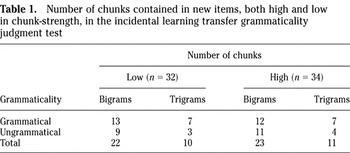
Number of chunks contained in new items, both high and low in chunk-strength, in the incidental learning transfer grammaticality judgment test
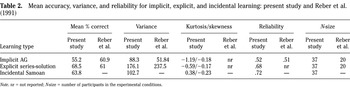
Mean accuracy, variance, and reliability for implicit, explicit, and incidental learning: present study and Reber et al. (1991)
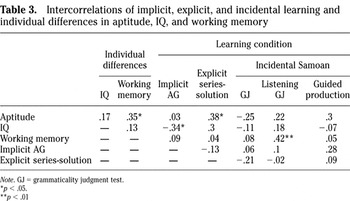
Intercorrelations of implicit, explicit, and incidental learning and individual differences in aptitude, IQ, and working memory
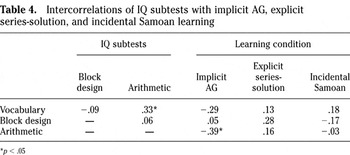
Intercorrelations of IQ subtests with implicit AG, explicit series-solution, and incidental Samoan learning
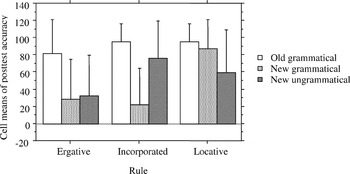
Mean percent-correct on Samoan sentence types (with standard deviation bars) in the immediate grammaticality judgment posttest.
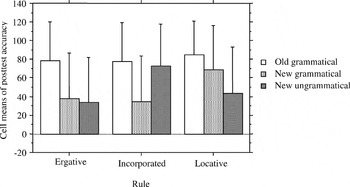
Mean percent-correct on Samoan sentence types (with standard deviation bars) in the immediate listening grammaticality judgment posttest.
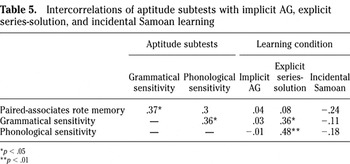
Intercorrelations of aptitude subtests with implicit AG, explicit series-solution, and incidental Samoan learning
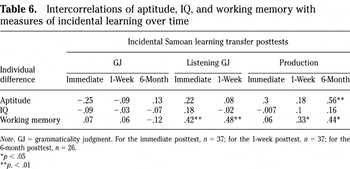
Intercorrelations of aptitude, IQ, and working memory with measures of incidental learning over time
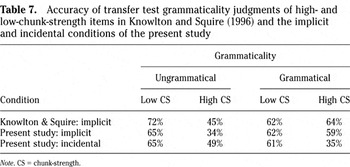
Accuracy of transfer test grammaticality judgments of high- and low-chunk-strength items in Knowlton and Squire (1996) and the implicit and incidental conditions of the present study
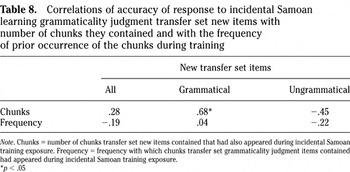
Correlations of accuracy of response to incidental Samoan learning grammaticality judgment transfer set new items with number of chunks they contained and with the frequency of prior occurrence of the chunks during training
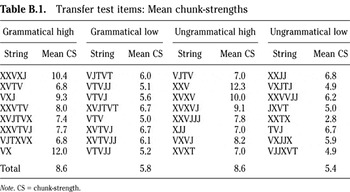
Transfer test items: Mean chunk-strengths
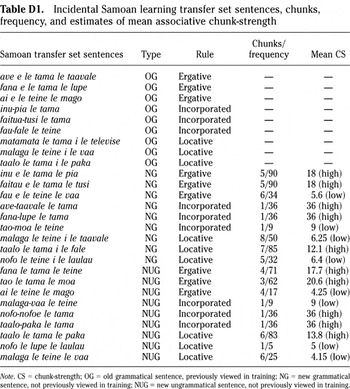
Incidental Samoan learning transfer set sentences, chunks, frequency, and estimates of mean associative chunk-strength
 You have
Access
- 99
- Cited by