




No CrossRef data available.
CONTEXT, CONTACT, AND COGNITION IN ORAL FLUENCY ACQUISITION: Learning Spanish in At Home and Study Abroad Contexts
Published online by Cambridge University Press: 23 April 2004
Abstract
This study investigates the role of context of learning in second language (L2) acquisition. Participants were 40 native speakers of English studying Spanish for one semester in one of two different learning contexts—a formal classroom at a home university (AH) and a study abroad (SA) setting. The research looks at various indexes of oral performance gains—particularly gains in oral fluency as measured by temporal and hesitation phenomena and gains in oral proficiency based on the Oral Proficiency Interview (OPI). The study also examines the relation these oral gains bore to L2-specific cognitive measures of speed of lexical access (word recognition), efficiency (automaticity) of lexical access, and speed and efficiency of attention control hypothesized to underlie oral performance. The learners also provided estimates of the number of hours they spent in extracurricular language-contact activities. The results show that in some respects learners in the SA context made greater gains, both in terms of temporal and hesitation phenomena and in oral proficiency as measured by the OPI, than learners in the AH context. There were also, however, significant interaction effects and correlational patterns indicating complex relationships between oral proficiency, cognitive abilities, and language contact. The results demonstrate the importance of the dynamic interactions that exist among oral, cognitive, and contextual variables. Such interactions may help explain the enormous individual variation one sees in learning outcomes, and they underscore the importance of studying such variables together rather than in isolation.This research was funded in part by a grant to Barbara F. Freed from the Council on International Educational Exchange, New York, in part by a grant from the Natural Sciences and Engineering Research Council of Canada to Norman Segalowitz, and in part by a grant from the Dean's Office, Faculty of Arts and Science at Concordia University, to Segalowitz. The authors wish to thank Joe Collentine, Manuel Díaz-Campos, and Barbara Lafford, who are members of the research team involved in the larger project of which this study is one part. A special note of thanks is due to Nicole Lazar, who is also a member of the research team, for her invaluable statistical advice. Finally, the authors would like to thank Conchita Bueno, Hazel Casas, Elizabeth Gatbonton, Randall Halter, Guy Lacroix, Anne-Marie Linnen, Magnolia Negrete, Irene O'Brien, Laura Renteria-Díaz, Marlene Taube, and Naomi Yamasaki, who helped during various phases of this project.
Information
- Type
- Research Article
- Information
- Copyright
- © 2004 Cambridge University Press
Do adult second language (L2) learners benefit more when learning in one context compared to another? For example, are there differences in the language gains made by students who combine formal language study with interaction in the native speech community—as in a study abroad (SA) context—compared to the gains made by students learning in the formal classroom context in their home community? Recently, investigators have looked at the effects on language learning success of study abroad1
The term study abroad also covers study of an L2 in a different linguistic region from one's home area within the same multilingual country—for example, Canadian English speakers from Ontario learning French in Quebec.
Numerous linguistic variables could be selected as the object of study for such an investigation. Given that both oral fluency and oral proficiency are two features of language use that have previously been shown to be sensitive to contextual variables (Brecht et al., 1995; Freed 1995; Freed, Segalowitz, & Dewey, this issue; Lafford, 1995; Magnan, 1986), we decided to focus specifically on these two related but distinct aspects of L2 learning.
In this study, we examined the relationship between learning context and gains in oral performance (proficiency and fluency) in an L2, as well as some of the cognitive processing skills mediating the relationship between learning context and oral gains. The study involved adult English speakers learning Spanish in two different contexts—AH and SA. Our study enabled us to investigate some of the interactions between psychological and contextual factors and their impact on oral development. In particular, we examined the interactions between three main sets of variables: learning context, oral production abilities, and L2-relevant cognitive processing abilities. We looked at these as a function of learning taking place in AH and SA contexts over the course of one semester. These three sets of variables are described in turn.
ORAL PERFORMANCE VARIABLES
The terms oral proficiency and oral fluency, as widely used in the literature, refer to multidimensional constructs and are not always used consistently (see Freed, Segalowitz, et al., this issue, and Koponen & Riggenbach, 2000, for discussions of this problem). In our study, we use the term oral proficiency to refer specifically to the ratings provided by the Oral Proficiency Interview (OPI). We use oral fluency to refer to those aspects of oral performance having to do with the fluidity or “smoothness” of language use (Freed, 1995). We operationalized fluency in terms of four temporal or hesitation-based measures: speech rate, mean run length containing no silent pauses or hesitations greater than 400 ms, mean run length containing no filled pauses (e.g., um, ah), and longest run containing no silent or filled pauses. We also obtained measures of the total number of words spoken, the duration of speech, and the length of the longest turn within an 8-minute sample of student speech.
In general terms, these eight indexes were obtained as follows (see the “Methods” section for details). Trained testers recorded the OPI given to all participants. The interviewer provided a global rating of the participant's oral proficiency, using a well-established scale for such judgments. Extracts of 4 minutes' duration were taken from the interview recordings at the beginning (pretest) and end (posttest) of the semester for a total of 8 minutes. These samples, derived from the OPI, became our speech corpus. They were transcribed to enable us to count words and filled pauses, and the recordings were acoustically analyzed for the temporal and hesitation features required for computing the fluency measures.
COGNITIVE PROCESSING ABILITY
There are several ways to think about how cognitive processing abilities might underlie L2 learning. One is to focus on factors related to language learning aptitude (Carroll, 1981; Robinson, 2002; Skehan, 2002). Aptitude refers to a learner's basic cognitive disposition or readiness for language learning, such as phonetic coding ability, rote learning capacity, and sensitivity to grammatical features (see, e.g., Harley & Hart, 2002, and Ross, Yoshinaga, & Sasaki, 2002, for studies of aptitude and context of learning; Brecht et al., 1995, and Freed, 1995, reported no relationship between Modern Language Aptitude Test aptitude and oral gains in a SA context). Aptitude factors are assumed to be unchanging characteristics of the individual (although see, e.g., Sternberg, 2002, who suggested that aptitude is at least partly learned and trainable). Other researchers have focused on cognitive learning strategies (e.g., O'Malley & Chamot, 1990) that include metacognitive strategies to attend to input in particular ways. Such aptitude and strategy approaches have in common their focus on cognitive factors that shape the course of learning in general. However, these factors do not necessarily directly underlie real-time oral performance, especially the temporal and hesitation phenomena that underlie fluency.
In this study we took a different approach. We focused instead on cognitive processing abilities that are likely to be directly implicated in real-time oral performance—in particular, with the four temporal or hesitation-based measures of fluency described previously. In taking this approach, we took a cue from the skill-acquisition literature that has been concerned with how cognitive processing abilities underlie expert performance (e.g., Ackerman, 1988, 1989; Shebilske, Goettl, & Regian, 1999). These are cognitive abilities that potentially interact with learning experiences in a dynamic way, both affecting the course of oral performance gains and being affected by learning experiences themselves. The cognitive variables included here were speed and efficiency of lexical access, and speed and efficiency of attention control. These cognitive variables have been discussed both in the context of L2 performance (DeKeyser, 2001; Johnson, 1996; Schmidt, 1992; Segalowitz, 1997, 2000, 2003; Segalowitz & Hulstijn, in press; Segalowitz, O'Brien, & Poulsen, 1998; Segalowitz & Segalowitz, 1993) as well as in the context of first language (L1) speaking and reading fluency, where many of the same performance issues arise, given that speed, accuracy, and smoothness are the hallmarks of good performance in speech and reading (Berninger, Abbott, Billingsley, & Nagy, 2001; Levelt, 1989; Perfetti, 1985). In this study, we obtained L2-specific measures of these variables as described in the following.
Speed of processing was indexed by reaction time (RT) in the tasks used. Speed of L2 processing was indexed by partialling out L1 from L2 RTs, thus controlling for individual differences in general speed of processing that would be reflected in L1 performance as well. The residualized score provided an L2-specific index of processing speed that could be expected to improve as a function of learning and practice over time.
Efficiency of processing was indexed by the coefficient of variation (CV) of the RT—that is, the standard deviation of an individual's RTs divided by that person's mean RT. The CV provides a measure of response-time variability adjusted for overall speed of response. Differences in CV reflect differences in variability that are not directly tied to the overall magnitude of the response time. The CV can thus be viewed as the standard deviation per millisecond of RT. The CV reflects the relative noisiness of the processes underlying a person's response time. A low CV indicates responding that is more temporally stable after adjusting for overall speed of responding, compared to a high CV. In other words, a change in the direction of lower variability reflected in a lower CV indicates that something more than simple speed-up must have occurred and that some kind of restructuring must have taken place. The CV can thus also be interpreted as a measure of automatization, where a change in CV distinguishes changes in RT due to restructuring of underlying processes (a qualitative increase in processing efficiency; automatization) from changes in RT due to simple speed-up of those processes (a quantitative increase in speed without restructuring; Segalowitz & Segalowitz, 1993; Segalowitz, Segalowitz, & Wood, 1998). L2-specific processing efficiency was indexed by partialling out L1 from L2 CVs, thus adjusting for individual differences in general cognitive efficiency that would be reflected in L1 performance as well.
It was hypothesized that speed and efficiency of L2-specific lexical access and attention control would be related to oral fluency in various ways. For example, being able to access meanings quickly and efficiently should enhance speech rate and reduce hesitations and interruptions that characterize less fluent speech. It was also hypothesized that these cognitive variables might serve as readiness factors for oral gains because to make use of language input the learner has to be able to process that input well. If processing abilities are below some threshold level of readiness, then gains in oral performance may not occur. Thus, for example, in the SA context the demands of communicating with NSs might be too challenging for learners with cognitive abilities below some threshold level, resulting in their being overwhelmed by their experiences. Similar learners in a less challenging AH context may not be overwhelmed and perhaps even advantaged.
Learning Context
What most differentiates SA from AH learning contexts is the availability in SA contexts of opportunities to interact with NSs. In this study, such contact was indexed in several ways. One involved variables reflecting the amount of self-reported out-of-class L2 communicative activities in the four basic skill domains of speaking, listening, reading, and writing. High levels of contact in these areas can be expected, among other things, to provide practice leading to various types of language gain. Language contact activities may also lead to cognitive gains in lexical access and language-relevant forms of attention control, abilities that we hypothesized to underlie oral fluency. In addition to activities in the four basic skill areas, we were also interested specifically in contact with the home-stay family, a special feature of the SA context. Finally, to the extent that learners freely choose whether to make use of opportunities to communicate in the L2 outside class, it may be that their starting levels of cognitive processing ability and their prior oral ability in the L2 shape these choices. For example, high-ability learners might seek out opportunities, and low-ability learners might choose to limit their contact. We investigated these possibilities.
The specific goals of this study can be summarized by the following four sets of questions:
- Oral performance gains, learning context, and language contact: Do AH and SA learning contexts differentially support gains in oral performance? To what extent are context-based differences in oral performance gains associated with time-on-task factors related to in-class and reported extracurricular activities? Is the impact of such time-on-task factors different in AH and SA environments?
- Cognitive processing ability gains, learning context, and language contact: Does learning in AH and SA contexts lead to similar gains in cognitive processing abilities that are hypothesized to underlie L2 oral performance—in particular, in speed and efficiency of lexical access and attention control? To what extent are gains in these cognitive abilities associated with time-on-task factors?
- Oral performance gains, initial levels of oral and cognitive processing ability, and learning context: Are oral performance gains related to initial oral and cognitive processing abilities? Is this relationship the same in the AH and SA contexts? Are there readiness or threshold effects in the way oral and cognitive processing abilities relate to oral performance gains?
- Language contact, initial levels of oral performance and cognitive processing ability, and learning context: Do initial oral performance and cognitive processing abilities influence the choices students make regarding out-of-class language contact activities?
METHOD
Participants
Forty-seven students studying Spanish as an L2 were recruited for this study.2
The participants could not be randomly assigned to the AH and SA conditions. This leaves open the possibility that some selection factors may have differentiated the two groups (e.g., attitudes toward L2 learning, learning strategies, readiness to engage in conversations, or communication strategies). However, as reported in the “Results” section, no significant differences were found on pretest measures of oral fluency or cognitive performance, and so it seems unlikely that selection factors affected the outcomes reported in this study.
Analysis
For all analyses, alpha was set at .05. When an ANOVA was conducted, only higher order significant interaction effects are reported if they explain lower order interactions and main effects. Nonparametric tests were used for analyses involving the OPI because of its ordinal nature. Standard errors of means are shown in parentheses following reports of means in the text and in tables. One-tailed tests are reported where there was a clear a priori directional hypothesis. Where appropriate, the adaptive False Discovery Rate (FDR) procedure recommended by Benjamini and Hochberg (2000) was used to protect against Type I errors with multiple tests.
General Procedures and Description of Materials
In week 1, the students were given the pretest version of the Language Contact Profile (LCP; Freed, Dewey, Segalowitz, & Halter, this issue). They were then given the pretest versions of the tape-recorded OPI in Spanish and a set of computer-based cognitive tests of lexical access and attention control. Thirteen weeks later, all participants completed the posttest version of the LCP, a post-OPI, and a repeat of the cognitive tests. The students also took other tests. These included a test of grammatical knowledge administered at the beginning of the semester and a pretest and posttest of phonological skill (Díaz-Campos, this issue), phonological short-term memory, and writing skill. Students also kept a journal recording their feelings and observations about their language-learning experiences. Finally, at the end of the semester, two members of the project's research team interviewed students in an effort to learn more about their language learning experiences throughout the semester. The results of these tests and additional analyses of the interview data will be presented elsewhere. In the following section, we describe the LCP, the eight measures of oral performance, and the four cognitive measures.
Language Contact Profile.
The LCP is a multifaceted questionnaire that examines various aspects of a student's language history and language use. It consisted of a 4-page pretest and a 6- to 8-page posttest questionnaire, in English, modified for AH and SA contexts (see Freed, Dewey, et al., this issue, for details).
The language contact data from the LCP were compiled as follows. Each language contact question asked the students to indicate how many days per week and how many hours per day they engaged in each of the four basic language skill activities—speaking, reading, writing, and listening—outside class. The product of these two numbers provided an estimate of total time per week for each activity. The AH students answered such questions about out-of-class language contact they had in Spanish, and the SA students answered about their contact in Spanish and in English. For the SA group, we also obtained a separate measure of time spent with the home-stay family. The measures of extracurricular language contact time thus included reported hours per week speaking (Speak), reading (Read), writing (Write), listening (Listen) in Spanish, the total number of contact hours (Total = sum of the four), and, for the SA group, the time spent in Spanish activities with the home-stay family (Family). Students also described their current Spanish language courses, thus providing information about classroom-based language contact, and answered questions about past learning history.
Oral Proficiency Interview.
The OPI involved a 20- to 30-minute tape-recorded interview given by testers trained and certified by ACTFL (Breiner-Sanders, Lowe, Miles, & Swender, 2000). Four testers participated, one for each context (AH and SA) by test time (pretest and posttest) combination. The interviewers provided OPI ratings that ranged from novice through intermediate to advanced (with low, mid, and high levels for each). The recordings were subsequently digitized and two 2-minute extracts were taken from each interview, yielding 4 minutes of pretest interview and 4 minutes of posttest interview for each student. The first extract started at about minute 7 of the interview, and the second at about minute 12. The extracts began at the beginning of a student turn and always avoided any conversation that came from a role play. These extracts provided the oral corpus used to obtain three other measures of general oral performance (pretest and posttest)—total number of words, duration, and longest turn—and the four oral fluency measures described previously—speech rate, mean length of run without silent pauses of 400 ms or longer, mean length of run without filled pauses, and longest fluent run (no silent or filled pauses).
Lexical Access.
A semantic classification task requiring lexical access (word recognition) provided the first pair of the cognitive measures. This was a computerized test in which participants made speeded, two-alternative forced-choice animacy judgments (decide if a word referred to a living or nonliving object) about single nouns presented on a computer screen (e.g., the boy = living; a boat = nonliving). This lexical access test had English and Spanish versions. Nouns were presented with definite and indefinite articles to ensure that the English nouns were not interpreted as verbs and to highlight the English or Spanish character of the words. The English words used were generally high in written frequency as given by Quinlan (1992)—frequencies ranged from 5 to over 300 per million; 80% of the stimuli had a frequency of 10 or higher; items with frequency counts from 5 to 9 were nouns highly familiar to educated English speakers, such as bicycle, spoon, and comb. A majority of the Spanish stimulus words were translation equivalents of the English stimuli and were judged by two teachers of Spanish as likely to be known by lower level learners of Spanish. Spanish frequency norms were not available and would not have been relevant to a language-learning population. (A full list of the words appears in Appendix A.) Reaction times and accuracy were recorded. Each version of the test began with six warm-up trials not included in the analyses followed by 100 experimental trials. The stimulus words were quasi-randomized so that no more than five similar judgment trials occurred in sequence. Participants responded by pressing one of two keys on a numeric keypad, using the right index finger for “living” and the left index finger for “nonliving.” The order of the tests—English then Spanish or vice versa—was counterbalanced across participants. The same tests were given at the beginning and end of the semester. At the start of the session, participants performed a practice version to become familiar with the procedures and equipment. In this version, participants made letter-digit judgments to letter and digit stimuli (i.e., no words appeared). The experimental versions of the lexical access test yielded two measures in each language—speed of lexical access (as measured by RT) and efficiency of lexical access (by CV, as previously described).
Attention Control.
An attention control test provided the second pair of cognitive measures. This was a computerized test involving speeded responses to indicate which of three words on the computer screen matched (repeat condition) or did not match (shift condition) a sample stimulus. The test had English and Spanish versions. Participants first trained on a practice version in the appropriate language and condition (English and Spanish; repeat and shift). Practice versions contained 20 trials using different stimulus words from the experimental conditions (practice stimuli were names of colors, numbers, buildings, people, and liquids).
Following practice, participants went on to do the corresponding experimental task. First they learned to classify the 20 experimental stimulus words into five specific categories, four words in each—words that could be responses to the questions To whom? Where? When? How many? and words that were a form of the verb to be (see Appendix B). This task was followed by either the repeat or the shift condition, as appropriate.
In the repeat condition, a category label appeared at the bottom of the screen (e.g., Where?) and three words across the top, only one of which was from the category named. The participant pressed one of three buttons on a numeric keypad, using the index, middle, or ring finger of the preferred hand to indicate whether the leftmost, middle, or rightmost word matched the category name. This continued for 12 trials with the same category, and then a new category was announced on the screen and used for the next 13 trials until all five categories were tested, for a total of 64 trials (16 warm-up trials followed by 48 experimental trials). Position of the target was randomly varied, the selection of nontargets was randomly varied in a counterbalanced manner, and the order of the five categories tested was randomized across participants. If the participant made an error, the computer gave audible feedback.
In the shift condition, three words from different categories appeared across the top of the screen. On the first trial, the participant selected any word by pressing the leftmost, middle, or rightmost button corresponding to that word's position. For example, on trial 1, the participant might have seen him now above and selected above by pressing the rightmost button. On the second trial, three new words appeared, one word from the same category as the word just selected and two words from categories not represented in the previous trial. On this trial, the participant had to select a word that came from a different category than the one previously selected (i.e., make a category shift). To continue with the example, on trial 2 the participant might have seen few below was and so should have avoided selecting below. On the third and subsequent trials, the participant had to continue shifting focus by choosing a word that represented a different category from the word selected on the immediately preceding trial. On error trials, the computer gave audible feedback. On the trial following an error, no words from the category previously selected were shown, and participants were instructed to start afresh—that is, they did not need to remember what they had chosen on the previous trial. There were 16 warm-up trials followed by 48 experimental trials in the shift condition. In both the repeat and shift conditions, the three words always appeared in three of four possible locations, in a manner designed to ensure that eye movement was required on successive trials, to discourage strategic fixating on one location.
The attention control test yielded measures in each language of speed (by RT) and efficiency (by CV) of cognitive processing for the repeat and the shift conditions separately.
All computer tests were carried out using a Macintosh G3 iBook with a numeric keypad as the response panel and with software written in HyperCard 2.3. The program included a routine that permitted timing of key-press responses with a resolution of 5 ms instead of the built-in 16.67-ms tick rate.
In summary, participants first performed the practice version of the lexical access tasks, followed by either the Spanish or English version, and then by the alternate version. Next, they completed the attention control task. For this, participants completed two blocks of testing on the repeat task, one in each language, and two blocks of the shift task, again one in each language, each block involving 16 practice and 48 experimental trials. The order repeat-shift or shift-repeat was counterbalanced across participants. The order English-Spanish or Spanish-English was also counterbalanced across participants and held constant for any given participant across the lexical access and attention control tasks.
RESULTS
The following summary of the primary results is organized in terms of the four sets of questions presented earlier. Interpretation follows in the “Discussion” section.
Oral Performance Gains, Learning Context, and Language Contact
There were eight measures of oral performance, examined as a function of learning context (AH, SA) and time (pretest, posttest). Three of these were the number of words spoken in the 4-minute interview extract (Total words), duration of speech during the 4-minute extract (Duration; maximum = 240 s), and number of words in the longest turn (Turn), which reflected the participant's ability to hold the floor while speaking. Four other measures of oral fluency (speed and fluidity or smoothness of speech) included: speech rate in words per minute (Rate); absence of hesitations (Hesit-free), expressed as the mean run length in words containing no silent pauses longer than 400 ms; absence of filled pauses (Filler-free), expressed as the mean run length in words with no filled pause dysfluencies, where a filled dysfluent pause was defined as an interruption in the speech flow by a non-Spanish filler item, including ah, um, laughing, insertion of English words such as like, no, or I mean; and number of words in the longest fluent speech run (Fluent-run) not containing any silent or filled dysfluencies (Freed, 1995). Finally, there was a general measure of oral proficiency provided by the OPI. Table 1 shows the means for all but the OPI rating (the OPI rating is an ordinal measure and receives a separate discussion).
Means (and standard errors) for pretest and posttest oral performance in the AH and SA contexts for learning Spanish

A series of t-tests comparing the AH and SA students on pretest measures of the seven oral performance measures revealed no significant differences (FDR corrected). Also, a Mann-Whitney U test comparing the pretest OPI ratings of the AH and SA students revealed no significant difference (median rating was intermediate-low for each group). Thus, there is no reason to believe that one group of students entered the study with superior L2 abilities.
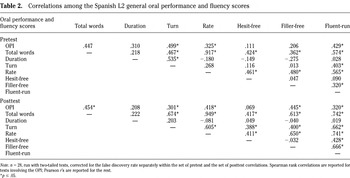
Table 2 reports the intercorrelation patterns among the eight oral measures at pretest and posttest.
Correlations among the Spanish L2 general oral performance and fluency scores

We were also interested in whether oral gains were attributable to time-on-task considerations. We used Total—the number of hours per week reported in the LCP summed across speaking, reading, writing, and listening activities in Spanish outside of class—as one index of time-on-task. For the SA context, we also used a measure of in-class contact—low for students taking only the three basic courses of instruction with no complementary courses versus high for students taking four or five courses of instruction.
As can be seen from Table 1, only the students in the SA context made significant gains in oral performance, and they did so on four of the seven oral measures: Turn, Rate, Filler-free, and Fluent-run. The measures Turn, Rate, Filler-free, and Fluent-run were subsequently submitted to two-way mixed ANOVAs with the between factor being context (AH, SA) and the within factor being time (pretest, posttest). Significant interaction effects indicating that the SA group changed significantly more than the AH group were found for three of the variables: Turn, F(1, 38) = 13.448, MSE = 565.836, p = .007, eta2 = .176; Rate, F(1, 38) = 27.865, MSE = 98.641, p < .001, eta2 = .423; and Filler-free, F(1, 38) = 5.213, MSE = 10.671, p = .028, eta2 = .121. The interaction effect was marginally significant and weak for Fluent-run, F(1, 38) = 3.854, MSE = 20.758, p = .057, eta2 = .092. These results suggest that the SA group made greater oral gains than the AH group. These ANOVAs were also conducted with total amount of reported out-of-class L2 contact covaried out (Total) and with number of previous years of study of Spanish covaried out. In all cases except one, the pattern of interaction effects remained the same. The exception was Filler-free, in which the interaction effect was removed by covarying out Total. Finally, t-test analyses of the oral gains in the SA group revealed no significant differences as a function of amount of classroom-based language contact hours. Thus, the overall pattern of results is that the SA group made greater gains than the AH group in length of longest turn, in rate of speech, in mean length of run free of filled pauses, and in longest run of speech free of silent or filled dysfluencies. This pattern, for the most part, was not a function of how much out-of-class contact the students had. Also, within the SA group, individual differences in oral gains did not reflect the amount of classroom-based hours the students had.
The OPI ratings, being ordinal measures, were submitted to nonparametric analyses. These yielded a similar pattern. Gains made by students were confined to an increase of one level only (e.g., intermediate-low to intermediate-mid). A sign test indicated significant pretest to posttest improvement for the SA group, n = 22; 12 students improved but 10 did not, p < .001, whereas there was no significant improvement for the AH group, n = 18; 5 students improved but 13 did not, p > .2. Chi-square analysis of these data revealed a trend, χ2 = 2.90, df = 1, p < .10, toward greater improvement in the SA versus the AH group. An independent samples t-test yielded no significant difference on the measure Total between students who made gains on the OPI versus those who did not, t(38) = .54. A chi-square test on the data from the SA group did not reveal any significant relationship between the presence or absence of OPI gains and more versus less classroom-based language contact, χ2 = .182, df = 1.
Thus, students in the SA context made gains on five of the eight oral measures—OPI, Turn, Rate, Filler-free, and Fluent-run—and students in the AH context did not. Variation in the SA group's gains did not appear to reflect global contact time with the language, either in or out of class.
We were also interested in the extent to which specific reported out-of-class language contact activities may have been implicated in oral gains. To examine this, we conducted three sets of exploratory correlational analyses with the gain scores for the five variables on which significant gains had been observed. Gains in Turn, Rate, Filler-free, and Fluent-run were calculated by partialling out the pretest scores from the posttest scores and using the residuals as gain measures.
The first set of analyses looked at the impact of extracurricular activities on speaking, reading, writing, and listening. No significant correlations (FDR corrected) were obtained. The second set of analyses looked at the impact on oral gains of time reported spent with the home-stay family. These analyses also yielded no significant correlations (FDR corrected). However, the correlation between gain in longest turn and family contact was negative, r = −.438, n = 22, two-tailed test, p = .042 (not FDR corrected), which suggested that the more Spanish language contact students had with their home-stay family the fewer gains they made in terms of extending the length of their turns at speaking. Because this result was not significant when FDR corrected, it can only be considered as suggestive.
Cognitive Processing Gains, Learning Context, and Language Contact
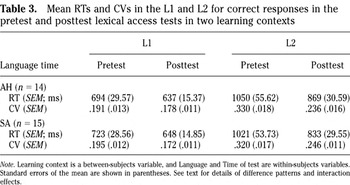
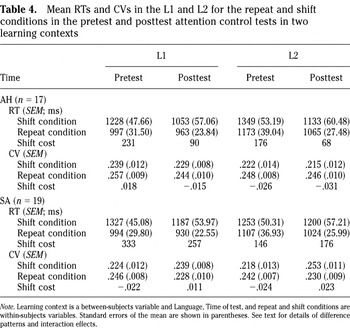
Tables 3 and 4 show the mean RTs and mean CVs for the pretests and posttests in the AH and SA contexts for the lexical access and for the attention control tests, respectively. The students in the AH and SA learning contexts did not differ significantly from each other on any of the pretest cognitive performance measures (none of the t-test comparisons of AH vs. SA groups on the various cognitive measures were significant, all t's < 1.91, df = 38). Mean error rate across conditions in the L1 was 5.39% and in the L2 was 10.53%.
Mean RTs and CVs in the L1 and L2 for correct responses in the pretest and posttest lexical access tests in two learning contexts

Mean RTs and CVs in the L1 and L2 for the repeat and shift conditions in the pretest and posttest attention control tests in two learning contexts

Cognitive processing abilities—lexical access speed, lexical access efficiency, attention control speed, and attention control efficiency—were analyzed as a function of AH and SA learning context. Data from participants whose error rate was 21% or greater were not included in the analyses; this reduced the AH group to 14 and the SA group to 15 for some analyses. The RTs and CVs reported in Tables 3 and 4 were submitted to ANOVAs to determine if there were differential cognitive gains as a function of learning context.
Residualized gain scores were also computed for each of these cognitive performance measures, and these gain scores were submitted to correlational tests with measures of reported extracurricular language contact. These analyses were done separately for the AH and SA groups because the groups had nonoverlapping distributions of reported extracurricular language contact time.
Each participant's residualized gain score for speed of lexical access was computed as follows. First, L1 RTs were partialled out from the L2 RTs across participants, separately for the pretest and posttest. The resulting residualized scores reflected the degree to which performance in L2 was better or worse than expected given performance in L1. This controlled for individual differences that were not specifically related to L2 lexical access, including differences in motor performance, general perceptual abilities, general language-processing abilities, and gains associated with repeating the tasks at posttest—and that would be reflected in L1 performance. Next, the residualized indices were transformed by multiplying by −1 to yield pretest and posttest lexical access speed scores (Lex-speed) in which higher values indicated greater speed. Finally, the pretest Lex-speed scores were partialled out from posttest Lex-speed scores to obtain a residualized gain score. The same procedure was used to compute measures of lexical efficiency (Lex-efficiency), using CVs from the lexical access test in place of the RT.
Measures of attention speed (Att-speed) gain and attention efficiency (Att-efficiency) gain were based on RTs and CVs, respectively, from the attention control test, using a procedure similar to the one just described. The first step, however, was to compute a shift cost score by partialling out performance on the repeat task from the shift task and then submitting the shift cost scores to the partialling out procedures described previously (first partialling out L1 from L2, and then pretest from posttest). Thus, for all four cognitive variables, because L1 performance had been partialled out from L2 performance, the indexes and gain scores were considered to be L2 specific.
To see if language contact led to gains in cognitive processing, cognitive gain scores were examined for significant correlations with the various categories of extracurricular language contact—the four skill areas of Speak, Read, Write, and Listen and home-stay family contact (Family). Finally, the cognitive gain scores were compared, in the SA group, between students with more versus less classroom instructional contact. The results of these analyses are described separately for each of the cognitive performance measures.
Lexical Access Speed.
Lexical access speed was expected to be related positively to fluency. To test this hypothesis, pretest lexical access speed was correlated against the four pretest measures of fluency. Lex-speed correlated significantly with Filler-free, r = .375, n = 40, p < .05 (one-tailed test, FDR corrected), which indicated that this cognitive ability was related to fluency.
The mean RTs shown in Table 3 for correct responses in the English and Spanish pretest and posttest lexical access tasks were submitted to a three-way mixed ANOVA with the between factor being context (AH, SA) and the within factors being language (L1, L2) and time (pretest, posttest). The highest order significant effect was a language by time interaction, F(1, 27) = 34.621, p < .001, MSE = 2968.061, eta2 = .562, which indicated that the 185-ms improvement in response speed in the L2 was significantly greater than the 67-ms improvement in the L1, an overall gain over time in speed of L2 lexical access. Most importantly, however, there were no context effects.
The data were further analyzed to see if lexical access speed gains were associated with the extracurricular language contact. Neither the SA nor the AH groups yielded significant correlations between contact variables and gains in Lex-speed. Finally, there was no significant difference on gains in lexical access speed between those SA learners with lower versus higher levels of classroom-based contact, t(13) < 1.
Lexical Access Efficiency.
Lexical access efficiency was also expected to be positively related to oral fluency. To test this, pretest Lex-efficiency was correlated against the four pretest measures of oral fluency and was found to correlate significantly with Filler-free, r = .377, n = 40, p < .05 (one-tailed test, FDR corrected), which indicated that this cognitive ability was also related to fluency.
The CVs reported in Table 3 were submitted to a three-way mixed ANOVA with the between factor context (AH, SA) and the within factors language (L1, L2) and time (pretest, posttest). The highest order effect was a significant language by time interaction, F(1, 27) = 34.295, p < .001, MSE = .000927, eta2 = .560, which indicated that the CV improvement of .084 in the L2 CV was significantly greater than the .018 improvement in the L1 CV, an overall gain in L2 processing efficiency. There were no significant context or interaction effects involving context. We further analyzed the data to see if gains in lexical access efficiency were positively associated with amount of extracurricular language contact. Neither the SA nor the AH groups yielded significant correlations between contact variables and gains in Lex-efficiency. Finally, there was no significant difference when lower versus higher level of classroom-based contact subgroups within the SA group were compared on lexical access efficiency gains, t(13) < 1.
Attention Control Speed.
We expected attention control speed to be positively related to oral fluency; however, no significant correlations were obtained when Att-speed was correlated against the four pretest measures of oral fluency.
The mean RTs shown in Table 4 for correct responses in the English and Spanish attention control task in the pretest and posttest were submitted to a four-way mixed ANOVA with the between factor being context (AH, SA) and the within factors being condition (shift, repeat), language (L1, L2), and time (pretest, posttest). The results revealed an expected condition by language effect, F(1, 34) = 12.789, p = .001, MSE = 10511.125, eta2 = .273, which indicated that performance in the shift condition was slower than in the repeat condition (shift cost) and that this difference was greater in L2 than in L1 (shifting was more difficult in L2). Most important for this study, the four-way interaction effect was not significant, F(1,34) < 1, failing to indicate a differential L2 versus L1 shift cost improvement from pretest to posttest favoring the SA group.
The data were further analyzed to see if attention speed gains were associated with amount of extracurricular language contact. In the SA group, the four basic skill activities did not yield significant correlations with gains in Att-speed. The reported amount of home-stay family contact did correlate significantly but negatively with gains in Att-speed, r = −.523, n = 19, p = .022 (two-tailed test). In the AH group, Att-speed did not correlate significantly with any of the contact variables.
Finally, no significant difference was found when the lower versus higher level of classroom-based language contact subgroups within the SA group were compared on gains in speed of attention control, t(13) < 1.
Attention Control Efficiency.
Attention control efficiency was also expected to be positively related to oral fluency. However, no significant correlations with the four pretest measures of fluency were obtained. When posttest Att-efficiency was correlated against the four posttest measures of fluency, an unexpected significant negative correlation was obtained with Rate, r = −.476, n = 40, p < .01 (two-tailed test, FDR corrected). This result indicated that, by the end of the semester, the greater the learner's efficiency in shifting attention, the slower that person's rate of speech.
The mean CVs shown in Table 4 for correct responses in the English and Spanish attention control tasks in the pretest and posttest were submitted to the same four-way mixed ANOVA design as were the RT data. The results revealed a significant condition by time by context three-way interaction effect, F(1, 34) = 8.305, p = .007, MSE = .00745, eta2 = .196, which indicated an overall gain in efficiency (lowering of the CV) over time. Most relevant for this study is that there were no other main or interaction effects with context and no significant language effects.
The data were further analyzed to see if attention efficiency gains were associated with amount of extracurricular language contact. Neither the SA nor the AH groups yielded significant correlations between contact variables and gains in Att-efficiency. Finally, an independent samples t-test revealed no significant difference in gains in attention control efficiency as a function of the amount of classroom-based contact, t(13) < 1.
Oral Performance Gains, Initial Levels of Oral and Cognitive Processing Ability, and Learning Context
The next set of analyses addressed the question of whether oral performance gains were dependent on initial levels of cognitive performance. To examine this, oral performance gain scores were tested for significant relationships with the pretest, residualized indexes of the four cognitive measures (L2 residualized against L1). First, to test for significant relationships between OPI gains and the four pretest cognitive measures, 2 × 2 between-subjects ANOVAs were conducted with each of the four pretest cognitive measures as the dependent variable and with the between factors context (AH, SA) and OPI-gain (gain, no gain). The analyses yielded significant main effects for Lex-speed and Lex-efficiency, F(1, 36) = 4.77, MSE = 14894.007, p = .035, eta2 = .12; and F(1, 36) = 4.73, MSE = .00369, p = .036, eta2 = .12, respectively. There were no other significant main effects or higher order interaction effects. These results indicated that, as a group, learners who made gains on the OPI started out with faster and more efficient L2-specific lexical access skills. As for the other oral gain measures, we found no significant correlations after FDR correction between oral gain measures and pretest cognitive scores when the data were analyzed separately by context or for the group as a whole.
Finally, analyses were conducted to see whether each type of cognitive performance gain correlated significantly with gains in any of the four oral fluency measures. Gains in Att-efficiency correlated significantly but negatively with gains in Rate, r = −.534, n = 40, p < .01 (two-tailed test, FDR corrected), which indicated that the greater the gains a learner made in efficiency of attention control, the lower the gains made in speech rate. There was a tendency for this effect to be more pronounced in the SA group, r = −.436, p = .042 (not significant when FDR corrected), than in the AH group.
Language Contact, Initial Levels of Oral Performance, Cognitive Processing Ability, and Learning Context
The SA students had many opportunities to engage in a diverse array of extracurricular Spanish language activities, but not all students took advantage of them. We conducted an analysis to see if pretest levels in each of the main oral variables (longest turn, speech rate, hesitation-free speech, filler-free speech, longest fluent run) were correlated with the amount of reported out-of-class time spent in speaking, reading, writing, and listening and, in separate analyses, with home-stay contact time. Pretest Turn correlated significantly with Listen, r = .54, and pretest Hesit-free correlated significantly with Read, r = .716 (for both, p < .05, FDR corrected). This suggests that ability to control long utterances at pretest predicted reported out-of-class listening activities and that ability to speak fluently (without hesitations) predicted reported out-of-class reading. None of the pretest oral variables correlated significantly with the family contact measure. Finally, none of the pretest performance cognitive measures correlated with the out-of-class contact measures.
DISCUSSION
This paper opened with the question of whether it is more advantageous to learn an L2 in one context than another—here specifically in a SA context or in the context of one's home language community. Our results indicated that, although a SA context appears to have some advantages, the picture as a whole is complex. To help the reader keep the larger picture in mind, the results are first summarized in terms of four general conclusions. The four conclusions are the following: (a) learners in the SA context made significant gains in oral performance, whereas learners in the AH context did not; (b) amount of in-class and out-of-class contact appeared to have only a weak and indirect impact on oral gains; (c) speed and efficiency of L2-specific cognitive processing were implicated in oral performance; and (d) learners' initial oral abilities appeared to play some role in determining the amount and kind of extracurricular L2 contact activities they reported having engaged in. The details of these results are explored, using the four sets of questions presented in the introduction as a framework.
Oral Performance Gains, Learning Context, and Language Contact
The results indicated that, compared to the AH context, learning in the SA context led to significantly greater oral performance gains. This was seen with respect to pretest-posttest differences on two general oral performance variables—OPI and longest speaking turn—and on three oral fluency measures—speech rate, mean length of speech run not containing filled pauses, and longest fluent run not containing silent hesitations or filled pauses, all indicating greater gains for the SA students. There are several potential explanations for this apparent SA advantage, not all of which are explored in this paper. One that cannot be discounted and that could not be examined directly here is that all the SA students were enrolled in a minimum of three courses per week, whereas all the AH students were enrolled in just one course. Beyond this basic difference, however, it is possible that other variables might have had an impact on learning gains. One important such variable is the amount of out-of-class language contact, important because the greater opportunities for such contact afforded by the SA context is one of the features that strikingly contrasts with other learning contexts. The results showed that, in general, out-of-class contact does not explain the differential gains between the AH and SA groups. The context by time interaction effects reflecting greater SA gains held for turn-length, speech-rate, and fluent-run variables, even when total number of reported hours of extracurricular L2 use and when previous years of Spanish study were covaried out. This finding suggests that the gains made in the SA context did not simply reflect greater out-of-class contact or prior study time. Thus, in answer to the first set of questions, our study indicates that, although the AH and SA learning contexts did differentially support gains in oral performance, this difference is probably not related in any direct or simple way to in-class or out-of-class time-on-task factors.
Nevertheless, one can ask whether extracurricular use of the L2 had an impact on gains in oral performance, even if it did not explain context differences. With one exception, the answer seems to be no. In the case of the AH learners, the lack of impact may not be surprising given that there were relatively few L2 extracurricular exposure opportunities and the students were heavily immersed in an L1 environment. In the case of the SA learners, the result is somewhat surprising. One would have expected that students who took advantage of the many opportunities to communicate with NSs in general, and with the home-stay family in particular, would have shown greater gains in oral performance. Not only did they not make such gains, but even differences in classroom-based exposure did not appear to have much impact on fluency for the SA group. One explanation may be that the amount of contact was simply too little. One semester may have been insufficient, and the number of contacts may have been too few for potential gains to be realized, although this seems unlikely, as the median number of reported hours per week was 18. There are, however, other possible explanations. The exception alluded to earlier may hold a clue. This was the significant negative correlation between time spent speaking with the home-stay family and gains in length of longest turn (ability to hold the floor). Home-stay interactions may have consisted largely of short exchanges—greetings, simple requests, and short formulaic exchanges (chitchat)—that resulted, if anything, in greater ability to communicate without necessarily holding the floor for a long time. Such an interpretation is consistent with other studies (Frank, 1997; Wilkinson, 1998) in which students have described the paucity of interaction they have had with their host families and the repetitive and often banal nature of many of their exchanges. These learners may have developed particular communicative strategies to compensate for their relative lack of oral ability (see Lafford, this issue, for a fuller discussion of this topic). It is possible that in the long term these communicative skills will bear fruit by allowing the learners to enter into more complex communicative situations that will greatly boost their oral performance. This is an important issue for future research. Another explanation for the apparent lack of relationship between time-on-task and oral performance gains in the SA group may be found in the threshold effects. The overall conclusion supported by our results is that the increased opportunities available to learners in the SA context did not necessarily result in oral performance gains over the semester.
Cognitive Processing Ability Gains, Learning Context, and Language Contact
High-level oral performance in the L2 requires a cognitive processing system that functions quickly and efficiently. Two such cognitive factors were identified—lexical access and attention control—and speed and efficiency indexes were developed for each. We further compared the AH and SA learning contexts in terms of how they promoted gains in cognitive functioning and how pretest levels of cognitive functioning might have served as readiness factors for learners attempting to capitalize on the specific natures of the different learning environments.
The first point to note is that the cognitive abilities we examined demonstrated a significant relationship to oral fluency. In the pretests, both speed and efficiency of lexical access were positively related to oral fluency—that is, the degree to which the learner's speech was free of self-generated filled pauses. In the posttests, the efficiency of attention control bore a negative relationship to speech rate, which perhaps suggests that the more that learners were capable of shifting attention from one aspect of speaking to another, the more they did so, with the result of slowing overall speech rate. The data suggested that this latter effect may have been slightly more pronounced in the SA context, reflecting, perhaps, the greater demands—and hence greater need to self-monitor—placed on learners speaking in a NS environment.
The results also indicated that, although learners in both contexts made gains over time in performance on the lexical access cognitive tests, there were no differential effects attributable to context. However, the results of analyses of gains in speed of attention control revealed an interesting pattern. In the SA context, there was a significant negative correlation between these gains and reported time spent speaking with the home-stay family. It is not clear whether this result indicates that interactions with the home-stay family were very demanding and overwhelming, leading to lower gains in attention control, or whether the interactions resulted in the acquisition of communicative strategies, as suggested earlier, that undermine the need to make rapid shifts in attention (Lafford, this issue). Whether eventually they would have been able to reverse this pattern once they had attained some critical level of attention control remains to be studied. It would be interesting, indeed, to chart the development of attention control as a function of communicative experience with NSs. In the AH context no such patterns were found, a reflection, perhaps, of the less challenging nature of the AH environment.
Thus, in answer to the second set of questions, these results indicate that, overall, the two learning contexts led to similar gains in fluency-relevant cognitive processing abilities and that the relationship between these gains and time-on-task variables was complex.
Oral Performance Gains, Initial Levels of Cognitive Processing Ability, and Learning Context
In answer to the third set of questions, the data revealed statistically significant relationships between gains in oral performance and pretest levels of cognitive abilities. In particular, OPI gains were significantly related to initial levels of lexical access processing speed and efficiency. This suggests that oral gains may depend, to some extent, on cognitive readiness to benefit from the learning opportunities available; fast, efficient abilities to connect words to meanings facilitated learning to speak more proficiently.
Also, gains in speech rate correlated significantly but negatively with gains in efficiency of attention control, indicating again that oral gains may reflect underlying cognitive processing abilities. In this case, gains in attention control may be reflective of gains in ability to monitor one's speech, which may result in a lowered tendency to speak faster as one becomes more fluent in other ways. This issue remains to be explored more fully in future research, perhaps with measures of self-monitoring ability included as a variable.
It is important to remember that the cognitive measures used here involved partialling out L1 performance on the same tasks, so the scores did not reflect learners' general cognitive abilities but rather their current cognitive skills with respect to the L2. Individual general or trait differences in such cognitive abilities must certainly exist and may also play a role in L2 performance. However, the data analysis procedure used here controlled for those factors. The lexical access, lexical efficiency, and attention control abilities assessed in this study—and found to relate significantly to oral variables—were acquired in the course of learning the L2 (including, of course, time spent before this study began). These data indicated that such abilities can be, and were in fact, modified by experience and so do not reflect fixed aptitudes as they are normally conceived. The results underscore the importance of considering how well a learner's current cognitive ability or readiness match or mismatch the challenges posed by a specific learning context.
Language Contact, Initial Levels of Oral Performance and Cognitive Processing Ability, and Learning Context
An important question concerning the SA context is: What predisposes a learner to pursue or avoid the special extracurricular opportunities available to use the L2 with NSs? Many factors may be involved here, including motivation and attitudes (Dörnyei & Schmitt, 2001; MacIntyre & Charos, 1996), beliefs about the learning process (Brecht & Robinson, 1995; Hinenoya & Gatbonton, 2000; Miller & Ginsberg, 1995; Taylor, Ménard, & Rhéault, 1977), and learning strategies and style (Ehrman & Oxford, 1995). The data presented provide some indication that initial oral performance levels may also influence learners' predispositions to make use of extracurricular communicative opportunities. In the SA context, pretest longest turn length correlated significantly with the indexes of reported extracurricular listening (e.g., to radio, films, and television) in the L2, and pretest oral fluidity (hesitation-free speech) correlated with reported extracurricular reading. Both these results suggest perhaps that an ability to control lengthy utterances may predispose learners to engage in reading and writing, activities that involve processing long messages. Alternatively, it may be that a short pretest turn length in one's speech signals an inability to process long messages and disposes a learner to avoid such activities. Future research should address this issue and other ways in which initial oral and cognitive abilities may be predictive of language contact activities that learners become engaged in, as these issues concern questions of fit between learner and context (e.g., the success of various recommendations in guides such as Paige, Cohen, Kappler, Chi, & Lassegard, 2002, may depend on the learner's readiness).
In conclusion, the larger picture provided by the results of this study may be summarized as follows. Different language-learning contexts can differentially lead to gains in oral performance, but the relationship between what a context offers and the nature of what an individual brings to the learning situation is both crucial and complex. Contexts differ in terms of what learning opportunities they present. Learners differ in terms of how ready they are linguistically and cognitively to seize the opportunities provided and to benefit from them once they do. This study documents examples of these complex interactions. It remains for future studies to identify other cognitive and linguistic variables involved in the dynamic of context-learner interaction. As we gain more knowledge about this dynamic, it should become easier to make appropriate fits between learners and learning contexts and to better understand the potential influence of one context of learning compared to another on language acquisition success.
APPENDIX A: STIMULUS WORDS USED IN THE LEXICAL ACCESS TASK

APPENDIX B: WORD CATEGORIES AND STIMULI USED IN THE ATTENTION CONTROL TASK

References
REFERENCES
Ackerman, P. L.
(1988).
Determinants of individual differences during skill acquisition:
Cognitive abilities and information processing.
Journal of Experimental Psychology: General,
117,
288–318.Google Scholar
Ackerman, P. L.
(1989).
Individual differences and skill acquisition. In
P. L. Ackerman,
R. J. Sternberg, &
R. Glaser (Eds.),
Learning and individual differences: Advances in theory and
research (pp.
165–217).
New York:
W. H. Freeman.
Benjamini, Y., &
Hochberg, Y.
(2000).
On the adaptive control of the false discovery rate in multiple
testing with independent statistics.
Journal of Educational and Behavioral Statistics,
25,
60–83.Google Scholar
Berninger, V. W.,
Abbott, R. D.,
Billingsley, F., &
Nagy, W.
(2001).
Processes underlying timing and fluency of reading: Efficiency,
automaticity, coordination, and morphological awareness. In
M. Wolf (Ed.),
Dyslexia, fluency, and the brain (pp.
383–414).
Timonium, MD:
York Press.
Brecht, R.,
Davidson, D. E., &
Ginsberg, R. B.
(1995).
Predictors of foreign language gain during study abroad. In
B. F. Freed (Ed.),
Second language acquisition in a study abroad context (pp.
37–66).
Amsterdam:
Benjamins.
Brecht, R., &
Robinson, J. L.
(1995).
On the value of formal instruction in study abroad: Student
reactions in context. In
B. F. Freed (Ed.),
Second language acquisition in a study abroad context (pp.
317–333).
Amsterdam:
Benjamins.
Breiner-Sanders, K.,
Lowe, P.,
Miles, J., &
Swender, E.
(2000).
ACTFL proficiency guidelines: Speaking, revised 1999.
Foreign Language Annals,
33,
13–18.Google Scholar
Carroll, J. B.
(1981).
Twenty-five years of research on foreign language aptitude. In
K. C. Diller (Ed.),
Individual differences and universals in language learning aptitude (
pp.
83–118).
Rowley, MA:
Newbury House.
DeKeyser, R. M.
(1991).
Foreign language development during a semester abroad. In
B. F. Freed (Ed.),
Foreign language acquisition and the classroom (pp.
104–118).
Lexington, MA:
D. C. Heath.
DeKeyser, R. M.
(2001).
Automaticity and automatization. In
P. Robinson (Ed.),
Cognition and second language instruction (pp.
125–151).
New York:
Cambridge University Press.
Dörnyei, Z., &
Schmitt, R. (Eds.).
(2001).
Motivation and second language acquisition.
Honolulu:
University of Hawai‘i Press.
Ehrman, M. E., &
Oxford, R. L.
(1995).
Cognition plus: Correlates of language learning success.
Modern Language Journal,
79,
67–89.Google Scholar
Frank, V.
(1997, March).
Potential negative effects of homestay.
Paper presented at the Middle Atlantic Conference of the American
Association for the Advancement of Slavic Studies, Albany, NY.
Freed, B. F.
(1995).
What makes us think that students who study abroad become fluent?
In
B. F. Freed (Ed.),
Second language acquisition in a study abroad context (pp.
123–148).
Amsterdam:
Benjamins.
Harley, B., &
Hart, D.
(2002).
Age, aptitude, and second language learning on a bilingual
exchange. In
P. Robinson (Ed.),
Individual differences and instructed language learning (pp.
301–330).
Amsterdam:
Benjamins.
Hinenoya, K., &
Gatbonton, E.
(2000).
Ethnocentrism, cultural traits, beliefs, and English proficiency: A
Japanese sample.
Modern Language Journal,
84,
225–240.Google Scholar
Johnson, K.
(1996).
Language teaching and skill learning.
Oxford:
Blackwell.
Koponen, M., &
Riggenbach, H.
(2000).
Overview: Varying perspectives on fluency. In
H. Riggenbach (Ed.),
Perspectives on fluency (pp.
5–24).
Ann Arbor:
University of Michigan Press.
Lafford, B.
(1995).
Getting into, through, and out of a survival situation: A
comparison of communicative strategies used by students studying
Spanish abroad and “at home.” In
B. F. Freed (Ed.),
Second language acquisition in a study abroad context (pp.
97–121).
Amsterdam:
Benjamins.
Lapkin, S.,
Hart, D., &
Swain, M.
(1995).
A Canadian interprovincial exchange: Evaluating the linguistic
impact of a three-month stay in Quebec. In
B. F. Freed (Ed.),
Second language acquisition in a study abroad context (pp.
67–94).
Amsterdam:
Benjamins.
Levelt, W. J. M.
(1989).
Speaking: From intention to articulation.
Cambridge, MA:
MIT Press.
MacIntyre, P. D., &
Charos, C.
(1996).
Personality, attitudes, and affect as predictors of second language
communication.
Journal of Language and Social Psychology,
15,
3–26.Google Scholar
Magnan, S. S.
(1986).
Assessing speaking proficiency in the undergraduate curriculum:
Data from French.
Foreign Language Annals,
19,
429–438.Google Scholar
Miller, L., &
Ginsberg, R. B.
(1995).
Folk linguistic theories of language learning. In
B. F. Freed (Ed.),
Second language acquisition in a study abroad context (pp.
294–315).
Amsterdam:
Benjamins.
O'Malley, J. M., &
Chamot, A. U.
(1990).
Learning strategies in second language acquisition.
New York:
Cambridge University Press.
Paige, R. M.,
Cohen, A.,
Kappler, B.,
Chi, J., &
Lassegard, J.
(2002).
Maximizing study abroad.
Minneapolis:
University of Minnesota Press.
Perfetti, C. A.
(1985).
Reading ability.
Oxford:
Oxford University Press.
Quinlan, P. T.
(1992).
Oxford psycholinguistic database.
Oxford:
Oxford University Press.
Robinson, P.
(2002).
Effects of individual differences in intelligence, aptitude, and
working memory on adult incidental SLA. In
P. Robinson (Ed.),
Individual differences and instructed language learning (pp.
211–266).
Amsterdam:
Benjamins.
Ross, S.,
Yoshinaga, N., &
Sasaki, M.
(2002).
Aptitude-exposure interaction effects on wh-movement
violation detection by pre-and-post-critical period Japanese
bilinguals. In
P. Robinson (Ed.),
Individual differences and instructed language learning (pp.
267–298).
Amsterdam:
Benjamins.
Schmidt, R.
(1992).
Psychological mechanisms underlying second language fluency.
Studies in Second Language Acquisition,
14,
357–385.Google Scholar
Segalowitz, N.
(1997).
Individual differences in second language acquisition. In
A. M. B. de Groot &
J. Kroll (Eds.),
Tutorials in bilingualism (pp.
85–112).
Mahwah, NJ:
Erlbaum.
Segalowitz, N.
(2000).
Automaticity and attentional skill in fluent performance. In
H. Riggenbach (Ed.),
Perspectives on fluency (pp.
200–219).
Ann Arbor:
University of Michigan Press.
Segalowitz, N.
(2003).
Automaticity and second language acquisition. In
C. Doughty &
M. Long (Eds.),
The handbook of second language acquisition (pp.
382–408)
Oxford:
Blackwell.
Segalowitz, N., &
Hulstijn, J.
(in press).
Automaticity in bilingualism and second language learning. In
J. F. Kroll &
A. M. B. de Groot (Eds.),
Handbook of bilingualism: Psycholinguistic approaches.
Oxford:
Oxford University Press.
Segalowitz, N.,
O'Brien, I., &
Poulsen, C.
(1998).
Evidence for a domain-specific component of attentional control in
skilled performance.
Brain and Cognition,
37,
129–132.Google Scholar
Segalowitz, N., &
Segalowitz, S.
(1993).
Skilled performance, practice, and the differentiation of speed-up
from automatization effects: Evidence from second language word
recognition.
Applied Psycholinguistics,
14,
369–385.Google Scholar
Segalowitz, S.,
Segalowitz, N., &
Wood, A. G.
(1998).
Assessing the development of automaticity in second language word
recognition.
Applied Psycholinguistics,
19,
53–67.Google Scholar
Shebilske, W.,
Goettl, B., &
Regian, J. W.
(1999).
Executive control of automatic processes as complex skills develop
in laboratory and applied settings. In
D. Gopher &
A. Koriat (Eds.),
Attention and performance XVII: Cognitive regulation of
performance—Interaction of theory and application (pp.
401–432).
Cambridge, MA:
MIT Press.
Skehan, P.
(2002).
Theorising and updating aptitude. In
P. Robinson (Ed.),
Individual differences and instructed learning (pp.
69–93).
Amsterdam:
Benjamins.
Sternberg, R. J.
(2002).
The theory of successful intelligence and its implications for
language-aptitude testing. In
P. Robinson (Ed.),
Individual differences and instructed language learning (pp.
13–43).
Amsterdam:
Benjamins.
Taylor, D. M.,
Ménard, R., &
Rhéault, E.
(1977).
Threat to ethnic identity and second-language learning. In
H. Giles (Ed.),
Language, ethnicity, and intergroup relations (pp.
98–118).
San Diego, CA:
Academic Press.
Wilkinson, S.
(1998).
Study abroad from the participants' perspective: A challenge
to common beliefs.
Foreign Language Annals,
31,
23–39.Google Scholar

Means (and standard errors) for pretest and posttest oral performance in the AH and SA contexts for learning Spanish
Correlations among the Spanish L2 general oral performance and fluency scores
Mean RTs and CVs in the L1 and L2 for correct responses in the pretest and posttest lexical access tests in two learning contexts
Mean RTs and CVs in the L1 and L2 for the repeat and shift conditions in the pretest and posttest attention control tests in two learning contexts
 You have
Access
- 419
- Cited by