Traditional research into implicit learning, the phenomenon of learning without awareness (Shanks & St. John, Reference Shanks and St. John1994; Williams Reference Williams2005, Reference Williams, Ritchie and Bhatia2009), as contrasted with explicit learning, has sought to minimize the effect of prior knowledge, by using either artificial grammars (e.g., Reber, Reference Reber1967) or artificial event sequences (e.g., serial reaction time experiments; see Nissen & Bullemer, Reference Nissen and Bullemer1987). Perruchet and Pacton (2006, p. 237) suggest that even arbitrary materials may not be “neutral” enough, for they may interact with related situational knowledge. It is typically assumed that domain-general mechanisms underlie implicit learning, but in many real-life situations, the learner may bring relevant prior knowledge or dispositions that may or may not be domain general, so the question that has been avoided is whether, or how, these impact on the implicit learning process.
Natural language learning is a case in point; some believe that linguistic universals constrain both first language (L1) and second language (L2) acquisition (Hawkins, Reference Hawkins2004) and that, in both cases, the theoretically interesting learning processes operate at the implicit level. Even those who dispute the nature of such linguistic universals would accept that L2 acquisition is heavily influenced by L1 knowledge, or L1-based processing strategies (N. C. Ellis & Sagarra, Reference Ellis and Sagarra2011; MacWhinney, Reference MacWhinney, Ellis and Robinson2008). Second language learners approach L2 acquisition with existing linguistic knowledge and habits they have gathered from their L1 acquisition experience. Crosslinguistic influence is well documented in the SLA literature, much of which is concerned with identifying the ways in which elements from one language get incorporated into another, accounting for errors, contrastive analysis, and the interaction of transfer effects with other factors. R. Ellis (1994/2001) argues that no theory of L2 acquisition “can be considered complete” if it ignores the learner’s prior linguistic knowledge (p. 300). In a similar vein, if implicit learning is posited as an underlying mechanism of language acquisition, one must also consider whether and how the influences of prior linguistic experience on learning take place implicitly. In the SLA literature, crosslinguistic influences are sometimes encompassed in theories of hypothesis testing and learner strategy (Corder, Reference Corder1981; Tomasello & Herron, Reference Tomasello and Herron1989), implying a certain degree of intention and awareness in the process. Although it is difficult to imagine that such influences involve only explicit processes, there does not seem to be empirical effort to demonstrate such influences operating at the implicit level during learning. Moreover, crosslinguistic influence is found to be subject to general constraints such as language level, sociolinguistic factors, markedness, prototypicality, language distance and psychotypology, and developmental factors (R. Ellis, 1994/2001). The interaction of such general constraints with domain-general learning mechanisms begs for research.
Our earlier work has begun to show that learning processes supporting implicit language-learning effects are not completely unconstrained. Leung and Williams (Reference Leung and Williams2012) used an efficiency measure (Seger, Reference Seger1994) to measure learning of a semiartificial article system comprising the pseudowords gi, ul, ro, and ne. In Experiment 1, participants (n = 33) were told that the use of the articles depended on the distance of the object described by the accompanying noun (gi and ul were used with an accompanying noun that referred to a near object; ro and ne were used if the noun referred to a far object). Unbeknownst to them, article use also depended on noun animacy (gi and ro were used with animate objects and ul and ne with inanimate objects). Objects were pictorially presented, along with an audio presentation of the corresponding noun phrase. The task for the participants was to respond as quickly as possible and to identify whether the noun referred to a living or a nonliving thing. The decision ensured the activation of animacy information and improved learning of its correlation with the articles, without drawing attention to the connection between animacy and the articles. Learning was measured by an increase in reaction time when the hidden regularity was violated (violation trials), when compared with a participant’s own reaction time in grammatical trials (control trials). After performing 272 training trials in the task, native speakers of English who claimed to be unaware of the hidden regularity (as revealed in a standardized verbal report; n = 20) nevertheless slowed down significantly in animacy decisions when correlation between article use and noun animacy was reversed. In contrast, in Experiment 2, article use correlated with the relative size of objects rather than their animacy. Participants (n = 26) were told that the use of the articles depended on noun animacy ( gi and ro with animate nouns and ul and ne with inanimate nouns), but they were not told that article use was also mapped with the relative size of the objects described by the noun (gi and ul were used with bigger objects and ro and ne with smaller objects). This time, the unaware participants (n = 20) showed no significant change in relative-size decision times when the mapping between article use and the relative size of the objects described by the nouns was reversed. The finding suggests that some meanings are more amenable to the implicit learning of form-meaning connections than others, but evidence was not conclusive as to why this is the case. One possible explanation is availability of grammatical processes and representations based on participants’ existing linguistic knowledge, but to probe into this issue, comparisons between participants with different L1s have to be made. Some initial evidence of the influence of L1 knowledge on implicit learning has been obtained in Williams (Reference Williams2005), in which it was found that participants who knew a L1 that marks gender on nouns using determiners were more accurate in learning an article-noun animacy mapping than those who did not know a gender language (see also Williams & Lovatt, Reference Williams and Lovatt2005; N. C. Ellis, Reference Ellis2005). The present study thus aims to consolidate and extend our earlier work by further exploring potential L1 influences on the implicit learning of a semiartificial grammatical system.
In terms of methodology, some concerns raised by Leow and Hama (Reference Leow and Hama2013) are addressed here. They criticize the internal validity of our methodology (reported in Leung & Williams, Reference Leung and Williams2011, Reference Leung and Williams2012) on three grounds: (a) offline measurement of unawareness, (b) the provision of implicit feedback, and (c) exposure to training items during the postexposure phase. Regarding (a), the problems they highlight in offline measurement of awareness—a potential mismatch in the knowledge the learner employs in processing data and what he or she reports orally, or the withholding of knowledge that learners are not confident about—are, unfortunately, also found in online procedures (i.e., think-aloud protocols), which they advocate for, and the think-aloud protocol method is not without controversy itself (e.g., the problem of reactivity; see Bowles, Reference Bowles2010). Making someone speak continuously does not guarantee that all the thoughts that pass through his or her consciousness are turned into speech. Moreover, the authors have also ignored an important part of our verbal report procedure—the fact that participants were not only asked to report knowledge but also invited to make guesses about the hidden regularity, a task that allows for a kind of sensitivity that think-aloud protocols do not seem to accommodate for. The second issue, on implicit feedback, is resolved by considering our experimental design. Feedback was provided for erroneous judgments on the surface system (e.g., near/far); no feedback was related to the hidden regularity; if anything, such implicit feedback diverts attention to the surface system of the article and promotes implicit learning. As for the third issue, in Leung and Williams (Reference Leung and Williams2011), participants were allowed to look at some of the training items again in the postexposure phase to help them recall knowledge and make guesses. It is logically possible that some participants demonstrate awareness during this postexposure stage, but these participants would have been excluded in our analysis, and so they could not have contaminated our unaware data. Incidentally, such a procedure was not adopted in our later or current studies.
We now report three experiments involving different learning materials and two language groups (native Chinese and native English speakers). Experiment 1 is a partial replication and a consolidation of the first experiment reported in Leung and Williams (Reference Leung and Williams2012). We study whether Chinese and English participants would learn implicitly an article mapping with animacy, a salient conceptual feature that is not heavily grammaticalized in Chinese or English. Next, in Experiment 2, we test for implicit learning effects involving linguistically unnatural concepts, such as the number of strokes in a Chinese character or the number of capital letters in an English word. In Experiment 3, we probe whether a feature extracted from the Chinese classifier system may be learned by our native Chinese- and native English-speaking participants. With these experiments, we move on from the question of whether implicit learning is possible at all in language acquisition to the question of whether it is constrained by linguistic knowledge, which will contribute to an understanding of the nature of implicit learning.
EXPERIMENT 1
Objective
This experiment aims to test whether animacy, a conceptually salient feature, may be implicitly mapped onto articles by native speakers of English and Chinese.
Participants
Thirty native speakers of English from the University of Cambridge and 27 native speakers of Cantonese Chinese from the University of Hong Kong, with varied L2 backgrounds, participated in this study. All Hong Kong participants had English as a L2, and some also knew other L2s.
Materials and Procedure
All experimental materials were digitalized and presented with E-Prime (Hong Kong; Schneider, Eschman, & Zuccolotto, Reference Schneider, Eschman and Zuccolotto2002) or SuperLab (United Kingdom; Abboud, Schultz, & Zeitlin, Reference Abboud, Schultz and Zeitlin2006) software.
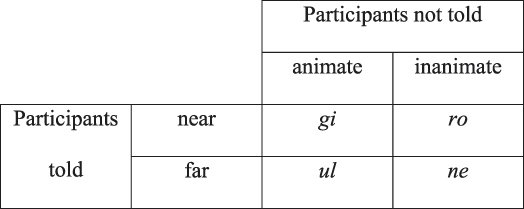
Participants were first introduced to a miniature article system (Figure 1). They were told that the articlesFootnote 1 are used to encode the distance between the speaker and the object (gi and ro for near objects and ul and ne for far objects). Therefore, gi dog may be read as “the near dog,” ro table as “the near table,” ul mouse as “the far mouse,” and ne car as “the far car.” Participants were instructed to spend as much time as they needed to remember the mapping between the articles and the distance system. Participants were, however, not told that the use of these articles also depended on the animacy of the accompanying noun (gi and ul for animate objects and ro and ne for inanimate objects).
The miniature article system used in Experiment 1.

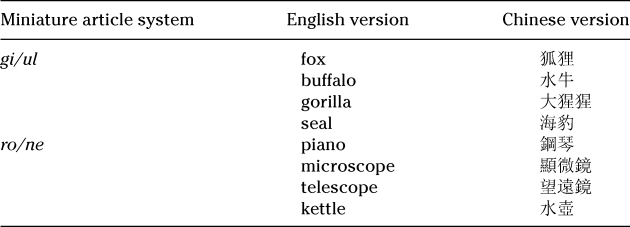
One hundred seventy-six animate and inanimate nouns were used for the experiment; each noun appeared twice (once with each possible article). In the training phase, participants were exposed to visually presented noun phrases (article and noun combinations). Although the same article system was used for all participants, the nouns were presented in each participant group’s L1 (i.e., English or Chinese; see Table 1). For instance, an English subject may have seen gi fox and a Chinese subject may have seen gi狐狸 (“fox”) on the screen. The task for the participants was first to make a decision about the animacy of the object (living or nonliving, using the M or C keys, respectively) described by the noun. The noun phrase then disappeared and was replaced by the prompt “N/F” (i.e., near/far). Participants had to indicate the distance meaning of the article (M key = near, K key = far). Both decisions had to be made as quickly as possible, and the reaction time of the participants was recorded. Response buttons were configured such that the near/far buttons were in a logical arrangement, one above the other, which also helps reduce interference with the other decision, which was in a horizontal arrangement; see Figure 2 for visualization. Reaction time for the animacy decision was measured from the onset of noun phrase; reaction time for the near/far decision was measured from the onset of the N/F prompt, which appeared immediately after the animacy response. Feedback was provided; if participants gave a wrong response, the display did not change. Eight practice trials were provided before the experiment started.
Sample animate and inanimate nouns used in Experiment 1

The configuration of response buttons on the millisecond-accurate keyboard/response box.
In the English version, 204 grammatical trials were presented in the training phase, with equal numbers of trials presented with each article. These trials were divided into four blocks, although no division between blocks was apparent to the participants. The first block consisted of 84 trials, which were made up of 84 nouns used in combination with an equal number of one of the two grammatically possible articles for each noun. Block 2 contained 60 trials, comprising 60 new nouns, again in combination with an equal number of appropriate articles. In Block 3, 28 of these nouns were repeated with a correct article of opposite distance from Block 2 (e.g., if gi pig had occurred in Block 2, then ul pig occurred in Block 3). Within Blocks 1, 2, and 3, the trials were divided into fixed groups of four, with each article occurring once. For each participant the order of trials within groups was randomized, as was the order of groups. This procedure meant that no more than two successive trials would involve the same article. In Block 4, the remaining 32 nouns from Block 2 were repeated. Half of them occurred with an article of different distance from Block 2 but correct animacy (e.g., if ul parrot had occurred in Block 2, then gi parrot occurred in Block 4). These were control trials. The other half of the Block 4 trials occurred with the article of opposite distance and animacy (e.g., if ro tent had occurred in Block 2, then ul tent occurred in Block 4). These were violation trials. Control and violation trials were randomly intermixed, and the nouns were rotated around conditions across subjects, resulting in two presentation lists. Note that, although nouns were repeated from Block 2 to Blocks 3 and 4, no article-noun combination was repeated throughout the experiment.
In the Chinese version, 260 grammatical trials were presented in the training phase, with equal numbers of trials presented with each article. Similar to the English setting, these trials were divided into four blocks; the first two blocks consisted of 84 trials each, which were made up of 84 nouns used in combination with one of the two grammatically possible articles in each block. Block 3 and Block 4 consisted of 80 and 12 grammatical items, respectively. Items within each of these four blocks were presented in a randomized order. In the testing phase, all article and noun combinations were novel to the participants. The testing block consisted of 16 control trials and 16 violation trials rotated between subjects, plus 60 grammatical fillers. Twelve grammatical fillers, using the same nouns as in Block 3 but with a different article combination, were first presented in the testing phase. This was followed by a randomized presentation of the rest of the items (16 control, 16 violation, and 48 filler items), which used the same nouns as in Block 4 but with a different article combination. Nouns matched with control and violation blocks were rotated for half of the participants in each language group to control for potential item effects. No article-noun combination was repeated throughout the experiment. See Table 1 for sample stimuli from the two language versions of the experiment.
Despite the fact that the trials have been labeled as “training,” “control,” or “violation” for the purpose of analysis, from the participants’ perspective, the task did not change throughout the experiment. The prediction is that, if the animacy rule has been learned implicitly, response times to make animacy decisions will be slower for violation than for control trials, even for participants who showed no awareness of the relevance of animacy, or related concepts, to article usage.
At the end of the experiment, participants filled out a questionnaire that probed awareness of the relevance of animacy to article usage, awareness of violations, and at what point in the experiment awareness of the regularity developed. Participants who reported no awareness were then encouraged to guess what factors (apart from distance) determined when the articles were used. The whole experiment took about 45 min to complete.
Results
In this and all subsequent experiments, two levels of unawareness were adopted: a failure to report knowledge of the hidden regularity spontaneously and a failure to suggest any relevance of the target concept (in this case, animacy) to article use when prompted to guess. Both of these groups are referred to as unaware, and their data are presented in the tables that follow. In the presentation of the results, we distinguish the participants who mentioned animacy when prompted, referred to as guessers, from those who did not, the nonguessers. Note that guessers only mentioned the possible relevance of animacy and were usually unable to report all of the mappings onto the articles correctly.
Outlying response times, at cutoff limits of ±2.5 standard deviations from each subject’s mean in the control and violation blocks, respectively, were removed from the analysis. Additionally, data were excluded from any participant whose mean response time for the first (animacy) decision over the two critical conditions was more than 2.5 standard deviations from the group mean. Considerable variability in animacy response times was observed, possibly because participants varied in how they distributed processing time over the two decisions. It was, therefore, decided to exclude inordinately slow participants on the basis that they may have been approaching the task in a different way from the majority.
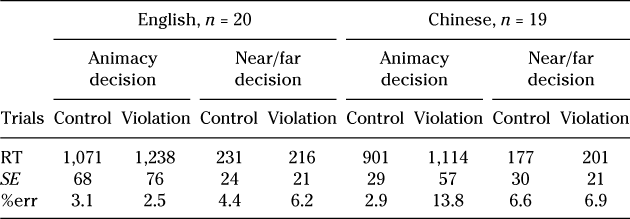
Of the 30 English participants, 20 did not report relevant knowledge of the regularity in response to the first debriefing question (awareness rate = 30%). Of the 27 native Chinese participants, 20 did not report knowledge of the hidden regularity (awareness rate = 26%). One Chinese participant was excluded due to slow overall animacy decision response times. The data for the participants who showed no awareness of the relevance of animacy before being prompted to guess are shown in Table 2.
Reaction time (RT), standard error (SE ), and percentage error (%err) for unaware participants in each condition in Experiment 1 (animacy)
English Results
For the 20 unaware participants, animacy decision response times in the violation condition were 167 ms slower than in the control condition, t(19) = 2.46, p = .024. There was no significant difference between the conditions in the percentage of errors, t(19) = 0.57, p = .577. For the near/far decision, there was no significant difference in reaction time, t(19) = 1.62, p = .121, or errors, t(19) = 1.37, p = .186. When prompted to guess the rule, 11 participants still did not mention the possible relevance of animacy. The mean reaction times in the control and violation conditions for these nonguessers were 1,042 ms and 1,175 ms, respectively, t(10) = 2.13, p = .059.Footnote 2 Error rates were 4.6% and 3.4%, t(10) = 0.69, p = .506. For the nine guessers (i.e., those who mentioned animacy when prompted to guess), mean animacy decision response times in the control and violation conditions were 1,040 ms and 1,195 ms, respectively, but the difference was not significant, t(8) = 1.43, p = .192. Error rates were equal at 1.4%. For the 10 aware participants, animacy decision response times in the control and violation conditions were 1,011 ms and 1,185 ms, respectively, t(9) = 3.36, p = .008. There was also a numerical difference in error rates—1.2% and 6.9%, respectively—but this difference was not significant, t(9) = 1.78, p = .11. There was an effect on the near/far decision in reaction times that approached significance, t(9) = 2.09, p = .066, but no effect in errors, t(9) = 0.29, p = .780.
Chinese Results
For the 19 unaware participants, animacy decision times in the violation condition were 213 ms slower than in the control condition, t(18) = 5.74, p < .001. There were also 10.9% more errors in the violation condition, t(18) = 3.90, p = .001. For the near/far decision, reaction times did not differ across conditions, t(18) = 1.17, p = .26, and there were no significant differences in error rates either, t(18) = 0.17, p = .87. There were 12 nonguessers. Their animacy response times in the violation condition were 174 ms slower than in the control condition, t(11) = 3.41, p = .006, and there was a 12.5% difference in error rates as well, t(11) = 3.94, p = .002. For the near/far decision, there were no effects in reaction times, t(11) = 0.82, p = .43, or error rates, t(11) = 0.00, p = 1.00, between conditions. For the seven guessers, response times in the control and violation conditions were 929 ms and 1,210 ms, t(6) = 10.68, p < .001. For the seven aware participants, animacy decision response times in the control and violation conditions were 1,049 ms and 1,128 ms, respectively, t(6) = 1.14, p = .30. There were 13.38% more errors in the violation condition than in the control condition, and this difference was significant, t(6) = 4.67, p = .003. For the near/far decisions, the difference in reaction times across conditions (M control = 166 ms, SE = 33 ms; M violation = 219 ms, SE = 38 ms) approaches significance, t(6) = 2.25, p = .07, but there were no effects on errors, t(6) = 0.62, p = .56.Footnote 3
Interim Discussion
The results replicated some of our earlier findings (Leung & Williams, Reference Leung and Williams2012) that a mapping between an article and the animacy of a noun object may be implicitly learned by native speakers of English; these results also extended previous findings to cover another language group (Chinese) and new experimental task conditions. The animacy concept imposes constraints on grammatical processes in English (see the discussion in Leung & Williams, Reference Leung and Williams2012) and, to some extent, in Chinese (overlapping with the classifier system).
The robust learning effect obtained in the Chinese group is somewhat surprising given that the Chinese language does not have an article system. However, it may not be necessary for the Chinese speakers to create a new grammatical category for the task; associations might have been formed with other possible lexemes that regularly appear before the noun, including classifiers,Footnote 4 numerals, and adjectives. It is also possible that knowledge of articles has been obtained from the participants’ L2. Out of these possibilities, identification with Chinese classifiers would seem to be the most likely possibility because such classifiers alone mark the semantic characteristics of their accompanying nouns. However, at this point, it remains unclear what grammatical category the Chinese participants may have assigned to the novel forms. Finally, it is also noticeable that the juxtaposition of the alphabetical articles and Chinese characters is orthographically odd, but this did not seem to hinder learning.
EXPERIMENT 2
Objective
This experiment aims to test whether linguistically anomalous, form-based concepts may be implicitly mapped onto articles by native speakers of English and Chinese.
Participants
Twenty-three native speakers of English from the University of Cambridge and 30 native speakers of Chinese from the University of Hong Kong with varied L2 backgrounds participated in the study.
Materials and Procedure
The setup and procedures followed the design in Experiment 1; the only changes were that the animacy system was now replaced with a nonsemantic concept for each participant group and that the first response the participants had to give was a judgment about this concept.
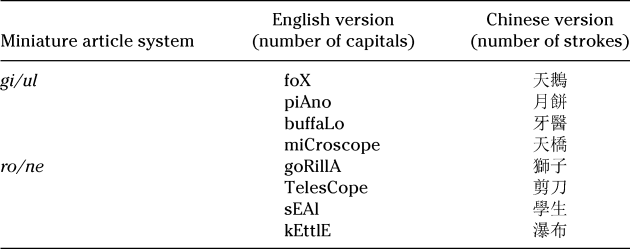
In the English version, the hidden regularity was that the choice of article depended on whether the word had one capital letter or two (i.e., gi cHair vs. ro hOuSe; see Table 3). In the Chinese version, the hidden regularity was whether the first character in a two-character noun had more strokes than the second (e.g., ro 鴨子 “duck”), and vice versa (e.g., gi 小鳥 “bird”), with the difference in strokes between the characters being big enough that no counting would be necessary (see Table 3).
Sample nouns used in Experiment 2
One hundred forty-four distinct nouns were used for the experiment. Eight practice trials were provided before the experiment started. The training phase consisted of 144 trials that were grouped into different units; in each unit, there were four noun phrases containing gi, ro, ul, and ne with a matching noun, respectively. Within each unit, the four noun phrases were presented in a randomized order. The training trials were also grouped into two blocks of 84 (Block 1) and 60 (Block 2) trials; within each block, the units were presented in a randomized order. This was followed by the testing phase, which consisted of 16 control trials, 16 violation trials, and 28 grammatical fillers. Eight of the grammatical fillers were first presented in the testing phase, followed by a randomized presentation of the rest of the items. Items in the testing phase contained the same nouns used in Block 2 but with a different article combination. Exactly the same design was used in the English and Chinese versions.
The article and target concept combination was reversed (i.e., gi cHair vs. ro hOuSe became gi hOuSe vs. ro cHair) for half of the participants in each language group, and the nouns used in the control and violation trials were also rotated for half of the participants, such that there were equal numbers of participants on each variant and rotation. No article-noun combination was repeated throughout the experiment. The whole experiment took about 30 min to complete.
Results
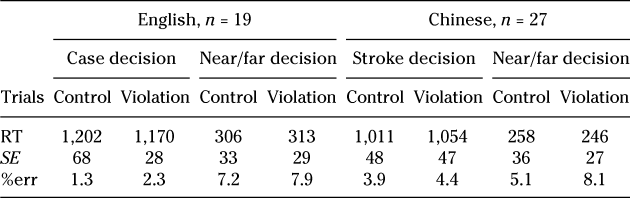
The data were treated in the same way as in Experiment 1. Of the 23 English participants, 20 did not report relevant knowledge of the regularity in response to the first debriefing question (awareness rate = 13%). Of the 29 Chinese participants, 28 did not report relevant knowledge of the regularity (awareness rate = 3%). One slow English unaware participant was excluded, as was one slow unaware Chinese. The data for the remaining unaware participants are shown in Table 4.
Reaction time (RT), standard error (SE ), and percentage error (%err) for unaware participants in each condition in Experiment 2 (case/strokes)
English Results
There were no significant effects for the unaware participants. In particular, case decision response times in the violation condition were actually 32 ms faster than in the control condition (contrary to the effect in Experiment 1), but this difference was not significant, t(18) = 0.75, p = .463. There was no difference in error rates either, t(18) = 1.14, p = .268. For the near/far decision, there was no difference in reaction time, t(18) = 0.49, p = .632, nor in errors, t(18) = 0.31, p = .761. For the 10 nonguessers, the reversed difference in case decision times between the control and violation conditions was even larger (1,326 ms and 1,213 ms), but the difference was not significant, t(9) = 1.78, p = .109. Error rates in the control and violation conditions were 1.2% and 3.1%, respectively, a difference that was in the predicted direction but only approached significance, t(9) = 1.96, p = .08. For the nine guessers, the case decision times in the control and violation conditions were 1,063 ms and 1,122 ms, respectively, t(8) = 1.47, p = .180, and the error rates were equal at 1.4%. For the three aware participants, case decision response times in the control and violation conditions were in the expected direction, being 1,183 ms and 1,419 ms, respectively. There was also a numerical difference in error rates: 2.1% and 8.3%, respectively. Case decision times were 332 and 365 ms in the control and violation conditions; error rates were 8.3% and 4.2%, respectively.
Chinese Results
There were no significant effects. In particular, for the stroke decision, although response times in the violation condition were 43 ms slower than in the control condition, this difference was not significant, t(26) = 1.53, p = 0.14. The error rates were not significantly different either, t(26) = 0.47, p = .65. There were no effects on the near/far decision in reaction times across conditions, t(26) = 0.41, p = .687, although the effect in errors did approach significance, t(26) = 2.0, p = .055. For the 22 nonguessers, reaction times in the control and violation conditions were 950 ms and 1,001 ms, respectively, but the difference was not significant, t(21) = 1.61, p = .12, nor was there a difference in error rates, t(21) = 0.49, p = .63. For the five guessers, the control and violation response times were almost identical at 1,282 ms and 1,290 ms, respectively. For the one aware participant, stroke decision response times in the control and violation conditions averaged 903 ms and 986 ms, respectively, and the near/far decision times averaged 131 ms and 127 ms. This participant made no errors in the control and violation conditions for both decisions.
Interim Discussion
In principle, the effects in Experiment 1 could have been due to learning an association between articles and patterns of key strokes. For example, on all grammatical trials containing ul, the participant would have first pressed the M key (for animate) and then the K key (for far). Participants could have simply learned an association between ul and the response sequence M key, K key, which could have resulted in a slowdown when, on a violation trial, a phrase containing ul required them to press the C key (inanimate) followed by the K key (far). But if this were the case, the effect should have persisted whatever the nature of the decision being made (animacy or number of capital letters/strokes). The fact that the effect disappeared in Experiment 2 shows that this technique is sensitive to learning the semantic correlates of the articles. Although the lack of a learning effect of any sort in both the Chinese and the English groups does not suggest that semantic distinctions can never be implicitly learned, it does show that different kinds of concepts are not equally ready to be mapped onto function words in implicit language learning, even though the form-based concepts have clearly been activated in a forced judgment task. Under the same learning conditions, learning effects were obtained in other conditions involving semantically based concepts.
EXPERIMENT 3
Objective
This experiment aims to test whether a concept derived from the Chinese classifier system, which is not grammaticalized in English, may be implicitly mapped onto articles by native speakers of English and Chinese. If it is only necessary that the article correlate with a semantic property of the noun, then an effect should be obtained in both Chinese and English. In contrast, if grammaticalization in the L1 is also a factor, then an implicit learning effect may only be obtained for the Chinese participants.
Participants
Twenty-seven native speakers of English from the University of Cambridge and 31 native speakers of Chinese from the University of Hong Kong with varied L2 backgrounds participated in the study.
Materials and Procedure
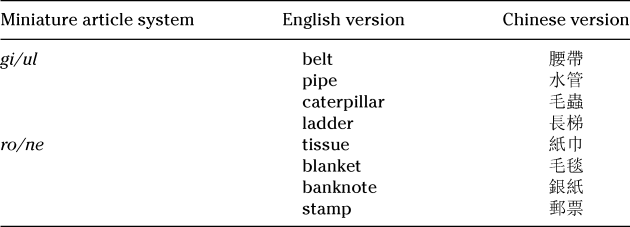
From more than 50 classifier languages, Allan (Reference Allan1977) has identified seven categories of classification: material, shape, consistency, size, location, arrangement, and quanta. The learning target in this experiment is derived from a shape distinction in the Chinese classifier system. The Chinese classifier 張 (zoeng1 in Cantonese) is generally used with thin, flat objects (e.g., sheets of paper, photos, blankets), and the counter 條 (tiu4 in Cantonese) is generally used with long, thin objects (e.g., rivers, straws, ties).Footnote 5 Both classifiers frequently occur in daily usage. It may be argued that the shape distinction is a salient cognitive category among Chinese speakers. In contrast, English is not a classifier language. Even though object shape is something that native English speakers are equally capable of perceiving, they are less familiar with categorizing such perceptions into semantic categories.
The same design as the previous experiments was adopted, except that a long/flat distinction became the hidden regularity governing article use in this experiment. The same article system was used with the two participant groups; nouns were presented in the L1 of the participants. For example, one may find items such as gi shoelace and ro envelope in the English version and their equivalents in the Chinese version (e.g., gi 鞋帶 “shoelace” and ro 信封 “envelope”). See Table 5 for sample items.
Sample long/flat nouns used in Experiment 3
One hundred four distinct nouns were used in the experiment. Participants were presented with eight practice trials and 148 training trials (the first 44 items were repeated once); when an item was repeated, the article that went with it had a different near/far reference. The training items were grouped into different units; in each unit there were four noun phrases: gi, ul, ro, and ne with a matching noun. Within each unit, the four items were presented in a randomized order. The 148 trials were also grouped into two blocks of 88 trials (Block 1) and 60 trials (Block 2); within each block, the units were presented in a randomized order. In the testing phase, there were 32 critical items (16 control trials and 16 violation trials) mixed with 28 grammatical fillers. Eight of the grammatical fillers were presented first during the testing phase, followed by a randomized presentation of the rest of the items. Items in the testing phase consisted of nouns used in Block 2 but were used with a different article combination. As in the previous experiment, four lists were created, so that the assignment of articles to long/flat nouns and to items that appeared in the control and violation trials was rotated and that on each list there were equal numbers of participants from each language group. No article-noun combination was repeated throughout the experiment. The whole experiment took about 30 min to complete.
Results
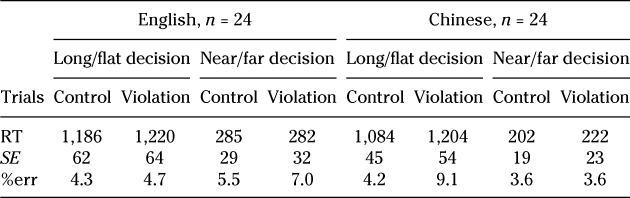
The data were treated in the same way as in Experiment 1. Of the 27 English participants, 24 did not report relevant knowledge of the regularity in response to the first debriefing question (awareness rate = 11%). Of the 31 Chinese participants, 25 did not report relevant knowledge of the regularity (awareness rate = 19%). One slow unaware Chinese participant was excluded. The data for the remaining unaware participants are shown in Table 6.
Reaction time (RT), standard error (SE ), and percentage error (%err) for unaware participants in each condition in Experiment 3 (long/flat)
English Results
For the unaware participants, there were no significant effects. In particular, although the long/flat response times in the violation condition were 34 ms slower than in the control condition, this difference was not significant, t(23) = 0.55, p = .548. The near/far response times did not differ either, t(23) = 0.20, p = .839. There was no difference in error rates for either the long/flat, t(23) = 0.20, p = .846, or the near/far decisions, t(23) = 1.06, p = .299. The long/flat response time difference between the control and violation conditions was not significant for the nine nonguessers (1,123 ms and 1,189 ms), t(8) = 0.68, p = .516, or for the 15 guessers (1,221 ms and 1,241 ms), t(14) = 0.77, p = .454. For the three aware participants, long/flat decision response times in the control and violation conditions were 1,369 ms and 1,651 ms, respectively, and for the near/far decision, they were 171 ms and 308 ms, respectively. There were also fewer long/flat decision errors in the control than in the violation condition, 4.2% and 25.0%, respectively, but not for the near/far decision, 6.2% and 2.1%, respectively.
Chinese Results
For the long/flat responses, the 24 unaware participants were significantly slower in the violation than in the control condition, t(23) = 3.32, p = .003. They also made significantly more errors in the violation than in the control condition, t(23) = 2.44, p = .022. For their near/far decisions, their reaction times and error rates did not differ across conditions; reaction times: t(23) = 1.30, p =.210; error rates: t(23) = 1.30, p = .205. The 15 nonguessers were still significantly slower in the violation condition than in the control condition in their long/flat decisions, t(14) = 2.63, p = .019. However, their error rates across conditions only showed a numerical difference (4.2% and 7.5%), t(14) = 1.74, p = .10. There were no effects across conditions in their near/far decisions—in their reaction times, t(14) = 0.74, p = .47, or error rates, t(14) = 0.68, p = .51. The six aware participants were 99 ms slower in their long/flat response times in the violation condition than the control condition, but the difference was not significant, t(5) = 1.62, p = .17. The difference in their error rates across conditions (5.2% and 17.7%, respectively) approached significance, t(5) = 2.34, p = .07. There were no effects across conditions in their near/far decisions.Footnote 6
Interim Discussion
If it is only necessary that the article correlate with a semantic property of the noun, then Experiment 3 should work in both Chinese and English (note that our relative-size manipulation in Leung and Williams, Reference Leung and Williams2012, was not a semantic property of the nouns as such but was contextually derived). But if it is necessary that the semantic distinction is somehow implicated in grammatical processes in the L1 (as is long/flat in Chinese), then an effect should only be obtained in Chinese, and this was found to be the case. Given the same amount of exposure to a semiartificial article system, our Chinese participants showed evidence of implicit learning, but the English participants did not. The finding provides support that crosslinguistic influence has taken place implicitly. Familiarity with semantic categorization seems to facilitate relevant learning.
OVERALL RESULTS
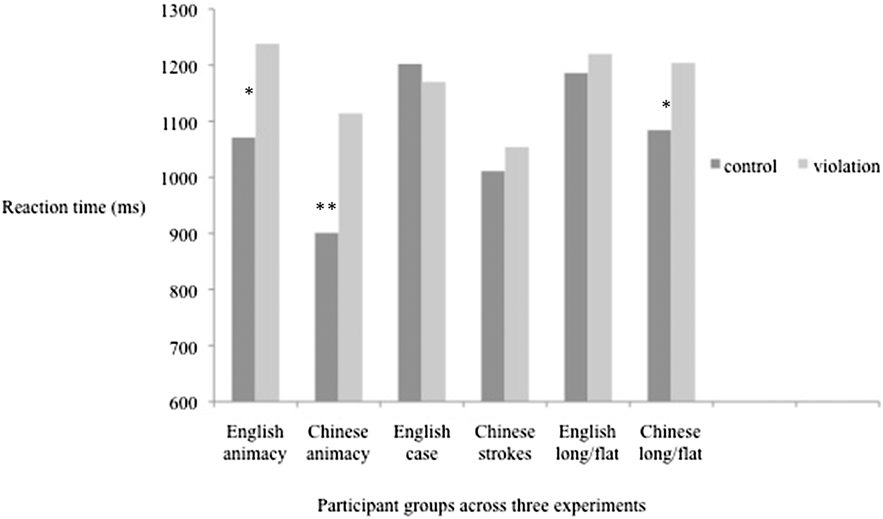
Reaction time data on the first decision (i.e., on animacy or case/stroke or long/flat) for the unaware participants in the three experiments are summarized in Figure 3. Evidence of learning was obtained for an article mapping with animacy, a semantically salient concept that influences grammatical processes, from both Chinese and English speakers (Experiment 1). However, there was little evidence of learning from either group when the learning target was the mapping between articles and form-based concepts that are not usually coded linguistically (Experiment 2). Evidence of learning was only obtained from the Chinese group when the learning target was an article mapping with a concept derived from the Chinese classifier system and absent in semantic categorization in English. It appears that learning is affected by (a) the saliency of conceptual features, (b) familiarity with semantic categorization, and (c) grammaticalization in the L1.
Reaction times for unaware participants in all three experiments. *p < .05. **p < .01.
GENERAL DISCUSSION
One could imagine that, in this paradigm, participants merely learn associations between articles and patterns of keystrokes (e.g., that gi is associated with the key sequence M [living]–M [near], or ne with the key sequence Z [nonliving]–K [far]). The control trials respect these patterns, but the violation trials break them (e.g., gi would occur with the sequence Z [nonliving]–M [near]). However, if this were the case, then the nature of the categorization being performed on the noun should have made no difference whatsoever. The fact that it did suggests that the learning effects were due to learning associations between the articles and the conceptual categories.
The finding that implicit learning effects are sensitive to the nature of the concepts involved points to an interaction between domain-general learning mechanisms and linguistic knowledge and habits. Semantic implicit learning in natural language is constrained by the availability of conceptual distinctions, which vary crosslinguistically. It is entirely possible that nonsemantic concepts and less familiar semantic categories may be learned implicitly over longer periods or learned in combination with explicit strategies. What has been demonstrated in our experiments is that, given the same amount of exposure, implicit learning effects are not uniform across different learning targets.
Implicit learning does not seem to involve unconstrained associative learning. First, implicit learning requires attention (Jiang & Chun, Reference Jiang and Chun2001), at least, in this context, to forms and meanings (but not to their correlations). Second, learning did not take place equally effectively when an equal amount of attention was drawn to different concepts, which appeared with equal statistical regularity. In all cases, the task forced computation of the relevant semantic distinction. What varies across experiments, therefore, is not the activation of the relevant concepts or the degree of attention that they were afforded but rather the extent to which they became associated with the articles. In all cases, both the relevant forms and meanings were “noticed” to the same degree. Some equate statistical learning with implicit learning (e.g., Conway & Christiansen, Reference Conway and Christiansen2006), but purely statistical computations should not be sensitive to the nature of the data (Perruchet & Pacton, Reference Perruchet and Pacton2006). Rather, learning in this domain appears to be constrained by the availability of certain conceptual distinctions, but not others, for association with the novel morphemes.
Of course, the task employed in these experiments is highly artificial and bears little resemblance to activities in everyday language learning. But we would argue that this does not compromise the relevance of the work to understanding L2 acquisition. The artificiality of the task was the result of the requirement to focus the participants’ attention on the relevant information—that is, the relevant distinction in relation to the noun and the identity of the accompanying article. Without ensuring this, failures to obtain learning could not be attributed to knowledge-based constraints. In natural learning situations, failures to learn may be the result of a host of factors (inattention to relevant information being one of the most important), and it was our purpose to remove this variable so as to expose a specific kind of constraint. The fact that evidence for such constraints was found under conditions that would be thought to actively promote the formation of the associations in question only speaks to the power of the block on the implicit learning process for certain kinds of regularity. If such limitations are evident in our paradigm, then it could be argued that they should be just as forceful in more naturalistic learning situations.
An alternative view would be that the specific task requirements somehow prevented the formation of associations that would be possible under more natural learning conditions. However, the fact that at least some associations were learnable points to the relative availability of different distinctions to the implicit learning process. We cannot rule out the possibility that these would be learnable given greater exposure in a more naturalistic task, but we would predict that they should always be less learnable than animacy or distinctions encoded in the L1, such as long/flat for a Chinese speaker.
Regarding our awareness measurement, it should be noted that prompting participants to make guesses in a task that explicitly draws attention to the relevant concept inevitably promotes a higher “awareness” rate. Even when participants could not think of what article use was based on in the first part of the verbal report, some of them made guesses that were relevant to the learning target. This may be helped by the saliency of the concept (but not the connection between the concept and the articles) promoted by the explicit judgment task, which may or may not have facilitated their response time performance (our measurement of learning). Nevertheless, we include the guessing criterion as an additional measurement of awareness because it may encourage the reporting of low-confidence knowledge. The reaction time and error patterns of unaware participants seem quite consistent regardless of whether we included or excluded the participants who made a relevant guess. In fact, our general claim about the effect of different conceptual distinctions on learning can be made even when the aware and unaware participants are combined. Where no effects were obtained on unaware participants, they were still not significant if the aware participants were included. And, of course, where effects were obtained on unaware participants, they were even stronger when the aware were included. This is because, even though all aware groups showed numerical learning effects, even in cases in which there was no learning among the unaware, the awareness rates followed the same pattern as the learning effects in the unaware. However, the fact that the same pattern of effects persists over the unaware participants shows that differences in learning are not due to conscious processes of hypothesis formation that might be guided by assumptions about the relevance of different types of distinctions to language.
We acknowledge that learning often involves both explicit and implicit learning. Our awareness criteria are helpful in helping us identify participants whose knowledge was implicit, but we do not treat the “aware” participants that we removed from our main analysis as a homogenous group (which explains variability in the aware data), and it is likely that implicit learning is involved in some of their learning too. It would be simplistic to assume that the data of unaware and aware participants reflect the contrast between implicit and explicit learning.
We provide evidence that crosslinguistic influences may take place implicitly, and we caution against a presumption that L1 transfer is based on hypothesis testing or learner strategy. It remains unclear to what degree such influences take place implicitly, explicitly, or both implicitly and explicitly, in different L2 acquisition settings, and it seems likely that individual differences exist. A better understanding of the mechanism underlying crosslinguistic influences has obvious theoretical and pedagogical implications. Theoretically, it sheds light on debates in language acquisition on domain specificity and linguistic universals; pedagogically it informs teaching and learning methodologies that aim to promote or discourage different kinds of influences. Our findings seem to be consistent with recent work that looks at the effects of biases on implicit learning, such as language-induced biases on sequence learning in Onnis and Thiessen (Reference Onnis and Thiessen2013); cross-cultural differences in perceptual biases in Kiyokawa, Dienes, Tanaka, Yamada, and Crowe (Reference Kiyokawa, Dienes, Tanaka, Yamada and Crowe2012); the impact of explicit expectations on implicit learning in Pothos (Reference Pothos2005); and musical expertise effects on the implicit learning of musical sequences in Dienes and Longuet-Higgins (Reference Dienes and Longuet-Higgins2004).
But the kind of crosslinguistic influences that we have demonstrated may go beyond simple transfer. In our experiments, English participants were only sensitive to animacy—a fundamental conceptual distinction, even though it is only subtly marked in English and there is no article-noun agreement. Chinese participants were sensitive to all semantic (but not nonsemantic) distinctions, presumably because of the predominance of animacy in conceptual organization (for the anthropocentricity of the concept, see Yamamoto, Reference Yamamoto1999; also see animacy as a “cue” in the competition model, MacWhinney, Reference MacWhinney and Robinson2001) and because of their experience with their classifier system.
Although many assume that L1 acquisition is essentially implicit, it is only recently that research has shown possibilities of adult L2 acquisition taking place implicitly. Apart from further exploring the mechanisms of crosslinguistic influences, which are pertinent to SLA research, future research into implicit language learning may also inform implicit learning research as to its nature and constraints.