The notion of developmental sequences can be considered as an accepted finding in SLA research (Long, Reference Long2007; VanPatten & Williams, Reference VanPatten and Williams2007), the existence of which is supported by robust evidence over the past 40 years (see Abrahamsson, Reference Abrahamsson and Robinson2013; Meisel, Reference Meisel and Robinson2013). A promising explanation for developmental sequences has been put forward by processability theory (PT; Pienemann, Reference Pienemann1998, Reference Pienemann2005), which presents itself as a psycholinguistic theory of second language (L2) development. According to PT, L2 learners go through separate developmental stages that are implicationally ordered.
A recent challenge to this long-established finding, however, comes from the dynamic systems theory (DST) approach to SLA (de Bot, Lowie, & Verspoor, Reference de Bot, Lowie and Verspoor2007). Dynamic systems theory scholars assert that it is time to reconsider whether universal orders really exist, given the high amount of variability present in learner language. In fact, de Bot et al. (2007, p. 8) claim that “the outcome of development over time can therefore not be calculated exactly.” In this article, we aim to demonstrate, however, that in addition to variability, interlanguage (IL) systems do follow a highly regular and predictable pattern. We discuss what kind of measures and evidence two SLA theories (i.e., PT and DST) use to describe and predict learners’ IL systems.
Dynamic systems theory uses measures that are adopted from the complexity, accuracy, and fluency (CAF) research tradition (Bulté & Housen, Reference Bulté, Housen, Housen, Kuiken and Vedder2012; Housen & Kuiken, Reference Housen and Kuiken2009). In this tradition, subordinate clause ratios have made their mark as a measure of linguistic complexity. In fact, subordination ratios appeared as one of the more valid indicators of L2 proficiency as well as L2 development because they were seen as “consistently linear and significantly related to program or school level” (Wolfe-Quintero, Inagaki, & Kim, Reference Wolfe-Quintero, Inagaki and Kim1998, p. 119). Subordination ratios and other CAF measures have been used as dependent as well as independent variables (Housen & Kuiken, Reference Housen and Kuiken2009). As dependent variables, researchers use them to examine the possible effects of, for example, instruction or task type, on the measures of linguistic complexity. As independent variables, the measures of linguistic complexity are used as an index of L2 language proficiency and L2 development over time. It is this last use of linguistic complexity measures in which we are interested here.
Adopting such CAF measures as a way to investigate the dynamism of L2 development, DST studies (e.g., Larsen-Freeman, Reference Larsen-Freeman2006) reveal that different participants follow different routes. Even though the group is making overall progress at the macro level, a look at the micro level shows interindividual and intraindividual variability. In accordance with these kinds of findings, DST scholars deduce that development is not universally stagelike. We argue, however, that CAF measures are misapplied in DST studies, as these measures may not be valid indicators of L2 development (e.g., Pallotti, Reference Pallotti2013). Instead, we adopt a method from PT, which will show that ILs follow strict developmental sequences. Our aim is not to argue for the abandonment of CAF measures but rather to argue for dismissing the way DST interprets these measures (i.e., as evidence that linear developmental sequences do not exist and cannot be predicted).
To this end, we focus on the development of subordinate clauses in L2 German and L2 Swedish. We disentangle learners’ problems with acquiring subordination (in the sense that one clause is being attached to another) from learners’ problems with acquiring the internal structure of subordinate clauses. We explore both (a) how subordinate clauses as such are acquired and (b) how the subordinate clause word order is acquired. We discuss first the development of subordinate clauses, as measured by subordination ratios, and then the emergence of subordinate clause word order. Regarding the emergence of word order, we discuss the acquisition of verb placement in L2 German and Swedish subordinate clauses. A challenge for learners of these languages is that the word order of subordinate clauses is different from the word order in main clauses. Both German and Swedish are verb-second (V2) languages, with the finite verb in the second position in declarative main clauses. The subordinate clauses of these languages, however, do not exhibit V2 word order. Subordinate clauses in German differ from main clauses in that the finite verb is in the final position instead. Subordinate clauses in Swedish differ from main clauses in their placement of the sentence adverbial (e.g., negation marker): In main clauses, the adverbial is placed after the finite verb; in subordinate clauses, the adverbial is placed before the finite verb. After a description of the word order rules in main clauses and subordinate clauses and a brief description of earlier studies on the acquisition of subordination in L2 German and L2 Swedish, we present our empirical results.
BACKGROUND
Dynamic Systems Theory and Subordination Ratios
The DST approach is fairly recent in SLA research and can be traced back to Larsen-Freeman (Reference Larsen-Freeman1997). In recent years quite a number of publications have discussed the characteristics of a DST approach to SLA (to name but a few: de Bot, Lowie, Thorne, & Verspoor, Reference de Bot, Lowie, Thorne, Verspoor, Mayo, Gutierrez-Mangado and Adrián2013; de Bot et al., Reference de Bot, Lowie and Verspoor2007; Larsen-Freeman & Cameron, Reference Larsen-Freeman and Cameron2008; Verspoor, de Bot, & Lowie, Reference Verspoor, de Bot and Lowie2011). Due to limitations of space, we present only the core principle here.
The DST approach to SLA views language development as a complex process of dynamic construction in which all variables are interconnected: “Changes in one variable will have an impact on all other variables that are part of the system” (de Bot et al., Reference de Bot, Lowie and Verspoor2007, p. 8). Due to this interaction of variables over time, development becomes unpredictable. In other words, DST argues against a linear developmental path for each individual. Instead, “learners do not progress through stages of development in a consistent manner. There is a great deal of variation at one time in learners’ performances and clear instability over time” (Larsen-Freeman, Reference Larsen-Freeman2006, p. 593).
To investigate how different variables interact over time, DST studies use CAF measures. In some such DST studies, it was found that the different variables (or subsystems) grow and decline at different rates. For example, the subsystems develop in a competitive interaction (e.g., when lexical complexity increases, syntactic complexity decreases; Verspoor, Lowie, & Dijk, Reference Verspoor, Lowie and Dijk2008), in a supportive interaction (e.g., when word complexity increases, noun phrase or sentence complexity also increases; Spoelman & Verspoor, Reference Spoelman and Verspoor2010), or in a precursor interaction (e.g., first the lexicon becomes more complex and accurate and then syntax becomes more complex and accurate; Caspi, Reference Caspi2010). Additionally, the variables reveal nonlinear development with a lot of variation over time (Larsen-Freeman, Reference Larsen-Freeman2006; Verspoor, Schmid, & Xu, Reference Verspoor, Schmid and Xu2012). For example, in a longitudinal study over 6 months, Larsen-Freeman (Reference Larsen-Freeman2006) examined the CAF of five Chinese learners of English. Although the group mean showed a linear progression, the patterns of the interindividual and the intraindividual data exhibited very clear differences, as the learners progressed and regressed in widely varying ways.
Deducing from these findings that SLA research should focus on variation goes too far, according to Pallotti (Reference Pallotti2009), who argued, in what he calls “the necessary variation fallacy” (p. 590), that SLA research should address not only variations and differences but also constants and similarities. We more than agree with this statement, but, at the same time, we argue that CAF measures may not give us the right tools to do this. Pallotti (Reference Pallotti2013) acknowledges this when he proposes a simple view of linguistic complexity (which is part of the CAF triad). He states that unnecessary assumptions (e.g., that complexity necessarily grows over time and overlaps with other constructs such as L2 development) should be avoided. We believe that his warning applies not only to the construct of linguistic complexity but also to the CAF measures in general. Consequently, it seems unfounded to us that DST studies use CAF measures to demonstrate that L2 development is unpredictable and does not take place in stages. To show this, we do not discuss all possible CAF measures but focus on linguistic complexity only.
The concept of linguistic complexity is often used to explain why some phenomena are acquired later than others in SLA (see, e.g., Housen & Kuiken, Reference Housen and Kuiken2009). For example, subordination is generally described as a complex feature, and its use (measured by, e.g., subordination ratios) thus appears late in L2 development. As one of the reviewers rightly pointed out, this kind of reasoning is circular, because linguistic complexity and developmental timing are conflated: Explaining the late acquisition of subordination by its complexity is just as fallacious as explaining its complexity by its late acquisition. One cannot simply appeal to complexity to explain the late acquisition of subordination and vice versa. From this circularity, it appears that the use of subordination ratios in particular, and CAF measures in general, may not be valid to show L2 development in terms of developmental timing.
Nevertheless, subordination ratios are widely used in the research literature. In their review of 16 studies in recent task-based language learning research, for example, Norris and Ortega (Reference Norris and Ortega2009) found that subordination ratios were used in all 16 studies without fail. For several reasons, they added, this “exclusive reliance on subordination is worrisome” (p. 566; see also Bulté & Housen, Reference Bulté, Housen, Housen, Kuiken and Vedder2012). They noted, for example, that subordination ratios measure only one dimension of linguistic complexity, and, if subordination ratios are used as absolute indices for L2 development or L2 proficiency, they are in fact misapplied and liable to misinterpretation.
Previous research has shown that ratios such as subordination ratios exhibit large fluctuations owing to, for example, the oral versus the written language mode (Beaman, Reference Beaman and Tannen1984), the degree of syntactic integration (Gayraud & Martinie, Reference Gayraud and Martinie2008), or task complexity (Robinson, Reference Robinson2011; Skehan & Foster, Reference Skehan, Foster, Van den Branden, Bygate and Norris2009), in both native speakers and L2 learners. In this sense, we believe that the construct of linguistic complexity as measured by, for instance, subordination ratios is valid as a dependent variable but not as an independent variable indicating L2 development (which is to be understood here not in a general sense but in terms of developmental timing and sequences). Instead, we claim that the emergence of the subordinate clause procedure—Stage 5 in PT—is, as a measure, better suited to gauge L2 developmental sequences.
Processability Theory and the Emergence of Subordinate Clause Word Order
Unlike the DST framework, in PT, variation and similarities are not considered as mutually exclusive entities. In fact, variational and developmental features are described within a two-dimensional, and consequently nonlinear, space (this idea can be traced back to Meisel, Clahsen, & Pienemann, Reference Meisel, Clahsen and Pienemann1981). This two-dimensional framework allows for steady development on the one hand and IL variation on the other. With respect to the acquisition of subordinate clauses, we hypothesize (in line with PT) that, despite the variation, the word order in the subordinate clause develops in a clear linear sequence (see the notion of hypothesis space in the Data Analysis section; Pienemann, Reference Pienemann1998, p. 231 and the following pages).
In PT, it is, in other words, not the use of subordinate clauses as such that matters but rather the internal properties of the subordinate clause (Pienemann, Reference Pienemann1998, p. 107). Processability theory research has established that the subordinate clause word order emerges as the final stage in morphosyntactic development.Footnote 1 Second language learners pass through a number of stages, which follow the different points in feature unification. Feature unification, adopted from lexical-functional grammar (LFG), is one of the fundamental principles in PT and refers to the compatibility of annotated features. For the unification of grammatical information to be possible, the information must be stored in a memory store (i.e., a syntactic buffer). The need to store grammatical information in a syntactic buffer comes with a cognitive cost, which rises proportionally with the duration for which it needs to be kept active in the memory store. Relying on Levelt’s (Reference Levelt1989) model of language production, PT describes the cumulative nature of unification points in a universal hierarchy of processability (see Pienemann, Reference Pienemann1998, Reference Pienemann2005):
1. No procedure (lemma access, chunks)
2. Category procedure
3. Phrasal procedure
4. Sentence procedure
5. Subordinate clause procedure (if applicable)
The first step for the L2 learner is to activate a lemma, including its syntactic category, on which a phrase can be built. Next, the phrase has to be assigned a grammatical function, which calls up a sentence procedure and eventually, if applicable, a subordinate clause procedure. The subordinate clause procedure is called for in languages in which the learner or speaker has to differentiate between the clausal structure in main and subordinate clauses. An example is the different positions of the verb in German, pre- or postverbal negation in Swedish, and the occurrence of inversion in direct, but not in indirect, questions in English.
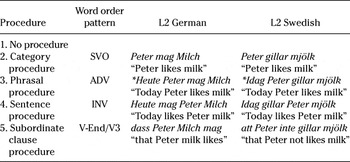
In PT, research on syntactic development has mainly focused on the development of word order regularities of various languages, including L2 German and L2 Swedish (for German: Boss, Reference Boss1996; Clahsen, Reference Clahsen and Andersen1984; Clahsen, Meisel, & Pienemann, Reference Clahsen, Meisel and Pienemann1983; Ellis, Reference Ellis1989; Jansen, Reference Jansen2008; Meerholz-Härle & Tschirner, Reference Meerholz-Härle, Tschirner, Aguado and Riemer2001; Meisel et al., Reference Meisel, Clahsen and Pienemann1981; Pienemann, Reference Pienemann1984, Reference Pienemann1989; for Swedish: Glahn et al., Reference Glahn, Håkansson, Hammarberg, Holmen, Hvenekilde and Lund2001; Håkansson, Reference Håkansson2001; Håkansson & Norrby, Reference Håkansson, Norrby and Mansouri2007, Reference Håkansson and Norrby2010; Philipsson, Reference Philipsson2007; Pienemann & Håkansson, Reference Pienemann and Håkansson1999; Rahkonen & Håkansson, Reference Rahkonen, Håkansson and Kessler2008; Schönström, Reference Schönström2010). Different empirical studies have reported developmental sequences that are generally consistent with the processability hierarchy (see Table 1).
Developmental sequence of word order in L2 German and L2 Swedish

The first stages are similar in German and Swedish, but the stage regarding subordinate clauses differs to a certain extent, at least on the surface. Following LFG, however, the underlying rule system of the learner can be described in a similar way. To differentiate between a main clause and a subordinate clause, the learner annotates the complementizer with the additional feature ROOT = −. Relying on the lexical clue (hence LFG), the learner knows when a sentence is a main clause and when it is a subordinate clause and uses different word orders accordingly.
In the present article, we do not aim to discuss the interstage development; instead, we focus on the intrastage development at the final stage in the processability hierarchy (i.e., at the subordinate clause procedure). Particularly, we explore how word order rules develop in subordinate clauses.
Word Order Typology in German and Swedish
In this section, we provide a brief description of the basic word order pattern in the main and subordinate clauses in German and Swedish.
Main Clauses
In the main clause, both languages make use of a basic subject-verb-object (SVO) word order, as illustrated by the c-structure rule and the sample sentences in (1), which show Swedish followed by German.Footnote 2
(1) S -> NPsubj VFIN (NPobj1) (NPobj2)
Han har en hund
Er hat einen Hund
“He has a dog.”
In the case of complex verb phrases (VPs), Swedish VPs remain intact, whereas the verbs in German appear in a split position, as shown in (2a) and (2b), respectively.
(2) a. S -> NPsubj (V)FIN (V)INF (NPobj1) (NPobj2)
Han har köpt en hund
“He has bought a dog.”
b. S -> NPsubj (V)FIN (NPobj1) (NPobj2) (V)INF
Er hat einen Hund gekauft
“He has bought a dog.”
Subordinate Clauses
The subordinate clause word order is different from the main clause in both languages. Recall that the ROOT feature refers to the lexical clue that distinguishes between a main and a subordinate clause.
In Swedish, differences arise in the context of sentence adverbials (e.g., negation particles). In main clauses, these adverbials occur after the finite verb, which ensures that the finite verb will always be in the V2 position (e.g., han har inte köpt en hund “He has not bought a dog”). In subordinate clauses, these adverbials occur before the finite verb, which results in an alternation between the V2 in main clauses and the verb-third (V3) in subordinate clauses, as shown in the example in (3).
(3) S -> COMPROOT =− NPsubj (NEG) (V)FIN (V)INF (NPobj1) (NPobj2)
att han inte har köpt en hund
“that he not has bought a dog”
In German, main clause and subordinate clause word order are always different; it is obligatory to put the finite verb in the final position of the subclause, as shown in (4).
(4) S -> COMPROOT=− NPsubj (NPobj1) (NPobj2) (NEG) (V)INF (V)FIN
dass er einen Hund gekauft hat
“that he a dog bought has”
dass er den Hund nicht gekauft hat
“that he the dog not bought has”
As many familiar with the acquisition of subordinate word order in German and Swedish are aware, these departures from main clause word order are more challenging learning issues than the use of subordinate clauses per se. This kind of learning challenge does not exist in English, in which the word order in the subordinate clause does not differ from that in the main clause, as illustrated in (5).Footnote 3
(5) S -> COMPROOT =− NPsubj (V)FIN (V)INF (NPobj1) (NPobj2)
that he has bought a dog
Earlier Studies on the Acquisition of Subordination in L2 German and L2 Swedish
The results from L2 research have shown that the placement of the finite verb in subordinate clauses poses great difficulties to L2 German learners. Ever since the Zweitspracherwerb italienischer und spanischer Arbeiter (“second language acquisition of Italian and Spanish workers”) project, which investigated the acquisition of German by migrant workers, established that the V-final rule is either acquired very late or even not acquired at all (Clahsen et al., Reference Clahsen, Meisel and Pienemann1983; Meisel et al., Reference Meisel, Clahsen and Pienemann1981; Pienemann, Reference Pienemann and Felix1980), several subsequent studies have replicated this finding (Boss, Reference Boss1996; Clahsen, Reference Clahsen and Andersen1984; Ellis, Reference Ellis1989; Haberzettl, Reference Haberzettl2005; Jansen, Reference Jansen2008; Meerholz-Härle & Tschirner, Reference Meerholz-Härle, Tschirner, Aguado and Riemer2001; Pienemann, Reference Pienemann1998). Although these studies differed in many respects (e.g., different first languages [L1s], adolescents vs. adults, or naturalistic vs. instructed learning environments), they showed that the basic sequence with the acquisition of the V-final rule as the last stage is always the same (see Table 1).
It should be noted that this sequence was established in studies using the emergence criterion, which is defined by Meisel et al. (1981, p. 112) as counting “the numbers of actual occurrences relative to the total number of possible occurrences.” Additionally, this sequence is to be interpreted in an implicational way, which means that the acquisition of the word order rule of a lower stage is a prerequisite for the acquisition of the word order rule of a higher stage.
Findings of studies on L2 Swedish have demonstrated a developmental order similar to that of German presented previously: SVO < Adverb fronting (ADV) < Inversion (INV) < Subclause (see Table 1). This word order development has consistently been reported across a number of empirical studies (e.g., Håkansson & Nettelbladt, Reference Håkansson and Nettelbladt1993; Håkansson & Norrby, Reference Håkansson and Norrby2010; Hammarberg & Viberg, Reference Hammarberg and Viberg1977; Hyltenstam, Reference Hyltenstam1977); thus, although the Swedish subordinate clause word order does not have a V-End like the German subordinate clause word order, the Swedish subordinate clause word order structure is likewise the last to be acquired.
Hyltenstam (Reference Hyltenstam1977) examined the variation in the placement of negation relative to the verb in learners of Swedish as a L2 and found that the variation was not random but highly regular. The placement of negation varied both according to clause type (main and subordinate clause) and according to verb type (main verbs and auxiliary or modal verbs). By using implicational scaling, he was able to detect a path of development: For main clauses, the negation was first placed in the target position in the context of an auxiliary verb and then in the context of a main verb. In subordinate clauses, the order was reversed, as the target placement of negation emerged first in the context of a main verb and thereafter in the context of an auxiliary verb. Hyltenstam (Reference Hyltenstam1977) suggested that this gradual change of negative placement is a case of the unlearning phenomenon proposed by Jakobson (Reference Jakobson1941) and that negative placement is “another case where the last acquired is the first to be given up” (Hyltenstam, Reference Hyltenstam1977, p. 409).
A lot of research on L2 morphosyntax has focused on discovering L2 developmental stages, in which the acquisition of one stage is put in relation to the acquisition of another stage. As the results of Hyltenstam (Reference Hyltenstam1977) suggest, however, different lexical contexts are also found to influence the development of morphosyntax. These can be seen as intrastage developments.
THE PRESENT STUDY: GERMAN AND SWEDISH AS L2S
L2 German and L2 Swedish Corpora
The data on L2 German derives from a longitudinal study that collected spontaneous language production data from nine Dutch-speaking learners over a period of 2 years (Baten, Reference Baten2013). At the time of the recordings, the nine learners were attending the same secondary school, located in an urban region of Flanders. Apart from an introductory course on German in the fourth grade of secondary school (held 1 hr/week), the pupils had no further formal instruction in German. During the 2 years of data collection, the pupils (then aged 17–18 years) received 3 hr/week of formal instruction. German is their third foreign language. Flemish secondary school pupils start with formal instruction in French and English prior to learning German. None of the pupils had experienced significant exposure to natural German input: German was not spoken at home, and none of the pupils had lived in a German-speaking country for a considerable length of time. The only natural exposure to German occurred during occasional tourist visits to German-speaking countries.
The learners were interviewed six times, approximately once every 3 months. Henceforth, these interviews are described as t1–t6. In each interview, the learners were asked to describe and retell a set of cartoons. The cartoons were selected from the Bildgeschichten Vater und Sohn (the “Father and Son comic strips”; Ohser, Reference Ohser2000). The advantage of these comic strips is that each picture can be described separately, and they give participants the opportunity to address the trivial yet amusing points at the end. These comic strips appear well suited to collecting L2 speech samples. The participants spoke freely and focused on the content of the cartoon. The average length of a conversation was approximately 20 min. After the final data were collected, the participants indicated that they enjoyed talking about the Father and Son cartoons. Therefore, there is little doubt about the participants’ spontaneity and that their main focus was conveying the content of the cartoons.
The data on L2 Swedish comes from the longitudinal project Swedish Inside and Outside Sweden (Håkansson & Norrby, Reference Håkansson and Norrby2010). The aim of this project was to compare the L2 acquisition of Swedish in Sweden (Malmö) and the foreign language acquisition of Swedish in Australia (Melbourne).
For the present analysis, data from 17 learners are used: eight learners from Melbourne (with English as their L1) and nine learners from Malmö (with a variety of L1s and English as a L2).Footnote 4 The learners were university students studying Swedish as a second or foreign language at a beginner’s level. Written data were collected three times over 1 year (t1–t3). For each data-collection time, the learner wrote one essay and one translation. The translation was used as a method to elicit inverted main clauses and subordinate clauses that demanded subordinate clause word order (i.e., with sentential adverbs).
In addition to the written data, oral data were collected once during the final data collection. The oral data consisted of an interview and a communicative task. After the interview, a specific communicative task was used to obtain a high number of examples of subordinate clauses with sentence adverbials (e.g., Glahn et al., Reference Glahn, Håkansson, Hammarberg, Holmen, Hvenekilde and Lund2001). The task is designed as a game with 12 illustrated cards that portray the performance, or nonperformance, of various activities. There are also larger playing boards, each containing six pictures that match those on the separate cards. The players (e.g., the learner and interviewer) take cards in alternative turns, describe which action is performed on the card (e.g., Jag fick kortet med mannen som inte sjunger “I got the card with the man who does not sing”), and place the card on top of the matching illustration on the board. The person who fills his or her board(s) first wins the game. To introduce the game and the vocabulary used, the learner first described each activity on the cards by using main clauses. This introduction was important to establish that the learners knew the placement of negation in main clauses (after the finite verb), which is different from its placement in subordinate clauses (in front of the finite verb). The participants then drew a card and were asked to describe its content. By this method, it was possible to elicit 12 examples of negated subordinate clauses, six clauses with main verbs and six clauses with auxiliary or modal verbs. The use of a game to elicit linguistic structures has the advantage of diverting the subjects’ attention from the formal aspects of language by engaging them in a communicative situation; at the same time, the informality of the situation makes it possible for the learners to use main clauses instead of subordinate clauses.
Data Analysis
In the following sections, we first present the ratio of subordinate clauses for both L2 German and L2 Swedish as they are measured in CAF research (i.e., dependent clause/total clauses). Then, we discuss the acquisition of the internal word order structure for L2 German and L2 Swedish separately. Here, we apply the emergence criterion, which is the acquisition criterion used in PT research. Emergence can be defined as the “point in time corresponding to the first systematic and productive use of a structure” (Pallotti, Reference Pallotti2007, p. 366). By systematic and productive use, we mean that memorized chunks must be excluded from analysis. In a way, “first” is somewhat contradictory because a sufficient quantity of contexts is required. After all, “first” does not involve an isolated case but should be embedded in a number of different contexts. In the research field, the minimal number of contexts considered necessary to claim that a structure has emerged varies among researchers, ranging from one (Glahn et al., Reference Glahn, Håkansson, Hammarberg, Holmen, Hvenekilde and Lund2001) to three (Dulay & Burt, Reference Dulay and Burt1974; Zhang, Reference Zhang and Pienemann2005), four (Jansen, Reference Jansen2008; Meisel et al., Reference Meisel, Clahsen and Pienemann1981; Pienemann, Reference Pienemann1998; Zhang, Reference Zhang2004), and even five (Andersen, Reference Andersen1978; Pienemann, Reference Pienemann1998).
In the current study, we adopt the rationale that learners have to use different verb types (e.g., main verbs and auxiliary or modal verbs) in subordinate clauses for us to be able to state that the subordinate clause word order rule has actually been acquired. In other words, we add verb type variation (i.e., main verbs and auxiliaries or modals) to the emergence criterion. In the PT paradigm, it is common to consider lexical variation in regard to determining the acquisition of morphological rules (e.g., the acquisition of subject-verb agreement), on both a lexical level (e.g., he walks, he sings) and a word type level (e.g., agreement with copulas vs. lexical verbs; Pienemann, Reference Pienemann1998, p. 124 and the following pages). In the acquisition of syntactic structures, one productive example is considered sufficient. To distinguish between the productive use of a structure and its use as an unanalyzed chunk, the following line of reasoning was adopted in the present study: A specific structure is recognizable as an unanalyzed chunk when the identical structure occurs several times invariantly and when these structures are the only examples. In practice, this means that within the particular verb type (either main verb or auxiliary or modal), there must be more than one example of the structure for it to be regarded as having emerged in the learner’s grammar.
The emergence criterion describes the beginning of the acquisition process and allows us to reveal stages. The criterion is in line with the speech processing point of view of PT, as it “can be understood as the point in time at which certain skills have, in principle, been attained or at which certain operations can, in principle, be carried out” (Pienemann, Reference Pienemann1998, p. 138). It is assumed that if certain skills are not available, then the linguistic structures reflecting those skills will not emerge in the learner’s IL, not even to a minimal extent. Only when the linguistic skills are available will the corresponding linguistic structures appear—evidently, to a minimal extent first. In addition, the processing perspective of PT also implies that it can be assumed that once a structure has emerged, it will remain a constant part of the IL system at later levels of development (e.g., the continuity hypothesis; Pienemann, Reference Pienemann1998, p. 147).
For the German data, we examine all subordinate clauses; for the Swedish data, we only analyze subordinate clauses containing an adverbial because the opposition between main clauses and subordinate clauses is determined by the placement of the sentential adverbial. In this study, we do not make a distinction between different complementizers and, as such, between different types of subordinate clauses. Learners may perhaps use the subordinate clause word order rule with certain complementizers but not with others (e.g., Pienemann, Reference Pienemann1998, p. 107). Because our study focuses on syntactic development, we do not further examine lexical aspects, neither in relation to the emergence criterion nor in relation to the ratio measure.
Before we move on to the results, it is necessary to address our theoretical or methodological stance toward the different learning contexts studied and the different data elicitation tasks used in our study. We adopt the logic of the so-called hypothesis space, which is an essential aspect of PT (Pienemann, Reference Pienemann1998, p. 231 and the following pages), and which refers to the range of structural hypotheses that are available at any one stage of the processability hierarchy. The notion of hypothesis space can be traced back to the multidimensional model in SLA (Meisel et al., Reference Meisel, Clahsen and Pienemann1981), which likewise differentiated between a vertical and a horizontal dimension in the acquisition process (i.e., between [steady] development and variation, respectively). This differentiation implies that different tasks and different learning contexts will affect the horizontal level (evident through, e.g., fluctuations in correctness levels), but not the vertical level. It is important to note here that the variation at the horizontal dimension does not exist in a theoretical vacuum; instead, the processing constraints (at the vertical level) define a priori the range of variation that is structurally possible.
RESULTS
L2 German and L2 Swedish Subordination Ratios
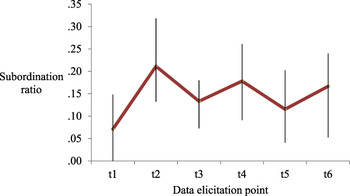
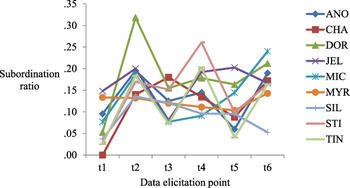
All L2 German learners used subordinate clauses from the start of data collection (except for two learners, CHA and TIN). The subordination ratios differed greatly according to the data point, however (see Figure 1). At t1, the lowest ratio is 0, and the highest is .14. At the later data points, the range is .13–.31 at t2, .07–.18 at t3, .09–.26 at t4, .04–.20 at t5, and .05–.24 at t6. These ranges clearly indicate that the nine participants in this study differ greatly in their use of subordinate clauses. Indeed, over the six interviews, the participants did not evolve linearly, as their individual ratios follow a pattern of increases and decreases (see Figure 2). Taking into account only the data points at the extreme (t1 and t6), however, an overall increase can be observed for all participants.
The subordination ratio of L2 German learners (group).

The individual subordination ratios of the L2 German learners.

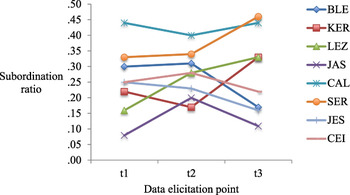
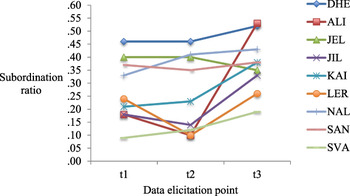
The same picture emerges from the data of L2 Swedish learners. All L2 Swedish learners used subordinate clauses at the first data point. The subordination ratio varies between .08 and .46 at t1, between .10 and .46 at t2, and between .11 and .53 at t3. Analogous to the L2 German learners, the individual L2 Swedish learners did not evolve linearly but followed a fluctuating pattern, either showing a decrease toward t2 and an increase toward t3 or, vice versa, showing an increase toward t2 and a decrease toward t3. Figure 3 displays the development for the L2 Swedish learners in Melbourne, and Figure 4, the development for the learners in Malmö.
The individual subordination ratios of the L2 Swedish learners (Melbourne).

The individual subordination ratios of the L2 Swedish learners (Malmö).

As can be seen in these figures, the individual data does not give a linear growth of subordination as the learners’ proficiency increases. The developmental picture of subordination ratios in L2 German and L2 Swedish is reminiscent of what Larsen-Freeman (Reference Larsen-Freeman2006) found in her longitudinal study of five Chinese learners. She too established that the group data suggested an ascending trend, but when the individual data were examined, the lines between the different data points sometimes went up and sometimes went down.
Informed by PT, we believe that we do not have to count the mere existence of subordinate clauses, as it is not subordination in itself that is difficult. Rather, the internal structure should be examined. In fact, when the internal structure remains the same, subordination is not complex at all. In most subordinate clauses in English, for example, there is no difference in the word order of main clauses relative to subordinate clauses, as in the example in (6).
(6) Main clause: he will bring the letter to the princess
Subordinate clause: . . . , because he will bring the letter to the princess
when
if
. . .
Thus, the learning problem is only of a lexical nature. In L2 English, learners merely need to acquire (the meaning of) complementizers, to which they can add a new clause.
This strategy is unsuitable for L2 German because it yields the wrong word order. Our results show that learners avail themselves of this strategy when first learning German (examples [7] and [8]). For Swedish, subordination involves a specific word order when the clause contains adverbials. This word order is not present in the first uses of subordination, as is illustrated in examples (9) and (10). The problems with subordinate clause word order indicate that learners have not yet annotated the (newly) learned lexical item(s) with the necessary grammatical information when they start using subordinate clauses.
(7) MIC: *du siehst dass er brengt den letter nach dem prinzess
“you see that he takes the letter to the princess”
(target: . . . dass er der Prinzessin den Brief bringt)
(8) MIC: *er macht eine loch . . . in die wand weil sein sohn hat ein spiegel
“he makes a hole . . . in the wall because his son has a mirror”
(target: . . . weil sein Sohn einen Spiegel hat)
(9) SER: *de turisterna som åker inte på landet åker till en stor stad
“the tourists that go not on the countryside go to a big city”
(target: . . . som inte åker på landet . . .)
(10) SER: *om man ville inte att andra kunde komma upp . . .
“if you wanted not that others could come up . . .”
(target: om man inte ville att . . .)
These examples show that in the case of L2 German and L2 Swedish, there is a mismatch between the use of subordination and the use of the subordinate clause processing procedures. This suggests that it is necessary to also look at the internal structure of the subordinate clauses used.
Subordinate Clause Word Order in L2 German
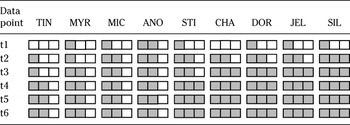
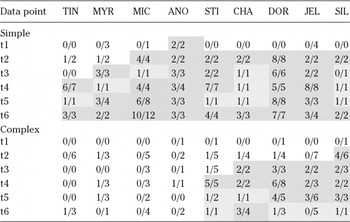
In Table 2, we summarize the development of verb placement in the subordinate clause. Inspired by Hyltenstam’s (Reference Hyltenstam1977) work on Swedish, we differentiate main verbs and auxiliaries or modal verbs. As a result, we distinguish three stages: (a) the finite verb does (V-End) or does not (No V-End) take the final position, either (b) with single main verbs only or (c) with both single main verbs and auxiliaries or modals.Footnote 5 Because of the three-dimensional nature of the data (i.e., participants, data points, and stages of verb placement), creating an easily readable table was a challenge. We opted for the graphic method (the actual numbers can be found in the Appendix). Figure 5 illustrates the graphics used in Table 2; the squares represent the three previously mentioned stages. In Table 2, if a square is colored grey, the corresponding word order rule has been acquired.Q3:Clarifications correct? Note that the squares in Fig. 5 are not shaded. It should be noted that when both the second and third squares is colored, the first square is evidently overruled. When none of the squares are colored, the learner did not use subordinate clauses.
The development of verb placement in L2 German subordinate clauses by individual participants

The legend for Table 2.

The German data contain 336 subordinate clauses. Dispersed over data points and number of participants, the mean number of subordinate clauses was six per interview. However, the total number of analyzed subordinate clauses varied across learners, ranging from 22 to 63. We assumed that this range in variation did not affect the results because we adopted the emergence criterion to determine acquisition (Pallotti, Reference Pallotti2007). This criterion stipulates that only the first systematic and productive use of a linguistic rule is required to determine whether that particular rule is acquired. In this respect, an overall mean of six subordinate clauses per interview session is considered sufficient. Furthermore, this criterion is compatible with Pallotti’s (Reference Pallotti2009) “necessary variation fallacy” (p. 590) because it uncovers constants in the variation. The exact number of applications and nonapplications of the V-End rule, in both simple and complex contexts, can be found in the Appendix.
Table 2 shows that most of the learners produced subordinate clauses from the start of data collection. However, they did not use the subordinate clause word order, except for one learner (ANO), who appeared to be able to put the single main verb in the final position, as in (11). She did not apply the V-End rule, however, when an auxiliary (here, a modal verb) was involved, as in (12). In (11), [///] indicates a long pause.
(11) ANO: während er euh eine be [///] wacht [= Dutch] [///] ein verbeugung macht
“while he uh a be [///] wait [///] a bow makes”
(12) ANO: *eine passant euh sagt dat [= dass] sie mussen halten
“a passer-by uh says that they must stop”
(target: . . . dass sie aufhören sollten)
From t2 onward, all learners used subordinate clauses. A closer look at the table shows that only one learner was able to place the finite verb in the final position, with both single main verbs as in (13) and auxiliaries as in (14).
(13) SIL: . . . dass es nicht weh tut
“. . . that it not hurt does”
(14) SIL: der lehrer euh sagt dass der hausaufsatz nicht gut gemacht ist
“the teacher uh says that the school essay not well done is”
At this time point (t2), six learners (ANO, CHA, DOR, MIC, JEL, and STI) applied the V-End rule for single main verbs, as in (15), but not when auxiliaries were involved, as in (16).
(15) MIC: er geht naar [:nach] sein zimmer und er sieht dass euh sein vader den buch liest
“he goes to his room and he sees that uh his dad the book reads”
(16) MIC: *und er glaubt nicht dass euh der junge der hausaufsatz hat gemacht
“and he believes not that uh the boy the school essay has made”
(target: . . . dass der Junge den Hausaufsatz gemacht hat)
The data even show that ANO and MIC were never able to produce auxiliaries in the final position in subordinate clauses. The same applies to MYR and TIN.
The other learners, however, advanced to the next stage at t3 (CHA, DOR, and JEL) or at t4 (STI), when they placed the finite auxiliary verb in the final position, as in (17).
(17) JEL: der vater euh denkt dass euh er eine fisch gefangen hat
“the dad uh thinks that uh he a fish caught has”
The development of these four learners suggests that the V-End rule is easier with single verbs. In other words, it shows that the emergence of the V-End rule is conditional on the distinction between single main verbs and auxiliaries.
On the basis of these findings, we can observe (a) a clear difference between the acquisition and nonacquisition of the V-End rule and (b) a dependence on single main verbs as opposed to auxiliaries or modals. It appears that the acquisition of the V-End rule is postponed in the case of complex VPs. In other words, at the same time when learners can apply the V-End rule with single main verbs, they cannot apply the V-End rule with auxiliaries or modals. When more than one verb is involved, the learners tend to place the infinite verb in the final position. This postponement especially applies when modal verbs are involved, such as in (18).
(18) DOR: *er zeigt das an sein sohn dass euh er nicht euh keine angst musst haben
“he shows it to his son that uh he not uh // no fear need to have”
(target: . . . dass er keine Angst haben sollte)
Differentiating between auxiliaries and modals, the data seems to suggest that the application of the V-End rule with modals is more difficult. In the data for CHA, for example, the emergence of the V-End rule with auxiliaries preceded the emergence of the rule with modals. In addition, JEL and DOR did not ever apply the V-End with modals. Their use of the V-End rule remained restricted to auxiliaries. If we present the distinction between auxiliaries (AUX) and modals (MOD) in a distribution, according to either the target (V-End) or nontarget (No V-End) rule application, we obtain the results in Table 3. The numbers represent the totals of all data points and all participants. The table shows a significant difference regarding the rule application between auxiliaries and modals. As a result, we conclude that L2 German subordinate clause use develops as follows: No V-End < V-End with single main verbs < V-End with more than one verb (auxiliaries) < V-End with more than one verb (modals).
Distribution of rule application with auxiliaries versus modals

Note. χ2 = 29.97, df = 1, p < .001. AUX = auxiliary; MOD = modal.
Subordinate Clause Word Order in L2 Swedish
A close look at the internal structure of the L2 Swedish subordinate clauses reveals that although all learners used subordination from the start, their use of subordinate clause word order developed gradually. In total, the Swedish data comprise 398 subordinate clauses. Of these, 176 clauses are neutral with respect to word order, whereas 222 clauses contain sentential adverbials (e.g., negations), which is the requirement for the subordinate clause word order. These 222 clauses were subjected to closer analysis. The mean value for this type of subordinate clause was four per interview, ranging from 4 to 20 per individual learner.
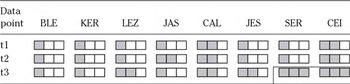
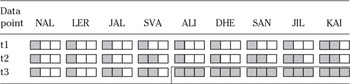
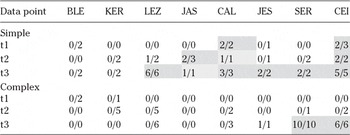
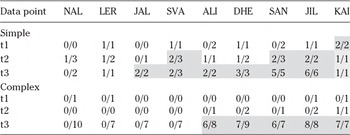
Similar to the presentation for L2 German, we summarize the development of the verb placement in the L2 Swedish subordinate clauses by distinguishing three stages: (a) the finite verb takes the second position, and the adverbial comes after the verb; (b) the single main verb takes the third position following the adverbial; and (c) both the single main verb and the auxiliary or modal verb take the third position following the adverbial. Tables 4 and 5 (see also the legend in Figure 6) show the results from L2 Swedish in the Melbourne and Malmö groups, respectively. When the different VPs are taken into consideration, we find that, although all the Melbourne learners used subordination from the start, only six of them eventually used the subordinate clause word order, and only two (SER and CEI) used the subordinate clause word order with modal verbs.
Development of ADV placement in L2 Swedish subordinate clauses (the Melbourne group)

The development of ADV placement in L2 Swedish subordinate clauses (the Malmö group)


The results from the Malmö group demonstrate that these learners, living in Sweden, are more advanced than those in the Melbourne group. However, the tendencies are the same. They all used subordinate clauses from the beginning, but only one of the learners managed to use the internal word order Adv + V. At t2, three more learners used Adv + V with main verbs, but no one used Adv + V with modal verbs. At t3, seven learners used Adv + V with main verbs, and five out of nine used Adv + V with modal verbs.
To illustrate the variation between main and modal verbs, consider the following examples, taken from the Malmö group. At t1, LER used Adv + V with main verbs, as in (19), but not with modal verbs, as in (20).
(19) LER: de som inte reser till landet reser till en stad (t1)
“those who not go to the country, go to a city”
(20) LER: *det var ett helt år som jag kunde inte gå (t1)
“it was a whole year that I could not walk”
(target: . . . som jag inte kunde gå)
These sentences indicate that the acquisition of the subordinate clause order is conditional on the complexity of the VP. This difference in VP complexity is also present in the data of SAN, who shows a complete picture of language development: At t1, she did not use Adv + V at all; at t2, she used it with main verbs, as in (21), but not with modal verbs; and finally, at t3, she also used it with modal verbs, as in (22).
(21) SAN: det är många barn som inte har ens en leksak (t2)
“there are many children who not have even one toy”
(22) SAN: jag fick den som inte kan flyga (t3)
“I got the one that not can fly”
Clearly, the use of modal verbs increases the complexity of the subordinate clause; as a result, learners seem to adopt evasion strategies. In (23), for example, JAL talks about the card she took (in the oral communicative task at t3). She hesitates and reformulates her original sentence with a modal verb and postposed negation into a construction with a single main verb and preposed negation. In so doing, she changes the context and makes the utterance easier to process.
(23) JAL: jag har en pojke som vill inte måla euh eller som inte målar (t3)
“I have a boy who will not paint uh or who not paint”
In summary, we conclude that L2 Swedish subordinate clause use develops as follows: No Adv/Neg + V < Adv/Neg + V with single main verbs < Adv/Neg + V with more than one verb (modals).
DISCUSSION
This article began with the idea that CAF measures (including subordination ratios) may not always be valid indicators of L2 development. Dynamic systems theory studies have used these measures to demonstrate that L2 development is unpredictable and not universally stagelike. Instead of using a CAF approach, we adopted an implicationally emerging processing skill approach, which has shown that the internal structure develops in a clear sequence.
In line with previous DST research results (e.g., Larsen-Freeman, Reference Larsen-Freeman2006; Verspoor et al., Reference Verspoor, Schmid and Xu2012), our subordination ratios revealed a fluctuating pattern. The fluctuation shows that the use of subordinate clauses differs according to participant and data point. The fluctuating pattern most likely results from, among other things,Footnote 6 an effect of the tasks used during data collection (e.g., Robinson, Reference Robinson2011; Skehan & Foster, Reference Skehan, Foster, Van den Branden, Bygate and Norris2009). Not every cartoon or essay assignment was well suited to the use of subordinate clauses. Obviously, some of the cartoons or essay assignments triggered the production of subordinate clauses to a greater degree than did others. However, every cartoon and essay assignment did yield subordinate clauses by some learners.
In other words, the subordination ratio used in the present study and the CAF measures in general appear to be valid measures to reveal variation (which is caused by a variety of factors, such as different tasks and different learning contexts). However, the CAF measures cannot be used as indicators of L2 development, because they are not operationalized as such. In DST, it seems that the definition and operationalization of variation and development coincide. On the contrary, PT adheres to the view that development and variation are two separate dimensions of SLA (e.g., Meisel et al., Reference Meisel, Clahsen and Pienemann1981). In PT, L2 development is operationalized by means of the emergence criterion, which is better suited to capture L2 stages.
One of the reviewers wondered if factors such as different tasks do not also influence the emergence criterion (as it clearly influences the complexity measure). We would argue that this is not the case, because the emergence of a specific syntactic rule represents the one cutoff point that remains constant. It represents the vertical dimension of the acquisition process, which is characterized by an implicational relationship of the processing procedures. The variation due to task differences, on the other hand, reflects the horizontal dimension, which refers to the range of possible structural hypotheses at any one stage, but which is at the same time constrained by the processing procedure of that stage. This two-dimensional approach to SLA is conceptualized as hypothesis space in PT.
In this context, Pienemann (Reference Pienemann1998) additionally proposes the steadiness hypothesis, which predicts that “the basic nature of the grammatical system of an IL does not change in different communicative tasks as long as those are based on the same skill type in language production” (p. 273). This means that learners’ stages are stable across different tasks. Also, when a stage has emerged, it will be a constant part of the IL system at later levels of development (e.g., the continuity hypothesis; Pienemann, Reference Pienemann1998, p. 147). This means that a linguistic structure can be regarded as having emerged in a particular data sample but may not have emerged in a subsequent sample. Pallotti (2007, p. 368) gave two explanations for this apparent nonemergence: First, the IL of the learner involved may experience some backsliding; second, the subsequent data sample may not provide sufficient contexts to determine the status of emergence of the linguistic structure at issue. In spite of this, it can be assumed that the linguistic rule is still part of the IL grammar but that it does not appear in the IL productions.
The logic of the hypothesis space can also be applied to the different learning contexts that were studied in the present study. Our study involved foreign language learners of German, foreign language learners of Swedish, and L2 learners of Swedish. These different contexts will obviously have influenced the acquisition process but, in our opinion, only in terms of the rate of acquisition, not in terms of the route of acquisition. Indeed, the Malmö group turns out to be more advanced than the Melbourne group. Nevertheless, irrespective of the learning context, every single learner reshapes his or her IL grammar according to the chronology of new processing procedures that emerge. Recall that the L2 studies on German word order also revealed the same sequence, irrespective of the learning context.
Adopting the emergence criterion, our results demonstrate that although the use of subordinate clauses was present during all data points, albeit to varying degrees, the development of the internal structure followed a clear and constant implicational sequence. In summary, the use of subordinate clauses in L2 Swedish develops as SUB < Adv + V (simple VP) < Adv + V (complex VP), whereas the use of subordinate clauses in L2 German develops as SUB (No V-End) < V-End (simple VP) < V-End (complex VP). L2 Swedish and L2 German learners used subordinate clauses from the beginning (with two exceptions in the L2 German group, who only started using subordinate clauses from t2 onward [CHA and TIN]). The immediate use of subordinate clauses did not mean, however, that the learners had reached the subordinate clause level in the PT hierarchy, because they did not necessarily simultaneously use the distinctive subordinate clause word order from the start. The internal structure emerged only later and in distinct phases. The subordinate clause word order occurred first with single main verbs only and afterward with complex VPs, including auxiliaries and modals. In the L2 German data, we found that the acquisition of the subordinate clause word order in subordinate clauses with complex VPs even depended on the verb type, where VPs with modals were more complex than VPs with auxiliaries. The same trend was observed in the L2 Swedish data, but more data (with more verb type variation) are needed to warrant such a conclusion.
With these results, our study replicates findings of L1 research. Müller (Reference Müller1993), for example, observed differences between the placement of main verbs and the placement of auxiliaries or modals in the German subordinate clauses of a French-German bilingual child. The child first applied the V-End rule with main verbs and only later applied it with auxiliaries and modals. Similarly, for L1 Swedish, Håkansson and Dooley Collberg (Reference Håkansson and Dooley Collberg1994) found an implicational order between modal and main verb contexts such that the subordinate clause word order was first used in the context of a main verb before it was used in modal contexts.
The present study compared linguistic complexity as measured by subordination ratios with the emergence of internal word order structures. Seeing that the emergence of the subordinate clause procedure relies on the use of the specific word order rule in L2 German and L2 Swedish, one reviewer wondered if the emergence criterion is not stepping into the territory of the accuracy dimension of the CAF triad. This is most certainly not the case. Whereas accuracy in the CAF research tradition refers to the relation of accurate and inaccurate uses of a certain structure (e.g., 80% accurate vs. 20% inaccurate), the emergence criterion in the PT research tradition looks at the first productive use of a certain structure. As was illustrated in Table 1, some PT stages involve structures that are part of the target language (e.g., INV at Stage 4 and V-End/V3 at Stage 5), whereas other PT stages contain structures that are not part of the target language (e.g., ADV at Stage 3 is not part of either German or Swedish but is still used in learner language). This being said, had we compared the accuracy and the emergence of the subordinate word order, our argument and our findings would have been the same: Just like complexity ratios, accuracy rates do not actually picture development but rather indicate the variation between and within individual learners. An analysis of accuracy rates would indeed show interindividual and intraindividual variation, but this variation and variability would not constitute evidence against stagelike development.
In sum, the findings on L2 German and L2 Swedish in this article are meant as a refutation of the DST claims that developmental stages do not exist and that L2 development is actually unpredictable. What we find particularly problematic is the way the DST approach seems to operationalize L2 development. As we understand it, L2 development is operationalized in terms of the CAF measures and, as such, in terms of frequency measures, such as mean scores, rates, and ratios. However, no rationale is provided for this equation.Footnote 7 Our argument is not that we should abandon CAF measures altogether but that we should not use them as indicators of L2 development as DST does. As long as the DST framework does not clearly define and operationalize L2 development, its supporters cannot simply interpret CAF measures as evidence that learners do not progress in fixed stages. In addition, those who develop the DST framework should make explicit the level of predictability they are talking about. Although it is indeed impossible to predict the exact pattern in terms of rates and ratios, it is possible, as we have shown, to predict an implicational sequence in terms of emergence.
CONCLUSION
With the claim “that the general developmental stages individuals go through are much less similar than we have assumed so far” (de Bot, Lowie, & Verspoor, Reference de Bot, Lowie and Verspoor2005, p. 24), DST challenges a long-standing finding in SLA research that L2 development occurs in stages. In PT, this steady development in stages (as well as the variation, for that matter) is explained by processing constraints. The aim of the present article is to show that developmental stages do exist and can be lexically governed. Using PT as a framework and its emergence criterion as an operationalization of L2 development, we were able to find clear (intra)stages in the development of subordinate clause word order in L2 German and Swedish. What is more, we were able to formulate testable hypotheses in advance, which is something that the DST framework does not enable us to do. As the supporters of DST acknowledge themselves (de Bot et al., Reference de Bot, Lowie and Verspoor2007) “the DST approach is much more geared towards visualization to see developments rather than to test them” (p. 14). We have shown, however, that CAF measures are not the right measures to visualize developmental stages. Instead, using the emergence criterion, we were able to bring to light that the lexicon (in the sense of verb types) is a driving force in morphosyntactic development.
Appendix
The development of the V-End rule in L2 German subordinate clauses (simple and complex)

The development of the ADV + verb rule in L2 Swedish subordinate clauses (simple and complex), Melbourne group

The development of the ADV + verb rule in L2 Swedish subordinate clauses (simple and complex), Malmö group