INTRODUCTION
Learning a second language (L2) after puberty is characterized by a great amount of individual variation, with some achieving highly advanced performance and others showing tremendous difficulty. In investigating the source of this variability, we propose a hypothesis that an anchor of L1 acquisition, domain-general auditory processing, can explain some variance in various aspects and stages of postpubertal L2 learning. To test this hypothesis, this article presents the results of three individual studies with three different types of adult L2 learners with diverse profiles of L1, experience, age of onset, and perceptual orientations (n = 139 Spanish, Chinese, and Polish residents in the United Kingdom). Through examining the relationship between auditory processing and acquisition across essentially different L2 learning instances, we aim to delve into the validity and generalizability of our hypothesis, that is, precise auditory processing as a driving force supporting phonological, lexical, and morphosyntax learning throughout the life span.
DOMAIN-GENERAL AUDITORY PROCESSING
One dominant view of language acquisition is that certain neurocognitive functions are specifically devoted to language learning (e.g., a left-lateralized frontotemporal system for syntax; Campbell & Tyler, Reference Campbell and Tyler2018). Comparatively, another influential idea has been put forward that states that language-related processing involves other neurocognitive networks that also underlie general-purpose learning (Hamrick et al., Reference Hamrick, Lum and Ullman2018 for an overview). One aspect of this latter, domain-general view that has received much scholarly attention is auditory processing (i.e., the capacity to precisely represent and remember characteristics of sounds, including nonverbal sounds; Mueller et al., Reference Mueller, Friederici and Ma¨nel2012). While a range of learning behaviors require analysis of acoustic signals at domain-specific levels (e.g., speech, music, and environmental sounds), a set of foundational abilities (i.e., perceiving spectro-temporal details) anchors all the phenomena, and thus could be considered to be domain-general.
The auditory channel is the primary means through which language input is initially received for most language learners. Infants must detect patterns in duration, amplitude, pitch, and higher-frequency spectral features at multiple time scales. A combination of such acoustic information is used to distinguish individual phonemes (Werker & Tees, Reference Werker and Tees1999), identify word boundaries (Cutler & Butterfield, Reference Cutler and Butterfield1992), and track syntactic structure (Marslen-Wilson et al., Reference Marslen-Wilson, Tyler, Warren, Grenier and Lee1992). Thus, any difficulties with audition could impact the ability to phonologically analyze speech and limit the intake of linguistic information available not only for lower-level, segmental and prosodic analysis, but also for higher-level lexical, morphosyntactic, and semantic processing of language (Broersma & Cutler, Reference Broersma and Cutler2008).
Auditory processing ability, as measured using tests that assess the discrimination of individual acoustic dimensions, has been shown to widely vary among L1 learners (Johnson et al., Reference Johnson, Watson and Jensen1987; Kidd et al., Reference Kidd, Watson and Gygi2007; Surprenant & Watson, Reference Surprenant and Watson2001) and has been strongly tied to L1 learning difficulty (Casini et al., Reference Casini, Pech-Georgel and Ziegler2018; Goswami et al., Reference Goswami, Wang, Cruz, Fosker, Mead and Huss2011), literacy development (Gibson et al., Reference Gibson, Hogben and Fletcher2006; White-Schwoch et al., Reference White-Schwoch, Woodruff Carr, Thompson, Anderson, Nicol, Bradlow, Zecker and Kraus2015; but see Georgiou et al., Reference Georgiou, Protopapas, Papadopoulos, Skaloumbakas and Parrila2010; Halliday & Bishop, Reference Halliday and Bishop2006), and aging processes (Ruggles et al., Reference Ruggles, Bharadwaj and Shinn-Cunningham2012; Schneider et al., Reference Schneider, Daneman and Pichora-Fuller2002; Wilson et al., Reference Wilson, Beckett, Barnes, Schneider, Bach, Evans and Bennett2002). As a result, the diagnosis of auditory processing has been proposed as a biomarker to identify appropriate treatments for abnormal language development, as suggested for autism spectrum disorders (Russo et al., Reference Russo, Skoe, Trommer, Nicol, Zecker, Bradlow and Kraus2008, Reference Russo, Nicol, Trommer, Zecker and Kraus2009) and dyslexia (Hornickel & Kraus, Reference Hornickel and Kraus2013).
The domain-generality of auditory processing has been tested beyond the context of L1 acquisition. To date, a growing amount of attention has been directed toward exploring the extent to which auditory processing enriches various types of language learning experiences during adulthood. For example, there is some empirical evidence that those with more precise auditory processing ability can better learn novel sounds and words that they have never heard before, after receiving brief amounts of perceptual training (e.g., Kempe et al., Reference Kempe, Thoresen, Kirk, Schaeffler and Brooks2012; Wong & Perrachione, Reference Wong and Perrachione2007; Wong et al., Reference Wong, Perrachione and Parrish2007). Similarly, Lengeris and Hazan (Reference Lengeris and Hazan2010) examined the impact of perception training on 28 Greek speakers’ L2 English vowel acquisition, and found that those who demonstrated better formant discrimination ability at the outset of the project realized more improvement in their L2 English vowel perception performance. Whereas the existing literature has generally supported the relationship between auditory processing and its relationship with the effectiveness of brief laboratory training, it remains unclear whether, to what degree, and how auditory processing can help individuals acquire the phonological and lexicogrammar dimensions of a new language in a naturalistic learning setting (the focus of the current study).
INDIVIDUAL DIFFERENCES IN NATURALISTIC L2 ACQUISITION IN ADULTHOOD
Learning a second language through immersion in adulthood is known to be not only difficult but also influenced by several factors. For example, the usage-based perspective of L2 acquisition predicts that one particularly influential factor is experience (i.e., how much, in what way, and when learners use the target language; Ellis, Reference Ellis2006). Research has also shown that L2 learners with greater levels of motivation and willingness to communicate tend to seek more opportunities to use an L2 with more fluent speakers in more diverse social settings (Derwing & Munro, Reference Derwing and Munro2013). In the field of L2 acquisition, scholars have exhaustively examined two different stages of naturalistic L2 learning: (a) the extent to which learners can quickly develop their new L2 systems through frequent, meaningful, and interactive conversations within a short term of study and work abroad (length of residence [LOR] = 1–2 years; i.e., early phase of learning); and (b) the extent to which L2 learners can eventually refine their linguistic competence to near-nativelike levels through long-term immersive experience (LOR > 5 years; i.e., ultimate attainment). For definitions, theoretical underpinnings, and empirical evidence, see DeKeyser (Reference DeKeyser2013).
While motivated, active, and regular L2 users continue to enhance their L2 proficiency as a function of increased LOR (1–5 years; Derwing & Munro, Reference Derwing and Munro2013), these experience-related factors do not fully explain the degree of success in late L2 acquisition, accounting for only small-to-medium variance in late L2 proficiency (e.g., R2 = .10−.20 in Saito, Reference Saito2015). In other words, even if two learners practice the target language for the same period, the final outcomes of their learning will most likely be different. This is arguably because certain L2 learners are more perceptually and cognitively adept at making the most of every practice opportunity that they engage in, resulting in greater gains from the same type of L2 experience, and leading to more advanced L2 proficiency in the long run (cf. Doughty, Reference Doughty2019).Footnote 1
Over the past 50 years, researchers have extensively examined the perceptual and cognitive abilities of late L2 learners with various levels of experience and proficiency. Focusing on long-term L2 residents, for example, the incidence of near-nativelike L2 proficiency has been found to be tied to learners’ explicit learning abilities necessary for successful foreign language learning through formal instruction, that is, foreign language aptitude (e.g., Abrahamsson & Hyltenstam, Reference Abrahamsson and Hyltenstam2008). More advanced L2 proficient users tend to demonstrate greater domain-general cognitive abilities, such as declarative, procedural, and working memory (e.g., Linck et al., Reference Linck, Hughes, Campbell, Silbert, Tare, Jackson, Smith, Bunting and Doughty2013). To provide a more full-fledged picture of the mechanisms underlying L2 learning, a strong call has been made for developing a more theoretically and empirically sound framework for conceptualizing the complex relationship between perceptual-cognitive abilities (domain-specific vs. general), experience (early-phase learning vs. ultimate attainment), and late L2 learning in both classroom and naturalistic settings (Li, Reference Li2016).
MOTIVATION FOR CURRENT STUDY
In conjunction with the theoretical discussion on what characterizes the driving factors of L2 acquisition, we propose a hypothesis that domain-general auditory processing, identified as a bottleneck of L1 acquisition (Mueller et al., Reference Mueller, Friederici and Ma¨nel2012), can explain some variation in the rate and ultimate attainment of L2 learning in adulthood. Under this view, experience is a necessary, but not sufficient condition for successful L2 acquisition. While more conversational experience surely boosts the speed of learning, especially at the outset of immersion, individual differences in auditory processing could help determine the extent to which learners can eventually benefit from received opportunities for L2 input and output. Throughout an extensive period of immersion, therefore, those with more precise audition are predicted to ultimately attain more advanced L2 phonological, lexical, and grammatical skills.
To test the role of auditory processing in L2 acquisition, our precursor work (Kachlicka et al., Reference Kachlicka, Saito and Tierney2019) took an exploratory approach, investigating 40 Polish residents’ auditory processing ability (temporal, spectral), diverse immersion profiles (LOR = 1–5 years), and L2 English proficiency (segmental perception, grammaticality judgments). According to the preliminary investigation, participants’ L2 phonological and grammar skills were found to be correlated with biographical factors (r = .374 for length of residence and foreign language education, r = −.345 for age of acquisition) and with auditory processing scores (r = −.633 for segmental proficiency, r = −.442 for grammatical proficiency). The results suggest that while practice is linked to successful L2 learning to some degree, more precise auditory processing competence is needed to carry out phonological, lexical, and grammatical analyses in a more efficient and effective way—that is, a key condition for the acquisition of high-level L2 proficiency (Doughty, Reference Doughty2019).
Given the theoretical significance of the topic for the L1 and L2 acquisition literature, the scope, size, and depth of the dataset in Kachlicka et al. needs to be expanded to further test our hypothesis that auditory processing is a foundation of human language acquisition throughout the life span, and germane to L2 learning in adulthood. While Kachlicka et al. provided emerging evidence for the link between auditory processing and acquisition, the generalizability of the findings needs to be tested in different L2 populations with different degrees of immersion experience. To this end, three individual studies were conducted to examine the link between audition, experience, and L2 proficiency among three different groups of L2 learners speaking different L1s, with participants having varied experience profiles (Study 1), a relatively small degree of experience (Study 2), and extensive experience (Study 3). In this article, we report what we initially aimed to achieve (Study 1 for conceptual replication of Kachlicka et al.), what we found (audition-proficiency link), and what we ultimately examined and discovered (Studies 2 and 3 for the relationships between audition, experience, and proficiency at different phases of L2 learning).
Our first objective was to conduct a conceptual replication of Kachlicka et al.’s (Reference Kachlicka, Saito and Tierney2019) findings with adult L2 learners with a different L1 background, that is, 39 Spanish speakers of English. In Study 1, we predicted and confirmed that similar correlations between auditory processing and L2 proficiency would be observed. To further investigate the extent to which the relationship between auditory processing and L2 proficiency generalizes to other L1 backgrounds and other degrees of immersion, we decided to conduct two follow-up studies in experienced Polish L1 speakers with a long history of L2 immersion and inexperienced Mandarin L1 speakers with a very short history of L2 immersion.
Concurring with existing discussion and empirical evidence that the nature of learning is different at the initial and later phases of L2 immersion (initial state vs. ultimate attainment; DeKeyser, Reference DeKeyser2013; see also Abrahamsson & Hyltenstam, Reference Abrahamsson and Hyltenstam2008; Birdsong & Molis, Reference Birdsong and Molis2001; Doughty, Reference Doughty2019; Saito, Reference Saito2015), we then conducted two follow-up studies. Study 2 involved less experienced L2 learners, that is, 50 Chinese speakers who had recently arrived and started naturalistic immersion in the United Kingdom. In this context, our hypothesis was that auditory processing would be weakly linked to their immersion experience simply due to the lack of sufficient exposure to authentic input and output opportunities, thereby preventing us from finding any significant impact of auditory processing on initial quick L2 learning. Finally, Study 3 concerned highly experienced L2 learners, that is, 50 long-term Polish residents with ample immersion experience in the United Kingdom. As shown in Study 1, auditory processing mirrored the extent to which L2 learners had frequently and intensively used the target language (strong auditory-experience link). In this regard, our final prediction was that it would be auditory processing rather than experience variables per se that would relate to the linguistic outcomes of such experienced L2 learners (strong audition-proficiency link).
Taken together, this article aims to test our overall hypothesis that auditory processing is a foundation of human language acquisition throughout the life span, and generalizable to postpubertal L2 learning. We predict that auditory processing and L2 acquisition will be linked, especially when adult L2 learners start using a new language for meaning through naturalistic immersion.
STUDY 1: CONCEPTUAL REPLICATION OF KACHLICKA et al. (Reference Kachlicka, Saito and Tierney2019)
After we completed our original project (Kachlicka et al., Reference Kachlicka, Saito and Tierney2019), we decided to reexamine the robustness of the audition-proficiency link (in particular, whether it generalizes to speakers of other first languages) by conducting a conceptual replication of Kachlicka et al. (Reference Kachlicka, Saito and Tierney2019) in a different L2 population, n = 39 L1 Spanish users of L2 English. The objective of Study 1 was to explore the extent to which Kachlicka et al.’s findings were specific to Polish speakers or generalizable to other groups of L2 learners, such as Spanish speakers.
METHOD
BIOGRAPHICAL BACKGROUNDS OF PARTICIPANTS
A total of 39 L1 Spanish residents in London participated in the study (17 males, 22 females). In terms of their nationalities, 8 participants were from Spain and 31 from North, Central, and South American countries (Columbia, Chile, Mexico, Peru). Following Kachlicka et al. (Reference Kachlicka, Saito and Tierney2019), the biographical variables in the current study were operationalized as a set of experience-related factors that previous L2 research has found to affect the process and product of adult L2 learning—that is, the length, onset, and quality of L2 use in naturalistic and classroom contexts. The chronological age of the participants widely varied at the time of the project (M age = 35.7, Range = 17–58). All the participants were considered to be late L2 learners of English, as they had arrived in the United Kingdom after the age of 17 (M = 35.7 years, Range = 17–58 years). Their L2 experience differed in terms of the amount of foreign language education (M = 4.6 years, Range = 0.1–15 years), the time at which they began foreign language education (M = 20.1 years, Range = 3–47 years), and their length of immersion in the United Kingdom (M = 6.24 years, Range = 2–24 years). All the participants reported that their primary language of communication at work and/or home was English, and that they were regularly using L2 English in various social settings. Following the procedure adopted in the Language Contact Profile (Freed et al., Reference Freed, Segalowitz and Dewey2004), participants’ L2 use backgrounds were queried at the time of the project. The frequency of L2 use differed according to interlocutor type—same L1 speakers (M = 51.5%, Range = 0–100%), fluent L2 speakers (M = 35.9%, Range = 0–100%) and nonfluent L2 speakers (M = 45.9%, Range = 0–100%). No participants reported any prior diagnosis of a hearing impairment that may have affected their audition and linguistic performance. See Supporting Information (deposited in IRIS), where we provide all the raw data regarding participants’ biographical backgrounds (as well as auditory processing and L2 test scores).
MEASURES OF AUDITORY PROCESSING
Following the procedure established in the precursor work (Kachlicka et al., Reference Kachlicka, Saito and Tierney2019), participants took four different tests that comprehensively indexed dimensions of auditory skills relevant to speech perception—that is, duration, amplitude rise time, pitch, and formant discrimination. For all the tests, a total of 100 continuous synthesized stimuli were created using custom MATLAB scripts. The tests followed an A × B discrimination format. Three tones were presented with an interstimulus interval of 0.5 s. Participants chose which of three tones differed from the other two by pressing the number “1” or “3.” Using an adaptive threshold procedure (Levitt, Reference Levitt1971), the size of the difference varied from trial to trial based on task performance. Initially, the tests started from Level 50. Whenever they made an incorrect response, the difficulty of the task decreased by a degree of 10 steps (with the difference being wider). When they correctly responded three times in a row, the task difficulty increased by a degree of 10 steps (with the difference being smaller). When a reversal happened (a decrease in difficulty followed by an increase or vice versa), the step size changed from 10 to 5 (second reversal), then to 2 and finally to 1. The tests stopped after either 70 trials or 8 reversals. Participants’ auditory processing score was measured as a threshold based on the mean of every reversal from the second on (lower auditory scores indicate higher sensitivity).
For the duration, rise time and pitch discrimination tests, a total of 100 500-ms four-harmonic complex tones were prepared with the fundamental frequency set at 330 Hz and equal amplitude across harmonics. For the duration discrimination test, the standard stimulus had a duration of 250 ms. Linear amplitude ramps were included at the onset and endpoint of the stimulus (15 ms each). Throughout the 100 tokens, the target acoustic dimension for each test ranged with a step of 2.5 ms in duration (252.5–500 ms), 2.85 ms in rise time (17.85–300 ms), and 0.3 Hz in F0 (330.3–360 Hz), respectively. For the formant discrimination test, a total of 100 tokens were created. The duration of each token was 500 ms with a fundamental frequency of 100 Hz and harmonics up to 3,000 Hz. Two 15 ms linear amplitude ramps were inserted at the beginning and endpoint of the stimulus. Using a parallel formant filter bank (Smith, Reference Smith2007), three formants were generated at 500 Hz, 1,500 Hz, and 3,000 Hz. The target dimension of F2 varied between 1,502 Hz and 1,700 Hz with steps of 2 Hz.
For all the audio materials used in the tests, and the results of test-retest reliability, see our brief research report (Saito et al., Reference Saito, Sun and Tierney2020b).
MEASURES OF L2 PHONOLOGICAL PROFICIENCY
Given that the primary objective of Study 1 was to replicate Kachlicka et al. (Reference Kachlicka, Saito and Tierney2019), we adopted the same segmental speech perception test that was featured in their study. The items covered notoriously difficult phonological contrasts for many L2 learners of English, such as tense-lax vowels (/i/ vs. /ɪ/, /u/ vs. /ʊ/, /æ/ vs. /ɛ/). Performance was at ceiling on the consonant contrasts (e.g., voicing in /g/ vs. /k/ and /d/ vs. /t/), and so these data were not analyzed further. The test used a forced-choice identification format, whereby participants listened to a target word and selected a correct answer from two alternatives that were minimally paired (“bad” vs. “bed”). Each contrast contained 20 samples, resulting in a total of 100 samples. Given that word frequency affects L2 learners’ perception performance (Flege et al., Reference Flege, Takagi and Mann1996), all the target items were checked and it was confirmed that they were included in the first 4,000 word families using BNC Word Lists in Vocab Profiler (Cobb, Reference Cobb2012). The assumption here was that all the participants should have known all the words, as 4,000-word families are considered to be the crucial lexical threshold necessary for functional L2 users of English (Van Zeeland & Schmitt, Reference Van Zeeland and Schmitt2013). The test was delivered and analyzed using MATLAB software. The correct identification ratio was automatically calculated (0–100%).
One methodological limitation of the speech perception test used in Kachlicka et al. (Reference Kachlicka, Saito and Tierney2019) was its exclusive focus on segmental aspects of L2 phonology. To this end, a prominence test was developed using MATLAB software to examine the participants’ ability to identify and decode prosodic emphasis at a sentence level (i.e., prosodic proficiency). The stimuli were adapted from the prosody perception battery reported in Jasmin et al. (Reference Jasmin, Dick, Holt and Tierney2020), and a detailed description of the stimuli can be found there. Briefly, a voice actor was asked to read a set of sentence pairs. Each of these pairs contained a section that was identical lexically but differed on the location of contrastive focus. For example, one sentence pair was “Dave likes to STUDY music, but he doesn’t like to PLAY music” and “Dave likes to study MUSIC, but he doesn’t like to study HISTORY.” These recordings were then cropped, leaving sound files that only contained the initial, lexically identical portions of the sentences (i.e., “Dave likes to study music”). The speech morphing software STRAIGHT was then used to manually time align these recordings and morph them onto one another, such that the size of cues to linguistic focus could be controlled to avoid floor and ceiling effects. Specifically, pitch and duration cues to focus location were set at 80% of their original values, and all other cues to focus were removed. Twenty stimuli were selected from the set of 49 stimuli created for Jasmin et al. (Reference Jasmin, Dick, Holt and Tierney2020). The correct identification ratio was calculated (0–100%) and used for the analysis.
MEASURES OF L2 GRAMMATICAL PROFICIENCY
To replicate the findings of Kachlicka et al. (Reference Kachlicka, Saito and Tierney2019), we adopted the same timed grammaticality judgment task featured in their study. This format has been widely used in the field of L2 acquisition as an outcome measure for tapping into relatively automatized yet explicit L2 grammar competence (Suzuki & DeKeyser, Reference Suzuki and DeKeyser2017). The original materials were derived from Godfroid et al. (Reference Godfroid, Loewen, Jung, Park, Gass and Ellis2015). In this task, participants read a total of 68 sentences. For each sentence, they were required to answer whether each sentence was syntactically acceptable. While 34 sentences were free of linguistic errors, the remaining sentences featured incorrect use of the target language related to 17 morphosyntactic structures (e.g., plurality, tense, article). The length of the sentences varied from 5 to 12 words. Each sentence was presented for a different limited period (1,800–6,240 ms) based on the suggestions from Godfroid et al. (Reference Godfroid, Loewen, Jung, Park, Gass and Ellis2015; considering L2 learners’ slower processing time). The accuracy ratio scores (0–100%) were automatically calculated based on the extent to which participants correctly identified the grammatical sentences and rejected the ungrammatical sentences.
RESULTS
CHARACTERISTICS OF AUDITORY PROCESSING
As expected, the results of the descriptive statistics demonstrated that the participants’ auditory processing widely varied, as measured by tests of duration, rise time, pitch, and formant discrimination. According to the results of Kolmogorov–Smirnov tests, the participants’ raw auditory processing scores were positively skewed (p < .05). To approximate normal distribution, all the auditory scores were statistically transformed using the log10 function. As originally conceptualized in Kachlicka et al. (Reference Kachlicka, Saito and Tierney2019), the four auditory dimensions were assumed to tap into two different aspects of audition: (a) temporal information processing (perception of sound duration and changes in amplitude); and (b) spectral information processing (discrimination of pitch and spectral shape). To index the participants’ two different dimensions of auditory processing (temporal vs. spectral), composite scores were calculated and used for the subsequent analyses. Duration and rise time discrimination scores were converted to z-scores and averaged to represent temporal processing, while pitch and formant discrimination scores were assumed to represent spectral processing. According to the results of normality tests (Kolmogorov–Smirnov), both temporal and spectral processing scores were assumed to be normally distributed (D = .093, .098, p = .854, .804).
CHARACTERISTICS OF BIOGRAPHICAL BACKGROUND VARIABLES
In the current investigation, we decided to take a comprehensive approach to cover multiple aspects of participants’ L2 learning experience, resulting in a total of seven measures related to the length, onset, and quality of L2 use in naturalistic and classroom contexts. These experience-related factors likely overlap with each other (e.g., earlier onset of learning leads to longer length of learning), which will result in multicollinearity problems in subsequent statistical analyses. To avoid unwanted confounds and identify the presence of latent factors, the seven biographical background variables were submitted to an exploratory factor analysis with the Direct Oblimin rotation methodFootnote 2 with the minimum Kaiser criterion eigenvalue set to 1.0.
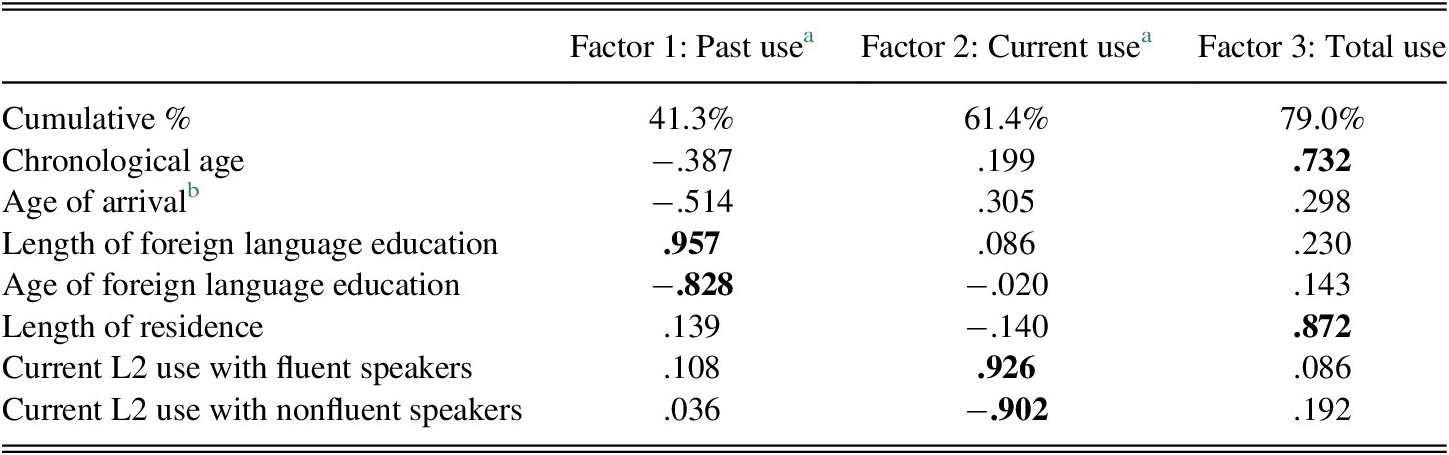
The factorability of the dataset was confirmed with the Kaiser–Meyer–Olkin (KMO) Measure of Sampling Adequacy (.422) and Bartlett’s Test of Sphericity (χ 2 = 276.354, p < .001). For factor loadings, 0.6 was used as a cutoff point in line with Hair et al.’s (1998) recommendation for factor analyses of a relatively small sample size (n < 100). To avoid any confusion as to the interpretation of latent factors, we did not take into account any individual variables with their loadings less than 0.6. As summarized in Table 1, Factor 1 was labeled as “Past Use” as it clustered length and onset of foreign language education prior to immersion. Factor 2 was labeled as “Current Use” (featuring the amount of time participants spend using their L2 with fluent vs. nonfluent speakers); and Factor 3 as “Total Use” (featuring length of residence in the United Kingdom). Not surprisingly, chronological age was included here, indicating that older participants likely had longer immersion experience. The resulting factor scores were used for the rest of the statistical analyses.
Summary of factor loadings underlying biographical background variables

Note. All loadings > .6 or < −.6 are highlighted in bold.
a Directionality was reversed to facilitate the interpretation of the factor (larger values indicate more practice).
b As Flege (Reference Flege, Piske and Young-Scholten2009, p. 184) pointed out, the results of the factor analyses suggest that age of arrival could be a “macrovariable,” characterized by a combination of L1-related, experiential, cognitive, and perceptual factors. The participants’ age of arrival profiles were confounded with a range of experience-related variables (factors related to current [current L2 use], accumulative [total L2 use], and past L2 experience [EFL training]).
AUDITORY PROCESSING, BIOGRAPHICAL BACKGROUNDS, AND L2 PROFICIENCY
The final objective of the statistical analyses was to explore the extent to which factors related to auditory processing and biographical background were predictive of the outcomes of the participants’ L2 phonological and grammar learning at the time of the project. To this end, linear mixed-effects models were constructed by using the lm functions from the lme package (Version 1.1-21; Bates et al., Reference Bates, Maechler, Bolker and Walker2015) in the R statistical environment (R Core Team, 2018).
For the purpose of comparison, all the segmental perception test scores (M = 74.6%, SD = 12.9%, Range = 50–100%), the prosodic perception scores (M = 76.4%, SD = 14.6%, Range = 40–100%), and the grammaticality judgment scores (M = 65.6%, SD = 13.1%, Range = 44–96%) were first standardized into z-scores. A linear mixed-effects regression analysis was performed with three different types of L2 proficiency scores (vowel perception, prosody perception, grammaticality judgment) as dependent variables relative to seven predictor variables: two auditory processing variables (Temporal, Spectral), three biographic factors (Past, Current, Total Use), and one repeated Task condition (vowel, prosody, grammar). Task was treatment coded, and vowel performance was used as the reference category. According to the results of the Kolmogorov–Smirnov test, composite L2 proficiency scores were found to be normally distributed (D = .114, p = .641).
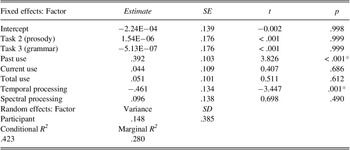
As summarized in Table 2, 28.0% of the variance in participants’ L2 proficiency scores were explained by the composite model. Two of the predictors reached statistical significance: one auditory processing factor (p < .001 for lower scores for more precise temporal processing) and one biographical factor (p = .011 for larger values for more previous EFL experience). Their t values were comparable (3.826, −3.447). The results suggest that postpubertal L2 learners’ success in L2 phonological and grammar learning was equally linked to their individual differences in temporal sensitivity and past L2 use (EFL training).
Summary of the final model explaining the perceptual and biographical correlates of L2 segmental, prosodic, and grammatical proficiency

* indicates statistical significance (p < .05).
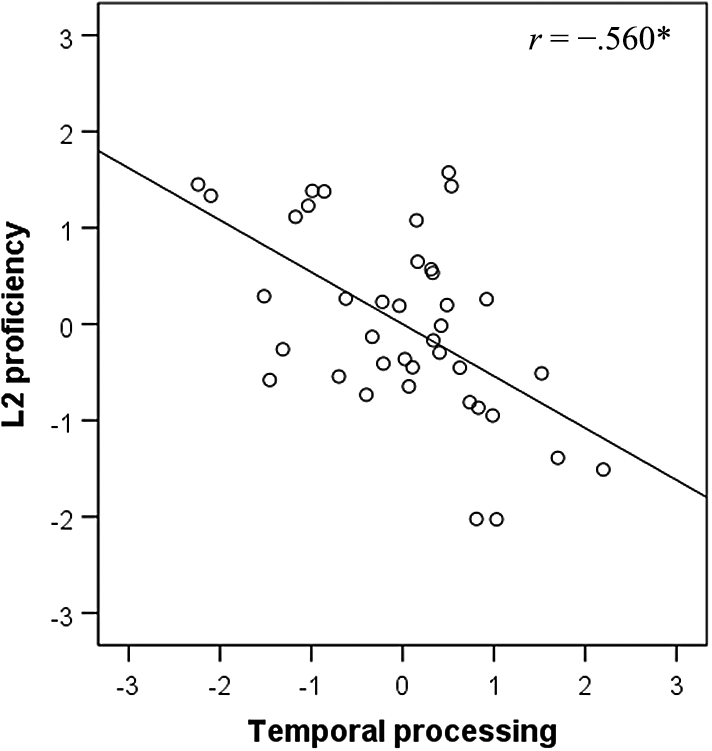
To look at the extent to which the auditory processing factor (temporal processing) alone made independent contributions to L2 proficiency, a partial correlation analysis was performed, covarying for all the biographical factors (Past, Current, Total Use). For this analysis, all L2 test scores were averaged across per participant, as the mixed-effects model did not find any main effects of task condition (vowel, prosody, grammar). To visually plot the audition-proficiency link, the participants’ temporal processing (lower scores index more precise processing) and composite L2 proficiency scores (larger scores index greater proficiency) were regressed on the biographical factors. As shown in Figure 1, a Pearson correlation analysis identified a significant relationship, r = −.560, p < .001. The size of the auditory processing effect could be considered moderate-to-strong in line with Plonsky and Oswald’s (Reference Plonsky and Oswald2014) field-specific benchmark (r = .25 for small, .40 for medium, .60 for large).
Correlation between L2 linguistic proficiency and auditory processing residuals with biographical factors partialled out.

DISCUSSION
The current study partially replicates Kachlicka et al.’s (Reference Kachlicka, Saito and Tierney2019) findings on the relationship between auditory processing, biographical background, and the phonological and grammatical aspects of postpubertal L2 learning. In the context of 39 Spanish learners of English with varied experience and proficiency levels (similar to the dataset of Kachlicka), the results of mixed-effects regression analyses showed that the outcomes of L2 learning were equally associated with experience factors (past EFL training) and auditory processing factors (temporal processing).
The results here suggest that the amount of learners’ experience could be a crucial moderator variable, and thus needs to be controlled with a view of obtaining a full-fledged picture of the intricate role of auditory processing in L2 proficiency. If L2 learners are at the initial stage of immersion (e.g., LOR < 1 year), the audition-proficiency link could be weak at best. This is arguably because such inexperienced L2 learners may have not yet had many opportunities to use their auditory processing ability to decode, intake, and integrate aural input into their linguistic systems. When more experienced L2 learners are concerned (e.g., LOR > 6 years), we predict that the audition-proficiency link could be most clearly observed. We speculate that years of regular, active and naturalistic L2 use would stimulate and lead to more precise auditory processing ability, which may in turn help learners best utilize every input opportunity over the prolonged period of immersion. In the long run, auditory processing may help determine the extent to which L2 learners can ultimately achieve in L2 phonological and grammatical proficiency.
To test our hypotheses, we conducted two separate studies examining the role of auditory processing in L2 acquisition among 50 inexperienced L2 learners (Study 2) and 50 experienced L2 learners (Study 3).
STUDY 2: INITIAL STAGE OF AUDITION-PROFICIENCY LINK
As mentioned earlier in the literature review section, there is both longitudinal and cross-sectional evidence that the experience-proficiency link consists of two different phases. While much learning is thought to take place within the first few years of immersion (i.e., early phase of learning), subsequently acquisition begins to slow down and reach a relatively stable state (i.e., ultimate attainment; for discussion and overviews, see Abrahamsson & Hyltenstam, Reference Abrahamsson and Hyltenstam2008; Birdsong & Molis, Reference Birdsong and Molis2001; DeKeyser, Reference DeKeyser2013). In the existing literature, the predictive power of experience is likely stronger at the initial rather than later stages of L2 learning (Saito, Reference Saito2015). Kachlicka et al. (Reference Kachlicka, Saito and Tierney2019) and Study 1 focused on L2 learners with a wide range of experience and proficiency profiles, which possibly confounds the role of audition and experience in different stages of L2 learning. Thus, in Studies 2 and 3 we attempted to isolate two essentially different stages of L2 immersion—that is, initial state of learning versus ultimate attainment.
METHOD
BIOGRAPHICAL BACKGROUNDS OF PARTICIPANTS
A total of 50 L1 Chinese speakers were recruited from various graduate programs at universities in London (3 males, 47 females, M age = 23.6, Range = 21–32). The data collection was conducted within 4 months after the participants had arrived in the United Kingdom. Prior to their study abroad, they had no extensive stay in any English-speaking countries, except for short-term family trips (e.g., < 3 weeks). The participants started learning English in schools in China at different times (M = 8.0 years, Range = 4–13 years), resulting in a wide range of total length of foreign language education (M = 13.4 years, Range = 10–19 years). Similar to Study 1, participants reported that they were using L2 English on a regular basis (> 33%). The amount of time they spent using L2 English with fluent speakers widely varied (M = 26.2%, Range = 5–60%). No participants reported any prior diagnosis of a hearing impairment that may have affected their audition and linguistic performance.
MEASURES OF L2 PHONOLOGICAL AND GRAMMATICAL PROFICIENCY
The same materials as in Study 1 were used to measure the participants’ proficiency in segmental (sound and word identification), prosodic (prominence detection), and grammatical intuition (grammaticality judgments).
MEASURES OF L2 LEXICAL PROFICIENCY
While the grammaticality judgment task was designed to evaluate participants’ sensitivity to morphosyntactic accuracy, it did not index their L2 vocabulary ability, another crucial component of L2 proficiency. To this end, another measure (i.e., LexTALE: Lemhöfer & Broersma, Reference Lemhöfer and Broersma2012) was adopted to tap into L2 learners’ lexical competence and intuition in English. LexTALE is an untimed lexical decision task consisting of 40 real words and 20 nonwords. This test has been shown to demonstrate strong correlations with L2 learners’ vocabulary knowledge, general proficiency, and self-ratings. The correct identification ratio was separately calculated for real words and nonwords (0–100%, respectively), and averaged for analysis.
RESULTS
CHARACTERISTICS OF AUDITORY PROCESSING
Similar to Study 1, the participants’ raw audition scores were not normally distributed (p < .05 according to Kolmogorov–Smirnov tests), and so they were logarithmically transformed. Composite scores were calculated by standardizing and averaging duration and rise time discrimination scores for temporal processing and pitch and format discrimination scores for spectral processing. The normality tests found both temporal and spectral processing scores to be normally distributed (D = .086, .069, p = .815, .957).
CHARACTERISTICS OF BIOGRAPHICAL BACKGROUNDS
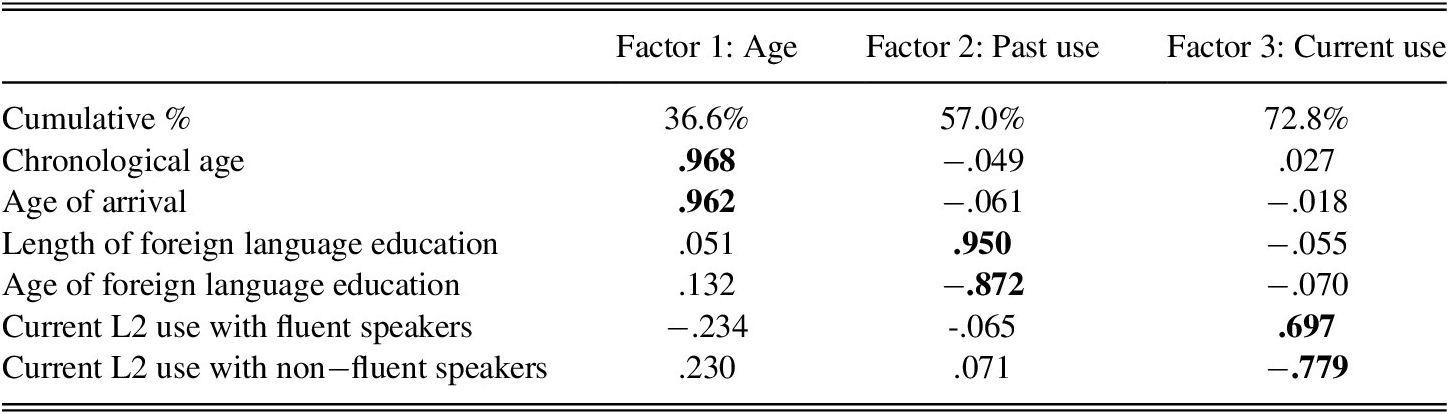
To check the latent factors underlying a total of six biographical background variables, these raw scores were submitted to a factor analysis with the Direct Oblimin rotation method. The factorability of the dataset was confirmed with the KMO Measure of Sampling Adequacy (.542) and Bartlett’s Test of Sphericity (χ 2 = 189.211, p < .001). As shown in Table 3, Factor 1 was labeled as “Age” (featuring chronological age and age of arrival), Factor 2 as “Past Use” (featuring the timing/length of EFL education), and Factor 3 as “Current Use” (featuring the frequency of L2 use with fluent and nonfluent speakers). The factors were used for the rest of the statistical analyses.
Summary of factor loadings underlying biographical background variables

Note. All loadings > .6 or < −.6 are highlighted in bold.
AUDITORY PROCESSING, BIOGRAPHICAL INFORMATION, AND L2 PROFICIENCY
A mixed-effects regression analysis was performed to examine the relative contributions of auditory processing and biographical backgrounds to participants’ L2 proficiency scores. Following the same procedure in Study 1, we standardized all the L2 linguistic test scores into z-scores—(a) segmental proficiency (M = 73.5%, SD = 10.1%, Range = 50–100%), (b) prosodic proficiency (M = 77.5%, SD = 13.1%, Range = 35–100%), (c) lexical proficiency (M = 62.3%, SD = 12.2%, Range = 24.3–93.1%), and (d) morphosyntactic proficiency (M = 79.7%, SD = 10.1%, Range = 50–97%). The model was constructed with their standardized L2 scores as dependent variables in accordance with one repeated Task condition (vowel, prosody, lexis, grammar), two auditory processing scores (temporal, spectral), and three biographic factors (Age, Past Use, Current Use). Task was treatment coded, and vowel performance was used as the reference category. Lower scores index more precise auditory processing. The results of the Kolmogorov–Smirnov test confirmed that composite L2 proficiency scores were normally distributed (D = .075, p = .917).
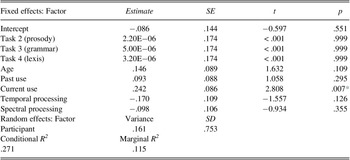
As shown in Table 4, the model identified Current Use as the only significant predictor (p = .007), accounting for 11.5% of the variance in participants’ L2 proficiency scores (across all the task conditions). In contrast with the findings from Study 1, none of the auditory processing factors (temporal, spectral) reached statistical significance (p > .05). This discrepancy indicates that the predictive power of auditory processing alone for L2 acquisition may become minor at best when analyses focus on inexperienced L2 learners without much immersion experience.
Summary of the final model explaining the perceptual and biographical correlates of L2 proficiency

* indicates statistical significance (p < .05).
DISCUSSION
There is emerging evidence that auditory processing could be a significant determinant of naturalistic L2 learning for L2 learners with a certain degree of immersion experience (cf. Kachlicka et al., Reference Kachlicka, Saito and Tierney2019 for n = 40 Polish speakers with LOR of 1–5 years, and Study 1 for n = 39 Spanish speakers with LOR of 2–24 years). In Study 2, however, the audition-proficiency link was considerably weaker in the context of n = 50 inexperienced Chinese learners of English with limited immersion experience (LOR < 4 months). The results indicated that the outcomes of initial stage of L2 immersion are more influenced by the extent to which participants actively use/practice the target daily (Flege, Reference Flege, Piske and Young-Scholten2009). Thus, it is possible that an anchor of L1 acquisition, that is, domain-general auditory processing, could be tied to the degree of success in postpubertal L2 learning, but only after learners engage in a sufficient amount of immersion experience.
STUDY 3: LATER STAGE OF AUDITION-PROFICIENCY LINK
Study 3 tests our hypothesis that individual differences in auditory processing could predict the later stage of L2 proficiency attainment. Unlike the precursor datasets (Kachlicka et al., Reference Kachlicka, Saito and Tierney2019; Studies 1 and 2), Study 3 focused on ultimate attainers who were assumed to reach the upper limit of L2 proficiency through a great deal of intensive L2 use for a prolonged period of residence in an L2-speaking country (LOR > 6–19 years). As many scholars have pointed out, the relationship between experience and proficiency is assumed to have already reached plateau among ultimate attainers (for a review, Piske et al., Reference Piske, MacKay and Flege2001). Here, our first prediction is that long-term L2 users’ proficiency is not clearly susceptible to the quality and quantity of immersion. Notably, ample empirical evidence has identified a range of perceptual-cognitive variables as significant determinants of success in L2 ultimate attainment, such as working memory (Linck et al., Reference Linck, Hughes, Campbell, Silbert, Tare, Jackson, Smith, Bunting and Doughty2013), language analytic ability (Abrahamsson & Hyltenstam, Reference Abrahamsson and Hyltenstam2008), and implicit learning ability (Suzuki & DeKeyser, Reference Suzuki and DeKeyser2017). Thus, our second prediction is that long-term L2 users’ proficiency could be mainly determined by the degree of auditory precision (rather than different types of biographical backgrounds).
METHOD
BIOGRAPHICAL BACKGROUNDS OF PARTICIPANTS
Considering the existing research standard in L2 ultimate attainment research (e.g., DeKeyser, Reference DeKeyser2013), efforts were made to recruit ultimate attainers with a relatively stable level of L2 proficiency. Because some ultimate attainment studies screened their participants multiple times to identify and scrutinize the degree of linguistic nativelikeness among highly advanced L2 learners, we would emphasize here that the main objective of Study 3 was to examine what characterized the auditory processing and L2 profiles among experienced L2 learners who had extensively used the target language for meaning in various social settings (as opposed to the inexperienced L2 learners in Study 2 who did not have much immersion experience). As shown in many previous studies (e.g., Flege et al., Reference Flege, Munro and MacKay1995; Saito, Reference Saito2013), we assumed that these late L2 learners likely showed nonnativelike L2 proficiency. In our view, ultimate attainers’ proficiency could be relatively stable, but not necessarily static. Although a quick, substantial improvement is unlikely to happen at the later stage of L2 development, even highly experienced L2 users’ linguistic systems are flexible to minor change (gradually developing or declining as a function of the frequency of L1 and L2 use; Flege, Reference Flege, Piske and Young-Scholten2009).
In Study 3, ultimate attainers were defined as highly experienced, active, and motivated L2 users despite the varied degree of L2 proficiency levels. To this end, the participants had to meet the following two conditions. First, they must have reported that their main language of communication either at home or work was L2 English (rather than L1) and that they had been residing in an L2 speaking environment for at least 6 years (for the same methodological decisions, see Birdsong & Molis, Reference Birdsong and Molis2001; Saito, Reference Saito2013). To recruit enough of such L2 highly experienced L2 attainers, the decision was made to recruit L1 Polish residents in London, UK. According to the national census (UK Census, 2011), the number of Polish immigrants in the city was relatively large (approximately 320,000 representing 4–5% of the population in Greater London). After the electronic flyer was widely distributed across five different universities in Greater London, on various community websites and through social media, approximately 100+ interested Polish speakers contacted the researchers.
The L2 use profiles of the recruits were carefully scrutinized using an online questionnaire and e-mail communication (LOR > 6 years; main language of communication = L2 English rather than L1 Polish). Although we did not assess their L2 proficiency, we did check the extent to which and how these participants had been using the target language. A final total of 50 experienced Polish speakers were carefully selected as ultimate attainers for Study 3. All the participants (12 males, 38 females) spent a varied amount of time in foreign language education in Poland (M = 7.0 years, Range = 1–13 years). Subsequently, they moved to the United Kingdom with an age of arrival of greater than 17 years (M = 23.1, Range = 17–32 years). At the time of the project, the participants (M age = 35.7 years, Range = 24–45 years) had resided in the United Kingdom for an extensive period (M = 11.8 years, Range = 6–19 years). They reported that they mainly used L2 English in various social settings (M L2 use = 75.1%, Range = 50–100%).
MEASURES OF AUDITORY PROCESSING
The same test materials used in Studies 1 and 2 were used to assess the participants’ duration, rise time, pitch, and formant discrimination abilities on a 100-point scale.
MEASURES OF L2 SEGMENTAL, PROSODIC, LEXICAL, AND GRAMMATICAL PROFICIENCY
The same materials used in Studies 1 and 2 were used to measure the participants’ proficiency in segmental perception (sound and word identification), prosody perception (sentence stress identification), vocabulary knowledge (lexical decision), and grammatical intuition (grammaticality judgments).
RESULTS
CHARACTERISTICS OF AUDITORY PROCESSING
To calculate the composite scores for the subsequent analyses, they were transformed through the log10 function, standardized, and averaged for temporal processing (duration and rise time) and spectral processing (pitch and formant). According to the Kolmogorov–Smirnov normality tests, both temporal and spectral processing scores were not significantly different from the normal distribution, D = .055, .122, p = .995, .409.
CHARACTERISTICS OF BIOGRAPHICAL BACKGROUNDS
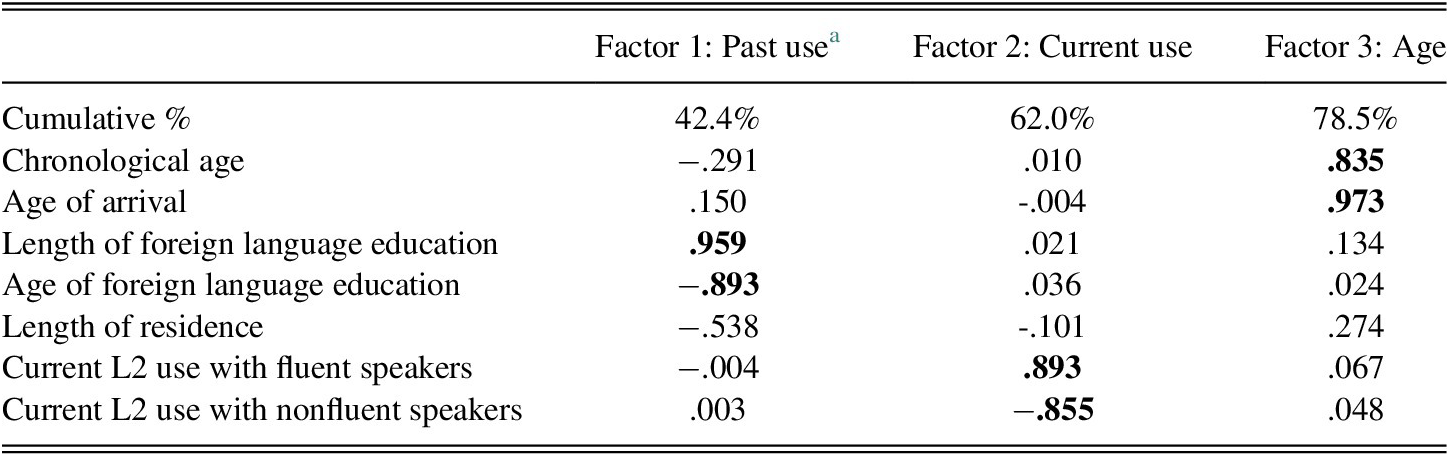
Participants’ biographical background scores were submitted to a factor analysis with the Direct Oblimin rotation method. The factorability of the dataset was confirmed with the KMO Measure of Sampling Adequacy (.567) and Bartlett’s Test of Sphericity (χ2 = 134.199, p < .001). According to Table 5, Factor 1 was labeled “Past Use” as it summarized the extent of participants’ EFL training; Factor 2 was labeled “Current Use,” as it summarized the extent to which participants were using L2 English at the time of the project; and Factor 3 was labeled “Age” as it summarized the age at which participants had started EFL education and immersion in the United Kingdom. These factors were used for the rest of the statistical analyses.
Summary of factor loadings underlying biographical background variables

Note. All loadings > .6 or < −.6 are highlighted in bold.
a Directionality was reversed to facilitate the interpretation of the factor (larger values indicate more practice).
AUDITORY PROCESSING, BIOGRAPHICAL BACKGROUNDS, AND L2 PROFICIENCY
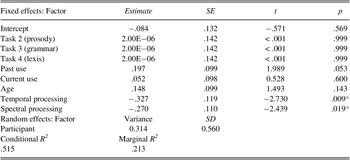
To examine how auditory processing and biographical background factors jointly interacted to determine L2 phonological, lexical, and morphosyntactic proficiency, a mixed-effects regression analysis was performed. The participants’ linguistic proficiency demonstrated a great deal of individual variation in terms of segmental perception (M = 83.2%, SD =10.4, Range = 55–100%), prosody perception (M = 81.9%, SD = 14.9%. Range = 40–100%), vocabulary knowledge (M = 80.1%, SD = 12.6%, Range = 34.7–100%), and grammatical intuition (M = 81.3%, SD = 9.9%, Range = 49–96%). For the purpose of statistical analyses, these measures were transformed to z-scores. The model included all the participants’ L2 proficiency scores as dependent variables, and two auditory processing scores (temporal, spectral), three biographical background factors (Age, Current Use, Past Use), and one repeated Task condition (vowel, prosody, vocabulary, grammar) as predictor variables. Task was treatment coded, and vowel performance was used as the reference category. Lower scores index more precise auditory processing. The Kolmogorov–Smirnov test found that participants’ composite L2 proficiency scores were normally distributed (D = .106, p = .583). As summarized in Table 6, the model identified only auditory processing factors as significant predictors (p = .009 for temporal processing, p = .019 for spectral processing), explaining 21.3% of the variance in participants’ L2 outcomes. Interestingly, none of the biographical background factors were included as significant predictors (p > .05).
Summary of the final model explaining the perceptual and biographical correlates of L2 proficiency

* indicates statistical significance (p < .05).
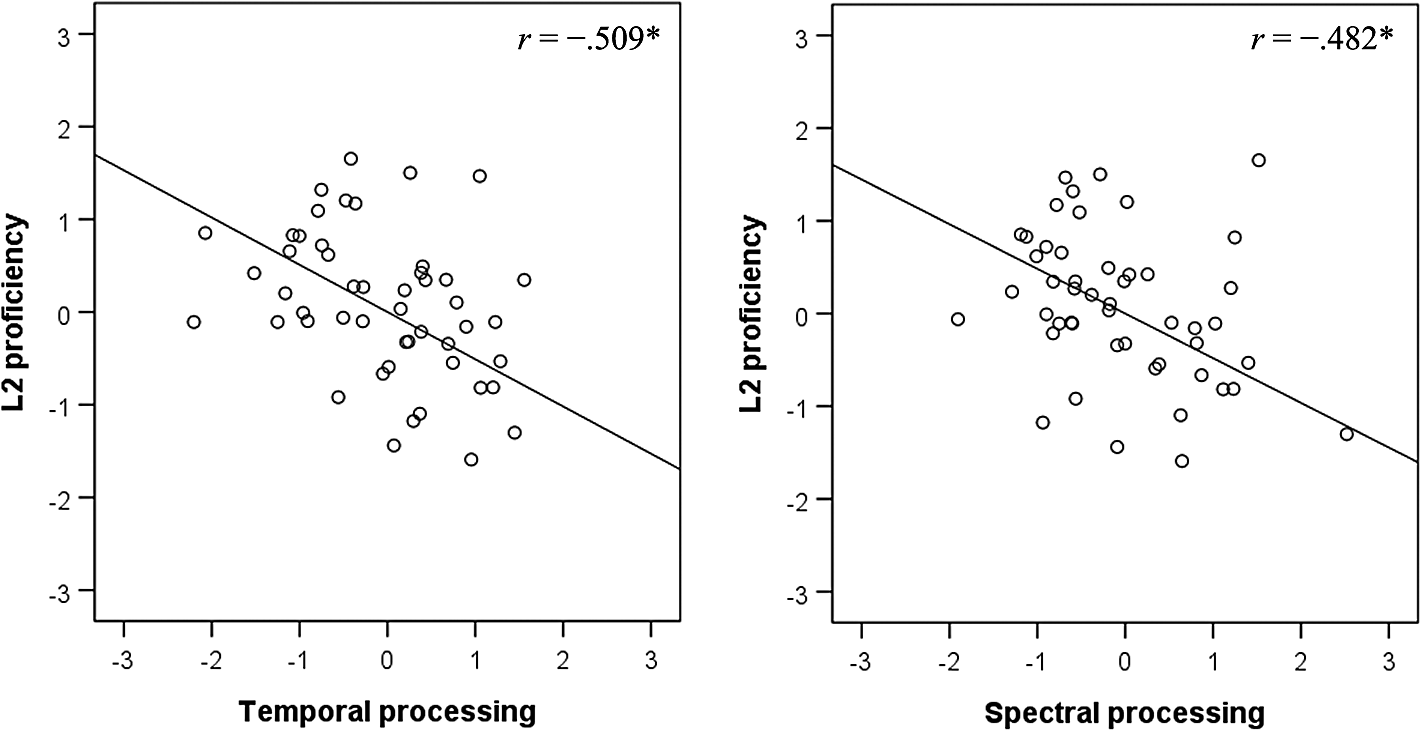
Finally, a set of partial correlation analyses were run to delve into precisely how the auditory processing factors (temporal, spectral) related to participants’ L2 proficiency (averaged L2 test scores) when all the other biographical factors were statistically factored out. The correlations were significant for both temporal processing (r = −.509, p < .001) and spectral processing (r = −.482, p < .001; see Figure 2).
Correlations between L2 linguistic proficiency and auditory processing residuals with biographical factors partialled out.

DISCUSSION
Study 3 examined the perceptual and biographical profiles of highly experienced (LOR = 6–19 years) L2 learners, and their relationship with segmental, prosodic, lexical, and grammatical proficiency attainment. In line with our predictions, the results of mixed-effects modeling analyses identified the significant explanatory power of auditory processing (R2 = .213) but not that of biographical background factors. The findings of Study 3 suggest that it is not experience but aptitude (i.e., auditory processing) that can predict the rate of success in postpubertal L2 learning (see Doughty, Reference Doughty2019).
STUDY 4: JOINT ANALYSIS
Given that the three studies separately concerned three different groups of adult L2 learners at different phases of L2 learning (Spanish, Chinese, Polish), Study 4 sought to examine the complex relationships between auditory processing, biographical backgrounds, and L2 proficiency when all the data were aggregated.
RESULTS
CHARACTERISTICS OF AUDITORY PROCESSING
A total of 139 participants’ (39 Spanish, 50 Chinese, 50 Polish) auditory processing scores were recalculated to derive standardized z scores. Given that the results of the Kolmogorov–Smirnov test found the distribution of the raw scores to be significantly nonnormal (p > .05), they were transformed using the log10 function. After transformation, the temporal and spectral processing scores were normally distributed, D = .072, .045, p = .436, .927.
CHARACTERISTICS OF BIOGRAPHICAL BACKGROUNDS
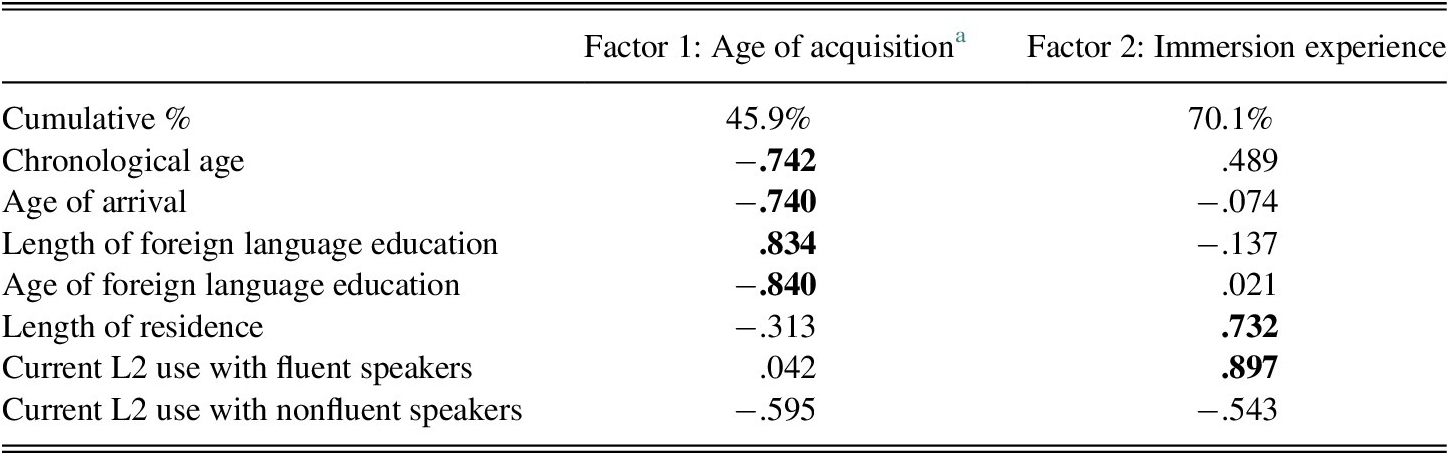
All the participants’ biographical background profiles were examined using an exploratory factor analysis with the Direct Oblimin rotation method. The factorability of the dataset was confirmed with the KMO Measure of Sampling Adequacy (.518) and Bartlett’s Test of Sphericity (χ2 = 749.895, p < .001). In light of the results (summarized in Table 7), Factor 1 was labeled as Age of Acquisition (indexing how early they started learning and using L2 English in both classroom and naturalistic settings); and Factor 2 was labeled as Immersion Experience (indexing how long and often they were using L2 English under immersion conditions). The factors were used for the rest of the statistical analyses.
Summary of factor loadings underlying biographical background variables

Note. All loadings > .6 or < −.6 are highlighted in bold.
a Directionality was reversed to facilitate the interpretation of the factor (more practice indicates better).
AUDITORY PROCESSING AND BIOGRAPHICAL BACKGROUNDS
We first conducted one-way ANOVAs to examine the role of participants’ L1 backgrounds in individual differences in the auditory processing abilities. The results yielded significant group effects for temporal and spectral processing (F = 26.011, p < .001) (F = 13.896, p < .001). As shown in the factor analyses mentioned previously, however, it is important to remember that the participants also widely differed in their biographical backgrounds (Age of Acquisition, Immersion Experience).
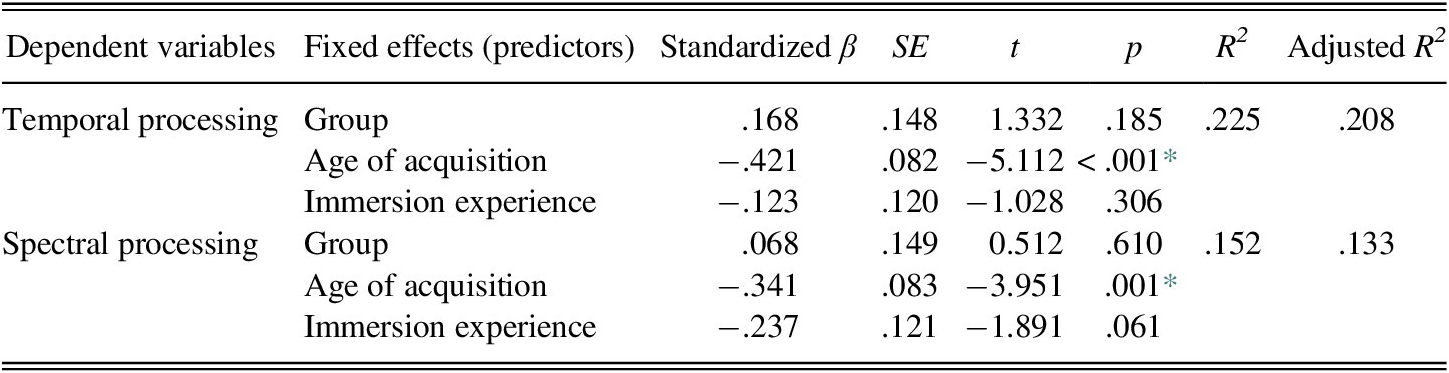
To examine the relative weights of L1 backgrounds and age- and experience-related variables, two multiple regression models were constructed using the lm function in R with two different types of auditory processing scores (temporal, spectral) as dependent variables. Lower scores index more precise auditory processing. For each model, three predictors were included, that is, Group (Spanish, Chinese, Polish), Age of Acquisition, and Immersion Experience. According to the results summarized in Table 8, the composite models significantly explained a medium amount of variance in participants’ temporal processing ability (20.8%) and spectral processing ability (13.3%).
Summary of the final model explaining the biographical correlates of auditory processing

* indicates statistical significance (p < .05).
The results suggest that when we aggregated the dataset of L2 learners, participants’ age of acquisition (rather than immersion experience) was found to be a significant predictor of their individual differences in auditory processing. Interestingly, when the participants’ biographical factors (Age of Acquisition, Immersion Experience) were controlled for, their L1 backgrounds (operationalized as a repeated Group factor) failed to reach statistical significance, suggesting that auditory processing is only weakly related to what types of language (e.g., tonal vs. nontonal) L2 users speak as a native language, at least within the current dataset.
AUDITORY PROCESSING, BIOGRAPHICAL BACKGROUNDS, AND L2 PROFICIENCY
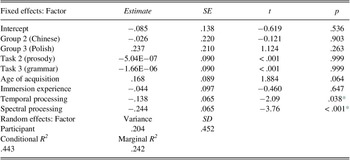
Given that all the groups completed segmental perception, prosodic perception, and grammaticality judgment assessments, these three test scores were standardized into z-scores, and used as an index of their L2 proficiency for the final analyses. The normality test confirmed that participants’ composite L2 proficiency scores were normally distributed, D = .099, p = .118. A linear mixed-effects regression analysis was performed with participants’ L2 proficiency scores as dependent variables relative to Group (Spanish, Chinese, Polish), Task (vowel, prosody, grammar), two auditory processing factors (temporal, spectral), and two biographical background factors (Age of Acquisition, Immersion Experience). According to the results of the model (shown in Table 9), 24.2% of the variance in participants’ L2 outcomes could be determined by the auditory processing factors (p = .038 for temporal processing; p < .001 for spectral processing). The predictive power of Age of Acquisition reached marginal significance (p = .064). Again, no effects of Group nor Task were found significant (p > .05).
Summary of the final model explaining the perceptual and biographical correlates of L2 proficiency (main effects only)

* indicates statistical significance (p < .05).
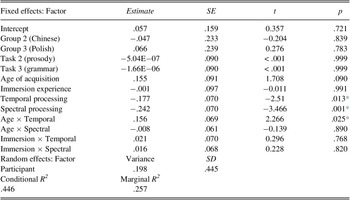
To test our hypothesis that those with more precise auditory processing can better utilize their L2 experience, another mixed effects model was constructed including the main and interaction effects of the auditory processing and biographical factors. Adding both main and interaction terms in the analyses could be considered robust, given that the sample size is relatively large and varied, including a total of 139 learners at various stages of L2 learning.
Referring to the second model (explaining 25.7% of the variance in participants’ L2 proficiency; see Table 10), the main effects of temporal and spectral processing remained significant (p = .013, .001). Interestingly, the interaction effect of Age of Acquisition and Temporal Processing was significant (p = .025). In general, Age of Acquisition was positively correlated with averaged L2 proficiency scores, r = .482, p < .001 (the direction of factor variable, Age of Acquisition, reversed; see Table 7). When the participants with more precise temporal processing (indexed by smaller scores) were grouped as More Temporally Oriented (n = 70), the relationship between Age of Acquisition and L2 proficiency became weaker, r = .243, p = .042. As for the remaining participants with less precise temporal processing (indexed by larger scores), whom we grouped as Less Temporally Oriented (n = 69), the predictive role of Age of Acquisition was considered stronger, r = .498, p < .001.
Summary of the final model explaining the perceptual and biographical correlates of L2 proficiency (main and interaction effects)

* indicates statistical significance (p < .05).
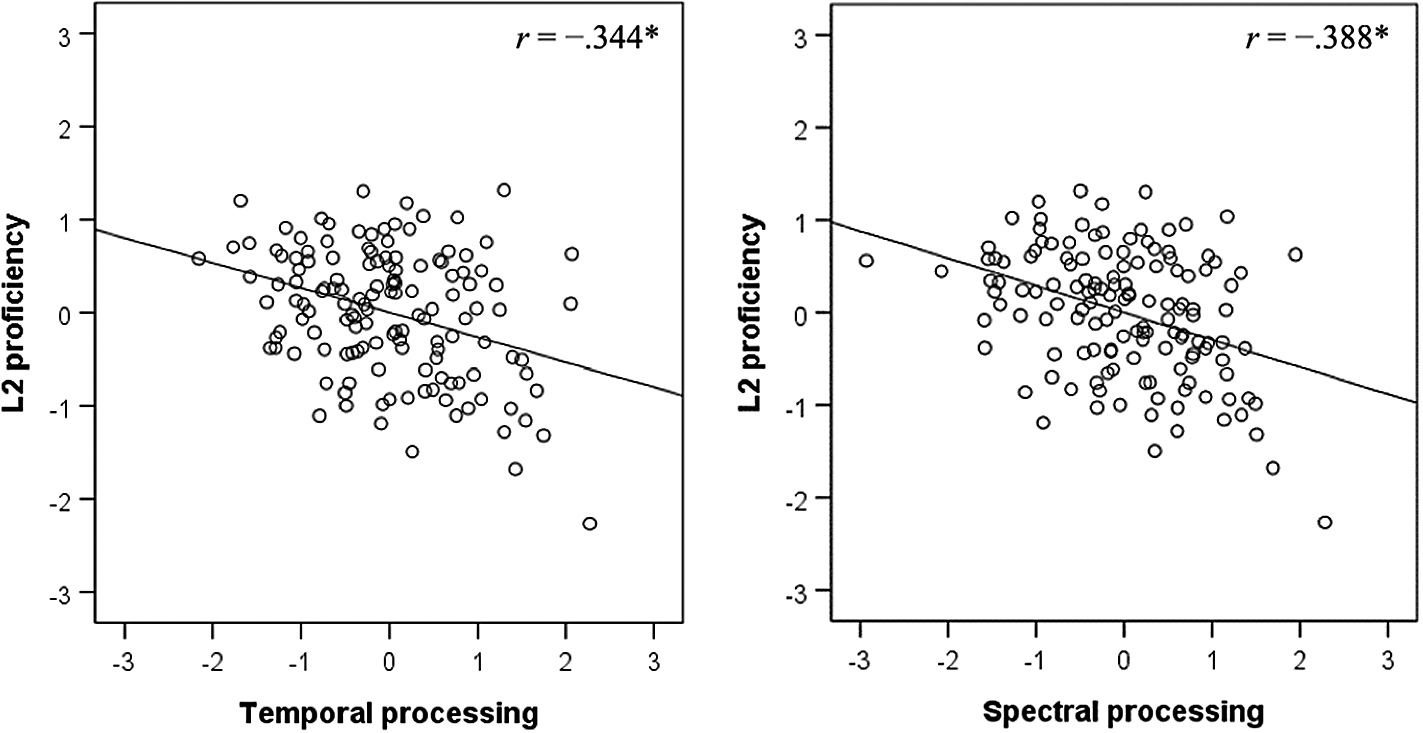
Finally, the independent contribution of auditory processing (temporal, spectral) to L2 proficiency (averaged L2 test scores) was examined using a set of partial correlation analyses for which the biographical background factors (Age of Acquisition, Immersion Experience) were controlled. As shown in Figure 3, there were moderate associations between L2 proficiency and temporal processing (r = −.344, p < .001) as well as spectral processing (r = −.388, p < .001) (Plonsky & Oswald, Reference Plonsky and Oswald2014).
Correlations between L2 linguistic proficiency and auditory processing residuals with biographical factors partialled out.

DISCUSSION
In the context of 139 Spanish, Chinese and Polish participants, the results hinted at a possible triangular relationship between experience, auditory processing, and L2 proficiency. First, participants’ auditory processing was primarily linked to their bilingual experience (how early they had started practicing the target language in classroom and naturalistic settings), and secondarily to their L1 backgrounds (Spanish, Chinese, or Polish). This is in line with the cognitive psychology literature on the relationship between language experience and auditory processing (e. g., Bidelman et al., Reference Bidelman, Gandour and Krishnan2011 for tonal vs. nontonal language users; Krizman et al., Reference Krizman, Slater, Skoe, Marian and Kraus2015 for simultaneous vs. sequential bilinguals).
Next, both auditory processing and biographical backgrounds together explained a moderate amount of variance in participants’ L2 proficiency (R 2 = .257) (Plonsky & Oswald, Reference Plonsky and Oswald2014). The results suggest that the degree of success in postpubertal L2 learning could be primarily determined by the extent to which individuals are perceptually adept at making the most of their L2 learning experience (i.e., more precise auditory processing). Among certain learners with less precise auditory processing capacities, the outcomes of their L2 proficiency may be mediated by how early and long L2 users have been practicing a target language.
GENERAL DISCUSSION
To replicate, extend and generalize the findings of our precursor research (Kachlicka et al., Reference Kachlicka, Saito and Tierney2019), the current study set out to examine the role of auditory processing as a predictor of various aspects of L2 proficiency in the context of three different groups of late L2 learners—that is, n = 39 Spanish speakers with varied experience profiles in Study 1 (LOR = 2–24 years), n = 50 inexperienced Chinese learners in Study 2 (LOR < 4 months), and n = 50 experienced Polish speakers in Study 3 (LOR = 6–19 years). Whereas auditory processing was not a significant predictor for inexperienced L2 learners at the onset of immersion (LOR < 4 months), the degree of success among more experienced L2 learners in various stages of naturalistic L2 immersion (LOR = 1–24 years) was mainly tied to participants’ individual differences in auditory processing ability (temporal, spectral) rather than their biographical backgrounds (experience, age).
The cross-sectional findings presented here lead us to make several conclusions about the perceptual-cognitive foundations of successful postpubertal L2 proficiency at different levels of immersion (the initial, mid- and later stages of L2 learning). In the initial phase of immersion, the predictive power of auditory processing is relatively weak. Echoing findings from the previous literature, our dataset suggests that inexperienced learners’ (LOR < 4 months) L2 proficiency is determined more by how frequently, regularly, and intensively they have been practicing the target language in naturalistic settings. As they engage in a sufficient amount of immersion in an L2 speaking environment (length of residence > 1 year), however, late L2 learners appear to draw on domain-general auditory processing to a greater extent, mirroring previous findings in children learning a first language.
Overall, our tentative conclusion is that auditory processing is a critical determinant of postpubertal L2 learning, particularly in an interactive, meaningful and immersive setting (similar to L1 acquisition). Our arguments here are in line with the view that domain-general auditory processing underlies the different stages and dimensions of language acquisition. According to an influential model of L1 phonological category acquisition (e.g., Toscano & McMurray, Reference Toscano and McMurray2010), learners track information about the distributional statistics of different auditory cues, in an attempt to figure out how many modes are present and where they’re located, and in so doing map auditory cues onto phonological categories (e.g., vowel length and voice onset time for voicing contrasts in stop consonants). By detecting patterns in temporal and spectral features in speech, learners establish robust phonological categories, which will in turn facilitate and expedite the acquisition of lexical, morphosyntactic, and semantic knowledge. Importantly, this model suggests that this process will be more rapid when the cue distributions have less variance or/and when learners can track such distributions more precisely. Given that our tests of temporal and spectral discrimination serve as an index of participants’ perceptual variance, those with lower thresholds (more precise auditory processing) may have less overlapping cue distributions between phonological categories, enabling them to extract the underlying categories more quickly.
All in all, the current study lends empirical support to the bilingual-cognitive account of L2 acquisition which suggests that L2 learners continue to rely on the same cognitive, perception-based mechanisms they used in acquiring their L1 (Birdsong, Reference Birdsong2006; Flege, Reference Flege, Piske and Young-Scholten2009). Our study adds that domain-general auditory processing may be one of the processes that underpins both L1 and L2 acquisition. To acquire an additional language after puberty, learners need to attend to relevant acoustic cues as a first step toward establishing new phonological, lexical, and grammatical categories despite the strong influence of possibly different cue weighting patterns in their L1 systems (McAllister et al., Reference McAllister, Flege and Piske2002 for the feature hypothesis). If certain individuals are endowed with more precise auditory processing, they could better notice, analyze, and internalize all the received auditory input throughout naturalistic L2 learning experience (i.e., combined effects of experience and audition on interlanguage development).
When L2 learners make greater efforts to use the target language with different interlocutors, such quality bilingual experience subsequently enhances auditory processing, as suggested in the previous literature (Krizman et al., Reference Krizman, Slater, Skoe, Marian and Kraus2015; Omote et al., Reference Omote, Jasmin and Tierney2017) and the current study (Study 1). One useful focus for future research will be the extent to which the effects of bilingual experience on auditory processing are modulated both by an individual’s L1 (e.g., tonal vs. nontonal languages) and the L2 in which the individual is immersed. In the long run, more precise auditory processing abilities will help L2 learners benefit more from every input and output opportunity, which will in turn lead them to develop, restructure, and refine more robust L2 phonological, lexical, and grammatical systems (i.e., strong audition effects on ultimate attainment).
The hypothesis that precise auditory processing facilitates both L1 and L2 acquisition motivates several topics for future investigation. First, the traditional models of aptitude for successful L2 acquisition have been limited to a set of cognitive abilities specific to explicit language learning and analysis in classroom settings (e.g., Carroll & Sapon, Reference Carroll and Sapon1959 for the Modern Language Aptitude Test). Given the importance of revisiting, revising, and updating the aptitude framework for naturalistic L2 learning based on the cognitive psychology literature (cf. Linck et al., Reference Linck, Hughes, Campbell, Silbert, Tare, Jackson, Smith, Bunting and Doughty2013 for Hi-Lab), we suggest that both temporal and spectral processing measures should be integrated in the comprehensive test batteries. It would be intriguing to compare the relative weights of different domain-general cognitive abilities (e.g., working, declarative, and procedural memory) in different types of L2 acquisition (e.g., classroom vs. naturalistic; see Faretta-Stutenberg & Morgan-Short, Reference Faretta-Stutenberg and Morgan-Short2018).
Related to this, it is noteworthy that the current study provided some evidence in support of the cognitive psychology literature that auditory processing may be related to biographical factors, such as bilingual experience (Krizman et al., Reference Krizman, Slater, Skoe, Marian and Kraus2015) and chronological age (Skoe et al., Reference Skoe, Krizman, Anderson and Kraus2013). This in turn suggests that auditory processing can be enhanced using focused training. Intriguingly, a range of remedial training programs have been devised to overcome auditory deficits in the L1 acquisition literature. For example, a few hours of training could enhance various dimensions of auditory processing among children and adults with language disorders, such as spectral processing (Micheyl et al., Reference Micheyl, Delhommeau, Perrot and Oxenham2006; Whiteford & Oxenham, Reference Whiteford and Oxenham2018) and pitch discrimination (Carcagno & Plack, Reference Carcagno and Plack2011). Future studies should conduct interventions with a pre- and posttest design to further delve into how the clinical techniques could be applied to help learners boost their auditory processing ability, and by extension to aid L2 learning. In this regard, it would also be crucial to investigate how individuals’ auditory processing profiles (e.g., duration, rise time, pitch vs. formant discrimination) could be used as a diagnostic tool to identify perceptually and cognitively matched, optimal training methods, and to incorporate clinical techniques in accordance with learners’ aptitude profiles and instructional treatments (i.e., the aptitude-treatment interaction; see Doughty, Reference Doughty2019).
From a methodological perspective, we would like to remind the readers of the fact that all the audition and linguistic measures in the current study were explicit in nature (i.e., the participants were clearly aware of what they were doing). During the auditory processing tasks, for example, all the participants were asked to pay conscious attention to discriminating acoustic differences in synthesized tokens. When working on vowel and prosody identification, and nonword and grammaticality judgment tasks, the participants were also allowed to carefully monitor the phonological, lexical, and grammatical aspects of language. Crucially, Study 4 failed to find significant group differences in the participants’ L2 proficiency scores even though they significantly differed in terms of the length of immersion experience. This null result raises a methodological concern that the L2 tests used in the current study may not have been sensitive enough to capture L2 proficiency at fine-grained levels. In this regard, the adoption of more implicit, complex, and demanding tasks has been suggested as an ecologically valid way to index the present state of L2 proficiency (see Abrahamsson & Hyltenstam, Reference Abrahamsson and Hyltenstam2009; cf. Saito et al., Reference Saito, Sun and Tierney2019 for spontaneous production measures).
In the field of L2 acquisition, it has been claimed that adult L2 learning uniquely involves both explicit and implicit modes of processing, suggesting that the attainment of high-level L2 proficiency depends on whether L2 learners can subconsciously acquire a target language regardless of cognitive and affective states (Doughty, Reference Doughty2019; Linck et al., Reference Linck, Hughes, Campbell, Silbert, Tare, Jackson, Smith, Bunting and Doughty2013). Recently, some scholars have suggested that auditory processing can be operationalized using explicit and implicit constructs through behavioral and neurophysiological measures (e.g., Díaz et al., Reference Díaz, Erdocia, de Menezes, Mueller, Sebastián-Gallés and Laka2016). This line of research has also shown that explicit and implicit auditory processing scores could tap into two different phenomena because these scores were not correlated with each other among bilinguals (Saito et al., Reference Saito, Sun and Tierney2019) and monolinguals (Clinard et al., Reference Clinard, Tremblay and Krishnan2010). Future studies should further examine how explicit and implicit auditory processing are uniquely tied to the initial, mid-, and final stages of L2 phonology, vocabulary, and grammar learning from multiple angles (cf. Saito et al., Reference Saito, Kachlicka, Sun and Tierney2020a, Reference Saito, Sun and Tierney2020c).
Finally, we acknowledge that the construct validity of the auditory processing measures (i.e., A × B discrimination) remains unclear. As pointed out in the existing literature (Snowling et al., Reference Snowling, Gooch, McArthur and Hulme2018), the task format inevitably not only taps into participants’ auditory perception skills but also may rely upon a range of modality-general cognitive abilities (e.g., working memory, attention control; for further discussion, see Saito et al., Reference Saito, Sun and Tierney2020b). To further examine the unique contribution of auditory perception to L2 learning, future studies should adopt not only auditory processing but also cognitive ability tasks. It would be intriguing to see the extent to which the perception-proficiency link remains significant even after all the cognitive individual differences are statistically controlled for (cf. Saito et al., Reference Saito, Sun and Tierney2019 for auditory perception vs. phonetic coding).