INTRODUCTION
Processing instruction (PI) is a type of pedagogical intervention that is designed to help second language (L2) learners acquire specific grammatical structures by giving them practice with efficient input processing through activities called structured input (SI). This intervention does not require production of target structures during training. The benefits of SI practice are presumed to be because these activities are created with L2 learners’ processing strategies in mind, and that they help learners process grammatical forms in input more efficiently than more traditional types of training that involve mechanical production of target structures. Since the publication of VanPatten and Cadierno (Reference VanPatten and Cadierno1993), a growing body of research in second language acquisition (SLA) has surfaced to support the benefits of PI. The first strand involves comparing PI to a drill-oriented pedagogical practice that was prevalent at the time VanPatten and Cadierno (Reference VanPatten and Cadierno1993) executed their study, a practice they called traditional instruction (TI). Another strand of PI research investigates the role of explicit information (EI) in grammar learning. Does EI help or does it make no difference?
Research over the past 20 years has demonstrated that PI can more effectively facilitate the learning of targeted structures than TI (e.g., Benati, Reference Benati2001; Cadierno, Reference Cadierno1995; Comer & DeBenedette, Reference Comer and DeBenedette2010; VanPatten & Cadierno, Reference VanPatten and Cadierno1993; VanPatten & Wong, Reference VanPatten, Wong and VanPatten2004). This research also suggests that EI is not necessary to help L2 learners process target forms correctly (e.g., Benati, Reference Benati and VanPatten2004; Sanz, Reference Sanz and VanPatten2004; VanPatten & Oikkenon, Reference VanPatten and Oikkenon1996; Wong, Reference Wong and VanPatten2004b). However, because the assessment tasks in these studies have been offline, we do not know how learners are interacting with the input they are attempting to process during real-time comprehension. As defined by VanPatten (Reference VanPatten2015b), input processing is “the moment-by-moment computation of sentence structure” (p. 92) and “the linking of form and meaning during real time comprehension” (p. 93). Therefore, for us to examine whether PI helps L2 learners make form-meaning connections more efficiently during real-time comprehension, we need to assess their input processing using an online measure. Online techniques may reveal findings that do not show up in studies that use strictly offline pretest/posttest designs because they provide “fine-grained information about moment-by-moment sentence comprehension” and additionally, they are more reliable measures of implicit knowledge (Keating & Jergerski, Reference Keating and Jegerski2015, p. 2). More recently, some PI studies have included online measures such as trials-to-criterion (e.g., Fernandez, Reference Fernandez2008; Henry, Culman, & VanPatten, Reference Henry, Culman and VanPatten2009; VanPatten, Borst, Collopy, Qualin, & Price, Reference VanPatten, Borst, Collopy, Qualin and Price2013) and self-paced reading (SPR) (e.g., Dracos, Reference Dracos2012; Henry, Reference Henry2015; McManus & Marsden, Reference McManus and Marsden2016) to investigate how L2 learners interact with input during real time. Henry (Reference Henry2015) compared PI and TI on the processing of German accusative case markers and found that while overall PI outperformed TI on an offline comprehension task, results of the SPR task did not show remarkable differences between how the two experimental groups processed the target structure.
A type of online measure that to our knowledge has not been used to assess the effects of PI is eye-tracking. Eye-tracking has an advantage over other types of online measures in SLA research because of its “incredibly fast temporal resolution” (Keating, Reference Keating, Jegerski and VanPatten2014, p. 75). Eye-tracking can measure the location and duration of eye gazes while speech unfolds, serving as “one of the most sensitive measures of moment-by-moment processing currently available” (Keating, Reference Keating, Jegerski and VanPatten2014, p. 75).
The present study reports the results of two experiments on L2 French learners’ processing of the French causative structure using eye-tracking as an online measure of input processing. Both experiments are conceptual replications of VanPatten and Wong (Reference VanPatten, Wong and VanPatten2004) comparing PI and TI. In Experiment 1, no EI about the target structure was given to participants before training (–EI). In Experiment 2, all participants were explicitly instructed on the French causative structure before they worked through training items (+EI).
BACKGROUND AND MOTIVATION
PROCESSING INSTRUCTION
PI is a pedagogical intervention that is informed by the strategies L2 learners use to process input, specifically, VanPatten’s model of input processing (VanPatten, Reference VanPatten1996, Reference VanPatten and VanPatten2004, Reference VanPatten, VanPatten and Williams2015a). This model makes predictions about what L2 learners do and do not do as they attempt to process sentence-level input. PI is an input-oriented intervention: Learners do not produce target items during training. Instead, they are given activities called SI to assist them with correct interpretation of sentence structure and to make correct form-meaning connections. The SI activities are designed so that learners must rely on sentence structure or a target form to correctly interpret the meaning that the form or structure encodes (VanPatten, Reference VanPatten2015b; Wong, Reference Wong and VanPatten2004a). In its original conception, PI also included explicit explanation about the targeted structure as well as a warning about the incorrect processing strategies that learners typically use that could lead to incorrect processing of target forms. For example, one of the predictions of the model is the First-Noun Principle (FNP): Learners tend to process the first noun or pronoun they encounter in a sentence as the agent (VanPatten, Reference VanPatten, VanPatten and Williams2015a). The tendency to assign the role of agent to the first animate noun phrase is known to be crosslinguistically common in the comprehension of structures with noncanonical word orders (e.g., passive forms, scrambled sentences, object clefts, and object-relative clauses), and the effect of this tendency has been demonstrated in children as well as in individuals with specific language impairment (SLI) or aphasia (Grodzinsky, Reference Grodzinsky2000; Leonard, Wong, Deevy, Stokes, & Fletcher, Reference Leonard, Wong, Deevy, Stokes and Fletcher2006; Swinney & Zurif, Reference Swinney and Zurif1995; cf., Meyer, Mack, & Thompson, Reference Meyer, Mack and Thompson2012). This strategy is effective when learners are processing SVO order sentences but will lead to incorrect interpretations if they are processing sentences in which the first noun is not the agent. This is the case with the French causative construction.
(1) Pierre fait faire du café à Marie.
Pierre makes to make coffee to Marie.
“Pierre makes Marie make coffee.”
(2) Jean fait acheter du lait à Paul.
Jean makes to buy milk to Paul.
“Jean makes Pierre buy milk.”
The verb faire is a common verb in French that means to do or to make (e.g., Pierre fait du café/Pierre makes coffee). This verb is also used as the main verb in the causative construction. As illustrated in (1) and (2), the causative construction consists of a conjugated form of the verb faire as the main verb followed by a second verb in the infinitive form to specify the caused action. In (1) the agent of the first conjugated verb, fait, is Pierre. The agent of the second verb in the infinitive form, faire, is Marie. This second agent Marie is placed postverbally and marked by the preposition à. Thus, the agent of the action faire du café is Marie. In (2) the agent of the main verb fait is Jean while the agent of the second infinitive verb infinitive, acheter, is Paul. The agent of the action acheter du lait is thus Paul. As verified in VanPatten and Wong (Reference VanPatten, Wong and VanPatten2004), when L2 learners process sentences like (1) and (2), they tend to interpret Pierre as the agent of the act of making coffee and Jean as the agent of buying milk because Pierre and Jean appear in the canonical subject position and are good candidates for executing the actions. VanPatten and Wong (Reference VanPatten, Wong and VanPatten2004) attempted to help L2 French learners overcome this processing strategy by first giving them EI about the causative structure and by making them aware of this tendency, which would lead to incorrect sentence interpretation for the French causative. Following this instruction, learners were given SI activities to help them overcome this tendency. These activities required them to listen to and read sentences that contained the verb faire in the causative and noncausative construction and then to determine who was performing the action. Participants never produce the target structure in these SI activities. This type of SI practice was designed so that learners would no longer strictly rely on the first noun as the agent of the action. Because cues such as animacy and plausibility were absent from sentences, the only way learners could correctly identify the agent of the caused action was through processing sentence structure.
The cue that learners needed to pick up to interpret that a sentence was causative was the presence of the second verb in the infinitive form after the conjugated main verb fait because it is this second verb that distinguishes causative sentences from noncausative sentences. For example, in (1), when learners initially only hear Pierre fait..., the sentence could plausibly be interpreted as Pierre doing something (e.g., Pierre fait du café [Pierre makes coffee]) or that he is going to have someone else do something (e.g., Pierre fait faire…). However, if learners subsequently hear a second verb in the infinitive (in this case faire), the only possible correct interpretation is that Pierre is going to have someone else do something. The goal of SI activities for the causative structure is to train learners to pick up on the cue that “fait + infinitive verb” denotes a causative construction that signals that the first noun cannot be the agent of the action. If such training is effective, learners who initially rely on the FNP should revise their sentence interpretation when they come across a second verb in the infinitive after the main verb fait.
In VanPatten and Wong (Reference VanPatten, Wong and VanPatten2004), PI training was compared to a drill-based treatment that they called TI, which consisted of giving participants EI on the causative structure followed by production practice with mechanical, meaningful, and communicative drills (see Paulston, Reference Paulston, Allen and Campbell1972 for rationale behind this practice). For example, participants in the TI group would see Marc/faire les valises à Jean (Marc/to pack the bags to Jean) and would have to create the causative construction with the elements: Marc fait faire les valises à Jean (Marc makes Jean pack the bags).
Using a pretest-posttest design, participants were assigned to either a PI, TI, or a control group. Training items for both treatment groups were balanced for vocabulary, number of activities, and practice time. The difference was that while the PI group received practice in interpreting sentence structure with SI activities, the TI group’s practice involved producing the target structure through drill practice. Regarding the EI that the two groups received, the difference was that the PI group additionally received a description of the difficulty that French learners have with this structure due to their FNP tendency. VanPatten and Wong (Reference VanPatten, Wong and VanPatten2004) explained that the TI group was not given this information because this was not typically part of traditional approaches to grammar instruction (p. 103).
The comparison of interpretation accuracy before and after training revealed the PI group performed significantly better than the TI group, while the two groups performed similarly on a sentence production task. Other studies that have found similar advantages of PI over TI include VanPatten and Cadierno (Reference VanPatten and Cadierno1993), Cadierno (Reference Cadierno1995), Benati (Reference Benati2001), and Comer and deBenedette (Reference Comer and DeBenedette2010). Interestingly, VanPatten and Wong (Reference VanPatten, Wong and VanPatten2004) also found that many TI participants also made the noncausative sentences causative, that is, they overgeneralized the newly learned structure and applied it to all items, even to distractor items that did not take the causative structure (see VanPatten & Wong, Reference VanPatten, Wong and VanPatten2004 for details). The PI group did not do this. When those TI participants who made distractor items causative were removed from the analysis, the production performance of the PI group (who had no practice in production) was better than the TI group, which performed no better than the control group. VanPatten and Wong (Reference VanPatten, Wong and VanPatten2004) concluded that TI teaches learners a test-taking strategy while PI teaches correct input processing that may lead to changes in mental representation enabling subjects to produce correct structures even though they did not practice doing so during training.
EFFECT OF EXPLICIT INFORMATION
A criticism of earlier research comparing PI with TI was that the group factor was confounded with instruction manipulation: The PI group was explicitly told about the FNP strategy while the TI group was not. VanPatten and Oikkenon (Reference VanPatten and Oikkenon1996) pointed out that the superior results found for PI in VanPatten and Cadierno (Reference VanPatten and Cadierno1993) could be due to the type of EI they received and not to the SI practice. Therefore, VanPatten and Oikkenon (Reference VanPatten and Oikkenon1996) isolated EI as a variable in PI. In their study on Spanish object pronouns with OVS order, they compared three groups: (1) EI + SI, (2) SI only without EI, and (3) a group that received EI only with no activities. They found that the group that received EI and SI, and the SI only group that did not get EI, performed the same. The EI only group made no gains. These results led the researchers to conclude that EI played no role: The component of PI that is responsible for the positive effects of PI research are the SI activities and not the EI. Many following studies have since replicated the results of VanPatten and Oikkenon (e.g., Benati, Reference Benati and VanPatten2004; Sanz, Reference Sanz and VanPatten2004; Sanz & Morgan-Short, Reference Sanz and Morgan-Short2004; Wong, Reference Wong and VanPatten2004b).
Fernandez (Reference Fernandez2008) introduced a different dimension to research on the role of EI in PI by examining whether EI can speed up the correct processing of certain structures. Using trials-to-criterion, a measure that counts how many items it takes for learners to begin processing a structure correctly, Fernandez compared PI with and without EI on two structures in Spanish: the subjunctive and object pronouns with OVS order. The results revealed that for the OVS structure, EI played no role in how soon, fast, or accurately participants processed the structure, supporting VanPatten and Oikkenon’s findings (1996). For the subjunctive, however, results showed that participants who had EI began to process the structure sooner, faster, and more accurately than those who did not have EI. Participants who only had SI did also eventually begin to process the subjunctive sentences correctly, confirming that SI practice alone can induce correct processing. Because having access to EI benefited the learners with the subjunctive structure but not for the OVS structure, Fernandez (Reference Fernandez2008) concluded that the benefits of EI may depend on the nature of the target structure.
VanPatten, Borst, Collopy, Qualin, and Price (Reference VanPatten, Borst, Collopy, Qualin and Price2013) also set out to isolate the effects of EI in PI as one of the goals in their study involving Spanish, German, French, and Russian. In a series of four experiments, they compared participants who received both EI and SI to participants who only received SI. Each language addressed a different target structure but all four structures shared the same processing problem, namely the FNP. The dependent measures were trials-to-criterion and improvement (i.e., posttest minus pretest) scores. In the Spanish study involving object pronouns with OVS order, there was no difference on either measure between participants who received EI with SI, and participants who received SI only without EI, replicating the results of Fernandez (Reference Fernandez2008). In the German study with nominative/accusative case marking on definite articles, participants who received EI before engaging in SI practice began to process sentences correctly sooner than those who did not have access to EI. On the pretest-posttest analysis, there was a marginal difference between the +EI and the –EI groups. This suggests that the –EI participants may have started to catch up to the +EI group but perhaps needed more items to do so (VanPatten et al., Reference VanPatten, Borst, Collopy, Qualin and Price2013, p. 516) (see also Culman, Henry, & VanPatten, Reference Culman, Henry and VanPatten2009, and Henry, Culman, & VanPatten, Reference Henry, Culman and VanPatten2009).
In the Russian experiment targeting nominative/accusative case marking on nouns, EI did not play a significant role in either trials-to-criterion or in the outcome based on the pretest-posttest measure. The French experiment, however, that targeted the causative structure as in VanPatten and Wong (Reference VanPatten, Wong and VanPatten2004), showed that the EI tended to help subjects process the structure sooner than those in the –EI condition. No significant difference, however, was found between the two conditions in the pretest-posttest analysis. This suggests that although EI might have helped participants process the target structure sooner, EI was not a factor in the outcome because it appears the –EI group was catching up to the +EI group in the end. The overall conclusion of this study across all four languages is that EI can speed up correct input processing for some structures (i.e., the French causative and German case marking). At the same time, because all participants in the –EI conditions eventually processed the structures correctly, EI may not be critical. SI alone appears to be sufficient to induce correct processing.
Henry (Reference Henry2017) examined the effects of EI and prosody on the same German target structure as VanPatten et al. (Reference VanPatten, Borst, Collopy, Qualin and Price2013) and found that EI helped learners process correctly sooner. Additionally, Henry (Reference Henry2017) found that participants who received either EI or prosody cues improved on an immediate comprehension and production task and this improvement was maintained on a delayed comprehension task four weeks later. The –EI participants, however, only improved on the immediate comprehension posttest and this improvement was not maintained on delayed posttests. Because Henry (Reference Henry2017) included delayed posttests, this study has evidence to show that EI can help learners process this target structure correctly sooner and maintain correct processing of the structure over time.
EYE-TRACKING: AN ONLINE MEASURE OF SENTENCE PROCESSING
In psycholinguistic research, eye-tracking has long been used as an online measure to assess how people process spoken input. The present study makes use of a visual world paradigm (see Trueswell & Tanhenhaus, Reference Trueswell and Tanenhaus2005, for a summary of its history) where participants’ gazes on visual targets (such as objects laid out or projected on the screen in front of them) are traced while they listen to speech input. The visual world paradigm has been particularly useful for revealing incremental online syntactic processing and has demonstrated that listeners integrate the grammatical role and the meaning of an incoming word as soon as sufficient sound information of the word unfolds in speech (Altmann & Kamide, Reference Altmann and Kamide1999; Kamide, Altmann, & Haywood, Reference Kamide, Altmann and Haywood2003). For the purpose of the current study, we adopted the paradigm that has been used to test online comprehension of passive constructions in typically developing children and adults (Stromswold, Eisenband, Norland, & Ratzan, Reference Stromswold, Eisenband, Norland and Ratzan2002) and individuals with aphasia (Meyer et al., Reference Meyer, Mack and Thompson2012), where two nearly identical scenes that differ only in the thematic roles of two people were presented side by side while participants listen to the sentence (e.g., a picture of a boy shaving the face of a man and a picture of a man shaving the face of a body are presented simultaneously with the target sentence “The man was shaved by the boy”). Participants were simply asked to choose the picture that matched the sentence they heard.
Using this picture-match paradigm, Stromswold et al. (Reference Stromswold, Eisenband, Norland and Ratzan2002) showed that adults swiftly shifted their gaze to the correct picture as soon as they heard the main verb of the passive form (e.g., The girl was pushed) while children did not look at the correct picture until they heard the prepositional phrase that specified the agent (by the boy). In Meyer et al. (Reference Meyer, Mack and Thompson2012), participants with Broca’s aphasia did not show the looks to the incorrect picture where the subject is the agent (e.g., A man is shaving a boy) while listening to a passive sentence (e.g., The man was shaved by a boy). In contrast, their chronological-age-matched control participants showed a clear bias toward the “first noun = agent” pictures until the end of the main verb (shaved). In the present study, L2 learners of French viewed two scenes while they listened to the causative structure (Pierre fait faire du café à Marie. Pierre makes Marie make coffee), which tends to be incorrectly interpreted with the FNP (VanPatten & Wong, Reference VanPatten, Wong and VanPatten2004).
Given the repeatedly observed FNP bias, we predict initial incorrect looks to the scene where the first noun plays the agent role (e.g., “Pierre…” will send listeners’ eyes to the picture where the man is making coffee for the woman) before learners receive any kind of intervention. The primary question is whether different types of interventions (PI or TI) lead to differences in online processing of the causative structure. Aforementioned previous research suggests that participants who are trained with PI are more successful on sentence interpretation tasks than participants who are trained with TI (Benati, Reference Benati2001; Cadierno, Reference Cadierno1995; VanPatten & Cadierno, Reference VanPatten and Cadierno1993; VanPatten & Wong, Reference VanPatten, Wong and VanPatten2004). Thus, we predict that those who receive SI activities may show reductions in initial looks to the incorrect picture (due to a faster switch to the correct picture) to a larger degree than those who receive drill-based TI activities.
The second question concerns the effect of EI on the change in online processing. While research has shown that the EI in PI is not necessary for correct input processing (Benati, Reference Benati and VanPatten2004; Sanz & Morgan-Short, Reference Sanz and Morgan-Short2004; VanPatten & Oikkenon, Reference VanPatten and Oikkenon1996; Wong, Reference Wong and VanPatten2004), it may help learners correctly process some structures more quickly (e.g., Henry, Reference Henry2017; VanPatten et al., Reference VanPatten, Borst, Collopy, Qualin and Price2013). The present study compared changes in fixation patterns across two groups that did not receive EI (Experiment 1, –EI) and who did receive EI (Experiment 2, +EI). If EI facilitates online processing of the causative structure in French regardless of the type of intervention, the reduction of initial incorrect fixations after training should be larger for both PI and TI groups in Experiment 2 than in Experiment 1.
EXPERIMENT 1
The first experiment compared two types of practice: PI practice in the form of SI activities and traditional drill-based practice (TI), on the French causative structure. Neither group received EI. During the experiment, participants received either PI or TI training on the causative structure. Eye-movements were examined to test whether the reduction of FNP bias would be found after training.
RESEARCH QUESTIONS
RQ1. Before training, will the PI and TI groups display the FNP bias as measured by accuracy in picture selection as well as in eye-movement patterns?
RQ2. After training, will the PI group show reliably higher accuracy scores on a picture selection task than the TI group and if yes, will the difference in the accuracy be accompanied by distinctive eye-movement patterns?
METHOD
PARTICIPANTS
A total of 64 L2 French learners were recruited from a third-semester college-level French course at a midwestern university. They received extra credit for their participation. The target structure, the French causative, was not taught in the basic language curriculum of this institution. Participants were randomly assigned to either the PI or the TI group. The criteria for inclusion in the study were (a) they did not have any history of hearing or visual impairments, and (b) they could not have prior knowledge of the target structure as assessed by the pretraining phase. Three participants spoke language(s) other than English and French with a middle- to high-level proficiency. Because their performances did not affect group performances, their data were included in the analysis.
MATERIALS
EYE-TRACKING STIMULI
Ninety-six pairs of pictures were created using the Bitstrips application (https://www.facebook.com/Bitstrips/), which provides templates for creating and designing comics. The pictures always depicted the same two people, a male (Pierre) and a female (Marie). Each item had a pair of identical scenes across which the actions/positions of the two people were swapped (Figure 1).
Sample slide for eye-tracking stimuli.

Twenty-four paired pictures were presented as target items in the causative and the noncausative conditions. Each of these critical items was presented with a set of two causative sentences (e.g., Pierre/Marie fait faire du café à Marie/Pierre. “Pierre/Marie makes Marie/Pierre make coffee.”) and two noncausative sentences (Pierre/Marie fait des café pour Marie/Pierre. “Pierre/Marie makes coffee for Marie/Pierre.”) across four lists such that each participant hears only one of the four sentences that can be matched with one side of the picture pair. An additional 72 items were distractors. Of these distractors, 24 pairs of pictures were presented across the four lists with two active sentences (Pierre/Marie tape Pierre/Marie. “Pierre/Marie pokes Marie/Pierre.”) and two passive sentences (Pierre/Marie est tape(e) par Marie/Pierre. “Pierre/Marie is poked by Marie/Pierre.”).Footnote 1 Forty-eight other distractors contrasted the actions of the two people in the scene (e.g., Pierre/Marie dort, et Marie/Pierre danse. “Pierre/Marie sleeps, Marie/Pierre dances.”). One third of these items were combined with sentences with an object relative clause (e.g., Pierre/Marie sent le t-shirt que Marie/Pierre a lavé. “Pierre/Marie smells the t-shirt that Marie/Pierre washed.”).
A total of 288 sentences (48 causative, 48 noncausative, 48 active, 48 passive, 64 conjoined, and 32 object-RC) were recorded by a female native speaker of French from Rennes, France, at 44.1 KHz sampling rate using Praat (Boersma & Weenink, 1992–2014).
TRAINING ITEMS AND THE TASK
PI training
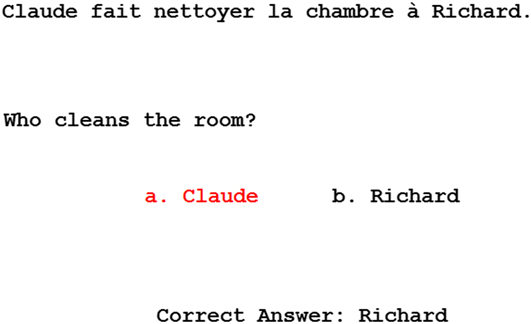
A total of 12 sentences containing the verb faire in the causative construction and 12 sentences with the verb faire in the noncausative construction were modeled after the SI activities in VanPatten and Wong (Reference VanPatten, Wong and VanPatten2004). Each sentence was presented on a slide with an English comprehension question and two possible answers (Figure 2).
Sample slide for PI training.

Participants responded by pressing a button on a button box. Once either a or b was chosen, the display showed the correct answer in red to provide feedback. No other information about the structure was given. Participants pressed the rightmost button to move on to the next sentence. Participants in the PI group never produced the target structure.
TI training
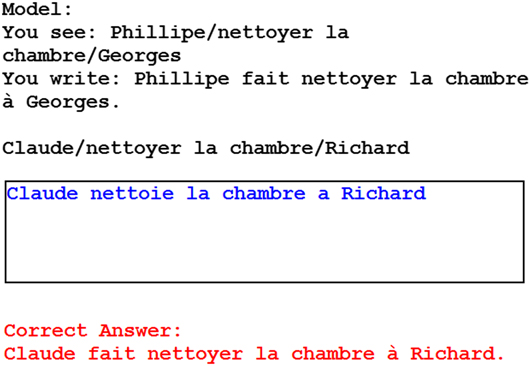
A total of 24 items were modeled after the TI treatment materials in VanPatten and Wong (Reference VanPatten, Wong and VanPatten2004). Participants were asked to create causative sentences with the verb faire following the model by typing their sentences into a box (Figure 3). Each prompt appeared on the screen individually. When participants finished typing their answer, they pressed the space bar to see the correct answer. No other information about the structure was given. Participants pressed the space bar to move on to the next prompt.
Sample slide for TI training.

Training items in both groups were balanced for vocabulary and number of activities. The difference was that the PI group received SI practice in interpreting sentence structure while the TI group created causative sentences by following a model (as is typical with traditional drill practice).
PROCEDURE
All participants had an experiment session that consisted of (a) pretraining eye-tracking, (b) training (either PI or TI), and (c) posttraining eye-tracking. After completing the consent form and background questionnaire, participant’s eyes were calibrated using the Clearview 5-point calibration program. In both the pretraining and posttraining blocks, participants responded to a total of 48 items, consisting of 6 causative, 6 noncausative, and 36 distractor items presented in a pseudorandom order. In each trial, a pair of scenes appeared on the screen. After 1.5 seconds, a sentence describing one of the two scenes was played through a headphone set. Participants were told to listen to the entire sentence before clicking on the picture that best matched the sentence. Upon clicking on one picture, the Eprime program (Schneider, Eschman, & Zuccolotto, Reference Schneider, Eschman and Zuccolotto2002) advanced to the next trial. Participants’ eye movements on the screen were continuously sampled at 60 Hz by Tobii 1750 system. After the pretraining eye-tracking task, participants moved to a different computer to work through the 24 training items of either the PI or the TI activities presented by Eprime. After completing the training, participants returned to the eye-tracking computer to complete another 48 posttraining items. There was no time pressure during any phase of the study.
ANALYSES AND RESULTS
Data from two participants were excluded from the analysis due to incompletion of the session and a system error. The following reports data from 32 participants in the TI group and 30 participants in the PI group.
Accuracy
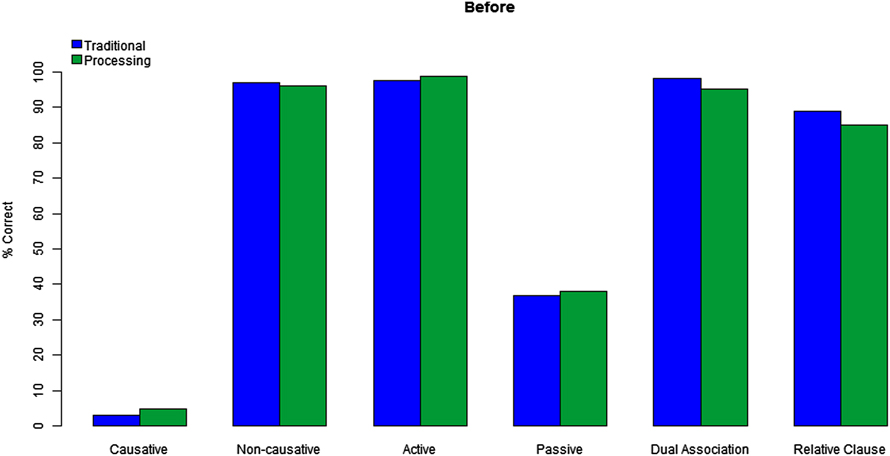
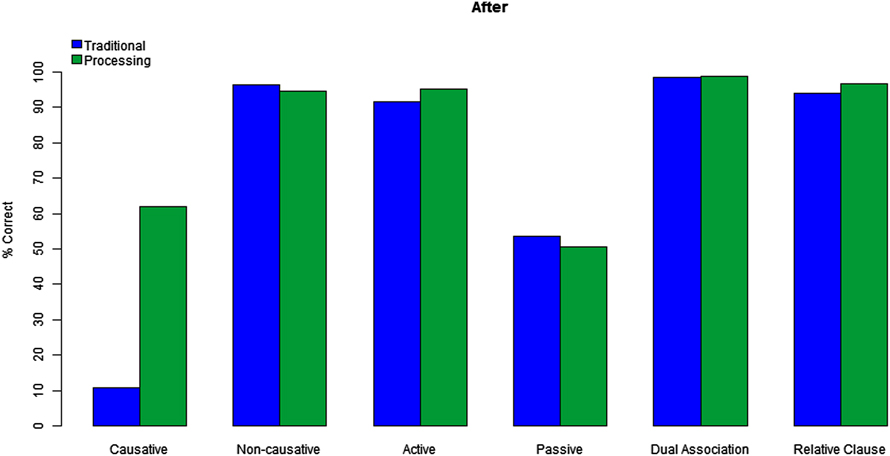
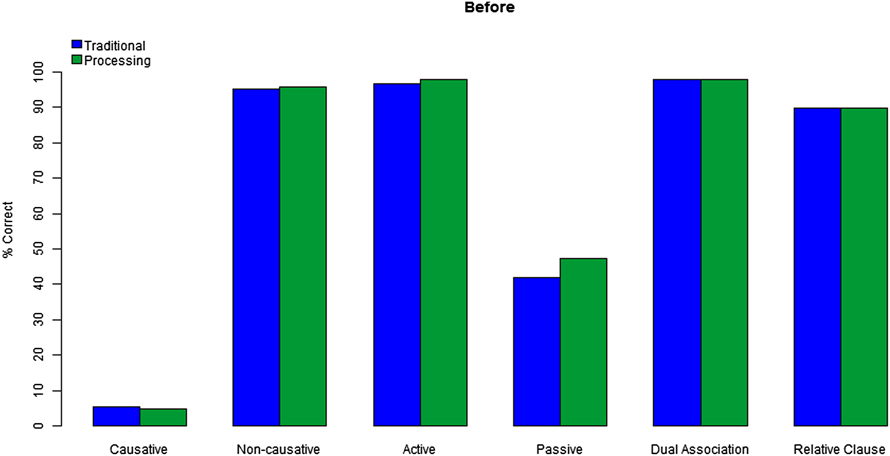
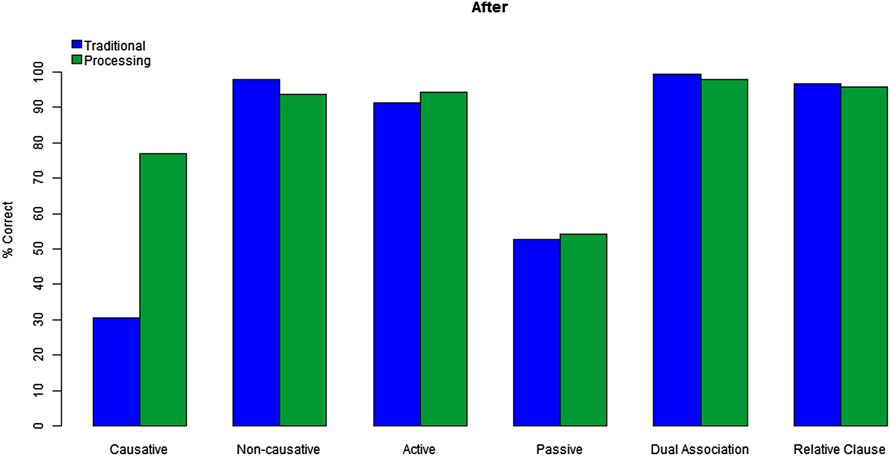
The effects of block and training type on mouse click responses were tested with a mixed-effects logistic regression model, which specified the training type (TI or PI) and the block (before or after training) and their interaction as predictor factors. Accuracy of picture selection for the causative structure sentences was very low for both TI and PI groups before training with no significant difference between the two groups (TI 3.9%; PI: 4.6%: Est = –.12, SE = .68, z = –.18, p = .86: Figure 4). After training, accuracy in the PI group improved to 62% while the TI group only improved to 11% (Figure 5). The result showed a robust effect of block (z = 7.25, p < .001), of training type (z = 5.07, p < .001) and a significant interaction between the two (z = 5.26, p < .001). The effect of block was significant for both the TI (z = 4.03, p < .001) and the PI training (z = 8.18, p < .001).
Experiment 1: Accuracy of picture selection before training.

Experiment 1: Accuracy of picture selection after training.

Eye-Movement Patterns
Because picture selection accuracy showed a robust effect for training type, the eye movements that preceded the mouse clicks are expected to reflect the effect of training as well. The important question is whether the fixation patterns will capture the expected initial bias toward the picture that would be congruent with the “first noun = agent” interpretation, and its predicted reduction after training.
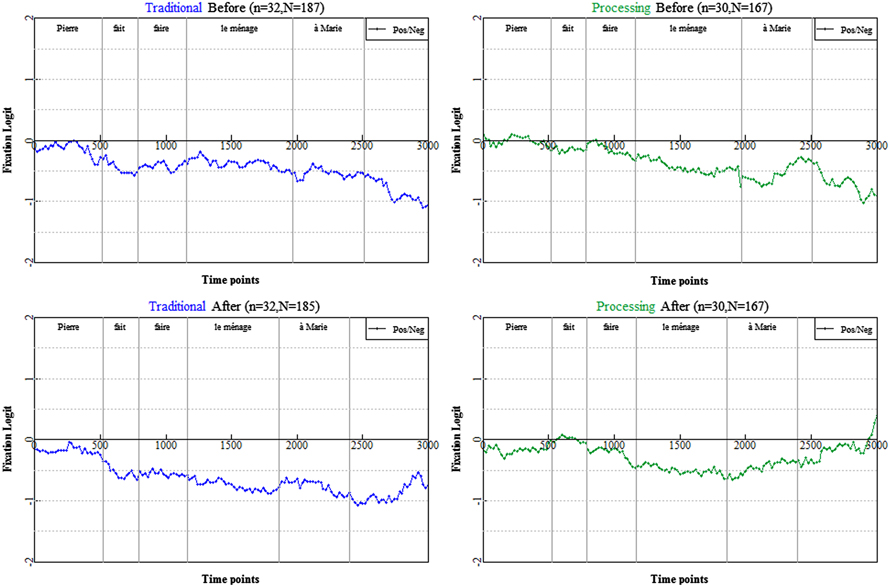
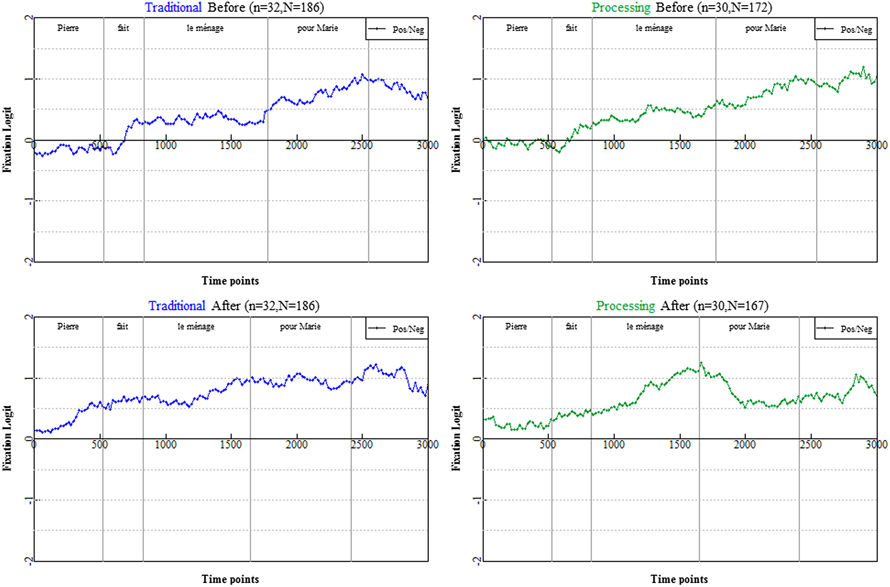
Because participants were viewing either the correct or the incorrect picture at any point in time, the changes in gazes were expressed in logit, or the log of the ratio between the numbers of fixations on the two areas of interest. The logit functions were plotted with the baseline of 0 in the middle of y-axis such that the relatively higher numbers of fixations on the correct picture would be shown above the midline whereas the relatively higher number of incorrect fixations would be shown below the midline. Thus, the stronger the FNP bias is, the larger downward deviation of the function from the midline we should observe. The fixation logits were aligned at the utterance onset, and at the onsets of critical windows according to the duration information of each auditory stimulus.
Figure 6 shows the TI and PI groups’ fixation patterns while they listened to the target causative structure in the before-training block (upper panels) and in the after-training block (lower panels). The two upper panels show the gradual increase in incorrect fixations to the “first noun = agent” picture throughout the causative sentence in both groups. The two lower panels for the after-training blocks, however, show a contrast between the training types: While the TI group showed a gradual increase in looks to the incorrect picture to a slightly greater degree than in the before-training block, the PI group showed a decrease in the incorrect fixations toward the end of the sentences. Importantly, the turning point in the fixation logits appeared at the beginning of the prepositional phrase (à Marie/Pierre), that is, participants in the PI group have started to shift their gazes before they processed the entire sentence.Footnote 2
Experiment 1: TI and PI groups’ fixation patterns while listening to the causative structure in before-training block (upper panels) and after-training block (lower panels).

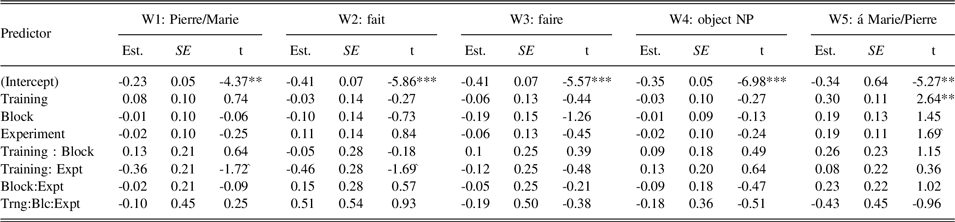
For the statistical analysis, the empirical logit (elogit) (Barr, 2008) was calculated for each time window (w1: subject Pierre/Marie; w2: fait; w3: faire; w4: the rest of the verb phrase; w5: à Marie/Pierre) of each trial. A set of mixed-effects models tested the effects of training type, block, and the interaction between the two on the elogits for each window (the training type and block were both sum coded). The p-value of each effect was tested through comparison of the models that were minimally different with the presence or absence of the factor in question. Table 1 summarizes the results for each time window.
Experiment 1: Summary of mixed-effect regressions on the fixation logits Elogit ∼ Training + Block + Training:Block + (1+Block|subj) + (1+Training|item)

N = 712: total number of observations participated in the model. ***p < .001, **p < .01, *p < .05, ^p < .1.
The constantly significant intercept across the five windows indicates an overall bias toward the incorrect picture throughout the sentences regardless of the training type and block. For the last window (à Marie/Pierre), a significant effect of training and a marginal interaction between training type and block were confirmed, indicating that the PI group made relatively more fixations to the correct pictures than the TI group, and the PI group made a larger increase in the looks toward the correct pictures across blocks than the TI group. The marginal effect of block in the last window was found in the PI group (z = 1.91, p = .06) but the TI group showed no effect of block (z = 1.21, p = .27).
DISCUSSION
Evidence for the FNP bias was confirmed both in eye-movement patterns and the following picture selection: Before training, participants increasingly gazed at the incorrect “first-noun = agent” picture throughout the causative sentence, leading to less than 5% accurate picture selection (i.e., the answer to RQ1 is yes).
The results of Experiment 1 also confirmed the previously reported effect of training type (VanPatten & Wong, Reference Wong and VanPatten2004): The SI activities in the PI training that directed participants’ attention to who did what in each sentence significantly improved the processing and comprehension of the target causative structure as compared to the TI training that forced mechanical production of causative sentences. The effect of PI on the accuracy of picture selection was robust even without explicit instruction on the target structure.
Importantly, the FNP bias in eye movement was reduced after training for the PI participants only. A closer examination of the gaze patterns further suggests that while the PI activities may have changed participants’ processing mechanism for the target structure, the TI activities did not lead to any changes in processing for the TI participants. Although accuracy of picture selection showed a minute improvement in the TI group, there was no visible change in their eye-fixation patterns after training. In contrast, the PI group showed the turning point in the fixation logit function at the onset of the final prepositional phrase (à Marie/Pierre).
The finding that PI participants started to shift their gaze to the correct picture at the onset of the final prepositional phrase à Marie/Pierre could lead one to speculate if participants might have been relying more on “à + noun” as a cue rather than “fait + infinitive verb.” Besides the second infinitive verb, another cue that a sentence is causative is the presence of “à + noun.” Compare noncausative sentence (3) to causative sentence (4):
(3) Marie fait la vaisselle avec Pierre.
Marie does the dishes with Pierre.
(4) Marie fait faire la vaisselle à Pierre.
Marie makes to do the dishes to Pierre.
“Marie makes Pierre do the dishes.”
However, because it takes 150 to 200 ms to program and execute the saccades (see Trueswell & Tanenhaus, 2005, for a review), the observed timing of the gaze shift suggests that PI participants started entertaining the opposite interpretation based on the information unfolding before the final prepositional phrase (à Marie/Pierre) that may have more clearly disambiguated the sentential meaning. Therefore, taken together, the present experiment has shown the effect of PI in both the online and offline measures (RQ2): PI practice appeared to change the way that the PI group processed the target structure but the TI practice did not lead to any processing changes for the TI group.
EXPERIMENT 2
The second experiment tested the effect of EI. It was conducted using the exact same materials as in Experiment 1 except for the addition of a slide that explained the target structure.
RESEARCH QUESTIONS
RQ1. Before training, will both groups display the FNP bias as measured in both eye-movement patterns and accuracy in picture selection? Is the bias equivalent to that observed in Experiment 1?
RQ2. As in Experiment 1, will the PI group show reliably higher accuracy scores on a picture selection task than the TI group after training and if yes, will the difference in the accuracy be accompanied by distinctive eye-movement patterns? Will the presence of EI boost these effects of PI?
METHOD
The same method used in Experiment 1 was used for Experiment 2. However, in Experiment 2, a slide that explained the target structure was added at the beginning of the TI and the PI training (Figure 7).
EI slide for Experiment 2.

Participants
Sixty L2 learners from the same third-semester college-level French course as Experiment 1 were recruited. However, only 50 of the 60 students showed up and participated in the experiment for extra credit.
Materials
The stimuli for the eye-tracking blocks and the training materials were identical to those in Experiment 1 except for the slide at the beginning of the training block that explained the target structure (Figure 7). This EI was identical for both groups. No additional instruction was given visually or orally.
Procedure
The experimental procedure was identical to that of Experiment 1. Participants had two eye-tracking blocks—before and after, and either TI or PI training with EI.
ANALYSES AND RESULTS
Data from one participant was removed from the analysis due to a file coding error. The following reports results from 25 participants in the TI group and 24 participants in the PI group.
Accuracy
Results for accuracy were similar to Experiment 1: Both TI and the PI groups had low accuracy in picture selection before training, but the PI group made a larger increase in accuracy after training than the TI group (Figures 8 and 9). The mixed effects logistic regression confirmed the lack of group difference in the before-training block (z = .007, p = .995), a main effect of training type (z = 2.78, p < .01), a main effect of block (z = 9.07, p < .001), and an interaction between the two (z = 2.91, p < .01).
Experiment 2: Accuracy of picture selection before training.

Experiment 2: Accuracy of picture selection after training.

Compared to Experiment 1, both groups exhibited larger increases in picture selection accuracy after training. The PI group reached 77% accuracy (as compared to 61% in Experiment 1), and even the TI group showed 31% accuracy (Experiment 1: 11%). Thus, the EI appeared to boost accuracy in both groups. The mixed-effect logistic regression on the data from both experiments showed a main effect for training (z = 4.24, p < .0001), a main effect for block (z = 11.13, p < .0001), and an interaction between the two (z = 5.06, p < .0001). The factor experiment (+EI/–EI), however, did not show a significant main effect (z = 1.2, p = .23), and had a marginal interaction with block (z = 1.96, p = .05). Within each training type (tested in separate within-group models), there was no interaction between block and experiment for either the TI group (z = .91, p = .36) or the PI group (z = .94, p = .35). Therefore, the improvement of accuracy after training was not significantly larger for Experiment 2 (+EI) as compared to Experiment 1 (–EI).
Eye-Movement Patterns
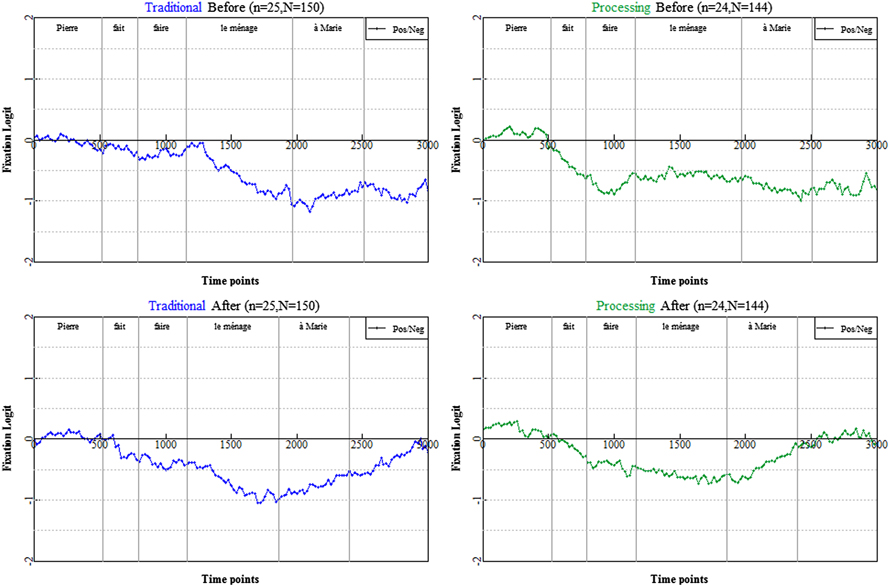
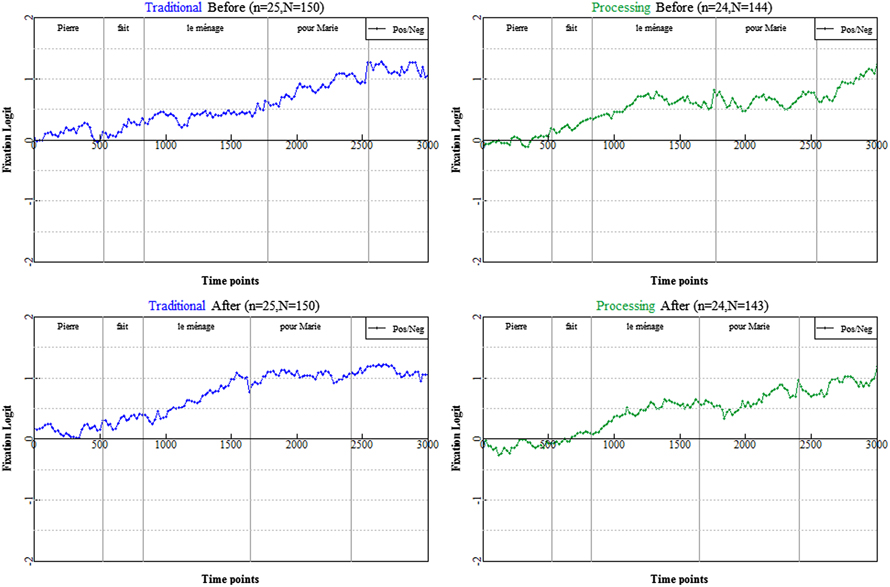
The fixation logit functions obtained from Experiment 2 confirmed a general strong bias toward the “first noun = agent” picture like in Experiment 1. Participants in both groups gradually shifted their gazes to the incorrect picture throughout the causative sentences during the block before training (upper panels of Figure 10).
Experiment 2: TI and PI groups’ fixation patterns while listening to the causative structure in before-training block (upper panels) and after-training block (lower panels).

The outcome of Experiment 2 differed from Experiment 1 in the gaze patterns after training. Unlike Experiment 1, participants in both TI and PI groups showed a reduction in looks to the incorrect “first noun = agent” toward the end of the causative sentences (Figure 10 lower panels). Importantly, in both groups, the logit function showed the turning point from which the looks to the incorrect picture gradually reduced at the beginning of the prepositional phrase (à Marie/Pierre), which was shown only for the PI group in Experiment 1. The number of incorrect fixations seemed relatively smaller in the PI group than in the TI group (notice that the looks to the two pictures reached the 50-50 level in the PI group by the end of the target sentences). The mixed-effects models revealed a main effect for block and a marginal effect for training type, and no interaction between the two for the last analysis window (Table 2). Within each group, the effect of block was not significant (TI: z = 1.01, p = .3; PI: z = 1.2, p = .19), indicating that the size of the reductions in the biased looks was relatively small.
Experiment 2: Summary of mixed-effect regressions on the fixation logits Elogit ∼ Training + Block + Training:Block + (1+Block|subj) + (1+Training|item)

N = 587: total number of observations participated in the model. ***p < .001, **p < .01, *p < .05, ^p < .1.
To test the effect of EI, another set of mixed-effects models was fitted to the data from both experiments. The results showed a robust main effect for training type and a marginal effect for experiment (i.e., +EI/–EI) for the last window (à Marie/Pierre), indicating that the PI groups in both experiments had a significantly smaller number of fixations to the incorrect picture before the end of the sentence, and there were overall fewer instances of incorrect looks to the “first-noun = agent” picture in the last window when participants received EI (Table 3). When the effect of block and experiment (+EI/–EI) were tested within each training type, the TI group showed neither the effect of block (z = .02) nor the effect of experiment (i.e., EI) (z = .77), nor the interaction between the two (z = 1.52, p = .13). The PI group showed a marginal effect of block (z = 1.9, p = .05), no effect of EI (z = 1.32, p > .1), and no interaction between the two (z = 0.03, p > .1).
Experiment 1 and 2: Summary of mixed-effect regressions on the fixation logits Elogit ∼ Training + Block + Experiment + Training*Block*Experiment + (1+Block|subj) + (1+Training|item)

N = 1282: total number of observations participated in the model. ***p < .001, **p < .01, *p < .05, ^p < .1.
DISCUSSION
The results of Experiment 2 confirmed the general FNP tendency that was shown in Experiment 1 in both the picture selection task and eye-movements patterns in the before-training blocks (RQ1). The similarities in performances in the before-training blocks across the two experiments confirm that the level of spoken sentence comprehension and the initial FNP parsing strategy of the L2 learners of French were comparable across the two experiments.
The effect of training type to attenuate the FNP tendency was confirmed in the picture selection task (RQ2): The PI + EI group exhibited a larger improvement in accuracy scores than the TI + EI group. In the eye-tracking data, both the TI and PI groups showed a reduction in looks to the incorrect (“first noun = agent”) pictures toward the end of the causative sentences after treatment, which was only observed in the PI group in Experiment 1. This suggests that the EI in Experiment 2 may have helped TI participants reduce the amount of gazes to the biased “first noun = agent” picture. While the number of incorrect fixations seemed smaller in the PI group than in the TI group, this difference was not statistically significant.
As for the effect of EI, the group difference in accuracy improvement seemed much larger in Experiment 2 than in Experiment 1. However, the statistical analysis on the data pooled across the two experiments revealed only a marginal interaction between block and experiment, and not a three-way interaction between training type, block, and experiment, which would have been shown if EI had enhanced the effect training more robustly for the PI group. Therefore, EI seemed to have little benefit for both the PI and the TI groups in terms of accurate picture selection.
The lack of effect of EI on online processing was also confirmed in the eye-tracking data of Experiment 2. After participants’ attention was drawn to the target structure, the looks to the “first noun = agent” picture showed the reduction or the turning point before the end of the sentence regardless of training type. Importantly, the timing of the turning point was similar across groups – participants started entertaining the other interpretation from the beginning of the last phrase. Hypothetically, in the present study, the EI combined with the PI training could have led to faster processing of the target structure. If the PI-based training with EI had immediately modulated the parsing efficacy and enhanced the certainty for the causative interpretation, participants’ incorrect interpretation could have been revised immediately after they heard the structural cue—the verb sequence “fait faire,” and the looks could have been more clearly directed toward the correct picture (i.e., the function could have flipped to show a rise above the midline). However, the data did not confirm such an additive or interactively enhanced effect. The present results therefore confirm the resilience of the FNP bias in online processing of the causative structure in L2 French learners.
DISCUSSION AND CONCLUSION
The present study used eye-tracking to compare the effects of PI and TI on the acquisition of the French causative structure, and examined the role that EI might play in accurate picture selection and on online processing of the target structure. Both experiments confirmed the previously reported tendency to assign the role of agent to the first animate noun (VanPatten & Wong, Reference VanPatten, Wong and VanPatten2004) in dichotomous picture selections. Like VanPatten and Wong (Reference VanPatten, Wong and VanPatten2004), both experiments also showed that PI resulted in significantly greater accuracy in interpreting the target structure than TI training. This was the case with and without EI. More importantly, the present study provides online data in the form of eye-movement patterns to reveal that PI training can lead to an immediate change in incremental sentence comprehension patterns, showing when and how the effects of training type and EI can appear in the eye movements of intermediate-level French learners.
Although the target structure and the tested population were different, it is worth noting that the present data from the before-training blocks showed similar eye-movement patterns as reported by Meyer et al. (Reference Meyer, Mack and Thompson2012), who examined online processing of passive forms in typically developing and aphasic individuals. In the typically developing control group of Meyer et al. (Reference Meyer, Mack and Thompson2012), the looks to the “first noun = agent” picture started increasing right after the participants heard the initial fragment of the sentence “The man was…” for both active and passive sentences. For the active sentences, the correct looks to the “first noun = agent” picture kept increasing toward the end. This gradual increase in looks to the correct picture while listening to a canonical word-order structure was also observed in our data from the noncausative trials (Figures 11 and 12). There, the rise in looks to the “first-noun = agent” pictures was initiated after the onset of the first noun phrase (Pierre/Marie) and kept growing until the end of the sentence in the before-training block in both Experiment 1 and 2. Interestingly, the onset of the rise to the correct picture was a little earlier in the after-training block of the TI group in Experiment 1, which also showed a numerically larger FNP tendency for the target causative structure after training. These observations together confirm that TI training without EI has little effect to reduce the FNP tendency.
Experiment 1: TI and PI groups’ fixation patterns while listening to the noncausative structure in before-training block (upper panels) and after-training block (lower panels).

Experiment 2: TI and PI groups’ fixation patterns while listening to the noncausative structure in before-training block (upper panels) and after-training block (lower panels).

The present data differed from Meyer et al. (Reference Meyer, Mack and Thompson2012) largely in the eye movements during later parts of the sentences. In Meyer et al., the typically developing control participants who were initially lured to the incorrect picture revised their interpretation immediately after they heard the grammatical cues to the structure (e.g., the past participle of the main verb: The man was shaved) and directed their gazes to the correct picture during the early part of the prepositional phrase (“by the”) before they heard the agent (“boy”). Thus, the participants’ eyes moved from the incorrect picture to the correct picture as soon as the critical grammatical cues unfolded in speech. In the present study with the causative structure, the critical grammatical cue that should have prompted participants to revise their interpretation was the second verb in the infinitive form (e.g., “Marie fait faire… [Marie makes to make…]”). However, such a quick and clear revision of sentence interpretation was not observed in the present data. When the FNP tendency was reduced (after training for the PI group in Experiment 1 and for both TI and PI groups in Experiment 2), the fixations gradually shifted away from the incorrect side of the picture set, approaching the 50-50 (i.e., logit = 0) level, yet they never flipped to the correct side: That is, the FNP tendency remained throughout the sentences. As one anonymous reviewer observed, this finding is not surprising because the accuracy scores never reached much beyond 60% in Experiment 1. It remains to be investigated whether more intensive training with a larger number of target sentences might improve accuracy and help learners revise their interpretation of target sentences more quickly. It is possible that while the training was beginning to destabilize participants’ reliance on the FNP, it was not sufficient for them to abandon it.
The present study also showed that EI did not have a significant effect in leading L2 learners to commit less to the FNP-based interpretation of the French causative structure. A small reduction in biased fixations occurred during online processing of the target sentences, but the data did not support that they revised their interpretation with certainty before the end of the sentences. Given the improvement to more than 75% accuracy in the PI group in Experiment 2, we may argue that participants who received EI with PI could eventually choose the correct picture reliably higher than chance level, but this change in offline responses may not be due to the robust change in the incremental online processing that would have led to the “flip” from the incorrect to the correct side of the picture set right after the grammatical cue to the causative structure (“fait + infinitive verb”). In other words, with the current data, we cannot determine whether PI training (even with EI) enhanced the processing of the participants to the extent that they could swiftly respond to the earliest grammatical cues to the causative structure (i.e., the second verb in the infinitive) during the comprehension of spoken sentences. The lack of effect for EI in the present study thus supports the results of previous offline studies such as VanPatten and Oikkenon (Reference VanPatten and Oikkenon1996), Benati (Reference Benati and VanPatten2004), Wong (Reference Wong and VanPatten2004b), Sanz (Reference Sanz and VanPatten2004), and Sanz and Morgan-Short (Reference Sanz and Morgan-Short2004).
One important observation across both experiments was that the presence of EI did not cause biased looks to decrease any earlier than the beginning of the final prepositional phrase “à Marie/Pierre.” Again, the present data did not show the additive effect of EI for the PI group. This consistent timing in gaze responses may show a ceiling level of performance with the causative construction in L2 learners who are about to complete their third-semester college-level French course. It is possible that participants recognized the causative structure upon hearing “fait + infinitive verb” but the general slower speed of L2 speech processing may have prevented faster gaze shift. Hypothesizing that native French speakers can flip their interpretation by the end of the causative sentences just like the native English speakers processing the passive sentences, a question remains as to how much training it would take for L2 learners to start responding to spoken sentences of noncanonical word order like native speakers.Footnote 3
We also explored the possibility that the reduction of FNP bias found in our study reflects the effect of EI to induce faster learning or improvement in the comprehension performances reported by Fernandez (Reference Fernandez2008) and VanPatten et al. (Reference VanPatten, Borst, Collopy, Qualin and Price2013). To test the interaction between the presence of EI and the trial order on the accuracy of picture selection, a mixed-effect model was fit to the data from the after-training blocks of the two experiments. The results showed a main effect of training (z = 3.31, p < .0001), experiment, that is, presence of EI (z = 2.44, p = .01), and trial order (z = 2.14, p = .03), and a marginal interaction between training and trial order (z = 1.65, p = .09), but no interaction between experiment and trial order. This means that the presence of EI (Experiment 2) had an overall effect to increase the picture selection accuracy and participants in the PI groups improved performance across trials faster than those in the TI group, but the improvement was not speeded by the presence of the EI. Because there were only six trials in the target causative structure within each block, the present experimental design may not be optimal for testing the effect of instruction on the speed of improvement. It remains an empirical question whether experiments with higher number of trials will capture a much clearer effect of EI in the gaze shift patterns.
The lack of effect found for EI may also be due to the nature of the practice activities in PI. SI activities in PI are designed to help L2 learners abandon their reliance on incorrect processing strategies such as the FNP (VanPatten et al., Reference VanPatten, Borst, Collopy, Qualin and Price2013, p. 508). If the PI practice activities in this study were sufficient to destabilize participants’ reliance on the FNP, then we would not expect EI to have much additional effect for PI participants.Footnote 4 However, the finding that the EI in Experiment 2 might have helped TI participants reduce the amount of gazes to the biased “first noun = agent” picture may suggest that the TI training activities were not robust enough on their own to reduce reliance on the FNP. Unlike the PI group, TI participants may have needed the EI to begin to entertain the possibility that the agent of the action in question may not be the first noun in the sentence.
Because we could not include delayed posttests in our design, this study cannot address the durability of any of the effects found. Henry (Reference Henry2017) found that EI helped learners maintain their correct processing of German nominative/accusative case marking four weeks later. In this study, it remains an empirical question whether EI might lead to more durable correct processing of the French causative structure.
To conclude, the present study demonstrated a robust and resilient FNP bias in L2 processing of spoken causative structure in French. The clear effect of PI over TI was replicated: The instruction that gave learners practice with SI led to more accurate processing of the target structure as compared to traditional training that required repetitive mechanical production of the target structure. An important contribution of the present study is the demonstration of the change in the online responses to the spoken input. Although it is not a quick, complete revision of the interpretation, intermediate L2 learners of French start entertaining the non-FNP interpretation before they fully process the final prepositional phrase of the causative structure that disambiguates the sentential meaning. The effect of EI was only weakly hinted. The present study opens questions as to how much training is required for learners’ processing ability to approach that of more proficient, nativelike speakers.
To our knowledge, this is the first study to use eye-tracking as an online measure of input processing with PI. By observing participants’ eye-movement patterns during real-time input processing, we have evidence to support that PI does change the way learners process the target structure, specifically the French causative structure. We look forward to seeing this methodology used in future PI studies to investigate other L2s, target structures, and processing principles.