




No CrossRef data available.
Article contents
- Abstract
- BACKGROUND
- RESEARCH QUESTIONS
- RESEARCH DESIGN AND METHODOLOGY
- PROCEDURE
- RESULTS
- DISCUSSION
- LIMITATIONS, DIRECTIONS FOR FUTURE RESEARCH, AND CONCLUSION
- APPENDIX A: SAMPLE FAMILIAR TREATMENT PASSAGE
- SAMPLE UNFAMILIAR TREATMENT PASSAGE
- APPENDIX B: SAMPLE FORM-RECOGNITION TASK (“OBTAINING A DRIVER'S LICENSE” PASSAGE)
- References
THE EFFECTS OF TOPIC FAMILIARITY, MODE, AND PAUSING ON SECOND LANGUAGE LEARNERS' COMPREHENSION AND FOCUS ON FORM
Published online by Cambridge University Press: 01 December 2004
Article contents
- Abstract
- BACKGROUND
- RESEARCH QUESTIONS
- RESEARCH DESIGN AND METHODOLOGY
- PROCEDURE
- RESULTS
- DISCUSSION
- LIMITATIONS, DIRECTIONS FOR FUTURE RESEARCH, AND CONCLUSION
- APPENDIX A: SAMPLE FAMILIAR TREATMENT PASSAGE
- SAMPLE UNFAMILIAR TREATMENT PASSAGE
- APPENDIX B: SAMPLE FORM-RECOGNITION TASK (“OBTAINING A DRIVER'S LICENSE” PASSAGE)
- References
Abstract
Research in first language and second language (L2) comprehension has demonstrated that both learner and input variables contribute to the ease with which a message is understood. Questions remain, however, as to how these variables affect the way L2 learners process linguistic form during comprehension. This study examines how one learner variable (topic familiarity) and two input variables (mode and pausing) affect learners' comprehension and their processing of a new morphological form (the Spanish future tense) in the input. Two hundred sixty-six participants in an accelerated beginning Spanish course either read or listened to a short narrative in Spanish on either a familiar topic or an unfamiliar one. Additionally, half of the listening groups encountered 3-second pauses between each sentence. After listening to or reading the passages, the participants performed two comprehension tasks (recall protocol and multiple-choice test) and two form-assessment tasks (form-recognition task and tense identification/translation). The results revealed that, although all three variables affected learners' comprehension, only mode affected learners' processing future tense morphology.An earlier version of this paper was presented at the conference Form-Meaning Connections in Second Language Acquisition held in Chicago in February, 2002. This paper is based on my doctoral dissertation completed at the University of Illinois at Urbana-Champaign. I am extremely grateful to Bill VanPatten for his guidance during the entire process of the research project as well as to James F. Lee, Diane Musumeci, Alice Omaggio Hadley, and Anna María Escobar for their feedback and encouragement. I also wish to thank the anonymous SSLA reviewers for their insightful and critical comments. All errors and omissions are, of course, my own.
Information
- Type
- Research Article
- Information
- Copyright
- © 2004 Cambridge University Press
All theories of SLA agree that learners construct their second language (L2) grammars through exposure to input even though these theories differ as to how this happens. Gass's (1997) model of SLA suggested that only comprehended input (i.e., input that the learner understands) can be further processed and eventually integrated into the developing L2 grammar. Although a few studies have found that premodified and interactionally modified input affects the acquisition of word meanings (Ellis & He, 1999; Ellis, Tanaka, & Yamazaki, 1994), little is known about how increased comprehension affects grammar learning. Furthermore, much of the research investigating this complex relationship has focused on manipulating input characteristics with the goal of rendering the input more comprehensible to the learner. Because comprehension involves a dynamic process involving both listener and reader variables as well as input variables, the present study investigates how one learner factor (topic familiarity) and two input factors (mode and pausing) affect L2 Spanish learners' comprehension of texts as well as their processing of a new grammatical form in the input—third-person-singular future tense morphology.
BACKGROUND
Text Comprehension and Processing Grammatical Form
Given the hypothesis that some kind of comprehension is necessary for learners to process linguistic form, a number of studies have manipulated input characteristics to determine their effects on both learners' comprehension and processing (or intake) of grammatical form.1
It should be pointed out that the terms processing and intake are often not well defined or consistently used in SLA research (see, e.g., Carroll, 1999, for further discussion). In some cases, intake refers to the subset of input that has been “attended to” or noticed (e.g., Leow, 1993, 1997, 2001), whereas VanPatten (2004) defined it as registering a form and determining its meaning or function. Most of the studies reviewed in this section operationalize intake as recognition of a target form. The present study follows VanPatten's definition and utilizes processing measures that examine both form registration and subsequent form-meaning connections.
Leow (1997) examined the effects of textual enhancement and text length on L2 Spanish learners' reading comprehension of text content and intake of impersonal imperative forms to which learners had no prior formal exposure. His findings revealed a significant effect for text length on comprehension (i.e., answers to short-answer comprehension questions) but not on intake (i.e., recognition of forms on a multiple-choice test). No effect was found for text enhancement on either the comprehension or intake tasks.
Lee (1998) investigated how the complexity of Spanish verbal morphology affects L2 Spanish learners' comprehension and input processing. Learners were exposed to a text containing either correct, inflected present subjunctive forms or infinitives, or a made-up inflection (-u). Lee found that learners in the three conditions were equally successful at recognizing the forms on a word-recognition task, but those that received the passage containing the present subjunctive forms wrote down fewer idea units on a first language (L1) recall protocol. He attributed these lower comprehension scores to the greater variability of the subjunctive forms, which required more cognitive resources to process than the infinitive or made-up forms.
In a study using both online and offline procedures, Leow (2001) examined the effects of textual enhancement of L2 Spanish learners' reading comprehension and their noticing and intake of formal imperatives. Although a significant correlation was found between learners' reported noticing on think-aloud protocols (online measure) and their performance on a word-recognition task (offline measure), no significant differences were obtained between the enhanced and unenhanced groups for either processing tasks or for the comprehension measures (multiple choice and short answer).
Lee (2002) manipulated two input characteristics (frequency of Spanish future tense verbs and presence of temporal adverbs) and learners' task orientation (form, meaning, or neutral) to examine their effects on L2 beginning Spanish readers' “specific” comprehension of future verbs (via L1 recall of future actions and a multiple-choice test) and processing of Spanish future tense morphology (via word-recognition and form-production tasks). The results revealed that frequency of future forms affected comprehension of future actions (target recall and multiple choice) as well as recognition of future verbs. The presence of temporal adverbs and the directing of learners' attention to meaning affected the percentage of future verbs recalled (comprehended), but these variables had no effect on any of the input processing measures.
Wong (2003) examined the effects of linguistic simplification and textual enhancement on L2 French learners' comprehension of texts (via analysis of idea units from L1 written recall) and their acquisition of past participle agreement in relative clauses (via an error-correction task). Although linguistic simplification facilitated learners' comprehension of the texts, no significant findings were obtained on the error-correction task. Similar findings were obtained for enhancement. Learners recalled (comprehended) more information from the enhanced elements of the text, but textual enhancement did not affect learners' performance on the error-correction task.
The present study seeks to extend the previous research in the following ways. First, rather than assessing either learners' comprehension of propositional information from the input or their specific comprehension of specific verbs, this study examines both. Second, it includes two measures of processing: a recognition task to assess learners' registration of future tense morphology and a tense-identification task in which learners had to assign meaning to inflected verb forms. Furthermore, given the centrality of processing limitations in explaining learners' difficulty in focusing on form during communicative exchanges (see, e.g., Doughty & Williams, 1998, and VanPatten, 1990), rather than manipulating textual clues (i.e., enhancement, presence of temporal adverbs, or input frequency), this study investigates variables that have been proposed to affect learners' processing load during comprehension and their subsequent ability to recognize and assign meaning to a new grammatical form in the input.
Topic Familiarity
Schema-based models of comprehension (e.g., Carrell & Eisterhold, 1983; Rumelhart, 1977, 1980) are most often used in SLA research to describe the role that learners' background knowledge plays in facilitating comprehension. These models posit that prestored schemata or scripts guide comprehension top-down, whereas more recent models (e.g., Kintsch, 1998) propose that background knowledge is stored as an associative network of propositions that are activated bottom-up through interaction with the textual data (see Nassaji, 2002, for a review of schema and construction-integration based models of comprehension and their application in L2 reading).2
An anonymous SSLA reviewer correctly pointed out that the term topic familiarity is problematic, given that this blanket term does not address specific types of information coded in schema-based models, construction-integration models, or others such as Johnson-Laird's (1983) Mental Models and Discourse Representation Theory (e.g., Kamp & Reyle, 1993). Although I agree that SLA research needs to make use of current psycholinguistic theories of comprehension and text structure to address the specific kinds of information that learners use during L2 comprehension, the point of the present study was to determine if learners' background knowledge (as generally understood in the SLA literature up to now) affects text comprehension and processing of future tense morphology.
Studies examining the role of topic familiarity on L2 listening comprehension have found a facilitative effect (Chiang & Dunkel, 1992; Long, 1990; Markham & Latham, 1987; Schmidt-Rinehart, 1994). The findings for reading comprehension, however, have been mixed. Some studies have reported facilitative effects for topic familiarity as either a main effect or as part of a complex interaction (Barry & Lazarte, 1995; Bügel & Buunk, 1996; Carrell & Wise, 1998; Chen & Donin, 1997; Johnson, 1982; Lee, 1986), but others have not (Carrell, 1983; Hammadou, 1991; Peretz & Shoham, 1990).3
For a detailed review of these studies and methodological issues in assessing comprehension and learners' background knowledge, see Leeser (2003).
Mode
L1 research investigating the differences between listeners and readers has pointed out the advantages readers have in comprehension due to the greater control over rate of processing as well as their ability to notice word, sentence, and paragraph boundaries (Anderson, 1980; Danks, 1980; Ferreira & Anes, 1994). Although learners are exposed to both aural and written input in the classroom, Leow (1995) noted that hardly any attention has been given to the role of mode in SLA research. Leow called for more research in the area of mode not only “for guiding the selection of input [in the L2 classroom] but also for increasing language teachers' awareness of what learners do with the input that is made available to them” (p. 86).
The L2 studies that have investigated mode have found that readers comprehend more informational content than listeners (Greenslade, Bouden, & Sanz, 1999; Lund, 1991; Wong, 2001) and that they are better able to allocate attentional resources simultaneously to content and grammatical form (Wong). Furthermore, Leow (1995) found that L2 Spanish learners who read passages recognized more present perfect and present subjunctive forms than those who listened to the same passages. The researchers all attributed their findings to the hypothesis that processing resources are less constrained in the written mode than in the aural mode.4
Another possibility suggested by an anonymous SSLA reviewer is that readers recognized more forms because they could backtrack and process stimuli more than once.
Pausing
Allowing for pauses in order to provide learners with more processing time has been suggested as one way of making speech directed to L2 learners more comprehensible (Gass, 1997; Hatch, 1983; Krashen, 1982; Rivers, 1980; Rost, 1990, 2002). Also, Chaudron and Richards (1986) noted that pauses increase in both frequency and length when native speakers address L2 learners, presumably “to provide further time for processing, and assist in segmenting discourse into meaningful units for higher level processing” (p. 116). However, little empirical evidence exists to support the notion that pausing does indeed facilitate comprehension. Blau (1990) found that beginning L2 English learners who encountered 3-second pauses “inserted at selected sentence, clause, and phrase boundaries” in passages delivered at approximately 150 words per minute (wpm) outperformed learners who did not on answers to wh-questions immediately following the passages. Sagarra (1998), however, did not find significant performance differences on L1 recall tasks between L2 beginning Spanish learners who encountered 1- or 2-second pauses inserted at phrase boundaries and 3-second pauses inserted between paragraphs and those that did not. Chaudron and Richards failed to find a significant difference between cloze recall scores for lower and higher proficiency English as a second language (ESL) learners who either listened to a lecture containing discourse markers (intersentential relations, framing of segments, and pause fillers) or a baseline lecture. The authors hypothesized that the baseline version was slow enough that additional segmenting, slowing down, or pausing may not have contributed to greater comprehension. Similarly, Griffiths (1990) reported no facilitative effect of slowed speech on intermediate-level ESL learners' comprehension when the rate was below 150 wpm. This finding could explain the lack of effect for pausing in Sagarra's study. The present study seeks not only to determine whether the provision of pauses above a given speech rate facilitates comprehension but also whether this additional processing time provides learners with more opportunities to recognize and assign meaning to linguistic form.
RESEARCH QUESTIONS
The previous section summarized research on how topic familiarity, mode, and pausing affect comprehension. Therefore, the following research questions guided this study:
- During L2 comprehension, does topic familiarity affect comprehension and the processing of grammatical form?
- Does mode affect comprehension and the processing of grammatical form?
- Does pausing after sentence boundaries affect comprehension and the processing of grammatical form?
RESEARCH DESIGN AND METHODOLOGY
The participants in this study came from an original pool of 648 L2 learners of Spanish from 32 intact classes of an accelerated elementary Spanish course at the University of Illinois at Urbana-Champaign. Each intact class was assigned to one of 16 different treatment groups. Each group read or listened to a warm-up passage, completed a comprehension recall, and then read or listened to one of four treatment passages. After reading or listening to a treatment passage, the learners completed two comprehension measures as well as two tasks that assessed the processing of the future tense (see Materials section). Eight of the 16 groups listened to a passage, whereas the other eight read one of the treatment passages. Half of the listening and reading groups were administered a passage containing a familiar scenario (described in the Materials section), and the other half received a passage dealing with an unfamiliar scenario. Furthermore, half of the listening groups encountered a 3-second pause after each sentence. To balance the design, a pause condition was created for the reading groups. Participants in this condition encountered the reading passage divided into sentences with two line spaces between each sentence.5
I agree with an anonymous SSLA reviewer that pauses during listening and line breaks between sentences in written texts may not be comparable conditions to be considered under the variable pause. It is important to keep in mind, however, that the purpose for including line breaks in the written text as pause was primarily to balance the research design. I also agree with this reviewer that future research should consider separately the psycholinguistic processes underlying pauses and visual breaks in a text.
Participants
Participants enrolled in these courses had no formal exposure to Spanish future tense morphology at the time of the study. However, to ensure that the participants had no prior knowledge of the target form, they were given a pretest consisting of a 10-item translation test prior to the experiment.6
This task contained a variety of forms and structures, and three items contained future tense morphology. The participants were instructed to translate into English each item or part of each item. The most basic verbs were used for the future (hablar “to speak,” comer “to eat,” and vivir “to live”) so that if the participant left the item blank, it was not due to not knowing the meaning of the verb. Participants who wrote down “will … ,” “going to … ,” or “shall …” for one or more of the future items were automatically excluded from the subject pool.
In addition to demonstrating previous knowledge of Spanish future tense morphology, participants were also excluded for the following reasons: (a) their native language was not English (as reported on a background questionnaire); (b) they reported hearing difficulties (as reported on a background questionnaire); (c) they failed to complete all tasks; (d) they failed to follow instructions; (e) they did not attend to form and meaning at the same time (as reported on the exit questionnaire and evidenced on the task by circling verb-final, accented -á's in the reading passages or by making a minimum of three tick marks on the instructions page for the listening passages); (f) readers reported on an exit questionnaire as having backtracked or read the passage more than once; or (g) they were administered one of the familiar topic passages yet reported that topic as being unfamiliar on a topic familiarity questionnaire or vice versa.
Materials
After being informed of the study, signing a consent form, and completing appropriate pretreatment materials (background questionnaire and the grammar pretest), the participants in each intact class received one of eight possible treatment packets. Each packet contained a topic-familiarity questionnaire, warm-up activities, one of four vocabulary study sheets, one of four treatment passages, two comprehension tasks (recall protocol and multiple-choice test), and two measures of processing future tense morphology (form-recognition and tense-identification tasks). Each of these are briefly described as follows.
Topic-Familiarity Questionnaire.
The purpose of the topic-familiarity questionnaire was to confirm the participants' familiarity of the content of the treatment passages. The questionnaire contained 10 different activities including the four topics of the treatment passages (“Going to a new university,” “Obtaining a driver's license,” “Publishing an article,” and “Getting a green card”) plus six distracter topics. The questionnaire was modeled and adapted after the form in Pulido (2003), and the participants were asked to rate their familiarity with each topic on a scale from 1 (very unfamiliar) to 4 (very familiar). Learners who received a packet containing a familiar topic passage (“Going to a new university” or “Obtaining a driver's license”) but rated that topic as unfamiliar on the topic-familiarity questionnaire (with a score of 1 or 2) were excluded from the data pool. Similarly, learners who received a packet containing an unfamiliar topic passage (“Getting green card” or “Publishing an article”) and rated that topic as familiar were excluded.
Warm-up Activities.
The participants in all treatment conditions either heard or read a short passage, Una historia verdadera “A true story,” which appears in an early chapter of their textbook, ¿Sabías que … ? Beginning Spanish (VanPatten, Lee, & Ballman, 2000). This passage was chosen because it was similar in length to the treatment passages (176 words), and it was thought that providing the learners with a familiar text at the beginning of the treatment would help them to adapt better to and feel more comfortable with the treatment procedure and the voice reading the passage (for the listening groups). After reading or listening to this passage, they completed a sample recall protocol.
Vocabulary Study Sheets.
Prior to reading or listening to the treatment passage, the learners saw a five-word vocabulary list. The motivation behind providing this list was to control vocabulary knowledge as much as possible as an intervening variable for comprehension of the passages. Each vocabulary study sheet contained a list of five nouns, adjectives, or adverbs from one of the treatment passages. These words were chosen due to their being perceived as difficult words according to an independent group of subjects from the same course during the previous semester. Verbs were not included in these lists because some of the tasks following the reading of or listening to the passages involved recognizing verb forms from the passages, and having the participants study verbs before the treatment passages might prime their attention and influence their answers in subsequent tasks. For the listening groups, the same person who read the treatment passages read each word of the vocabulary study sheets.
Target Form.
The third-person future tense morphology was chosen as the target form because it is a perceptually salient form in the written mode (due to the written accent on the final vowel—hablará “he or she will speak,” comerá “he or she will eat,” vivirá, “he or she will live”) and in the aural mode (due to the stressed final vowel; see Lee, 2002, for further discussion). Furthermore, unlike present indicative, preterit, imperfect, and present subjunctive forms, future tense morphology is a consistent form in that it uses the same paradigm for all verb classes (-ar, -er, and -ir verbs). Finally, because this study investigated how learners attach meaning to a new morphological form encountered in the input, it was important to select a form that the participants had not previously encountered. The future tense was selected because it is a form that is not formally presented to L2 Spanish learners in the context of this study until the third-semester course. Additionally, in classroom settings, futurity is most often conveyed using the periphrastic ir a + infinitive. This reduced the possibility that the participants had been exposed to the targeted future form in classroom discourse.
Treatment Passages.
Two different passages for each familiar and unfamiliar condition were developed to provide a greater generalizability of the results for the effect of topic familiarity. All four narratives were constructed on the basis of script-norming procedures (see, e.g., Bower, Black, & Turner, 1979; Graesser & Nakamura, 1982) and conformed to a set of activities pertinent to an important or memorable event or personal experience. They were structured around the scenario of someone who, within a couple of months, will participate in or undergo the process of a particular event or activity. The four events were: “Going to a new university,” “Obtaining a driver's license,” “Getting a green card,” and “Publishing an article.” The familiar scenarios (“Going to a new university” and “Obtaining a driver's license”) were chosen because all of the participants were university students and possessed first-hand knowledge of what the first week of school is like and were therefore expected to possess the appropriate background knowledge for this event. Furthermore, nearly all of these university students possessed a driver's license and were familiar with the process of obtaining one.
The two less familiar content narratives (“Getting a green card” and “Publishing an article”) were chosen because they represented contexts that would seem unfamiliar to the target group of participants. The green card narrative was based on the script-norming tasks of two informants who were in the actual process of obtaining a green card as well as from information contained on the United States Immigration and Naturalization Service's Web site on procedures and steps to obtaining a green card. The passage about publishing an article was adapted from Pulido (2003), which followed this same script-norming procedure but was modified by changing the verbs to the future tense and in ways to conform to the structural characteristics of the other passages.
To control for intervening variables other than content familiarity, all four passages were similar in length (185–189 words). Each passage contained 16 sentences and 19 future verb forms, one or two of which were irregular verbs. Furthermore, in each passage one future verb appeared in 11 of the sentences and two appeared in four sentences. Additionally, all passages contained the following future discourse markers: the title El futuro de [John]:… “[John]'s future” and en agosto del 2002, es decir, en el futuro “in August of 2002—that is, in the future” within the first two lines of the passage. August of 2002 was in the future at the time of data collection. All passages were proofread by three native speakers of Spanish from different regions of Latin America and Spain. Sample passages can be found in Appendix A.8
Due to space limitations, only two of the four passages appear in Appendix A. The other passages may be obtained by contacting the author.
For the listening passages, a native Spanish speaker from Colombia read each of the passages, and the readings were recorded onto a compact disc. The duration of each listening passage was between 66.48 and 68.97 seconds, with a delivery of between 163 and 166 words per minute. Pause versions of each passage were produced by inserting 3-second pauses after each sentence.9
Delivery of the listening passages exceeded 150 wpm, given that previous studies found no facilitative effects for pauses, slowed speech below this rate, or both (e.g., Chaudron & Richards, 1986; Griffiths, 1990). Three-second pauses were used, following Blau (1990).
Assessment Tasks Measuring Comprehension
Recall Protocol.
Immediately after reading or listening to one of the four passages, participants in both the reading and listening groups performed a written recall protocol, which the participants completed in their L1 to ensure that they provided as much information as possible about what they had understood from the passage (Lee, 1986; Rott, Williams, & Cameron, 2002; Shohamy, 1984; Wolf, 1993). The purpose of the recall was to determine learners' comprehension of passage content. The scores for the comprehension recall tasks were based on the number of correct idea units the participants wrote down (e.g., Bernhardt, 1991; Lee, 1998; Rott, 1999; VanPatten, 1990; Wong, 2001, 2003).10
The idea units corresponded to basic semantic propositions, main clauses, subordinate clauses (including adverbial and relative clauses), heavy prepositional phrases, and temporal adverbs (e.g., then, next). The following example demonstrates how one sentence was divided into three idea units: Jenny tiene 15 años / y en agosto de 2002 / cumplirá 16 años “Jenny is 15 years old / and in August of 2002 / she'll turn 16.” Idea units for the four passages may be found in Leeser (2003).
Multiple-Choice Test.
After completing the recall, the learners completed a 10-item multiple-choice test in English based on the passage they either read or heard. The purpose of the multiple-choice test was to determine learners' specific comprehension of future actions from the passage. This task was modeled after the one used in Lee (2002), in which each item corresponded to an action or event from the passage and a blank that corresponded to a target verb form. The choices for each item included verbs in the present, past, present perfect, and future forms, with the correct answer for each item being the future, as in (1).

The future forms were distributed among the four choices so that if learners “wished to employ a ‘same-tense’ selection strategy, they would have to search for that particular tense” (Lee, p. 63). All 10 items in the test involved actions that would sound plausible in either the present, past, or future. That is, if learners chose the future in one item, they would not be obligated by event probabilities to choose the future in subsequent items. The sentence would make sense with any of the choices. One point was given for each future action selected.
Assessment Tasks Measuring Processing of Future Tense Morphology
In this study, processing means registering a form and subsequently assigning meaning to it (see, e.g., VanPatten, 2004). For this reason, two measures of processing were included: one examining learners' recognition of future forms and one to determine if learners could assign future meaning to future forms.
Form-Recognition Tasks.
Following the multiple-choice test, participants completed a form-recognition task in which they were instructed to place a checkmark next to the word if they remembered seeing or hearing it in the passage (Appendix B). Given the hypothesis that some kind of cognitive registration of forms in terms of noticing (Schmidt, 1990, 1995) or detection (Tomlin & Villa, 1994) is necessary for form-meaning connections to occur, the rationale for this task is that, if learners cognitively registered the forms in some way, they would be able to recognize them on the task (Lee, 1998). Four different form-recognition tasks were used—one for each of the four different passages. Each task contained 60 items, which included the 19 passage future verb forms, 5 passage nouns, and 36 distracter items.11
Distracters were chosen on the basis of surface similarity with the future tense and consisted of: (a) five conditional forms (third-person singular) of the targeted verbs, (b) five future verbs (third-person singular) not found in the passage, (c) five imperfect subjunctive forms (third-person singular) of the targeted verbs, (d) six preterit forms (third-person singular) of the targeted verbs, (e) five nouns (containing an accented -á) unrelated to the passage topics, and (f) 10 common verbs in the imperfect subjunctive, future, and infinitive forms. A template was used for the construction of the four recognition tasks to ensure that the order in which the future verbs appeared in the passages was consistent with their order of appearance in the task. For example, the fifteenth future verb of each passage always appeared as item 1. See Leeser (2003) for the template used as well as the form-recognition tasks for each passage.
See Huibregtse, Admiraal, and Meara (2002) for a detailed discussion and justification of this index. The index results in a score with a range from 0 to 1. The formula is: 1 − {[4h(1 − f) − 2(h − f)(1 + h − f)] /[4h(1 − f) − (h − f)(1 + h − f)]}. h is the “hit-rate” or proportion of correct “yes” responses, and f is the “false-alarm rate” or proportion of incorrect “yes” responses.
Tense-Identification Task.
This final assessment task consisted of 20 nouns and corresponding verb forms, which included five present indicative, five preterit, five conditional, and five future forms. The participants were instructed to write the best English equivalent for each noun and corresponding verb form, as shown in (2).

As with the word-recognition task, the participants in the listening treatments heard each form read to them by the same speaker who had read the preceding passage. Only the five items that contained future forms were scored. One point was given to an item that had an English marking of futurity (i.e., will, going to, or shall) for the future forms on the task.
Standardized Test.
In a separate treatment session, the participants completed listening and reading comprehension sections of the university's standardized Spanish language placement test to ensure that the relative Spanish comprehension levels of the intact classes used for the treatment groups were not significantly different. This multiple-choice test contained 20 items, and each item was worth one point, yielding a total of 20 possible points.
PROCEDURE
The data were collected on two class days during the participants' regularly scheduled classes. On the first day, the participants were provided with general information about the study, signed a consent form, and completed a background questionnaire and the grammar test. After completion of these forms, each of the 32 sections was administered one of 16 treatment packets, which contained the materials and assessment tasks previously described. The participants completed the tasks in the following order: reading or listening to warm-up passage, practice recall, vocabulary study sheet, one of the four treatment passages, comprehension recall, multiple-choice comprehension, form recognition, tense identification, and debriefing questionnaire. Prior to reading or listening to their respective treatment passage, the participants were instructed that, in addition to reading or listening to the passage for content, they were to pay attention to any occurrence of a word-final, accented -á. For those in the listening groups, this was operationalized by having the learners place a tick mark on the instruction sheet each time they heard these words. The readers were instructed to place a circle around each word-final, accented -á while they read the passage for content (Lee, 2002; Leow, 2001; Wong, 2001). Lee noted in his study that he did not know how many times the learners read the passage and whether the learners marked the accented á's as they read or whether they marked them after reading the passage for content. In the present study, participants in the reading groups answered questions as part of an exit questionnaire to determine whether they (a) circled the á's while they read, (b) circled the á's before or after they read, or (c) did a combination of (a) and (b). Participants who indicated either (b) or (c) were excluded from the data pool. After reading or listening to one of the four treatment passages, the participants completed each of the assessment tasks in the order previously discussed. They were instructed that, once they finished a section, they were not permitted to return to it at any time.
RESULTS
Results of the Topic-Familiarity Questionnaire
To determine if there was a significant difference between the mean rating scores of each of the passage topics, the data from the topic familiarity questionnaire were submitted to an ANOVA with a randomized complete block design. The mean ratings for each topic are shown in Table 1. The results of the ANOVA revealed a significant effect for topic F(3, 266) = 3808.66, p < .0001. The Fisher's PLSD test indicated that there was no significant difference between participants' ratings of the two more familiar topics (“Going to a new university” and “Obtaining a driver's license”), p = .5898. Both of the familiar topics received significantly higher ratings than each of the less familiar topics (“Publishing an article” and “Getting a green card”), p < .0001. When the mean ratings of the two more familiar topics were compared with the mean ratings of the two less familiar topics, the mean difference was significant, t(266) = 106.69, p < .0001.
Mean familiarity ratings of passage topics from topic-familiarity questionnaire

Because a significant difference was found between the two less familiar topics (the participants reported being more familiar with the process of publishing an article than with the process of getting a green card, p < .0001), independent sample t-tests were performed for each task for learners who received either the passage “Publishing an article” or “Getting a green card.” The results revealed that, for learners who received either of these less familiar topic passages, there was no significant difference in scores on the comprehension recall, t(128) = −.54, p = .59; the multiple-choice test, t(128) = 1.21, p = .23; and the tense-identification test, t(128) = .23, p = .77. For this reason, data for learners who received either familiar topic passage were combined into the familiar condition, and data for learners who received the less familiar passage topics were combined into the unfamiliar condition. The independent, between-group variables in the statistical analyses were topic familiarity (familiar or unfamiliar), mode (listening or reading), and pause (pause or no pause). The scores for all tasks were submitted to separate 2 × 2 × 2 ANCOVAs with the standardized test score entered as the covariate. Because the t-test results for the word-recognition task revealed a significant difference between unfamiliar passages, t(128) = −2.39, p = .02, a separate 4 × 2 × 2 ANCOVA was performed, using the independent variable passage instead of familiarity.
Results for Comprehension
Recall Protocol.
The first measure of comprehension (i.e., propositional information) was the number of correct idea units correctly recalled from the passage on the recall protocol. The mean recall scores are shown in Table 2, and the ANCOVA summary table is found in Table 3. Significant main effects were found for mode and for topic familiarity. A significant effect was found for the covariate, standardized test. The slope (β = .054) indicates a positive relationship between learners' performance on the standardized test and their performance on the comprehension recall. There was no significant main effect for pause. In addition to the significant main effects, two significant two-way interactions were found between mode and familiarity and between familiarity and pause. There was also a significant three-way interaction (Mode × Familiarity × Pause).
Descriptive statistics for comprehension recall task

ANCOVA summary for comprehension recall task

To locate the source of the significant main effects and interactions, a series of post hoc tests were conducted using Fisher's PLSD. The Fisher's PLSD test for mode revealed that readers produced more correct idea units than listeners, p < .0001, and the test for familiarity revealed that learners who received passages on more familiar topics recalled significantly more idea units than those who received passages on less familiar topics, p < .0001. For the significant interaction Mode × Familiarity, the analysis revealed the following significant differences. Learners who received familiar passages outperformed those who received unfamiliar passages in both the listening mode and in the written mode, p < .0001. Additionally, learners who read texts (regardless of whether the passage dealt with a familiar or unfamiliar topic) scored significantly higher than those who listened to texts in the familiar conditions as well as in the unfamiliar conditions, p < .0001. For the Fisher's PLSD test that examined the significant interaction between familiarity and pause, pausing made a difference for learners who received familiar passages. Those who received familiar passages without pauses scored higher than those who received the same passages with pauses, p < .05. Finally, for the significant triple interaction (Mode × Familiarity × Pause), the analyses revealed that, within the aural mode, learners who listened to familiar passages without pauses recalled significantly more idea units than those who listened to familiar passages with pauses, p < .01. However, just the opposite was found for the groups that listened to unfamiliar passages. Learners that heard unfamiliar passages with pauses recalled more than those who heard the same passages without pauses, p < .05.
Multiple-Choice Test.
The means for all conditions in this test (comprehension of future actions) are presented in Table 4, and the ANCOVA summary is shown in Table 5. The ANCOVA results reveal significant main effects for mode and pause. There was no significant main effect for topic familiarity or for the covariate, standardized test. A significant interaction was found between mode and familiarity. There were no other significant two- or three-way interactions among any of the other independent variables.
Descriptive statistics for multiple-choice comprehension test

ANCOVA summary for multiple-choice task

Fisher's PLSD tests were conducted to explore these significant main effects and interactions. The analyses revealed that, for mode, the readers scored significantly higher than the listeners, p < .01. For pause, the learners who received passages without pauses scored significantly higher than those who received passages with pauses, p < .01. Because the research questions and hypotheses in this study specifically address pausing in the aural mode, a Fisher's PLSD was conducted to determine whether this difference in pausing would be found within the listening groups. The analysis revealed that there was no significant difference in scores between learners who heard the passages with pauses and those who heard the passages without pauses. Pausing only made a difference for the readers, p < .001. With regard to the significant interaction between mode and familiarity, the Fisher's PLSD test revealed two significant differences. In the reading groups, learners who read passages on familiar topics outscored those who read passages on unfamiliar topics, p < .01. For those learners who received passages on familiar topics, the readers scored significantly higher than the listeners, p < .0001.
Results for Processing of Future Tense Morphology
Form Recognition.
Table 6 reports the descriptive statistics for the form-recognition task and includes the number of correct future verbs selected from the passage and the accuracy rate in parentheses. The results of the ANCOVA revealed a significant effect for mode, F(1, 266) = 57.29, η2 = .288, p < .0001, and the covariate standardized test approached significance, F(1, 266) = 3.76, p = .054. The slope (β = .002) indicates a positive relationship between learners' performance on the standardized test and their ability to correctly identify future verbs they encountered in the passage. The Fisher's PLSD revealed that, for the main effect for mode, the readers showed greater accuracy in identifying future verbs from the passages than the listeners, p < .0001. The ANCOVA substituting passage for familiarity revealed a significant main effect for mode, F(1, 266) = 107.95, η2 = .302, p < .0001, and a significant main effect for passage, F(3, 266) = 3.24, η2 = .038, p = .023. There were no other significant main effects or interactions. The Fisher's PLSD revealed that, for the main effect for passage, learners who received one of the unfamiliar passages (“Publishing an article”) were more accurate in identifying passage future verbs than learners who received the other unfamiliar passage or either of the two familiar passages.
Descriptive statistics for word-recognition task (number of correct future verbs selected)

Tense-Identification Task.
The descriptive statistics for this form-meaning measure are presented in Table 7. Because more than half of the participants received a score of 0 on the tense-identification task, which resulted in the low mean scores, the ANCOVA could not be used. The Fisher's exact test was used instead to determine if the pattern of behavior between learners in the two conditions of each independent variable (mode, familiarity, and pause) was significantly different. The only significant finding was for mode. The results of the Fisher's exact test revealed that the pattern for listeners was significantly different than the readers, p = .0053. This significant difference is due to the fact that there were many more readers than listeners who correctly assigned future meaning to the five future verb forms.
Descriptive statistics for tense-identification task

DISCUSSION
The findings of this study for topic familiarity and pausing indicate that, although learners comprehended more information from the texts in certain conditions (familiar topic passages and aural unfamiliar topic passages with pauses), this increase in comprehension did not facilitate processing future tense morphology (i.e., recognition of future forms or connecting future meaning with future forms).13
There was, of course, one unexpected finding with topic familiarity on the form-recognition task: Learners who received one of the unfamiliar passages (“Publishing an article”) were more accurate than those learners who received either of the familiar passages or the other unfamiliar passage. Given that no differences were found between passages on either of the comprehension measures, this may be a spurious finding. Furthermore, when data from both unfamiliar passages were combined, no significant differences were found between the familiar and unfamiliar conditions.
It is important to point out that pausing in this study revealed two counterintuitive findings: (a) learners who received familiar passages with pauses recalled significantly less information than those who did not encounter pauses, and (b) readers who encountered pauses (i.e., line spaces) between passage sentences comprehended significantly fewer future actions than those who did not. For the first finding, it is unknown whether this is a spurious finding or if the artificially inserted pauses somehow distracted learners who listened to familiar passages. Because learners did not provide feedback as to whether they found the pauses distracting, this remains speculative. For the second finding, pauses negatively affected readers' comprehension of future verbs (multiple-choice test). The visual presentation of the texts could possibly explain this negative effect. Each passage contained the word “future” in the title (e.g., “Jenny's future: Getting her driver's license” or “John's future: His first week at college”) as well as future discourse markers en agosto del 2002 “in August of 2002” and en el futuro “in the future” within the first two lines of each narrative. There were no other lexical expressions of futurity in the passages. Because in the written mode pause was operationalized as inserting line spaces between sentences, it is possible that learners comprehended these passages not as continuous discourse but as isolated sentences. In other words, they may have failed to comprehend that the future discourse markers referred to all of the actions in the narrative.14
An anonymous SSLA reviewer suggested that this problem may have been avoided if the learners read the text on a computer screen and the discourse markers (i.e., El futuro de … or en agosto del 2002) had remained on the screen while individual sentences appeared and disappeared for the pause condition.
Mode was the most consistent variable in this study, given that readers comprehended more propositional information and future actions, and readers recognized and assigned meaning to more future forms. The question remains, however, as to why pausing and topic familiarity affected comprehension only, whereas mode affected both comprehension and processing of form. VanPatten (1996) has noted that, although
it is reasonable to conclude that simplification decreases demands on attentional capacity, attentional capacity … is also affected by task demands of which processing time is a significant variable…. It could be that even with simplified input, time pressure to comprehend may place sufficient demands on the learner such that attentional resources cannot keep up with the demands of the task. (p. 28)
The need to alleviate this time pressure during comprehension could provide an important explanation for the differential effects of the independent variables on comprehension and processing future tense morphology. Although the 3-second pauses between sentences served to alleviate the time pressure, of the various treatment conditions, only learners who were given passages in the written mode were able to control their rate of processing (e.g., Danks, 1980; Ferreira & Anes, 1994). This control, coupled with the claim that L2 learners can more easily perceive word and sentence boundaries because written input is neatly segmented, could provide the reason why mode affected comprehension and processing future tense morphology more than the other variables.
Researchers working within an interaction framework have also attributed importance to the role of learners' control of the input during negotiated interaction in making input more comprehensible and potentially more likely to be used as data for further processing. For example, Gass (1997) noted that, although the input provided to the learner is of great importance for SLA, it is the input “coupled with the learner's manipulation [italics added] of the input through negotiated interaction that forms a basis of language development” (pp. 86–87). Furthermore, Gass noted that, through this manipulation of the input during interaction, learners “can focus on what is necessary for them” (p. 129). During negotiated interaction, the learner can manipulate or control the rate of processing by stopping the speech stream and asking for repetitions, clarifications, elaborations, and slower speech in order to focus on those elements of language necessary for his or her own understanding. In the present study, mode was the only independent variable for which there was a difference in learners' control over the rate of processing between the two conditions (reading and listening). Readers cannot (usually) ask an author for elaborations or modifications, and they do not have a conversational partner. But, as in negotiated interaction, they can control the rate of processing. Furthermore, the condition that afforded learners' greater control over their rate of processing (reading) was also the condition that allowed them to process form and meaning more than any other group or condition. This finding suggests that increased comprehension can affect processing of form, but obviously it does not guarantee that this will occur (e.g., Sharwood Smith, 1986, 1991; VanPatten, 1996, 2004).
This experiment included assessment measures of comprehension as well as processing, because of the hypothesized relationship between these two processes. As Gass (1997) noted, these two processes are not isomorphic, but if input is not comprehended in some way, learners cannot make form-meaning connections because no meaning is available to attach to the forms they encounter in the input. However, the results of the tense-identification task revealed that nearly one-third of learners in the most comprehensible condition (reading passages on familiar topics) and more than one-half of all learners obtained a score of 0—thereby failing to connect future meaning with future forms. The low scores on the tense-identification task are similar to the results of Lee's (2002) input processing measure (form-production task) in his study examining L2 Spanish readers' incidental acquisition of future tense. One might conclude from this finding that comprehensibility has little to do with processing linguistic form. In fact, to quote one anonymous reviewer, “that over half of the participants scored 0 on the tense identification task is highly indicative of a lack of relationship between comprehensibility of a task and acquisition of form.”15
This reviewer also noted that, instead of comprehension being necessary to process form, learners come to an understanding of meaning as a result of correctly parsing form. I agree that, in the case of something like word order (e.g., clitic placement in Spanish), form needs to be parsed correctly to understand meaning. With temporal morphology, however, temporal adverbs and other discourse markers provide the same temporal information as the morphology. Therefore, learners can understand temporal reference without knowing the form. In her dissertation, Musumeci (1989) found that learners relied solely on lexical items for temporal reference and not on verbal morphology.
It is also important to consider the possibility that the future discourse markers in the passages may have circumvented learners' need to process future tense morphology. VanPatten's model of input processing (1996, 2004) proposes that, when lexical and grammatical cues to meaning encode the same information such as temporal relations, learners are more likely to understand temporal relations from lexical items than from the verbal morphology. As evidence of this, Musumeci (1989) found that beginning-level learners of French, Italian, and Spanish relied solely on temporal adverbs—and not temporal morphology—to assign temporal reference to sentences. Given that learners in the present study had no prior knowledge of the future form, their only source of determining temporal reference in the texts was from the lexical cues. The findings of the multiple-choice test revealed that 61% of the learners identified at least one action from the passage as taking place in the future, but only 25% of all learners assigned future meaning to the morphology. These results suggest that, although processing input for meaning, many beginning learners may not process temporal information encoded grammatically—at least not after exposure to one treatment passage and no previous knowledge of the form. That said, because all learners were instructed to attend to the meaning of the passages, any knowledge that these 25% obtained about Spanish future tense morphology was gained incidentally as a result of comprehending the meaning of the texts. As Lee (2002) noted in discussing the results of his study, given the incremental nature of acquisition, these learners “appear to be off to a respectable start in acquiring Spanish future-tense morphology, and they got their start as a byproduct of reading [or listening]” (p. 74).
LIMITATIONS, DIRECTIONS FOR FUTURE RESEARCH, AND CONCLUSION
As with all empirical studies, the context of the present study, along with specifics in the research design, must be taken into consideration when making generalizations about the findings. Some of these considerations include the use of only one form (future tense) and one frequency (19 tokens per passage). Given that the inclusion of more than one type of form or frequency would have increased the already large number of cells in this study, future research should explore these issues in separate studies to extend the current findings.
Of the various treatment conditions in this study, the findings suggest that learners are most likely to process future tense morphology from written input. However, it is important to note that nearly one-fifth of the learners (13 out of 67) in the most difficult comprehension condition (listening to passages on unfamiliar topics) successfully made a form-meaning connection between Spanish future verb forms and future meaning. Also, almost one-third of the learners (20 out of 64) in the easiest comprehension condition (reading passages on familiar topics) did not. Although the findings in this study can address how mode, topic familiarity, and pausing affected processing Spanish future tense morphology, they cannot address why some learners were able to make form-meaning connections and others were not. Sawyer and Ranta (2001) have claimed that if “the field of SLA is to attain explanatory adequacy … the exploration of how different learner traits lead to different learning outcomes needs to be a focus of future research activity” (p. 320). Research arguing for the importance of a variety of individual differences abounds (see Sawyer & Ranta for a review), but the one learner variable directly related to research investigating task demands and input processing is working memory. Individual differences in working memory have already been proposed as explaining variation in L2 development (e.g., Ellis & Sinclair, 1996; Harrington & Sawyer, 1992; Miyake & Friedman, 1998; Sawyer & Ranta). And studies have shown that individual differences in working memory affect L2 comprehension (Harrington & Sawyer; Osaka & Osaka, 1992). If it is true that significant differences exist among individuals in their working memory capacity, and allocation of attentional resources to form and meaning is dependent on this capacity, it logically follows that individuals will differ in terms of what they are able to process, independent of how the input is externally manipulated. Future research could examine the interplay of differences in working memory capacity and variables affecting task demands on comprehension and input processing.
Finally, the assessment measures used in this study should be considered when interpreting the results. All of the assessment measures in this experiment were postexposure or offline tasks. That is, comprehension and processing were operationalized as performance on a task after exposure to input containing the new forms. These measures can only reveal what learners remembered (recall protocol, multiple choice, and word recognition) and hypothesized about the target form (tense identification) after reading or listening to the treatment passages and completing other tasks. No online measure was used to determine what learners were actually comprehending or processing while they were reading and listening to the passages (e.g., Leow, 2001). Therefore, they cannot tell us what the learners were doing during comprehension (Leow, 2000). Only online measures can provide this information. Because online measures such as eye-tracking, reaction times, and think-aloud have only been used to investigate processing written input, they would not be able to provide any information about the effects of mode or pausing on comprehension and input processing. However, future research could use these online measures to determine how topic familiarity affects how and where learners allocate attentional resources during reading.
The findings of this experiment suggest that if learners at these beginning levels are going to make form-meaning connections at all during comprehension, they are more likely to do so from written than aural input. Although the findings for mode support the idea that increased comprehension facilitates processing of form, the overall findings for topic familiarity and pausing do not. The speculation was whether increased comprehension might facilitate processing of form when learners can somehow control the comprehensibility. Keeping in mind the limitations, it is hoped that this study can serve as a point of departure for other experiments that seek to investigate how both text and learner variables affect learners' ability to process form during comprehension.
APPENDIX A: SAMPLE FAMILIAR TREATMENT PASSAGE
Instructions (reading): Read the following the passage carefully one time. In addition to reading the passage for content, circle each word-final, accented -á anytime that it appears. For example, if you see the word está, you would circle the accented -á.
Instructions (listening): You will hear a passage one time. In addition to listening to the passage for content, place a mark on this page each time you hear a word-final, accented -á. For example, if you hear the word está, you would place a mark on the page.
El futuro de Jenny: Su licencia de conducir
Jenny tiene 15 años y en agosto del 2002, es decir, en el futuro cumplirá 16 años. Para su cumpleaños Jenny quiere su licencia de conducir. Pero antes, ella tomará una clase en su escuela secundaria. En esta clase, Jenny estudiará las reglas básicas de conducir. Al final de la clase, el maestro le dará un examen. Si Jenny pasa el examen escrito, recibirá un permiso para conducir un coche con otra persona. Seguramente ella practicará con su padre. Será un poco difícil al principio para Jenny, pero ella aprenderá poco a poco. El día de su cumpleaños, Jenny irá al departamento del secretario del estado. Llevará su certificado de nacimiento y otra identificación. Después de esperar mucho tiempo, Jenny conducirá su coche con un oficial. El oficial mirará todo lo que Jenny hace. Por fin, Jenny aparcará el coche, y el oficial le dirá si pasó el examen o no. Si pasa el examen, Jenny entrará en la oficina con los papeles necesarios. Una persona le sacará su foto y luego Jenny esperará unos minutos más. Por fin, obtendrá su licencia y volverá a su casa muy contenta.
Jenny's future: Her driver's license
Jenny is 15 years old and in August of 2002—that is, in the future she will turn 16. For her birthday, Jenny wants her driver's license. But first, she will take a class at her high school. In this class, Jenny will study the basic rules of driving. At the end of the class, the teacher will give her a test. If Jenny passes the written test, she will receive a permit to drive with another person. Surely she will practice with her father. It will be a little hard at first for Jenny, but she will learn little by little. On the day of her birthday, Jenny will go to the Secretary of State's office. She will take her birth certificate and another identification. After waiting a long time, Jenny will drive her car with an official. The official will watch everything that Jenny does. Finally, Jenny will park the car, and the official will tell her if she passed the test or not. If she passes the test, Jenny will go into the office with the necessary papers. Someone will take her picture and then Jenny will wait a few more minutes. Finally, she will get her license and return home very happy.
SAMPLE UNFAMILIAR TREATMENT PASSAGE
El futuro de María: Su permiso de trabajo
María trabaja para una compañía en los Estados Unidos, pero ella es de Colombia. En agosto del 2002, es decir, en el futuro terminará su permiso para trabajar legalmente en este país. Entonces, María empezará un largo proceso para obtener un permiso de trabajo permanente. Consultará con un abogado primero. El abogado le explicará el proceso y María escuchará todo lo que el abogado diga. La compañía ayudará mucho a María. Mandará la información apropiada al departamento de inmigración. Luego, el departamento de inmigración revisará los documentos de María y leerá la petición de su compañía. María esperará un año para obtener una respuesta de inmigración. Si recibe buenas noticias, María visitará a un médico para hacer un examen completo. El médico verificará que María no tiene problemas de salud. Después, María viajará a Chicago y hablará con un agente de inmigración. El agente le preguntará muchas cosas. Luego, María tendrá que esperar más tiempo. El departamento de inmigración procesará todos los papeles de María. Su permiso de trabajo permanente llegará por correo, y por fin María será una residente legal en los Estados Unidos.
Maria's future: Her work permit
Maria works for a company in the United States, but she is from Colombia. In August of 2002—that is, in the future, her permit to work legally in this country will end. So, Maria will begin a long process in order to obtain a permanent work permit. She will first consult with a lawyer. The lawyer will explain the process to her, and Maria will listen to everything that the lawyer says. The company will help Maria a lot. It will send all the necessary information to the department of immigration. Then, the department of immigration will review Maria's documents and read the company's petition. Maria will wait one year to get an answer from immigration. If she receives good news, Maria will visit a doctor to have a complete exam. The doctor will verify that Maria does not have any health problems. Afterwards, Maria will travel to Chicago and will speak with an immigration agent. The agent will ask her many things. Then, Maria will have to wait longer. The department of immigration will process all of Maria's papers. Finally, her permanent work permit will arrive by mail, and Maria will be a legal resident in the United States.
APPENDIX B: SAMPLE FORM-RECOGNITION TASK (“OBTAINING A DRIVER'S LICENSE” PASSAGE)
Instructions (listening groups): You will hear a list of 60 words. Place a checkmark in the space if and ONLY if you heard that word in the passage you listened to.
Instructions (reading groups): Place a checkmark by a word if and ONLY if it appeared in the passage you read.

References
REFERENCES
Anderson, J.
(1980).
Cognitive psychology and its implications.
New York:
W. H. Freeman.
Barnett, M.
(1989).
More than meets the eye: Foreign language reading, theory, and
practice.
Englewood Cliffs, NJ:
Prentice Hall.
Barry, S., &
Lazarte, A.
(1995).
Embedded clause effects on recall: Does high prior knowledge of
content domain overcome syntactic complexity in students of
Spanish?
Modern Language Journal,
79,
491–504.Google Scholar
Bensoussan, M., &
Laufer, B.
(1984).
Lexical guessing in context in EFL reading comprehension.
The Journal of Research in Reading,
7,
15–32.Google Scholar
Bernhardt, E.
(1991).
Reading development in a second language: Theoretical, empirical,
and classroom perspectives.
Westport, CT:
Ablex.
Blau, E. K.
(1990).
The effect of syntax, speed, and pauses on listening comprehension.
TESOL Quarterly,
24,
746–753.Google Scholar
Bower, G.,
Black, J., &
Turner, T.
(1979).
Scripts in memory for text.
Cognitive Psychology,
11,
177–220.Google Scholar
Bügel, K., &
Buunk, B.
(1996).
Sex differences in foreign language text comprehension: The role of
interests and prior knowledge.
Modern Language Journal,
80,
15–31.Google Scholar
Carrell, P.
(1983).
Three components of background knowledge in reading comprehension.
Language Learning,
33,
183–207.Google Scholar
Carrell, P., &
Eisterhold, J.
(1983).
Schema theory and ESL reading pedagogy.
TESOL Quarterly,
17,
553–573.Google Scholar
Carrell, P., &
Wise, T.
(1998).
The relationship between prior knowledge and topic interest in
second language reading.
Studies in Second Language Acquisition,
20,
285–309.Google Scholar
Carroll, S. E.
(1999).
Putting “input” in its proper place.
Second Language Research,
15,
337–388.Google Scholar
Chaudron, C., &
Richards, J. C.
(1986).
The effect of discourse markers on the comprehension of lectures.
Applied Linguistics,
7,
113–127.Google Scholar
Chen, Q., &
Donin, J.
(1997).
Discourse processing of first and second language biology texts:
Effects of language proficiency and domain-specific knowledge.
Modern Language Journal,
81,
209–227.Google Scholar
Chern, C.
(1993).
Chinese students' word-solving strategies in reading in
English. In
T. Huckin,
M. Haynes, &
J. Coady (Eds.),
Second language reading and vocabulary learning (pp.
67–82).
Westport, CT:
Ablex.
Chiang, C., &
Dunkel, P.
(1992).
The effect of speech modification, prior knowledge, and listening
proficiency on EFL lecture learning.
TESOL Quarterly,
26,
345–374.Google Scholar
Danks, J.
(1980).
Comprehension in listening and reading: Same or different? In
J. Danks &
K. Pezdek (Eds.),
Reading and understanding (pp.
1–39).
Newark, DE:
International Reading Association.
Doughty, C., &
Williams, J.
(1998).
Focus on form in classroom second language acquisition.
New York:
Cambridge University Press.
Ellis, N. C., &
Sinclair, S.
(1996).
Working memory in the acquisition of vocabulary and syntax: Putting
language in good order.
Quarterly Journal of Experimental Psychology,
49A,
234–250.Google Scholar
Ellis, R., &
He, X.
(1999).
The roles of modified input and output in the incidental
acquisition of word meanings.
Studies in Second Language Acquisition,
21,
285–301.Google Scholar
Ellis, R.,
Tanaka, Y., &
Yamazaki, A.
(1994).
Classroom interaction, comprehension, and the acquisition of word
meanings.
Language Learning,
44,
449–491.Google Scholar
Ferreira, F., &
Anes, M.
(1994).
Why study spoken language? In
M. A. Gernsbacher (Ed.),
Handbook of psycholinguistics (pp.
33–56).
San Diego, CA:
Academic Press.
Gass, S.
(1997).
Input, interaction, and the second language learner.
Mahwah, NJ:
Erlbaum.
Graesser, A., &
Nakamura, G.
(1982).
The impact of a schema on comprehension and memory.
The Psychology of Learning and Motivation,
16,
59–109.Google Scholar
Greenslade, T.,
Bouden, L., &
Sanz, C.
(1999).
Attending to form and content in processing reading texts.
Spanish Applied Linguistics,
3,
65–90.Google Scholar
Griffiths, R.
(1990).
Speech rate and NNS comprehension: A preliminary study in
time-benefit analysis.
Language Learning,
40,
311–336.Google Scholar
Hammadou, J.
(1991).
Interrelationships among prior knowledge, inference, and language
proficiency in foreign language reading.
Modern Language Journal,
75,
27–38.Google Scholar
Harrington, M., &
Sawyer, M.
(1992).
L2 working memory capacity and L2 reading skill.
Studies in Second Language Acquisition,
14,
25–38.Google Scholar
Hatch, E.
(1983).
Simplified input and second language acquisition. In
R. W. Andersen (Ed.),
Pidginization and creolization as language acquisition (pp.
64–86).
Rowley, MA:
Newbury House.
Haynes, M.
(1993).
Patterns and perils of guessing in second language reading. In
T. Huckin,
M. Haynes, &
J. Coady (Eds.),
Second language reading and vocabulary learning (pp.
46–64).
Westport, CT:
Ablex.
Huibregtse, I.,
Admiraal, W., &
Meara, P.
(2002).
Scores on a yes-no vocabulary test: Correction for guessing and
response style.
Language Testing,
19,
227–245.Google Scholar
Johnson, P.
(1982).
Effects on reading comprehension of language complexity and
cultural background of text.
TESOL Quarterly,
16,
169–181.Google Scholar
Johnson-Laird, P. N.
(1983).
Mental models: Towards a cognitive science of language, inference,
and consciousness.
Cambridge, MA:
Harvard University Press.
Kamp, H., &
Reyle, U.
(1993).
From discourse to logic.
Dordrecht:
Kluwer.
Kintsch, W.
(1998).
Comprehension: A paradigm for cognition.
New York:
Cambridge University Press.
Krashen, S.
(1982).
Principles and practice in second language acquisition.
London:
Pergamon.
Lee, J. F.
(1986).
Background knowledge and L2 reading.
Modern Language Journal,
70,
350–354.Google Scholar
Lee, J. F.
(1998).
The relationship of verb morphology to second language reading
comprehension and input processing.
Modern Language Journal,
82,
33–48.Google Scholar
Lee, J. F.
(2002).
The incidental acquisition of Spanish future tense morphology
through reading in a second language.
Studies in Second Language Acquisition,
24,
55–80.Google Scholar
Lee, J. F., &
Wolf, D.
(1997).
A quantitative and qualitative analysis of the word-meaning
inferencing strategies of L1 and L2 readers.
Spanish Applied Linguistics,
1,
24–64.Google Scholar
Leeser, M. J.
(2003).
Second language comprehension and processing grammatical form:
The effects of topic familiarity, mode, and pausing.
Unpublished doctoral dissertation,
University of Illinois at Urbana-Champaign.
Leow, R.
(1993).
To simplify or not to simplify: A look at intake.
Studies in Second Language Acquisition,
15,
333–355.Google Scholar
Leow, R.
(1995).
Modality and intake in second language acquisition.
Studies in Second Language Acquisition,
17,
79–89.Google Scholar
Leow, R.
(1997).
The effects of input enhancement and text length on adult L2
readers' comprehension and intake in second language
acquisition.
Applied Language Learning,
8,
151–182.Google Scholar
Leow, R.
(2000).
Attention, awareness, and focus on form research: A critical
overview. In
J. F. Lee &
A. Valdman (Eds.),
Form and meaning: Multiple perspectives (pp.
69–96).
Boston:
Heinle & Heinle.
Leow, R.
(2001).
Do learners notice enhanced forms while interacting with the L2? An
online and offline study of the role of written input enhancement in L2
reading.
Hispania,
84,
496–509.Google Scholar
Long, D.
(1990).
What you don't know can't help you: An exploratory study
of background knowledge and second language listening
comprehension.
Studies in Second Language Acquisition,
12,
65–80.Google Scholar
Lund, R.
(1991).
A comparison of second language listening and reading comprehension.
Modern Language Journal,
75,
196–204.Google Scholar
Markham, P., &
Latham, M.
(1987).
The influence of religion-specific background knowledge on the
listening comprehension of adult second language students.
Language Learning,
37,
157–170.Google Scholar
Miyake, A., &
Friedman, N. F.
(1998).
Individual differences in second language proficiency: Working
memory as “language aptitude.” In
A. F. Healy &
L. E. Bourne (Eds.),
Foreign language learning: Psycholinguistic studies on training and
retention (pp.
339–364).
Mahwah, NJ:
Erlbaum.
Musumeci, D.
(1989).
The ability of second language learners to assign tense at the
sentence level: A cross-linguistic study.
Unpublished doctoral dissertation,
University of Illinois at Urbana-Champaign.
Nassaji, H.
(2002).
Schema theory and knowledge-based processes in second language
reading comprehension: A need for alternative perspectives.
Language Learning,
52,
439–481.Google Scholar
Osaka, M., &
Osaka, N.
(1992).
Language-independent working memory as measured by Japanese and
English reading span tests.
Bulletin of the Psychometric Society,
30,
287–289.Google Scholar
Peretz, A., &
Shoham, M.
(1990).
Testing reading comprehension in LSP: Does topic familiarity affect
assessed difficulty and actual performance?
Reading in a Foreign Language,
7,
447–455.Google Scholar
Pulido, D. C.
(2003).
Modeling the role of second language proficiency and topic
familiarity in second language incidental vocabulary acquisition
through reading.
Language Learning,
53,
233–284.Google Scholar
Rivers, W.
(1980).
Listening comprehension. In
K. Croft (Ed.),
Readings on English as a second language (pp.
265–277).
Cambridge, MA:
Winthrop.
Rost, M.
(1990).
Listening in language learning.
London:
Longman.
Rost, M.
(2002).
Teaching and researching listening.
London:
Longman.
Rott, S.
(1999).
The effect of exposure frequency on intermediate language
learners' incidental vocabulary acquisition and retention through
reading.
Studies in Second Language Acquisition,
21,
589–619.Google Scholar
Rott, S.,
Williams, J., &
Cameron, R.
(2002).
The effect of multiple-choice L1 glosses and input-output cycles on
lexical acquisition and retention.
Language Teaching Research,
6,
183–222.Google Scholar
Rumelhart, D.
(1977).
Toward an interactive model of reading.
Attention and performance,
6,
573–603.Google Scholar
Rumelhart, D.
(1980).
Schemata: The building blocks of cognition. In
R. Spiro,
B. Bruce, &
W. Brewer (Eds.),
Theoretical issues in reading comprehension (pp.
33–58).
Mahwah, NJ:
Erlbaum.
Sagarra, N.
(1998).
Effectiveness of rate-controlled speech and simplified syntax on
listening comprehension in beginners. In
A. Ortiz Provenzal (Ed.),
Antología del 90 Encuentro Nacional de Profesores
de Lenguas Extranjeras [Anthology of the 9th National Conference
of Foreign Language Teachers] (pp.
313–322).
Mexico City:
Universidad Nacional Autónoma de México.
Sawyer, M., &
Ranta, L.
(2001).
Aptitude, individual differences, and instructional design. In
P. Robinson (Ed.),
Cognition and second language instruction (pp.
319–353).
New York:
Cambridge University Press.
Schmidt, R.
(1990).
The role of consciousness in L2 learning.
Applied Linguistics,
11,
129–158.Google Scholar
Schmidt, R.
(1995).
Consciousness and foreign language learning: A tutorial on the
role of attention and awareness in learning. In
R. Schmidt (Ed.),
Attention and awareness in foreign language learning (pp.
1–63).
Honolulu:
University of Hawaii Press.
Schmidt-Rinehart, B.
(1994).
The effects of topic familiarity on second language listening
comprehension.
Modern Language Journal,
78,
179–189.Google Scholar
Sharwood Smith, M.
(1986).
Comprehension versus acquisition: Two ways of processing input.
Applied Linguistics,
7,
239–274.Google Scholar
Sharwood Smith, M.
(1991).
Speaking to many minds: On the relevance of different types of
language information for the L2 learner.
Second Language Research,
7,
118–132.Google Scholar
Shohamy, E.
(1984).
Does the testing method make a difference? The case of reading
comprehension.
Language Testing,
1,
147–170.Google Scholar
Tomlin, R., &
Villa, H.
(1994).
Attention in cognitive science and second language acquisition.
Studies in Second Language Acquisition,
16,
183–203.Google Scholar
VanPatten, B.
(1990).
Attending to form and the content in the input: An experiment in
consciousness.
Studies in Second Language Acquisition,
12,
287–301.Google Scholar
VanPatten, B.
(1996).
Input processing and grammar instruction: Theory and research.
Westport, CT:
Ablex.
VanPatten, B.
(2004).
Input processing in SLA. In
B. VanPatten (Ed.),
Processing instruction: Theory, research, and commentary (pp.
5–31).
Mahwah, NJ:
Erlbaum.
VanPatten, B.,
Lee, J. F., &
Ballman, T.
(2000).
¿Sabías que…? Beginning Spanish.
New York:
McGraw-Hill.
Wolf, D.
(1993).
A comparison of assessment tasks used to measure FL reading
comprehension.
Modern Language Journal,
77,
473–489.Google Scholar
Wong, W.
(2001).
Modality and attention to form and meaning in the input.
Studies in Second Language Acquisition,
23,
345–368.Google Scholar
Wong, W.
(2003).
The effects of textual enhancement and simplified input on L2
comprehension and acquisition of non-meaningful grammatical form.
Applied Language Learning,
14,
109–132.Google Scholar
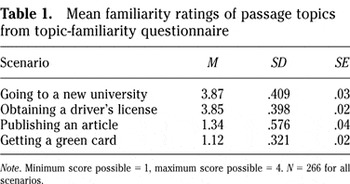
Mean familiarity ratings of passage topics from topic-familiarity questionnaire
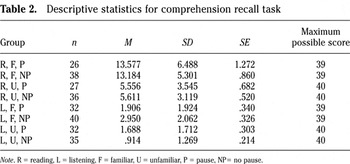
Descriptive statistics for comprehension recall task
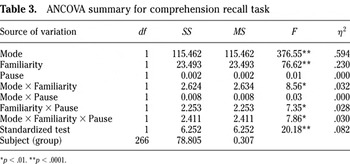
ANCOVA summary for comprehension recall task
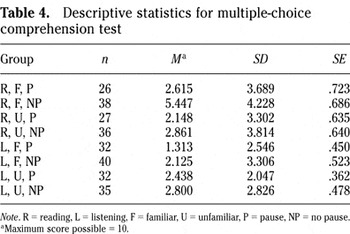
Descriptive statistics for multiple-choice comprehension test
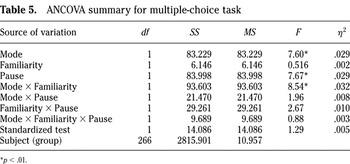
ANCOVA summary for multiple-choice task
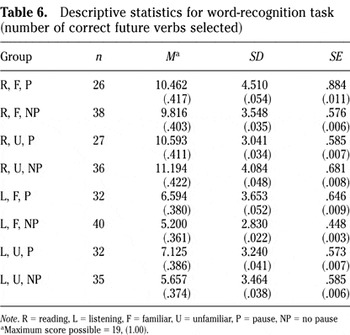
Descriptive statistics for word-recognition task (number of correct future verbs selected)
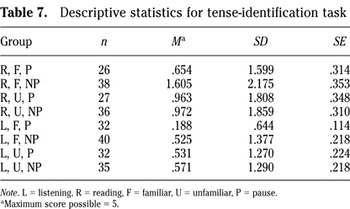
Descriptive statistics for tense-identification task
 You have
Access
- 29
- Cited by