The development of sociolinguistic competence by advanced second language (L2) learners is an area of interest within the field of SLA that has come under increased research-based scrutiny over the last decade or two (e.g., Bayley & Preston, Reference Bayley and Preston1996; Bayley & Regan, Reference Bayley and Regan2004; Dewaele & Regan, Reference Dewaele, Regan, Foster-Cohen and Nizegorodcew2001; Geeslin, Reference Geeslin, Leow and Sanz2000; Iwasaki, Reference Iwasaki2008; Killam, Reference Killam2011; Li, Reference Li2010; R. Mougeon, Nadasdi, & Rehner, Reference Mougeon, Nadasdi and Rehner2010; Schmidt, Reference Schmidt2011; van Compernolle, Reference van Compernolle2011). This research has focused on the sociolinguistic competence of learners of different second or foreign languages (e.g., Chinese, English, French, Japanese, or Spanish) from a variety of linguistic backgrounds. Our own research in this area (see F. Mougeon & Rehner, Reference Mougeon and Rehner2009; Rehner, Reference Rehner2010, Reference Rehner2011) has, to date, focused on the development of sociolinguistic competence by first- and fourth-year Canadian university-level learners of French as a second language (FSL) who have studied the language at the elementary or secondary school level either in a core French program (i.e., formal study of the language delivered via short French classes offered at set times in the school schedule)Footnote 1 or in a French immersion program (i.e., content-based language instruction in which French is the medium through which various subject courses are taught). Our past research, like many of the other studies in the field, has examined the impact on the use of specific sociolinguistic variants exerted by a limited set of specific linguistic and extralinguistic factors, such as the surrounding phonetic or lexical context, the sex and social class of the speaker, and the amount of time the speaker has spent in a French-speaking environment.
Unlike our past research based on multifactorial analyses of sociolinguistic variation, the present article undertakes a dual-phased transversal and longitudinal study that is more qualitative in nature. We begin with a transversal investigation of whether cohesive patterns can be found in an examination of a range of individual factors related to the learners’ (extra)curricular “active commitments” to French (a new term we introduce and define in the Methodology section) and their reflections on their own FSL learning, on the nature of bi- or multilingualism, and on language education in Canada, enabling the drawing of learner profile portraits that summarize the multiple effects of these factors. We then consider whether an index of engagement based on these portraits can shed light on three measures of the learners’ sociolinguistic (i.e., their use of informal sociolinguistic variants) and linguistic (i.e., the average length of their interviews and their use of positive or negative speech elements) performance. We then move to a longitudinal examination of changes in the learners’ profile portraits and resulting differences in their rates of informal sociolinguistic variant use. In other words, we consider the role that the students’ evolving learner profile portrait plays in their use of sociolinguistic variants by considering their level of engagement with French as measured in part through the number, duration, frequency, and intensity of their active commitments to French.
LITERATURE REVIEW
Contexts of L2 Learning and Use
Research has shown that context impacts various aspects of L2 acquisition (e.g., D’Amico, Reference D’Amico2010; DeKeyser, Reference DeKeyser1986; Díaz-Campos, Reference Díaz-Campos2004; Freed, Reference Freed and Freed1995; Lafford & Collentine, Reference Lafford, Collentine, Salaberry and Lafford2006). For instance, in a special issue of Studies in Second Language Acquisition (SSLA), edited by Collentine and Freed (Reference Collentine and Freed2004), the contributions of Segalowitz and Freed (Reference Segalowitz and Freed2004) and Freed, Segalowitz, and Dewey (Reference Freed, Segalowitz and Dewey2004) showed that studies abroad and short-term immersive experiences positively impact learners’ oral fluency (e.g., speech rate and hesitations) and overall proficiency, and Lafford (Reference Lafford2004) concluded that these experiences lead to interactions that are more fluid, with fewer communication gaps. Finally, in his chapter, Collentine (Reference Collentine2004) demonstrated that study abroad learners experience greater improvements in their narrative abilities and semantic density, aiding in the communication of their ideas, whereas their at-home counterparts have an advantage in their overall lexicogrammatical growth.
Furthermore, studies of the impact of context on the development of L2 sociolinguistic competence, in particular, are numerous (e.g., Alvord & Christiansen, Reference Alvord and Christiansen2012; Blondeau & Nagy, Reference Blondeau, Nagy, Jensen and Van Herk1998; Collentine & Freed, Reference Collentine and Freed2004; Dewaele, Reference Dewaele1992, Reference Dewaele2004; Dewaele & Regan, Reference Dewaele, Regan, Foster-Cohen and Nizegorodcew2001, Reference Dewaele and Regan2002; Geeslin, García-Amaya, Hasler-Barker, Henriksen, & Killam, Reference Geeslin, García-Amaya, Hasler-Barker, Henriksen, Killam, Borgonovo, Español-Echevarría and Prévost2010, Reference Geeslin, García-Amaya, Hasler-Barker, Henriksen, Killam, Geeslin and Díaz-Campos2012; Lapkin, Hart, & Swain, Reference Lapkin, Hart, Swain and Freed1995; R. Mougeon et al., Reference Mougeon, Nadasdi and Rehner2010; Nagy, Blondeau, & Auger, Reference Nagy, Blondeau and Auger2003; Nagy, Moisset, & Sankoff, Reference Nagy, Moisset and Sankoff1996; Regan, Reference Regan, Bayley and Preston1996, Reference Regan and Dewaele2005; Regan, Howard, & Lemée, Reference Regan, Howard and Lemée2009; Sankoff, Reference Sankoff, Auger and Rose1997; Sankoff et al., Reference Sankoff, Thibault, Nagy, Blondeau, Fonollosa and Gagnon1997; Sax, Reference Sax2003; Thomas, Reference Thomas2000, Reference Thomas2002). These studies show that L2 learners with greater contact with the language in extracurricular settings make more nativelike use of sociolinguistic variants than do classroom-based learners. This nativelike use includes a better knowledge and use of the range of variants available, their relative frequencies, and their social, stylistic, and linguistic constraints.
Acquisition of L2 Sociolinguistic Competence in a Study Abroad Context
Study abroad programs can provide opportunities for learners to develop nativelike L2 use. For instance, Geeslin, Fafulas, and Kanwit (Reference Geeslin, Fafulas, Kanwit, Howe, Blackwell and Quesada2013) and Salgado-Robles (Reference Salgado-Robles2011) showed that learners of L2 Spanish integrate local community norms into their speech after a stay in Spanish-speaking communities from different parts of the world and acquire knowledge of local nonstandard forms. Geeslin et al. (Reference Geeslin, García-Amaya, Hasler-Barker, Henriksen, Killam, Borgonovo, Español-Echevarría and Prévost2010, Reference Geeslin, García-Amaya, Hasler-Barker, Henriksen, Killam, Geeslin and Díaz-Campos2012) demonstrated that L2 learners of Spanish move toward more nativelike understandings of the linguistic constraints on variation after a stay abroad. Iwasaki (Reference Iwasaki2008) showed that L2 learners of Japanese display better style-shifting abilities after a study abroad stay in Japan, and Marriott (Reference Marriott and Freed1995) arrived at similar results in a study of politeness patterns by exchange students in Japan.
For French, Collentine and Freed’s (2004) introduction to the special issue of SSLA reviews research documenting the sociolinguistic abilities of learners who have undertaken studies abroad and intensive short-term immersion experiences. They show that these types of experiences have a positive impact on the development of politeness strategies that conform to social conventions, the acquisition of pragmatic elements linked to improved sociolinguistic skills, and the use of informal variants in more nativelike ways. Kinginger (Reference Kinginger2008) investigated the situationally appropriate use of the singular address pronouns tu and vous and the self-reported acquisition of colloquial French lexical items by American FSL students who took part in a study abroad program in France. She found that, after having taken part in the program, many of the students were able to mark (in)formality and to consistently use the address pronouns in situationally appropriate ways. Regan et al. (Reference Regan, Howard and Lemée2009) and Lemée and Regan (Reference Lemée, Regan, Regan and Ni Chasaide2010), in their research with Irish FSL learners who spent a year in France, find that contextual factors (e.g., intensity of language contact and degree of L2 exposure) positively impact the learning of native stylistic rules. They call for studies of how learner-specific factors (e.g., self-assessment, residence type, or motivation) connect to L2 sociolinguistic development.
Acquisition of L2 Sociolinguistic Competence in a Classroom Context
R. Mougeon et al. (Reference Mougeon, Nadasdi and Rehner2010) examined the impact of classroom instruction on the learning of sociolinguistic variants by Canadian French immersion students at the secondary level. These authors find that the range, frequency, and level of formality of variants present in the learners’ educational input (particularly in the teachers’ speech) correspond almost exactly with that documented in the speech of the learners. They suggest that, for classroom-based learners, the overly formal sociolinguistic model of speech presented by instructors is the key influencing factor in the students’ subsequent overuse of formal and hyperformal variants and of their concomitant avoidance of vernacular variants and underuse of informal variants.
Mode of Instruction: Immersion versus Core French Programs
For research on Canadian FSL acquisition, the contrast for mode of instruction has been immersion versus core French (e.g., Genesee, Reference Genesee1999; Lambert, Genesee, Holobow, & Chartrand, Reference Lambert, Genesee, Holobow and Chartrand1993; Nagy et al., Reference Nagy, Blondeau and Auger2003). From early on, such research (e.g., Barik & Swain, Reference Barik and Swain1975; H. P. Edwards & Casserly, Reference Edwards and Casserly1976; Stern, Reference Stern1978) showed that immersion students outperform their nonimmersion peers in terms of overall French language comprehension and production. One long-lasting difference between former immersion and core French students’ abilities is the development of sociolinguistic competence. Research by F. Mougeon and Rehner (Reference Mougeon and Rehner2009) and Rehner (Reference Rehner2010, Reference Rehner2011) has documented a broader range of variant use by former immersion students (compared to core French students) at the university level, particularly for informal and vernacular variants that are not part of institutional pedagogical norms (see Valdman, Reference Valdman2003, on the notion and reality of FSL pedagogical norms). These studies have also shown that former immersion university learners consistently outperform their former core counterparts in terms of their understanding of the linguistic and extralinguistic factors that constrain variant use.
Advanced Learners
A wealth of research evidence exists documenting the development of overall linguistic competence by advanced L2 learners (e.g., Bartning & Schlyter, Reference Bartning and Schlyter2004; Hancock & Kirchmeyer, Reference Hancock, Kirchmeyer and Dewaele2005; Labeau, Reference Labeau2005; Towell, Reference Towell, Coleman and Towell1987). Labeau and Myles’s (Reference Labeau and Myles2009) edited volume revisits the notion of the advanced learner variety, defining a learner’s profile of discursive and grammatical competence on the continuum of L2 acquisition. In that volume, considering further evidence that very advanced L2 learners outperform advanced learners in their appropriation and use of native sociostylistic rules (Forsberg, Reference Forsberg, Labeau and Myles2009; Labeau, Reference Labeau, Labeau and Myles2009), Bartning (Reference Bartning, Labeau and Myles2009) refines her 1997 description of the advanced learner, which focused specifically on the features distinguishing them from near-native learners in all aspects of speech production (e.g., verbal morphology, perfect vs. imperfect forms, agreement, gender, negation, concept of the future, and subordination). She argues that an additional near-native level is necessary in her taxonomy to account for stylistic and discursive differences at the upper end of the advanced learner scale.
Individual Factors
Howard, Mougeon, and Dewaele (Reference Howard, Mougeon, Dewaele, Bayley, Cameron and Lucas2013) highlight the need for research on the “specificity of the acquisition process underlying the development of L2 sociolinguistic competence” (p. 353), and recent studies have examined the role of demographic and identity-related factors in the development of L2 sociolinguistic competence. For example, Li’s (Reference Li2010) work on L2 Chinese underscores the importance of considering multiple dimensions of L2 learning and use, where complex linguistic, social, and developmental factors interact. In relation to demographic factors, researchers such as Blondeau and Nagy (Reference Blondeau, Nagy, Jensen and Van Herk1998), Blondeau, Nagy, Sankoff, and Thibault (Reference Blondeau, Nagy, Sankoff and Thibault2002), Dewaele (Reference Dewaele2004), Geeslin and Gudmestad (Reference Geeslin and Gudmestad2010), Geeslin and Guijarro-Fuentes (Reference Geeslin, Guijarro-Fuentes, Potowski and Cameron2007), R. Mougeon et al. (Reference Mougeon, Nadasdi and Rehner2010), and Regan et al. (Reference Regan, Howard and Lemée2009) have shown that sex, social class background, and language(s) spoken at home influence L2 learners’ patterns of sociolinguistic variant use. Additionally, the study of L2 learner identity formation is attracting considerable research attention (see Garold, Xuesong, & Lamb, Reference Garold, Xuesong and Lamb2011). For instance, Singleton, Regan, and Debaene (Reference Singleton, Regan and Debaene2013) explored the competing identities of Polish immigrants in Ireland and France, Wei (2011) examined identity building by multilingual Chinese youth living in Britain, and Ni Chasaide and Regan (Reference Ni Chasaide, Regan, Regan and Ni Chasaide2010) investigated the identity formation of learners mastering two languages simultaneously (Irish and French) in the context of an Irish immersion school. F. Mougeon and Rehner (Reference Mougeon, Rehner and Collier2010) examined the connection between bilingual identity and sociolinguistic variant use for Canadian university-level FSL learners and show that use of informal variants is greatest among learners who have forged a French identity that is more complex and solidified than during their secondary-level studies. Blondeau (Reference Blondeau, Regan and Ni Chasaide2010) examined the development of L2 French identity by Anglophone Montrealers who learned French both in high school immersion programs and by living in a French-speaking milieu and shows that these learners are acutely aware of the sociostylistic differences between the French taught in school (characterized by formal and hyperformal variants) and the French of the community and their social networks (featuring a range of variants, including those that are informal or vernacular).
Multilinguals versus Bilinguals
Finally, on the subject of research highlighting differences in the acquisition process of speakers of two or more additional languages compared to monolingual L2 learners, some authors argue that such differences are significant enough to justify a separate body of research using a distinct research methodology. This body of research examines the intensity of cognitive efforts on the part of multilinguals (e.g., Hoffman, Reference Hoffman, Cenoz and Jessner2000) as well as the nature of cognitive processes (e.g., M. Edwards & Dewaele, Reference Edwards and Dewaele2007). Dewaele and Wei (Reference Dewaele and Wei2013) found that speakers with a high level of multilingualism display more tolerance of ambiguity than do bilinguals or monolinguals. Furthermore, they showed that simply growing up in a multilingual family is not enough to raise such tolerance levels. Finally, they demonstrated that tolerance of ambiguity is higher after a stay abroad of more than 3 months but that this increase levels off after 1 year abroad. Concerning FSL learners, Dewaele (Reference Dewaele, Regan and Ni Chasaide2010) argues that speakers of three and four languages differ significantly in their perception of their own French proficiency and in their perception of the proficiency of first language (L1) speakers. His research shows that multilinguals’ attitudes impact the expectations and goals they set for future achievements. Bijvoet and Fraurud (Reference Bijvoet and Fraurud2012) examine a second level of impact that a multilingual community may exert on speakers. They explore young people’s perceptions of themselves and of others in a multilingual setting and show that the subjects’ perceptions of their own competence do not always match their actual competence and that such perceptions are highly fluctuating according to the changing multilingual and multicultural environment.
METHODOLOGY
With this background in mind, the present article undertakes, first, a transversal investigation of whether patterns can be found in an examination of a range of individual factors related to learners’ (extra)curricular active commitments to French and their reflections on their FSL learning, on the nature of bi- or multilingualism, and on language education in Canada. This transversal investigation enables us to draw learner profile portraits that summarize the multiple effects of these factors. We then consider whether an index of engagement based on these portraits can shed light on three measures of sociolinguistic and linguistic performance. Finally, we move to a longitudinal examination of changes in the learners’ profile portraits across time and any resulting differences in their sociolinguistic performance. This methodological approach, although not strictly variationist or designed to compare students’ speech in formal versus informal contexts, allows for a more comprehensive picture of the learners and their sociolinguistic and linguistic performance.
Participants and Data Collection
The data used in the current study were first collected in 2005 via surveys and interviews with 61 university-level FSL learners in their first or fourth year of study in a bilingual university in the English-dominant province of Ontario, Canada, where these students were majoring in various liberal arts disciplines. The 2005 surveys provided basic demographic, language use, and educational background information about the participants. The 2005 interviews with these learners followed a semidirected, Labovian-style approach, touching on a range of formal and informal topics designed to engage participants in a discussion in French. In 2008, 19 of the 61 learners from the 2005 corpus were reinterviewed using the same protocol. These 19 learners were in their first year of study in 2005 and in their fourth year by 2008.
Data Analysis
Adopting a grounded theory approach (Strauss & Corbin, Reference Strauss and Corbin1998), we analyzed our 2005 survey and interview data to identify individual factors that could help to form learner profile portraits. The individual factors in the study were emergent and were arrived at through an iterative, bottom-up approach; they may therefore be particular to this group of learners. The following three main categories of individual factors emerged: students’ reflections on their FSL learning, their thoughts on bilingualism and bilingual education in general, and their degree of engagement in their own FSL learning (see details in the next section). The 2005 interview content was also examined for information about the three types of dependent variables in the present study—namely, the average length of the interviews, the use of positive or negative speech elements by the participants, and the range and frequency of informal and formal French variants used. Finally, we compared the results of our analysis of the 2005 data with that of the 2008 interviews to determine if any changes in the learners’ profile portraits had occurred across time and whether any such changes corresponded to changes in their sociolinguistic performance as measured through their use of sociolinguistic variants, the most complex of the three measures examined in the 2005 data.
Individual Factors: FSL Learning, Bilingualism and Bilingual Education, and Engagement
The first individual factor that emerged focused on the students’ reflections on their own FSL learning. It is important to point out that, as we previously discussed (Bijvoet & Fraurud, Reference Bijvoet and Fraurud2012), self-perception does not necessarily equate directly with actual abilities. In fact, our own research (F. Mougeon & Rehner, Reference Mougeon and Rehner2009) with these same cohorts under study in the present article has shown that some of the students underestimate their French proficiency on the basis of their unequal competence in a range of skills due to a lack of focus on oral skills in particular FSL programs. Despite these negative self-evaluations, one must bear in mind that, having graduated from high school FSL programs and now taking university-level courses in French, the students are considered by the system as having reached an advanced stage of proficiency. The second individual factor that emerged was the students’ thoughts on bi- and multilingualism and language education in Canada. The final individual factor was the learners’ (extra)curricular active commitments to French beyond their fulfillment of the institution’s mandatory language requirements (either a second-year French language course or any course taught through the medium of French). An active commitment is a self-imposed change in lifestyle initiated by a L2 learner involving a certain degree of risk taking and responsibility to promote a maximum use of and exposure to that language. For the active commitments in this study, we measured their frequency, intensity, duration, level of intellectual demand, and immediacy of use.
Dependent Variables: Length of Interviews, Positive or Negative Speech Elements, and Sociolinguistic Variants
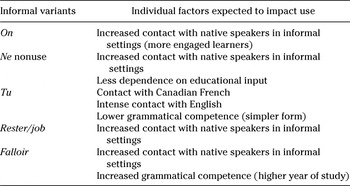
Three measures of sociolinguistic and linguistic performance function in the present study as the dependent variables. First, with respect to linguistic performance, the average length of the interviews, excluding the interviewer’s interventions, was calculated for each learner profile portrait; this measure is generally indicative of L2 learners’ level of linguistic competence. Second, the students’ use of both positive and negative speech elements (i.e., use of idiomatic neutral or informal expressions and of French colloquial expressions versus use of English sentences in the French interview and complaints about not understanding native French accents or the speed of French input, which signals insufficient familiarity with the prosodic features of French) across the different learner profile portraits was documented. Finally, with regard to sociolinguistic performance, we calculated the use of particular sociolinguistic variants during the interviews by the members of each of the profile portraits to determine if the rate of use of the informal variants (a measure of sociolinguistic development resulting from extracurricular exposure to French and thus a potential reflection of engagement in French acquisition beyond classroom learning) increased in step with the level of active commitments measured in each of the learner profile portraits.Footnote 2 The six sociolinguistic variables examined are presented in the following paragraphs (with the informal variant listed first), along with expectations for their use by the learners.
The first-person plural subject pronoun on (versus nous) and the nonuse (versus use) of the negative particle ne are mildly marked variants commonly used in informal speech by most native speakers of French. As such, we expected that those students with increased contact with native speakers in informal settings would display the most frequent use of these two informal variants. However, for the remaining students, we expected to see an overuse of ne because there is an overwhelming presence of ne in the speech of teachers and in the pedagogical materials used in the types of French classes they have taken (see R. Mougeon et al., Reference Mougeon, Nadasdi and Rehner2010).
The second-person address pronoun tu (versus vous) is a marked informal variant in native speech, more so in certain communities than in others: for example, in Canadian French, where its use is reinforced by the generic use of tu as a variant of on; this use is much less common in Europe (e.g., Coveney, Reference Coveney2010; Dewaele, Reference Dewaele2002; Gardner-Chloros, Reference Gardner-Chloros, Ayres-Bennett and Jones2007). Intense contact with English, which uses one single pronoun, you, for both address and generic use, may also reinforce the frequency of tu in Canadian L1 and L2 French. Making this informal variant a more viable candidate for L2 speakers regardless of level of contact with native speakers is the fact that the verbal paradigm following tu is simpler than that after vous. All persons in the singular are homophones in spoken French for all regular and most irregular verbs. Thus, we expected to find a potentially unstable pattern of use of this informal variant across the learner profile portraits.
The two lexical variables examined—rester (versus habiter or vivre “to live”) and job (versus travail “work”)—have vernacular or informal variants found in the speech of native speakers. Thus, we expected to find increased use of the vernacular and informal variants in keeping with the learners’ degree of exposure to native spoken French.
Finally, the expression of necessity falloir (versus devoir “must”) represents more of a developmental variable. Falloir is frequently used in native French, but its use is governed by several linguistic constraints. First, it has to be preceded by the third-person impersonal pronoun il, and it may take either an infinitive complement or a dependent clause with a verb in the subjunctive mode (some irregular verbs have specific subjunctive forms distinct from better known, more common forms in the indicative and hence are less readily available to L2 learners). These constraints are likely to pose difficulties for L2 learners. Therefore, we expected to find increased use of falloir according to higher levels of exposure to native French and year of study. The expectations for use of the six informal variants under study are summarized in Table 1.
Individual factors expected to impact informal variant use

Research Questions and Hypotheses
The present study seeks to determine the following: (a) whether the multiple effects of the various individual factors identified can effectively be captured in a series of learner profile portraits, (b) whether such portraits correlate with three measures of learners’ sociolinguistic and linguistic performance, and (c) whether any changes in the learners’ profile portraits are matched by corresponding changes in the learners’ use of informal sociolinguistic variants. In doing so, the study addresses four research hypotheses. First, we expect to find a set of cohesive patterns within a range of individual factors, allowing for the drawing of learner profile portraits. Second, we anticipate a strong positive correlation between the level of engagement reflected in the profile portraits and the three measures of sociolinguistic and linguistic performance. This hypothesis is based on the body of research mentioned previously demonstrating that greater extracurricular L2 contact results in more nativelike target language use. Third, we expect that the multilingual FSL learners’ previous experience learning another language will lead them to outperform their bilingual counterparts in the three measures of sociolinguistic and linguistic performance. This hypothesis is based on those studies outlined previously demonstrating cognitive and linguistic advantages for multilinguals. Finally, we expect that, as the learners progress through their university studies, their level of engagement will increase and that, as a result, their use of informal sociolinguistic variants will also increase.
RESULTS
With these goals and expectations in mind, we turn now to the results of the analyses, beginning with the learners’ profile portraits. Overall, for the three main individual factors outlined in the methodology, the following specific individual factors emerged:
• A range of curricular experiences (e.g., type of high school program [core vs. immersion], number of years spent studying French at the university level, types of FSL and French-medium classes enrolled in, and plans for graduate studies involving French)
• A range of extracurricular experiences (e.g., current or future living arrangements involving Francophones; presence of Francophone friends, partners, or family members (present or future); extracurricular immersion experiences; current or planned pastime activities in French; and projected career or current or future part-time jobs in which French is used)
• Learners’ perception of their identity as bilingual or multilingual students
• Learners’ broad and precise ideas about multi- or bilingualism and bilingual education
• Learners’ reflections on their actual use of French in a variety of contexts
As expected, cohesive patterns were revealed in the learners’ active commitments and reflections, allowing for three levels of engagement to be distinguished: engaged, moderately engaged, and minimally engaged learners. Furthermore, as hypothesized, the data revealed that the multilingual learners differentiate themselves from their bilingual counterparts in relation to the pace of their FSL acquisition and the intensity of their engagement. As such, and in keeping with the research referenced previously, the learner profile portraits have been further categorized according to whether the students are multi- or bilingual, resulting in the following six learner profile portraits: engaged multilinguals, engaged bilinguals, moderately engaged multilinguals, moderately engaged bilinguals, minimally engaged multilinguals, and minimally engaged bilinguals.Footnote 3
Learner Profile Portraits
Engaged Multilinguals
Most of these eight students are in their fourth year of university and are taking or intend to take French-medium courses. They live at home or in student residences and have regular contact with Francophones. All have spent 1 year in a Francophone environment or intend to do so, are involved in extracurricular activities in French, and have current or future plans for jobs involving French. They report using French regularly and all the time with Francophones, though some find it difficult at times to find interlocutors. Many code switch to adapt to different situations or speakers.
They are the most able to report on their L2 learning and to discuss the evolving nature of multilingualism. Most have complex identities from their multiple languages and competing loyalties; they mention the “balancing” of languages, maintaining relationships across their languages, and experiencing changes in which languages are dominant (and when and why). All but one consider themselves bilingual in reference to French and English, with the additional component of their identity coming from their other languages. Most say their oral French skills are stronger than their written. Some say that their accent is fluid and that they can use informal French appropriately. Some mention the usefulness of being exposed to explicit grammar instruction in French in university, because their language learning had previously been based more on intuition. They feel that acquiring solid metalinguistic knowledge of French will benefit not only their future French language learning but also their future career.
They comment on the language laws and policies in different parts of the country and on how classroom L2 learning changes depending on context and program type. The mandatory bilingual requirements of the college are seen as an incentive to offset the imbalance in their multiple languages by supporting their French development. Some comment on how living in a French-speaking environment helps them overcome fears of making mistakes or not feeling accepted.
Engaged Bilinguals
All four of these students are in their fourth year of university, one from a core program and three from early immersion or French-medium schools before or after immersion. All take French-medium courses or translation, and three intend to pursue French in graduate school. They live with Francophones or intend to move to Francophone communities, maintain regular contact with Francophones, and have had frequent or long stays in a Francophone environment, but only one mentions a year abroad. Three of these students watch TV, listen to music, send e-mails, read books or magazines, and/or take part in social activities in French. All have current or future plans for jobs in which French constitutes a major part of their duties. In terms of their self-reported use of French, they use the language in their current jobs and regularly with their friends, partner, or family, and two mention that they switch languages depending on their interlocutors or the context.
They display a strong self-knowledge of their language-learning progress and skills. French has been or is their dominant language in some contexts and their English and French have interfered with or influenced each other. French, which they acquired more than learned, is a big part of their lives, and they have acquired local varieties and possess a strong attachment to that variety. They say that their informal registers are more developed than their formal ones.
These students express the need to develop transferable language skills and to be taught more than one variety of French. One student thinks one can only be bilingual if one is born that way; another student mentions that it is better to have a standard French accent than a L2 accent, so one does not stick out; a third student says he would like to have learned more than the local variety of French in school and likes the fact that university study exposes him to a wider array of Francophones; and another student comments on the transferability of bilingual skills in professional environments. These students feel only moderately satisfied with their bilingualism, but all report that their French is good.
Moderately Engaged Bilinguals
These 15 learners are from both core and immersion backgrounds and are in their first and fourth years of university. Three take French-medium courses, one had an internship in French, and most want to continue with French in graduate school or teachers college. Many have, had, or plan to have living arrangements involving Francophones, and more than half have some contact with Francophones. Most have made one or more trips to Francophone environments (lasting several weeks to 2 months), with variable levels of use of French. Only one student spent a year abroad, and two others intend to do so. Each engage in one extracurricular activity in French but rarely more, and most are considering a job involving French. Most use French sporadically outside class, except for two who use the language in a variety of contexts.
Although two consider themselves bilingual because they can read, write, speak, and think in both languages (though their written French surpasses their oral), most are stronger in English and do not consider themselves bilingual (e.g., they do not always understand Francophones, they are surrounded by those who are more bilingual, and they make grammar errors or have vocabulary gaps and English accents). They are aware of register problems in their French, though one mentions her capacity to change French accents. Some experienced “regressions” in their French (e.g., since returning from French environments, since their first year of university, or over the summer). Despite these negative perceptions, it must be remembered that their French is sufficiently advanced to take French-medium courses at university and to plan to continue in graduate programs involving the use of French.
Some have limited knowledge of global Francophone culture, and many comment on the importance of French in Canada. They reflect on the virtues and shortcomings of Francophones and on gaps between the FSL educational system, their observable results, and how Francophones use the language. Some comment explicitly on learning grammar in French but not English.
Moderately Engaged Multilinguals
With the exception of one learner in the fourth year of university, these seven students are in their first year and are evenly split between core and immersion backgrounds. Half intend to take French-medium courses or obtain recognition of their bilingual competence,Footnote 4 though French is not mentioned clearly in their plans for graduate school. They live at home with their parents, and some speak French on a regular basis, though not intensively. Although all have visited Francophone environments, there is little unity in these experiences. Four plan to spend a year abroad, and all but one have pastimes in French. Half have current or future plans for jobs in French.
For most, their family language forms the largest part of their identity, though all but one consider themselves bilingual with reference to French and English. Most recognize different French accents, and some are working to modify their own for different reasons. They have limited knowledge of the components of the French-language instruction they received beyond the role of oral practice and exposure, commenting primarily on the value of strong oral skills. Only two students offer modest reflections on the nature of bilingualism or bilingual education.
Minimally Engaged Bilinguals
These 20 learners are primarily in the first year of university and are from core or partial immersion backgrounds. Most have a course-based commitment to French, although this commitment extends past the basic level (one has a bursary to take 60% of her courses in French; four are taking or plan to take a French-medium course). Half are majoring or minoring in French or intend to do so. Many mention graduate studies or teachers college involving French. Most live in student residences but do not comment on contacts with Francophones, except when several admit they do not take advantage of the opportunities that surround them. Most have made one or more short trips to Francophone environments (lasting from several days to several weeks), though they took little advantage of opportunities to immerse themselves in the language while there. Although they engage in few extracurricular activities in French, several intend to do a year abroad. Two students have or intend to have a job involving French, and some even have or hope to find a job in a French-speaking environment.
These students generally understand the importance of French in Canada and recognize that there are different types of Canadian French but are not interested in language policies. Most do not consider themselves bilingual because their oral skills need improvement, but they hope to be bilingual when they graduate. Several feel they are fairly bilingual but say they still need to improve their skills. Their perceptions, though, have changed over time (e.g., they considered themselves bilingual until meeting people who they thought were “actually bilingual”). Most feel they need to increase their confidence and develop contact with French outside school.
Many comment on the shortcomings of FSL education (e.g., how having teachers uninterested in the language is demotivating). A few students, though, comment on the strengths of their bilingual education (e.g., immersion classes helped them to develop their accents and late-immersion students have more explicit grammar instruction).
Minimally Engaged Multilinguals
These eight students are mostly first-year university students from core French backgrounds. They do not take courses in French except as required, and French is not part of their future plans for graduate school or thereafter. Most live with their parents and make no mention of using French with friends, family, or partners. One mentions that an immersion experience improved her French and one is considering a third year abroad; however, although most have visited Francophone environments, their visits involved little or no actual use of French. Very few students in this category engage in the use of media in French, and for most their job plans do not include French.
They consider their community of origin to contribute most to their identity building, and French is excluded from this process. Although their bilingualism is not defined in reference to English and French, they hope to become bilingual in these terms by graduation, though they do not express the will to engage in activities that would improve their French. They have little knowledge of different varieties of French, and they feel that classroom learning is more effective than out-of-class practice to develop their bilingualism as required by the college to graduate. Almost none commented on their French-language education.
Overall Characterization and Measurement of Student Engagement
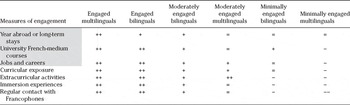
With the preceding information in mind, Table 2 provides a holistic assessment of the presence, number, frequency, duration, and intensity of the active commitments to French for the six learner profile portraits. We have adapted from Bartning (Reference Bartning1997) a simple system of “+” and “−” markings to capture the complex and diverse nature of the factors that, in combination, the learners credited with propelling them to a more advanced level of proficiency and that allow us to draw the six portraits of engagement. The most active commitment to the particular activities is noted with “++” and the least active with “−−.” As can be seen, the engaged multilinguals receive the highest ranking for each of the measures. Although it is only this group that receives this top rating throughout, the engaged bilingual group is not far behind, with positive measures in all categories and top ratings in six of the seven categories. Where the engaged bilinguals differ is in the degree to which they (plan to) participate in stays abroad or long-term stays. The moderately engaged bilinguals receive positive measures in all categories of engagement. Like their more engaged counterparts (whether multi- or bilingual), they are participating in (or plan to participate in) year-abroad programs or extended stays, French-medium courses, jobs or careers involving the use of French, curricular and extracurricular activities in French, immersion experiences, and regular contacts with Francophones. Where they differ most notably is in the frequency and intensity of these activities. The moderately engaged multilinguals participate less often in four of the seven measures than do their bilingual group mates, receiving only three (top) positive ratings. This decrease in engagement is most noticeable for the two minimally engaged profile portraits, where the level of engagement receives a predominantly negative rating throughout.
Measurement of overall engagement in French according to profile portrait

Note. The most active commitments are indicated by “++” and the least active commitments are indicated by “−−,” with “+” and “−” indicating intermediate levels of commitment; “=” indicates average levels of commitment. The gray-shaded characteristics take into account actual engagement and intentions to engage, whereas the nonshaded characteristics include only actual commitments or performance.
Analysis of the Dependent Variables
Linguistic Performance: Average Interview Length and Positive and Negative Speech Elements
The engaged multilinguals, the most engaged profile, produced 4,257 words on average in their interviews and used the following informal and idiomatic expressions: à cause que “cause,” fait que “so,” chu partie “I left,” une job “a job,” pour le fun “for fun,” mon chum “my boyfriend,” quelque chose de même “something like that,” des niaiseries “stupid things,” c’est ben l’fun “it’s real fun.” The engaged bilinguals produced on average 3,728 words in their interviews and used the following informal expressions: mes colocs “my roomies,” j’trouve London un peu plate “I find London rather boring,” c’est pas cool “it’s not cool,” and ça va adonner que j’ai arrêté mes cours “it just happens that I am through with my courses”; they also used the following idiomatic expressions: j’ai d’la misère “it’s really tough” and touche du bois “touch wood.” Only the former core French student in this profile did not use any such expressions. These results speak to the multistylistic competence of the learners in these two profile portraits and are a reflection of the students’ exposure to native uses of the target language in a variety of naturalistic situations (e.g., Dewaele & Regan, Reference Dewaele, Regan, Foster-Cohen and Nizegorodcew2001; Geeslin et al., Reference Geeslin, Fafulas, Kanwit, Howe, Blackwell and Quesada2013; Kinginger, Reference Kinginger2008; Salgado-Robles, Reference Salgado-Robles2011).
In their interviews, which averaged 3,481 words in length, a few moderately engaged bilinguals used the following informal expressions: juste pour le fun “just for fun,” chum “boyfriend,” and un bon job “a good job”; they also used the following idiomatic expressions: franchement “really” and qui me vient à l’esprit “that comes to mind.” One student demonstrated a lot of English-influenced phonology (or simply unusual phonology) and a tendency to regularize verbal paradigms, for example, j’m’intéresser “I am interested in” (where the infinitive verbal form is substituted for the expected inflected form) and à liser “to read” (where a regular verb ending is substituted for an irregular verb ending). For their part, the moderately engaged multilinguals produced an average of 3,442 words during their interviews and used very few informal speech features. One student produced two occurrences of informal words borrowed from English, namely chum “boyfriend” and pour le “fun” “for fun.” Two students made frequent use of je vas, which is an informal variant of je vais “I am going” in French but which is also a regularized part of L2 French interlanguage (and most likely so in these instances). Two students in this category demonstrated some difficulties in understanding or formulating utterances in French during the interview.
Finally, for the two least engaged profile portraits, the minimally engaged bilinguals produced 2,846 words during their interviews. A few of the students in this group each used one informal expression during their interview—ouais “yep,” ça fait rien “doesn’t matter,” ballon-panier “basketball,” queq’chose “somethin’,” or j’connais pas vraiment c’est quoi “*I don’t really know what is it”—but many had significant recourse to English to sustain the conversation: j’ai une interest um l’exchange “I have an interest um the exchange.” Several students had clear difficulty understanding what the interviewer was asking but were able to communicate this difficulty in French (e.g., je ne comprends pas “I don’t understand” or peux-tu répéter la question “can you repeat the question?”). As for the minimally engaged multilinguals, on average their interviews were 2,644 words in length. About half of the students in this profile showed significant difficulty in a real conversation with a native speaker outside the classroom context, reflecting, as noted previously, the classroom nature of their L2 learning that prioritized written skills over oral ones. These difficulties in speaking and in understanding spoken French during the interview were dealt with by the students through a variety of communication strategies using French (e.g., pardon “sorry,” je ne comprends pas “I don’t understand,” comment dit-on dare I don’t dare “how do you say dare, I don’t dare,” comment dit-on it does help to be scared “how do you say it does help to be scared,” or nous avons présenté les projets sur about les art pieces de Rodin “we presented projects on about the art pieces of Rodin”).
Thus, in sum, we see that, as hypothesized, the average number of words and the presence of positive and negative speech elements react in a direct and linear fashion to changes in the individual factors captured by the learner profile portraits, indicating that these two measures of linguistic performance are clearly correlated with the students’ level of engagement.
Sociolinguistic Performance: Use of Sociolinguistic Variants
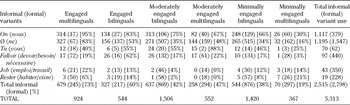
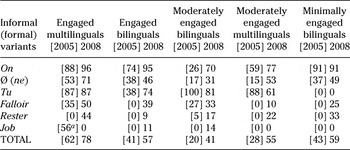
Table 3 provides the results of the analysis of sociolinguistic variant use by the students in the six learner profile portraits, with the number of tokens for each informal variant followed by the number of tokens of the corresponding formal variant in brackets and the percentage of informal use in square brackets. As expected, the most frequent use of informal variants is displayed by the most engaged students, followed by the moderately engaged students, with the minimally engaged students displaying the least frequent use of informal variants in their L2 French. Along the continuum of student engagement, the multilinguals at the higher end of the scale show a more accurate and appropriate use of the sociostylistic rules of French than do the equally engaged bilinguals. However, this trend is neutralized at the moderate level of engagement, where the bi- and multilinguals use the informal variants at near-equal levels, and it is reversed at the minimal level of engagement, where the bilinguals use them more frequently than do their multilingual counterparts.Footnote 5 This ordering of informal variant use by profile portrait is a near-perfect match to the ordering of profile portraits according to level of engagement. This near-perfect match becomes perfectly linear when one focuses on the occurrence of the mildly marked informal variants on and ne omission, which are the two informal variants that we expected to pattern most closely with levels of engagement. Remarkably, at the higher end of the engagement scale, the students’ frequency of use of informal variants is equal to or just below the levels of use documented by past research for native speakers, especially for on use.Footnote 6
Overall use of informal (formal) variants by profile portrait (2005)

Note. The percentages represent the percentage of informal variant use compared to formal variant use within each cell.
Concerning the use of the informal address pronoun tu, our results do not exhibit any coherent pattern in the frequency of use across the cohorts along the engagement continuum. This variant is not highly frequent, perhaps due to the type of semidirected interview used to collect the data (i.e., led by an interviewer significantly older than all of the interviewees). The occurrences of tu did not vary in frequency with the students’ longer or more intense exposure to French, pointing both to the students’ poor understanding (even at advanced levels of French proficiency) of the sociolinguistic rules governing the use of second-person address pronouns in French and to the unstable or evolving characteristics of the native rules of tu use.
Although the two informal or vernacular lexical variants are not overly frequent for any profile group, their use displays a u-shaped curve, rather than the predicted linear correlation with engagement outside the classroom setting. It should be pointed out that the informal or vernacular variants job and rester may not be recognized as such by the less engaged L2 learners who have limited exposure to informal native French. The u-shaped curve, then, may reflect their use as informal or vernacular variants by the engaged students who have significant contact with French outside the classroom and as English-supported variants by the minimally engaged students, with job functioning as a code switch or nonce borrowing from English and rester sharing some degree of semantic similarity with the English to rest.
Turning to falloir “to have to, to need to,” our results show that this variant is used only modestly by the more engaged students and is almost nonexistent in the speech of the less engaged. It should be noted that most of the students’ uses of falloir are in an infinitive construction (e.g., il faut faire “we have to do”) or with verbs that do not vary in the subjunctive (verbs ending with -er, like travailler “to work”), thus minimizing the time necessary to process the constrained use of falloir. The students favor the formal variant devoir. This tendency is not particularly surprising, as a cohort of graduating Francophone students from the same university (see F. Mougeon’s, Reference Mougeon2008, corpus of university-level spoken L1 French) showed the same pattern in their interviews and used devoir half of the time, pointing to the constraints of the formal academic context in which these students were studying at the time of the interview. This being said, the highest rate of frequency of falloir is found in the speech of the engaged bilinguals. This higher frequency of use may be due to their prolonged stays in a Francophone environment and to their frequent contacts with Francophones in everyday nonacademic settings.
The preceding findings concerning the effect of individual factors on informal variant use reveal marked differences between the multilingual and bilingual L2 learners and between those with more or fewer active commitments to the language. This result regarding the influence of active commitments to the language is in line with Regan et al. (Reference Regan, Howard and Lemée2009), who point to a spectacular drop in the use of ne in negative sentences and a marked increase in the use of on for nous by students returning from 1 year spent in France, as compared with their use prior to the learners’ stays abroad. This finding is also in keeping with those of Dewaele and Regan (Reference Dewaele, Regan, Foster-Cohen and Nizegorodcew2001), who documented the increased use of colloquial words by FSL learners after a year abroad, and Blondeau et al. (Reference Blondeau, Nagy, Sankoff and Thibault2002), who found that Anglophone FSL learners in Quebec recognize sociostylistic differences in French according to context as a result of their extensive exposure to local French as well as their high school immersion learning.
Profile Portrait Changes of the Returning Subcohort from 2005 to 2008
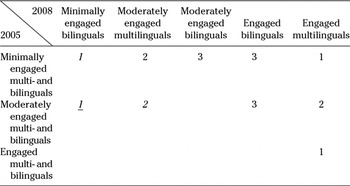
In 2008, as expected, the 19 returning students displayed a redefinition of their engagement level toward French (see Table 4, which indicates the number of students in each of the engagement categories in 2005 versus 2008). As can been seen, most of the moderately or minimally engaged students (14 of the 19) demonstrated increased levels of engagement by 2008, except for four students, whose level of engagement decreased or remained stable over the 3 years (indicated in italicized fonts). The only student whose level of engagement decreased (indicated in underlined font) admitted that she decided to pursue academic objectives other than French and that she considered her initial linguistic level (a result of her immersion grade school background) adequate for her needs. The change in engagement level is more marked for the bilinguals than for the multilinguals, and it is also interesting to note that there are no longer any minimally engaged learners within the multilingual cohort in 2008.
Changes in the level of engagement of the returning cohort: 2005 versus 2008

Note. The italics mark the four students whose level of engagement remained stable or decreased over the 3 years; the underlining marks the one student whose level of engagement decreased.
In addition to the level of engagement, the nature and intensity of engagement changed for students in all profile portraits from 2005 to 2008, even though many of the commitments described in 2005 remain in the 2008 data. Although absent from the 2005 data for the engaged multi- and bilinguals, the possibility of working and living in a French-speaking country or province was being seriously considered in 2008. In 2008, the moderately engaged bilinguals and multilinguals focused more on taking courses in French or in FSL. The bilingual students in 2008 did not mention continuing their studies in French after graduation, and the multilinguals made no mention of media use in French. Finally, the minimally engaged bilinguals in 2008 did not mention taking courses in French or in FSL, studying French later, or taking trips to French-speaking locales.
Understandably, as the students of the 2008 cohort got closer to graduation, their postgraduation life and careers became more clearly focused than in their 2005 interview. Decisions to commit to using French seem bolder than during their 2005 interview and include a commitment to live and work in a Francophone environment where authentic contact with Francophones gives credibility and authenticity to their actual participation in the life of the two linguistic communities, in contrast to the more prudent academic study abroad formula. Conversely, students who were moving away from French when considering their future did not readily engage in mixing with Francophones but would, if necessary, resort to taking courses in French or in FSL, a safer and more readily available alternative with a finite time frame.
Finally, returning to the difference in the crossportrait movement according to level of engagement for the multilinguals, it is possible that this difference may have to do with competition among several languages fighting for space alongside English. In many cases the multilingual, engaged students were trilingual, and a third language may have taken over as their preferred other language, resulting in a linguistic focus that is not as tight as that of the bilinguals.
The Impact of Portrait Change on Sociolinguistic Variant Use
Table 5 compares the informal variant use in the 2008 data with that for 2005 according to the students’ profile portrait changes. To allow for a more direct comparison, the 2005 figures reflect data from only the 19 students who were reinterviewed in 2008, not the entire 2005 sample of 61 students. The figures represent the percentage of informal variant use, with the 2005 results in square brackets. As expected, as the students became more engaged, they made more frequent use of informal variants. This is true of students in all portraits: engaged multi- and bilinguals’ use was 16% higher in 2008; moderately engaged multi- and bilinguals’ use increased 21% and 27%, respectively, and there was a 16% increase for minimally engaged bilinguals. As in 2005, by 2008, multilingual students who became engaged rank as the most frequent users of informal variants, maintaining a gap between their results and those of the engaged bilinguals as well as the less engaged learners.
The use of informal variants (in percentages) by profile portrait (2005 vs. 2008)

Note. The percentages outside of the brackets indicate 2008 use of informal variants by the returning cohort; the percentages inside the brackets indicate their 2005 use of these variants.
a The unexpectedly high rate of use of this informal variant is due to one speaker who produced all occurrences. This speaker did not continue this pattern of use in 2008.
At odds with the hypothesis that more engagement would lead to greater informal variant use, the moderately engaged bilinguals remain the lowest users, despite an increase from 2005 to 2008. This suggests that they favor formal variants over informal ones. All of the students in this category are from immersion backgrounds, and, according to their interview answers, they felt they had acquired sufficient conversational skills but felt less competent as users of formal academic style. They intended to focus on acquiring such formal skills while attending university and may thus have looked for more opportunities to acquire such skills through course-related writing activities. The minimally engaged bilinguals’ use of informal variants, already high in 2005, was still high in 2008 and increasingly so. Contrary to the cohort of moderately engaged learners, some confessed that they had moved away from French, at least in their area of academic studies, and had decided to take all of their discipline courses in English. In this case, their primary remaining exposure to the language likely served only social or conversational needs, hence the surprisingly high proportion of informal variants. For this reason, it is likely that a more restricted use of French for social purposes accounts for this overuse of informal variants by the less engaged students. Furthermore, their exceptionally high rate of informal variant use is largely due to a high frequency of on use. This marked preference for on by the less engaged L2 learners is comparable to the overgeneralization of on as a first-person plural pronoun by restricted L1 speakers and may be related to a process of simplification of the verbal paradigm in the plural. In other words, the overwhelming use of on of the less engaged learners may signal a developmental stage associated with their L2 interlanguage more than knowledge of the informal value of this variant. In addition, these L2 students were likely exposed to high levels of on use in high school through their teachers’ speech and the pedagogical materials (see Rehner, Mougeon, & Nadasdi, Reference Rehner, Mougeon and Nadasdi2003), thus making it easier for these less engaged learners to acquire this variant. Finally, for those learners in this profile portrait who decided not to pursue their academic studies in French and who continued to associate with their Francophone friends outside of the university context, it is likely that these students would continue to have intense exposure to on use, as it is a highly frequent informal variant both in European and in Canadian French (see Blondeau, Reference Blondeau1999).
Taken as a whole, the preceding findings, particularly the documented increase in informal variant use from 2005 to 2008, suggest a strong correlation between patterns of use and students’ active commitment levels as they progress through their undergraduate studies. These findings lend support to those of researchers such as Alvord and Christiansen (Reference Alvord and Christiansen2012), Collentine (Reference Collentine2004), D’Amico (Reference D’Amico2010), DeKeyser (Reference DeKeyser1986), Díaz-Campos (Reference Díaz-Campos2004), Freed et al. (Reference Freed, Segalowitz and Dewey2004), Geeslin et al. (Reference Geeslin, García-Amaya, Hasler-Barker, Henriksen, Killam, Borgonovo, Español-Echevarría and Prévost2010, Reference Geeslin, García-Amaya, Hasler-Barker, Henriksen, Killam, Geeslin and Díaz-Campos2012), Lafford (Reference Lafford2004), and Segalowitz and Freed (Reference Segalowitz and Freed2004), whose work has shown that greater contact with the target language outside of the classroom context has a positive impact on the development of oral fluency and overall proficiency, on the production of more fluid speech, on narrative abilities and semantic density, on the integration of local community norms, on more nativelike understandings of the linguistic constraints on variation, and on style-shifting abilities and politeness patterns. The findings also highlight distinct patterns and paces in the acquisition of sociolinguistic competence and in the attitudes and reflections of bilinguals as compared to multilinguals (supporting the suggestion by De Angelis, Reference De Angelis2007, Hoffman, Reference Hoffman, Cenoz and Jessner2000, and Pavlenko, Reference Pavlenko2008, among others, that these two learner populations are not one and the same). Our results point to the various degrees of efficiency students demonstrate in mapping their lifestyle goals onto their language use choices and in the securing of adequate places where their language can be put to use by investing in the right level of engagement toward reaching this goal.
Finally, investigating the returning cohort has allowed for the creation of real-time portraits of the acquisition of sociolinguistic competence in its advanced stages and bears witness to the evolving process of this acquisition as it links to the parallel evolution of personal engagement. We have provided sociolinguistic evidence of the impact of the changing learning opportunities and individual active commitments on the pace and nature of advanced L2 learners’ experience, as described in Bijvoet and Fraurud’s (Reference Bijvoet and Fraurud2012) study of L2 acquisition in a multilingual context, in which these authors noted the interaction between changing environments or learning goals and learners’ own identity definition. Dewaele (Reference Dewaele, Regan and Ni Chasaide2010) has documented the role of multilingual learners’ attitudes and expectations on their perceptions of their own proficiency and of targeted native proficiency. By measuring the learners’ use of sociolinguistic variants at different stages in their advanced proficiency against their evolving self-assessments of their learner identities as they progress through their university studies, we have isolated social, attitudinal, and contextual factors promoting or slowing down active engagement in learning French. We have also identified demographic factors, such as the existence and dominance of the learners’ other languages, that may modify the pace and smoothness of the FSL learning process as well as refine the ways in which individuals determine their expectations for achievement levels.
CONCLUSION
The current study and resulting engagement scale have documented the role that L2 students’ learner profile portraits play in their sociolinguistic and linguistic performance by considering their level of L2 engagement as measured through the number, duration, frequency, and intensity of their active commitments to the use of their L2 in their regular activities as students and future professionals. Our results highlight, in particular, the uneven pace of acquisition of the rules and frequency of use of informal variants by the cohorts of advanced L2 learners. Some less marked sociolinguistic variants (e.g., on) were used by many of the students as frequently as by native speakers. Such variants had been acquired by the students prior to university study through exposure via pedagogical materials and their teachers. In contrast, more marked variants (e.g., rester) remained underused as compared to their use in native speech. Studies of variation in L1 Francophone minority communities, however, have also documented low frequencies of use of certain marked variants linked to speakers’ levels of language use restriction (R. Mougeon & Beniak, Reference Mougeon and Beniak1991), which is similar in some ways to the exposure experienced by the present L2 learners. In the current study, the frequency of informal variants was shown to be sensitive to the students’ intensity of contact with native speech and to their year of study, with increases in engagement level and progress through university studies being matched by increases in informal variant use.
Our distinction between the multilingual and bilingual cohorts highlighted another factor impacting the students’ sociolinguistic production. Distinguishing between multilingual and bilingual learners has allowed us to craft a more precise picture of the varied pace of acquisition of diverse learner cohorts according to the presence or absence of competition with a third or subsequent language at different stages in life (e.g., Bijvoet & Fraurud, Reference Bijvoet and Fraurud2012; Dewaele, Reference Dewaele, Regan and Ni Chasaide2010). Our results in this regard may point to a more efficient way for advanced multilingual learners to strategically infer rules for appropriate use of sociolinguistic variants from their other languages used in similar contexts, thus saving processing time but risking infelicitous results in terms of nativelikeness in the target language, as stylistic rules are most often language specific. Further research on this point would serve to confirm or refine this finding related to the acquisition patterns in French as a subsequent language by advanced multilingual learners.