Lyster and Saito (this issue), in their excellent meta-analysis of classroom-based oral corrective feedback (CF) studies, comment that “the field of CF research has grown dramatically over the last 20 years” (p. 295). Lyster and Saito are referring to oral CF research, but in fact this growth is evident in both oral and written CF research. In the case of oral CF studies, there has been a progression from predominantly descriptive studies aimed at developing taxonomies of the CF strategies (e.g., Allwright, Reference Allwright, Burt and Dulay1975; Chaudron, Reference Chaudron1977) to experimental studies that investigate the effects of different types of CF strategies on second language (L2) development (e.g., Lyster, Reference Lyster2004; Sheen, Reference Sheen and Mackey2007b). In the case of written CF studies, there has been a progression from studies concerned primarily with the effects of CF on learners’ revision of their original texts (e.g., Fathman & Whalley, Reference Fathman, Whalley and Kroll1990) to experimental studies with designs similar to those found in oral CF research that investigate what effect written CF has on the accuracy with which learners use specific grammatical structures in new pieces of writing (Bitchener, Reference Bitchener2008; Sheen, Reference Sheen2007a). Why has the interest in CF been so intense? The answer to this question lies partly in the fact that CF is of both theoretical relevance to SLA researchers and of practical concern to language teachers and partly in the fact that it is a highly researchable phenomenon.
The theoretical significance of CF research is perhaps more evident in the case of oral CF studies. SLA theories differ both in the importance attached to CF and in the type of feedback hypothesized needed for acquisition. Thus, whereas theories derived from Chomsky’s Universal Grammar (e.g., Schwartz, Reference Schwartz1993) claim that acquisition is driven entirely by positive evidence and, thus, that CF has no role as a source of negative evidence, cognitive interactionist theories (e.g., Long, Reference Long, Ritchie and Bhatia1996) claim that CF assists acquisition by helping learners establish targetlike form-meaning mappings while they are engaged in the effort to communicate. Skill-learning theories (e.g., DeKeyser, Reference DeKeyser, Doughty and Williams1998) also see a role for CF in assisting learners to proceduralize their declarative knowledge of the L2. Interactionist and skill-learning theories have also provided competing hypotheses concerning which type of CF—input-providing or output-pushing—best promotes SLA. In contrast, sociocultural theory rejects the view that there is a single type of CF that is best for learning; instead, it proposes that learners benefit most when teachers prompt the learner to self-correct and scaffold his or her attempts by fine-tuning their choice of corrective strategy to the learner’s developmental level (Aljaafreh & Lantolf, Reference Aljaafreh and Lantolf1994).The study of CF has served as a means of testing the claims of these competing SLA theories.
However, the study of CF has also been motivated by practical, pedagogic concerns. Lyster and Saito (this issue), for example, state explicitly that their own interest in oral CF is partly motivated by theoretical concerns but also by a desire to provide implications for teaching. In the case of written CF, theory has played a much lesser role. As Ferris (Reference Ferris1999, this issue) points out, L2 writing researchers have been less concerned with whether CF assists acquisition and more concerned with whether it helps L2 students improve the overall effectiveness of their writing. However, Truscott’s (Reference Truscott1996, Reference Truscott1999) dismissal of written CF has forced researchers to address the basic theoretical issue—whether written CF does in fact assist acquisition. Thus, current written CF research is theoretically oriented, although it maintains its traditional concern for improving pedagogy. The study of oral and written CF constitutes an area where theory and practice interface. In many ways, it constitutes an exemplary topic for applied linguistics enquiry. It is interesting to note that all of the articles in this issue demonstrate a concern for both theory and pedagogy.
Studies of CF have multiplied for another reason: CF is very researchable. In comparison to other features of classroom discourse, corrective episodes can be identified with relative ease and reliability, as attested, for example, in both functional taxonomies of CF strategies (Aljaafreh & Lantolf, Reference Aljaafreh and Lantolf1994; Lyster & Ranta, Reference Lyster and Ranta1997) and in the descriptions of repair that utilize the techniques of conversational analysis (Seedhouse, Reference Seedhouse1997, Reference Seedhouse2004). Furthermore, CF is easy to manipulate in experimental studies (i.e., the researcher can expect with some confidence that externally defined treatments composed of two different CF types—e.g., implicit vs. explicit—will be implemented successfully during actual teaching).
Researchability is, of course, an important criterion for deciding what to investigate, but it also has its dangers. As the history of SLA shows, there is a risk of researchable topics becoming overmined. Three examples come to mind: error evaluation studies (see Ellis, Reference Ellis2008, for a review), studies that investigate field dependence versus field independence, and correlational studies of learning strategies that involve the use of questionnaires such as the strategy inventory for language learning (SILL). Multiple studies in these areas appeared between 1970 and 1995, but theoretical problems and concerns about the validity of the instruments and procedures employed have cast doubt on the legitimacy of these topics as foci for research: There has been a dwindling of interest in them. Will CF go the same way? I suspect not. However, perhaps what is needed is a clear framework that can inform future oral and written CF studies.
A FRAMEWORK FOR INVESTIGATING CF
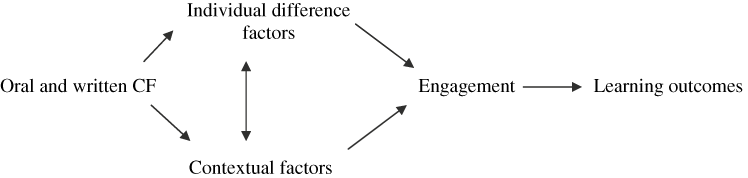
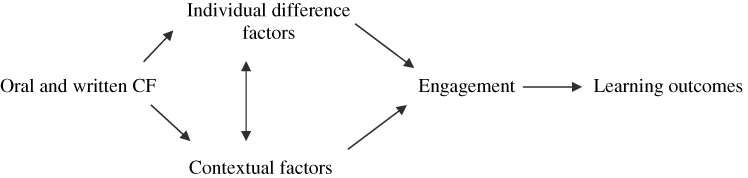
The framework shown in Figure 1 helps to identify the variables that CF research to date has addressed and aspects that future CF research might find useful to investigate. The framework is intended not so much as a theory of CF but as a heuristic that can inform research. I will discuss each component and illustrate how it has been researched in studies of both oral and written CF. I will also consider how the studies reported in this special issue address the different variables in the framework.
A componential framework for investigating CF.
Oral and Written CF
Oral and written CF constitutes the object of enquiry. There is now a very substantial body of both oral and written CF research that has focused on the investigation of the strategies that can be employed to correct learner errors. This research has been both taxonomic (as in Ellis, Reference Ellis2009; Lyster & Ranta, Reference Lyster and Ranta1997) and descriptive or ethnographic (as in Seedhouse, Reference Seedhouse1997; Van Lier, Reference Van Lier1988). Taxonomies of CF have sought to identify the different types of strategies that can be employed. They are of two kinds: simple lists of strategies and more theoretically driven classifications. Accounts of oral and written CF strategies differ, although there are some interesting points of similarity.
In oral CF research, two ways of classifying strategies have figured. Yang and Lyster’s (this issue) study is based on Lyster’s (Reference Lyster2004) distinction between recasts (one type of input-providing CF) and output-pushing CF (which includes a number of different strategies, all of which push the learner to self-correct). Sheen (this issue) draws on a different distinction—namely, implicit CF (e.g., recasts) and explicit CF (e.g., explicit correction and metalinguistic clues). Lyster and Saito’s (this issue) meta-analysis examined both distinctions. There is also an ongoing debate as to which of these classifications is the more theoretically valid. The relative effectiveness of input-providing and output-pushing CF pits cognitive interactionist theories that view input as the primary source of acquisition against skill-learning theories that emphasize the importance of production for learning. The implicit-explicit distinction draws on arguments about input saliency and the importance of noticing in language learning (Schmidt, Reference Schmidt1994). It is worth pointing out that the two distinctions overlap. For example, it is possible to identify strategies that are implicit and input-providing (i.e., recasts), implicit and output-pushing (i.e., requests for clarification), explicit and input-providing (i.e., explicit correction), and explicit and output-pushing (i.e., elicitations).
Types of written CF have been primarily distinguished in terms of whether they are direct (i.e., the correct form is given to the learner) or indirect (i.e., an error is indicated, but the correct form is not supplied). A parallel can be drawn between direct written CF and input-providing oral CF (recasts), as Sheen (this issue) does in her article comparing the effects of oral and written CF. It is less clear, however, whether indirect written CF corresponds to output-pushing CF as whether learners actually produce the correct form prompted by the correction is an engagement feature, which in the case of writing is more clearly optional. A request for clarification, for example, requires a response from the learner; however, the learner can choose to revise or not to revise his or her utterance following written CF (whether of the direct or indirect kind). Nor is there anything that corresponds to the implicit-explicit distinction in oral CF.Footnote 1 Written CF is invariably explicit regardless of how it is provided (i.e., learner writers will know immediately that whatever marks or words they see written on their text constitute corrections). However, like SLA researchers, a number of L2 writing researchers have drawn on depth of processing theory (Craik & Lockhart, Reference Craik and Lockhart1972) to argue that indirect CF is more effective than direct CF because it engages the learner more. As Ferris (this issue) notes, this argument is based not on the effect written CF has on acquisition but rather on the need to promote learners’ autonomous editing skills. Two of the studies in this issue address written CF. Storch and Wigglesworth (this issue) compare indirect CF and a rather special form of direct CF—reformulation—where a native-speaker version of the learner’s whole text is given to the learner. Sheen (this issue) compares direct CF and direct CF combined with metalinguistic comments. Sheen’s study was designed to investigate corresponding types of oral and written CF, but she acknowledges that exact parallels do not exist.
Oral and written CF differ in another respect. Oral CF is typically immediate, whereas written CF is delayed (i.e., it becomes available to the learner some time after the error was committed), which is of potential theoretical interest. Doughty (Reference Doughty and Robinson2001) argued that oral CF is effective in promoting interlanguage restructuring precisely because it is immediate (i.e., it occurs in what she calls a window of opportunity for connecting form to meaning). However, not all oral CF is immediate: Teachers sometimes elect to delay providing feedback on oral errors until the learners have completed an oral activity. Rolin-Ianziti (in press) reported on a descriptive study of such delayed oral CF.
Individual Factors
Individual learner factors include age, language aptitude, memory, learning style, personality, motivation, language anxiety, and learner beliefs. In terms of the framework in Figure 1, these factors interact with contextual factors to mediate between the CF that learners receive and their engagement with the CF and thereby influence learning outcomes. The vast bulk of CF studies has ignored learner factors, focusing instead on the relationship and the effect of specific CF strategies and learning outcomes. However, in recent years, a few studies have begun to investigate the relationship between learner factors and certain aspects of engagement, such as uptake, as well as the mediating effect that learner factors exert on learning outcomes. Sheen (Reference Sheen2008), for example, reported a study that showed that language anxiety influences the extent to which learners uptake recasts and what they subsequently learn (measured in terms of increased accuracy of a specific grammatical feature). Goldstein (Reference Goldstein, Hyland and Hyland2006), in a case study of two different L2 writers, concluded that the students’ motivation was a key factor that influenced the use they made of the teacher’s written feedback. The general neglect of individual difference factors in CF studies is surprising because it would seem self-evident that learners will vary considerably in how they respond to CF, whether oral or written.
Differences will also be evident in what individual teachers think about feedback and how they handle it (see, e.g., Schulz, Reference Schulz2001). Although teachers generally feel the need to correct learner errors, they differ with regard to what errors they think need correcting, who ideally should do the correcting (the teacher, the student who committed an error, or another student, as in peer feedback), when they should correct (e.g., some teachers express the belief that it is wrong to correct errors that arise when learners are performing communicative tasks or engaged in expressive writing), and how they should correct. Given the sheer complexity of the issues involved in correcting errors—whether in speech or in writing—it is not surprising that teachers have been found to be inconsistent and imprecise in their treatment of error (Nystrom, Reference Nystrom, Seliger and Long1983; Zamel, Reference Zamel1985). In part, though, this reflects the need teachers feel to tailor their feedback to suit the individual learner, as demonstrated so clearly in Hyland’s (Reference Hyland1998) study of how a teacher responds to the written errors made by different students.
Problems can arise when there is a mismatch between the teacher’s and the learners’ goals. Hyland (Reference Hyland2000), for example, reported on a study in which the teachers tended to treat the students’ drafts as finished pieces that needed fixing, whereas the students saw feedback as a means of enhancing their learning of English. Hyland felt that the teachers tried to control the feedback process too rigidly and failed to take into account the students’ own goals.
As noted, socioculturally oriented studies of CF are based on the assumption that CF needs to be fine-tuned to the individual learner. Such fine-tuning will need to take into account not only the learners’ developmental level but also how they orientate to correction, which, in turn, will be influenced by a host of individual difference factors. In this special issue, two of the studies investigated individual difference factors that affect learners. Lyster and Saito included age as one of the variables in their meta-analysis. They found that younger learners benefit more than older learners from oral CF. Storch and Wigglesworth examined learners’ beliefs about the two types of CF they received and provided evidence to suggest that when learners see little value in the kind of CF they receive, they fail to engage with it and do not utilize it when revising or rewriting their texts. None of the studies, however, examined variation in teachers’ practice of CF.
Contextual Variables
Contextual variables include both macro factors related to the setting in which learning takes place (e.g., immersion, foreign language [FL], and L2 settings) and microfactors related to the nature of the activity the learners are participating in when they receive correction. Studies of both oral and written CF have taken place in FL, L2, and immersion settings, with findings demonstrating that CF is effective in all three. Sheen (Reference Sheen2004) compared the oral CF found in four different settings—Canadian immersion, Canadian English as a second language (ESL) for a group of migrants, New Zealand ESL for international students, and Korean English as a foreign language (EFL). She found that recasts were the dominant CF type in all four contexts, but it was especially true in the Korean EFL and New Zealand ESL settings. She also found that rates of self-correction varied considerably across settings. Lyster and Mori (Reference Lyster and Mori2006) also found differences in learners’ uptake of oral correction in two different immersion contexts: French immersion in Canada and Japanese immersion in the United States. Prompts induced higher levels of uptake and repair in French immersion, but in Japanese immersion, recasts achieved these effects. Bitchener and Knoch (Reference Bitchener and Knoch2008), however, found no difference in the extent to which two groups of learners (migrant learners studying English in public institutions in New Zealand and international students visiting New Zealand to study in private language schools) improved their accuracy following three types of written CF.
Macrodistinctions of this kind are somewhat crude, as they ignore the variation that can exist within each setting. Studies that examine the impact of microfactors are likely to be more informative. Examples of such studies include Seedhouse’s (Reference Seedhouse2004) study of repair in language classrooms. He distinguished between form-and-accuracy contexts and meaning-and-fluency contexts and found—not surprisingly—that correction is more likely to occur in the form-and-accuracy contexts. It is interesting, however, that the teachers Seedhouse investigated demonstrated “a strong dispreference for direct and overt negative evaluation of learner errors” (p. 172) irrespective of context. Oliver and Mackey (Reference Oliver and Mackey2003) found differences in the frequency of uptake and modified output in different interactional contexts in child ESL classrooms. Uptake and modified output were more likely to occur in explicit language contexts, whereas feedback, uptake, and modified output were least frequent in exchanges focusing on classroom management.
Although oral CF researchers have paid some attention to contextual factors, written CF research has largely neglected them. Goldstein (Reference Goldstein, Silva and Matsuda2001) commented that “the research has been largely noncontextual and non-social” (p. 77). Goldstein’s own research (e.g., Goldstein, Reference Goldstein, Hyland and Hyland2006) is an exception. Contextual factors interact with individual difference factors. Motivation, for example, is a dynamic phenomenon (Dörnyei, Reference Dörnyei2005) and, thus, is likely to impact the extent to which learners attend to correction depending on both the general setting and their attitude toward the specific activity in which they are engaged. The extent of a learner’s language anxiety will vary depending on contextual factors such as the learner’s relationship with the teacher and other learners in the class and the degree to which they feel they are being evaluated in specific activities.
Contextual factors—macro and micro—receive little attention in the articles in this special issue. In this respect, they reflect the general tendency in CF research. However, Lyster and Saito included setting as one of the variables in their meta-analysis, finding no difference in the effects of oral CF in FL and L2 classroom settings. They argued that more qualitative research is needed to investigate the role played by contextual factors.Footnote 2
Engagement
I use the term engagement to refer to how learners respond to the feedback they receive. CF type, individual difference factors, and contextual variables together influence how learners engage with the CF. Engagement can be examined from three different perspectives: a cognitive perspective (where the focus is on how learners attend to the CF they receive), a behavioral perspective (where the focus is on whether and in what way learners uptake oral corrections or revise their written texts), and an affective perspective (where the focus is on how learners respond attitudinally to the CF). These three senses of engagement are applicable to the study of both oral and written CF.
Clearly, if CF is to have any effect on learners’ developing interlanguages, it has to be attended to. The role of attention in cognitive theories of SLA has attracted considerable interest within this field in recent years (Robinson, Reference Robinson, Doughty and Long2003; Schmidt, Reference Schmidt and Robinson2001). Attention involves noticing and noticing-the-gap (Schmidt & Frota, Reference Schmidt, Frota and Day1986) as well as rehearsal, the process by which material is held and recycled in working memory. A number of oral CF studies have explored these cognitive processes. Mackey (Reference Mackey2006), for example, investigated learners’ perceptions of the gap between their own production and recasts by examining the learners’ online learning journals, conducting a stimulated recall, and administering questionnaires. She found clear evidence of noticing-the-gap in the case of the three structures she investigated (questions, plurals, and past tense) but reported that noticing was only related to actual learning in the case of questions. Egi (Reference Egi2007) used learners’ immediate reports and stimulated recall to examine how they responded to recasts. She found that the learners did not always perceive the recasts as corrective (i.e., sometimes they interpreted them as responses to content), bearing out the claims of a number of other researchers (e.g., Ellis & Sheen, Reference Ellis and Sheen2006; Lyster, Reference Lyster1998) that learners frequently fail to realize they are being corrected. Such studies demonstrate the importance of examining how learners engage cognitively with CF. Two studies in this special issue make an attempt to examine learner engagement. Both Yang and Lyster and Sheen included an exit questionnaire, which the learners completed after the final posttest, to investigate to what extent the learners became aware of the linguistic focus of the CF. Yang and Lyster reported little evidence of learners’ awareness of the target structure (past tense forms) in spite of their significant improvement on proficiency measures. Sheen found that learners demonstrated much greater awareness when the CF was explicit than when it was more implicit (i.e., consisted of recasts).
A number of studies (e.g., McDonough & Mackey, Reference McDonough and Mackey2006; Sheen, Reference Sheen2006) have investigated the behavioral manifestation of learners’ engagement with oral CF by examining different forms of uptake—in particular, uptake that involves repair. These studies show that uptake with repair varies depending on the type of CF, with recasts leading to lower levels of repair than prompts. However, the theoretical significance of uptake is a controversial issue. One view expressed by interactionist theories (e.g., Long, Reference Long and Long2007) is that uptake (including uptake that contains a repair of the original error) is of little value to acquisition, as this depends primarily on the input provided by the correction (recasts). Another view expressed by researchers who draw on skill-learning theory (e.g., Lyster, Reference Lyster2004) is that uptake following prompts and containing repair enables learners to strengthen their control over linguistic forms that they have only partially acquired. There is now some evidence to suggest that uptake with repair following prompts assists acquisition (see, e.g., Loewen & Philp, Reference Loewen and Philp2006). In this issue, Yang and Lyster report the extent to which uptake with repair occurred following recasts and prompts and then discuss the role of self-repair when interpreting the results of their study.
The extent to which learners attend to corrections and uptake them (i.e., in the revisions they make to their texts following CF) are also issues of importance for the study of written CF. A number of early studies investigated how learners handle the feedback they receive. Cohen (Reference Cohen1991), for example, asked EFL students to report on how they perceived the teacher’s feedback on their compositions. He found that they perceived the teacher as both a judge and an interested reader. Cohen also investigated their understanding of the feedback and reported that the learners were not always clear about the teacher’s comments or certain how to handle them. Sachs and Polio (Reference Sachs and Polio2007) used think-aloud and poststudy interviews to examine how learners responded to error corrections and to reformulations of the texts. They reported that learners found the error corrections easier to process. This study, like many others, also examined the relationship between what they attended to in the corrections and their subsequent revisions, noting that “reports of noticing during the processing of written feedback were related to subsequent revision changes” (Sachs & Polio, p. 85). Storch and Wigglesworth’s (this issue) contribution similarly addresses the relationship between learners’ engagement with written CF and the subsequent uptake of the corrections in their revised text and in the production of a new text on the same topic.
Researchers have paid less attention to learners’ affective responses to the corrections they receive. This is somewhat surprising given that one of the objections sometimes leveled against CF is that it creates anxiety in learners and thus interferes with acquisition (see, e.g., Krashen, Reference Krashen1982). Storch and Wigglesworth’s (this issue) study provides evidence that learners do develop an affective response to the type of written corrections they received, which influenced how they processed it. In this case, however, it was not anxiety but rather dislike of a specific type of feedback (reformulation) that the CF triggered. None of the studies of oral CF in this issue examined learners’ affective responses to CF.
Learning Outcomes
The final component of the proposed framework concerns learning outcomes, where the greatest difference between studies of oral and written CF has been found. Oral CF research is primarily concerned with the effect that CF has on learners’ acquisition of the linguistic features targeted by the CF. Written CF research, until recently, has been more concerned with how CF can help learners become better writers. Ferris (this issue) stresses this difference, pointing out that this is one reason why written CF has typically been unfocused (i.e., has addressed a range of different types of errors) and why revision has figured as a key element in the design of written CF studies. However, as previously noted, a number of recent studies of written CF have adopted the same approach as that found in oral CF research—they have examined focused CF (i.e., CF directed at just one or two linguistic features) and have used a pretest, immediate posttest, and delayed-posttest design to investigate the effect of CF on acquisition.
As I have pointed out elsewhere (Ellis, Reference Ellis, Bardovi-Harlig and Dörnyei2006), the term acquisition can have a number of different meanings. It can refer to (a) the acquisition of an entirely new linguistic feature, (b) an increase in the accuracy with which partially acquired features are used, or (c) progress along a sequence of stages that characterize the acquisition of grammatical features such as past tense or question formation. Oral CF studies have typically examined acquisition in terms of (b), although a number of studies (e.g., Mackey & Philp, Reference Mackey and Philp1998) have adopted (c) as their measure of acquisition. Written CF studies have focused exclusively on (b). I know of no studies that have used (a) as their outcome measure, probably because of the difficulty of identifying linguistic features that are entirely unknown by a group of learners. In general, then, both oral and written CF studies have taken accuracy as the measure of the outcome of exposure to CF. However, this too is a problematic construct, as it raises the thorny question of how it should be measured. Lyster and Saito (this issue) included type of outcome measure as one of the variables investigated in their meta-analysis. They drew on Norris and Ortega’s (Reference Norris and Ortega2000) classification of four types of measurement: (a) free constructed responses, (b) constrained-constructed responses, (c) selected responses, and (d) metalinguistic judgments. It is interesting to note that they report larger effect sizes for free constructed responses than for the other types. This finding is encouraging because, arguably, free constructed responses afford the most valid measure of the effect that CF has on learners’ linguistic competence if this is defined in terms of implicit knowledge.
The notion of free constructed response, however, probably warrants closer attention. In particular, there is an obvious difference between oral and written free constructed responses: The former are more likely to demonstrate changes in linguistic competence than the latter. In her contribution, Sheen (this issue) recognizes this difference, acknowledging as a limitation of her study the lack of any measure based on oral free constructed responses. An interesting question is whether the effect of CF is more evident in oral than in written tasks, given that the latter afford more time for monitoring (i.e., explicit knowledge). The answer to this question may depend on the linguistic target. In Yang and Lyster’s (this issue) study, the difference between the oral and written posttest scores was much greater for regular past tense verbs than for irregular verbs.
CONCLUDING COMMENTS
This special issue was based on the assumption that there is merit in examining oral and written CF together. Whereas there are some obvious differences between the two types of feedback in terms of both purpose and approach, there are also some obvious similarities. One of my purposes in proposing this framework for investigating CF was to demonstrate where these commonalities lie. The framework allows for the formation of a number of specific research questions that can be investigated in terms of both media:
1. What are the different types of CF? How can these types be most convincingly classified? What parallels are there between types of oral and written CF?
2. What effect does oral and written CF have on learners’ acquisition of specific linguistic features? Do oral and written CF have similar or different effects?
3. In what way do individual factors influence how teachers conduct oral and written CF and how learners respond to this CF?
4. In what ways do contextual factors influence how oral and written CF is accomplished in different settings and in different types of learning activities?
5. In what ways do learners engage with oral and written CF and how does their engagement influence learning outcomes?
6. What constitutes the learning outcomes of CF and how can these outcomes be best measured?
Although the studies in this special issue do not address all of these questions in depth, they certainly provide a number of insights about how these questions might be answered and what kinds of answers we might expect to find.
The approach to the investigation of CF that I have expounded is componential, analytic, and, arguably, reductionist. The framework identifies specific variables involved in CF and provides a basis for examining each one separately and for investigating the relationships between them. This is, of course, not the only approach possible. Ethnographic studies of CF adopt a holistic, emic approach. In other words, they aim to provide a picture of how correction (i.e., repair) is actually accomplished in different settings and in different activities. Conversational analysts such as Seedhouse (Reference Seedhouse2004) do not set out to investigate prespecified types of CF or how individual factors mediate learners’ engagement with CF or how engagement leads to learning. Rather these researchers seek to understand how repair is enacted in specific contexts of language use. From this perspective—a perspective endorsed by sociocultural and sociocognitive theorists—learning is viewed not as an outcome (i.e., something that results from correction) but rather as a process that occurs within the enactment of a corrective episode. CF is viewed at one and the same time as both a social and cognitive event that needs to be studied in situ by taking into account the goals and motives and the participants.
The analytic approach to investigating CF—reflected in the majority of the articles in this special issue (Storch and Wigglesworth being the one exception)—has proved enormously productive allowing for increasingly specific research questions to be systematically investigated. The framework proposed in Figure 1 provides a means of both reviewing the research that has taken place to date and revealing where the gaps are. There is, however, no need for paradigm wars. There is also obvious merit in more holistic, qualitative approaches that document the situated nature of CF and the complex discoursal events where learning takes place.