In his seminal article, Bley-Vroman (Reference Bley-Vroman1990) posed the logical problem of foreign language learning, the adult second language (L2) version of the logical problem of language acquisition (Baker & McCarthy, Reference Baker and McCarthy1981)—that is, the poverty of the stimulus. How is it that the learner comes to possess an enriched grammar that exceeds the (impoverished) input received? Bley-Vroman investigated “the proposition that child language development and adult foreign language learning are in fact fundamentally different” (p. 4) and proposed that child language acquisition is guided by Universal Grammar (UG) and driven by domain-specific acquisition procedures, whereas adult SLA is guided by native language transfer and driven by domain-general problem-solving strategies. Thus, the original fundamental difference hypothesis (FDH) maintained that the divide between child and adult language acquisition constitutes a nearly unbridgeable chasm and that the availability of UG is a crucial element to the difference.
In his update of the evolving context for the FDH, Bley-Vroman (this issue) considered four developments in theoretical and empirical research that have taken place over the past two decades and noted that these developments force a reconceptualization of the FDH: The FDH must now include an explanandum (1a) in addition to an explanans (1b).
(1) a. The explanatory burden of SLA
b. The nature of the SLA system and of second language (L2) knowledge. (p. 176)
On the one hand, Bley-Vroman noted that, from a theoretical perspective, the Minimalist Program (Chomsky, Reference Chomsky1995, Reference Chomsky and Kenstowicz2001, Reference Chomsky and Belletti2004) has obviated the need for rich UG and for parameters of the principles and parameters type (cf. Chomsky, Reference Chomsky1981; Pollock, Reference Pollock1989) and thus diminished the issues of UG availability and parameter setting in SLA. On the other hand, empirical findings from cognition, learning procedures, and language processing have shown that there is not a clear distinction between the language faculty and more general cognitive processes. Bley-Vroman drew conclusions from this evidence to propose new ways of looking at child and adult differences.
Distinct acquisition pathways for children and adults as well as significant age of acquisition (AoA) effects (i.e., defective morphosyntax, nonnative phonology, and slow processing) constitute substantial evidence for a fundamental difference.Footnote 1 However, current research has also suggested that “the processes of the language faculty (broadly conceived) are not exclusive to language” (Bley-Vroman, this issue, p. 185) and that both native and subsequent languages draw on similar resources in acquisition and processing. Empirical substantiation from a variety of sources (e.g., Conradie, Reference Conradie2005, Reference Conradie2006; Haznedar, Reference Haznedar2001, Reference Haznedar2003; Song & Schwartz, this issue; Unsworth, Reference Unsworth, Cazzoli-Goeta, Pourcel and Van Espen2002, Reference Unsworth2005) indicates that the difference between child and adult language learning is, above all, quantitative, not qualitative, a continuum rather than a break. To explore the differences and similarities between child and adult language acquisition in process and resultant state, this article will first review the premises of the two versions of the FDH. Then three interrelated topics—the pathway of child SLA, endstate AoA effects, and language processing by monolinguals and bilinguals—will be discussed to propose that the difference between child and adult language learners is gradient, not absolute.
THE FDH AND PATH OF ACQUISITION
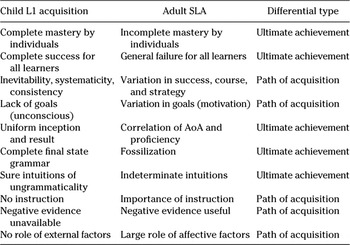
Bley-Vroman (Reference Bley-Vroman1990) pointed out 10 fundamental characteristics (see Table 1) that distinguish adult and child language learning, half of which relate to ultimate achievement and half to path of acquisition.Footnote 2
Fundamental characteristics of child L1 acquisition and adult SLA

Note
From “The Logical Problem of Foreign Language Learning” by R. Bley-Vroman, Reference Bley-Vroman1990, Linguistic Analysis, 20, pp. 6–13. Adapted with permission.
The differences between first language (L1) acquisition and adult SLA are evident to any nonspecialist and have been amply documented. Bley-Vroman (this issue) pointed to reliability (i.e., children always acquire language) and convergence (i.e., children always converge on the same grammar) as L1 but not L2 traits (Pullum & Scholz, Reference Pullum and Scholz2002), whereas Herschensohn (Reference Herschensohn2000) noted that L1 acquisition is involuntary and complete, two characteristics not shared with SLA.Footnote 3 Meisel (Reference Meisel, Haznedar and Gavruseva2008) observed five uncontroversial L1-L2 differences: (a) In the initial state, L2 utterances are longer, more complex, and probably contain functional categories; (b) the course of acquisition is not identical in L1s and L2s; (c) the rate of acquisition is fast in L1s and protracted in L2s; (d) variation is greater in L2s than in L1s; and (e) few or no L2 learners reach nativelike competence. Adopting the FDH, Meisel argued that the language-making capacity is subject to maturation (a L1 acquisition window of opportunity) but that parts of this capacity become inaccessible as the human child matures.
The FDH assumes a dichotomy between child and adult language acquisition, a perspective whereby the two phenomena are either fundamentally different or fundamentally the same: “The burden of proof ought then to fall on proponents of the view that child and adult language learning are fundamentally the same” (Bley-Vroman, Reference Bley-Vroman1990, p. 4). Bley-Vroman compared the FDH to the idea of a critical period and thus made the availability of UG and domain-specific language-learning procedures the endowment of childhood.Footnote 4 Whereas some indications suggest that nativelike acquisition of phonological and morphosyntactic features is restricted to young childhood—at which time the human brain retains enough plasticity to establish new parametric values—not all L2 areas impede learners in comparable ways (Herschensohn, Reference Herschensohn2007). Indeed, there are multiple sensitive periods for various phenomena (Birdsong, Reference Birdsong2006; Hyltenstam & Abrahamsson, Reference Hyltenstam and Abrahamsson2000, Reference Hyltenstam, Abrahamsson, Doughty and Long2003).
Most recently, Bley-Vroman (this issue) observed that new perspectives raised by theoretical and empirical advances of the past 20 years have reduced the distinction between the language faculty and general cognition. This reduction is reflected in the minimalist model’s (Chomsky, Reference Chomsky and Belletti2004) bare phrase structure approach that links the two modules of language production-comprehension, the conceptual-intentional and sensorimotor, via a pared-down computational system. In light of these new perspectives, Bley-Vroman suggested that foreign languages and SLA must be viewed as manifestations of human language and human cognition, which are not mutually exclusive but rather intersect, a perspective that leads to a dilemma: “Without rich UG and language-specific processes, we are left without a framework within which to formulate an account of the properties of unreliability and nonconvergence” (this issue, p. 187). He proposed three bridging characteristics—patching, general cognition, and shallow processing—that helped to explain differences between L1 and L2 acquisition. Bley-Vroman argued convincingly that patches, idiosyncratic repair mechanisms that are also available in native languages, serve to bootstrap SLA, particularly when the core system is not working well; for example, L2 learners may exploit ready-made chunks before they have mastered a grammatical feature. Furthermore, Bley-Vroman reiterated his earlier (1990) point that SLA exploits general cognitive strategies but that this is also the case for L1 acquisition. Finally, Bley-Vroman indicated that late bilinguals prefer shallow language processing, as opposed to monolinguals’ more developed ability to use deep as well as shallow processing (cf. Clahsen & Felser, Reference Clahsen and Felser2006a, Reference Clahsen and Felser2006b).
As Bley-Vroman (Reference Bley-Vroman1990) originally noted citing Lenneberg (Reference Lenneberg1967), children gain their native tongue by “automatic acquisition from mere exposure” (Lenneberg, p. 176), whereas adults learn foreign languages consciously, with obvious deficits and great variation. To determine how these well-attested acquisitional differences develop between infancy and adulthood, the intermediate ages—in terms of path of acquisition and endstate grammatical competence—must be examined to decide if there is a precipitous divide or a gradient continuum in the two processes. Here, gradient is understood as progressively changing differences in the physiological activity of an organism. In L1 acquisition and adult SLA, a major qualitative distinction between child and adult language acquisition development and resultant endstate grammar would be a precipitous difference, whereas a gradient difference would be progressive quantitative distinctions across learners whose AoA and proficiency levels differ. The precipitous difference implies a threshold and a sharp critical period offset, whereas the gradient difference views the individual learner in terms of abilities that diminish with increasing age, brain maturation, and experience with the native tongue, but not abruptly.Footnote 5 In this view, learning mechanisms such as UG, cognitive resources, input frequency, and social interaction assume quantitatively different roles with increasing AoAs and (conversely) with increasing proficiency.
Typical L1 Acquisition and Adult SLA
The typically developing monolingual child’s acquisition of language begins in utero and proceeds quite systematically crosslinguistically, a process that seems self-evident given that all children learn quite a bit of their native tongue by the age of 4. At birth, children are attuned to the ambient prosody and quickly establish segmentation patterns that will serve them for life (Cutler, Reference Cutler, Gleitman and Landau1994; Cutler, Mehler, Norris, & Segui, Reference Cutler, Mehler, Norris and Segui1992). Newborns’ ability to recognize potential phonemic differences categorically (Eimas, Siqueland, Jusczyk, & Vigorito, Reference Eimas, Siqueland, Jusczyk, Vigorito, Lust and Foley2004) is attenuated by the end of the first year of life, when children focus their phonemic inventory on the native language. In perception, newborns prefer native versions of a given phoneme to similar phonemes of other languages (Kuhl, Reference Kuhl2004); in production, they babble sounds that resemble their native inventory (Boyssons-Bardies, Reference Boysson-Bardies1999). Meanwhile, infants figure out that the sounds they perceive are associated with meaning, a link they are soon able to exploit in the production of their first words (Bloom, Reference Bloom2002). In the second year of life, single-word utterances are soon succeeded by telegraphic speech and the emergence of morphosyntax (Guasti, Reference Guasti1993/1994, 2002; Pierce, Reference Pierce1992): Children learning languages with rich morphology pay attention to the inflections even though they can barely produce them; for example, in Spanish, children use gender-appropriate protodeterminers with nouns (Lleó, Reference Lleó, Herschensohn, Mallén and Zagona2001), and, in Italian, verbal inflections are acquired quite early (Guasti, Reference Guasti2002). Perceptually, word order differences are understood long before they can be produced (Hirsh-Pasek & Golinkoff, Reference Hirsh-Pasek and Golinkoff1996). The mature grammar continues to be perfected throughout the third year, and, by age 4, a fairly stable command of the native tongue has been achieved (Radford, 1990). Children clearly have ample input for the core grammar, and they are aided by social interactions and cultural conventions (Genesee, Paradis, & Crago, Reference Genesee, Paradis and Crago2006), but it is the subtler aspects that Bley-Vroman (Reference Bley-Vroman1990) has cited that prove the necessity of UG: “The gap between available experience and attained competence […] is bridged by an innate Universal Grammar […] and by innate domain-specific procedures for arriving at a grammar” (p. 3).
In contrast to children, adult foreign language learners do not all follow the same path or achieve the same results in less than 4 years. It seems that they must attempt everything at once—phonology, morphosyntax, vocabulary, and usage—while coping with the influence of their native language.Footnote 6 Additionally, adult L2 learners do not specialize their focus as do children but rather attempt to overcome their entrenched phonological tendencies (Kuhl, Reference Kuhl and Gazzaniga2000, has described the L1 as an experience that warps the brain) as they intentionally learn vocabulary and combine words into sentences. Adults often avail themselves of instruction and seek negative evidence to gauge their progress. At an early basic variety stage (Klein & Perdue, Reference Klein and Perdue1997), L2 learners avoid morphology and rely on pragmatic means to convey meaning and also show distinct default patterns that look more like cognitive patches than the systematic stages of L1 grammatical development (Meisel, Reference Meisel1997). At more advanced levels, adults gain morphosyntactic competence, but even experienced near-natives have difficulty with discourse conditioned factors; for example, Sorace and Filiaci (Reference Sorace and Filiaci2006) demonstrated that near-native Anglophone learners of Italian have nonnativelike intuitions concerning anaphoric binding of overt subjects in null subject languages. Sorace and Filiaci argued that the difficulty with overt subjects relates to the fact that they are conditioned by discourse and pragmatic factors, whereas the unconditioned null subjects are determined by the core syntax. In sum, clear differences in path of acquisition, rate, reliability, and endstate grammars are observed in L1 children and adult L2 learners, but similarities in learning strategies, intermediate stages, and endstate grammars can also be found.
Child SLA
Schwartz (Reference Schwartz1992) reasoned that child and adult SLA must be compared to ascertain whether “the same developmental sequence occurs for adult and child L2 [learn]ers” (p. 8). The same developmental sequence—a test that speaks directly to Bley-Vroman’s (Reference Bley-Vroman1990) proposal—might be an indication of similar language acquisition processes for both children and adults. An increasing number of studies that have looked at child SLA (e.g., Belletti & Hamann, Reference Belletti, Hamann, Prévost and Paradis2004; Haznedar, Reference Haznedar2001, Reference Haznedar2003; Hulk & Cornips, Reference Hulk, Cornips, Unsworth, Parodi, Sorace and Young-Scholten2006; Meisel, Reference Meisel, Bhatia and Ritchie2004, Reference Meisel, Haznedar and Gavruseva2008; Unsworth, Reference Unsworth2005) can be used to determine its resemblance to other acquisition sequences. If the L1 has not yet reached its ceiling by approximately the age of 4, the L1 may attrite or never reach full potential (Montrul, Reference Montrul2008; Wong-Fillmore, Reference Wong-Fillmore1991). The term child SLA is then best reserved for children with a mature L1 but who are not yet too susceptible to age effects (i.e., age 4 through 7 or 8; cf. Meisel, Reference Meisel, Haznedar and Gavruseva2008).
Schwartz (Reference Schwartz, Beachley, Brown and Conlin2003), in an update of her (1993) research question, investigated studies of the acquisition of Dutch as a L2 by children and adults (Unsworth, Reference Unsworth, Cazzoli-Goeta, Pourcel and Van Espen2002; Weerman, Reference Weerman2002). Weerman found that L1 acquisition and child SLA are similar to each other and different from adult SLA in the mastery of two-gender adjectival inflection in Dutch.Footnote 7 Unsworth, who examined scrambling—a stylistic inversion of direct object and verb that L2 learners take time to master—found that child and adult SLA are similar to each other and different from L1 acquisition. This paradox was resolved by Schwartz’s (Reference Schwartz, Beachley, Brown and Conlin2003) proposal that there is a developmental distinction between syntax—in which child and adult SLA are similar—and inflectional morphology—in which child L2 and L1 acquisition are similar. Schwartz termed this proposal asymmetric acquisition: “L2 adults asymmetrically acquire grammar, such that inflectional morphology typically lags behind syntax, sometimes even dramatically” (p. 46).Footnote 8
Schwartz’s (Reference Schwartz, Beachley, Brown and Conlin2003) conclusion dovetails with other research that supports Newport’s (Reference Newport and Bloom1994) idea that young children are more sensitive to morphological detail and that this sensitivity diminishes with age. Newport argued that children have an advantage in the ability to pay attention to detail, her less is more hypothesis.
If children perceive and store only component parts of the complex linguistic stimuli to which they are exposed, while adults more readily perceive and remember the whole complex stimulus, children may be in a better position to locate the components. (Newport, p. 554)
In a similar vein, Herschensohn, Stevenson, and Waltmunson (Reference Herschensohn, Stevenson and Waltmunson2005) found that child learners of L2 Spanish—albeit inaccurate in production—showed awareness of the morphological ending of verbs. In a production task in which participants were asked to distinguish between singular and plural subjects, the children’s most frequent inflectional error was the reversal of singular and plural. In contrast, adult learners often use nonfinite forms at early stages (Herschensohn, Reference Herschensohn2001; Klein & Perdue, Reference Klein and Perdue1997; Prévost & White, Reference Prévost and White2000). The children’s awareness of bound morphemes seems to reflect Newport’s (Reference Newport and Bloom1994) observation that children perceive the component parts, whereas adult nonfinite errors seem to be indicative of Newport’s idea that adults focus on the complex stimulus, in which the core meaning is expressed as a default form. However, child L2 learners do not show the pattern of rapid mastery of inflectional morphology that is characteristic of L1 acquisition. In a participant pool of L2 child learners, who were quite well matched to the L1 and early balanced bilingual children that he had documented earlier, Meisel (Reference Meisel, Haznedar and Gavruseva2008) pointed to default infinitival forms inappropriately used with subject clitics (which indicate verbs raised to check nominative case) in child L2 French. These child L2 learners resembled the adult L2 more than the L1 learners.
Recent studies of child SLA have indicated comparability to adult SLA in native language transfer (Haznedar, Reference Haznedar2001, Reference Haznedar2003) and path of acquisition (Unsworth, Reference Unsworth2005) but also in data that suggest a resemblance to the L1 patterns of optional infinitives (Prévost, Reference Prévost2003; Prévost & White, Reference Prévost and White2000; but see also Meisel, Reference Meisel1997, Reference Meisel, Haznedar and Gavruseva2008). Unsworth looked at three groups of Dutch learners’—child L1, Anglophone child L2, and adult L2—acquisition of scrambling, the movement of a direct object leftward, as illustrated in (2).Footnote 9
(2) a. Willemijn heeft vandaag de tuin omgespit.
Willemijn has today the garden up-dug
b. Willemijn heeft de tuin vandaag omgespit.
Willemijn has the garden today up-dug
“William dug up the garden today.”
Scrambling, a stylistic movement linked to discourse and pragmatic factors, is found in languages as diverse as German and Japanese. Unsworth used a range of production and comprehension experiments to document comparisons among the groups with respect to acquisition path and final interpretive abilities. All of the learners gained competence in the production of scrambling of definite and indefinite specific objects, and they all passed through similar developmental stages, a pattern that supports the availability of UG for adult and child learners, given Schwartz’s (Reference Schwartz, Beachley, Brown and Conlin2003) and Bley-Vroman’s (Reference Bley-Vroman1990) reasoning. Furthermore, for both L1 and L2 learners, there were intermediate stages that showed optionality of scrambling, another similarity of sequencing. Perhaps most significant was the finding that all learners gained the ability to distinguish the interpretation of definite specific objects (which can be scrambled) from indefinite nonspecifics (which cannot be scrambled), a very subtle poverty-of-the-stimulus aspect of this complex syntactic construction. Unsworth’s work has thoroughly documented the similarity of L1 acquisition, child SLA, and adult SLA as well as the acquisition of poverty-of-the-stimulus phenomena and the continuity of acquisition patterns found in children and adults. Likewise, Song and Schwartz (this issue) found similar achievement in their comparison of child and adult L2 learners’ acquisition of Korean wh-movement with negative polarity items, also a poverty-of-the-stimulus phenomenon.
If infants who perceive and acquire a L1 follow a strict schedule, children and adults who learn a L2 follow timetables and pathways that are less rigid.Footnote 10 SLA in young children may resemble L1 acquisition in certain respects not found in older children and adults: Children younger than 5 are more adept at the acquisition of morphological details (Newport, Reference Newport and Bloom1994) and may go through an optional infinitive period (Prévost & White, Reference Prévost and White2000). Children are clearly better than adults in gaining phonological mastery of their native language, undoubtedly because their earliest learning (during the first year of life) is of native prosody (which bootstraps syntax and morphology in the second year). Indeed, this early learning biases the speaker to the native phonology, which becomes more entrenched with experience and more difficult to overcome with later SLA. Children are also better than adults in perceiving and later producing morphological inflection, although, in the long run, very proficient adult L2 learners can master verbal and nominal inflection with near-native ability. Children gain their core native syntax within a few years but only gradually build up pragmatic abilities tied to discourse information structure and cultural expectations. Adult L2 learners require more than the 2 years children spend on morphosyntax development but may eventually gain the core syntax of movement and anaphors. Like children, adult L2 learners also build pragmatic skills gradually, but, unlike children, adults have persistent difficulties with the syntax-pragmatics interface.
In sum, evidence of both L1 and L2 patterns of acquisition and native language influence are found in child SLA. From one perspective, L1 acquisition is fundamentally distinct given that it is a biological milestone that correlates with the establishment of specific neural networks for various aspects of the grammar that are acquired in sequential orders. As such, it cannot be repeated per se; subsequent languages are learned with a brain that is already altered from the birth state. The neural networks laid by the L1 will either be reinforced into ever more established monolingual patterns or be used to scaffold the learning of subsequent languages. Child SLA is necessarily distinct from L1 acquisition and shares much (e.g., error patterns) with adult SLA, but differences in path between L1 and L2 acquisition do not necessarily entail differences in the quality of endstate knowledge. On closer inspection, child SLA is a sort of bridge between L1 acquisition and adult SLA, in which children (who have sufficient input) gain more nativelike skills than adults. The evidence concerning child SLA does not present a clear picture that resolves the FDH puzzle; rather, it falls between the two and suggests a continuum, not a divide.
ENDSTATE: L2 AoA EFFECTS
Research has, therefore, shown that the path of acquisition differs in certain ways between children and adults but that child SLA bridges the two groups in various respects. Nevertheless, adult L2 learners show various deficits in their final state grammars compared to native speakers, and systematic studies of ultimate achievement in L2 phonology and morphosyntax (e.g., Birdsong, Reference Birdsong1999, Reference Birdsong2006; Johnson & Newport, Reference Johnson and Newport1989; Scovel, Reference Scovel1988) have shown an inverse correlation of proficiency with AoA.
The existence of age deficits in L2 learners has been amply documented for decades as lack of phonetic accuracy in L2, inexact morphosyntax, and indeterminate grammaticality judgments (GJs; Birdsong, Reference Birdsong1999; Flege, Reference Flege1987a, Reference Flege1987b; Hyltenstam & Abrahamsson, Reference Hyltenstam and Abrahamsson2000, Reference Hyltenstam, Abrahamsson, Doughty and Long2003; Johnson & Newport, Reference Johnson and Newport1989; McDonald, Reference McDonald2000; Scovel, Reference Scovel1988; Singleton, Reference Singleton1989; Singleton & Ryan, Reference Singleton and Ryan2004).
AoA Effects, Phonology, and Morphosyntax
The original FDH (Bley-Vroman, Reference Bley-Vroman1990) proposed that children learn their L1 phonology and morphosyntax successfully, whereas adults fail to learn L2 phonology and morphosyntax because they are not aided by UG and domain-specific acquisition procedures. The failure should be verifiable through a comparison of endstate child L1 and adult L2 acquisition, a comparison that would presumably reveal deficits in the adult L2 grammar. A number of studies (e.g., Birdsong, Reference Birdsong1999, Reference Birdsong2006; Johnson & Newport, Reference Johnson and Newport1989; Scovel, Reference Scovel1988) have compared the endstate of child L1, child SLA, and adult SLA, with the added documentation of a decline in grammatical proficiency that correlates inversely with increasing AoA. The primary format for the AoA studies is a comparison of achievement (e.g., pronunciation, GJs) by individuals—often immigrants—who have learned a L2 at different onset ages. These comparisons inevitably show that younger is better for more nativelike achievement and that nativelike achievement is generally attributed to AoA. For example, Scovel—along with many others (e.g., Asher & Garcia, Reference Asher, Garcia, Krashen, Scarcella and Long1982; Flege, Reference Flege1987a, Reference Flege1987b; Ioup & Weinberger, Reference Ioup and Weinberger1987; Major, Reference Major, Ioup and Weinberger1987; Piske, MacKay, & Flege, Reference Piske, MacKay and Flege2001)—showed that adult native speakers of English can accurately distinguish native English from foreign accented English and that these native judges correlate nativeness with earlier AoA in immigrant learners’ pronunciation. Asher and Garcia had pioneered the format with Cuban immigrants, whose AoA varied from preschool to adulthood. The authors noted that with AoA even as early as age 5, the immigrants would not necessarily be perceived as truly native English speaking by native speakers. Asher and Garcia conceded, nevertheless, that more advanced AoA is not a guaranteed hindrance to nativelike accent because some learners with later AoA were deemed more nativelike than those with earlier AoA. Flege and colleagues (e.g., Flege & Liu, Reference Flege and Liu2001; Flege & MacKay, Reference Flege and MacKay2004; Flege, Munro, & MacKay, Reference Flege, Munro and MacKay1995; Flege, Yeni-Komshian, & Liu, Reference Flege, Yeni-Komshian and Liu1999) have extended the variables examined in the AoA studies to look at the influence of quality of input, continued experience with the L1, and lexical frequency in both production and perception. The greatest deficit, it should be emphasized, is the lack of phonetic accuracy (e.g., voice onset time) rather than phonological parameters such as stress assignment, which can be gained in the L2 (Archibald, Reference Archibald1993).
Similarly, the Johnson and Newport (Reference Johnson and Newport1989) morphosyntax GJ task—which has been replicated with various immigrant populations (e.g., Birdsong & Molis, Reference Birdsong and Molis2001; DeKeyser, Reference DeKeyser2000; Flege et al., Reference Flege, Yeni-Komshian and Liu1999; Jia, Aaronson, & Wu, Reference Jia, Aaronson and Wu2002)—demonstrated that the sharpness of the GJ declines with increasing AoA. Johnson and Newport used 276 sentences (of which 140 were ungrammatical) that contained errors such as determiner use, inflection, and syntactic order to test GJs of 46 Chinese and Korean immigrants to the United States.
The results show a clear and strong relationship between age of arrival in the United States and performance. Subjects who began acquiring English in the United States at an earlier age obtained higher scores on the test than those that began later. (Johnson & Newport, p. 77)
These AoA studies show a decline in proficiency with an increase in age, although additional factors such as learner characteristics (e.g., personality, motivation) or native language influence also impact final state ability, an unexpected fact under a strictly maturational version of UG availability. In general, there is a correlation between L2 proficiency and earlier AoA, but the detailed picture shows that some adult learners gain nativelike abilities and some child learners do not.Footnote 11 As an example, Birdsong and Molis replicated Johnson and Newport’s study with L1 Spanish learners of English and found many learners who were indistinguishable from native speakers in GJs, regardless of AoA. Furthermore, child L2 learners—as noted by Asher and Garcia (Reference Asher, Garcia, Krashen, Scarcella and Long1982)—usually show deficits and variability that are unexpected under a strictly maturational view of child L2 learning capacity. The global picture shows an inverse relation of endstate ability with increasing AoA, which indicates that an individual learner beyond the age of 5 will inevitably show certain deficits in phonetic realization, morphological mastery, and determinacy of GJs. Such a decline is indicative of a continuum, not a fundamental break, with AoA as one of several factors that include L1 influence, proficiency level, quality of input, and learner characteristics. This gradual decline can be explained in terms of the FDH (although Bley-Vroman,1990, did not, because only adult and child language acquisition, not intermediate ages, were contrasted) by assuming that UG and acquisition procedures do not turn on and off like a faucet but rather diminish into adulthood. Under this diminishing scenario, children from age 7–12 would have progressively less access to UG acquisition devices.Footnote 12 The diminishing might be a function of the loss of certain aspects of UG (cf. Hawkins, Reference Hawkins2001; White, Reference White2003) or of diminished ability on the learner’s part. To test this idea of waning capacity for language acquisition, the quantity of initial ability or diminished ability should be calculated; however, this is difficult, if not impossible, to determine, even for a single individual.
Finally, the well-documented deficits characteristic of later acquisition—such as lack of morphological crispness and phonetic precision—do not illustrate the poverty-of-the-stimulus diagnostics that the FDH holds to be the gold standard criterion. Ample input of correct pronunciation and inflection exists in primary linguistic data, yet it is phonetic and morphological accuracy that is most obviously defective in adult L2 grammars. The most blatant late L2 defects do not reflect clear diagnostics of UG.
Maturation or Experience?
The immigrant studies have clearly shown that, in general, younger is better for SLA, although it is not age alone that is the determining factor in ultimate attainment. Indeed, Flege (e.g., Flege & Liu, 2001) has proposed that it is depth of experience with the L1 rather than strictly maturational constraints that determines perceived age effects. Studies on the L1 and L2 acquisition of American Sign Language (ASL) help to shed light on Flege’s idea.
Mayberry’s (Reference Mayberry1993) comparison of late L1 learners of ASL (congenitally deaf) with age-matched L2 learners of ASL provides insight into AoA effects. Mayberry used four groups of nine signers to test processing recall and production of complex ASL sentences. Participants were identified as late-L2 (AoA 8–15; they had learned L1 English before onset of deafness), late-L1 (AoA 9–13), childhood (AoA 5–8), or native signers (AoA 0–3). As expected, AoA correlated inversely with accuracy, with native signers outperforming all other groups. However, the late-L2 group performed better than the childhood group and substantially better than the late-L1 group. Late-L1 learners are then more susceptible to age effects than are late-L2 learners at the same AoA, even though L2 learners do not acquire the language with completely nativelike abilities.
The chronological decline in the L1 acquisition of grammar is probably related to several neural factors such as a decline in plasticity, changes in cognitive maturation, and cerebral development of nonlinguistic specialization in the areas that should be linguistic (due to the lack of appropriate input). It is clear that experience with the native language— although it may be interference for a L2—is also a crucially important framework on which to construct the L2. Mayberry’s (Reference Mayberry1993) study underlines the importance of experience with a L1 learned at the appropriate age as well as neural maturation.
The AoA research (e.g., Birdsong, Reference Birdsong1999; Herschensohn, Reference Herschensohn2007; Johnson & Newport, Reference Johnson and Newport1989) indicates that L2 learners of all ages show phonetic and morphosyntactic deficits that, overall, correlate positively with increasing AoA. The data confirm the claims of the FDH that adult L2 learners may have fossilized nonnative pronunciation and morphology, indeterminate intuitions on GJs, and incomplete mastery (to varying extents). A diminishing ability account can explain the correlation between AoA and proficiency observed in child learners with different AoAs. It is, however, not clear that the age effects are due to the diminishing availability of UG and L1 domain-specific acquisition procedures because the diagnostics (i.e., phonetic detail, inflectional accuracy) are not obvious poverty-of-the-stimulus criteria. Finally, Mayberry’s (Reference Mayberry1993) results emphasized the role of experience with the native language for SLA at any age and showed that acquisition ability is not an absolute function of AoA. It is clear that L1 acquisition must take place in a window of opportunity (Meisel, Reference Meisel, Haznedar and Gavruseva2008) and that L1 experience is crucial for SLA as both a positive influence (i.e., a scaffold for the L2; Mayberry) and a negative one (i.e., native interference; Kuhl, Reference Kuhl and Gazzaniga2000). Both maturation and experience have a role in the diminishing capacity for language acquisition with increasing age.
Declarative and Procedural Knowledge
Ullman (Reference Ullman2001a, Reference Ullman2001b)—who related adult and child differences in the biology of language acquisition to learning and knowledge theories—has provided what could be considered a rationalization for the FDH. Ullman adopted a distinction between declarative and procedural knowledge to put forth an account of L1-L2 differences that relates AoA to neural representation. According to this model, conscious declarative memory (which encompasses facts and lexical items, among others) contrasts significantly with unconscious procedural memory (which encompasses habits and grammatical processing, among others).
Conscious declarative memory is not modular in the Fodorian sense (Fodor, Reference Fodor1983, Reference Fodor2001) and is concentrated in the left medial temporal lobe. In contrast, unconscious procedural memory is modular in functional specificity, involves long-established motor and cognitive skills, and is concentrated in the left frontal lobe and the basal ganglia (cf. Paradis, Reference Paradis2004, Reference Paradis, Köpke, Schmid, Keijzer and Dostert2007).Footnote 13 Native language storage of lexico-semantic information is in declarative memory, whereas grammatical knowledge is implemented particularly in the left frontal region and the subcortical basal ganglia.
Ullman (Reference Ullman2001a, Reference Ullman2001b) argued that procedural routines are established early in life so that, with increasing age, humans shift reliance from procedural to declarative memory (in all domains of learning). Therefore, in SLA, especially with increasing AoA, declarative memory becomes the predominant mechanism for the learning and storage of both lexical and grammatical information, as Bley-Vroman (Reference Bley-Vroman1990) has argued for the FDH. The procedural system can be available in the L2 if it is either acquired early enough or is sufficiently practiced (i.e., proficient). The shift from procedural to declarative memory is seen in later AoA in the acquisition of L2 grammatical forms memorized as words and of grammatical rules learned explicitly in declarative memory (unlike L1 implicit grammar).
Given the wide acceptance of ideas on explicit versus implicit learning and AoA effects, Ullman’s (Reference Ullman2001a, Reference Ullman2001b) originality is this link of the declarative-procedural distinction to specific regions of the brain that change with age. This proposal was supported by the dissimilarity between lexical and grammatical ability in the L1 and the L2: Native speakers all have automatized, rapid, and highly accurate grammatical abilities, whereas L2 learners are far less accurate and quick. Lexico-semantic knowledge, in contrast, is fairly comparable for the L1 and the L2. Nonproficient bilinguals can be expected to use declarative memorization of words, grammatical chunks, and explicit rules. However, some learners become proficient and implement procedural storage of L2 grammar. Ullman (Reference Ullman2001b) admitted that “practice as well as age of exposure should affect both grammatical proficiency and the degree of dependence on procedural memory for grammatical computations” (p. 110). The abilities of proficient late bilinguals who exhibit procedural memory in the L2 require a nuanced version of Ullman’s core proposal of maturational deterioration of procedural learning. Furthermore, the proficient late learners often begin their acquisition with declarative learning later supplemented by automatization; Ullman does not explain how initial L2 declarative knowledge eventually becomes paralleled by L2 procedural abilities. Advanced L2 learners eventually automatize their grammatical knowledge, even if they first learn through declarative mechanisms (Paradis, Reference Paradis2004).
The correlation of decreasing L2 ability with increasing AoA appears to corroborate the FDH, and Ullman’s (Reference Ullman2001a, Reference Ullman2001b) proposal provides a reason for this correspondence. On closer inspection of adult learners with high proficiency, however, L2 learners’ reliance on declarative learning procedures and lack of procedural knowledge is not absolute, as high proficiency adult learners illustrate. Ullman’s ideas are correct but not in a categorical manner. Children—especially infants whose brains work to establish neural networks for language, vision, and cognition, among others—are better able to establish procedural knowledge than adults, whose neural pathways have long been entrenched. Adults have honed their ability to gain declarative knowledge as their consciousness has increased during maturation. It is not, however, the case that adults are incapable of gaining new procedural knowledge or establishing new synaptic pathways: Excellent adult language learners exhibit expertise that disproves the idea of L2 failure and mitigates Ullman’s proposal. Furthermore, adults clearly establish unconscious procedural knowledge even at very early stages of L2 learning (Osterhout, McLaughlin, Pitkänen, Frenck-Mestre, & Molinaro, Reference Osterhout, McLaughlin, Pitkänen, Frenck-Mestre and Molinaro2006). Although Ullman’s proposal provides an attractive explanation for the FDH, the procedural-declarative distinction cannot absolutely divide child and adult learning; once again, there is a continuum of language knowledge-storage that can range from highly proceduralized to very declarative, a gradient difference not a precipitous one.
PROCESSING
Ullman’s (Reference Ullman2001a, Reference Ullman2001b) proposal suggests that grammatical deficits related to AoA (i.e., those aspects of ultimate achievement that characterize the fundamental difference between child and adult language learning) derive from patterns linked to neural networks established early or late in development. Here, similarities and differences in the ways that child and adult learners implement their language in real-time processing are examined. Psycholinguistic studies provide another perspective on ultimate achievement and may reveal underlying competence. For native speakers, speech automaticity is seen in the rapidity of perception, quick repair in parsing, and accuracy of production, factors that allow the speaker to devote cognitive energy to other tasks. When automaticity is challenged by additional cognitive load, native speakers are more prone to errors and slower processing of language. Processing studies generally substantiate Ullman’s proposal that early establishment of neural networks results in procedural knowledge; however, these studies also explain the complexity and variability of the neural representation and implementation of language, as Stowe, Haverkort, and Zwarts (Reference Stowe, Haverkort and Zwarts2005) have indicated. Clahsen and Felser (Reference Clahsen and Felser2006a, Reference Clahsen and Felser2006b) underlined this complexity and variability in their description of four factors responsible for L2 differences: variable levels of grammar knowledge (proficiency), L1 influence, cognitive resource limitations, and maturation. These factors, all of which may affect L2 processing, are consistent with the revised FDH and with the notion of gradience.
Behavioral Studies
Psycholinguistic studies measure cerebral reactions to language by gauging, for example, reading time or eye movements in response to tasks that involve lexical access, morphosyntactic parsing, repair of misleading syntax (so-called garden path sentences), and ambiguity resolution. This research also reveals the strategies used in processing, preferences that sometimes point to crosslinguistic variation. Investigations of behavioral responses to linguistic tasks by adult L2 learners generally indicate that adult learners have slower reaction times (RTs) and lower accuracy than native speakers (Clahsen & Felser, Reference Clahsen and Felser2006a, Reference Clahsen and Felser2006b); in contrast, child L2 learners often pattern with adult native speakers (Guillelmon & Grosjean, Reference Guillelmon and Grosjean2001). Increased memory load, created by the extra processing demands of the L2, contributes to the less efficient and less accurate responses of late learners (McDonald, Reference McDonald2000): This is similar to monolinguals’ slower and less accurate decoding of more complex sentences (Hasegawa, Carpenter, & Just, Reference Hasegawa, Carpenter and Just2002).
Age effects, if due to maturational causes, should have the strongest influence on grammar—the procedural knowledge gained in an early period—rather than on vocabulary, which is continually added throughout a lifetime as declarative knowledge. There are clear differences between grammatical and lexical processing, but, as Clahsen and Felser (Reference Clahsen and Felser2006b) pointed out, this distinction is too broad, given that adult L2 learners can achieve nativelike processing in some domains of syntax. Clahsen and Felser (Reference Clahsen and Felser2006a), who compared L2 learners with native children and adults, explained similar processing strategies for children and adult natives in terms of continuity (although the native children showed slower RTs). In contrast, Clahsen and Felser (Reference Clahsen and Felser2006a, Reference Clahsen and Felser2006b) argued that L2 processing of complex syntax remains nonnativelike, a difference due to the learners’ preference for shallow structure parsing (i.e., lexico-semantic or pragmatic information) over nativelike full parsing. Native processing, for example, entails the unconscious representation of phrase structure and filler-gap dependencies (i.e., nonlinear structural relationships). Although the authors referred to the L2 distinction as an indication of a “fundamentally different grammatical system” (Clahsen & Felser, Reference Clahsen and Felser2006b, p. 564), they noted that native speakers use both surface and full parsing and that extremely proficient late bilinguals may, in principle, use full parsing.
Hopp (Reference Hopp2007) pointed out that “these open issues compromise the predictive scope of the ‘Shallow Structure’ Hypothesis” (p. 81) and instead proposed the fundamental identity hypothesis, whereby
There are no fundamental differences between non-native and native grammatical representation or processing architecture forced by a critical period. Differences, if found, relate to factors characterizing L2 acquisition independently of a critical period, e.g. L1 transfer or performance factors, such as computational limitations, etc. (p. 81)
Hopp investigated scrambling in L2 German by late bilinguals whose L1 was Dutch, English, or Russian in offline and online tasks. These carefully controlled experiments tested a stylistically difficult construction—conditioned by semantic and pragmatic discourse factors—that revealed L2 abilities not only in morphosyntactic control but also in interpretation and processing strategies. Hopp demonstrated distinctions related to L1 and to proficiency level but concluded that L2 learners’ grammatical knowledge and processing are similar to that of native speakers.
Other investigations of grammatical processing have revealed age effects whereby younger learners show greater automatization; for example, McDonald (Reference McDonald2000) documented faster RTs and more accurate GJs for monolinguals and early (less than 5 years at AoA) L1 Spanish learners of L2 English and noted a significant correlation between increasing RT and AoA. However, McDonald’s experiment also included L1 Vietnamese learners of English whose RTs and GJs did not resemble native responses at any AoA. The L1 Vietnamese learners generally demonstrated decreasing ability with increasing AoA, which led McDonald to view the difficulties as a result of processing, with the older learners slowed by an increased memory load as a result of decoding problems. The influence of the L1 on child L2 learners is not a surprise, given that other scholars have noted discrepant responses between populations with the same AoA but different native tongues: Birdsong and Molis’s (2001) replication of Johnson and Newport’s (Reference Johnson and Newport1989) study, in which a quite dissimilar profile for L1 Spanish learners of English with varying AoAs was found than for the original Asian L1 participants, is just one example. Such dissimilarities in child L2 endstate grammars underline the differences between early balanced bilingual acquisition and later child SLA and the similarity of child SLA and adult SLA.
Although late bilinguals (adult L2 learners) show quantitative differences from early bilinguals and monolinguals in latency and RT, they, nevertheless, gain qualitative patterns that resemble native processing. Foucart (Reference Foucart2007) and Sagarra and Herschensohn (Reference Sagarra, Herschensohn, Chan, Jacob and Kapia2008) tested gender processing in L2 French and Spanish, respectively. Foucart—who measured eye movement and event-related potentials (ERPs) in comprehension and production tasks with L1 English, German, and Spanish learners of L2 French—concluded that gender representation is the same for late bilinguals as for native speakers (regardless of whether the L1 is gendered) but that gender computation is less automatic in the L2 than in the L1. Foucart pointed out that highly proficient bilinguals may reach nativelike representation and processing of gender, regardless of AoA or L1 influence. Likewise, Sagarra and Herschensohn—who measured comprehension RTs in a moving-window task that tested postnominal adjective concord and discord (in L1 English learners of L2 Spanish)—found that learners with an ungendered L1 were able to gain processing sensitivity to gender disagreement in the L2, a recognition of gender congruency that is also characteristic of native speakers of gendered languages. In their comparison of beginning and intermediate learners of L2 Spanish, Sagarra and Herschensohn noted that beginners are insensitive to agreement or disagreement of adjectives with the head noun (as predicted by transfer of L1 gender and concord properties) but that intermediate learners and native controls patterned similarly: Both groups demonstrated longer reading times for adjectives that disagreed with the head noun.
The influence of L1 strategies on ambiguity resolution in the L2 is another area of morphosyntactic processing that has been investigated; for example, some sentences with relative clauses can ambiguously attach to either of two noun phrases, as illustrated in (3).
(3) John read the review of the novel that was written by Mary’s husband.
In this sentence, the relative clause that was written by Mary’s husband may refer to either the novel or the review. Monolinguals vary in their preference for high (with review) or low (with novel) attachment of the relative clause. Spanish and German native speakers were found to prefer high attachment, whereas English native speakers were found to prefer low attachment. Whether learners transfer their L1 strategy or adapt to the L2 strategy is a question asked by a number of scholars who have investigated different L1s and L2s. Fernández (Reference Fernández, Klein and Martohardjono1999, Reference Fernández, Heredia and Altarriba2002) compared early and late Spanish L1-English L2 bilinguals’ and English monolinguals’ ambiguity resolution and found significant differences for all three groups. English monolinguals preferred low attachment, as predicted, whereas the late learners unsurprisingly preferred high attachment. The early learners—who should presumably have committed to nativelike preferences in English early on—actually fell in the middle, closer to the late learners than the monolinguals. In contrast, Dussias’s (Reference Dussias2003, Reference Dussias2004) studies of Spanish-English late bilinguals found that L2 learners of English with intense immersion adopted the English attachment preference, not simply for English but also for their native Spanish. Thus, research has demonstrated that the issue of age and processing pattern is not clear-cut: Learners may or may not have different relative clause attachment strategies from native controls and may exhibit differences from their L1. Learners may be affected by L1 influence and may rely more on lexical cues than on structural ones (Papadopoulou & Clahsen, Reference Papadopoulou and Clahsen2003). Although there are some cases of processing discrepancies between the L1 and the L2, in general the behavioral studies show qualitatively similar responses between monolinguals and bilinguals but slower RT as a function of increasing AoA. Although L2 processing is clearly slower and perhaps more shallow than native processing, the basic architecture of the system is the same for native and nonnative languages (Clahsen & Felser, Reference Clahsen and Felser2006b; Hopp, Reference Hopp2007).
ERPs
In contrast to behavioral studies that measure external responses to language processing, ERP and neuroimaging studies actually look at neural reactions while the brain is processing language. These studies confirm both the grammar-lexicon distinction and the localization of brain functions. ERPs measure electrical impulses that travel through neuronal membranes as indicated by electroencephalographs (Osterhout, McLaughlin, & Bersick, Reference Osterhout, McLaughlin and Bersick1997). Of particular interest to language scholars is a typical brain reaction of native speakers to two distinct kinds of anomalies, lexico-semantic and morphosyntactic, as illustrated in (4b) and (5b), respectively.Footnote 14
(4) a. I drink my coffee with milk.
b. I drink my coffee with hat.
(5) a. The students run to the store.
b. The students runs to the store.
For native speakers, the brain-wave response to semantically anomalous sentences, as in (4b), differs from the response to grammatical sentences, as in (4a), in that a negative wave is produced 400 ms after the word hat (i.e., the N400). In contrast, the response to a morphologically anomalous sentence, as in (5b), is a positive wave that occurs about 600 ms after the word runs (i.e., the P600). These responses have been well-documented crosslinguistically and with a range of anomalies that belong to these two classes: lexico-semantic (e.g., nonwords) or morphosyntactic (e.g., gender concord).
Given that lexical learning is ongoing through life and similar in the L1 and the L2, ERP studies have found, as expected, that bilinguals of all AoAs show lexico-semantic responses (i.e., N400) qualitatively comparable to native speakers, even after limited exposure (e.g., McLaughlin, Osterhout, & Kim, Reference McLaughlin, Osterhout and Kim2004, and Osterhout et al., Reference Osterhout, McLaughlin, Pitkänen, Frenck-Mestre and Molinaro2006, with 14 h of instruction). In contrast, the evidence for bilingual grammatical processing is much more complex, as documented by ERPs: The P600 effect—which presumably reflects the rapid grammatical processing Ullman (Reference Ullman2001a, Reference Ullman2001b) described in the frontal region—is often not observable or is reduced, with increased latency in late bilinguals. Osterhout and colleagues have conducted longitudinal investigations of ERPs of both N400 and P600 effects with college students in their first year of French. Although the beginning students of French reliably showed robust N400 responses to nonwords within the first few weeks of the study, these beginning learners did not produce a P600 response to grammatical anomalies at that time: Half of the students (the fast learners) developed the P600 over the course of the entire year of study, and, then, only for subject-verb agreement, not for determiner-noun agreement (Osterhout et al.).Footnote 15 These longitudinal studies have revealed just how similar L1 and L2 unconscious neural reactions are, even at the beginning stages of language learning.
Studies of more advanced bilinguals—those who have a level of proficiency comparable to monolinguals (Hahne, Reference Hahne2001)—have shown that proficiency, more than AoA, is an important factor in determining similarity of response between native speakers and late bilinguals. Hahne and Friederici (Reference Hahne and Friederici2001), in an ERP study of Japanese speaking learners of L2 German (comparable to the Russian learners discussed by Hahne), found that the Japanese learners showed no P600 response, whereas the Russians learners had shown such an effect to L2 German syntactic anomalies. Hahne and Friederici noted that L1 influence and proficiency level clearly contribute to the difference.
Ongoing research by Foucart and Frenck-Mestre (Reference Foucart and Frenck-Mestre2005) hints at the development of the P600 effect in late bilinguals who are advanced intermediates in an immersion setting. The authors studied L1 German learners of L2 French with respect to gender anomalies. German, like French, is a gendered language that requires agreement of the determiner and the head noun. Gender discord anomalies provoke a P600 response in native speakers. The learners showed two patterns in their reaction to French gender discord: One group had a P600 for all French anomalies, whereas the other had a P600 only for the French anomalies that were also ungrammatical in German. The evidence shows that P600 effects are possible in a L2 because all of the German learners exhibited a neural reaction to grammatical anomalies. Foucart and Frenck-Mestre speculated that the group that responded to the anomalies found only in German might either be stabilized with respect to transferred German gender or still be in the process of acquiring Frenchlike reactions; that is, they might be at a preliminary stage before gaining a P600 response to L2 French gender errors. As predicted, the evidence from ERP studies supports the availability of declarative knowledge of vocabulary and ongoing lexical learning through life, with similar N400 responses to semantic anomalies by early and late learners. ERP evidence does not resolve the questions related to age sensitivity of grammatical processing and procedural knowledge. Indeed, the evidence confounds the issue rather than clarifying it, because late L2 learners at both beginning and advanced proficiency produce responses to morphosyntactic anomalies that qualitatively resemble the native speaker’s P600. Late L2 learners may show quantitative differences in attenuated latency and amplitude or fail to show the P600 response altogether, in which case they may be processing in a more lexical-declarative manner. The performance of more proficient late L2 learners, those whose grammatical processing resembles that of native speakers, is less indicative of a fundamental divide in the way that child and adult learners implement their grammatical competence and more indicative of incremental differences influenced by numerous factors.
Neuroimaging
A technique such as functional magnetic resonance imaging (fMRI) allows researchers to represent the brain’s processing of language through visual images that depict changes in blood flow, which indicates activation of specific areas in response to a linguistic task. A variety of studies of monolinguals and bilinguals that have investigated perception and production of phonetic distinctions, morphosyntax, semantics, and discourse (e.g., Friederici, Reference Friederici and Gazzaniga2004; Marian, Spivey, & Hirsch, Reference Marian, Spivey and Hirsch2004; Shapiro & Caramazza, Reference Shapiro, Caramazza and Gazzaniga2004; Zatorre, Reference Zatorre, Banich and Mack2003) confirm that the left hemisphere is critical to language functions, but neuroimaging does not provide definitive evidence of isolated regions of specialization.
In an investigation of German-Italian bilinguals, Wartenburger et al. (Reference Wartenburger, Heekeren, Abutalebi, Cappa, Villringer and Perani2003) studied the role of AoA and proficiency in response to grammatical or semantic tasks. Phenomena that involve differential roles of the AoA were investigated: Lexico-semantic knowledge is not age sensitive, whereas morphosyntactic knowledge is more susceptible to AoA. Wartenburger et al. measured RT, accuracy, and neural activation in response to acceptability judgments for either grammatical or semantic sentences in three groups of learners: early and late AoA high-proficiency learners and late AoA low-proficiency learners. All participants showed comparable neural responses on the semantic judgment, but the two high-proficiency groups (equivalent on both RT and accuracy) performed better than the low-proficiency group on RT and accuracy. For the acceptability judgment, proficiency was again important for accuracy: The two high-proficiency groups performed better than the low-proficiency group. However, the participants showed an age-related difference in RT and neural activation. Both late AoA groups had increased RT and a broader neural response in Broca’s Area, whereas the early AoA group had more restricted neural activation. Monolinguals and early proficient bilinguals’ restricted neural activation, corroborated in numerous other studies (e.g., Banich & Mack, Reference Banich and Mack2003; Carreiras & Clifton, Reference Carreiras and Clifton2004; Galaburda, Kosslyn, & Christen, Reference Galaburda, Kosslyn and Christen2002; Gazzaniga, Reference Gazzaniga2000, Reference Gazzaniga2004), is indicative of the efficiency of processing (Herschensohn, Reference Herschensohn2007). Although the late AoA high-proficiency learners had achieved a solid command of the grammar, they relied on more disperse and less efficient knowledge; that is, their neural activation is less localized than that of monolinguals.
The attenuation of morphosyntactic processing ability related to AoA could be attributed to diminishing brain plasticity with increasing age. Very young child L2 learners exposed to sufficient quantities of a L2 acquire this language with essentially nativelike fluency and neural responses, but, after the age of 5, child learners show increased RT. Brain plasticity alone is not responsible for the decline, however, because experience with the L1 also impacts the SLA process, particularly in morphosyntax and phonology. Subsequent languages are parasitic on the neural architecture of the L1 (Mayberry, Reference Mayberry1993), so, purportedly, maturational deficits associated with additional languages must be indirectly related to whatever neural constraints on development exist for the native language.
Although evidence such as that from Wartenburger et al. (Reference Wartenburger, Heekeren, Abutalebi, Cappa, Villringer and Perani2003) indicates an age advantage for developing rapid procedural knowledge of morphosyntax, a study by Pallier et al. (Reference Pallier, Dehaene, Poline, LeBihan, Argenti and Dupoux2003) showed that the early establishment of dedicated native language neural circuits is not impervious to adjustment in later childhood. Pallier et al. reported on adults who had been adopted by French families (at 3–8 years of age), whose native language was Korean and who subsequently learned fluent French. These learners should have established L1 Korean fairly completely before their adoption, given the average age of 6. The learners, all deemed nativelike in French, responded to behavioral and neuroimaging measures, as did French native controls. More remarkably, the learners reported no conscious memory of Korean and showed neither behavioral nor neuroimaging responses to spoken Korean. Their unconscious brain responses to their L1 were no different than their responses to the unknown control language, Polish. The only difference between the learners and the native French controls was a greater extent of neural activation indicated by the fMRI, a less efficient processing similar to that observed by Wartenburger et al. in the older L2 learners. Pallier et al. argued that the brain does not undergo a permanent loss of plasticity because of either maturation or experience with the L1. Rather, the L2 takes over the dedicated networks from the L1: “Any child between three to eight years of age can succeed to a high degree and they do so by using the same brain areas as are recruited for first language acquisition” (Pallier et al., p. 158). Pallier (Reference Pallier, Köpke, Schmid, Keijzer and Dostert2007) concluded that these experiments “argue against irreversible modifications occurring in the first ten years of life, either because of maturational constraints or as a byproduct of learning the L1” (p. 164).
Overall, studies of bilinguals that provide insight into the structure and function of the lexicon and grammar indicate that bilinguals are qualitatively similar to monolinguals in processing on both behavioral and cortical measures. Clearly, the L2 is distributed in similar areas as the L1, and online perception and production show similar patterns, such as the ERP responses to anomalies. Monolinguals and bilinguals (both early and late) treat language similarly, but there are quantitative differences between monolinguals and late bilinguals with respect to RT, accuracy, and morphosyntactic processing. Proficiency, rather than age, is a better predictor of fluency and nativelike processing. “Grammatical processing of the L2 is acquired and carried out through the same computational brain devices underlying L1 grammatical processing” (Perani & Abutalebi, Reference Perani and Abutalebi2005, p. 204).
Although processing and brain architecture are not the focus of the FDH, language resides in the brain, and acquisition is an inevitability of early childhood, so processing and brain architecture should shed light on differences in child and adult language acquisition. AoA is found not to be significant for lexico-semantic learning that continues through life, although early procedural knowledge gained in native acquisition can have an impact on adult processing of morphosyntax. However, the adult brain is not fundamentally different from the child’s developing mind; adults have native cerebral patterns that impact L2 processing, either by transfer or interference.
DISCUSSION AND CONCLUSIONS
Second language learners can never be native speakers, even if they are near-native in the eyes of the native beholder. L2 learners can never learn the target language as native monolinguals learn their L1 because they are already language-endowed. Having passed that physiological milestone and having constructed (albeit unconsciously) the neural networks necessary for language storage and processing, L2 learners can never again initiate their brain to language, because the standard acquisition course of prosody to vocabulary to grammar, with its strict and crosslinguistically immutable timetable, will have been run by the age of 4. From this perspective, L2 learners of any age are fundamentally different from monolingual learners. However, monolingual learners are also different from bilingual learners, attrited L1 learners, specific language impairment L1 learners, Williams Syndrome L1 learners, and child L2 learners in terms of path, rate, and endstate of acquisition (Genesee et al., Reference Genesee, Paradis and Crago2006; Köpke, Schmid, Keijzer, & Dostert, Reference Köpke, Schmid, Keijzer and Dostert2007; Meisel, Reference Meisel1994; Montrul, Reference Montrul2008). The differences between these populations and adult L2 learners should not be characterized by a dichotomy between child and adult language learning but rather by gradient distinctions in various aspects of the path of acquisition and endstate competence.
In L2 learners at advanced levels of proficiency, (a) phonology may be targetlike but phonetic realization faulty (often in subtle ways such as voice onset time), (b) core syntax may be 99.9% accurate but morphological realization at only 90% accuracy, (c) discourse implementation may be fluent and competent but stylistic variation less than optimal (including subtleties of register and pragmatics), and (d) processing may be qualitatively quite similar to that of native speakers but with substantially longer RTs. Does this evidence constitute proof of a profound difference between adult and child language learning? The evidence of acquisition pathway and ultimate attainment can address this question.
The research on the pathway of L1 acquisition, child SLA, and adult SLA has demonstrated that, aside from what could be perceived as differences in strategy, motivation, and conscious learning in adult and child learners, there are striking similarities of sequence, optionality, and interlanguage misanalysis (Conradie, Reference Conradie2005; Unsworth, Reference Unsworth2005). Although L1 learners uniformly master their native tongue, L2 learners—child or adult—do not have such a guarantee: The variation described by the FDH is characteristic of SLA, not simply of adult SLA. Similarly, instruction, negative evidence, and affective factors may play a role for both child and adult L2 learners. In particular, if child SLA is investigated, characteristics shared between adult L2 and child L1 acquisition can be observed (Schwartz, Reference Schwartz, Beachley, Brown and Conlin2003), evidence adduced for continuing operation of UG and domain-specific acquisition procedures. Furthermore, there is no precipitous divide that could be attributed to a critical period threshold (Birdsong, Reference Birdsong2006). Thus, child SLA illustrates a continuum between L1 acquisition and adult SLA, which suggests that the difference between child and adult language learning is gradient, not abrupt.
There are, nonetheless, differences between child L1 and adult L2 ultimate achievement, differences that are complex and only partially maturational. The correlation between AoA and morphosyntactic proficiency has been well documented (e.g., potential deterioration after the age of 5 with respect to sure intuitions, complete mastery, and crosslearner consistency [all characteristics of the FDH]). The most blatant AoA effects are phonetic inaccuracy, morphological errors, indeterminate GJs, and processing speed, factors that essentially do not qualify as poverty-of-the-stimulus effects. Only the GJs indicate a shortcoming in that respect, but unsure intuitions are quantitatively, not qualitatively, different from those of native speakers (cf. Dekydtspotter, this issue; Dekydspotter, Sprouse, & Anderson, Reference Dekydtspotter, Sprouse and Anderson1997). As McDonald (Reference McDonald2000)—who replicated Johnson and Newport’s (Reference Johnson and Newport1989) study—has argued, the deficits may be due to differences in processing that accompany maturation rather than a waning influence of UG. Length of experience with the native tongue may be an equally important factor as maturation for the neural establishment of a L2 (Flege et al., Reference Flege, Yeni-Komshian and Liu1999; Kuhl, Reference Kuhl2004). One might conclude that the characteristics of imperfect ultimate achievement could be explained by the alternatives that Bley-Vroman (Reference Bley-Vroman1990) suggested: L1 interference, inadequate input, adult inhibitions, and competing cognitive systems. Indeed, research since Bley-Vroman’s original proposal of the FDH has explored these factors, as acknowledged by the evolved FDH (Bley-Vroman, this issue).
First language interference—a recognized factor since contrastive analysis (Lado, Reference Lado1957)—is a major focus of investigation in current SLA research in approaches such as full transfer/full access (Schwartz & Sprouse, Reference Schwartz and Sprouse1996) or organic grammar (Vainikka & Young-Scholten, Reference Vainikka and Young-Scholten1996, Reference Vainikka, Young-Scholten, Unsworth, Parodi, Sorace and Young-Scholten2006). Careful studies of restricted phenomena such as verb movement in Afrikaans (Conradie, Reference Conradie2005) have provided clear evidence of the influence of the L1 in SLA and its role at different stages of L2 development. Similarly, the importance of primary linguistic data has been recognized (Schwartz, Reference Schwartz1993) and more thoroughly discussed with respect to adequacy of input; for example, Carroll (Reference Carroll2001) adopted a processing approach to posit how primary linguistic data are parsed by L2 learners who must first package the data in terms of a developing grammar. As in the case of L1 influence, input can be both a positive and a negative (e.g., misparsed data) contribution to L2 development. Motivational, sociocultural, and individual variables are clearly implicated in SLA (Bialystok, Reference Bialystok1997, Reference Bialystok2001; Birdsong, Reference Birdsong1999; Doughty & Long, Reference Doughty and Long2003), as are competing cognitive systems (DeKeyser, Reference DeKeyser2000). Adult and younger L2 learners make use of a coalition of resources, but they also go beyond their resources, as poverty-of-the-stimulus investigations have shown; UG is available to adults and children, as are procedural acquisition strategies. The difference between adult and child language learning is one of gradient degree. The burden of proof is neither to show fundamental difference nor fundamental similarity between child and adult learning but rather—in recognition of the virtual continuum in acquisition procedures and availability of UG—to acknowledge the gradient difference manifested in differential patterns, achievement, and processing.