The interactionist approach to second language acquisition (SLA) underscores the importance of negotiation for meaning that creates opportunities for receiving comprehensible input and producing output, as well as receiving corrective feedback that facilitates second language (L2) development by helping learners bridge the gap between their interlanguage and the target language (Gass & Mackey, Reference Gass, Mackey, VanPatten and Williams2007; Long, Reference Long, Ritchie and Bhatia1996). This theoretical approach, the efficacy of which has been demonstrated by numerous empirical studies and meta-analyses (e.g., Mackey & Goo, Reference Mackey, Goo and Mackey2007; Ziegler, Reference Ziegler2016a), serves as the foundation for task-based language learning and teaching (Doughty & Long, Reference Doughty and Long2003; Long, Reference Long and Markee2015). The process-based approach of task-based language teaching (TBLT) emphasizes interaction and a focus on meaning, providing an ideal environment for negotiation, corrective feedback, and output to occur, thereby creating opportunities for L2 development to take place. Indeed, a large body of empirical and synthetic research has indicated positive effects for task-based interaction (e.g., Keck, Iberri-Shea, Tracy-Ventura, & Wa-Mbaleka, Reference Keck, Iberri-Shea, Tracy-Ventura, Wa-Mbaleka, Norris and Ortega2006; Lai & Li, Reference Lai and Li2011; Ziegler, Reference Ziegler2016b), providing ample evidence for the developmental benefits of task-based interaction and feedback.
During the last few decades, research has investigated a wide range of factors and processes in task-based contexts, including the relationship between learner outcomes and types of task (e.g., Ellis, Reference Ellis2009), modified output (Gurzynski-Weiss & Baralt, Reference Gurzynski-Weiss and Baralt2014, Reference Gurzynski-Weiss and Baralt2015), and task complexity (e.g., Révész, Reference Révész2011). In addition, recent research has investigated cognitive factors, including working memory capacity (e.g., Mackey & Sachs, Reference Mackey and Sachs2012; Révész, Reference Révész2012), and social factors, such as peer relationships and attitudes (e.g., Philp & Duchesne, Reference Philp and Duchesne2016; Philp & Tognini, Reference Philp and Tognini2009). Reviews (e.g., Keck et al., Reference Keck, Iberri-Shea, Tracy-Ventura, Wa-Mbaleka, Norris and Ortega2006; Lai & Li, Reference Lai and Li2011; Mackey & Goo, Reference Mackey, Goo and Mackey2007) have indicated, however, that the majority of research has examined the facilitative role of task-based interaction and corrective feedback on grammar and lexis, with findings demonstrating positive developmental effects for a wide range of lexical and grammatical features (e.g., Ammar & Spada, Reference Ammar and Spada2006; Carroll & Swain, Reference Carroll and Swain1993; Goo, Reference Goo2012; Leeman, Reference Leeman2003; Mackey & Philp, Reference Mackey and Philp1998; McDonough, Reference McDonough and Mackey2007; McDonough & Mackey, Reference McDonough and Mackey2008; Sheen, Reference Sheen2008). Although these findings have highlighted the efficacy of task-based interaction for promoting learners’ grammatical and lexical development, the extent to which researchers have examined the relationship between interaction and the development of L2 phonology within task-based frameworks has been relatively minimal in comparison. The few studies that have been conducted, however, have demonstrated positive benefits for priming (Trofimovich, McDonough, & Neumann, Reference Trofimovich, McDonough and Neumann2013) and corrective feedback (Saito, Reference Saito2015; Saito & Lyster, Reference Saito and Lyster2012) on L2 phonology, highlighting the need for further investigation of the effects of interaction on learners’ phonological development.
In addition, although task-based interaction in face-to-face (FTF) contexts is largely accepted as beneficial to L2 development (e.g., Keck et al., Reference Keck, Iberri-Shea, Tracy-Ventura, Wa-Mbaleka, Norris and Ortega2006), the relationship between tasks and learner outcomes within computer-mediated environments is less clear (although see Lai & Li, Reference Lai and Li2011; Ziegler, Reference Ziegler2016, for reviews). The growing body of research examining computer-mediated communication (CMC) and task-based interaction suggests positive benefits within technology-supported environments (e.g., Lai & Li, Reference Lai and Li2011; Yanguas, Reference Yanguas2010, Reference Yanguas2012; Yilmaz, Reference Yilmaz2011), with research demonstrating that features found to be beneficial to L2 development in FTF contexts, such as negotiation for meaning and modified output, can and do occur in CMC environments (e.g., Bueno-Alastuey, Reference Bueno-Alastuey2013; Gurzynski-Weiss & Baralt, Reference Gurzynski-Weiss and Baralt2014, Reference Gurzynski-Weiss and Baralt2015). In addition, similar to FTF task-based research (Keck et al., Reference Keck, Iberri-Shea, Tracy-Ventura, Wa-Mbaleka, Norris and Ortega2006), lexical items have also been found to be more facilitative of negotiation than grammatical items in CMC (Fernández-Garcia & Martínez-Arbelaiz, Reference Fernández-Garcia and Martínez-Arbelaiz2002). Long (Reference Long2007) has also argued that the type of target form may be an influencing factor on the effectiveness of interactional feedback in facilitating L2 development, highlighting the need for more research to understand the effectiveness of task-based interaction on a range of L2 outcomes in CMC contexts.
Although scholars have called for further examination into whether interaction, both in general and within task-based contexts, facilitates the acquisition of L2 phonology (e.g., Solon, Long, & Gurzynski-Weiss, Reference Solon, Long and Gurzynski-Weiss2014; Mackey, Abbuhl, & Gass, Reference Mackey, Abbuhl, Gass, Gass and Mackey2012), the number of studies remains small, preventing the drawing of firm conclusions regarding the positive benefits of interaction for the development of phonological skills. Furthermore, little research to date has examined the role of modality in mediating the benefits of interaction on the development of learners’ pronunciation, despite evidence demonstrating high levels of negotiation on phonological features between different combinations of learner dyads in computer-mediated environments (e.g., Bueno-Alastuey, Reference Bueno-Alastuey2013; Jepson, Reference Jepson2005). The current study aims to deepen our understanding of the developmental benefits of task-based interaction by exploring the relationship between interaction, specifically corrective feedback, modality, and the development of L2 phonology within a task-based computer-mediated context.
BACKGROUND
Interaction and L2 Phonology
Phonetics lies at the heart of oral communication as speakers need to put together phonemes to create morphemes, which are then used to build words, and words are used to build sentences, and so on. However, being able to produce segmental features intelligibly is not enough for successful oral communication. L2 speakers need to use prosodic elements such as stress, intonation, and rhythm to become effective communicators. In fact, non-target-like L2 prosody may reduce the intelligibility of the L2 speaker and hinder successful communication (Hahn, Reference Hahn2004; Zielinski, Reference Zielinski2008). Mispronunciation, misplaced stress, and other types of phonological issues are known to be common in L2 oral communication (Williams, Reference Williams1999), leading to possible problems with intelligibility and resulting in potential communication breakdowns and negotiation for meaning.
Research in FTF contexts has shown that negotiation for phonological features through interactional tasks is common (e.g., Mackey et al., Reference Mackey, Al-Khalil, Atanossova, Hama, Logan-Terry and Nakatsukasa2007; Mackey, Gass, & McDonough, Reference Mackey, Gass and McDonough2000), with studies demonstrating evidence confirming the occurrence of negotiation for phonological features but also for L2 learners successfully understanding the intent of phonological feedback (Carpenter, Jeon, MacGregor, & Mackey, Reference Carpenter, Jeon, MacGregor and Mackey2006; Lyster & Saito, Reference Lyster and Saito2010). In addition, previous studies have demonstrated negotiation resulting from phonological problems also occurs in CMC contexts. For example, in her study that explored the effects of synchronous voice-based CMC on interaction, Bueno-Alastuey (Reference Bueno-Alastuey2013) found that the highest number of language-related episodes that learners engaged in focused on negotiation of phonological features. Learners’ recognition of feedback may also increase the likelihood of their noticing of target phonological features, thereby providing further opportunities for L2 development. Furthermore, there is evidence that successful uptake and repair occurs following corrective feedback that focuses on pronunciation (Lyster, Reference Lyster1998; Sheen, Reference Sheen2006). Thus, findings suggest that L2 learners are able to notice phonological feedback, and may therefore be able to benefit from it.
Nevertheless, the body of research examining L2 phonology remains small. For instance, according to Major (Reference Major1998), few studies published in reputable journals explored questions related to L2 phonology, with previous research having examined consonant clusters in learners’ interlanguage (Eckman, Reference Eckman1991), phonological memory (Ellis, Reference Ellis1996), and the effects of cross-language transfer on L2 syllable structure (Hancin-Bhatt & Bhatt, Reference Hancin-Bhatt and Bhatt1997). In general, existing studies that have focused on development and acquisition of L2 phonology have been limited in scope when compared to research studies that focus on the acquisition of syntax and morphology. The majority of L2 phonology studies have investigated questions related to the acquisition of segmental features (Gut, Reference Gut2009), such as the development of /ɹ/ in L2 English by Japanese learners (Saito, Reference Saito2015; Saito & Lyster, Reference Saito and Lyster2012), the production of obstruents in English by Chinese speakers (Broselow, Chen, & Wang, Reference Broselow, Chen and Wang1998), and the production of English vowels by German, Spanish, Mandarin, and Korean speakers (Flege, Bohn, & Jang, Reference Flege, Bohn and Jang1997). In her review, Gut (Reference Gut2009) found that the overwhelming majority of the articles pertaining to L2 phonetics and phonology focused on segmentals (e.g., consonants, vowels), with only 24 out of the 172 phonology studies (10 studies on word stress, nine on intonation, four on speech rhythm, and one on prosody) focusing specifically on suprasegmentals (i.e., a phonetic feature that extends beyond a single phonetic segment). Despite the potential benefits of more targetlike suprasegmental production in L2 speech, including increased intelligibility and comprehensibility (Field, Reference Field2005), few studies have explored the acquisition of these features by L2 learners (although see Piske, MacKay, & Flege, Reference Piske, MacKay and Flege2001; Trofimovich & Baker, Reference Trofimovich and Baker2006).
The Role of Suprasegmentals in L2 Interaction
Previous research has demonstrated that suprasegmentals have a considerable impact on the intelligibility of L2 speakers, and, although learners may be able to compensate for their mispronunciation of individual sounds with the help of communicative context, prosodic issues are likely to lead to communication breakdowns as they have an impact on communication at the pragmatic level (Cenoz & Lecumberri, Reference Cenoz and Lecumberri1999). For example, misplacement of nuclear stress may lead to misinterpretation of the intended meaning, potentially negatively affecting L2 speakers’ intelligibility and comprehensibility (Hahn, Reference Hahn2004) and leading to communication breakdowns (Jenkins, Reference Jenkins2002). By contrast, accurately placed lexical stress allows listeners to process L2 utterances easily and with higher accuracy (Field, Reference Field2005), and prosodic features in general significantly affect native speakers’ perceptual judgment of comprehensibility (Kang, Reference Kang2010; Munro & Derwing, Reference Munro and Derwing2011), underscoring the importance of stress in L2 English.
Research has also demonstrated that instruction focusing on suprasegmentals is likely to yield positive results for learners in terms of effective oral communication (Derwing & Munro, Reference Derwing and Munro2009), highlighting the role of suprasegmentals as a key factor that directly impacts L2 learners’ perceived intelligibility, comprehensibility, and fluency. Previous studies have also indicated that suprasegmental features are positively affected by exposure and instruction. For example, Trofimovich and Baker (Reference Trofimovich and Baker2006) found a positive correlation between the length of exposure to and production of stress timing by Korean learners of English, suggesting that L2 learners’ production of suprasegmentals could improve over time. Similarly, Derwing, Munro, and Wiebe (Reference Derwing, Munro and Wiebe1998) showed that L2 learners with different first languages can benefit from pronunciation instruction that particularly focuses on suprasegmentals. Overall, the importance of suprasegmental features for learners’ intelligibility, comprehensibility, and fluency is recognized, thereby encouraging additional research in this area. However, although the importance of suprasegmentals to L2 development is relatively clear, the selection of which specific suprasegmental feature to investigate is less transparent. Because a number of studies have yielded findings that demonstrate the importance of lexical stress in linguistic processes (Soto-Faraco, Sebastián-Gallés, & Cutler, Reference Soto-Faraco, Sebastián-Gallés and Cutler2001; van Donselaar, Koster, & Cutler, Reference van Donselaar, Koster and Cutler2005), we argue that learners’ development of stress is an area needing further investigation.
Recasts, Interactional Tasks, and L2 Development
Recasts, which are one of the most commonly occurring forms of corrective feedback in natural communicative settings (Li, Reference Li2010; Lyster & Ranta, Reference Lyster and Ranta1997), have been found to have a positive effect on L2 acquisition (Goo & Mackey, Reference Goo and Mackey2013; Li, Reference Li2010; Mackey & Goo, Reference Mackey, Goo and Mackey2007). Research has shown that receiving recasts and participating in negotiation may support learners’ L2 development by providing both positive and negative evidence, which, as Gass and Mackey (Reference Gass, Mackey, VanPatten and Williams2007) point out, can aid learners in noticing their erroneous utterances and focusing their attention on the target language, thereby preparing learners to be more observant regarding future instances of linguistic input and the testing of their linguistic hypotheses. Providing feedback in the form of recasts on deviations from accurate lexical stress placement might help L2 learners to move toward a more targetlike production. Indeed, studies have reported that learners are able to notice the corrective force of recasts on phonological errors (Carpenter et al., Reference Carpenter, Jeon, MacGregor and Mackey2006; Mackey et al., Reference Mackey, Gass and McDonough2000), suggesting that opportunities for noticing and development can and do occur following recasts on phonological target features. In other words, the combination of positive and negative evidence provided by recasts may create opportunities for L2 learners to successfully extract the negative evidence out of recasts (Ellis & Sheen, Reference Ellis and Sheen2006) and use it to move closer to the target form through immediate juxtaposition of their erroneous output and the target form (Mackey, Reference Mackey and Mackey2007).
Recasts are also minimally intrusive (Doughty, Reference Doughty and Robinson2001), allowing learners to maintain focus on meaning and task completion. This unique aspect of recasts becomes particularly useful when providing corrective feedback on phonological errors. In general, phonological errors can be embarrassing and frustrating for many L2 learners even if they have a good command of grammar and vocabulary (Derwing & Munro, Reference Derwing and Munro2009). Therefore, providing feedback that does not interfere with the flow of the communication may be more likely to support learning without raising anxiety. There is also evidence that recasts on phonological issues can result in high percentages of uptake and repair (Sheen, Reference Sheen2006), as recasts may allow learners to focus attention on the feedback without feeling threatened by it. Furthermore, Long (Reference Long2007) has argued that recasts aid the learning of target language features that are crucial in terms of meaning and that are also difficult to learn, such as English lexical stress.
Although it is a crucial element of word formation, the correct placement of stress can be challenging for many L2 learners (Hahn, Reference Hahn2004). The prosodic features of recasts, which can be manipulated to increase explicitness and salience, may also support learners’ acquisition of stress. For instance, the salience of recasts may be increased through the strategic emphasis of stress and intonation (e.g., Leeman, Reference Leeman2003), which can then lead to learner uptake and correction (Loewen & Philp, Reference Loewen and Philp2006). Finally, recasts on lexical stress can be very short and focused, making them easy to process and more useful for L2 learners (Philp, Reference Philp2003; Sheen, Reference Sheen2006).
Technology and L2 Pronunciation
Research has also demonstrated positive benefits on learners’ pronunciation and speaking skills associated with computer-assisted language learning (e.g., Hardison, Reference Hardison2004, Reference Hardison2005). For example, Neri, Mich, Gerosa, and Giuliani (Reference Neri, Mich, Gerosa and Giuliani2008) found that students receiving pronunciation training from a computer-assisted training system using automatic speech recognition (ASR) achieved results similar to students receiving traditional teacher-led pronunciation training. Benefits have also been found for speech modeling software, which provides a graphic representation of the complex waveform, thereby helping to raise learners’ awareness and performance of intonation and pronunciation (Carey, Reference Carey2004; Chun, Reference Chun2002). Studies examining the use of ASR and visual feedback have found improved production and perception of aural features, as well as significant gains on pretest-posttest measures of prosody and segmental accuracy (Hirata, Reference Hirata2004). More recently, Mompean and Fouz-González (Reference Mompean and Fouz-González2016) found that Twitter-based pronunciation instruction positively impacted learners’ pronunciation and engagement, while Ducate and Lomicka (Reference Ducate and Lomicka2009) demonstrated that despite students’ positive perceptions of the use of podcasting, there were no significant gains for learners’ pronunciation. Although results are somewhat mixed across various technologies, synthetic research seems to suggest that, in general, technology may support greater improvement in pronunciation than FTF classroom instruction (Golonka, Bowles, Frank, Richardson, & Freynik, Reference Golonka, Bowles, Frank, Richardson and Freynik2014).
Many of the studies examining pronunciation in computer-mediated contexts, however, have focused on drills or exercises, highlighting the need for research grounded in sound pedagogical frameworks from instructed SLA (e.g., Chapelle, Reference Chapelle2001). Indeed, few studies have examined the direct effects of technology on pronunciation in task-based contexts. Rather, studies have focused on general oral proficiency (e.g., Abrams, Reference Abrams2003; Payne & Whitney, Reference Payne and Whitney2002; Yanguas, Reference Yanguas2012) or on quantity and quality of negotiation during tasks (e.g., Bueno-Alastuey, Reference Bueno-Alastuey2013). For instance, Yanguas (Reference Yanguas2010) found differences in negotiation patterns between learners participating in audio interaction with learners taking part in FTF or video interaction, a difference attributed to the lack of visual input in the audio SCMC group. Research has also demonstrated similarities in performance for learners in video SCMC and FTF contexts (Yanguas, Reference Yanguas2010, Reference Yanguas2012), with results indicating that overall interactional patterns in oral SCMC were more similar to those in FTF contexts than those of written CMC, suggesting that there are important implications in terms of modality.
However, despite the widespread availability and popularity of oral SCMC programs, such as Skype or Google Hangouts, the number of studies investigating these modes remains small overall (e.g., Bueno-Alastuey, Reference Bueno-Alastuey2013; Jepson, Reference Jepson2005; Lee, Reference Lee2007; Sykes, Reference Sykes2005; Yanguas, Reference Yanguas2010, Reference Yanguas2012). Although these findings demonstrate positive effects for technology on general oral development, more research is needed to understand the effects of mode on learners’ pronunciation in task-based contexts. In addition, because the mode of video chat remains underrepresented in the field, more research is necessary to understand the extent to which feedback might differentially impact development in FTF and video chat SCMC.
THE CURRENT STUDY
Seeking to fill these gaps in the literature, this exploratory study addresses the following research questions:
-
1. What are the effects of recasts on learners’ development of lexical stress?
-
2. Compared to FTF contexts, how effective are recasts provided during synchronous computer-mediated video task-based interaction at promoting learners’ development of lexical stress?
In regard to the first research question, we believe that explicit types of recasts, as defined in Leeman (Reference Leeman2003), Loewen and Philp (Reference Loewen and Philp2006), and Philp (Reference Philp2003), could have a positive effect on misplaced lexical stress. Recent studies have demonstrated a positive relationship between recasts and phonological development (e.g., Saito, Reference Saito2015), highlighting the need for further research. Also, considering the increasing interest in using technology for language learning as well as the lack of research examining the potential development benefits of synchronous video chat, we believe that the second question will provide important information regarding the relationship between recasts, development, and modality.
METHODS
Participants
The participants were 64 Arab learners of L2 English enrolled in a midsized university located in the Middle East. Each participant was given a voucher for a cup of coffee and a donut for their participation. According to the pretreatment background survey, six learners spoke a language other than Arabic (Russian, Hausa, Farsi, Tamil, and Sinhalese). These six participants carried out the activities, but their data were eliminated from the sample to control for the influence of the first language. In addition, one speaker of Egyptian Arabic had his data removed from the sample for failing to appropriately complete the tasks. This resulted in a final sample size of 57 participants. The dialects of Arabic spoken by the remaining 57 participants were Gulf (n = 34), Levantine (n = 12), Egyptian (n = 7), Sudanese (n = 2), Libyan (n = 1), and Iraqi (n = 1). There were 27 male and 30 female participants with a mean age of 18.63 (SD = 1.10 years). The mean years of English instruction completed by participants was 9.65 (SD = 4.36). Participants were enrolled in either an intensive English program (n = 52) or were matriculated in a mainstream English-only course curriculum (n = 5). Participants were upper-intermediate learners, and their proficiency levels in English were ranked between International English Language Testing System (IELTS) score of 5.5 and 6.5.
Materials
Randomly assigned learner dyads completed a total of five activities in English consisting of sentence-completion, information-exchange, and interview tasks. Twenty English words with primary stress on the second syllable were selected from the academic word list (Coxhead, Reference Coxhead2000) to serve as the target words. Half of the words had three syllables, and the other half had four syllables. The 20 words were then divided into two sets, so that each set contained five three-syllable and five four-syllable words. To counterbalance the target words, the words in Set 1 were embedded into the handouts given to Partner A, and the words in Set 2 were embedded into the handouts given to Partner B. Dyads were provided with different sets of target words to prevent participants from hearing the pronunciation of a target word from their partner prior to producing it themselves.
There were a total of three handouts comprised of two sentence-completion tasks (SCT), which served as the pre- and posttests, and a list of questions to be used during the interview task, which was the treatment task. The SCTs served two main purposes. First, they contained the carrier sentences, a common method of elicitation in studies that focus on phonology or phonetics (e.g., Colantoni, Marasco, Steele, & Sunara, Reference Colantoni, Marasco, Steele, Sunara, Miller, Martin, Eddington, Henery, Miguel, Tseng and Walter2014; McAllister, Flege, & Piske, Reference McAllister, Flege and Piske2002) for the target vocabulary, which allowed for the control of the phonological (e.g., segmental environment) and nonphonological (e.g., lexical and morphological environments, syntactic complexity) context. Second, SCTs provided the participants with an opportunity to generate ideas before they shared them with their partner.
The first SCT consisted of 10 open-ended sentences that the participants were asked to complete based on their beliefs about what makes a good language classroom or a good language teacher. To reduce interference, each target word was embedded into a different sentence in sentence-medial position (e.g., The most important component of a good language lesson is . . .). The handout for the interview task consisted of a list of 10 questions that were directly related to the sentences in the first SCT. The same target words were used when forming the questions (e.g., In your opinion, what is the most important component of a good language lesson?). The second SCT was based on the answers provided by the interviewee (e.g., He thinks that the most important component of a good language lesson is . . .).
In addition, all learners also completed an exit survey that consisted of eight Likert-scale items and six open-ended items. The survey focused on participants’ perceptions of the tasks, the focus of feedback, and their opinions about participating in conversational interaction in different modalities.
Procedure
Prior to data collection, participants were randomly assigned to one of four conditions: FTF recast, FTF control, SCMC recast, and SCMC control. The participants attended data-collection sessions in pairs. All data were collected in a quiet room on the university campus. Prior to data collection, participants were informed about the procedure. After that they were asked to fill out the background survey. Participants were then given the first SCT and asked to complete the open-ended sentences about language teaching and language classrooms. The participants were informed that there were no right or wrong answers, and they were asked to draw on their personal opinions. They were also given a chance to ask questions when they did not understand a sentence or a word. When the participants did not understand a word, they were provided with a definition, but the pronunciation of the word was withheld so as to not provide a model.
After completing the first SCT, participants shared their sentences with each other by taking turns reading their sentences aloud, and commenting on whether they agreed or disagreed with their partner’s opinions. This interaction served as the pretest data.
The next task was the interview. Three faculty members from the same university, a native speaker of Canadian English, a native speaker of British English, and a near native speaker of English (the first author) were selected as subjects for the task. Dyads from the FTF and SCMC recast groups were randomly assigned to interview the native speakers, whereas the two control groups interviewed the first author. Prior to data collection, the first author explained the procedures to the interviewees and gave them a chance to practice giving recasts. For the participants who were in the FTF groups, the interviewee came to the room where the participants carried out SCTs. For the participants in the SCMC groups, a Skype connection was established with the interviewee using a MacBook Pro computer. The built-in microphone and speakers were tested with the participants prior to data collection to ensure that all participants were able to hear one another clearly.
During the interview, the participants took turns asking the questions that were given to them on the second handout. While listening to the interviewee’s responses, they took notes for the postinterview task. When the participants in the recast groups mispronounced a target word, the interviewee provided a recast by repeating the target word in isolation with the correct stress placement and then emphasizing the correct stress placement once again when using the word as part of their response to the question (e.g., “comPOnent. . . . Well, I guess the most important comPOnent of a good lesson would be an enthusiastic teacher”; uppercase letters indicate stress placement). Although scholars have suggested that the explicitness of a recast may vary depending on emphasis and stress (Mackey et al., Reference Mackey, Gass and McDonough2000), in this study, the interviewers sought to make the recasts more explicit by slightly exaggerating the stress placement.
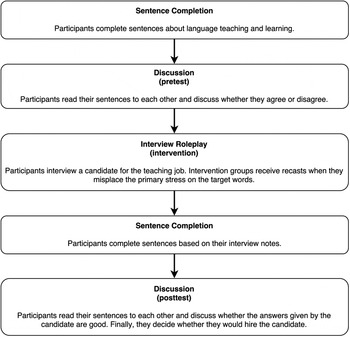
After the interview, participants were given the last handout—the second sentence- completion task—and asked to complete the 10 sentences based on their interview notes. For the final stage, the participants shared their interview notes with their partner by reading the sentences aloud, and, at the end, they decided whether they should hire the candidate. The posttest data were collected during this stage. The five tasks, including the pre- and posttest tasks, were given back-to-back and took participants approximately 1 hour to complete. Figure 1 illustrates the data collection procedure. Pretest, treatment, and posttest tasks were conducted consecutively in order to assess the immediate impact of recasts on learners’ oral production, as well as to control for potentially mediating factors such as classroom or tutoring instruction in which learners were enrolled. Careful attention was paid to ensure that the pretest, intervention, and posttest tasks were comparable by having each phase require the production of the same target words in sentence-medial position, allowing for the analysis of stress placement. After completing the last task, participants were asked to fill out the exit survey. When they did not understand a word or a survey item, they were provided with a clarification in English.
Data collection procedure.

All of the participants’ interactions were audio recorded during their conversations with each other as well as their interaction with the interviewee during the role-play activity. All learners wore Shure WH20 XLR headset microphones connected to a Roland Duo-Capture EX USB audio interface. Following the procedure used by Kirkham (Reference Kirkham2016), the microphone was positioned at 30 degrees off-axis and about 3 cm away from the speaker’s mouth. All files were saved onto an iPad as 44,100 Hz .wav files.
ANALYSIS
The acoustic analysis of the data from the final sample of 57 participants was carried out in Praat (Boersma & Weenink, Reference Boersma and Weenink2015). When coding the data for analysis, tokens with minor phoneme changes were kept in the dataset (e.g., [əbrotʃəbl] for “approachable,” [ɪnkaʊndɚ] for “encounter,” [komjunɪket] for “communicate,” or [eθɔrɪti] for “authority”). Fifty-seven participants would have produced 1,140 total tokens during the pretest and posttest. However, unintelligible tokens and tokens with reduced or extra syllables were excluded (e.g., [əksplɪkt] for “explicit,” [rekutənt] for “reluctant,” [daɪnæm] for “dynamic,” or [pɑrtɪpɪkəli] for “participate”), leaving 840 tokens that were included in the statistical analyses.
The word and syllable boundaries for the 840 tokens were determined based on visual and auditory information. Then, a Praat script was used to extract individual tokens from continuous speech and to save them as separate .wav files. The acoustic analysis of the tokens focused on duration, pitch, and intensity, as previous studies have shown that these cues are reliable correlates of lexical stress in English (Beckman, Reference Beckman1986; Sluijter & van Heuven, Reference Sluijter and van Heuven1996). Another Praat script was used to extract duration, average intensity, and peak pitch values for each syllable. The duration values were measured in milliseconds and multiplied by 1,000 for readability purposes. The intensity values were measured in decibels, and the pitch values were measured in Hertz.
To facilitate the statistical comparison of pretest and posttest data, a single number that represents the value of the measure for the second syllable relative to other syllables was calculated for each of the three dependent variables. For example, to calculate the relative syllable duration for a three-syllable word, the sum of the durations of the first syllable (S1) and the third syllable (S3) was subtracted from the duration of the second syllable (S2). When it comes to four-syllable words, the sum of the durations of S1, S3, and the fourth syllable (S4) was subtracted from the duration of S2.
Before running the analysis, the data were checked for normality using q–q plots. The q–q plots for all three dependent variables showed that there were a few extreme outliers in the dataset. After the outliers were removed, the distribution was normal with the number of tokens reduced to 778. However, the tokens were not evenly distributed across participants and groups, and there were instances of missing data. Thus, the data did not meet the underlying assumptions necessary to conduct an ANOVA analysis. Rather, because it was necessary to include participants and words as random variables, a mixed-effects model with restricted maximum likelihood was fitted in R using the lme4 package (Version 1.18). Based on the research design, a mixed-effects model was fitted using the interaction among condition, modality, and time as the fixed effect and treating participants and words as the random effects. However, considering the fact that syllable might also be an intervening fixed effect, a second model was created using the interaction among condition, modality, time, and syllable as the fixed effect with participants and words as the random effects. The two models were compared for all three dependent variables. The addition of syllable as a fixed main effect improved the model for the analysis of duration, χ2(8) = 18.6, p = .02. However, it had no effect in the case of intensity, χ2(8) = 2.91, p = .94, or pitch, χ2(8) = 9.75, p = .28. As a result, syllable was used as a fixed effect in the analysis of duration, but it was excluded from the analyses of intensity and pitch.
In addition to acoustic analysis, auditory analyses based on listener perceptions were also conducted. Previous research suggests that when it comes to processing acoustic cues and uptake, listeners are highly efficient (van Donselaar, Koster, & Cutler, Reference van Donselaar, Koster and Cutler2005). Therefore, similar to previous studies that have used listener perceptions as a measure of development (e.g., Derwing et al., Reference Derwing, Munro and Wiebe1998), for the present study, two raters provided their perceptual judgments of lexical stress placement for the pretest and posttest data. The first author listened to each token in isolation and coded them as correct or incorrect based on lexical stress placement. Then a native speaker of British English with a background in Teaching English to Speakers of Other Languages (TESOL), who was trained to code for the purposes of this study, coded a subset (100 tokens) of the data. He was informed that he could listen to a recording as many times as necessary before making a judgment about stress placement. He listened to each token in isolation and asked to hear some of the tokens for a second time before making a judgment. According to Kappa analysis, there was a strong agreement between the two raters (κ = .86, p = .00).
RESULTS
Duration
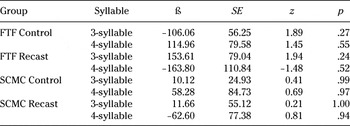
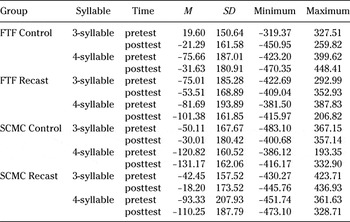
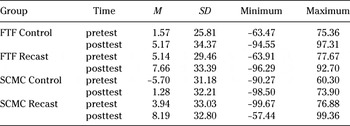
We expected to see a noticeable increase in the relative duration of S2 for the intervention groups, as stressed syllables have a longer duration. However, the results showed that there were no significant differences between pretest and posttest S2 durations of three- and four-syllable words for any of the four participant groups. There was almost no difference between pretest and posttest S2 duration of three-syllable words produced by the SCMC control group (ß = 10.12, SE = 24.93, z = 0.41, p = .99) and the SCMC recast group (ß = 11.66, SE = 55.12, z = 0.21, p = 1.00). In the case of four-syllable words, the SCMC control group produced words with longer S2 duration on the posttest (ß = 58.28, SE = 84.73, z = 0.69, p = .97), whereas the SCMC recast group produced shorter S2 duration (ß = −62.60, SE = 77.38, z = 0.81, p = .94). By contrast, the FTF control group produced shorter S2 duration for three-syllable words on the posttest (ß = −106.06, SE = 56.25, z = −1.89, p = .27), whereas the posttest S2 durations for FTF recast group were longer (ß = 153.61, SE = 79.04, z = 1.94, p = .24). Finally, posttest S2 durations for four-syllable words were longer for the FTF control group (ß = 114.96, SE = 79.58, z = 1.45, p = .55) and shorter for the FTF recast group (ß = −163.80, SE = 110.84, z = −1.48, p = .52). Table 1 provides a summary of these results; Table 2 illustrates the descriptive statistics for duration.
Summary of linear mixed-effects statistics for duration

Descriptive statistics for duration

Intensity
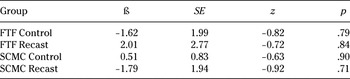
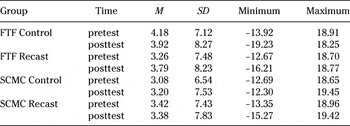
It was hypothesized that recasts would lead to higher relative intensity values for S2. However, the results did not show a significant change for any of the groups for the dependent variable intensity. The SCMC control group produced S2 with slightly more intensity on the posttest (ß = 0.51, SE = 0.83, z = −0.63, p = .90) compared to the SCMC recast group (ß = −1.79, SE = 1.94, z = −0.92, p = .71). However, the FTF control group had lower S2 values on the posttest (ß = −1.62, SE = 1.99, z = −0.82, p = .79) compared to the FTF recast group (ß = 2.01, SE = 2.77, z = −0.72, p = .84). Table 3 summarizes the results for intensity; Table 4 provides descriptive statistics illustrating the results for intensity.
Summary of linear mixed-effects statistics for intensity

Descriptive statistics for intensity

Pitch
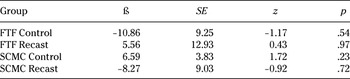
We also predicted higher relative pitch values on the posttest for the intervention groups. Yet, similar to the findings for duration and intensity, there were no significant differences in pitch across the four groups. The S2 pitch values for the SCMC control group were slightly higher on the posttest (ß = 6.59, SE = 3.83, z = 1.72, p = .23), whereas the posttest S2 pitch values were lower for the SCMC recast group (ß = −8.27, SE = 9.03, z = −0.92, p = .72). The results for the recast groups followed a different pattern with the FTF control group producing lower S2 pitch (ß = −10.86, SE = 9.25, z = −1.17, p = .54), and the FTF recast group producing higher S2 pitch on the posttest (ß = 5.56, SE = 12.93, z = 0.43, p = .97). Tables 5 and 6 provide a summary of these findings.
Summary of linear mixed-effects statistics for pitch

Descriptive statistics for pitch

Auditory Analysis
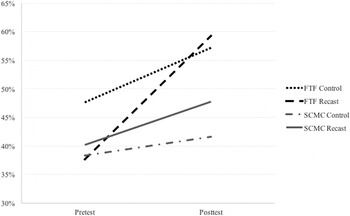
Based on rater judgments of the pretest data, the FTF recast group correctly placed lexical stress 37.63% of the time, and the SCMC recast group correctly placed lexical stress 40.16% of the time. Both recast groups had a higher percentage of correct lexical stress placement on the posttest, with 59.26% for the FTF recast group and 47.75% correctly stressed words for the SCMC group. The control groups also performed better on the posttest; however, the difference between pre- and posttests was smaller compared to recast groups. The FTF control group increased correct stress placement from 47.62% to 57.14%, and the SCMC group increased it from 38.30% to 41.58%. Figure 2 illustrates the gains experienced by each of the four groups.
Percentage of correct stress placement over time by group according to auditory analysis.

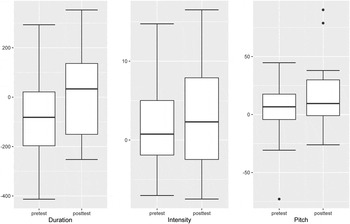
Based on the results of the auditory analysis, we were able to identify 20 tokens that were marked as inaccurate on the pretest and accurate on the posttest for lexical stress placement. The tokens were three-syllable words produced by 14 participants from FTF and SCMC recast groups and they contained 8 types out of the total 10 types. A new mixed-effects model was fitted using time as the fixed effect and treating participants and words as the random effects. Due to the small number of tokens, modality as a fixed effect was not included in the model. The results showed that there was no statistical difference between the pretest and posttest measurements of intensity (ß = 1.72, SE = 1.38, t = 1.25, p = .23) or pitch (ß = 10.27, SE = 7.58, t = 1.36, p = .19). However, the increase in relative S2 duration was statistically significant (ß = 92.27, SE = 30.11, t = 3.07, p = .00). Table 7 and Figure 3 provide a summary of the analyses.
Summary of linear mixed-effects statistics for the 20 tokens

Comparison of pretest and posttest acoustic measurements of the 20 tokens.

DISCUSSION
The goal of this exploratory study was twofold: (a) to examine the impact of recasts on learners’ development of lexical stress and (b) to provide a first look into whether recasts provided in FTF and the underexplored condition of oral SCMC (video chat in the current study) differentially facilitated development of lexical stress in task-based learning environments. Based on the acoustic analysis of duration, intensity, and pitch, findings show that there were no statistically significant differences between the pretest and posttest measurements across groups. Despite the lack of statistical significance for improvement for groups, several trends are worthy of discussion. First, the comparison of linear mixed-effects models indicated that the inclusion of syllable as a fixed effect improved the model only when the dependent variable was duration. Also, the largest positive difference between pretest and posttest duration measurements occurred in the case of three-syllable words produced by the FTF recast group. Therefore, further analyses examining the relationship between recasts and duration for three-syllable words were conducted. The new analyses were based on listener perceptions, which yielded a limited number of tokens and therefore did not allow for separate statistical analyses of the treatment conditions. The results indicated that the increase in relative duration of S2 was significant, suggesting that recast may promote development of lexical stress, although more research is needed to determine the role of modality. This focus on syllable duration by Arabic speakers is not surprising considering that the systematic vocalic contrast in Arabic relies heavily on vowel duration (de Jong & Zawaydeh, Reference de Jong and Zawaydeh2002). Similar to the way they utilize vowel duration in their L1 for creating vocalic contrast or placing stress, the participants may have sought to manipulate duration in an attempt to shift stress placement onto the correct syllable in English. Therefore, the provision of recasts may have pushed the participants to focus their attention on S2 duration and attempt to modify their production accordingly. In addition, the participants in the FTF recast group were better at increasing the duration of S2 for three-syllable words in comparison to four-syllable words, potentially because the additional syllable increased the difficulty level and made it more challenging for them to manipulate syllable duration as they did for three-syllable words. Overall, the findings suggest a pattern that is in line with evidence from previous studies on Arab learners of English (de Jong & Zawaydeh, Reference de Jong and Zawaydeh2002; Munro, Reference Munro1993) in that the learners in the FTF recast group tried to manipulate duration more than pitch and intensity in an attempt to improve stress placement.
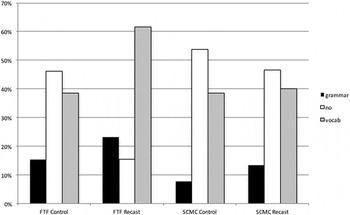
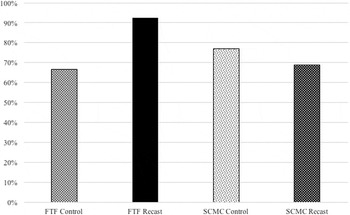
Although the FTF recast group made an attempt at manipulating syllable duration, the SCMC recast group did not show a similar pattern. To understand why this may be the case, we analyzed the responses given on the exit survey. Findings indicated that the majority of the participants in the FTF recast group responded to the question “Did you focus on any specific grammatical form or vocabulary during the task?” by saying that they focused on vocabulary. Many of them specifically mentioned the target words as the words that they focused on during the tasks following the provision of feedback, suggesting that the provision of recasts may have helped support learners’ noticing of target features. In fact, according to responses given to Likert-scale items, the FTF recast group paid more attention to pronunciation compared to the other groups. The analysis of responses to the Likert-scale item “The interview task helped me learn pronunciation” showed that 92% of the FTF recast group either agreed or strongly agreed with the statement, whereas this number was only 69% of the SCMC recast group. Figures 4 and 5 illustrate the survey responses across groups.
Participants’ responses to the question “Did you focus on any specific grammatical form or vocabulary during the tasks?” by group.

Participants’ responses to the Likert-scale item “The interview task helped me learn pronunciation” by group.

It is important to point out that this study did not specifically seek to investigate noticing or attention; however, the patterns that emerged suggest possible effects of noticing and attention due to modality. Given the present results, this increased focus on vocabulary and pronunciation by the FTF recast group may have been sufficient for these learners to notice the feedback on these target items, resulting in the observed increases in S2 duration.
As Figure 4 shows, the majority of the participants in the SCMC recast group responded to the question by saying that they did not focus on any particular linguistic feature. This suggests that the learners in the SCMC recast group may not have noticed the recasts as feedback or noticed the targets of the feedback. Because of its importance for L2 acquisition (e.g., Goo & Mackey, Reference Goo and Mackey2013; Mackey, Reference Mackey2006; Schmidt, Reference Schmidt and Robinson2001), the lack of reported noticing in the SCMC group may have constrained the benefits available from the recasts. In other words, because the SCMC group may not have been aware of the intent of the feedback, and therefore have had fewer opportunities for noticing, they may not have benefited from the recasts as much as the FTF group did. These findings are in contrast to previous research arguing that SCMC may increase learners’ opportunities to notice target items in the input as well as to notice gaps between their interlanguage and the target language (Beauvois, Reference Beauvois1992; Kelm, Reference Kelm1992; Lai & Zhao, Reference Lai and Zhao2006; Payne & Whitney, Reference Payne and Whitney2002), suggesting that different forms of SCMC may impact noticing in unique ways. For example, because interaction in written SCMC is hypothesized to be slower than FTF interaction, due to variability in learners’ typing speed and Internet connections, text-chat may provide more opportunities for learners to review and assess their production during interactions, therefore increasing the opportunities for noticing and subsequent L2 development. In addition, scholars have suggested that because text-chat provides learners with a visual representation of their own output, thereby directing learners’ attention to their language and allowing students to “practice and gain control over more cognitively demanding aspects of grammar that otherwise might not be so frequently practiced in classroom oral interaction” (Pellettieri, Reference Pellettieri, Warschauer and Kern2000, p. 82), it may be more supportive of noticing and L2 development than other forms. Furthermore, learners’ ability to review text-chat transcripts, whether in real time during an interaction or postinteraction, also offers learners the opportunity to visually review input, output, and feedback, thereby potentially direction their attention to their interlanguage and possibly leading to improvement (Toyoda & Harrison, Reference Toyoda and Harrison2002, p. 96). Finally, written SCMC may require more verbal explicitness due to the lack of visual contact, thereby drawing learners’ attention to form in the input and their subsequent output. This enhanced explicitness may also apply to learners’ use and provision of corrective feedback. Recent meta-analyses have indicated that explicit forms of corrective feedback, such as metalinguistic feedback, result in greater short-term gains than implicit forms of feedback, such as recasts (e.g., Li, Reference Li2010). In other words, the increased opportunities for noticing, and therefore development, may be specific to written modalities rather than computer-mediated contexts. Indeed, the current findings support previous research examining oral SCMC (Yanguas, Reference Yanguas2010, Reference Yanguas2012), with results demonstrating no significant differences in L2 learning outcomes between FTF and video-chat SCMC groups, suggesting that oral SCMC may have an important, although not necessarily positive, impact on learners’ noticing and subsequent L2 development.
However, it is important to note that empirical results for improved noticing in text-based SCMC are somewhat mixed. For example, Payne and Whitney (Reference Payne and Whitney2002) found that learners reported noticing their mistakes more frequently in SCMC chat environments than in FTF interaction. Lai and Zhao (Reference Lai and Zhao2006), although they did not compare FTF and SCMC interactions, found that text chat resulted in learners’ improved noticing of errors and interactional feedback, providing further evidence of the possible benefits in SCMC to enhance noticing. In contrast, Gurzynski-Weiss and Baralt (Reference Gurzynski-Weiss and Baralt2014) found no significant differences in noticing between FTF and SCMC task-based interactions. Gurzynski-Weiss and Baralt (Reference Gurzynski-Weiss and Baralt2015) found that modified output, both partial and fully modified, strongly predicted learners’ accurate noticing of feedback. In general, then, these mixed results highlight the need for further research examining noticing in both written and oral forms of CMC.
Overall, both the results of the rater judgments and the acoustic analyses indicate a positive trend for improved lexical stress placement by the FTF recast group. This improvement may have been due to their increased focus on the target words, which may have enhanced the noticing and therefore the development of the suprasegmental features. However, the results of the SCMC recast group are less clear. Although rater judgments seem to indicate improvement over time, suggesting positive benefits for learners receiving corrective feedback, the SCMC group experienced less improvement than the FTF group. These results suggest that mode may in fact play an influential role in the effectiveness of corrective feedback on phonological features, underscoring the need for additional research comparing audiovisual forms of SCMC with FTF contexts.
Learners’ Perceptions
Despite the findings demonstrating no statistically significant differences across modality in terms of L2 development, results from the exit surveys indicated that learners had generally positive perceptions of technology-mediated learning environments. For example, 93% of the learners in the SCMC conditions felt that oral SCMC was helpful for improving speaking, listening, and pronunciation skills. Although there were no significant improvements in lexical stress production, learners’ positive attitudes toward using technology for language learning are encouraging and echo the findings of previous research regarding learners’ perceptions of the efficacy of SCMC, particularly when combined with meaning-focused tasks (e.g., Bradley & Lomicka, Reference Bradley and Lomicka2000; Darhower, Reference Darhower2008). In addition, 73% of learners in the SCMC recast condition and 61% in the SCMC control condition felt that interaction in a computer-mediated context was less stressful than in more traditional learning environments. Interestingly, this was also the opinion of the majority of learners in the FTF control condition (67%). Although it is beyond the scope of the current study to provide empirical results regarding learners’ state anxiety, the results from learners’ perceptions seem to support previous research suggesting that one of the benefits of computer-mediated interaction is the potential to reduce learners’ anxiety levels (Abrams, Reference Abrams2003; Kelm, Reference Kelm1992; Kern, Reference Kern1995). As Beauvois (Reference Beauvois1992) points out, there may be less immediacy in SCMC than FTF, providing learners with additional time to process input and produce output. This added time may be beneficial to learners with greater levels of anxiety or for learners with low proficiency levels. In addition, Kern (Reference Kern1995) found that introverted learners may be more likely to participate in SCMC contexts, with students indicating on self-report measures that they feel freer to take part in the interaction. Some researchers have also argued that oral production is one of the leading causes of learner anxiety (Gregersen & Horwitz, Reference Gregersen and Horwitz2002; Krashen, Reference Krashen2003), an interesting claim given that the current results indicate learners’ nonetheless preferred oral interaction in computer-mediated environments. Although SCMC may not have enhanced learners’ developmental opportunities, this context may be advantageous over FTF interactions by reducing learners’ levels of anxiety (Baralt & Gurzynski-Weiss, Reference Baralt and Gurzynski-Weiss2011). To gain a better understanding of the role setting may play in learner development, researchers should consider pursuing empirical examinations of the role of anxiety, as well as the relationships between individual differences and L2 development, across traditional and computer-mediated oral modalities.
Limitations and Future Research
Although the current study provides a first look at the differential development of phonological features across video chat and traditional FTF task-based contexts, as with most research of this type, there are some important limitations that must be noted. The current research followed a one-shot design in which learners were exposed to a limited amount of feedback during a short period of time. However, language learning is frequently nonlinear in nature, requiring continued exposure to input and feedback to support learners’ noticing and subsequent development of target language features. Future research should seek to provide repeated instances of feedback, as well as experiment with more explicit forms of feedback, to increase learners’ noticing of target language forms. Similarly, the acquisition and development of lexical stress placement may require extended periods of time. The duration of the current study was less than 2 h and used only an immediate posttest administered directly after the treatment task. Previous research has demonstrated that the positive effects of recasts may be delayed (Mackey & Goo, Reference Mackey, Goo and Mackey2007); as such, learners’ development in the present study may not have been captured by the immediate posttest. Future research should consider including delayed posttests to capture development that may occur over longer periods of time. In addition, task type may have impacted learners’ stress. Although the task may have elicited natural use of the target feature, it may not have been essential for learners to produce correct stress as it may not have negatively affected the intended meaning or their interlocutors’ understanding. Future research should consider how task type and essentialness might impact the quantity and quality of learners’ pronunciation. Finally, the current research examined only one mode of SCMC in comparison to FTF. Previous research that has compared various modes of CMC suggests there are important differences in the efficacy of task-based interaction and corrective feedback across CMC types (Yanguas, Reference Yanguas2010, Reference Yanguas2012; Yilmaz, Reference Yilmaz2011), highlighting the need for more research examining audio and video modes of SCMC.
CONCLUSION
The present study reports the findings of a preliminary investigation examining Arab learners’ development of lexical stress in English in FTF and the underexplored context of video task-based chat. Although no statistical differences were found over time or across mode, results indicated that Arab learners of English seem to depend more on syllable duration when manipulating lexical stress placement, providing further support for previous research (de Jong & Zawaydeh, Reference de Jong and Zawaydeh2002). In addition, the current study takes a novel approach to L2 phonological development by employing acoustic as well as auditory analysis, thereby seeking to provide a more comprehensive understanding of the development of suprasegmentals. Finally, participants’ perceptions of using SCMC were largely positive, with learners indicating that they felt less anxiety when interacting in the computer-mediated condition. Based on the data presented here, these findings highlight the need for more research examining these topics, particularly the relationship between corrective feedback, the development of L2 lexical stress over time, and the nuanced differences between traditional task-based interaction and audio-visual modes of SCMC.