INTRODUCTION
Much vocabulary knowledge is acquired incidentally through exposure to words in speech or print in both the first and second languages (e.g., Nagy et al., Reference Nagy, Herman and Anderson1985; Swanborn & Glopper, Reference Swanborn and de Glopper1999). Previous research suggests that exposure to word spellings facilitates English-speaking children and adults’ ability to remember the pronunciations and meanings of new English vocabulary words being learned when recall is tested without spellings (e.g., Ehri & Wilce, Reference Ehri and Wilce1979; Rastle et al., Reference Rastle, McCormick, Bayliss and Davis2011; Ricketts et al., Reference Ricketts, Bishop and Nation2009; Rosenthal & Ehri, Reference Rosenthal and Ehri2008). This effect of spellings on vocabulary learning is referred to as orthographic facilitation. Whether such orthographic facilitation exists in second language learners learning a nonalphabetic language is unknown.
The current study aimed to investigate the effects of exposure to Chinese orthography on learning phonological forms of new words in learners of Chinese as a second language. Chinese is a morphosyllabic language in which each character maps to a morpheme or syllable, instead of a phoneme. Unlike an alphabetic language, the correspondence between orthography and phonology in Chinese is more indirect and less reliable. Another unique characteristic is that Chinese orthography presents not only phonological information but also semantic information. Previous research suggests that the role of orthography in oral vocabulary learning in native Chinese-speaking children is complex and depends on the degree of orthography-phonology and orthography-semantic congruence (Li et al., Reference Li, Zhang, Ehri, Chen, Ruan and Dong2016). The current research aimed to extend the research from native Chinese speakers to Chinese as a second language learners whose first language is English.
This research topic is of theoretical interest given the differences in the orthography–phonology correspondence rules in Chinese and English. Most previous research on the effect of orthographic input in a second language (L2) phonological learning has focused on learners of Roman-based scripts. The results are mixed with positive orthographic facilitation effects reported in some studies (Escudero, Reference Escudero2015; Escudero et al., Reference Escudero, Simon and Mulak2014; Showalter & Hayes-Harb, Reference Showalter and Hayes-Harb2013) and negative or null orthographic effects found in other studies (e.g., Hayes-Harb et al., Reference Hayes-Harb, Nicol and Barker2010; Mathieu, Reference Mathieu2016). The current study will fill the gap by investigating whether and how exposure to characters with varying degrees of orthography–phonology and orthography–semantic congruence affects the phonological and semantic aspects of vocabulary learning in learners of Chinese as a second language.
CHARACTERISTICS OF CHINESE ORTHOGRAPHY
To help readers better understand the relevant research in Chinese, we will first review the characteristics of Chinese orthography. The basic unit of the Chinese writing system is the character. Each character represents a monosyllabic morpheme and is pronounced as a syllable. About 80% of characters are semantic–phonetic compound characters (Fu, Reference Fu and Chen1989), sometimes called phonetic compounds, each comprising a semantic radical and a phonetic radical. The semantic radical usually appears on the left and the phonetic radical falls on the right in a left-right structure character. For example, in the semantic–phonetic compound character 烤 (/kǎo/, to burn), 火 is a semantic radical (fire) that gives cues to the meaning of character, and 考(/kǎo/) is a phonetic radical that provides cues to the sound of the character. These phonetic compound characters make up 72% of the characters Chinese children learn during elementary school (Shu et al., Reference Shu, Chen, Anderson, Wu and Xuan2003).
The usefulness of the information provided by semantic radicals varies. According to Shu et al.’s (Reference Shu, Chen, Anderson, Wu and Xuan2003) analysis, 58% of compound characters in all the Chinese characters taught in elementary schools are semantically transparent. Semantic radicals provide conceptual categories or are directly related to character meanings. For example, the transparent character 猫, /māo/, the cat has the animal radical 犭. In 9% of opaque characters, the radical provides no related information or provides misleading information about character meaning (Shu et al., Reference Shu, Chen, Anderson, Wu and Xuan2003). For example, 猜, /cāi/, guess, has the animal radical 犭.
According to Shu et al.’s (Reference Shu, Chen, Anderson, Wu and Xuan2003) analysis of a corpus of school Chinese, phonetic radicals provide accurate sound information for only about 39% of the semantic–phonetic compound characters, called regular compound characters. That is, these characters have the same pronunciation as their phonetic radicals. Phonetic radicals of 26% of compound characters are semiregular and provide partial pronunciation information. For example, the character 精, /jīng/ is a semiregular character because the phonetic radical 青, /qīng/ shares the same rime and tone, /īng/, but a different onset with the whole character (j vs. q). Phonetic radicals of 15% of compound characters are irregular and provide misleading information about the character. For example, 怡, /yí/ is an irregular character because the phonetic radical 台, /tái/, provides an incongruent and even misleading sound cue to the whole character. The current study will manipulate orthography–phonology and orthography–semantics congruency to explore whether various types of orthographic input would yield orthographic facilitation or interference effects in learners of Chinese as a second language.
THE ROLE OF ORTHOGRAPHY IN VOCABULARY LEARNING IN NATIVE CHINESE AND ENGLISH SPEAKERS
There is growing evidence of the benefit of English orthography on the recall of novel pronunciations in native English-speaking children and adults (Ehri & Wilce, Reference Ehri and Wilce1979; Lucas & Norbury, Reference Lucas and Norbury2014; Mengoni et al., Reference Mengoni, Nash and Hulme2013; Rastle et al., Reference Rastle, McCormick, Bayliss and Davis2011; Ricketts et al., Reference Ricketts, Bishop and Nation2009; Rosenthal & Ehri, Reference Rosenthal and Ehri2008). For example, in a vocabulary learning study with English speaking children aged 8–9 years, Ricketts et al. (Reference Ricketts, Bishop and Nation2009) reported that children were more able to learn the spoken label-picture associations and target spelling patterns after incidental exposure to orthography compared to a no orthography condition. This orthographic facilitation in English vocabulary learning can be explained as resulting from the formation of grapheme–phoneme connections between spellings and pronunciations along with meanings to create better specified phonological representations of the words in memory (Ehri, Reference Ehri, Gough, Ehri and Treiman1992, Reference Ehri2005).
Research with native English-speaking adults, however, has presented mixed findings. In Hayes-Harb et al.’s (Reference Hayes-Harb, Nicol and Barker2010) study, adult learners were auditorily presented a set of pseudowords along with pictures indicating their meanings in three conditions: with written word forms consistent with pronunciations (e.g., kamad—/kɑməd/), with written word forms inconsistent with pronunciations (e.g., kamand—/kɑməd/), and no written word forms. Participants were tested for the memory of phonological forms of newly learned words without written word forms. The results showed no facilitation of learning for the exposure to consistently written word forms condition compared to the no written word form condition. An interference effect was found for exposure to inconsistently written word forms. The findings suggest that spelling-sound consistency may affect the way orthographic input influences phonological learning of new vocabulary words.
Compared to alphabetic languages, Chinese orthography is unique as it presents not only phonological information but also semantic information. As noted earlier, phonetic or semantic radicals in Chinese characters vary in the usefulness of predicting pronunciations or meanings of the compound characters. To investigate whether Chinese children can use orthography-phonology mapping to learn the pronunciations of new vocabulary words and to use orthography–semantic mapping to learn the meanings of new words in Chinese, Li et al. (Reference Li, Zhang, Ehri, Chen, Ruan and Dong2016) carried out a study with 24 second graders in China. The children were taught to associate 12 spoken monosyllabic labels with novel-object pictures accompanied either by phonologically accurate characters symbolizing the spoken labels, phonologically misleading characters symbolizing incongruent spoken labels, or no orthography, over four learning trials. Half the characters had semantically transparent radicals, which symbolized accurate semantic information of novel objects. The other half of the characters had semantically opaque radicals, which symbolized misleading semantic information of novel objects. Learning trials were interleaved with test trials. After each learning trial, children recalled spoken labels without any orthography present. Results revealed orthographic interference, indicated by poorer recall with phonologically misleading characters and semantically opaque characters over no orthography. Orthographic facilitation was not evidenced by the superior recall of phonologically or semantically accurate characters over no orthography, possibly because the presence of phonologically or semantically incongruent characters discouraged attention to orthography, and thus the potential benefits of orthography presence diminished. The results suggest that the mnemonic power of orthography in facilitating or limiting vocabulary learning depends largely on the degree of orthography–phonology and orthography–semantic congruence in Chinese acquisition. Because irregular phonetic radicals provide misleading phonological information and may inhibit the role of orthography input, the current study will replace irregular characters with semiregular characters that provide partial pronunciation information and see if exposure to written forms with full or partial pronunciation information would facilitate or hinder oral vocabulary learning for learners of Chinese as a second language.
EFFECT OF ORTHOGRAPHIC INPUT ON PHONOLOGICAL AND LEXICAL LEARNING IN L2 LEARNERS
There is a growing body of psycholinguistic research on the effect of orthographic input on lexical and phonological learning of new words in L2 learners, but most studies focus on Roman-based scripts and two typologically close writing systems in a first and second language, and the results are mixed. The positive orthographic effect was found in L2 learners of a variety of first language backgrounds (e.g., Dutch-English in Escudero, Reference Escudero2015; Spanish-Dutch in Escudero et al., Reference Escudero, Simon and Mulak2014; English-Mandarin in Showalter & Hayes-Harb, Reference Showalter and Hayes-Harb2013). Negative orthographic effect or interference was found in other studies (e.g., English-Mandarin in Bassetti, Reference Bassetti2006; Spanish-Dutch in Escudero et al., Reference Escudero, Simon and Mulak2014; English-Arabic in Mathieu, Reference Mathieu2016; English-German in Hayes-Harb et al., Reference Hayes-Harb, Brown and Smith2018). The null orthographic effect was found in some studies (e.g., English-French in Simon et al., Reference Simon, Chambless and Kickhöfel Alves2010; English-Arabic in Showalter, Reference Showalter2012 and Showalter & Hayes-Harb, Reference Showalter and Hayes-Harb2015).
Most available research focused on phonological learning and reported that familiarity with the writing system affects differently how orthographic input influences phonological learning of new vocabulary words for L2 learners. Some studies found that novel or less familiar orthographic input can significantly hinder learners’ ability to utilize the orthographic information in learning new phonological forms of new vocabulary because learners need to suppress native orthographic rules (Mathieu, Reference Mathieu2016). However, other studies have found no influence of unfamiliar written input on phonological learning of second language learners (Showalter & Hayes-Harb, Reference Showalter and Hayes-Harb2015). When orthographies are presented in an entirely novel script, learners (at first exposure) are unable to use the written input beneficially.
To date, limited research is available regarding the influence of orthographic input on L2 learners’ phono-lexical representations of new words in non-Romantic writing systems. A few research studies involved Korean-Arabic and Mandarin-Korean learners (Han & Kim, Reference Han and Kim2017; Han & Oh, Reference Han and Oh2018). In Han and Kim’s (Reference Han and Kim2017) study, native Mandarin speakers learned novel Korean words with various types of spellings for the variants. The results showed that exposure to spellings supported the production and lexical storage of L2 allophones. A handful of studies have investigated the effect of orthographic input, Zhuyin or pinyin, a phonetic script of Chinese, on phonological and lexical learning of Mandarin words in native English speakers who learn Chinese as a second language (e.g., Bassetti, Reference Bassetti2006; Hayes-Harb & Cheng, Reference Hayes-Harb and Cheng2016; Showalter & Hayes-Harb, Reference Showalter and Hayes-Harb2013). In Hayes-Harb and Cheng’s (Reference Hayes-Harb and Cheng2016) study, native English speaker students learned the phonological forms of new words better in the Zhuyin condition (a novel script, which used Chinese strokes or components to represent sound) than in the pinyin (a familiar script, which used roman-alphabet to represent sound) condition. Despite familiarity with pinyin graphemes, the participants developed less targetlike phonological representations of new words, presumably because they needed to suppress native language grapheme-phoneme correspondences in favor of pinyin graphemes. Showalter and Hayes-Harb (Reference Showalter and Hayes-Harb2013) reported a facilitative role of an unfamiliar orthographic form, written pinyin with lexical tone marks, on native English speakers’ ability to associate a novel phonological feature (lexical tone) with newly learned lexical items.
Despite these interesting findings, it remains unclear whether Chinese L2 learners would benefit from or exhibit interference from exposure to various types of Chinese characters in the phonological and lexical acquisition of new words. The current study will fill the gap by investigating whether and how character orthography–phonology mapping and character orthography–semantic connections affect the phonological and semantic aspects of vocabulary learning in learners of Chinese as a second language.
THE PRESENT STUDY
The primary purpose of the present study was to investigate whether exposure to characters that represent accurate or partially accurate sound and meaning information facilitates or hinders the phonological acquisition of new words for adult learners of Chinese as a second language. Chinese learners with intermediate and advanced Chinese proficiency levels were taught the associations of monosyllable spoken labels with pictures of novel objects depicting meanings paired either with regular characters, semiregular characters, or no orthography. The learning outcome focus was on memory for spoken labels of the vocabulary words because previous research suggests the greatest facilitation in phonological learning of new words from orthography input and semantic learning tends to reach the ceiling quickly (Rosenthal & Ehri, Reference Rosenthal and Ehri2008). Previous research also suggests that native English speakers who are beginning learners of Chinese more readily use semantic radical information to learn the meanings of new characters than use phonetic radical information to learn the pronunciations of new characters (Zhang et al., Reference Zhang, Li, Dong, Xu and Sholar2016). Because of the varying relationship between phonetic radicals and whole compound characters, acquiring orthography–phonology correspondence rules is particularly challenging for learners of Chinese as a second language. Based on these findings, it was hypothesized that Chinese as a second language learners whose first language is English may not benefit from the availability of phonologically or semantically congruent Chinese characters in remembering the spoken labels of vocabulary in Chinese. These students may be distracted by the less congruent phonetic information and misleading semantic information encoded in orthography. That is, exposure to semiregular characters and semantically opaque characters may hinder their phonological learning of new vocabulary words.
The current study is theoretically important and methodologically innovative for at least two reasons. First, most previous research on the effect of orthographic input in L2 phonology development has been investigated in a variety of Roman-based scripts (e.g., English, Italian, Spanish, Dutch, German). When both L1 and L2 are alphabetic languages, L2 learners are likely to use their prior knowledge of the alphabet and the L1 vocabulary to support L2 word learning (de Groot & Keijzer, Reference de Groot and Keijzer2000). Learning vocabulary words in a new language, however, is different from integrating new vocabulary items into the existing lexicon because L2 learners will necessarily build new orthographic and phonological rules. This is especially challenging when L1 and L2 are typologically distant, such as Chinese and English. Given the sharp contrast in Chinese and English, the findings will yield important insights into the role of orthography in L2 phonological development and provide implications for oral vocabulary instruction for L2 learners. Second, because Chinese orthography presents not only phonological but also semantic information, manipulating both spelling-sound consistency and spelling-meaning transparency is possible and will offer unique insights into this line of research.
To recapitulate, the current study addressed two research questions:
-
(1) Does exposure to Chinese orthography facilitate or hinder the memory of the spoken labels of new vocabulary words (relative to no orthography) in adult learners of Chinese as a second language?
-
(2) Do varying orthography–phonology and orthography–semantic congruence affect the learners’ memory of the spoken labels of new vocabulary words?
METHOD
PARTICIPANTS
Thirty American undergraduates enrolled in an intensive Chinese program at a university in the southern United States participated in the study. There were 11 males and 19 females. The average age was 20.2 (SD = 1.16) years old. All participants were European Americans and native-English speakers. The number of semesters taking a Chinese course ranged from two to nine. There were 18 students in intermediate Chinese levels (5 students in the 200-level and 13 students in the 300-level) and 12 students in the advanced (400-level) Chinese classes. According to the instructor, students in the 200-level, 300-level, and 400-level had learned at least 500, 1,000, and 1,500 characters, respectively, at the time of the study. These students took Chinese classes 5 days a week and received 1 to 2 hours of individual tutoring each week. The length of the Chinese learning experience in the intensive Chinese program ranged from 12 (200-level) to 45 months (400-level), with an average of 22 months. Before the Chinese program, eight students had at least 1 year of the Chinese learning experience. Twenty-four students (80%) had participated in the intensive summer program and 26 (87%) students had been to Chinese-speaking countries. The length of stay ranged from 2 weeks to 8 months. Among all participants, six students’ parents spoke a foreign language, including French, Italian, German, Chinese, Spanish, and Korean.
MATERIALS AND PROCEDURE
All participants were administered the vocabulary learning experiment and a language background survey at the end of the study.
Vocabulary Learning Experiment
A paired-associate learning paradigm was adapted from previous research on orthographic effect (e.g., Ricketts et al., Reference Ricketts, Bishop and Nation2009; Rosenthal & Ehri, Reference Rosenthal and Ehri2008). Students were taught the associations between 15 monosyllable spoken labels and pictures of novel objects over three trials. These were new labels for novel objects for Chinese as second language learners (e.g., feather fan). To investigate whether orthography–phonology and orthography–semantics congruency influences the effect of spellings on oral vocabulary learning in Chinese, 15 regular pseudocharacters and 15 semiregular pseudocharacters were formed. A pseudocharacter refers to the novel combination of semantic and phonetic radicals in their legal positions but the whole character is nonexistent (to simplify, the terms characters and pseudocharacters will be used synonymously in the remaining text). Half of the characters involved transparent semantic radicals and half involved opaque semantic radicals. Congruency in the current article refers to grapheme–phoneme correspondences and grapheme–semantics correspondences. Congruent Chinese characters (phonetic regular and semantic transparent) provide accurate sound and semantic information. Incongruent Chinese characters (phonetic semiregular or semantic opaque) provide partially accurate or even misleading sound or semantic information. To minimize student confusion about which part of the character served as the semantic or phonetic radical, all semantic radicals were highly frequent and not pronounceable. The result of a pilot semantic radical knowledge task before the present study showed that all students knew the meaning of 73% of these 15 selected semantic radicals. Eight semantic radicals were transparent (e.g., a transparent character  , semantic radical 衤, cloth, corresponding to the picture cloth) and seven were opaque (e.g., an opaque character
 , semantic radical 扌, hand, corresponding to the pictured fire).
All the phonetic radicals in the regular and semiregular characters were simple characters and selected from the textbooks of 100-level students and frequently used through 100-level courses. Therefore, all phonetic radicals were familiar to the participants according to the Chinese instructor. The result of a pilot phonetic radical knowledge task showed that all students could name 85% of these 30 selected phonetic radicals. The radical of regular characters had the same rimes and onsets as the whole character (e.g., a regular character  , phonetic radical 可, /kě/, corresponded to the syllable /kě/), while the radical of semiregular characters had the same rimes but different onsets as the whole character (e.g., a semiregular character , phonetic radical 哥, /gē/, corresponded to the syllable /kě/).
Fifteen monosyllabic pseudowords and picture triplets (see Appendix A) were the stimuli in the vocabulary learning experiments. Each monosyllable or picture was paired with one orthographic condition: regular phonetic characters, semiregular phonetic characters, or no orthography. The 15 triplets were pseudorandomized across three versions (1, 2, 3) so that each participant was only randomly assigned to learn one version. As a result, each study list contained five monosyllables of each of the three orthographic conditions. See examples of stimuli versions 1, 2, and 3 in Appendix A.
In the beginning, the stimuli were randomly presented in PowerPoint with the same time intervals, and the experimenter named each picture twice in the first learning trial. Students were encouraged to repeat after the experimenter but their attention was not drawn to the orthography beneath the pictures nor were they instructed to use it. After the first learning trial, students were presented with the pictures without orthography and asked to recall the names and write their responses as pinyin, which was the script that they were familiar with using. No feedback was given in the test trials. Each correct answer received one point. The scoring was based on onsets and rimes and tones were excluded from scoring.
After the first test trial, students were taught the names of the 15 object pictures again in the second learning trial followed by the second test trial. Altogether three learning trials and three test trials were interweaved. The orders of the characters presented in three learning trials and three testing trials were entirely different. The experiment took about 20 minutes. The maximum score for each test trial was 15.
Language Background Survey
Students filled in a short background survey about their demographic information, the experience of learning Chinese, and traveling to Chinese-speaking countries.
RESULTS
Table 1 presents the descriptive statistics of vocabulary learning performance (the mean percentages of correct monosyllables recalled) by different orthography conditions and learning trials.
Mean proportion (M) and standard deviations (SD) of correct monosyllables recalled during three test trials of four types orthography present conditions and no orthography condition (N = 30)

Note: P+S+: Regular phonetic and transparent semantic radical; P+S−: regular phonetic and opaque semantic radical; P−S+: semiregular phonetic and transparent semantic radical, P−S−: semiregular phonetic and opaque semantic radical; P0S0: no orthography.
First, to investigate the role of phonetic condition, following previous studies (Li et al., Reference Li, Zhang, Ehri, Chen, Ruan and Dong2016; Zhang et al., Reference Zhang, Li, Liu and Chen2020), we combined the transparent and opaque items in regular orthography (P+S+, P+S−) and semiregular orthography (P−S+, P−S−), respectively, so that the number of items in regular phonetic orthography and semiregular phonetic orthography became comparable to that in no orthography condition.
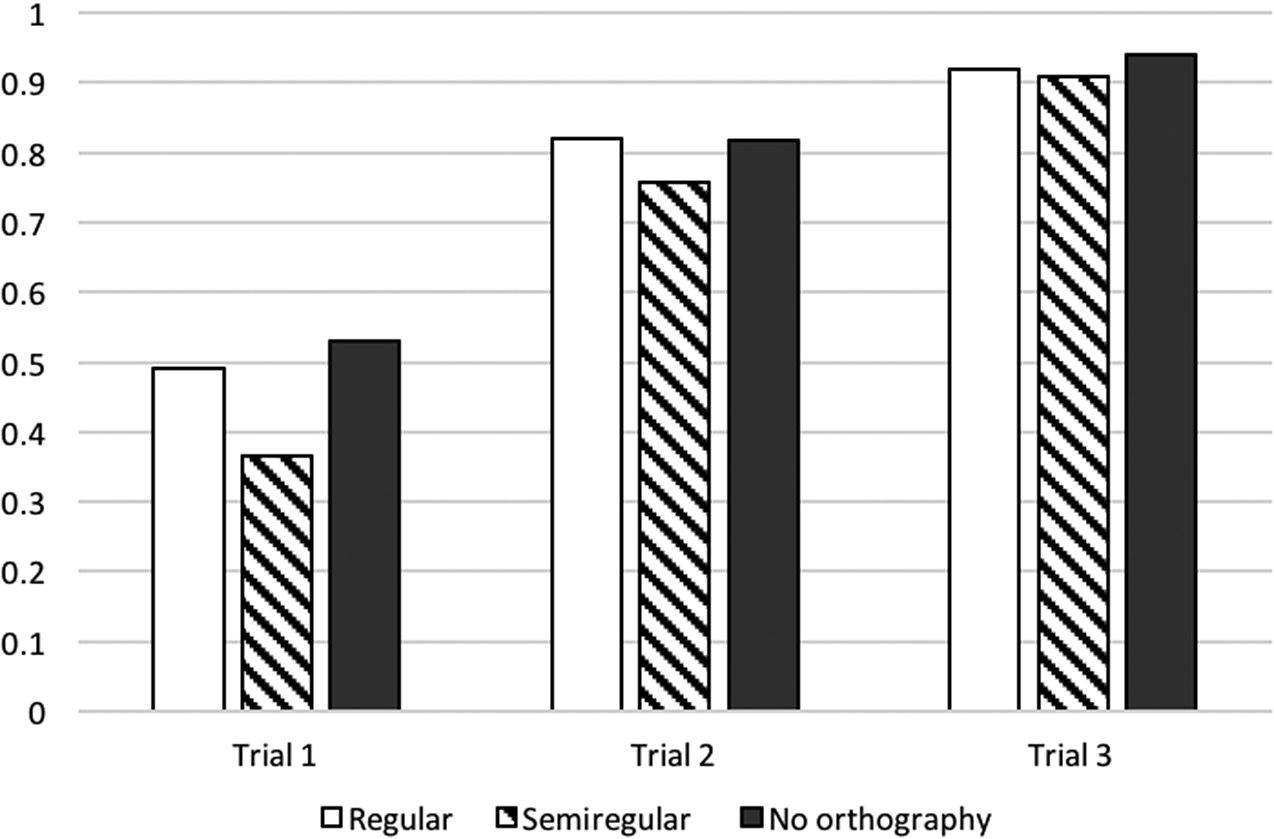
A two-way repeated measures ANOVA (regular phonetic, semiregular phonetic, no orthography × learning trial) was performed on students’ scores on the vocabulary learning task. The main effect of phonetic congruency condition was significant, F(2, 58) = 3.57, p = .034 < .05, ŋp2 = .110. The post hoc multiple comparisons suggested that students performed less accurately on semiregular phonetic condition compared to no orthography condition, p = .016 < .05, 95% CI = [−.152, −.017]. No significant difference between no orthography condition and regular phonetic condition, p = .565, 95% CI = [−.085, .047], or difference between regular phonetic condition and semiregular phonetic condition, p = .064, 95% CI = [–.004, .135], was found. Results also showed a significant main effect of learning trial, F (2, 58) = 122.51, p < .001, ŋp2 = .809. The post hoc multiple comparisons of trial showed that the students’ performance on all conditions gradually increased with learning trials, all ps < .001, T1 vs. T2: 95% CI = [−.339, −.273], T2 vs. T3: 95% CI = [−.176, −.075].
The interaction between learning trial and phonetic condition was not significant, F (4, 116) = 1.61, p = .177, ŋp2 = .052. As shown in Figure 1, these results suggest that the presence of regular characters does not enhance the memory of spoken labels of new words compared to no orthography and the presence of semiregular phonetic characters hinders oral vocabulary learning.
Mean proportion correct of vocabulary words over test trials when regular phonetic characters, semiregular phonetic characters, or no orthography accompanied the words and pictures during test trials.

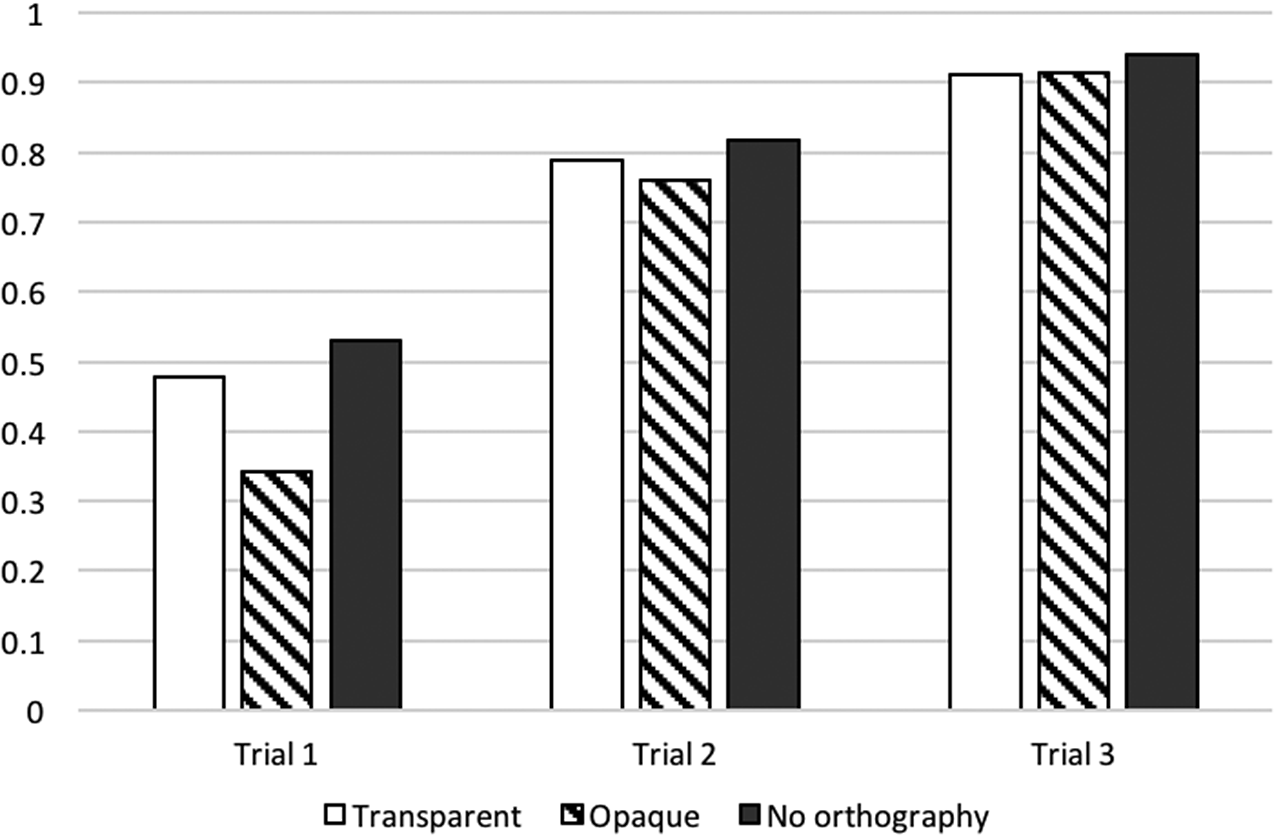
Similarly, to investigate the semantic condition effect, we combined the regular and semiregular items in the transparent condition (P+S+, P−S+) and opaque condition (P+S−, P−S−), respectively. A two-way repeated measures ANOVA (semantic condition: transparent, opaque, no orthography × learning trial) was conducted. A significant main effect of semantic condition was found, F (2, 58) = 4.60, p = .014 < .01, ŋp2 = .137. The post hoc multiple comparisons suggested that students performed worse on opaque condition compared to no orthography condition, p < .001, 95% CI = [−.136, −.044]. No significant difference was found between the no orthography condition and the transparent condition, p = .337, 95% CI = [−.112, .040], or between the transparent condition and opaque condition, p = .066, 95% CI = [−.004, .111]. Results also showed a significant main effect of learning trial, F (2, 58) = 123.52, p < .001, ŋp2 = .810. The post hoc multiple comparisons of learning trial showed that the students’ performance on all conditions gradually increased with learning trials, all ps < .001, T1 vs. T2: 95% CI = [−.403, −.273], T2 vs. T3: 95% CI = [−.187, −.082].
The interaction between learning trial and semantic condition was not significant, F (4, 116) = 2.40, p = .054 < .1, ŋp2 = .077. As shown in Figure 2, these results suggest that compared to the no orthography condition, exposure to characters with transparent semantic radicals did not facilitate oral vocabulary learning, and exposure to characters with opaque semantic radicals significantly interfered with learners’ ability to remember the spoken labels.
Mean proportion correct of vocabulary words over test trials when semantic transparent characters, semantic opaque characters, or no orthography accompanied the words and pictures during test trials.

Table 2 summarizes effect sizes of orthographic interference or facilitation between each orthography present condition relative to the no orthography condition. No phonological or semantic facilitation occurred from orthography that accurately represents pronunciation and semantic information (P+S+) compared to no orthography. Phonological and semantic interference was the result of orthography that misrepresents pronunciation and/or semantic information (P+S−, P−S+, P−S−) compared to no orthography at the beginning of learning presumably because interference is caused by competing pronunciations and competing meanings being activated during learning. Two competitors with partial pronunciation and misleading semantics (P−S−) produce the largest effect size of orthographic interference (−.62) in early learning trials, but such orthographic interference effects diminished with trials.
Effect size of orthography interference or facilitation between each orthography present condition relative to no orthography condition

Note: P+S+: regular phonetic and transparent semantic radical; P+S−: regular phonetic and opaque semantic radical; P−S+: semiregular phonetic and transparent semantic radical, P−S−: semiregular phonetic and opaque semantic radical.
Finally, to investigate whether semantic radical transparency had an interaction with phonetic radical regularity, two-way repeated measures ANOVA (semantic transparency, phonetic regularity) were conducted with the 10 orthographic present items in each version. The result showed no significant interaction between phonetic regularity and semantic transparency, F (1, 29) = .025, p = .875, ŋp2 = .001. No significant main effect of phonetic regularity or semantic transparency was found, F (1, 29) = 2.68, p = .112, ŋp2 = .085, 95% CI = [−.014, .129], F (1, 29) = 3.64, p = .066 < .1, ŋp2 = .112, 95% CI = [−.004, .111].
DISCUSSION
The current study sought to investigate the effects of the presence of Chinese orthography on remembering the phonological forms of new words in native English speakers learning Chinese as a second language. Going beyond previous research, not only orthography–phonology congruence but also orthography–semantic congruence was manipulated. Instead of using irregular characters that provided misleading pronunciation information and caused orthographic interference for young Chinese children (Li et al., Reference Li, Zhang, Ehri, Chen, Ruan and Dong2016), the present study used semiregular characters, which provide partial phonological information in the vocabulary learning task. Similar to the findings observed in Chinese-speaking children (Li et al., Reference Li, Zhang, Ehri, Chen, Ruan and Dong2016), the current results showed that exposure to phonologically regular or semantically transparent characters during learning did not enhance recall of the spoken labels compared to no orthography, but exposure to phonologically semiregular characters and semantically opaque characters significantly hindered remembering the spoken labels of new words. The interference effects are consistent with previous research suggesting that incongruent orthographic information interferes with the development of phonological representations for newly learned words in adult L2 learners (Hayes-Harb et al., Reference Hayes-Harb, Nicol and Barker2010).
The current findings suggest that exposure to the transparent or regular semantic radicals did not produce orthographic facilitation but exposure to opaque or semiregular semantic radicals interferes with vocabulary learning. The unique contribution of the current study is that orthography–semantic congruence also plays a role in oral vocabulary learning for learners of Chinese as a second language. This finding is novel because most previous manipulated orthography–phonology congruence instead of orthography–semantic congruence.
The first possible explanation is that a competing word may be activated when a misleading semantic radical or partially correct phonetic radicals appeared and students had to work hard to suppress the competing vocabulary, thus less attention was allocated to the semantic properties of transparent radicals and phonetic properties of semiregular radicals. Despite possible reduced attention, orthographic interference evident in the findings suggest that the pronunciation and semantics information encoded in the orthographic stimuli was activated.
Second, the orthography–phonology mapping involves larger syllabic units compared to English where phonemes are mapped to graphemes, and orthographic facilitation may be less likely to happen in Chinese as second language learners as they need to suppress their native language grapheme–phoneme mapping. According to the psycholinguistic grain size theory (Zigler & Goswami, Reference Zigler and Goswami2005), when grapheme–phonemic misspellings are paired with unfamiliar spoken vocabulary words during learning, no mapping connections may be activated spontaneously because learners of Chinese as a second language need to suppress the orthography–phonology correspondence rules in their first language. The current results suggest that learners of Chinese as a second language treat the pronunciations of semiregular characters as misleading whole syllables and do not benefit from the shared rimes between the spoken labels and character pronunciations, thus orthographic interference was observed in the semiregular character condition over no orthography. Thus, the similarity in grapheme–phoneme correspondence in L1 and L2 may influence vocabulary learning in L2. The findings obtained in English speakers may not apply to teach Chinese as a second language and students perhaps would benefit from phoneme segmentation when learning the syllables of semiregular characters.
Third, most common (and thus, first-learned) characters in the Chinese as second language curriculum are skewed toward irregularly pronounced semiphonetic compounds and learners of Chinese as a second language may have not developed sufficient insights into positional constraints and functions of radicals to benefit from the phonetic radicals in learning the spoken labels of new vocabulary. Native Chinese speakers develop an awareness of the positional constraints of radicals and know that certain radicals appear in certain positions at an early age (Tong & McBride, Reference Tong and McBride2014). However, learners of Chinese as a second language may have difficulty distinguishing semantic radicals from phonetic radicals in compound characters because of their less well-developed sensitivity to orthographic regularity in Chinese. However, the interference effect of semiregular characters cannot be explained by the confusion of phonetic radicals from semantic radicals because all semantic radicals used were not pronounceable. Learners of Chinese as a second language have particular difficulties in learning orthography–phonology associations in Chinese (Zhang et al., Reference Zhang, Li, Dong, Xu and Sholar2016). It is possible that even when students know the pronunciation of a phonetic radical, they may have difficulty associating the phonetic radical with the pronunciation of a whole character.
The current study has several limitations. First, in a within-subjects design, the effect of orthography on oral vocabulary learning may be altered across three orthographic conditions due to strategy changes. Although all 15 words were taught in each orthographic condition across students, each student learned only five words of each orthographic type. Students may use orthography in the regular phonetic or transparent semantic conditions but rely less on orthography when pictures are accompanied by semiregular or opaque characters. Future research may use a between-subjects design and compare longer lists of words taught to independent groups and see if the current results hold.
Second, the current study involved students with varying levels of Chinese proficiency, but due to the small sample size, the influence of proficiency level on the orthographic effects was not considered in the study. Furthermore, not all students knew the meanings of the selected semantic and phonetic radicals that appeared in the vocabulary learning experiment. Despite this limitation, the results are unlikely affected because orthographic interference evident in the findings suggests that the pronunciation and semantics information encoded in the orthographic stimuli was activated. In our study with native Chinse speaking children (Li et al., Reference Li, Zhang, Ehri, Chen, Ruan and Dong2016), the same orthographic interference, but no orthographic facilitation was found with the same design even when all children were familiar with the phonetic and semantic radicals.
The findings have pedagogical implications for vocabulary instruction in Chinese as a second language. Teaching the pronunciations of new words by exposing learners of Chinese as a second language to orthography may not seem to enhance their vocabulary learning compared to teaching new words without orthography especially for less phonologically regular and semantically transparent words. The results suggest that when grapheme–phoneme correspondence rules differ in native and second languages, it may be more helpful not to introduce the written word forms in vocabulary instruction for the learners of Chinese as a second language. Interference of semiregular characters and opaque characters suggest that language teachers should consider carefully whether both oral and written forms of a word should be presented to learners of L2 vocabulary learning. Another recent study with similar participants showed that the presence of pinyin enhanced recall of spoken labels of new vocabulary words over no orthography (Zhang et al., Reference Zhang, Li, Liu and Chen2020). Therefore, presenting pinyin is a more promising approach to L2 vocabulary learning.
To recapitulate, the current study makes an important contribution to the role of orthographic input in L2 learners’ phono-lexical acquisition literature. No orthographic facilitation but interference, indicated by the poorer recall of vocabulary labels when presented with conflicting semantic information and partial phonetic information compared to no orthography, was found with native English speakers learning Chinese as a second language. These findings reveal the complex effects of orthographic input in L2 word learning for learners and open the door for future research about how the Chinese writing system influences first and second language learners’ oral vocabulary learning.
Appendix A
Examples of Vocabulary Words, Meanings, Pictures, and Orthography Forming Three Counterbalanced Versions of Items
Note: P+S+: Regular phonetic and transparent semantic radical; P+S−: regular phonetic and opaque semantic radical; P−S+: semiregular phonetic and transparent semantic radical, P−S−: semiregular phonetic and opaque semantic radical; P0S0: no orthography.