




No CrossRef data available.
Article contents
- Abstract
- PREVIOUS STUDIES ON L2 ACQUISITION OF ENGLISH STRESS PATTERNS
- KOREAN PROSODY
- RESEARCH QUESTIONS
- EXPERIMENT 1: EFFECTS OF LEXICAL CLASS AND SYLLABIC STRUCTURE ON PRODUCTION
- EXPERIMENT 2: EFFECTS OF LEXICAL CLASS AND SYLLABIC STRUCTURE ON PERCEPTION
- REGRESSION ANALYSES: EFFECTS OF LEXICAL CLASS, SYLLABIC STRUCTURE, AND PHONOLOGICALLY SIMILAR WORDS ON STRESS PLACEMENT
- SUMMARY OF RESULTS
- GENERAL DISCUSSION AND CONCLUSION
- Appendix A1. Words read by the Korean-English bilinguals in the frame sentence “I said ____ this time” to determine accuracy in stress placement on real English words
- References
KNOWLEDGE OF ENGLISH WORD STRESS PATTERNS IN EARLY AND LATE KOREAN-ENGLISH BILINGUALS
Published online by Cambridge University Press: 25 October 2005
Article contents
- Abstract
- PREVIOUS STUDIES ON L2 ACQUISITION OF ENGLISH STRESS PATTERNS
- KOREAN PROSODY
- RESEARCH QUESTIONS
- EXPERIMENT 1: EFFECTS OF LEXICAL CLASS AND SYLLABIC STRUCTURE ON PRODUCTION
- EXPERIMENT 2: EFFECTS OF LEXICAL CLASS AND SYLLABIC STRUCTURE ON PERCEPTION
- REGRESSION ANALYSES: EFFECTS OF LEXICAL CLASS, SYLLABIC STRUCTURE, AND PHONOLOGICALLY SIMILAR WORDS ON STRESS PLACEMENT
- SUMMARY OF RESULTS
- GENERAL DISCUSSION AND CONCLUSION
- Appendix A1. Words read by the Korean-English bilinguals in the frame sentence “I said ____ this time” to determine accuracy in stress placement on real English words
- References
Abstract
The effects of age of acquisition and native language prosody on the acquisition of English stress patterns were investigated with early and late Korean-English bilinguals (n = 20). Distributional patterns of stress placement based on syllabic structure, distributional patterns of stress placement based on lexical class, and stress patterns of phonologically similar words were investigated for their effect on the placement of stress in English nonwords. Both bilingual groups—like the native English controls—showed extension of stress patterns from phonologically similar real words. The effect of syllabic structure for early bilinguals was slightly different from that of native speakers, and late bilinguals showed more reduced effects. Unlike previous work with Spanish-English bilinguals, Korean-English bilinguals demonstrated a nonnativelike effect of lexical class, most pronounced in the late bilinguals. This difference might be due to Koreans' low sensitivity to word-level statistical distributions because of early exposure to a phrase-level prosodic system.This research was supported by a grant (DC05132) from the National Institutes of Health (National Institute on Deafness and Other Communication Disorders). Thanks are extended to J. J. Clark for her help in administering the experiments and to Kyoung-Ho Kang for help locating participants. I would also like to thank the four anonymous SSLA reviewers, Jonathan Loftin, and Lisa Redford for valuable comments on an earlier version of this article.
Information
- Type
- Research Article
- Information
- Copyright
- © 2005 Cambridge University Press
It is well known that larger delays in exposure to a second language (L2) are correlated with greater perceived foreign accent. Although other factors, such as length of residence in the L2-speaking country and amount of first language (L1) and L2 use, have also been shown to predict foreign accent (e.g., Flege, Munro, & MacKay, 1995b; Guion, Flege, & Loftin, 2000; Yeni-Komshian, Flege, & Liu, 2000), age at which L2 acquisition begins seems to be the most important predictor of degree of foreign accent (Flege, Yeni-Komshian, & Liu, 1999; Piske, MacKay, & Flege, 2001).
Many factors could contribute to a foreign accent. The most heavily investigated factor has been segmental production. There have been many studies investigating the production of L2 consonants and vowels by early and late L2 learners (e.g., Flege, 1991, 1993; Flege, MacKay, & Meador, 1999; Flege, Munro, & MacKay, 1995a; Guion, 2003; Munro, Flege, & MacKay, 1996). However, there have been relatively fewer studies investigating the acquisition—by either early or late learners—of elements of the prosodic system (e.g., stress accent, pitch accent, tone; see Davis & Kelly, 1997; Guion, Harada, & Clark, 2004). Nonetheless, perceived foreign accent and intelligibility might be more greatly impacted by prosodic than segmental factors (Anderson-Hsieh, Johnson, & Koehler, 1992; Munro & Derwing, 1999).
Prosody appears to be one of the first properties of the L1 linguistic system learned by infants (Bahrick & Pickens, 1988; Moon, Cooper, & Fifer, 1993). Learning of prosodic patterns might begin in utero, as the acoustic cues that code prosody are reliably conducted to the womb (Lecanuet & Granier-Deferre, 1993). Newborn infants have been shown to prefer their mother's voice to another female voice and to prefer stories read by their mother during pregnancy to other stories (DeCasper & Fifer, 1980; DeCasper & Spence, 1986). It has also been demonstrated that newborn infants can discriminate utterances with typologically different prosodic systems (Mehler & Christophe, 1995; Mehler et al., 1988).
Knowledge of language-specific prosodic patterns has been shown to influence speech processing in infants and adults. Infants of approximately 8 months of age show a bias toward the dominant prosodic pattern of their L1 for segmentation of two syllable words from continuous speech and cannot reliably segment words in a language with a prosodic system different from the L1 (Houston, Jusczyk, Kuijpers, Coolen, & Cutler, 2000; Jusczyk & Aslin, 1995; Jusczyk, Houston, & Newsome, 1999, Polka & Sundara, 2003). In the case of adults, crosslinguistic studies of stress perception have found that listeners from a language with contrastive stress (Spanish) are better at distinguishing nonwords that differ only in stress placement than listeners from a language without contrastive stress (French), especially under conditions requiring greater use of processing resources (Depoux, Pallier, Sebastián-Gallés, & Mehler, 1997; Depoux, Peperkamp, & Sebastián-Gallés, 2001).
Given the apparent early onset of L1 prosodic acquisition, the question arises as to whether the age of L2 exposure affects the ability to learn a new prosodic system. Our earlier research (Guion et al., 2004) has shown that native speakers (NSs) of a stress language (Spanish) can successfully learn some aspects (detailed subsequently) of the English stress system and that early learners are more successful than late learners. English and Spanish have somewhat similar prosodic systems in that they both have contrastive stress accent associated with lexical words. The current paper aims to investigate the acquisition of aspects of the English stress system by early and late learners whose L1 prosodic system is quite different from English. Specifically, the knowledge of English stress patterns acquired by NSs of Korean, a language in which tonal patterns are thought to be associated with an accentual phrase that is not isomorphic to the lexical word, is investigated.
PREVIOUS STUDIES ON L2 ACQUISITION OF ENGLISH STRESS PATTERNS
Most previous studies on the acquisition of English stress by L2 learners have focused on one of three aspects of stress knowledge: patterns based on syllabic structure, statistical distribution of stress across the lexical classes of noun and verb, or analogical extension of stress patterns from phonologically similar words. Our previous work (Guion et al., 2004) addressed all three factors for Spanish learners of English, allowing for an investigation into the relative success of acquisition for each of these aspects. Most previous work has investigated either early or late learners and thus has not allowed for an estimation of age of acquisition effects. Exceptions include the work of Davis and Kelly (1997) and our previous work (Guion et al., 2004), which included both early and late bilinguals.
The most heavily studied aspect of English stress knowledge is that of stress patterns based on syllabic structure. Both vowel quality and number of coda consonants are thought to influence stress placement in English (e.g., Chomsky & Halle, 1968; Hayes, 1982). In the case of two-syllable nouns and verbs—the objects of investigation in the current study—stress regularly adheres to the following patterns. For two-syllable verbs, the final (ultimate) syllable will receive main stress if it has a long vowel or ends in at least two consonants, as in (1). If the ultimate syllable does not have a long vowel or end in two or more consonants, the penultimate syllable is stressed, as in (2). The syllable not receiving main stress might have secondary stress, contain an unstressed full vowel, or contain a reduced vowel.1
The status of the nontonic syllable in cases where the vowel is not reduced is problematic. It is difficult to perceptually determine whether the vowel has secondary stress or is stressless (Burzio 1994, p. 48). Articulatory distinctions are also difficult to make: Stone (1981) found only one level of stress based on jaw movement between most prominently stressed and reduced syllables. Whether nontonic syllables with full vowels are perceived to have secondary stress or be stressless also seems to vary with speaking rate and style. However, the focus of this study is on the placement of main stress and, as such, the status of the nontonic syllables is left as an open question. The transcriptions of the example words provided here reflect the stress levels of the nontonic syllables considered possible by the author.

For two-syllable nouns, the ultimate syllable will receive main stress only if it has a long vowel.2
See Burzio (1994, pp. 48–52) for an alternative to the standard view.

An examination of the statistical distribution of main stress across the English lexicon reveals that long vowels (e.g.,

in beet) are stressed more often than short vowels (e.g.,

in bit). Guion, Clark, Harada, and Wayland (2003) reported an investigation of the CELEX lexical database (Baayen, Piepenbrock, & Gulikers, 1995) whose results indicated that long vowels were roughly twice as likely to be stressed as short vowels (60% of long vowels vs. 35% of short vowels were stressed). It seems that no study investigating the effects of coda consonants on the statistical distribution of stress in English has been reported in the literature.
Investigation into the ability of L2 learners to acquire English stress patterns based on syllabic structure indicates that such patterns are affected by age of English acquisition. Investigations with late L2 learners of English with German, Spanish, or Polish (all with word-level stress) as L1 have found evidence for only partial learning of English stress patterns based on syllabic structure (Archibald, 1992, 1993; Erdmann, 1973; Guion et al., 2004; Mairs, 1989). Many of these studies also reported transfer of L1 stress patterns into English. Similarly, studies with English learners whose prosodic systems differ from English have found little evidence for the acquisition of English stress patterns based on syllabic structure. In a study in which NSs of the nonstress languages Mandarin and Cantonese (both tone languages) and Japanese (a pitch accent language) read real English words, Archibald (1997) found that the errors in stress placement did not seem to be related to syllabic structure. In fact, the errors did not have any readily discernible pattern.
Studies investigating the acquisition of English stress patterns based on syllabic structure in early bilinguals have also reported nonnativelike knowledge. Early childhood Spanish-English bilinguals have demonstrated knowledge of stress patterns based on syllabic structure similar—but not identical—to that of English NSs (Guion et al., 2004). A study with late childhood French learners of English indicated that a novel prosodic system might not be well acquired even before puberty. Pater (1997) found that late childhood French learners of English did not demonstrate nativelike knowledge of English stress patterns in a production task. French does not have word-level stress like English; rather, it has a phrase-level accent in which lexical items having close semantic or syntactic relations are grouped together into a single phonological phrase with an accent on the final syllable (Di Cristo, 1998).
Another aspect of English stress that has received increasing interest recently is knowledge of the distributional stress patterns of nouns and verbs. English bisyllabic nouns are more likely to have initial syllable stress, and bisyllabic verbs are more likely to have final stress (Kelly & Bock, 1988; Sereno, 1986). Native English speakers have been shown to be sensitive to this distributional property and to demonstrate effects of its knowledge in experiments with nonwords (Baker & Smith, 1976; Guion et al., 2003; Kelly & Bock, 1988) and real words in an onset gating task (Arciuli & Cupples, 2004).
Nonnative speakers (NNSs)—both early and late bilinguals—have also demonstrated knowledge of this distributional pattern. Davis and Kelly (1997) studied a group of English learners from a variety of L1 backgrounds (Cantonese, Finnish, German, Korean, Japanese, and Spanish) with varying ages of acquisition (5–27 years). The researchers presented the learners with bisyllabic English nonwords that varied in stress placement and asked them to use the nonword in a sentence in any way they wanted. They found that words with final stress were more likely to be used in a sentence as verbs than were words with initial stress. Interestingly, age of arrival and length of residence were not correlated with performance. Arciuli and Cupples (2003, 2004) found an effect of the distributional patterns of stress across nouns and verbs in speeded grammatical classification and onset gating tasks with groups of L2 English speakers from a variety of L1 backgrounds (mostly lexical tone or lexical stress languages). Typically stressed two-syllable nouns and typically stressed two-syllable verbs exhibited a processing advantage in the experimental tasks. Effects of age of acquisition were not investigated in these studies.
In our previous study (Guion et al., 2004), both early and late Spanish-English bilinguals demonstrated knowledge of the distribution of stress across nouns and verbs. The participants tended to produce bisyllabic nonwords in a noun context with initial stress and in a verb context with final stress. Similar effects were found for stress preference in a perception task as well. The strength of the effect was nativelike for the early bilinguals but tended to be even stronger for the late bilinguals than the native English participants. As Spanish does not have different stress patterns for nouns and verbs (Harris, 1969, 1992), this distributional pattern must have been learned through exposure to English.
The third aspect of English stress that has been investigated is the analogical extension of stress patterns to phonologically similar words. It has been shown that the stress patterns of known words play a role in stress assignment on new words for native English speakers, even in cases for which the analogical stress assignment runs counter to predictions made by syllable structure or lexical class (Baker & Smith, 1976; Guion et al., 2003). In our previous study, both early and late Spanish-English bilinguals were nativelike in their extension of analogical stress to nonwords, in that stress patterns of the phonologically similar words predicted stress independently from the factors of syllabic structure and lexical class (Guion et al., 2004). These previous results indicate that learners might use a similarity metric to determine stress placement. The dimension of phonological similarity might be at the level of the individual exemplar or of the segmental pattern shared by the real words and nonwords. Additionally, these results indicate that the use of such a metric is not affected by age of acquisition. Such findings are in agreement with a view that language acquisition processes associated with item-by-item learning might be dependent on general associative processes that are available across the life span (Neville, 1999).
KOREAN PROSODY
As one goal of the current study is to investigate the effects of native prosodic patterns on the acquisition of English stress patterns by Korean learners, some understanding of the Korean prosodic system is needed. Because all of the Korean speakers in the current study are from Seoul and speak the standard Seoul dialect, the focus of this section is on the prosody of Seoul Korean.
Korean has a prosodic system that is typologically quite different from English. The predominant view of Korean prosody holds that tone patterns are associated with the domain of the accentual phrase—an intonational unit—that might include several lexical items and is not straightforwardly predictable from syntactic structure (Jun, 1996, 1998). Thus, Korean prosody differs from English in two major ways. First, the basic building block of Korean prosody is the tone pattern, whereas in English, it is stress accent. Second, the domain for prosodic association is different: In English, stress accents are associated with the lexical word, and in Korean, tone patterns are associated with an accentual phrase.
Jun (1998) demonstrated empirically that standard Seoul Korean has the tone pattern Low-High-Low-High (LHLH) or High-High-Low-High (HHLH), depending on the manner of the consonant of the first syllable of the accentual phrase. When the first consonant is either aspirated or tense, the tone is high; otherwise, it is low.3
Korean obstruents can have a three-way manner distinction: tense, lax, and aspirated. See Cho, Jun, and Ladefoged (2002) for a complete phonetic description of this manner distinction.
One might expect that because the laryngeal setting of the initial consonant in an accentual phrase affects prosody in Korean, the voicing of the initial consonant in English might also affect stress placement. However the mapping between Korean and English consonants is not one-to-one. For example, in a crosslanguage mapping study, Schmidt (1996) reported that English voiced stops and voiceless fricatives are mapped with almost equal frequency to Korean lax and tense stops and Korean lax and tense fricatives, respectively. Thus, the voicing distinctions made in English cannot be transparently related to Korean manner distinctions.
Additionally, Korean differs from English in its vowel inventory and permissible syllable types. Modern Seoul Korean does not have a length distinction or tense-lax vowel opposition (Kim & Han, 1998). Furthermore, Korean only allows one consonant—either a sonorant or a lax stop—in coda position (Kim & Jongman, 1996). Thus, the ability to correctly place stress according to vowel length and number of coda consonants would have to be predicated on the acquisition of English vowel distinctions and syllabic structures.
Given this brief description of Korean prosody, it is evident that Korean learners of English have to learn a very different prosodic system than the one in their L1. Importantly, they must learn that English has stress accent and not a tonal pattern and that stress is a lexical property (i.e., a property of a given word) and not a phrasal property. In other words, Korean learners of English must learn to associate stress placement information with the lexical representations of words and, if they are to learn the statistical distribution of stress patterns, to abstract patterns across the lexicon.
RESEARCH QUESTIONS
The investigation reported here was designed to address the question of whether the acquisition of a novel prosodic system would be affected by age of L2 acquisition and prosodic properties of the L1. To this end, knowledge of the English prosodic system in native Korean speakers who learned English in childhood and postpuberty was investigated. To ensure that learners with something close to ultimate levels of English attainment were studied, participants with long lengths of residence in the United States and high proficiency on standardized English language tests were recruited.
Because the Korean prosodic systems is based on the phrase level (and not the word level as in English), the ability of Korean learners of English to associate stress with individual lexical items and to abstract stress patterns from statistical distributions across lexical items was of interest. Specifically, the aim of the current research was to investigate knowledge of main stress placement based on syllabic structure and lexical class and the ability to analogically extend stress of known words to new words in early and late Korean-English bilinguals.
Given the apparent early onset of the acquisition of prosody during infancy, it might be that the window of opportunity to attain nativelike prosody ends quite early. Thus, early childhood learners (beginning between the ages of 1 and 6) were predicted to show reduced knowledge of English stress patterns compared to NSs. Also, given the observation that the strength of foreign accent increases with age of acquisition, the postpubescent (late) learners were expected to show reduced learning compared to the early learners. However, if differences were found between the early and late Korean-English bilingual groups, they could not be attributed solely to age of acquisition because of natural confounds between age of acquisition and other subject characteristics known to affect language acquisition, such as length of residence and L2 use (Flege, 1988).
Two experiments, one assessing production and the other perception of main stress placement, are reported. It is hypothesized that the perceptual experiment might reveal knowledge of stress patterns not found in the production data because of the nature of the tasks. The perception task requires only preference judgments and, thus, places fewer demands on the processing system than the production task, which also requires the formation and production of a nonword. The method used in these experiments is the same as that used in our previous research (Guion et al., 2003, 2004).
EXPERIMENT 1: EFFECTS OF LEXICAL CLASS AND SYLLABIC STRUCTURE ON PRODUCTION
In this experiment, three groups of participants—a native English group, an early Korean-English bilingual group, and a late Korean-English bilingual group—were asked to produce two-syllable nonwords in both noun and verb sentence frames. The effects of lexical class and syllabic structure of four nonword stimulus types were investigated.
Method
Participants.
Thirty adults were paid to participate in the experiment. None reported being diagnosed with any language or reading disorders and all passed a pure tone hearing screening in both ears from 500 to 4000 Hz at octave intervals (28 at 20 dB and 2 at 25 dB). The participants were recruited based on their L1 and on their L2 experience and divided into three groups (n = 10): native English, early Korean-English bilingual, and late Korean-English bilingual. The results from the native English group have been reported previously (Guion et al., 2004), but the group is described here, and the results are reported in the current study, thus allowing a comparison of the bilinguals with native English speakers. All participants in the native English group learned English as their L1, and no other language was spoken in the home during childhood. Most had some history of foreign language study in high school or college, but none had lived abroad for more than 3 consecutive months. The bilingual participants all spoke standard Seoul Korean as their L1 and had lived in the United States for at least 5 years. The early bilinguals had begun learning English at the age of 1 to 6 years. The age of acquisition for the late bilinguals ranged from 15 to 34 years old and was determined by age of first massive exposure to English when they moved to the United States. Speakers in both bilingual groups used English regularly on a daily basis at the time of the study. On average, the early bilingual group used English 80%, whereas the late bilinguals used English 55% of the time (see Table 1).
Information on the participants

It was important to the goals of the study that the bilingual participants in the two groups be of roughly equal proficiency in English. Because the early bilinguals were likely to be highly proficient, the late bilinguals needed to be quite proficient as well. To this end, late bilinguals with long lengths of residence (11 years on average) and high levels of education (all had at least some college in the United States) were recruited. Additionally, a standardized test of English proficiency—the Test of Adolescent and Adult Language (TOAL)—was administered to all participants. This test was chosen because of its ability to test high-proficiency English speakers at adult levels (Hammill, Brown, Larsen, & Weiderholt, 1994). Two of the TOAL subtests (those focusing on listening vocabulary and listening grammar) were administered. The two bilingual groups performed comparably on the TOALs (see Table 1). There was no significant difference between the two bilingual groups for TOAL test 1, F(1, 18) = 2.3, p > .05, or test 2, F(1, 18) = 0.51, p > .05. Note also that scores for all three groups were well below the ceiling score of 35.
An additional proficiency measure was devised to test specifically the ability of the Korean-English bilinguals to correctly place stress on real English words. Eighteen words with stress patterns consistent with regular English stress patterns, as described by Chomsky and Halle (1968), and 18 words of the same syllabic structure but which were not consistent with the regular patterns were selected. The words in the two groups did not differ in their token frequency. The Appendix contains a list of these words and their frequency information.
The words were presented orthographically (i.e., in English spelling), and the bilingual participants were asked to first rate the confidence of their knowledge of the word's meaning and of their ability to pronounce the word on 5-point scales. Then, the participants were recorded reading each of the words in the sentence frame “I said __ this time.” The words were later coded for correct stress placement. Only words with a rating of 5 on both scales were considered in the analysis. Table 2 presents the average proportion of correct stress placement by group for each of the two word types. Note that both groups of bilinguals display high accuracy (95% or higher) of stress placement on known English words. The results from this proficiency test indicate that both groups of bilingual speakers are highly accurate in stress placement on known English words, whether or not they are consistent with the regular stress patterns.
Mean proportion of correct stress placements on known real English words

Materials.
The stimuli consisted of 40 two-syllable nonwords. The syllables comprising the nonwords were recorded and presented to the listeners as isolated stressed syllables. There were four types of nonword, each with a different syllabic structure (see Table 3).
Nonwords used in Experiments 1 and 2

The individual syllables making up the nonwords were recorded by a NS of American English. The same speaker also recorded the phrases “I'd like to _____” and “I'd like a _____.” The final “to” and “a” were produced in a reduced form (i.e.,

). The phrase “I'd like to ____” will be referred to as the verb frame and the phrase “I'd like a ____” will be referred to as the noun frame.
Procedure.
The three groups of participants were asked to concatenate words of four syllabic structure types (see Table 3)—presented as isolated, stressed syllables—into a single word and say it in a frame sentence. Each of the nonwords was presented twice, once with the noun frame and once with the verb frame. Two pseudorandomized, counterbalanced blocks were used, totaling 80 trials. Each nonword was presented only once in each block. Half of the productions in each block were in the noun frame and half in the verb frame. There was a short distracter task between the two blocks. Participants were given practice trials using nontest items before the first block.
Stimulus presentation was controlled by software on a personal computer and played over high-quality loud speakers in a sound-attenuated room. For each trial, the participants were first presented with a frame sentence. Presentation of the frame was both aural and visual. After a 500-ms delay, the two stressed, isolated syllables comprising the nonword were presented with a 500-ms interstimulus interval. Presentation of nonwords was aural only. Participants could replay the trial if they wished. After responding, they pushed a button to continue to the next trial. Responses were recorded on tape for later coding.
The participants were instructed to take the two syllables, keep them in the same order, and make a single word from them. They were instructed to produce all of the sounds of the syllables they heard. Additionally, participants were asked to say the word in the carrier phrase that had just been presented. They were asked to say the carrier phrase in the same way they had heard it. If the final word in the frame (“to” or “a”) was produced with stress during the practice block, the participant was stopped and corrected. All participants could easily produce the carrier phrase in the desired manner.
Coding and Reliability.
A NS of English listened to the taped responses and coded them as having main stress on either the first or second syllable. A few of the nonwords were produced with segmental content different from that in the stimulus. If the substitution did not change the syllabic structure, the response was counted; that is, if a segmental substitution resulted in a lax or schwa vowel for a lax vowel, a long vowel for a long vowel, or one consonant for another, it was allowed. However, if the substitution changed the syllabic structure, the response was counted as missing. Unallowed substitutions were those in which a lax or schwa vowel was produced for a long vowel (or vice versa) or in which a coda consonant was deleted or added. Only 1% of the responses needed to be discarded because they did not reproduce the syllable pattern presented to the participant. Thus, the participants in the study were able to produce readily perceptible differences between English tense and lax vowels as well as coda consonant clusters. As mentioned earlier, the acquisition of these two features of English is prerequisite to learning English stress patterns based on syllabic structure.
Rater reliability was assessed by recoding a subset of the data. Ten responses were arbitrarily chosen (to equally sample all of the nonwords) from each of the 30 participants, for a total of 300 items. These responses were digitized and removed from their sentential context. The same NS of English as well as another English NS blindly recoded these responses. The intraclass correlation coefficient (McGraw & Wong, 1996) for the two ratings done by the same rater was quite high, ρ = .96. This indicates that the rater coded main stress placement with a high degree of reliability. The high correlation also indicates that bias was minimal, as the second coding was done blindly. When the ratings of the two raters were submitted to a single measure intraclass correlation (which indicates the reliability when a single rater is used, as was the case here), the correlation coefficient was also high, ρ = .84, indicating that the use of one rater was highly reliable.
Statistical Analysis.
The scores from the production task were submitted to a mixed-design analysis of variance (ANOVA) with three factors: group (3), syllabic structure (4), and lexical class (2). The three levels for the factor group were native English, early bilingual, and late bilingual. The two levels for the factor lexical class were word produced in a noun frame and word produced in a verb frame. The four levels for the factor syllabic structure were defined as the four nonword types in Table 3. For the subject (designated as F1 in the Results subsection) and item (F2) analyses, repeated measures were used on lexical class, as the same nonword was produced both in a noun frame and in a verb frame. For the subject analysis, repeated measures were used on syllabic structure as well, in order to compare the productions by a given participant across the four nonword types.
Results
Figure 1 presents the mean proportion of initial syllable main stress for the four nonword types, two sentence frames, and three groups. Note that nonwords produced in a noun frame were more often produced with initial syllable stress than those in a verb frame. Also, a long vowel in the initial syllable (type 1) conditioned more initial syllable stress, whereas a long vowel in the final syllable (type 4) conditioned more final stress. Additionally, the size of the effects is smaller for the late bilingual group.

Mean proportion and standard error of initial stress productions for the three groups (n = 10). Four nonword types (10 items for each type) with different syllabic structures were produced in noun (black bar) and verb (gray bar) sentence frames.
Because some of the scores were greater than .90 or less than .10, the proportions were arcsine transformed, producing scores that were normally distributed and had a constant variance (Woods, Fletcher, & Hughes, 1986, p. 220). The transformed scores were then submitted to a mixed- design ANOVA with three factors: group (3), syllabic structure (4), and lexical class (2).
The main effects of syllabic structure, F1(3, 81) = 37.99, p < .05; F2(3, 108) = 38.08, p < .05, and lexical class, F1(1, 27) = 45.63, p < .05; F2(1, 108) = 114.78, p < .05, were significant as well as the two-way interactions of lexical class and group, F1(2, 27) = 6.17, p = .05; F2(2, 108) = 10.08, p < .05, type and lexical class, F1(3, 81) = 6.99, p = .05; F2(3, 108) = 5.99, p < .05, and the three-way interaction, F1(6, 81) = 2.12, p < .05; F2(6, 108) = 2.99, p < .05. This indicates that the effects of syllabic structure and lexical class (and their interaction) affected stress placement differently across the three groups. The interaction of lexical class and group was due to the smaller effect of lexical class for the bilingual groups than the native English group. On average, the native English group had .31 more first syllable stress productions in the noun frame than the verb frame (.60 vs. .29), the early bilingual group had .21 (.52 vs. .31), and the late bilingual group had .08 (.44 vs. .36).
The three-way interaction was explored by performing separate ANOVAs investigating the effect of syllabic structure for each lexical class for each of the three groups. The effect of syllabic structure was significant, p < .05, for all groups for words produced in both the noun and verb sentence frames (F-values ranged from 4.15 to 17.97). However, the pairwise comparisons revealed differences among the groups.
In the case of words produced in the noun frame, the native English group was found to have more initial syllable stress responses on type 1 nonwords than the other three types, Tukey's p < .05. The early bilingual group had more initial stress responses on type 1 than on types 2 and 4 as well as more initial stress placement on type 3 than type 4, Tukey's p < .05. The late bilingual group, on the other hand, had more initial syllable stress responses for types 1 and 3 than for type 4, Tukey's p < .05. In the case of words produced in the verb frame, the native English group was found to have more initial syllable stress responses for types 1 and 3 than for types 2 and 4, Tukey's p < .05. The early bilingual group had more initial stress responses on type 1 than on type 4, Tukey's p < .05. On the other hand, the late bilingual group had more initial stress responses for types 1 and 2 than for type 4.
Discussion
The results from the production experiment revealed several differences in knowledge or implementation—or both—of English stress patterns between the monolingual English speakers and the bilingual speakers. First, although all three groups had more first syllable main stress responses in the noun frame than the verb frame, the size of the effect differed across the groups. The early bilinguals showed a somewhat reduced effect, as compared to the monolinguals, and the late bilinguals showed an even greater reduction of the effect.
Second, the effect of syllabic structure on main stress placement differed across the groups. The monolinguals produced stress patterns consistent with the distribution of stress across vowel types. In other words, effects due to vowel length were found. For both noun frame and verb frame productions, more initial stress was found for CVVCVCC nonwords (type 1) than CVCVCC (type 2) nonwords. Additionally, the verb frame productions showed more final syllable stress for CVCVVC nonwords (type 4) than CVCVC (type 3) nonwords. Coda consonant effects were also found; namely the verb frame productions had more final syllable stress for CVCVCC nonwords (type 2) than CVCVC (type 3) nonwords.
The early Korean-English bilingual group also demonstrated an effect of vowel length. In the noun frame productions, CVVCVCC nonwords (type 1) had more initial stress than CVCVCC (type 2) nonwords and CVCVVC nonwords (type 4) had more final stress than CVCVC (type 3) nonwords. However, the coda consonant effect was not found.
The late Korean-English bilinguals showed an effect of vowel length, but only for the final syllable. In the noun frame productions, CVCVVC nonwords (type 4) had more final stress than CVCVC (type 3) nonwords. The initial long vowel effect was not found, nor was the coda consonant effect.
EXPERIMENT 2: EFFECTS OF LEXICAL CLASS AND SYLLABIC STRUCTURE ON PERCEPTION
The same three groups from Experiment 1 participated in this experiment. The participants were asked to report their preference for initial or final syllable stress on two-syllable nonwords (the same ones used in the previous experiment) that were aurally presented in noun and verb sentence frames. The effects of lexical class and syllabic structure on the four nonword stimulus types were investigated.
Method
Participants.
The same 30 participants from Experiment 1 were divided into the three groups of native English, early Korean-English bilingual, and late Korean-English bilingual.
Materials.
The same 40 nonwords used in Experiment 1 (see Table 3) were produced with main stress on the initial and final syllable. The vowel that did not receive main stress was produced as a full vowel (i.e., not schwa; see note 1 for a discussion of the status of unreduced vowels not receiving main stress). Both stress patterns of each word were produced in each of the carrier frames “I'd like a ____” and “I'd like to ____,” totaling 160 sentences. The “a” or “to” of each phrase was produced in a reduced manner. The same NS used in Experiment 1 produced these sentences.
Procedure.
All participants completed Experiment 2 after finishing Experiment 1. They were asked to listen to the prerecorded phrases in pairs that varied only in the stress placement on the nonword. In a given trial, the nonword pairs differing only in stress placement were presented in the same sentence frame (noun or verb). For example, in a single trial, the sentence “I'd like a

would be played, followed by “I'd like a

.” The participants were instructed to listen to the two sentences and indicate which one sounded the most like a real English sentence to them.
Each target nonword was presented in two trials, once in a noun frame and once in a verb frame. Two pseudorandomized, counterbalanced blocks were used, totaling 80 trials. Each nonword was presented only once in each block. Half of the productions in each block were in a noun frame and half were in a verb frame. The order of initial or final syllable stress within a trial was also controlled. For a given nonword, the order of stress presentation remained constant for both the noun frame and verb frame trials. For each of the four nonword types, five of the nonwords were presented with initial stress, then final stress. Conversely, the other five were presented with final stress, then initial stress. There was a break of a few minutes between the two blocks. Participants were given some practice trials using nontest items before the first block.
The stimuli were presented over high-quality headphones in a sound-attenuated room. Participants adjusted the presentation volume to a comfortable level before testing began. For each trial, the participants heard two sentences with a 1500-ms interstimulus interval. They responded by indicating which sentence they preferred by pushing a button labeled “first” or “second.” The response brought up the next trial after a 2000-ms delay. No repetition of the trial was allowed.
Statistical Analysis.
The same statistical design used for the production data was used for the perception data. Briefly, the scores from the perception task were submitted to a mixed-design ANOVA with three factors: group (3), syllabic structure (4), and lexical class (2) with repeated measures on lexical class for the subject (F1) and item (F2) analyses, and repeated measures on syllabic structure as well for the subject analysis.
Results
The mean proportions of initial stress responses for each group are presented in Figure 2. Note that, as was the case with the production data, nouns tended to have more initial stress responses than verbs. The effect was consistent across the four syllabic structure types for the native English group but inconsistent for the two bilingual groups. Additionally, note that the pattern of stress preference by syllabic structure type was quite similar for the three groups. A long vowel in the initial syllable (type 1) conditioned more initial syllable stress, whereas a long vowel in the final syllable (type 4) conditioned more final stress. Additionally, a final consonant cluster conditioned more final stress (type 2) than a final singleton consonant (type 3).

Mean proportion and standard error of initial stress preference for the three groups (n = 10). Four nonword types (10 items for each type) with different syllabic structures were presented in noun (black bar) and verb (gray bar) sentence frames.
The proportions of initial stress were arcsine transformed (because some of the scores were above .90 and some below .10) and then submitted to a mixed-design ANOVA with three factors: group (3), syllabic structure (4), and lexical class (2).
The main effects of syllabic structure, F1(3, 81) = 32.21, p < .05; F2(3, 108) = 20.74, p < .05, and lexical class, F1(1, 27) = 48.02, p < .05; F2(1, 108) = 25.13, p < .05, were significant. The main effect of group was significant for the item, F2(2, 108) = 18.81, p < .05, but not the subject, F1(2, 27) = 3.02, p > .05, analysis. The interaction of lexical class and group was significant for the subject, F1(2, 27) = 3.89, p < .05, but not item, F2(2, 108) = 0.36, p > .05, analysis. The three-way interaction was also significant for the subject, F1(6, 81) = 3.86, p < .05, but not item, F2(6, 108) = 1.71, p > .05, analysis.
The interaction of group and lexical class was likely due to the relatively reduced effect of lexical class for the late bilingual group (.07 difference on average) compared to the native English (.11 difference on average) and early bilingual groups (.10 difference on average). The effect of lexical class also differed by group across the four nonword types, as indicated by the three-way interaction. The native English group showed a trend for more initial stress preference in the noun frame than the verb frame for all four types, the early bilingual group for three types, and the late bilingual group for only two types. All three groups showed similar trends for syllabic structure effects. Tukey's tests on the effect of syllabic structure revealed that all three groups had more initial stress responses on type 1 than on type 2 and more initial stress responses on type 3 than on type 4, p < .05. All groups also showed a nonsignificant trend for type 3 to have more initial stress than type 2.
Discussion
Consistent with the results from the production experiment (Experiment 1), the bilinguals exhibited a reduced effect of lexical class compared to the native English speakers. The early bilinguals showed a lexical class effect in fewer nonword types than the native English speakers, and the late bilinguals in even fewer nonword types. This indicates that late bilinguals do not have knowledge about the distribution of stress across lexical classes as robust as early bilinguals and, in turn, that the early bilinguals have less knowledge than the monolinguals. This was found to be the case in both the production and perception experiments. In contrast to the production experiment, the results from the perception experiment indicated little difference in knowledge of English stress patterns based on syllabic structure among the groups. All three groups tended to prefer stress on long vowels. More initial stress was found for CVVCVCC nonwords (type 1) than for CVCVCC (type 2) nonwords, and final stress was more preferred on CVCVVC nonwords (type 4) than on CVCVC (type 3) nonwords. Additionally, all three groups showed a nonsignificant tendency for a coda consonant effect; that is, more final syllable stress was preferred for CVCVCC nonwords (type 2) than CVCVC (type 3) nonwords.
The greater evidence of syllabic structure effects in the late bilingual group in the perception as opposed to the production experiment might be due to the different task demands between the two experiments. Perhaps the lack of production demands allowed the late bilinguals to more effectively utilize their knowledge about English stress patterns based on syllabic structure in the perception task.
REGRESSION ANALYSES: EFFECTS OF LEXICAL CLASS, SYLLABIC STRUCTURE, AND PHONOLOGICALLY SIMILAR WORDS ON STRESS PLACEMENT
In this section, the results of six logistic regression analyses designed to investigate the effects of lexical class, syllabic structure, and the influence of phonologically similar real words on stress placement for the three groups are reported. These analyses provide additional information to the ANOVAs presented previously, as the effect of phonologically similar words is factored in, allowing for an assessment of its unique predictive power on stress placement.
Dependent Variables
The dependent variables used in the analyses are the results from Experiments 1 and 2. The individual data points are used and are thus binary (i.e., initial or final stress). A separate regression was done on the production and perception results for each of the three groups.
Independent Variables
Three binary independent variables were used as predictors for each analysis: syllabic structure, lexical class, and phonological similarity.
Syllabic Structure.
The first predictor variable was the stress placement predicted by the distribution of stress across different syllable types. As presented earlier, long vowels seem to be the greatest attractors of stress in English, followed by coda consonant clusters, followed by a singleton coda consonant. Stress placement was predicted in the following manner. If the nonword has a syllable with a long vowel, it is stressed. If there is no long vowel, a syllable with a coda cluster is stressed. If there is no such syllable, the syllable with a single coda consonant is stressed. Thus, a unique prediction (initial or final stress) was made for each of the four nonword types.
Lexical Class.
The second independent variable was based on the statistical distribution of main stress between nouns and verbs. Nouns were predicted to have initial main stress, and verbs were predicted to have final main stress.
Phonological Similarity.
The third predictor variable was made up of the results from a word similarity task that each of the 30 participants completed. For this variable, stress is predicted on the initial or final syllable based on the stress placement of a phonologically similar real word collected from each participant for each of the nonwords.
The purpose of the word similarity task was to gather information on main stress placement of real English words that were phonologically similar to the nonwords used in the study and to use the results as an independent variable in the regression analyses described here. It is likely that different participants would consider different words to be phonologically similar to the nonwords, especially given that the participants had different language backgrounds. Thus, this task was employed to empirically determine phonologically similar words for each of the participants individually.
In the phonological similarity task, the 30 participants heard the same 40 nonwords used in Experiments 1 and 2 in a single randomized block and presented as isolated syllables. A 10-s interval followed the presentation, in which time the participants listed orally any phonologically similar words they thought of. Specifically, they were asked: “Does the way they sound remind you of any real words?” It seemed that the participants were able to perform this task, as the vast majority of their responses had obvious segmental commonalities with the stimuli.
An English NS listened to the taped responses and coded them as having either initial or final stress. The placement of stress was determined by the perceived location of main stress on the English word as the participant actually produced it. Only the stress of responses for English disyllabic words was used in the analysis. Most words were disyllabic, but a few (around 2% of the cases) were longer. These cases were not used in the analysis.
In the case of the native English speakers, 258 responses were recorded out of a possible 400 (40 nonwords × 10 participants). On average, responses for 26 out of 40 trials were recorded per participant. The early bilinguals produced 239 out of 400 responses. On average, responses for 24 out of 40 trials were recorded per participant. The late bilinguals produced 177 out of 400 responses. On average, responses for 18 out of 40 trials were recorded per participant. There were a wide variety of responses to any given target nonword, indicating considerable variation in phonological associations with real words among the participants. These results highlight the need for individualized determination of phonologically similar words for a given participant. Well over 90% of the responses had obvious segmental similarities to the nonwords, indicating that the participants were basing their responses on phonological similarities (and not, e.g., semantic associations).
Regression Results
Production Data.
A logistic regression analysis was performed with stress placement of the nonwords produced in Experiment 1 as the outcome variable. The three predictor variables were syllabic structure, lexical class, and phonological similarity.
For the native English group, after deletion of 284 cases with missing values on phonological similarity, 516 cases were available for analysis. A test of the full model with all three predictors against a constant-only model was statistically reliable, χ2(3) = 97.5, p < .05, indicating that the predictors, as a set, reliably distinguished between initial and final stress on the production data with a good model fit, Nagelkerke R2 = .23. Overall classification was moderately good. On the basis of the three predictor variables, correct classification rates were 57% for initial and 80% for final stress, with an overall success rate of 70%.
For the early Korean-English bilingual group, after deletion of 322 cases with missing values on phonological similarity, 478 cases were available for analysis. A test of the full model was statistically reliable, χ2(3) = 54.5, p < .05, with a moderate model fit, Nagelkerke R2 = .15. Correct classification was similar to the native English group: On the basis of the three predictor variables, correct classification rates were 53% for initial and 76% for final stress, with an overall success rate of 66%.
For the late Korean-English bilingual group, after deletion of 450 cases with missing values (446 on phonological similarity, 4 from the dependent variable), 350 cases were available for analysis. A test of the full model was statistically reliable, χ2(3) = 27.8, p < .05, with a fair model fit, Nagelkerke R2 = .10. Overall classification was weaker for initial stress than for the native English group. On the basis of the three predictor variables, correct classification rates were 25% for initial and 87% for final stress, with an overall success rate of 62%.
Table 4 shows the contribution of the individual predictors to the model for each group by giving the Wald statistic (in terms of z-ratio) and the odds ratio, which estimate the strength of the prediction. The effect of lexical class made a unique, significant contribution to the model for the native English and early bilingual groups. It was the strongest predictor for the native English group and the second strongest predictor for the early bilingual group. However, lexical class did not significantly contribute to the model for the late bilingual group. The effects of syllabic structure and phonological similarity made significant contributions to the models for all three groups. Syllabic structure was the strongest predictor for the early bilingual group and the weakest predictor for the native English and late bilingual groups. Phonological similarity was the strongest significant predictor for the late bilingual group, weakest predictor for the early bilingual group, and the second strongest predictor for the native English group.
Results from logistic regression analyses with the production results from Experiment 1 as the dependent variable

Perception Data.
A logistic regression analysis was performed with preference of stress placement on the nonwords in Experiment 2 as the outcome variable. The three predictor variables were syllabic structure, lexical class, and phonological similarity.
For the native English group, after deletion of 284 cases with missing values on phonological similarity, 516 cases were available for analysis. A test of the full model with all three predictors against a constant-only model was statistically reliable, χ2(3) = 64.0, p < .05, indicating that the predictors, as a set, reliably distinguished between initial and final stress on the perception data with a moderate model fit, Nagelkerke R2 = .16. Overall classification was moderate: On the basis of the three predictor variables, correct classification rates were 50% for initial and 80% for final stress, with an overall success rate of 69%.
For the early Korean-English bilingual group, after deletion of 322 cases with missing values on phonological similarity, 478 cases were available for analysis. A test of the full model was statistically reliable, χ2(3) = 31.0, p < .05, with a fair to poor model fit, Nagelkerke R2 = .09. Correct classification was similar to native English group: On the basis of the three predictor variables, correct classification rates were 50% for initial and 73% for final stress, with an overall success rate of 62%.
For the late Korean-English bilingual group, after deletion of 446 cases with missing values on phonological similarity, 354 cases were available for analysis. A test of the full model was statistically reliable, χ2(3) = 33.1, p < .05, with a fair model fit, Nagelkerke R2 = .12. Overall classification was fair: On the basis of the three predictor variables, correct classification rates were 68% for initial and 54% for final stress, with an overall success rate of 61%.
Table 5 shows the contribution of the individual predictors to the model for each group by giving the Wald statistic and odds ratio. As was the case for the production data, the effect of lexical class made a unique, significant contribution to the model for the native English and early bilingual groups only. It was the weakest predictor for these groups. Lexical class did not significantly contribute to the model for the late bilingual group. The effects of syllabic structure and phonological similarity made significant contributions to the models for all three groups. Syllabic structure was the strongest predictor for the early bilingual group and second strongest predictor for the native English and late bilingual groups. Phonological similarity was the strongest predictor for the native English and late bilinguals groups and second strongest predictor for the early bilingual group.
Results from logistic regression analyses with the perception results from Experiment 2 as the dependent variable

Discussion
The results indicate that all three predictor variables—lexical class, phonological similarity, and syllabic structure—made significant and partially independent predictions of stress placement for both the native English speakers and the early Korean-English bilinguals. In other words, each of these three factors made a unique contribution to the prediction of stress for these groups. However, only the predictor variables of phonological similarity and syllabic structure made significant predictions of stress placement for the late Korean-English bilinguals. This indicates that the late bilinguals were not reliably using knowledge of the statistical distribution of stress placement across the lexical classes of noun and verb. This finding correlates with the results from the ANOVAs, which found that the late bilinguals had much weaker effects of lexical class than the native English speakers.
All three groups showed a significant effect of phonological similarity in both the perception and production models, indicating that participants were relying on stress patterns of phonologically similar words to determine their preference for stress placement. In the case of the late bilinguals, phonological similarity was the strongest predictor of stress placement, indicating that this group relied more heavily on extension of stress patterns from individual words than on the use of distributional patterns (i.e., syllabic structure and lexical class).
SUMMARY OF RESULTS
The results from the regression analyses indicate that early Korean-English bilinguals—like native English speakers—rely on knowledge of syllabic structure, lexical class, and stress placement of phonologically similar words to assign stress to nonwords. However, there were some slight differences between the early bilinguals and the NSs. First, in the production and perception experiments, the effect of lexical class was relatively reduced for the early bilinguals. Second, in the production experiment, the preference to stress syllables with coda consonant clusters over singleton coda consonants found for the native English speakers was not found for the early Korean-English bilinguals. The late Korean-English bilinguals were less nativelike in their responses than the early group. In the regression analyses, the effect of lexical class did not make a significant contribution to the models. This was not surprising, given the greatly reduced effect of lexical class on stress assignment in the production and perception experiments. The strongest predictor of stress placement was the stress pattern of phonologically similar words. A second major difference was found for the effect of syllabic structure in the production experiment. The late bilinguals only showed a preference for stress placement on final long vowels. The preference for stress placement on initial long vowels and syllables with coda consonant clusters found for the NSs was not evidenced.
However, unlike the production experiment, the effect of syllabic structure was nativelike for both the early and late bilingual groups in the perception experiment. These results might indicate that the bilinguals have learned the patterns of stress assignment based on syllabic structure, but that this knowledge cannot be as effectively used in a production task. This might have been due to the additional production demands on the processing system in the first experiment.
GENERAL DISCUSSION AND CONCLUSION
The results of this study indicate that both early and late Korean-English bilinguals have nonnativelike knowledge of the distributional patterns of stress placement across the lexical classes of noun and verb. In comparison to native English speakers, the early bilinguals evidenced a slightly reduced knowledge and the late bilinguals evidenced a greatly reduced knowledge of this distributional property. These results differ from our previous research with Spanish-English bilinguals, in which both the early and late learners evidenced knowledge of stress distributions by lexical class (Guion et al., 2004). The results also differ from previous research with English learners of mixed L1 backgrounds. Davis and Kelly (1997) found that preferential use of initially stressed, two-syllable nonwords as nouns and finally stressed nonwords as verbs was not related to English experience. Arciuli and Cupples (2003, 2004) also found a processing advantage for initially stressed, two-syllable nouns and finally stressed, two-syllable verbs in a group of English learners with varying age of English acquisition.
The difference between the current study and the previous studies investigating knowledge of English stress patterns by lexical class might be due to a difference in the participants' linguistic backgrounds. Perhaps exposure during infancy to different types of prosodic systems (word level or phrase level) might affect the learning of lexical stress patterns. As described earlier, prosodic prominence in Korean is determined at the accentual phrase level (not word level) and realized by a tone pattern. Spanish, on the other hand, has word-level stress accent similar to English. The vast majority of the participants in the Davis and Kelly (1997) and Arciuli and Cupples (2003, 2004) studies also had L1s with word-level prosodic prominence (stress accent, pitch accent, or tone). Perhaps early exposure to a phrase-level prosodic system adversely affected the native Koreans' ability to detect and abstract stress patterns at the lexical level. Also, the early Korean-English bilinguals were relatively more successful in learning lexically based stress patterns than the late Korean-English bilinguals.
Given the finding that late bilinguals from language backgrounds with word-level prosody (including lexical stress, pitch accent, and tone) can learn distributions of stress by lexical class (Arciuli & Cupples, 2003, 2004; Davis & Kelly, 1997; Guion et al., 2004), it might be that early exposure to a predictable phrase-level prosodic system affected the Koreans' ability to attend to and learn word-level prosodic patterns. Once the processing system is set up to accommodate phrase-level prosody, it is perhaps more difficult to learn word-level prosodic statistical distributions. This effect might become more pronounced with increased delays of exposure to the L2.
However, the differences between the early and late bilinguals in this study might not be due to age of acquisition effects alone. The early bilinguals had longer residence in the United States than the late bilinguals (mean 18 years vs. 11 years, respectively), and the early bilinguals had most of their education in an English-speaking medium, whereas the late bilinguals attended only college in an English-speaking medium. Length of residence and years of education in an English-speaking medium have been shown to affect foreign accent ratings and linguistic knowledge (Asher & Garcia, 1969; Flege et al., 1995b, 1999; Purcell & Suter, 1980).
Turning to another finding, the results from the production experiment indicated that neither early nor late Korean-English bilinguals have completely nativelike knowledge of or access to patterns of stress placement by syllabic structure. The early bilinguals showed somewhat reduced effects and the late bilinguals more greatly reduced effects. However, at least partial knowledge of English stress patterns based on syllabic structure was evidenced in both groups in the production experiment, and in the perception experiment, both groups were near nativelike in their use of syllabic stress patterns. The results of these two experiments might indicate that the Korean-English bilinguals have a generally less robust knowledge of stress patterns based on syllabic structure than the native English speakers, or it might indicate that the Korean-English bilinguals have greater difficulty using this knowledge in production.
The finding from the production experiment that Korean-English bilinguals demonstrated only partial knowledge of the English stress patterns based on syllabic structure lends support to previous findings from other production experiments. Complex stress patterns based on syllabic structure have been reported to be difficult for L2 learners at a variety of proficiency levels (e.g., Archibald 1993; Erdmann, 1973; Mairs, 1989; Pater, 1997) as well as for highly proficient late learners (Guion et al., 2004).
However, the positive findings for both bilingual groups from the perception experiment in the current study indicate that some learning of stress patterns based on syllabic structure is possible throughout the life span, but that this knowledge is less robust or harder to access in an online processing task for the bilingual speakers. Thus, it seems that syllable-based generalizations about stress placement in English can be learned to some extent by both early and late learners, but that the representations are in some way different from or less accessible than NSs' representations.
Interestingly, the finding that long vowels are more reliable attractors of main stress than coda consonants for both bilingual groups was also found with Spanish-English bilinguals (Guion et al., 2004). These findings might be related to the typological evidence that long vowels are a better attractor for stress than coda consonants. Some languages consider syllables of the type CVV or CVC heavy. Some languages might consider only syllables of the type CVV heavy (even if they have the possibility of coda consonants). However, there are apparently no languages that consider CVC to be heavy that do not also consider CVV to be heavy (see Blevins, 1995; Gordon, 2002). Some languages preferentially stress syllables with long vowels, even in cases where such stress violates the regular metrical pattern. However, it seems that no language treats syllables with a coda consonant (with the exception of a sonorant) in a like manner (Hayes, 1995, pp. 270–276). Additionally, Gordon (2002) reported that CVV syllables generally have a greater normalized intensity than CVC syllables and, thus, are phonetically of a greater weight. The language learners in the current study and in Guion et al. might have been sensitive to the greater phonetic weight of CVV syllables and used this phonetic cue in stress assignment on the nonwords.
Another interpretation from the results of this study suggests that both early and late bilinguals—like NSs—use analogy with phonologically similar real words to determine stress placement. The predictions made by the stress placement of phonologically similar words made significant contributions to the regression models for all three groups and made the strongest prediction for the late learners. This indicates that the Korean-English bilinguals incorporated stress into the lexical representations of learned English words and could use those representations to assign stress to novel words. The early and late Spanish-English bilinguals in the earlier study (Guion et al., 2004) also showed this ability. Thus, the ability to learn stress placement on a word-by-word basis and to analogically extend stress to new words seems to be equally available to learners of all ages and does not seem to be influenced by L1 background. In fact, the late bilinguals in the current study relied most heavily on this analogical extension. These results support Neville's (1999) proposal that acquisition processes associated with item-by-item learning might be dependent on general associative processes that are available across the life span.
Recall that both bilingual groups were highly accurate (95% or higher) in their placement of stress on known, real English words. This indicates that the bilingual subjects are able to correctly stress English words, but that the knowledge underlying stress placement is different for bilinguals and monolinguals. The early Korean-English bilinguals demonstrated a somewhat reduced reliance on patterns of syllabic structure and lexical class as compared to the monolinguals, whereas the late bilinguals showed an even greater reduction of reliance on patterns of syllabic structure and very little reliance on patterns of lexical class. Like the monolinguals, however, both bilingual groups made use of stress patterns of phonologically similar words. Thus, it seems that the Korean-English bilingual groups are able to associate stress patterns with individual lexical items but are less likely to abstract patterns of stress placement across lexical items. The likelihood of successful pattern abstraction is relatively reduced for the late as compared to the early bilinguals. In contrast, English learners who speak a L1 with word-level prosody seem to be quite good at abstracting stress patterns based on lexical class (Arciuli & Cupples, 2003, 2004; Davis & Kelly, 1997; Guion et al., 2004). This difference might be due to exposure during infancy to different types of prosodic system. English learners exposed as infants to word-level prosody might be better at detecting statistical properties of stress patterns across the lexicon than English learners exposed as infants to phrase-level prosody.
Appendix A1. Words read by the Korean-English bilinguals in the frame sentence “I said ____ this time” to determine accuracy in stress placement on real English words

References
REFERENCES
Anderson-Hsieh, J.,
Johnson, R., &
Koehler, K.
(1992).
The relationship between native speaker judgments of nonnative
pronunciation and deviance in segmentals, prosody, and syllable
structure.
Language Learning,
42,
529–555.Google Scholar
Archibald, J.
(1992).
Transfer of L1 parameter settings: Some empirical evidence from
Polish metrics.
Canadian Journal of Linguistics,
37,
301–339.Google Scholar
Archibald, J.
(1993).
The learnability of English metrical parameters by adult Spanish
speakers.
International Review of Applied Linguistics and Language
Teaching, 31/32,
129–142.Google Scholar
Archibald, J.
(1997).
The acquisition of English stress by speakers of nonaccentual
languages: Lexical storage versus computation of stress.
Linguistics,
35,
167–181.Google Scholar
Arciuli, J., &
Cupples, L.
(2003).
Effects of stress typicality during speeded grammatical
classification.
Language and Speech,
46,
353–374.Google Scholar
Arciuli, J., &
Cupples, L.
(2004).
Effects of stress typicality during spoken word recognition by
native and nonnative speakers of English: Evidence from onset
gating.
Memory & Cognition,
32,
21–30.Google Scholar
Asher, J. J., &
Garcia, R.
(1969).
The optimal age to learn a second language.
Modern Language Journal,
53,
334–341.Google Scholar
Baayen, R. H.,
Piepenbrock, R., &
Gulikers, L.
(1995).
The CELEX lexical database.
Philadelphia:
Linguistic Data Consortium, University of Pennsylvania.
Bahrick, L. E., &
Pickens, J. N.
(1988).
Classification of bimodal English and Spanish language passages by
infants.
Infant Behavior and Development,
11,
277–296.Google Scholar
Baker, R. G., &
Smith, P. T.
(1976).
A psycholinguistic study of English stress assignment rules.
Language and Speech,
19,
9–27.Google Scholar
Blevins, J.
(1995)
The syllable in phonological theory. In
J. A. Goldsmith (Ed.),
The handbook of phonological theory (pp.
206–244).
Oxford:
Blackwell.
Burzio, L.
(1994).
Principles of English stress.
New York:
Cambridge University Press.
Cho, T.,
Jun, S.-A., &
Ladefoged, P.
(2002).
Acoustic and aerodynamic correlates of Korean stops and
fricatives.
Journal of Phonetics,
30,
193–228.Google Scholar
Chomsky, N., &
Halle, M.
(1968).
The sound pattern of English.
Cambridge, MA:
MIT Press.
Davis, S. M., &
Kelly, M. H.
(1997).
Knowledge of the English noun-verb stress difference by native and
nonnative speakers.
Journal of Memory and Language,
36,
445–460.Google Scholar
DeCasper, A. J., &
Fifer, W. P.
(1980).
Of human bonding: Newborns prefer their mothers' voices.
Science,
208,
1174–1176.Google Scholar
DeCasper, A. J., &
Spence, M. J.
(1986).
Prenatal maternal speech influences newborns' perception of
speech sounds.
Infant Behavior and Development,
9,
133–150.Google Scholar
Depoux, E.,
Pallier, C.,
Sebastián-Gallés, N.,
&
Mehler, J.
(1997).
A destressing “deafness” in French?
Journal of Memory and Language,
36,
406–421.Google Scholar
Depoux, E.,
Peperkamp, S., &
Sebastián-Gallés, N.
(2001).
A robust method to study stress “deafness.”
Journal of the Acoustical Society of America,
110,
1606–1618.Google Scholar
Di Cristo, A.
(1998).
Intonation in French. In
D. Hirst &
A. Di Cristo (Eds.),
Intonation systems: A survey of twenty languages (pp.
195–218).
New York:
Cambridge University Press.
Erdmann, P. H.
(1973).
Patterns of stress-transfer in English and German.
International Review of Applied Linguistics,
11,
229–241.Google Scholar
Flege, J. E.
(1988).
Factors affecting degree of perceived foreign accent in English
sentences.
Journal of the Acoustical Society of America,
84,
70–79.Google Scholar
Flege, J. E.
(1991).
Age of learning affects the authenticity of voice-onset time (VOT)
in stop consonants produced in a second language.
Journal of the Acoustical Society of America,
89,
395–411.Google Scholar
Flege, J. E.
(1993).
Production and perception of a novel, second-language phonetic
contrast.
Journal of the Acoustical Society of America,
93,
1589–1608.Google Scholar
Flege, J. E.,
MacKay, I. R. A., &
Meador, D.
(1999).
Native Italian speakers' perception and production of English
vowels.
Journal of the Acoustical Society of America,
106,
2973–2987.Google Scholar
Flege, J. E.,
Munro, M. J., &
MacKay, I. R. A.
(1995a).
Effects of age of second-language learning on the production of
English consonants.
Speech Communication,
16,
1–26.Google Scholar
Flege, J. E.,
Munro, M. J., &
MacKay, I. R. A.
(1995b).
Factors affecting strength of perceived foreign accent in a second
language.
Journal of the Acoustical Society of America,
97,
3125–3134.Google Scholar
Flege, J. E.,
Yeni-Komshian, G. H., &
Liu, S.
(1999).
Age constraints on second-language acquisition.
Journal of Memory and Language,
41,
78–104.Google Scholar
Gordon, M.
(2002).
A phonetically driven account of syllable weight.
Language,
78,
51–80.Google Scholar
Guion, S. G.
(2003).
The vowel systems of Quichua-Spanish bilinguals: Age of acquisition
effects on the mutual influence of the first and second languages.
Phonetica,
60,
98–128.Google Scholar
Guion, S. G.,
Clark, J. J.,
Harada, T., &
Wayland, R. P.
(2003).
Factors affecting stress placement for English non-words include
syllabic structure, lexical class, and stress patterns of phonologically
similar words.
Language and Speech,
46,
403–427.Google Scholar
Guion, S. G.,
Flege, J. E., &
Loftin, J. D.
(2000).
The effect of L1 use on pronunciation of Quichua-Spanish
bilinguals.
Journal of Phonetics,
28,
27–42.Google Scholar
Guion, S. G.,
Harada, T., &
Clark, J. J.
(2004).
Early and late Spanish-English bilinguals' acquisition of
English word stress patterns.
Bilingualism: Language and Cognition,
7,
207–226.Google Scholar
Hammill, D. D.,
Brown, V. L.,
Larsen, S. C., &
Weiderholt, J. L.
(1994).
Test of adolescent and adult language (
3rd ed.).
Austin, TX:
Pro Ed.
Harris, J. W.
(1969).
Spanish phonology.
Cambridge, MA:
MIT Press.
Harris, J. W.
(1992).
Spanish stress: The extrametricality issue.
Bloomington:
Indiana University Linguistics Club.
Hayes, B.
(1982).
Extrametricality and English stress.
Linguistic Inquiry,
13,
227–276.Google Scholar
Hayes, B.
(1995).
Metrical stress theory: Principles and case studies.
Chicago:
University of Chicago Press.
Houston, D.,
Jusczyk, P. W.,
Kuijpers, C.,
Coolen, R., &
Cutler, A.
(2000).
Both Dutch- and English-learning 9-month-olds segment Dutch words
from fluent speech.
Psychological Bulletin and Review,
7,
504–509.Google Scholar
Jun, S.-A.
(1996).
The phonetics and phonology of Korean prosody: Intonational
phonology and the prosodic hierarchy.
New York:
Garland.
Jun, S.-A.
(1998).
The accentual phrase in the Korean prosodic hierarchy.
Phonology,
15,
189–226.Google Scholar
Jusczyk, P. W., &
Aslin, R. N.
(1995).
Infants' detection of the sound patterns of words in fluent
speech.
Cognitive Psychology,
29,
1–23.Google Scholar
Jusczyk, P. W.,
Houston, D., &
Newsome, M.
(1999).
The beginnings of word segmentation in English-learning
infants.
Cognitive Psychology,
39,
159–207.Google Scholar
Kelly, M. H., &
Bock, J. K.
(1988).
Stress in time.
Journal of Experimental Psychology: Human Perception and
Performance,
14,
389–403.Google Scholar
Kim, H., &
Jongman, A.
(1996).
Acoustic and perceptual evidence for complete neutralization of
manner of articulation in Korean.
Journal of Phonetics,
24,
295–312.Google Scholar
Kim, H.-S., &
Han, J.-I.
(1998).
Vowel length in modern Korean: An acoustic analysis. In
B.-S. Park &
J. H. Yoon (Eds.),
Proceedings of the 11th International Conference on Korean
linguistics (pp.
412–418).
Seoul:
Hanshin.
Lecanuet, J.-P., &
Granier-Deferre, C.
(1993).
Speech stimuli in the fetal environment. In
B. Boysson-Bardies,
S. de Schonen,
P. W. Jusczyk,
P. McNeilage, &
J. Morton (Eds.),
Developmental neurocognition: Speech and face perception in the
first year of life (pp.
237–248).
Dordrecht:
Kluwer.
Mairs, J. L.
(1989).
Stress assignment in interlanguage phonology: An analysis of the
stress system of Spanish speakers learning English. In
S. M. Gass &
J. Schachter (Eds.),
Linguistic perspectives on second language acquisition (pp.
260–283).
New York:
Cambridge University Press.
McGraw, K. O., &
Wong, S. P.
(1996).
Forming inferences about some intraclass correlation
coefficients.
Psychological Methods,
1,
30–46.Google Scholar
Mehler, J., &
Christophe, A.
(1995).
Maturation and learning of language in the first year of
life. In
M. S. Gazzinga (Ed.),
The cognitive neurosciences (pp.
943–954).
Cambridge, MA:
MIT Press.
Mehler, J.,
Jusczyk, P. W.,
Lambertz, G.,
Halsted, G.,
Bertoncini, J., &
Amiel-Tinson, C.
(1988).
A precursor of language acquisition in young infants.
Cognition,
29,
143–178.Google Scholar
Moon, C.,
Cooper, R., &
Fifer, W.
(1993).
Two-day-olds prefer their native language.
Infant Behavior and Development,
16,
495–500.Google Scholar
Munro, M. J., &
Derwing, T. M.
(1999).
Foreign accent, comprehensibility, and intelligibility in the speech
or second language learners.
Language Learning,
49,
285–310.Google Scholar
Munro, M. J.,
Flege, J. E., &
MacKay, I. R. A.
(1996).
The effects of age of second language learning on the production of
English vowels.
Applied Psycholinguistics,
17,
313–334.Google Scholar
Neville, H.
(1999).
Specificity and plasticity in neurocognitive development in
humans. In
M. Gazzaniga (Ed.),
The new cognitive neurosciences (
2nd ed., pp.
83–98).
Cambridge, MA:
MIT Press.
Pater, J. V.
(1997).
Metrical parameter missetting in second language
acquisition. In
S. J. Hannahs &
M. Young-Scholten (Eds.),
Focus on phonological acquisition (pp.
235–261).
Amsterdam:
Benjamins.
Piske, T.,
MacKay, I. R. A., &
Flege, J. E.
(2001).
Factors affecting degree of foreign accent in an L2: A
review.
Journal of Phonetics,
29,
191–215.Google Scholar
Polka, L., &
Sundara, M.
(2003).
Word segmentation in monolingual and bilingual infant learners of
English and French. In
M. J. Solé,
D. Recasens, &
J. Romero (Eds.),
Proceedings of the 15th International Congress of phonetic sciences,
Barcelona (pp.
1021–1024).
Adelaide, Australia:
Causal Productions.
Purcell, E. T., &
Suter, R. W.
(1980).
Predictors of pronunciation accuracy: A reexamination.
Language Learning,
30,
271–287.Google Scholar
Schafer, A. J., &
Jun, S.-A.
(2002).
Effects of accentual phrasing on adjective interpretation in
Korean. In
M. Nakayama (Ed.),
Sentence processing in East Asian languages (pp.
223–255).
Stanford, CA:
CSLI Publications.
Schmidt, A. M.
(1996).
Cross-language identification of consonants: Part 1—Korean
perception of English.
Journal of the Acoustical Society of America,
99,
3201–3211.Google Scholar
Sereno, J. A.
(1986).
Stress pattern differentiation of form class in English.
Journal of the Acoustical Society of America,
79,
S36.Google Scholar
Stone, M.
(1981).
Evidence for a rhythm pattern in speech production: Observations of
jaw movement.
Journal of Phonetics,
9,
109–120.Google Scholar
Woods, A.,
Fletcher, P., &
Hughes, A.
(1986).
Statistics in language studies.
New York:
Cambridge University Press.
Yeni-Komshian, G. H.,
Flege, J. E., &
Liu, S.
(2000).
Pronunciation proficiency in the first and second languages of
Korean-English bilinguals.
Bilingualism: Language and Cognition,
3,
131–149.Google Scholar
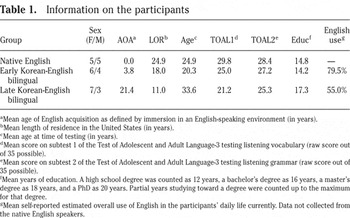
Information on the participants
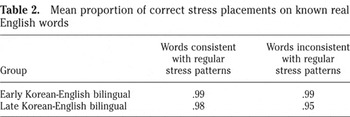
Mean proportion of correct stress placements on known real English words

Nonwords used in Experiments 1 and 2
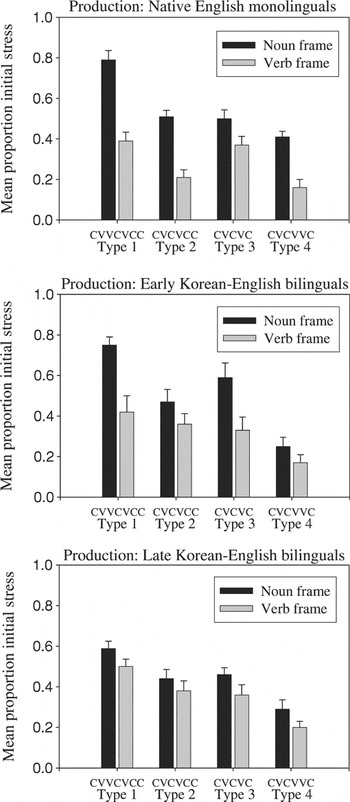
Mean proportion and standard error of initial stress productions for the three groups (n = 10). Four nonword types (10 items for each type) with different syllabic structures were produced in noun (black bar) and verb (gray bar) sentence frames.
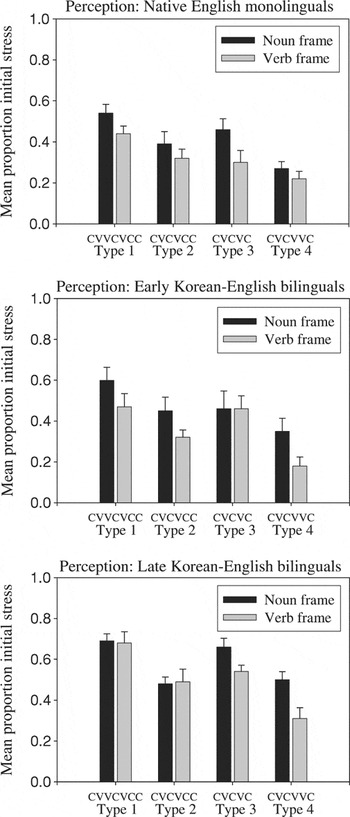
Mean proportion and standard error of initial stress preference for the three groups (n = 10). Four nonword types (10 items for each type) with different syllabic structures were presented in noun (black bar) and verb (gray bar) sentence frames.
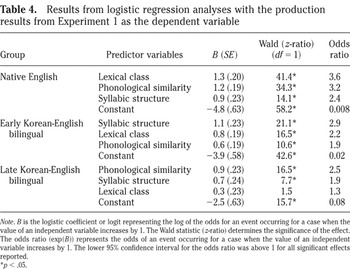
Results from logistic regression analyses with the production results from Experiment 1 as the dependent variable
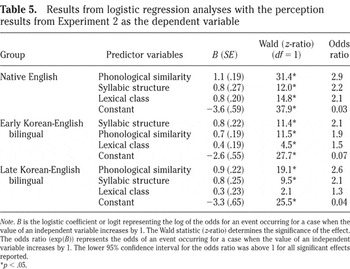
Results from logistic regression analyses with the perception results from Experiment 2 as the dependent variable
 You have
Access
- 46
- Cited by