




No CrossRef data available.
Article contents
LEARNING SECOND LANGUAGE SUPRASEGMENTALS: Effect of L2 Experience on Prosody and Fluency Characteristics of L2 Speech
Published online by Cambridge University Press: 10 February 2006
Abstract
This study examines effects of short, medium, and extended second language (L2) experience (3 months, 3 years, and 10 years of United States residence, respectively) on the production of five suprasegmentals (stress timing, peak alignment, speech rate, pause frequency, and pause duration) in six English declarative sentences by 30 adult Korean learners of English and 10 adult native English speakers. Acoustic analyses and listener judgments were used to determine how accurately the suprasegmentals were produced and to what extent they contributed to foreign accent. Results revealed that amount of experience influenced the production of one suprasegmental (stress timing), whereas adult learners' age at the time of first extensive exposure to the L2 (indexed as age of arrival in the United States) influenced the production of others (speech rate, pause frequency, pause duration). Moreover, it was found that suprasegmentals contributed to foreign accent at all levels of experience and that some suprasegmentals (pause duration, speech rate) were more likely to do so than others (stress timing, peak alignment). Overall, results revealed similarities between L2 segmental and suprasegmental learning.This research was partially supported by research grants from the University of Illinois and Brigham Young University. Many thanks are extended to Youngju Hong for her help in testing the Korean participants and to Molly Mack and James E. Flege for their advice throughout this research project. The authors gratefully acknowledge Randall Halter, Elizabeth Gatbonton, and five anonymous SSLA reviewers for their helpful suggestions on earlier drafts of this paper as well as Randall Halter for his invaluable statistical assistance.
Information
- Type
- Research Article
- Information
- Copyright
- © 2006 Cambridge University Press
Over the last several decades, speech perception and production research has been characterized by an increased interest in language prosody (defined as a combination of tonal, temporal, and dynamic features associated with such suprasegmental aspects of phonology as stress, rhythm, and intonation), particularly in describing prosodic systems in a variety of languages (e.g., Hirst & Di Cristo, 1998) and explaining their development in native language (L1) acquisition (e.g., Pierrehumbert, 2003). This research has not only yielded interesting insights into the grammatical, discoursal, and attitudinal functions of prosody in speech comprehension and production (Bolinger, 1989; Couper-Kuhlen & Selting, 1996; Cutler, Dahan, & van Donselaar, 1997) but has also revealed the contributions of prosody to the acquisition of both syntactic and lexicosemantic aspects of language (Christophe, Gout, Peperkamp, & Morgan, 2003; Christophe, Nespor, Guasti, & Van Ooyen, 2003).
Given the important role of prosody (hereafter, suprasegmentals) in language learning and use, the scarcity of research investigating second language (L2) acquisition of suprasegmentals is striking (see Chun, 2002, for review). Indeed, although suprasegmentals have been found to influence listener judgments of comprehensibility and accentedness of L2 speech (Anderson-Hsieh, Johnson, & Koehler, 1992; Munro & Derwing, 1995, 1998), revealing their importance in L2 learning and use, few studies have systematically examined how L2 suprasegmentals are learned or have identified what factors influence their learning (Grover, Jamieson, & Dobrovolsky, 1987; Lepetit, 1987), although some suprasegmentals (e.g., word stress) have been studied in greater detail than others (e.g., Guion, Harada, & Clark, 2004). In fact, no studies have to date investigated the effects of both short and extended L2 experience on adult learners' acquisition of L2 suprasegmentals and very few have focused on the acquisition of more than one suprasegmental (Munro, 1995). Thus, the objective of the present study was to offer a more comprehensive investigation of L2 suprasegmental learning than those given in previous studies. To attain this objective, the effect of short and extended L2 experience on the acquisition of five suprasegmentals was examined in the present study.
One approach to investigating L2 phonological learning—including the acquisition of L2 suprasegmentals—is to determine the role of learners' experience with, or exposure to, linguistic input, whether in a classroom-based or a naturalistic setting. However, most research that examines the role of experience in L2 phonological learning has focused on the acquisition of segmental speech phenomena residing at the level of individual phones (vowels and consonants), phonetic features, or syllables (e.g., Broselow, Chen, & Wang, 1998; Flege, Bohn, & Jang, 1997; Major & Faudree, 1996), not on the acquisition of suprasegmentals. In one study, for example, Flege, Bohn, et al. found that more experienced native Spanish, Mandarin, and Korean learners of English (those who had resided in the United States between 5.4 and 9.0 years) were more accurate at producing English

in bit and at identifying English

as members of the bat-bet continuum than were less experienced learners (those who had resided in the United States between 0.4 and 0.9 years). Similarly, Flege and MacKay (2004) reported that native Italian learners of English who often used their L1 perceived English vowels less accurately than learners who seldom used their L1, a finding that held regardless of the learners' age at the time of first extensive exposure to the L2 (Flege, Frieda, & Nozawa, 1997).
These and other studies that have explored the effect of linguistic experience (often defined as length of learners' residence in the target country or their self-estimated amount of L1 and L2 use) on the acquisition of L2 segmental accuracy have revealed the following two findings. First, a rapid improvement in L2 segmental accuracy, as measured in perception or production tests or in ratings of global foreign accent, occurs in the early stages of L2 learning, typically within the first months of L2 experience (Flege, 1988; Flege, Munro, & Skelton, 1992). Additional learning seems to require more extensive experience with or exposure to L2 input, often in excess of 7 years (Baker, Trofimovich, Mack, & Flege, 2001; Flege, Takagi, & Mann, 1995; Flege, Bohn, et al., 1997). For example, after an initial exposure to their L2, Japanese learners of English improve little in their production of English

during 1 year of L2 experience (Aoyama, Flege, Guion, Akahane-Yamada, & Yamada, 2004) and might, in fact, require an amount of experience in excess of 21 years to produce English

accurately (Flege et al., 1995). Second, experience-driven improvements in segmental accuracy are frequently noted for some L2 learners and for some subcomponents of the learners' phonetic system(s), with other aspects remaining impervious to L2 experience or use (Baker et al.; Bohn & Flege, 1990; Flege, Bohn, et al., 1997). For example, the more experienced learners of English in the Flege, Bohn, et al. study who improved in their production of English

in bit were no more accurate than the less experienced learners in their production of English

in beat, bat, and bet, respectively. Experience-driven learning thus appears to depend on the particular segmental aspect of L2 phonology studied, with some aspects susceptible to learning, whereas others are relatively impervious to it (see Best, 1995, and Flege, 1995, for discussion).
Does L2 suprasegmental learning resemble the acquisition of L2 segments? That is, can learners, with an increasing amount of L2 experience, produce L2 suprasegmentals like native speakers (NSs) of that language? Can they produce all or only some L2 suprasegmentals like NSs of that language? Existing research on the acquisition of L2 suprasegmentals does not offer a straightforward answer to these questions. This is surprising considering that research in the past few years has documented the fact that inaccurate production of L2 suprasegmentals might contribute more to foreign accent than inaccurate segmental production (Anderson-Hsieh et al., 1992; Koster & Koet, 1993; Munro, 1995), that nativelike use of suprasegmentals characterizes fluent L2 speech (Dechert & Raupach, 1987; Wennerstrom, 2000), and that explicit instruction focusing on suprasegmentals—more likely so than segmental training—might translate into nativelike spontaneous L2 speech (Derwing, Munro, & Wiebe, 1998).
Laboratory-based short-term training studies—particularly those employing technology—have provided some insights into the role of experience in L2 suprasegmental learning (Abberton & Fourcin, 1975; de Bot, 1980, 1981; James, 1976). For example, in one study, native Dutch learners of English improved in their production of L2 intonation after exposure to a 12-min tape illustrating the direction, range, speed, and place of English pitch change (t'Hart & Collier, 1975). This same procedure, paired with a visual presentation of intonation contours, was later found to promote L2 suprasegmental learning more effectively than perceptual (discrimination) training or delayed auditory feedback (de Bot, 1983; Lane & Schneider, 1963), resulting in significant improvements in native Dutch and French learners' ability to imitate English intonation (de Bot & Mailfert, 1982). More recently, similar beneficial findings were reported in laboratory studies that trained learners to produce L2 intonation (Hardison, 2004) and to discriminate novel rhythmic patterns (Bailey, Plunkett, & Scarpa, 1999). Although revealing about the nature of training (and hence learning), these studies do not indicate whether more extensive, naturalistic L2 experience evinces similar learning.
Unlike these training studies, investigations that have examined effects of experience on L2 suprasegmental learning in a naturalistic setting have yielded inconclusive results (e.g., Leather, 1987; Moyer, 1999). Some studies revealed positive effects of L2 experience, suggesting, for example, that at least some Chinese learners of French with 7–14 years of L2 experience were judged to produce French question intonation accurately 60–70% of the time (Shen, 1990). By contrast, other studies yielded null findings, revealing, for instance, that neither Japanese nor Canadian first-, second-, and third-year university learners of French differed in their production of French intonation contours (Lepetit, 1987). Yet other investigations indicated that learners in fact regress in their learning. For example, Grover et al. (1987) found that 10-year-old French immersion students produced the French continuative intonation natively, whereas 16-year-olds in the same program did not, sounding indistinguishable from their native English peers (see also Grosser, 1997).
This observed variability in learners' success in L2 suprasegmental learning might be attributed to two sources. First, most previous investigations of L2 suprasegmental learning examined effects of relatively short or medium experience (between several months and about 5 years of L2 experience) on learners' perception and production of L2 suprasegmentals. If the relationship between the amount of experience and L2 phonological learning is not linear (Aoyama et al., 2004; Flege, 1988; Flege et al., 1995), which suggests that marked improvements in L2 suprasegmental accuracy are unlikely within the first few years of L2 experience, then it is important to investigate L2 suprasegmental learning at several stages of learning: those characterized by short, medium, and extended amounts of L2 experience. Second, most previous investigations of L2 suprasegmental learning examined the acquisition of only one suprasegmental at a time (see, however, Munro, 1995). If L2 suprasegmental learning is similar to L2 segmental learning in that its success depends on the particular suprasegmental aspect of L2 phonology studied, then it is important to investigate the acquisition of more than one suprasegmental by the same learners. Examining the acquisition of several suprasegmentals by the same learners might help explain the inconclusive results of the previous investigations of L2 suprasegmental learning (Grover et al., 1987; Lepetit, 1987). The present study addresses both of these objectives in an investigation of L2 suprasegmental learning that examines the effects of short, medium, and extended L2 experience on adult acquisition of five different suprasegmentals.
With an overall goal of examining whether L2 phonological learning is similar at the segmental and suprasegmental levels, the present study addresses two questions: (a) Does the amount of L2 learners' experience influence their production of L2 suprasegmentals? and (b) If so, which suprasegmentals are likely to be influenced by their amount of L2 experience? To answer these questions, adult native Korean learners of English who differed in their amount of L2 experience and English NSs were asked to produce six English declarative sentences. Three analyses were performed. The first analysis attempts to determine if suprasegmentals pose a problem for the learners—contributing to a foreign accent in their speech at each level of L2 experience—and if nativelike production of suprasegmentals was attainable after a short, medium, or extended amount of L2 experience. The second analysis examines in detail the learners' production of five English suprasegmentals (stress timing, tonal peak alignment, speech rate, pause frequency, and pause duration) at each level of L2 experience. Two of the examined suprasegmentals (stress timing, tonal peak alignment) characterize speech melody, whereas the remaining three (speech rate, pause frequency, duration) characterize speech fluency. These suprasegmentals are discussed in detail in the following sections. The final analysis investigates the relative contribution of each of the five suprasegmentals to a foreign accent in the learners' speech. Taken together, the analyses seek to clarify how experience influences L2 suprasegmental learning.
THE CURRENT STUDY
Participants
There were 40 participants in this study (n = 10 per group). Thirty were native Korean learners of English assigned to one of three groups based on their length of United States residence. The first group—the “inexperienced” learners—had arrived in the United States at a mean age of 29 (24–33 years) and had resided in the United States for about 3 months (1–5 months). The second group—the “moderately experienced” learners—had arrived in the United States at a mean age of 24 (18–30 years), resided in the United States for about 3 years (2.1–3.6 years), and were, on average, 27 years of age (22–33 years). The third group—the “experienced” learners—had arrived in the United States at a mean age of 21 (18–25 years), resided in the United States for about 10 years (7–15 years), and were, on average, 32 years of age (28–36 years). Ten English adult monolinguals—the English speaker group—with an average age of 26 years, also participated for comparison purposes. Although all participants were adults, the inexperienced learners were slightly older than both the moderately experienced and the experienced learners at the time of their arrival in the United States, F(2, 27) = 15.87, p < .001. The experienced learners were also slightly older than both the moderately experienced learners and the English speakers at the time of testing, F(3, 36) = 6.57, p < .01. These analyses thus confirmed that learners' length of residence (LOR) in the United States and their age at the time of arrival (AOA) in the United States were confounded in this study (Hakuta, Bialystok, & Wiley, 2003; Stevens, 2004). The implications of this are discussed for each analysis conducted. (See Table 1 for a summary of pertinent information about the participants.)
Means and standard deviations (in parentheses) for participant variables

At the time of testing, all participants were attending an American university, which suggests that they used English often; all had been exposed only to the American variety of English. Because years of United States residence is an adequate measure of L2 experience only if learners speak the L2 often (Flege & Liu, 2001), the participants were asked to estimate their daily use of English overall as well as in a number of situations (at home, at school, in interactions with friends). Comparisons of these self-ratings indicated that the group of inexperienced learners overall used English less often daily than the group of experienced learners, F(2, 27) = 4.98, p < .025, but that the three groups did not differ in their self-ratings of their daily use of English at home (22% on average), at school (80% on average), and in interactions with friends (36% on average). This suggested that the participants used English in the United States to a similar degree (at least 80% of the time at school) and in similar situations.
The participants were asked to rate their proficiency in English and Korean on a 10-point scale (1 = “I don't know any English/Korean,” 10 = “I am a native speaker of English/Korean”). All participants estimated their proficiency in Korean at the NS level but differed in their English proficiency; the experienced learners rated themselves as more proficient than the moderately experienced learners, and the moderately experienced learners rated themselves as more proficient than the inexperienced learners, F(3, 36) = 119.91, p < .001. The English speakers estimated their English proficiency at the NS level and, consequently, higher than all learner groups' English self-ratings (Table 1).
Materials and Procedure
The materials included six English declarative sentences elicited as responses to question prompts (Table 2). The participants produced the sentences in a delayed sentence-repetition task in which they heard and repeated each of the 6 target sentences as well as 12 distracter sentences. The sentences were presented in three randomized blocks, but only the sentences spoken in the last block were used in the analyses to ensure that the participants were familiar with the task and could repeat each sentence to the best of their ability. The analyses were based on 240 sentences (4 groups × 10 speakers × 6 sentences). All audio recordings were made using a Shure head-mounted microphone (SM10A) and Sony DAT tape recorder (TCD-D8). The recorded sentences selected for analysis were digitized and normalized for peak intensity and perceived loudness.
Stimulus sentences used in a delayed-sentence repetition task

The participants were tested individually in a quiet location using a personal computer and stimulus presentation software (Smith, 1997). The participants first heard a question (prompt) spoken by a male NS of English; the prompt was followed by a response spoken by a female NS of English. Then the participants listened to the prompt again and repeated the response they had heard. For example, to elicit the sentence “Your bed is by the window,” the prompt-response sequence in (1) was used.

Used in both L1 (e.g., Ratner, 2000) and L2 (e.g., Guion, Flege, Liu, & Yeni-Komshian, 2000) acquisition research, the delayed sentence-repetition task allows for the elicitation of fluent speech while avoiding reading as part of the task. Although other common elicitation tasks used in suprasegmental analyses (e.g., reading sentences from cue cards or the computer screen [Ladd, Faulkner, Faulkner, & Schepman, 1999] or describing pictures or telling a simple story [Moyer, 1999]) are indeed more ecologically valid because they provide speech samples that are representative of natural speech (see Face, 2003, for a comparison of suprasegmentals in lab vs. spontaneous speech), the delayed sentence-repetition task was deemed appropriate for the present study. This task elicited relatively fluent speech samples that were identical and therefore maximally comparable across all the participants (thus allowing for direct comparisons of speech samples across participant groups, which would not have been possible in a picture-description task), and that did not require the participants to read (thus removing the participants' reading ability as a potential confounding factor, which would have been present in a reading task). Although repetition tasks often involve the limitation that participants might mimic both the segmental and the suprasegmental content of the utterance, the likelihood of the participants' direct mimicry in the delayed sentence-repetition task employed here was minimized by the delay between the prompt and the participants' repetition of it (3–5 s).1
Despite its potential limitations, the delayed sentence-repetition task used in the present study elicited the suprasegmental data that differed across the participant groups in several nontrivial ways (see the Results section). Admittedly, using a more naturalistic task to elicit suprasegmental data might have shown greater between-group differences, particularly between the NS and the inexperienced learner groups; this warrants replication of the present study using other, more ecologically valid speech elicitation procedures.
DATA ANALYSIS
Three analyses were performed. The first analysis examined the extent to which the learners were able to produce L2 suprasegmentals accurately, as measured by global foreign-accentedness ratings. In this analysis, the sentences spoken by the participants were presented to native English listeners for accentedness rating. These judgments were then compared across the three groups of learners and the English speaker group. The second analysis examined the extent to which the learners were able to accurately produce specific suprasegmentals: stress timing, peak alignment, speech rate, pause length, and pause frequency. The acoustic measurements obtained were compared across the three learner groups and the group of English speakers. The final analysis extended the findings of the first two by using a multiple regression procedure to investigate the degree to which the learners' production of specific suprasegmentals contributed to native listeners' judgments of foreign accentedness in the learners' speech.
Ratings of Foreign Accent
Method.
The first objective of the present study was to test the hypothesis that the experienced learners were more likely than the inexperienced and the moderately experienced learners to accurately produce L2 suprasegmentals. To address this objective, the recorded sentences were first low-pass filtered to remove all energy components of the speech signal above 450 Hz, thus preserving suprasegmentals—in other words, the acoustic correlates of stress, rhythm, and intonation—while removing most of the segmental content. The low-pass-filtered sentences sounded muffled, as if spoken in an adjacent room, just out of earshot (Munro, 1995). Then the sentences were presented to a group of 10 native English listeners for accentedness judgment. Low-pass filtering ensured that the listeners based their accent judgments on the suprasegmental and not on the segmental content of the sentences. Although this procedure might not seem ecologically valid and might not yield results generalizable to a variety of natural and other laboratory-based settings, low-pass filtering has been used successfully in rating L2 learner speech (Lane, 1963; Munro, 1995; Van Els & de Bot, 1987).
The English listeners were, on average, 22 years of age (19–25 years) and had no experience with a foreign language other than regular L2 classes. The low-pass-filtered sentences spoken by the 40 participants were presented to the listeners in six randomized blocks; each block contained all of the participants' renditions of the same sentence. The listeners were told which sentence the participants were attempting to say so that the listeners could compare what they heard to their expectations of what the sentence should sound like. As the listeners heard each sentence played over loudspeakers positioned in front of them, they rated the degree of foreign accentedness on a 9-point scale (1 = “strong foreign accent,” 9 = “no foreign accent”). The listeners were encouraged to use the entire scale and to guess if they were unsure. They were allowed to listen to each sentence as many times as they wished but were not permitted to change their responses after they had been recorded. The dependent variable in this analysis was the mean foreign-accentedness rating calculated by averaging the 10 English listeners' ratings for the six sentences produced by each of the 40 participants. Interrater reliability analyses comparing the 10 English listeners' ratings for each sentence yielded moderate to very high average indices (α range: .62–.94), which suggests that the listeners were consistent in their judgments.
Results.
The obtained foreign-accentedness ratings were submitted to a one-way ANOVA that compared the accentedness ratings of the three learner groups and the English speaker group. This analysis revealed a significant group effect, F(3, 36) = 30.08, p < .0001. Tukey post hoc tests (p < .05) further revealed that all three groups of L2 learners received significantly lower accentedness ratings than the English speakers and that the group of inexperienced learners received significantly lower accentedness ratings than the two more experienced (moderately experienced and experienced) learner groups (Figure 1). To determine if the learners' LOR had an effect on accentedness ratings that was independent of the effect of learners' AOA—an effect that was suggested by the one-way ANOVA—a first-order partial correlation was computed between the learners' accentedness ratings (n = 30) and LOR (the variable of principal interest here), with AOA (the variable confounded with LOR) partialled out.2
As suggested by an anonymous reviewer, an alternative approach to help control the effects of the confounding variable AOA might have been an analysis of covariance (ANCOVA) instead of ANOVA. However, because the value of AOA for the group of English NSs was effectively 0 years, it would have been impossible to meet the ANCOVA assumption of homogeneity of regression slopes.

Group means for foreign accentedness ratings (± 1 SE) for inexperienced (Inexp.), moderately experienced (Mod. exp.), and experienced (Exp.) learners and native English speakers (E. speakers).
The preceding analyses indicate that the learners differed in their ability to produce L2 suprasegmentals in a nativelike manner; that is, those learners with a 3-month LOR scored lower on the accent judgment scale than those with a 3- and a 10-year LOR, and all learners, including the learners with a 10-year LOR, produced the English sentences with a foreign accent. This finding suggests that at least some degree of foreign accent in learners' speech resides at the level of suprasegmentals and that, even with substantial L2 experience, at least some suprasegmentals were not produced with nativelike accuracy. The next analyses sought to identify which specific suprasegmentals contributed to foreign accent in the learners' speech and to determine the extent to which they did so.
Acoustic Analyses
Five specific suprasegmentals that might have contributed to foreign accent in the learners' speech were examined in the acoustic analyses: stress timing, peak alignment, speech rate, pause frequency, and pause duration. These aspects characterize the general flow of speech and represent potential sources of difficulty for L2 learners of English, likely contributing to foreign accent (Cenoz, 2000; Mennen, 1998; Munro, 1995; Towell, 2002). These suprasegmentals were acoustically analyzed in the 240 recorded sentences and were compared across the four participant groups. The goal of these analyses was to determine which of the five suprasegmentals might have contributed to the differences in foreign accent shown in the preceding analysis across the three learner and one NS groups. In other words, the focus of the following analyses was to examine how accurately the inexperienced, moderately experienced, and experienced learners were able to produce each of these five suprasegmentals. These analyses are presented in turn, preceded by a brief description of relevant research on each suprasegmental and a description of the methodology used.
Stress Timing.
As a stress-timed language, English has a rhythm characterized by alternations in degree of stress, with stressed syllables significantly longer than unstressed ones and most vowels in unstressed syllables reducing to a schwa (Bolinger, 1965). By contrast, as a syllable-timed language, Korean does not exhibit alternations in degree of stress and has syllables that are approximately the same in duration (de Jong, 1994; Jun, 1996; Lim, 2001). Even though the distinction between syllable- and stress-timed languages has been debated (Dauer, 1983), it is still generally considered that most languages of the world fall somewhere along the syllable- and stress-timed continuum (Ramus, Nespor, & Mehler, 1999).
Learners' difficulty in acquiring L2 stress timing (i.e., variation in stress and in degree of vowel reduction from syllable to syllable) has been documented both for NSs of syllable-timed languages (e.g., Spanish) acquiring stress-timed English (Gutiérrez-Díez, 2001) and for NSs of stress-timed languages (e.g., English) acquiring syllable-timed French (Freland-Ricard, 1996) or Portuguese (Ciancio, 2001). For example, relatively advanced Spanish learners of English produced English with a syllable-duration ratio (duration ratio of unstressed to stressed syllables) that was intermediate between those obtained for speakers of Spanish and English in their L1 (Gutiérrez-Díez), which suggests that learning L2 stress timing might pose a problem for L2 learners.
Method.
The following analysis examined the syllable-duration ratios in the 240 recorded sentences to determine if English stress timing posed a problem for the learners in this study and if they were able to produce L2 stress timing (near) natively with an increasing amount of L2 experience. The duration of stressed and unstressed syllables was measured from the display of digital speech-analysis software (Praat) between two cursors placed at the onset and offset of voicing in each syllable, which included the length of all consonants and vowels (see Deterding, 2001, for a description of this procedure). The syllables were designated as either stressed or unstressed using two methods. First, English stress placement as described in published sources (e.g., Couper-Kuhlen, 1986, p. 39) was examined. This analysis yielded the generalizations that primary stress is assigned to the “rightmost primary-stressed vowel of major constituents” (content words) and that polysyllabic content words retain word-level stress-placement patterns. Then an acoustic analysis of the sentences produced by the group of NSs of English was conducted. This analysis revealed that all of the syllables designated as stressed—as predicted by the published sources—were indeed characterized by greater intensity, longer duration, and higher pitch than the syllables designated as unstressed. (See Table 2 for stressed and unstressed syllables used in this analysis.)
The obtained stressed versus unstressed syllable durations were averaged for each participant across the six declarative sentences and a single ratio of unstressed to stressed syllables, which was used as the dependent variable in this analysis, was computed for each participant. If the learners used English-like stress timing, the ratio of unstressed to stressed syllables should be lower (e.g., closer to .5, the actual average ratio obtained for the 10 NSs of English in the present study) because unstressed syllables are shorter than stressed ones in nativelike English syllable-to-syllable stress alternations (Bolinger, 1965; Nakatani, O'Connor, & Aston, 1981). If the learners used Korean-like syllable timing, the ratio should be higher (closer to 1) because unstressed and stressed syllables are roughly equal in duration.
Results.
The ratios obtained for each learner were submitted to a one-way ANOVA comparing the three learner groups and the group of English speakers. This analysis revealed a significant group effect, F(3, 36) = 11.13, p < .001, and Tukey tests (p < .05) further revealed that the inexperienced and the moderately experienced learners, but not the experienced learners, differed significantly from the English speakers in their ratio of unstressed/stressed syllables. Thus, learners with more L2 experience were better able than learners with less L2 experience to produce English stress timing like NSs of English (i.e., with lower syllable-duration ratios; see Figure 2). As in the previous analysis, to ascertain that LOR had an effect on the learners' syllable-duration ratios that was independent of the AOA effect, a first-order partial correlation was computed between the learners' ratios (n = 30) and LOR, with AOA partialled out. This analysis yielded a significant correlation between LOR and syllable-duration ratios after AOA was partialled out, r(27) = −.53, p < .01. However, the correlation between syllable-duration ratios and AOA remained nonsignificant after LOR was partialled out, r(27) = −.13, p = .52. These analyses indicate that the learners' ability to produce English sentences with English-like stress timing was related to the learners' amount of L2 experience.

Group means for syllable duration ratios (± 1 SE) for inexperienced (Inexp.), moderately experienced (Mod. exp.), and experienced (Exp.) learners and native English speakers (E. speakers).
Peak Alignment.
Another suprasegmental examined in this study was peak alignment (i.e., the location of the highest value [peak] of pitch [or of its acoustic correlate, fundamental frequency] relative to the accented syllable in an intonation phrase). Along with the shape of pitch peak and the size of pitch movement, peak alignment defines a prosodic unit of a particular language and, by extension, characterizes its rhythm (Botinis, Granström, & Möbius, 2001). Several studies have documented that languages differ considerably in their use of pitch rises and falls to indicate emphasis, emotion, or syntactic information (Cutler et al., 1997; Lepetit, 1987; Van Els & de Bot, 1987). In English, for example, pitch peak often corresponds to a high-value tonal accent associated with a prominent syllable, usually in the most prominent word in an intonation phrase (see Pierrehumbert, 1980, for a comprehensive review). Thus, in English, pitch peak is lexical and is, therefore, specific to a particular word—often the last content word in an intonation phrase (i.e., the most important word given the pragmatics of the utterance). As such, pitch peak is usually aligned with the onset (beginning) of the stressed syllable (Ladd, Mennen, & Schepman, 2000). In Korean, however, variations in pitch prominence are most likely used not for the purpose of accent or prominent-syllable marking but for the purposes of marking the boundary of an accentual phrase (a tonally demarcated unit containing more than one lexical item; Pierrehumbert). Thus, in Korean, pitch peak is phrasal and is, therefore, not specific to a particular word (Jun, 1998; Lim, 2001); that is, pitch peak is usually aligned with the offset (end) of the syllable, occurring on the last word in an accentual phrase as a marker of its boundary (de Jong, 1994; Kim & Kim, 2001). In summary, English and Korean differ in their use of pitch accent (the former uses pitch peaks for signaling syllable prominence and the latter uses it for marking a phrase boundary) but seem to diverge less in the location of pitch accent placement (pitch peak often occurs on the last word in a phrase, aligned with the onset of the syllable in English and with its offset in Korean).
To date, only one study has specifically investigated peak alignment in L2 learners' speech. Examining peak alignment in Greek sentences spoken by native Dutch speakers, Mennen (1998) reported that even after an extensive amount of experience with Greek (12–35 years), Dutch speakers did not “reach native-like values for this aspect of intonation” (p. 337), suggesting that peak alignment might be difficult to master. This difficulty in learning to place pitch accent in a nativelike manner might be attributed to several causes. First, learners are not always implicitly or explicitly aware of the uses of pitch (Pennington & Ellis, 2000) and frequently do not distinguish them in perception and production (Grover et al., 1987). Second, NSs often display variability in their pitch-accent placement (Silverman & Pierrehumbert, 1990), making it difficult for learners to determine nativelike patterns of pitch-accent placement. Finally, sentences with pitch-accent displacement (e.g., as spoken by Korean learners [Kim & Kim, 2001]) might not dramatically affect the comprehensibility or intelligibility of learners' speech (Munro & Derwing, 1995) and therefore might not be subject to either explicit or implicit corrective feedback that leads to learning.
Method.
The following analysis examined peak alignment in the 240 recorded sentences to determine if English peak alignment posed a problem for the learners in this study and if, with an increasing amount of L2 experience, they were able to produce L2 peak alignment (near) natively. First, pitch contours in the six English sentences were examined for each participant using digital speech-analysis software in order to identify pitch peaks. Next, sentence-final pitch peaks were excluded from those identified because learners are less likely to displace pitch peaks in sentence-final and prepausal contexts (i.e., in situations where no segments follow the stressed syllable and where English pitch peak is possibly identical to Korean pitch peak). Finally, peak alignment was calculated for the remaining pitch peaks (see Table 2 for syllables used in these calculations). The location of peak alignment was defined as the distance (in milliseconds) between the onset of the vowel in the stressed syllable and the point in the pitch contour with the highest value of fundamental frequency (Ladd et al., 2000; Mennen, 1998). The obtained peak-alignment values were averaged for each participant across the six declarative sentences, yielding the dependent variable in this analysis. If the L2 learners used English-like peak alignment, then pitch peak should be aligned with the onset of the vowel of the stressed syllable (i.e., the peak-alignment value should be close to 0). If the L2 learners used Korean-like placement, then the peak should be aligned with the offset of the stressed syllable (i.e., the peak-alignment value should be larger than 0).
Results.
The peak-alignment values for each learner were submitted to a one-way ANOVA that compared the values for the three learner groups and the group of English speakers. This analysis revealed a significant group effect, F(3, 36) = 3.71, p < .025, and Tukey tests further revealed that all learner groups had peak-alignment values that were significantly different from those of the English speakers and that the three learner groups did not differ from one another (Figure 3). A first-order partial correlation computed between the learners' peak-alignment values (n = 30) and LOR yielded a nonsignificant correlation after AOA was partialled out, r(27) = −.19, p = .33. The correlation between the learners' peak-alignment values and AOA was also nonsignificant after LOR was partialled out, r(27) = −.13, p = .51. Both of these analyses suggest that neither the amount of L2 experience nor age of arrival seemed to predict accuracy in pitch peak location.

Group means for peak alignment (± 1 SE) for inexperienced (Inexp.), moderately experienced (Mod. exp.), and experienced (Exp.) learners and native English speakers (E. speakers).
Speech Rate.
Speech rate is one of the most studied suprasegmentals (e.g., Derwing, 1990; Griffiths, 1991). Previous research on L2 speech rate has yielded a common finding that learners often produce L2 speech at a slower rate than do NSs (Lennon, 1990; Munro & Derwing, 1995, 1998), perhaps because of constraints related to the processing, encoding, and retrieval of phonological information, or because of difficulties in articulation of L2 speech, or both (Munro & Derwing, 1995, 2001). Slow speech rate is often seen as an impediment to comprehensibility and perhaps intelligibility (Munro & Derwing, 1998, 2001), as a sign of nonnativeness (Anderson-Hsieh & Koehler, 1988), and even as a source of stereotypes and evaluative judgments (Zuengler, 1988) and frustration with nonnative speech (Brennan & Brennan, 1981). Munro and Derwing (1995, 1998, 2001) described an optimal rate for nonnative speech—neither too slow nor too fast—a rate that evinces lower accentedness and higher comprehensibility ratings even when the number of segmental and suprasegmental errors is held constant. Although several studies have established that L2 learners' ability to produce L2 speech at a nativelike rate depends on such factors as learners' age at the time of L2 learning (Guion et al., 2000) or learners' language background (Derwing & Munro, 1997), little research has investigated how the amount of L2 experience influences L2 speech rate (Towell, 2002; Towell, Hawkins, & Bazergui, 1996).
Method.
The following analysis examined speech rate in the 240 recorded sentences to determine if speech rate posed a problem for the learners in this study and if they were able to produce L2 sentences at a (near) native speech rate with an increasing amount of L2 experience. Following previous investigations of speech rate (Munro, 1995; Towell et al., 1996), speech rate in this study was measured by dividing the number of uttered syllables by their total duration (i.e., total length of utterance, including pauses). The obtained speech-rate ratio (syllable/s), averaged for each participant across the six sentences, was the dependent variable in this analysis. If the L2 learners produced the sentences at a nativelike rate, then their speech-rate ratio should be similar to that obtained for the English speakers.
Results.
The speech-rate ratios were submitted to a one-way ANOVA comparing the three learner groups and the group of English speakers. This analysis revealed a significant group effect, F(3, 36) = 19.59, p < .0001, and Tukey post hoc tests further revealed that all groups of L2 learners had speech-rate ratios that were significantly different from those of the English speakers and that speech-rate ratios did not differ among the three learner groups (Figure 4); that is, regardless of the length of their residence in the United States, the learners produced English sentences at a slower rate than did the English speakers. A first-order partial correlation computed between the learners' speech-rate ratios (n = 30) and LOR yielded a nonsignificant correlation after AOA was partialled out, r(27) = −.23, p = .23. More important, however, the correlation between the learners' speech-rate ratios and AOA remained significant after LOR was partialled out, r(27) = −.50, p < .01. Overall, these analyses indicate that the learners' ability to produce English sentences at a (near) native rate did not seem to depend on the amount of learners' L2 experience (indexed as LOR) but was related to the age at which they were exposed to English in the United States, a finding that parallels that reported by Guion et al. (2000).

Group means for speech rate (± 1 SE) for inexperienced (Inexp.), moderately experienced (Mod. exp.), and experienced (Exp.) learners and native English speakers (E. speakers).
Pause Frequency and Duration.
Another suprasegmental that is most likely related to degree of foreign accent is pausing. Pausological research has determined that both pause duration and pause frequency affect listeners' ratings of foreign accent in L2 speech, and that both are often viewed as determinants of both fluency and intelligibility (Albrechtsen, Henriksen, & Faerch, 1980; Cenoz, 2000). Pauses, like speech rate, might indicate the speaker's difficulty with the task, perhaps reflecting processing or memory constraints unique to L2 speech (Schachter, Christenfeld, Ravina, & Bilous, 1991). Learners also commonly pause more in their L2 than in their L1 (Riazantseva, 2001), regardless of cross-language and cross-cultural differences in pause frequency and pause duration (Grosjean & Deschamps, 1975; Holmes, 1995). Although the contribution of pause frequency and duration to determining fluency of speech is well attested, it is not well understood how speech fluency (as measured by frequency and duration of pauses) develops as a function of L2 experience. Although some studies have revealed that, with an increasing amount of L2 experience, pause frequency and pause duration might moderately decrease in learners' speech (Lennon, 1990), other studies have found no changes in pause duration after 3 years of a college foreign language program (Towell, 2002) or even after 6 months of study-abroad experience (Towell et al., 1996). Still other studies have suggested that both frequency and length of silent pauses in reading might increase with learners' L2 proficiency (Kowal, O'Connell, & Sabin, 1975).
Method.
The following analysis examined pause duration and frequency in the 240 recorded sentences to determine if pausing posed a problem for the learners examined in this study and if, with an increasing amount of L2 experience, they were able to produce L2 sentences fluently (i.e., without frequent and long pauses). Pauses were defined as any break in the speech stream longer than 100 ms in length, a measure commonly used in pausological research (see Riazantseva, 2001, for review). Pause frequency was calculated by averaging the number of pauses for each participant across the six sentences; pause duration was computed by averaging pause durations for each participant across the six sentences. If the L2 learners produced the sentences in a nativelike manner, then their pausing (as measured by pause frequency and duration) should not be different from the native English speakers' pausing.
Results.
The frequency and duration of pauses were submitted to one-way ANOVAs comparing the three learner groups and the group of English speakers. The analyses of pause frequency and pause duration revealed significant group effects: F(3, 36) = 4.13, p < .025 and F(3, 36) = 5.24, p < .005, respectively. Tukey tests further revealed that only the least experienced L2 learners (those with about 3 months of United States residence) produced English sentences with pauses that were significantly higher in frequency and longer in duration than the pauses produced by the NSs of English (Figures 5 and 6); that is, the more experienced learners—those with 3 years of residence in the United States or more—appeared to be better able than the less experienced learners to produce English sentences like NSs of English. To determine if LOR indeed had an effect on learners' pause frequency and pause duration that was independent of the AOA effect, first-order partial correlations were computed between these fluency indexes (n = 30) and LOR, with AOA partialled out. These analyses yielded no significant correlations, rs(27) < .12, ps = .52. More important, however, the correlations between both pause frequency and pause duration and AOA remained significant after LOR was partialled out, rs(27) > .42, ps < .025. Overall, these analyses indicate that the learners' ability to produce English sentences with (near) native fluency appeared to depend little on the amount of learners' L2 experience (indexed here as LOR) but was related to the age at which they were exposed to English in the United States (cf. O'Connell & Kowal, 1972; Olynyk, D'Anglejan, & Sankoff, 1987).

Group means for number of pauses (± 1 SE) for inexperienced (Inexp.), moderately experienced (Mod. exp.), and experienced (Exp.) learners and native English speakers (E. speakers).

Group means for duration of pauses (± 1 SE) for inexperienced (Inexp.), moderately experienced (Mod. exp.), and experienced (Exp.) learners and native English speakers (E. speakers).
In summary, the results of the preceding five analyses reveal that the learners' production of only one suprasegmental (stress timing) was related to their amount of L2 experience. The learners' production of three other suprasegmentals (speech rate, pause frequency, pause duration) seemed to be related to their age at the time of L2 learning. The learners' production of one other suprasegmental (peak alignment) appeared to bear no relationship to either learners' amount of L2 experience or their age at the time of L2 learning.
Relationship Between Suprasegmental Accuracy and Foreign Accent
Although the previous analyses established that the learning of at least some L2 suprasegmentals is related to the amount of learners' L2 experience (indexed here as years of residence in the United States), these analyses did not indicate the relative importance of these suprasegmentals to the listeners' perception of foreign accent in L2 learners' speech. Thus, the following question was addressed in the final analysis: What is the degree to which the specific L2 suprasegmentals such as those examined in this study contribute to foreign accent in L2 learners' speech? To answer this question, the learners' accentedness ratings and their accuracy scores for the five suprasegmentals focused on here were submitted to correlation and regression analyses. First, zero-order correlations were computed between the learners' accentedness ratings (n = 30) and their suprasegmental accuracy scores (syllable-duration ratios, peak-alignment values, speech rate ratios, frequency and duration of pauses). This analysis indicated that each of the suprasegmental accuracy scores (with the exception of peak-alignment scores) significantly correlated with the participants' accentedness ratings (Table 3) and with each other, which suggests that there was a strong and complex relationship between the participants' accuracy in producing specific suprasegmentals and the degree to which their speech was perceived as being accented.
Summary of correlation analyses between foreign-accentedness ratings and acoustic measurements

To estimate unique contributions of each suprsegmental to predicting accentedness ratings, the data were next submitted to stepwise multiple regression. The accentedness rating was used as the criterion measure, and the same suprasegmental accuracy scores were entered separately as predictors, in decreasing order of their correlation with the criterion variable (entry criterion: p ≤ .05). Only duration of pauses and speech rate appeared to have significantly predicted accentedness ratings: R2 change for duration of pauses accounted for about 37% and R2 change for speech rate accounted for an additional 9% unique variance of accentedness ratings (Table 4). Overall, these findings suggest that the listener judgments of low-pass-filtered speech might have reflected fluency-based characteristics of L2 speech, indexed in this study by measurements of speech rate and duration of pauses.
Summary of stepwise multiple regression analyses for acoustic measurements as predictors of foreign-accentedness ratings

GENERAL DISCUSSION
Situated within the context of L2 suprasegmental learning, the present study sought to offer a more comprehensive investigation of L2 suprasegmental learning than those done in previous studies by examining the effect of short, medium, and extended amounts of L2 experience on the acquisition of five English suprasegmentals (stress timing, peak alignment, speech rate, pause frequency, and pause duration) by 30 Korean learners of English. Results revealed three specific findings. First, results of the first analysis demonstrated that the learners' (nonnative) production of L2 suprasegmentals rendered their L2 speech accented at all levels of experience examined (3 months, 3 years, and 10 years of residence in the United States), which suggests that suprasegmentals presented a learning challenge for these learners regardless of their amount of L2 experience. Second, subsequent analyses of individual suprasegmentals suggested that the learners' ability to produce some suprasegmentals (stress timing) was related to the amount of their L2 experience or exposure, whereas their ability to produce others (speech rate, pause duration, and pause frequency) was related more to their age at the time of first extensive exposure to the L2. Third, results of the final analysis revealed that fluency-based characteristics of the learners' L2 speech (duration of pauses, speech rate), more so than its melody-based characteristics (stress timing, peak alignment), were associated with the degree to which the learners' speech was perceived as accented, at least in the context of rating low-pass-filtered speech for foreign accent. These findings provided insights into the nature of L2 suprasegmental learning and the factors influencing it, thereby revealing similarities between L2 segmental and suprasegmental learning.
The results of the present study offer two broad conclusions regarding the nature of L2 suprasegmental learning: First, both L2 segmental and L2 suprasegmental learning appear to be gradual and, second, suprasegmental learning varies according to the suprasegmental studied. The first conclusion is that the acquisition of L2 suprasegmentals is akin to L2 segmental learning in that both likely represent a gradual learning process that often requires extended amounts of experience with, or exposure to, the L2. Some aspects of fluent L2 speech (e.g., those characterized by infrequent and short pauses) might be learned early in this process, other aspects of nativelike L2 speech (e.g., those characterized by syllable-to-syllable stress alternations) might require several years of L2 exposure, whereas still others (e.g., speech rate or nativelike placement of tonal peaks) might in fact not be learned to nativelike accuracy, even with a decade of L2 experience. These findings extend and clarify the results of previous investigations of suprasegmental learning, both in controlled (laboratory) and naturalistic settings (e.g., de Bot & Mailfert, 1982; Grosser, 1997; Hardison, 2004; Lepetit, 1987). Although initial learning gains in L2 suprasegmental learning might be attributed to effects of short-term exposure (e.g., de Bot & Mailfert), nativelike production of certain suprasegmentals might require years of practice, experience that is perhaps more extensive and intensive than that available in 2–3 years of classroom language training (e.g., Lepetit).
More important, these findings emphasize that the exact nature of L2 experience—whether defined as length of residence in the target country, amount of contact with the L2, or frequency of L2 use—might crucially determine both the success and rate of L2 suprasegmental learning. For example, the learners in this study were able to produce L2 sentences with nativelike fluency (with infrequent and short pauses) after 3 years of L2 experience, whereas British learners of French were unable to do so within 3 years of a university foreign-language program (Towell, 2002) or even after 6 months of study-abroad experience (Towell et al., 1996). Similarly, Spanish learners of English in their last year of university studies in English philology (Gutiérrez-Díez, 2001) did not produce English stress timing natively, whereas the learners in this study did so within at least 10 years of their L2 experience. Although the methodologies used in these studies (as well as languages studied and learner populations tested) differ greatly, making comparisons between them difficult, these findings underscore both salient and subtle differences in these and other learners' L2 experience. These differences include, but are not limited to, the nature and type of L2 input (Jia & Aaronson, 2003), amount and extent of L2 practice (Flege & Liu, 2001), and perhaps even degree of affiliation to the L2 ethnic group (Gatbonton, Trofimovich, & Magid, 2005). Understanding such differences (e.g., by comparing L2 suprasegmental learning in a naturalistic setting, such as in this study, and that occurring under more intensive or controlled circumstances, such as in study abroad programs) not only will shed light on the relationship between L2 experience and suprasegmental learning but also will clarify what the term L2 experience means and how much of it is requisite for learning different aspects of a L2 phonology, both segmental and suprasegmental.
The other broad conclusion prompted by the results of the present study is that L2 suprasegmental learning depends on the particular suprasegmental aspect of L2 phonology studied. In other words, experience effects were most evident in the present study for those suprasegmentals that characterize speech melody (stress timing) as opposed to those that describe speech fluency (speech rate, pause frequency, and pause duration). Possible reasons for this dissociation are offered later in this section. It is likely that the learners in this study were able to acquire English stress timing, which appears to be perceptually distinct from Korean syllable timing (Jun, 1996), because they were able to perceive these crosslinguistic differences in the input they received. Given that learners were not able to perceive (subtle) distinctions between English and Korean pitch-peak placement and its alignment relative to the stressed syllable (Kim & Kim, 2001), it appears that the learners failed to align English pitch accent in a nativelike manner within 10 years of their L2 experience (see Flege, 1995, and Major, 2002, for related accounts of L2 segmental learning).
Based on crosslinguistic—not perceptual—comparisons, these claims are tentative. Nonetheless, they suggest that what is readily learnable from L2 experience (and therefore subject to experience effects) are only those L2 suprasegmentals that are relatively perceptually distinct from L1 suprasegmentals, not those that are perceptually similar across learners' L1 and L2. If this is indeed the case, then the seemingly contradictory results obtained in previous investigations of L2 suprasegmental learning (e.g., Lepetit, 1987) might be due to the nature of the L2 suprasegmentals studied and, more important, the nature of the relationship between aspects of L1 and L2 suprasegmentals. As such, to predict and explain which L2 suprasegmentals are learned from experience and which need to be addressed in training, what is needed are further investigations of learning difficulty using perceptual comparisons between L1 and L2 suprasegmentals (see Grabe, Rosner, Garcia-Albea, & Zhou, 2003, for a first attempt).
The present study yields evidence that L2 suprasegmental learning might also depend on learners' age at the time of first extensive exposure to the L2, an unexpected finding in a study of adult L2 learning (but see Birdsong & Molis, 2001). Nevertheless, learners' age at the time of L2 exposure (range: 17.5–33 years), not the amount of their L2 experience (range: 1 month to 15 years)—in other words, the factors that are often confounded in L2 contexts (Hakuta et al., 2003; Stevens, 2004)—was related to the learners' L2 fluency (as measured by speech rate, duration and frequency of pausing). The adult learners in this study who arrived in the United States in their early twenties tended to produce L2 speech at a faster rate and with fewer pauses and hesitations than the learners who arrived in the United States in their late twenties and early thirties. This finding suggests that the influence of age on L2 learning—and, by extension, the influence of many factors that correlate with an individual's age, such as memory capacity (Chincotta & Underwood, 1998), processing speed (Rabinowitz, Ornstein, Folds-Bennett, & Schneider, 1994), patterns of language socialization and use (Jia & Aaronson, 2003), or amount of formal schooling (Flege, Yeni-Komshian, & Liu, 1999)—might continue into adulthood (Birdsong & Molis, 2001); that is, this influence might continue beyond the putative critical or sensitive period typically marked by an early and often rapid decline in L2 learners' ability to perceive and produce L2 segmentals and suprasegmentals (Flege et al., 1999; Ioup & Tansomboon, 1987; Tahta, Wood, & Loewenthal, 1981). Beyond a doubt, however, this relationship between learners' age and L2 suprasegmental learning needs to be clarified in further research by systematically controlling both age and experience factors.
It is perhaps more important that the present study reveals that different suprasegmentals appear to vary in the extent to which they are susceptible to L2 experience effects. L2 learners' production of one of the suprasegmentals that characterizes speech melody—stress timing—was affected by the amount of learners' L2 experience. By contrast, L2 learners' production of those suprasegmentals that characterize speech fluency (speech rate, frequency and duration of pausing) was not affected by it and, instead, might have been related to learners' age at the time of first extensive exposure to the L2. This obtained dissociation between the suprasegmentals that characterize speech fluency and those that characterize speech melody, which must remain speculative until investigated further (e.g., in a child-adult comparison of L2 suprasegmental learning), is suggestive of the different mechanisms that underlie their processing and learning.
Previous research has shown that the processing and learning of the suprasegmentals characterizing speech melody—including stress timing—likely reside at the level of phonological processing and involve the use of such phonological categories as the phonological word—or the smallest unit in a prosodic hierarchy (Wheeldon & Lahiri, 1997). As shown in the present study, this processing and learning might depend on the degree to which such categories differ across learners' L1 and L2. By contrast, the suprasegmentals that characterize speech fluency reflect rapid and efficient functioning of several psycholinguistic mechanisms at multiple levels of processing (Munro & Derwing, 2001), including those of lexical access (Costa & Santesteban, 2004), grammatical encoding (Segalowitz & Frenkiel-Fishman, 2005), and conversion of a speech plan into articulatory output (Zsiga, 2003). Apparently, nativelike functioning of any (or all) of these mechanisms requires a sufficiently early experience with the language.
In an attempt to explain this effect of early exposure on the acquisition of speech fluency, some researchers have recently suggested that age-based reduction in processing proficiency—causing a slower speech rate—might be due to the competition between learners' two languages, requiring older learners (whose L1 is already well established), as opposed to younger learners (whose L1 is still developing), to allocate greater processing resources to suppress their L1 (Favreau & Segalowitz, 1984; Guion et al., 2000; Meuter & Allport, 1999). Other researchers have linked the effects of early exposure on L2 fluency to adults' difficulty in proceduralizing (automatizing) their L2 (Towell, 2002), possibly as a result of adults' overreliance on declarative memory (i.e., memory for factual information) but not procedural memory (i.e., memory for cognitive operations or procedures) in their processing of L2 input (Ullman, 2001).
In addition to further clarifying psycholinguistic bases of the differences between the suprasegmentals characterizing speech fluency and melody, the individual contributions of the suprasegmentals characterizing speech melody and speech fluency to the perception of foreign accent in adult L2 learners' speech should be more thoroughly investigated in future research. The results of the present study indicate that the suprasegmentals that characterize speech fluency (pause duration, speech rate) were more likely than the suprasegmentals that characterize speech melody (stress timing, peak alignment) to contribute to the perception of a foreign accent in adult L2 learners' speech. This finding should be viewed with caution because accentedness ratings based on low-pass-filtered speech might not reflect perceptions of foreign accent in face-to-face interaction or even in laboratory settings when clear speech is rated (see Munro, 1995). It is therefore important that further investigations using other data-gathering procedures and populations of learners determine whether and to what extent the degree of accentedness specific to L2 suprasegmentals is related to speech fluency and melody.
CONCLUSIONS
Contextualized within L2 suprasegmental learning and designed to examine how L2 suprasegmentals are learned by identifying factors influencing this learning, the present study overall reveals similarities between the learning of L2 phonology at the level of sentences and at the level of individual segments or sounds. In both cases, this learning appears to be driven by linguistic experience and is likely to depend on the particular segmental or suprasegmental aspect being studied, suggesting that L2 speech-learning theories (e.g., Best, 1995; Flege, 1995; Major, 2002) can be extended to account for the processing and learning of both L2 segmentals and suprasegmentals. Although the present study reports on a preliminary attempt to untangle the myriad factors that contribute to L2 suprasegmental learning, it leaves unanswered many questions about, for example, the relative importance of segmental and suprasegmental influences on comprehensibility, intelligibility, and accentedness of L2 speech (particularly at different levels of proficiency and experience), about child-adult differences in success and rate of L2 suprasegmental learning, and about the processing bases of L2 suprasegmental learning. These and other questions need to be explored in future research.
References
REFERENCES
Abberton, E. &
Fourcin, A.
(1975).
Visual feedback in the acquisition of intonation. In
E. H. Lenneberg &
E. Lenneberg (Eds.),
Foundations of language development 2 (pp.
157–165).
San Diego, CA:
Academic Press.
Albrechtsen, D.,
Henriksen, B., &
Faerch, C.
(1980).
Native speaker reactions to learners' spoken
interlanguage.
Language Learning,
30,
365–396.Google Scholar
Anderson-Hsieh, J. &
Koehler, K.
(1988).
The effect of foreign accent and speaking rate on native speaker
comprehension.
Language Learning,
38,
561–613.Google Scholar
Anderson-Hsieh, J.,
Johnson, R., &
Koehler, K.
(1992).
The relationship between native speaker judgments of nonnative
pronunciation and deviance in segmentals, prosody, and syllable
structure.
Language Learning,
42,
529–555.Google Scholar
Aoyama, K.,
Flege, J.E.,
Guion, S.G.,
Akahane-Yamada, R., &
Yamada, T.
(2004).
Perceived phonetic dissimilarity and L2 speech learning: The case of
Japanese /[fish-hook R]/ and English /l/ and /[turned
R].
Journal of Phonetics,
32,
233–250.Google Scholar
Bailey, T.M.,
Plunkett, K., &
Scarpa, E.
(1999).
A cross-linguistic study in learning prosodic rhythms: Rules,
constraints, and similarity.
Language and Speech,
42,
1–38.Google Scholar
Baker, W.,
Trofimovich, P.,
Mack, M., &
Flege, J.E.
(2001).
The effect of perceived phonetic similarity on non-native sound
learning by children and adults. In
B. Skarabela,
S. Fish, &
A. H.-J. Do (Eds.),
Proceedings of the Annual Boston University Conference in Language
Development (pp.
36–47).
Boston:
Cascadilla Press.
Best, C.T.
(1995).
A direct-realist perspective on cross-language speech
perception. In
W. Strange (Ed.),
Speech perception and linguistic experience: Issues in
cross-language research (pp.
171–206).
Timonium, MD:
York Press.
Birdsong, D. &
Molis, M.
(2001).
On the evidence for maturational constraints in second language
acquisition.
Journal of Memory and Language,
44,
235–249.Google Scholar
Bohn, O.-S. &
Flege, J.E.
(1990).
Interlingual identification and the role of foreign language
experience in L2 vowel perception.
Applied Psycholinguistics,
11,
303–328.Google Scholar
Bolinger, D.
(1965).
Pitch accent and sentence rhythm. In
I. Abi &
T. Kanekiyo (Eds.),
Forms of English: Accent, morpheme, order (pp.
139–180).
Cambridge, MA:
Harvard University Press.
Bolinger, D.
(1989).
Intonation and its uses: Melody in grammar and discourse.
Stanford, CA:
Stanford University Press.
Botinis, A.,
Granström, B., &
Möbius, B.
(2001).
Developments and paradigms in intonation research.
Speech Communication,
33,
263–296.Google Scholar
Brennan, E. &
Brennan, J.
(1981).
Measurement of accent and attitude toward Mexican-American
speech.
Journal of Psycholinguistic Research,
10,
487–501.Google Scholar
Broselow, E.,
Chen, S.-I., &
Wang, C.
(1998).
The emergence of the unmarked in second language phonology.
Studies in Second Language Acquisition,
20,
261–280.Google Scholar
Cenoz, J.
(2000).
Pauses and hesitation phenomena in second language
production.
ILT Review of Applied Linguistics,
127–128,
53–69.Google Scholar
Chincotta, D. &
Underwood, G.
(1998).
Non-temporal determinants of bilingual memory capacity: The role of
long-term representations and fluency.
Bilingualism: Language and Cognition,
1,
117–130.Google Scholar
Christophe, A.,
Gout, A.,
Peperkamp, S., &
Morgan, J.
(2003).
Discovering words in a continuous speech stream: The role of
prosody.
Journal of Phonetics,
31,
585–598.Google Scholar
Christophe, A.,
Nespor, M.,
Guasti, M.-T., &
Van Ooyen, B.
(2003).
Prosodic structure and syntactic acquisition: The case of the
head-direction parameter.
Developmental Science,
6,
211–220.Google Scholar
Chun, D.M.
(2002).
Discourse intonation in L2: From theory and research to
practice.
Amsterdam:
Benjamins.
Ciancio, J.
(2001).
Phonological interference and transference of a native English
speaker when speaking Portuguese.
CTJ Journal,
40,
25–38.Google Scholar
Costa, A. &
Santesteban, M.
(2004).
Lexical access in bilingual speech production: Evidence from
language switching in highly proficient bilinguals and L2 learners.
Journal of Memory and Language,
50,
491–511.Google Scholar
Couper-Kuhlen, E.
(1986).
An introduction to English prosody.
London:
Edward Arnold.
Couper-Kuhlen, E. &
Selting, M. (Eds.).
(1996).
Prosody in conversation.
New York:
Cambridge University Press.
Cutler, A.,
Dahan, D., &
van Donselaar, W.
(1997).
Prosody in the comprehension of spoken language: A literature
review.
Language and Speech,
40,
141–201.Google Scholar
Dauer, R.M.
(1983).
Stress timing and syllable-timing reanalyzed.
Journal of Phonetics,
11,
51–62.Google Scholar
de Bot, K.
(1980).
The role of feedback and feedforward in the teaching of
pronunciation: An overview.
System,
8,
35–45.Google Scholar
de Bot, K.
(1981).
Intonation teaching and pitch control.
ILT Review of Applied Linguistics,
52,
31–42.Google Scholar
de Bot, K.
(1983).
Visual feedback of intonation: Part I. Effectiveness and induced
practice behavior.
Language and Speech,
26,
331–350.Google Scholar
de Bot, K. &
Mailfert, K.
(1982).
The teaching of intonation: Fundamental research and classroom
applications.
TESOL Quarterly,
16,
71–77.Google Scholar
de Jong, K.
(1994).
Initial tones and prominence in Seoul Korean.
OSU Working Papers in Linguistics,
43,
1–14.Google Scholar
Dechert, H.W. &
Raupach, M.
(1987).
Prosodic patterns of proceduralized speech in second and first
language narratives. In
A. James &
J. Leather (Eds.),
Sound patterns in second language acquisition (pp.
81–102).
Dordrecht:
Foris Publications.
Derwing, T.M.
(1990).
Speech rate is no simple matter: Rate adjustment and NS-NNS
communicative success.
Studies in Second Language Acquisition,
12,
303–313.Google Scholar
Derwing, T.M. &
Munro, M.J.
(1997).
Accent, intelligibility, and comprehensibility: Evidence from four
L1s.
Studies in Second Language Acquisition,
19,
1–16.Google Scholar
Derwing, T.M.,
Munro, M.J., &
Wiebe, G.E.
(1998).
Evidence in favor of a broad framework for pronunciation
instruction.
Language Learning,
48,
393–410.Google Scholar
Deterding, D.
(2001).
The measurement of rhythm: A comparison of Singapore and British
English.
Journal of Phonetics,
29,
217–230.Google Scholar
Face, T.L.
(2003).
Intonation in Spanish declaratives: Differences between lab speech
and spontaneous speech.
Catalan Journal of Linguistics,
2,
115–131.Google Scholar
Favreau, M. &
Segalowitz, N.
(1984).
Automatic and controlled processes in the first- and second language
reading of fluent bilinguals.
Memory and Cognition,
11,
565–574.Google Scholar
Flege, J.E.
(1988).
Factors affecting degree of perceived foreign accent in English
sentences.
Journal of the Acoustical Society of America,
84,
70–79.Google Scholar
Flege, J.E.
(1995).
Second language speech learning: Theory, findings, and
problems. In
W. Strange (Ed.),
Speech perception and linguistic experience: Issues in
cross-language research (pp.
229–273).
Timonium, MD:
York Press.
Flege, J.E.,
Bohn, O.-S., &
Jang, S.
(1997).
The effect of experience on nonnative subjects' production and
perception of English vowels.
Journal of Phonetics,
25,
437–470.Google Scholar
Flege, J.E.,
Frieda, A.M., &
Nozawa, T.
(1997).
Amount of native-language (L1) use affects the pronunciation of an
L2.
Journal of Phonetics,
25,
169–186.Google Scholar
Flege, J.E. &
Liu, S.
(2001).
The effect of experience on adults' acquisition of a second
language.
Studies in Second Language Acquisition,
23,
527–552.Google Scholar
Flege, J.E. &
MacKay, I.R.A.
(2004).
Perceiving vowels in a second language.
Studies in Second Language Acquisition,
26,
1–34.Google Scholar
Flege, J.E.,
Munro, M.J., &
Skelton, L.
(1992).
The production of word-final English /t/-/d/
contrast by native speakers of English, Mandarin, and Spanish.
Journal of the Acoustical Society of America,
92,
128–143.Google Scholar
Flege, J.E.,
Takagi, N., &
Mann, V.
(1995).
Japanese adults can learn to produce English /r/ and
/l/ accurately.
Language and Speech,
38,
25–55.Google Scholar
Flege, J.E.,
Yeni-Komshian, G.H., &
Liu, S.
(1999).
Age constraints on second language learning.
Journal of Memory and Language,
41,
78–104.Google Scholar
Freland-Ricard, M.
(1996).
Second language learners' temporal and rhythmic organizations:
A multilingual study.
Revue de Phonétique Appliquée,
118–119,
61–91.Google Scholar
Gatbonton, E.,
Trofimovich, P., &
Magid, M.
(2005).
Learners' ethnic group affiliation and L2 pronunciation
accuracy: A sociolinguistic investigation.
TESOL Quarterly,
39,
489–511.Google Scholar
Grabe, E.,
Rosner, B.S.,
Garcia-Albea, J.E., &
Zhou, X.
(2003).
Perception of English intonation by English, Spanish, and Chinese
listeners.
Language and Speech,
46,
375–401.Google Scholar
Griffiths, R.
(1991).
Pausological research in an L2 context: A rationale and review of
selected studies.
Applied Linguistics,
12,
345–364.Google Scholar
Grosjean, F. &
Deschamps, A.
(1975).
Analyse contrastive des variables temporelles de l'anglais et
du français: Vitesse de parole et variables composantes,
phénomènes d'hésitation [A contrastive
analysis of English and French temporal variables: Speech rate and
component variables, hesitation phenomena].
Phonetica,
31,
144–184.Google Scholar
Grosser, W.
(1997).
On the acquisition of tonal and accentual features of English by
Austrian learners. In
J. Leather &
A. James (Eds.),
Second language speech (pp.
211–228).
Berlin:
Mouton de Gruyter.
Grover, C.,
Jamieson, D.G., &
Dobrovolsky, M.B.
(1987).
Intonation in English, French, and German: Perception and
production.
Language and Speech,
30,
277–295.Google Scholar
Guion, S.G.,
Flege, J.E.,
Liu, S.H., &
Yeni-Komshian, G.H.
(2000).
Age of learning effects on the duration of sentences produced in a
second language.
Applied Psycholinguistics,
21,
205–228.Google Scholar
Guion, S.G.,
Harada, T., &
Clark, J.J.
(2004).
Early and late Spanish-English bilinguals' acquisition of
English word stress patterns.
Bilingualism: Language and Cognition,
7,
207–226.Google Scholar
Gutiérrez-Díez, F.
(2001).
The acquisition of English syllable timing by native Spanish
learners of English: An empirical study.
International Journal of English Studies,
1,
93–113.Google Scholar
Hakuta, K.,
Bialystok, E., &
Wiley, E.
(2003).
Critical evidence: A test of the Critical-Period Hypothesis for
second language acquisition.
Psychological Science,
14,
31–38.Google Scholar
Hardison, D.M.
(2004).
Generalizations of computer-assisted prosody training: Quantitative
and qualitative findings.
Language Learning and Technology,
8,
34–52.Google Scholar
Hirst, D. &
Di Cristo, A.
(1998).
A survey of intonation systems. In
D. Hirst &
A. Di Cristo (Eds.),
Intonation systems: A survey of twenty languages (pp.
1–44).
New York:
Cambridge University Press.
Holmes, M.
(1995).
A crosslinguistic comparison of the production of utterances in
discourse.
Cognition,
54,
169–207.Google Scholar
Ioup, G. &
Tansomboon, A.
(1987).
The acquisition of tone: A maturational perspective. In
G. Ioup &
S. Weinberger (Eds.),
Interlanguage phonology: The acquisition of a second language sound
system (pp.
333–349).
Cambridge, MA:
Newbury House.
James, E.
(1976).
The acquisition of prosodic features using a speech
visualizer.
International Review of Applied Linguistics in Language
Teaching,
14,
227–243.Google Scholar
Jia, G. &
Aaronson, D.
(2003).
A longitudinal study of Chinese children and adolescents learning
English in the United States.
Applied Psycholinguistics,
24,
131–161.Google Scholar
Jun, S.-A.
(1996).
The phonetics and phonology of Korean prosody: Intonational
phonology and prosodic structure.
New York:
Garland Publications.
Jun, S.-A.
(1998).
The accentual phrase in the Korean prosodic hierarchy.
Phonology,
15,
189–226.Google Scholar
Kim, J.S. &
Kim, S.-H.
(2001).
Remarks on Korean speakers' realization of English intonation:
Focusing on declarative sentences.
Pan-Pacific Association of Applied Linguistics,
5,
187–207.Google Scholar
Koster, C.J. &
Koet, T.
(1993).
The evaluation of accent in the English of Dutchmen.
Language Learning,
43,
69–92.Google Scholar
Kowal, S.,
O'Connell, D.C., &
Sabin, E.J.
(1975).
Development of temporal patterning and vocal hesitations in
spontaneous narratives.
Journal of Psycholinguistic Research,
4,
195–207.Google Scholar
Ladd, D.R.,
Faulkner, D.,
Faulkner, H., &
Schepman, A.
(1999).
Constant “segmental anchoring” of F0 movements under
changes in speech rate.
Journal of the Acoustical Society of America,
106,
1543–1554.Google Scholar
Ladd, D.R.,
Mennen, I., &
Schepman, A.
(2000).
Phonological conditioning of peak alignment in rising pitch accents
in Dutch.
Journal of the Acoustical Society of America,
107,
2685–2696.Google Scholar
Lane, H.L.
(1963).
Foreign accent and speech distortion.
Journal of the Acoustical Society of America,
35,
451–453.Google Scholar
Lane, H.L. &
Schneider, B.
(1963).
Methods of self-shaping echoic behavior.
Modern Language Journal,
47,
154–160.Google Scholar
Leather, J.
(1987).
F0 pattern inferences in the perceptual acquisition of second
language tone. In
A. James &
J. Leather (Eds.),
Sound patterns in second language acquisition (pp.
59–80).
Dordrecht:
Foris Publications.
Lennon, P.
(1990).
Investigating fluency in EFL: A quantitative approach.
Language Learning,
40,
387–417.Google Scholar
Lepetit, D.
(1987).
Cross-linguistic influence in intonation: French/Japanese and
French/English.
Language Learning,
39,
397–413.Google Scholar
Lim, B.-J.
(2001).
The role of syllable weight and position on prominence in
Korean.
Japanese/Korean Linguistics,
9,
420–433.Google Scholar
Major, R.C.
(2002).
The phonology of the L2 user. In
V. Cook (Ed.),
Portraits of the L2 user (pp.
67–92).
Clevedon, UK:
Multilingual Matters.
Major, R.C. &
Faudree, M.C.
(1996).
Markedness universals and the acquisition of voicing contrasts by
Korean speakers of English.
Studies in Second Language Acquisition,
18,
69–90.Google Scholar
Mennen, I.
(1998).
Second language acquisition of intonation: The case of peak
alignment.
Chicago Linguistic Symposium,
34,
327–341.Google Scholar
Meuter, R.F.I. &
Allport, A.
(1999).
Bilingual language switching in naming: Asymmetrical costs of
language selection.
Journal of Memory and Language,
40,
25–40.Google Scholar
Moyer, A.
(1999).
Ultimate attainment in L2 phonology: The critical factors of age,
motivation, and instruction.
Studies in Second Language Acquisition,
21,
81–108.Google Scholar
Munro, M.J.
(1995).
Nonsegmental factors in foreign accent: Ratings of filtered
speech.
Studies in Second Language Acquisition,
17,
17–34.Google Scholar
Munro, M.J. &
Derwing, T.M.
(1995).
Foreign accent, comprehensibility, and intelligibility in the speech
of second language learners.
Language Learning,
45,
73–97.Google Scholar
Munro, M.J. &
Derwing, T.M.
(1998).
The effects of speaking rate on listener evaluations of native and
foreign-accented speech.
Language Learning,
48,
159–182.Google Scholar
Munro, M.J. &
Derwing, T.M.
(2001).
Modeling perceptions of the accentedness and comprehensibility of L2
speech: The role of speaking rate.
Studies in Second Language Acquisition,
23,
451–468.Google Scholar
Nakatani, L.H.,
O'Connor, K.D., &
Aston, C.H.
(1981).
Prosodic aspects of American English speech rhythm.
Phonetica,
38,
84–106.Google Scholar
O'Connell, D.C. &
Kowal, S.
(1972).
Cross-linguistic pause and rate phenomena in adults and
adolescents.
Journal of Psycholinguistic Research,
1,
155–164.Google Scholar
Olynyk, M.,
D'Anglejan, A., &
Sankoff, D.
(1987).
A quantitative and qualitative analysis of speech markers in the
native and second language speech of bilinguals.
Applied Psycholinguistics,
8,
121–136.Google Scholar
Pennington, M.C. &
Ellis, N.C.
(2000).
Cantonese speakers' memory for English sentences with prosodic
cues.
Modern Language Journal,
84,
372–389.Google Scholar
Pierrehumbert, J.B.
(1980).
The phonology and phonetics of English intonation.
Unpublished doctoral dissertation,
MIT,
Cambridge, MA.
Pierrehumbert, J.B.
(2003).
Phonetic diversity, statistical learning, and acquisition of
phonology.
Language and Speech,
46,
115–154.Google Scholar
Rabinowitz, M.,
Ornstein, P.A.,
Folds-Bennett, T.H., &
Schneider, W.
(1994).
Age-related differences in speed of processing: Unconfounding age
and experience.
Journal of Experimental Child Psychology,
57,
449–459.Google Scholar
Ramus, F.,
Nespor, M., &
Mehler, J.
(1999).
Correlates of linguistic rhythm in the speech signal.
Cognition,
73,
265–292.Google Scholar
Ratner, N.B.
(2000).
Elicited imitation and other methods for the analysis of trade-offs
between speech and language skills in children. In
L. Menn &
N. B. Ratner (Eds.),
Methods for studying language production (pp.
291–312).
Mahwah, NJ:
Erlbaum.
Riazantseva, A.
(2001).
Second language proficiency and pausing: A study of Russian speakers
of English.
Studies in Second Language Acquisition,
23,
497–526.Google Scholar
Schachter, S.,
Christenfeld, N.,
Ravina, B., &
Bilous, F.
(1991).
Speech disfluency and the structure of knowledge.
Journal of Personality and Social Psychology,
60,
362–367.Google Scholar
Segalowitz, N.S. &
Frenkiel-Fishman, S.
(2005).
Attention control and ability level in a complex cognitive skill:
Attention-shifting and second language proficiency.
Memory and Cognition,
33,
644–653.Google Scholar
Shen, X.S.
(1990).
Language by speakers of a tonal language: Chinese speakers learning
French prosody.
International Review of Applied Linguistics,
28,
119–134.Google Scholar
Silverman, K. &
Pierrehumbert, J.B.
(1990).
The timing of prenuclear high accents in English. In
J. Kingston &
M. E. Beckman (Eds.),
Papers in laboratory phonology: Part I. Between the grammar and the
physics of speech.
New York:
Cambridge University Press.
Smith, S.C.
(1997).
UAB Software [Computer software].
Department of Rehabilitation Sciences, University of Alabama at
Birmingham,
Birmingham.
Stevens, G.
(2004).
Using census data to test the critical-period hypothesis for second
language acquisition.
Psychological Science,
15,
215–216.Google Scholar
t'Hart, J. &
Collier, R.
(1975).
Integrating different levels of intonation analysis.
Journal of Phonetics,
3,
235–255.Google Scholar
Tahta, S.,
Wood, M., &
Loewenthal, K.
(1981).
Age changes in the ability to replicate foreign pronunciation and
intonation.
Language and Speech,
24,
363–373.Google Scholar
Towell, R.
(2002).
Relative degrees of fluency: A comparative case study of advanced
learners of French.
International Review of Applied Linguistics,
40,
117–150.Google Scholar
Towell, R.,
Hawkins, R., &
Bazergui, N.
(1996).
The development of fluency in advanced learners of French.
Applied Linguistics,
17,
84–119.Google Scholar
Ullman, M.T.
(2001).
The neural basis of lexicon and grammar in first and second
language: The declarative/procedural model.
Bilingualism: Language and Cognition,
4,
105–122.Google Scholar
Van Els, T. &
de Bot, K.
(1987).
The role of intonation in foreign accent.
Modern Language Journal,
71,
147–155.Google Scholar
Wennerstrom, A.
(2000).
The role of intonation in second language fluency. In
H. Riggenbach (Ed.),
Perspectives on fluency (pp.
102–127).
Ann Arbor:
University of Michigan Press.
Wheeldon, L.R. &
Lahiri, A.
(1997).
Prosodic units in speech production.
Journal of Memory and Language,
37,
356–381.Google Scholar
Zsiga, E.C.
(2003).
Articulatory timing in a second language: Evidence from Russian and
English.
Studies in Second Language Acquisition,
25,
399–432.Google Scholar
Zuengler, J.
(1988).
Identity markers and L2 pronunciation.
Studies in Second Language Acquisition,
10,
33–49.Google Scholar
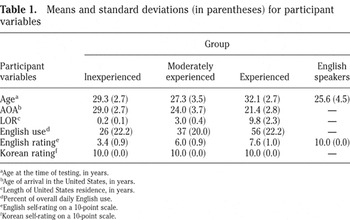
Means and standard deviations (in parentheses) for participant variables
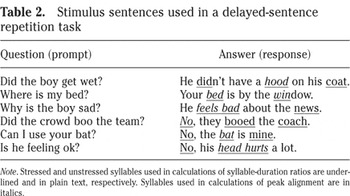
Stimulus sentences used in a delayed-sentence repetition task
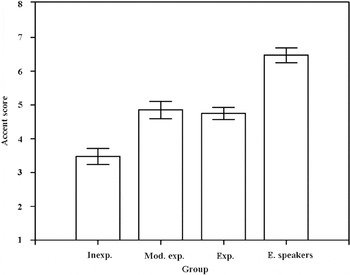
Group means for foreign accentedness ratings (± 1 SE) for inexperienced (Inexp.), moderately experienced (Mod. exp.), and experienced (Exp.) learners and native English speakers (E. speakers).
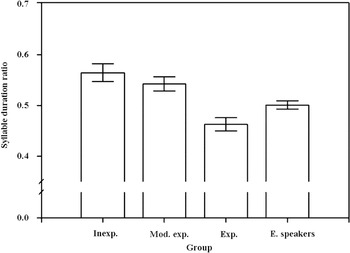
Group means for syllable duration ratios (± 1 SE) for inexperienced (Inexp.), moderately experienced (Mod. exp.), and experienced (Exp.) learners and native English speakers (E. speakers).
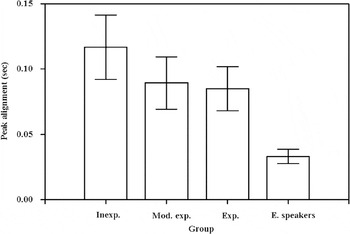
Group means for peak alignment (± 1 SE) for inexperienced (Inexp.), moderately experienced (Mod. exp.), and experienced (Exp.) learners and native English speakers (E. speakers).
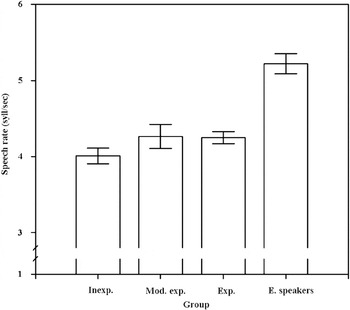
Group means for speech rate (± 1 SE) for inexperienced (Inexp.), moderately experienced (Mod. exp.), and experienced (Exp.) learners and native English speakers (E. speakers).
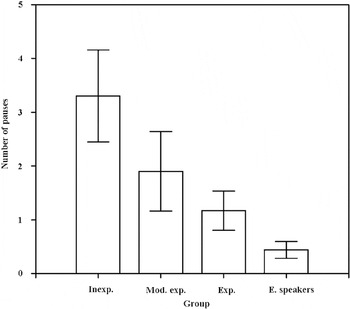
Group means for number of pauses (± 1 SE) for inexperienced (Inexp.), moderately experienced (Mod. exp.), and experienced (Exp.) learners and native English speakers (E. speakers).
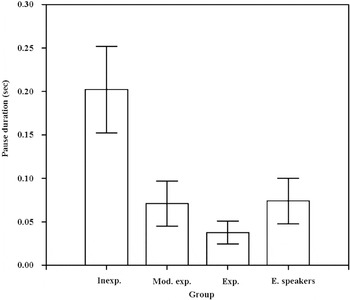
Group means for duration of pauses (± 1 SE) for inexperienced (Inexp.), moderately experienced (Mod. exp.), and experienced (Exp.) learners and native English speakers (E. speakers).
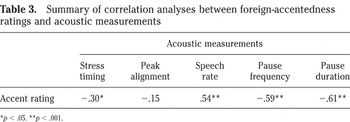
Summary of correlation analyses between foreign-accentedness ratings and acoustic measurements
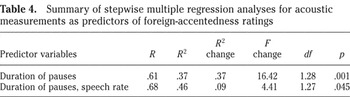
Summary of stepwise multiple regression analyses for acoustic measurements as predictors of foreign-accentedness ratings
 You have
Access
- 300
- Cited by