INTRODUCTION
Over the past three decades, the field of second language acquisition (SLA) has witnessed a proliferation of empirical evidence documenting the robust benefits of interaction in second language (L2) learning (Behney & Gass, Reference Behney, Gass and Schwieter2013; Mackey, Abbuhl, & Gass, Reference Mackey, Abbuhl, Gass, Gass and Mackey2012; Plonsky & Gass, Reference Plonsky and Gass2011). Building on interactionist perspectives, L2 researchers have recently begun adopting the concept of interactive alignment from first language (L1) research (the interactive alignment model [IAM]; Pickering & Garrod, Reference Pickering and Garrod2004) to investigate to what extent linguistic alignment occurs with L2 learners and how alignment affects interaction-driven L2 learning. In a narrow sense, linguistic alignment is defined as the development of aligned representations using an automatic psycholinguistic priming mechanism that acts on every level of linguistic representation (Branigan, Garrod, & Pickering, Reference Branigan, Garrod, Pickering, Brooks and Kempe2014). Similarly, priming is a cognitive repetition phenomenon whereby language comprehension or production is facilitated by prior exposure to particular language forms or meanings (McDonough & Trofimovich, Reference McDonough and Trofimovich2009). In the last decade, such phenomena (i.e., linguistic alignment, priming) have been discussed using various terms (e.g., convergence, repetition, cannibalization, recycling) by researchers from various theoretical perspectives (Atkinson, Churchill, Nishino, & Okada, Reference Atkinson, Churchill, Nishino and Okada2007; Markee & Kunitz, Reference Markee and Kunitz2013).
Building on previous L2 interaction and collaborative alignment task studies, the current study examined the role of linguistic alignment in the development of L2 grammatical knowledge (i.e., stranded preposition in relative clauses [RCs]) using collaborative alignment tasks. Following previous research (Trofimovich, McDonough, & Foote, Reference Trofimovich, McDonough and Foote2014), linguistic alignment was operationalized as the occurrence of primed production of a stranded preposition in an RC. In addition, past L1 research has shown that alignment occurs in both spoken and written modes, suggesting that alignment processes in written modality are largely similar to those in oral communication (e.g., Hartsuiker, Bernolet, Schoonbaert, Speybroeck, & Vanderelst, Reference Hartsuiker, Bernolet, Schoonbaert, Speybroeck and Vanderelst2008). However, much less is known regarding the effect of modality on the occurrence and proportion of linguistic alignment in L2 interactions. Furthermore, although previous research has suggested that learner characteristics, such as working memory (McDonough & Kim, Reference McDonough, Kim, Granena, Jackson and Yilmaz2016), previous knowledge of target structures (McDonough, Reference McDonough2005), and proficiency levels (Kim & McDonough, Reference Kim and McDonough2008) may affect the occurrence of alignment and the subsequent learning outcomes, the extent to which these variables influence the degree of alignment in oral and written modalities has not been examined. The goal of this study was thus to determine the role of linguistic alignment on the development of English grammatical knowledge (i.e., stranded prepositions in RCs) in face-to-face (FTF) and synchronous computer-mediated communication (SCMC) contexts and to also examine the role of learner characteristics in the occurrence of alignment and any subsequent L2 learning.
LINGUISTIC ALIGNMENT IN L1 INTERACTION
Research has shown that speakers mutually adapt to each other’s linguistic behaviors without conscious awareness of the language they use during dialogue (Foltz et al., Reference Foltz, Gaspers, Meyer, Thiele, Cimiano and Stenneken2015). Among different theoretical approaches to account for this phenomenon, IAM has received extensive attention from both L1 and L2 researchers (e.g., Pickering & Garrod, Reference Pickering and Garrod2004; Trofimovich et al., Reference Trofimovich, McDonough and Foote2014). The basic idea underlying IAM is that conversation is a joint activity wherein interlocutors collaboratively establish mutual understanding, as interlocutors “share many aspects of their representations of the situation under discussion” (Branigan, Pickering, Mclean, & Cleland, Reference Branigan, Pickering, McLean and Cleland2007, p. 164). One determiner of conversational success is the extent to which the interlocutors align their language use by representing the same linguistic elements within the conversation. Alignment can occur at various linguistic levels simultaneously (e.g., lexical, syntactic, phonetic, prosodic) to promote successful communication (Garrod & Pickering, Reference Garrod, Pickering and Gaskell2007; Pickering & Ferreira, Reference Pickering and Ferreira2008).
Alignment is presumed to arise from the operation of an implicit, resource-free priming mechanism both within and between levels of linguistic representation that require little or no conscious awareness. Thus, L1 researchers claim that interlocutors are usually unaware that priming has taken place (Pickering & Garrod, Reference Pickering and Garrod2004) and very rarely notice alignment of linguistic form (Branigan, Pickering, Pearson, & McLean, Reference Branigan, Pickering, Pearson and McLean2010). Although the terms alignment and priming have been used interchangeably in many of the previous studies, we chose to use alignment in the current study because, as indicated by Michel and Smith (2018), this term encompasses the underlying psycholinguistic mechanism of priming as well as its actual linguistic manifestation. Because the linguistic target in the current study is grammatical (i.e., stranded prepositions in RCs), we use the even more specific term structural alignment, which refers to a tendency wherein interlocutors produce specific syntactic constructions that recently occurred in conversation, rather than alternative constructions that could be used to express the same meaning (Pickering & Ferreira, Reference Pickering and Ferreira2008). However, in our review of previous research, we use whichever term the author(s) of previous studies employed, unless the two terms (i.e., alignment and priming) denoted a different construct. Alignment is often operationalized as primed production of language in the literature (e.g., Trofimovich et al., Reference Trofimovich, McDonough and Foote2014), and an example of structural alignment is as follows: one speaker produces a passive construction (e.g., The vase was broken by my brother) during conversation, and then the original speaker or an interlocutor is likely to produce another passive construction (e.g., The door was fixed by the manager) later in the same conversation, rather than an alternative form, such as an active construction (e.g., The manager fixed the door).
Previous L1 research has maintained that linguistic alignment can take place in written communication as well as spoken interactions (Hartsuiker et al., Reference Hartsuiker, Bernolet, Schoonbaert, Speybroeck and Vanderelst2008; Zwaan & Radvansky, Reference Zwaan and Radvansky1998). For instance, Cleland and Pickering (Reference Cleland and Pickering2006) examined the occurrence of structural priming (specifically, double-object and prepositional datives) in both spoken and written modalities with English-speaking university students to investigate whether writing and speaking employ the same syntactic representations. They examined the spoken production of the two target forms after both written and spoken primes with verb repetition between primes and targets (Experiment 1), without verb repetition between primes and targets (Experiment 2), and with written production of the target forms after both written and spoken primes without verb repetition between primes and targets (Experiment 3). The findings indicated priming occurred between modalities regardless of whether primes and targets matched modalities, suggesting that written and spoken production shares similar syntactic representations. Hartsuiker et al. (Reference Hartsuiker, Bernolet, Schoonbaert, Speybroeck and Vanderelst2008) further investigated whether different modalities (written vs. spoken) would affect structural priming of the same two structures in Dutch. Overall, their results replicated those of previous research found in spoken dialogue between human interlocutors (Branigan, Pickering, & Cleland, Reference Branigan, Pickering and Cleland2000) in terms of the magnitude of structural priming, and they argued that commonalities exist between syntactic processes in spoken and written interactions.
In sum, prior L1 research has demonstrated that speakers achieve mutual understanding during conversations by systematically and unconsciously aligning their language at different dimensions of language (e.g., lexis, grammar), and that linguistic alignment occurs across different modalities of interactions (e.g., written and spoken). However, studies that examined written and spoken dialogues often used preprogrammed computer tools, and thus do not fully represent the authentic interactional situations.
LINGUISTIC ALIGNMENT IN SLA RESEARCH
Within the domain of L2 research, an increasing number of empirical studies have employed priming methods to investigate the development of linguistic representations of L2 learners, bilingual speakers, and multilingual speakers (see McDonough & Trofimovich, Reference McDonough and Trofimovich2009 for a review). The current study examined the occurrence of structural alignment, and our review focuses on relevant L2 alignment studies conducted in interactional contexts.
Previous L2 structural alignment research has explored the pedagogical benefits of alignment activities for both immediate and delayed L2 development (e.g., Conroy & Antón-Méndez, Reference Conroy and Antón-Méndez2015; McDonough, Reference McDonough2006; McDonough & Chaikitmongkol, Reference McDonough and Chaikitmongkol2010). L2 research generally employs a pretest and posttest research design to explore the effects of alignment on L2 development (Conroy & Antón-Méndez, Reference Conroy and Antón-Méndez2015; McDonough, Reference McDonough2006; McDonough & Chaikitmongkol, Reference McDonough and Chaikitmongkol2010; McDonough, Kielstra, Crowther, & Smith, Reference McDonough, Kielstra, Crowther, Smith, Mackey and Marsden2016; McDonough & Kim, Reference McDonough and Kim2009; McDonough & Mackey, Reference McDonough and Mackey2006, Reference McDonough and Mackey2008; McDonough, Neumann, & Trofimovich, Reference McDonough, Neumann and Trofimovich2015; Shin & Christianson, Reference Shin and Christianson2012). For instance, findings of lab-based L2 alignment studies have shown that learners often produced more primed production than unprimed production of target linguistic features when there is alternation between two constructions with similar meaning, such as double-object and prepositional datives (McDonough, Reference McDonough2006; Shin & Christianson, Reference Shin and Christianson2012), active and passive constructions (Kim & McDonough, Reference Kim and McDonough2008), stranded prepositions (Conroy & Antón-Méndez, Reference Conroy and Antón-Méndez2015), and RCs and prepositional phrases (Trofimovich, McDonough, & Neumann, Reference Trofimovich, McDonough and Neumann2013). These studies often point to a higher suppliance or accurate production rate of target structures on the production-based posttest compared to the pretest as evidence of the benefits of alignment on the development of L2 structures.
MODALITY EFFECTS ON L2 INTERACTION AND STRUCTURAL ALIGNMENT
As discussed in the preceding text, previous L1 studies have demonstrated the occurrence of alignment in both oral and written discourse (e.g., Hartsuiker et al., Reference Hartsuiker, Bernolet, Schoonbaert, Speybroeck and Vanderelst2008). However, to date, little L2 alignment research has been conducted in written discourse (e.g., text-chat), and no study has directly compared alignment effects in both FTF and SCMC contexts while holding other factors the same. This is surprising because to date a large amount of research comparing FTF and SCMC contexts has been conducted in SLA contexts (see Ziegler, Reference Ziegler2016 for review). For instance, SLA researchers have shown that the facilitative features of FTF interaction also occur during SCMC interaction (Sauro, Reference Sauro2011). Specifically, in SCMC settings, learners are provided with opportunities to interact, produce language, and modify their output in response to any communication difficulties, as well as respond to feedback from an interlocutor in an authentic communicative setting. Some studies have further indicated that SCMC provides learners with certain advantages over FTF interactions, including an increased opportunity for learners’ attention to be drawn to the form of the language, as well as more time for learners to understand and process target language input (Ziegler, Reference Ziegler2016). Given that attention may be facilitative of L2 development (Schmidt, Reference Schmidt and Robinson2001), and that detection of grammatical structures is a prerequisite for structural alignment to occur (McDonough & Fulga, Reference McDonough and Fulga2015), the alignment effects between written SCMC (i.e., text-chat) and oral interaction might be qualitatively different.
With regard to interaction modalities, previous L2 structural alignment studies have mainly been conducted in FTF contexts or using preprogramed computer-human interactions in lab-based studies, and have focused on the role of priming mechanisms in interaction-driven L2 acquisition. Our study was particularly motivated by Conroy and Antón-Méndez (Reference Conroy and Antón-Méndez2015), which was an investigation of whether a priming treatment would assist L2 learners’ acquisition of stranded prepositions in RCs. Using a pretest/posttest research design, they compared the number of produced stranded prepositions between an experimental group (i.e., priming condition) and a control group. Their results were in line with previous L2 studies (e.g., McDonough, Reference McDonough2006; McDonough & DeVleeschauwer, Reference McDonough and De Vleeschauwer2012), in that stranded prepositions were primed in a similar fashion to previously investigated structures (e.g., wh-questions, passives), and that the priming treatment was beneficial for learning stranded prepositions (evidenced by increased, accurate production for the experimental group compared to the control group). Conroy and Antón-Méndez (Reference Conroy and Antón-Méndez2015) expanded their L2 priming studies by targeting a new syntactic structure (i.e., stranded prepositions) using preprogramed computer-human interactions. However, their study design did not include any delayed posttests, and learners’ individual characteristics were not controlled in their statistical analysis.
In terms of alignment in SCMC contexts, Uzum (Reference Uzum2010) found that 18 learners of English with various L1 backgrounds demonstrated alignment during text-chat interactions in the domain of not only speed and fluency but also their lexical and grammatical choices. Uzum also suggested that the reflexive feature of text-chat, such as scrolling back and forth through earlier statements, may have promoted the degree of alignment between speakers. Using corpus linguistic tools, Collentine and Collentine (Reference Collentine, Collentine, McDonough and Mackey2013) examined the extent to which 53 learners of L2 Spanish aligned their use of Spanish subjunctive mood during SCMC interactions, demonstrating that L2 learners exhibited structural alignment while carrying out a task in a text-based SCMC context. Recently, Michel and Smith (Reference Michel, Smith, Gass, Spinner and Behney2018) examined to what extent L2 learners demonstrate linguistic alignment focusing on the lexical overlap of three or more consecutive words (n-grams) during learner-learner task-based interaction in SCMC settings. Through the use of eye-tracking technology, Michel and Smith demonstrated examples of the six learners’ visual attention to aligned text; however, overt visual attention was not in line with the majority of lexical overlap between learners. According to Michel and Smith, this suggests that alignment in an L2 might not be associated with explicit, strategic behavior, but is rather the result of unconscious, implicit behavior. In sum, previous L2 research suggests that linguistic alignment occurs in SCMC contexts, and although these studies are rather small scale in terms of the sample size, the data from screen capture and eye-tracking techniques offer insights into learners’ convergence behavior during interaction, particularly related to their attention to the texts. Whereas interaction studies conducted in SCMC contexts suggested learners’ explicit awareness of language input, alignment studies have yet to provide clear evidence accounting for alignment behavior by L2 learners.
Considering the large amount of discussion on the unique contextual characteristics between FTF and SCMC settings, these different modalities may also exert influences on the amount of primed production. While evidence has grown suggesting the occurrence of structural alignment in SCMC contexts, no study, to date, has compared L2 learners’ alignment behaviors in FTF and SCMC settings using identical alignment materials to study modality effects on the development of L2 grammar through alignment activities.
LEARNER CHARACTERISTICS AND L2 STRUCTURAL ALIGNMENT EFFECTS
In addition to the efforts made to investigate the effects of structural alignment on L2 grammatical knowledge development, researchers have explored which learner characteristics are associated with the occurrence of alignment in L2 development. One important question is whether a threshold of preexisting linguistic representation of target features must exist for alignment effects to occur (i.e., prior knowledge of target structures). Previous studies have suggested that alignment effects may depend on the existence and strength of the mental representation of the target structure, supporting the notion that learners must have at least partial knowledge of the target structure for alignment to occur. To investigate whether L2 learners can be primed to produce a novel linguistic pattern with or without detection of the target form, McDonough and Fulga (Reference McDonough and Fulga2015) conducted experiments with learners who have little familiarity with the transitive construction in Esperanto due to the lack of a corresponding structure in their L1 (i.e., English). Their findings demonstrated that learners’ detection of the linguistic form was required for the occurrence of alignment, suggesting the importance of the existing mental representation of the target structure in alignment. However, to what extent the level of learners’ preexisting knowledge of target features impacts the magnitude of alignment is still underresearched.
Similar to previous knowledge of target structures, the role of learners’ overall proficiency in alignment effects has been of interest in L2 research. For example, Kim and McDonough (Reference Kim and McDonough2008) investigated the extent to which L2 learners benefitted from verb repetition (i.e., lexical boost) while carrying out a collaborative priming task with a researcher and the effect of L2 proficiency on the primed production of English passive constructions. Findings showed that the proportion of the target structure production and the priming effects increased together with learners’ L2 proficiency. In addition, Bernolet, Hartsuiker, and Pickering (Reference Bernolet, Hartsuiker and Pickering2013) investigated the influence of L2 proficiency on shared syntactic representations in L1 Dutch–L2 English bilinguals. Their findings demonstrated that between-language priming (e.g., from Dutch to English) was stronger for more proficient L2 learners, suggesting that as L2 learners gain proficiency, the representations of the target structure (S-genitives) for the learners’ L1 and L2 are collapsed into a single language-neutral representation shared between the two languages. Although L2 proficiency is suggested as one of the factors that impacts priming effects, it is not always controlled in priming research, and little research has examined this variable systematically using valid proficiency measures.
McDonough et al. (Reference McDonough, Kielstra, Crowther, Smith, Mackey and Marsden2016) looked into the role of two learner characteristics (i.e., statistical learning [the implicit learning ability to extract a grammatical rule from the aural input that learners are sequentially exposed to] and working memory) and explicit memory (i.e., awareness) in the occurrence and persistence of structural priming. The statistical learning test was adapted from Gómez (Reference Gómez2002) and working memory capacity (WMC) was assessed using the Wechsler Adult Intelligence Scale (WAIS-III) and the digit span backwards task (Psychological Corporation, 1997). While they found a positive impact of priming activities on L2 learners’ subsequent production of the target structure, there were no significant relationships between statistical learning, working memory, and structural priming. Furthermore, although the participants who explicitly mentioned RCs (i.e., the target structure) during an exit interview did not produce more RCs than the other participants, they did have higher working memory and statistical learning scores. Their findings suggest that while differences in statistical learning and working memory may be related to the participants’ explicit awareness of the target structure, they were not correlated with their primed or subsequent production.
Bernolet and Hartsuiker (2017) suggested that explicit memory mechanisms may underlie structural priming; that is, L2 speakers may go through a process of retrieving the previous utterance from explicit memory and imitate it with only minimal edits in the following utterance. More specifically, Bernolet and Hartsuiker demonstrated that when compared to high-proficient L2 speakers, low-proficient L2 speakers tended to rely more on an explicit memory strategy such as copying the prime sentence while slightly adjusting it so as to convey the relevant message. The speakers were particularly likely to do this when they had not formed abstract representations of a structure in their L2 and are thus highly uncertain as how to formulate the appropriate sentence.
With regard to the role of working memory, different findings were obtained when intervening turns were manipulated between primes and targets. Specifically, McDonough and Kim (Reference McDonough, Kim, Granena, Jackson and Yilmaz2016) found a positive relationship between working memory measured using a running span test (Broadway & Engle, Reference Broadway and Engle2010) and L2 speakers’ primed production of English passives when the prime sentences were adjacent to target picture descriptions (i.e., prompts). However, when primes and targets were separated by two to five filler sentences, working memory had no significant relationship to the speakers’ primed production, similar to the findings in McDonough et al. (Reference McDonough, Kielstra, Crowther, Smith, Mackey and Marsden2016). Additionally, working memory was not found to be related to the L2 learners’ subsequent production, regardless of the number of intervening turns manipulated in the study. Overall, both McDonough et al. (Reference McDonough, Kielstra, Crowther, Smith, Mackey and Marsden2016) and McDonough and Kim (Reference McDonough, Kim, Granena, Jackson and Yilmaz2016) demonstrated that working memory was unrelated to the implicit component of structural priming (i.e., a lack of awareness of the target form), suggesting that there is no significant relationship between working memory and the implicit learning that occurs through structural priming. However, evidence for the role of working memory in structural priming effects is still equivocal, as shown by the divergent findings between the two aforementioned studies.
THE CURRENT STUDY
To address the research gaps discussed in the previous section, the present study investigated the effect of structural alignment on the development of stranded prepositions in RCs in FTF and SCMC contexts. The current study also aimed to examine the role of learner characteristics in working memory, previous knowledge of the target structure, and L2 proficiency in the primed and subsequent production of the target structure. The current study was guided by the following two research questions:
1. To what extent does structural alignment occur during FTF and SCMC interactions among Korean EFL learners? To what extent do modality of interaction, working memory, previous knowledge of stranded prepositions in RCs, and overall language proficiency impact the amount of structural alignment?
2. To what extent does structural alignment facilitate production of stranded prepositions in RCs? To what extent do modality of interaction, working memory, previous knowledge of stranded prepositions in RCs, overall language proficiency, and the degree of structural alignment impact the alignment effects on the learning of stranded prepositions in RCs?
METHOD
PARTICIPANTS
A total of 114 Korean EFL university students (51 female and 63 male) enrolled in a variety of undergraduate programs (e.g., chemistry, business, engineering) participated in the study. The students ranged in age from 18 to 26 years, with a mean of 21.4 years (SD = 2.39). All of them had completed at least 10 years of mandatory English classes in their elementary (1–2 hours per week for 4 years), junior high (3 hours per week for 3 years), and high schools (3 hours per week for 3 years). None of the students majored in English-related studies at the time of data collection. Due to some students choosing to withdraw their participation in the experiment, the final sample size was 94. Less than 5% of students were enrolled in English classes for 2 hours per week at the time of data collection. Therefore, the students’ additional English input other than study sessions were minimal. The students were financially compensated for their participation.
TARGET STRUCTURE
The target structure of the study was the English stranded preposition construction in RC or an oblique RC construction, in which the object of a preposition is relativized as in Example (1):
(1) This is something (which) you take cookies from.
In Example (1), only the relative pronoun which is moved to the beginning of the RC with the preposition from stranded at the end of the clause (i.e., preposition stranding). Even when the relative pronoun is omitted, the preposition is left at the same position, making the sentence grammatically correct. Examples (2) and (3) show interlanguage features of a stranded preposition construction in RCs. Example (2) represents null preposition (null prep) and Example (3) represents the use of a resumptive pronoun in RCs:Footnote 1
(2) This is something (which) you take cookies ∅.
(3) This is something children take cookies here.
Previous research has suggested that the null preposition is an interlanguage feature typical of English L2 learners (Sadighi, Parhizgar, & Saadat, Reference Sadighi, Parhizgar and Saadat2004), and that across various L1 backgrounds and proficiency levels, English L2 learners generally face difficulty in acquiring the stranded preposition construction (Conroy & Antón-Méndez, Reference Conroy and Antón-Méndez2015). Stranded prepositions have been found to be resistant to instruction (Sadighi et al., Reference Sadighi, Parhizgar and Saadat2004), and learners’ use of null prepositions in RCs continues until later stages of L2 development, when they have already established knowledge related to the correct use of prepositions with verbs in nonstranding contexts (Hokari & Wakabayashi, Reference Hokari, Wakabayashi, Bowles, Ionin, Montrul and Tremblay2009). One of the major sources of learner difficulty that has been pointed out in previous research is the contrast between L1s and L2s. Accordingly, stranded prepositions in RCs can be particularly difficult for Korean learners of English due to typological differences between Korean and English, particularly for RCs and verb argument constructions using prepositions. For example, Korean does not have prepositions, but instead has postpositions as equivalents, as shown in Example (4):Footnote 2
(4) 내 가족은 한국에 산다.
nay kacok-un hankwuk-ey sa-n-ta
my family-TC Korea-LOC live-PRS-DC
“My family lives in Korea.”
Furthermore, unlike English, RCs are prenominal in Korean and the use of a postposition depends on the type of sentence where the postposition is contained. Specifically, although postpositions are compulsory in both declarative and interrogative sentences in Korean, they must be omitted from the corresponding RC, in which an object of postposition is relativized as shown in Example (5):
(5) 이것이 내가 사는 집이다.
ikes-i nay-ka sa-nun cip-ita
this-NM I-NM live-RL house- DC
“This is the house I live in.”
Therefore, postposition stranding is not permitted in Korean RCs and there is no equivalent structure for stranded prepositions in English RCs (Klein, Reference Klein1993). It can be assumed that this may cause difficulties for Korean learners of English in acquiring the structure of stranded prepositions in RCs. Of a range of prepositions that can be used in RCs, we chose four prepositions that were found to be more commonly used in a stranded construction than in other structures (e.g., pied-piping) according to corpus analysis: with, on, in, and from (Biber, Johansson, Leech, Conrad, & Finegan, Reference Biber, Johansson, Leech, Conrad and Finegan1999; Dimitriadis, Reference Dimitriadis2007).
RESEARCH DESIGN AND PROCEDURE OF THE STUDY
The current study was conducted using a pretest-posttest-delayed posttest research design. Students were first randomly assigned into either the FTF alignment (n = 35), SCMC alignment (n = 29), or control groups (n = 30, 14 SCMC, 16 FTF). All students in both modality groups scheduled three individual sessions with the researchers whom they had not met prior to the study over a 3-week period. The first two meetings were 1 to 2 days apart, and the last meeting was held 2 weeks after the immediate posttest. On Day 1, students in all groups completed a demographic survey, a grammaticality judgment test, and an oral production pretest (10 minutes). Students in the alignment group then carried out the first set of alignment activities (20–40 minutes). On Day 2, they carried out the second set of alignment activities (20–40 minutes) and the immediate production posttest (10 minutes), whereas students in the control group only completed the posttest. Two weeks later, all the students completed the delayed production posttest (10 minutes), working memory test (10 minutes), and cloze test (30 minutes).
Both the FTF and SCMC alignment groups followed the same procedure and used the same materials, with the only difference between the two groups being the modality. The SCMC group used individual laptops in a quiet room. The text-chat SCMC sessions were conducted using the Campfire chat website. Half the students in the control group conducted the production tests using the FTF procedure while the other half followed the SCMC procedure. Control groups performed the pretest and posttests only without any alignment sessions.
MATERIALS
Production Tests for Stranded Prepositions
To test students’ knowledge and use of stranded preposition constructions in RCs before and after the treatment sessions, three versions of a production test were designed for pretest, immediate posttest, and delayed posttest administration. Each version of the production tests consisted of a 12-picture-item description task. Each item was presented with a picture of an object accompanied by a verb written in English. Students were asked to explain the object in the picture (e.g., a picture of a dictionary) using the verb provided (e.g., learn; see Appendix A for a list of verbs and nouns used). Then based on the descriptions, the researcher had to choose the correct picture that was being described. A total of 36 verbs from the treatment sessions were used in the production tests, and no verb was used more than once on any of the production tests.Footnote 3 Additionally, none of the pictures (i.e., target objects) and object nouns were repeated between the production tests and the treatment sessions. Nouns and verbs were initially selected based on Conroy and Antón-Méndez (Reference Conroy and Antón-Méndez2015), and word frequency and collocations were considered using freely available corpus-based resources (e.g., General Service List, Corpus of Contemporary American English) to ensure that the experimental materials included commonly used vocabulary words and collocations in English. The three production tests were counterbalanced so that each test was used an equal number of times as a pretest, immediate posttest, or delayed posttest randomly across participants. After hearing or reading students’ description of each item, the researcher guessed the object based on the description as follows:
Example (6)
1 Student: This is something you stack clothes in (a picture of “dresser” and the verb “stack” were provided for this item).
2 Researcher: A dresser?
3 Student: Yes.
Alignment Activity Materials
Following previous FTF interaction-oriented L2 alignment studies (e.g., McDonough & Kim, Reference McDonough and Kim2009), the current study used communicative activities that were carried out between a researcher and a student. The treatment alignment activities were interactive object description tasks. As shown in Example 7, after hearing the researcher’s description of an object (prime), the student guessed the identity of the object. After confirming if the student was correct (or providing the correct answer if they were wrong), the student then described the item shown on their picture using the supplied verb (e.g., cook). Following Conroy and Antón-Méndez (Reference Conroy and Antón-Méndez2015), filler pairs were included between the prime/target pairs. All filler items were constructed with RCs; however, no stranded prepositions were used. Similar to the prime/target pairs, a picture of an item and a verb were provided for targets after each filler (see Example 7). Only transitive verbs were used for all conditions. For both conditions, the researcher then guessed the item based on the student’s description. The same sequence was applied to both primes and fillers.
Example (7)
1 Researcher: This is something you dry dishes on. (prime)
2 Student: Dish rack. This is something you cook on. (target) [a picture of a “stove” and the verb “cook” were provided]
3 Researcher: Stove.
4 Researcher: This is something you bring on a plane. (filler)
5 Student: Luggage. This is something you show when you go to other countries. [a picture of a “passport” and the verb “show” were provided]
A total of 18 prime-target pairs and 18 filler pairs were used in alignment sessions 1 and 2, for a total of 36 trials per session (72 trials per student for both sessions). No verb or picture objects were repeated within or between the two sessions. The two versions of the alignment activities were counterbalanced between the sessions (see Appendix B for a complete list of verbs and nouns referring to the objects in the picture). The control group did not perform any alignment tasks and conducted the pretests and posttests only.
Both production and alignment materials were piloted with 10 students enrolled in an Intensive English Program in the United States and five English instructors possessing master’s degrees in TESOL or a relevant field to ensure the difficulty level of the vocabulary and the clarity of pictures were appropriate. The learners in the pilot sessions possessed similar English proficiency to those used in this study, and any necessary revisions were made based on the pilot sessions.
Working Memory Test
In the current study, WMC was operationalized as the ability to simultaneously process and store information. To provide a working memory test not overly dependent on L2 proficiency, we used an aural running span test (Broadway & Engle, Reference Broadway and Engle2010). Students heard a series of letters and were asked to recall the last n items from lists that are m + n items long. The instructions were provided in the students’ L1 (Korean) to avoid misunderstanding. The number of letters to recall was predetermined and was provided to the students. However, the students were not informed of the total number of letters that they would hear in the series. For instance, the message “remember the last 4 letters” appeared on the monitor, but the students were not informed a priori of the total number of letters to be presented aurally in any given sequence. The spans ranged from three to six, and there were six sets of each span for a total of 108 letter items in the test. Following Broadway and Engle (Reference Broadway and Engle2010), 1 point was assigned to each item correctly chosen in correct serial position. Thus, the possible total score of the running span test was 108.
Cloze Test
To measure students’ general English proficiency, we used a cloze test first validated by Brown (Reference Brown1980), consisting of 50 items that the students were given 30 minutes to complete. A cloze test was chosen because it has been found to be an adequate indicator of general language proficiency (Brown, Reference Brown2002; Hinofotis, Reference Hinofotis, Oller and Perkins1980; Oiler & Conrad, Reference Oiler and Conrad1971). Other longer tests of general English proficiency could not be given in the study due to time constraints. One point was given to a correct response, and no points were given to any unacceptable responses, with no partial points given. The highest point total was 50. Internal-consistency reliability of the cloze test was calculated using Cronbach’s alpha, which reported a standard alpha of .87, indicating acceptable reliability.
Grammaticality Judgment Test
To measure students’ existing knowledge of stranded preposition constructions in RCs, we administered a grammaticality judgment test. As a means to prevent students’ noticing of the target structure being tested, a total of 12 target items (6 correct and 6 incorrect) and 8 distractors were included in the test. Students were asked to choose one of the following for each item: correct, incorrect, or I don’t know. If they chose incorrect, they were asked to correct the error and explain the source of the error in Korean. For grammatically correct items, a total of 1 point was assigned, and for grammatically incorrect items a total of 2 points were assigned.Footnote 4 One point was given to whether participants were able to determine the accuracy of each sentence (correct vs. incorrect). For incorrect items, 1 point was given only to the responses where they accurately corrected the errors. In other words, 0 points were given if they failed to spot the errors even if they correctly identified that the sentence is grammatically incorrect. Therefore, the possible total score for the grammaticality judgment test was 18 points. The internal consistency reliability was measured using Cronbach’s alpha and reported a standard alpha of .74. Considering the small number of items included in the test (k = 12), and that it was a pretest, where many students were not able to answer the questions correctly, the reliability level is acceptable for the purposes of this study.
DATA CODING
The Production of Stranded Prepositions in RCs
Both the production test data and alignment data were coded using the same criteria. We focused on the production of the target construction (i.e., stranded prepositions in RCs – N + relativizer + subject + V + object + preposition) regardless of accuracy following previous alignment studies that treated target features as constructions (McDonough & De Vleeschauwer, Reference McDonough and De Vleeschauwer2012; McDonough & Kim, Reference McDonough and Kim2009). Thus if learners produced stranded preposition constructions in RCs (i.e., suppliance; e.g., This is something we can store kimchi in), the response was scored as 1, even if the response included an incorrect preposition (e.g., This is something that people store kimchi from). All other responses that did not include any stranded prepositions were assigned a score of 0 (e.g., This is something you put kimchi). Two raters coded 20% of the data, and the interrater reliability between the two raters was calculated using Cohen’s kappa and reached acceptable agreement at .93. Any disagreements were discussed and adjudicated. The entire dataset was then coded by two raters independently, and any differences in the coding were discussed among the researchers until 100% agreement was made.
STATISTICAL ANALYSIS
We analyzed our data using generalized linear mixed effects logistic regression models (GLME) because they offer methodological advantages over traditional regression and repeated-measure ANOVA analyses (Baayen, Davidson, & Bates, Reference Baayen, Davidson and Bates2008; Jaeger, Reference Jaeger2008). First, LME models are built by choosing a dependent variable and one or more predicting variables, much like a traditional multiple regression analysis. However, unlike traditional multiple regression, LMEs allow for the inclusion of both fixed and random effects that can be categorical (e.g., experimental group) or numerical (e.g., age). A fixed effect is an effect that is hypothesized to have a predictable outcome on the dependent variable (e.g., treatment conditions) or serves as a control variable (Baayen et al., Reference Baayen, Davidson and Bates2008). In general, variables that are involved in hypothesis testing or should be controlled for (e.g., initial language proficiency) are entered as fixed effects, while students and test items are entered as random effects. By entering students and items as random effects, they are assigned unique intercepts in the model, rather than having a single intercept fit to all students or items, which preserves the individual variation of items and students rather than pooling their results into single means. These models also allow for the inclusion of random slopes, which allows for the effect of a fixed effect to vary by a specific random effect. In other words, random effects allow for variance associated to students and items being different from one another, while random slopes capture the variance associated with each student and/or item in relation to a specific fixed effect.
Second, LMEs allow for nonindependence of data, which means that one student or item can contribute more than one data point per condition, allowing for an analysis of raw data points rather than a single mean score per student, as would occur in traditional ANOVA methods. Because of this, LMEs are robust to unequal N sizes and can include partial datasets from students who do not complete all trials, making them ideal for repeated measures designs. Similar to standard logistic regression, GLMEs provide a set of log odds ratios (i.e., estimates) and z-values for each variable (i.e., fixed effect) and interaction entered into a model, which summarizes a measure of the strength and direction of each effect on the dependent variable.
Because our dependent variable is a binary outcome (i.e., 0 or 1), we used logistic mixed effects models with a logit link designed to calculate the probability of a binary outcome based on the different predictor variables entered into the model (Jaeger, Reference Jaeger2008). We used R (R Core Team, 2016) and the lme4 package (Bates, Maechler, Bolker, & Walker, Reference Bates, Maechler, Bolker and Walker2015) to build and analyze our GLME models. We also used the package lmerTest (Kuznetsova, Brockhoff, & Christensen, Reference Kuznetsova, Brockhoff and Christensen2015) to derive p values from the LME output. We then calculated odds ratios for predictors based on exponentiation of the estimates for each predictor in each model, which provides a measure of effect size for each predictor in the model (Levshina, Reference Levshina2015). We also include 90% confidence intervals for the odds ratios using the Wald method to account for low power associated with interaction terms in regression models (Baguley, Reference Baguley2012). To obtain a measure of effect sizes of the entire GLME model, we used the r.squaredGLMM function from the MuMIn package (Nakagawa & Schielzeth, Reference Nakagawa and Schielzeth2013), which computes two separate R 2 values: a marginal R 2 for the variance explained by the fixed factors only, and a conditional R 2 for the variance explained by both fixed and random factors together.
To systematically answer our research questions, we built three different models: one for the alignment data (RQ 1) and two for the production test data (RQ 2). For the alignment model (RQ1), we entered students’ production score during the alignment tasks as the dependent variable. Our experimental fixed effects included modality (FTF vs. SCMC), receptive pretest score, production pretest score, cloze test score, WMC score, and prime type (prime vs. filler), and our control variables included sequential number of each individual trial as well as the alignment session number (first or second) to control for task familiarity effects. For our interactions, we tested separate interactions between prime type and the following fixed effects: WMC, modality, cloze scores, receptive pretest scores, and production pretest scores. Additionally, interactions between prime type and trial order (i.e., presentation order of the stimulus) and prime type and session order (first vs. second) were included as control variables to account for the tendency for students to become better at a task as they advance through successive trials. Students and items (i.e., verb for each trial) were entered as crossed random effects. In addition, a random slope of prime type was fit on the random effect of students to account for possible differences in magnitude of priming effects on a per-individual basis.
To properly interpret main effects and interactions, the main effects of any terms included in nonsignificant interactions are reported from a separate, main-effects only model in prose (all main effects were retained in both models regardless of significance). All numerical variables were centered before being included in the model and were also checked for multicollinearity by examining their variance inflation factors (VIF). For all the data, no predictor had a VIF value higher greater than two, suggesting no evidence of strong multicollinearity. The predictor variables were also checked for evidence of separation through visual analysis of crosstabs of the predictors and dependent variable, which verified that none of the predictor variables could perfectly predict the binary outcome and thus showed no strong evidence of separation.
For the production test data models (RQ2), we constructed one model containing all the students in the experimental and control groups and a different model containing only those in the experimental group. The first of these models was constructed to initially answer whether any learning effects carried over from the treatment sessions within both modalities, and then to test whether there were any differences between the two different modalities and groups. The second of these two models was designed to test whether any of the learner characteristics further influenced any learning effects for the students in the experimental group only. It was necessary to fit this separate model because we also wanted to include the degree of alignment for each individual student, and therefore could not include the students in the control group in this model (as they would all have an alignment score of 0 and therefore cause multicollinearity between experimental condition and amount of alignment, thus biasing the estimates in the model). The two production models thus both included the students’ performance on the production tests as the dependent variable as a binary outcome (0 vs. 1).
The first production test model included fixed effects of group (experimental vs. control), modality (FTF vs. SCMC), test order (pretest, immediate posttest, delayed posttest), receptive pretest score, cloze test score, WMC score, and a three-way interaction between group, modality, and test order. We also entered trial order (i.e., presentation order of the stimulus) as a control variable in each model. Students and items (i.e., verb for each trial) were entered as random effects, and a random slope of test order was added to the random effect of student. To interpret all the comparisons present in the three-way interaction, we conducted follow-up comparisons using the emmeans package (Lenth, Reference Lenth2018) and also visually plot the interaction.
The second production test model included fixed effects of modality (FTF vs. SCMC) and separate interactions fit between test order (pretest, immediate posttest, delayed posttest) and receptive pretest score, cloze test score, WMC score, and total amount of alignment from the alignment sessions. The total amount of alignment was calculated for each student by summing the total number of trials during the alignment sessions that a student produced a stranded preposition construction (min 0, max 78).
RESULTS
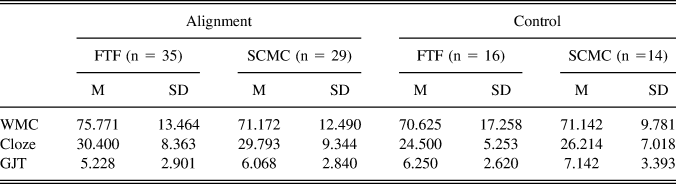
Prior to answering the research questions, descriptive statistics of the WM test (possible total: 108), cloze test (possible total: 50), and GJT scores (possible total: 18) among the four groups are presented in Table 1.
Descriptive statistics of raw scores for WMC, cloze test, and GJT scores

Note: WMC maximum score = 108; Cloze maximum score = 50; GJT maximum score = 36.
The Occurrence of Structural Alignment
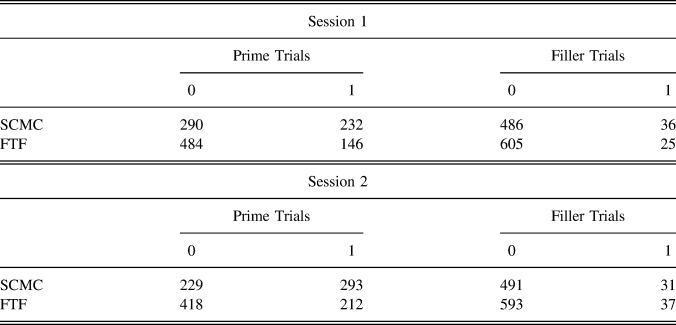
The first research question asked whether structural alignment of stranded prepositions in RCs occurs among Korean EFL students, and if so whether modality of interaction, WMC, previous knowledge of the target structure measured using a grammaticality judgment test, production pretest scores, and students’ overall language proficiency (measured using cloze test score) influences the amount of alignment. Table 2 displays the frequency statistics for each coding category during the treatment sessions. Primed and unprimed production of stranded prepositions are presented, separated by modality (i.e., FTF and SCMC) and session order. The frequency counts display higher instances of stranded preposition constructions (score of 1) after prime trials for students in the SCMC group in both treatment sessions compared to students in the FTF group, and also demonstrate that for both modalities, scores of 1 occurred more frequently after a prime when compared to a filler, and that these values increased from the first session to the second session.
Frequency of stranded preposition construction production after prime and filler trials during alignment sessions

Note: A score of 0 indicates a construction that did not include a stranded preposition, whereas a score of 1 indicates a construction including a stranded preposition
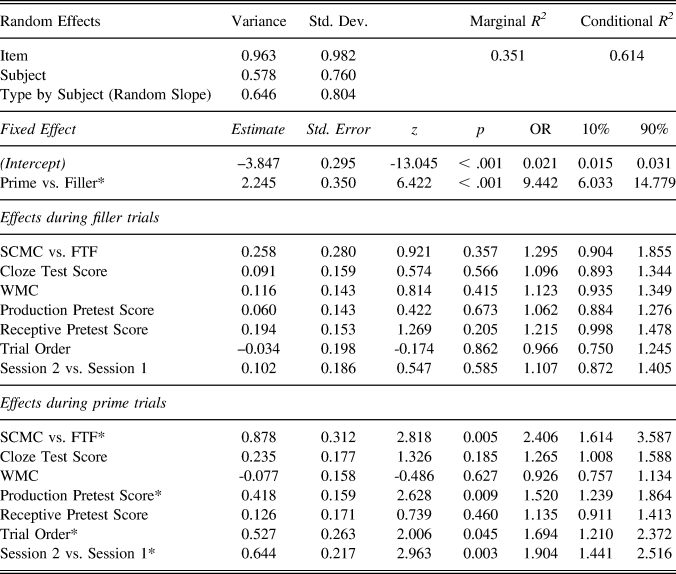
To test if the frequencies in Table 2 represented statistically significant differences, a GLME model was fit using the variables described previously. Results from a model containing only main effects included a significant main effect for prime type, with the odds ratio reporting that students were 24.34 times more likely to produce a stranded preposition construction after a prime trial when compared to a filler trial (Intercept = –4.420, Estimate = 3.192, Std. Error = 0.324, z = 9.852, p < .001, OR = 34.337, 5% CI = 14.283, 95% CI = 41.467). Results from a model with full interactions included four significant interactions, in that modality, production pretest scores, session order, and trial order all interacted significantly with prime type. Specifically, SCMC students had a 2.4 times greater likelihood of producing a stranded preposition construction after a prime trial when compared to the FTF students based on the odds ratio. Moreover, for all students, each increase in score on the production pretest predicted a 1.5 times greater likelihood of producing a stranded preposition after a prime trial when compared to a filler trial. In terms of session order and trial order, these results suggest that students were significantly more likely to produce stranded prepositions on later trials within each session, and also significantly more likely to produce stranded prepositions in the second alignment session when compared to the first alignment session. The significant interaction between modality and prime type is displayed in Figure 1.
Interaction between prime type and modality.
Note: During filler trials, no significant differences occurred between modalities. During prime trials, SCMC participants had significantly higher primed production when compared to FTF participants.

Table 3 displays the coefficients, z values, p values, odds ratio, confidence intervals, and random effects summary for this model. The random effects structure indicated greater inherent variance for items when compared to students, and also that the point estimates for the interaction between modality during prime trials were greater than the random variance associated with students. This model reported a marginal R 2 of .351 and a conditional R 2 of .614.
GLME testing alignment effects between FTF and SCMC participants

Note: All numerical predictor variables were centered before being input into the model. Significant effects demonstrate that SCMC participants were significantly more likely to produce the target structure after prime trials when compared to FTF participants, and that higher production pre-test scores predicted a significantly higher likelihood to produce the target structure for prime trials when compared to filler trials. Interactions among the control variables of session and trial order and prime type indicate a significantly higher likelihood to produce the target structure after prime trials when compared to filler trials during the second priming session and also within the subsequent processing of the priming sessions. The main effect for prime type from a main effects only model was significant (Intercept = –4.420, Estimate = 3.192, Std. Error = .324, z = 9.852, p < .001, OR = 34.337, 5% CI = 14.283, 95% CI = 41.467, marginal R 2 = .335, conditional R 2 = .625).
* Significant effect
The Role of Linguistic Alignment in L2 Learning
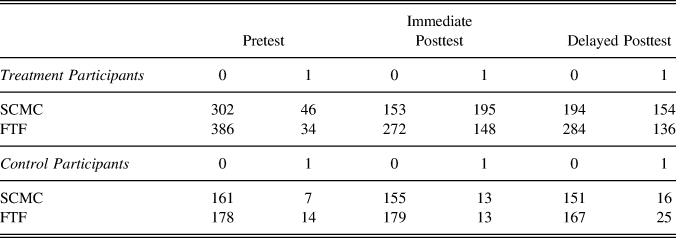
The second research question focused on how the alignment sessions may affect subsequent production of the stranded preposition constructions in RCs on the two posttests. It further asked whether the modality of the treatment sessions, students’ WMC, preexisting knowledge of the target structure, overall language proficiency, and the degree of alignment impact the alignment effects on the learning of stranded prepositions in RCs. Table 4 displays the frequency of stranded preposition construction production for students in the four different conditions for all three of the production tests. As can be seen, FTF and SCMC students who participated in the alignment sessions produced more stranded preposition constructions on the immediate and delayed posttests when compared to their respective pretest scores. Both these groups also scored higher on the immediate and delayed posttests when compared to their respective control conditions.
Descriptive statistics production scores during production tests

Note: A score of 0 indicates a construction that did not include a stranded preposition, whereas a score of 1 indicates a construction including a stranded preposition.
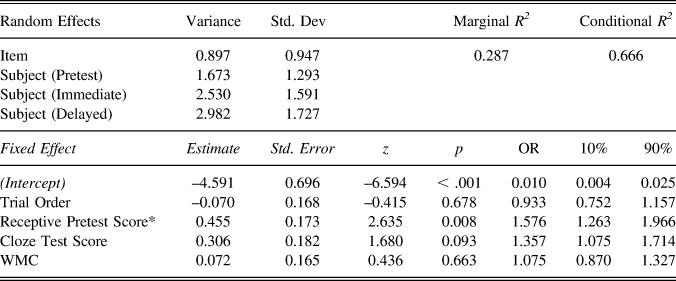
To test if these differences were significant, two GLME models were fit to the production data using the variables described previously (one model with all students, and one model with only students in the experimental condition). The GLME model including students in both control and experimental groups reported a significant main effect for receptive pretest scores, with odds ratios indicating that each increase in receptive pretest score predicted a 1.576 greater likelihood of producing a stranded preposition construction on one of the production tests. In addition, the three-way interaction between modality, group, and test order was significant. Follow-up post-hoc comparisons were then conducted using the emmeans package to examine possible learning effects within each of the groups, compare these results between the control and experimental students, and compare between the SCMC and FTF contexts. Table 5 displays the coefficients, z values, p values, odds ratio, and confidence intervals for the main effects, as well as the random effects summary for this model. The random effects structure indicated greater variance for students (with a random slope for test order) when compared to items. This model reported a marginal R 2 of .287 and a conditional R 2 of .666.

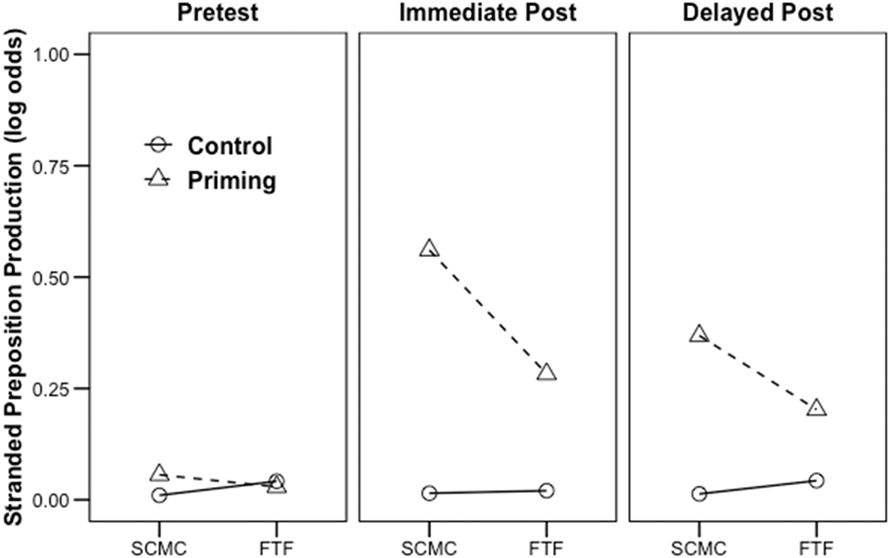
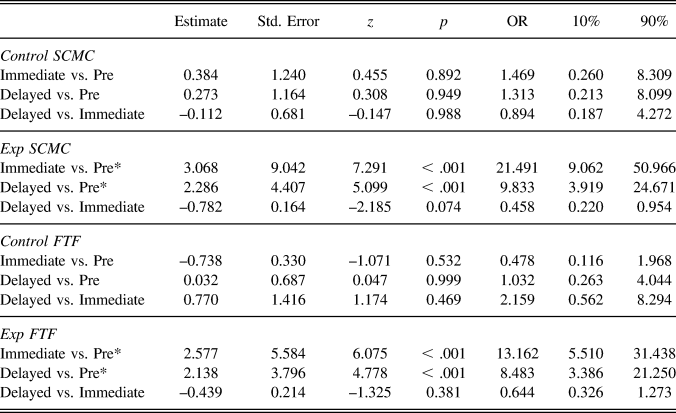
Figure 2 visualizes the significant interaction between test order, modality, and group. Because the GLMER output from R does not facilitate simple presentation of the contrasts involved in three-way interactions, we report the within- and between-group comparisons from this model in two separate tables. Table 6 displays the results from pairwise comparisons within groups. These comparisons reported no significant differences among the three production tests for control students in both the SCMC and FTF modalities, while students in both the experimental SCMC and FTF groups demonstrated significantly higher likelihood of producing a stranded preposition construction on the immediate posttest and delayed posttest when compared to the pretest. Specifically, odds ratios report that the experimental SCMC students had a 21.491 times greater likelihood to produce a stranded preposition construction on the immediate posttest and a 9.833 times greater likelihood on the delayed posttest when compared to the pretest. The experimental FTF students had smaller effects, with a 13.162 times greater likelihood to produce a stranded preposition construction on the immediate posttest and a 8.483 times greater likelihood on the delayed posttest when compared to the pretest. There were no significant differences between performance on the immediate and delayed posttests for any of the students in the experimental groups.
Three-way interaction between groups (experimental vs. control), modalities (SCMC vs. FTF), and production test order.
Note: Pairwise comparisons reported no significant differences among the four groups during the pretest and no significant differences among all three tests for participants in the control condition. Participants in the experimental condition were significantly more likely to produce stranded preposition constructions on the immediate and delayed posttests when compared to their pretest scores, and these participants were also significantly more likely to produce stranded preposition constructions on the immediate posttest when compared to their respective control conditions. SCMC experimental participants were also significantly more likely to produce a stranded preposition construction on the delayed posttest when compared to their respective control condition, and this difference failed to reach significance for the corresponding contrast between the FTF participants (based on adjusted p values).

Within group comparisons for production test performance

Note: Model intercept = –4.591. Adjusted p values reported for multiple comparisons using Tukey method from the emmeans package. Terms on left side of vs. are baselines for each comparison.
* Significant effect
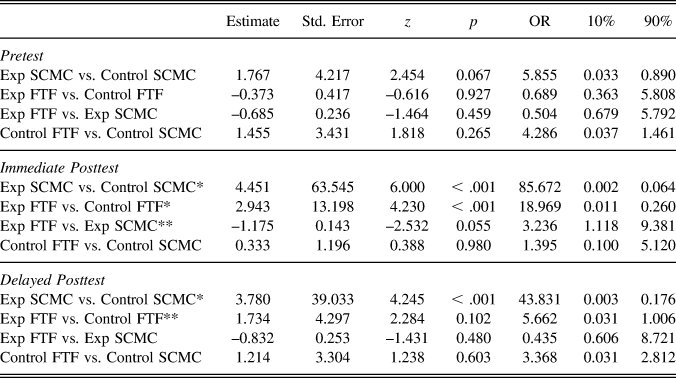
Table 7 reports the pairwise comparisons between the different groups and included no significant differences among the students for stranded preposition production during the production pretest. Significant differences were reported for the immediate posttest, with odds ratios reporting experimental SCMC and FTF students having a significantly greater likelihood (85.672 and 18.969 times greater, respectively) of producing a stranded preposition when compared to the control SCMC and FTF students. For the delayed posttest, there was a significant difference between the experimental and control SCMC students, with odds ratios reporting experimental SCMC students were 43.831 more likely to producing a stranded preposition construction on the delayed posttest when compared to SCMC control students. While the corresponding difference between the experimental and control FTF students failed to reach significance based on adjusted p values (p = .102), the z value and odds ratio still suggests a meaningful difference between the two groups, with students in the FTF experimental condition reporting a 5.662 greater likelihood to produce a stranded preposition construction when compared to the control students.
Between group comparisons for production test performance

Note: Model intercept = –4.591. Adjusted p values reported for multiple comparisons using Tukey method from the emmeans package. Terms on left side of vs. are baselines for each comparison. The odds ratio for the comparison between experimental participants during the immediate posttest was manually converted into a positive ratio (1/OR) for ease of interpretation (original value = 0.309).
* Significant effect
** Nonsignificant yet meaningful effect
In terms of comparisons between modalities within the same groups, there were no significant differences between control SCMC and FTF participants on either the immediate or delayed posttests. The difference between the experimental SCMC and FTF students on the immediate posttest was not significant based on the adjusted p value (p = .055), but the odds ratio and z value suggest a meaningful yet small difference between the two groups, with the experimental SCMC students having a 3.236 times greater likelihood of producing a stranded preposition construction when compared to the experimental FTF group on the immediate posttest. Finally, there were no significant differences between the experimental SCMC and FTF students on the delayed posttest.
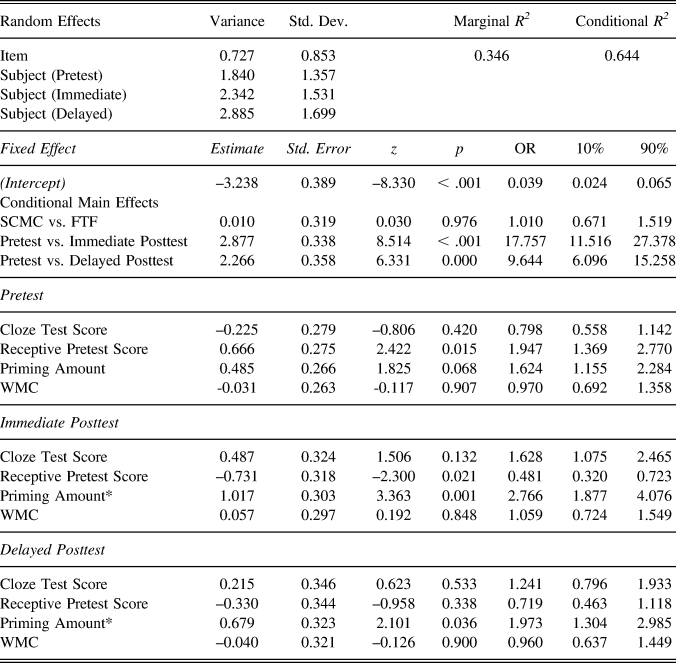
A final model was fit using only the data from the participants in the experimental condition to test whether any of the learner characteristics (receptive knowledge, cloze test scores, WMC, and amount of alignment) influenced production of stranded preposition constructions during the production tests. A model fit with main effects only reported a significant, positive effect for amount of alignment (Intercept = –1.530, Estimate = 1.151, Std. Error = 0.190, z = 6.082, p < .001, OR = 3.160, 10% = 2.480, 90% = 4.028, model marginal R 2 = .171, conditional R 2 = .662). There were no other significant main effects. A model fit with the interactions specified in the preceding text included a significant interaction between amount of alignment and test order, in that each increase in amount of alignment predicted a significantly higher likelihood for students to produce stranded preposition constructions on the immediate (2.766 times greater) and delayed (1.973 time greater) posttests when compared to the pretest. There was no significant difference between the immediate and delayed posttests. Table 8 displays the coefficients, z values, p values, odds ratio, and confidence intervals, as well as the random effects summary for this model. The random effects structure indicated greater variance for students (with a random slope for test order) when compared to items. This model reported a marginal R 2 of .346 and a conditional R 2 of .644.
GLME testing effects of learner characteristics on production tests for participants in the experimental group

Note: Conditional main effects do not represent true main effects as these terms are included as interactions in the model. Follow-up comparison using the multcomp package to compare the effect of priming amount on the immediate versus delayed posttests found no significant difference (Estimate = –0.338, Std. Error = .279, z = –1.214, p = .225, OR = 0 .713, 10 = –0.796, 90% = 0.120). The main effect for amount of priming from a main effects only model was significant (Intercept = –1.530, Estimate = 1.151, Std. Error = 0.190, z = 6.082, p < .001, OR = 3.160, 10% = 2.480, 90% = 4.028, model marginal R 2 = .171, conditional R 2 = .662).
In sum, the results suggest that structural alignment occurred regardless of modality, and that students in the SCMC context demonstrated stronger magnitude of alignment when compared to the FTF students (as evidenced by significantly higher likelihood to produce stranded prepositions during prime trials). In terms of learning effects, both the experimental groups outperformed their respective control groups based on their production of stranded prepositions, with the SCMC students significantly outperforming the control group on both immediate and delayed posttests, and the FTF students significantly outperforming the control group on the immediate posttest only (however, the effect size for this comparison on the delayed posttest suggests this difference may still be meaningful). In the same light, while there was no significant difference between FTF and SCMC on their gains both on the immediate and delayed posttests, the effect size between the groups’ performance on the immediate posttest suggests that the SCMC group may have outperformed the FTF group. In terms of the learner characteristics, all students’ scores on the receptive test was a significant predictor during the production tests, but this effect did not hold when examining the performance for only the students in the experimental groups, where the amount of alignment then became the strongest predictor and potentially subsumed the variance explained by receptive pretest scores.
Discussion
The purpose of the study was to investigate the occurrence of structural alignment in two interaction modes (i.e., FTF and SCMC) as well as the effects of alignment on the subsequent learning of stranded prepositions in RCs. Furthermore, we also investigated whether certain learner characteristics (i.e., preexisting knowledge of the target structure, general English proficiency, and WMC) and amount of alignment would mediate any effects. Structural alignment was operationalized as the production of stranded prepositions in RCs after hearing or reading a prime sentence during interactive tasks between students and the researchers.
Regarding the first research question, results indicate that primed production was significantly more likely following primes when compared to fillers, and this finding was consistent regardless of the interaction mode. These results align with previous L2 speech production studies illustrating the occurrence of significantly more primed production than unprimed production of target grammatical features when compared to a filler such as passives and wh-questions with inversion (Conroy & Antón-Méndez, Reference Conroy and Antón-Méndez2015; Kim & McDonough, Reference Kim and McDonough2008; McDonough, Reference McDonough2005; McDonough & Kim, Reference McDonough and Kim2009). Furthermore, these findings support Michel and Smith’s (Reference Michel, Smith, Gass, Spinner and Behney2018) results in that structural alignment occurs in an L2 SCMC context when using the same alignment materials as in FTF interactions.
In addition, the current study found a significant interaction between modality and the magnitude of alignment that occurred during interactive alignment tasks. More specifically, the SCMC context facilitated a significantly greater degrees of alignment than the FTF context (see Table 3 and Figure 1). This particular observation is not in accordance with that from previous L1 research, which showed that structural alignment effects were not markedly different between the written and spoken modes (Cleland & Pickering, Reference Cleland and Pickering2006). Instead, the findings from L1 research comparing oral and written modes suggest that the processing involved during written and spoken dialogues among adult L1 speakers is similar; whereas the differing magnitude of alignment in the two modalities of dialogue with L2 students found in this study may suggest that L2 speakers process syntax differently during different modes of L2 interactions such as speaking and writing. However, although SCMC in this study involved written dialogues, it is very different from how L1 studies examined written dialogue (e.g., sentence completion task on the computer after reading primes on the screen). For instance, the SCMC condition in the current study allowed the students to scroll up and down, and several interactional turns still remained on the screen while students were completing target sentences after prime sentences. Therefore, it was possible for students in this condition to refer to previous turns while formulating their replies, and this may further explain the enhanced alignment effects found in this condition when compared to the FTF condition.
Another possible explanation for the difference between SCMC and FTF students in this study may be related to whether students use implicit or explicit memory processes in different interaction modes. Hartsuiker and Bernolet (Reference Hartsuiker and Bernolet2017) claimed the presence of an explicit memory component to alignment in addition to a more abstract component, and that L2 speakers are likely to rely on explicit memory strategies when they have not formed abstract representations of a structure in L2 and so are highly uncertain about how to formulate appropriate sentences. Such explicit memory strategies are particularly likely when it is easier to copy and slightly adjust the prime response to convey the relevant message. Therefore, it may be that explicit memory strategies were more successful in SCMC interactions when compared to FTF interactions. Furthermore, previous SCMC studies have suggested that text-chat might facilitate L2 learners’ noticing of linguistic forms, as learners have more time to process written input compared to oral input during FTF interaction (see Sauro, Reference Sauro2011 and Ziegler, Reference Ziegler2016). Thus, the greater degree of alignment observed in the SCMC mode may be a result of SCMC students consciously noticing the stranded preposition structure more so than the FTF students.
One additional potential explanation for why SCMC was a more facilitative context for the occurrence of alignment in the current study is that the students were all Korean learners of English who were accustomed to explicit grammar instruction and translation analytic strategies used during their experiences learning English in the Korean education system. This experience might have resulted in an enhanced grammatical sensitivity, and thus the SCMC students may have been more able to employ familiar language learning strategies related to translating written texts and analyzing the structure of input they encounter in their classrooms. In other words, this may have led students in the SCMC condition to utilize strategies unavailable to those in the FTF condition, which in turn facilitated a strengthening of their mental representations of the target form, and subsequently the occurrence of structural alignment. This suggests that alignment in text-chat contexts might tap into different cognitive processes and strategies than those used during FTF interaction. This question should be further examined in future studies using different data sources such as stimulated recall, interviews, eye-tracking data, or knowledge source judgment questionnaire (Marsden, Williams, & Liu, 2013), which can provide further insights into how learners process primes in different modes of communication.
In terms of learning outcomes, the findings that both experimental groups outperformed the control group on the immediate posttest and that the SCMC students outperformed the control group on the delayed posttests suggest the short-term and some long-term benefits of alignment for the acquisition of stranded prepositions in RCs regardless of modality. Moreover, while there were no significant differences between modalities for the experimental groups on the immediate or delayed posttest reported using adjusted p values, effect sizes suggest that there was a stronger effect for SCMC students on the immediate posttest when compared to FTF students. A lack of a significant difference between the two modalities might be due to the way that we operationalized the subsequent learning of stranded prepositions in RCs. In the current study, we treated the stranded prepositions in RCs as constructions and analyzed the production of these constructions in terms of suppliance rather than accurate production only to focus on the mental representation of constructions.
The current study expands L2 alignment literature in terms of target structures by studying RCs containing stranded prepositions (i.e., oblique RCs), which is considered a complex and abstract construction for Korean EFL learners because they have to simultaneously account for the processing of RCs as well as verb argument constructions. Previous research has suggested that the processing asymmetry between different types of English RCs is largely attributable to the linear distance between the head and the gap in RCs (the distance factor; O’Grady, Reference O’Grady and Kidd2011). Specifically, O’Grady and his colleagues proposed that the difficulty of processing a RC increases with the length of the filler-gap dependency. Thus, oblique RCs draw on more integration resources than direct object RCs (the nontargetlike interlanguage form in this study) because they have more intervening lexical items to process between the filler and the gap. This may in turn require more time to connect the filler with the empty gap, thus creating a burden on syntactic processing before the dependency can be resolved (Kim & O’Grady, Reference Kim and O’Grady2016). Furthermore, the use of stranded prepositions in RCs requires not only the processing of RCs but also the correct co-indexation of verb, noun, and preposition (e.g., Students learn words from dictionaries), which makes the structure difficult to acquire. Our findings may indicate that the alignment activities, whether in FTF or SCMC, were helpful in processing, detecting, and eventually acquiring syntactically complex structures such as stranded prepositions in RCs as evidenced by the increased subsequent production during the immediate and delayed posttests when compared to that in the pretest. Based on the pretest production data, it was found that the majority of students were not familiar with the target structure. By hearing or reading primes, they were able to detect the constructions, which played a facilitative role for alignment (McDonough & Fulga, Reference McDonough and Fulga2015), establish new representations of the stranded preposition in RC structure, or reinforce their initial states of representation.
In the current study, none of the verbs were repeated between the primes and targets, but the same prepositions were used between the primes and targets (e.g., Prime sentence spoken by the researcher: This is something that you purchase food from. Prompt verb that was given to students: select with a picture of a clothes dresser, designed to prompt a sentence such as This is something you select clothes from.). As lexical overlap between primes and targets (i.e., lexical boost) has been found to facilitate alignment effects (McDonough & Kim, Reference McDonough and Kim2009), the students in the current study might have been able to form an abstract construction while hearing or reading verb argument constructions with the same prepositions (e.g., verb + N + from), even with different verbs between primes and targets (i.e., purchase + N + from vs. select + N + from). These findings further suggest the potential of alignment activities in teaching a verb argument construction containing a preposition, which is a highly complex construction for L2 learners.
Another unique contribution of this study is the systematic investigation of how different learner characteristics may interact with structural alignment during alignment tasks using LME modeling. Specifically, previous L2 studies have not examined how previous knowledge of the target structure, L2 proficiency, and working memory may or may not mediate alignment effects systematically. The results from the current study identified production pretest scores as a significant predictor of the amount of primed production. These findings are in line with McDonough and Fulga (Reference McDonough and Fulga2015) in that students' prior knowledge of a target structure was facilitative of the occurrence of priming. The current study also suggests that the amount of primed production was a significant predictor of the subsequent learning of stranded prepositions in RCs. Alignment involves the following procedure: processing primes (i.e., input) and producing primed output. Our finding demonstrates that the amount of primed production significantly contributes to the subsequent production of the target structure, suggesting that actual primed production plays a stronger role in alignment-driven learning when compared to only processing the primes. Future research in this area may want to consider more purposeful investigations of this claim.
In terms of working memory effects, the current study did not find a significant relationship between students’ WMC and the degree of structural alignment. The present finding is similar to another L2 priming study by McDonough et al. (Reference McDonough, Kielstra, Crowther, Smith, Mackey and Marsden2016), which indicated that WMC was not a significant factor for learning unfamiliar constructions through alignment activities. Linguistic alignment during SCMC interactions might not involve students’ working memory because the students had written primes available to review during the task. Also, the current study used an aural running span test, which might not have tapped into the same cognitive memory processes that students in the SCMC contexts may have relied upon. This null finding for working memory may also be due to the nature of the primes used in the current study. We speculate that our prime sentences might be relatively short and thus contained a relatively small amount of information to store and process simultaneously (i.e., seven words on average: This is something that you purchase food from), and thus students might not have needed to draw heavily upon working memory when engaging with the input from the researcher and forming their own sentences. In other words, the distance between the filler and the gap in the current study might not have been significant enough to require complex working memory. Finally, Redick and Lindsey’s meta-analysis of complex span and n-back (e.g., running span, Broadway & Engle, Reference Broadway and Engle2010) measures of WMC suggests that these two types of tests do not necessarily measure the same underlying construct. As one of the anonymous reviewers of this study pointed out, the lack of significant WMC factor in the current study could have been due to the type of WMC test implemented, and the results of the current study should be limited to the use of running span. To validate this speculation, future studies are warranted to target more complex RCs with additional clauses.
Conclusion
In sum, findings from the current study suggests that L2 learners’ processing of primes is influenced by the modality of communication (i.e., FTF and SCMC), and that alignment effects are more facilitated by SCMC contexts when compared to FTF contexts. In terms of learning outcomes, students in both the SCMC and FTF alignment groups demonstrated a significantly greater likelihood of producing a stranded preposition on the immediate and delayed posttests when compared to their pretest scores, whereas the control participants reported no significant differences among their production test scores. Moreover, the SCMC alignment students also significantly outperformed their respective control group on both the immediate and delayed posttest, with the FTF alignment students only doing so on the immediate posttest. Additionally, the current study highlights the role of prior knowledge on the occurrence of linguistic alignment, and also suggests that the amount of primed production is a significant factor in subsequent alignment-driven learning.
There are several limitations that need to be acknowledged. First, as addressed previously, additional data from stimulated recalls or eye-tracking techniques that may account for language processing during alignment task performance would have contributed to our deeper understanding of the nature of alignment. Additionally, although our task was meaning-focused task with expected outcomes (i.e., guessing the item being described), it was to some extent a very controlled task. Future research would benefit from implementing various types of communicative tasks that elicit more natural interactions in both FTF and SCMC contexts.
The next step in this line of research is to examine the implicit or explicit nature of linguistic alignment with L2 learners because SCMC might elicit more explicit memory and noticing of the target features. Additional data using various methods are necessary to achieve this goal. Furthermore, the current study needs to be replicated with different target features and/or with diverse learner populations. Foreign language learners might process primes differently compared to second language learners, particularly in SCMC mode; therefore, whether similar results would be found with learners who have received L2 input in naturalistic contexts needs to be further investigated.
APPENDIX A
TARGET VOCABULARY IN THE PRODUCTION TESTS

APPENDIX B
TARGET VOCABULARY IN THE PRIMING TASKS