





Introduction
Task-based language teaching (TBLT) is widely valued for fostering active learner engagement. Engagement, broadly understood as active participation and involvement in learning activities (Hiver et al., Reference Hiver, Al-Hoorie, Vitta and Wu2021; Philp & Duchesne, Reference Philp and Duchesne2016), has been theorized as a prerequisite for successful second language (L2) acquisition (Dörnyei & Kormos, Reference Dörnyei and Kormos2000) and gained increasing prominence in language learning research (Hiver et al., Reference Hiver, Al-Hoorie, Vitta and Wu2021), particularly within TBLT (for a comprehensive overview, see Hiver et al., Reference Hiver, Dao and Yamazaki2025; Qiu, Reference Qiu2025).
While considerable empirical effort has been devoted to examining how tasks can promote engagement, less is understood about how task engagement relates to L2 learning outcomes (Qiu, Reference Qiu2025). In investigating such links, greater transparency in the operationalization of engagement may help address methodological challenges highlighted in recent studies (Aoyama et al., Reference Aoyama, Yamazaki, Nakamura, Vuogan, An, Kim and Al-Hoorie2024; Qiu, Reference Qiu2025).
Extending Suzuki and Nakamura (Reference Suzuki and Nakamura2026), the present study examines the role of engagement in mediating the relationship between vocabulary support and lexical learning in interactive information-gap tasks. In doing so, we propose a task-driven composite approach to operationalizing engagement, which supports pedagogically interpretable findings while retaining the visibility of the specific behaviors that constitute engagement.
Literature review
Engagement–learning link in task-based language teaching
To date, a substantial body of TBLT research has examined factors shaping task engagement (Qiu, Reference Qiu2025), including task features and task types (e.g., Lambert et al., Reference Lambert, Philp and Nakamura2016; Nakamura et al., Reference Nakamura, Phung and Reinders2020) as well as learner variables (e.g., Aubrey et al., Reference Aubrey, Lambert and Leeming2020; Dao & McDonough, Reference Dao and McDonough2018). An emerging line of research has also begun to examine the outcomes of task engagement. Recent studies have investigated how engagement relates to L2 learning outcomes in relation to task-related factors, such as task type (Newton, Reference Newton2013), content (Lambert & Aubrey, Reference Lambert and Aubrey2025), and design (Phan & Dao, Reference Phan and Dao2023), as well as learner-related factors, such as self-reference (Qahl & Lambert, Reference Qahl and Lambert2025) and task motivation (Hiver & Dao, Reference Hiver and Dao2025).
The present study contributes to these lines of inquiry by examining an underexplored feature of the TBLT framework, that is, explicit lexical support provided before and during task performance. It investigates how such support may shape learners’ engagement in information-gap tasks and how engagement may relate to lexical learning. TBLT implementations vary in the extent to which linguistic support is provided before task performance. The inclusion of pre-task lexical support in the present study may align with task-supported language teaching (TSLT), which incorporates a brief focus on form prior to task performance (Li et al., Reference Li, Ellis and Zhu2016).
Pedagogically, TBLT frameworks are expected to offer teachers multiple options for task implementation. Understanding how support mechanisms shape learner engagement and subsequent learning can provide useful guidance for instructional design. To this end, findings from task engagement research should be pedagogically interpretable.
Operational challenges in task engagement research
To date, task engagement has commonly been researched based on Philp and Duchesne’s (Reference Philp and Duchesne2016) multidimensional model, which conceptualizes engagement as a multifaceted construct involving behavioral, cognitive, social, and affective dimensions. Within this framework, task engagement is often operationalized through discourse-analytic indicators (i.e., indicators identified in learners’ transcribed interaction during the task), which are assigned a priori to specific dimensions. For example, the number of words produced during the task is often used as an indicator of behavioral engagement, whereas instances of negotiation of meaning or form are typically interpreted as indicators of cognitive engagement (see Lambert & Aubrey, Reference Lambert, Aubrey, Lambert, Aubrey and Bui2023, for a comprehensive review). Selected indicators are then pre-grouped according to the dimensions they are assumed to represent. Findings are then frequently summarized and discussed at the dimensional level.
While the dimensional approach has generated valuable insights and supported the accumulation of findings across studies through meta-analyses and systematic reviews (Hiver et al., Reference Hiver, Al-Hoorie, Vitta and Wu2021; Okunuki & Kashimura, Reference Okunuki and Kashimura2024; Qiu, Reference Qiu2025), two aspects of this methodology warrant further attention. The first concerns the visibility and consistency of task engagement operationalizations. As demonstrated in recent reviews (Qiu, Reference Qiu2025), operationalizations of engagement dimensions vary considerably across studies, with different sets of indicators used to represent individual dimensions and some inconsistencies noted (Aoyama et al., Reference Aoyama, Yamazaki, Nakamura, Vuogan, An, Kim and Al-Hoorie2024). As a result, summarizing findings at the dimensional level may obscure important variation in the specific indicators used to operationalize engagement, making it difficult to build a cumulative and concrete understanding of task engagement across studies.
The second aspect concerns pedagogical interpretability when findings are reported primarily at the dimensional level. For instructors working within TBLT frameworks, understanding how learners engage in concrete task behaviors (e.g., actively using target lexical items through interaction) may be more informative than knowing whether a task increased or decreased a particular engagement dimension (e.g., behavioral engagement). Similarly, descriptions of specific engagement behaviors that are closely linked to task features may offer more direct insight into instructional design decisions.
These considerations suggest the potential value of an approach that maintains the clarity of the indicators used to operationalize engagement while summarizing them in a contextually interpretable and pedagogically meaningful manner.
The current study
This study aims to contribute to task engagement research in two ways. First, it aims to enhance the methodological visibility and pedagogical interpretability of engagement operationalization by adopting a task-driven composite approach in which task-specific discourse-analytic indicators are summarized through principal component analysis (PCA).
Second, it seeks to shed light on the under-researched link between explicit vocabulary support, engagement in interactive information-gap tasks, and task-based L2 lexical learning outcomes. To this end, the following research questions (RQs) are addressed:
RQ1. How do students engage in interactive information-gap tasks, as reflected in observed engagement indicators?
RQ2. To what extent does task engagement mediate the effect of vocabulary support on task-based lexical learning?
Methods
The dataset used in the present study is drawn from Suzuki and Nakamura (Reference Suzuki and Nakamura2026), who examined the effects of explicit vocabulary support during interactive information-gap tasks on L2 lexical learning and affective responses to tasks (i.e., task emotions, perceived task difficulty, and perceived partner collaborativeness). The present study uses the lexical learning component of this dataset and extends the original design by incorporating a new analysis of learners’ engagement behaviors based on discourse data from the task interactions.
Participants
The participants were 66 Japanese university studentsFootnote 1 (38 male, 28 female; mean age = 19.42 years, SD = 1.19) enrolled in six intact English communication courses. The cohort represented a range of academic majors, primarily liberal arts (25.0%), agriculture (25.1%), and international business (20.6%). Their English proficiency, based on TOEICFootnote 2 test scores converted to the Common European Framework of Reference for Languages (CEFR; Educational Testing Service, 2025), was predominantly at the A2 level (77.3%), with smaller cohorts at the A1 (6.1%) and B1 (10.6%) levels; TOEIC scores were unavailable for four students.
The six classes were assigned to one of two conditions: a task-only group (three classes, n = 36) or a vocabulary-support group (three classes, n = 30). To ensure proficiency was balanced within the interactive dyads, students were paired based on their scores from the junior English Minimal Test (jMET), a validated dictation test of general English proficiency (Goto et al., Reference Goto, Maki and Kasai2010).
An independent-samples Welch t-test, using jMET scores, showed no significant proficiency difference between the vocabulary-support and control groups (t(60.28) = 0.51, p = .61). A Shapiro–Wilk test indicated that jMET scores were normally distributed (W = .99, p = .80).
Materials
Information-gap tasks. Two interactive information-gap tasks, titled “Company Spy” and “Museum Thief,” were adapted from the TBLT textbook by Kelly and Suzuki (Reference Kelly and Suzuki2024). As shown in Figure 1, learners were organized into pairs, with one student acting as the “sender” and the other as the “receiver.” The sender, provided with a series of pictures depicting a spy’s or thief’s actions with corresponding time stamps, described the events to the receiver, who then had to plot the information onto a corresponding map of the location. The objective was for the pair to collaboratively reconstruct the sequence of events. To ensure each learner experienced both roles, students acted as the sender for one task and the receiver for the other. Learners were instructed to interact in English during the tasks, and 20 min were allocated to complete each task.
Information-gap tasks: Company Spy (top) and Museum Thief (bottom).

Target collocation list. In the vocabulary-support condition, learners were provided with a list of the useful collocations corresponding to key actions in the task materials (Appendix A in the Online Supplementary Material). The list served as optional linguistic support to facilitate task completion, and learners were free to use their own lexical resources in addition to the provided expressions. The list consisted of 16 verb–noun collocations, with eight items designated for each task (Company Spy and Museum Thief). These items (e.g., climb a ladder, release sleeping gas) were selected for their functional relevance to successful task completion rather than on strict statistical grounds, aligning with a view of formulaic language that prioritizes contextual utility (Wood, Reference Wood and Webb2019). The constituent verbs and nouns were high-frequency words drawn from the top 1,000 word families of the British National Corpus (BNC)/Corpus of Contemporary American English (COCA) word family lists (Nation, Reference Nation2017), and the verb–noun combinations were reviewed by a native English speaker, who confirmed them as natural and appropriate expressions for describing the target scenes in the task materials. A previous study that employed longer versions of the same information-gap tasks found that Japanese university learners did not consistently produce these specific combinations (Suzuki et al., Reference Suzuki, Nozawa, Uchihara, Nakamura, Miyazaki and Jeong2025). Taken together, we anticipated that although the learners in the current study might recognize the individual words within the verb–noun combinations, they would struggle to produce these specific combinations spontaneously, and that vocabulary support would therefore lead to greater use of the target collocations during task performance. Although some combinations may be less common in A2-level materials, they were considered suitable pedagogical targets in this study.
Lexical knowledge test. To measure gains in collocational knowledge, a written production test was administered before and after the tasks. The pretest and posttest were identical in content, each containing the 16 target collocations and 8 distractor items, with the item order randomized between administrations. For each item, learners were given a Japanese phrase and required to write the corresponding English collocation in blank spaces, cued with the first letter and word length (e.g., カメラのスイッチを切る = (s _ _ _ _ _) (o _ _) a (c _ _ _ _ _)). This form-recall format was designed to assess productive knowledge of the target forms. The complete test is available in Appendix B in the Online Supplementary Material.
Operationalization of task engagement: A task-driven composite approach
In this study, we operationalized task engagement through a task-driven composite approach. This approach begins with identifying discourse-analytic indicators that reflect learners’ active participation and involvement in the task. The focus on behaviors draws on theoretical views that emphasize action as a core characteristic of engagement (Hiver et al., Reference Hiver, Al-Hoorie, Vitta and Wu2021; Oga-Baldwin, Reference Oga-Baldwin2019). Next, the identified indicators were subjected to PCA to group co-occurring indicators into composite behavioral patterns. These composite behavioral patterns, commonly referred to as components in PCA practice, are alternative forms of the original variables (DeVellis & Thorpe, Reference DeVellis and Thorpe2021), representing the unique engagement manifested in the specific task context. As such, the term, composite, in this study denotes the summarization of multiple observable task-specific discourse-analytic indicators into broader engagement patterns (for detailed discussions of composite modeling, see, e.g., Alamer et al., Reference Alamer, Schuberth and Henseler2024).
Methodologically, this operationalization offers contextualized measures of task engagement, supporting the task-dependent nature of engagement emphasized in the literature (Aoyama et al., Reference Aoyama, Yamazaki, Nakamura, Vuogan, An, Kim and Al-Hoorie2024; Hiver et al., Reference Hiver, Dao and Yamazaki2025). The grouping of indicators was treated as exploratory, as the study aimed to identify patterns of co-occurring engagement behaviors in this particular dataset. To preserve the visibility of the behaviors that constitute the operationalization of engagement, the components are described primarily in terms of the specific indicators.
Analysis
To investigate how engagement was represented through observable interactional behaviors during the task (RQ1), we employed a two-phase qualitative-quantitative procedure based on the task-driven composite operationalization of task engagement. The first phase was qualitative, aimed at identifying discourse-analytic engagement indicators that were characterized by the specific task demands while being informed by the literature on task engagement. As such, the analysis proceeded in the following steps. First, the learners’ audio-recorded task performances were transcribed using a verbatim transcription method.Footnote 3 Next, three sets of transcripts (i.e., a total of 12 task performances by six students) were read through and qualitatively examined to identify engagement indicators based on the literature on task engagement (Aoyama et al., Reference Aoyama, Yamazaki, Nakamura, Vuogan, An, Kim and Al-Hoorie2024; Philp & Duchesne, Reference Philp and Duchesne2016; Qiu, Reference Qiu2025; Reinders & Nakamura, Reference Reinders, Nakamura, Mercer and Gregersen2021) and previous studies adopting discourse-analytic measures of task engagement (e.g., Lambert & Aubrey, Reference Lambert, Aubrey, Lambert, Aubrey and Bui2023; Lambert et al., Reference Lambert, Philp and Nakamura2016; Nakamura et al., Reference Nakamura, Phung and Reinders2020; Trofimovich et al., Reference Trofimovich, Tekin and McDonough2021). For the indicators identified in the transcripts, we further examined their roles in relation to key elements of this study, such as the interactive nature of information-gap tasks and typical discourse sequences, as well as the provision of collocation lists. Through multiple discussions and reexaminations, eight indicators were established as initial measures of task engagement. Accordingly, a coding manual was developed, detailing the definitions of these indicators and outlining the coding rules and instructions.
The second phase was primarily quantitative, coding the occurrences of these indicators in the transcripts and using PCA to group indicators parsimoniously. First, using the manual and coded transcripts, we trained an independent coder, a senior undergraduate student majoring in applied linguistics.Footnote 4 Then, the coder and the first author independently coded transcripts from seven pairs (> 20% of the dataset) to assess the inter-rater reliability. Krippendorff’s alpha was .99, indicating near-perfect agreement (Krippendorff, Reference Krippendorff2004). For collocation use, which involved not only identifying occurrences but also assigning partial scores (e.g., 0.5 when only the verb or noun was used), the intraclass correlation coefficient [ICC(2,1)] was computed. The result revealed an ICC of 1.00 (95% CI [1.00, 1.00]), indicating perfect agreement (Koo & Li, Reference Koo and Li2016). The remaining data were coded by the independent coder. During the coding process, any unclear cases were discussed and resolved collaboratively, ensuring consistent application of the coding scheme. The occurrences of indicators for each pair were normalized by the time on task to compute engagement scores for individual students.
The engagement scores were then entered into a PCA. To determine the number of components to retain, we used a parallel analysis based on principal components, which provides a more robust criterion than the traditional eigenvalue-greater-than-one rule (DeVellis & Thorpe, Reference DeVellis and Thorpe2021; Patil et al., Reference Patil, Singh, Mishra and Donavan2008). An oblique rotation, Oblimin, was applied to allow for correlations among components. Simultaneously, the correlation matrix was examined to understand relationships among indicators (see Appendix C in the Online Supplementary Material). To examine the stability of the final PCA loading pattern, we conducted a bootstrap-based stability check using 1,000 resamples. Tucker’s congruence coefficient was used to assess the similarity of the component loading patterns, following the guidelines proposed by Lorenzo-Seva and Berge (Reference Lorenzo-Seva and ten Berge2006): Values from .85 to .94 indicate fair similarity, whereas values higher than .95 indicate that components can be considered equivalent.
To create composite scores for each engagement component, we applied a regression-based weighting approach using the component loadings from the PCA. Specifically, each indicator was multiplied by its corresponding loading (i.e., weight) on the relevant principal component, and the weighted scores were summed to generate composite scores. The resulting composite scores were standardized (z-scores) for subsequent analysis.
With regard to RQ2, when exploring how engagement mediated the effect of vocabulary support on lexical learning, we conducted BayesianFootnote 5 regression analyses followed by mediation models using the brms package (Bürkner, Reference Bürkner2017) in R (version 4.4.2).
In the first regression model, the three engagement components derived from PCA served as outcome variables, with vocabulary support as the predictor and L2 proficiency as a covariate. The second model examined the direct path from vocabulary support to lexical learning, and the third model examined direct paths from each engagement component to lexical learning. Pre-task vocabulary scores and grand-mean-centered jMET scores (i.e., L2 proficiency) were included as covariates in these models.
The final analyses consisted of Bayesian mediation models, with vocabulary support as the predictor, an engagement component as the mediator, and post-task vocabulary scores as the outcome. Pre-task vocabulary scores and grand-mean-centered jMET scores were included as covariates in all paths. All variables were standardized before analysis.
Bayesian regression and mediation models were estimated using the brms package (Bürkner, Reference Bürkner2017) with the cmdstanr backend. Models were fitted using four chains with 4,000 iterations each (1,000 warmup).
Default weakly informative priors implemented in brms were used. Flat priors were specified for regression coefficients, while weakly informative Student-t priors were used for intercepts and residual standard deviations, constraining parameters to plausible ranges while remaining robust to outliers (Gelman et al., Reference Gelman, Jakulin, Pittau and Su2008). Full prior specifications for all models are provided in Appendix D in the Online Supplementary Material.
Convergence diagnostics indicated a satisfactory model fit (R̂ = 1.00; high bulk and tail effective sample sizes), with no divergent transitions. Posterior predictive checks (Appendix E in the Online Supplementary Material) indicated that the models reproduced the observed data distributions reasonably well.
Indirect effects were estimated using the mediation() function from the bayestestR package (Makowski et al., Reference Makowski, Ben-Shachar and Lüdecke2019). Following Gignac and Szodorai (Reference Gignac and Szodorai2016), standardized regression coefficients (β) of 0.10, 0.20, and 0.30 were interpreted as small, medium, and large effects, respectively. We applied these benchmarks to relationships between continuous variables. For the paths that involved the condition being a binary predictor (0 = task only, 1 = vocabulary support), effects were interpreted based on the direction and credibility of the posterior estimates.
Results
Engagement in interactive information-gap tasks (RQ1)
Examination of the task performance transcripts identified eight discourse-analytic indicators reflecting how students engaged in the interactive information-gap tasks. Figure 2 presents the indicators with descriptions and representative excerpts.
A list of engagement indicators with descriptions and representative excerpts.
Note: A coding manual is provided in Appendix F in the Online Supplementary Material.

A prominent feature of the interaction was the presence of negotiation moves, as learners worked to resolve communication difficulties and complete the task by identifying missing information and collaboratively filling the information gaps. Such negotiation moves were oriented toward addressing communication breakdowns (i.e., negotiation of meaning; Pica et al., Reference Pica, Holliday, Lewis and Morgenthaler1989), linguistic form (i.e., negotiation of form; Lyster & Ranta, Reference Lyster and Ranta1997), and task-related information (i.e., negotiation of content; Rulon & McCreary, Reference Rulon, McCreary and Day1986).
The negotiation moves were further observed to serve two distinct purposes: clarification and elaboration, reflecting the communicative demands of the information-gap tasks. Clarification moves were observed when learners sought to resolve uncertainty regarding a partner’s prior utterance, whereas elaboration moves arose when additional detail was required to complete the task.
When a partner’s utterance was incomplete or unclear, learners sometimes supplied or refined the utterance, a behavior identified as peer completion. It should be noted that similar behaviors have been described as turn completion (Nakamura et al., Reference Nakamura, Phung and Reinders2020) and responsiveness (Trofimovich et al., Reference Trofimovich, Tekin and McDonough2021) in previous task engagement research.
Given the direct relevance of the target collocations provided as part of the instructional support, learners’ use of target collocations was treated as a distinct engagement indicator, rather than being subsumed under overall lexical production. Similarly, negotiation moves involving target collocations were distinguished from negotiation moves that did not involve target collocations.
Another indicator identified in the transcripts was response confirmation, in which learners signaled that their partner’s utterance had been heard or understood, typically through brief acknowledgments such as “ok” or “yes.” Echoing was also observed, whereby learners repeated information previously provided by their partner. These indicators reflected learners’ responsiveness (Trofimovich et al., Reference Trofimovich, Tekin and McDonough2021) and functioned as small but critical moves that helped learners to proceed from one information gap to the next. Checking-in behaviors were additionally identified when learners verified that their task partner was following or had understood the information provided.
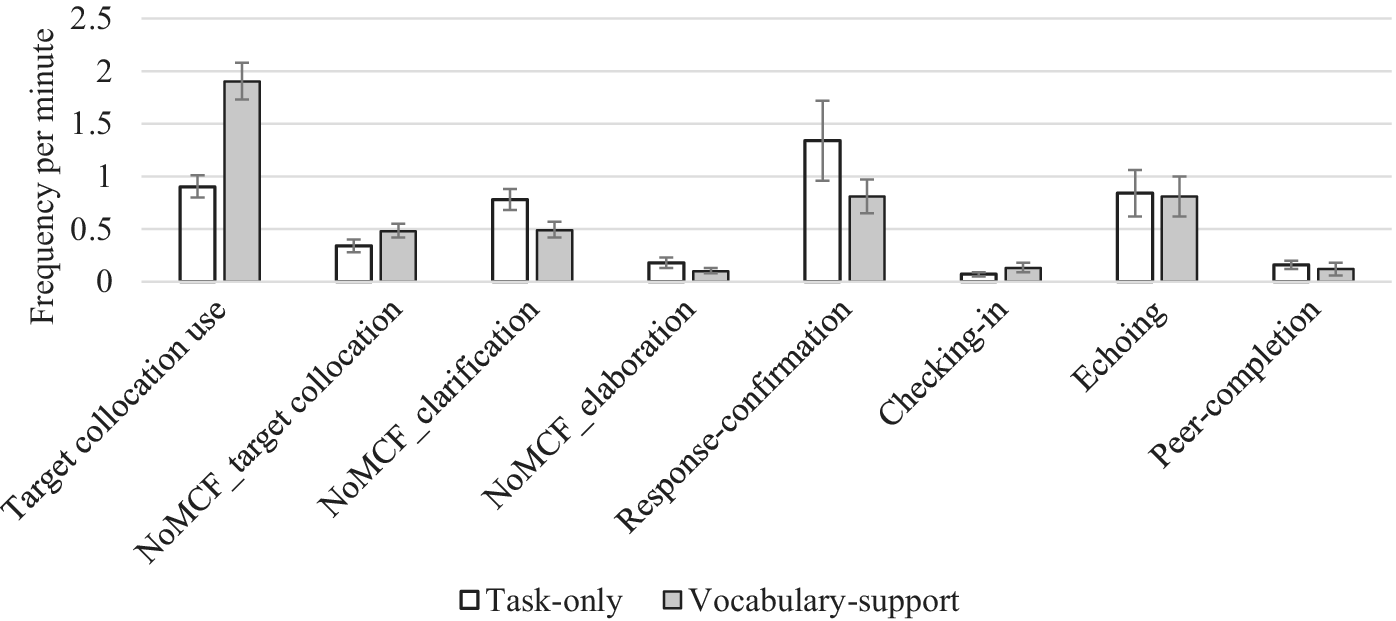
Descriptive statistics for the eight indicators are illustrated in Figure 3, with full values reported in Appendix G in the Online Supplementary Material. While the indicators varied in overall frequency, some tendencies were observable across conditions. For example, target collocation use and collocation-related negotiation moves appeared more frequently in the vocabulary-support condition, whereas peer completion and clarification-oriented negotiation moves appeared more frequently in the task-only condition.
Descriptive statistics for task engagement indicators.
Note: Error bars indicate 95% confidence intervals. NoMCF = negotiation of meaning, content, and form.

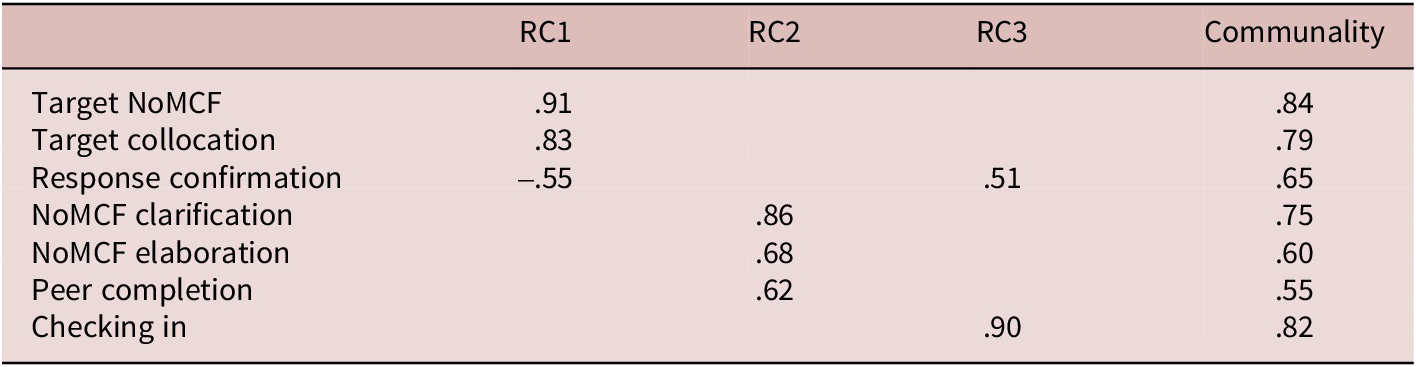
When these scores were analyzed using PCA, the initial PCA revealed that one of the eight indicators, echoing, cross-loaded on two components (loadings = .41 and .69), making it difficult to assign it to a single coherent engagement component. After its removal, the subsequent PCA with the remaining seven indicators yielded a clear and interpretable solution comprising three rotated components (hereafter RC1, RC2, and RC3), as shown in Table 1. The three-component solution explained 73.09% of the total variance. Communalities ranged from .55 to .84, indicating that most indicators were well represented by the retained components. Inspection of the scree plot also supported this three-component solution (see Appendix H in the Online Supplementary Material). Furthermore, the component correlation matrix indicated minimal associations among the components (see Appendix I in the Online Supplementary Material), suggesting that the identified engagement patterns were distinct. The bootstrap-based stability check further supported the overall stability of the three-component PCA solution (see Appendix J in the Online Supplementary Material).
Principal component loadings for engagement indicators

Table 1. Long description
Table 1 reports principal component loadings of .40 or greater for seven engagement indicators across three rotated components, together with communalities. RC1 includes Target NoMCF (.91), target collocation use (.83), and response confirmation (-.55). RC2 includes NoMCF clarification (.86), NoMCF elaboration (.68), and peer completion (.62). RC3 includes checking in (.90) and response confirmation (.51). Communalities are .84 for Target NoMCF, .79 for target collocation use, .65 for response confirmation, .75 for NoMCF clarification, .60 for NoMCF elaboration, .55 for peer completion, and .82 for checking in. RC denotes rotated component, and NoMCF denotes negotiation of meaning, content, and form. The full loading matrix is provided in Appendix K of the Online Supplementary Material.
Note: RC = Rotated component. NoMCF = negotiation of meaning, content, and form. Only loadings ≥ .40 are displayed; the full loading matrix is reported in Appendix K in the Online Supplementary Material.
Taken together, the PCA results indicated that the indicators formed three distinguishable patterns of co-occurring engagement behaviors, as described below:
-
• RC1 reflected collocation-focused engagement, characterized by the use of target collocations in interaction. This component consisted of two indicators: target collocation use and negotiation of meaning, content, and form involving target collocations.
-
• RC2 reflected co-construction of task-relevant information and joint meaning making, characterized by interactional behaviors through which learners collaboratively clarified and elaborated task content. This component consisted of three indicators: negotiation of meaning, content, and form for clarification; negotiation of meaning, content, and form for elaboration; and peer completion.
-
• RC3 reflected task-maintenance behaviors that supported the progression of the interaction. This component consisted of two indicators: response confirmation and checking in.
It should be noted that we retained response confirmation only in RC3, as the negative loading of response confirmation on RC1 suggested that this behavior moved in the opposite direction from the other two indicators in that component.
Mediating role of engagement in the effect of vocabulary support on lexical learning (RQ2)
RC1 (target collocation use + collocation-related negotiation). Initial Bayesian regression analyses showed that vocabulary support had a credible, positive effect on lexical learning (β = 0.77, 95% credible interval [CrI] [0.46, 1.08]). Vocabulary support also had a credible, positive effect on RC1 (β = 1.45, 95% CrI [1.11, 1.79]). In turn, RC1 strongly predicted lexical learning, with a large effect size (β = 0.30, 95% CrI [0.13, 0.47]).
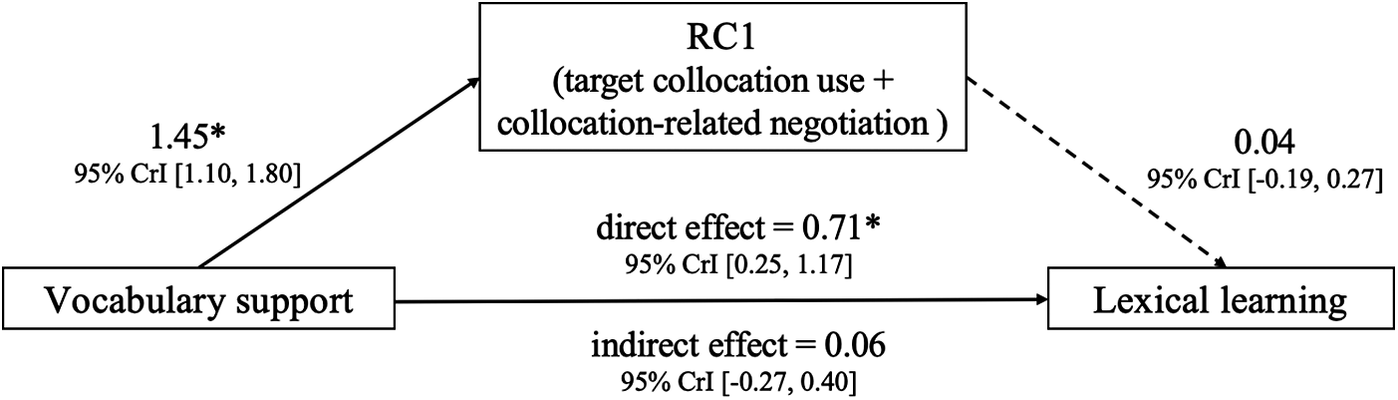
In the final Bayesian mediation model (Figure 4), vocabulary support retained a credible positive effect on RC1 (β = 1.45, 95% CrI [1.10, 1.80]). Vocabulary support also retained a credible positive direct effect on lexical learning even after including RC1 in the model (β = 0.71, 95% CrI [0.25, 1.17]). The indirect effect of vocabulary support on lexical learning via RC1 was weak and non-credible (β = 0.06, 95% CrI [–0.27, 0.40]), suggesting little evidence that RC1 mediated the relationship between vocabulary support and lexical learning.
Mediation model for RC1.
Note: Standardized regression coefficients (β) are presented. Asterisks indicate credible effect (95% CrI does not include zero). Dotted lines represent non-credible pathways.

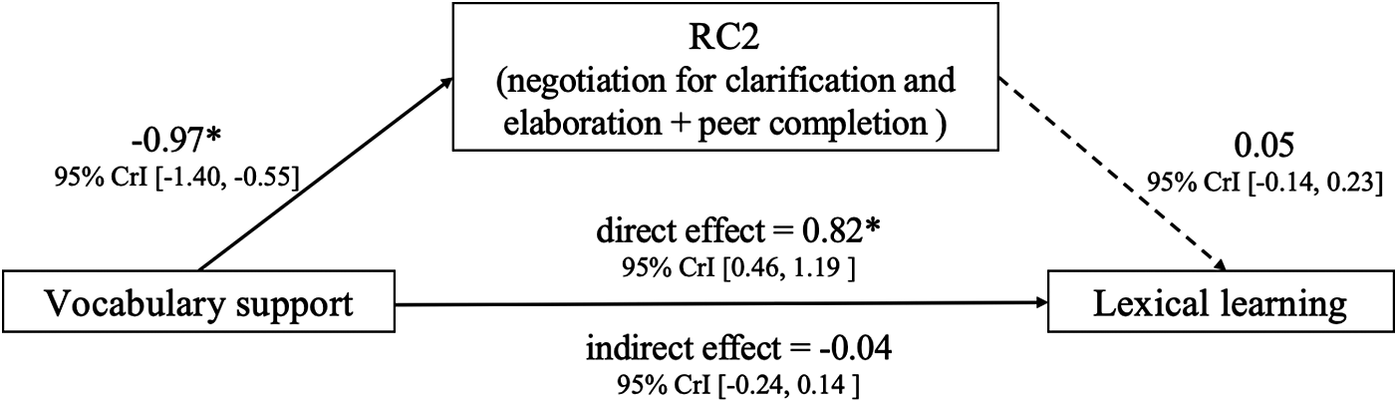
RC2 (negotiation for clarification and elaboration + peer completion). Bayesian regression analyses showed that vocabulary support had a credible, negative effect on RC2 (β = –0.97, 95% CrI [–1.40, –0.54]). While RC2 showed a small positive relationship with lexical learning, the relationship was not credible (β = 0.05, 95% CrI [–0.14, 0.23]).
In the final Bayesian mediation model (Figure 5), vocabulary support retained a credible negative effect on RC2 (β = –0.97, 95% CrI [–1.40, –0.55]) and a positive effect on lexical learning (β = 0.82, 95% CrI [0.46, 1.19]). The indirect effect was weak and non-credible (β = –0.04, 95% CrI [–0.24, 0.14]), showing little evidence for mediation.
Mediation model for RC2.
Note: Standardized regression coefficients (β) are presented. Asterisks indicate credible effect (95% CrI does not include zero).

RC3 (response confirmation + checking in). Vocabulary support showed no credible effect on RC3 (β = –0.45, 95% CrI [–0.93, 0.04]). Similarly, no credible pathway was shown from RC3 to lexical learning (β = –0.16, 95% CrI [–0.34, 0.02]). Accordingly, mediation was not tested.
Discussion
Engagement in interactive information-gap tasks (RQ1)
Our first RQ aimed to identify and describe the ways in which learners engaged in interactive information-gap tasks with greater transparency and interpretability. To this end, task engagement was operationalized using discourse-analytic indicators from the transcripts. Of the eight indicators initially indentified, seven were summarized into three engagement patterns using PCA: RC1 (target collocation use + collocation-related negotiation), RC2 (negotiation for clarification and elaboration + peer completion), and RC3 (response confirmation + checking in).
Notably, these engagement patterns do not appear to map neatly onto the commonly established dimensions of engagement. RC1 seems to reflect features commonly associated with both the behavioral dimension (i.e., production of target lexical items) and the cognitive dimension (i.e., target collocation–related negotiation moves). Similarly, RC2 includes characteristics associated with the social dimension (i.e., peer completion) as well as the cognitive dimension (i.e., negotiation for clarification and elaboration).
On the other hand, the three engagement patterns appear to align closely with the key characteristics of the tasks used in this study. Learners used concrete vocabulary to precisely describe and exchange information contained in the task materials (RC1). Even when they did not possess knowledge of the precise lexical items, they negotiated and co-constructed meaning and information to resolve discrepancies in understanding (RC2). Learners also maintained interaction through response confirmation and checking-in moves that supported the progression of the task (RC3). Taken together, these findings further echo the notion that engagement is context-dependent and shaped by the specific demands of the task (Aoyama et al., Reference Aoyama, Yamazaki, Nakamura, Vuogan, An, Kim and Al-Hoorie2024; Hiver et al., Reference Hiver, Dao and Yamazaki2025; Philp & Duchesne, Reference Philp and Duchesne2016).
Vocabulary support, engagement, and lexical learning (RQ2)
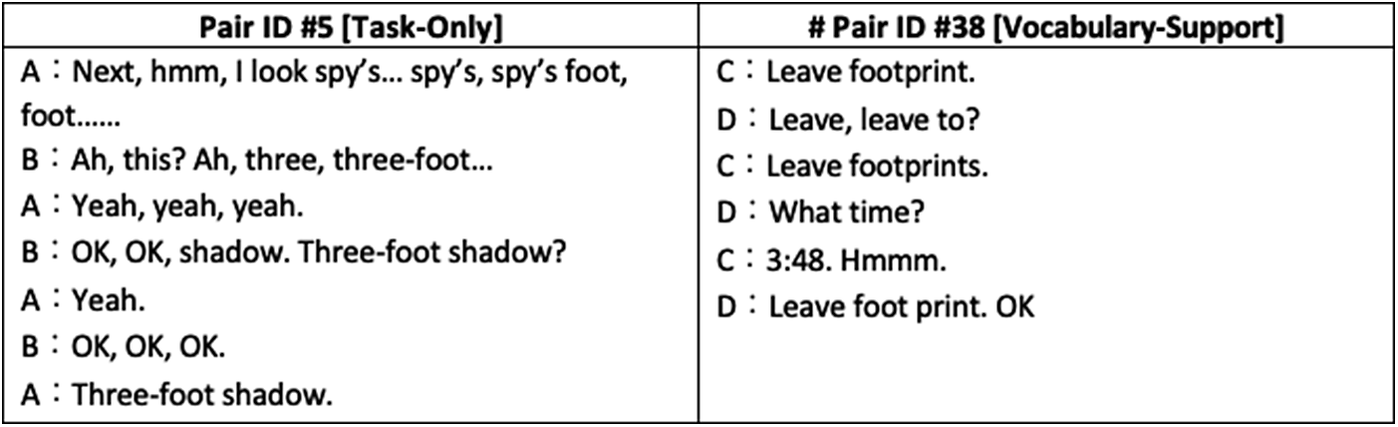
Our second RQ explored the role of engagement in mediating the relationship between vocabulary support and lexical learning. The findings showed that the provision of vocabulary support shaped how learners engaged in the tasks. Learners who received a list of task-relevant collocations engaged in the tasks by actively utilizing these lexical items in completing the tasks (RC1) while maintaining the progress of the interaction (RC3). Learners without the vocabulary support also demonstrated task-maintenance behaviors (RC3), but their engagement was more strongly characterized by joint meaning making and co-construction behaviors, such as negotiation for clarification and peer completion (RC2). This contrast is illustrated in Figure 6, which presents a comparative excerpt showing how a vocabulary-support pair directly used the target collocation, whereas a task-only pair relied on paraphrasing and negotiation to convey the intended meaning.
Excerpts from task-only and vocabulary-support groups.
Note: Target collocation = leave footprints.

Despite these distinct engagement patterns observed between the two groups, none of these patterns credibly mediated the effect of vocabulary support on lexical learning. The result showed that learners’ gains in productive knowledge of the target collocations, as measured by the form-recall test, were primarily attributable to the vocabulary support itself and that engagement did not appear to mediate this relationship.
While this result may seem counterintuitive, particularly for the vocabulary-support condition, where learners frequently used the target collocations in performing the tasks, this result importantly highlights the different facets and modalities of lexical learning (Nation, Reference Nation2001). The vocabulary tests in this study primarily assessed written lexical knowledge, and the potential contribution of collocation-oriented engagement may not have been fully captured by this modality. Had auditory lexical knowledge also been assessed, the analysis might have revealed a relationship between collocation-oriented engagement and lexical development. This account also highlights the importance of input-assessment congruence in vocabulary research (Kaderoğlu, Reference Kaderoğlu2026). Additionally, this interpretation may help explain differences between the present findings and previous task engagement studies that have reported positive relationships between engagement and learning, whose operationalization of L2 learning was more closely aligned with the linguistic processes activated during task performance (e.g., Hiver & Dao, Reference Hiver and Dao2025; Suzuki et al., Reference Suzuki, Nozawa, Nakamura, Uchihara, Miyazaki and Jeong2026).
Another possible account for these non-credible mediation results relates to the relatively short treatment period (40 min across the two information-gap tasks). Although learners in the vocabulary-support condition used the target collocations frequently during interaction (approximately twice per minute), the absolute learning gains were modest, averaging 2.92 collocations out of the 16 targets, compared with 0.50 in the task-only group (Suzuki & Nakamura, Reference Suzuki and Nakamura2026). It therefore remains uncertain whether this amount of task interaction was sufficient for interactional engagement to translate into gains in productive knowledge as measured by the form-recall test. Moreover, the restricted range of learning gains may have limited the statistical detection of an indirect effect. These considerations call for replication studies with more extensive interventions (e.g., designs incorporating task repetition) that provide repeated opportunities for learners to encode and consolidate the target collocations.
From a pedagogical perspective, the contrasting engagement patterns across the two conditions are themselves informative. Although learners without vocabulary support did not demonstrate substantial gains in productive knowledge of the target collocations, they showed higher frequencies of interactional engagement behaviors, such as peer completion and negotiation of meaning, form, and content. Such behaviors may, in principle, encourage collaborative learning and contribute to the development of interactional competence.
Lastly, the findings illustrating the contextualized manifestation of engagement and its mediating role should be understood within the specific implementation adopted in the current study, in which explicit vocabulary support was provided prior to task performance—an approach best framed as TSLT. In stronger TBLT approaches, where linguistic support is provided more reactively, such as in response to learners’ emergent communicative needs during or after task performance, the engagement patterns observed across groups may have been less distinct. This, in turn, could have influenced the mediating role of engagement.
Limitations
We acknowledge several limitations of the present study. First, the data were drawn from a relatively small sample at a single instructional site, reflecting the classroom-based nature of this study. Although smaller sample sizes may be considered adequate for PCA when analyses indicate strong correlations among variables and a limited number of components (Tabachnick & Fidell, Reference Tabachnick and Fidell2013), the results should be interpreted with appropriate caution. Similarly, while Bayesian analyses allow for more stable estimation with smaller samples (Yuan & MacKinnon, Reference Yuan and MacKinnon2009), and while careful attention was paid to the specification of priors and interpretation of credible intervals, caution is warranted when generalizing the findings beyond the present context. The current exploratory findings should be replicated with larger samples across multiple instructional sites to establish their generalizability (Vitta et al., Reference Vitta, Nicklin and McLean2022).
Second, we administered only an immediate posttest. The absence of a delayed posttest prevented us from examining the long-term retention of the observed learning gains. In addition, as discussed above, the written form-recall test may not have fully captured the aspects of collocational knowledge developed through oral interaction (Nation, Reference Nation2001). Future research should therefore incorporate delayed posttests as well as modality-congruent measures, such as auditory form recall (Kaderoğlu, Reference Kaderoğlu2026), to trace the development and retention of different aspects of collocational knowledge.
Third, while the present study focused on the role of vocabulary support in shaping engagement patterns, learners’ engagement is likely to be co-determined by learner-internal variables (e.g., language aptitude, personality) and interactional and contextual variables (e.g., pair dynamics, L1 use, classroom climate). Future research may therefore benefit from examining how multiple learner- and task-related variables jointly shape engagement behaviors in interactive tasks, as well as incorporating multimodal indicators of engagement.
Finally, we retained instances of L1 use when coding engagement indicators as they were closely embedded in interactional discourse that was otherwise conducted in the L2. However, further investigation into the role of L1 use, such as through additional categories of engagement indicators (e.g., L2-only negotiation moves vs. negotiation moves involving code-switching), could provide richer insights into task engagement, particularly in instructed second language learning contexts where learners typically share the same L1 background.
Conclusion
This study examined how explicit vocabulary support shapes learners’ engagement behaviors and task-based lexical learning in interactive information-gap tasks. By operationalizing engagement through discourse-analytic indicators, the study identified distinct patterns of engagement that reflect how learners collaboratively work toward task completion. The findings contribute to growing research exploring the role of engagement in language learning by demonstrating how external linguistic support may shape both interactional behaviors and learning outcomes within TBLT contexts.
Methodologically, this study illustrates the value of a task-driven composite approach to operationalizing engagement, which retains the visibility of the discourse-analytic indicators underlying engagement patterns. Because the approach identifies engagement patterns as they are manifested in a specific task and labels them in terms of concrete behaviors, findings can be communicated in a form that is both methodologically transparent and pedagogically accessible. For example, reporting that learners actively used and negotiated target collocations (RC1) conveys more actionable information to practitioners than reporting that learners demonstrated a higher level of behavioral engagement.
Pedagogically, the findings offer implications for task design and implementation in EFL contexts. When the instructional goal is for learners to use and acquire specific target phrases, providing a pre-task collocation list appears effective: Learners with such support used the target collocations more frequently and made greater gains in productive knowledge. When the goal is to maximize negotiation-rich interaction, withholding pre-task lexical support may be preferable, as learners without the list engaged more in clarification-oriented negotiation and peer completion, drawing on their own linguistic resources. Given that no engagement pattern credibly mediated learning in this study, however, such design choices are best understood as shaping the interactional processes through which learning opportunities emerge, rather than as directly determining learning outcomes.
Taken together, these findings contribute to ongoing efforts to better understand how engagement functions within task-based interaction and how task implementation choices may support meaningful language use and learning.
Supplementary material
The supplementary material for this article can be found at http://doi.org/10.1017/S0272263126102101.
Data availability statement
The dataset for this study is available on the Open Science Framework (OSF) at https://osf.io/zhc47.
Acknowledgments
We express our deepest gratitude to Yee-Ching Hon for her dedicated and invaluable contribution throughout the engagement coding process.
Funding
This work was supported by JSPS KAKENHI Grant Numbers 25K16369 and 25K00479.
Competing interests
The authors declare no competing interests.




 Open access

