Practice has been shown to positively impact second language (L2) speakers’ accuracy during memory retrieval and their processing speed. Drawing on skill-learning theories (Anderson, Reference Anderson1985; Schneider & Fisk, Reference Schneider, Fisk and Magill1983), research in cognitive psychology has typically examined error rate and reaction time during paired-associate tasks. Neuroimaging evidence has shown that during skill development, learners increasingly become reliant on procedural memory over declarative memory, resulting in more skilled performance, that is, faster and more accurate performance (Eichenbaum, Reference Eichenbaum2012; Ullman, Reference Ullman2001). What drives the change in memory retrieval is practice; by being engaged in repeated practice, learners develop memory routines based on the procedural system more and more, that is, proceduralization. Ultimately, L2 learners may automatize L2 knowledge by restructuring the components of procedural memory. To that end, the vast majority of L2 practice studies have examined the spacing effect, that is, the length of intervals between practice sessions (e.g., Nakata, Reference Nakata2015; Rodgers, Reference Rodgers2011; Schuetze, Reference Schuetze2015; Serrano, Stengers, & Housen, Reference Serrano, Stengers and Housen2015; Suzuki & DeKeyser, Reference Suzuki and DeKeyser2017a; Toppino & Gerbier, Reference Toppino and Gerbier2014), with the findings revealing positive effects of practice on L2 learning overall.
However, previous L2 research faces several methodological issues. First, the practice tasks in empirical studies have been largely mechanical and decontextualized. Given the evidence related to skill specificity (Healy & Bourne, Reference Healy and Bourne1995) and transfer-appropriate processing (Morris, Bransford, & Franks, Reference Morris, Bransford and Franks1977), practice conditions should approximate the context where L2 learners will use the learned skills in the real world. Specifically, if the instructional goal is to help learners develop L2 communicative skills, repeated practice should elicit memory retrievals of those skills. Therefore, the current study implemented contextualized practice activities as part of classroom instruction and examined their effect on English as a foreign language (EFL) learners’ production of wh-questions. Second, previous research has examined learners’ correct responses to experimental stimuli only. However, during the learning processes, L2 learners may draw upon their interlanguage systems and produce incorrect utterances. It is unclear whether practicing inaccurate forms has any longer-term effects. Third, while skill-learning theories claim that declarative knowledge supports the development of procedural knowledge (DeKeyser, Reference DeKeyser, Loewen and Sato2017), evidence for their association has been scarce. Therefore, the current study considered the potential role of declarative knowledge, along with both correct and incorrect production, as potential predictors of increased accuracy and fluency.
BACKGROUND AND MOTIVATION
THE DECLARATIVE/PROCEDURAL MODEL AND SKILL LEARNING
Drawing on theories of skill learning (Anderson, Reference Anderson1985) and automaticity (Schneider & Fisk, Reference Schneider, Fisk and Magill1983) from cognitive psychology, skill acquisition theory states that L2 skill development involves two types of memory systems. On the one hand, the declarative memory system (knowledge that) is characterized by controlled processing that is slow, serial, and effortful. Though often thought to hold rules of grammatical systems, declarative representations may contain a broader range of factual knowledge, such as the meaning of words, their phonological forms, and grammatical specifications (Morgan-Short & Ullman, Reference Morgan-Short, Ullman, Gass and Mackey2012). On the other hand, the procedural memory system subsumes fast, parallel, and fairly effortless processes. The advantage of procedural processing is that it frees up space in short-term memory so that an individual can handle other tasks concurrently. Hence, procedural knowledge (knowledge how) is thought to be responsible for actual actions, such as speaking a L2 fluently (DeKeyser, Reference DeKeyser, Loewen and Sato2017; Gade, Druey, Souza, & Oberauer, Reference Gade, Druey, Souza and Oberauer2014).
The declarative/procedural model explains certain L2 development phenomena (Ullman, Reference Ullman2001). For instance, child learners in an immersion school develop a procedural system that may contain fossilized L2 errors, in which case declarative knowledge may be necessary to restructure the corresponding procedural system. Another phenomenon can be found in foreign language learning situations in which learners store what they learn using grammar-translation methods in the declarative system; however, instructional activities do not help them develop the procedural memory that is required for spontaneous production (see DeKeyser, Reference DeKeyser, VanPatten and Williams2007a; Lyster & Sato, Reference Lyster, Sato, García Mayo, Gutierrez-Mangado and Martínez Adrián2013). Meanwhile, the development of procedural memory takes longer than that of the declarative system. This is because procedural memory is less amenable to changes because its activation involves different areas of brain; in contrast, retrieval of declarative memory is associated with a narrower region in the brain (Chein & Schneider, Reference Chein and Schneider2005; Eichenbaum, Reference Eichenbaum2012).
Important to note is that the declarative/procedural model or automaticity theory does not predict that declarative knowledge becomes or is converted to procedural knowledge as a result of skill development; rather, depending on the task to be performed, “the relative functionality of the two systems can affect which one is relied on more” (Ullman & Lovelett, Reference Ullman and Lovelett2018, p. 42). During the skill learning process, a person becomes more reliant on procedural knowledge while declarative knowledge supports the shift in dependence on memory retrieval routines. In other words, the controlled and automatic processes constantly interact and controlled processing “modifies memory and leads to the development of automatic processing” (Schneider, Dumais, & Shiffrin, Reference Schneider, Dumais, Shiffrin, Parasuraman and Davies1984, p. 23).Footnote 1 In the context of L2 skill learning, therefore, it can be hypothesized that having grammatical knowledge of a specific structure would support the development of the procedural memory system, which controls faster processing. In addition, it may be the case that declarative grammatical knowledge enhances accuracy increases while developing procedural representations. The current study tested practice effects while considering the declarative knowledge that the learners had possessed prior to the practice sessions.
PROCEDURALIZATION AND THE DEVELOPMENT OF ACCURACY AND FLUENCY
The premise of skill-learning theories is that as a person develops procedural representations of a skill, the error rate of performing the relevant task decreases and the speed of memory access increases. Those patterns conform to the power law of practice—an initial rapid change followed by gradual changes (Langley, Laird, & Rogers, Reference Langley, Laird and Rogers2009; Newell & Rosenbloom, Reference Newell, Rosenbloom and Anderson1981). In DeKeyser’s (Reference DeKeyser1997) experiment, the participants were first taught morphosyntactic rules and vocabulary of an artificial language. The participants then engaged in both comprehension and production practice sessions. In production tasks, the participants completed gap-fill sentence tasks that described pictures. The changes of error rate followed the power function of practice whereby the participants became dramatically more accurate from the first to the second sessions while the following decline in error rates was more gradual (see also Ferman, Olshtain, Schechtman, & Karni, Reference Ferman, Olshtain, Schechtman and Karni2009).
Similar findings have been reported in real languages as well. For instance, Bird (Reference Bird2010) investigated the acquisition of an English morphosyntactic structure (i.e., tense/aspect of verb forms). The learners engaged in practice sessions involving error correction of ungrammatical forms on worksheets. In Suzuki and DeKeyser (Reference Suzuki and DeKeyser2017a), grammatical accuracy of a Japanese morphology (te-form) was targeted. Regardless of the practice conditions (spaced or massed), learners showed improvement over four practice sessions, with changes conforming to the power law of practice. With a cross-sectional design involving three different proficiency groups, Rodgers (Reference Rodgers2011) compared oral production during picture description tasks. In these tasks, learners completed sentences by filling in a gap related to the target structure (the regular present tense of the indicative in Italian). The analysis of error rates showed that the three groups significantly differed and Rodgers concluded that “learners become more automatic … as they become more proficient in the language” (pp. 311–312).
With regards to the speed of cognitive processing, skill-learning research has primarily examined reaction time when responding to stimuli or performing a task, based on a premise that reaction time provides insight into “how the mind works, and infer about the cognitive processes or mechanisms involved in language processing” (Jiang, Reference Jiang2012, p. 2). Various studies reported practice effects as evidenced by a decline in reaction time (see DeKeyser, Reference DeKeyser, Loewen and Sato2017). However, the speed of cognitive processing can be operationalized as oral fluency as well, as Anderson (Reference Anderson2005) illustrated in relation to foreign language learning: “the procedural, not the declarative, knowledge governs the skilled [fluent] performance” (p. 282). Indeed, oral fluency is a more relevant construct when considering classroom L2 learning, which is the focus of the current study.
L2 fluency was conceptualized into three types by Segalowitz (Reference Segalowitz2010): cognitive, utterance, and perceived. Utterance fluency involves temporal aspects of L2 production and cognitive fluency is arguably manifested in some of those indices. Perceived fluency is based on listeners’ impressions of speeches. The development of utterance fluency can be characterized by temporal measures, such as speed (e.g., speech rate), pauses (filled or unfilled), and repair (e.g., repetitions) phenomena (see Derwing, Reference Derwing, Loewen and Sato2017). Research suggests that certain aspects of utterance fluency represent cognitive fluency, although findings have been mixed. For instance, in Segalowitz and Freed’s (Reference Segalowitz and Freed2004) study, cognitive processing was investigated through lexical access (animacy judgment tests) and the results were compared with the learners’ utterance fluency during oral proficiency interviews. Among different oral fluency indices, filled pauses were correlated with the reaction time scores, meaning that cognitive fluency was observed in pause phenomena. However, in an investigation of cognitive versus utterance fluency, de Jong, Steinel, Florijn, Schoonen, and Hulstijn (Reference de Jong, Steinel, Florijn, Schoonen and Hulstijn2013) found that speech rate (mean syllable duration) was the best predictor of cognitive fluency (β = .50), while pause phenomena (silent pause duration) explained only 5% of the total variance of cognitive fluency.
Several studies examined the effect of practice on utterance fluency. De Jong and Perfetti (2011), for example, examined whether a fluency-focused oral activity (the 4/3/2 task) impacted the development of temporal aspects of spontaneous production. The learners who repeated the same speech multiple times, as opposed to giving different speeches, improved their fluency by reducing the length of pauses, increasing syllables per minute, and lengthening stretches of speech. In Suzuki and DeKeyser (Reference Suzuki and DeKeyser2017a), reaction time included “from the onset of the prompt word to the end of the utterance” (p. 174), suggesting that the scores indicated how fast the learners spoke—a similar index to speech rate. Having found improvement in the fluency measure, Suzuki and DeKeyser claimed that “[a] speed measure is a more sensitive index of procedural knowledge because it not only tests the accuracy of conjugation, but also how fast the morphological knowledge can be deployed” (p. 182). In sum, research has shown that repeated practice supports proceduralization (or automatization) both in accuracy and fluency (see also Lim & Godfroid, Reference Lim and Godfroid2015). However, the practice and testing materials in the studies reviewed have been rather decontextualized (e.g., fill in the gap), leaving a question as to whether practice effects extend to a more communicative skill.
QUALITY OF PRACTICE
Proceduralization can be facilitated by repeated practice. As Anderson and Schunn (Reference Anderson, Schunn and Glaser2000) put it: skill acquisition theory places “a premium on the practice which is required to learn permanently the components of the desired competence” (p. 2). However, two issues related to the quality of practice require further investigation. First, previous research considered correct responses only and ignored incorrect responses, possibly due to the nature of practice—an incorrect response in a paired-associate task may not contribute to retention rates of correct choices. However, in instructed L2 learning settings, learners who are developing procedural L2 knowledge produce incorrect utterances. During this process, learners may produce partially inaccurate utterances based on their interlanguage systems.
The second issue is related to the “meaningfulness” of practice. A concept of practice includes a wide array of “activities in the second language engaged systematically, deliberately, with the goal of developing knowledge of and skills in the second language” (DeKeyser, Reference DeKeyser2007b, p. 8). To that end, it is claimed that meaningful practice “is better at driving the brain processes that result in successful recall” (Anderson, Reference Anderson2005, p. 198). Nonetheless, much of cognitive psychology research has operationalized practice as memorization during paired-associate tasks. For instance, participants in Pavlik and Anderson (Reference Pavlik and Anderson2005) memorized English translations of Japanese words. The task that the participants in Morgan-Short, Steinhauer, Sanz, and Ullman (Reference Morgan-Short, Steinhauer, Sanz and Ullman2012) performed involved an artificial language, where participants followed instructions in the language during a computer board game. In L2 research as well, practice has been rather decontextualized. Although the task in de Jong and Perfetti (Reference de Jong and Perfetti2011) was delivered as part of classroom activities, it was a monologue task in which students individually recorded their speeches in a computer lab, responding to general questions, such as “What do you think about pets?” The production tasks in Suzuki and DeKeyser (Reference Suzuki and DeKeyser2017a) involved depicting pictures to the experimenter and describing short video clips to the computer.
A tenet of skill-learning theories is transfer-appropriate processing; a skill learned in a certain context is best transferred to performance in a similar context (Morris et al., Reference Morris, Bransford and Franks1977). DeKeyser (Reference DeKeyser1997) showed that practice of comprehension led to proceduralization of comprehension skills, while production practice led to production skills. In a reading fluency study, Martin-Chang and Levy (Reference Martin-Chang and Levy2005, Reference Martin-Chang and Levy2006) compared isolated-training involving computerized word-naming games and context-training providing learners with the target words in a story. The results showed that learners who were given isolated training scored higher on the test in which individual words were presented on a computer screen, while learners in the context-training group, who were taught words in passages, outperformed the isolated-training group in the reading passage test. Hence, evidence suggests that practice effects are specific in regard to skills, tasks, and context, and if the goal of L2 instruction is to help learners develop communicative skills, practice should be contextualized. (We will detail our operationalization of contextualization in the “Methods” section.)
THE CURRENT STUDY
DeKeyser (Reference DeKeyser2010) called for an investigation in which practice is operationalized in a “broader definition of systematic practice and fulfill[s] specific functions in the learning process that mere communicative input and interaction cannot” (p. 159). The current study answers this call by examining practice effects in an EFL classroom setting. While SLA researchers have long argued for the importance of meaningful, communicative practice to develop communicative skills (Ellis & Shintani, Reference Ellis and Shintani2014; Lightbown, Reference Lightbown2000; Loewen & Sato, Reference Loewen, Sato, Loewen and Sato2017; Ortega, Reference Ortega2014), empirical research has examined practice that is not meaningful. Therefore, the current study examined the impact of contextualized practice. We operationally define contextualized practice as a type of practice that occurs in an intact classroom where learners engage in production that is transfer appropriate to authentic, communicative language use.
Additionally, limited research has examined practice effects on grammatical structures (e.g., Bird, Reference Bird2010; Suzuki & DeKeyser, Reference Suzuki and DeKeyser2017a), or focused on wh-questions—the target structure in the current study. In terms of outcome measures, previous research generally focused on processing speed during vocabulary memorization tasks (e.g., Nakata, Reference Nakata2015; Schuetze, Reference Schuetze2015; Sobel, Cepeda, & Kapler, Reference Sobel, Cepeda and Kapler2011). Some studies examined utterance fluency (e.g., de Jong & Perfetti, Reference de Jong and Perfetti2011; Suzuki & DeKeyser, Reference Suzuki and DeKeyser2017a), but with decontextualized monologue tasks. The current study examined L2 production during interactive tasks with the classroom teacher and analyzed the learners’ accuracy and fluency.
Furthermore, the contribution of both types of memory systems to improved L2 performance has not been identified. In other words, we do not know much yet about how declarative knowledge contributes to the development of procedural knowledge. We explored this issue by considering the scores of a declarative knowledge test as a predictor variable when gauging the impact of practice on procedural knowledge. Lastly, given that L2 learners unavoidably produce inaccurate structures, we explored the differential impact of correct and incorrect utterances in regression models. The research questions were as follows:
RQ1: Does contextualized practice facilitate L2 speakers’ production of accurate and fluent wh-questions?
RQ2: What learner and practice factors predict changes in the accuracy or fluency of the L2 speakers’ wh-questions?
METHODS
PARTICIPANTS
The initial participant pool consisted of 55 students enrolled in an undergraduate degree program in English education at a large private university in Santiago, Chile. However, students who missed more than two practice sessions (n = 21) were excluded from the study. Therefore, the final participant pool consisted of 34 students (16 males and 18 females) who ranged in age from 18 to 24, with a mean age of 21.3 (SD = 2.0). In terms of their prior English instruction, they had studied English in primary and secondary schools for a mean of 11.5 years (SD = 3.0), but few students reported using English for communication outside the classroom. Only five students reported 1 to 2 hours per week of conversation with their friends in English and three students reported that they used English at work. The students had never taken any standardized proficiency tests, but based on the university curriculum, they had recently completed classes at the B1 level on the Common European Framework of Reference (Council of Europe, 2001). The students were taking a required English class that followed general principles of communicative language teaching, and emphasized the development of students’ communicative competence. Instructors regularly engaged in whole-class discussions. The course was theme based and targeted specific lexical and grammatical forms in each unit.
TARGET STRUCTURE
The target structure of the intervention was wh-questions, which have been widely studied in classroom-based SLA research to explore the developmental outcomes associated with corrective feedback (Adams, Reference Adams and Mackey2007; Lightbown & Spada, Reference Lightbown and Spada1990), task complexity (Kim, Reference Kim2012), and structural priming (McDonough & Chaikitmongkol, Reference McDonough and Chaikitmongkol2010), to test the effectiveness of form-focused instruction (Spada & Lightbown, Reference Spada and Lightbown1999; White, Spada, Lightbown, & Ranta, Reference White, Spada, Lightbown and Ranta1991) and to explore learners’ awareness of L1-L2 differences (Ammar, Lightbown, & Spada, Reference Ammar, Lightbown and Spada2010; Lightbown & Spada, Reference Lightbown and Spada2000). In addition to allowing for comparisons with previous research, the focus on wh-questions was also motivated by pedagogical reasons, as questions complemented the objectives and materials of the participants’ EFL integrated skills course.
The wh-question form under investigation consisted of a question word followed by an obligatory auxiliary verb, subject, and lexical verb, which has been referred to as a wh-aux 2nd question (Pienemann & Johnston, Reference Pienemann, Johnston and Nunan1987; Pienemann, Johnston, & Brindley, Reference Pienemann, Johnston and Brindley1988). This type of wh-question was selected because L2-English learners often alternate between several variants: the targetlike form in which the obligatory auxiliary verb is supplied (when was the baby born?), an interlanguage form without an auxiliary verb (*when the baby born?), or an interlanguage form with a misplaced auxiliary verb (*when the baby was born?). Even when learners produce an auxiliary verb in the correct location, they may still make errors involving subject/auxiliary verb agreement (e.g., *where are the family going?) or auxiliary/lexical verb agreement (e.g., *what goal does he has?). In the current study, only wh-questions that require auxiliary verbs were considered because a missing auxiliary verb is not ungrammatical for some question types, such as wh-questions with the copula (what color is the dog?) or questions in which the wh-word functions as a subject (which boy likes chocolate?).
MATERIALS
Declarative knowledge test
The declarative knowledge test was created by the researchers to assess the participants’ preexisting declarative knowledge of the target structure. The test included three item types that the participants were familiar with from their previous English classes: fill in the blank, correct the error, and scrambled sentences. The 16 fill-in-the-blank items provided a short dialogue consisting of a question-and-answer sequence in which one word in the question had been deleted, specifically the question word (four items), the auxiliary verb (eight items), or the lexical verb (four items). The error correction section also provided 16 short dialogues in the form of question and answer sequences. However, each question contained an error that involved the question word (four items), the auxiliary verb (six items), or the lexical verb (six items). Finally, the scrambled sentence section provided eight sentences in jumbled order, which included five wh-aux 2nd questions, two wh-subject questions, and one negative question. The 40-item test was pilot tested with students at the same university (N = 21) and instrument reliability was assessed using Cronbach’s alpha, which was .75. Based on the item statistics, seven items that showed no variation were removed from the test. Therefore, the final test included 13 fill-in-the-blank items, 15 error correction items, and 5 scrambled sentences, for a total of 33 items. Reflecting our main focus, the test contained 24 wh-aux 2nd questions along with nine items that targeted other types of questions, including wh-subject and wh-copula questions. Although the test included these wh-questions that do not require an auxiliary verb as distracters, the students’ performance on these items was not included in their declarative knowledge scores. Based on the participants’ performance, the instrument reliability (Cronbach’s alpha) of the declarative knowledge test was .87 for the 24 wh-aux 2nd items and .89 for all 33 items.
Contextualized practice activities
The current study operationalized contextualized practice by drawing on general educational as well as L2 psycholinguistic literature. Drawing on activity theory (Leont’ev, Reference Leont’ev and Wertsch1981), Van Oers (1998) argued that contextualization involves connecting a specific learning context and meaning making in that context (see also Lyster & Sato, Reference Lyster, Sato, García Mayo, Gutierrez-Mangado and Martínez Adrián2013). In the current investigation, the learners engaged in practice that triggered their goal-oriented behavior. Specifically, their goal was to develop communicative skills. The practice activities were designed to help them achieve the meaning making (the goal) in the classroom context. The topics of practice were chosen based on the particular context, including the existing curriculum, so as to further facilitate learners’ “continuity of thought” (Walz, Reference Walz1989, p. 162) between their regular activities and those for the current experiment. For the same purpose, the activities were collaboratively developed with the teachers. Finally, the practice was done between students and their teachers, as opposed to the researchers, to increase the purposeful use of language in the classroom context.
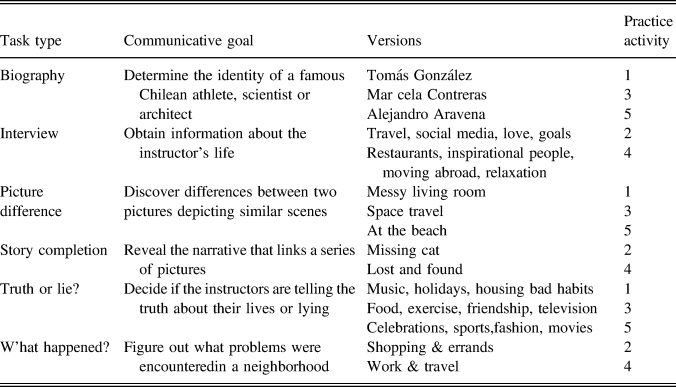
The activities consisted of teacher-fronted, information-gap tasks that complemented three themes targeted in the students’ classes during the intervention period: work and education, environmental issues, and physical and mental health. Six information-gap task types were developed, with multiple versions created to yield 15 tasks distributed across five practice sessions (three tasks per session). A complete list of the task types, versions, and the distribution across the practice activities is provided in Table 1. Although there was variation in the communicative goal of the tasks (e.g., deciding if the instructor was telling the truth or lying vs. guessing the identity of a Chilean celebrity), they were all one-way tasks in which the instructor held the information and the students’ role was to ask questions to obtain that information. All activities were led by the teacher in the classroom where the whole class interacted with the teacher concurrently, so as to approximate the experimental setting to real classroom interaction.
Task versions by practice activity

All tasks were presented through PowerPoint slides that showed images along with prompts in the form of wh-words (what, when, where, how, why, how much/many, what + noun, and which + noun). The number of wh-prompts varied from four to eight across the six task types, but each practice session presented a total of 20 wh-prompts with the same distribution of specific wh-words. The wh-prompts were timed to appear on the images one at a time, giving students 10 seconds to produce a question using the wh-prompt. An audio signal (i.e., a beep) was used to indicate that time had expired before the next wh-prompt appeared (see Supplementary Materials for sample tasks). The instructor provided answers after each wh-prompt or at the end of each task. Depending on the task, the teachers were provided with the answers. For instance, in the Biography task, where the learners’ goal was to guess a Chilean celebrity, the teacher was given relevant information about the celebrity. However, in the Interview task, where the learners asked questions to know more about the teacher’s personal life, the teacher answered the learners’ questions spontaneously.
DESIGN
A within-group, repeated-measures design was used to determine whether the participants’ accuracy and fluency of wh-questions changed across the five practice sessions. Accuracy was operationalized as grammatically correct production of the target structure, while fluency was operationalized as utterance fluency. We analyzed three indices of utterance fluency—speed, pause, and repair phenomena. For the second research question, an associational design was used to determine what factors were associated with changes in the participants’ production of wh-questions. The outcome variable was the gain scores for accuracy and fluency from the first and final sessions. The predictor variables were (a) the scores of the declarative knowledge test; (b) the total number of correct wh-questions across the second, third, and fourth sessions; and (c) the total number of incorrect wh-questions across the second, third, and fourth sessions.
PROCEDURE
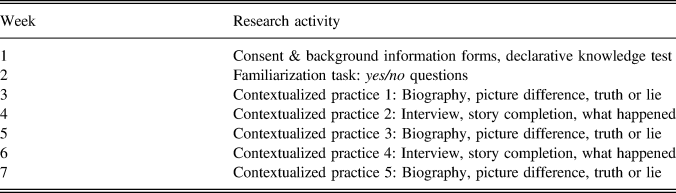
The activities were carried out in the participants’ regularly scheduled classes over a five-week period (see Table 2). In the first week, the participants completed the consent and background information forms (15 min), along with the declarative knowledge test (20 min). To familiarize the students with the activity format and audio-recording equipment, a task with communicative activities similar to the intervention activities was implemented in week two (20 min). However, the familiarization task targeted yes/no questions instead of wh-questions. In weeks three to seven (i.e., Time 1 to Time 5), learners engaged in the contextualized practice activities. Each session took approximately 15 minutes to complete, and was administered at the beginning or end of a class period based on its fit with the lesson’s other instructional activities. All students held a digital audio-recorder to individually record their language production during the practice tasks. It is important to stress that the teachers did not provide any feedback on the learners’ erroneous utterances. While skill acquisition theory underscores the importance of feedback to avoid entrenching inaccurate knowledge structures, feedback was controlled in the current experiment so as to tease apart the effect of contextualized practice.
Research activities by week

DATA CODING AND ANALYSIS
Declarative knowledge
The tests were scored by the researchers by giving one point to each correct item, with no half points for partially correct answers. For the fill-in-the-blank items, correct items were those for which a participant had supplied a question word, auxiliary verb, or lexical verb that resulted in a grammatically accurate question. For the error correction items, correct items had a change (insertion or deletion) that repaired the error and resulted in a grammatically accurate question. Finally, the scrambled question items were considered correct if the question contained all the words provided in a grammatically accurate word order without any additions or deletions. The participants’ scores for the 24 wh-aux 2nd question items were summed and used in the subsequent analysis, but their scores for the nine distracter questions (wh-subject and wh-copula) were not analyzed further.
Accuracy
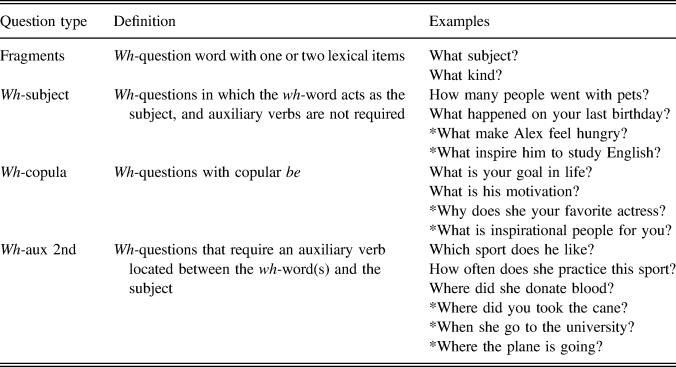
The audio-recordings of the practice sessions were transcribed and verified by research assistants. The transcripts were analyzed by research assistants for the occurrence of wh-questions, which were classified as fragments, wh-subject, wh-copula, and wh-aux 2nd. Definitions and examples of each type are provided in Table 3.
Wh-question types with examples

* INDICATES ungrammatical questions
After classifying all the participants’ questions, their wh-aux 2nd questions were further analyzed for accuracy. To be classified as accurate, a wh-aux 2nd question required the correct (a) question word, (b) word order (i.e., position of auxiliary verb), (c) subject/auxiliary verb number agreement, and (d) auxiliary verb/main verb agreement in tense and aspect. Errors involving forms unrelated to question formation, such as article use, plurals, or lexical choice (e.g., blood banker as opposed to blood bank), were not considered in the accuracy coding. Proportional scores were obtained by calculating the percentages of incorrect utterances out of total utterances in each session. A subset of the data (20%) was coded by a research assistant for interrater reliability, which was calculated as Cohen’s kappa for the classification of wh-questions (.85) and intraclass correlation coefficients for the accurate wh-aux 2nd questions (.94).
Fluency
Following previous practice research, we focused on fluency of correct productions of wh-aux 2nd questions. The resulted number of questions analyzed for fluency was 1,133 out of 1,973 (57.43%) (details are presented in the results section). First, fluency of individual questions was analyzed using Audacity. Then, the average scores of the fluency indices, based on the number of questions that each learner produced, were calculated for each learner at each practice session. Hence, the scores presented in the “Results” section indicate fluency per question.
Three fluency indices were used: speech rate (syllables per second), mean length of pauses (average length of pauses), and repair phenomena (summed frequency of false starts, repetitions, and self-corrections). In terms of the cutoff length of pauses, de Jong and Bosker (Reference de Jong and Bosker2013) compared different cutoff lengths (between 100 ms to 1,000 ms) in relation to vocabulary knowledge and perceived fluency. The results showed that a 250–300 ms cutoff was the “optimal threshold for measuring the number of pauses (per total or per speaking time) with respect to studies that aim to investigate L2 proficiency” (p. 20). Following this result, the silences shorter than 250 ms, so-called micropauses (Riggenbach, Reference Riggenbach1991), were not considered as pauses in the current study. Interrater reliability was calculated on a subset of the data (20%) which yielded acceptable agreement rates for all indices (speech rate: r = .78; mean length of pauses: r = .75; repairs: r = .91).
Statistical analyses
In the dataset, only 19 learners participated in all five sessions. As a result, 25 cases were missing, among a potential of 170 cases (34 participants tested five times). Accordingly, we conducted missing values analyses on the dataset, using the expectation-maximization algorithm (see Mbogning, Bleakley, & Lavielle, Reference Mbogning, Bleakley and Lavielle2015).Footnote 2
To understand the overall patterns of accuracy and fluency changes over the five sessions, descriptive statistics were first analyzed and visually inspected. Then, the data were submitted to two types of inferential statistics. First, repeated measures ANOVAs (RM ANOVAs) were chosen for examining the impact of contextualized practice on the participants’ accuracy and fluency. The assumption of normality was met for error rate at five sessions (all above p = .20 according to Kolmogorov-Smirnov) as well as all fluency indices at five sessions (all above p = .06 according to Kolmogorov-Smirnov). However, Mauchly’s tests showed that the dataset violated the assumption of sphericity (error rate: p = .005; speech rate: p < .000; mean length of pauses: p = .004; repair phenomena: p < .000). In the “Results” section, therefore, we report the results with Huynh-Feldt correction (sphericity not assumed). For the post-hoc pairwise comparisons, LSD was chosen given that some of the comparisons were irrelevant to the objective of the study (e.g., Time 2 vs. Time 5). The alpha level for all tests of significance was set at .05.
Second, to answer the second research question pertaining to the predictors of improved accuracy or fluency, hierarchical multiple regressions were chosen. In total, four models were tested for the four indices of accuracy and fluency. In all models, the two predictor variables were the frequencies of correct and incorrect productions. The expectation-maximization algorithm was not applied to the raw frequencies data, meaning that the scores reflected actual production frequencies. The frequencies from Times 2, 3, and 4 were summed; Times 1 and 5 were not included so as to avoid violating the independence of observation for the inferential statistics. To explore the contribution of declarative knowledge to proceduralization, the scores of the declarative knowledge test were entered in the first block (Step 1: see Petrocelli, Reference Petrocelli2003). In the second block (Step 2), the frequencies of correct and incorrect productions were entered as the predictors. In so doing, we tested (a) the predictive value of declarative knowledge for proceduralization in the first models, and (b) we controlled the learners’ preexisting declarative knowledge and teased apart the effect of the quality of practice on the changes in accuracy and fluency over time in the second models.
The assumptions of hierarchical multiple regressions were met (see Osborne & Waters, Reference Osborne and Waters2002). First, the sample size requirement based on two predictors was met according to Pedhazur (Reference Pedhazur1982). Second, all the outcome variables were normally distributed: error rate (Kolmogorov-Smirnov, p = .08), speech rate (Kolmogorov-Smirnov, p = .20), mean length of pauses (Kolmogorov-Smirnov, p = .09), and repair phenomena (Kolmogorov-Smirnov, p = .14). Third, multicollinearity was not observed in the dataset: the correlation coefficient between the two predictors was .36 (see Supplementary Materials for the correlation matrix). Also, the variance inflation factors in all models (VIFrange = .67–1.48) supported the use of regression analyses (Heiberger & Holland, Reference Heiberger and Holland2004). Finally, no homoscedasticity was observed in the scatterplots.
RESULTS
DATA OVERVIEW
Over the five practice sessions, the participants produced 2,851 questions in total. As can be seen in Table 4, learners produced comparable numbers of questions in each session, as shown by the individual averages ranging from 18.90 to 23.21. Also, judging from the standard deviations, ranging from 6.24 to 11.28, it can be said that all learners produced questions in every session to a certain degree. The minimal frequencies in each session were: Time 1 = 18; Time 2 = 17; Time 3 = 15; Time 4 = 16; and Time 5 = 15.
Descriptive statistics of question types

Note. f = the frequency of produced questions; wh-S wh-subject questions; wh-C = wh-copula questions; wh-A = wh-auxiliary 2nd questions. The means represent the number of questions produced by each learner.
Across the data collection points, the learners produced more wh-aux-2nd questions—the target structure of the current study—than wh-subject and wh-copula questions. As the intervention activities aimed for, the production of wh-subject questions was the lowest, amounting to 3% (84/2,851) of the total questions (details can be found in Supplementary Materials). Notably, the learners produced wh-aux-2nd questions consistently over the five sessions (range = 12.73–16.26), with much less variation than wh-subject and wh-copula questions.
In the regression analyses, the cumulative frequencies of wh-aux-2nd questions from Times 2, 3, and 4 were entered as the predictor variables. In total, the learners produced 1,216 wh-aux-2nd questions. On average, they produced 21.62 (SD = 14.58) correct questions and 23.82 (SD = 16.77) incorrect questions. Both scores were normally distributed according to Kolmogorov-Smirnov (correct: p = .20; incorrect: p = .19).
ACCURACY AND FLUENCY CHANGES OVER TIME
Accuracy
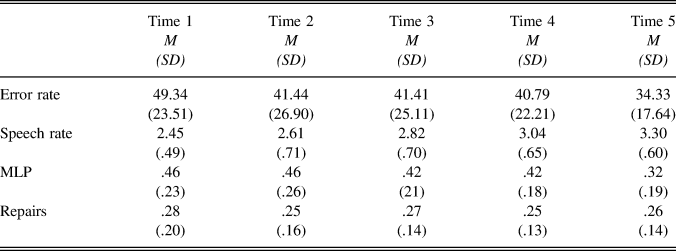
The RM ANOVA of error rate showed a significant main effect: F(3.59, 118.40) = 4.863, p = .002, ηp2 = .128. Table 5 reports the descriptive statistics of each session.Footnote 3 The pairwise comparisons for each interval revealed that the error rates were significantly reduced from Time 1 to Time 2 (p = .002, d = .32, 95% CI [.54, 15.26]) and from Time 4 to Time 5 (p = .025, d = .32, 95% CI [.86, 12.07]). In addition, the comparison between Time 1 and Time 5 reached significance (p < .000, d = .72, 95% CI [7.33, 22.68]). The changes in the other intervals were not significant: Time 2–Time 3 (p = .994, d < .00 , 95% CI [–7.16, 7.22]); Time 3–Time 4 (p = .832, d = .02, 95% CI [–5.25, 6.49]). Figure 1 depicts the changes of error rate over time.
Changes in error rates and fluency indices over five sessions

Note. MLP = mean length of pauses. The fluency indices—speech rate, MLP, and repairs—show scores per question.
Error rates and their standard deviations at five sessions.

Fluency
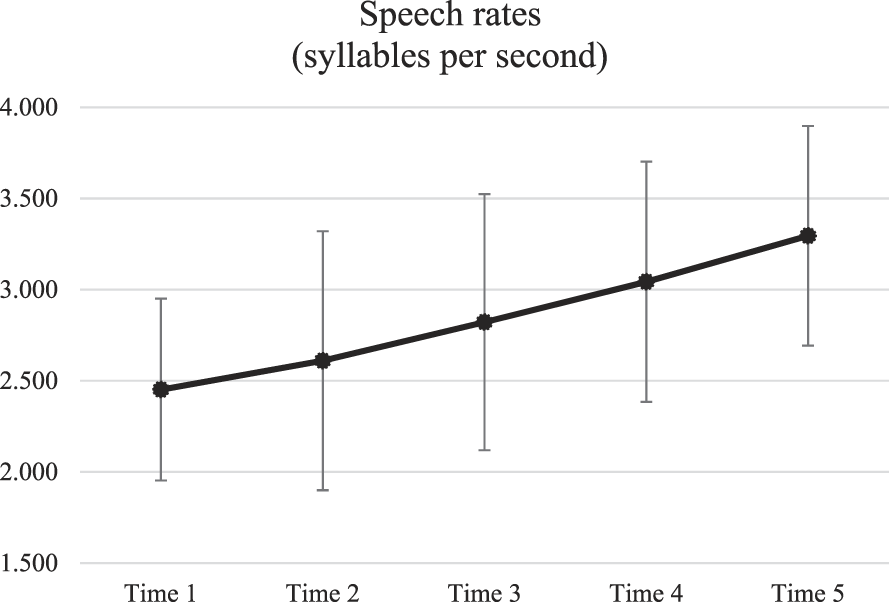
First, the RM ANOVA of speech rate detected a significant main effect: F(1.93, 63.71) = 18.108, p < .000, ηp2 = .354. The pairwise comparisons between each interval showed that the speech rates significantly increased from Time 1 to Time 4 at each interval: Time 1–Time 2 (p = .048, d = .26, 95% CI [–.316, –.001]); Time 2–Time 3 (p = .025, d = .30, 95% CI [–.394, –.028]); and Time 3–Time 4 (p < .000, d = .33, 95% CI [–.311, –.132]). The difference between Time 4 and Time 5 did not reach significance (p = .067, d = .40, 95% CI [–.019, .523]). Furthermore, the comparison between Times 1 and 5 showed a significant increase (p < .000, d = 1.53, 95% CI [–1.117, –.570]). Figure 2 depicts the changes in speech rate over time.
Speech rates and their standard deviations at five sessions.

The RM ANOVA of mean length of pauses also yielded a significant main effect: F(3.34, 110.27) = 18.108, p = .005, ηp2 = .114. The analyses of the intervals showed that the mean length of pauses significantly decreased from Time 4 to Time 5 (p = .001, d = .59, 95% CI [.047, .160]). The differences in the other intervals were not significant: Time 1–Time 2 (p = .932, d < .00, 95% CI [–.098, .106]); Time 2–Time 3 (p = .204, d = .16, 95% CI [–.023, .103]); or Time 3–Time 4 (p = .750, d < .00, 95% CI [–.064, .046]). However, the comparison between Time 1 and Time 5 reached significance: p = .005, d = .66, 95% CI [.045, .233].Footnote 4 Figure 3 visually describes the changes in mean length of pauses over time.
Mean lengths of pauses and their standard deviations at five sessions.

Finally, the RM ANOVA of repair phenomena did not show a significant effect: F(3.20, 105.72) = .351, p = .801, ηp2 = .011. Figure 4 depicts the changes in the number of repair phenomena over time.
Repair phenomena and their standard deviations at five sessions.

PREDICTORS OF PRACTICE EFFECT
Preexisting declarative knowledge
The grammar test administered prior to the intervention included 24 items related to wh-aux-2nd questions. The learners scored the 24 questions correctly with a mean of 59% (SD = 25.12). The data was normally distributed as evidenced by the result of Kolmogorov-Smirnov (p = .08).
Accuracy
The first regression model for accuracy, where the preexisting declarative knowledge was the predictor, yielded a nonsignificant result: F(1, 32) = .232, p = .634, R 2 = .007. However, the second model, which tested the effect of contextualized practice over and above learners’ preexisting declarative knowledge, was significant: F(2, 30) = 4.558, p = .019, accounting for 24% (R 2) of the total variance in the change over time (ΔR 2 = .231). As shown in Table 6, the grammar test scores did not predict the practice effect in the second model either (p = .299; β = –.195). However, both correct (p = .007) and incorrect (p = .045) productions were significant predictors. The negative correlation coefficients indicate that the more correct questions a learner produced, the more accurate his or her production became over time. More precisely, the standardized beta coefficient (β) indicates that for every unit increase in correct production, a decrease of .56 SD units can be expected in the change of error rate. On the contrary, production of incorrect questions showed positive predictive power (β = .39), meaning that the more incorrect questions a learner produced, the less accurate she or he became at the end of intervention.
Regression results for predictors of change of error rates

Fluency
The difference scores (i.e., Time 5 minus Time 1) of the following fluency indices were entered as the outcome variables in each model: (a) speech rate, (b) mean length of pauses, and (c) repair phenomena (see Supplementary Materials for the correlation matrix).
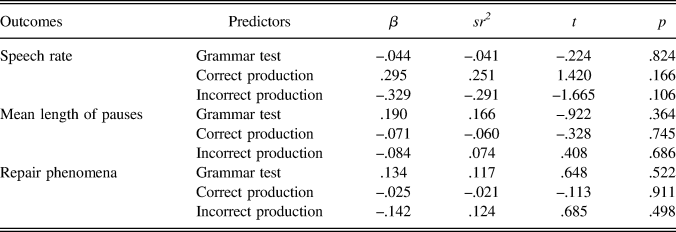
The first model for speech rate, where the preexisting declarative knowledge was the predictor, yielded a nonsignificant result: F(1, 32) = .472, p = .497, R 2 = .015. The second model, after entering correct and incorrect productions, was not significant either: F(2, 30) = 1.264, p = .304, accounting for 11% (R 2) of the total variance in the change over time (ΔR 2 = .098). Table 7 shows the details of the second model.
Regression results for predictors of change of fluency indices

Neither of the two models for mean length of pauses was significant; The first model: F(1, 32) = .730, p = .399, R 2 = .022; and the second model: F(2, 30) = 0.293, p = .830, with a minimal change from the first model (ΔR 2 = .006).
Similar to the results of the other fluency indices, neither of the two models for repair phenomena was significant; the first model: F(1, 32) = 0.317, p = .577, R 2 = .010; and the second model: F(2, 30) = 0.276, p = .842, accounting for 3% (R 2) of the total variance in the change over time (ΔR 2 = .017).
SUMMARY OF THE RESULTS
The results of the grammar test showed that the learners had not fully developed the declarative knowledge of the target structure (M % = 59). With this amount of declarative knowledge, the learners engaged in five sessions of contextualized practice. The RM ANOVAs showed that error rates of oral production incrementally decreased over time, especially between Time 1 and Time 2 and between Time 4 and Time 5. The difference between Time 1 and Time 5 was also significant. Similar patterns were observed in the changes of speech rate: incremental increases over time and a significant difference between Time 1 and Time 5. Although the decrease of mean length of pauses was gradual, the comparison between Time 1 and Time 5 reached significance. However, repair phenomena were not affected by the contextualized practice. In terms of predictors of the practice effect, preexisting grammar knowledge did not predict changes in either accuracy or fluency. The second model for accuracy showed that correct productions predicted the decrease of error rate. In contrast, the production of incorrect questions negatively affected the change in accuracy. Neither correct nor incorrect productions predicted changes in any indices of fluency.
DISCUSSION
CONTEXTUALIZED PRACTICE AND PROCEDURALIZATION
The first research question asked about the impact of contextualized practice operationalized as L2 production during communicative activities in the classroom. The results of error rate showed an initial significant decline (Time 1–Time 2) followed by gradual changes (Time 2–Time 4). This pattern of changes conforms to the expected learning curves resembling the power function of practice. By engaging in contextualized practice, the learners were able to become more accurate in their spontaneous production over time; in other words, the practice may have helped develop the procedural memory of English wh-questions. In the current study, feedback was not provided during the practice sessions (cf. Suzuki & DeKeyser, Reference Suzuki and DeKeyser2017a). It may be the case that during the proceduralization, learners became more reliant on procedural memory that, in turn, freed up their short-term memory for accessing their declarative knowledge. Differently put, the practice did not aid the learners to learn a novel structure; rather, it helped them develop procedural representations of a target structure for which the learners already possessed declarative knowledge. In this situation, practice alone was sufficiently powerful to facilitate proceduralization.
One may argue that the initial decline was due to the testing effect. However, we note that not only did the learners participate in a training session with the identical activity but also the testing effect does not account for the significant difference between Time 4 and Time 5. We speculate that the significant change between Time 4 and Time 5 is an indication of partial proceduralization (DeKeyser, Reference DeKeyser2010). As can be seen in the error rate in Time 5 (34.33%), there was much more developmental space left at the end of the intervention. Accordingly, we believe that the learners were not yet at the automatization stage at Time 5 (see Hulstijn, Van Gelderen, & Schoonen, Reference Hulstijn, Van Gelderen and Schoonen2009; Segalowitz & Segalowitz, Reference Segalowitz and Segalowitz1993). This interpretation suggests a possibility that the changes observed in the current study may represent faster access to the declarative system rather than deployment of the relevant knowledge in the procedural system.
The current study focused on three fluency indices: speech rate, mean length of pauses, and repair phenomena. The result of speech rate differed from that of accuracy in that, first, there was no significant change from Time 1 to Time 2, and second, the learners consistently became faster over the five sessions. The mean length of pauses also decreased but only when Time 1 and Time 5 were compared. While the power function was not observed in those indices, the overall changes support previous fluency studies. In de Jong and Perfetti (Reference de Jong and Perfetti2011), for example, the group who repeated the same speech involving the same lexical items exhibited more signs of proceduralization than the group that recited different speeches. Those learners increased speech rate (phonation/time ratio) and decreased mean length of pauses. The current study showed that the learners who engaged in repeated practice of the same grammatical structure (wh-questions) but with different lexical items became faster with shorter pauses during communicative interaction.
The differential findings of the three fluency indices add to the discussion pertaining to cognitive versus utterance fluency. If we consider that the learners were in the process of proceduralization of English wh-questions, only speech rate and pause phenomena were susceptible to the effect of contextualized practice. Also, given the consistent increase in speech rate, it can be argued that speech rate best represents the change in the underlying cognitive mechanism (de Jong et al., Reference de Jong, Steinel, Florijn, Schoonen and Hulstijn2013). However, repair phenomena were largely unrelated to the other measurements. In Freed’s (Reference Freed and Freed1995) study that compared the fluency of L2 learners who studied at home and those who studied abroad showed that the study abroad learners produced faster speech; however, those learners produced more repair markers, such as false starts, repetitions, and self-corrections. Freed (Reference Freed and Freed1995) concluded that the study-abroad learners “monitor their speech and self-correct along the way” (p. 141) while expressing complex structures. The results of the current study seem to support this claim in that although the learners became more accurate and faster, their repair attempts were not related to those changes.
In sum, contextualized practice yielded positive changes in both accuracy and fluency, except for repair phenomena. The effect sizes of the comparisons between Time 1 and Time 5 of error rate (d = .72), speech rate (d = 1.53), and mean length of pauses (d = .66) were all medium to large (Plonsky & Oswald, Reference Plonsky and Oswald2014). Regardless of the exact knowledge structure that the learners developed, it is encouraging that their communicative production became more accurate and faster, and their access to relevant memory systems became more efficient and effortless. From a practical perspective, such changes may be an L2 learning goal for both learners and teachers (DeKeyser, Reference DeKeyser, Loewen and Sato2017).
CONTRIBUTION OF DECLARATIVE KNOWLEDGE
The second research question was related to learner (preexisting declarative knowledge) and practice (correct vs. incorrect productions) factors as potential predictors of the effect of contextualized practice. The results support skill-learning theories in that (a) declarative knowledge assists proceduralization at least at the initial stage of the process and (b) repeated practice has a robust effect in allowing learners to increasingly rely on procedural memory over time. Skill-learning theories, including those in cognitive psychology (Schneider & Fisk, Reference Schneider, Fisk and Magill1983), neuroimaging (Ullman, Reference Ullman2001), and psycholinguistic (DeKeyser, Reference DeKeyser1997) research, explain that declarative and procedural systems are developed concurrently while the shifts in reliance on the two systems occur as a person becomes more accurate and faster during a given task. It was predicted that the development of skilled performance may be supported by declarative knowledge to develop and/or restructure the representations in the procedural system.
Interestingly, the scores of the declarative knowledge test, administered prior to engaging in contextualized practice, did not predict the extent of the practice effect on accuracy or fluency changes. This result indicates that having declarative knowledge of a grammatical structure may not be related to the development of the procedural system of that structure when practice is considered as the cause of the changes. Accordingly, it could be said that contextualized practice alone facilitates a positive change in accuracy, on the one hand. On the other hand, the result seems to challenge skill acquisition theory in that learners may not need an explicit understanding of a grammatical structure to benefit from contextualized practice. However, in the current study, all learners possessed some declarative knowledge of the target structure. Hence, it is premature to argue that practice alone is sufficient to develop procedural memory of a grammatical structure. What the results suggest is, instead, that the amount of declarative knowledge was not related to the extent to which each learner benefited from practice.
To further examine the contribution of declarative knowledge to proceduralization, we ran additional correlational analyses (Pearson, two-tailed) between the grammar test scores and error rate in Time 1, which yielded a significantly negative correlation (r = –.36, p = .036). At Time 5, the relationship became nonsignificant (r = –.16, p = .348). This means that before the intervention, the more declarative knowledge a learner possessed, the more accurate his or her oral production was. However, as the learners engaged in extensive practice, the initial declarative knowledge became less relevant to their oral production. It may be the case that knowing grammatical rules are helpful for engaging in the targetlike behavior at an earlier stage of proceduralization, yet practice effects forge such a relationship. Similar patterns were observed in speech rate (Time 1: r = .46, p = .035; Time 5: r = –.15, p = .403) and mean length of pauses (Time 1: r = –.44, p = .010; Time 5: r = –.15, p = .398). Those results suggest that at the beginning of the intervention, the learners who possessed more declarative knowledge produced faster utterances with shorter pauses. Such patterns disappeared after the intervention, which indicates the robust effects of contextualized practice on the development of procedural memory. Also, the results imply that had the learners had no declarative knowledge of the target structure, the proceduralization might not have been observed as they would not have any knowledge source to monitor their production while engaging in contextualized practice.
From a pedagogical perspective, it can be said that teaching grammatical rules explicitly may help learners engage in targetlike production at the beginning. However, the amount of declarative knowledge that learners possess prior to engaging in practice may be unrelated to the individuals’ rates of proceduralization. Therefore, promoting contextualized practice after the initial instruction would be recommended, without continuing explicit instruction. In other words, it may be the case that repeated contextualized practice may be sufficient to develop accurate procedural knowledge of a particular grammatical structure when learners have some declarative knowledge of that structure. However, the quality of practice seems to matter in the rate of proceduralization, which we discuss in the following section. In addition, we caution that we did not test the learners' declarative knowledge after the intervention; it is possible that declarative knowledge also developed due to the contextualized practice, which may have supported the development of procedural memory.
CORRECT VERSUS INCORRECT PRACTICE
The second regression model included the frequencies of correct and incorrect productions as the predictors. The results showed that correct productions predicted the change in accuracy. This may not be a surprising finding; the more a learner produces correct utterances, the more accurate she or he becomes, confirming the findings in the studies in which only correct responses were analyzed to investigate proceduralization (e.g., Rodgers, Reference Rodgers2011; Suzuki & DeKeyser, Reference Suzuki and DeKeyser2017a). The current study extended the research agenda by investigating the impact of incorrect production. This was because L2 learners constantly produce inaccurate utterances and research has not discovered how those utterances impact L2 learning. Somewhat unexpectedly, the regression analysis showed that incorrect production negatively predicted the change of the accuracy scores.
At a glance, the results suggest that learners are better off not producing incorrect utterances. However, a careful interpretation is in order because the current study investigated practice of a complex linguistic structure in a classroom context. Despite its negative predictive power, we encourage teachers to promote contextualized L2 production as much as possible for the following reasons. First, the frequency of correct questions increased along with that of incorrect questions (r = .361; p = .036), meaning that students were producing more of both forms. Besides, in the classroom, the teacher cannot force students to produce correct utterances only, especially during communicative activities. Second, as the output hypothesis states, L2 learners test their linguistic hypotheses based on their interlanguage systems by producing the L2, which helps them notice what they can or cannot produce (see Loewen & Sato, Reference Loewen and Sato2018). This cognitive process may have contributed to the proceduralization found in the current study, even though the incorrect productions were not related to the gain scores. Finally, the predictive power of correct production (β = .56) was higher than that of incorrect production (β = .39); hence, statistically speaking, promoting communicative usage of language would ultimately facilitate proceduralization of grammatical knowledge.
The findings related to incorrect production pinpoint the importance of feedback—another pillar of skill acquisition theory along with practice. Anderson and Schunn (Reference Anderson, Schunn and Glaser2000) cautioned that without feedback during practice, “the student might wind up entrenching the wrong knowledge structures” (p. 16) and feedback at propitious moments during repeated practice promotes meaningful learning. To this end, L2 research of corrective feedback has abundantly documented that when a learner is given feedback, she or he may produce the correct version of the error, in the forms of successful uptake or modified output (Lyster, Saito, & Sato, Reference Lyster, Saito and Sato2013). Such evidence has been reported in the development of question formation as well (Lightbown & Spada, Reference Lightbown and Spada1990). Had the teachers provided corrective feedback in the current study, the frequency of correct productions might have increased and that of incorrect productions decreased, which would have increased the overall effectiveness of the contextualized practice. Indeed, in Sato and Lyster (Reference Sato and Lyster2012), EFL learners who engaged in extensive paired communicative activities improved their utterance fluency, while only those who received feedback improved accuracy. Hence, we recommend that the teacher increase opportunities whereby students engage in contextualized practice while providing corrective feedback at appropriate moments.
In terms of the changes in fluency, none of the predictors were significant in any model. Given the findings that speech rate and mean length of pauses improved over time, we can conclude that the correctness of production does not matter as far as fluency development is concerned. Simply speaking, by engaging in repeated practice, the learners became faster in executing a particular performance—asking wh-questions. Pedagogically, if the instructional goal is to improve fluency, the teacher does not have to be concerned about the learners’ grammatical knowledge or correctness of their production. Clearly, however, an increase in fluency should not be the sole goal of L2 instruction.
CONCLUSIONS AND LIMITATIONS
The current study focused on three issues related to practice effects. First, while skill learning researchers have long argued for the importance of meaningful practice, often the experimental tasks have been mechanical and decontextualized. The current study operationalized “contextualized practice” and delivered it as classroom activities. Second, to investigate the practice effect on real language use, we examined changes in accuracy and fluency during communicative L2 production. Third, drawing on declarative/procedural models, the contribution of learners’ declarative knowledge to proceduralization was tested. While the exact nature of knowledge structures that contextualized practice (re-)structured is unknown, we conclude that contextualized practice supported the development of procedural knowledge of wh-questions, at least partially. At the same time, those learners may have become faster in accessing declarative knowledge of the structure.
The current study comes with ample ecological validity. The intervention activities were collaboratively developed with the teachers. The resulting activities align with L2 teachers’ understanding of contextualized practice in general (see Korkmaz & Korkmaz, Reference Korkmaz and Korkmaz2013). In addition, the intervention was delivered by the classroom teachers as part of regular classes. The drawbacks of increasing the study’s ecological validity included the large attrition rate and the wide standard deviations (see Sato & Loewen, Reference Sato, Loewen, DeKeyser and Prieto Botana2019, for pros and cons of classroom research). Nonetheless, given the positive results, we recommend that teachers implement activities that elicit repeated contextualized practice of a specific linguistic form, be it morphosyntactic, phonological, or pragmatic.
The limitations of the current study include, first, the lack of a control group. Without a comparison, we remain cautious to claim that the observed changes were solely due to the intervention. Second, although the frequencies of correct/incorrect productions were entered in the regression models, each learner engaged in different amounts of practice, which might have mediated the overall impact of repeated practice. Third, while the practice and outcome measures addressed the desired goal of L2 instruction (i.e., communicative production), the current study did not measure changes in comprehension. Given the evidence related to skill specificity (DeKeyser, Reference DeKeyser1997), it is possible that the learners developed productive skills only. Similarly, the grammar test might not have been an ideal measure of declarative knowledge. Future research may benefit by administering more sophisticated tests of declarative and procedural knowledge prior to and after practice. To answer a theoretical question as to whether particular L2 knowledge has been automatized—as opposed to a practical question as to whether L2 production has become faster and more accurate—a measurement that taps into the change in the underlying cognitive structure (e.g., brain scanning) would be useful. Automatization has been operationalized with a statistical technique (Segalowitz & Segalowitz, Reference Segalowitz and Segalowitz1993), but there is a criticism of such an approach (Hulstijn et al., Reference Hulstijn, Van Gelderen and Schoonen2009). Fourth, we did not consider learners’ individual aptitude found to moderate practice effects (see Suzuki & DeKeyser, Reference Suzuki and DeKeyser2017b). Future research can consider those weaknesses while considering the goal of contributing to our understanding of the role of contextualized practice in L2 learning and teaching.
SUPPLEMENTARY MATERIAL
To view supplementary material for this article, please visit https://doi.org/10.1017/S0272263119000159