Whether morphologically complex words are stored as whole forms (e.g., farmer, unhook) or as stems plus affixes (e.g., farm + er, un + hook) has been a question for discussion over many years. The prelexical decomposition account holds a morphology-first view (e.g., Longtin & Meunier, Reference Longtin and Meunier2005; Rastle, Davis, & New, Reference Rastle, Davis and New2004; Taft & Ardasinski, Reference Taft and Ardasinski2006; Taft & Forster, 1975) whereby complex words are analyzed into their component morphemes and these are the only access units to the whole-word representation. However, the supralexical account (e.g., Giraudo & Grainger, Reference Giraudo and Grainger2001, Reference Giraudo, Grainger, Assink and Sandra2003) holds the view that the morphological representations can only be accessed after the full-form representations of the complex words have been accessed. As a compromise, a hybrid model (e.g., Diependaele, Sandra, & Grainger, Reference Diependaele, Sandra and Grainger2005, 2009; Diependaele, Morris, Serota, Bertrand, & Grainger, 2013; Morris, Porter, Grainger, & Holcomb, Reference Morris, Porter, Grainger and Holcomb2011) proposes that morphological processing occurs both prelexically and supralexically, with both pathways being available. As such, it is quite similar to dual-route models (Schreuder & Baayen, Reference Schreuder, Baayen and Feldman1995) where there is a direct route to the whole-word representation and an indirect route via the stems and affixes.
Evidence for prelexical decomposition comes from research using the masked priming paradigm (e.g., Marslen-Wilson, Bozic, & Randall, Reference Marslen-Wilson, Bozic and Randall2008; Rastle et al., Reference Rastle, Davis and New2004) where native speakers show facilitated recognition of a target word not only when the prime is a complex word derived from it (e.g., teacher-TEACH) but also when the prime is a pseudo-derived word that only appears to have a morphological relationship with the target (e.g., corner-CORN). Rastle and Davis (Reference Rastle and Davis2008) conclude from such research that decomposition is “applied to all morphologically structured stimuli, irrespective of their lexical, semantic, or syntactic characteristics” (p. 949).
Research into morphological decomposition has largely focused on suffixed words, but there is also evidence for the decomposition of prefixed words. Masked priming with prefixes has been reported in different languages by Chateau, Knudsen, and Jared (2002; English); Giraudo and Grainger (2003; French); Diependaele et al. (2009; Dutch); Dominguez, Alija, Rodriguez-Ferreiro, and Cuetos (2010; Spanish); and Kim, Wang, and Taft (2015; Korean). For example, Chateau et al. (Reference Chateau, Knudsen and Jared2002) found that the recognition of a prefixed word was facilitated when the masked prime was a word that used the same prefix in the same way (e.g., dislike-DISPROVE; degrade-DEFORM), and Dominguez et al. (Reference Dominguez, Alija, Rodriguez-Ferreiro and Cuetos2010) found that Spanish target words that began with a prefix such as INCAPAZ (“incapable”) were facilitated in the masked priming paradigm even when the prime was a pseudo-prefixed word such as INDUSTRIA (“industry”). Diependaele et al. (Reference Diependaele, Sandra and Grainger2009) showed the same thing in English when the target was the stem or pseudostem of the prime (e.g., rename-NAME and relate-LATE, respectively). Taken together, these studies strongly support the robustness of a prefix decomposition effect.
When the processing of prefixed words is compared directly to that of suffixed words, there is some evidence that they do not differ (e.g., Beauvillain, Reference Beauvillain1994; Beyersmann, Ziegler, & Grainger, Reference Beyersmann, Ziegler and Grainger2015; Beyersmann, Cavalli, Casalis, & Colé, Reference Beyersmann, Cavalli, Casalis and Colé2016). Using French materials, Beyersmann et al. (Reference Beyersmann, Cavalli, Casalis and Colé2016) found masked priming effects in all conditions when the primes were nonwords, regardless of whether the target was embedded at the end or beginning of the prime. For example, lexical decision responses to the word AMOUR (“love”) were the same whether preceded by a nonword that was prefixed (préamour; “prelove”), nonprefixed (brosamour; “broslove”), suffixed (amouresse; “lovedom”), or nonsuffixed (amourugne; “lovegne”).
By contrast, one might expect the processing of prefixed words to differ from that of suffixed words as a result of the fact that the position of the stem is different. Owing to the dynamic nature of reading, the affix is encountered first in a prefixed word, while the stem is encountered first in a suffixed word. Indeed, there are studies that suggest that differences in processing do arise as a result of this. For instance, an eye-tracking study by Beauvillain (Reference Beauvillain1996) revealed that cumulative stem frequency affected the duration of first fixations when reading suffixed words and second fixations when reading prefixed words. Kim et al. (Reference Kim, Wang and Taft2015) found in Korean that suffixed primes facilitated responses to their stem targets regardless of the lexicality or interpretability of the primes while prefixed primes only facilitated responses when they were real words and not when they were nonwords.
While it is the case that the recognition of prefixed words in native language processing has received some attention, the same issue for second language learners is still very much in its infancy and is the focus of the present study. Broadly, there are two different theoretical views accounting for differences between the processing of polymorphemic words in a first and second language (L1 and L2). One view holds that L2 processing shares the same mechanism as L1 despite slower reaction times and less automatization (e.g., Diependaele, Duñabeitia, Morris, & Keuleers, Reference Diependaele, Duñabeitia, Morris and Keuleers2011; Li, Taft & Xu, Reference Li, Taft and Xu2017; Portin, Lehtonen, & Laine, Reference Portin, Lehtonen and Laine2007). For example, Li et al. (Reference Li, Taft and Xu2017) found that L1 Chinese speakers with a high proficiency in L2 English showed the same pattern of masked priming effects in English as did native English speakers, namely, facilitation for both transparently suffixed and pseudo-suffixed words (e.g., teacher-TEACH, corner-CORN, respectively), but not for form-related words (e.g., freeze-FREE).
The alternative view holds that L2 processing differs in more fundamental ways from L1 processing (e.g., Clahsen & Neubauer, Reference Clahsen and Neubauer2010; Clahsen, Felser, Neubauer, Sato, & Silva, Reference Clahsen, Felser, Neubauer, Sato and Silva2010; Heyer & Clahsen, Reference Heyer and Clahsen2015; Silva & Clahsen, Reference Silva and Clahsen2008; Ullman, Reference Ullman2004, Reference Ullman and Sanz2005). For example, Clahsen and Neubauer (Reference Clahsen and Neubauer2010) found significant morphological priming effects for derived forms (namely -ung nominalizations) for L1 speakers of German, but no priming for L2 speakers with Polish as their L1, suggesting that L2 processing might focus less on the morphological structure of a complex word and, instead, rely more on storage and retrieval of whole-word-form representations in the mental lexicon. On finding that late bilinguals showed significant priming effects for stem targets with derived prime words (scanner-SCAN) as well as purely orthographic prime-target overlap (scandal-SCAN), Heyer and Clahsen (Reference Heyer and Clahsen2015) similarly suggested that L2 learners are less sensitive to morphology and are more influenced by surface-form properties than in their native language.
Jacob, Heyer, and Veríssimo (Reference Jacob, Heyer and Veríssimo2017) found that native German speakers showed equally strong priming effects for derived and inflected words, while Russian L2 learners of German only showed priming for the derived words. It was argued that L2 speakers might be less able to strip off inflectional affixes than derivational ones because the former lack semantic content and are, therefore, less salient than the latter. Other evidence suggests that the acquisition of derivational rules maybe immune to a sensitive period, as Veríssimo, Heyer, Jacob, and Clahsen (Reference Veríssimo, Heyer, Jacob and Clahsen2018) observed, while inflectional priming for Turkish-German bilinguals was only nativelike when L2 acquisition started before age 5, derivational priming was present even when German was acquired after the age of 10.
As can be seen, most L2 data in the literature come from studies of suffixed words, whether they be derived or inflected (e.g., Jacob et al., Reference Jacob, Heyer and Veríssimo2017; Kirkici & Clahsen, Reference Kirkici and Clahsen2013), with very little focus on prefixed words. In the only apparent study testing the bilingual processing of prefixed words, Grauwe, Lemhöfer, Willems, and Schriefers (Reference Grauwe, Lemhöfer, Willems and Schriefers2014) used functional magnetic resource imaging to investigate the processing of semantically transparent prefixed verbs in Dutch by German L2 speakers, with a clear long-lag priming effect observed in the left inferior frontal gyrus that suggested the involvement of decompositional processing. However, such a conclusion is drawn for prefixed verbs in an L2 that is of similar linguistic structure to L1. What happens if this is not the case, as with Chinese-English bilinguals?
THE PRESENT STUDY
While Li et al. (Reference Li, Taft and Xu2017) observed that proficient Chinese-English bilinguals appeared to decompose derived suffixed words in the same way as monolingual English speakers, it is possible that the same will not be true for prefixed words. In particular, prefixation is not a concept that Chinese speakers would have dealt with when processing their L1. Chinese has a number of cases in which a character acts in a similar way to a suffix (e.g., 者 conveys the notion of agency in a word like 读者 meaning “reader,” where 读 means “read”), but there are only a few characters that recur in the initial position of a word (such as 老, 小, and 阿), and these are usually considered to be adjectives, adverbs, or particles rather than prefixes. So, because there appears to be no true equivalent of prefixation in Chinese, it is useful to probe the question of whether L2 learners with a Chinese L1 process English prefixed words in the same way as L1 English speakers.
In the present study, we assessed whether proficient Chinese-English bilinguals decompose English prefixed words at a prelexical stage of visual word recognition where meaning plays no role. The masked priming paradigm was adopted with each of three conditions being tested against a baseline where the prime was unrelated to the target word. The three conditions comprised items in which the prefixed prime had a semantically transparent relationship with the stem target (the Transparent condition; e.g., disagree-AGREE), items in which the pseudo-prefixed prime had an opaque relationship with the target (the Opaque condition; e.g., reactor-ACTOR), and items in which the prime did not begin with a prefix, but the target was embedded at the end (the Form condition; e.g., stranger-ANGER). The contrast between the Transparent and Opaque conditions tested the impact of semantic relatedness on morphological priming, while the contrast between the Opaque and Form conditions tested whether any priming effects observed for the former could be ascribed merely to orthographic overlap. Both the native speakers and the bilinguals undertook the same masked priming task on the same set of materials, which were designed to be of sufficient frequency to be in the vocabulary of the bilinguals.
Diependaele et al. (Reference Diependaele, Sandra and Grainger2009) used Dutch words to test native speakers on prefixed words, finding almost the same amount of priming for the transparent (e.g., rename-NAME) and opaque (e.g., relate-LATE) conditions in the masked priming paradigm. If proficient L2 participants show a similar pattern of responding to L1 participants (e.g., Diependaele et al., Reference Diependaele, Duñabeitia, Morris and Keuleers2011; Li et al., Reference Li, Taft and Xu2017), priming effects for both transparent and opaque words should be observed, but not for form-related words. This was the pattern of results observed by Li et al. (Reference Li, Taft and Xu2017) when proficient Chinese-English bilinguals processed suffixed words, but it is possible that the same will not be observed for prefixed words. If proficient Chinese-English bilinguals are not sensitive to prefixation, they will either show no priming across any of the conditions or, like the less-proficient bilinguals tested by Li et al. (Reference Li, Taft and Xu2017), will show priming across all three conditions. The latter would arise if priming were based solely on orthographic overlap between the prime and target.
METHOD
PARTICIPANTS
A group of English native speakers (identifying themselves as “monolingual”) and a group of Mandarin-English bilinguals took part in the experiment. The monolingual group consisted of 44 undergraduate students at University of New South Wales (UNSW) with a mean age of 19.82 years (SD = 4.26), receiving course credit for their participation. The bilingual participants were 42 international students at UNSW with a Chinese-language background and a mean age of 22.5 years (SD = .9), receiving $10 for their participation. They had a general IELTS score above 6.5, hence being quite proficient in English, and most were enrolled in a master’s or doctoral program. A questionnaire was given to the bilingual participants to extract estimates of language use. The mean age of acquisition of English was 9.6 (SD = 2.0), and the average time they had been in an English-speaking environment was 2 years (SD = 2.5, ranging from .5 to 7 years).
MATERIALS AND DESIGN
The three conditions each included 20 items (see Appendix). The primes and targets in the Transparent condition possessed a semantic relationship with their stem (e.g., disagree-AGREE), while this was not the case in the Opaque condition despite an apparent morphological relationship in terms of form (e.g., reactor-ACTOR). The primes and targets in the Form condition were related orthographically, but not semantically or morphologically (e.g., stranger-ANGER). The primes in this condition comprised the target preceded by a nonmorphological letter string (i.e., a letter string not used as a prefix in English, such as str-). According to the values taken from Davis (Reference Davis2005), the prime and target were matched across conditions on log frequency, as well as length and orthographic neighborhood size (i.e., the number of other words that differed from the word in question by one substituted letter). An unrelated prime was also selected to serve as a baseline for each target. These were orthographically, morphologically, and semantically unrelated to their target and were matched as closely as possible on frequency and length to their corresponding related prime.
The experiment also included 60 nonword distractor targets. Half of them had word primes, two-thirds of which consisted of a prefixed prime and a target word that was one letter different from the stem (e.g., resound-TOUND; improve-FROVE), and one-third of which were made up of a nonprefixed prime and a nonword target (e.g., umbrella-BRELLU). The other half of the nonwords had an orthographically unrelated word prime, equivalent to the unrelated word items.
The targets were arranged in a Latin square design requiring two lists, each containing 20 Transparent, Opaque, and Form targets, half of which were preceded by a related prime and the other half preceded by an unrelated prime. The same set of nonword distractors were used in each list. Participants were only presented with one of the two lists and, therefore, saw each target word only once.
Before the final materials were chosen, the familiarity of the items for bilinguals at university level was optimized by having an independent group of undergraduate students from Zhejiang University in China evaluate the familiarity of each prime and target (including control primes). Using a 7-point scale with 0 meaning “unknown” and 7 meaning “very familiar,” only items with an average score of 5 or more were included. The mean values of all the controlled item properties are shown in Table 1.
Materials attributes at different treatment levels of prime by type. WL, N, and Log F refer to word length, orthographic neighborhood size, and log frequency, respectively.

PROCEDURE
The stimuli were presented using DMDX software (Forster & Forster, 2003), with each trial consisting of a 500 ms forward mask (########) replaced by the lowercase prime, followed 50 ms later by the uppercase target. The target remained onscreen for 1,500 ms or until a response was given, with an intertrial interval of 1,000 ms. Participants were told in their native language that a series of letter strings would appear on the screen and that they should press the right shift key as quickly but as accurately as possible if it was a real English word or the left shift key if it was not. No mention was made of the existence of the primes. Included at the beginning of the experiment were 10 practice items that were of a similar structure to the experimental items.
RESULTS
The error rate for bilinguals was more than 60% for three items (namely JURY in the opaque condition, and DUAL and ITCH in the Form condition), which was more than 2.5 standard deviations above the mean error rate for all targets. We, therefore, deleted these target words from our analyses of the bilingual data. The error rate of one bilingual participant was also more than 60% and was removed from the analyses.Footnote 1
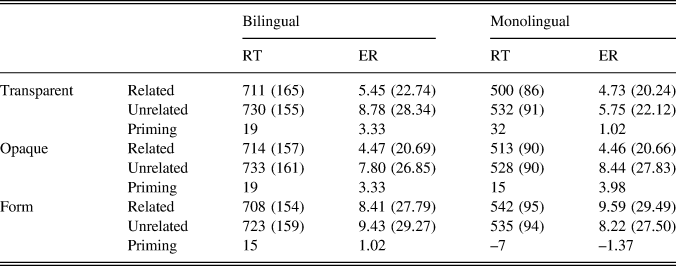
A linear mixed effects (LME) analysis was conducted using R and the lme4 package (Bates, Maechler, & Bolker, Reference Bates, Maechler and Bolker2012), with a focus on correct reaction times (RT) and error rates (ER). Before fitting the models, response times faster than 200 ms and slower than 2.5 SDs above mean group RT were excluded. All the discarded data accounted for 9.37% of the bilingual data and 6.95% of the monolingual data. Table 2 displays the mean correct RT and error rates from each condition for the remaining data. The positive skew in the RT data was reduced using inverse transformation (–1,000/RT). Prime type (Transparent vs. Opaque vs. Form), relatedness (related vs. unrelated), and group (monolingual vs bilingual) were treated as fixed effects, as were the interactions between each of the fixed factors. Target frequency and RT on the previous trial were included as covariates and retained in the final model. To balance Type I errors and statistical power, we followed the recommendation of Matuschek, Kliegl, Vasishth, Baayen, and Bates (Reference Matuschek, Kliegl, Vasishth, Baayen and Bates2017) and included random slopes if model fit was improved (as measured by AIC). Random structures of Prime type and relatedness were assessed. The best model for the RT analysis contained a by-subject Prime type slope, while it contained no random slopes for the ER analysis.
Performance at each treatment level of participant by type by prime in the experiment. RT is in milliseconds, while ER refers to percentage error rate. Standard deviation is reported in parentheses.

The ER analyses were conducted using the binomial function, with z scores being generated. Whether an error was made on the previous trial was included as a fixed factor instead of the RT on the previous trial. Coefficients with two-tailed p-values less than .05 (based on the z-distribution) were considered statistically significant.
In the analysis of RTs, there were main effects of relatedness, t = 3.82, p < .001; of group, t = 10.90, p < .001; and of target frequency, t = 5.33, p < .001, as well as a three-way interaction involving group, prime type, and relatedness, t = 3.86, p < .001. The magnitude of priming in the Transparent condition was significantly larger for the monolinguals than for the bilinguals (t = 3.10, p = .002), but there was no significant difference for the Opaque conditions (t = .93, p = .35). The magnitude of Form priming was significantly higher for bilinguals than for monolinguals (t = 2.00, p = .047). A three-way interaction was also observed when the priming effects for the Transparent and Form conditions were compared between the two groups (t =3.61, p < .01). That is, the difference in the magnitude of priming between those two conditions was greater for the monolinguals than for the bilinguals. There was also a significant three-way interaction when the magnitude of priming in the Opaque condition was compared with that in the Form condition between the two groups (t = 2.04, p = .04), with a larger difference for the monolinguals. However, no such three-way interaction was observed between the Transparent and Opaque conditions (t = 1.54, p = .12).
Because there were significant interactions involving the group factor, separate LME analyses were carried out on each of the two language groups without the inclusion of group as a fixed factor. For monolinguals, priming effects were observed in both the Transparent (t = 5.31, p < .001) and Opaque conditions (t = 2.48, p = .02), with no priming in the Form condition (t = .94, p = .35). Moreover, the interaction effect between the Transparent and Form conditions was significant (t = 4.00, p < .01), as well as between the Opaque condition and the Form condition (t = 2.58, p = .01). There was no interaction between the Transparent and Opaque conditions (t = 1.62, p = .11). In contrast, bilinguals showed priming in all three conditions, with significant simple effects for the Transparent (t = 2.15, p = .04), Opaque (t = 2.09, p = .04), and Form (t =2.07, p = .04) conditions, and no interactions across these conditions (all ps > .05).
In the ER analysis, there was a main effect found for relatedness (z = 2.54, p = .01), but no main effects for prime type or groups, nor any interactions (all ps > .05).
DISCUSSION
The RT analysis of the monolingual group revealed that transparent and opaque prefixed words generated significant priming effects, while form-related words did not. Such results indicate that the priming for the monolinguals was morphologically based and not simply determined by orthographic overlap, and this is quite consistent with the study of prefixed words by Diependaele et al. (Reference Diependaele, Sandra and Grainger2009). For bilinguals, equally strong priming effects were observed in all three conditions in the RT analysis and, notably, there was greater priming in the Form condition than there was for the monolinguals. Along with the different magnitude of priming between the bilinguals and monolinguals in the Transparent condition, together with the interaction between the Transparent and Form condition and between the Opaque and Form condition across the two groups, it can therefore be concluded that Chinese-English bilinguals are less sensitive to the morphological status of prefixes than are native English speakers. The bilinguals are more influenced by the mere overlap of letters between the prime and target regardless of whether the nonoverlapping letters have the form of a prefix.
When examining the processing of suffixed words by Chinese-English bilinguals, Li et al. (Reference Li, Taft and Xu2017) found that high-proficiency bilinguals, like monolingual English speakers, showed facilitation for both transparent and opaque primes (e.g., teacher-TEACH and corner-CORN, respectively), but not form-related primes (e.g., freeze-FREE). However, lower proficiency bilinguals showed priming even for the Form condition, suggesting an effect of orthographic overlap rather than morphological relatedness. The priming effect for the Form condition for the bilinguals in the present study, together with the lack of an interaction with the other conditions, indicates an effect of orthographic overlap here as well. Therefore, the present pattern of results for the bilinguals are more in line with that of the low-proficient bilinguals examined by Li et al. (Reference Li, Taft and Xu2017) who were based in China rather than abroad in an English-speaking country. What is noteworthy, though, is that the bilinguals in the present study were taken from the same pool of participants as the high-proficiency bilinguals in the Li et al. (Reference Li, Taft and Xu2017) study, namely, international students at UNSW. Although there is no guarantee that the participants in the two studies were of identical proficiency, there is no reason to think that they systematically differed in terms of their English ability. As such, it can be suggested that Chinese-English bilinguals are less sensitive to the status of prefixes as morphological units as they are to the status of suffixes because even higher proficiency bilinguals treat prefixes in the same way as any letter grouping at the beginning of the word. This might be the result of the fact that Chinese does not have prefix-like characters, but that it does have characters that function in the same way as a suffix.
It seems, then, that for native English speakers, prefixed words are represented as an affix and stem, just as suffixed words are. That is, for native speakers, stems are accessed while affixes are stripped off for derived words, whether they are prefixed words or suffixed words, which is consistent with Taft (Reference Taft1979) and Beauvillain (Reference Beauvillain1994). Proficient Chinese-English bilinguals, however, might be sensitive to the morphological status of a suffixed word, but are more focused on the orthographic composition of the word when it is prefixed.
The lack of form-based priming for native English speakers (e.g., turnip-TURN) has typically been interpreted to mean that no decomposition occurs when the target embedded in the prime is accompanied by a non-affix (see e.g., Rastle et al., Reference Rastle, Davis and New2004). However, a more likely interpretation (see e.g., Grainger & Beyersmann, Reference Grainger and Beyersmann2017) is that it arises from competition between the lexical representations for the prime and target (while the apparent morphological structure of a pseudo-derived word, such as corner, prevents it from quickly inhibiting the lexical representation for the target, CORN). Such an account is supported by studies (e.g., Beyersmann et al., Reference Beyersmann, Cavalli, Casalis and Colé2016) that demonstrate form-based priming when the prime has no lexical representation to compete with the target (i.e., when it is a nonword as in turnop-TURN). The fact that the bilinguals in the present study of prefixed words (and the nonproficient bilinguals in the Li et al., Reference Li, Taft and Xu2017, study of suffixed words) show statistically equivalent priming for the Form condition as for the other two conditions, therefore, suggests that they do not experience the competition between the prime and target that native English speakers do. Such a conclusion is consistent with Qiao and Forster (Reference Qiao and Forster2017) who argue that L2 is represented in such a way that no competition occurs between lexical representations, unlike the L1 lexicon.
What needs to be explained, though, is why the high-proficiency bilinguals showed no priming in the Form condition of the Li et al. (Reference Li, Taft and Xu2017) study that looked at suffixed words, just like the English L1 speakers. It seems that there was indeed competition for the L2 speakers under these circumstances. More proficient bilinguals appear to experience competition between an embedded word and the word in which it is contained when the former is found at the beginning of the latter (e.g., turn embedded in turnip), but not when the embedded word is found at the end of the longer word (e.g., anger embedded in stranger). The reason for the difference between the two types of word may well arise from the sequential processing that takes place from the beginning of a letter string. That is, an initially embedded word will be immediately encountered and, therefore, provide a greater opportunity for competition with the longer word than will other embedded words.
In conclusion, then, Chinese-English bilinguals appear to have difficulty processing the internal structure of prefixed words, even when such individuals are of sufficient proficiency to be sensitive to the structure of suffixed words. The fact that prefixes are not a feature of Chinese word structure may be the major contributing factor to the lack of sensitivity to such sublexical units in English.
SUPPLEMENTARY MATERIAL
To view supplementary material for this article, please visit https://doi.org/10.1017/S0272263119000172