The role of learning environment in second language (L2) development has been much discussed in the field of SLA, mainly in studies comparing the effects of one learning environment over another on rate and attainment of various aspects of L2 learning. A major line of comparison has been made between study-abroad and at-home instructional contexts (e.g., Collentine, Reference Collentine2004; DeKeyser, Reference DeKeyser and Freed1991; Dewey, Reference Dewey2004; Diaz-Campos, Reference Diaz-Campos2004; Freed, Segalowitz, & Dewey, Reference Freed, Segalowitz and Dewey2004; Huebner, Reference Huebner and Freed1995; Segalowitz & Freed, Reference Segalowitz and Freed2004; Towell, Reference Towell2002). The former typically involves studying the L2 in a country where it is spoken and thus combines formal classroom study with interaction in the target language community. It contrasts with the at-home environment, in which input and interaction opportunities are usually limited to the classroom. A common assumption is that the study-abroad environment is potentially more beneficial to L2 development because students are exposed to target language input both inside and outside class and they have varied opportunities for authentic language use with native speakers. The abundant target language opportunities available in the study-abroad environment are thought to lead to dramatic gains in overall language ability.
Despite this premise, empirical studies that document the actual effects of a study-abroad environment in comparison to a formal, domestic environment are still underrepresented in the field (e.g., Freed, Reference Freed1995; see Collentine & Freed, Reference Collentine and Freed2004, for a review). Moreover, recent studies have shown that the study-abroad environment is not always advantageous for L2 development; students in the target language environment do not always spend more time using the L2 nor do they necessarily make more progress than their peers who study the L2 at home (e.g., Dewey, Reference Dewey2004; Freed et al., Reference Freed, Segalowitz and Dewey2004; Tanaka, Reference Tanaka2004). The literature thus suggests that the relationship among environment, language contact, and language gains is rather complex and calls for further empirical investigation.
The present study intends to contribute to the existing body of study-abroad studies by addressing the role of learning environment in the development of a rather neglected area of language ability—pragmatic comprehension. This study examines whether learning English in a L2 environment (i.e., English as a second language [ESL] or the study-abroad environment) in contrast to a foreign language (FL) environment (i.e., English as a foreign language [EFL] or a domestic instructional environment) has a differential impact on gains in accurate and speedy comprehension of pragmatic meaning.
BACKGROUND
Pragmatic competence refers to the ability to communicate meaning in a socially appropriate manner and to interpret meaning—whether explicit or implicit—according to context (Thomas, Reference Thomas1995). The role of learning environment is considered particularly important in pragmatic development because pragmatic competence entails the ability to control the complex interplay of language, language users, and the context of language use (Kasper, Reference Kasper1992; Levinson, Reference Levinson1983; Mey, Reference Mey1993; Thomas, Reference Thomas1983, Reference Thomas1995). To become pragmatically competent, one needs to be linguistically competent and able to both assess contextual information and use linguistic resources appropriately according to context. Because linguistic means of encoding and decoding language functions are not salient and are often culture-specific (e.g., Blum-Kulka, House, & Kasper, Reference Blum-Kulka, House and Kasper1989; Boxer, Reference Boxer2002; Wolfson, Reference Wolfson1989), the target language community may offer an optimal environment for learners to grow pragmatically: They can observe how people convey appropriate levels of politeness and which linguistic means are used to communicate meaning indirectly through everyday interactions.
Some previous studies have in fact documented the superiority of a L2 environment over a FL environment for pragmatic development, especially in the production and perception of speech act expressions (Bardovi-Harlig & Dörnyei, Reference Bardovi-Harlig and Dörnyei1998; Barron, Reference Barron2002; Hoffman-Hicks, Reference Hoffman-Hicks, Bouton and Kachru1992; Li, Reference Li2000; Matsumura, Reference Matsumura2001, Reference Matsumura2003; Olshtain & Blum-Kulka, Reference Olshtain, Blum-Kulka, Gass and Madden1985; Schauer, Reference Schauer2006; Takahashi & Beebe, Reference Takahashi and Beebe1987). Matsumura (Reference Matsumura2001), for example, examined the development of learners' perception of the appropriateness of advice-giving expressions. Japanese learners of English were given 12 advice-giving scenarios and were asked to select the most appropriate advice-giving expression from four options. Data were collected four times over 1 academic year from two groups of learners: learners who studied in Canada and learners who stayed in Japan. Results showed that, as time passed, a greater number of students in the study-abroad group chose more appropriate expressions, which suggests that exposure to the target language and communicative conventions assisted their pragmatic development. Matsumura (Reference Matsumura2003) argued that proficiency had an indirect effect on this pragmatic development because the high-proficiency learners sought more opportunities for exposure to L2 input and, as a result, became more pragmatically competent.
The positive impact of study-abroad environments on pragmatic development has also been documented in the area of pragmatic sensitivity. Following Bardovi-Harlig and Dörnyei's (Reference Bardovi-Harlig and Dörnyei1998) study, Schauer (Reference Schauer2006) examined L2 learners' detection of pragmatic and grammatical errors and perceived severity of these errors. German learners in ESL and EFL environments watched a series of video interactions in which the interlocutors' speech acts—apologies, refusals, requests, and suggestions—contained either grammatical or pragmatic errors. Results corresponded to Bardovi-Harlig and Dörnyei's findings: Compared with the EFL learners, the ESL learners recognized a considerably higher number of pragmatic errors than grammatical errors. Their pragmatic awareness continued to improve during their 9-month stay in the target language country, almost to the native-speaker level. Post hoc interview data revealed that the opportunities to observe everyday life interactions in the ESL environment helped some learners notice differences between their own output and that of native speakers and to modify their language according to native-speaker norms.
The facilitative effect of a L2 context has often been attributed to the nature of the environment. In a L2 environment, learners have more opportunity to gain pragmatic awareness. They can analyze pragmatic features in native-speaker models and link them to the environment. Learners in a FL environment may not have as many opportunities to observe how people convey appropriate levels of politeness and formality in speech acts.
Contrary to this general assumption, several studies have provided a more nuanced picture of the relationship between pragmatic gains and learning environments (Atsuzawa-Windley & Noguchi, Reference Atsuzawa-Windley and Noguchi1995; Bardovi-Harlig & Hartford, Reference Bardovi-Harlig and Hartford1993; Barron, Reference Barron2002; Cohen & Shively, Reference Cohen and Shively2007; Kinginger & Belz, Reference Kinginger and Belz2005; Kinginger & Blatter, Reference Kinginger, Blatter, Ortega and Byrnes2008; Kinginger & Farrell, Reference Kinginger and Farrell2004; Marriot, Reference Marriot and Freed1995; Matsumura, Reference Matsumura2007; Niezgoda & Röver, Reference Niezgoda, Röver, Rose and Kasper2001; Röver, Reference Röver2005; Warga & Scholmberger, Reference Warga and Scholmberger2007). Three generalizations can be drawn from these studies: (a) Not all learners gain equally during their time abroad; (b) pragmatic development occurs in a FL environment; and (c) some aspects of pragmatics improve more than others.
A line of study-abroad research has revealed differential degrees of gain among learners in a host country and has documented that learner agency and access to opportunities for practice greatly affected pragmatic development (Kinginger & Belz, Reference Kinginger and Belz2005; Kinginger & Blatter, Reference Kinginger, Blatter, Ortega and Byrnes2008; Kinginger & Farrell, Reference Kinginger and Farrell2004). Kinginger and Blatter examined gains in the awareness of French colloquial expressions among 17 American students in a study-abroad program. Whereas most students made some progress in interpreting colloquial phrases, pretest and posttest scores showed a great deal of variation, with gains of 0–15 (out of 30) points. The variation was explained by the intensity and range of experiences available to the learners. Follow-up interviews revealed that the learner who exhibited the greatest gains frequently had dinner with the host family and engaged in conversations on a variety of topics, whereas the learner with the smallest gain usually had dinner alone in front of his television, resulting in scant contact with the target language community.
Several other studies have shown that formal instructional settings in a FL context can foster pragmatic development. In another replication of Bardovi-Harlig and Dörnyei's (Reference Bardovi-Harlig and Dörnyei1998) study, Niezgoda and Röver (Reference Niezgoda, Röver, Rose and Kasper2001) found that EFL learners detected a higher number of pragmatic and grammatical errors in speech acts and judged both error types as more serious than did ESL learners in their sample from the Czech Republic. EFL learners' sensitivity to pragmatic inappropriateness was attributed to the fact that they were enrolled in a teacher education program that used a communicative approach. Proficiency also interacted with appropriateness judgments: Low-proficiency learners in both environments recognized more pragmatic than grammatical errors and rated pragmatic errors as more severe, but the tendency was opposite for the high-proficiency learners. In a similar vein, Ohta's (Reference Ohta2001) study examined the longitudinal development of seven college students of Japanese in a FL environment. Class observations showed that the learners in a formal instructional setting were able to acquire appropriate pragmatic routines over time with the help of teachers' explicit modeling and collaborative peer activities in the classroom.
Another line of research has revealed that the effect of learning environment is closely related to the types of pragmatic objects to be learned. Röver (Reference Röver2005) used a web-based written test to measure the performance of ESL (N = 94) and EFL (N = 205) learners on three pragmatic constructs: production of speech acts, comprehension of implicatures, and comprehension of routines. The speech act section of the test included 12 situations that elicited requests, refusals, and apologies. The implicature section tested comprehension of two types of implicatures: formulaic implicatures that had typical structural and semantic features (e.g., showing agreement by saying “Is the Pope Catholic?”) and idiosyncratic implicatures that lacked conventional features. The routine items tested recognition of two types of routines: situational routines tied to specific situations and functional routines that were not situation bound. Results revealed no effect of L2 exposure on learners' production of speech act strategies and comprehension of implicatures but a significant proficiency effect on both. Comprehension of routines was quite different: Learners who had exposure to the target language environment scored significantly higher than learners who did not.
In line with recent reviews of pragmatic development in various learning environments (DuFon & Churchill, Reference DuFon and Churchill2006; Kasper & Rose, Reference Kasper and Rose2002), two generalizations can be drawn from the previous literature. First, living in a L2 community is no panacea for pragmatic development. Success and rate of pragmatic development are greatly affected by the object of pragmatic learning, not by living situation alone. Previous studies examined study-abroad participants' performance in relation to various pragmatic features—including speech act strategies, politeness markers, stylistic devices, and comprehension of implicatures and routines—and found that some pragmatic targets were learned better in the target language community and others were not. It seems that the structure of the learning object itself, along with the types of opportunities offered in specific contexts, determines whether pragmatic targets are best learned through out-of-class interaction and exposure, or whether domestic classroom learning alone is just as effective for learners who have sufficient general proficiency. The second generalization is that pragmatic development is constrained by the interaction of contextual and noncontextual, learner-related factors. The specific properties of the learning environment in conjunction with learners' agency and proficiency shape opportunities for L2 pragmatic learning. Living in the target language community alone may not facilitate pragmatic learning if learners do not actively seek opportunities for practice, or if they do not have a threshold proficiency that permits them to seek out such opportunities.
Although the literature reviewed here provides a relatively well-formed analysis of pragmatic gains in L2 and FL contexts, studies that compare pragmatic development across different environments are still underrepresented in the field. More empirical research is needed because the majority of studies thus far examined the production and perception of speech acts in relation to learning environment, and the question of whether pragmatic comprehension shows differential developmental patterns across learning environments has yet to be examined.
Pragmatic comprehension, an aspect of pragmatic competence, refers to the ability to recognize the intention encoded in a speaker's utterance. According to Thomas (Reference Thomas1995), meaning has two levels: utterance meaning, the lexical sense of the words uttered, and force, the speaker's underlying intention. Pragmatic comprehension entails the understanding of meaning at both levels: the ability to understand what words and sentences mean as well as what speakers want to do by using them. Similar to pragmatic production, pragmatic comprehension is considered sensitive to learning environment because it involves the interpretation and use of layers of contextual cues to infer a speaker's implied intentions (Sperber & Wilson, Reference Sperber and Wilson1995). Contextual cues are not limited to external factors such as physical environment or the immediately preceding discourse. Internal factors, such as one's knowledge of and beliefs about the world, conventions, and cultural norms, equally contribute to meaning interpretation (Duranti & Goodwin, Reference Duranti and Goodwin1992; Sperber & Wilson; Verschueren, Reference Verschueren1999). Because experience in the immediate environment usually helps establish these internal and external cues, the type of learning environment could greatly affect the ability to comprehend pragmatic force in communication.
Learning environment may also be important for pragmatic comprehension because pragmatic meaning is sometimes conveyed through conventionalized expressions specific to a language community. For instance, the expression “I am wondering if + verb” is conventional when making a request in English (e.g., Blum-Kulka et al., Reference Blum-Kulka, House and Kasper1989), whereas it is common to say “I wonder” to disagree with someone's opinion in Japanese (Furukawa, Reference Furukawa2001). Knowledge of such conventions of language use and the cultural rules behind them is a prerequisite for the successful comprehension of implied meaning. When learners are aware of the conventions or when conventions are shared between the first language (L1) and the L2 (e.g., giving a reason for refusal in Japanese and English), meaning is more easily accessed as long as learners have sufficient linguistic skills to comprehend the utterances. However, when conventions are not familiar or when implied meaning is conveyed through nonconventionalized expressions, comprehension load increases and extensive inferential processing is required, as learners use syntactic and lexical information as well as contextual cues and knowledge of conventions to infer meaning. In relevance theory, Sperber and Wilson (Reference Sperber and Wilson1995) articulated the relationship between processing load and contextual cues: As the number of contextual cues to be processed increases, the search for meaning becomes more extensive and greater processing effort is required. Conventionality is one factor that can reduce processing load, because a listener can understand intended meaning based on knowledge of conventions rather than interpretation of a great number of contextual signals.
Conventions and rules of speaking are usually learned through interactional experiences in a particular environment. Environments that offer greater opportunities to communicate in a L2 are likely to assist the comprehension of nonconventional implied meaning because they offer plenty of practice with inferential processing. The influence of environment has been observed in research on routines, which are highly conventionalized forms of language associated with a specific situation and communicative function (Coulmas, Reference Coulmas and Coulmas1981; Wray, Reference Wray2000). Because the comprehension of routines is entirely memory based and closely associated with the situations in which they occur, exposure to common situations in the target language environment is considered to facilitate comprehension. House (Reference House1996) documented this contextual effect in a study of the use of pragmatic routines by German learners of L2 English: Learners who spent time in the target language community outperformed learners who did not, even when the FL learners had pragmatic instruction. Röver (Reference Röver2005) also found that L2 learners of English who spent time in a target language environment outperformed learners who did not.
In L2 pragmatic research, a growing number of studies have examined comprehension of conventional and nonconventional implied meaning in a L2 or FL environment (Bouton, Reference Bouton, Bouton and Kachru1992, Reference Bouton, Bouton and Kachru1994, Reference Bouton and Hinkel1999; Cameron & Williams, Reference Cameron and Williams1997; Carrell, Reference Carrell, Hines and Rutherford1981, Reference Carrell1984; Cook & Liddicoat, Reference Cook and Liddicoat2002; Garcia, Reference Garcia2004; Kasper, Reference Kasper1984; Koike, Reference Koike, Gass and Neu1996; Röver, Reference Röver2005; Taguchi, Reference Taguchi2002a, Reference Taguchi2003, Reference Taguchi2005a, Reference Taguchi2007, Reference Taguchi2008; Takahashi & Roitblat, Reference Takahashi and Roitblat1994; Ying, Reference Ying1996). These studies generally confirmed that comprehension is affected by general L2 proficiency and the degree of directness and conventionality encoded in expressions. For instance, Cook and Liddicoat examined L2 comprehension of request intentions by ESL learners of two proficiency levels who responded to a written questionnaire that contained 15 scenarios followed by request-making expressions of three directness levels: direct (e.g., “Pass me the salt”), conventional indirect (e.g., “Can you pass me the salt?”), and nonconventional indirect (e.g., “Are you putting salt on my meat?”). High-proficiency learners had difficulty understanding nonconventional indirect forms, whereas the low-proficiency group had difficulty with both indirect forms. The results suggest that, as general proficiency develops, learners are able to comprehend a wider range of indirect expressions.
Studies of pragmatic comprehension thus far have typically used a cross-sectional design, and only a few studies to date have investigated the longitudinal development of pragmatic comprehension using a pretest and posttest design (Bouton, Reference Bouton, Bouton and Kachru1992, Reference Bouton, Bouton and Kachru1994; Taguchi, Reference Taguchi2007). Bouton investigated ESL learners' comprehension of conversational implicatures using a test with 33 short written dialogues that included different types of implicatures. Bouton (Reference Bouton, Bouton and Kachru1992) reported that comprehension of relevance-based implicatures became nativelike after 4.5 years but that learners continued to have problems with some formulaic implicatures (e.g., sequence implicatures, Pope question implicatures). Bouton (Reference Bouton, Bouton and Kachru1994) analyzed learners' comprehension at a 17-month interval. Contrary to the earlier study, learners did not achieve nativelike comprehension, and four types of implicatures remained difficult after 17 months: indirect criticism, Pope questions, sequence implicatures, and irony.
Taguchi (Reference Taguchi2007) examined the development of the comprehension of indirect refusals and indirect opinions among 92 Japanese EFL learners over 2 months. Based on Searle's (Reference Searle1979) speech act taxonomy, refusals were categorized as a type of commissive (an act of committing the speaker to do something) in a reverse direction (i.e., negative commissive), and expressing opinions was categorized as representatives (an act of representing the speaker's state of mind). According to Brown and Levinson's (Reference Brown, Levinson and Goody1978) politeness theory, the speech act of refusal is considered impolite because it could threaten the listener's positive face (i.e., the desire to be accepted). To minimize this potential threat, the speaker uses a variety of politeness strategies. Indirect strategies, such as providing explanations or excuses for a refusal without explicitly saying no, are considered a common conventional social practice in refusal situations, and empirical data also support this usage (e.g., Beebe, Takahashi, & Uliss-Weltz, Reference Beebe, Takahashi, Uliss-Weltz, Scarcella, Andersen and Krashen1990; Nelson, Carson, Batal, & Bakary, Reference Nelson, Carson, Batal and Bakary2002). Expressions used to convey opinions indirectly are considered less conventional because meaning is not attached to specific linguistic expressions or language use patterns. For example, indicating a negative opinion of a movie by saying “I was glad when it was over” illustrates that linguistic options for how to express the opinion are virtually unlimited. Linguistic expressions used to convey opinions are guided by general inferential strategies and are thus more idiosyncratic and freer than other types of expressions.
In Taguchi's (Reference Taguchi2007) study, indirect refusals and indirect opinions were incorporated into a computerized listening instrument, and EFL learners' comprehension development was analyzed. The degree of development was examined based on two attributes: accuracy of comprehension (scores on the listening test) and speed of comprehension (response time). The data revealed that L2 comprehension was faster and more accurate for indirect refusals than for indirect opinions. Learners showed a significant improvement in both accuracy and comprehension speed over time, but the degree of development was much larger for accuracy than it was for speed. Accuracy was significantly related to general proficiency as measured by the TOEFL exam, whereas comprehension speed was related to semantic access skill as measured by a word judgment test. Accuracy and speed were not related to each other.
Although Bouton (Reference Bouton, Bouton and Kachru1992, Reference Bouton, Bouton and Kachru1994) and Taguchi (Reference Taguchi2007) clearly showed that L2 learners in both environments (ESL and EFL) made notable progress over time in their ability to comprehend implied meaning, neither study used a control group to directly compare the degree of gains among learners in one environment over another. A comparison of learning environments may shed light on the differential effects of environment on gains in pragmatic comprehension. Given the differences in gains in accuracy and speed of processing of pragmatic meaning documented by Taguchi, these two measures of development lend themselves well to such a comparative inquiry: Analyzing gains in accuracy and speed by learners in L2 and FL environments could provide a meaningful developmental account of pragmatic comprehension.
The development of performance fluency and speed, especially oral fluency, has been compared across environments using pretest and posttest designs in several studies (e.g., Freed, Reference Freed and Riggenbach2000; Freed et al., Reference Freed, Segalowitz and Dewey2004; Segalowitz & Freed, Reference Segalowitz and Freed2004; Towell, Reference Towell2002). Segalowitz and Freed compared oral fluency gains between learners of L2 Spanish in a study-abroad environment and an at-home instructional environment. An oral proficiency test was given to the two L2 groups at the beginning and end of a semester. The results revealed that although the study-abroad group made significant gains in oral fluency, as measured by speech rate and number of filler-free units, the amount of language contact and use reported in the post hoc questionnaire (i.e., the language contact profile) showed no significant relationship with the gains.
The fact that the study-abroad group showed a greater improvement in fluency supports theories of cognitive skill development that postulate that increased practice leads to increased performance speed (Anderson, Reference Anderson1983, Reference Anderson1990; McLaughlin, Reference McLaughlin1987; McLaughlin & Heredia, Reference McLaughlin, Heredia, Ritchie and Bhatia1996). According to Anderson, skill development involves a shift from a stage characterized by declarative knowledge (i.e., knowledge that) to a stage characterized by procedural knowledge (i.e., knowledge how). Language learning is a process in which declarative knowledge becomes procedural through practice. At the beginning stage of skill development, L2 learners retrieve and use declarative knowledge of language rules consciously. Through repeated practice, rule application becomes increasingly automatic, rapid, and eventually unconscious. Hence, automaticity is acquired through repetitive, consistent associations between L2 input and the learner's responses to it (Segalowitz, Reference Segalowitz and Riggenbach2000). Ellis (Reference Ellis and Robinson2001) claimed that the best predictor of language facility is time-on-task; exposure to L2 input and extensive L2 practice will help learners acquire language knowledge and processing efficiency, which will consequently promote rapid skill execution.
Claims that abundant input and language use opportunities are necessary for L2 fluency development imply that a L2 environment could be more advantageous than a FL environment for the development of speed in pragmatic comprehension, as learners in a FL environment may be at a disadvantage due to their limited incidental exposure to and practice with the L2. Compared with processing of lower level input (e.g., words and sentences), the impact of learning environment on speed may be even greater for pragmatic processing because associative practice involving linguistic, sociocultural, and contextual information is required for successful development, and this complex interplay of linguistic and extralinguistic factors may not be readily accessible in a FL environment.
The interaction between environment and language gain is a worthwhile investigation in the area of pragmatic comprehension due to the context-sensitive nature of the construct, but very little research has examined the development of accurate, speedy pragmatic comprehension in relation to learning environments. It is worth investigating whether learners in a L2 environment achieve greater gains than learners in a FL environment by taking advantage of the greater availability of target language input, interaction, and associative processing practice that may lead to better pragmatic awareness. The present study pursued this inquiry and asked: Are there differences in the development of speedy and accurate comprehension of implied speaker intentions between learners in EFL and ESL environments?
METHODOLOGY
Participants
Participants in this study were native speakers of Japanese studying English at a college in an ESL or EFL setting.Footnote 1 The ESL group included 57 students enrolled in the first session of an intensive English program (IEP) in a college located in the United States. There were 19 males and 38 females, ranging in age from 18 to 28 years, with an average age of 18.56. They averaged 6.5 years of formal English education conducted in Japanese in Japan, which suggests that the majority of them recently finished 6 years of junior and senior high school education. Two students each had 1 month of prior living experience, and one student had 6 months of living experience in an English-speaking country. The EFL group included 60 students enrolled in the first session of the IEP program in a college in Japan. There were 13 males and 47 females, ranging in age from 18 to 22 years, with an average age of 18.23. The EFL group had an average of 6.08 years of formal English study in Japan prior to college, indicating that most of them just graduated from high school. Three students in the EFL group had 9–11 months prior living experience in an English-speaking country. The Institutional Testing Program TOEFL (ITP TOEFL) was administered to each group before the IEP session started; this test revealed that learners in both groups were at the beginning level of English proficiency. There was no significant proficiency difference between the groups for the composite score, t(115) = 1.10, p = .27, or for the listening section score, t(115) = 0.93, p = .35. In short, the ESL and EFL groups were largely comparable in terms of age, educational background, average number of years of formal English study, and initial general English proficiency.
Learning EnvironmentsFootnote 2
ESL Environment
The ESL students were recruited from an IEP program in a small private college located in Hawai‘i; this college was founded in 1977 as a branch of a Japanese college and became independent in 1998. The college serves students from Japan who desire academic proficiency in English in order to earn an American Associate in Arts degree (AA) and eventually move on to a bachelor's degree program (BA) at an American university. The college generally admits 100–120 Japanese students each year. At the time of the study, the IEP program consisted of 28 hr of instruction per week in English over a period of 12 weeks. Class size in the IEP program was small, with a maximum of 16 students per class.
The IEP program has three levels, and students are promoted to the next level upon successful completion of the course requirements. At the time of the study, there were 16 IEP instructors; most were native speakers of English, and the rest were nonnative speakers with near-native competency. All instructors had an academic degree in TESOL, education, or linguistics from a university in the United States. Because the goal of the IEP program is to prepare students for entry into an AA program, classes focus on activities associated with academic English use, including listening to lectures, comprehending and summarizing texts, and writing short responses and essays.
The IEP program uses a content-based, integrated skills approach in which students practice the four language skills. All classes are taught in English. Students have two main classes: reading/writing and listening/speaking. The reading/writing class uses a textbook organized by academic topics (e.g., sociology, human behavior). Using the core textbook, students practice a variety of reading skills (e.g., skimming, scanning, previewing, using environment to guess meaning), expand their vocabulary, and learn how to write an academic essay. The listening/speaking class focuses on listening comprehension and oral communication strategies in formal and informal environments (small talk and discussion). Typical class activities include listening to lectures and taking notes, group and class discussion, class presentations, vocabulary expansion, and pronunciation practice. In conjunction with the listening/speaking course, students have learning resource lab hours in which they further polish their aural/oral skills using a variety of audio-visual equipment and real-life materials (e.g., movies, news clips). Students also take a computer class, an American culture class, and an elective depending on their level. There is no explicit instruction on pragmatics at any level.
EFL Environment
The EFL students were recruited from an IEP program in a small public college located in northern Japan; it is one of the few colleges in Japan in which all courses are taught in English. The college generally admits about 150 Japanese students each year. At the time of the study, students in the IEP program received approximately 16–18 hr of instruction per week over half of a semester (about 7.5 weeks). Class size was relatively small, with 15–20 students per class. There were 16 instructors in the IEP at the time of the study, including 14 native English speakers and two fluent speakers of English who are Japanese. All instructors had an academic degree in TESOL or applied linguistics from a university in the United States or Canada.
The IEP classes are taught in English and are intended to prepare students for typical academic work that is seen in college-level courses in the United States (e.g., listening to lectures, participating in discussion, and writing papers). After students complete the IEP program, they proceed to basic education and advanced courses to complete their undergraduate degree. All students are expected to transfer to a university in an English-speaking country during their third year.
There are three levels in this IEP program; students are promoted to the next level after they complete the course requirements and achieve the required degree of proficiency as measured by the TOEFL. At the time of data collection, the students had three main classes. The first-level class was a content-based, integrated skills course in which English is taught through academic subjects (e.g., history, sociology). Class activities included reading and summarizing academic texts, writing short essays, listening to lectures, watching videos, group and class discussion, oral presentations, and vocabulary learning. The second class was a focused-listening class in which students engaged in a variety of speaking and listening activities (e.g., listening to short conversations and lectures, small talk and discussion, pronunciation practice). They also practiced note-taking strategies and dictation skills. In the third class, a writing class, students learned to write academic essays in English. In addition to these three classes, students attended language lab hours and performed self-guided listening and reading tasks with a variety of authentic audio-visual materials (e.g., movies, news clips), and they also took a computer class. There was no explicit pragmatic instruction at any level.
Similarities and Differences Between the ESL and EFL Environments
The two target institutions in this study share similar characteristics in terms of student background, teacher background, class size, class structure, and activities. In both institutions, Japanese students made up almost 100% of the classroom population. In both contexts, the curriculum is an intensive, integrated skill-based English for academic purposes program that pursues content-based instruction (i.e., English used as a medium to teach content areas). Classes are taught 100% in English by native speakers or fluent nonnative speakers who have graduate degrees in TESOL or related areas. Academic English skills (e.g., writing essays, note-taking, oral presentations, extensive reading) are emphasized in the course of instruction, corroborating the curriculum objective of preparing students for university-level work in an English-speaking country.
Because participants were all Japanese students who had recently graduated from Japanese high schools, both groups were considered to have had similar educational experiences under the official curriculum guidelines and educational policies of Japan. Although recent national curricula have emphasized a communication-oriented teaching approach (Mombusho, 1999), abundant research has documented that university entrance exams and other factors cause difficulty in implementing communicative teaching in Japan (Gorsuch, Reference Gorsuch2000, Reference Gorsuch2001; McGroarty & Taguchi, Reference McGroarty, Taguchi, Frodesen and Holten2005; Oka & Yoshida, Reference Oka and Yoshida1997; Taguchi, Reference Taguchi2002b, Reference Taguchi2005b; Taguchi & Naganuma, Reference Taguchi and Naganuma2006; Wada, Reference Wada and Savignon2002). These studies revealed that class time is largely allocated to grammar instruction or mechanical spoken exercises, with little attention paid to functional and sociolinguistic aspects of language use. Listening exercises in textbooks emphasize comprehension of literal meaning, and inferential skills are almost never practiced. Speaking exercises also focus on mere information exchange, with little attention to sociocultural aspects of interaction such as politeness and formality. These findings suggest that the Japanese students sampled in this study did not have many opportunities to practice pragmatic skills prior to the study.
Insofar as their motivation and goals are concerned, students in the ESL and EFL groups were also believed to be relatively similar because their choice of college indicates that they want to gain academic English abilities appropriate for regular university work in an English-speaking country. This specific motivation seems obvious for the EFL group because only a few English-medium universities currently exist in Japan. Traditional Japanese universities in which English is taught as an academic subject by using Japanese as an instructional medium are in the majority. In contrast to the vast majority of high school graduates who typically attend traditional universities, the EFL students in this study chose this unique instructional environment because of their motivation to pursue the study of English at an advanced level.
Despite the similarities in student background, academic preparation, and objectives of the courses in which they were involved, there were differences in students' living arrangements and potential use of English outside of class. The EFL institution is located in a small town with a population of 8,000 in northern Japan; the town is isolated from major public attractions, and students' activities are thus mainly limited to on-campus facilities. The ESL institution is located in Hawai‘i, a major tourist destination with a population of one million. Although Hawai‘i shows evidence of Japanese influence, given that 16.7% of the population has Japanese ancestry and 4.8% of the population speaks Japanese at home (MLA, 2007), the ESL environment in Hawai‘i provided students with more potential English contact than the EFL environment in Japan, particularly because of their living arrangements. At the time of data collection, all ESL students except one had a home-stay arrangement with local families who were native speakers of English, and more than 90% of the students reported speaking English at home almost every day, for approximately 10 hr per week on average. Additionally, the students were required to speak English to each other on campus all the time.Footnote 3 In the EFL environment, on the other hand, all students lived on campus and had another Japanese student as a roommate. Because there were no international students from English-speaking countries on campus at the time of data collection, it was assumed that the students did not have extensive contact with native English speakers outside of the classroom and thus that they communicated mainly in Japanese.
Instrument: Pragmatic Listening Task
This study examined L2 learners' ability to interpret speaker intentions accurately and quickly. The focus was on intentions that are not explicitly stated and thus are only implied. Implied meaning is defined as meaning “that goes beyond what is given by the language form itself or what is literally said” (Verschueren, Reference Verschueren1999, p. 25). Comprehension of implied meaning refers to the ability to (a) recognize a mismatch between the literal utterance and the intention of the utterance and (b) comprehend the intention of the utterance.
Comprehension of implied meaning was assessed by a computerized pragmatic listening task (PLT) with 60 items: 2 practice items, 10 filler items, and 48 experimental items (24 refusal and 24 opinion items). The instrument was drawn from Taguchi (Reference Taguchi2007), in which partial items were adapted from previous studies (Bouton, Reference Bouton, Bouton and Kachru1992, Reference Bouton, Bouton and Kachru1994; Holtgraves, Reference Holtgraves1999; Kotsonis, Reference Kotsonis1981; Röver, Reference Röver2005) with the authors' permission (see the Appendix for sample sentences). Each item contained a short dialogue spoken by a male and a female native English speaker. In the experimental dialogues, the reply that appeared at the end did not provide a straightforward answer to the speaker's question. Thus, the experimental items were intended to test L2 learners' ability to comprehend the implied speaker intention encoded in the seemingly irrelevant reply. Each dialogue was followed by a yes/no question designed to check comprehension of the speaker's intention. The task was performed using the SuperLab Pro Program for Windows (Cedrus, 2003).
Sample test items are presented in (1) and (2). Indirect refusal items included four types: refusals to requests (six items), invitations (six items), suggestions (six items), and offers (six items). Utterances used for indirect refusals took the form of providing a reason and were written so as to avoid explicit linguistic markers of refusals such as “no,” “I can't,” or “I don't want to,” which were identified as direct refusal expressions (Beebe et al., Reference Beebe, Takahashi, Uliss-Weltz, Scarcella, Andersen and Krashen1990; Nelson et al., Reference Nelson, Carson, Batal and Bakary2002). Indirect opinion items were written as expressions used to convey opinions in a nonliteral manner. To counteract response biases, half of the indirect opinion items were designed to illustrate negative opinions, and the other half were written to imply positive opinions.
(1)

(2)


These two item types (refusals and opinions) were included in the listening task in order to counteract any response biases as well as to add variety to the items in terms of the degree of conventionality. Indirect refusal items were considered more conventional because the utterances used to convey refusals provided a reason, which is considered a common and predictable pattern of refusal routines (Beebe et al.; Nelson et al.). In contrast, indirect opinion expressions were considered less conventional because they reflected neither specific discourse routines nor conventions of language use.
Each conversation was coded for category by two raters. The percentage agreement rate between the two raters was .97. The item on which two raters did not agree was revised. Differing level of conventionality and the resulting differences in comprehension were also documented in Taguchi (Reference Taguchi2005a). Furthermore, to reduce the effect of construct-irrelevant variance from the participants' different levels of vocabulary knowledge, following Röver (Reference Röver2005), all vocabulary items used in conversations and yes/no questions were drawn from Longman's (1995) defining vocabulary list. The 2,000 words on the list are identified as common, frequent, and basic English words and are also used to write all the definitions in the Longman dictionary.
Following Biber's (Reference Biber, Biber and Finegan1994) framework of situational parameters, conversations used in the PLT were carefully analyzed and counterbalanced over five interlocutor relationships: college friends, housemates, co-workers, teacher-student, and family members. The situations were also counterbalanced over three settings: school, company, and home. There was no situation in which the interlocutors were total strangers to each other.
When writing dialogues, great care was taken to keep the length of the conversations relatively similar in order to control the impact on short-term memory. Each conversation had 42–48 words (M = 44.8, SD = 1.9 words). Additionally, because the response time taken to answer the yes/no questions was part of the focus of investigation, the number of words in the questions was also kept to six or seven, because equal input length could reduce reading time effects and make response times more comparable. The number of turns in each dialogue was also kept approximately the same, between three and five. The internal consistency reliability of the PLT was estimated using Cronbach's alpha, yielding .85 for the full test (k = 58), .72 for refusal items (k = 24), and .71 for opinion items (k = 24). The PLT was administered to a native-speaker group in Taguchi (Reference Taguchi2007); compared with L2 learners, the native speakers in that study were almost perfectly accurate and much faster in their comprehension.
Procedures
The PLT was administered twice, at the beginning and end of a half-semester period (about 7 weeks) for the EFL group and at the beginning and end of a 5-week period for the ESL group.Footnote 4 These specific timings were selected to control the number of instructional hours across groups. In the EFL group, one IEP term lasted for a half-semester period in which the students received about 120–130 hr total of instruction (16–18 hr per week). An IEP term for the ESL group lasted 12 weeks. Because the ESL group received 28 hr of instruction per week, the second PLT was administered during their fifth week of instruction, after they had completed approximately 130 hr of classroom instruction.
The PLT was administered on on-campus PC computers. To begin, participants sat at the computers, put on headphones, and read instructions on the computer screen in their native language. Before starting the test, they practiced on two items. For each test item, participants heard a dialogue, and immediately following the dialogue, a yes/no question appeared on the screen. Participants responded yes or no by pressing 1 for yes and 2 for no; these keys are adjacent to each other on the keyboard. As soon as an answer was chosen, the computer automatically proceeded to the next item. Response time was measured from the moment the question appeared on the screen to the moment the participant pressed the key. The computer recorded all responses and their latencies. The same procedure was repeated for the participants at the end of the intensive week course. All participants heard the dialogues in the same order, and the order of the test items was changed for the second listening test.
Data Analysis
This research compared gains in pragmatic comprehension ability between ESL and EFL learners. Comprehension ability was operationalized in terms of the correct identification of implied-meaning items (i.e., indirect refusals and indirect opinions) and the speed with which the answer was chosen. Accuracy was measured by the PLT, which had an interval scale of 0–48 (0–24 for each item type). Comprehension speed (also interval data) was operationalized as response times and was calculated by averaging the number of seconds taken to answer items correctly. For each learner group, development of accuracy and speed was analyzed using two paired-sample t tests to compare the differences in accuracy scores and response times between the pretest and posttest sessions. Effect size (η2) was also calculated for differences in accuracy score and response time and compared between the two L2 groups. The 10 filler items in the listening task were excluded from all analyses. The significance level for hypothesis testing was set at .05; however, because the analyses of the first research question used two statistical comparisons, the alpha level was adjusted to .025 using the Bonferroni correction in order to avoid a type I error (Brown, Reference Brown1990; Hatch & Lazaraton, Reference Hatch and Lazaraton1991; Jaeger, Reference Jaeger1993; SPSS, 1998).
Prior to the statistical analyses, distributions of the variables were examined for underlying assumptions. Although the distribution of comprehension accuracy data met the assumptions, the distribution of response time data did not meet the assumptions of normality, linearity, and homoscedaticity. Because violation of these assumptions would weaken the statistical analysis, statistical procedures to remedy these problems were necessary prior to conducting the fundamental analysis. First, outliers were considered, as is common procedure in SLA studies that deal with response time data. In the time data, outliers were found in the data of three participants, so the data from these participants were eliminated from the dataset. Additionally, close examination revealed unusual response patterns from two participants (e.g., random key pressing). Therefore, data from these participants were also eliminated from the dataset. Another procedure recommended for improving nonnormality is data transformation (Tabachnick & Fidell, Reference Tabachnick and Fidell2001). Transformation is one way to fit data more closely to the underlying assumptions of statistical tests. Because the data were positively skewed, following Tabachnick and Fidell, a logarithmic transformation was performed.Footnote 5 After the removal of outliers and transformation, the distributions were found to be normal, as confirmed with the Shapiro-Wilks test at the alpha level of .05.
RESULTS
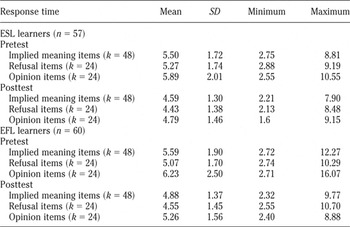
Tables 1 and 2 display descriptive statistics for accuracy scores and response times, respectively, in the pretest and posttest sessions for the ESL and EFL learner groups. Both groups of learners comprehended indirect refusal items more accurately and more quickly than indirect opinion items, which suggests that the conventionality encoded in the refusals assisted their comprehension.
ESL and EFL learners' accuracy scores in PLT

Note. k = number of items. Pretests and posttests were given after the two groups received approximately 130 hr of classroom instruction (after 5 weeks for the EFL group and 7 weeks for the EFL group).
ESL and EFL learners' response time in PLT

Note. k = number of items. The time refers to the average number of seconds taken to answer items correctly.
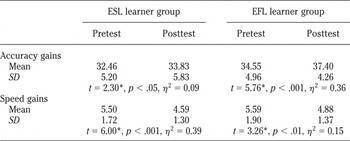
Patterns of gains in pragmatic comprehension ability were examined separately for ESL and EFL groups. Table 3 displays the results of a series of paired-sample t tests that compared accuracy scores and response times between the pretest and posttest for each learner group. Both groups showed significant improvement in accuracy and speed of pragmatic comprehension over time. For the ESL group, a paired-sample t test revealed a significant difference between pretests and posttests for scores, t(56) = 2.30, p < .025, as well as for response times, t(56) = 6.00, p < .025, which indicates that the ESL learners achieved significant gains in accuracy scores and response times over the 5-week period. Similarly, for the EFL group, paired-sample t tests revealed a significant pretest and posttest difference for scores, t(59) = 5.76, p < .025, as well as for response times, t(59) = 3.26, p < .025, which suggests significant gains in pragmatic comprehension over the 7-week period.
Gains in accuracy scores and response times of implied meaning items

Note. T tests were performed on the transformed response time data. There were 48 implied meaning items (indirect refusals and indirect opinions). The mean time refers to the average number of seconds taken to answer each item correctly.
Although both groups demonstrated notable development in pragmatic comprehension ability, comparisons of effect sizes revealed interesting patterns. For the ESL group, the effect size of the response time difference (η2 = 0.39) was notably larger than that of the score difference (η2 = 0.09). The pattern was reversed for the EFL group. Although the EFL learners made a significant improvement in processing speed, the effect size of the response time difference (η2 = 0.15) was much smaller than that of the accuracy gain (η2 = 0.36). The results thus suggest that the degree and pattern of development differed between accuracy and response speed as well as between the ESL and EFL environments. The longitudinal gain of speed in the processing of pragmatic information was smaller than that of the accurate understanding of pragmatic meaning in the EFL environment. In contrast, the ESL environment seemed to have more strongly supported the development of processing speed than accurate comprehension of pragmatic meaning.
As post hoc analyses, differences in the gains on comprehension accuracy and response speed were compared between the two learner groups. Accuracy scores and response times at posttest were submitted to univariate ANCOVAs with the group (ESL and EFL) as the between-subjects factor and the initial accuracy scores and response times as covariates. ANCOVA was used instead of ANOVA because there was variation in the initial accuracy scores and response times between the groups. There was a significant effect of group on accuracy scores of indirect refusals at posttest, F(1, 115) = 12.40, p < .025; however, the degree of effect was small (η2 = 0.10). On the other hand, there was no significant effect of group on accuracy gains for indirect opinions, F(1, 115) = 3.27, p = .073. The results suggest that the EFL group showed significantly greater improvement than the ESL group in the accurate comprehension of indirect refusals but not in the comprehension of indirect opinions. There was no significant effect of group on response times of indirect refusals, F(1, 115) = 0.422, p = .517, or indirect opinions, F(1, 115) = 2.85, p = .094.
DISCUSSION
This study revealed improvement in pragmatic comprehension among ESL and EFL learners in terms of both accuracy scores and response times, which suggests that pragmatic comprehension develops over time regardless of environment. It seems that, with time, as learners receive more instruction on their general L2 skills, the ability to comprehend nonliteral meaning develops in terms of both accuracy and speedy processing of meaning.
The ESL and EFL learners also showed similar developmental patterns in their comprehension of the two types of implied meaning. For both groups, comprehension of indirect opinions was both more difficult and took more time than indirect refusal comprehension. Accuracy of comprehension of indirect opinions also demonstrated less improvement compared with that of indirect refusals. These findings suggest that comprehension of indirect opinions presents greater demands for processing; as a result, comprehension of opinions may lag behind that of refusals in pragmatic development, regardless of the environment of residence.
Expressions of indirect refusal encoded a certain degree of conventionality that was likely to have assisted learners' comprehension. Certain patterns of conventionality are shared between English and Japanese: In both languages, it is common to provide a reason for refusing an invitation or suggestion. Both groups of learners were likely to have relied on their L1-based knowledge when comprehending L2 refusal intentions. Indirect opinion items, on the other hand, did not follow any fixed patterns of discourse shared between the L1 and L2; consequently, the interpretation of speaker intention in those items was less straightforward than the interpretation of intention in indirect refusals. Without a convention to rely on, comprehension of indirect opinions was more difficult and took longer for the learners in this study.
In summary, the comprehension of more conventional implied meanings may precede that of less conventional ones, insofar as learners are aware of the conventions of language and language use in the target culture or the conventions are shared between the L1 and L2. The ability to comprehend less conventional implied meanings does not seem to develop in a parallel manner due to the extensive inferential skills needed to arrive at the correct interpretations. Development of pragmatic comprehension, then, seems to be characterized as the ability to comprehend a range of less conventional, idiosyncratic implied meanings accurately in a speedy manner. Similar to the EFL learners, the ESL learners in this study also had difficulty comprehending less conventional implied meanings, which might suggest that they did not take advantage of opportunities for inferential practice available in the target language environment. Or it may be that, due to the Japanese influence in Hawai‘i, the target language environment did not produce the intended effect of boosting the learners’ development in accurate comprehension of implied meaning. Although the ESL learners had a home-stay arrangement with English-speaking families, the amount of inferential communication that they experienced might not have been sufficient for significant pragmatic gains to occur in the relatively short period of time (5 weeks) between the pretest and the posttest.
The present findings do not lend support to the previous findings that living in the target language environment is beneficial for pragmatic development (Bardovi-Harlig & Dörnyei, Reference Bardovi-Harlig and Dörnyei1998; Barron, Reference Barron2002; Hoffman-Hicks, Reference Hoffman-Hicks, Bouton and Kachru1992; Li, Reference Li2000; Matsumura, Reference Matsumura2001, Reference Matsumura2003; Olshtain & Blum-Kulka, Reference Olshtain, Blum-Kulka, Gass and Madden1985; Schauer, Reference Schauer2006; Takahashi & Beebe, Reference Takahashi and Beebe1987). In fact, the findings illustrate that pragmatic development also occurs among learners in a FL environment (e.g., Niezgoda & Röver, Reference Niezgoda, Röver, Rose and Kasper2001; Ohta, Reference Ohta2001). Both the ESL and EFL learner groups made significant gains and, more importantly, the EFL group displayed greater gains than the ESL group in the accuracy of comprehension of indirect refusals. Hence, it seems that learners in a FL environment are not necessarily disadvantaged in pragmatic development; pragmatic comprehension develops naturally in domestic, formal classroom settings that afford limited opportunity for input, communicative practice, and pragmatic awareness, as long as the context affords sufficient resources for such development.
The pattern of findings may be related to the design of the current study, which examined the comprehension aspect of pragmatic competence in relation to environment, whereas previous studies focused on the production of pragmatic expressions. Most previous studies compared learners' gains in the production of speech acts as well as in the perception and choice of appropriate linguistic expressions used to perform them. It is possible that the comprehension and production of speech intentions may require somewhat different types of pragmatic abilities and are thus affected differently by learning environment. The ability to comprehend the intentions behind utterances is considered an innate human capacity. When we hear something, we automatically seek the relevance of the message, even if the message seems to be unrelated to the previous discourse. This inferential ability develops naturally as we mature cognitively and become socialized in our language community (Baron-Cohen, Leslie, & Frith, Reference Baron-Cohen, Leslie and Frith1985; Hala & Carpendale, Reference Hala, Carpendale and Hara1997). Thus, relevance processing in L1 might be directly transferable to the L2 comprehension process once learners acquire sufficient L2 listening ability to utilize such processing. The actual environment of learning may thus be of secondary importance as long as it affords sufficient instruction and practice to promote general listening skills. The target FL environment in this study seems to have provided such quality L2 practice. Although EFL learners did not have much incidental exposure to the L2 outside the classroom, they received intensive English instruction in the L2 for 3–4 hr per day. The large amount of in-class contact probably contributed to gains in overall listening ability, including inferential listening.
The production of speech intentions, on the other hand, seems to require conscious learning and attention to the target communication patterns because norms for performing speech acts differ across cultures and social environments. Although the concept of politeness and related social skills may be universally shared across cultures and develop naturally in the L1 socialization process, specific linguistic means to express these concepts are often culture-specific and may not be directly transferable to the L2 (Wolfson, Reference Wolfson1989). Hence, appropriate levels of directness and politeness as well as the linguistic expressions necessary to implement them in speech acts could be subject to conscious noticing and learning in the L2 community (e.g., Kasper & Rose, Reference Kasper and Rose2002; Schmidt, Reference Schmidt, Kasper and Blum-Kulka1993). A L2 environment may naturally afford more evidence of pragmalinguistic and sociolinguistic norms (Kasper, Reference Kasper1992; Leech, Reference Leech1983; Thomas, Reference Thomas1983)—that is, which linguistic forms to use in which environments—and may, consequently, facilitate the acquisition of form-function-context mappings in the production of speech acts.
The present findings support claims in the previous literature that the nature of pragmatic targets, along with experience in the host community, greatly affects the success and rate of pragmatic development: Although both learner groups showed significant development in accuracy and speed of pragmatic comprehension, interesting group differences emerged when the degree of development is compared between the two measures. The increase in speed was much smaller than the increase in accuracy for the EFL group, whereas the pattern was reversed in the ESL group. Implications of these findings are twofold: (a) In the course of L2 development, speed and accuracy may not develop in parallel, and (b) different environments may support different aspects of pragmatic comprehension ability.
For the EFL group, speedy, automatic processing of pragmatic meaning did not develop as quickly as accurate interpretation of pragmatic meaning. Linguistic, cognitive, and sociocultural factors are involved in the processing of pragmatic functions, and the coordination of these elements must be automatized to achieve speedy comprehension. Because the EFL learners in this study obviously had the linguistic resources to accurately decode pragmatic intentions, less substantial gain in speed may simply be due to the limited amount of processing practice available in the EFL environment. Given less exposure and practice, processing may thus take longer to be automatized in the EFL environment.
These interpretations corroborate existing theories of skill development. Cognitive psychologists have argued that the speed of language processing develops naturally in accordance with increased associative practice between stimuli (i.e., input) and response (Anderson, Reference Anderson1990; MacKay, Reference MacKay1982; McLaughlin, Reference McLaughlin1987; Rumelhart & McClelland, Reference Rumelhart and McClelland1986). Performance speed gradually increases through practice because connections of nodes in the neural network system become reinforced through repeated activations of these nodes (MacKay). For beginning-level learners, simple activities such as sentence decoding and reading aloud require conscious linguistic coding and thus take some time (Segalowitz, Reference Segalowitz and Riggenbach2000). As learners become more skilled, basic processing components (e.g., letter recognition, sentence processing) become routinized and automatized, freeing up space for more complex processing components; repeated associative practice thus helps promote the development of performance speed (Segalowitz).
The small gain in speed among EFL learners in this study may be due to the fact that they lacked sufficient opportunities for associative practice to develop performance speed. In a FL environment, EFL learners had limited incidental exposure to the L2; as a result, mapping practice between form and meaning did not occur frequently. As noted previously, associative practice involving linguistic, sociocultural, and contextual information is required for successful pragmatic development, and access to interactions involving combinations of these linguistic and extralinguistic factors may have been limited in the FL environment.
The ESL learners in this study showed more improvement in speed than in accuracy. Compared to the EFL learners, the ESL learners were likely to have had more everyday out-of-class practice in processing the target language. As a result, given comparable initial L2 proficiency, it is possible that the greater gains in speed demonstrated by the ESL learners is due to the abundant incidental processing practice available in the study-abroad environment.
LIMITATIONS OF THE STUDY AND IMPLICATIONS FOR FUTURE RESEARCH
Whereas the current study was limited to two specific learner groups—ESL and EFL—the comparative approach used here could be profitably expanded to investigate pragmatic development over a wider range of proficiency levels, ages, and L1 and L2 backgrounds. Furthermore, although the current sample was unavoidably skewed toward females, future research may consider taking gender balance into consideration in sampling.
The focus of the study was to examine whether the L2 learners were able to identify the correct implied intention without being distracted by other information. Because this ability was examined by a highly controlled decontextualized listening task that contained a series of artificial dialogues, it is questionable whether the task elicited an adequate representative sample of real-life language use. This limitation should be addressed in future research, perhaps by observing a subset of learners in authentic communicative situations. Additionally, in real-life conversations, implicitness becomes manifest through various discourse and sequential features, such as deixis and reference words, ellipsis, tone of voice, incomplete sentences, or disfluency features. These multiple features could jointly make up for overall inexplicitness and assist in the comprehension of implied meaning. Future research should identify those features in authentic interactions and incorporate them into the PLT.
This study examined the effects of environment by sampling learners from distinct physical environments but was not able to reveal precisely which environmental factors may have affected development differently. Because learning opportunities for pragmatics could vary considerably even within the same physical environment (see Kasper & Rose, Reference Kasper and Rose2002, for a review), future research should incorporate additional measures such as interviews and self-report journals to document learners' specific motivations for learning the L2 as well as their experiences with access to the target culture and input at individual levels. Class observation could offer equally valuable information related to pragmatic experience. Although the target institutions in this study did not offer courses specifically on pragmatics, close examinations of classroom practice and teacher-student interaction patterns could reveal the availability of pragmatic input and practice in formal settings. Analyses of the nature of social contacts, domains of contacts, and activity types could also provide additional information about the extent to which pragmatic development is influenced by the types of sociocultural experiences and inferential practice available in different environments. Such qualitative analyses could provide valuable information about the amount, quality, and intensity of input that plays a decisive role in pragmatic development. These lines of investigation are in accordance with current approaches to SLA—as represented in theories of dynamic systems, chaos/complexity, and emergentism—that view L2 development as a contextualized and dynamic process (de Bot, Reference De Bot2008; Ellis & Larsen-Freeman, Reference Ellis and Larsen-Freeman2006; Larsen-Freeman & Cameron, Reference Larsen-Freeman and Cameron2008). Because context is a complex system, close examination of its constituents and agents as well as the interaction of these elements is necessary in order to accurately identify the nature and cause of pragmatic development.
Although this study compared gains between two environments (L2 vs. FL), the definition of environment could be extended to a broader range of instructional arrangements. A future investigation could compare gains made in an intensive learning environment compared to a distributed learning environment. The Japanese EFL learners in this study may have shown notable improvement in accurate comprehension of pragmatic meaning even in a short period of time because they were enrolled in an intensive program that offered rich, condensed, in-class input and practice. Such gains may not be realistic in regular Japanese universities that typically offer only a few 90-min classes per week, thus distributing learning opportunities over days and weeks. Following previous studies that compared gains among a study-abroad group, an immersion group, and a formal instructional group (Freed et al., Reference Freed, Segalowitz and Dewey2004), pragmatic gains should be examined across different instructional arrangements within the same physical environment.
Finally, because this study examined pragmatic development over a short period of time, future studies should examine the development over a longer stretch of time (e.g., 1 academic year or longer). Such longitudinal studies are important, particularly because the size of gains was shown to be different between accuracy and speed, and the effect sizes were not large. Future longitudinal studies could examine pragmatic development in terms of a combination of comprehension and production skills. Over the last few decades, developmental studies in pragmatics have predominantly examined production skills, particularly the production of speech acts. Only a handful of studies have examined the development of pragmatic comprehension ability or the development of production and comprehension aspects within a single learner group. As a result, questions related to the developmental issue of L2 pragmatic competence—such as whether comprehension and production abilities are achieved simultaneously, or whether comprehension precedes production—remain unanswered. Analyses of contextual effects on comprehension and production combined should help expand our understanding of the aspects of pragmatic abilities that are most susceptible to learning environment. Such analyses, combined with qualitative descriptions of contextual features, will reveal the precise role that environment plays in pragmatic development.
APPENDIX
PRAGMATIC LISTENING TASK SAMPLE ITEMS
Indirect Refusal Items
(a)
(b)


Indirect Opinion Items
(a)
(b)


Distracter Items
(a)
(b)


Note. The entire test instrument is available by contacting the author.