Preparing students who are willing and able to speak in another language is one of the most prominent goals of foreign language teaching around the world (MacIntyre, Clément, Dörnyei, & Noels, Reference MacIntyre, Clément, Dörnyei and Noels1998). Developments in foreign/second language teaching have emphasized fostering the communicative competence among language learners (Khajavy, Ghonsooly, Hosseini, & Choi, Reference Khajavy, Ghonsooly, Hosseini and Choi2016), but gaining competence does not necessarily imply a willingness to use the language for authentic communication. In emphasizing the communicative uses of language, authors such as Diane Larsen-Freeman and Peter Skehan have suggested that one must talk to learn (see MacIntyre & Charos, Reference MacIntyre and Charos1996, p. 3). Furthermore, the importance of interaction and producing language in language development has been emphasized in well-known second language acquisition (SLA) theories such as interaction hypothesis (Long, Reference Long, Ritchie and Bahtia1996) and comprehensible output hypothesis (Swain & Lapkin, 1995). It is widely understood that learners show a wide range of individual differences in their willingness to communicate (WTC) in foreign language, and that over time, individual differences in WTC will contribute to finding and taking advantage of L2 practice opportunities. Research suggests that several factors influence WTC directly or indirectly, including motivation (Ghonsooly, Khajavy, & Asadpour, Reference Ghonsooly, Khajavy and Asadpour2012; Joe, Hiver, & Al-Hoorie, Reference Joe, Hiver and Al-Hoorie2017; Öz, Demirezen, & Pourfeiz, Reference Öz, Demirezen and Pourfeiz2015; Peng & Woodrow, Reference Peng and Woodrow2010), self-confidence (Yashima, Reference Yashima2002), classroom environment (Khajavy et al., Reference Khajavy, Ghonsooly, Hosseini and Choi2016; Peng & Woodrow, Reference Peng and Woodrow2010), international posture (Ghonsooly et al., Reference Ghonsooly, Khajavy and Asadpour2012; Peng, 2015; Yashima, Reference Yashima2002), and attitudes (Khajavy et al., Reference Khajavy, Ghonsooly, Hosseini and Choi2016; Yashima, 2002). Perhaps the strongest and most consistent correlates of WTC are having perceived communicative competence and a lack of anxiety (Elahi, Khajavy, MacIntyre, & Taherian, 2016).
Although language anxiety has been shown to play a crucial role in the development of WTC, the role of other emotions in supporting or detracting from WTC has been rarely studied. Emotions and their impact on achievement have been extensively studied in general educational research (Goetz, Lüdtke, Nett, Keller, & Lipnevich, Reference Goetz, Lüdtke, Nett, Keller and Lipnevich2013; Zembylas, Charalambous, & Charalambous, Reference Zembylas, Charalambous and Charalambous2014), but very few studies have directly examined emotions in foreign language research (Dewaele & MacIntyre, Reference Dewaele and MacIntyre2014; Dewaele, Witney, Saito, & Dewaele, Reference Dewaele, Witney, Saito and Dewaele2017; MacIntyre & Vincze, Reference MacIntyre and Vincze2017). Dörnyei and Ryan (2015, p. 9) call for more research on emotions in SLA and state that “feelings and emotions play a huge part in all our lives, yet they have been shunned to a large extent by both the psychology and the SLA literature.” The authors further explain that although anxiety as a negative emotion was examined, there are also positive emotions that should be integrated in the study of emotions in SLA research. Moreover, with the introduction of positive psychology in SLA, a call has been made to better understand specifically the role of positive emotions in promoting and facilitating language development (MacIntyre & Gregersen, 2012). Dewaele and MacIntyre (Reference Dewaele and MacIntyre2014, 2016a) emphasize that positive emotions in general, and enjoyment in particular, should be examined in the research literature to balance research that already has described the role of language anxiety. MacIntyre and Mercer (Reference MacIntyre and Mercer2014) state that “models of the learning and communication process are incomplete without explicit consideration of positive emotions, individual strengths, and the various institutions and contexts of learning” (p. 165). To date, WTC models have not directly incorporated positive emotion.
In addition to the need to conceptualize positive emotion in L2 WTC research, a methodological gap also can be noted. Second language classroom research has not often considered the nested structure of its data (Cunnings, Reference Cunnings2012; Cunnings & Finlayson, Reference Cunnings, Finlayson and Plonsky2015, Linck & Cunnings, Reference Linck and Cunnings2015). Most often, statistical relationships are calculated based on scores from learners treated as if they are independent from each other, but this raises an important statistical issue. Learners share a classroom environment, giving them relevant experiences in common—they have the same teacher, do the same activities at the same time, create a shared classroom atmosphere, and so on. In addition, classrooms are nested within schools that also share important dimensions in common, including its physical attributes, the socioeconomic and political context in which it operates, school leadership, state-level curriculum planning, and so on. An assumption of parametric statistic tests is the independence of the individual observations (Cunnings, Reference Cunnings2012; Hox, Reference Hox2010). However, it is a strong possibility that correlations among variables, including emotional reactions and WTC, for students in the same class would be higher than the correlations among those variables for students from different classes (Hox, Reference Hox2010). This violates the statistical assumption of independence. The issue of independence, however, is addressed directly in multilevel analysis and its more recent development, doubly latent multilevel analysis wherein both individual and contextual factors are considered. No published research uses multilevel analysis to examine WTC in L2 classrooms.
The present study will address both the need to examine positive emotion and the use of multilevel analysis as a statistical procedure. We will examine the relations among classroom environment, anxiety, enjoyment, and WTC using doubly latent multilevel analysis.
ENJOYMENT AND ANXIETY
Research has shown that students experience a wide range of positive and negative emotions (Goetz et al., Reference Goetz, Lüdtke, Nett, Keller and Lipnevich2013; Zembylas et al., Reference Zembylas, Charalambous and Charalambous2014), and recently MacIntyre and Vincze (Reference MacIntyre and Vincze2017) have shown that the ratio of positive to negative emotions is correlated with a wide variety of motivation-related variables, including frequency and quality of contact with speakers of the target language. Emotions also play a significant role in students’ success and performance in the classroom. Frenzel, Pekrun, and Goetz (Reference Frenzel, Pekrun and Goetz2007) outline three reasons that indicate the importance of emotions in students’ learning. First, emotions are influential factors in students’ psychological well-being. Second, emotions influence students’ achievement in different ways. Third, when students are emotionally involved in the content of a subject, they become more interested in the subject and achieve better results (see Frenzel et al., Reference Frenzel, Pekrun and Goetz2007).
MacIntyre and Gregersen (2012) describe the qualitative differences between positive and negative emotions, based on the broaden-and-build theory (Fredrickson, 2004). On the one hand, negative emotion tends to be associated with a specific through-action tendency that focuses a person’s attention toward a specific task and narrows the scope of attention. For example, anger tends to create a tendency to destroy obstacles in one’s path and fear tends to evoke self-protection and thoughts of escaping the situation. On the other hand, positive emotion tends to broaden a person’s attentional focus, helping them build resources for the future. Positive emotion facilitates exploration and play, which is associated with an expanded perceptual field and creativity in problem solving (Fredrickson, Reference Fredrickson2013).
Among the negative emotions, anxiety has been the most-studied emotion in both educational (see Frenzel et al., Reference Frenzel, Pekrun and Goetz2007) and foreign language research (see Dewaele & MacIntyre, Reference Dewaele and MacIntyre2014). Foreign language anxiety has been defined as “worry and negative emotional reaction aroused when learning or using a second language” (MacIntyre, Reference MacIntyre and Young1999, p. 27). Foreign language classrooms can be full of anxiety-provoking situations (Horwitz, Horwitz, & Cope, Reference Horwitz, Horwitz and Cope1986; Khodadady & Khajavy, Reference Khodadady and Khajavy2013; Young, Reference Young1991), especially when language learners must communicate in a foreign language. It has been found that communication anxiety is one of the main obstacles to fostering WTC (Khajavy et al., Reference Khajavy, Ghonsooly, Hosseini and Choi2016; MacIntyre, Baker, Clément, & Donovan, 2002; Peng & Woodrow, Reference Peng and Woodrow2010).
Whereas many studies have explored the role of anxiety in language learning, very few studies have focused on positive emotions in foreign language classrooms (Dewaele & MacIntyre, Reference Dewaele and MacIntyre2014). Cao (Reference Cao2011, Reference Cao2014) argues that both negative and positive emotions are influential individual factors that affect the quality of the classroom interactions; anxiety, boredom, enjoyment, and satisfaction each influence learners’ WTC. Moreover, Kang (Reference Kang2005) found three psychological antecedents of WTC: security, excitement, and responsibility. Among them, excitement can be considered a positive emotion relevant to WTC. Recent developments in positive psychology (MacIntyre & Mercer, 2014) emphasize that, for a complete picture of the role of emotion in language learning, positive emotions should be examined alongside negative emotions in research (MacIntyre & Vincze, Reference MacIntyre and Vincze2017; Teimouri, 2016). Among positive emotions that are potentially relevant to the learning process, enjoyment has been investigated more than other emotions (Frenzel et al., Reference Frenzel, Pekrun and Goetz2007). Moreover, language learning features potentially enjoyable interpersonal relationships, authentic communication, and several classroom activities. Dewaele and MacIntyre (Reference Dewaele and MacIntyre2014) note that two important sources of enjoyment in language classrooms are “developing interpersonal relationships and making progress toward a goal” (p. 242). Research on long-term currents in motivation for language learning also emphasizes the role of positive emotions in general, and enjoyment in particular, within a sense of personal growth (Ibrahim, Reference Ibrahim, MacIntyre, Gregersen and Mercer2016).
Consistent with research on emotions in education (Frenzel et al., Reference Frenzel, Pekrun and Goetz2007), Dewaele and associates (Dewaele & MacIntyre, Reference Dewaele and MacIntyre2014; Dewaele, MacIntyre, Boudreau, & Dewaele, Reference Dewaele, MacIntyre, Boudreau and Dewaele2016) found a pattern suggesting greater levels of enjoyment compared to anxiety among foreign language learners in an international survey. Moreover, they found that females have higher levels of both anxiety and enjoyment than males, suggesting stronger emotional reactions among female learners. Consistent with the movement toward applying positive psychology in SLA, Dewaele et al. (2017) advocate expanding the nearly exclusive emphasis on negative emotions also to include language learners’ positive emotions. Finally, and perhaps most relevant to the present study, Dewaele and MacIntyre (Reference Dewaele and MacIntyre2016b) have suggested, based on recent research, that teachers can have a more pronounced impact on learners’ language enjoyment and only a lesser impact on language anxiety, making the need to understand the role of positive emotion in WTC more pressing.
Another point of emphasis in conceptualizing anxiety and enjoyment is whether they are opposite ends of a single continuum (i.e., reverse ends of the same construct) or are two distinct constructs. Dewaele and MacIntyre (Reference Dewaele and MacIntyre2014) examined this question and found that anxiety and enjoyment are not two ends of the same continuum, but instead are best considered two different emotions that may be correlated. This implies that the absence of enjoyment does not mean the presence of anxiety and vice versa. Therefore, how these two separate emotions, when examined simultaneously, might be related to WTC would make clearer the nature of anxiety and enjoyment in WTC research. In this study, a negative relation is expected between anxiety and WTC, as higher levels of anxiety reduce individuals’ WTC. Moreover, enjoyment is related to developing interpersonal relationships (Dewaele & MacIntyre, Reference Dewaele and MacIntyre2014), and so we hypothesized a positive relation between enjoyment and WTC as higher levels of foreign language enjoyment improves interaction among the students.
WILLINGNESS TO COMMUNICATE
The concept of WTC, first proposed in L1 by McCroskey and Richmond (Reference McCroskey, Richmond, McCroskey and Daly1987), was originally defined as a personality trait that is consistent across different situations. However, considering the wide range of linguistic competencies of L2 speakers that run from absolute beginners to fluent bilinguals, it is likely that L2 WTC is much more variable than L1 WTC because of the wide range of possible communication opportunities and competencies possessed by communicators. In developing the conceptualization of L2 WTC, research has examined both stability and fluctuation. Emphasizing the situated nature of the concept, WTC in the foreign language context has been defined as “a readiness to enter into discourse at a particular time with a specific person or persons, using a L2” (MacIntyre, Dörnyei, Clément, & Noels, Reference MacIntyre, Clément, Dörnyei and Noels1998, p. 547). It has been shown that foreign language learners’ WTC in the target language varies substantially within individuals over time and across situations (MacIntyre et al., Reference MacIntyre, Clément, Dörnyei and Noels1998). This variation is the outcome of a set of linguistic, communicative, and contextual factors, described in the pyramid model of WTC, that have been tested in several empirical studies and in a variety of settings (Joe et al., Reference Joe, Hiver and Al-Hoorie2017; Khajavy et al., Reference Khajavy, Ghonsooly, Hosseini and Choi2016; Öz et al., Reference Öz, Demirezen and Pourfeiz2015; Peng & Woodrow, Reference Peng and Woodrow2010; Yashima, Reference Yashima2002). In fact, the WTC model shows that L2 communication depends on more than linguistic or even communicative competence, emphasizing that a learner must also develop the psychological “readiness” to speak when an opportunity arises. Longer-term processes influencing WTC include patterns of relations among language groups, learner personality factors, core motivations, attitudes, anxieties, and competencies, including linguistic and communicative competence. More immediate influences include the desire to speak with a particular person and feelings of self-confidence in the situation. By collecting a wide range of influences on L2 communication, it has been argued that WTC can be considered the main goal of language instruction that incorporates linguistic and communicative competence along with other relevant factors (MacIntyre et al. Reference MacIntyre, Clément, Dörnyei and Noels1998).
Research on WTC recently has examined factors that contribute to students’ engagement in the classroom (Mystkowska-Wiertelak & Pawlak, 2014; Pawlak, Mystkowska-Wiertelak, & Bielak, Reference Pawlak, Mystkowska-Wiertelak and Bielak2016), wherein situated and microlevel contextual factors affect language learning and use. In contexts in which English is primarily used for communication in the classroom setting, contextual factors are especially relevant. Researchers have begun to focus on the classroom context. In one of the first such studies, Peng and Woodrow (Reference Peng and Woodrow2010) proposed a WTC model whereby the immediate classroom context was examined in the Chinese English as a Foreign Language (EFL) context. In this study, interplay of foreign language self-confidence, classroom environment, learners’ beliefs, and motivation affected WTC. Their findings indicated that both foreign language self-confidence and classroom environment were direct predictors of WTC. Moreover, Khajavy et al. (Reference Khajavy, Ghonsooly, Hosseini and Choi2016) tested a similar model in the Iranian EFL context and, consistent with Peng and Woodrow (Reference Peng and Woodrow2010), found that both foreign language self-confidence and classroom environment directly predicted WTC. The quantitative results are buttressed by qualitative studies (e.g., Cao, Reference Cao2014; Peng, Reference Peng2012) showing the importance of situational and classroom contextual factors affecting WTC. This collection of findings argues for modeling classrooms as a source of variability in learners’ ratings of WTC and explicitly accounting for key features of the classroom context.
CLASSROOM ENVIRONMENT
Classroom context refers to all the things that are present in the classroom that can affect individuals’ engagement. In Bronfenbrenner’s (1979) ecological view of human development in education, the classroom environment is influential in students’ success in addition to cognitive and affective factors. Both qualitative (Cao, Reference Cao2011, Reference Cao2014; Peng, Reference Peng2012) and quantitative studies (Khajavy et al., Reference Khajavy, Ghonsooly, Hosseini and Choi2016; Peng & Woodrow, Reference Peng and Woodrow2010) have taken an ecological approach to L2 WTC. In qualitative studies, results found that individual, linguistic, and environmental factors affect WTC. Cao (Reference Cao2011) defines environmental factors as “variables embedded in the immediate classroom environment that exerted influences on learners’ WTC” (p. 471). These qualitative studies found that topic, task types, teacher, interlocutors, and class interactional pattern influence learners’ communication in the classroom.
Moreover, quantitative studies that conceptualized classroom environment as teacher support, student cohesiveness, and task orientation found that classroom environment is a direct predictor of students’ WTC. Topic of the communication can affect WTC from four aspects: familiarity with the topic, sensitivity to the topic, interest in the topic, and topical knowledge (Cao, Reference Cao2014). Interesting and challenging tasks bring about learners’ engagement in the class (Khajavy et al., Reference Khajavy, Ghonsooly, Hosseini and Choi2016). Teachers’ styles, immediacy, and support also significantly contribute to language learners’ engagement and WTC. Interlocutor refers to the role of students and classmates in the class that interact with each other. Students’ personality, communicative competence, help, and support influence one’s WTC. Finally, class interactional pattern refers to the group size, or the number of participants in a conversation. Cao (Reference Cao2011, Reference Cao2014) states that students are usually more willing to communicate in small groups than in whole class activities. In the quantitative studies (Khajavy et al., Reference Khajavy, Ghonsooly, Hosseini and Choi2016; Peng & Woodrow, Reference Peng and Woodrow2010), classroom environment was found as a direct predictor of WTC, implying that a positive classroom environment including a supportive teacher, collaborative classmates, and interesting topics foster communication among the students. This positive relation is also hypothesized in this study but at Level 2 (see next section: “Doubly Latent Multilevel Analysis”). Moreover, these studies found that classroom environment is positively related to self-confidence, which means a supportive classroom environment decreases anxiety and increases perceived communicative competence. Based on this, we hypothesized that classroom environment is negatively related to anxiety as a Level 2 effect. Finally, Dewaele and MacIntyre (2014) asked their participants to name enjoyable episodes in their foreign language classroom. They found that classroom activities, teacher, and classmates play an important role in enjoyment. In other words, classroom environment has the potential to influence ways in which students are experiencing enjoyment. In the same vein, we expected that a positive classroom environment is related to enjoyment of the English class.
DOUBLY LATENT MULTILEVEL ANALYSIS
It is very common in SLA research that the data have a nested or hierarchical structure (Cunnings, Reference Cunnings2012; Cunnings & Finlayson, Reference Cunnings, Finlayson and Plonsky2015, Linck & Cunnings, Reference Linck and Cunnings2015). A nested structure means that observations at one level of analysis are nested within another level of analysis (Nezlek, Reference Nezlek2008). For example, students are nested within the classrooms, and classrooms are nested within the schools. Another example is the repeated measures nested within individuals in longitudinal research. In this type of data, researchers use the word level to refer to the nested structure in which larger numbers show higher data structures. Considering the previous example, students constitute Level 1, classrooms constitute Level 2, and schools constitute Level 3 data.
One issue to be considered with nested data is that they violate the assumption of independence of observations that is required for traditional statistical analyses such as ordinary least squares (OLS) multiple regression and ANOVA data analysis procedures (Peugh, Reference Peugh2010). The assumption of independence states that the scores from one measure or observation should not affect scores on other measures or observations (Mackey & Gass, Reference Mackey and Gass2016). This violation produces Type I error in which a null hypothesis is incorrectly rejected (Peugh, Reference Peugh2010). To avoid this error, multilevel analysis must be used as it considers the nested structure of the data. To clarify the concept of multilevel analysis, Hox (Reference Hox2010) states that the effect of an individual’s intelligence on his school achievement depends on the average intelligence of other students in the school. As an example, consider a moderately intelligent student in a high-achieving context who becomes demotivated and ends up as an underachiever in this context. However, the same student in a context with lower standards of excellence might become confident and even an overachiever. Therefore, the effect of a student’s intelligence depends on average intelligence of other students in the class. Applying multilevel analysis in WTC research, it is very probable that the effect of an individual foreign language learner’s anxiety and enjoyment on his WTC is related to the average anxiety and enjoyment of other learners in the class. For example, a moderately anxious foreign language learner in a highly anxious classroom context might not be much willing to speak in English. However, the same foreign language learner in a less anxious classroom context might become more willing to speak in English as he perceives his classmates are not afraid of speaking and feel confident to communicate. Therefore, these issues can be effectively addressed in multilevel analysis.
This study employs a recent development in multilevel analysis, doubly latent multilevel analysis. A doubly latent multilevel analysis is based on latent variables with several indicator variables, rather than using single manifest variables. The latent variable scores are then nested within multiple levels. This approach is a combination of multilevel modeling and structural equation modeling (SEM), a kind of “best of both worlds” approach. The advantage of multilevel analysis lies in controlling for sampling error by considering the nested structure of the data as different scores of individual students (Level 1) are indicators of a latent class (Level 2). However, traditional multilevel analyses tend to use single indicators for the constructs in the model, and latent variables that include multiple indicators are underutilized (Marsh et al., 2012; Morin et al., 2014). Moreover, SEM, which uses latent variables and controls measurement error, does not consider nested structure of the data. To control sampling error (an advantage of multilevel analysis) and measurement error (an advantage of SEM), doubly latent multilevel analysis (or multilevel structural equation modeling, ML-SEM) was suggested (Lüdtke et al., 2008; Marsh et al., 2009, 2012).
THE PRESENT STUDY
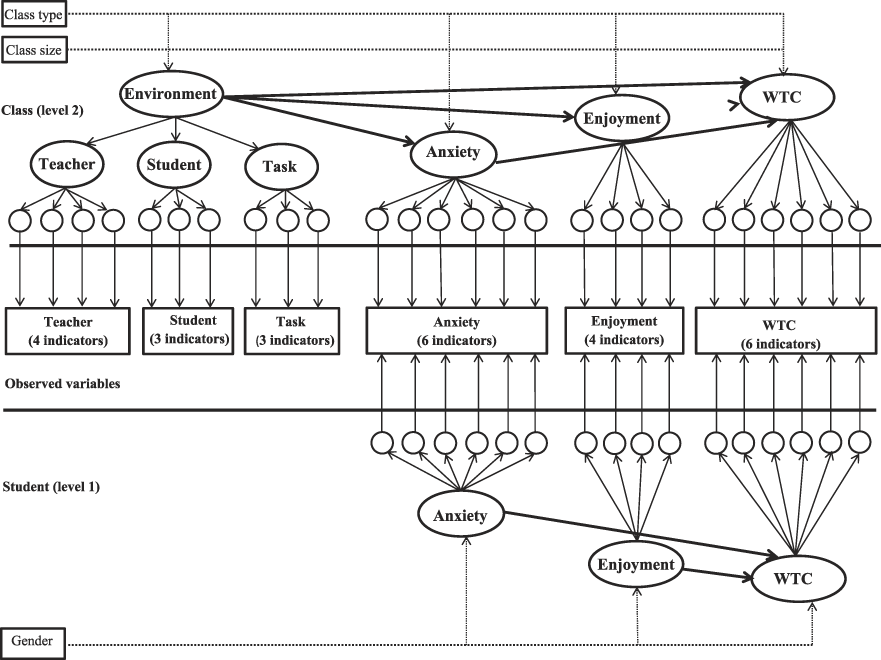
This study examines the relations among classroom environment, anxiety, enjoyment, and WTC to address both the need to examine positive and negative emotional influences on WTC as well as modeling classroom-level effects. Direct and indirect relations among constructs are examined using doubly latent multilevel analysis (see Figure 1). Previous research has shown that anxiety tends to be negatively related to WTC, while classroom environment is positively related to WTC (e.g., Khajavy et al., Reference Khajavy, Ghonsooly, Hosseini and Choi2016). However, these relations have been examined at the individual level. In this study, we aim to replicate the same relations using doubly latent multilevel analysis in which the relation between anxiety and WTC is investigated at both Level 1 and Level 2, and the relation between classroom environment with anxiety and WTC is tested only at Level 2 because classroom environment is by nature a Level 2 construct that should not be examined at Level 1. Moreover, we expected a positive relation between enjoyment and WTC at both levels, and between classroom environment and enjoyment only at Level 2. The following guiding hypotheses are proposed to be tested:
Hypothesis 1 (H1). At the individual level, enjoyment positively predicts WTC, and anxiety negatively predicts WTC.
Hypothesis 2 (H2). At the classroom level, enjoyment positively predicts WTC, and anxiety negatively predicts WTC.
Hypothesis 3 (H3). At the classroom level, classroom environment positively predicts enjoyment and WTC, but negatively predicts anxiety.
Hypothesis 4 (H4). At the classroom level, emotions mediate the relation between classroom environment and WTC.
Hypothesis 5 (H5). At the individual level, girls have higher anxiety, enjoyment, and WTC.
Doubly latent multilevel model tested in this study.

METHOD
PARTICIPANTS
A total of 1,528 secondary school students (55.4% male) from 65 different classrooms in both rural and urban areas in Iran participated in this study. The students’ age ranged between 12 and 18 (M = 14.31, SD = 1.28). Students’ participation in the study was voluntary. Researchers gathered data during regular classroom hours. All students had to pass English as a compulsory school subject.
In describing the participants, it is important to mention that in 2013, the new English language curriculum was implemented in Iran and the new English textbook series (Prospect) that were based on communicative language teaching (CLT) techniques were taught. A crude comparison of the old and the new English curriculum in Iranian public schools indicate that the latter is more likely to stimulate and encourage WTC among Iranian students. Among these students, 84.6% were taking an English course with the new curriculum and new books designed for CLT, while 15.4% were taking the English course with the old curriculum and books. The average number of students participating per classroom was 23.50 (SD = 12.59) with a range of 6 to 77 students per class. Students were asked to rate their own language proficiency. Among them, 22.4% rated their English proficiency as beginner, 48.8% as lower-intermediate, 17.7% as intermediate, 4.1% as upper-intermediate, 3.2% as advanced, and 3.8% did not rate their proficiency. The present study was conducted in accordance with ethical standards provided by the American Psychological Association (2010). Prior to students’ participation in the study, they read an informed consent in which the purpose, duration, and procedure of the research were explained. They were informed that their participation is voluntary. Moreover, data collection and analyses were done on anonymous data.
INSTRUMENTATION
Willingness to Communicate
To assess WTC, seven items from Khajavy et al. (2016, adapted from Weaver, Reference Weaver2005) were used on a 5-point Likert type scale ranging from 1 (strongly disagree) to 5 (strongly agree). The items assessed to what extent learners are willing to communicate in English in the classroom (e.g., asking the meaning of a word). The Cronbach’s α for this scale was .81.
Classroom Environment
To assess the three components of classroom environment, 13 items from Khajavy et al. (2016, adapted from Fraser, Fisher, & McRobbie, 1996) were measured on a 5-point Likert type scale ranging from 1 (strongly disagree) to 5 (strongly agree). Four items were used to assess teacher support (e.g., the teacher is patient in teaching), three items for student cohesiveness (e.g., I work well with other class members), and three items for task orientation (e.g., tasks designed in this class are attracting). The Cronbach’s α for teacher support, student cohesiveness, and task orientation were .80, .81, and .68, respectively.
Anxiety
To assess students’ communication anxiety, six items from Khodadady and Khajavy (2013, adapted from Horwitz et al., 1986) were used in this study on a 5-point Likert type scale from 1 (strongly disagree) to 5 (strongly agree). The items assessed students’ anxiety while communicating in English (e.g., I start to panic when I have to speak without preparation in English class). The Cronbach’s α for this scale was .80.
Enjoyment
Four items from Peixoto, Mata, Monteiro, Sanches, and Pekrun (Reference Peixoto, Mata, Monteiro, Sanches and Pekrun2015) were used to assess enjoyment on a 5-point Likert type scale ranging from 1 (strongly disagree) to 5 (strongly agree). The items assessed the extent to which students enjoy their English language classrooms (e.g., I enjoy being in my English class). The Cronbach’s α for this scale was .86.
DATA ANALYSIS
It has been argued that, in educational research, when researchers want to examine Level 2 variables such as classroom, teacher, and school, the Level 2 unit should be the unit of the analysis (Morin, Marsh, Nagengast, & Scalas, Reference Morin, Marsh, Nagengast and Scalas2014). As this study focuses on classroom environment, its evaluation is based on Level 2 classroom-level construct. Two types of Level 2 constructs have been identified: climate and contextual constructs (Marsh et al., Reference Marsh, Lüdtke, Robitzsch, Trautwein, Asparouhov, Muthén and Nagengast2009; Morin et al., Reference Morin, Marsh, Nagengast and Scalas2014). Climate variables refer to students’ aggregated ratings of their classroom that are common to all students in the class and not specific individuals’ characteristics (Morin et al., Reference Morin, Marsh, Nagengast and Scalas2014). In other words, climate constructs show “students’ shared perceptions of their classroom environment” (Arens, Morin, & Watermann, Reference Arens, Morin and Watermann2015, p. 185). Contextual constructs, by contrast, refer to students’ Level 1 aggregated ratings of individuals’ characteristics that are meaningful by themselves, and may have another meaning at Level 2 (Marsh et al., Reference Marsh, Lüdtke, Robitzsch, Trautwein, Asparouhov, Muthén and Nagengast2009; Morin et al., Reference Morin, Marsh, Nagengast and Scalas2014). A well-known example of contextual effect is big-fish-little-pond effect in education (see Marsh, 2006), where the individual (Level 1) effect of achievement on self-concept is positive, but the same effect at the classroom level (Level 2) is negative, implying that when an individual’s achievement is less than average-classroom achievement, it has a negative effect on their self-concept.
In the present study, classroom environment was modeled at the classroom level (Level 2), and anxiety, enjoyment, and WTC were modeled at both Level 1 and Level 2. The Level 2 effects of classroom environment on anxiety, enjoyment, and WTC were considered as climate effects, while the Level 2 effects of anxiety and enjoyment on WTC were considered as contextual effects. In addition, gender (0 = female, 1 = male) was entered as a Level 1 predictor. Finally, classroom type (0 = prospect, 1 = non-prospect) and class size were controlled as a Level 2 predictor.
ML-SEM (see Marsh et al., Reference Marsh, Lüdtke, Robitzsch, Trautwein, Asparouhov, Muthén and Nagengast2009; Morin et al., Reference Morin, Marsh, Nagengast and Scalas2014) was conducted using Mplus 6.11 with robust maximum likelihood estimator. ML-SEM combines multilevel analysis with SEM. This combination considers both sampling error and measurement error, two main sources of error that are neglected in simple multilevel analysis.
Multilevel confirmatory factor analysis (ML-CFA) was run before testing the ML-SEM models. For both ML-CFA and ML-SEM, we used goodness-of-fit indices to examine whether the models fit the data adequately. As a criterion by which to judge model fit, a good model should show CFI and TLI indices above .90 and the RMSEA should be less than .08 (see Marsh, Hau, & Wen, Reference Marsh, Hau and Wen2004). We also used effect size (ES) indicators following the procedures reported in ML-SEM research (see Marsh et al., Reference Marsh, Lüdtke, Robitzsch, Trautwein, Asparouhov, Muthén and Nagengast2009 and Morin et al., Reference Morin, Marsh, Nagengast and Scalas2014 for a detailed report on how to calculate ESs). The formula for this ES is ES = (2 * B * SD predictor)/ SD outcome where B is unstandardized regression coefficient, SD predictor is the standard deviation of the predictor, and SD outcome is the Level 1 standard deviation of the outcome (Marsh et al., Reference Marsh, Lüdtke, Robitzsch, Trautwein, Asparouhov, Muthén and Nagengast2009). This formula is comparable to the Cohen’s d ES that is now commonly found in L2 research. The resultant ES shows the difference in the dependent variable between two Level 2 groups that differ by two standard deviations on the predictor variable. As such, we will interpret those effects based on Cohen’s (1988) guidelines with values above .10, .30, and .50 reflecting small, moderate, and large ESs, respectively.
RESULTS
PRELIMINARY ANALYSES
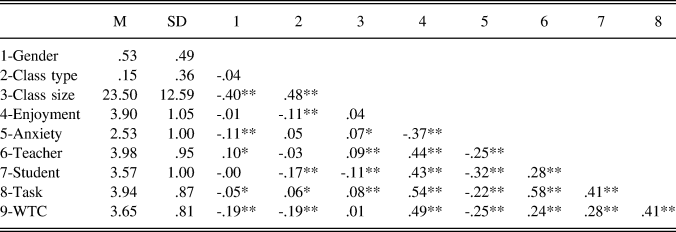
Descriptive statistics and correlations among all variables can be seen in Table 1. Mean level of WTC (3.65) is above the midpoint of the five-point scale, suggesting that students possess at least a moderate level of WTC. Furthermore, WTC correlates significantly with all the other variables, showing its strongest correlation with enjoyment (r = .49). Furthermore, the means for anxiety and enjoyment are 2.53 and 3.90, respectively, on a five-point scale, suggesting moderate levels of anxiety and fairly high levels of enjoyment in the English classroom. Paired sample t-test showed that the difference between mean levels of these two emotions is statistically significant (t = 28.914, p < .001, Cohen’s d ES = .79). The ES shows that enjoyment is moderately (see Plonsky & Oswald, Reference Plonsky and Oswald2014 for a detailed report on interpreting ES in L2 research) more common than anxiety in the language classrooms.
Descriptive statistics and correlations between variables

Note: * p < .05, ** p < .01
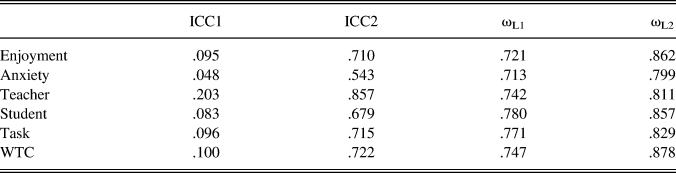
Level 1 analysis takes individuals as the unit of analysis as is typically done in research of individual differences in SLA, while Level 2 analysis takes the group (classroom) as the unit of analysis. An important consideration of ML-SEM is variability at Level 2; to asses this variability, intraclass correlation (ICC1) coefficient was used. To assure variability at Level 2, ICC1 should be close to or more than .10 (Hox, Reference Hox2010). Results of the ICC1analyses are shown in Table 2. As Table 2 indicates, ICC1 values are satisfactory for enjoyment (.095), teacher support (.203), student cohesiveness (.083), task orientation (.096), and WTC (.100), but low for anxiety (.048). Although the ICC1 for anxiety is low, even this amount of variance can lead to bias and distortion in results of the conventional OLS regression (Cohen, Cohen, West, & Aiken, Reference Cohen, Cohen, West and Aiken2003). In addition to ICC1, it is also recommended to report ICC2 in ML-SEM (Morin et al., Reference Morin, Marsh, Nagengast and Scalas2014). ICC2 refers to the reliability of the students’ ratings at the class level (i.e., interrater reliability). Interpretation of ICC2 values is similar to other reliability measures (Morin et al., Reference Morin, Marsh, Nagengast and Scalas2014). As Table 2 indicates, ICC2 values are satisfactory for enjoyment (.710), teacher support (.857), student cohesiveness (.679), task orientation (.715), and WTC (.722), but low for anxiety (.543). According to Arens et al. (Reference Arens, Morin and Watermann2015), low ICC2 values are not a problem by themselves in doubly latent ML-SEM, as this error is controlled in the latent regression process. Therefore, results of the ICC1 and ICC2 imply that the nested structure of the data can be analyzed using doubly latent ML-SEM.
Intraclass correlations and composite reliability

Finally, ML-CFA was conducted to assure the construct validity of the models (Morin et al, Reference Morin, Marsh, Nagengast and Scalas2014). Goodness-of-fit indices for the ML-CFA showed adequate fit to the data (see Table 3). In addition, two-level composite reliability was calculated using an omega (ω) coefficient (Geldhof, Preacher, & Zyphur, Reference Geldhof, Preacher and Zyphur2014). Like other reliability estimates, values greater than .70 show acceptable composite reliability. Results showed satisfactory values for all variables at both levels: enjoyment (ωL1 = .721, ωL2 = .862), anxiety (ωL1 = .713, ωL2 = .799), teacher support (ωL1 = .742, ωL2 = .811), student cohesiveness (ωL1 = .780, ωL2 = .857), task orientation (ωL1 = .771, ωL2 = .829), and WTC (ωL1 = .747, ωL2 = .878).
Goodness-of-fit indices for MLCFA and ML-SEM

ML-SEM MODELS
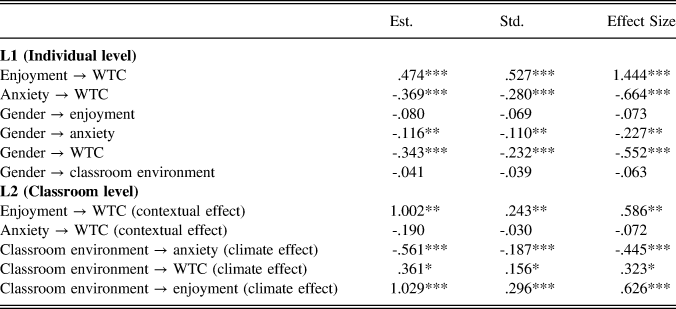
To test the proposed model, doubly latent multilevel analysis was used. Goodness-of-fit indices showed that the model fit the data adequately (see Table 3). Parameter estimates for both levels can be seen in Table 4.
Multilevel predictive models of WTC

Note: * p < .05, ** p < .01, *** p < .001, Est. = unstandardized parameter estimate; Std. = standardized
parameter estimate
Results of the study indicated that, at the individual level, enjoyment was positively related to WTC (standardized β = .527, ES = 1.444) while foreign language anxiety was negatively related to WTC (standardized β = -.280, ES = -.664), supporting H1. Although both anxiety and enjoyment showed a large magnitude effect, of the two variables, the ES was higher for enjoyment. Slightly different results were obtained at the classroom level, where only enjoyment was related to WTC (standardized β = .243, ES = .586). This large magnitude effect indicates that classrooms with higher levels of enjoyment were more willing to communicate in English. Therefore, H2 was partially supported. Consistent with H3, testing climate effects, classroom environment was positively related to both enjoyment (standardized β = .296, ES = .626) and WTC (standardized β = .156, ES = .323), but negatively related to anxiety (standardized β = -.187, ES = -.445). The ES for enjoyment was large, and of moderate magnitude for WTC and anxiety.
To examine the mediational role of emotions between classroom environment and WTC, only enjoyment was examined, as the path between anxiety and WTC was not significant at Level 2. Results showed that the indirect effect of classroom environment on WTC, as mediated by enjoyment, was significant (unstandardized β = 1.031), partially supporting H4.
Finally, results indicated that girls were a little more anxious (standardized β = -.110, ES = -.227) and much more willing to communicate in English (β = -.232, ES = -.552) than boys, but no significant difference was found for enjoyment. These results provide partial support for H5.
DISCUSSION
This study is the first in SLA to adopt a hierarchical approach to modelling the effects of specific positive and negative emotions, enjoyment and anxiety respectively, on WTC. The hierarchical approach, using doubly latent multilevel analysis, allows us to conclude that the relationship between enjoyment and WTC is substantial at both Level 1, individual students, and Level 2, the classrooms level. The connection between anxiety and WTC was observed at the individual level but not at the classrooms level. Our approach is consistent with the goal of positive psychology to understand both specific positive emotions and positive institutions.
The results of the present study replicate and extend previous findings. Starting at the individual level, both anxiety and enjoyment were related to WTC, indicating a role for both positive and negative emotions. Anxiety has been shown to be one of the most consistent predictors of WTC (Öz et al., 2015; Peng, 2014). In this study, the correlation between enjoyment and WTC was stronger than that between anxiety and WTC. Fredrickson (2004, p. 147) notes that joy is associated with an urge to “play, push the limits, and be creative.” To the extent that communication pushes learners to expand their horizons, the present study provides evidence that among individual learners who experience enjoyment, there is a greater WTC. Although anxiety also was shown to be associated with reduced WTC, it is important to note that positive and negative emotions are not opposites and do not show a seesaw relationship. Rather, MacIntyre and Gregersen (2012, pp. 198–199) argue it is
best to conceptualize emotion along two separate dimensions, positive-broadening and negative-narrowing… Rather than looking at emotion as approach versus avoidance, we can discuss interesting moments of approach and avoidance, to capture in theory the tensions experienced by learners so that pedagogy can actively deal with the issues raised by affective reactions, and better understand the breadth of facilitative and debilitating emotional processes.
Within individuals, the tendency to approach communicating in English can, at times, coexist with the tendency to experience the restraining forces of anxiety. Based on the correlations we obtained in the present study, we suggest that learners who are enjoying their learning experiences are more likely to be willing to cross the communicative threshold, when the opportunity arises.
A slightly different pattern was obtained at the classroom level, where only enjoyment was related to WTC and no significant contextual effect was found between anxiety and WTC. This finding implies that students’ shared perceptions of a joyful classroom enhanced their WTC, while their shared perceptions of an anxious classroom were not necessarily predictive of their WTC. As this study is the first attempt to incorporate enjoyment in WTC research, results appear to suggest that the positive role of enjoyment might be more influential in promoting WTC than the negative role of anxiety in reducing WTC. However, we note that in describing influences on WTC in the classroom, previous studies have not directly considered the role of positive emotions in general, or enjoyment in particular. Only the qualitative study by Cao (Reference Cao2011) explicitly addressed both negative and positive emotions, including enjoyment, as influences learners’ WTC.
Potentially complex interactions among positive and negative emotions also can be seen in the test for gender differences. Compared to boys, girls in the present study had somewhat higher WTC and anxiety, but no difference was found between boys’ and girls’ enjoyment. Results showing girls having both higher WTC and more anxiety are consistent with prior research (MacIntyre, Baker, Clément, & Donovan, Reference MacIntyre, Baker, Clément and Donovan2002), and should not be considered a contradiction. The function of negative emotion generally is to narrow attention (Fredrickson, 2013), and higher anxiety for girls reflects greater emotional investment in language learning; at moderate levels anxiety can be linked to “generating focus on the need to take specific action” (Dewaele et al., Reference Dewaele, MacIntyre, Boudreau and Dewaele2016, p. 55). Although anxiety is most often described as an unpleasant experience, occasional anxiety arousal can be expected when one is invested and engaged with tasks that have the potential for errors, misunderstanding, and possible embarrassment (Khodadady & Khajavy, Reference Khodadady and Khajavy2013). Gender differences did not emerge with respect to enjoyment, which is inconsistent with prior research (Dewaele et al., 2016; Dewaele & MacIntyre, Reference Dewaele and MacIntyre2014), although a nonsignificant difference is difficult to interpret given the many differences between the studies. Future research on enjoyment and other positive emotions may shed light on differences in the emotional experiences of boys and girls as they learn a new language.
More broadly, results of ML-SEM indicated that the climate effect of classroom environment was significant on anxiety, enjoyment, and WTC. Classroom environment showed positive effects on both enjoyment and WTC, and a negative effect on anxiety. It is not surprising that in supportive classrooms, where the teachers help students, students help each other, and the tasks are both interesting and challenging, students tend to feel less anxious and have both higher enjoyment and WTC. This finding is consistent with prior research that found an effect of classroom environment on anxiety and WTC (Khajavy et al., Reference Khajavy, Ghonsooly, Hosseini and Choi2016; Peng & Woodrow, Reference Peng and Woodrow2010). Moreover, the relation between positive classroom environment and enjoyment supports the principles of positive psychology by demonstrating the positive effects can be associated with institutions (MacIntyre & Mercer, Reference MacIntyre and Mercer2014). Dewaele and MacIntyre (Reference Dewaele and MacIntyre2014) emphasized the importance of classroom environment in facilitating enjoyment by considering the role of positive, well-organized, and happy teachers and peers; the present results show that classroom environment had the strongest connection to enjoyment.
Further emphasizing the role of enjoyment at the classroom level, enjoyment was found to mediate the relation between classroom environment and WTC, while the mediational role of anxiety was nonsignificant. This pattern shows that the classroom environment can facilitate WTC, both directly and indirectly. Direct effects may emerge from communication patterns that are established in the classroom that can lead even reserved students to speak under supportive conditions (Yashima, MacIntyre & Ikeda, 2016). There also is an indirect pathway, suggesting that if classrooms produce higher levels of enjoyment, they can foster WTC. “Classroom activities and interaction can be utilized to both teach language and reinforce students’ individual, burgeoning affective strengths in L2 contexts” (MacIntyre & Gregersen, 2012, p. 209). WTC theory suggests that having the desire to authentically communicate, that is wanting to say something to a person or persons who are present in the local context, is an immediate precursor to WTC and L2 communication (MacIntyre et al., Reference MacIntyre, Clément, Dörnyei and Noels1998). The present results suggest that enjoyable classroom activities can provide a context that fosters social bonds and interpersonal relations (Dewaele & MacIntyre, Reference Dewaele and MacIntyre2014).
The role of enjoyment as a positive emotional state in the classroom is emerging clearly in the present data. Consistent with Dewaele and MacIntyre (Reference Dewaele and MacIntyre2014), feelings of enjoyment were more prevalent than anxiety among language learners. Despite using different methodologies, different sampling procedures (classroom-based vs. web-based sampling), and different measures of both enjoyment and anxiety, the present means for enjoyment and anxiety (3.90 and 2.53) respectively are very similar to the means reported by Dewaele and MacIntyre (2014) that were 3.82 and 2.75, respectively. Although future research is required, the findings are suggesting that enjoyment might be more prevalent than anxiety in language classrooms, a pattern also reported in math classes (Frenzel et al., Reference Frenzel, Pekrun and Goetz2007).
CONCLUSION
In this study, we aimed to examine the role of enjoyment as an important positive emotion in WTC construct alongside anxiety. Moreover, we examined these relations using a robust and new statistical procedure, doubly latent multilevel analysis, which considers both sampling error and measurement error. The procedure we used to apply doubly latent multilevel analysis can be adopted in other studies in the field of SLA to account for the nested structure of the data and reduce Type I error.
Implications of these results for both language teachers and researchers can be identified. Classroom environment influenced learners’ anxiety, enjoyment, and WTC. In this study, classroom environment was defined by teachers’ support, students’ cohesiveness, and task orientation. Teachers play a most significant role here, as teacher support, students’ cohesiveness, and task orientations can be influenced by the classroom activities teachers use and the climate they create. Choosing familiar and interesting topics for conversation (Cao, Reference Cao2014; Peng, Reference Peng2012), providing delayed error correction (Zarrinabadi, Reference Zarrinabadi2014), giving feedback to the students (Pishghadam & Khajavy, Reference Pishghadam and Khajavy2014), and using friendly and supportive behavior (Kang, Reference Kang2005; Zarrinabadi, Reference Zarrinabadi2014) are among the actions that language teachers can take to increase learners’ WTC. Additional suggestions for activities inside and outside the classroom are provided by Gregersen and MacIntyre (Reference Gregersen, MacIntyre, Dörnyei, MacIntyre and Henry2014). Dewaele and MacIntyre (Reference Dewaele and MacIntyre2016b) argued that teachers have a stronger influence on learners’ enjoyment of the classroom than they have on learners’ anxiety levels. The implications of the present results can be found at multiple levels, as enjoyment had a strong relationship with WTC at both the individual level and the classroom level. Within a classroom, results suggest that students who enjoy learning more also tend to be more willing to communicate.
As with all research, there are limitations in this study. First, we used a correlational design to examine the relations between variables. Though we had a large sample size and ML-SEM is a robust statistical procedure, future research can use experimental and longitudinal designs to shed more light on the nature of these relations. Emotional reactions can be conceptualized as general tendencies, as we have done here, or as immediate reactions to experiences in situ, leading to the possibility of results being tied to the timescale under investigation—as when a typically relaxed student has an anxiety reaction (see Gregersen, MacIntyre, & Meza, Reference Gregersen and MacIntyre2014). Furthermore, in the present study we focused only on anxiety and enjoyment as two important emotions. There is a wide range of both positive and negative emotions (such as amused, grateful, proud, anger, embarrassed, and shame) that can be examined regarding WTC in future studies (see MacIntyre & Vincze, 2017, who studied the relationships among 19 emotions and motivation-related variables). As another limitation, we focused on psychological and contextual aspects of WTC, and linguistic factors were not included. Future studies might choose to assess students’ English proficiency and its relation to WTC using multilevel analyses. Finally, this study was conducted in the foreign language context of Iran; more research is required in diverse locations to replicate and examine the external validity of the findings of the present study.
Interest in studies of emotion and language learning is rapidly increasing. The results of studies of emotion, including the present one, have the potential to contribute to a more complete understanding of the language learner and the learning process, including communication. The present study was the first to use ML-SEM, a robust statistical procedure, in language learning research. Future studies using nested data can employ this data analytic technique as it allows for conceptualizing relationships at both the individual and classroom levels.