Research on SLA through the lenses of generative grammar has allowed for theorization of second language (L2) development as parameter resetting, as precise descriptions of acquisition sequences, as triggers for learning, and as end-state grammars, as well as for explicit predictions (e.g., Lardiere, Reference Lardiere1998a, Reference Lardiere1998b; Lardiere & Schwartz, Reference Lardiere and Schwartz1997; Prévost & White, Reference Prévost and White2000; Schwartz & Gubala-Ryzak, Reference Schwartz and Gubala-Ryzak1992; Thomas, Reference Thomas1995; White, Reference White1990/1991, Reference White1991, Reference White1992). Two fundamental questions have received considerable attention from researchers: the question of the native language (L1) grammar as the initial state (e.g., Haznedar, Reference Haznedar, Hughes, Hughes and Greenhill1997; Montrul, Reference Montrul2000; Schwartz, Reference Schwartz1998; Schwartz & Sprouse, Reference Schwartz, Sprouse, Hoekstra and Schwartz1994, Reference Schwartz and Sprouse1996; Slabakova, Reference Slabakova2000; White, Reference White1987; Whong-Barr & Schwartz, Reference Whong-Barr and Schwartz2002; Yuan, Reference Yuan1998) and the question of the epistemology of L2 grammar (e.g., Dekydtspotter, Sprouse, & Anderson, Reference Dekydtspotter, Sprouse and Anderson1997; Kanno, Reference Kanno1997; Martohardjono, Reference Martohardjono1993; Pérez-Leroux & Glass, Reference Pérez-Leroux, Glass, Pérez-Leroux and Glass1997), where the poverty of the stimulus (POS) that motivates Universal Grammar (UG) has played an important role (Schwartz & Sprouse, Reference Schwartz, Sprouse, Juffs, Talpas, Mizera and Burtt2000a, Reference Schwartz, Sprouse and Archibald2000b; White, Reference White1989).
On the hypothesis that the same mechanisms fully constrain nonprimary language acquisition, differences between L1 and L2 acquisition reveal distinct initial states (Schwartz & Sprouse, Reference Schwartz, Sprouse, Hoekstra and Schwartz1994, Reference Schwartz and Sprouse1996) as well as difficulties assembling the feature matrixes of categories and lexical items and fully establishing mappings between them (Haznedar & Schwartz, Reference Haznedar, Schwartz, Hughes, Hughes and Greenhill1997; Lardiere, Reference Lardiere, Dekydtspotter, Sprouse and Liljestrand2005, Reference Lardiere2009). Deviant morphology reveals underspecified representations (Lardiere, 1998b; McCarthy, Reference McCarthy2007; Prévost & White, Reference Prévost and White2000) and phonological filtering of morphophonological forms (Goad & White, Reference Goad and White2006; Goad, White, & Steel, Reference Goad, White and Steele2003; Lardiere, Reference Lardiere and Archibald2000). Crucially, nativelike performance requires fast lexical access and quick integration of distinct information, so that given fixed resources, processing that is slowed by underlearned lexical access routines as well as by nontarget prosody and lexis induces deviant outcomes (Dekydtspotter, Schwartz, & Sprouse, Reference Dekydtspotter, Schwartz, Sprouse, Grantham O’Brien, Shea and Archibald2006). Thus, the demonstration through the POS argumentation that interlanguage representations appear fully UG-governed narrows the search space for L1-L2 differences by requiring that these be compatible with the demonstrated epistemological status.
Hawkins (Reference Hawkins2001) argued that because POS arguments motivate UG, finding POS arguments in the case of SLA does not advance understanding of what is specific to SLA versus L1 grammars. Hawkins advocated a difference-focused program of research in which the (current) theory of UG guides the investigator in generating hypotheses about the specificity of L2 grammars (Hawkins & Chan, Reference Hawkins and Chan1997; Hawkins & Hattori, Reference Hawkins and Hattori2006; Tsimpli & Dimitrakopoulou, Reference Tsimpli and Dimitrakopoulou2007; Tsimpli & Roussou, Reference Tsimpli and Roussou1991). Research in this vein assumes that L2 grammars will deviate from native grammars depending on the initial selection of certain functional features in the development of the L1 grammar. As Schwartz and Sprouse (Reference Schwartz, Sprouse, Juffs, Talpas, Mizera and Burtt2000a, Reference Schwartz, Sprouse and Archibald2000b) noted, such approaches yield accounts of SLA that are highly dependent on (the details of) particular versions of the theory of UG. Such accounts may be voided as the understanding of UG evolves and may become unavailable.
The compatibility of L2 grammars with the theory of UG is, however, not a guarantee that L2 representations are UG-constrained. In contrast, if a substantial body of evidence suggests that aspects of representations acquired in SLA require UG because they remain without plausible explanation in the absence of UG, the motivation for studying SLA in the generative paradigm becomes more solidly epistemologically anchored. Bley-Vroman (Reference Bley-Vroman1990) and Schwartz (Reference Schwartz1986, Reference Schwartz1987), in a debate on L2 epistemology, articulated conceptually plausible and empirically testable hypotheses that carved out the conceptual space and unleashed a body of empirical research seeking to resolve the epistemological question. An outcome of this effort is that generative SLA research appears to be on robust empirical foundations, even if it must probe deeper into the exact nature of constraints on L2 representations in light of new insights as the theory of UG develops. There appears to be a developing consensus on the UG-constrained nature of L2 representations as well as on the importance of the degree of informational encapsulation involved in learners’ access to representations in which the new research frontier lies. I argue that interpretive evidence coupled with correct analytic procedures can contribute substantially to advancing this research frontier.
THE DEFINING EPISTEMOLOGICAL DEBATE
L2 Epistemology: Take 1
When he introduced the fundamental difference hypothesis (FDH), Bley-Vroman (Reference Bley-Vroman1990) pointed to 10 characteristics of SLA: lack of (guaranteed) success, the nonexistence of complete success, variation in success, course, strategy, and areas of attainment, in addition to correlation of age and proficiency, fossilization, indeterminate intuitions as well as the importance of instruction, negative evidence, and affective factors (cf. Schwartz, Reference Schwartz, Burmeister and Rounds1990). The FDH claimed that SLA involved the learner’s L1 grammar supplemented by domain-general learning procedures. Many structures licensed by the L1 grammar will, therefore, be in conformity with UG principles because the L1 grammar is UG-sanctioned. However, target language structures not licensed by the learner’s L1 grammar are not inherently limited to receive only UG-sanctioned representations. The lack of direct access to UG accounts for these characteristics of SLA. Bley-Vroman’s view of L2 epistemology relies on a particular conception of UG in mental architecture: UG vanishes as parametric values are adopted, thus establishing a grammar.
L2 Epistemology: Take 2
Schwartz (Reference Schwartz1986, Reference Schwartz1987, Reference Schwartz1988) argued, in contrast, that L2 grammars must be cut of the same epistemological cloth as L1 grammars by virtue of the nature of mental architecture in the area of language. Schwartz’s argument is based on Chomsky’s concept of UG augmented with Fodor’s (Reference Fodor1983) theory of mind, in which language input is processed by a specialized, informationally encapsulated module. Specifically, Schwartz (Reference Schwartz1999) proposed that UG provides the contents of this module, which is also augmented with a parameterized lexicon (see also Fodor, Reference Fodor2000). In this architecture, a grammar results from the union of UG principles with language-specific information. Thus, UG is not destroyed in the process of developing the L1 grammar but carves out the mental space for grammatical analysis throughout the life span. The ability to acquire L2 grammars beyond the structures that L1 grammar licenses testifies to the ability of the parser to assign other (UG-sanctioned) representations that trigger grammatical change. In other words, at each step of processing, the representations accessed by the parser must be licensed by the grammar. When licensing fails, acquisition is triggered.
Investigating L2 Epistemology
The question of L2 epistemology may provide empirical validation for work seeking to describe L2 development in terms of the theory of UG, but it can also provide information about the mental architecture in the area of language. This is because not all reasonable hypotheses about the mental architecture predict the same outcome for L2 epistemology.
In L1 acquisition, the strongest argument in favor of a domain-specific universal mental space that channels the acquisition of native grammars resides in the character of aspects of the acquired representations that seem specific to language and independent of the input received, because these representations are acquired across a range of languages, or independent of its quality, because these representations are acquired, despite the lack of direct relevant information in the input. In other words, aspects of natural language knowledge seem far beyond the information that the input can reasonably provide and seem to implicate cognitive structures specific to natural language. Because natural language grammars seem to occupy a particular niche among logically possible grammars, the question of L2 epistemology can, therefore, be profitably approached in terms of the degree to which L2 grammars also occupy this exact niche. If the analysis of the target language input is not strictly UG-constrained, L2 grammars are not expected to consistently fall within the niche of UG-compatible grammars. Thus, if L2 representations show reflexes of this specific niche over a range of domains, the FDH becomes greatly threatened, whereas Schwartz’s (Reference Schwartz1987) hypothesis is significantly enhanced by such empirical vindication.
Additionally, Schwartz’s (Reference Schwartz1987) and Bley-Vroman’s (Reference Bley-Vroman1990) hypotheses differ with respect to the penetrability of the grammatical module. Recent research addresses interactions between domain-specific representations and (presumably domain-general) principles of language use: Certain implicatures are domain-general in character, whereas others seem grammatically computed even in SLA (Dekydtspotter & Hathorn, Reference Dekydtspotter and Hathorn2005; Slabakova, Reference Slabakova, Caunt-Nulton, Kulatilake and Woo2007). Similarly, certain interface relations inherent in (the theory of) UG appear to require a strong degree of information encapsulation. Access to semantic representations that involve scope may provide suggestive evidence (Dekydtspotter, Reference Dekydtspotter2001), because it offers a case in which the respective contributions of the structure of representations and contextual information can be evaluated.
Bley-Vroman (this issue) noted that in addition to the computational system that derives complex structures, UG must also allow for underived constructions lexically represented as basic grammatical units, which can be enriched with distributional, semantic, and pragmatic specifications. Semantically, the representations derived by the computational system are compositional, which entails that the meaning of the whole reflects the meaning of the parts and composition rules, whereas the underived constructions are holistic, which entails that the meaning of the whole is unrelated to its component parts. Bley-Vroman proposed that L1-L2 differences may, thus, be due to a much larger role of holistic representations in L2 grammars. This new claim can be semantically evaluated by investigating the extent of the compositional reflex in L2 grammars.
EVIDENCE OF DOMAIN-SPECIFICITY OF L2 REPRESENTATIONS
Methodological Underpinning
A body of research on island effects in SLA (Johnson & Newport, Reference Johnson and Newport1991; Schachter, Reference Schachter, Gass and Schachter1989) suggested that late-acquired L2 grammars differed from L1 grammars acquired from birth, on grounds that nonnative speakers (NNSs) accepted subjacency violations (i.e., movement across more than one bounding node) significantly more than native speakers (NSs; cf. White & Genesee, Reference White and Genesee1996, for nativelike behavior in French-English acquisition). The ability of learners to replicate targetlike performance was taken to be revealing of the extent to which UG constraints were involved. Although learners’ performance has generally proven not to be targetlike, learners typically detected ungrammaticality above chance. Bley-Vroman, Felix, and Ioup (Reference Bley-Vroman, Felix and Ioup1988) pointed out that above-chance behavior was suggestive of possible UG effects but argued that relative degrees of acceptability across various subjacency violations in learners’ responses indicated likely effects of various parsing strategies rather than UG constraints (cf. White, Reference White, Flynn and O’Neil1988).
Martohardjono (Reference Martohardjono1993) noted that “violations are predicted to vary in seriousness across different types of wh-constructions depending on the particular domain out of which an element is extracted” (p. 3), following advances in the understanding of island phenomena introduced by the Barriers (Chomsky, 1986) framework. Martohardjono, therefore, argued that “in order to show inaccessibility of UG in the SLA of wh-questions, one must minimally investigate learners’ knowledge of principled UG effects on the structures under study, including for example knowledge of strong effects such as those of the Empty Category Principle” (pp. 3–4). Martohardjono realized that the degree of severity across violations could be used as a signature of UG. Crucially, knowing the degree of severity across various violations such as after a complement to a noun as illustrated in (1) versus an adjunct to a noun phrase as shown in (2) is accompanied by a serious learnability problem. In cases in which the relevant structures in the L1 do not involve movement chains, NNSs could not realistically be expected to gather the information that certain violations are much worse than others. If such asymmetries develop in learners with L1 grammars that do not license wh-movement in interrogative sentences, their development cannot be attributed to the direct application of the L1 grammar to the analysis of that target structure, neither can they be attributed to direct classroom instruction or to any evidence in the input. Indeed, ungrammatical sentences of this sort are not part of the input that learners receive. This difference is not taught in the English classroom. In fact, most speakers of English are not consciously aware of the asymmetry. Thus, if L2 learners acquire knowledge of such asymmetries, then such knowledge must be derived by the learners themselves as the result of UG constraints.
(1) *Which book did John hear a rumor that you had read?
(2) **Who did you criticize the student who saw?
From a methodological point of view, it is also important to note that acceptability or interpretability judgments require not only computations of grammatical representations but also a conscious decision to accept or to reject, which is, of course, related to effects of the grammatical representations but also involves other contextual factors that may generate interferences. Given the subtlety of the linguistic phenomena, it is not reasonable to expect even NSs to always accept the items that are licit and reject the items that violate some principle of grammar. Rather, for any given study population, one should expect a statistically significant difference between exemplars of the relevant asymmetry within the combined data. Martohardjono (Reference Martohardjono1993) argued that the standard for determining whether the same cognitive mechanisms underlie L1 and L2 grammars could not realistically be the absence of a detectable difference between the performance of NSs and NNSs; rather researchers should seek to find a statistically significant asymmetry in learners that mirror the theoretical investigations of L1 grammars. This methodological logic is the standard throughout this article.
Syntactic Evidence
Martohardjono (Reference Martohardjono1993; see also Epstein, Flynn, & Martohardjono, Reference Epstein, Flynn and Martohardjono1996) provided elegant empirical support for UG constraints on wh-movement on the basis of the acquisition of the weak-strong island distinction. Consider the weak island effects incurred in extractions of the wh-expression out of a noun complement and wh-complement as illustrated in (3a) and (3b), respectively, versus the strong island effects incurred in extractions out of relative and adjunct clauses as in (4a) and (4b), respectively.
(3) a. *Which book did John hear a rumor that you had read?
b. *Which book did John wonder who had read?
(4) a. **Which book did John meet a child who read?
b. **Which soup did the man leave the table after the waiter spilled?
Although none of these sentences are grammatical in English, they nevertheless show differentiated levels of unacceptability, reflected in discrete violations of syntactic principles. Both (3) and (4) violate the subjacency condition. Huang’s (Reference Huang1982) condition on extraction domains (CED) attributes the stronger deviance of (4) to extraction from a non-theta-governed domain (i.e., a domain that is not governed by a theta-assigning head), which (3) does not involve. Assuming Chomsky (Reference Chomsky, Martin, Michaels and Uriagereka1998), the CED reduces to phase-by-phase application of move (i.e., cyclicity) that interacts with lexical selection (because lexically selected complement heads and their edges are accessible to operations that apply in the phase of the selecting head). In (4), the domains of extractions are not lexically selected; hence, there is no bridge from phase to phase. As a result, the extractions in (4) violate cyclicity. In (3), the domains of extractions are lexically selected: Cyclicity is not violated. The distinctions considered here appear to be an idiosyncratic reflex of the derivational nature of the computational system and the structure of the lexicon.
However, the precise contrasts that surface in English interrogatives do not discernibly surface in the interrogatives of every language. The distinction between weak and strong islands is derivative: It appears in specific constructions of a given language only if the language’s functional lexicon induces the operation move during the derivation of these constructions. Therefore, Chinese interrogatives that involve noun complement and wh-complement structures as illustrated in (5a) and (5b), respectively, and relative clause and adjunct structures as shown in (6a) and (6b), respectively, are completely acceptable because the wh-expression is not moved.Footnote 1
(5) a. Lisi shoudao Zhangsan kandao shenme de xiaoxi?
Lisi received Zhangsan saw what pcl news
*“What did Lisi receive the news that Zhangsan saw?”
b. Ni wen shei mai-le shenme?
You ask who buy-prf what
*“What did you ask who bought?”
(Yi-Ting Wang, personal communication, July 30, 2008)
(6) a. Ni zui xihuan mai-le shenme dongxi de ren?
You most like buy-prf what thing pcl person
**“Who do you most like the person who bought?”
(Yi-Ting Wang, personal communication, July 30, 2008)
b. Ni yinwei wo shuo-le shenme er bu gaoxing?
You because Isay-prf what then not happy
**“What are you unhappy because I said?”
(Martohardjono, Reference Martohardjono1993, p. 56)
In Indonesian, interrogatives that involve noun complement and wh-complement structures as illustrated in (7a) and (7b), respectively (corresponding to weak islands), are severely degraded; however, interrogatives that involve relative clause and adjunct structures as shown in (8a) and (8b), respectively (corresponding to strong islands), are perfect.
(7) a. ?*Siti dapat kabar bahwa saudaranya pergi kemana?
Siti received news that relative-poss go where
*“Where did Siti receive the news that her relative went?”
(Epstein et al., Reference Epstein, Flynn and Martohardjono1996, p. 689)
b. *Siti ingin tahu diman Adik menyembunikam apa?
Siti want know where Adik act-hide what
*“What does Siti wonder where Adik hid?”
(Epstein et al., Reference Epstein, Flynn and Martohardjono1996, p. 689)
(8) a. Siti baca buku yang menceritakan apa?
Siti read book relact-tell-ben what
*“What did Siti read the book that talked about?”
(Martohardjono, Reference Martohardjono1993, p. 53)
b. Surat ini datangnya sesudah Siti memanggil siapa?
letter this arrival-poss after Siti call who
*“Who did this letter arrive after Siti call?”
(Martohardjono, Reference Epstein, Flynn and Martohardjono1993, p. 54)
Indonesian interrogatives do not involve wh-movement as shown in the acceptability of (8); this is comparable with the Chinese cases in (6). Other language-dependent constraints render the sentences in (7) ungrammatical.
This raises the issue of whether this distinction emerges in Chinese-English and Indonesian-English interlanguage interrogative formation. Given that the weak-strong island distinction is not in the primary linguistic data and is not the subject of language instruction, determining whether just these contrasts arise in Chinese-English and Indonesian-English interlanguage is of high probative value in evaluating the degree of domain-specificity of interlanguage representations. The weak-strong island distinction is exactly the type of knowledge organization associated with natural language grammars but crucially not with other cognitive systems, such as the logical-conceptual component responsible for thought. Such asymmetries are exactly the kind of evidence that provides a strong argument for UG. Therefore, not just any data are relevant to L2 epistemology. Epistemological relevance requires particular L1-target language constellations, properties that satisfy severe POS problems, and criteria of domain-specificity.
Results of Martohardjono’s (Reference Martohardjono1993) study are provided in Table 1, which documents contrasts in unacceptability between weak and strong islands that arise in Chinese-English and Indonesian-English interlanguage. Martohardjono found that learners would more readily accept weak island violations over strong island violations in English, despite the fact that their L1 grammar would have led them to show no preference in the case of a Chinese-speaking learner and the opposite pattern in the case of an Indonesian-speaking learner. Thus, Chinese-English learners (n = 19) rejected strong islands (76%) significantly more than weak islands (38%), p < .0001. Indonesian-English learners’ (n = 24) rejection rate for strong islands (87%) was greater than their rejection of weak islands (42%), p < .0001. English NSs (n = 10) also exhibited a similar contrast: 94% rejection for strong islands versus 79% rejection for weak islands, p < .0001.
Weak versus strong distinctions across language backgrounds: Combined mean rejections of ungrammatical sentences

Note
From “Wh Movement in the Acquisition of a Second Language: A Cross-Linguistic Study of Three Languages With and Without Overt Movement,” by G. Martohardjono, Reference Martohardjono1993, Unpublished doctoral dissertation, McGill University, Montreal, p. 124. Adapted with permission.
As Martohardjono (Reference Martohardjono1993) pointed out, although the groups exhibited different rejection levels, what is theoretically significant is the fact that the distinction manifested itself at all. Crucially, the contrasts that appear in Chinese-English and Indonesian-English interlanguage (a) are precisely those expected in the theory of UG, (b) are not those expected strictly on the basis of the L1 grammars, (c) are neither directly represented in the input nor the subject of instruction, and (d) seem specific to natural language grammars to the exclusion of other cognitive systems. In other words, the weak-strong island distinction that appears seems to place Chinese-English and Indonesian-English interlanguage grammars within the narrow niche characteristic of natural language grammars.
The Syntax-Semantics Interface Evidence
The syntax-semantics interface in L1 grammars also exhibits amazing idiosyncrasy—a presumed reflex of rich, highly specific deductive cognitive structures. In other words, not all syntactic systems have the same semantic consequences. Depending on the syntactic composition in the learner’s analysis of data, distinct interpretive consequences are expected. This makes the interpretive interface eminently probative of the epistemology of L2 grammars. To the extent that the syntax-semantics interface in interlanguage grammars can be shown to mirror these properties, serious doubt is cast upon claims that interlanguage syntax is relatively impoverished or that its acquisition is not guided by UG. In certain quantification structures, English and French differ in that French syntax licenses discontinuous quantifiers in which the quantifier is separated from its restriction in surface pattern, whereas English syntax licenses only continuous quantifiers in surface pattern. The English surface pattern and its closest French analogue are ambiguous, which allows (at least) two interpretations. However, in the discontinuous quantification pattern, UG blocks one of these interpretations, which allows for the epistemological hypotheses to be tested. If it can be shown that English learners of French develop precise restrictions on the interpretation of the discontinuous pattern in the targetlike fashion once they come to have an interlanguage grammar that licenses this interpretation, then a highly specific grammatical organization inherent to the learners must yield these precise interpretations. Crucially, the precise semantics of the French-only pattern is not mentioned in standard reference grammars of French, let alone the object of instruction.
Dekydtspotter and Sprouse (Reference Dekydtspotter and Sprouse2001) reported the results of an experiment that probed for knowledge of the interpretation of the continuous and discontinuous quantifier phrases as illustrated in (9).
(9) a. Qui de célèbre fumait au bistro dans les années 60?
who of famous smoked in-the bar in the years 60
b. Qui fumait de célèbre au bistro dans les années 60?
who smoked of famous in-the bar in the years 60
“Which famous person used to smoke in the bar in the 60s?”
In the interrogative in (9a), qui “who” and its adjectival restriction de célèbre “of famous” form a continuous constituent. The interrogative in (9b) involves a discontinuous constituent. Extending de Swart’s (Reference de Swart, Baker and Dowty1992) work, Dekydtspotter and Sprouse noted that the discontinuous constituent takes scope under tense. Thus, qui … de célèbre “who … of famous” in (9b) characterizes someone who was famous at the time when the event happened, whereas qui de célèbre “which famous person” in (9a) may characterize either such a person or someone who is famous at the time of speech.
Dekydtspotter and Sprouse’s (Reference Dekydtspotter and Sprouse2001) study relied on a crucial learnability problem that involves continuous and discontinuous quantifier patterns as well as event-time and speech-time interpretations. The discontinuous quantification pattern (deceptively) appears to be a simple rewrite variant of the first pattern. Natural analogical extension, unconstrained by UG, would lead the learner to falsely assume that the second pattern is ambiguous in the same way that the first pattern is.
Each participant received a booklet with 50 items in one of three randomized orders. Each item consisted of a narrative in English followed by a question-answer pair in French. The stimulus consisted of a questionnaire presented as a transcript of an elaborate comprehension exercise. The questionnaire included eight quadruples crossing event-time and speech-time answers with continuous and discontinuous interrogatives and 18 fillers. Scenarios that supported both event-time and speech-time answers were constant in all conditions. A scenario read by Mrs. Briggs, an English-speaking character, was followed by a question asked by Madame Goyette, a teacher of English, and answered by a pupil with a speech-time answer or an event-time answer as illustrated in (10).
(10) Mrs Briggs: Attitudes toward smoking have changed drastically since the 1960s. In the 1960s many people would go to bars and smoke every night. For example, Herman the Hermit was a famous rock star in those days and was often seen smoking with Linda Tripp, who was then totally unknown. How times have changed! It is Linda Tripp who is famous, and neither of them smokes any more.
Mme Goyette: Qui fumait de célèbre au bistro dans les années 60?
Who smoked of famous in-the bars in the years 60
“Which famous person smoked in bars during the 60s?”
Elève: Linda Tripp
After participants read each context-stimulus sentence pairing, they indicated whether the proposed answer was a correct answer to the question. The choices were yes, no, and cannot decide. Participants were told to use cannot decide only if they would be purely guessing. The pairing in (10) violates syntax-semantics interface constraints on scope. Nevertheless, given the scenario and the answer provided, plausible speech intentions can be easily reconstructed by respondents. Without the constraining effect of UG, it would be easy to impose on the words an interpretation that would be true in the context of the given narrative as well. Three of the four responses in each minimal quadruple were accurate. Fillers that presented cases in which the sentence did not describe the narrative were used to balance yes and no responses.
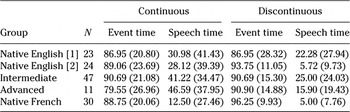
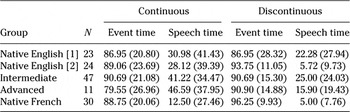
The experimental groups consisted of university-level English-speaking learners of French in the United States, ranging from the intermediate (or second-year) level of study up through the advanced level. The most advanced learners began learning French through classroom instruction as adolescents or adults and spent at least 9 months (i.e., one academic year) in a French-speaking country, in which they spoke French at least part of each day. They had not studied French linguistics (particularly syntax) at the graduate level. A cross-section of learners is desirable from a developmental perspective, in that a comparison of learner group behavior can allow us to extrapolate a developmental path, including the point at which such asymmetries appear in interlanguage grammars, if at all. English NS control groups provided truth value judgments of putative sentences based on word-for-word English glosses of the French test sentences with of (i.e., Task 1) and without of (i.e., Task 2). The purpose of these control groups was to establish what information knowledge of English could provide. Another group consisted of French NSs who were university-level students at French universities studying toward a general diploma in English. This group served to document the sensitivity of the testing instrument to the relevant interpretive distinctions, in the event that no learner groups would display any sensitivity. Results are presented in Table 2.
Acceptance rates (in %) by quantifier type interacting with event- versus speech-time scenarios
Note
SDs appear in parentheses.
Event-time answers were generally preferred and were accepted at very similar rates across constructions. Speech-time answers, however, were far less acceptable in response to discontinuous interrogatives than in response to continuous interrogatives. This speech-time reading is also not the most readily accessible in continuous quantification. What is crucial here, however, is that there is a distinction between acceptance rates for speech-time answers in continuous versus discontinuous quantification. Intermediate learners of French (n = 47) accepted 25% of speech-time answers in response to discontinuous interrogatives versus 41% in response to continuous interrogatives, p < .005. This effect became more pronounced in advanced learners (n = 11) with 15.90% in response to discontinuous interrogatives versus 46.59% in response to continuous interrogatives, p < .05. For French NSs, the difference was not statistically significant, as means were too close to zero. English grammar does not license discontinuous structures, and in the task that glossed the French verbatim, Task1, significant asymmetries did not arise. In the task without of, Task 2, relevant asymmetries appeared, with 5.72% in response to discontinuous interrogatives versus 28.12% in response to continuous interrogatives, p < .05. If learners were to rely on various strategies, diverse patterns should arise; however, inspection of the data revealed highly regimented behavior. Furthermore, with no relevant direct exposure, English speakers seemed to have inherent knowledge of the constraint, so that upon acquiring the relevant French morphology that allows left-branch extractions, the relevant interpretations arise.
In the case of interrogatives, the POS is particularly dire. It appears that for learners to glean such information from the input, a suitable number of instances of these rare interrogatives is required as well as a considerable amount of knowledge about the circumstances under discussion and the participants in the speech situation. Intermediate learners have not been exposed to discontinuous wh-quantifiers with adjectival restrictions, let alone the range of possible interpretations. Additionally, one typically asks a question because one does not have the relevant information. These scenarios presuppose interactions that not every learner will encounter and the assumption that the learner would use such an interaction as an occasion for grammatical learning. Thus, if the (nonnative) hearer of Qui fumait de célèbre au bistro dans les années 60? “Which famous person used to smoke in the bar in the 60s?” should misinterpret it as intending a speech-time interpretation and answers accordingly, the learner’s conversation partner would not be in a position to correct the misinterpretation, because she or he is relying on the learner for the relevant information. The same could be said for the case in which the learner utters such a sentence under the false assumption that a speech-time interpretation is allowed. In this case, the answer will be taken as an answer to the intended question, because the learner does not know the information he or she is seeking. If a learner witnesses an exchange between two interlocutors when an answer is provided to a question, in most situations, knowledge of the world is partial, thus little information can be retrieved. Supposing that the learner who witnesses the exchange happens to know everything relevant about the situation, there is no guarantee that the answer would clearly identify the intended interpretation. This is because the interlocutor could be mistaken about the state of the world, so that the answer provided may not accurately reflect the interpretation that was intended. Knowing for sure what interpretation was intended and that the answer provided was for this interpretation and believed to be true requires knowing the mind of the speakers. The possibility that licit form-meaning pairings are grasped in this way from the input provided by conversational exchange seems extremely remote, if not implausible.
The Semantics-Pragmatics Interface Evidence
Dekydtspotter and Hathorn (Reference Dekydtspotter and Hathorn2005) investigated an interpretive contrast that involves not only idiosyncrasy at the syntax-semantics interface but, crucially, idiosyncrasy at the semantics-pragmatics interface. Consider the examples in (11).
(11) a. Quelque chose de remarquablea été observé par chacun des chercheurs.
something of remarkable has been observed by each of-the researchers
b. Quelque chosea été observé de remarquablepar chacun des chercheurs. something has been observed of remarkable by each of-the researchers
“Something remarkable was observed by each of the researchers.”
Examples like (11a), in which the indefinite pronoun and adjectival restriction are adjacent, call up situations where one and the same thing was observed by each of the scientists as well as situations where each scientist observed something different. Out of the blue, (11b) suggests that the same thing was not observed by all. This intuition requires specific interactions between syntax, semantics, and pragmatics. At the syntax-semantics interface, the discontinuous quantifier quelque chose ... de remarquable “something … of remarkable” must be interpreted in situ and, thus, under the quantifier chacun des chercheurs “each of the researchers.” The semantic interpretation, therefore, is that for each of the researchers, there is a remarkable thing that he or she observed. At the semantics-pragmatics interface, this semantic representation induces an additional pragmatic inference (an implicature) excluding situations in which the observed objects happen to be one and the same. In other words, if one uses (11b), which uniquely describes situations in which each scientist observed a (potentially different) thing, it must be that the same object was not observed by all, assuming Grice’s (Reference Grice, Cole and Morgan1975) principle of cooperation. Such a reasoning can, however, be defeated. Both (11a) and (11b) can be followed by a sentence like (12) without yielding a contradiction.
(12) En fait, la même chose a été observée par tous les chercheurs.
infact the samething has been observed by all the researchers
“In fact the same thing was observed by all the researchers.”
Statements that correct implicatures confound the relevant aspects of interpretation if the task of the learners is simply to associate a form with the range of situations that it may describe. Because corrective statements cross the continuous-discontinuous dimension, they do not specifically flag the discontinuous structure. These learning-theoretic problems are avoided if the aspects of interpretation investigated are basic to mental organization in the area of language: the result of computations triggered by specific syntactic and semantic representations.
To find out what English-French learners know of the interpretive difference between sentences in (11a) and (11b), participants were presented with an interpretive judgment task in which crucial items crossed same or different object contexts with continuous versus discontinuous sentences. The task consisted of eight quadruples and 18 fillers in three random orders. For each context-sentence pair, a first character, Mrs. Briggs, read a scenario in English, a second character, Madame Goyette, a teacher of English, asked an information question of her pupils in the context of a comprehension exercise, and a pupil answered this question with a continuous or discontinuous answer. An example item is provided in (13).
(13) Mrs Briggs: Having landed on the planet Omega, the three scientists of the interstellar expedition separated to begin their exploration of the planet. At exactly 1:45 in the afternoon, there was a flash of light. From their respective vantage points, each of the scientists observed a single enormous explosion on the closest moon.
Mme Goyette: Qu’ est-ce qui s’est donc passé?
what is-it that self-is thus passed?
“So, what happened?”
Elève: Quelque chose a été observé de remarquable par chacun
Something has been observed of remarkable by each des scientifiques.
of the scientists.
“Some remarkable thing was observed by each of-the scientists.”
Participants indicated whether the response given by the pupil was adequate. An adequate response was defined as one that would not mislead a hearer about the facts. Thus, the sentence Someone was wearing a hat and someone was wearing a red shoe would be true in a situation where Mary was wearing a hat and also a red shoe, but it would mislead a hearer to think that two people were involved. Respondents were trained with such examples.
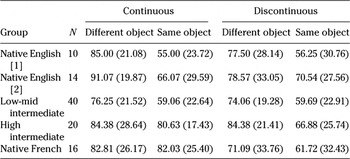
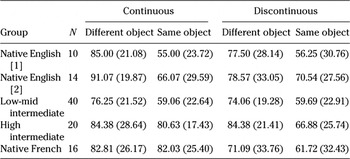
As Table 3 shows, intermediate English learners of French accepted sentences with discontinuous quantifiers as descriptions of different-object versus same-object contexts at 84.38% versus 66.88%, respectively, p .05. The same group of learners accepted sentences with continuous quantifiers as description of same-object and different-object contexts at similar rates at 84.38% and 80.63%, respectively. A difference in acceptance rates of continuous and discontinuous sentences also arose in same-object contexts, p = .050. This replicates the exact contrasts found in the NS data.
Acceptance rates (in %) of continuous-discontinuous quelque chose de … “something of …” followed by an adjective interacting with same- or different-object scenarios
Note
SDs appear in parentheses.
The results of low-mid intermediate learners on the same task reveal no contrast between the two constructions in terms of the acceptance of same-object contexts. The results of an English control group that did an English-language version of the task display patterns similar to the low-intermediate learners. Task 1 was a verbatim gloss of the French structure with of, whereas in Task 2, the preposition did not appear. In all of these groups, there was a measurable response bias against same-object contexts.
Thus, the behavior of low-mid intermediate learners was like that of the English NSs: There was no construction-dependent effect. In contrast, the behavior of high intermediate learners was Frenchlike: A construction-dependent effect appeared. The general dispreference for same-object contexts by low-mid intermediates does not follow purely from semantics: On all possible logical forms of the sentence, the sentence should be true. However, learners might have first accessed the semantic representation in which the logical object (sentential subject) is interpreted in theta position in the scope of the logical subject (i.e., for every researcher there is an object that is observed), before accessing the inverse scope representation (when allowed by the syntax).
Crucially, the response patterns of all groups suggest that the semantic representation (i.e., for every researcher there is an object that is observed) automatically triggered a pragmatic implicature that the same objects were not observed by all. The difference between Englishlike and Frenchlike response patterns can be explained if the grammaticality of the discontinuous structure (which uniquely receives the interpretation of the logical object in the scope of the logical subject) makes the inverse scope representation possible, with the continuous syntax more perspicuous. These patterns in English-French interlanguage, therefore, not only suggest knowledge of specific syntax-semantics interactions but also the computations of implicatures in the area of quantification.
One may ask how the implicatures are derived. General beliefs will not yield these patterns. The belief that most discoveries involve different objects, for instance, allows for exceptions, and such a belief will simply be contradicted by the single-object scenarios. These scenarios should indicate that the situation is not prototypical, and the respondents should accept the sentences. Dekydtspotter and Hathorn (Reference Dekydtspotter and Hathorn2005) also discussed asymmetries induced by implicatures triggered with the universal event-quantifier toujours “always” versus the existential event-quantifier parfois “sometimes.” Implicatures triggered by the semantically noninnocuous interaction of universal and existential quantifiers but not by the semantically innocuous interaction of existential quantifiers are signatures of the grammatical computation of pragmatic implicatures through semantic scales. In an interesting experiment, Slabakova (Reference Slabakova, Caunt-Nulton, Kulatilake and Woo2007) provided evidence for the computation of scalar implicatures as part of a grammatical reflex in learners. She showed that learners are strongly guided by the implicatures induced by quantifiers and noted that the modeling of scalar implicatures as a grammatical reflex best accounts for the learner behavior, because the suspension of these implicatures seems more difficult.
The Weight of the Evidence
Another way to approach the problem of epistemology is to search for L2 phenomena that are a priori supported by cognitive states that fall outside the constraints of UG. Now, if a UG-compatible explanation exists, the argument is neutralized. Thus, Clahsen and Muysken (Reference Clahsen and Muysken1986, Reference Clahsen and Muysken1989) argued that the acquisition of German word order by speakers of Romance languages involves operations disallowed by UG. Du Plessis, Solin, Travis, and White (Reference Du Plessis, Solin, Travis and White1987) as well as Schwartz and Tomaselli (Reference Schwartz, Tomaselli, Abraham, Kosmeijer and Reuland1990), however, showed the UG-compatibility of the sequence, removing this as a case where SLA must fall outside the constraints of UG. Klein (Reference Klein1993, Reference Klein1995) argued that L2 development lies outside UG on the basis of the null prep phenomenon—in which prepositions are dropped in wh-movement dependencies. Dekydtspotter, Sprouse, and Anderson (Reference Dekydtspotter, Sprouse and Anderson1998) showed such structures to occur in L1 grammars (therefore, to be UG-governed), even if relatively rarely, and offered an account for this phenomenon. A competing UG-compatible analysis of the null prep phenomenon was offered by Klein (Reference Klein2001). Similarly, arguments that particular phenomena require UG are neutralized by evidence that general mechanisms can account for them. However, similar claims can apply to L1 grammars (O’Grady, Reference O’Grady2005, Reference O’Grady2008) as well. Even if (most if not all) grammatical primitives turn out to have plausible counterparts in nonlinguistic domains, the specificity of grammar relies on the specific nature of their transduction into the grammatical domain in the mental architecture. For instance, grammatical gender can certainly claim roots in general cognition, but not all systems for effecting gender agreement will have the same processing signatures: This can be empirically investigated (see Dekydtspotter & Renaud, Reference Klein2009). For adult SLA, the question becomes whether cognitively developed speakers of a language with no gender agreement acquiring a L2 that exhibits gender agreement patterns will calculate gender agreement in dedicated fashion or whether alternative uses of gender features are possible. In a survey of the literature, White (Reference White2003) drew attention to a considerable asymmetry in the body of evidence that favors the proposition that SLA is UG-constrained.
Martohardjono (Reference Martohardjono1993) initiated a crucial breakthrough in the investigation of L2 epistemology that involved the recognition of the methodological need to search for dire POS and to eschew the problems of the comparative fallacy entirely (Bley-Vroman, Reference Bley-Vroman1983), the investigation of patterns within interlanguage. Another insight came from the realization that the various types of L2 syntactic systems have different semantic repercussions. Semantic knowledge can thus be used to probe for the nature of L2 grammatical representations. Given the POS, scope constraints associated with permutations of word order must follow as reflexes of domain-specific deductive knowledge and can be viewed as signatures of domain-specificity. To the extent that such syntax-linked restrictions on interpretive possibilities are found in interlanguage, these restrictions demonstrate that both L1 and L2 acquisition are constrained such that, after sufficient exposure to input, a grammatical state emerges that assigns just the right kind of logical form representation to a given structure.
The FDH runs afoul of a growing body of interpretive research that argues that knowledge acquired in the course of SLA is constrained by principles of UG (see Dekydtspotter, Anderson, & Sprouse, Reference Dekydtspotter, Anderson, Sprouse and Ayoun2007, and Slabakova, Reference Slabakova2006a, for reviews). Findings are not limited to the clausal domain or quantification. Anderson (Reference Anderson2002) discussed the semantic effects of adjective positioning in the expression of nominal reference in French. Slabakova (Reference Slabakova2006b) examined the syntax-linked semantics of bare nouns in English and Italian. Borgonovo and Prévost (Reference Borgonovo, Prévost, Beachley, Brown and Conlin2003) and Borgonovo, Bruhn de Garavito, and Prévost (Reference Borgonovo, Bruhn de Garavito, Prévost, Burgos, Clark-Cotton and Ha2005) considered interpretive effects of indicative versus subjunctive mood in L2 Spanish. Montrul and Slabakova (Reference Montrul and Slabakova2003) provided an argument for aspect. Each argument must be evaluated for its own merit, but there is comfort in a body of research that pushes for the establishment of the hypothesis that L2 grammars are UG-constrained.
The insight that the structure of a given module imposes certain consequences on other components can be generalized: A Fodorian language module that satisfies the conditions of domain-specificity and of informational encapsulation can be expected to have repercussions at its interfaces with its systems of general cognition (Fodor, Reference Fodor1983, Reference Fodor2000). Pragmatics seems highly revealing: Some aspects of pragmatics seem to be grammatical and are an integral part of the language module, whereas others are not. If the same partition of the burden can be shown to exist in L2 grammars as in L1 grammars (see Dekydtspotter & Hathorn, Reference Dekydtspotter and Hathorn2005, for suggestive evidence), this would suggest that the same type of cognitive constraints are at play.
INFORMATION ENCAPSULATION
Fodor (Reference Fodor1983) argued that processing a native language involves a universal, domain-specific, and informationally encapsulated deductive system that assigns to linguistic input a representation accessible to the general cognitive system. The language processor thus computes the linguistic input on the basis of structure of the representations themselves, without regard to contextual information. This property is known as information encapsulation. Schwartz (Reference Schwartz1987, Reference Schwartz1999) hypothesized that SLA must also be characterized by domain-specific representations accessed in a task-specific way. Therefore, the high degree of domain-specificity of the representations that is demonstrated given current understanding of UG is a basic requirement for the hypothesis to be true. However, as Fodor (Reference Fodor2000) pointed out, domain-specificity and information encapsulation are gradient properties and they are also independent of one another. Hence, the architecture of the mind may involve mixed systems with highly domain-specific representations, but the processing of these representations may be influenced by general contextual information, in which case it would not be informationally encapsulated. Thus, establishing Schwartz’s (Reference Schwartz1987, Reference Schwartz1999) hypothesis also requires finding evidence of the informational encapsulation of the processing of target language input. Research on scalar implicatures that focuses on the interaction of the domain-specific grammatical module with principles of language use is relevant to this question. The central question becomes the exact nature of the grammar-pragmatics interface in SLA. One might expect to find effects of the language module in pragmatic reasoning: Cases of scalar implicatures in the area of quantification in which contextual information is not usable are revealing because the grammar predetermines what information can be used. Informational encapsulation (as a gradient property) requires investigations in various aspects of performance. The grammatically triggered change in the relative strength of certain specific readings in ambiguous cardinality interrogatives is therefore considered.
The cardinality interrogative expression combien “how many” can appear in French together with its restriction de followed by a noun phrase as illustrated in (14a) or in discontinuous syntax as shown in (14b).
(14) a. Combien d’ animaux est-ce que ces enfants ont tous voulus?
how-many of animals is-it that these children have all wanted
b. Combien est-ce que ces enfants ont tous voulu d’ animaux?
how-many is-it that these children have all wanted of animals
“How many animals did these children all want?”
The examples in (14) include the universal quantifier tous “all.” As discussed by de Swart (Reference de Swart, Baker and Dowty1992), when a quantifier is separated from its restrictive clause in surface syntax by another quantifier, the intervening quantifier must take scope over the first quantifier; that is, combien “how many” in (14b) must take narrow scope, whereas combien “how many” in (14a) may take either narrow or wide scope. On the narrow-scope interpretation, the question anticipates that each child wanted a number of animals (not necessarily the same animals) and asks for that number. On the wide-scope interpretation, the question anticipates that there might be animals wanted by all of the children and asks for the number of those. I focus here on access to this representation in the continuous structure in the course of the acquisition of the discontinuous structure. However, before the manner of access to representations can be considered, the type of representations being accessed must be ascertained.
Dekydtspotter, Sprouse, and Swanson (Reference Dekydtspotter, Sprouse and Swanson2001) administered a truth value judgment task featuring 28 test items that represented seven sets of minimal quadruples for which the continuous versus discontinuous version of a sentence with combien “how many” was crossed with a scenario that forced the narrow-scope versus wide-scope interpretation. Each scenario consisted of a set of three individuals, all of whom selected a set of items, some being selected by all three individuals and others being selected by only one individual as shown in (15).
(15) Philippe and Monique Dupont hired a magician and her assistant to entertain at their son Jean’s 10th birthday party. The magician announced that she could read minds. Her assistant brought out a white rabbit, a black rabbit, a bird, a cat and a dog. From experience, the magician and her assistant knew that the children would include the 2 rabbits in their choices. The magician then asked Jean, Marie and Paul to think of the animals they would like to have. As predicted, Jean thought of the 2 rabbits and the bird. Marie thought of the 2 rabbits and the dog. Paul thought of the 2 rabbits and the cat. Winking, the assistant asked the magician:
“Combien est-ce que ces enfants ont tous voulu d’ animaux?”
How many is-it that these children have all wanted of animals
“How many animals did these children all want?”
Sure that the expected pattern had arisen, the magician answered:
“Deux, bien sûr.”
Two of course
“Two, of course.”
In a scenario with three children, all of whom want two rabbits plus one other animal (a bird for one child, a cat for another, and a dog for the third), the answer to the question posed in (14a) could either be three (narrow scope) or two (wide scope), whereas the answer can only be three for (14b). Participants were asked to determine whether the answer to each combien “how many” question was correct, selecting from the choices: yes, no, and cannot decide. The expected answer in (15) is no.
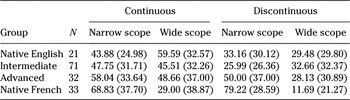
Table 4 presents a summary of the results. On the whole, French NSs accessed the narrow-scope interpretation more easily than the wide-scope interpretation irrespective of the (dis)continuous patterning of combien “how many.” However, despite depressed rates of acceptance for the wide-scope interpretation across both word order patterns, NSs nonetheless distinguished to a statistically significant degree between the two syntactic constructions at 29% (continuous) versus 11.69% (discontinuous), p < .01. In a similar task in which French sentences were glossed with English words, English NSs disliked discontinuous constituents. Acceptance rates for the discontinuous syntax revealed that English speakers did not exhibit the semantic distinction at 33.16% (narrow scope) versus 29.48% (wide scope), p = .476. Intermediate English learners of French also exhibited no knowledge of the discontinuous syntax at 25.99% (narrow scope) versus 32.66% (wide scope), p = .146. A preference for the continuous syntax was also observed. In contrast, the advanced learners produced an asymmetry in their interpretation of discontinuous syntax at 50.00% (narrow scope) versus 28.13% (wide scope), p < .05. This suggests that the constraint on the discontinuous syntax develops channeled by a domain-specific syntax-semantic interface.
Acceptance rates (in %) of continuous-discontinuous combien “how many” interrogatives interacting with wide- versus narrow-scope interpretations

Note
SDs appear in parentheses.
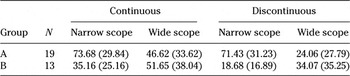
Individual patterns of advanced learners in Table 5 were analyzed by Dekydtspotter (Reference Dekydtspotter2001), who focused on access to interpretations of the continuous structure as in (14a) dependent on the response pattern found with the discontinuous structure as in (14b). As can be observed in Table 4, French NSs also strongly favored the narrow-scope interpretations of continuous interrogatives such as Combien d’animaux est-ce que ces enfants ont tous voulus? “How many animals did these children all want?.” This preference was not in evidence in the data of English NSs. A similar asymmetry between English and French was also reported in production by Villalta (Reference Villalta, Tamanjani, Hirotani and Hall1999). As Table 5 illustrates, this difference in the relative access of narrow-scope interpretations of continuous interrogatives is replicated in English-French acquisition: Those advanced learners, Group A, who preferred narrow-scope answers paired with discontinuous interrogatives (with acceptance rates above 50%) also exhibited a Frenchlike strong preference for the narrow-scope interpretation in continuous interrogatives. Those advanced learners, Group B, who generally disliked distributive answers paired with discontinuous interrogatives (with acceptance rates below 50%) did not show this preference, behaving instead in Englishlike fashion. Access to the wide-scope (versus narrow-scope) interpretation of continuous cardinality interrogatives seems dependent on the status of discontinuous cardinality interrogatives.
Acceptance rates (in %) of continuous-discontinuous combien “how many” interrogatives in two groups of advanced learners

Note
SDs appear in parentheses.
If learners were simply sensitive to raw frequencies, relative access to interpretations of Combien d’animaux est-ce que ces enfants ont tous voulus? “How many animals did these children all want?” should be independent of Combien est-ce que ces enfants ont tous voulu d’animaux? “How many animals did these children all want?.” Depending on the vagaries of exposure and of strategies employed, a range of behavior would be expected. The relationship, therefore, suggests that access to representation is guided by the possibility of in situ argument licensing rather than by sensitivity to context.
Crucially, the appearance of discontinuous wh-quantifiers in the interlanguage grammar triggers a change in the relative ease of access to wide-scope interpretations of continuous wh-quantifiers. The contexts that induce wide-scope interpretations were the same for the two types of advanced learners. What differs is the grammatical state that respondents brought to the task. The nature of the grammatically licensed representations themselves seems to determine access to interpretations, when context should otherwise make the interpretation clear. These results present, therefore, prima facie evidence for informational encapsulation in which the representations themselves determine processing irrespective of context.
In a related study, Dekydtspotter and Outcalt (Reference Dekydtspotter and Outcalt2005) measured reading times of intermediate and advanced learners on continuous cardinality quantifiers. English learners of French were presented with the same contexts, followed by a question read in seven segments. After the question, an answer was provided. Respondents either accepted or rejected the sentence by pressing an appropriate button. When participants indicated that the answer was correct, reading times were analyzed. Reading times were flat across the two conditions for intermediate learners. However, on the wide-scope interpretation, differences in reading times on the quantifiers were longer for advanced learners than for intermediate learners. Advanced learners’ reading times were shorter than intermediate learners’ reading times on the quantifiers on the narrow-scope interpretation. It appears, therefore, that scope is computed as soon as the quantifiers are encountered. This is suggestive of a syntactic reflex that mediates development. Clearly, work on access to scope relations is in its infancy relative to the question of L2 representations. These results seem, however, promising.
SEMANTICS AND CONSTRUCTIONS
Bley-Vroman (this issue) argued that the language faculty must also include a set of grammatical patches capable of interfacing with the central generative system and suggested that the impaired L2 parsing envisaged by Clahsen and Felser (Reference Clahsen and Felser2006a, Reference Clahsen and Felser2006b) may lead to learners positing underived constructions augmented with co-occurrence and meaning specifications (see also Bley-Vroman, Reference Bley-Vroman1997). Whereas L1 acquisition is characterized by a deep rule-based reflex with kludge-and-patch representations that account for the residue, this kludge-and-patch system takes over in SLA.
Interpretation can provide evidence for the compositional or holistic nature of a putative construction. A study in progress (Dekydtspotter & Petrush, Reference Dekydtspotter, Petrush, Grantham O’Brien, Shea and Archibald2006) that investigates aspects of the interpretation of the ne … que construction in the expression of “only” in English-French interlanguage is outlined here. Exposure of the population under investigation to ne … que “only” is limited; the structure is not targeted in instruction. It may be present incidentally in the input, either in authentic texts or in the speech of the instructor. Crucially, the form-meaning relation in the structure is opaque. The meaning of “only” does not transparently follow from knowledge that the particle ne is associated with negation and that the particle que is generally a marker of subordination. The meaning of the construction can be contextually clear or may have been directly provided by the instructor. Thus, a learner might naturally treat ne … que followed by any type of phrase (XP) as a discontinuous chunk, with a lexical stipulation that the structure as a whole means “only” XP. In contrast, the meaning of the construction might be derived. With this view, que XP is interpreted as an existential exceptive expression dependent on negation, akin to “not … anyone other than XP.”
The ne … que “only” structure exhibits certain asymmetries, as illustrated in (16), revealing a composition of negation with an exceptive phrase. In (16a), the que-marked object naturally receives a specific interpretation of un acteur “an actor” in which there is one actor in the world whom Aurélie dreams of marrying to the exception of everyone else as well as a nonspecific interpretation in which un acteur “an actor” is strictly dependent on the situations imagined in the dream. In (16b), un acteur “an actor” is interpreted in the scope of rêve “dream,” so that the semantic value of un acteur “an actor” is dependent on the situations imagined. Such an interpretation is due to the fact that the negative head ne is itself in the scope of the intensional verb rêve “dream” and the interpretation of the object marked by que is dependent on ne. A specific interpretation is possible but, crucially, much harder to obtain.
(16) a. Aurélie ne rêve d’ épouser qu’ un acteur.
Aurélie neg dreams to marryque an actor.
b. Aurélie rêve de n’épouser qu’ un acteur.
Aurélie dreams to neg marry que an actor.
“Aurélie dreams of marrying only an actor.”
The composition of ne with the que-marked expression in (16) leads to the different interpretations described. If ne … que XP is listed as a discontinuous chunk with the specification that it means “only” XP, these observations do not follow. The restrictions on the interpretation require stipulations derived from the input or by a general cognitive principle of meaning differentiation. What is manifestly not in the input of the typical classroom could not have been noticed. One might suggest a general principle of meaning differentiation. However, even a strategy such as “Assign scope where ne is placed” would not match the patterns where ne placed in the matrix clause allows either a specific or a nonspecific interpretation, whereas ne placed in the embedded clause inhibits the specific interpretation.
Dekydtspotter and Petrush (Reference Dekydtspotter, Petrush, Grantham O’Brien, Shea and Archibald2006) tested knowledge of this asymmetry with a task that crossed nonspecific scenarios and specific scenarios with statements containing ne … que “only.” There were seven quadruples crossing scenarios that required nonspecific or specific interpretations with two word orders and 12 fillers appearing in three random orders. In the nonspecific scenario for (16), Aurélie fancies herself as an actor’s wife—which may vary with every copy of Us Weekly. Both word orders are possible descriptions of this situation. In the specific scenario for (16), Aurélie imagines her life as the next wife of a specific actor, Brad Pitt, a real-life individual not dependent on who is on the cover of Us Weekly. The second word order with ne in the embedded clause is less felicitous, because it does not suggest that there is such an individual. The specific interpretation can, however, be accommodated but requires extra computations.
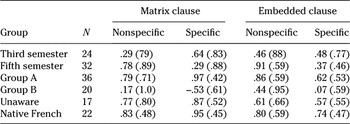
English learners of French were asked to evaluate how well the sentences described the situation on a scale of values (–2, –1, +1, +2), from very badly to very well. Zero values, can’t tell, were excluded from the analysis. Participants were third- and fifth-semester learners as well as a group of advanced learners and NSs. Third-semester learners’ exposure is highly controlled, whereas fifth-semester learners received more input derived from various media sources with greater likelihood of encountering ne … que “only.” Intermediate learners were divided into two groups depending on whether they reported being aware that the proposition expressed by Marie saw only Jean could be also expressed as “Marie n’a vu que Jean.” Learners who are not aware that ne … que XP can express “only” XP have presumably had the least exposure, even through incidental encounter, to the structure.
The mean scores are presented in Table 6. For third-semester learners, ne in the matrix clause received higher scores in specific versus nonspecific contexts, p < .05, but ne in the embedded clause yielded no such asymmetry, p = .825. In fifth-semester learners, specific interpretations received lower scores across the board: When ne is located in the matrix clause, the contrast between specific versus nonspecific is significant, p < .005, and the contrast is also significant when ne is located in the embedded clause, p < .0005. The degree to which learners accepted the nonlocal placement of ne and que introduced a large degree of variability. To address this problem, I consider the subset of learners who assigned positive scores to ne in the matrix clause in specific contexts above 50%, Group A (n = 36). The hypothesis predicts that ne placed in the embedded clause should inhibit this tendency. In specific contexts, there was a strong effect of ne placement, ne in matrix versus embedded clause, p < .0005. In nonspecific contexts, there was none, p = .551. For the remainder of the intermediate learners (Group B), an asymmetry of ne placement in specific contexts was observed in the opposite direction, p < .005; however, no effect was found in nonspecific contexts, p = .234. Learners who were not aware that “only” XP can be expressed with ne … que XP exhibited such a contrast in their scoring of form-meaning pairs: Scores in specific contexts were sensitive to ne placement, p < .05, whereas scores in nonspecific contexts were not, p = .342. For NSs, scores in specific contexts showed sensitivity to ne placement, p = .055, whereas scores in nonspecific interpretations were essentially flat, p = .780.
Mean scores for the placement of ne interacting with nonspecific and specific scenarios

Note
SDs appear in parentheses.
Once the variability due to the position of ne and que in the sentence was taken into account, intermediate learners’ patterns exhibited clear signs that the meaning of the ne … que XP construction as “only” XP is not stipulated but derived from the meaning of its parts. This does not rule out a short-lived chunk with a meaning postulate but suggests that a compositional reflex puts severe limits on such mechanisms.
CONCLUSIONS
Second language grammars are far removed from linear grammars, pattern matching, or even combinatory logic systems. Interpretative evidence consistently suggests that L2 grammars inhabit a particular niche carved by UG. This threatens the FDH as envisaged by Bley-Vroman (Reference Bley-Vroman1990) because although many strategies are expected with a range of consequences, surprising uniformity is found both across learners and across the spectrum of constructions. In contrast, findings that inherent constraints gain full expression as the relevant morphosyntactic properties develop strongly favors the mental landscape presented in Schwartz (Reference Schwartz1986, Reference Schwartz1987, Reference Schwartz1988, Reference Schwartz1999). Establishing Schwartz’s hypothesis requires also establishing the hypothesis of informational encapsulation of access to L2 representations. Interpretation can also provide evidence on the nature of processing and on the specific analyses of constructions adopted by learners, because these analyses also leave specific interpretive fingerprints.