In this article, we investigate the manner in which intermediate proficiency English-French classroom learners in their second and fourth semester of college-level French process ambiguous sentences as in (1), in which the relative clause (RC) (here, “who takes a walk downtown”) may be construed as modifying either the noun phrase (NP) headed by the first noun (N1) or by the second noun (N2), which is introduced by the genitive preposition de “of.” The secretary of the psychologist takes the walk in the former case, whereas the psychologist is the walker in the latter case. The first interpretation results from (high) attachment of the RC to the first NP (NP1) in syntax. The second interpretation is due to (low) attachment of the RC to the second NP (NP2).
(1) Nous adorons le secrétaire du psychologue qui se promène au centre ville.
“We adore the secretary of the psychologist who takes a walk downtown.”
The problem of ambiguous attachment of the RC exists in French and in English. However, research has suggested that RC attachment may be resolved differently by native speakers (NSs) of the two languages: NSs of French appear to generally favor high attachment of RCs (Baccino, De Vincenzi, & Job, Reference Baccino, De Vincenzi, Job, De Vincenzi and Lombardo2000; Frenck-Mestre, Reference Frenck-Mestre, Sorace, Heycock and Shillcok1997; Frenck-Mestre & Pynte, Reference Frenck-Mestre, Pynte, De Vincenzi and Lombardo2000; Zagar, Pynte, & Rativeau, Reference Zagar, Pynte and Rativeau1997), whereas NSs of English generally prefer low attachment of RCs (Fodor, Reference Fodor and Hirotani2002, among others). Similarly, NSs of Afrikaans, Croatian, Dutch, German, Greek, Italian, and Russian seem to favor high attachment of the RC, whereas speakers of Brazilian Portuguese, Egyptian Arabic, Norwegian, Romanian, and Swedish favor low attachment (Fodor).
This contrast between English and French suggests distinct processing strategies, whereby French speakers would resolve ambiguity by closing the phrase marker early in processing, and English speakers would resolve it by closing the phrase marker late. This proposal has led to a number of hypotheses. In an experience-based approach, Cuetos and Mitchell (Reference Cuetos and Mitchell1988) argued for attunement of the parser (i.e., a mechanism that allows input to be processed) to frequencies in the input: They proposed that the parser tracks the relative number of unambiguous attachments in the input and follows these tendencies. In contrast, Gibson, Pearlmutter, Canseco-Gonzalez, and Hickok (Reference Gibson, Pearlmutter, Canseco-Gonzalez and Hickok1996) proposed a structural trigger that determines the relative strength of distinct parser operations. In a [+verb-raising] language like French, a strategy of predicate proximity, by which the RC attaches directly to the argument of the verb (i.e., early closure), takes precedence over the general recency strategy of attaching to the most recently processed constituent (i.e., late closure). In a [−verb-raising] language like English, the general recency strategy is followed: The RC attaches to the most recently processed expression.
However, Fodor (Reference Fodor1998, Reference Fodor and Hirotani2002) noted that the preference for high attachment of RCs in languages like French seems to be a lone exception to structure minimization. Indeed, across languages and constructions, the parser generally avoids generating more structure than necessary at each stage of processing, in line with principles such as right association (Kimball, Reference Kimball1973) and minimal attachment (Frazier, Reference Frazier1978). The postulation of construction-specific processing strategies seems incompatible with the general character of syntactic parsing. Therefore, Fodor (Reference Fodor and Hirotani2002) suggested an account citing prosodic requirements for French RCs as the source of the preference for high attachment of RCs. On this hypothesis, the processing of RCs in French follows structure minimization as in English. However, English and French differ in prosodic requirements on RCs among other things. In English, the RC preferentially falls under the prosodic constituent associated with NP2: This segmentation uniquely converges with low attachment in syntax. In French, the RC preferentially constitutes its own prosodic constituent, following the pattern of right-branching complements. This segmentation does not fit well with the low attachment structure, inducing a revision from low attachment to high attachment in syntax. In short, Fodor (Reference Fodor and Hirotani2002) proposed that prosodic differences between English and French explain why (everything else being equal) RCs generally tend to be construed as modifying NP2 in English and NP1 in French.
The hypothesis that the processing of RCs in native French involves interactions between syntactic and prosodic computations is well supported by the available empirical evidence. First, there is evidence of structure minimization: RCs are preferentially interpreted low with thematic prepositions (i.e., avec “with”), as revisions across thematic domains are particularly costly (Crocker, Reference Crocker1996; Pritchett, Reference Pritchett1992). Baccino et al. (Reference Baccino, De Vincenzi, Job, De Vincenzi and Lombardo2000) demonstrated this NP2-modification preference with thematic prepositions in French; their results mirrored results from De Vincenzi and Job (Reference De Vincenzi and Job1995) for Italian. Second, there is evidence that the length of the RC and consequently its phonological weight affects the likelihood of NP1 construal. Thus, for French, Pynte and Colonna (Reference Pynte, Colonna, Kennedy, Radach, Heller and Pynte2000) and Fernández, Fodor, de Almeida, Bradley, and Quinn (Reference Fernández, Fodor, de Almeida, Bradley and Quinn2003) showed that NSs construed longer RCs with NP1 significantly more often than shorter RCs. Third, response time (RT) evidence suggests that construing the RC with NP1 is computationally more costly than construing the RC with NP2. Pynte and Colonna and Baccino et al., who examined RTs on a disambiguating verbal segment inside the RC, independently documented shorter latencies when the RC verb agreed with NP2 as opposed to with NP1. This was observed despite a preference for attachment to NP1 in interpretive judgments. It is generally assumed that longer latencies indicate additional computations triggered by a greater processing load. These asymmetries in RTs suggest that construing RCs with NP1 was more costly than construing RCs with NP2, because NP1 construal required more computations than the NP2 construal.
Hence, final interpretation preferences may not (always) be revealing of earlier tendencies of the parser. We note, however, that a RT study conducted by Zagar et al. (Reference Zagar, Pynte and Rativeau1997) revealed a different pattern: RCs construed with NP1 were read more quickly than were RCs construed with NP2. The authors concluded that NP2 attachment required additional processing. These results may appear antithetical, but they are only apparently contradictory. In other words, given interacting modules, both conclusions are likely to be true, with each reflecting distinct computational moments in the processing of RCs. Many adjustments are made in the course of processing as information from distinct domains needs to be reconciled.
At this juncture, it is important to note that differences in RC attachment preferences between English and French have been demonstrated in silent reading experiments and that results from this body of work appear to be related to prosody: (a) Prosodic constituency influences parsing of RCs, (b) longer RCs tend to be represented as prosodic constituents on their own, and (c) longer RCs induce more NP1 interpretations than shorter ones. These facts may be elegantly unified if a prosodic representation is projected in silent reading (Fodor, Reference Fodor and Hirotani2002). Conceptually, the hypothesis of projection of prosodic structure in silent reading follows naturally if sentence processing involves a mental reflex in which syntactic, phonological, and interpretive modules operate simultaneously in the treatment of input, within the limits of their respective modes of composition and interface relations. Under such a mode of operation, a prosodic representation is always assigned as part of the treatment of language input.
RC ATTACHMENT AMBIGUITY IN SECOND LANGUAGE PROCESSING
Second language (L2) research on RC disambiguation presents mixed findings and conclusions. Frenck-Mestre (Reference Frenck-Mestre, Heredia and Altarriba2002) reported eye-movement studies of two groups of university-level English-French learners studying in France. The first group of learners had an average of 1 year of residency in France, whereas the second group of learners had, on average, 5 years of residency. Spanish-French learners were also compared to the English-French learners to examine the effect of the native language (L1) on L2 processing (NSs of Spanish generally favor NP1 attachment; see Fodor, Reference Fodor and Hirotani2002). A group of French NSs was tested to allow learner-native comparisons. Respondents read sentences, as in (2), in which verbal agreement disambiguated the locus of RC attachment.
(2) Jean a vu [la gardienne des filles/les filles de la gardienne] qui revient de Paris.
“Jean saw [the nanny of the girls/the girls of the nanny] who comes back from Paris.”
For Spanish-French learners, first-pass gaze durations on the disambiguating verb were longer when it agreed with NP2. A similar asymmetry was produced by native French readers. English-French learners with just 1 year of residency in France produced the opposite bias: Longer first-pass gaze durations were produced on the disambiguating verb when it agreed with NP1. The group with a mean of 5 years of residency, however, produced an asymmetry in gaze duration that reflected the development of a Frenchlike bias for attachment to NP1.
Pointing to effects of the L1 in the contrast between English-French and Spanish-French learners and to the target-language-like performance of the skilled English-French learners, Frenck-Mestre (Reference Frenck-Mestre, Heredia and Altarriba2002) argued for similar processing by NSs and nonnative speakers (NNSs), despite the general slowness that persisted even in highly skilled L2 readers. Frenck-Mestre (Reference Frenck-Mestre2005) described these results in terms of attunement of the sentence processor, as envisaged by Cuetos and Mitchell (Reference Cuetos and Mitchell1988), following “prolonged exposure to this language” (Frenck-Mestre, Reference Frenck-Mestre2005, p. 192). Although processing is undoubtedly sensitive to frequency in certain aspects of language, attunement to frequencies of intended meanings places a large burden on the listener and has great potential for error. Thus, the feasibility of tracking the frequencies of meanings seems to us to be exceedingly remote. The proposal that the preferred prosodic representations of RCs play a central role in the general preference for high attachment versus low attachment, however, allows for a conceptually clearer trigger for processing development: Attachment preferences are switched as learners attune to the preferred prosodic representations of right-branching complements in French. Because such representations are flagged in speech, this seems a far more concrete (and therefore likely) trigger. However, before we can consider the feasibility of the prosodic proposal further, we need to determine that the parsing mechanisms deployed in SLA are such that a change in preferred prosodic representation could in fact induce a processing change.
Putting aside for now the question of the exact nature of triggers, a current body of research on RC attachment in L2 processing has argued, contra Frenck-Mestre (Reference Frenck-Mestre, Heredia and Altarriba2002), that the processing of even advanced learners is typically unlike that of NSs. In their investigation of the processing of temporarily ambiguous RCs by advanced L2 learners of Greek, Papadopoulou and Clahsen (Reference Papadopoulou and Clahsen2003) did not find evidence that the L2 learners exhibited a preference for NP1 or NP2 attachment in the genitive condition on a scalar acceptability judgment task; the learners also did not produce RT asymmetries on a self-paced reading task. This was in contrast to Greek NSs, who favored NP1 attachment in acceptability ratings and in RTs. Gender agreement on the past participle disambiguated between attachment to NP1 or NP2, and the second noun occurred either after the genitive preposition tis “of” or after the thematic preposition me “with.” With thematic prepositions, however, both NSs and NNSs preferred low attachment to NP2 and exhibited RT differences that suggest greater computational complexity when the RC was attached to NP1; that is, RTs were longer when high attachment was forced. Papadopoulou and Clahsen reasoned that L2 learners relied heavily on lexical-thematic information but not on pure phrase structure information. They proposed that L2 learners delayed attachment to seek other information that could resolve the structural ambiguity, whereas NSs implemented specialized structural strategies.
Felser, Roberts, Gross, and Marinis (Reference Felser, Roberts, Gross and Marinis2003) found similar results for advanced German and Greek learners of English. Their experimental items implicated either the nonthematic preposition of or the thematic preposition with, and number marking on the auxiliary verb (singular or plural) indicated the intended attachment. With the thematic preposition, NSs and NNSs patterned alike in judgments and in RTs, showing a general preference for NP2 attachment. With the nonthematic preposition, NSs' and NNSs' patterns diverged: NSs displayed a preference for NP2 attachment in judgments and in RTs, whereas NNSs demonstrated no preference. For the NNSs, there was no evidence that the attachment preference (i.e., high attachment) of the learners' L1 affected the results, nor was there convergence on low attachment. In their discussion of these results, Felser et al. concurred with Papadopoulou and Clahsen's (Reference Papadopoulou and Clahsen2003) conclusions—namely that L2 processing is not based on phrase structure information.
Dussias (Reference Dussias and Nicol2001, Reference Dussias2003) examined RC attachment preferences of Spanish and English monolinguals versus late English- and Spanish-dominant bilinguals (in each group, respondents had 11 years of study and functioned in an academic environment). The instrument included an offline interpretation questionnaire in English and Spanish in which an ambiguous sentence was followed by a question and two answers. There was also a RT experiment in Spanish, for which the critical items contained complex NPs joined by the genitive preposition de “of” and modified by a temporarily ambiguous RC; the intended attachment was eventually disambiguated using natural gender. In each example, the RC required a feminine head noun, which occurred in first or second position in the complex NP. As opposed to the stimuli for the RT experiment, questionnaire items simply lacked the last disambiguating segment. Questionnaire results showed that Spanish monolinguals strongly favored high attachment, whereas English monolinguals strongly favored low attachment. Both bilingual groups were statistically different from Spanish monolinguals and not statistically different from each other on the Spanish questionnaire task. More specifically, on the Spanish task, both groups of bilinguals selected significantly fewer high attachments than Spanish monolinguals. On the English questionnaire task, the bilinguals were not statistically different from the English control group or from each other. In the self-paced reading task, Spanish monolinguals read the last segment faster when the RC was construed with NP1 than with NP2. A RT asymmetry in the opposite direction was found among the Spanish-English learners: These participants showed faster RTs on the last segment when the RC was interpreted as a modifier of NP2. However, no differences were discovered in the RTs of English-Spanish learners. Dussias (Reference Dussias2003) noted that “the non-significance in the online data could have resulted from a lack of experimental power” (p. 551) but suggested that bilinguals' reliance on default processing strategies (i.e., a general preference for low attachment) in the judgment questionnaires could be due to the activation of two grammars during processing.
Surveying the current literature on RC attachment in L2 sentence processing in terms of target language convergence, Papadopoulou (Reference Papadopoulou2005) provided a summary of the main findings on the topic: NNSs fall back on lexical-thematic information, context, and possibly defaults such as late closure and do not immediately deploy a structural mechanism as do NSs. For our part, we simply note that the jury is still out: The contrast between thematic and nonthematic prepositions reported in processing of RCs in SLA is in keeping with what is generally known about sentence processing. As noted by Fodor (Reference Fodor and Hirotani2002), whereas the attachment of RCs to NP1 is systematically inhibited with thematic prepositions, the attachment of RCs to NP1 or NP2 in the context of a nonthematic genitive preposition is subject to variation. Hence, nonnative respondents may have suffered performance breakdowns or displayed large individual variation precisely where the human sentence processor exhibits greater pliability. The contour of the performance breakdowns suffered by NNSs may thus be a reflex of a task-specific algorithm of the type we have highlighted.
ON THE NATURE OF L2 PROCESSING
Contrasting the performances of advanced adult L2 learners with that of native adults and children on tasks investigating the processing of RCs, long-distance dependencies, and inflectional morphology, Clahsen and Felser (Reference Clahsen and Felser2006a, Reference Clahsen and Felser2006b) proposed the shallow structure hypothesis. According to this hypothesis, L2 sentence processing is significantly different from native sentence processing precisely because it lacks a deep syntactic reflex. In other words, whereas native sentence processing involves detailed grammatical representations mediating the integration of diverse information, “L2 learners do not rely on phrase-structure based parsing strategies when resolving ambiguities in the L2” (Clahsen & Felser, Reference Clahsen and Felser2006b, p. 17). Instead, during L2 sentence processing, input is segmented and analyzed on the basis of “lexical, pragmatic, and world knowledge” (Clahsen & Felser, Reference Clahsen and Felser2006b, p. 32). Thus, in stark contrast to NSs, who process quickly on the basis of structural information, NNSs cannot access the kind of detailed syntactic representations available to NSs. For Clahsen and Felser (Reference Clahsen and Felser2006a, Reference Clahsen and Felser2006b), grammatical knowledge fails to inform the processing of sentences of the target language input, which explains the (general) lack of robust L1 effects in L2 sentence processing and the (general) lack of convergence on the norms of the target language community. Jiang (Reference Jiang2004) made a similar claim about access to morphological representations in Chinese-English sentence processing. Clahsen and Felser (Reference Clahsen and Felser2006a) surmised that L2 learners' inability to deploy syntactic knowledge in processing was due to some fundamental difference in the nature of L2 grammars with respect to L1 grammars, in keeping with arguments by Bley-Vroman (Reference Bley-Vroman1990), Clahsen and Muysken (Reference Clahsen and Muysken1986), Meisel (Reference Meisel, González and Guervós1998), and others. We note, however, that the claim of a fundamental epistemological difference in L2 grammar is irreconcilable with the findings of a significant body of research in the past decade that has documented the development of domain-specific grammatical properties not directly instantiated in the L1 grammar in extreme cases of poverty of the stimulus (e.g., Dekydtspotter, Anderson, & Sprouse, Reference Dekydtspotter, Anderson, Sprouse and Ayoun2007; Hawkins, Reference Hawkins2001; Slabakova, Reference Slabakova2006; see also Schwartz & Sprouse, Reference Schwartz, Sprouse and Archibald2000, for reviews and critiques). Indeed, White's (Reference White2003) survey of the current literature on the topic of the nature of L2 grammars showed that research that supports deep epistemological similarity far outweighs research that supports a fundamental epistemological difference.
Processing differences between NSs and NNSs have been documented by psycholinguistic research in a number of areas: argument structure (Frenck-Mestre & Pynte, Reference Frenck-Mestre and Pynte1997; Juffs, Reference Juffs1998b), filler-gap dependencies (Juffs & Harrington, Reference Juffs and Harrington1995), garden path sentences (Juffs, Reference Juffs1998a), RC attachment (Dussias, Reference Dussias and Nicol2001, Reference Dussias2003; Felser et al., Reference Felser, Roberts, Gross and Marinis2003; Frenck-Mestre, Reference Frenck-Mestre, Heredia and Altarriba2002, Reference Frenck-Mestre2005; Papadopoulou & Clahsen, Reference Papadopoulou and Clahsen2003), and many others. However, as Juffs (Reference Juffs2006) and Dekydtspotter, Schwartz, and Sprouse (Reference Dekydtspotter, Schwartz, Sprouse, O'Brien, Shea and Archibald2006) noted, the fact that native and nonnative processing differ does not necessarily mean that they differ fundamentally. These authors argued that small differences could end up producing very divergent outcomes in the same parsing principles. Thus, it is uncontroversial that NNSs are generally slower than NSs; therefore, their time courses can differ substantially from those obtained from NSs.
Indeed, as a function of differences in global processing speed, due in part to lexical access and retrieval (Favreau & Segalowitz, Reference Favreau and Segalowitz1983), time courses on the same task may reflect different moments of processing for NSs and NNSs. Whereas NSs' RTs on targeted expressions indeed generally reveal certain task-specific computations associated specifically with these expressions, slower computing speed in the processing of the target language may frustrate direct comparisons of NSs and NNSs. Therefore, differences in direct comparisons may not be reliable indicators of distinct performance theories. L2 sentence processing may in fact obey the same parsing principles as native sentence processing, but processing may break down to varying degrees as slower computations time out in the limits of available resources. In the grammatical domain, Bley-Vroman (Reference Bley-Vroman1983) argued that direct comparisons between NSs and NNSs in SLA research can be massively open to confound. For instance, native and nonnative processing could yield apparently similar results in spite of differing algorithms. Likewise, superficially dissimilar results could arise from simple time course differences in the same algorithm.
Mindful of these issues, we focus on L2 processing evidence that can distinguish between task-specific and general processing mechanisms. Thus, we focus on the extent to which learners' processing of RC ambiguity resolution reveals specific interactions between a syntactic reflex to attach quickly following structure minimization, autonomous prosodic computations, and contextual information. If English-French learners' processing of RCs can be shown to implicate a syntactic reflex immune to contextual information in interaction with prosody, then the claim that L2 processing of RCs is not structurally guided is put into jeopardy. We note that relatively few studies have specifically addressed the degree to which L2 processing reflects a task-specific algorithm (Dekydtspotter, Reference Dekydtspotter2001; Dekydtspotter & Outcalt, Reference Dekydtspotter and Outcalt2005; Lieberman, Aoshima, & Phillips, Reference Lieberman, Aoshima and Phillips2006). We will address these issues in our study, but first we must consider the evidence for a task-specific reflex in sentence processing.
SENTENCE PROCESSING: A UNIVERSAL TASK-SPECIFIC REFLEX
General Architecture
Sentence processing is generally considered to be incremental (i.e., representations are built immediately as input is encountered) and to achieve great speed by following certain designated routes—even if these routes lead to dead ends (i.e., garden paths; e.g., Crocker, Reference Crocker1996; Fodor & Inoue, Reference Fodor, Inoue, Fodor and Ferreira1998, Reference Fodor, Inoue, De Vincenzi and Lombardo2000; Frazier & Clifton, Reference Frazier and Clifton1996; Frazier & Raynier, Reference Frazier, Raynier and Hawkins1988). Across languages, sentence processing is characterized by the processor's inability to learn from previous mistakes, although the particular manifestation of this characteristic varies with the language (i.e., with the specifics of the representations computed). Fodor (Reference Fodor1983) argued that humans are endowed with an innate, genetically determined language processing module that operates on the basis of the local structure of representations but crucially not on external information. It is plausible that the modules of the parser are provided by Universal Grammar (UG; Fodor, Reference Fodor2000; Schwartz, Reference Schwartz1999). Crocker formalized an innate, universal, and modular processor—of the type envisaged by Fodor (Reference Fodor1983)—for which UG provides the contents, assuming the principles and parameters model of grammar. This processing model is updated with minimalist assumptions here.
Crocker (Reference Crocker1996) proposed that sentence processing is driven by the principle of incremental comprehension: “The Sentence Processor operates in such a way as to maximize comprehension of the sentence at each stage of processing” (p. 106). This principle requires immediate processing in each module as input is encountered—in other words, processing without delay. All modules operate concomitantly, each according to its principles of combination and in accordance with interface relations specified by UG. So, according to the principle of incremental comprehension, any input must receive a syntactic analysis in the syntactic modules, a prosodic analysis in the phonological processing module, and a semantic representation in the interpretive module—in the limits of the computations inherent in each module and interface.
Focusing on the processing of phrase structure relations, Fodor and Inoue (Reference Fodor, Inoue, De Vincenzi and Lombardo2000) argued that the parser adopts whichever syntactic attachment is computed most rapidly and proposed the condition called attach quickly, which stipulates the following: “On receiving a word of the input sentence connect it to the current partial phrase marker as quickly as possible” (p. 23). Constituents are thus attached as they are encountered, and the resulting structure is verified against the grammar. Fodor and Inoue characterized this integration, which has no regard for eventual outcome, with the condition attach (anyway): “On receiving a word of the input sentence, connect it to the current partial phrase marker for the sentence wherever it least severely violates the grammar, subject to preference principles” (p. 26). We assume that these preference principles reflect basic economy requirements in the spirit of minimalism. Thus, at each step in processing, the parser constructs the most economical syntactic representation that still permits interpretation of the input. Parsing principles such as minimal attachment (Frazier, Reference Frazier1979), right association (Kimball, Reference Kimball1973), late closure (Frazier & Fodor, Reference Frazier and Fodor1978), active filler (Clifton & Frazier, Reference Clifton, Frazier, Carlson and Tanenhaus1989; Stowe, Reference Stowe1986), theta attachment (Pritchett, Reference Pritchett1992), and so forth derive from this design.
Concomitant Autonomous Processing and the Interfaces
We now turn to the processing of ambiguous sentences in French (3a) and in English (3b), focusing on the interaction of syntax and prosody at the interface between syntax and phonological form (PF) in the general model established. The two possible interpretations of each sentence depend on the attachment of the RC to either NP2 or NP1.
(3)
a. Nous adorons le secrétaire du psychologue qui se promène au centre ville.
b. We adore the secretary of the psychologist who takes a walk downtown.
According to the model adopted here, syntactic and prosodic representations are accessed concomitantly as each input item is encountered; that is to say, given the complex nominal structure le secrétaire du psychologue “the secretary of the psychologist” and the first hint of a RC in the form of qui “who,” the processor accesses the relevant syntactic representations as in (4) and is confronted with two grammatically possible attachments of the RC (to NP1 or to NP2).
(4)

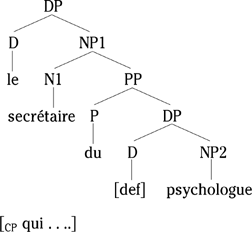
The principle of incremental comprehension requires immediate integration of the RC into the syntactic structure according to inherent computational principles: The least complex attachment that allows for an interpretation is selected at each step of processing. Thus, because attachment of the RC to NP1 is not necessary for an interpretation to obtain, no such attachment is created on first pass. Instead, the RC is integrated at the bottom of the structure, as in (5).
(5)
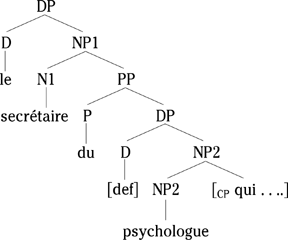
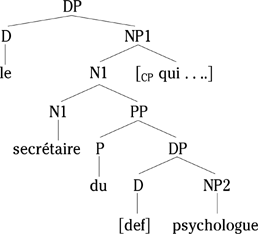
Although the structure in (5) is licensed by the grammar at the interpretive interface, the representation may or may not be compatible with what is already known; for example, the psychologist may be gravely ill and unable to take a walk. If so, the structure is manifestly not what the speaker intended, and a revision is triggered as in (6).
(6)
Meanwhile, under the principle of incremental comprehension, an input sentence concomitantly and autonomously receives an incremental prosodic analysis in the phonological processing module in accordance with projection conventions at the PF interface, even in silent reading (Fodor, Reference Fodor and Hirotani2002). Standard assumptions about the projection of prosodic structure readily characterize Fodor's (Reference Fodor1998, Reference Fodor and Hirotani2002) proposal that the relative ease with which NSs of French construe RCs with the first noun in the NP1-de-NP2 construction is due to the prosodic independence of RCs from the head noun. We assume that prosodic structure is projected incrementally in processing input. Prosodic representations consist of four levels: (a) utterance (Utt), a prosodically autonomous unit of speech; (b) intonational phrase (IntPhr), over which melodic contours are defined; (c) phonological phrase (PPhr), which includes a (major) lexical head and functional categories; and (d) prosodic word (PWd), which includes words, affixes, and clitics (Hayes, Reference Hayes, Kiparsky and Youmans1989; Inkelas & Zec, Reference Inkelas, Zec and Goldsmith1995; Nespor & Vogel, Reference Nespor, Vogel, van der Hulst and Smith1982, Reference Nespor and Vogel1986; Selkirk, Reference Selkirk1984, Reference Selkirk1986).
In the case of le secrétaire du psychologue “the secretary of the psychologist,” each noun projects a separate phonological phrase; these two phonological phrases are then eligible for membership in either a single intonational phrase or in two different intonational phrases. The resultant intonational phrase or intonational phrases will be contained within an utterance. Contrary to the binary structure of syntax, an utterance may contain a single intonational phrase or a number of sister intonational phrases. Finally, contiguous prosodic constituents of the default representation may be reanalyzed by erasing boundaries between abutting constituents (Post, Reference Post1999). Crucially, whereas left-branching modifiers are part of the phonological phrase of the head noun, right-branching constituents project their own phonological phrase as a default in French. Thus, a RC constituent—as a right-branching modifier—induces a new phonological phrase. Moreover, we assume that each phonological phrase defines an intonational phrase as a default. In French, the initial prosodic segmentation is, therefore, as in (7a). In English, a RC as a noun modifier is integrated into the phonological phrase projected from the noun, and the initial prosodic analysis is as in (7b).
(7)
a. [Utt [IntPhr Nous adorons] [IntPhr le secrétaire] [IntPhr du psychologue] [IntPhr [PPhr qui …]]]
b. [Utt [IntPhr We adore] [IntPhr the secretary] [IntPhr [PPhr of the psychologist who … PPhr]]]
The prosodic representation in (7a) is compatible with both low attachment, as illustrated in (5), and high attachment, as in (6), in syntax. Thus, despite the fact that syntax initially delivers the NP2-attachment structure in (5), at the PF interface in French, the initial prosodic representation in (7a) fits the syntactic representation associated with both NP2 attachment, as in (5), and NP1 attachment, as in (6). In English, however, the initial prosodic representation (7b), with the modifier included in the prosodic unit of NP2, is only congruent with the syntactic input in (5). As a result of this congruence, the processor commits to the initial syntactic representation in (5), which makes a revision more costly in English. Thus, the preference for low attachment in English is explained by the coincidence of initial prosodic and syntactic representations. Lack of congruence at PF in French does not result in such a commitment, and revision of the initial syntactic representation in which the RC is attached low, as in (5), to a representation in which the RC modifies NP1, as in (6), is cost-free at this interface.
Fodor (Reference Fodor1998) argued that the influence of prosody during processing is best exemplified by the effect of RC length on RC attachment, a phenomenon that can be explained in terms of a desideratum of prosodic balance. Fodor proposed that prosodic balance follows from a tendency toward bisection as a means of reconciling the flatter prosodic representation with binary-branching syntactic structure. Given the initial prosodic representation in (7a) and the search for prosodic balance, the effect of RC length is readily expressed in terms of the reanalysis of abutting boundaries of prosodic constituents. Thus, on the grounds of prosodic balance, a short RC favors a reanalysis as in (8), whereas a long RC favors reanalysis as in (9), in which the two nouns form a single prosodic unit.
(8) [Utt [IntPhr Nous adorons le secrétaire] [IntPhr du psychologue qui se promène]]
[Utt [IntPhr We adore the secretary] [IntPhr of the psychologist who takes a walk]]
(9) [Utt … [IntPhr le secrétaire du psychologue] [IntPhr qui se promène au centre ville]]
[Utt … [IntPhr the secretary of the psychologist] [IntPhr who takes a walk downtown]]
At the interface with syntax, the prosodic structure in (8) best fits with the syntactic structure in (5), in which the RC is a modifier of NP2, whereas the prosodic structure in (9) best matches the syntactic structure in (6), in which the RC modifies NP1. Crucially, interactions of syntax and phonology in the model presented here obey the condition of information encapsulation during processing: Syntactic and prosodic computations are blind to each other and to context. The central issue is whether L2 processing conforms to this architecture.
THE STUDY
We investigate the influence of RC length and intonation contour on the interpretation of RCs in the NP1-de-NP2 construction by intermediate English-French learners as well as the interaction of syntactic structure and context in a timed reading task. Task 1 was a silent reading task that manipulated RC length. Task 2 was an aural task that manipulated the placement of major prosodic breaks as well as RC length. Task 3 was a timed reading task in which context was manipulated. The learners were adult classroom learners of French in their second or fourth semester of French at a large American university in the Midwest, and all were NSs of English. There were 26 learners of French in their second semester and 61 learners of French in their fourth semester. We also tested 11 NSs of French and 35 NSs of English on similar tasks.
Experimental Items
The experimental items used for all three tasks had the same structure: Each sentence contained a complex NP and a RC that could be interpreted as modifying either NP1 or NP2. Several design criteria were respected in the creation of the experimental items. First, the matrix clause did not contain verbs of perception, and no raising verbs were used in the embedded clause. We also attempted to use verbs within the RC that would not semantically favor either of the nouns as a subject. Additionally, given that RC attachment is affected by definiteness, frequency, and pragmatic felicity, various reversible professional relationships (i.e., animate nouns familiar to learners) were selected as the NPs for our tasks. To guard against order effects, all nouns were counterbalanced, resulting in pairs of sentences that differed only in the order of the two nouns, as exemplified in (10) and (11).
(10) Nous adorons le secrétaire du psychologue qui se promène (au centre ville).
“We adore the secretary of the psychologist who takes a walk (downtown).”
(11) Nous adorons le psychologue du secrétaire qui se promène (au centre ville).
“We adore the psychologist of the secretary who takes a walk (downtown).”
Task 1
In this task, participants were presented with sentences as in (10) or (11) in written form. They then responded to a comprehension question (i.e., Qui se promène au centre ville? “Who takes a walk downtown?”) by selecting among three different responses: (a) le secrétaire “the secretary,” (b) le psychologue “the psychologist,” or (c) cannot tell. Respondents were instructed to indicate the answer to the question that came to them most readily by circling one of the proposed answers: (a) or (b). They were instructed to select answer (c) if they could not make this determination. They were further instructed to act as quickly as possible, to follow immediate intuitions, not to second guess themselves, and not to go back. The cannot tell response removes guessing behavior from the response pattern, because it avoids forced answers in case of a lack of preference. The order in which the N1 and the N2 appeared in the answer line (i.e., whether response [a] or [b] contained N1 or N2), was randomly assigned for each item so as to control for the possibility that subjects would seize on the first answer provided for them. This task contained 20 test sentences, half of which contained long RCs that included a modifier (indicated in parentheses in our examples), whereas the other half contained short RCs without such a modifier. There were 10 fillers that involved two potential noun antecedents and a RC or a genitive construction. These were also followed by comprehension questions of the same type as those for experimental items.
Task 2
In this task, respondents were presented with sentences identical to those in Task 1. Whereas the sentences were presented only in written form in Task 1, in Task 2 they were presented only aurally. Learners responded to the same comprehension questions as those in Task 1, and, again, the order in which the N1 and the N2 appeared in the response line was randomly assigned. In the creation of the stimuli for Task 2, both RC length and intonation contour were manipulated. Forty experimental items and 40 fillers were created. Half of the experimental items contained long RCs and half contained short RCs, and each individual test item was recorded with two different prosodic contours. Given that the default prosodic grouping in French treats right-branching complements such as RCs as their own prosodic units, we decided to vary the placement of this major prosodic break. As such, the RC either formed a prosodic constituent with NP2 ([[… NP1] [NP2 RC]]), or NP1 and NP2 formed a prosodic constituent, with the RC forming its own prosodic constituent ([… [NP1 NP2] [RC]]). According to Jun and Fougeron (Reference Jun and Fougeron2002), prosodic units are punctuated with a boundary tone on the last tone-bearing syllable. Thus, when NP1 ends the prosodic constituent, it bears a primary rising tone, whereas when NP2 ends the prosodic constituent, the tone occurs on the last full syllable of this noun. Inspection of the aural stimuli created for this study revealed the tone placement pattern described by Jun and Fougeron. Additional inspection of the auditory signal suggested that a secondary high tone on the relative pronoun was higher when the RC formed an independent prosodic constituent than when the RC was prosodically grouped with the NP2. As it was not our intent to investigate to which phonetic cues learners might be sensitive, the signal was not manipulated after recording.
Respondents received Tasks 1 and 2 in the same booklet, and all responses were recorded in these booklets. These two tasks were completed within the same session; the silent reading task was completed first, followed by the listening task. There were three different randomizations of each task. The session was held in a language laboratory in which participants sat at individual computers. Participants controlled the speed at which they completed the task.
Task 3
The computerized timed reading task was administered approximately 1 week after Tasks 1 and 2. Respondents sat at Macintosh computers running Psyscope software (Cohen, MacWhinney, Flatt, & Provost, Reference Cohen, MacWhinney, Flatt and Provost1993). They were first presented with a context in English that unambiguously required either a construal of the RC with NP1 or with NP2, followed by a noncumulative moving-window presentation of sentences with long RCs, as illustrated in (12) and (13). Slashes are used in these examples to show the segmentation of the test items into seven sections. Respondents saw only one section at a time; a new section was called up by the respondent's press of a button, and the computer measured time elapsed between button presses. Following this presentation, respondents were asked the question “Is this a correct description?” They then pressed buttons to answer yes, no, or cannot tell.
(12) A friendly neighborhood hairstylist is forced to close shop at about the same time that one of his bankers is returning from a lengthy vacation in Japan. This hairstylist's most faithful client, Luc, claims that this banker is too selfish to be concerned with a small business owner and blames him for the closing of the shop.
Luc / accuse / le banquier / du coiffeur / qui / revient / du Japon.
“Luc / accuses / the banker / of the hairdresser / who / comes back / from Japan.”
(13) Three hairstylists decided to leave Orléans and try to open shops in Tokyo. One of them is now returning, however, because his business there folded. The hairstylist's friend, Luc, claims that the closing is the fault of the hairstylist's banker who had refused to help in the new business venture.
Luc / accuse / le banquier / du coiffeur / qui / revient / du Japon.
“Luc / accuses / the banker / of the hairdresser/ who / comes back / from Japan.”
The contexts requiring attachment to either NP1 or NP2 had the same general structure: There was always a unique plausible referent in the context that satisfied the denotation of the common noun not modified by the RC. There were multiple plausible referents in the context that satisfied the denotation of the noun modified by the RC; the modification by the RC allowed for one of these referents to be uniquely identified. Each test sentence was fully ambiguous; thus, each sentence was paired with a context requiring a NP1 construal as well as a context requiring a NP2 construal. Moreover, any given respondent saw each test sentence matched with only one context, which was randomly selected by the program. The criteria for test item creation were also respected in the construction of Task 3. Additionally, the lengths of the critical segments were kept constant: Both halves of the complex NP contained exactly three syllables, the verb always consisted of two syllables, and the final segment consisted of three syllables.
In Task 3, there were 40 items (20 experimental sentences and 20 fillers), and respondents generally completed the task in less than 30 min. All test sentences were true statements based on the contexts. However, depending on the attachment, these statements could become false. All fillers contained RCs that unambiguously attached to a simple NP, and half of the fillers also contained a complex NP somewhere in the sentence. We calculated mean RTs for all segments on each of the two conditions. For each of the two contextual conditions, we removed the RTs that were more than two standard deviations beyond the means. Only RTs for which a yes response was given contributed to measurements, because only yes responses are informative of the interpretation assigned. Twenty experimental items crossed with two contextual conditions provided 40 items for analysis. One item was removed from the analysis: It was rejected in both conditions because a problem shared by both contexts resulted in substantially fewer acceptance rates for this item.
RESULTS
RC Length and Interpretation
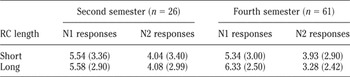
We first consider the effect of RC length on the interpretation of our second- and fourth-semester English-French learners in Task 1. Table 1 shows the mean number of selections of N1 and N2 answers by second- and fourth-semester learners. As can be deduced from Table 1, cannot tell selections were few. They represented 4.8% of responses, equally split between both conditions. We first performed our analysis on the differences in selections of N1 versus N2 answers. For each respondent, we subtracted the number of N2 selections from the number of N1 selections in both conditions. Scores could, in principle, range from −10 (only N2 answers selected) to +10 (only N1 answers selected). Thus, positive scores indicate a greater selection of N1 answers, whereas negative scores indicate a greater selection of N2 answers. When an asymmetry was detected, we analyzed the contribution of N1 and N2 answers to this response pattern. A mixed two-way ANOVA with RC length as the within-subjects factor and semester as the between-subjects factor revealed no main effect of semester in the between-subjects analysis, F(1, 85) = 0.372, p = .544. In the within-subjects analysis, there was a near-significant effect of RC length, F(1, 85) = 0.372, p = .057, as well as a near-significant interaction of RC length with semester, F(1, 85) = 0.372, p = .057. Because an effect of RC length qualified by semester was suggested, we examined the results from second- and fourth-semester learners separately. Table 1 shows that differences in the selection of N1 versus N2 answers produced by second-semester learners were flat across both conditions, 1.5 (SD = 6.70) for short RCs versus 1.5 (SD = 5.83) for long RCs. For fourth-semester learners, a post hoc pairwise comparison of RC length was highly significant, 1.41 (SD = 5.56) for short RCs versus 3.08 (SD = 4.80) for long RCs, t(60) = 3.223, p < .005. Given these results, we examined the contribution of N1 versus N2 answers to this effect. It was largely due to enhanced selections of N1 answers with long RCs, t(60) = 3.396, p < .005, although a theoretically revealing contrast also arose with N2 answers, t(60) = 2.510, p < .025. For the two t tests, the alpha level was set at .025.
Task 1: Mean number of selections of N1 and N2 answers by second- and fourth-semester learners according to RC length

Note. SDs are in parentheses.
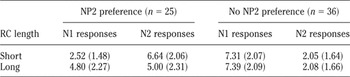
We hypothesize that a low attachment tendency with short RCs should be inhibited by lengthening the RCs. To test this hypothesis, we examined the subject distribution of fourth-semester respondents: 25 fourth-semester learners selected a majority of N2 answers with short RCs, allowing a (clearer) test of this hypothesis. The remaining 36 fourth-semester learners had a very robust tendency to select N1 answers across the board. Table 2 illustrates that the expectations of the hypothesis are borne out in the data: A t test examining scores for short, −4.12 (SD = 2.80), versus long RCs, −0.200 (SD = 4.56), was very highly significant, t(24) = 5.105, p < .0005. T tests comparing N1 and N2 selections across RC length were also highly significant: t(24) = 4.994, p < .0005, for the selection of N1 answers, and t(24) = 4.994, p < .005, for the selection of N2 answers.
Task 1: Mean number of selections of N1 and N2 answers for fourth-semester learners

Note. SDs are in parentheses.
Intonation Contour and Interpretation
In Table 3, the results from Task 2 are reported by semester as well as by RC length and intonation contour. On this task, cannot tell selections represented 8.7% of responses. Again, we first considered the data in terms of the difference in the selection of N1 and N2 answers. We conducted a three-factor ANOVA with length and intonation as repeated measures. Between-subjects analysis revealed no main effect of semester, F(1, 85) = 0.202, p = .654. Within-subjects analysis revealed no main effect of intonation contour, F(1, 85) = 0.064, p = .8, and no main effect of RC length, F(1, 85) = 3.670, p = .059. There were, however, significant interactions of intonation contour and semester, F(1, 85) = 5.308, p < .05, and of RC length and intonation contour, F(1, 85) = 4.688, p < .05. Table 3 shows that fourth-semester learners produced similar responses across the four conditions: N1 answers were generally favored. However, second-semester learners produced potentially significant contrasts. For four t tests, we adopted a Bonferroni protection of α = .0125. Indeed, on the [… [NP1 NP2] [RC]] segmentation, values for short RCs with a mean score of −0.15 (SD = 6.30) contrasted significantly with values for long RCs with a mean score of 1.73 (SD = 6.05), t(25) = 2.868, p < .01. However there was no detectable effect of RC length on the [[… NP1] [NP2 RC]] segmentation: Values for short RCs with a mean score of 1.88 (SD = 6.74) did not contrast with values for long RCs with a mean score of 1.31 (SD = 5.77), t(25) = 0.878, p = .388. We now turn to the effect of segmentation. In the case of short RCs, the contrast in values on the [… [NP1 NP2] [RC]] segmentation with a mean score of −0.15 (SD = 6.30) versus the [[… NP1] [NP2 RC]] segmentation with a mean score of 1.88 (SD = 6.74) did not reach significance, t(25) = 2.442, p = .022. In the case of long RCs, scores on the [… [NP1 NP2] [RC]] segmentation with a mean of 1.73 (SD = 6.05) failed to contrast with scores on the [[… NP1] [NP2 RC]] segmentation with a mean of 1.31 (SD = 5.77), t(25) = 0.671, p = .508. In this group, there was also a general response bias for N1 answers mitigated in the case of short RCs by the [… [NP1 NP2] [RC]] segmentation.
Task 2: Mean number of selections of N1 and N2 answers by second- and fourth-semester learners according to intonation contour and RC length

Note. SDs are in parentheses.
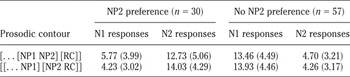
The distribution of learners was analyzed to find out whether the lack of effect of intonation contour in the aggregate data was in fact generally true of all learners, or whether a subset of learners provided evidence that intonation enters into processing even in early stages of acquisition. We identified 30 learners who selected a majority of N2 answers in response to stimuli in which the RC was in the prosodic domain of NP2 (vs. those who did not). They included nine second-semester and 21 fourth-semester learners. Their respective response patterns are presented in Table 4. A role for use of intonation contour in processing would find empirical support if these learners' tendency to interpret the RC as a NP2 modifier were significantly depressed when the RC was aligned with a major intonation unit. For the two t tests, the alpha level was set at .025. NNSs who preferred construing the RC with NP2 on the [[… NP1] [NP2 RC]] segmentation were sensitive to prosodic groupings: The [… [NP1 NP2] [RC]] segmentation inhibited their preference for NP2 to a significant extent, t(29) = 2.694, p < .025. Crucially, no effects were found for the rest of the subjects, t(56) = 1.618, p = .111. Given these results, we examined the pattern of selection of N1 and N2 answers by these 30 learners. For the two t tests, the alpha level was set at .025. The differences in the rates of selection of N1 answers and N2 answers across prosodic groupings were statistically significant for N1 answers, t(29) = 2.686, p < .025, and for N2 answers, t(29) = 2.686, p < .025.
Task 2: Mean number of selections of N1 and N2 answers by intonation contour

Note. SDs are in parentheses. Each condition included 10 short and 10 long RCs.
Syntax, Context, and Interpretation
We now turn to Task 3, in which we employed a RT experiment to investigate the degree to which a syntactic reflex guides intermediate learners' ambiguity resolution. Crucially, this experiment paired ambiguous sentences with disambiguating contexts. First, learners' acceptance of the sentence in contexts that require the RC to be construed with NP1 versus contexts that require the RC to be construed with NP2 will be considered. The RTs recorded during the experiment will then be examined. Twenty second-semester learners and 45 fourth-semester learners returned to complete Task 3. The second-semester learners accepted 124 sentences in which the RC was construed with NP1 (54% of responses) and 106 sentences in which the RC was construed with NP2 (46% of responses). On the other hand, the fourth-semester learners accepted 349 sentences in which the RC was construed with NP1 (64% of responses) versus 196 sentences in which the RC was construed with NP2 (36% of responses).
Table 5 presents the mean number of yes responses in NP1 versus NP2 contexts. For second-semester learners, there is no difference between the two contexts. In contrast, fourth-semester learners produced more yes responses in NP1 contexts. An ANOVA with context as the within-subjects factor and semester as the between-subjects factor revealed a main effect of context, F(1, 63) = 13.971, p < .0005, qualified by semester, F(1, 63) = 5.885, p < .05. A pairwise t test comparing acceptance rates of fourth-semester learners in the NP1 versus the NP2 condition was highly significant, t(44) = 5.700, p < .0005.
Task 3: Mean number of yes responses in NP1 and NP2 contexts by second- and fourth-semester learners

Note. SDs are in parentheses.
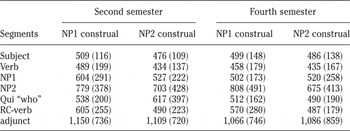
The RT measures on the RC segments are shown in Table 6. We assumed that significantly longer RTs are indicative of an increased processing load. Furthermore, we expected that the reflexes of this processing load in the attachment of ambiguous RCs might be seen on the disambiguating RC verb. If not, a spillover effect on the final adjunct is also possible. We therefore conducted subject and item analyses on the disambiguating verb segment. The subject analysis included context as the within-subjects factor and semester as the between-subjects factor. The item analysis had context and semester as within-subjects factors. Both the subject analysis, F 1(1, 62) = 17.835, p < .0005, and the item analysis, F 2(1, 18) = 31.914, p < .0005, revealed a main effect of context. There was no interaction of context with semester in either analysis, F 1(1, 62) = 0.002, p = .965; F 2(1, 18) = 0.436, p = .517, and no main effect of semester on the item analysis, F 2(1, 18) = 0.650, p = .430. Post hoc t tests revealed that RTs for the RC-verb segment were significantly longer on the contextually required construal of the RC with NP1 than on the construal of the RC with NP2 in the subject analysis, t 1(63) = 4.574, p < .0005, and in the item analysis, t 2(18) = 4.340, p < .0005. The construal of the RC with NP1 was computationally more complex than that with NP2 in English-French processing. The pattern produced by fourth-semester learners on Task 3 merits close inspection. These learners were significantly more likely to accept sentences as correct characterizations of the contexts when a NP1 construal was required. This final preference for construing RCs with NP1 runs contrary to the pattern seen in the RT data, which suggests an early preference for attachment of RCs to NP2. The results for the fourth-semester learners are, therefore, clearly suggestive of two distinct moments in the computations: an early bias for NP2 construal in the RT asymmetries on the disambiguating verb segment and a late (developing) bias for NP1 construal in judgment asymmetries. RTs on NP2 were much longer than on NP1, which suggests a pause placement. The placement of a pause suggests that the RC marked the start of a new prosodic constituent; this silent prosodic boundary also allows an alternative explanation for the final bias for the NP1 construal. One may wonder if prosody should be involved at all, because the moving-window presentation does not constitute normal silent reading. It could be argued, however, that on a well-motivated hypothesis about the sentence processor, a phonological representation is always projected.
Task 3: Mean RTs by segment according to construal (in ms)

Note. SDs are in parentheses.
A Brief Discussion of NSs
Results from the NSs do not bear on the architecture of L2 processing and will be briefly summarized due to limited space. On Task 1, English NSs' responses were sensitive to RC length, −1.38 (SD = 5.57) for short RCs versus −0.12 (SD = 5.67) for long RCs, t(33) = 2.451, p < .05. (One English NS did not do Task 1.) French NSs' results were not statistically significant, −5.64 (SD = 3.50) for short RCs versus −4.73 (SD = 4.67) for long RCs, t(10) = 0.792, p = .447. On Task 2, a reflex of sensitivity to intonation contour appeared in French NSs, −3.17 (SD = 4.99) versus −8.05 (SD = 1.62) for prosodically independent versus dependent short RCs, t(10) = 3.551, p < .01, and −1.10 (SD = 5.24) versus −7.13 (SD = 3.10) for prosodically independent versus dependent long RCs, t(10) = 3.101, p < .05. English NSs produced similar asymmetries: −0.29 (SD = 6.28) versus −4.71 (SD = 5.11), for prosodically independent versus dependent short RCs, t(34) = 3.941, p < .0005, and 0.97 (SD = 5.64) versus −3.57 (SD = 5.77), for prosodically independent versus dependent long RCs, t(34) = 4.218, p < .0005. On Task 3, English NSs' mean number of yes responses in NP1 contexts (5.13, SD = 2.95) versus NP2 contexts (5.88, SD = 2.42) were similar. The mean number of yes responses by the French NSs in NP1 contexts (5.27, SD = 2.69) versus NP2 contexts (4.73, SD = 2.37) were also alike. However, context-dependent asymmetries appeared in RTs. A subject and an item analysis both revealed that construing the RC with NP2 induced significantly longer RTs on the segment following the disambiguating verb for French NSs, 1,644 ms (SD = 1108) versus 951 ms (SD = 548), t 1(9) = 3.244, p < .05; t 2(17) = 3.747, p < .01. Significantly longer RTs were produced on the verb itself for English NSs, 517 ms (SD = 296) versus 446 ms (SD = 173), t 1(29) = 2.216, p < .05; t 2(18) = 2.742, p < .05. (One French and two English NSs accepted only NP1 answers. One item did not yield yes answers in the French data.) This asymmetry suggests that the experiment captured a processing stage in which NP1 modification is more readily accessible than NP2 modification. As in the learner data, a RT increase of about 200 ms on the second NP over RTs on the first NP suggests that respondents paused before the RC, with now familiar interpretive consequences. These patterns confirm that prosody influences the eventual interpretation of RCs, and that interpretive biases arise in the course of processing even when they are not salient in the final interpretation. It appears that the same instrument may capture distinct computational moments for NSs and NNSs even if their processing involves similar interactions.
DISCUSSION
We first consider the strength of the evidence for the hypothesis that L2 sentence processing includes a prosodic reflex. On Task 1, second-semester learners did not show sensitivity to lengthening of the RC, but fourth-semester learners did. Perusal of individual distribution indicated that longer RCs inhibited the NP2 construal in learners that favored this construal with shorter RCs. On Task 2, aggregate results proved inconclusive, but examination of individual behavior was revealing. Thirty NNSs were sensitive to the placement of a prosodic boundary. The rest of the NNSs (n = 57) followed a strong bias for N1 answers. This obscured the role of intonation in the aggregate data (see Liljestrand Fultz, Reference Liljestrand Fultz, Caunt-Nulton, Kulatilake and Woo2007, for an early prosodic reflex in the interpretation of prepositional phrases that is slightly delayed with RCs). We take these effects as evidence that a prosodic reflex is an integral part of interlanguage processing. The lack of effect of intonation contour on RC interpretation for many learners should not be a total surprise. Fast connected speech presents significant processing hurdles of its own: Relevant prosodic cues must be detected in the signal and correctly interpreted. Processing in separate modules must also be coordinated. If any of these conditions are not met singly or in combination, the interpretation will not be affected by intonation.
The evidence for an autonomous syntactic reflex in English-French processing of RCs is now considered. To test learners' sensitivity to contextual information, the contexts utilized in Task 3 provided information allowing for direct attachment of the RC to the appropriate noun. All contexts had the same general character: One noun had a unique referent precluding modification by a restrictive RC, whereas the other noun had several referents requiring modification by a restrictive RC. If L2 processing involved direct use of contextual information, as would be expected on the basis of the shallow structure hypothesis, learners should treat construal of the RC with NP1 and NP2 in essentially the same manner. If L2 processing involves a syntactic reflex to minimize structure, then construing the RC with NP2 should be computationally less complex than construing the RC with NP1. Because more computations take more time, RTs on the disambiguating verb segment in the RC should be shorter when the RC modifies NP2 than when the RC modifies NP1. This is precisely what we found in our English-French learners in both second- and fourth-semester learners.
The behavior of fourth-semester learners on Task 3 was particularly revealing: There was significantly more acceptance of construal with NP1 than with NP2, although RTs were faster on the disambiguating verb when the RC modified NP2. Thus, for this learner group, we found a discrepancy between the construal favored in processing (NP2 construal) and the construal favored in final interpretations (NP1 construal). This interpretation-dependent asymmetry presumably reflected two distinct stages of processing in which the relative computational complexity of construing with NP1 versus NP2 was reversed and in which, crucially, the initial preference for attachment to NP2 followed as an effect of syntactic minimization in processing. This difference in attachment preference in the processing and judgments of fourth-semester learners is a signature of a particular modular organization in which a syntactic reflex to minimize structure mediates the integration of expressions. Unless there is a processing bias for NP2 modification that can later be rejected and revised, triggering additional processing costs, these changes in relative computational complexity in processing are mysterious.
Although both second- and fourth-semester learners demonstrated the effect of syntactic minimization in their RTs, only fourth-semester learners showed evidence of a revised attachment when asked to provide a truth-value judgment of the ambiguous sentences in light of each context. In the model of processing adopted here, the preference for NP2 attachment in RTs and the preference for NP1 attachment in judgments follow from an initial low attachment tendency that obeys principles of structure minimization and a later high attachment tendency that reflects the prosodic segmentation of expressions. On our account, the development of the preference for NP1 attachment in fourth-semester learners (vs. second-semester learners) suggests a growing ability to revise the initial parse after prosodic feedback within the limits of cognitive resources. In a modular architecture, this development follows from improved alignment of the modules during processing. We take the simplicity of this hypothesis to be a sign of its inherent value.
IMPLICATIONS FOR RESEARCH
We have addressed the nature of L2 sentence processing in terms of the degree to which specific patterns of breakdown and recovery reflect the specific organization of the module of mind dedicated to language. We found evidence that supports autonomous syntactic and prosodic computations and the integration of these two at their interface in the processing of ambiguous sentences by intermediate English-French learners. This type of processing crucially requires computations impervious to the perceiver's global state of knowledge. This is clearly in contrast to Clahsen and Felser's (Reference Clahsen and Felser2006a, Reference Clahsen and Felser2006b) shallow structure hypothesis, according to which NNSs fail to compute as detailed a syntactic analysis of input sentences as NSs and resort to whatever nonstructural information is available in interpreting. It could be argued that the shallow structure hypothesis describes what happens in breakdown and is therefore untouched by the behavior of learners as they recover from breakdown. This interpretation of the shallow structure hypothesis, however, still suffers from the fact that indications of a rather idiosyncratic mental organization seem to be present even in learners at relatively early stages of interlanguage development—an observation that we consider significant.