Task-based language teaching and learning (TBLT) is both an empirical line of study and a pedagogical framework, with aims of providing optimal opportunities for acquiring a second language (L2) through the accomplishment of real-world tasks within meaningful context. Despite these overarching goals, certain aspects of L2 development, such as prosody and pragmatics, have been largely ignored in the TBLT experimental literature. Given the central role of the prosody-pragmatics interface in many languages, including Spanish (Escandell-Vidal, Reference Escandell-Vidal2011; Prieto & Roseano, Reference Prieto and Roseano2010), research examining the possibility of tasks to encourage attention to these areas of the L2 is needed.
The present study seeks to open a dialogue in the TBLT literature on the intersection of prosody and pragmatics in SLA. Specifically, this study examines if intonation, and by extension its pragmatic functions, can be instructed through a task-based, focus-on-form intervention (Ellis, Reference Ellis2009; Long, Reference Long2014). To assess this question, the current study utilized two linguistic constructions in Spanish that have an identical morphological form but can be differentiated through prosody to express two different pragmatic functions: declaratives and imperatives. This experiment provides evidence that task-based instruction can be designed to encourage noticing of intonational cues (e.g., pitch accents and boundary tones) used to express pragmatic functions.
LITERATURE REVIEW
The Prosody-Pragmatics Interface
Whereas segmental phonology investigates individual phonological segments of a language (e.g., /p/, /t/, /k/), prosody examines how languages organize segments into larger units, such as syllables and phrases. The focus of the present study is intonation (i.e., variation in pitch that does not create lexical contrasts). Currently, intonation is generally analyzed through language-specific tones and breaks indices (ToBI) labeling systems, which are couched in the autosegmental-metrical (AM) framework (Ladd, Reference Ladd1996; Pierrehumbert, Reference Pierrehumbert1980). The AM framework proposes that intonation is organized around a series of abstract high (H) and low (L) tones that are phonetically realized through rises and falls in the fundamental frequency (F0); pitch is the F0 perceptual correlate. For example, speakers increase their F0 to reach a H tone target; conversely, speakers decrease their F0 to reach a L tone target. In this framework, F0 movement is analyzed at two different points in an utterance: (a) metrically strong syllables of individual words, which are called pitch accents; and (b) breaks in the prosodic unit, which are called boundary tones.
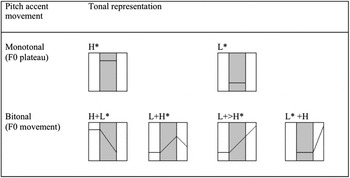
In Spanish ToBI (e.g., Hualde & Prieto, Reference Hualde, Prieto, Frota and Prieto2015), pitch accents occur at lexically stressed syllables, while boundary tones appear at the end of minor and major breaks in the prosodic unit; these are called intermediate and intonational phrases, respectively. There are two types of pitch accents in Spanish: (a) monotonal, in which there is plateau in F0 across the stressed syllable; and (b) bitonal, in which there is F0 movement during or after the stressed syllable. In Spanish ToBI notation, the tonal target associated with pitch accent is marked as an asterisk. Figure 1 presents a schematic representation of pitch accents found in the present study, with the stressed syllable highlighted in dark gray and the nonstressed syllables appearing in white.
Schematic representation of some Spanish pitch accents and nuclear configurations (taken from Aguilar, de-la-Mota, & Prieto, Reference Aguilar, de-la-Mota and Prieto2009).

To exemplify the differences in pitch accent, let us use the word novela “novel,” which is lexically stressed on the syllable –ve–. For the monotonal pitch accents, –ve– would be labeled H* if there was a high F0 plateau, while L* would indicate a low F0 plateau. For the bitonal pitch accents, the notation H+L* would signal a high F0 plateau on the syllable no–, followed by a decrease in F0 at the beginning of –ve–. The notations L+H* and L+>H* signify a F0 rise in the stressed syllable that either reaches its peak in the stressed syllable (i.e., L+H*) or in the posttonic syllable –la (i.e., L+>H*, with the greater-than sign indicating a delay in the F0 peak); this difference in tonal alignment—that is, the temporal movements of F0 across segments—is an important distinction in the present study. Finally, the notation L* +H is used to signal a L tone target in the stressed syllable that is followed by a F0 rise in the posttonic syllable –la.
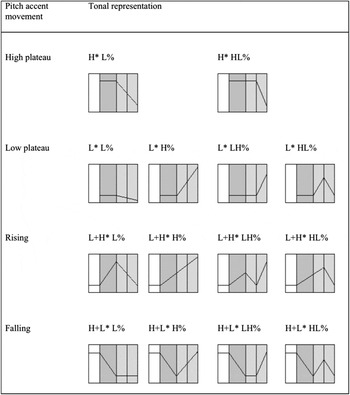
Another important aspect of Spanish intonation is the nuclear configuration of an utterance, which is the combination of the final pitch accent and an intonational phrase boundary tone. Previous research has proposed that the nuclear configuration can convey pragmatic meaning in Spanish; for example, changes in the nuclear configuration can be used to distinguish between sentences that are morphologically identical in Spanish, such as declarative statements and questions, different types of questions, and imperative versus declarative utterances (Prieto & Roseano, Reference Prieto and Roseano2010). Similar to the pitch accents, the intonational phrase boundary tone can be monotonal or bitonal, and in ToBI notation it is represented with a percent sign. Figure 2 presents a schematic representation of some possible nuclear configurations in Spanish, with the boundary tone highlighted in light gray.
Schematic representation of some Spanish nuclear configurations (taken from Aguilar et al., Reference Aguilar, de-la-Mota and Prieto2009).

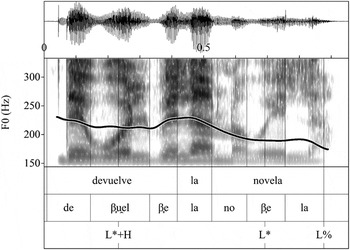
We will focus on two nuclear configurations that this study’s native speaker instructor used to distinguish between imperative and declarative utterances, using the utterance devuelve la novela “s/he returns the novel”: L* L% and H+L* L%. In the former, the stressed syllable in the final word novela (i.e., –ve–) receives a low plateau tone (i.e., L*), while the posttonic syllable –la receives a low boundary tone (i.e., L%); this pattern was found exclusively with declarative sentences, as can be seen in Figure 3.
Waveform and pitch contour of the declarative target utterance devuelve la novela “s/he returns the novel” from the native speaker instructor.

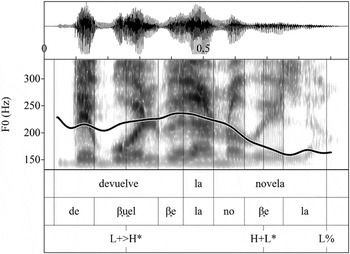
The other nuclear configuration found with the native speaker instructor was H+L* L%. With this pattern there is a F0 decrease in the final stressed syllable –ve– (i.e., H+L*), which continues in the posttonic syllable –la with a low boundary tone (i.e., L%). An example from present study is presented in Figure 4.
Waveform and pitch contour of the imperative target utterance devuelve la novela “return-IMP the novel” from the native speaker instructor.

L2 ACQUISITION OF PROSODY
Research on L2 prosody has investigated topics such as how L2 prosody can contribute to the perception of foreign accent (Munro & Derwing, Reference Munro and Derwing1995; van Els & de Bot, Reference van Els and de Bot1987), the transfer of first language (L1) prosodic patterns to the L2 (Gabriel & Kireva, Reference Gabriel and Kireva2014; Maastricht, Krahmer, & Swerts, Reference Maastricht, Krahmer and Swerts2016; Mennen, Reference Mennen2004; Swerts & Zerbian, Reference Swerts and Zerbian2010), and the effects of length of residence on L2 prosody (Trofimovich & Baker, Reference Trofimovich and Baker2006). Research has also demonstrated that learners may use different prosodic cues from native speakers to produce meaningful L2 distinctions. For example, L1 Japanese learners of English can use differences in pitch to mark stress in English instead of duration (Aoyama & Guion, Reference Aoyama, Guion, Bohn and Munro2007), and L1 Zulu learners of English can mark contrastive focus equally for both noun phrases instead of only for the focused noun phrase (Swerts & Zerbian, Reference Swerts and Zerbian2010). Furthermore, there is evidence that the incorporation of more prosodic forms into the learner’s interlanguage may decrease the consistency and increase the variability of L2 prosody before becoming more targetlike (Henriksen, Geeslin, & Willis, Reference Henriksen, Geeslin and Willis2010).
Previous research has shown that increases in L2 proficiency (Henriksen et al., Reference Henriksen, Geeslin and Willis2010; Maastricht et al., Reference Maastricht, Krahmer and Swerts2016; Swerts & Zerbian, Reference Swerts and Zerbian2010; Trofimovich & Baker, Reference Trofimovich and Baker2006) and increased awareness of target language (TL) prosodic forms (Hardison, Reference Hardison2004; Pennington & Ellis, Reference Pennington and Ellis2000; Ramírez Verdugo, Reference Ramírez Verdugo2006) may facilitate the acquisition of targetlike prosodic forms. For example, Pennington and Ellis (Reference Pennington and Ellis2000) found that Ll Cantonese learners of English significantly improved their recognition of the pragmatic distinction between focus and neutral sentences when their attention was drawn to the use of stress. Additionally, Hardison (Reference Hardison2004) reported that L1 English learners of French modified their prosodic output when shown their own pitch contours compared to a native speaker’s prosodic production in real time. Researchers have also stressed the importance of teaching intonation in context (Jenkins, Reference Jenkins2004; Levis & Pickering, Reference Levis and Pickering2004), which makes it even more surprising that researchers have not yet attempted to teach intonation through real-world tasks. For the present study, a focus-on-form, tasked-based intervention was created to encourage learners to notice prosodic forms in the input and how they are used to make a pragmatic distinction in Spanish between imperatives and declaratives.
THE TARGET STRUCTURE: SPANISH IMPERATIVES VERSUS DECLARATIVES
There has been empirical interest in Spanish imperative and declarative intonation (Navarro Tomás, Reference Navarro Tomás1944; Robles-Puente, Reference Robles-Puente and Alvord2011; Willis, Reference Willis2002), partially due to both types of utterances utilizing the same morphological form. This morphological congruence can lead to ambiguity, as shown in (1), which can be resolved using prosody.
-
(1) Declarative: Corta las cebollas “S/he cuts the onions”
Imperative: Corta las cebollas “Cut the onions”
Although there are other contextual cues (e.g., nonverbal cues, the relationship between the conversational participants, and previous discourse) that can help contribute to an utterance’s meaning, prosody can also play a crucial role in limiting the number of possible interpretations an utterance can have (Wilson & Wharton, Reference Wilson and Wharton2006).
With respect to declarative utterances, the most common intonation pattern found in the 10 Spanish varieties surveyed in Prieto and Roseano (Reference Prieto and Roseano2010) contained a rising pitch accent on the verb and a L* L% nuclear configuration (i.e., a final low tone and a low boundary tone; see Figure 3). Despite this cross-dialectal convention for signaling a declarative sentence, there does not seem to be a single way to express the imperative found across all Spanish varieties. The literature thus far has shown that different (and sometimes conflicting) prosodic cues can express the imperative, including lengthened tonic syllables (Prieto & Roseano, Reference Prieto and Roseano2010; Willis, Reference Willis2002), shorter tonic syllables (Navarro Tomás, Reference Navarro Tomás1944), wider tonal ranges (Navarro Tomás, Reference Navarro Tomás1944; Prieto & Roseano, Reference Prieto and Roseano2010; Robles-Puente, Reference Robles-Puente and Alvord2011; Willis, Reference Willis2002), and nuclear configurations, including H+L* L% (Prieto & Roseano, Reference Prieto and Roseano2010; see Figure 4).
With respect to the L1 of the learners in the present study, the standard pattern for English declaratives is a final falling tone (Bolinger, Reference Bolinger, Hirst and Di Cristo1998; Hirschberg, Reference Hirschberg, Horn and Ward2004; O’Connor & Arnold, Reference O’Connor and Arnold1961; Pierrehumbert & Hirschberg, Reference Pierrehumbert, Hirschberg, Cohen, Morgan and Pollack1990; Tench, Reference Tench1996) that is either preceded by a plateau (Hirschberg, Reference Hirschberg, Horn and Ward2004; O’Connor & Arnold, Reference O’Connor and Arnold1961; Pierrehumbert & Hirschberg, Reference Pierrehumbert, Hirschberg, Cohen, Morgan and Pollack1990), a rise (Bolinger, Reference Bolinger, Hirst and Di Cristo1998) or a fall (Bolinger, Reference Bolinger, Hirst and Di Cristo1998; O’Connor & Arnold, Reference O’Connor and Arnold1961). However, some American English speakers can also use a final rising tone with declarative sentences, a phenomenon that is popularly known as uptalk (Warren, Reference Warren2016). With regard to English imperatives, it has been claimed that there is a final falling tone (Bolinger, Reference Bolinger, Hirst and Di Cristo1998; O’Connor & Arnold, Reference O’Connor and Arnold1961; Tench, Reference Tench1996) that can be preceded by either a low tone plateau (O’Connor & Arnold, Reference O’Connor and Arnold1961) or a falling or rising prenuclear tone (Bolinger, Reference Bolinger, Hirst and Di Cristo1998). As can be seen from these studies, there does not appear to be one way to express imperatives or declaratives in English. However, it should be noted that, to the author’s knowledge, there has been no systematic investigation of the pragmatics-prosody interface using English ToBI like what has been conducted in Spanish (e.g., Prieto & Roseano, Reference Prieto and Roseano2010); in fact, Hirschberg (Reference Hirschberg, Horn and Ward2004, p. 24) notes that for English ToBI “[the] study of the contribution of intonational contours to overall utterance interpretation has so far been confined to a few contours.”
Consequently, the acquisition of the Spanish imperative-declarative distinction using prosody may be challenging for L1 English speakers because it appears that both pragmatic functions employ a final falling tone in English (Bolinger, Reference Bolinger, Hirst and Di Cristo1998; Hirschberg, Reference Hirschberg, Horn and Ward2004; O’Connor & Arnold, Reference O’Connor and Arnold1961; Pierrehumbert & Hirschberg, Reference Pierrehumbert, Hirschberg, Cohen, Morgan and Pollack1990; Tench, Reference Tench1996); this is to say, L1 English learners of Spanish will have to acquire a new prosodic distinction that may not exist in their L1. Although there may be other cues at their disposal (e.g., nonverbal and discursive), the addition of appropriate prosodic cues may help to make it easier for native speakers to recognize the pragmatic intention behind a learner’s utterance.
Additionally, native speakers of Spanish have different prosodic resources in their linguistic repertoire to express the imperative, which may reflect their variety of Spanish (Prieto & Roseano, Reference Prieto and Roseano2010) or simply their idiolect (Willis, Reference Willis2002); given that the prosodic expression of imperativity appears to be variable: (a) this may present a potential learnability issue for learners, who could benefit from an instructional intervention because there is not a one-to-one mapping of prosodic form to pragmatic function; and (b) research investigating possible instructional effects should take into account the type of prosodic input made available to the L2 (i.e., the instructor’s own production patterns) when examining whether L2 output is moving in a targetlike direction.
THE PRESENT STUDY
The present study investigated the potential to use a focused, task-based intervention to encourage the noticing of a pragmatic distinction between imperatives and declaratives through intonation in Spanish. The study is motivated by three observations: (a) there is a strong connection between prosody and expressing real-world meaning in Spanish (Escandell-Vidal, Reference Escandell-Vidal2011; Prieto & Roseano, Reference Prieto and Roseano2010); (b) previous research has suggested the possibility of misunderstandings between learners and native speakers due to nontargetlike L2 prosody (Ramírez Verdugo, Reference Ramírez Verdugo2005; Ramírez Verdugo & Romero Trillo, Reference Ramírez Verdugo and Romero Trillo2005); and (c) awareness to prosodic form (Hardison, Reference Hardison2004; Pennington & Ellis, Reference Pennington and Ellis2000; Ramírez Verdugo, Reference Ramírez Verdugo2006) in contextualized settings (Jenkins, Reference Jenkins2004; Levis & Pickering, Reference Levis and Pickering2004) can improve L2 prosodic output.
There were two main research questions that guided the present investigation.
-
1. Does focus on grammatical + intonational form during a focused, task-based intervention lead to increased improvement on producing a pragmatic distinction between imperative and declarative utterances using intonation as compared to focus on grammatical form?
-
2. After a focused, task-based intervention, do L2 learners use the same phonetic cues as those provided in the input by a native speaker instructor to distinguish between declarative and imperative utterances?
METHOD
Participants
Forty-five third-year L2 Spanish learners enrolled in introductory Spanish content courses (i.e., institutionally defined as intermediate learners) at a large American university volunteered to participate in the present study in exchange for extra credit. Sixteen participants were excluded because they were heritage speakers of Spanish or because all of their productions contained disfluencies and/or a creaky voice. Footnote 1 The final sample of 28 L2 Spanish learners were L1 English speakers and began acquiring Spanish in a foreign language classroom beginning at ages 12–13. In addition to the L2 learners, a native speaker of Andalusian Spanish participated as the instructor of the focused, task-based intervention.
Procedure
The experiment took place in an otherwise empty computer lab with individual computers and headset microphones to record the participants’ speech. The untimed experiment was divided into three phases—a pretest, the task-based intervention, and a posttest—and took approximately one hour to complete (e.g., 20 minutes for the pretest, 20–30 minutes for the intervention, and 5–10 minutes for the posttest). The task-based intervention was conducted entirely in Spanish; the instructions in the pre- and posttest were given in English.
Participants were assigned to one of two types of the task-based intervention: the focus on grammatical form condition (FOG) or the focus on grammatical + intonational form (FOG + I) condition. Each of the experimental sessions was limited to a maximum of 10 students. Students could choose one of six possible sessions, which were randomly assigned a type beforehand (three FOG sessions and three FOG + I sessions), based on their availability.
PRETEST: ORAL DISCOURSE COMPLETION TASK
Upon arriving at the computer lab, participants were assigned to a computer on which there was a PowerPoint presentation of an oral discourse completion task (oral DCT; see Félix-Brasdefer, Reference Félix-Brasdefer, Martínez-Flor and Usó-Juan2010, for an overview). An oral DCT provides participants with a series of discourse contexts created by the researcher that are intended to elicit a particular response, in this case, imperatives and declaratives. After reading the discourse contexts participants are prompted to respond to the situation. However, to standardize the responses among all participants they were prompted to produce the target utterance. Although this type of data collection may not elicit wholly natural speech, oral DCTs have been widely used in both pragmatics (Félix-Brasdefer, Reference Félix-Brasdefer, Martínez-Flor and Usó-Juan2010) and laboratory phonology (Prieto & Roseano, Reference Prieto and Roseano2010) because they can target the linguistic structure of interest.
During the oral DCT, participants were asked to produce nine imperative utterances and nine declarative utterances (which constituted minimal pairs), as well as seven distractor items from Prieto and Roseano (Reference Prieto and Roseano2010). Footnote 2 All target utterances were comprised of the following structure: verb (three syllables) + definite article (one syllable) + noun (two to four syllables). In line with previous research, the number of sonorant segments (e.g., vowels, liquids, and nasals) was maximized in order to obtain a continuous pitch contour. The discourse contexts were then created to match the target utterances.
To ensure that participants produced these declarative and imperative minimal pairs, the discourse context was manipulated using the second line of the production prompt. For example, in the declarative context the participants read a situation in which they were to inform their interlocutor what another character was doing, whereas in the imperative context participants ordered someone to do something. To ensure that participants interpreted the imperative context as requiring them to force their interlocutor to perform an action the closed prompt read “order him: [target utterance],” while for the declarative contexts the prompt was “you say: [target utterance].”
After the completion of three practice items, participants were presented with a pseudorandomized order of 25 slides that each contained a discourse context followed by the two speech elicitation prompts. The participants’ audio was captured through a headset microphone and recorded using the software program Audacity (Audacity Team, 2014).
TASK-BASED INSTRUCTIONAL SESSION
Following Ellis’s (Reference Ellis2009) definition of a task (i.e., a meaning-focused activity involving some kind of gap for which learners have to rely largely on their own resources to complete and for which there is an outcome other than language use), this study’s task-based intervention—which was centered around recipes—was a focused task designed to have participants practice the imperative-declarative contrast. The task was divided into three task phases—pretask, during task, and posttask—that began immediately after the last participant completed the pretest.
During the pretask phase, the instructor went over the 10 steps necessary to make a Spanish omelet by ordering the researcher to “perform” the actions (i.e., imperatives) and then narrating what the researcher was doing (i.e., declaratives). Footnote 3 In this way, both types of pragmatic utterances with morphologically identical forms—and, by extension, their prosodic cues—were available in the input for both groups of learners. During this phase, the instructor engaged the FOG students in conscious awareness-raising (Schmidt, Reference Schmidt1993) of the imperative’s grammatical form by asking learners if they knew how the imperative was formed in Spanish, followed by a demonstration of how to conjugate it. In the FOG + I condition, learners received the same instruction on how to grammatically form the imperative, and in addition they received instruction on the prosodic differences between the two. First, the instructor asked the students if they heard a difference between the declarative and imperative utterances during the recipe demonstration. Afterward, the instructor shared with the students that, although the forms of the imperative and declarative look identical to one another, intonation can be used to distinguish the two. The instructor then redemonstrated the prosodic differences between the two utterances by returning to the first two steps of the recipe and saying each one first in the imperative and then in the declarative form, instructing the class that the imperative form has una entonación fuerte “a strong intonation.” This was all the explicit instruction on intonation that the students in FOG + I received (e.g., the instructor did not teach students that a fall in the final pitch accent before the end of the intonational phrase can signal the imperative).
In the during-task phase, the instructor gave each participant an authentic Hispanic recipe for which they had to gather paper cutout ingredients from the front of the lab. Upon completion, participants were told that they were to give their ingredients to their partner and make them “cook” the recipe by ordering them through the recipe’s steps; participants switched roles when the first recipe was completed. The instructor did not interact with the students during this phase unless they had a question. Furthermore, there was no difference in the lesson plan for this phase of the task-based intervention between conditions.
Although no feedback was provided to the two conditions in the during-task phase, the participants did receive feedback specific to their condition in the posttask phase, which was a public performance of the during-task work. More specifically, the FOG condition received metalinguistic (Lyster & Ranta, Reference Lyster and Ranta1997) feedback if there was an error with the grammatical form of the imperative, whereas the FOG + I condition received metalinguistic feedback if the instructor did not perceive an intonational difference between declaratives and imperatives. When this occurred, she reminded students that the imperative has una entonación fuerte “a strong intonation,” like the example in (2).
-
(2) Recuérdate que hay una entonación especial con los mandatos que es más fuerte que la de las frases normales. Por ejemplo, puedes decir “hierve el pescado” para las frases normales pero “hierve el pescado” para los mandatos. “Remember, that there’s a special intonation with commands that’s stronger than the one with normal sentences. For example, you can say hierve el pescado ‘boil the fish’ for the normal sentences but hierve el pescado ‘boil the fish’ [with falling tone on pescado ‘fish’] for commands.”
It is important to note that, again, there was no explicit instruction on which intonational cues the students needed to modify in order to distinguish imperatives and declaratives.
POSTTEST
Immediately after completing the task-based intervention, participants were instructed to return to their individual computers to complete the posttest; participants received a new version of the pretest with a different presentation order of the 25 slides. As with the pretest, participants’ productions were recorded using their headset microphone in Audacity.
PHONETIC ANALYSIS
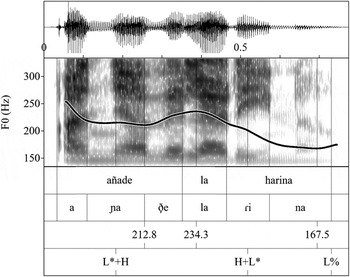
Four phonetic cues were measured in Praat (Boersma & Weenink, Reference Boersma and Weenink2015) to explore three different aspects of intonation: pitch range (for both the noun and verb), tonal alignment of the verb’s pitch accent (i.e., the syllable in which the F0 rise or fall began, if any), and the nuclear configuration. For the pitch ranges, the maximum and minimum pitch values associated with the pitch accents were measured in Hertz (Hz) and converted to the equivalent rectangular bandwidth (ERB) scale (Glasberg & Moore, Reference Glasberg and Moore1990). This conversion has been used in previous research because it “gives a better approximation of the perceptual distance between F0 levels (i.e., the measures of F0 magnitude) and allows more easily for the comparison of male and female data” (Henriksen, Reference Henriksen2012, p. 547). The verb’s pitch accent and the utterance’s nuclear configuration were categorized according to the most recent revision of Spanish ToBI (Hualde & Prieto, Reference Hualde, Prieto, Frota and Prieto2015). The rises and falls were manually determined by locating the pitch elbows, which is either the point where a low tone begins to clearly rise or the point where the high tone begins to clearly fall. Figure 5 provides an example of how these cues were identified and measured.
Measurement of pitch range and classification of pitch accents and nuclear configuration of the imperative target utterance añade la harina “add-IMP the flour” from the instructor.

The first tier of the labeling system contains an orthographic transcription of the utterance, and the second tier contains the phonetic transcription. In the third tier each pitch elbow is marked, along with their corresponding F0 values in Hz. Finally, in the last tier the Spanish ToBI labels for pitch accents and boundary tones are annotated.
STATISTICAL ANALYSIS
The 18 oral DCT utterances from the native speaker instructor (i.e., nine imperative and nine declarative utterances) were analyzed separately from the 686 L2 target utterances. The theoretical number of utterances from the 28 learners was 1,008; in total, 322 L2 target utterances were excluded from analysis (31.9% of the data), due to disfluencies in speech (N = 135) or creaky voice (N = 187) because they distorted the visible pitch contour.
Descriptive statistics for the pitch ranges revealed that the data was not normal for the instructor and the learners. Footnote 4 A series of Wilcoxon Signed-Rank tests were performed for the instructor, and for the learners the pitch ranges were submitted to log transformation to create a normal distribution before being submitted for analysis using a generalized linear mixed model (GLMM) in SPSS (IBM Corporation, 2011). Footnote 5 A mixed-effects modeling was chosen because it can take into account random factors—in this case, learners’ individual differences and the individual target utterances—when modeling the outcome. The GLMM examined the two continuous dependent variables according to three fixed factors: condition (FOG vs. FOG + I), time (pretest vs. posttest), and pragmatic intention (intended imperative vs. intended declarative contexts). For both the instructor and the learners, the pitch accents and nuclear configurations were analyzed according to their frequency distribution.
RESULTS
Native Speaker Intonational Patterns
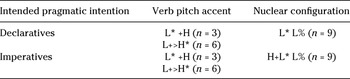
The results from the series of Wilcoxon Signed-Rank tests indicated that for the native speaker instructor the imperative ranks were not statistically different than declarative ranks for verb pitch range (Z = −1.63, p = .11). The frequency distribution for the instructor’s tonal alignment of the verb’s pitch accent and the utterance’s nuclear configuration is provided in Table 1, and examples of declarative and imperative utterances were provided in Figures 3 and 4.
Verb pitch accents and nuclear configuration for the instructor

As can be seen in Table 1, the verb pitch accents in the declarative and imperative contexts showed one of two patterns: (a) a low tone throughout the stressed syllable followed by a rise in the posttonic syllable (L* +H; see Figure 3) or (b) a rise throughout the stressed syllable that reaches its peak in the posttonic syllable (L+>H*; see Figure 4). However, there was a clear difference in the target utterance’s nuclear configuration depending on the pragmatic context: Declarative sentences were realized as a low tone throughout the stressed syllable of the last word in the phrase followed by a fall or a continued low plateau (L* L%; see Figure 3); for imperatives, there was a fall associated with the stressed syllable of the last word in the phrase followed by a low plateau (H+L* L%; see Figure 4). This final fall was also captured by the significant difference in the noun’s pitch range, which was greater in imperative target utterances than declarative ones (Z = −2.87, p = 0.004). Thus, it appears that the native speaker instructor of this study makes a pragmatic distinction between the morphologically identical imperative and declarative utterances based only on the utterance’s nuclear configuration.
After this statistical analysis was conducted, the researcher met with the instructor to raise her consciousness of how she makes a pragmatic distinction through the nuclear configuration by showing her images like the ones in Figures 3 and 4 along with playing the corresponding sound files. This was done so that she would be able to listen for differences in the final pitch accent and boundary tone in the FOG + I participants in order to provide corrective feedback. However, it is important to note that all participants had access to the nuclear configuration difference in the input during the pre- and posttask phases of the task-based instructional session, although the learners’ attention was not drawn to it in the FOG condition.
LEARNER INTONATIONAL PATTERNS
Verb’s Pitch Accent Range
The GLMM analysis revealed main effects in the pitch range of the verb for time, F(1, 677) = 13.97, p < .001, and pragmatic intention, F(1, 677) = 13.95, p < .001; overall, the verb pitch range was larger in the posttest (M = −1.10 ERB, SD = 0.09 ERB) than the pretest (M = −1.32 ERB, SD = 0.09 ERB), and this difference yielded a large effect size, d = 2.44. Furthermore, target utterances that were produced in an imperative context had a larger pitch range (M = −1.10 ERB, SD = 0.09 ERB) than utterances in the declarative context (M = −1.32 ERB, SD = 0.09 ERB); this difference also yielded a large effect size, d = 2.44. There was no main effect for condition, F(1, 677) = 0.46, p = .499.
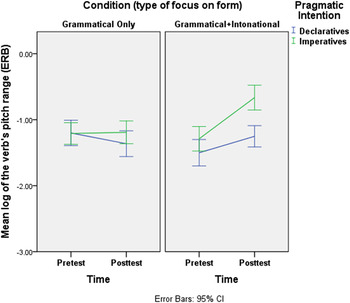
There was a statistically significant interaction between condition and time, F(1, 677) = 13.28, p < .001. Overall, the posttest target utterances in FOG + I had the largest verb pitch range (M = −0.94 ERB, SD = 0.13 ERB), followed by the posttest in the FOG condition (M = −1.26 ERB, SD = 0.13 ERB), the pretest in the FOG condition (M = −1.27 ERB, SD = 0.13 ERB), and the pretest in the FOG + I condition (M = −1.37 ERB, SD = 0.13 ERB). There was also a significant interaction between condition and pragmatic intention, F(1, 677) = 7.73, p = .006. Overall, the FOG + I imperative utterances had the largest verb pitch range (M = −0.96 ERB, SD = 0.13 ERB), followed by FOG imperatives (M = −1.23 ERB, SD = 0.13 ERB), FOG declarative utterances (M = −1.29 ERB, SD = 0.13 ERB), and FOG + I declaratives (M = −1.35 ERB, SD = 0.12 ERB). However, there were no significant interactions between time and pragmatic intention, F(1, 677) = 3.58, p = .059, or time, pragmatic intention, and condition, F(1, 677) = 1.55, p = .213. Despite the nonsignificant three-way interaction (see Figure 6), a series of Bonferroni post hoc tests were conducted to examine the relationship of these three variables.
Mean log of the verb’s pitch range.

To answer the first research question regarding whether there were differences between FOG and FOG + I after the task-based intervention, three main points are presented along with results from the supporting post hoc tests for the verb’s pitch range. First, there were no differences between conditions before the instructional session. In the pretest, the FOG and FOG + I conditions did not significantly differ from each other on their values for declaratives, t 676 = 1.04, p = .298, or imperatives, t 676 = 0.09, p = .932. Furthermore, before the instructional session, there was no significant difference between imperatives and declaratives for the FOG condition, t 676 = 0.15, p = .881, or for the FOG + I condition, t 676 = 1.74, p = .082, although it marginally differed in the FOG + I condition (i.e., CI for FOG + I comparison was [−0.03, 0.42]).
Second, changes were observed in the verb’s pitch range after the intervention for the FOG + I group but not for the FOG group. There was a significant difference between the imperative target utterances in the FOG + I condition between the posttest (M = −0.66 ERB, SD = 0.14 ERB) and pretest (M = −1.27 ERB, SD = 0.14 ERB) with respect to the verb’s pitch range, t 676 = 2.21, p = .027; this was a large effect, d = 4.36. This result means that, in the posttest, the FOG + I group increased the verb’s pitch range with imperative utterances from the results in the pretest. However, there was also a significant increase in the verb’s pitch range between the pretest (M = −1.47 ERB, SD = 0.14 ERB) and the posttest (M = −1.22 ERB, SD = 0.14 ERB) with the declarative sentences of the FOG + I condition. This yielded a large effect size, d = 1.79, albeit not as large as the effect size observed with imperatives. Significant differences were not observed between the pre- and posttest values for the FOG condition for declaratives, t 676 = 0.27, p = .786, or imperatives, t 676 = 0.36, p = .719. These post hoc tests show that, whereas the FOG learners did not modify the verb’s pitch range in the posttest, FOG + I learners did modify output, moving in a targetlike trajectory to be able to modify intonation.
Third, significant differences were observed between imperatives and declaratives for the FOG + I group after the instructional session, t 676 = 4.91, p < .001, but not for the FOG group, t 676 = 0.82, p = .410. In FOG + I condition, the verb pitch range on the posttest was larger with imperatives (M = −0.66 ERB, SD = 0.14 ERB) than declaratives (M = −1.22 ERB, SD = 0.14 ERB). These values yielded a large effect size for this difference, d = 4.00, meaning that FOG + I learners were able to utilize the verb’s pitch range to make a distinction between imperative and declarative utterances. Furthermore, there was a statistically significant difference in the posttest imperative utterances between conditions, t 676 = 2.98, p = .003, with the FOG + I condition showing a larger verb pitch range (M = −0.66 ERB, SD = 0.14 ERB) than the FOG condition (M = −1.21 ERB, SD = 0.14 ERB); this was also a large effect size, d = 3.93. This finding for the FOG + I condition shows that they are moving in a targetlike direction toward using intonation to make a pragmatic distinction.
Taken together, these post hoc tests demonstrate that learners in the FOG + I condition made a pragmatic distinction between imperatives and declaratives with the verb’s pitch range, whereas the FOG learners did not modify this intonational cue, nor did they use it distinguish between two morphologically identical forms with different pragmatic meanings. Because the only difference between the two conditions was the type of focus-on-form present in the task-based intervention, there is some evidence that the explicit focus on grammatical and prosodic form may have encouraged participants to notice an intonational difference between imperatives and declaratives and to subsequently modify their output in the posttest. Although native speakers of Spanish may utilize tonal range to signal a pragmatic distinction between imperatives and declaratives (Navarro Tomás, Reference Navarro Tomás1944; Prieto & Roseano, Reference Prieto and Roseano2010; Robles-Puente, Reference Robles-Puente and Alvord2011; Willis, Reference Willis2002), the native speaker of the present study did not employ this intonational cue; therefore, the use of the verb’s tonal range in the FOG + I condition may be an interlanguage feature if we directly compare the L2 learners’ results to the input they received in the intervention.
NOUN’S PITCH ACCENT RANGE
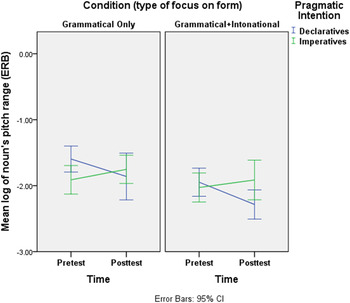
With regard to the noun’s pitch range, the GLMM analysis revealed that there were no main effects for time, F(1, 677) = 0.02, p = .894, pragmatic intention, F(1, 677) = 0.00, p = 1.000, or condition, F(1, 677) = 3.07, p = .080. There was a statistically significant interaction between condition and pragmatic intention, F(1, 677) = 6.72, p = .010. Overall, the FOG declarative utterances had the largest noun pitch range (M = −1.65 ERB, SD = 0.15 ERB), followed by FOG imperative utterances (M = −1.83 ERB, SD = 0.15 ERB), FOG + I imperative utterances (M = −1.95 ERB, SD = 0.15 ERB), and FOG + I declaratives (M = −2.12 ERB, SD = 0.15 ERB). There was also a statistically significant interaction between time and pragmatic intention, F(1, 677) = 8.64, p = .003. Overall, the pretest declarative utterances had the largest noun pitch range (M = −1.78 ERB, SD = 0.13 ERB), followed by posttest imperative utterances (M = −1.79 ERB, SD = 0.13 ERB), pretest imperative utterances (M = −1.98 ERB, SD = 0.13 ERB), and posttest declaratives (M = −1.99 ERB, SD = 0.13 ERB). There were no significant interactions observed between condition and time, F(1, 677) = 1.13, p = .289, or time, pragmatic intention, and condition, F(1, 677) = 1.83, p = .177. Despite the nonsignificant three-way interaction (see Figure 7), a series of Bonferroni post hoc tests were conducted to better examine the relationship of these three variables.
Mean log of the noun’s pitch range.

With the goal of continuing the discussion of the findings for the first research question, the following three points are presented along with their supporting post hoc tests for the noun’s pitch range. However, it should be noted that the 95% CI error bars in Figure 7 suggest a great deal of individual variation in the data.
To begin, there were few differences between the conditions before the task-based intervention. In the pretest, the FOG and FOG + I conditions did not significantly differ from each other on their values for declaratives, t 676 = 1.49, p = .137, or imperatives, t 676 = 0.65, p = .514. Furthermore, there was no significant difference between declaratives and imperatives in the FOG + I condition, t 676 = 1.49, p = .137. However, the FOG condition did have a statistically significant difference between these two pragmatic contexts in the pretest, t 676 = 1.97, p = .050, with declaratives exhibiting a larger noun pitch range (M = −1.63 ERB, SD = 0.17 ERB) than imperatives (M = −1.92 ERB, SD = 0.17 ERB); this yielded a large effect size, d = 1.71. However, it is important to note that learners in the FOG condition made a pragmatic distinction based on the noun’s pitch range differently from the instructor, who distinguished declaratives and imperatives through a larger noun pitch range with imperatives.
Second, there were some changes in the noun’s pitch range after the task-based intervention for FOG + I but not for FOG. There was a significant difference between the declarative target utterances in the FOG + I condition between the pretest (M = −1.94 ERB, SD = 0.16 ERB) and posttest (M = −2.31 ERB, SD = 0.16 ERB) with respect to the noun’s pitch range, t 676 = 2.84, p = .005; this was a large effect, d = 2.31. This finding indicates that in the posttest the FOG + I condition decreased the noun’s pitch range of declarative utterances. However, there was not a significant difference between imperatives in the pre- and posttest, t 676 = 1.55, p = .122. The FOG condition maintained values for imperatives, t 676 = −1.23, p = .220, and declaratives, t 676 = 0.32, p = .747, that resulted in nonsignificant differences between the pre- and posttests. It seems that the FOG + I condition only modified the noun’s pitch range for declarative sentences, whereas the verb’s pitch range of imperative utterances increased in the posttest.
Finally, for the FOG + I condition, there was a significant difference between imperatives and declaratives in the posttest, t 676 = 3.50, p < .001, but not for the FOG condition, t 676 = 0.52, p = .606. The noun pitch range for participants in the FOG + I condition on the posttest was larger with imperatives (M = −1.84 ERB, SD = 0.16 ERB) than declaratives (M = −2.31 ERB, SD = 0.16 ERB); this difference yielded a large effect size, d = 2.94. This result suggests a modification in a targetlike direction given that the native speaker instructor also demonstrated larger noun pitch range with imperatives than declaratives. Furthermore, there was a statistically significant difference in the posttest declarative utterances between conditions, t 676 = 3.13, p = .002, with the FOG + I condition showing a smaller range in nouns (M = −2.31 ERB, SD = 0.16 ERB) than the FOG condition (M = −1.68 ERB, SD = 0.17 ERB). This was also was a large effect size, d = 3.76. This result seems to indicate an effect of the type of instruction present in the task-based intervention.
These results for the noun’s pitch range provide evidence that the intonational change in FOG + I condition was the result of the focus-on-form these participants received in the task-based intervention that explicitly featured a focus on intonational form in addition to grammatical form; furthermore, this modification was not found in the posttest of the FOG groups. However, unlike the verb pitch range modifications observed with the imperatives, with the noun pitch range we actually see modification of the declarative utterances in the FOG + I condition; these learners decreased noun pitch range in declarative utterances to make the pragmatic distinction instead of increasing the noun’s pitch range in the imperative context as the instructor does.
TONAL ALIGNMENT OF THE VERB’S PITCH ACCENT
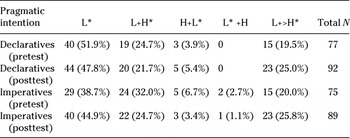
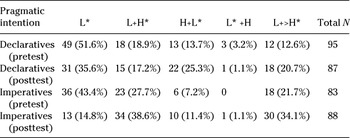
As was previously defined, tonal alignment refers to timing of the pitch peak and falls across segments. Overall, five of the seven proposed pitch accents in Spanish (Hualde & Prieto, Reference Hualde, Prieto, Frota and Prieto2015) were found in pitch accents of the verbs in the L2 data of this study. These raw frequencies and percentages for declaratives versus imperatives are presented in Tables 2 and 3.
Relative frequency distribution of tonal alignment of the verb for FOG

Relative frequency distribution of tonal alignment of the verb for FOG + I

If we first compare the two conditions on the pretest, we can see that more than 50% of the verb pitch accents used by participants was L* for declaratives, whereas for imperatives there was a slight preference for L* in both conditions (38.7% in FOG and 43.4% for FOG + I). This pattern is quite different from the instructor who did not use L* for the verb’s pitch accent in imperative and declarative utterances, but rather L* +H (33.3%) and L+>H* (66.7%) in both pragmatic contexts. However, this is not to say that the learners did not produce rising pitch accents in the pretest, as almost half of the imperative utterances did show a rising pitch accent that either reached its peak in the stressed syllable (i.e., L+H*; 32.0% for FOG and 27.7% for FOG + I) or in a posttonic syllable (i.e., L+>H*; 20.0% for FOG and 21.7% for FOG + I).
With respect to possible changes after the task-based intervention, there are minimal differences between the pre- and posttest distributions of the verb pitch accents in the FOG condition; the only exception is that, in the posttest, the majority of pitch accents in both pragmatic contexts have a rise in pitch that either reaches its peak in or after the stressed syllable. However, if we compare the FOG + I pre- and posttest results, we can see that the overall rate of rising pitch accents that begin in the verb’s stressed syllable increases from 49.4% (L+H* = 27.7%; L+>H* = 21.7%, L* +H = 0%) to 73.8% (L+H* = 38.6%; L+>H* = 34.1%, L* +H = 1.1%) in the imperative context. This result is more targetlike in the sense that there is a rise instead of a low plateau; however, the instructor never employed the L+H* pitch accent in the imperative target utterances. Furthermore, there also appears to be a difference in the declarative verb pitch accent in the FOG + I condition, with an increase of H+L* between the pretest (13.7% of total) and posttest (25.3% of total), indicating more variability in the interlanguage system after the task-based intervention.
NUCLEAR CONFIGURATIONS
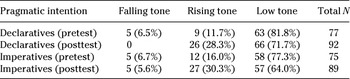
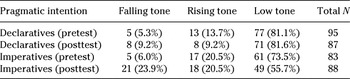
In addition to the verb pitch accent, the nuclear configuration of the 686 target L2 utterances were categorized according to the Spanish ToBI system. Upon surveying the data, it was evident that there was a large amount of variation (i.e., 14 possible nuclear configurations were identified) compared to the instructor’s categorical use of L* L% for declaratives and H+L* L% for imperative sentences. For example, in addition to the more targetlike L% boundary tone, there were also utterances that displayed a high rising terminal (H%) for these nonquestion utterances, a phenomenon that has been found in American English (Warren, Reference Warren2016). To better organize the data, all variants were collapsed according to the meaningful distinction made by the instructor—that is, the final pitch accent of the utterance. Therefore, the pitch accents L+H*, L* +H, and L+>H* were grouped together as rising tones; L* was categorized as a low tone; and H+L* was categorized as a falling tone. The raw frequencies and percentages for pitch movement of the final pitch accent are presented in Tables 4 and 5.
Relative frequency distribution of the final pitch accent of the noun for FOG

Relative frequency distribution of the final pitch accent of the noun for FOG + I

As can be seen from the pretest patterns for both conditions, there do not appear to be differences in the final pitch movement. Furthermore, neither condition appears to differentiate imperatives from declaratives based on this movement, as there was a strong preference to use a low tone regardless of the intended pragmatic meaning. Additionally, it is important to note that the final falling tones for both groups occur at very low frequencies in the pretest. Both groups of learners in the pretest were nonnative like in their realization of the imperative’s nuclear configuration compared to the native speaker instructor.
With regard to the posttest, the FOG + I condition demonstrated an increase in the frequency of falling tones with imperative utterances, from 6.0% in the pretest to 23.9% in the posttest, which indicates a move toward targetlike productions. Although there was still a preference for low tones with imperatives in the posttest, the increase of falling tones does demonstrate that, as a group, the FOG + I condition slightly modified their final pitch accent. Crucially, there was not a large increase in falling tones in declarative utterances between the pre- and posttest in the FOG + I condition nor did the FOG condition increase the use of a final falling tone in imperatives or declaratives after the task-based intervention. However, it is curious to note the FOG condition increased their use of a final rising tone in both imperative and declarative sentences between the pre- and posttests, indicating that there may be more variability in their interlanguage system.
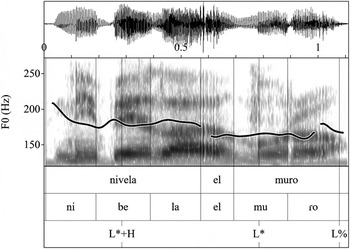
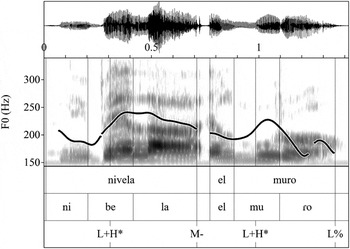
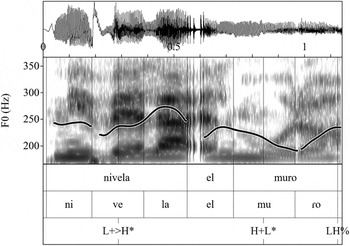
Finally, Figures 8, 9, and 10 illustrate these changes in the pitch contour for the FOG + I condition. Figures 8 and 9 are representative of the differences observed between imperatives and declaratives in the FOG + I condition on the posttest. Although the nuclear configuration for the imperative utterance in Figure 9 is nontargetlike—in comparison to the instructor’s input—Figure 10 exemplifies a more targetlike production of the imperative (i.e., presence of a final fall) on the posttest of a FOG + I condition.
Waveform and pitch contour from a FOG + I participant’s posttest declarative utterance nivela el muro “s/he is straightening the wall.”

Waveform and pitch contour from a FOG + I participant’s posttest imperative utterance nivela el muro “straighten-IMP the wall.”

Waveform and pitch contour from a FOG + I participant’s posttest imperative utterance nivela el muro “straighten-IMP the wall.”

DISCUSSION
The current study investigated the possibility of employing a focused, task-based intervention centered on how intonation can be used to distinguish two morphologically identical forms in Spanish: imperatives and declaratives. Through a pretest-posttest design, which was mediated by one of two focus-on-form conditions, this study sought to explore: (a) whether focus on grammatical + intonational form during a task-based intervention leads to increased improvement on producing this pragmatic distinction through intonation as compared to a focus on grammatical form condition; and (b) whether L2 learners use the same phonetic cues as those provided in the input by a native speaker instructor to distinguish between declarative and imperative utterances.
With respect to the first research question, this study has provided evidence that explicit focus-on-form of the pragmatic functions of intonation in a task-based lesson led L2 Spanish learners in the FOG + I condition to modify their output in the posttest. Specifically, with the imperative utterances between the pre- and posttests, as a whole this group increased the verb’s pitch range (nontargetlike based on the instructor’s input), lowered the pitch range of the noun (nontargetlike), increased the percentage of rising verb pitch accents (targetlike), and increased the frequency of falling tones in the nuclear configuration (targetlike). Furthermore, the modifications of the verb and noun’s pitch range showed statistically significant differences between imperative and declarative sentences in the posttest, whereas, in the pretest, this was not the case. Moreover, in the FOG condition no effects were observed between the pre- and posttest results or between imperative and declaratives during the posttest. It is important to note that both groups received similar input from the instructor, in that the intonation cues she uses (i.e., the nuclear configuration) to distinguish imperatives (i.e., H+L* L%) from declarative (i.e., L* L%) were available to both conditions during the task-based intervention.
Given these striking differences between the two conditions, it is proposed that the output modification in the FOG + I condition is attributable to the type of instruction these learners received from the instructor. In this condition, during the pretask phase, the instructor engaged the learners in a conscious awareness-raising exercise by explicitly instructing them to notice how Spanish declaratives and imperatives can be distinguished through the use of intonation. Additionally, when learners did not modify their imperative intonation during the public performance in the posttask, the instructor provided them with metalinguistic feedback on how they needed to change their intonation when using the imperative. Furthermore, because it was a public performance, this explicit feedback was heard by all the participants, which may have benefited the whole group. It is possible that the learners in the FOG + I condition may have noticed a gap between their interlanguage and the TL as the result of the type of instruction, and that the input available became intake, which may have led to the modified output on the posttest. Indeed, the present study seems to be in line with previous L2 prosody research, which has shown that increased awareness can lead to TL gains (Hardison, Reference Hardison2004; Pennington & Ellis, Reference Pennington and Ellis2000; Ramírez Verdugo, Reference Ramírez Verdugo2006). However, what is unique about the present study is that it has demonstrated that the pre- and posttask opportunities to focus-on-form, which are normally described in the TBLT literature as a focus on grammatical form (Ellis, Reference Ellis2003), can be expanded to include intonational form as well.
Another key feature of this study is the demonstration of how intonation can be the focus of a TBLT lesson without sacrificing the essential components of a task (Ellis, Reference Ellis2009); this is important given that previous L2 prosodic research has emphasized teaching intonation in meaningful contexts (Jenkins, Reference Jenkins2004; Levis & Pickering, Reference Levis and Pickering2004). This finding may help lay the foundation for other TBLT researchers and practitioners to begin to incorporate a task-based focus on intonation into the L2 classroom, providing the opportunity for learners to stretch their interlanguage development in an area that does not as frequently receive attention in the literature, or in the classroom, compared to segmental phonology and grammatical forms.
Despite the observed differences in the posttest of the FOG + I condition, the results clearly show that the modified output is more variable and slightly different than the input provided by the instructor (i.e., greater pitch range in the noun and the categorical use of H+L* L% for imperative utterances). The results of the present study have shown that the FOG + I learner productions are different from those of the instructor in the following ways: (a) learners increased the verb pitch range in the posttest with imperatives—a nonsignificant difference for the instructor; (b) learners decreased the noun’s pitch range with declaratives to distinguish it from imperatives—instead of increasing the noun’s pitch range with imperatives to create more productions of the falling tone H+L* in the nuclear configuration; and (c) learners utilized a plethora of different nuclear configurations, both in the final pitch accent and the boundary tone, which made it necessary to just focus on the final pitch accent—the instructor categorically used L* L% for declaratives and H+L* L% for imperatives. This finding concurs with other L2 prosody studies that have demonstrated that learners may employ different prosodic cues in production from native speakers to still make a meaningful distinction in the L2 (Aoyama & Guion, Reference Aoyama, Guion, Bohn and Munro2007; Swerts & Zerbian, Reference Swerts and Zerbian2010).
Having their attention drawn to how intonation can be used to make a TL pragmatic distinction may have increased the amount of variability in the interlanguage system of the FOG + I condition learners (e.g., the large 95% CI error bars in the noun’s pitch range in Figure 7); increasing variability when new variable forms are added to the interlanguage is a consistent trend found in the general SLA literature, in addition to L2 prosodic research (Henriksen et al., Reference Henriksen, Geeslin and Willis2010). This interpretation is strengthened by the fact that the learners in the FOG condition did not make any significant modifications in their output on the posttest. One possibility for this result may have to do with the fact that nothing new was added to the interlanguage system for the learners, who had already learned how to morphologically form the imperative. Footnote 6
Although it cannot be known for sure why the learners modified the pitch ranges, it is possible that they misinterpreted some of the cues in the signal. For example, for the instructor to have a large final falling tone that could result in a significant difference between imperatives and declaratives, there needed to have been a high peak, which would have been the result of L* +H or L+>H* pitch accent in the verb. This high peak may have been noticed by the FOG + I learners and interpreted as meaning that they needed to reach this peak in the verb’s pitch accent. Furthermore, to approximate the final fall of the imperative sentences, the learners may have resorted to decreasing the noun’s tonal range to create a difference between the two pragmatic contexts. However, these possible explanations are currently just speculation as no measures of L2 perception of the TL prosody or of noticing were implemented in this study, something that should be included in future research.
With its emphasis on teaching language through real-world tasks and the potential to incorporate focus-on-form, this study has shown how TBLT can help promote the L2 acquisition of the prosody/pragmatics interface. Specifically, these two aspects of TBLT— contextualized language use and the possibility to increase awareness of form—have also been proposed as facilitators in the acquisition of L2 prosody (Hardison, Reference Hardison2004; Jenkins, Reference Jenkins2004; Levis & Pickering, Reference Levis and Pickering2004; Pennington & Ellis, Reference Pennington and Ellis2000; Ramírez Verdugo, Reference Ramírez Verdugo2006). However, despite some modifications moving in a more targetlike direction, this study has also shown that learners’ interlanguage intonation is still variable, and they can employ other resources to make meaningful TL contrasts that are not present in the native speaker instructor’s speech.
CONCLUSION
One of the most significant questions that remains from the present study is whether or not these changes in the imperative prosody in the FOG + I condition are long lasting. This is unfortunately beyond the scope of this study, which first wanted to assess if prosody was even teachable within a TBLT framework; future research should certainly incorporate a delayed posttest into the empirical design. Future research should also include a direct measure of L2 noticing of prosody in order to strengthen claims made about the effectiveness of instruction. Additionally, in order to investigate whether these L1 English learners of Spanish transferred their L1 intonation patterns when made aware of a L2 pragmatic distinction through intonation more work needs to be done on correlating English intonation with pragmatic functions. Previous research has shown that L2 learners transfer their L1 prosodic patterns to the TL (Gabriel & Kireva, Reference Gabriel and Kireva2014; Maastricht et al., Reference Maastricht, Krahmer and Swerts2016; Mennen, Reference Mennen2004; Swerts & Zerbian, Reference Swerts and Zerbian2010), so in order to investigate this possibility a direct comparison between the learners’ L1 and L2 productions should be made. Moreover, the role of language proficiency should also be investigated as it has been shown that it can promote the acquisition of L2 prosody (Henriksen et al., Reference Henriksen, Geeslin and Willis2010; Maastricht et al., Reference Maastricht, Krahmer and Swerts2016; Swerts & Zerbian, Reference Swerts and Zerbian2010; Trofimovich & Baker, Reference Trofimovich and Baker2006).
To provide credence to the necessity of teaching the prosody/pragmatic interface, future research should also examine native speakers’ perception of L2 intonation, given that this may cause misunderstandings to arise between learners and native speakers (Ramírez Verdugo, Reference Ramírez Verdugo2005; Ramírez Verdugo & Romero Trillo, Reference Ramírez Verdugo and Romero Trillo2005). If native speakers are unable to accurately interpret the intended pragmatic meaning of L2 learners, this could lead to negative consequences for the learner in situations in which it is essential that they make their intentions known. The methodology present in this study could be adaptable to other minimal prosodic pairs, such as distinguishing between different types of questions in Spanish (e.g., confirmation yes-no vs. counterexpectational yes-no questions; Prieto & Roseano, Reference Prieto and Roseano2010). Finally, it would be beneficial to capture the in-the-moment input from instructors and in-the-moment output from learners in future studies on TBLT and L2 intonation, as these productions may reflect the instructors’ and learners’ actual pragmatic use of intonation more so than the explicit and formal knowledge obtained in this study. However, using more spontaneous data creates a dilemma because more naturalistic data, with its large quantity of nonsonorant segments, will make it harder for computer software programs to track the pitch contour. However, these potential challenges offer the field new opportunities as this line of investigation is wide open given that, to the author’s knowledge, this is the first study of its kind to see if intonation is teachable through the use of a focused, task-based intervention.
Despite these limitations, the present study has the potential to open a new and exciting line of research in the fields of TBLT and SLA by initiating and promoting dialogue on the instruction of L2 intonation and pragmatics in a TBLT setting. The evidence gathered from this study has demonstrated that it is possible to expand the traditional morphological focus-on-form to intonation in a TBLT setting, and that learners can benefit from it. These results have important pedagogical implications in that they show that it is possible to use a focused, task-based intervention to raise awareness of how intonation can be used to express specific pragmatic functions in the TL, with focus-on-form present during the pre- and posttask phases. Future research in this area is needed to corroborate the present study’s findings before specific recommendations can be made for implementing task-based intonation instruction into classrooms. To this end, it is of great importance for researchers in the field to begin to fill this knowledge gap and expand our understanding of how other L2 phonological aspects of L2 acquisition are mediated and affected in a TBLT setting.
SUPPLEMENTARY MATERIAL
The supplementary material provides the target sentences, a sample oral DCT, a detailed lesson plan of the tasked-based intervention, and sample materials for the focused, tasked-based intervention.
To view supplementary material for this article, please visit https://doi.org/10.1017/S0272263116000267.