A body of research investigates the possibility that second language (L2) sentence processing might be characterized in terms of learners’ reduced ability to generate expectations in various domains, as a result of representational, computational, and individual factors (Dussias, Valdés Kroff, Guzzardo Tamargo, & Gerfen, Reference Dussias, Valdés Kroff, Guzzardo Tamargo and Gerfen2013; Grüter, Rhode, & Schafer, Reference Grüter, Rhode, Schafer, Orman and Valleau2014; Grüter, Lew-Williams, & Fernald, Reference Grüter, Lew-Williams and Fernald2012; Hopp, Reference Hopp2013a, Reference Hopp2013b). Anticipation might be found to various degrees as a function of current L2 knowledge, the automaticity of lexical access, and processing capacity. Kaan (Reference Kaan2014) notes the role of individual differences (e.g., input, quality of representations, automatic access, and working memory [WM] capacity) that generally affect processing performance. In the domain of clause structure, a hierarchy of semantically interpreted categories (e.g., C > I > v > V as per Chomsky, Reference Chomsky2005) would presumably play a role in anticipation. For first language (L1) sentence processing, Omaki, Lau, White, Dakan, Apple, and Phillips (Reference Omaki, Lau, White, Dakan, Apple and Phillips2015) argue “that the parser uses pre-verbal information to predictively create rich syntactic representations regardless of word order differences across languages” (p. 15). In their eye-movement Experiments 2 and 3, Omaki et al. (Reference Omaki, Lau, White, Dakan, Apple and Phillips2015) report longer reading times (RTs) on intransitive verbs in filler-gap contexts than in island contexts. They suggest massive anticipation in advance of verb integration as part of a hyperactive gap-filling procedure. Indeed, a transitivity expectation has been argued as a source of processing loads after intransitive verbs in DP1 Vintranstive DP2 V2 sequences (Mitchell, Reference Mitchell and Coltheart1987; Van Gompel & Pickering, Reference Van Gompel and Pickering2001). Anticipation contrasts with sentence processing that conservatively uses lexical information. This is the focus of our investigation.
In the domain of L2 sentence processing, Juffs (Reference Juffs2004) reports an unexpected mild garden path on V2 in the processing DP1 Vintransitive DP2 V2 sequences by L2 learners, which was especially strong in learners from verb-final background. Such an effect, if it can be found in L2 learners and native speakers (NSs) alike, might rather be consonant with a transitive anticipation in advance of verb integration as part of a hyperactive category-driven gap-filling procedure, rather than by a purely L1-based L2 strategy. Whereas L2 sentence processing is modulated by L1-based interlanguage representations, underlearned lexical access, and reduced WM capacity (Coderre, Conklin, & van Heuven, Reference Coderre, Conklin and van Heuven2011, Reference Coderre, Conklin and van Heuven2013; Dekydtspotter & Sprouse, Reference Dekydtspotter, Sprouse, Liceras and Zobl2003; Liu & Perfetti, Reference Liu and Perfetti2003; McDonald, Reference McDonald2006; McDonald & Roussel, Reference McDonald and Roussel2010; Miller, Reference Miller, Plonsky and Schierloh2011, Reference Miller2014, Reference Miller2015; Segalowitz & Segalowitz, Reference Segalowitz and Segalowitz1993), core requirements on parsing might be independent of learning conditions, exposure, and proficiency levels.
In view of all these considerations, L2 sentence processing by classroom learners with low proficiency, no naturalistic exposure, and nontargetlike L1-based processing strategies might differ most from L1 sentence processing. Hence, differences in the real-time deployment of grammatical information between NSs and L2 learners with nativelike proficiency would suggest processing limitations. In contrast, similar processing in NSs and in low proficiency L2 learners alike would suggest constraints shared by the L1 and L2 learning conditions. Footnote 1 The interaction of intransitivity information provided by the verb with a possible category-driven transitivity prediction due to clause structure is examined in DP1 V1 DP2 V2 stimuli in a group of L1-Korean L2-English learners (with low-intermediate proficiency and experience of English limited to classroom exposure) and in a group of NSs. The L1-Korean language background was selected for its distance from English in terms of word order, grammatical reflexes of intransitivity, and distinct processing steps in V-final languages (Juffs, Reference Juffs2004; Mazuka & Lust, Reference Mazuka and Lust1990). The most expert L2 learners have been documented to be able to process similarly to NSs (Hopp, Reference Hopp2010, Reference Hopp2013a). Much less is known about real-time processing by learners with low proficiency. Thus, intermediate learners with lower proficiency and exposure limited to the classroom were purposefully recruited, given that these conditions would be most conducive to fundamental differences. Under these conditions, similarities between NSs and learners might reflect shared constraints.
The article is organized as follows. An introductory discussion focuses on the question of a transitivity expectation in the context of split intransitivity contrasting unaccusative (e.g., arrive, fall) with unergative verbs (e.g., swim, snore). These verbs differ in thematic/argument structure and syntactic representations because the theme or patient subjects of unaccusative sentences originate as V-complements. Footnote 2 We discuss a subtle integration problem on the V2 segment after intransitive verbs—modulated by intransitivity type—as a case of parser-grammar misalignment signaling specific elements of architecture (Lewis & Phillips, Reference Lewis and Phillips2015). A self-paced reading experiment in the moving window format is then introduced and discussed. Evidence of greater processing loads on V2 after unaccusative verbs relative to copular predicates and unergative verbs is presented. The discussion examines these asymmetries in the light of views on L2 sentence processing. The article concludes with implications of a transitivity expectation for L2 parsing.
PROCESSING INTRANSITIVE CLAUSES AND (SPLIT) INTRANSITIVITY
Given that access to a verb’s semantics/argument structure is quasi-instantaneous (Boland, Reference Boland1993), attaching DP2 as a sister to V [VP Vintransitive DP2] in DP1 Vintransitive DP2 V2 sequences is against all argument-structure expectations (Juffs, Reference Juffs2004). A subject should naturally fill the sole argument position of a 1-place predicate in a clause. Still, with stimuli in (1a, b), Van Gompel and Pickering (Reference Van Gompel and Pickering2001) found increased processing loads on the vet and and his after struggled in (1a) relative to scratched in (1b).
-
(1) a. After the dog struggled the vet and his new assistant took off the muzzle.
b. After the dog scratched the vet and his new assistant took off the muzzle.
Thus, for the segment the vet, Van Gompel and Pickering (Reference Van Gompel and Pickering2001) noted that “regression-path times clearly showed that the intransitive condition took longer to read than did the transitive condition” (p. 853). A similar pattern was reported in the following region and his: “regression-path times for the critical region and first-pass regressions and regression-path times for the post-critical region indicated that readers experienced more difficulty immediately after intransitive verbs than after transitive verbs” (ibid.). They concluded that the parser initially ignored lexical information as first suggested by Mitchell (Reference Mitchell and Coltheart1987).
A default prosodic structure is assigned in silent reading (Fodor, Reference Fodor2002). Hence, this effect may be due to the absence of an expected comma at a major prosodic boundary between an intransitive verb and a following DP. Indeed, Adams, Clifton, and Mitchell (Reference Adams, Clifton and Mitchell1998) showed that a comma voids processing loads on following segments but an intervening adverbial does not. Revisiting Van Gompel and Pickering’s (Reference Van Gompel and Pickering2001) claim, Staub (Reference Staub2007) compared processing loads reflected in eye movements on postverbal segments after unaccusative (2a) and unergative (2b) verbs, contrasting with optionally transitive verbs (2c). Following Van Gompel and Pickering (Reference Van Gompel and Pickering2001), he focused on two crucial regions the vet (region 1) and and his (region 2).
-
(2) a. When the dog arrived the vet and his new assistant took off the muzzle.
b. When the dog struggled the vet and his new assistant took off the muzzle.
c. When the dog scratched the vet and his new assistant took off the muzzle.
Staub first confirmed that “when the subordinate clause verb is intransitive, processing difficulty appears on a subsequent noun phrase in normal reading” (Staub, Reference Staub2007, p. 556). Staub then contrasted the effect of the comma punctuation with intransitive subordinate clauses as in (3a–d).
-
(3) a. When the dog arrived the vet and his new assistant took off the muzzle.
b. When the dog arrived, the vet and his new assistant took off the muzzle.
c. When the dog arrived at the clinic the vet and his new assistant took off the muzzle.
d. When the dog arrived at the clinic, the vet and his new assistant took off the muzzle.
Staub reported that “the absence of a comma increased all reading time measures on ambiguous region 1 (the vet), but this increase was not modulated by whether there was additional material” (ibid., p. 558). For Staub, therefore, the cost of establishing a main clause in the absence of a comma signals the failure to mark this major phrase prosodic boundary. A prosodic effect jeopardizes arguments for a transitivity expectation, Staub argued. However, a prosodic explanation should not care about the type of verb intransitivity. Still, additional marginal asymmetries between unaccusative (2a) and unergative (2b) verbs arose: “On ambiguous region 2 (and his) . . . reading times on the go-past measures were significantly longer in the unaccusative condition than in the unergative condition” (ibid., p. 554). Again on region 2, “there were somewhat more regressions in the unaccusative condition than in the unergative condition (10.7% vs. 6.8%), and this difference was marginal by participants and significant by items” (ibid., p. 555). Staub (Reference Staub2007) offers a summary: “The unaccusative and unergative condition did not show any signs of differing on ambiguous region 1. . . . To the extent that these conditions differed at all, it was in the direction of greater processing difficulty for sentences with unaccusatives on the next region, ambiguous region 2” (ibid.). Staub concluded against a transitivity prediction, quickly disavowed by conjoined lexical intransitivity and prosodic information, in favor of parsing guided by lexical information, which is accompanied by marginal reflexes of intransitivity type. Footnote 3
However, if parsing were uniquely reliant on intransitive specifications, the single argument position in the thematic grid of the predicate irrespective of thematic role should be automatically saturated by the sentential subject, leaving the structuring of the following clause unaffected by the thematic structure of unergative versus unaccusative verbs. Some force must lead to greater processing difficulty after unaccusative verbs. Footnote 4 On Van Gompel and Pickering’s transitivity expectation, the distribution of processing loads arises as a reflex of the revisions required. Verbs with basic transitive specifications fit the transitivity prediction, causing no immediate processing difficulty, until the analysis is later contradicted by further input (2c). In contrast, the lexical specifications of intransitive verbs mismatch this prediction, creating processing loads (2a, b), independently of any prosodic factor. Distinct intransitivity specifications interact differently with the transitivity expectation. Unergative verbs have agentive subjects, rather than complements. The specifications of unergative verbs disavow the anticipated V-complement structure immediately, but leave the analysis of DP1 unchanged. Unaccusative verbs have an internal theme/patient argument licensed as a V-complement. The revision of the transitivity prediction thus changes the (thematic) analysis of DP1. More changes increase the processing burden with consequences downstream.
The L2 literature also reports unexpected processing loads after intransitive verbs. Juffs (Reference Juffs2004) examined the processing of English garden path sentences (4a), non-garden-path sentences (4b), and unconscious garden-path sentences (4c) by L2 learners from Chinese, Japanese, and Spanish L1 backgrounds. Juffs’s experiment examined the role of WM in judgments.
-
(4) a. After the children cleaned the house looked very neat and tidy.
b. When the student arrived the professor asked her about her trip.
c. The doctor knew the nurse liked the men from England.
Juffs (Reference Juffs2004, p. 212) took note of an unexpected “mild garden path” in the processing of his “non-garden-path sentences” in what amounted to an intransitive control condition. Specifically, there were RT spikes on the V2 segment (e.g., asked) for all L2 groups that were, however, most salient in a Japanese group. A similarly large processing load was not observed in NSs. Given that such a spike is unexpected on the basis of thematically based expectations, it was proposed that in a V-final language “the parsing preference . . . is to Spell-out whenever a V is reached” (ibid., p. 215). This explanation must, however, be reconciled with the fact that Spell-out is delayed until all requirements from lexis are satisfied and face the fact that a spike in processing load was detected among all L2 learner groups. An effect in all L2 groups seems better aligned with a transitivity prediction, disavowed by lexical information, leading to integration problems for the main clause affecting the V2 segment. Given that lexical access is slower in L2 sentence processing, the anticipated structure might fail to be promptly rejected, yielding the effect to linger longer than in NSs.
Assuming robust use of subcategorization knowledge (Dussias & Cramer-Scaltz, Reference Dussias and Cramer-Scaltz2008; Frenck-Mestre & Pynte, Reference Frenck-Mestre and Pynte1997), Hopp (Reference Hopp2013b) considered the role of WM, proficiency, reading speed, automaticity of lexical access, and reliance on morphosyntactic information in processing with stimuli in (5a–e) by advanced L1-German L2-English learners.
-
(5) a. When the girl was praying the boy made some funny noises.
b. When the girl was praying, the boy made some funny noises.
c. When the girl was praying, he made some funny noises.
d. When the girl was playing the boy made some funny noises.
e. When the girl was playing the piano made some funny noises.
(5a) versus (5b) was a control comparison. (5b) versus (5c) examined case information, (5a) versus (5d) transitivity information, and (5d) versus (5e) plausibility information. Hopp (Reference Hopp2013b) reported effects of punctuation. Turning to the critical (5a) versus (5d) comparison, the L2 group produced evidence of greater processing loads on DP2 and V2 after transitive playing (5d) than after intransitive praying Footnote 5 (5a), suggesting that L2 learners used the verb’s intransitivity to exclude a direct object analysis in (5a) and plausibility to exclude a direct object analysis in (5d). However, the processing load patterns in the transitivity comparison are the reverse from those obtained by Staub (Reference Staub2007) and Van Gompel and Pickering (Reference Van Gompel and Pickering2001). Hopp (Reference Hopp2013b) reasoned that this was a feature of his stimulus: The other studies examined the reading of complex noun phrases (NPs), “which extended the temporary ambiguity” (p. 18). Hopp’s (Reference Hopp2013b) results document the use of intransitive lexical information in the L2 parsing of DP1 Vintransitive DP2 V2 sequences.
In sum, in L1 and L2 acquisition, unexpected processing loads have been reported after (nonalternating) intransitive verbs in the processing of DP1 V1 DP2 V2 sequences. A fleeting integration problem after intransitive verbs, especially unaccusative verbs, suggests that more than the valence of the predicate is at stake in establishing subject-predicate relations. A transitivity prediction interacting with the lexical and prosodic information seems to better explain the subtle details of the asymmetries that emerged (cf. Staub, Reference Staub2007). This is in line with evidence of processing loads with intransitive verbs in filler-gap contexts relative to island contexts, suggestive of massive anticipation in advance of verb integration (Omaki et al., Reference Omaki, Lau, White, Dakan, Apple and Phillips2015).
THE STUDY
Hypotheses
We consider integration difficulties after intransitive verbs (if any) in DP1 V1 DP2 V2 sequences as a possible reflex of the interaction of an anticipated transitive structure with intransitive lexical specifications for V1. On our working hypothesis, the parser assigns an agentive interpretation to DP1, leading to a transitivity prediction. The verb’s intransitivity specifications—encoding an unaccusative versus unergative distinction—are accessed upon encountering the verb. In view of a transitivity expectation, intransitive verbs in general (6a, b) should induce an integration problem for the matrix clause downstream, compared to intransitive copular predicates that eschew a DP complement (6c, d) (Claim 1).
-
(6) a. As the journalist arrived the editor postponed the meeting.
b. As the president spoke the journalist stopped talking.
c. As the journalist was late the editor postponed the meeting.
d. As the president was on air the journalist stopped talking.
These processing loads will, crucially, be modulated by intransitivity type: Unaccusative verbs (6a) should generally induce significantly greater processing loads relative to their corresponding copular predicates (6c) than unergative verbs (6b) relative to their corresponding copular predicates (6d) (Claim 2). Lastly, unaccusative verbs (6a) might also induce a greater integration problem downstream than unergative verbs might (6b), in the absence of such an asymmetry in the match conditions (6c vs. 6d) (Claim 3). Crucially, effects of an unmarked major prosodic boundary between two clauses as an intransitive predicate has been detected will be equal across all conditions (6a–d). The boundary effect should affect DP2. Integration effects affecting the main clause should arise on the V2 segment.
Given that the effects of these computations should be detectable to various degrees in NSs and L2 learners as the function of the speed with which lexical information can be accessed, L2 learners’ processing might differ in specific ways from NSs’ processing. L2 learners are expected to access lexically encoded grammatical specifications less efficiently, thus more slowly, than NSs. L2 learners’ slower lexical access might be visible not only in longer RTs, but also in the speed with which an anticipated structure is challenged by the lexical information from the verb. Thus, underlearned lexical access to the verb specifications in L2 will lead to a greater effect of the transitivity prediction downstream, whereas overlearned lexical access to the verb specifications in NSs will allow immediate recovery from an anticipated transitive structure. As per Juffs (Reference Juffs2004), who found an effect on V2 after intransitive verbs in L2 learners but not in NSs, any effect is likely to be larger in L2 learners, with lesser echoes in NSs. An integration difficulty after intransitive verbs would not arise if L2 sentence processing were guided solely by the semantic resolution of referential roles. This is because the referential index of DP1 should be entered into the theta-grid of V1 as V1 is encountered.
Materials
To test the predictions made by our working hypothesis, we created a stimulus list of 80 sentences: 28 experimental sentences (see Appendix) and 52 distracters presented in a self-paced, noncumulative, moving-window format using the Linger software (Rohde, Reference Rohde2001). The experimental sentences included seven unaccusative verbs—come, fall, arrive, die, appear, stay, and remain—and seven unergative verbs—talk, wait, swim, yawn, snore, speak, Footnote 6 and sneeze (Levin & Rappaport, Reference Levin and Rappaport-Hovav1995). Footnote 7 Crucially, these verbs do not participate in causative/inchoative alternations in English. Footnote 8 Knowledge of the verbs in the targeted population was determined by piloting at the same teaching institution. It was not reasonable to present a large number of items on a Latin square to a low-proficiency learner population. An appropriate test for such a learner group required reduced numbers of items and repetition of items for each subject, while keeping the task seamless.
The stimuli were presented on a computer screen in six to seven segments as in (7).
-
(7) As / the journalist / arrived / the editor / postponed / the meeting.
Subord. / DP1 / V1 / DP2 / V2 / the meeting.
All 80 items were presented in a different order for each participant. The critical regions for analyses were DP2 and specially V2, in view of a potential integration difficulty. After each sentence, an interpretation question asked about the content of the sentence. These interpretation questions queried a wide range of information about the sentences; the role of the participants in the events described by the sentence and the nature of the events described by the sentence. For example, the question “Did the journalist postpone the meeting?” appeared after the sentence “When the journalist arrived the manager postponed the meeting.” The number of expected yes and no answers was balanced across the task.
The 28 experimental sentences were organized in 2 × 2 conditions (verbal vs. copular predicate context × unaccusative vs. unergative verb condition), as shown in (8).
-
(8) Sample (unaccusative vs. unergative verb) Conditions and (verbal vs. copular predicate) Contexts
a. Unaccusative test condition—verbal predicate
As the journalist arrived the editor postponed the meeting.
b. Unergative test condition—verbal predicate
As the president spoke the journalist stopped talking.
c. Unaccusative match condition—copular predicate
As the journalist was late the editor postponed the meeting.
d. Unergative match condition—copular predicate
As the president was on air the journalist stopped talking.
Thus, the RTs on the segments the editor postponed in the unaccusative test condition (8a) can be compared to the RTs on the same segments in the unaccusative match condition (8c) involving a copular predicate rather than a verb. Likewise, the RTs on the segments the journalist stopped in the unergative test condition (8b) can be compared to the RTs on the same segments in the unergative match condition (8d). The RTs on the following DP2 and V2 segments in the verbal predicate test conditions (8a) and (8b) can be compared to the RTs on the same following DP2 and V2 segments in the copular predicate match conditions (8c, d). This is the central effect that is predicted.
The 52 distracters involved various constructions involving gerundive constructions and subordination with a wide variety of conjunctions, when, while, because, as, as soon as, although, each time, whenever, and so forth. Twenty-four items also involved repetitions of DP2 V2 sequences, so that the critical items would not stand out in this manner. VPs in subordinate clauses included both transitive and intransitive predicates, represented by both verbs and copular constructions. Thus, all manner of VPs were represented. Half of the intransitive VPs in the distracter stimuli involved optionally intransitive verbs.
Word length for the DP2 and V2 regions was balanced across the unaccusative and unergative conditions to eliminate the potential influence of word length on RTs. The seven nouns had on average 2.4 syllables (7.6 letters) in unaccusative sentences and 2.5 syllables (8 letters) in unergative sentences. The V2 segment had a mean of 1.2 syllables (5.7 letters) in unaccusative sentences and 1.1 syllables (5.7 letters) in unergative sentences. The targeted DP2 and V2 segments were also selected on the basis of their frequencies in the Corpus of Contemporary American English (COCA) at Brigham Young University. Footnote 9 Mean frequencies for DP2 were 4,597 per million in the unaccusative conditions and 4,807 per million in the unergative conditions. Mean frequencies for the critical V2 segment in the unaccusative conditions (119,506 per million) were higher than in the unergative conditions (63,544 per million). This was done because, on the basis of higher mean frequencies for V2 segments in the unaccusative conditions than in the unergative conditions, V2 RTs should be longer in the unergative conditions than in the unaccusative conditions. Hence, if longer RTs arise on V2 segments after unaccusative verbs, they will not be attributable to retrieval differences reflecting V2 form frequencies.
Word retrieval might be affected more by relative lemma frequencies. Lemma frequencies per million words were obtained in WebCelex (http://celex.mpi.nl/) and were included as a covariate in the statistical analysis. These become relevant only for Claim 3, which contrasts processing loads after unaccusative versus unergative verbs. Mean lemma frequencies of nouns in DP2 were higher in the unergative (56.14) than in the unaccusative (36.86) conditions. Mean lemma frequencies for the crucial V2 segments were higher in the unaccusative conditions (743) than in the unergative conditions (480.43) (Unaccusative condition: postpone 12; call 693; throw 159; become 834; make 2332; help 388; leave 783 / Unergative condition: stop 332; listen 177; make 2332; throw 159; kick 42; stay 250; shut 71). Hence, if longer RTs arise on V2 segments after unaccusative verbs, they will not be attributable to retrieval differences reflecting V2 lemma frequencies. Additionally, any variability due to lexical retrieval for DP1, DP2, or V2 is neutralized in the design for Claims 1 and 2. Crucially, for any (unaccusative vs. unergative) difference to speak to Claim 3, a difference must occur in the verbal predicate test conditions in the absence of any difference in the corresponding copular predicate match conditions. It is important to note that the stimulus was completely randomized to control for task-internal lexical priming.
In summary, an integration problem for the matrix clause downstream, compared to intransitive copular predicates that eschew a DP complement (Claim 1), predicts longer V2 RTs in the verbal predicate conditions (8a, b) than in the copular predicate conditions (8c, d). Due to a predicted modulation by intransitivity type, V2 RTs in the unaccusative test verbal predicate condition (8a) should be longer than in the unaccusative match copular predicate condition (8c) when V2 RTs in the unergative verbal predicate condition (8b) should not be distinguished from V2 RTs in the unergative copular predicate condition (8d) (Claim 2). A greater downstream integration problem induced by unaccusative verbs than by unergative verbs predicts V2 RTs in the unaccusative test verbal predicate condition (8a) to be longer than V2 RTs in the unergative test verbal predicate condition (8b), with no asymmetry between the match copular predicate conditions (8c) and (8d) (Claim 3).
Participants and Methods
The study population consisted in two groups: a NS group and a L2 group of lower-proficiency classroom learners. The respondents were all undergraduate college students, so that they are closely matched in age. The NS group determined what could be expected on our stimulus, when the respondents’ general ability to deploy structural knowledge in real-time syntactic analysis is not in dispute. It was expected that, if parsing involves a transitivity prediction interacting with lexical intransitive specifications, these respondents’ results would confirm our hypotheses. Thus, 25 NSs of American English were recruited. They were enrolled in an introductory linguistics course and completed the experiment for extra credit. They were naïve with respect to the properties investigated. Their mean age was 20.7 years (SD = 4.4). Seventeen NSs had studied a L2 in a classroom setting (7 Spanish; 4 French; 3 German; 1 Hebrew; 1 Portuguese; 1 Japanese). Their average accuracy on the comprehension questions in the experiment was 90%.
The target L2 group was selected to determine what could be expected from L2 learners for their processing presumably differs most from NSs. Our learners are less proficient than Juffs’ (Reference Juffs2004) learners. We targeted relatively low proficiency L2 learners for theoretical reasons, seeking to document similarities across the widest gap. Indeed, L2 sentence processing might differ most in classroom learners with low proficiency, with no naturalistic exposure, and with distinct L1-based processing strategies for a verb-final language. Thus, 22 undergraduate students were recruited in Korea because they had no experience living in an English-speaking country and because they were expected to have lower English proficiency. They were enrolled in a BA program in a school of business at a large university. They did not receive class credit. They had a mean age of 21.5 (SD = 1.82) at the time of testing. They had had on average 10.8 (SD = 2.38) years of classroom exposure to English. We verified that they were indeed lower-proficiency learners with Brown’s (Reference Brown1980) 50-blank cloze test, which includes 25 close-class items and 25 open-class items. Respondents filled in as many blanks as possible in the limits of ten minutes. This task demanded that words be quickly retrieved and integrated into a greater syntactic and discourse context. Under these same experimental conditions, NSs’ scores ranged from 30 to 50 with an average of 45 with strict scoring in which their answers were scored with respect to a reference list as specified in Brown (Reference Brown1980). Advanced L2 learners would be expected to approach these levels of performance. Our L2 learners achieved a mean score of 9.2 (SD = 4.1). They were substantially slower readers, which affected their performance in this cloze test. With lax scoring, when their accuracy was measured on the number of words that they provided, they were 65% correct. This documents a large proficiency gap between the two groups. The average accuracy of L2 learners on the comprehension questions in the experiment was 75% (SD = 9.8). Footnote 10
Participants were tested in a language lab. They completed a short background questionnaire regarding their age, sex, native language background, and exposure to any other languages. The learners also provided details of their English learning experience, including their age of first exposure, length and type of exposure to English, and length of stay in any English-speaking country (if applicable). After the questionnaire, participants completed Brown’s (Reference Brown1980) cloze test. The reading task started with a training session. This familiarized them with the moving-window procedures and the type of actions required of them. Then, they moved on with the main experimental task, in which RTs for each segment were recorded in milliseconds. After reading each sentence, participants answered an interpretation question about the content of the sentence, by pressing either yes or no buttons. However, if respondents could not retrieve the information, they could opt out of responding by pressing the space bar. Respondents rarely used this option (5.7% for L2 learners/1.2% for NSs). It took about 35 minutes to complete the entire task, so that the respondents were not fatigued.
Analytical Procedures
Raw RT data were pruned by condition and group. For each segment, RTs below 200 milliseconds were eliminated because the words were skipped. RTs above two standard deviations beyond the mean were also removed as outliers. Values below 200 milliseconds were replaced by the lowest acceptable value of 200 milliseconds. Values above two standard deviations beyond the mean were replaced by the highest acceptable value of mean plus two standard deviations for each condition and each group. They represented a mere 3.4% of the data for NSs and 4.6% of the data for L2 learners. The words for which the measures are taken have different length and different lemma frequencies. This affects the measures and needs to be accounted for in the analysis. First, because RTs are skewed, a log-transformation was performed on the DP2 and V2 RT data. This normalizes their distribution. Second, in the spirit of the analytical procedures in Jaeger, Fedorenko, Hofmeister, and Gibson (Reference Jaeger, Fedorenko, Hofmeister and Gibson2008) and Hofmeister (Reference Hofmeister2011), residuals within subjects were calculated by fitting a regression line for word length in critical items and fillers alike. Word length differences and participants contributed to RT differences, β = .106, SE = .002, t = 5.273, p < .0001 for DP2 word length differences and β = -.070, SE = .001, t = -3.479, p = .001 for participants; β = .169, SE = .002, t = 8.519, p < .0001 for V2 word length differences and β = -.077, SE = .001, t = -3.869, p < .0001 for participants. After checking for potential collinearity, residual log RTs for DP2 and V2 were each analyzed in SPSS with a linear mixed model with (verbal vs. copular) predicate status, (unaccusative vs. unergative) condition, subject group (NSs vs. L2 learners), and lemma frequency as fixed effects, with subjects and items as random intercepts. Footnote 11 Fixed effects were coded with dummy coding. Crucially, we did not follow an iterative procedure seeking to discover which potential variables were best predictors. Rather, the predictors are selected by virtue of theoretically guided hypotheses with experimental predictions. SPSS provides tests of fixed effects, parameter estimates for the fixed effects, and Bonferroni-adjusted pairwise comparisons based on estimated marginal means.
RESULTS
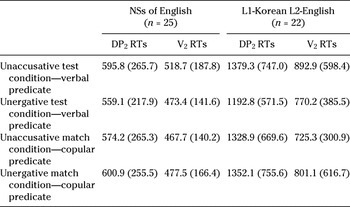
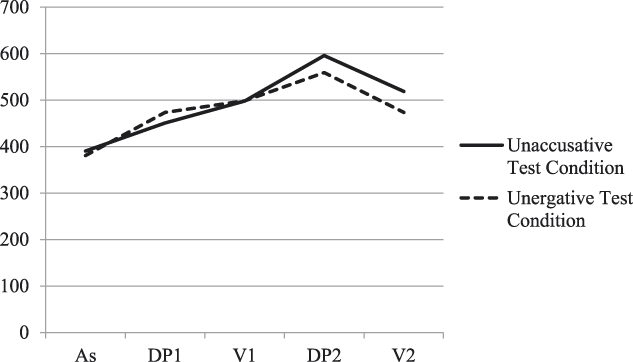
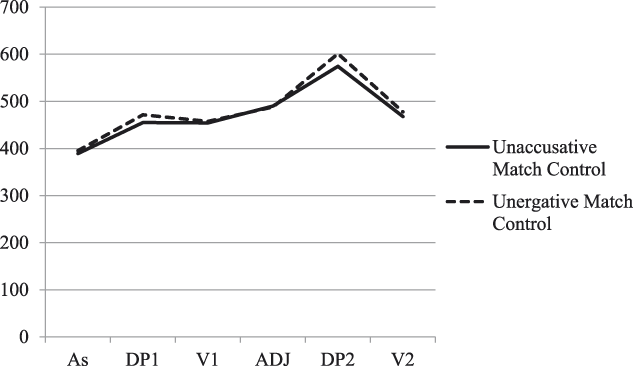
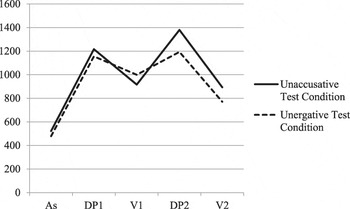
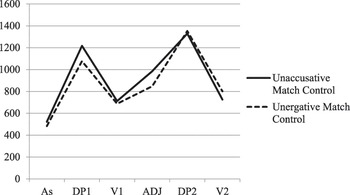
Table 1 shows the RT courses in milliseconds for the verbal predicate conditions (e.g., As the journalist arrived the editor postponed the meeting vs. As the president spoke the journalist stopped talking) and the copular predicate conditions (As the journalist was late the editor postponed the meeting vs. As the president was on air the journalist stopped talking) for the NSs and L2 learners. Figure 1 and Figure 2 show the RT courses in milliseconds for the verbal and predicate conditions for the NSs. Figure 3 and Figure 4 show learners’ RT courses. A linear mixed model analyzing residual log RTs on the DP2 segment revealed only a main effect of group, F(1, 1267.322) = 165.279, p < .0005. There were no main effects of (unaccusative vs. unergative) condition (p > .8) or (verbal vs. copular) predicate status (p > .5) and no interaction (p > .3). Therefore, the DP2 analysis was not revealing. As the figures show, there was a spike on DP2 in both groups even after copular predicates, presumably due in part to a major phrase boundary that was not marked. We move on to the analysis of the V2 segment.
Mean reading times from the subjects’ perspective for DP2 and V2 by condition

Note. Standard deviations are in parentheses. DP2 = second Determiner Phrase. V2 = second Verb. NSs = native speakers. L1 = first language. L2 = second language.
Native speakers’ reading times of each segment in verbal predicate conditions (milliseconds).

Native speakers’ reading times of each segment in copular predicate conditions (milliseconds).

Learners’ reading times of each segment in verbal predicate conditions (milliseconds).

Learners’ reading times of each segment in copular predicate conditions (milliseconds).

The linear mixed model analyzing residual log RTs on the V2 segment revealed a main effect of (unaccusative vs. unergative) condition, F(1, 20.143) = 8.281, p = .01, (verbal vs. copular) predicate status, F(1, 20.143) = 4.468, p < .05, and subject group, F(1, 1271.623) = 308.045, p < .0001. The group difference was echoed in the estimates of fixed effects (Estimate = -.174, SE = .02, t = -8.71, p < .0005). The model also found a two-way interaction of (unaccusative vs. unergative) condition with (verbal vs. copular) predicate status, F(1, 20.143) = 4.788, p < .05. This interaction appears driven by the unaccusative verbal predicate test condition. The parameter estimates show the unaccusative verbal predicate test condition to be (marginally) distinguished from the other conditions (Estimate = .063, SE = .03, t = 1.866, p = .066). The model also found a three-way interaction between (unaccusative vs. unergative) condition, V2 lemma frequency and subject group, F(1, 1256.493) = 6.803, p = .009. This three-way interaction appears driven by the unaccusative conditions in NSs. The parameter estimates show the unaccusative conditions in NSs to be (marginally) distinguished from the rest (Estimate = 5.78, SE = 3.24, t = 1.783, p = .075). The parameter estimates also revealed a main effect of V2 lemma frequency (Estimate = 3.39, SE = 1.67, t = 2.032, p = .046) and revealed an interaction of (unaccusative vs. unergative) conditions with V2 lemma frequency in which the unaccusative conditions were significantly distinguished from the baseline unergative conditions (Estimate = -6.04, SE = 2.441, t = -2.474, p = .016).
Pairwise comparisons for the entire population revealed the verbal predicate test condition to be significantly different from the copular predicate match condition (i.e., V2 residual log RTs in (8a, b) > V2 residual log RTs in (8c, d)), F(1, 20.143) = 7.633, p < .05. This was driven by the unaccusative verbs, however. The unaccusative verbal predicate test condition was statistically distinguished from its corresponding copular predicate match condition (i.e., V2 residual log RTs in (8a) > V2 residual log RTs in (8c)), F(1, 20.143) = 13.811, p = .001, with no such distinction for the counterpart unergative conditions (i.e., V2 residual log RTs in (8b) ≈ V2 residual log RTs in (8d), p > .8). The unaccusative verbal predicate test condition was also statistically distinguished from the unergative verbal predicate test condition (i.e., V2 residual log RTs in (8a) > V2 residual log RTs in (8b)), F(1, 20.143) = 7.166, p < .05, whereas there was no such distinction in the match copular conditions (i.e., V2 residual log RTs in (8c) ≈ V2 residual log RTs in (8d), p > .4).
L2 learners were distinguished from NSs in all four conditions: F(1, 1263.878) = 134.311, p < .0005 for the unaccusative verbal predicate test condition, F(1, 1263.878) = 110.258, p < .0005 for the unaccusative copular predicate match condition, F(1, 1263.906) = 120.892, p < .0005 for the unergative verbal predicate test condition, and F(1, 1263.906) = 120.697, p < .0005 for the unergative copular predicate match condition. In both NSs and L2 learners, the unaccusative verbal predicate test condition was statistically distinguished from its copular predicate match condition, F(1,62.089) = 5.073, p < .05 for NSs and F(1, 78.338) = 9.923, p < .005 for L2 learners, when no difference was registered for unergative conditions, p > .8 for both NSs and L2 learners. The difference between the unaccusative verbal predicate test condition and the unergative verbal predicate test condition was statistically significant for L2 learners only, F(1, 78.338) = 4.798, p < .05, but only weakly echoed in NSs, F(1, 62.089) = 2.910, p = .093, while the results were much flatter across the board for the matching copular predicate conditions: p > .6 for NSs and p > .4 for L2 learners.
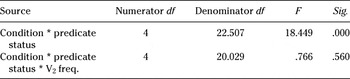
In view of the interaction of group with (unaccusative vs. unergative) condition and V2 lemma frequency, we examined the slopes of regression in each condition with a cell means model for each group separately. In the cell means model, the interaction of (verbal vs. copular) predicate status with (unaccusative vs. unergative) condition, and its interaction with V2 lemma frequency were declared as fixed effects, with no intercept or main effects. Subject and item were declared as random intercepts. This reparameterizes the model so that the parameter estimate for each condition is the regression slope of V2 lemma frequency. As Table 2 shows, the two-way interaction of (unaccusative vs. unergative) condition and (verbal vs. copular) predicate status was significant, but there was no further interaction with V2 lemma frequency in NSs.
Tests of fixed effects native speakers

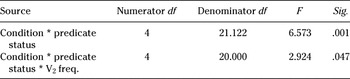
For the L2 learners, both the two-way interaction of (unaccusative vs. unergative) condition and (verbal vs. copular) predicate status and the three-way interaction of (unaccusative vs. unergative) condition and (verbal vs. copular) predicate status and lemma frequency were significant as shown in Table 3.
Tests of fixed effects for learners

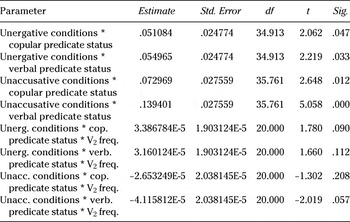
The regression line slopes of V2 lemma frequency are given in Table 4. Clearly, the verbal predicate test condition is statistically distinguished, significantly contributing to the overall interaction.
Estimates of fixed effects on V2 reading times for learners’ cell means analysis

DISCUSSION
It was predicted that unaccusative verbs especially might induce an integration problem on V2 following Juffs (Reference Juffs2004) in contradistinction to unergative verbs and copular predicates. A theoretically significant interaction implicating the verbal condition arose on V2. Processing loads on V2 were greater after (intransitive) verbs than after their counterpart copular predicates (Claim 1). Unaccusative verbs contributed significantly to this effect. Processing loads on V2 after unaccusative verbs were also robustly greater than after their matching copular predicates, while the same effect was not found in the unergative conditions (Claim 2). Processing loads on V2 were found to be marginally greater after unaccusative verbs than they were after unergative verbs (Claim 3). These patterns resulted in an interaction of (verbal vs. copular) predicate status with (unaccusative vs. unergative) condition in the entire population.
RTs for the L2 group are twice as long as NSs’ RTs. Significantly longer RTs are not, however, unusual in L2 learners in general even with a familiar script. L2 learners have long been observed to be slower readers but to produce theoretically relevant patterns in spite of this (Frenck-Mestre & Pynte, Reference Frenck-Mestre and Pynte1997; Hoover & Dwivedi, Reference Hoover and Dwivedi1998). As Frenck-Mestre (Reference Frenck-Mestre2002) notes, “[S]lower L2 reading is not necessarily indicative of different processing as compared to NSs” (p. 222). Juffs’ (Reference Juffs2004) Japanese learners’ RTs were also twice as long as NSs’ RTs in critical regions. The unaccusative verbs induced processing loads on V2s in both populations, although this was more clearly shown for L2 learners as in Juffs (Reference Juffs2004). On the basis of greater lemma frequencies for V2s in the unaccusative conditions than in the unergative conditions, faster processing might be expected in the unaccusative verb test condition than in the unergative verb test condition. In fact, residual log RTs on V2 segments were longer in the unaccusative verb test condition, as predicted by a garden path. Longer residual log RTs on the V2 segment were observed for the unaccusative verbal predicate test condition relative to the copular predicate match condition, with the same DP1s, DP2s, and V2s. A mean cells analysis of the L2 data also showed the unaccusative verbal test condition to be distinguished by its regression slope of V2 lemma frequency. A range of observations, therefore, suggests that unaccusative verbs induced an integration problem on V2, which was more severe in L2 learners than in NSs.
We now consider how these increased processing loads after unaccusative verbs, especially strong in L2 learners, might be modeled. We argued that a category-based transitivity prediction interacts with the lexical-semantic/argument-structure information to induce integration problems after intransitive (unaccusative) verbs relative to copular predicates in sentence processing. We found supportive evidence in both NSs and L2 learners. The integration problem seemed greater in L2 learners than in NSs, as a function of slower access to the lexical information, inducing more effortful revisions in L2 sentence processing. However, given the central role of unaccusativity, it might be argued that lexical-thematic knowledge in a L2 suffices to explain the results. This would be consistent with the shallow structure hypothesis (SSH), according to which L2 learners rely on lexical information in the absence of detailed syntactic computations (Clahsen & Felser, Reference Clahsen and Felser2006a, Reference Clahsen and Felser2006b). In the absence of syntactic details such as movement chains, SSH references a direct association mechanism in which a DP is referentially construed with an upcoming verb with an argument position unsaturated. O’Grady (Reference O’Grady2005) models the referential-thematic processing of predication relations, in the absence of autonomous syntactic chains. Processing is guided by a general efficiency requirement serving the goal of minimizing processing burden. By the efficiency requirement, “[D]ependencies (lexical requirements) must be resolved at the first opportunity” (O’Grady, Reference O’Grady2005, p. 28). Thus, in a DP1 Vintransitive DP2 V2 sequence to be processed, DP1 has a referential index and the upcoming intransitive V1 has a single open thematic position that must be satisfied. This referential index is immediately entered into the theta grid of the verb, filling that position. This incremental procedure (resolving expressions locally from left to right) does not predict a processing problem for the thematic integration of DP2 with V2 because intransitive verbs as a class are not expected to induce attachment ambiguities. The fact that a distinct integration problem after an unaccusative intransitive verb was observed clearly shows that something more is at play to begin with. Indeed, an anonymous reviewer points out that treating this effect as a lexical issue rather than as a syntactic issue (so that the SSH would predict it) does not “give the syntactic properties of unaccusatives their due.” The reviewer further points out that “the lexicon is ‘shallow,’ but unaccusativity is as much syntax as it is lexicon,” so that an effect of unaccusativity in sentence processing is inconsistent with SSH, because “deep syntactic properties” are in evidence, given that “underlying semantic themes project to VP internal complements,” where they are interpreted as per the Uniformity of Theta Assignment Hypothesis.
In order to obtain the observed results, a shallow processing mechanism would need to analyze the sequence, DP1 Vintransitive DP2 V2, by combining the unaccusative verb with the local DP2 first. The efficiency requirement on processing is violated, unless DP1 is associated with a CAUSE or LET predicate, which would account for its agentivity (Jackendoff, Reference Jackendoff1993). However, CAUSE or LET are prima facie the semantic values of a transitive v category in syntax. In the absence of a real-time (category-based) transitivity expectation, L2 sentence processing might perhaps be argued not to be constrained by the efficiency requirement: the parser would wait, keeping chunks of information in memory and applying subcategorization knowledge to these chunks. L2 learners’ processing has been described as less efficient, with labored lexical access and slower deployment of resources, resulting in delays. However, nobody to our knowledge has suggested that the incremental reduction of the processing burden at each step of processing is not the general mode of operation in L2 sentence processing. L2 sentence processing that is not constrained by the efficiency requirement seems to us to be implausible, especially when an account that respects the efficiency requirement exists. Hence, garden-path effects on V2s after unaccusative verbs found in NSs and L2 learners are contrary to what thematically guided processing alone predicts. They cannot be explained as a prosodic effect after intransitive predicates as this was a constant in the design affecting verbs and copular predicates alike, specifically on DP2. The role of subcategorization information in an integration problem in the structuring of DP1 Vintransitive DP2 V2 sequences seems to depend on some other process involving category and locality—the requirements in the structuring for DP1 having been temporarily met. This is presumably the real-time computation of a transitivity expectation in advance of lexical integration (Van Gompel & Pickering, Reference Van Gompel and Pickering2001).
A long-standing body of literature on constraint-based parsing (Boland, Reference Boland1993; Ford, Bresnan, & Kaplan, Reference Ford, Bresnan, Kaplan and Bresnan1982; Shapiro, Nagel, & Levine, Reference Shapiro, Nagel and Levine1993; Trueswell, Tanenhaus, & Kello, Reference Trueswell, Tanenhaus and Kello1993) documents the immediacy of access to lexical information. A long-standing body of research claims lexical intervention on structuring (Clifton, Speer, & Abney, Reference Clifton, Speer and Abney1991; Frazier, Reference Frazier and Coltheart1987, Reference Frazier and Marslen-Wilson1989, Reference Frazier, Balota, Flores d’Arcais and Rayner1990; Rayner, Carlson, & Frazier, Reference Rayner, Carlson and Frazier1983). An integration problem after intransitive verbs, especially after unaccusative verbs, has the potential of shedding new light on a long-standing debate about the very nature of parsing. While the possibility of a transitivity prediction with intransitive verbs is still anathema to many, new evidence challenges this conventional wisdom. Omaki et al. (Reference Omaki, Lau, White, Dakan, Apple and Phillips2015), also reacting to Staub (Reference Staub2007), reported a transitivity expectation after intransitive verbs in filler-gap dependencies relative to island contexts, suggesting that an immediate category computation massively predicts in advance of intransitivity information. Our observations fit naturally within these developments, but see Hopp (Reference Hopp2015, in press) for arguments that lexical processing also affects syntactic processing downstream.
CONCLUSION AND PERSPECTIVES
In L2 learners and NSs alike, processing loads induced by unaccusative verbs were observed in longer residual log RTs on the V2 segment in the unaccusative verbal predicate test condition than in the copular predicate match condition. Greater lemma frequencies for V2s in the unaccusative conditions than in the unergative conditions predict faster reading of V2s in the unaccusative verb test condition than in the unergative verb test condition. Hence, our results are contrary to expectations based on the frequencies of V2s in the unaccusative versus unergative conditions. Our results, rather, suggest that a category-based transitivity expectation interacts with the lexical argument-structure representations of unaccusative verbs. Extensive parse revisions create structural processing loads measured in RTs. In fact, an independent effect of structure (pointing to the distinctness of the unaccusative verb test condition) was observed to interact with V2 frequency in our Korean-speaking L2 learners. Hence, a transitivity expectation was modulated by the lexical information of unaccusative and unergative verbs, so that unaccusative verbs induced a significant integration problem downstream.
Even if L2 learners make robust use of subcategorization information (Dussias & Cramer-Scaltz, Reference Dussias and Cramer-Scaltz2008; Frenck-Mestre & Pynte, Reference Frenck-Mestre and Pynte1997; Hopp, Reference Hopp2013b), evidence of a transitivity prediction suggests that L2 behavior might be alternatively examined as a reflex of computations that fail to complete in real time in targetlike manner or are severely challenged by L2 input, echoing recent parser-grammar considerations by Lewis and Phillips (Reference Lewis and Phillips2015). Establishing a transitivity prediction requires additional evidence, but the fact that an integration problem exists after intransitive verbs, especially after unaccusative verbs, seems to be the hallmark of required revisions given a transitivity prediction. The differences that have emerged between unaccusative and unergative verbs cannot be explained away prosodically. The fact that a transitivity prediction appears to be at play (even in classroom learners with low proficiency and no naturalistic exposure) suggests the centrality of prediction in sentence processing. Hence, core requirements on parsing might very well apply independently of learning condition, exposure, or proficiency level.
APPENDIX
EXPERIMENTAL SENTENCES IN TEST AND MATCH CONDITIONS
A. Unaccusative test condition—verbal context
-
1 As the journalist arrived the editor postponed the meeting.
-
2 As the lady fell the official called the ambulance.
-
3 As the boxer came the audience threw eggs at him.
-
4 As the president died the congressmen became very busy.
-
5 As the mechanic appeared the truck made strange noises.
-
6 As the customer remained the salesman helped her shop.
-
7 As the producer stayed the actress left the stage.
B. Unergative test condition—verbal context
-
1 As the president spoke the journalist stopped talking.
-
2 As the doctor talked the patients listened to the radio.
-
3 As the interviewer waited the applicant made herself presentable.
-
4 As the fish swam the fisherman threw his net.
-
5 As the goalkeeper yawned the player kicked the ball.
-
6 As the wife snored the husband stayed up last night.
-
7 As the singer sneezed the manager shut the window.
C. Unaccusative (match) condition—copular context
-
1 As the journalist was late the editor postponed the meeting.
-
2 As the lady was unconscious the official called the ambulance.
-
3 As the boxer was still the audience threw eggs at him.
-
4 As the president was sick the congressmen became very busy.
-
5 As the mechanic was careless the truck made strange noises.
-
6 As the customer was friendly the salesman helped her shop.
-
7 As the producer was angry the actress left the stage.
D. Unergative (match) condition—verbal context
-
1 As the president was on air the journalist stopped talking.
-
2 As the doctor was out the patients listened to the radio.
-
3 As the interviewer was away the applicant made herself presentable.
-
4 As the fish was still the fisherman threw his net.
-
5 As the goalkeeper was inattentive the player kicked the ball.
-
6 As the wife was noisy the husband stayed up last night.
-
7 As the singer was sick the manager shut the window.