





Suicide rates in India are among the highest in the world, with the most recent estimates ranging between 18 and 21 deaths per 100 000 population (c.f. the global average of 11/100 000). This equates to an estimated 230 000 suicides annually with far-reaching consequences. 1 Young people are a particularly important and high-profile group at risk in India, with the suicide rate among youth aged 15–29 years roughly double the national average. 1 The first national suicide prevention strategy, developed in 2022, Reference Vijayakumar, Chandra, Kumar, Pathare, Banerjee and Goswami2 identified media reporting of suicide as a key area for intervention. Responsible media reporting of suicide is a population-level suicide prevention intervention recommended by the World Health Organization (WHO). Reference Zalsman, Hawton, Wasserman, van Heeringen, Arensman and Sarchiapone3–5 Numerous ecological studies from ‘Western’ high-income country settings have demonstrated that some media reports of suicide incidents can be a stimulus for imitation acts. Reference Niederkrotenthaler, Voracek, Herberth, Till, Strauss and Etzersdorfer6–Reference Stack8 This is known as the Werther effect. Consequently, media guidelines published by the WHO recommend avoiding some media reporting practices, 4 such as publishing a detailed description of the suicide method. These media guidelines also encourage reporting practices that are potentially protective, such as educating the public about suicide, providing details for a suicide helpline and reporting on stories of people who have found ways to navigate through and cope with suicidal thoughts. However, there has been less research into the potential to generate protective effects from media stimuli. A recent meta-analysis of eight experimental studies, all undertaken in either Austria or Australia, observed that exposure to educative suicide prevention media content containing stories of hope and recovery from a suicide crisis can have protective effects on suicidal ideation among people with greater pre-existing vulnerability. Reference Niederkrotenthaler, Till, Kirchner, Sinyor, Braun and Pirkis9 This has become known as the Papageno effect. These narratives are hypothesised to exert their effects by presenting models of coping and help-seeking, strengthening beliefs about the possibility of surviving suicidal crises and thereby reducing suicidal ideation, particularly among individuals with higher baseline vulnerability.
Mass media in India
Until now, no experimental studies Reference Moniri, Haregu, Spittal, Vijayakumar, Niederkrotenthaler and Calais-Ferreira10 have been undertaken in low- and middle-income countries, where this intervention is appealing because of the potential to generate population-level effects at low cost. The mass media market in India has until recently continued to observe exponential growth and diversification in the number of mass media outlets since the market was privatised in the late 1990s, with particular growth in print and digital news platforms. Reference Rao11 In contrast to many high-income countries, where newspaper circulation has declined, India has maintained steady annual growth in terms of publications and income. 12,13 Print media therefore reaches very large segments of the population, and most major titles now also have strong online editions. Competition is fierce to attract lucrative advertising revenue, and there is a high level of global commercial interests in the purchasing power of the rapidly expanding middle class in India. Reference Thussu14 As in many countries, this has seen the rapid expansion of a ‘24/7’ breaking news culture. Alongside this trend, the diversity of cultures in India has seen strong demand for a wide array of local/regional news channels, catering to diverse languages and tastes. Reference Rao11 Of the 400 million copies of newspapers circulated daily, approximately 50% are in Hindi, and the remainder are in English and a wide range of regional vernacular languages. 13
Media coverage of suicide in India
In India, the setting of our study, ‘attempt to commit suicide’ was a crime under the Indian Penal Code until 2017, which has resulted in strong social taboos and a high level of stigma around suicide. Reference Ranjan, Kumar, Pattanayak, Dhawan and Sagar15 Relatedly, our prior research has shown that readers of print media in India are exposed to a daily diet of brief, explicit and simplistic reporting of suicides and suicide attempts, predominantly developed by crime reporters. Reference Armstrong, Vijayakumar, Niederkrotenthaler, Jayaseelan, Kannan, Pirkis and et al16,Reference Dhanya, Mamman, Davis, Anusree and Armstrong17–Reference Armstrong, Vijayakumar, Cherian, Krishnaswamy and Pathare20 Recommended reporting characteristics, such as providing information on suicide prevention programmes are rare, and hopeful stories of people who have survived a suicide crisis are almost non-existent. Importantly, even when individuals do not read the original print media articles, suicide reports from newspapers and online print media are frequently repackaged and shared via social media and other digital platforms, further amplifying their potential reach and impact. The poor quality of media reporting in India compares starkly to countries such as Australia, where there has been more than a decade of dedicated work to improve media reporting of suicide and where, for example, inclusion of information on suicide helplines in news coverage has become common practice. Reference Skehan, Paton and Tynan21
Current study
Our study reports on a three-arm randomised controlled trial (RCT) with young adults in India to assess the effects of exposure to educative suicide prevention content in the print media on reducing suicidality and improving stigma of suicide, knowledge of suicide and intentions to seek help. We also assessed whether modifying the print media stimuli to include brief lived experience stories of hope and survival of a suicide crisis would result in larger reductions in suicidal ideation than educative content alone. Finally, we examined whether the effects of the print media articles differed by the degree of participant vulnerability to suicide.
Method
Study design
The study design was a three-arm RCT measuring the effects of protective suicide content in print media articles, with an allocation ratio of 1:1:1 to achieve equal group sizes. Measurement occurred at baseline (before randomisation), post-test and 14-day follow-up. The authors assert that all procedures contributing to this work comply with the ethical standards of the relevant national and institutional committees on human experimentation and with the Helsinki Declaration of 1975, as revised in 2013. All procedures involving human subjects were approved by the Human Ethics Committee at the University of Melbourne (Ref: 2021-20927-15388-3) and by the Schizophrenia Research Foundation (SCARF) in India (Ref: SRF-SAMARTH/02/FEB-2022), a WHO Collaborating Centre for Mental Health Research and Training. The study also received approval from the Health Ministry Steering Committee at the Indian Council of Medical Research and was registered with the Clinical Trials Registry of India (Ref: CTRI/2022/09/045439; https://ctri.nic.in/Clinicaltrials/advancesearchmain.php).
Participants
Eligible participants were young adults (18–29 years of age) living in Chennai, India. Exclusion criteria included: (a) low literacy, which prevented completion of the study questionnaire, or (b) being a health professional or a student of a health-related course.
Participants were recruited using social media advertisements on Facebook and snowball sampling, and written informed consent was obtained. They were informed that the study was about the effects of reading media reports on health and social issues. Participants were provided with Rs500 (∼US$6) at post-test and Rs750 (∼US$9) at follow-up to reimburse travel expenses and time spent participating in the study. Data were collected in a hired office space setting in central Chennai.
Randomisation and masking
In blocks of six, participants first completed baseline measures on digital tablets using a Research Electronic Data Capture (REDCap) survey and were then randomised using the randomisation module in REDCap at an allocation ratio of 1:1:1 to achieve equal group sizes. REDCap then immediately exposed participants to the intervention and control articles on the same digital tablet. Participants were blinded to group allocation and the study hypotheses; to support this, the questionnaire also contained measures related to the control condition (i.e. knowledge and attitudes related to diabetes) to maintain blinding. Because randomisation was implemented entirely within REDCap, the research assistants facilitating data collection were blinded to group allocation, and both the research assistants and the data analyst were blinded to both group allocation and the study hypotheses.
Procedures
Participants were randomised to one of two intervention groups (intervention groups 1 and 2) or a control group. All three groups were exposed to three brief (∼600 words) Tamil-language print media articles that varied by group, on digital tablets (see Supplementary File 1 available at https://doi.org/10.1192/bjp.2026.10799). The articles used in the study were co-designed with a senior Indian media professional. Each article was first written in English (for our multi-lingual investigator team), then translated into Tamil, then back-translated into English to ensure equivalence of meaning. Intervention group 1 were exposed to three articles containing educative suicide prevention content. These articles were characterised by coverage of the new national suicide prevention strategy, real suicide prevention programmes; debunking suicide myths, opinions from mental health experts, encouraging people to seek help and messages of hope that people with suicidal thoughts can find a way to survive a suicide crisis with support. Intervention group 2 were exposed to a modified version of the same three print media articles given to intervention group 1. The articles were of the same length but were modified to each contain one ∼250-word account of a young adult who had coped with experiences of suicidal ideation, emphasising examples of help-seeking and a range of different coping strategies and supports. To accommodate these narratives while maintaining the same article length, there was a reduction in the amount of expert commentary. These articles were based on real stories, but with fictional identities and locations. The control group was exposed to three print media articles on diabetes, a public health issue unrelated to suicide and unlikely to impact responses on the study measures.
Outcomes
Data were collected using a self-administered questionnaire on digital tablets implemented using REDCap (Research Electronic Data Capture; hosted on University of Melbourne servers and accessed via Windows 10/11; Vanderbilt University, Nashville, Tennessee, USA; https://projectredcap.org), a secure, web-based application for building and managing online surveys. We randomised the sequence of the outcome measures to avoid bias.
Primary outcome
Suicidal ideation was measured using the Survival and Coping Beliefs subscale of the Reasons for Living Scale (RFLS), Reference Linehan, Goodstein, Nielsen and Chiles22,Reference Range23 a 24-item measure of suicidal ideation that explores positive reasons to refrain from suicide (e.g. ‘I believe I can learn to cope with my problems’). Scale scores are reverse-coded, resulting in higher scores indicating higher suicidal ideation. Participants rate each reason for not personally dying by suicide on a scale from 1 (not at all important) to 6 (extremely important). It has a solid theoretical base and by focusing on strengths rather than weaknesses, it has been used to assess beliefs about internal capacity to refrain from suicide. It has been used to assess media-induced changes in suicidal ideation. Reference Till, Tran, Voracek and Niederkrotenthaler24–Reference Niederkrotenthaler and Till26 We translated the tool into Tamil and undertook a validation study in Chennai, India, which recommended dropping item 4 to improve internal consistency. The 23-item Tamil version of the subscale yielded acceptable content validity, excellent internal consistency (Cronbach’s alpha > 0.9) and test–retest reliability (ICC = >0.8).
Secondary outcomes
Stigmatising attitudes towards suicide were measured using the 44-item Suicide Stigma Assessment Scale (SSAS). Reference Corrigan, Sheehan and Al-Khouja27,Reference Nicholas, Haregu, Henderson and Armstrong28 Participants are presented with a brief vignette about a person who has recently attempted suicide and are asked whether they endorse items such as ‘How cowardly would you feel XX is?’ and ‘I would look down on XX’. Items are scored on a 9-point scale anchored by ‘very much = 9’ and ‘not at all’ (= 0), with scores ranging from 56 to 337. We translated the tool into Tamil language and back-translated it into English, and adapted the vignette to be culturally relevant. Reference Armstrong, Mohanraj, Kumar, Haregu, Spittal and Jayakumar29 In our data, the SSAS had excellent internal consistency (i.e. Cronbach’s alpha = 0.87).
Suicide prevention knowledge was measured using the Literacy of Suicide Scale (LOSS). Reference Batterham, Calear and Christensen30 Participants are asked to agree or disagree with 12 true (e.g. there is a strong relationship between alcoholism and suicide) or false (e.g. talking about suicide always increases the risk of suicide) statements regarding suicide. Items are scored as correct/incorrect and summed to yield a total literacy score.
Intentions to seek help were measured using the General Help-Seeking Questionnaire (GHSQ). Reference Rickwood and Thomas31 Participants were asked how likely they are to seek help if experiencing suicidal thoughts in the next 4 weeks from any of nine pre-coded options (for example, friends, parents, phone helplines, mental health professionals, other persons). Responses are captured on a 7-point Likert scale anchored by ‘extremely unlikely’ = 1 and ‘extremely likely’ = 7. We calculated an overall help-seeking intention score and also examined item-level intentions for specific sources of support (e.g. phone helplines), reflecting the source-specific structure of the instrument rather than assuming a single unidimensional scale.
Statistical analysis
We had powered the study to detect a small-to-moderate (Cohen’s d = 0.4) effect size between study groups with 80% power (alpha = 0.05). We required 300 participants, which we raised to 375 to allow for a dropout rate of 25% by 14-day follow-up measurement. We recruited 375 participants, evenly spread across the three study groups (control group = 125, intervention group 1 = 124, intervention group 2 = 126). All participants completed baseline and post-test measurements, and only 4.3% (n = 16) had dropped out at 14-day follow-up. This sample size allowed us to have >80% power (alpha = 0.05) to detect small effect sizes (Cohen’s d = 0.2) between study groups.
All analyses were undertaken using Stata version 18 (Stata/SE 18.0 for Windows; StataCorp LLC, College Station, Texas, USA; https://www.stata.com). Chi-square tests were used to check for differences in participant characteristics between study groups, and we observed a difference in the distribution of age between the three groups. Mean and s.d. were calculated for each outcome measure at each point of measurement. Linear regression (analysis of covariance (ANCOVA)) models were used to estimate the effects of the group (control, intervention group 1, intervention group 2) on the outcome measures at post-test, with group as an indicator variable, adjusting for age and the respective baseline values of the outcome measures. Similar models were then run for outcomes measures at follow-up. To examine whether the effects on suicidal ideation differed by participant vulnerability, we undertook post hoc subgroup analyses that only included participants with above-median scores on the suicidal ideation measure at baseline, consistent with prior studies. Reference Niederkrotenthaler, Till, Kirchner, Sinyor, Braun and Pirkis9 Multiple imputation was used to handle the data from the small number of study dropouts. Effect sizes were expressed as standardised mean differences (SMDs), calculated as the regression coefficient divided by the pooled s.d., to provide a common effect-size metric across outcomes measured on different scales. SMDs of 0.2, 0.5 and 0.8 were considered small, medium and large, respectively. We conducted a sensitivity analysis for treatment effect estimates using linear mixed models.
Role of the funding source
The funder of the study had no role in study design, data collection, data analysis, data interpretation or writing of the report.
Results
Participants
Figure 1 shows the progress of participants through the trial. Recruitment commenced on 1 August 23, and between August 2023 and March 2024 a total of 562 people expressed interest, of whom 375 met the inclusion criteria and consented to participate. Randomisation resulted in 125 participants being assigned to the control group and 124 and 126 assigned to intervention groups 1 and 2, respectively. At 14-day follow-up, six participants were lost from the control group, and four and six from intervention groups 1 and 2, respectively.
CONSORT flow diagram.

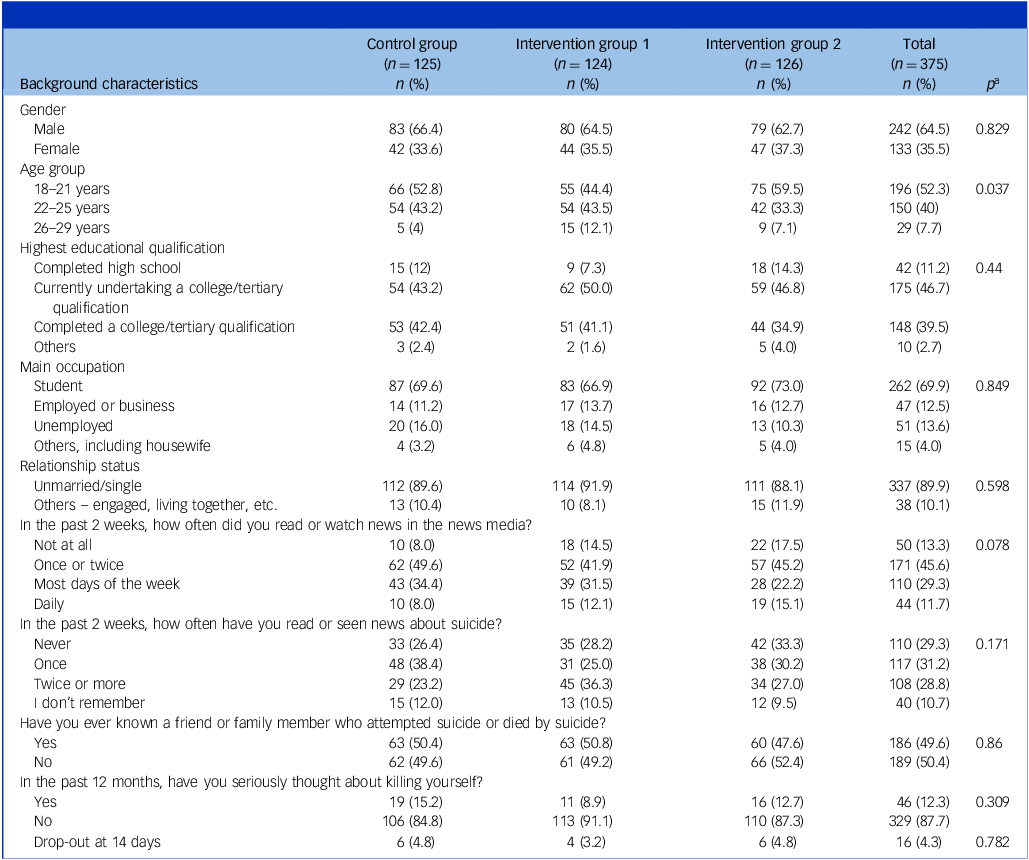
Two-thirds (65%) were male, most (92%) were aged between 18 and 25 years, most (86%) had some exposure to higher education, more than two-thirds (70%) were students and most were unmarried/single (90%) (see Table 1). Half (50%) had known a friend or family member who had attempted or died by suicide, just over one in ten (12%) reported seriously thinking of killing themselves in the past 12 months and a little more than half (60%) recalled being exposed to news media related to suicide in the past 2 weeks. There was a significant difference in the age distribution across groups. At baseline, there were no statistically significant differences in the outcome measures between groups.
Baseline characteristics of study participants

Table 1 Long description
The table presents baseline characteristics of study participants across three groups: Control group (n = 125), Intervention group 1 (n = 124), and Intervention group 2 (n = 126). It includes data on gender, age group, highest educational qualification, main occupation, relationship status, exposure to news media, exposure to news about suicide, knowledge of someone who attempted or died by suicide, and thoughts about killing oneself. The table has 12 rows and 7 columns, including column headers and total counts. Notable trends include a significant difference in age distribution across groups and no statistically significant differences in outcome measures between groups at baseline.
a. p values are from a chi-square test.
Primary outcome analyses
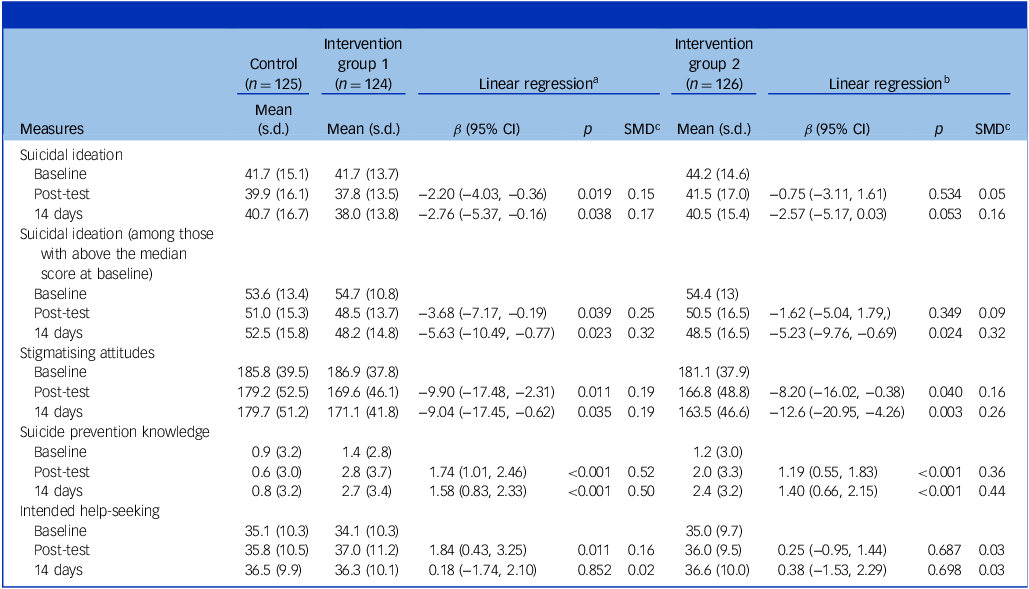
Table 2 shows the mean scores on the primary and secondary outcomes for the intervention and control groups at baseline/post-test and follow-up, and the results of the linear regression analyses.
Linear regression of intervention effects compared with control group

Table 2 Long description
The table presents mean scores and linear regression analyses for control and intervention groups on outcomes like suicidal ideation, stigmatizing attitudes, suicide prevention knowledge, and intended help-seeking. It includes data at baseline, post-test, and 14 days follow-up. The table has 12 rows and 12 columns. Column headers include Control, Intervention group 1, Linear regression, and Intervention group 2. Row labels include Suicidal ideation, Suicidal ideation (among those with above the median score at baseline), Stigmatizing attitudes, Suicide prevention knowledge, and Intended help-seeking. Each row provides mean scores and standard deviations for each group at different time points, along with regression coefficients, confidence intervals, p-values, and standardized mean differences.
a. Effects on intervention group 1: change in respective outcome variables, adjusting for age, with an indicator variable for group.
b. Effects on intervention group 2: change in respective outcome variables, adjusting for age, with an indicator variable for group.
c. Standardised mean difference (SMD): linear regression beta coefficient divided by pooled s.d.
Suicidal ideation
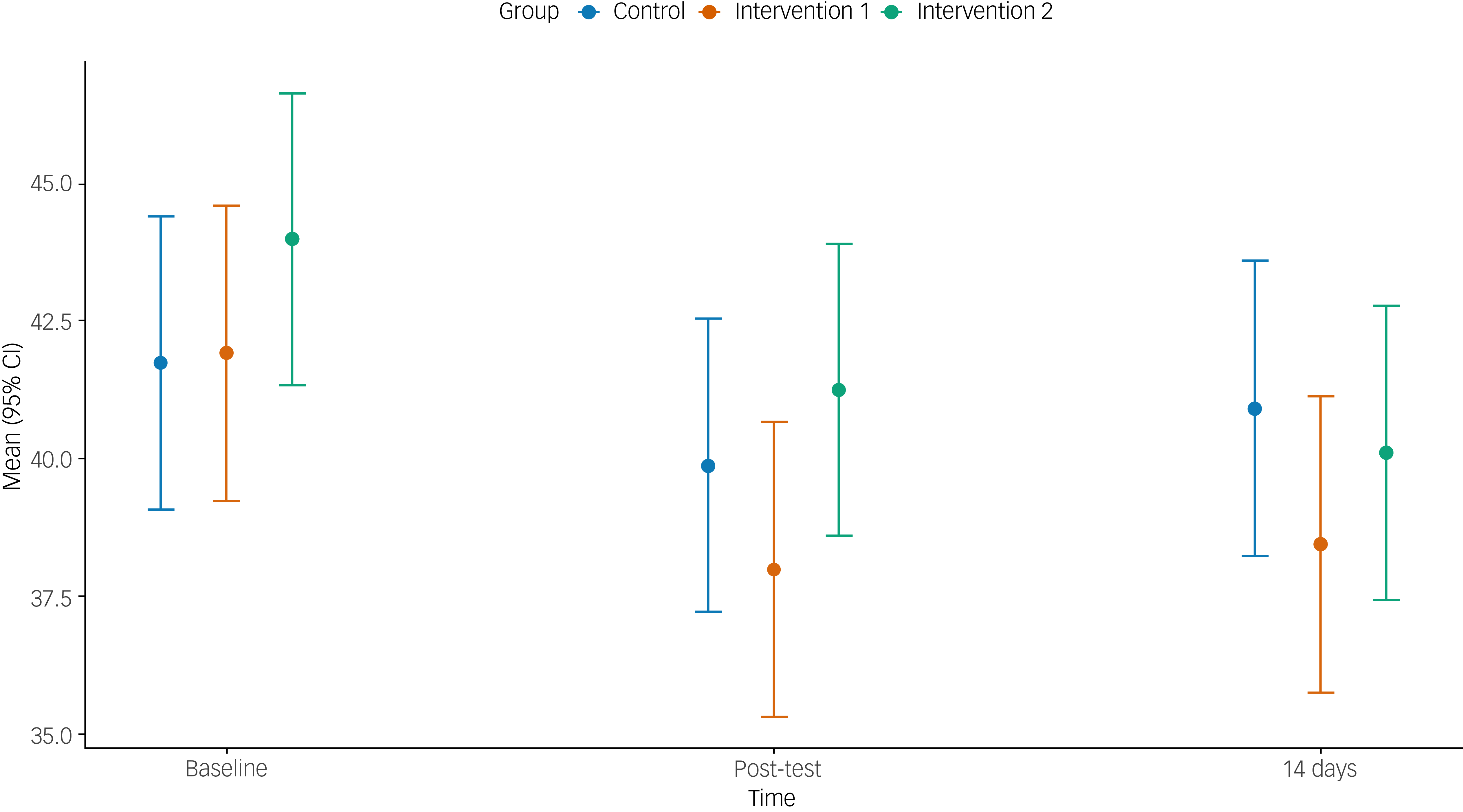
For the primary outcome, we observed a small and significant decrease in suicidal ideation in intervention group 1 at post-test (SMD = 0.15, p = 0.019), which was sustained at 14-day follow-up (SMD = 0.17, p = 0.038) (see Fig. 2). There was no significant effect on suicidal ideation in intervention group 2 at post-test (SMD = 0.05, p = 0.534), yet a marginal (p = 0.053) reduction in suicidal ideation was observed at 14-day follow-up (SMD = 0.16), which was comparable in size to the small effects in intervention group 1. There were no statistically significant differences in intervention effects on suicidal ideation between the two intervention groups at post-test and 14-day follow-up (see Supplementary Table 1).
Mean (95% CI) of suicidal ideation score by intervention groups and timepoints.

In our subgroup analysis among participants with above-median scores on the suicidal ideation measure at baseline, we observed a statistically significant decrease in suicidal ideation in intervention group 1 at post-test (SMD = 0.25, p = 0.039), which was sustained at 14-day follow-up (SMD = 0.32, p = 0.023). In this subgroup, there was no effect on suicidal ideation in intervention group 2 at post-test (SMD = 0.09, p = 0.349), yet a significant decrease was observed at 14-day follow-up (SMD = 0.32, p = 0.024).
Secondary outcome analyses
Stigmatising attitudes
At both post-test and 14-day follow-up, we observed small and statistically significant reductions in stigmatising attitudes in intervention group 1 (post-test SMD = 0.19, p = 0.011; 14-day SMD = 0.19, p = 0.035) and intervention group 2 (post-test SMD = 0.16, p = 040; 14-day SMD = 0.26, p = 0.003).
Suicide prevention knowledge
At both post-test and 14-day follow-up, we observed moderate and statistically significant increases in suicide prevention knowledge in intervention group 1 (post-test SMD = 0.52, p < 0.001; 14-day SMD = 0.50, p < 0.001) and intervention group 2 (post-test SMD = 0.36, p < 0.001; 14-day SMD = 0.44, p < 0.001).
Intended help-seeking behaviour
We observed a small and statistically significant increase in total intended help-seeking behaviour scores in intervention group 1 at post-test (SMD = 0.16, p = 0.011), which was not sustained at 14-day follow-up (SMD = 0.02, p = 0.852). There was no change in total intended help-seeking behaviour scores in intervention group 2 (post-test SMD = 0.03, p < 0.687; 14-day SMD = 0.03, p < 0.698). Post hoc analyses examined the effects on intentions to seek help from specific types of support (see Supplementary Table 2). Compared with the control group, participants in intervention group 1 exhibited small increases in intentions to seek help from intimate partners (SMD = 0.16, p = 0.028), phone helplines (SMD = 0.32, p > 0.001) and mental health professionals (SMD = 0.15, p < 0.040). We also observed an increase in intentions to seek help from phone helplines (SMD = 0.26, p = 0.067) in intervention group 2 at post-test. No effects were sustained at 14-day follow-up in either group.
Sensitivity analysis
The treatment effect estimates were consistent across ANCOVA and linear mixed models, indicating that the substantive findings are robust. Differences in p-values arise because mixed models partition variance differently and incorporate correlation across repeated measures, which affects standard errors but not the underlying effect size (see Supplemental Table 3).
Discussion
Young adults who viewed the print media content with educative suicide prevention messaging demonstrated small reductions in suicidal ideation and stigmatising attitudes, and improvements in suicide prevention knowledge and intended help-seeking. These improvements were sustained at 14-day follow-up, other than for intended help-seeking. Importantly, the improvements in suicidal ideation were also observed in the subgroup of participants with greater vulnerability to suicidal ideation at baseline. The effect sizes were small, which is consistent with comparable previous studies on the effects of brief media stimuli on suicidal ideation. Reference Niederkrotenthaler, Till, Kirchner, Sinyor, Braun and Pirkis9
These findings are notable given participants were only exposed to three short (∼600 words) print media articles. In line with conventional benchmarks, the effect sizes (i.e. SMDs) observed in this trial fall within the ‘small’ range (around 0.2), indicating modest individual-level changes in suicidal ideation. Many psychological interventions also yield small effects on suicidal ideation, and these are resource-intensive interventions that reach a limited number of at-risk people. Reference Buscher, Torok, Terhorst and Sander32,Reference Kothgassner, Robinson, Goreis, Ougrin and Plener33 While the effects on suicidal ideation in our study were small, print media reaches many thousands of people in the general population in India, 13 and these small effects across a large number of people can represent a substantial population-level impact that is highly cost-effective. For example, the print media sector in India circulates an estimated 400 million copies daily across all languages. If brief educative content with effects of the magnitude observed in this trial were embedded routinely in widely read newspapers or their online editions, even a small average reduction in suicidal ideation could translate into a large absolute number of young adults experiencing lower levels of suicidal distress. Our findings therefore support the view that protective media content is best conceptualised as a population-level strategy that shifts risk distributions slightly for many people, rather than as an intensive clinical intervention targeting a few individuals at very high risk. Our findings suggest that protective media content may be a feasible and scalable component of a broader public-health strategy, when the intervention can be embedded in widely consumed media and repeatedly encountered over time.
This RCT was accompanied by a nested qualitative study using semi-structured interviews with 20 trial participants exposed to the protective media content. Reference Armstrong, Kumar, Mohanraj, Krishnamoorthy and Vijayakumar34 That study showed that young adults in Chennai described routine suicide reporting as sensational, distressing and often misleading, while the educative and recovery-oriented articles used in our interventions were experienced as unexpectedly hopeful, myth-busting and supportive of help-seeking, thereby triangulating and enriching our quantitative findings.
Contemporary research in ‘Western’ cultural settings and international media guidelines recommend the use of hopeful narratives of people surviving suicide crises. 4,Reference Niederkrotenthaler, Till, Kirchner, Sinyor, Braun and Pirkis9,Reference Niederkrotenthaler, Tran, Gould, Sinyor, Sumner and Strauss35 In our trial, adding brief lived-experience narratives to educative content did not clearly produce larger or more immediate effects on suicidal ideation than educative content alone, although a delayed effect emerged at 14-day follow-up among participants with greater baseline vulnerability. One plausible explanation is methodological: unlike most Papageno-type interventions where the media piece is entirely devoted to a recovery story, our narratives were short vignettes (about 250 words) embedded within broader educative articles, with a corresponding reduction in expert commentary to maintain equal length, so the ‘dose’ of narrative content may have been too small to produce incremental benefits within a single exposure. One possible explanation for the delayed effect is that these hopeful survival narratives are almost non-existent in the media in India, Reference Armstrong, Vijayakumar, Niederkrotenthaler, Jayaseelan, Kannan, Pirkis and et al16,Reference Armstrong, Goyal, Dhar, Vijayakumar, Haregu and Singh36 and time may have been required to reflect on and digest these stories. It is also possible that the reception and impact of lived-experience narratives differ across cultural contexts. Although the vignettes were based on real lived experiences and co-designed with local experts, they may not capture all the help-seeking pathways and contexts that feel most salient or realistic for all young adults in this setting. In view of these design and contextual considerations, our findings should not be interpreted as evidence against the Papageno effect in India or other low- and middle-income countries, but rather as indicating that both the format (brief embedded vignettes versus full recovery stories) and the cultural tailoring of narratives are crucial design elements that warrant further investigation.
Our finding of a reduction in stigmatising attitudes, sustained at 14-day follow-up in both intervention groups, is also remarkable. Prior research has found suicide-related attitudes to be resistant to change after exposure to brief media stimuli. Reference Till, Tran, Voracek and Niederkrotenthaler24,Reference Till, Niederkrotenthaler, Herberth, Vitouch and Sonneck37 However, these prior studies have been undertaken in settings where the general population has been exposed to prior suicide prevention campaigns, potentially causing ceiling effects in these studies. It is plausible that media stimuli may be more likely to have effects on attitudes in locations where protective media content related to suicide is rare. Although suicidal ideation was specified as the primary outcome, the observed improvements in suicide-related knowledge and stigma are central to the public health significance of this intervention and likely represent important mechanisms through which brief protective media content may contribute to longer-term prevention.
Strengths and limitations
A strength of the study was that it is the first experiment to report effects of protective media content related to suicide in South Asia, where there is a significant suicide burden. Indeed, it is the first such experiment outside of Austria or Australia. A further strength is the follow-up period of 14-days, which goes beyond prior studies that tested either immediate effects or effects at 1 week. Reference Niederkrotenthaler, Till, Kirchner, Sinyor, Braun and Pirkis9,Reference Niederkrotenthaler and Till26 The study also has some limitations. First, we used a convenience sample, which was well educated, and students were over-represented, limiting generalisability. Second, suicidal ideation was ascertained through participants’ responses to a questionnaire, without clinical evaluation. Finally, although it is encouraging that some effects persisted at 14-day follow-up, this remains a relatively short timeframe, and our findings should be interpreted as evidence of short-term impact pending further research on the durability of effects and the optimal frequency of exposure in real-world prevention settings.
In conclusion, this study indicates that exposure to brief media stimuli with educative suicide prevention messaging can lead to small improvements in suicidality, stigmatising attitudes, suicide prevention knowledge and intentions to seek help. Media stimuli can reach very large numbers of people, and educative suicide prevention media messaging is an important strategy for suicide prevention in India.
Supplementary material
The supplementary material is available online at https://doi.org/10.1192/bjp.2026.10799
Data availability
Data may be obtained from a third party and are not publicly available. Raw data cannot be shared publicly due to ethical restrictions, as permission from participants was not sought to place their data in a public repository given the highly stigmatised nature of suicidality. Requests for access to the raw data can be sent to the Human Research Ethics Committee at the University of Melbourne (Ref: 2021-20927-15388-3) at HumanEthics-Enquiries@unimelb.edu.au.
Acknowledgements
We would like to thank Sandhya Ravishankar, a senior media veteran, who worked with G.A. and L.V. to develop the media content used for the intervention and control conditions. We would like to thank Dr Thara Rangaswamy and Ms Jothi Lakshmi from SCARF-Chennai for leading the data safety and monitoring board for this study. Artificial Intelligence use: No artificial intelligence tools have been used in the research or writing process for this manuscript.
Author contributions
G.A., L.V., T.N. and J.P. conceptualised the study. G.A., T.H., R.M. and S.K. verified the data. R.M., S.K., T.H. and G.A. curated the data. T.H. and M.J.S. conducted the formal analysis. G.A., L.V., T.N. and J.P. secured funding. G.A., L.V., S.K. and R.M. conducted the investigation. G.A., L.V., T.N., T.H. and M.J.S. developed the methodology. R.M., S.K., B.N., D.S. and G.A. administered the project. G.A., L.V., S.K. and R.M. provided resources. G.A. and L.V. supervised the study. G.A. and T.H. wrote the original draft. G.A., S.K., R.M., T.H., M.J.S., T.N., J.P., B.N., D.S. and L.V. reviewed and edited the manuscript. All authors read and approved the final version of the manuscript.
Funding
The study was funded by a research grant from the American Foundation for Suicide Prevention (SRG-R-005-19).
Declaration of interest
L.V. is a member of the editorial board of the British Journal of Psychiatry, and did not take part in the review or editorial decision-making process for this paper.



 Open access


eLetters
No eLetters have been published for this article.