


Background
The number of children and young people (CYP) in contact with NHS-funded mental health services is increasing. Since 2019, the number of under-18s referred to Child and Adolescent Mental Health Services (CAMHS) has risen by 53%, reaching over 1.2 million in 2022 (Young Minds, 2024). The trend of increasing referrals and unmet need can be further exemplified by the Royal College of Psychiatrists’ findings that in November 2025 there were 550,610 children on mental health waiting lists with 289,722 waiting over a year and 165,887 waiting over 2 years (Royal College of Psychiatrists, 2026). Delays in accessing care can exacerbate existing mental health difficulties (King, Reference King2025), making responsiveness a critical feature of service delivery.
A particularly vulnerable group of CYPs with mental health needs are those who experience a long-term health condition (LTC), defined as a diagnosed health condition lasting more than 3 months. CYP diagnosed LTC account for around 1.7 million, or 23%, of CYP in England (Moore et al., Reference Moore, Nunns, Shaw, Rogers, Walker and Ford2019). Compared with their healthy peers, CYP experiencing LTC are significantly more likely to develop mental health symptoms and face additional barriers to care, often due to poor integration between mental and physical health services (Adams et al., Reference Adams, Chien and Wisk2019; Pinquart, Reference Pinquart2020; Pinquart and Shen, Reference Pinquart and Shen2011).
Previous research suggested that some of the challenges faced by CYP trying to access mental health support for LTC can be mitigated by offering a low-intensity service accessed via self-referral within paediatric hospitals. This service, known as The Lucy Project, offered support at the time of need with limited waiting time and was found to increase access to mental health services while offering clinically and statistically meaningful psychological outcomes for CYP and their parents (Bennett et al., Reference Bennett, Kerry, Fifield, Ching, Catanzano, Liang and Shafran2021; Catanzano et al., Reference Catanzano, Bennett, Kerry, Liang, Heyman, Coughtrey and Shafran2021; Roach et al., Reference Roach, Bennett and Heyman2025). The support offered included signposting to existing provision, referral to appropriate services such as neurodevelopmental assessments and provision of low-intensity cognitive behavioural therapy (LICBT). The service was also adjudged to cost roughly half of a typical course of more traditional high-intensity psychotherapy (Clarke et al., Reference Clarke, Morris and Catanzano2022). The previous studies indicated that The Lucy Project was able to offer assessments within two weeks on average.
Whilst these outcomes, including reduction in overall waiting time, are very promising, they do not necessarily equate to equitable access across diverse patient groups. Despite ongoing efforts to reduce health disparities in the UK, evidence suggests that inequalities in child and adolescent mental health services are widening (Fairchild, Reference Fairchild2019). A 2013 systematic review (Reiss, Reference Reiss2013) found that 94% of included studies reported an inverse relationship between at least one socioeconomic status (SES) marker and mental health outcomes, indicating that lower SES is associated with poorer mental health in CYP. Children from lower SES backgrounds were also found to be two to three times more likely to develop mental health problems and more likely to experience comorbidities. A 2021 review (Cooper and Stewart, Reference Cooper and Stewart2021) reinforced this, showing that, all else being equal, CYP from higher-income households had better mental health outcomes than those from lower-income families. Fairchild (Reference Fairchild2019) summarised the literature in an editorial, proposing that lower SES families may face a ‘double-hit pathway’: first, they are more likely to experience mental health difficulties due to socioeconomic disadvantage; second, they are less likely to access support services for their family’s mental health needs.
Additionally, CYP from diverse ethnic backgrounds also face additional barriers to accessing mental health services. For example, children from global majority backgrounds may encounter language barriers, fear of accessing services due to the potential for racist treatment, and lower awareness of available services, all of which can delay treatment and worsen outcomes (Aspinal and Jacobsen, Reference Aspinall and Jacobsen2004). A recent review further highlights that systemic inequalities continue to affect ethnic minority communities across the UK’s national healthcare system, including mental health provisions (Kapadia et al., Reference Kapadia, Zhang, Salway, Nazroo, Booth, Villarroel-Williams, Becares and Esmail2022). NHS England’s Core20PLUS5 initiative recognises these disparities and prioritises improving access to mental health services for ethnic minority CYP (NHS England, 2022).
Evidence from the original Lucy Project study, and the later non-randomised multi-site study indicated that the number of families from non-White British, global majority backgrounds were more represented in the study when compared with nationwide CAMHS data (Catanzano et al., Reference Catanzano, Bennett, Kerry, Liang, Heyman, Coughtrey and Shafran2021), which may suggest that overall, the drop-in model reduced barriers to accessing care for those from global majority background.
The non-randomised multi-site study allowed sites to implement the drop-in model in the ways that best suited their local setting and population. This means that equitability of access may have been different across different sites. One of the sites in the six-site single arm trial was Sheffield Children’s Hospital, a specialist children’s hospital in the North of England. Following the single arm trial, funding was received to continue the project as a service.
Sheffield Children’s Hospital is a specialist tertiary hospital offering local, regional and national health services to young people and families. As such, many young people are required to travel significant distances to attend appointments which can have significant impacts on families who have to take time off work or for children to miss school (MacDonald et al., Reference MacDonald, Ferrari, Fainman-Adelman and Iyer2021; Owens et al., Reference Owens, Hoagwood, Horwitz, Leaf, Poduska, Kellam and Ialongo2002). The Lucy Project in Sheffield therefore chose to implement a video-call based only LICBT intervention to minimise disruption to daily life via time and expense of travel. While a digitally based intervention can reduce impact of travel, there are also concerns relating to children in lower socio-economic contexts being excluded from accessing the intervention due to a lack of access to appropriate technology (Holmes and Burgess, Reference Holmes and Burgess2022). Therefore, the present paper wishes to evaluate if this service decision inadvertently or disproportionately impacts the most deprived.
This study aims to describe how The Lucy Project has been implemented in Sheffield Children’s Hospital, and to understand if the accessibility and acceptability of the service are associated with the SES and ethnicity. Specifically, these questions were met through examining:
-
(1) The demographics of the families accessing The Lucy Project Service in comparison with the demographics of children and young people in Sheffield.
-
(2) Whether SES or ethnicity were associated with engagement or withdrawal from The Lucy Project (considered as a proxy for acceptability; Simmonds-Buckley et al., Reference Simmonds-Buckley, Bennion, Kellett, Millings, Hardy and Moore2020).
Method
Intervention
The Lucy Project service at Sheffield Children’s Hospital offers self-referral psychological interventions to support young people, aged 6–18 years old, who experience recent onset distress related to their physical health. To access the service, young people or their parents are able to scan a QR code or follow a link to an online self-referral form which they can complete and submit.
To support appropriate referrals, the self-referral form begins by explaining eligibility criteria and emphasises the service being for young people who experience mild to moderate psychological difficulties in relation to their physical health. In addition to demographic details, the form asks for descriptions of current difficulties, what the impacts of the difficulty have on other areas of life (e.g. school or friendships) and if there are any current or historical known experiences of risk. The form also includes information around the interventions being video-based and not face-to-face – potential referrals are required to tick a box confirming their understanding of the above before being able to submit the form.
The QR code for the self-referral form was displayed in clinic areas via TV screens or shown to potential young people by clinicians using posters or business cards. The self-referral form is received via a shared inbox and is then assessed and triaged accordingly based upon eligibility and the suitability of LICBT to meet the needs of the young person. To be eligible for The Lucy Project, patients must be under a consultant at a designated paediatric hospital for a physical health condition. Patients had to exhibit mild to moderate mental health needs, such as anxiety, depression, and/or behavioural difficulties which were not currently being treated by other psychology services (Roach et al., Reference Roach, Bennett and Heyman2025). Once a referral was received, patients were contacted by an assistant psychologist who performed a triage call and discussed with senior children’s wellbeing practitioners and a clinical psychologist to determine eligibility and complexity of the referral before a triaging decision was made.
Participants are either allocated to a brief, low intensity cognitive behavioural therapy (LICBT) intervention, signposted or referred to an appropriate internal or external service such as local CAMHS, neurodevelopmental services or stepped to higher intensity psychotherapy in paediatric psychology services where available. LICBT is provided by senior children’s wellbeing practitioners (CWP) who have experience in adapting LICBT treatment protocols to children and young people who experience difficulties with their health. Following an initial assessment session, if appropriate, young people would be offered 6–8 sessions of video-based LICBT which is conducted remotely; no face-to-face interventions are offered within this service.
The nature of delivering LICBT protocols within a paediatric health setting requires practitioners to be aware of the additional complexities that can arise within this context. For example, young people may be more likely to experience pain or fatigue, meaning session lengths need to be amended. Young people may also be more likely to have conflicting hospital appointments leading to inconsistent session times. In terms of the work itself, considerations around specific pieces of the protocol need to carefully take into account physical health. For example, exposure work for young people with allergies or epilepsy need careful liaison with medical professionals and families to understand the relative risk and dangers of being exposed to different environments. We also need to consider when to challenge thoughts given that fears and unwanted thoughts may be justified and reasonable given the potential risks.
CWP also had the option of using parent-led LICBT should the young person not be able to engage with the work directly or were too young as per protocol. We recognise that LICBT is not suitable for all, and so The Lucy Project serves a vital function in referring people whose needs are not met by LICBT into other suitable services. Onwards referrals and signposting is done directly without the family needing to complete a further referral.
Sample
The data from patients accessing the service (n = 149) was obtained from patient records following engagement with The Lucy Project Service at a single site at Sheffield Children’s Hospital, a specialist children’s hospital in the north of England. The first 41 participants of this sample who entered the Sheffield service were also included in The Lucy Project roll-out analysis published elsewhere, which ran from December 2022 to January 2024 (Roach et al., Reference Roach, Bennett and Heyman2025). The remaining 108 participants accessed the Sheffield service between January 2024 and December 2024 following its transition from a research project into a stand-alone service. The process for accessing the service remained the same following this transition with the exception of families not needing to give informed consent checks as part of the research project. All data were reviewed in retrospect as part of an evaluation of The Lucy Project service which has been established as routine clinical care in the hospital. Data were anonymised prior to analysis.
Data analysis
Objective
The objective of this study was to understand if specific demographic characteristics impacted on how young people and families engage with The Lucy Project Service. Demographics which were utilised for this analysis were indices of multiple deprivation (IMD) and ethnicity.
Engagement status
Outcome data were organised into a binary variable of ‘engaged’ or ‘not engaged’. This was assessed from status data recorded by practitioners. Patients who ‘engaged’ included those that completed the planned work, were still undertaking intervention, or had been successfully signposted to more suitable service providers. Patients who were considered ‘not engaged’ had either declined input, dropped out prior to agreed end of intervention, or not responded to contact following their own self-referral.
Ethnicity
All ethnicity data were taken from the medical records. All patients are asked to provide their ethnicity at their first contact with the hospital and this is updated on the system accordingly.
Deprivation index
To estimate participants’ experience of deprivation, we used the indices of multiple deprivation (IMD), which is the official measure of relative deprivation for small areas of the United Kingdom (Ministry of Housing, Communities & Local Government, 2019). Areas are ranked from the most deprived area (rank 1) to the least deprived (rank 10), with deprivation measured across seven distinct domains: income, employment, education, health, crime, barriers to hosing and services, and the living environment. We used participants’ postcodes which were collected as routine to indicate corresponding IMD decile.
Results
Ethnicity
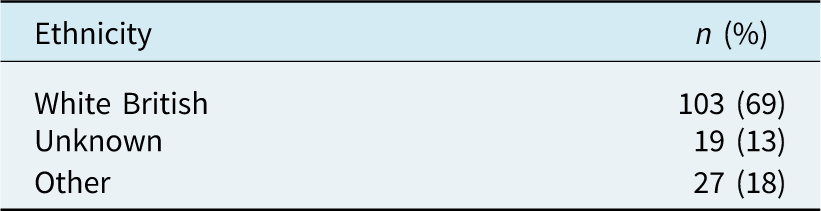
Ethnicity information was evaluated as described above; however, given the large variance in ethnicities that were recorded, it was decided to aggregate this information into the most common categories to allow meaningful analysis. The emergent categories were: ‘White British’ n = 103, ‘unknown’ n = 19, and ‘other’ n = 27.
A summary of all collected patient demographics for this study can be found in Table 1. Ethnicity figures (Table 1) are broadly similar to that of the Sheffield region where this phase of the intervention took place, with 69% of our sample identifying as White British compared with 74.5% of the population in the 2021 Census (Sheffield City Council, 2021).
Participant ethnicity

Table 1. Long description
A table summarizing participant ethnicity data. The table has two columns: Ethnicity and n (%). It contains three rows. Row 1: White British, 103 (69). Row 2: Unknown, 19 (13). Row 3: Other, 27 (18).
Indices of multiple deprivation
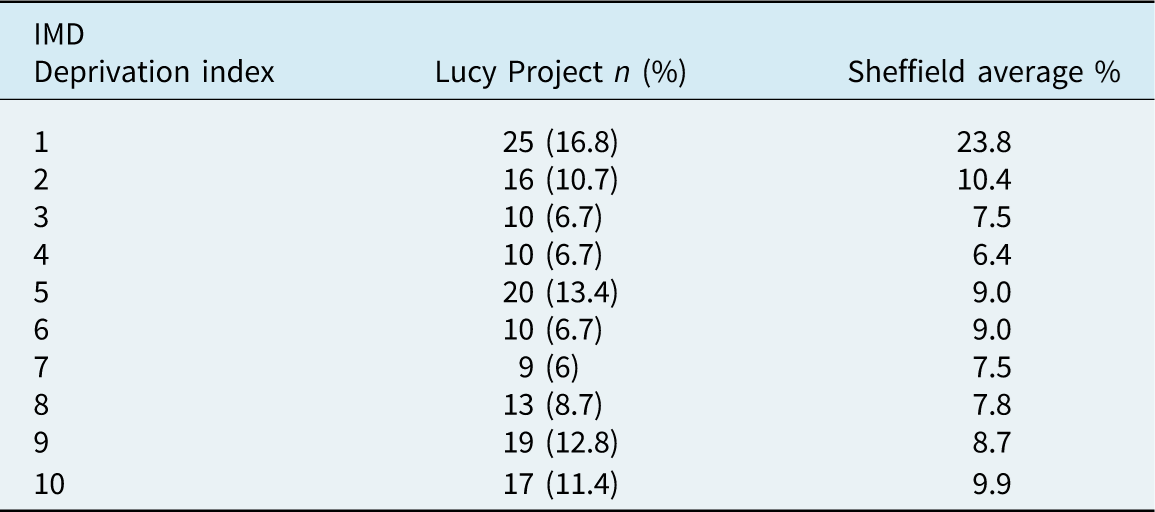
IMD data suggest that 27.5% of participants lived in areas associated with the bottom two centiles of deprivation compared with 34.2% recorded in the Sheffield general population (Sheffield City Council, 2025). Figures for comparison between this sample and the Sheffield population in general are provided in Table 2.
Participant indices of multiple deprivation

Table 2. Long description
A table with 10 rows and 3 columns comparing deprivation indices between the Lucy Project and Sheffield average. The columns are labeled IMD Deprivation index, Lucy Project n (%), and Sheffield average %. The rows list deprivation indices from 1 to 10. For each index, the table shows the number and percentage of participants in the Lucy Project and the corresponding percentage for the Sheffield average. Notable values include 25 participants (16.8 percent) in the Lucy Project for index 1 compared to 23.8 percent in Sheffield, and 17 participants (11.4 percent) for index 10 compared to 9.9 percent in Sheffield.
Demographics
A breakdown of demographic data in this sample can be found in Table 3. We can see in these data that on average, around 2/3 of participants were female with an average age of approximately 11, with these findings being consistent across the three ethnic groups considered here. A similar pattern was also seen with IMD deciles 1–3 and 8–10; however, the gender split was more even for IMD deciles 4–7 which was around 55% female.
Demographic information of sample

Table 3. Long description
The table presents demographic data of participants categorized by gender, ethnicity, and IMD deciles. It has 7 columns and 6 rows. The columns are labeled Overall, White British, Unknown, Other, IMD 1-3, IMD 4-7, and IMD 8-10. The rows are labeled Male, Female, Mean Age, Min. age, and Max. age. Row 1: Male, 56 (37 percent), 40 (39 percent), 7 (35 percent), 9 (34 percent), 16 (31 percent), 22 (45 percent), 18 (37 percent). Row 2: Female, 93 (63 percent), 63 (61 percent), 13 (65 percent), 17 (66 percent), 35 (69 percent), 27 (55 percent), 31 (63 percent). Row 3: Mean Age, 11.76, 11.72, 11.26, 12.23, 11.82, 11.81, 11.65. Row 4: Min. age, 6, 6, 6, 6, 6, 6, 7. Row 5: Max. age, 18, 18, 16, 14, 17, 18, 16.
Analysis
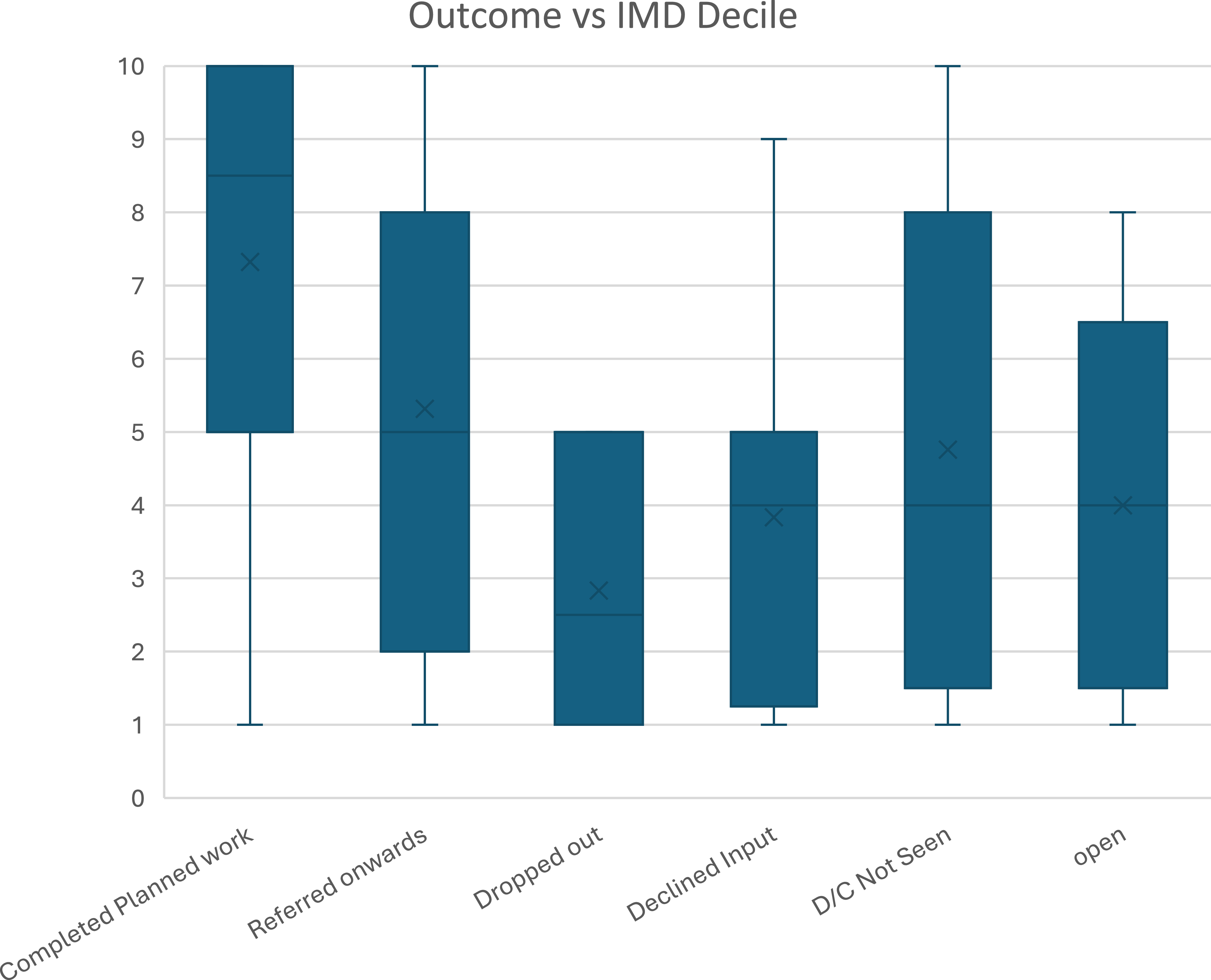
A visual representation of this data can be found in Fig. 1, where we can see the average IMD decile of those who complete work appears much higher than those who dropped out or declined input. Interestingly those who were referred onwards, were discharged unseen or who were still open at the time of analysis showed larger ranges on these box plots.
Patient outcome related to IMD decile.

A binary logistic regression was conducted to examine whether IMD and ethnicity comparisons predicted the likelihood of service engagement in The Lucy Project. The dependent variable was engagement status. Predictors included ethnicity and IMD decile.
The overall model was statistically significant, χ2 (3) = 11.455, p = 0.010, indicating that the predictors reliably distinguished between participants who were rated as ‘engaged’ and ‘not engaged’ in their outcome within Lucy Project treatment. The model explained approximately 10.6% of the variance in service engagement status and correctly classified 71.1% of cases.
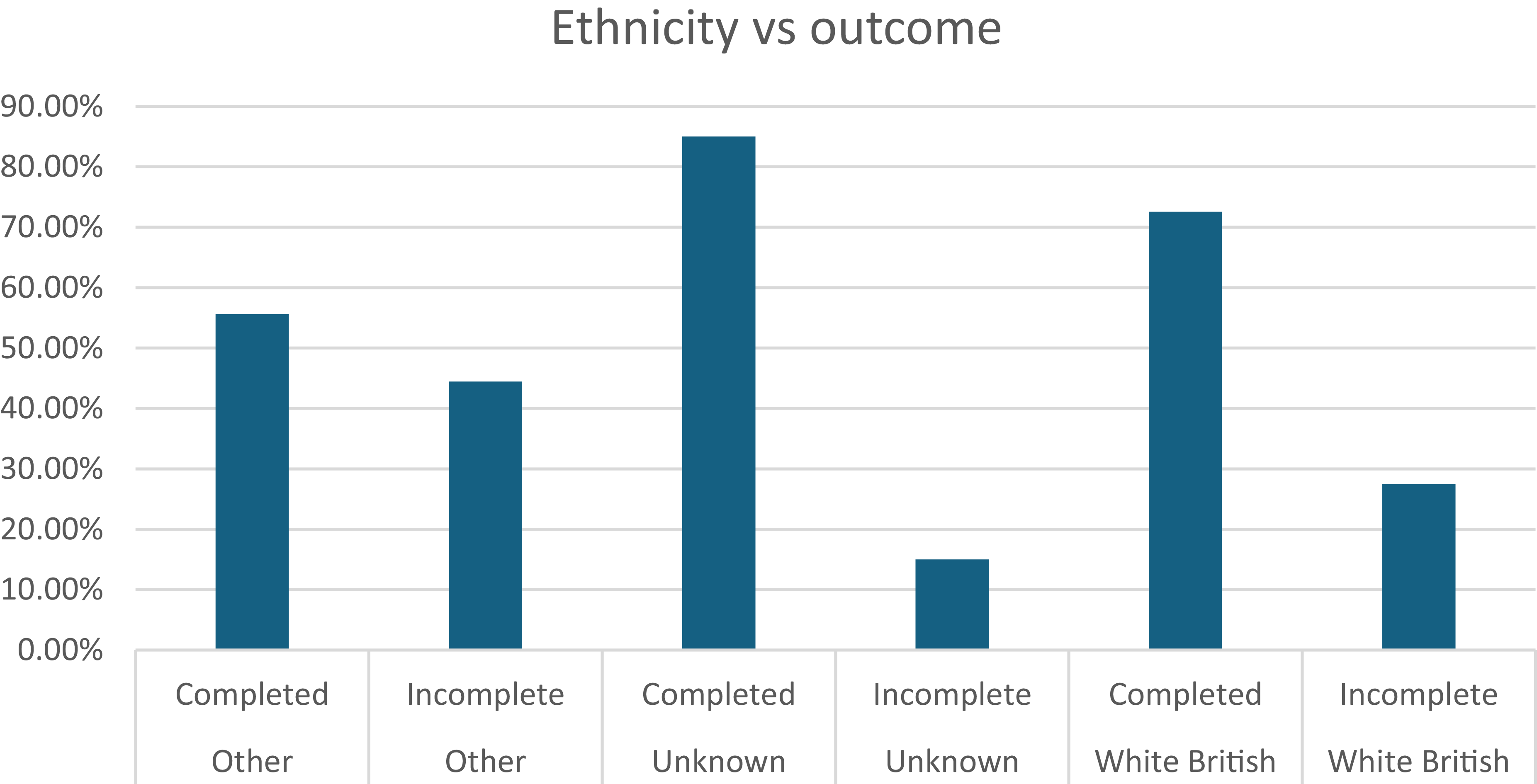
Examining the individual predictors, ethnicity did not significantly predict service engagement. Compared with White British participants, those identifying as ‘other ethnic group’ did not differ significantly in odds of engaging with treatment within The Lucy Project, B = 0.551, p =.172. Those who selected ‘prefer not to say’ and so were ‘unknown’ also did not differ significantly compared with White British identifying participants, B = –0.830, p = 0.219. A visual representation of those who engaged and those who did not based on their ethnicity can be seen in Fig. 2.
A comparison of Ethnicity (other, unknown or White British) to treatment outcome.

IMD decile was a significant predictor, B = –0.153, SE = 0.063, Wald = 5.958, p = 0.015, suggesting for every 1-unit increase in IMD decile, the odds of the service engagement decrease by about 14.2%.
Discussion
Previous research highlights that access to support for children’s mental health services can be limited and problematic, with large waiting lists reported (Royal College of Psychiatrists, 2026). Additionally, children and young people diagnosed with LTC experience higher prevalence of mental health difficulties as well as challenges of physical and mental health care integration (Adams et al., Reference Adams, Chien and Wisk2019; Pinquart, Reference Pinquart2020; Pinquart and Shen, Reference Pinquart and Shen2011).
The Lucy Project represents a novel approach to integrated paediatric psychology intervention which employs both self-referral and LICBT to support young people and families via video call. Evidence is emerging around its effectiveness in terms of psychometric outcomes (Bennett et al., Reference Bennett, Kerry, Fifield, Ching, Catanzano, Liang and Shafran2021; Catanzano et al., Reference Catanzano, Bennett, Kerry, Liang, Heyman, Coughtrey and Shafran2021; Roach et al., Reference Roach, Bennett and Heyman2025) and cost effectiveness (Clarke et al., Reference Clarke, Morris and Catanzano2022).
As The Lucy Project employs an electronic referral form and virtual, video-based interventions, it can be seen as potentially reducing some barriers to access, such as needing to find time in a medical appointment to discuss mental health, being able to take time off school or work to travel to an appointment or travel long distances (MacDonald et al., Reference MacDonald, Ferrari, Fainman-Adelman and Iyer2021; Owens et al., Reference Owens, Hoagwood, Horwitz, Leaf, Poduska, Kellam and Ialongo2002). While these are potential benefits of the model, it is also worth acknowledging the concerns around digital poverty and exclusion (Holmes and Burgess, Reference Holmes and Burgess2022) which could impact some of the most vulnerable young people.
Given these concerns, the current paper wished to look at the first 149 young people to access The Lucy Project at a specific site to see if there were any differences between those who engage with the service and those who do not following an initial self-referral with respect to their demographic variables of IMD and ethnicity.
The findings demonstrate that although ethnicity did not predict service engagement, the IMD decile of participants was a significant predictor of service engagement status. These findings suggest that participant engagement strategies within The Lucy Project should carefully consider those clients who reside in areas that score higher on the IMD scale.
Firstly, our sample was, from an ethnicity perspective, broadly representative of our local population with 69% of our sample identifying as White British compared with 74.5% of the general population. It was found that a significant proportion of our sample did not have their ethnicity recorded and were labelled as ‘unknown’ within this study. As the patients had already been logged in the system by medical specialities prior to referral to The Lucy Project, they were not asked as default as a part of The Lucy Project triage process. This has now been amended to make sure that it is asked about at appointments regardless of prior input to ensure that pertinent information is captured should it have been missed elsewhere in the process.
Even if we assume that all of the 13% of ‘unknown’ ethnicity patients were White British this would still suggest that around one-fifth of the sample were from a global majority background. Given the sample make up it is encouraging to see that once someone has made a self-referral, their completion or non-completion of the intervention was not influenced by their ethnicity in a statistically significant manner. It can be noted that the current paper is unable to understand the experience of accessing the service and if any barriers exist prior to a self-referral; however, once within the service the outcomes are equivalent between ethnicities.
In contrast we can see a significant difference emerge in relation to engagement and IMD. The analysis showed that the more deprived the environment a young person is living in, the more likely they were to engage with the intervention or to be appropriately signposted in contrast to more affluent young people who were more likely to drop out. The authors of this paper posit a potential explanation that young people from more affluent backgrounds may have access to alternative social or healthcare support and financial means to access support elsewhere compared with young people who do not have such opportunity. At this time, this is a hypothesis that would require additional study into aspects not just of digital poverty and exclusion but in terms of access to wider social protectants which may influence engagement with specific services. We would want to consider this especially in reference to a self-referral service and how this is functionally distinct from traditional services that require a professional’s referral.
One of our main concerns around access to such a digitally based service was around digital exclusion and poverty, potentially making it more difficult for young people from less privileged backgrounds being able to access appropriate technology (Holmes and Burgess, Reference Holmes and Burgess2022). However, the current sample showed that 27.5% of young people accessing the service were from the bottom quintile of IMD status which is encouraging that digital exclusion is not as big a barrier as anticipated. We are also anecdotally aware that many young people accessed the intervention using computers, tablets or phones from within their school. This allowed young people to have minimal disruption to their school day by being able to miss only one lesson in the day as opposed to having to travel to an appointment. Further work would be needed to understand if those accessing via digital equipment in school would have been able to do so from home or if they would have had the same access if not in school or home-educated for example. Given the difference in contexts it would also be useful to understand if accessing from school or home is more or less acceptable to specific groups of young people.
The current study is a preliminary analysis of the service in its infancy. As such, it contains a small sample that required categories to be condensed to support analysis. In future, analysis would employ a larger sample to allow a broader analysis of ethnicity, and for outcomes to be split so that engagement status could be separated into those who completed intervention and those who were successfully signposted elsewhere. The authors are fully aware of the tension of grouping a large variety of individuals, cultures and ethnicities within umbrella terms such as ‘other’ or ‘unknown’ and would want to amend this in future work. Additionally, IMD is a proxy measure of deprivation across a specific postcode group and as such does not take into account the individual’s level of poverty or deprivation. While the individual postcode sections are small, they are not individual, and the global IMD is split into deciles which makes the approach a blunter tool than an individual rating. Despite it being the best measure available, the authors still recognise its limitations with respect to individuals.
A larger sample would also have allowed us to more precisely consider subcategories of ‘engagement’ and ‘non-engagement’, for example the differences between those who drop and those who never commence intervention may have different experiences. While the choices to consolidate categories such as relative deprivation, ethnicity and engagement status were made in this paper to allow broad meaning to emerge, it would be vital for future research to employ larger samples and more specific metrics to fully understand the underlying data with more precision and depth.
The Lucy Project has now expanded beyond Sheffield into surrounding regions and beyond, thus understanding how people access the service and making this as equitable as possible is one of the key priorities as the service continues to evolve. A more robust planned analysis of patient data from across the eight partner hospitals will help to shed more light on access to such a service in the future.
Key practice points
-
(1) Services should consider targeted engagement strategies that take into account both the individual and co-occurring impacts of deprivation and ethnicity.
-
(2) Consider what other support mechanisms and services are accessible to young people from different levels of deprivation given the finding that less deprived are more likely to self-refer but then drop out.
-
(3) Services need to be more aware of routine recording of ethnicity in practice.
-
(4) Digital exclusion needs to be carefully considered and alternative access via institutions such as schools be sought to support those who may not have reliable access to such technologies.
Data availability statement
Not applicable to this article.
Acknowledgements
None.
Author contributions
Steve Jones: Conceptualization-Lead, Data curation-Lead, Formal analysis-Lead, Funding acquisition-Lead, Investigation-Lead, Methodology-Lead, Project administration-Lead, Resources-Lead, Software-Lead, Supervision-Lead, Validation-Lead, Writing - original draft-Lead, Writing - review&editing-Lead; Sophie D Bennett: Conceptualization-Supporting, Funding acquisition-Equal, Writing - original draft-Equal, Writing - review&editing-Equal; Roz Shafran: Conceptualization-Equal, Funding acquisition-Equal, Writing - review&editing-Supporting; Anna Roach: Conceptualization-Supporting, Project administration-Equal, Writing - review&editing-Equal; Isobel Heyman: Conceptualization-Supporting, Writing - review&editing-Supporting; Rebecca Evans: Conceptualization-Equal, Project administration-Equal, Writing - review&editing-Supporting; Emily Webster: Conceptualization-Equal, Data curation-Supporting, Project administration-Equal, Writing - review&editing-Supporting; Evan Hughes: Data curation-Equal, Formal analysis-Supporting, Methodology-Supporting, Project administration-Equal, Validation-Supporting, Writing - original draft-Equal, Writing - review&editing-Supporting; Frederica Cooke: Conceptualization-Supporting, Data curation-Equal, Project administration-Equal, Software-Equal, Writing - original draft-Equal, Writing - review&editing-Supporting; Eleni Tsappis: Data curation-Supporting, Formal analysis-Equal, Investigation-Equal, Methodology-Equal, Software-Equal; Emilie Southeran: Data curation-Equal, Formal analysis-Equal, Investigation-Equal, Methodology-Equal, Software-Equal.
Financial support
None.
Competing interests
The authors declare no financial competing interests in relation to this submission or work contained therein.
Ethical standards
The work has been undertaken with respect to NHS Digital guidance on publication of anonymised practice data. The authors confirm that they have abided by the Ethical Principles of Psychologists and Codes of Conduct set out by the BABCP and BPS.


 Open access


Comments
No Comments have been published for this article.