


Introduction
Tic disorders are common neurodevelopmental conditions in children and young people, with Tourette syndrome (TS) and chronic tic disorders (CTD) affecting around 1‒2% in England. Tics are rapid repetitive and involuntary movements (motor tics) or sounds (vocal tics), and can be simple (such as blinking or throat clearing), or complex (such as a series of sounds or phrases, or moving multiple parts of the body). For a diagnosis of TS or CTD, these tics need to have been present for more than 12 months. The diagnosis of CTD requires the presence of either motor or vocal tics, and TS the presence of both vocal and motor tics. Research has found boys to be more affected, with onset typically occurring between ages of 3–8 years. Tics follow a waxing-waning pattern, peaking at 8–12 years, with symptoms often improving in adulthood. TS and CTD frequently co-occur alongside other psychiatric conditions, in particular attention-deficit hyperactivity disorder (ADHD), obsessive compulsive disorder (OCD), and autism (Whittington et al., Reference Whittington, Pennant, Kendall, Glazebrook, Trayner, Groom, Hedderly, Heyman, Jackson, Jackson, Murphy, Rickards, Robertson, Stern and Hollis2016),
Functional tics are involuntary physical movements, and a type of functional neurological disorder. They can occur alone and also co-occur in an individual with TS or CTD. However, in contrast to TS or CTD, functional tics have a more sudden adolescent onset, primarily affect girls, and are often triggered by psychosocial stressors. Presentations of functional tics increased during COVID-19, in part linked to psychological distress and routine disruptions experienced by children, young people and their families (Martindale and Mink, Reference Martindale and Mink2022).
Tic disorders can significantly impact children and young people’s quality of life at home and at school, and cause distress for families. Difficulties reported vary, in part according to the nature and severity of the tics, but may include physical discomfort, problems sitting still and concentrating, teasing/bullying from the wider peer group, and issues linked to trying to control their tics. Tic disorders alone have been found to impact on emotional well-being and school functioning (Cutler et al., Reference Cutler, Murphy, Gilmour and Heyman2009; Eapen et al., Reference Eapen, Cavanna and Robertson2016; Pérez-Vigil et al., Reference Pérez-Vigil, Fernández de la Cruz, Brander, Isomura, Jangmo, Kuja-Halkola and Mataix-Cols2018), but co-occurring difficulties can both exacerbate tics and cause additional difficulties for the child/young person (Rattu et al., Reference Rattu, Hall, Hall, Murphy, Kilgariff, James and Groom2025).
With regard to treatment, European guidelines suggest first-line psychological interventions for TS and CTD to be psychoeducation and behavioural therapies. This could include comprehensive behavioural intervention for tics (CBITs; Woods et al., Reference Woods, Piacentini, Chang, Deckersbach, Ginsburg, Peterson, Scahill, Walkup and Wilhelm2008), incorporating habit reversal therapy (HRT), and exposure and response prevention (ERP; Andrén et al., Reference Andrén, Jakubovski, Murphy, Woitecki, Tarnok, Zimmerman-Brenner, van de Griendt, Mol Debes, Viefhaus, Robinson, Ganos, Szejko, Müller-Vahl, Cath, Hartmann and Verdellen2022; Verdellen et al., Reference Verdellen, Keijsers, Cath and Hoogduin2004), both of which have comparable evidence bases and have demonstrated effectiveness when delivered in one-to-one or group format (Hadji-Michael et al., Reference Hadji-Michael, Catanzano, McAllister, Heyman, Lack, Murphy and Gilmour2024). CBIT (HRT) involves the child/young person identifying a small number of particularly bothersome tics and learning to replace one at a time with a behaviour that is physically incompatible with and less socially noticeable than the tic. In contrast, ERP targets multiple tics simultaneously, by exposing the child/young person to the premonitory urge that occurs prior to their tic and teaching them to resist the urge to tic for increasingly prolonged periods of time. Notably, ERP is a CBT approach also used to treat other difficulties, such as OCD. As such, it will be familiar to most CBT therapists and have the benefit of being transferable to treat these co-occurring difficulties if needed. In contrast, functional tics, although less studied, respond poorly to self-control techniques, therefore individualised formulation and treatment targeting underlying anxiety is recommended (Pringsheim et al., Reference Pringsheim, Ganos, McGuire, Hedderly, Woods, Gilbert, Piacentini, Dale and Martino2021).
The national context
Within the UK, significant problems exist in service provision for children and young people with tics. Evidence based treatments do exist, but services offered vary across regions, leaving professionals uncertain about the care and support available. Generic CYP MH services often lack the capacity, expertise and confidence to support those with a diagnosis, leading to referrals to specialist centres, long waits and travel burdens for families (Parker et al., Reference Parker, French, Groom and Hall2024). A recent review of assessment and treatment of tics in services for children and young people in England (Rattu et al., Reference Rattu, Hall, Hall, Murphy, Kilgariff, James and Groom2025) identified a need ‘to develop clear service pathways offering both assessment and treatment, and to equip [healthcare professionals] HCPs with sufficient training and resources to provide appropriate care’ (p. 1).
This was the experience of Islington Child and Adolescent Mental Health Service (CAMHS), a generic NHS CYP MH service in London. The service had developed Best Practice Guidelines for Tics, but assessments were only conducted by psychiatrists, and practitioners in the CAMHS Therapies Team lacked confidence in post-diagnostic care. This resulted in delays in initial diagnosis, and further delays for treatment as there was often the need for onward referral to a regional specialist Tics/TS service at Great Ormond Street Children’s Hospital (GOSH). The service recognised the need for a local assessment and treatment pathway and, given the prominent role of CBT in evidence-based treatments for tics, the CBT lead and practitioners in the therapies team took the lead in its development.
Aims of introducing a tics pathway
The development of the tics pathway followed a quality improvement (QI) approach, defined as ‘a systematic continuous approach that aims to solve problems in healthcare, improve service provision, and ultimately provide better outcomes for patients’ (Blackhouse and Ogunlayi, Reference Blackhouse and Ogunlayi2020; p. 1). It involves understanding the problem and setting aims for the project, developing an initial strategy, using data to test out these ideas and inform revisions where necessary, involving a range of key stakeholders including frontline workers, those with lived experience and service users throughout.
With problems identified by the national and local service context in mind, the aims of this QI project were:
-
(1) To build knowledge and skills in the service in the assessment, diagnosis, provision of psychological support and treatment for tic disorders.
-
(2) To develop and implement a clear, evidence-based pathway for the assessment and treatment of tic disorders.
-
(3) To reduce the waiting times for the assessment and treatment of tic disorders in the service.
-
(4) To provide good quality support that meets the needs of families, as evidenced by outcomes data and feedback.
-
(5) To provide support for families locally and reduce the need for referral to the national service at GOSH.
Method
Development of the tics pathway
Building knowledge and skills in the team
To build expertise in diagnostic assessment, treatment and support, five clinicians completed GOSH’s low-cost tics training in November 2022. The two-day course covered aetiology, diagnosis, and evidence-based treatments for TS and CTD, with a brief overview of functional tics for differential diagnosis. A key benefit of the training package was ongoing access to GOSH resources and follow-up consultation sessions to support local pathway implementation.
Designing the pathway
Key insights from the GOSH training informed Islington’s tics pathway. In addition, one of the CBT team has lived experience as a parent of a child with TS, which contributed to the thinking. Firstly, a clear distinction was made between the nature of support and treatment provided for CTD/TS versus functional tics. Secondly, as most children and young people with CTD/TS experience peak symptoms in early adolescence, with decline by early adulthood, symptom management often proves more beneficial than a course of therapy. Consequently, the pathway prioritises the offer of initial psychoeducation and resources aimed at ‘living with’ tics at home and school, with therapy offered only after this to those who desired it.
Implementation of the tics pathway
Following an initial development period, the pathway was implemented in March 2023. Figure 1 shows the pathway in diagrammatic form, and a copy is also included in the Supplementary material.
Islington CAMHS Therapies Team tics pathway. Please note this pathway focuses on assessment and psychological support. It does not include medication best practice guidelines.

Figure 1. Long description
The flowchart begins with the CAMHS Therapies Team (CTT) CBT Manager screening referrals for tics assessment/support. If the child or young person (CYP) has a diagnosis, the family is telephoned to clarify the reason for referral, explain the tics pathway, and send a tics resource pack. If the CYP has not yet been assessed, they are allocated for a diagnostic assessment. The diagnostic assessment includes a face-to-face meeting with the parent and CYP, including the Yale Global Tics Severity Scale within 8 weeks. If tics are suspected, the assessment information is discussed with colleagues in psychiatry to clarify the diagnosis and consider medication. If a co-occurring condition is suspected, next steps for further assessment within CTT and/or possible referral to the CAMHS Neurodevelopmental Team are discussed. If not tics, next steps are discussed with the CTT Manager. If a tics diagnosis is given, an appointment is offered to feedback the outcome of the assessment and discuss next steps with the family. The assessment/diagnostic summary letter is sent with either the CTD/TS or functional tics resource pack. If CTD/TS is diagnosed, a psycho-education workshop is offered. If functional tics are diagnosed, the family is added to the CBT waiting list for evidence-based anxiety treatment. If the family wants to attend the workshop, they are added to the workshop waiting list. If the family does not want to attend the workshop, the case is closed. 4‒6 weeks after the workshop a call is made to see if there are any further therapeutic needs. If no further support is required, a summary letter is sent, and the case is closed. If tics treatment is needed, a summary letter is sent, and the family is added to the CBT waiting list for group or one-to-one treatment. If a co-occurring condition requires treatment after the tics workshop/intervention, next steps for accessing intervention/support with the CTT Manager are discussed.
Assessment and diagnosis
CBT practitioners, rather than psychiatrists, conduct assessments, with the aim of reducing wait times to within 2 months. The assessment aims to establish whether the child/young person has a tic disorder and whether there are symptoms that might be better explained by other presentations or co-occurring conditions such as autism, ADHD or OCD. The assessment also ascertains whether the child/young person has CTD/TS versus functional tics, as this has implications for treatment. A structured assessment protocol has been developed to support this process, incorporating the Yale Global Tic Severity Scale (Haas et al., Reference Haas, Jakubovski, Fremer, Dietrich, Hoekstra, Jäger and Müller-Vahl2021), a clinician-rated tool with acceptable psychometric properties, recommended by GOSH and others as gold standard in the assessment of tics. Additional questions about the child/young person’s history and presentation are asked to aid differential diagnosis, such as functional tics versus CTD/TS, and tics versus stereotypies (Eapen and Usherwood, Reference Eapen and Usherwood2022). Information for practitioners to support differential diagnosis is included in the Supplementary material. Having a clear assessment template has enabled practitioners who did not attend the initial GOSH training, including more junior practitioners like Child and Senior Wellbeing Practitioners, to participate, with in-service training and close supervision.
The information gathered during assessment is reviewed by at least two CBT practitioners, and cases where there is diagnostic uncertainty or the need to consider medication are taken to the service’s daily psychiatric drop-in sessions for discussion. If the assessment suggests there may be previously undiagnosed co-occurring conditions, further exploration is carried out by a clinician within the Therapies Team and/or a referral made to the CAMHS Neurodevelopmental Team for assessment where appropriate. The GOSH consultation sessions have provided valuable diagnostic support for complex presentations and enhanced the team’s expertise in this area, and learning points have been incorporated into the assessment protocol to aid practitioners in an ongoing way.
Following assessment, those diagnosed with CTD or TS receive a diagnostic letter and, if required, one for their school/college. They are also given information about psychoeducational resources for themselves and school, and are informed about the waiting time for a post-diagnostic psycho-educational workshop. A list of resources is included in the Supplementary material. In contrast, in line with the GOSH training and evidence base, those diagnosed with functional tics are placed on a waiting list for appropriate individual treatment following collaborative discussion and formulation of their difficulties. Children and young people with diagnosed or suspected co-occurring disorders receive resources and support for their tics straight away, and are given the option of being put on the waiting list for further assessment and/or treatment for their additional difficulties if needed.
Psychoeducational workshop
The CBT team adapted the GOSH resource pack to meet local families’ needs, offering workshops to all diagnosed with TS/CTD. The lived experience of the parent in the CBT team who has a child with TS also informed some of the workshop content and mode of delivery. The workshop covers information about tics, ways of talking about tics to others, and management tips for home and school.
As a regional service, GOSH delivered their workshops online. However, Islington CAMHS had experienced decreased participation in other online webinars and preference had been expressed for in-person workshops. Feedback from families suggested this mode of delivery resulted in attendees feeling more supported, validated, and their symptoms normalised; and as families lived nearby, in-person workshops were accessible for them. Workshops run regularly, either when six children/young people are on the waiting list or every 3 months.
Those who attend the workshop complete an evaluation form to ascertain the impact of the workshop and get feedback on its delivery. The most recent version is included in the Supplementary material and includes rating the impact of tics/TS on their everyday functioning, their level of knowledge about tics/TS, their confidence managing their tics, and personal goals for attending. At the 6-week follow-up meeting, attendees re-rate their answers and are asked whether they are doing anything differently to manage the tics/TS since attending. Feedback from families and facilitators are used to revise the workshop where appropriate in an ongoing way. For example, initially only parents/carers of primary school children were invited to attend the workshop. However, some parents commented that the workshop would have benefited their children too, so now possible attendance of all children/young people is discussed with parents/carers so they can make an informed decision.
Further treatment
The choice about whether to have further treatment post-workshop is made by the child/young person and their family in discussion at their 6-week follow-up appointment with one of the CBT team. Data on what informs the decision to address, rather than ‘live with’, their tics has not been formerly gathered. However, clinicians involved suggest that contributing factors include the severity and impact of the tics, such as having a greater range of motor and vocal tics, more visible/uncomfortable/extreme tics, and tics that impact more negatively at home/school/with their peer group; a desire to learn how to control or manage their tics better; and a wish to meet others with tics. Those who want further treatment are put on the appropriate waiting list for this.
Group treatment
Groups are facilitated by a senior CBT therapist, supported by junior practitioners such as a Child/Senior Wellbeing Practitioner or trainee clinical psychologist. They are run when enough children/young people are on the waiting list, and they attend with a parent/carer as a coach to support practice during sessions and at home. As all those attending groups to date have wanted to address multiple tics, rather than target one or two, the service has offered ERP groups in line with the evidence-base (Verdellen et al., Reference Verdellen, Keijsers, Cath and Hoogduin2004). The one-to-one ERP intervention outlined in Verdellen et al.’s (Reference Verdellen, Griendt, Kriens and Van de Van Oostrum2016) tics therapist manual and parent workbook was used by GOSH to develop a group protocol. This consists of eight weekly 1.5-hour sessions, which GOSH deliver remotely, and the slides for each group session were shared as part of their training package. The Islington CBT team made some minor adjustments to make sessions more appropriate for in-person delivery and in consideration of the age of those taking part. For example, more colourful slides were used and some interactive revision quizzes created for the start of each session which the families took part in using Mentimeter.
One-to-one therapy
Children/young people outside the age range of the group, or those who specified a preference for individual therapy, are offered sessions of either ERP or HRT based on the evidence and their individual wishes/needs.
Results
Outcome of the pathway to date
Data
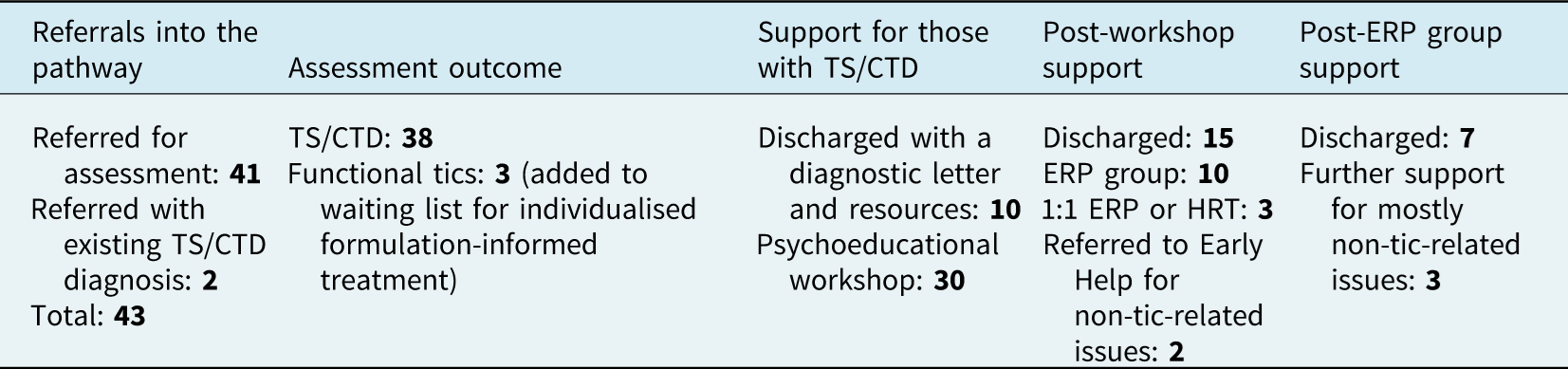
Table 1 summarises key data relating to the journey through the tics pathway of children and young people referred between March 2023 and October 2024. 41 children/young people were referred for assessment, of whom 38 were given a diagnosis of CTD or TS. An additional two children/young people with an existing diagnosis of TS were referred to the pathway for post-diagnostic support.
Tics pathway throughput data for March 2023 to October 2024

Table 1. Long description
A table summarizing the journey through the tics pathway of children and young people referred between March 2023 and October 2024. The table has four columns and six rows. Column headers are Referrals to the pathway, Assessment outcome, Support for those with TS/CTD, Post-workshop support, and Post-ERP group support. Row labels are Referred for assessment, Referred with existing TS/CTD diagnosis, and Total. Row 1: Referred for assessment, 41, TS/CTD: 38, Functional tics: 3 (added to waiting list for individualised formulation-informed treatment), Discharged with a diagnostic letter and resources: 10, Psychoeducational workshop: 30, Discharged: 15, ERP group: 10, 1:1 ERP or HRT: 3, Referred to Early Help for non-tic-related issues: 2, Further support for mostly non-tic-related issues: 3. Row 2: Referred with existing TS/CTD diagnosis, 2, TS/CTD: 43. Row 3: Total, 43.
The average wait for assessment was 8 weeks, in contrast to an average of 37 weeks prior to March 2023. Of the 40 children/young people with a CTD or TS diagnosis, 30 chose to attend a psychoeducational workshop, which took place within 8 weeks. Post-workshop, 15 children/young people required no further support and were discharged; 13 asked for further tic-related treatment, of whom 10 attended an ERP group and three received one-to-one ERP or HRT; and two were referred to Early Help services for non-tic-related support. Of the 10 children/young people who attended the group, seven were discharged and three received further support for mostly non-tic-related difficulties.
Psychoeducational workshops
Data received in the feedback gathered from attendees suggest the workshops have been well received by parents and children/young people, and delivering them has also been a positive and valuable experience for the workshop facilitators. Children/young people and parents/carers have often had similar experiences with tics which they have been able to share with one another. This, together with the psychoeducational material provided, has helped normalise tics for many families, reducing the need for further treatment or support, as reflected in this parent’s comment:
‘I am really glad I have attended this workshop because it helped me to understand a lot about Tourette’s and that I should leave him be if the tics don’t bother him’
ERP groups
The service has run two groups to date, involving 10 boys aged 8‒13 years, six of whom completed the intervention. Group outcomes are collected using a range of tic specific questionnaires as well as more generic outcome measures, such as goal based outcomes (GBOs; Law and Jacobs, Reference Law and Jacob2015) and a Tics Group Intervention Feedback form (a copy of which is included in the Supplementary material). A full list of measures is included in the Supplementary material. Although it is beyond the scope of this paper to report the outcomes in detail, it is notable that 100% of participants demonstrated a 3 to 6 point increase in their GBO ratings; a significant improvement indicating reliable change (Edbrooke-Child et al., Reference Edbrooke-Childs, Jacob, Law, Deighton and Wolpert2015). In addition, both parents and children/young people ‘agreed’ or ‘strongly agreed’ on their feedback forms that the group enhanced their understanding of tics, improved their knowledge of management strategies, increased confidence in resisting the urge to tic, and said they would recommend the group to other children/young people with tics. As with the workshop, feedback suggests receiving treatment alongside others can be valuable for families. For example, groups provide opportunities to connect with peers facing similar challenges, validate and normalise experiences and struggles, and build friendships and connections which sometimes continue beyond the program. Of the 10 families who started the group, seven were discharged and three received further support for mostly non-tic-related difficulties, demonstrating these group interventions to be a cost and resource-effective approach to treatment. In addition, in line with the literature (Hadji-Michael et al., Reference Hadji-Michael, Catanzano, McAllister, Heyman, Lack, Murphy and Gilmour2024), the fact that the group followed an ERP protocol was beneficial due to its familiarity with facilitators from their previous CBT experience, and generalisability to address co-occurring difficulties in one or two attendees.
It was important for the service to reflect on those who did not complete the group. Families who dropped out faced a range of socioenvironmental challenges, such as housing issues, parental health problems and competing sibling demands, which sometimes impacted their ability to attend the group. Similarly, it became apparent that successful ERP required families to be emotionally and socially equipped to undertake home practice outside sessions. To try and support families and improve engagement, group facilitators introduced mid-week check-in calls, which offered positive reinforcement and encouragement, and also a space to problem-solve around both attendance and ERP practice.
One-to-one therapy
Only three out of the 41 children/young people in the pathway with a diagnosis of TS or CTD requested one-to-one therapy. In line with the evidence base, all three were offered either ERP or CBIT (HRT) according to their needs and wishes. This low interest in further therapy was a significant learning point for the service, who would previously have offered one-to-one intervention to everyone, and contributed to the ability of the service to provide timely and resource-effective support to others referred.
Discussion
Reflections and implications for practice
As outlined in the introduction, the service’s aims of this QI project were to build knowledge and skills in assessment, diagnosis and treatment of tic disorders; develop and implement an evidence-based tics pathway; reduce waiting times for assessment and treatment; provide good quality support that meets the needs of families; and provide support locally rather than referring families to the regional specialist service. Data presented suggests these aims have been achieved: the service and practitioners within it have developed knowledge and confidence that have enabled them to devise and implement an evidence-based tics pathway, and positive feedback and outcomes data suggest it is good quality and beneficial for families and the service. Waiting times for assessment, diagnosis and provision of evidence-based support and interventions have greatly reduced. Families now receive support locally, and in the three years since the pathway was introduced, the service has only needed to refer one young person to the regional tics service (GOSH) for more specialist support.
A key shift in the service has been to prioritise prompt assessment, diagnosis, and psychoeducation over offering therapy to all. This has allowed families to access initial support quickly, while reducing the demand for resource-intensive and unnecessary interventions. Expanding the number of practitioners involved in the delivery of the pathway, and providing a structure that allows the inclusion of some junior staff under close supervision, has further improved the pathway’s efficiency and cost-effectiveness.
The GOSH two-day training package played a crucial role in the initial pathway development, offering an affordable means for multiple practitioners to build confidence in designing, implementing, and troubleshooting the local pathway. Follow-up consultation sessions have provided tailored guidance, problem-solving opportunities, and skill consolidation. In addition, gathering outcome data and feedback from children, young people and parents/carers about their experience of different elements of the pathway, as well as regular reflection amongst practitioners, have been vital in refining the approach to the support/interventions provided.
Despite these advancements, challenges remain. For example, differential diagnosis for common co-occurring difficulties can be challenging. Additionally, the increasingly difficult societal context and socioeconomic issues faced by children/young people and families have at times impacted on the success of the interventions and the overall experience of families navigating different support systems for these.
To support discussion relating to these challenges, and to inform the ongoing review and development of the pathway, the service has invested in further GOSH consultation groups. However, as CBT practitioners in the service gain more experience with tics, the frequency of these consultation groups has reduced, ensuring continuing support in a cost-effective way.
Conclusion
Implementing a tics pathway has significantly benefited all children/young people/families, and Islington CAMHS as a whole. The service has made a significant shift in its clinical approach, moving away from viewing tics as complex neurological conditions requiring specialist assessment and treatment. Instead, with minimal training and consultation, the service has developed the capability to assess, diagnose, and deliver evidence-based support and interventions effectively. This transformation has empowered the service to better meet the needs of its local population in a cost-effective way, replacing a ‘not our usual business’ mindset with a ‘this can be our business too’ approach.
It is hoped that this paper will inspire and equip other generic CYP MH services to establish similar tic pathways, enabling them to support families within their local communities and make a meaningful difference to the lives of children, young people and their families.
Key practice points
-
(1) Although effective evidence-based treatments exist for children and young people with tic disorders, families often face challenges accessing timely diagnosis and support due to lack of provision in local CYP MH services.
-
(2) Many children and young people with TS/CTD do not need or want therapy: prioritising quick assessment/diagnosis and providing families with psychoeducational materials and support can reduce distress and enable the majority to live with their tics in a positive way.
-
(3) Broadening the range of CYP MH practitioners involved in the assessment and treatment of tics is an impactful and cost-effective way of reducing waiting times for children, young people and families.
-
(4) With minimal training and consultation it is possible for a generic CYP MH service to assess and provide a range of evidence-based interventions for tic disorders, improving access to timely support for children, young people and families within their local communities, and make a meaningful difference to their lives.
Supplementary material
To view supplementary material for this article, please visit https://doi.org/10.1017/S1754470X26100944
Data availability statement
Data that support the findings of this service evaluation are available from the corresponding author upon reasonable request, but this will be limited according to NHS information governance and ethical considerations.
Acknowledgements
We would like to thank other practitioners in Islington CAMHS who contributed to the development and running of the pathway (Francesca Fiore and Kyriana Delisle) and clinicians from Great Ormond Street Hospital (in particular Maria Hadji-Michael, Eve McAllister and Tara Murphy).
Author contributions
Vicki Curry: Conceptualization-Lead, Data curation-Equal, Methodology-Equal, Project administration-Equal, Supervision-Equal, Writing - original draft-Equal, Writing - review & editing-Lead; Andia Papadopoulou: Conceptualization-Equal, Data curation-Equal, Formal analysis-Equal, Methodology-Equal, Project administration-Equal, Resources-Equal, Supervision-Equal, Writing - original draft-Equal, Writing - review & editing-Supporting; Selina Kapasi: Conceptualization-Equal, Data curation-Equal, Formal analysis-Equal, Methodology-Equal, Project administration-Equal, Resources-Equal, Supervision-Equal, Writing - original draft-Equal, Writing - review & editing-Supporting; Nicole Adegbite: Resources-Equal, Writing - original draft-Supporting, Writing - review & editing-Supporting; Celestelle Anderson: Data curation-Equal; Ellie Tidy: Data curation-Equal, Writing - original draft-Supporting, Writing - review & editing-Supporting; Holly Tricker: Resources-Equal, Supervision-Equal, Writing - original draft-Supporting, Writing - review & editing-Supporting; Natalia Wozniak: Data curation-Equal, Resources-Equal, Writing - original draft-Supporting, Writing - review & editing-Supporting.
Financial support
No specific grant from any funding agency, commercial or not-for-profit sectors was received.
Competing interests
The authors declare none.
Ethical standards
This paper outlines a service QI project and does not include any identifiable patient information. As such, submission for formal ethics approval was not required. Consent to include service names and the information in the article was obtained from Islington CAMHS senior management team and Whittington Health NHS Trust Information Governance team. Permission to mention GOSH by name was obtained from Dr Tara Murphy, lead of the GOSH Tics Service. The authors have abided by the Ethical Principles of Psychologists and Code of Conduct as set out by the BABCP and BPS.



 Open access


Comments
No Comments have been published for this article.