


Introduction
Recent research suggests that up to 22% of children and young people (CYP) in the UK are living with a mental health condition (NHS Digital, 2022). Based on latest reports from NHS England (2023) and NHS Digital (2023), approximately 51‒66% of CYP with a reported mental health disorder did not receive care in recent periods, highlighting a considerable access gap in care.
Low-intensity cognitive behavioural therapy (LI CBT) can help address this demand‒capacity gap. LI CBT uses guided self-help materials that are often delivered in under 6 hours of therapist contact time, with each session typically 30 minutes or less (Shafran et al., Reference Shafran, Myles-Hooton, Bennett and Öst2021), although it is acknowledged that this can vary depending on services to account for factors such as developmental needs, family dynamics and physical health conditions. LI CBT sessions are conducted by specifically trained practitioners. The National Institute for Health and Care Excellence (NICE) guidelines recommend LI CBT as a first line treatment for anxiety, low mood and behavioural problems in children and young people (NICE, 2013a; NICE, 2013b; NICE, 2019).
In 2007, the government launched ‘Improving Access to Psychological Therapies (IAPT)’, now known as ‘Talking Therapies’, where a new workforce (Psychological Wellbeing Practitioners) was trained to deliver LI CBT to adults with common mental health difficulties (Clark, Reference Clark2011). In 2011, CYP-IAPT was launched, and in 2017 Children and Young People’s Wellbeing Practitioners (CWPs) were introduced to deliver LI CBT interventions for adolescents experiencing anxiety and low mood, and children under 12 years old with anxiety and behavioural difficulties (Fonagy et al., Reference Fonagy, Pugh and O’Herlihy2017). Recent research has shown reduced anxiety and depression symptoms in CYP who received LI CBT interventions delivered by CWPs in CAMHS settings (Burn et al., Reference Burn, Vainre, Humphrey and Howarth2020; Turnbull et al., Reference Turnbull, Kirk, Lincoln, Peacock and Howey2023).
In the UK, approximately 23% of CYP are living with a long-term health condition (LTC), defined as any diagnosed health condition lasting for a minimum of 3 months, for which a cure is unlikely and results in limitations in ordinary activities and increased use of health services (Moore et al., Reference Moore, Nunns, Shaw, Rogers, Walker, Ford, Garside, Ukoumunne, Titman and Shafran2019; NHS Digital, 2021). CYP with LTCs are significantly more likely to develop mental health symptoms than otherwise healthy CYP, with rates of psychiatric disorders up to four times greater compared with CYP who are physically well (Almane et al., Reference Almane, Jones, McMillan, Stafstrom, Hsu, Seidenberg, Hermann and Oyegbile2019; Hysing et al., Reference Hysing, Elgen, Gillberg, Lie and Lundervold2007; Pinquart, Reference Pinquart2020). Psychological distress is reported amongst CYP with LTCs as their identity may become taken up with so many aspects of the health condition and limit how they are able to engage in typical milestones and everyday life. Up until recently, LI CBT interventions were only accessible via primary care settings or through schools, social care or CAMHS services, with little to no provision within paediatric settings (Roach et al., Reference Roach, Cullinan, Shafran, Heyman and Bennett2023).
Children with LTCs are often referred to CAMHS but can find it difficult to access treatment due to their LTC. A report by the Children and Young People’s Commissioner found that the outcome of referral is not known for up to 78% of CYP referred to CAMHS for problems adjusting to their physical illness (Byrne et al., Reference Byrne, Shafran, Whadcock and Bennett2023; Rojas et al., Reference Rojas, Ching, Fifield, Catanzano, Bennett, Heyman and Shafran2023). In 2018, Talking Therapies was expanded to specifically consider mental health difficulties in the context of LTCs in adults (IAPT-LTC) (National Collaborating Centre for Mental Health, 2018). There is no equivalent pathway for CYP, despite research demonstrating that evidence-based treatments for common mental health issues are effective for CYP with LTCs (Bennett et al., Reference Bennett, Shafran, Coughtrey, Walker and Heyman2015, Reference Bennett, Cuijpers, Ebert, McKenzie Smith, Coughtrey, Heyman, Manzotti and Shafran2019; Catanzano et al., Reference Catanzano, Bennett, Kerry, Liang, Heyman, Coughtrey, Fifield, Taylor, Dalgleish and Xu2021a; Catanzano et al., Reference Catanzano, Bennett, Tibber, Coughtrey, Liang, Heyman, Team and Shafran2021b; Moore et al., Reference Moore, Nunns, Shaw, Rogers, Walker, Ford, Garside, Ukoumunne, Titman and Shafran2019).
Despite the lack of a national pathway for CYP with LTCs, some paediatric hospitals and services have set up their own initiatives. One such example is the Child and Young People Psychological Medicine Services (CYPPS) based at University College London Hospital (UCLH). From 2022 to 2024, the service participated in a non-randomised research trial (‘The Lucy Project’) where LI CBT services were set up across multiple paediatric hospitals (ISRCTN15063954; Roach et al., Reference Roach, Bennett, Heyman, Coughtrey, Stokes, Ndoci, Balakrishnan, Astle, Drinkwater and Evans2024). Following the success of the study, trainee and qualified CWPs were implemented into the service and continued to offer LI CBT interventions to CYP with LTCs at the hospital after the research project finished. This is one of the first paediatric hospital services in the country to offer these interventions to CYP living with LTCs.
Establishing CWPs within a paediatric psychology setting was projected to hold several potential benefits. Due to the more focused nature of the work, it was hoped that CWPs would be able to begin working with children and young people quickly and discharge sooner, which would result in shorter wait times and reduced wait lists; therefore, meeting one of the key aims of the equivalent ‘Talking Therapies’ programme for children and young people (Ludlow et al., Reference Ludlow, Hurn and Lansdell2020). It was important for CYPs to be able to access evidence-based interventions within their hospital setting. It also aimed to fill the gap in services, where traditional CAMHS settings are often not equipped to manage the difficulties that come alongside living with a health condition, and physical health professionals are not always equipped to manage a young person’s mental health needs (Byrne et al., Reference Byrne, Shafran, Whadcock and Bennett2023). By offering a LI CBT intervention within the hospital setting, CWPs could remain linked in with the CYP’s medical team to allow for a holistic approach supported through a multi-disciplinary team of practitioners.
Research aims and questions
The overall aim of this service evaluation was to evaluate the acceptability and preliminary effectiveness of the CWP LTC service at UCLH. Specifically, the following research questions were addressed:
-
(1) What were the characteristics of children and young people seen in this service?
-
(2) What was the preliminary effectiveness of the service according to standardised measures of symptoms and goals?
-
(3) How acceptable was the service to patients and families?
Method
TIDieR guidelines were used when reporting the findings from this study (Hoffmann et al., Reference Hoffmann, Glasziou, Boutron, Milne, Perera, Moher and Michie2014).
Setting
CYPPS receives referrals from multiple teams across the hospital including Oncology, Diabetes, Epilepsy, General Paediatrics, Dermatology, Gastroenterology, Endocrinology, Rheumatology, Long Covid and the TRACCS team (Treatment and Rehabilitation of Adolescents and Children with Complex Conditions Service).
Participants
From November 2022 to August 2023, participants could be referred through the research study detailed above (Roach et al., Reference Roach, Bennett, Heyman, Coughtrey, Stokes, Ndoci, Balakrishnan, Astle, Drinkwater and Evans2024, Reference Roach, Bennett, Heyman, Coughtrey, Batura, Gonzalez and Shafran2025a). From January 2023 to January 2024 (both during and after the research project ended), participants were also referred through routine clinical pathways which was referrals into both the paediatric psychology team and psycho-oncology team. Both routes of entry had the same inclusion criteria.
Inclusion criteria
CWP interventions were delivered to any CYP under 25 years old currently under a consultant at UCLH (as per the service eligibility). The presenting difficulty needed to fit one of the four populations who were offered interventions by CWPs: (1) children aged 2–8 years presenting with behavioural difficulties, (2) children aged 5–11 years who presented with anxiety, (3) young people aged 12–25 years presenting with anxiety, or (4) low mood.
Measures
CWPs use routine outcomes measures before, during and after clinical practice to track progress (Law and Wolpert, Reference Law and Wolpert2014). Using outcome measures has shown improved patient outcomes (Boswell et al., Reference Boswell, Kraus, Miller and Lambert2015) and a recent study found that routine outcomes measures are used almost universally in routine low-intensity psychological treatment (Roach et al., Reference Roach, Stokes, McDonnell, Griffiths, Curry, Heyman and Shafran2025b)
Revised Children’s Anxiety and Depression Scale (RCADS-47)
The RCADS is a 47-item self-report questionnaire made up of six subscales: major depressive disorder (MDD), generalised anxiety disorder (GAD), obsessive-compulsive disorder (OCD), panic disorder, separation anxiety disorder, and social phobia (Chorpita et al., Reference Chorpita, Yim, Moffitt, Umemoto and Francis2000). It also provides total anxiety and total depression scores. Responses to items are rated on a 4-point Likert scale (0‒3), corresponding to ‘never’, ‘sometimes’, ‘often’, or ‘always’. The RCADS has demonstrated strong internal reliability (Cronbach’s alpha = .93) across both clinical and non-clinical samples (Chorpita et al., Reference Chorpita, Yim, Moffitt, Umemoto and Francis2000; Chorpita et al., Reference Chorpita, Moffitt and Gray2005).
Goal based outcomes (GBOs)
GBOs assess the progress made towards a goal which has been established by the child or young person during their intervention (Law and Jacob, Reference Law and Jacob2013). Lower scores indicate a greater distance from the set goal (0 = no progress), while higher scores indicate progress towards the goal (10 = goal fully achieved). Goals were then collated and subsequently organised into categories to understand common themes across the sample.
Feedback
Feedback was obtained from the patients who accessed CWP interventions via The Lucy Project. Patients and their families completed a follow-up questionnaire 6 months after they consented to take part in the study and could share optional open text feedback about what they found helpful and any general comments.
Procedure
The RCADS-47 and GBOs measures were collected in the first and final session and recorded on an online database. Data were transferred to an Excel database and then imported into SPSS for analysis.
Data analysis
Objective 1
Descriptive statistics are provided below to understand the characteristics of CYP seen in this service.
Objective 2
To understand the preliminary effectiveness of the service pre- and post-intervention, RCADs scores were compared and changes were tested using paired samples t-tests or Wilcoxon signed rank tests (for non-parametric data) and converted into standardised effect sizes (Cohen’s d). Cohen’s d values of less than 0.40 represent a ‘small’ effect, values between 0.40 and 0.80 reflect a ‘moderate’ effect, and values greater than 0.80 reflect a ‘large’ effect.
Aggregated pre‒post progress scores of up to three GBOs were also compared using t-tests or non-parametric Wilcoxen signed ranks and then converted into effect sizes. Further exploratory investigations were conducted on the goals, grouping goals by topic and comparing progress between groups.
Objective 3
Open text feedback was analysed qualitatively to understand the acceptability of this service to patients and their families.
Results
Objective 1
Descriptive statistics
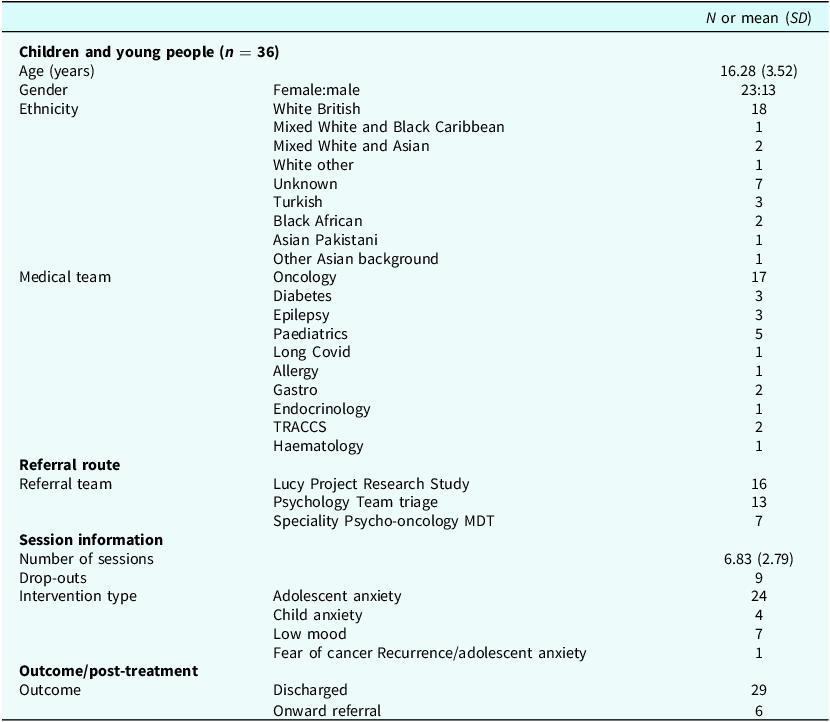
Thirty-six CYP received LI CBT interventions from three trainee CWPs. Sixteen (44%) of these participated in The Lucy Project research study, and 20 (56%) were seen as part of standard care and referred via usual clinical pathways at UCLH. Referrals were received from 10 different medical specialties, with almost half from oncology. There was no wait list; patients were picked up between 2 and 4 weeks of being referred.
Table 1 shows the demographics of the CYP seen in the CWP service. The age of CYP ranged from 3 to 23 years (mean age = 16.28 years, standard deviation = 3.52) with 64% of the sample female.
Demographics of patients and practitioners

Table 1. Long description
The table presents the demographics of children and young people (n = 36) in a medical service. It includes details such as age, gender, ethnicity, medical team, referral route, session information, and outcome/post-treatment. The age ranges from 3 to 23 years with a mean age of 16.28 years and a standard deviation of 3.52. The gender distribution is 23 females and 13 males. Ethnicity includes categories like White British, Mixed White and Black Caribbean, Mixed White and Asian, White other, Unknown, Turkish, Black African, Asian Pakistani, and Other Asian background. The medical teams listed are Oncology, Diabetes, Epilepsy, Paediatrics, Long Covid, Allergy, Gastro, Endocrinology, TRACCS, and Haematology. Referral routes include the Lucy Project Research Study, Psychology Team triage, and Speciality Psycho-oncology MDT. Session information covers the number of sessions, drop-outs, and intervention types such as Adolescent anxiety, Child anxiety, Low mood, and Fear of cancer Recurrence/adolescent anxiety. Outcomes include Discharged and Onward referral.
Interventions delivered by three CWPs included LI CBT for adolescent anxiety (n = 24), parent-led child anxiety (n = 4), adolescent low mood (n = 6), and one patient was offered guidance on fear of cancer recurrence (adapted CBT for anxiety). Regardless of their entry pathway, participants received the same interventions. Number of sessions ranged from 1 to 11, with the average number of sessions being 6.3.
Objective 2
Change in pre- and post-intervention scores
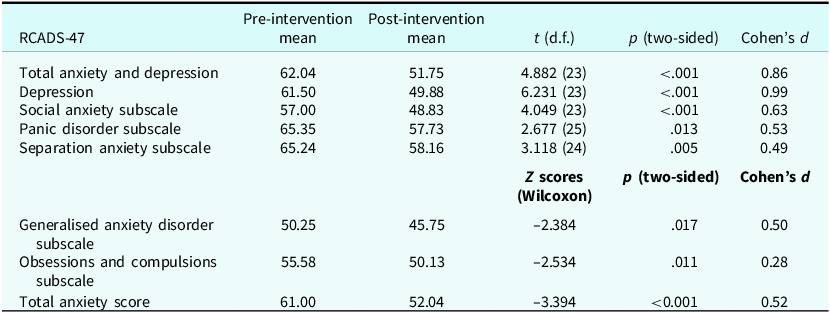
Pre- and post-intervention data, shown in Table 2, highlighted improvements across the RCADS total scores and subscales. Effect sizes demonstrated small to large effects (d = 0.28‒0.99) for pre to post changes for all subscales of the RCADS. Large effect sizes were found for total RCADS scores (d = 0.86) and low mood subscale scores (d = 0.99). Findings demonstrate broad improvements across all mental health domains as measured using the RCADS following CWP intervention.
Comparison of pre- and post-treatment means for the RCADS

Table 2. Long description
A table comparing pre- and post-intervention means for RCADS-47 subscales and total scores. The table has 8 rows and 7 columns. Column headers are: RCADS-47, Pre-intervention mean, Post-intervention mean, t (d.f.), p (two-sided), and Cohen’s d. Row labels include Total anxiety and depression, Depression, Social anxiety subscale, Panic disorder subscale, Separation anxiety subscale, Generalised anxiety disorder subscale, Obsessions and compulsions subscale, and Total anxiety score. Each row provides the pre-intervention mean and standard deviation, post-intervention mean and standard deviation, t-value with degrees of freedom, p-value, and Cohen’s d for each subscale and total score. Notable trends include reductions in mean scores post-intervention across all subscales and total scores, with varying degrees of statistical significance and effect sizes.
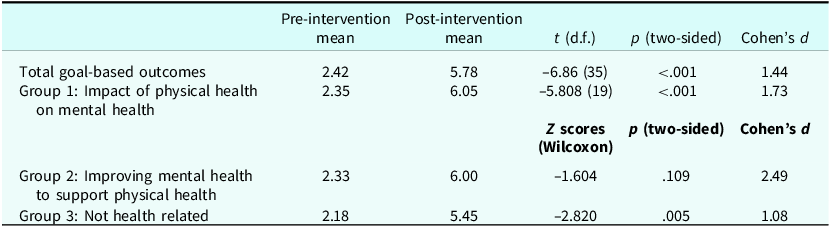
The pre- and post-intervention GBO data were analysed (Table 3), and a significant difference was found between pre and post outcomes (p < .001). Post-intervention goal ratings (M = 5.78, SD = 2.59) were significantly greater than pre-intervention goal ratings (M = 2.42, SD = 2.06). This suggests that progress towards goals increased following CWP intervention.
Pre and post GBOS

Table 3. Long description
A table with six rows and five columns comparing pre- and post-intervention mean scores for different groups. The columns are labeled Pre-intervention mean, Post-intervention mean, t (d.f.), p (two-sided), and Cohen’s d. The rows are labeled Total goal-based outcomes, Group 1: Impact of physical health on mental health, Group 2: Improving mental health to support physical health, and Group 3: Not health related. Row 1: Pre-intervention mean, 2.42; Post-intervention mean, 5.78; t (d.f.), -6.86 (35); p (two-sided), <.001; Cohen’s d, 1.44. Row 2: Pre-intervention mean, 2.35; Post-intervention mean, 6.05; t (d.f.), -5.808 (19); p (two-sided), <.001; Cohen’s d, 1.73. Row 3: Pre-intervention mean, 2.33; Post-intervention mean, 6.00; t (d.f.), -1.604; p (two-sided), Cohen’s d, 2.49. Row 4: Pre-intervention mean, 2.18; Post-intervention mean, 5.45; t (d.f.), -2.820; p (two-sided), .005; Cohen’s d, 1.08.
Goals were grouped into three categories: (1) Goals related to the impact of physical health on mental health: e.g. feeling more confident going back to school after being in hospital; (2) Goals about improving mental health to support physical health: e.g. to learn strategies to help with my emotional regulation to reduce headaches and (3) Goals which were not specifically health related: e.g. being able to put their hand up or give a presentation in class, or to be able to initiate a meet-up with one of their peers. Pre- and post-intervention GBO data were analysed for each of the types of goals. A significant difference was found been pre and post GBOs relating to the impact of physical health on mental health (p < .001) with post-intervention goals (M = 6.05, SD = 2.42) significantly greater than pre-intervention goals (M = 2.35, SD = 1.81). A significant difference was also found on goals unrelated to health with post-intervention goals (M = 5.45, SD = 3.33) ranked significantly greater than pre-intervention goals (M = 2.18, SD = 2.71).
Objective 3
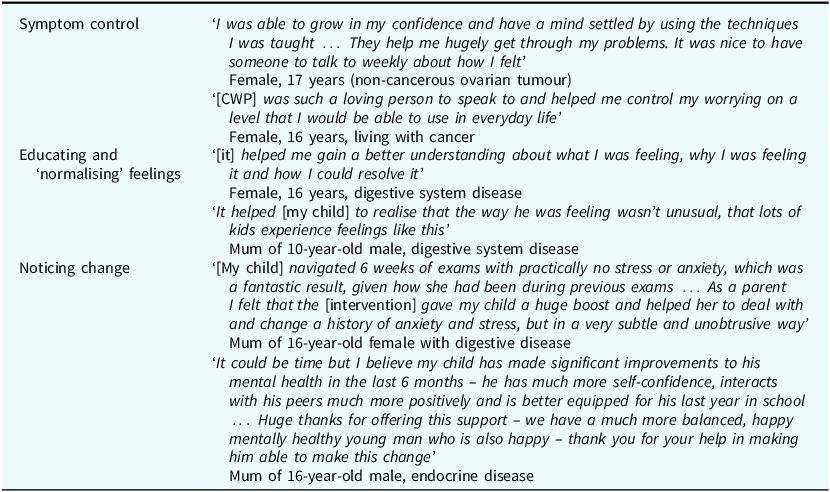
Open-text feedback was received from patients and families accessing the CWP service via The Lucy Project pathway (n = 16). Feedback focused on how the interventions helped to control symptoms, educate CYP on what was happening and impact this had on their wellbeing. Families indicated high levels of satisfaction with the interventions their child received. Sample quotes are displayed in Table 4.
Patient feedback

Table 4. Long description
A table with three rows and three columns summarizing feedback from patients and families on the CWP service via The Lucy Project pathway. The columns are labeled Symptom control, Educating and normalising feelings, and Noticing change. Row 1: Symptom control, ‘I was able to grow in my confidence and have a mind settled by using the techniques I was taught ... They help me hugely get through my problems. It was nice to have someone to talk to weekly about how I felt’, Female, 17 years (non-carcinous ovarian tumour); Educating and normalising feelings, ‘[it] was such a loving person to speak to and helped me control my worrying on a level that I would be able to use in everyday life’, Female, 16 years, living with cancer; Noticing change, ‘[it] helped me gain a better understanding about what I was feeling, why I was feeling it and how I could resolve it’, Female, 16 years, digestive system disease. Row 2: Symptom control, ‘[CWP] was such a loving person to speak to and helped me control my worrying on a level that I would be able to use in everyday life’, Female, 16 years, living with cancer; Educating and normalising feelings, ‘[it] helped [my child] to realise that the way he was feeling wasn’t unusual, that lots of kids experience feelings like this’, Mum of 10-year-old male, digestive system disease; Noticing change, ‘[My child] navigated 6 weeks of exams with practically no stress or anxiety, which was a fantastic result, given how she had been during previous exams ... As a parent I felt that the [intervention] gave my child a huge boost and helped her to deal with and change a history of anxiety and stress, but in a very subtle and unobtrusive way’, Mum of 16-year-old female with digestive disease. Row 3: Educating and normalising feelings, ‘It could be time but I believe my child has made significant improvements to his mental health in the last 6 months - he has much more self-confidence, interacts with his peers much more positively and is better equipped for his last year in school ... Huge thanks for offering this support - we have a much more balanced, happy mentally healthy young man who is also happy - thank you for your help in making him able to make this change’, Mum of 16-year-old male, endocrine disease.
Discussion
Overall, the findings from this study demonstrate that LI CBT interventions delivered by CWPs as part of the paediatric psychology service at UCLH were offered to and accepted by a wide range of CYP with LTCs; were effective in their aim of reducing symptoms of anxiety and low mood; and importantly, were acceptable to patients and families.
Our findings are in line with previous studies that found LI CBT to be effective for CYP with LTCs (Catanzano et al., Reference Catanzano, Bennett, Sanderson, Patel, Manzotti, Kerry, Coughtrey, Liang, Heyman and Shafran2020; Roach et al., Reference Roach, Stokes, McDonnell, Griffiths, Curry, Heyman and Shafran2025b), whilst extending these findings to demonstrate the effectiveness of implementing CWPs into a paediatric hospital service. In addition to this, GBOs showed post-intervention ratings to be significantly higher than pre-intervention ratings, demonstrating positive progress towards goals following CWP intervention. This finding complements existing research which indicates goals to be a useful method of capturing change relevant to CYP’s individual and unique life contexts (Law and Jacob, Reference Law and Jacob2013). This may be particularly appropriate for a paediatric setting where lives are impacted by various complex inter-related physical and mental health factors and where, as Jacob and colleagues (Reference Jacob, Edbrooke-Childs, Flannery, Segal and Law2023) have reflected, ‘recovery’ means different things to different people.
Clinical implications
The implementation of LI CBT in a paediatric psychology setting offered access to low-intensity psychological support for CYP. Not only did this allow for LI CBT psychological support to be contextualised within the individual’s medical treatment and therefore contributing to holistic care, it also helped to release qualified clinicians’ time to enable them to take on more complex cases and subsequently reduce the waitlist for psychological support. It offered more timely access to psychological support for CYP. Prior to this service CYP presenting with anxiety and low mood would have been placed on the general waitlist and may have waited up to 6 months to be seen. Since the arrival of the CWP service, it has been possible to see these CYP within 2‒4 weeks.
Sufficient triage and screening of referrals was important to ensure the intervention was appropriately matched to referral criteria; for example, consideration of level of risk and whether mental health difficulties were in the context of adjusting to diagnosis/dealing with a LTC health condition and whether LI CBT would be an effective intervention at that stage. This was reflected in the low number of CYP at end of intervention that required further follow-up or onward referrals/signposting. It was also important that the CWPs received appropriate and regular supervision which may pose as a challenge for some services as supervisors must hold a recognised Postgraduate Certificate in Supervision, have at least 2 years of post-qualification experience in a CYP mental health setting, and maintain active registration with the British Association for Behavioural and Cognitive Psychotherapies (BABCP) or the British Psychological Society (BPS) (Charlie Waller Institute, n.d.)
CWP supervision at UCLH was provided by a qualified clinical psychologist with CBT expertise and LI CBT expertise, who also attended and completed the CWP supervisor training. Their experience in paediatrics was also crucial in helping to think about the interplay between physical health and mental health. This supervision helped to ascertain whether it was more appropriate to target mental health difficulties related to the CWP models such as a clear presentation of anxiety that could be targeted with a CWP intervention, or whether the YP needed to be passed on to the paediatric psychology team for specific work around managing/adjusting to a health condition; and to also consider appropriateness in terms of intensity/level of risk.
Depending on inclusion criteria and service demand it may also be possible to expand inclusion criteria for paediatric psychology support. For example, exclusion criteria for paediatric psychology support are often limited to mental health difficulties arising from physical health difficulties which can sometimes be difficult to determine. In this service, CYP were offered the LI CBT intervention regardless of whether their physical health difficulties impacted their mental health, provided they were currently under the care of a UCLH consultant. As illustrated in the Results, the implementation of LI CBTs in a paediatric setting led to significant improvements for CYP where physical health was having an impact on mental health. There was also improvement in GBOs that focused on improving mental health to impact on physical health, although this was not statistically significant. These results are encouraging as they evidence the potential value of LI interventions in a physical health setting but may be developed with further adaptions made to incorporate the specific challenges of health difficulties into the intervention.
Limitations and research implications
A limitation of this study was the small sample size of 36. In future, it would be helpful to replicate with a larger sample size, over a longer follow-up period, including session-by-session outcome measures, recovery rates, and a quality of life measure (e.g. PedsQL). It would also be helpful to do a more in-depth qualitative analysis of the feedback received and to understand overall accessibility of this service. Despite this, the preliminary outcomes are promising and provide support for the effectiveness and implementation of LI CBT in a paediatric setting. As this is a non-randomised study, including a control group in the future would determine the specificity of the effectiveness of the interventions.
Additionally, although information was gathered in terms of medical conditions, it may be helpful to gain more specific information on impact of LTCs and quality of life as a result. This would provide a more detailed understanding of the types of health presentations as well as severity that benefit from LI interventions in a paediatric setting. It is recommended that a service evaluation is conducted annually to monitor intervention effectiveness as this service continues to develop and grow.
In this service it was possible to implement interventions across a range of LTCs which supports the transdiagnostic approach/service. However, adaptions and modifications to interventions for physical health may add further value to these interventions. For example, in one case a CYP presented via the gastroenterology team with severe anxiety associated with eating, having followed a very restrictive diet for over a year. The practitioner completed an LI CBT anxiety intervention, but adapted this to also include Avoidant Restrictive Food Intake Disorder informed CBT, otherwise known as CBT-AR (Thomas and Eddy, Reference Thomas and Eddy2019), which allowed for effective but safe exposure to foods and drinks.
Conclusion
Overall, the findings from this study demonstrate that LI CBT delivered by CWPs can be implemented within a paediatric setting, are effective in reducing symptoms of anxiety and low mood in CYP with LTCs, and are acceptable to CYP and families. Expansion of LI CBT within paediatric settings is encouraged to provide holistic care where mental health support is connected to physical healthcare and to also reduce waitlist numbers and times for paediatric psychology teams.
Key practice points
-
(1) Integrating low-intensity CBT into medical settings is feasible and effective: CBT therapists should consider how low-intensity interventions can be effectively delivered within paediatric healthcare settings, especially for children and young people managing long-term physical conditions.
-
(2) Goal-based work enhances engagement and outcomes: using personalised goal-based outcomes (GBOs) alongside standardised measures like the RCADS may help track progress and increase client motivation, making therapy more relevant and impactful.
-
(3) Children and Young People’s Wellbeing Practitioners can extend access to early intervention in paediatric psychology services: collaborating with or supervising CWPs offers a scalable way for CBT services to meet rising mental health needs, especially by providing early, accessible support for mild to moderate anxiety and depression.
Data availability statement
The data that support the findings of this study are available from the corresponding author, K.M., upon reasonable request.
Acknowledgements
None.
Author contributions
Katie McDonnell: Conceptualization-Equal, Data curation-Equal, Investigation-Equal, Supervision-Equal, Writing - original draft-Equal, Writing - review & editing-Equal; Anna Roach: Conceptualization-Equal, Data curation-Equal, Formal analysis-Equal, Investigation-Equal, Methodology-Equal, Writing - original draft-Equal, Writing - review & editing-Equal; Sarah Ormrod: Investigation-Equal, Methodology-Equal, Resources-Equal, Writing - review & editing-Equal; Theodore Prendegast: Investigation-Equal, Methodology-Equal, Writing - review & editing-Equal; Gareth Vinton: Investigation-Equal, Methodology-Equal, Writing - review & editing-Equal; Isabella Stokes: Investigation-Equal, Methodology-Equal, Writing - review & editing-Equal; Michael Groszmann: Funding acquisition-Equal, Writing - review & editing-Equal; James McParland: Supervision-Equal, Writing - review & editing-Equal; Lucy Casdagli: Supervision-Equal, Writing - review & editing-Equal; Sophie D Bennett: Supervision-Equal, Writing - review & editing-Equal; Isobel L Heyman: Funding acquisition-Equal, Supervision-Equal, Writing - review & editing-Equal; Roz Shafran: Conceptualization-Equal, Funding acquisition-Equal, Supervision-Equal, Writing - review & editing-Equal.
Financial support
This work was supported by The Beryl Alexander Charity and Great Ormond Street Hospital Charity, Grant/Award Number: 16HN11 and UCLH Transformation Fund.
Competing interests
The author(s) declared no potential competing interests with respect to the research, authorship, and/or publication of this article.
Ethical standards
The research study was granted by the London Riverside Research Ethics Committee (REC reference number: 16/LO/1915). The UCLH Quality and Safety Team reviewed the service evaluation proposal and approved authorisation to write up in March 2024. Data collection commenced at an earlier date of January 2023 as part of routine practice and these data were included in the study. Authors abided by the Ethical Principles of Psychologists and Code of Conduct as set out by the BABCP and BPS.

 Open access


Comments
No Comments have been published for this article.