


Introduction
It has been recognised that there is a cohort of people who miss out on access to psychological therapies (Sainsbury Centre for Mental Health, 2005); these individuals typically fail to meet criteria for specialist secondary mental health services, yet their needs are considered too complex for NHS Talking Therapies (formerly Improving Access to Psychological Therapies) or primary care-based services. In response to this gap, the NHS Long Term Plan (NHS, 2019) and Five Year Forward View (NHS Health Education England, 2014) outlined commitments to new and integrated models of primary and community mental health care aiming to widen access to psychological therapies, deliver trauma-informed care, aid medication management and support for self-harm and coexisting substance use (Health Education England, 2021).
As part of this transformation, several new psychological practitioner roles were introduced to support implementation efforts, one of which is the mental health and wellbeing practitioner (MHWP). This role was designed to deliver psychological intervention to individuals who may have fallen between the gap of primary and secondary care. MHWPs specifically focus on treating severe mental illness, including in some services, a focus on individuals who have an emerging, or a diagnosis of, personality disorder, particularly emotionally unstable personality disorder (EUPD). Historically, this clinical cohort has faced significant barriers to accessing services and treatment due to the perceptions that their presenting difficulties can be challenging to treat (Ingram, Reference Ingram2018), and research has shown that individuals with personality disorders and their families often encounter stigma and poor quality of care when accessing psychological support, highlighting the poor provision of services for this cohort (Barr et al., Reference Barr, Jewell, Townsend and Grenyer2020).
In alignment with NHS England’s long-term Mental Health Transformation plan, delivery of Psychological Therapies for Severe Mental Health Problems (PT-SMHP) programmes has been newly commissioned. The PT-SMHP programme aims to increase access to evidence-based psychological therapies as recommended by the National Institute for Clinical Excellence (NICE); ensure timely access to NICE-recommended psychological therapies for adults and older adults with severe mental health problems; and to provide better quality care and improved outcomes through the delivery of psychological interventions for people with severe mental health problems (NHS England, 2024). The clinical streams that fall under the PT-SMHP programme include complex emotional needs/personality disorders, psychosis/bipolar and eating disorders. Alongside these streams are a range of evidence-based psychological therapies curricula aimed to upskill a clinical workforce in their treatment; however, the availability and range of treatment offers for each stream would be dependent on funding and local commissioning arrangements (for a training delivery evaluation, see Kneafsey et al., Reference Kneafsey, Pezaro, Maravic da Silva, Presley, Russell, Bluteau, Bayes and Martin2023).
Given that the MHWP role is still relatively new, there is currently limited data on its effectiveness within mental health services in England which leads us to the purpose of this current study. This study aims to explore the impact of the newly commissioned MHWP role within a primary care-based PT-SMHP service in the East of England. The primary objective of this study is to present preliminary findings that evaluate change in clients’ symptoms following treatment delivered by MHWPs. Specifically, it was predicted that following a course of treatment, there would be an overall improvement on standardised measures, thereby providing initial evidence that this role is having a positive impact on community mental health services.
Clinical setting
The East of England-based PT-SMHP service where this study was conducted was originally commissioned in 2022 to deliver psychological interventions to individuals who were considered too severe for primary care psychological therapies, but at the same time did not have an identified secondary care need. It was commissioned to work alongside both primary and secondary care services to help reduce the number of cases being declined an intervention, and to encourage greater collaboration in the management of cases between services.
The PT-SMHP service was intended to operate as a standalone service with its own governance system and clinical team, which consisted of a clinical lead, cognitive behaviour therapists (trainee and qualified), MHWPs (trainee and qualified) and an administrator. The clinicians within the service were supervised and line managed by the clinical lead. For individuals to access the service a referral would need to be made by another mental health service, or other identified partner agencies. Referrals would not be accepted if actively receiving an intervention in another mental health setting at the time; however, the service would accept cases that were open for medication reviews with psychiatry; see Fig. 1.
Referral sources. ‘N/A’ denotes referral information either not provided or unavailable.

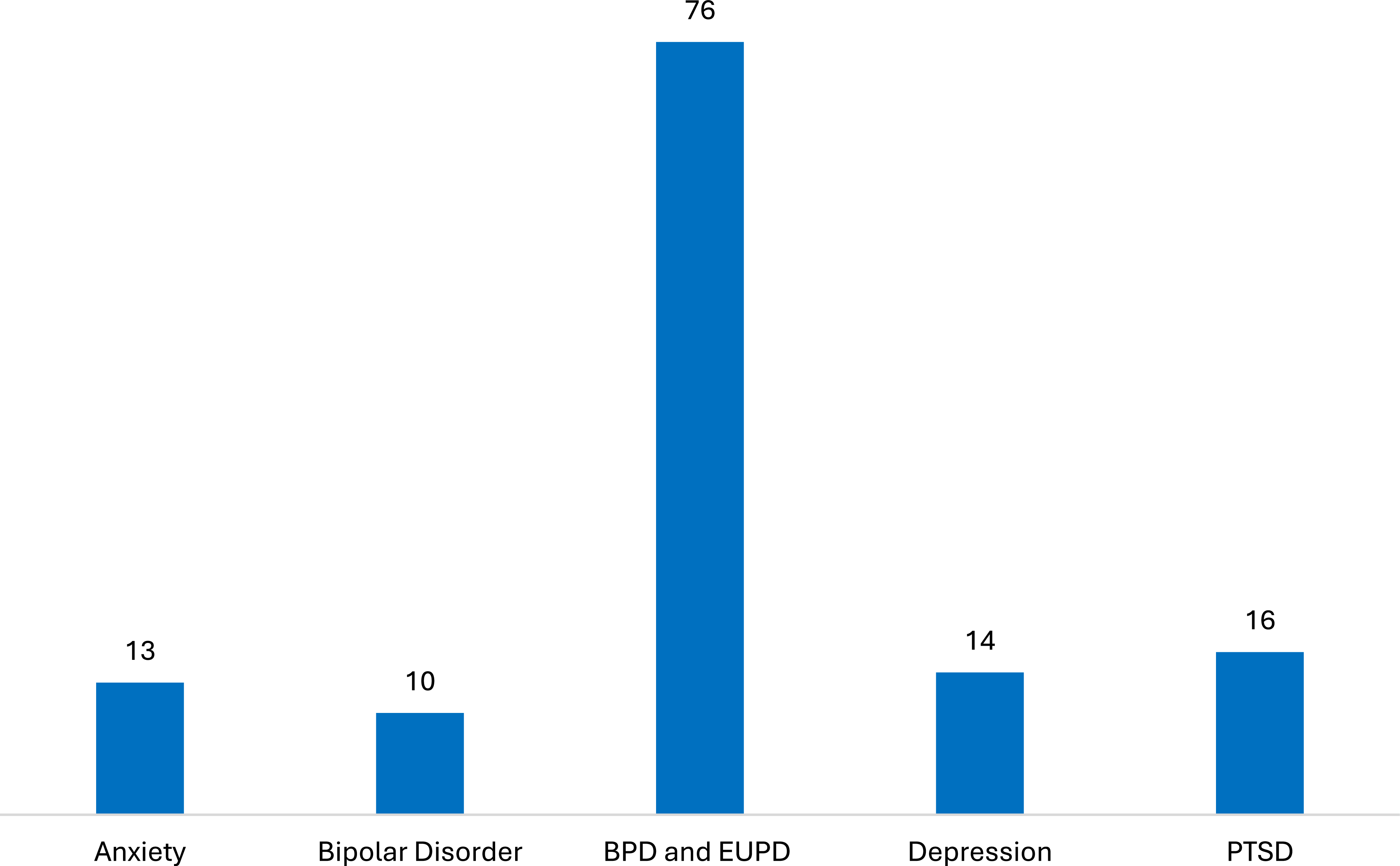
If the referral was deemed suitable, a case would be created and the individual assessed. The most common clinical presentation referred was for difficulties related to a diagnosis of EUPD. Following triage of the referral, the case would be allocated to a clinician for further assessment, which usually consisted of a one-hour appointment where history, current symptomatology and functioning, goals for treatment and risk would be assessed. Following their assessment, cases would be assigned a problem descriptor depending on their focus of treatment, which would be agreed during the assessment process. If the agreed focus was on managing emotions within the context of an EUPD diagnosis, for example, an EUPD problem descriptor would be assigned on the electronic patient records (EPR); however, if a service user had a diagnosis of EUPD but the focus of treatment was agreed to be depression, then a depression problem descriptor would be assigned. The assessment would be discussed in supervision to determine suitability. See Fig. 2.
Problem descriptors by referral. ‘Anxiety’ includes generalised anxiety disorder, social anxiety, and health anxiety; ‘PTSD’ includes diagnosed PTSD and trauma. *In many referrals, the terms BPD and EUPD were used interchangeably, and thus have been combined in our data.

If it was determined that the PT-SMHP service could meet the needs of the individual, then consideration would be made whether to offer an MHWP intervention, or a course of cognitive behaviour therapy for personality disorders (CBT-pd), which would be of greater intensity. The intervention provided would be dependent on symptom severity, goals for treatment, previous treatment episodes and current level of risk. Using the new ICD-11 classification (World Health Organization, 2022) for personality disorders, the PT-SMHP service would generally see individuals whose clinical presentation would be classified under mild to moderate levels of severity (Swales, Reference Swales2022). The move from a focus on diagnosis to levels of severity in personality disorders has brought benefits, as it allows clinicians and services to target their interventions more effectively by regulating the level of intensity offered (Bach and Simonsen, Reference Bach and Simonsen2021); this approach was reflected in the clinical offer of the PT-SMHP service in the current study. The levels of severity approach also helped the PT-SMHP service situate and differentiate itself from primary care and secondary care-based services or other complex needs pathways (see Royal College of Psychiatrists, 2020, for an explanation of different tiers of treatment) to identify and fill an existing treatment gap.
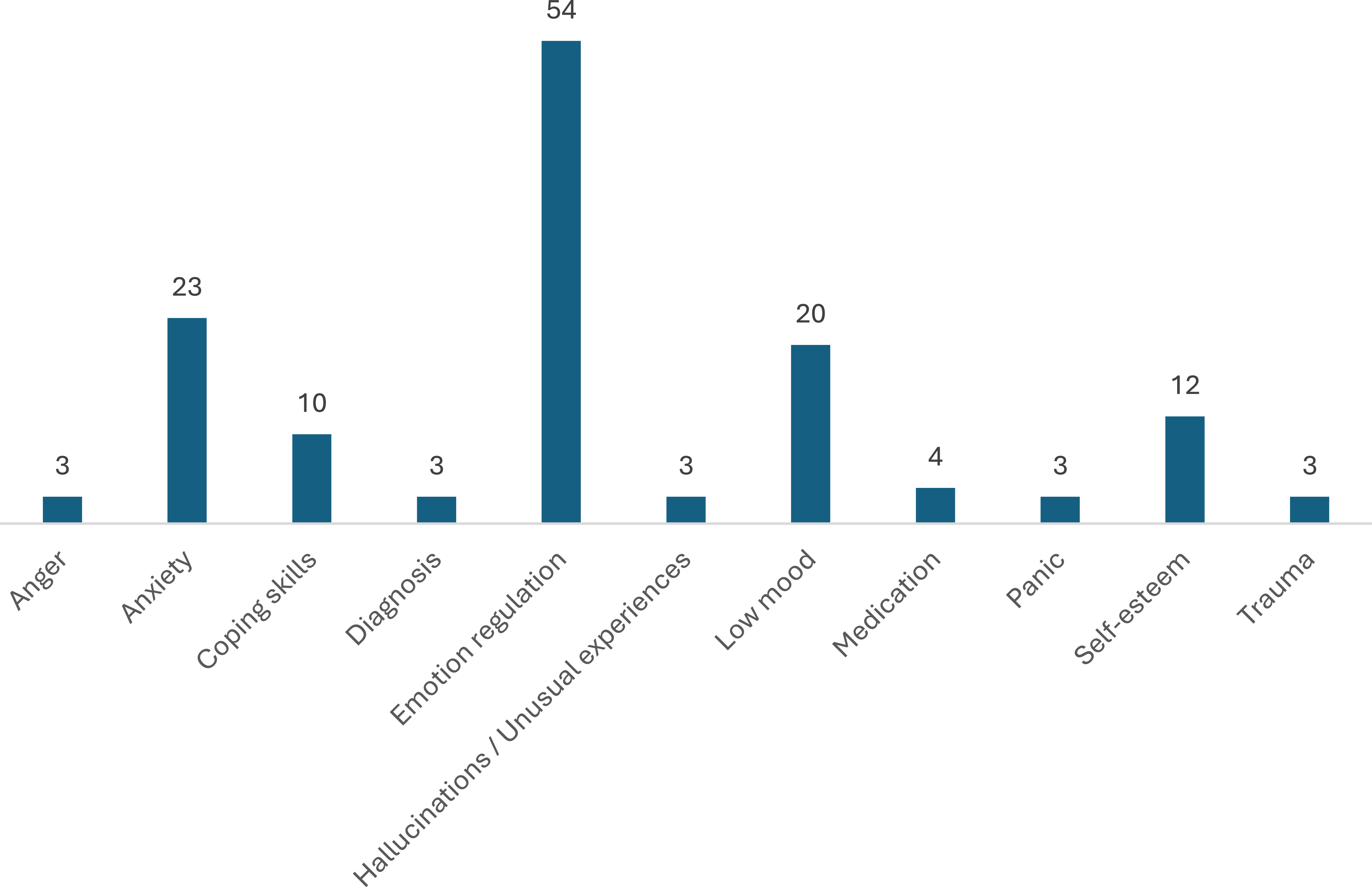
MHWPs supported clients by delivering a range of low-intensity CBT-informed interventions designed to enhance recovery through structured, person-centred care within community mental health services as outlined in the MHWP ‘Guide to Practice’ (NHS Health Education England, 2022). These interventions include behavioural activation, graded exposure, problem-solving, sleep hygiene and emotion regulation strategies. Interventions were employed across several different clinical presentations depending on need (see Fig. 3). If the case presented with greater complexity, then CBT-pd (Davidson, Reference Davidson2008) would be offered, which is a medium-length intervention of 25+ sessions, and was one of the recommended modalities included in the mental health transformation which has demonstrated effectiveness in the treatment of severe mental health problems (Matusiewicz et al., Reference Matusiewicz, Hopwood, Banducci and Lejuez2010). It offers a high-intensity approach where the focus is on emotional and behavioural regulation, usually in the context of interpersonal relationships. The two levels of treatment were intended to address different types of clinical need within a personality disorder presentation, for example the MHWP intervention focused mainly on symptom improvement and increased coping strategies, while the CBT-pd treatment attempted to improve overall personality functioning (Bach and Simonsen, Reference Bach and Simonsen2021).
Intervention focus. ‘Anxiety’ includes generalised anxiety disorder, social anxiety, and health anxiety. *In many referrals, the intervention focus was not suitable for our service, including diagnosis and medication review, therefore service users were referred onwards to the appropriate service.

The PT-SMHP service did not have a crisis function and because of this its risk threshold was mild to moderate; cases with imminent levels of risk would be referred onwards to secondary care services. Risk levels were determined by assessing factors such as static, stable, dynamic, future and protective factors (Hawton et al., Reference Hawton, Lascelles, Pitman, Gilbert and Silverman2022), and a clinical judgement was then made between the assessor and supervisor on whether the risk presentation could be held in the PT-SMHP service. If concerns were raised about service suitability, the assessor could either liaise with the original referrer to discuss alternative options, or the case could be reviewed in the local community-based multi-disciplinary team (MDT) meeting for a more suitable pathway, which had representation from other parts of the system, such as secondary care psychology and psychiatry (Bháird et al., Reference Bháird, Xanthopoulou, Black, Michie, Pashayan and Raine2016). There were also avenues available to escalate any sudden increase in risk which required more immediate action, such as in the event of a mental health crisis. Once it had been agreed that the case was suitable for intervention with the PT-SMHP service it would be allocated to a waiting list until treatment could begin.
Method
Participants
Data were collected from 32 service users referred to qualified MHWPs between January 2024 and January 2025. Referral sources included general practitioners (GPs), primary care networks, secondary care services, and redirection of referrals, including self-referrals, to a Talking Therapies service. The age of service users ranged from 19 to 57, with a mean age of 33 years (SD=9.9). The sample consisted of 29 women (83%) and six men (17%); it was noted none of the sample identified as gender non-conforming. The sample majority consisted of service users who self-identified as White British (n=23, 71.9%), with two service users identifying as Black or Black British (6.2%), two service users identifying as mixed White and Black African or Caribbean (6.2%), and five service users (15.6%) not providing their ethnicity.
The duration of treatment ranged between six and 15 sessions, with a mean of 12 sessions. A total of 90 service users were excluded from the sample due to non-attendance, stepping up to secondary care services, non-completion of standardised measures, and unsuitability including level of risk, presenting difficulty, and goals for psychological intervention (see Fig. 4). Out of the sample, 24 (69%) service users had a diagnosis of borderline personality disorder (BPD), eight (22%) service users had a diagnosis of bipolar disorder; other diagnoses included depression and generalised anxiety disorder (GAD).
Reasons for ending treatment. ‘N/A’ denotes treatment information either not provided or unavailable. ‘Other psychological support’ includes counselling, EMDR, and CMHT brief intervention. ‘Referred onwards’ includes services in the voluntary and non-statutory sector.

Measures and manipulations
Each service user completed routine outcome measures during their first treatment session (pre-treatment), midway through their treatment sessions (mid-treatment), and their last treatment session (post-treatment). These outcome measures are routinely collected for all service users who engage with the service and were therefore not specifically collected for the purpose of this study. The CORE-10 Questionnaire (Barkham et al., Reference Barkham, Bewick, Mullin, Gilbody, Connell, Cahill, Mellor-Clark, Richards, Unsworth and Evans2012) is a 10-item measure designed to assess psychological distress; scores range between 0 and 40, with a score of 11 and above indicating clinical significance. The Short Warwick-Edinburgh Mental Well-being Scale (SWEMWBS; Stewart-Brown et al., Reference Stewart-Brown, Tennant, Tennant, Platt, Parkinson and Weich2009) is a 7-item measure that assesses positive aspects of an individual’s mental wellbeing; scores range between 7 and 35, with no fixed boundaries of clinical significance. The Recovering Quality of Life (ReQoL; Keetharuth et al., Reference Keetharuth, Brazier, Connell, Bjorner, Carlton, Buck, Ricketts, McKendrick, Browne, Croudace and Barkham2018) is a 10-item measure designed to measure recovery and quality of life; scores range between 0 and 40, with a score of 25 and above indicating clinical significance. The Goals Based Outcome Tool (GBO) measured achievement of an individual’s goals and is generally rated between 0 and 10.
Data analysis
Data were analysed using IBM SPSS Statistics (version 29) analytics software. Differences in outcome measures, specifically the CORE-10, SWEMWBS, ReQoL and GBOs, across the three time periods of treatment (pre-, mid-and post-treatment) were analysed with repeated measures ANOVAs.
Design
This report presents the preliminary findings from a larger ongoing longitudinal study, using pre-, mid-and post-intervention trial methods, following clients (n=32) from baseline (before therapy) through the course of low-intensity weekly treatment (1–15) sessions, and at discharge (final session). This preliminary evaluation is limited to examining changes in psychological wellbeing before and after therapy.
Results
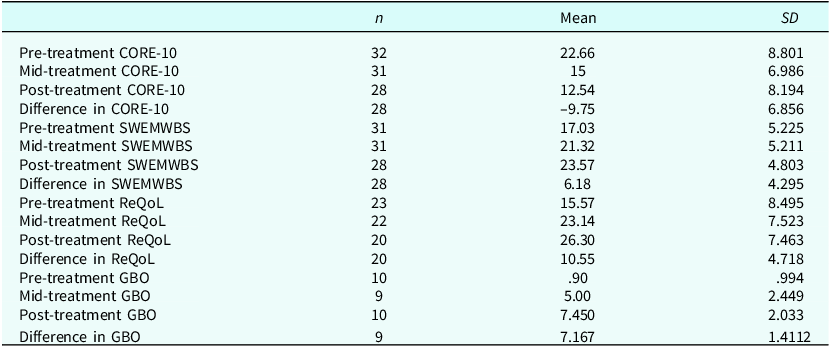
Repeated-measures ANOVAs were performed to evaluate the effect of treatment on the standardised measures. The means and standard deviations for standardised measures scores are presented in Table 1. Mauchly’s test indicated that the assumption of sphericity had been met for all ANOVAs (see Table 2). Results reflected that the effect of treatment on all the standardised measures was significant at the .05 level.
Descriptive statistics of scores

Table 1. Long description
The table presents descriptive statistics of scores for various treatments. It has 10 rows and 4 columns. The columns are labeled n, Mean, and SD. The rows are labeled with different treatment stages and measures: Pre-treatment CORE-10, Mid-treatment CORE-10, Post-treatment CORE-10, Difference in CORE-10, Pre-treatment SWEMWBS, Mid-treatment SWEMWBS, Post-treatment SWEMWBS, Difference in SWEMWBS, Pre-treatment ReQoL, Mid-treatment ReQoL, Post-treatment ReQoL, Difference in ReQoL, Pre-treatment GBO, Mid-treatment GBO, Post-treatment GBO, Difference in GBO. Each row lists the number of observations (n), the mean score, and the standard deviation (SD) for each treatment stage and measure.
ANOVA statistical outputs

Table 2. Long description
A table with five rows and four columns presenting the results of repeated-measures ANOVAs. The columns are labeled F-value, d.f. (between, within), p-value, and Partial η2. The rows are labeled CORE-10, SWEMWBS, ReQoL, and GBO. Row 1: CORE-10, 38.811, (2, 52), less than .001, 0.599. Row 2: SWEMWBS, 36.505, (2, 54), less than .001, 0.575. Row 3: ReQoL, 60.787, (2, 38), less than .001, 0.762. Row 4: GBO, 32.277, (2, 16), less than .001, 0.801.
CORE-10
Post-hoc pairwise comparisons with a Bonferroni adjustment indicated that CORE-10 scores significantly decreased from pre-treatment to post-treatment (p=<.001), and pre-treatment to mid-treatment (p=<.001); however, scores did not significantly decrease from mid-treatment to post-treatment (p=.076).
Short Warwick-Edinburgh Mental Well-being Scale
Post-hoc pairwise comparisons with a Bonferroni adjustment indicated that SWEMWBS scores significantly decreased from pre-treatment to post-treatment (p=<.001), pre-treatment to mid-treatment (p=<.001), and mid-treatment to post-treatment (p=.021).
Recovering Quality of Life
Post-hoc pairwise comparisons with a Bonferroni adjustment indicated that ReQoL scores significantly decreased from pre-treatment to post-treatment (p=<.001), pre-treatment to mid-treatment (p=<.001), and mid-treatment to post-treatment (p=.019).
Goals based outcome tool
Post-hoc pairwise comparisons with a Bonferroni adjustment indicated that GBO scores significantly decreased from pre-treatment to post-treatment (p=<.001), pre-treatment to mid-treatment (p=.007), and mid-treatment to post-treatment (p=.021).
Discussion
This study aimed to explore the impact of the MHWP role on service users receiving treatment within a PT-SMHP service in the East of England. The results showed a significant reduction in scores on the CORE-10 and a significant increase in ReQoL, SWEMWBS and GBO, indicating reliable improvement in symptoms across all measures. Although the authors recognise that the sample size is small and the intervention offered was within a specific setting, these preliminary findings provide initial evidence that the MHWP role shows promise within this PT-SMHP service and is impacting service user outcomes. All service users self-reported an increase in achievement towards their goals, which has been previously suggested as a key aspect of promoting personal recovery from mental illness (Shepherd et al., Reference Shepherd, Boardman and Slade2008; Slade, Reference Slade2009a; Slade, Reference Slade2009b). This was supported by significant improvement in scores of the ReQoL which measures service users’ recovery and quality of life; suggesting interventions from an MHWP may provide positive impact on the wellbeing and quality of service users’ lives.
A reduction in scores found on the CORE-10 during this study suggests there was a decrease in psychological distress following a course of treatment with an MHWP and an increase in scores on the SWEMBWS indicated more positive aspects associated with the service user’s wellbeing. Although further research is needed with larger sample sizes and controls, these results tentatively suggest that additional research and investment into the MHWP role within primary care mental health services could be beneficial for service users.
Practical implications
The preliminary findings within this study provide initial evidence that low-intensity interventions facilitated by qualified MHWPs are effective for service users with a severe mental illness diagnosis. This is in accordance with the current supportive literature on the clinical effectiveness of low-intensity psychological interventions for severe mental illness (Crawford et al., Reference Crawford, Thana, Parker, Turner, Carney, McMurran, Moran, Weaver, Barrett, Roberts, Claringbold, Bassett, Sanatinia and Spong2020).
The findings also provide initial support for the economic viability of the MHWP role within this PT-SMHP service. Given prior evidence demonstrating the clinical efficacy and cost-effectiveness of psychological practitioner roles within NHS services, including Psychological Wellbeing Practitioners (PWPs) within Talking Therapies Services (Layard et al., Reference Layard, Clark, Knapp and Mayraz2007; Mukuria et al., Reference Mukuria, Brazier, Barkham, Connell, Hardy, Hutten, Saxon, Dent-Brown and Parry2013), these results support the potential for MHWPs to offer scalable and resource-efficient interventions within NHS mental health provisions.
In terms of treatment implications, the data suggest that there was a high level of disengagement from the intervention offered by the MHWPs; this is a recognised challenge in the treatment of individuals with a diagnosis of BPD (Arntz et al., Reference Arntz, Mensink, Cox, Verhoef, van Emmerik, Rameckers, Badenbach and Grasman2023). In this study, 43% of the original cohort of 90 service users identified were excluded due to this factor. If MHWPs are going to continue offering interventions to individuals with a diagnosis of BPD, it may be pertinent for MHWP training courses to dedicate time to the issue of engagement and suggest strategies and areas of focus to help reduce the risk of disengagement, so awareness of this becomes part of MHWP core practice. For example, it has been identified that a focus on the therapeutic alliance, and its monitoring throughout treatment, is a significant factor on individuals with a diagnosis of BPD remaining in treatment, and that potential disengagement markers, such as socioeconomic and motivational factors, be thoroughly assessed before treatment begins and the intervention approach adapted (De Salve et al., Reference De Salve, Rossi, Gioacchini, Messina and Oasi2025).
Although further research into the clinical and economic efficacy of MHWPs is needed, within both PT-SMHP services and other NHS mental health services such as community mental health teams, initial findings may suggest the benefit of increasing NHS funding for MHWP training and post-qualified roles to further support service users nationally.
Limitations
A limitation of this study is the small sample size; therefore, results should be interpreted with caution, pending replication. In addition, the study had to exclude 90 service users due to stepping up to secondary care services, disengagement, unsuitability, or non-completion of standardised measures, therefore further impacting the validity of the results. The absence of a control group is also an acknowledged limitation of the preliminary study. The outcomes reported are based on an incomplete dataset in some instances; for example, the GBO was not collected from the full sample under study. Future studies on the MHWP role must therefore ensure that data are consistent and complete for the entire study cohort to increase outcome reliability.
Although the outcome data reported in the current study are limited, it does hold promise for the benefit of the role. Therefore, future studies should aim to conduct a larger, randomised controlled trial driven to detect change in the key outcomes, including within different services.
Additionally, another limitation for this study is that the interventions were conducted by two qualified MHWPs, therefore limiting the generalisability and external validity of the findings to other qualified MHWPs and services. Clinician expertise and therapist competence may have been a confounding variable during this study; therefore, results should be further replicated to improve external validity.
Due to this study being conducted within a primary-care mental health setting, findings may be context dependent, therefore results should be interpreted with caution when considering the MHWP role in other settings such as secondary care.
Conclusions and clinical implications
Results show promise in improving access to low-intensity psychological support for service users with severe mental illness. Results suggest the role is preliminarily clinically effective in improving symptoms of and recovery from severe mental illness within the PT-SMHP service. Additional studies are needed to further investigate efficacy of the role with a larger sample, including across other mental health settings such as secondary care to ensure external validity.
Key practice points
-
(1) This study outlines the implementation and delivery of primary care-based, low-intensity interventions delivered by mental health and wellbeing practitioners to individuals diagnosed with a personality disorder.
-
(2) Although the results show some promise, further research with controls is needed to determine whether the mental health and wellbeing practitioner role can serve as a robust option in the treatment of individuals diagnosed with a personality disorder, especially using a stepped-care model.
-
(3) The study found that there was a significant level of disengagement, and if the mental health and wellbeing practitioner role is going to continue offering treatment to this cohort, training programmes should consider increasing an emphasis on how to continuously engage individuals diagnosed with a personality disorder while in treatment.
Data availability statement
Data are available from the Corresponding Author on request.
Acknowledgements
None.
Author Contributions
Emily Walter: Conceptualization-Equal, Project administration-Equal; Katie Harrold: Formal analysis-Equal, Methodology-Equal, Project administration-Equal; Patrick Larsson: Conceptualization-Equal; Maggie Rosairo: Conceptualization-Equal.
Financial support
There is no financial support to declare.
Competing interests
There are no competing interests relating to the publication of this manuscript.
Ethical standards
Ethical approval was not required for this study as it was an anonymised examination of routine treatment outcomes and did not involve any manipulation or randomisation.




 Open access


Comments
No Comments have been published for this article.