


Introduction
The largest cross-national survey of any specific phobia found a 12-month prevalence of 5.5% among adults (Wardenaar et al., Reference Wardenaar, Lim, Al-Hamzawi, Alonso, Andrade, Benjet, Bunting, de Girolamo, Demyttenaere, Florescu, Gureje, Hisateru, Hu, Huang, Karam, Kiejna, Lepine, Navarro-Mateu, Oakley Browne and de Jonge2017). The prevalence of a specific phobia of vomiting (emetophobia) in the community has not been systematically studied compared with other specific phobias and has been as low as 0.2% (Becker et al., Reference Becker, Rinck, Türke, Kause, Goodwin, Neumer and Margraf2007). However, surveys using case records have found emetophobia to be the most common type of specific phobia for which treatment is sought (Veale et al., Reference Veale, Beeson and Papageorgiou2025a). This guide is an updated version of the original protocol (Veale, Reference Veale2009), which was evaluated in a randomised controlled trial (Riddle-Walker et al., Reference Riddle-Walker, Veale, Chapman, Ogle, Rosko, Najmi, Walker, Maceachern and Hicks2016). Several case series have also been published on the treatment of emetophobia (Ahlen et al., Reference Ahlen, Edberg, Di Schiena and Bergström2015; Davidsdottir et al., Reference Davidsdottir, Hjartarson, Ludvigsdottir, Gunnarsson, Vidar, Kvale, Hansen, Hagen and Öst2025; Keyes et al., Reference Keyes, Deale, Foster and Veale2020). This updated protocol includes an up-to-date understanding of psychopathology (Veale and Lambrou, Reference Veale and Lambrou2006) and input from people with emetophobia. The protocol can be used in children and adolescents but requires exposure delivered in a developmentally appropriate way, and often the involvement of parents as co-therapists. However, there are no controlled trials of treating emetophobia in young people. In this article, we use the terms specific phobia of vomiting (SPOV) and emetophobia interchangeably. The former is a more technical term, whereas the latter is more commonly used.
Treatment of a specific phobia
In vivo exposure therapy has the most evidence for treating specific phobias (Choy et al., Reference Choy, Fyer and Goodwin2007). Recent developments have included technology-assisted therapies (e.g. virtual reality), which can be as effective and may be more tolerable than in vivo exposure therapy (Freitas et al., Reference Freitas, Velosa, Abreu, Jardim, Santos, Peres and Campos2021). In vivo exposure therapy for emetophobia requires some adaptations from other specific phobias for various reasons:
-
(a) It is not usually acceptable or there is insufficient evidence based on people with emetophobia to conduct in vivo exposure to repeated vomiting in oneself or others in the way one might be exposed to spiders or heights. Alternatives to vomiting are discussed in the article.
-
(b) For some people, emetophobia may be more similar to obsessive-compulsive disorder (OCD), with magical thinking and frequent repetitive behaviours (e.g. reassurance seeking, checking, and excessive washing). People with emetophobia often distinguish between vomiting in others that may be contagious or non-contagious; for example, people who are intoxicated in a pub are safer than vomiting due to norovirus (Veale et al., Reference Veale, Hennig and Gledhill2015).
-
(c) Compared with most specific phobias, emetophobia has an internal attentional bias; for example, monitoring gastrointestinal sensations such as nausea, dizziness, and bloating which are then misinterpreted as evidence that vomiting is about to occur. Visceral sensations of nausea and stomach churning may be closely linked to feelings of uncertainty (Freeston and Komes, Reference Freeston and Komes2023) (e.g. not knowing whether one is going to vomit). Attentional bias may still switch externally to others who are at risk of vomiting.
-
(d) Emetophobia may present with functional gastrointestinal disorder diagnoses such as irritable bowel syndrome (IBS), disordered eating, and low weight (Manassis and Kalman, Reference Manassis and Kalman1990; Veale et al., Reference Veale, Costa, Murphy and Ellison2012). These additional factors are likely to make treatment more challenging, as people may be reluctant to drop their safety-seeking behaviours and rigid rules around food and eating; therefore, they may require additional focus in future studies.
-
(e) Frequent co-morbidities, especially generalised anxiety disorder, depressive disorder, social anxiety, OCD, and personality disorders, may make treatment more difficult (Keyes et al., Reference Keyes, Gilpin and Veale2018; Sykes et al., Reference Sykes, Boschen and Conlon2015). Individuals with an autistic spectrum condition (ASC) may be more prone to developing emetophobia, although this has not been systematically studied. ASC is important to identify because of increased interoceptive sensitivity and difficulties in emotional awareness, labelling, and regulation.
-
(f) There is a significantly high female-to-male ratio of 9:1 (Keyes et al., Reference Keyes, Gilpin and Veale2018; Meule et al., Reference Meule, Seufert and Kolar2025). This is relevant because many women with emetophobia may avoid having children or terminate a pregnancy because of the risk of morning sickness or the feeling of being unable to care for a child who vomits regularly. However, the perinatal period may also be the time when the motivation to seek help is greatest. Importantly, there is no evidence that exposure therapy is harmful during pregnancy (Allinson et al., Reference Allinson, Barnbrook and Challacombe2026; Challacombe et al., Reference Challacombe, Sabin, Jacobson, Tinch-Taylor, Potts, Carter and Lawrence2023). Therefore, throughout this article, we refer to a person with emetophobia as ‘she’.
Making the diagnosis
Most people with emetophobia who seek help are aware that they have a specific phobia. The diagnosis of specific phobia is straightforward (American Psychiatric Association, 2013; WHO, 2018). In the ICD-11, it is characterised by marked and excessive fear or anxiety that consistently occurs upon exposure or anticipation of exposure to vomiting (e.g. proximity to someone who may be ill) that is disproportionate to the actual danger of vomiting. Phobic objects, both external and internal cues such as nausea, or situations are avoided or endured with intense fear or anxiety. Symptoms must persist for at least several months and be sufficiently severe to result in significant distress or significant impairment in personal, family, social, educational, occupational, or other important areas of functioning. Fear of vomiting was predominantly focused on vomiting oneself (47%) or on oneself and others vomiting (39%). In a meta-analysis of all studies on emetophobia, only 11% of the participants reported that their main problem was fear of others vomiting (Meule et al., Reference Meule, Seufert and Kolar2025).
Co-morbidity may be an issue, and we will discuss this in terms of how the therapy may have to be modified. ‘Fears’ of vomiting (which are not marked or excessive) are generally common in the community (8.8% in one study) (van Hout and Bouman, Reference van Hout and Bouman2012); however, it is only classified as a phobia when sufficiently severe to cause significant pre-occupation, distress, or functional impairment. Therefore, it is especially important in an assessment to ask your client to add up how much time (e.g. minutes or hours) a day the individual worries about vomiting, the degree of distress it causes, and how it impacts their work, relationships, childcare, social life, and physical health. The handicap may be severe (e.g. being severely restricted in their activities or endangering their life by stepping into a road to escape from someone vomiting). We discuss below when it may be classified as OCD.
Co-morbidity
Social anxiety, depression, and generalised anxiety are the most common co-morbid problems reported in published surveys (Meule et al., Reference Meule, Seufert and Kolar2025). These factors do not necessarily interfere with the therapy. Emotional dysregulation may make emetophobia more difficult to treat and may result in services disagreeing about which condition to treat first or who is best placed to treat an individual. Other problems, such as avoidant and restrictive food intake disorder (ARFID) or compulsive washing to prevent the risk of vomiting, may also be associated with emetophobia. However, all these processes should be incorporated into a person-centred and idiosyncratic formulation.
Obsessive-compulsive disorder (OCD)
The problem with diagnoses is that they are categorical, and there is no agreed-upon nosology or clear guidance in ICD-11 or DSM-5 to differentiate between a specific phobia of vomiting and OCD (or when there is co-morbidity). Our opinion is that emetophobia is on a continuum between a specific phobia (characterised by marked escape, avoidance, hypervigilance, and safety behaviours) and OCD, when there may be additional processes, such as magical thinking and frequent repetitive behaviours (e.g. reassurance seeking, checking, counting, and excessive washing) that are part of the formulation. The key issue is that these added processes function as a means of trying to ‘know’ if vomiting will occur and trying to prevent it from happening. People at the OCD end of the spectrum may also distinguish between vomiting in others that may be contagious, such as contamination, or non-contagious, such as intoxication. We believe that it is important to have a clear diagnosis of specific phobia of vomiting, even though there are processes that are shared with OCD. A similar issue occurs in anorexia nervosa (AN) where individuals may have magical thinking and repetitive behaviours about eating (e.g. cooking food in a particular way or eating in a specific order; chewing each bite a certain number of times before swallowing). The motivation behind these behaviours is to control food intake and body weight. These may overlap with processes in OCD but are still part of a diagnosis of AN. Classifying emetophobia separately from OCD allows for the formal evaluation of specific protocols and treatments for emetophobia (rather than being treated with a generic protocol for OCD). It is important to have a good formulation of processes, such as repetitive behaviours that maintain pre-occupation and distress, prevent the disconfirmation of feared outcomes, and reduce one’s ability to tolerate uncertainty. When the presentation shares processes with moderate-to-severe OCD, there is a rationale for offering SSRI medication in severe cases (see below). There can also be true co-morbidity with OCD; for example, the individual has other symptoms which are OCD, such as intrusive sexual thoughts and doubts, which are unrelated to fears of vomiting. Here, the discussion focuses on determining the main problem (e.g. emetophobia or OCD) to be addressed first.
Avoidant and restrictive food intake disorder (ARFID)
ARFID occurs when there is disordered eating, leading to nutritional or functional impairment; however, it is not motivated by weight, shape, or body-image concerns. Individuals with emetophobia are motivated to prevent or reduce vomiting. Therefore, emetophobia may drive the comorbid ARFID. For example, someone with emetophobia may restrict (a) the amount they eat to avoid feeling ‘full’, (b) eating in certain contexts (for example, not eating food cooked by someone else or in an unfamiliar restaurant), (c) certain types of food (for example, shellfish, poultry, unwrapped food), (d) have rules around the timing of food and when to eat (for example, avoiding eating shortly before travel or going to bed), and (e) may have idiosyncratic associations with foods that are ‘unsafe’ and associated with vomiting or gastrointestinal discomfort, such as IBS symptoms. Therefore, individuals with emetophobia may have a low body mass index (BMI; Keyes and Veale, Reference Keyes, Veale, Anderson, Murray and Kaye2017; Veale et al., Reference Veale, Costa, Murphy and Ellison2012). Restricting one’s eating and feeling hungry (and believing that it reduces the risk of vomiting) are forms of negative reinforcement. It strengthens the avoidance of eating but has unintended physiological consequences such as further nausea. This is interpreted as evidence of a further risk of vomiting and anxiety. This completes the problem-maintaining circle (Bakker, Reference Bakker2008). When food restriction is more severe, with a very low BMI, it may lead to emotional numbness. For some people, this reduces their anxiety and uncertainty about vomiting. This will have the unintended consequence of preventing a person with emetophobia from tolerating uncertainty and anxiety.
In our opinion, a low BMI should not be an exclusion criterion for CBT (Veale, Reference Veale2026). The assumption is that being underweight may attenuate emotional expression (Davies et al., Reference Davies, Schmidt, Stahl and Tchanturia2011) or make one too cognitively rigid, leading to ineffective treatment. These processes should be assessed separately. In other words, they may have a low BMI but experience anxiety or panic due to the threat of vomiting. They may be cognitively ‘rigid’ and would prefer to die than vomit but are still willing to perform the tasks required to tolerate the anxiety and uncertainty about vomiting to improve their quality of life. Another assumption is that being underweight results in reduced emotional experience and, thus, ineffective therapy. However, Napel-Schutz et al. (Reference ten Napel-Schutz, Vroling, Mares and Arntz2022) found that imagery rescripting is an effective method for individuals with underweight eating disorders. The authors’ personal experience has found that individuals with emetophobia, a low BMI, and ARFID can be treated as long as there is no significant medical risk. To determine medical risk, it may be helpful to ask for a specialist in eating disorders or doctor to report on the Meed classification ( https://meed.org.uk ) to determine if the patient is medically compromised. This included the rate of weight loss, physical examination, blood tests, and electrocardiograms. A predominant ‘red’ classification implies an impending risk to life and possible hospital admission. The ‘amber’ classification suggests a high concern and need for regular monitoring (but should not necessarily exclude CBT). ‘Green’ classification indicates a low impending risk to life and should not interfere with the therapy. A priority in therapy is to increase the diversity and amount of food consumed without safety-seeking behaviours (called ‘safety behaviours’ for short). If necessary, she may require nutritional supplements, such as vitamins and folate, of which she may be deficient. ARFID may overlap with being on the autistic spectrum, as discussed below.
Autistic spectrum condition (ASC)
Individuals with ASC may be more prone to developing emetophobia and ARFID than neurotypical individuals. This is probably because such individuals are usually more sensitive to their bodily sensations. This sensory distress is especially relevant for the experience of gastrointestinal and other sensations in the throat and stomach, which may be more difficult to tolerate during exposure (e.g. fizzy drinks, food). This, in turn, may lead to sensory overload and panic, resulting in further nausea and uncertainty about whether the patient will vomit. In addition, ASC often includes the desire for sameness and consistency of texture within the food itself (i.e. not directly related to visceral sensations). This, in turn, strengthens emetophobia (for example, any nausea resulting from an unusual food type reinforces the idea that food needs to be the same). Individuals on the autism spectrum may also struggle to be aware of, label, communicate with, and regulate their emotions. Overall, this means that more therapy sessions may be required to account for reasonable adaptations to therapy, address skill deficits in emotion regulation, communication, and information processing, and approach, consolidate, or generalise meaningful learning from exposure tasks (Fassbinder et al., Reference Fassbinder, Schweiger, Martius, Brand-de Wilde and Arntz2016).
Personality disorders
The ICD-11 distinguishes between personality difficulties and diagnoses of mild, moderate, or severe personality disorders (WHO, 2018). This may include the negative affectivity domain and the borderline pattern, which are dominated by emotional lability and poor emotion regulation. When this is co-morbid with emetophobia, treating emetophobia may become more challenging. This is because therapy involves learning to tolerate anxiety and uncertainty and testing specific predictions that contribute to the likelihood or awfulness of vomiting. If an individual struggles with emotional dysregulation, they may become suicidal or threaten others when activated by the threat of vomiting. However, without active treatment for emetophobia, individuals continue to experience significant disruptions in their functioning. When emotional dysregulation is severe, individuals usually require help to tolerate distress through grounding or formal dialectical behaviour therapy (Zeifman et al., Reference Zeifman, Boritz, Barnhart, Labrish and McMain2020). However, there is a difficult balance, as individuals may never receive a trial of therapy for emetophobia, and it is important for teams and/or individual providers not to work in isolation. Where possible, it may be helpful to advocate for sufficient additional support from local teams to address difficulties with emotion regulation before commencing CBT or joint packages of care to manage risk. Another option is residential or in-patient treatment.
Generalised anxiety disorder (GAD)
Emetophobia is usually treated before GAD, as clients report that it is more important than GAD. There are shared processes, such as intolerance to uncertainty and worry, which in emetophobia may temporarily suppress visceral sensations such as nausea.
Social anxiety disorder (SAD)
One variation of emetophobia is the fear of vomiting that occurs almost exclusively in social or public situations (without any significant fear of vomiting when alone or with family members). This is usually associated with the fear of others negatively evaluating them if they vomit. This does not differ greatly from the fear of incontinence or shaking in front of others. This variation requires an adapted social anxiety protocol (Clark and Wells, Reference Clark and Wells1995).
Depressive episode
Here, the symptoms of depression are almost always secondary to the functional impairment and avoidance caused by emetophobia. In a study of people receiving treatment for OCD, there was some evidence of a cross-lagged relationship between OCD symptoms and depression (Simkin et al., Reference Simkin, Hodsoll and Veale2022); therefore, it may be helpful to treat both emetophobia and depression in parallel using behavioural activation.
Learning theory and developmental factors
Associative conditioning suggests that the expectation of vomiting (a conditioned stimulus) is associated with fear or disgust (van Overveld et al., Reference van Overveld, de Jong, Peters, van Hout and Bouman2008) and uncertainty (an unconditioned stimulus). Learning may have come from past aversive experiences of vomiting (and their cues), vicariously (e.g. observing others vomit or react negatively to vomiting), or even through verbal transmission of information about vomiting (Askew and Field, Reference Askew and Field2008). Vomiting may occur in unsafe or unpredictable environments; therefore, it is associated with negative and aversive experiences. For others, the vomiting was sudden or unexpected. In some cases, very early aversive experiences of vomiting or internal cues, such as stomach ache or upset, may occur at the pre-verbal stage; therefore, it may be impossible for the person to specify predictions or cognitions related to them. These cases may describe a ‘felt sense’ association or a sense of awfulness. Past memories may have become fused with the present, so that they are re-experienced as if they are about to be repeated (Veale, Reference Veale2009).
The panic cycle
Once the association is learned, the core catastrophic appraisal misinterprets nausea and other gastrointestinal symptoms as evidence that vomiting is highly likely to occur. Other appraisals may include loss of control (Boschen, Reference Boschen2007; Veale, Reference Veale2009), the evaluation of vomiting as unacceptable (Boschen, Reference Boschen2007), and extreme awfulness (Veale, Reference Veale2009), leading to further anxiety and/or nausea. Another cognitive process is intolerance of uncertainty (for example, not knowing whether one is going to vomit, how long the vomiting will last, or how one will cope with it if it occurs). It should be noted that the felt sense of uncertainty can be a visceral sensation (Freeston and Komes, Reference Freeston and Komes2023), which may then be interpreted as impending vomiting, leading to further anxiety and uncertainty. This leads to a ‘problem-maintaining-circle’ (Bakker, Reference Bakker2008). Intolerance of uncertainty may lead to attempts to resolve it and associated feelings of discomfort by seeking 100% certainty that one will or will not vomit. Visceral gastrointestinal sensations related to uncertainty may be misinterpreted as a sign of ‘certain’ imminent vomiting, despite evidence that these sensations do not result in vomiting. This ‘certainty’ interpretation results in a further increase in nausea sensations, as well as excessive planning, analysis, and preparation for vomiting, which are not required. Finally, there is a lack of self-efficacy in one’s beliefs about coping with episodes of vomiting in oneself or others. We would draw out this formulation like a panic attack with the client (Clark, Reference Clark1986). The catastrophic appraisals, the need for certainty and control, visceral sensations, and anxiety are linked by associative conditioning. It inevitably leads to various maladaptive ways of coping, such as escape and avoidance behaviours (governed by operant conditioning), and strengthens the panic cycle.
Maintenance factors in a panic
The response to fear is to avoid or control the chance of vomiting or gain certainty over whether one will vomit, which in turn strengthens beliefs and increases pre-occupation and distress about vomiting. The exact strategies depend on the severity of the threats. These responses are governed by operant conditioning because they are negatively reinforced. This includes:
-
(a) Experiential avoidance of thoughts and images of the self or others vomiting and interoceptive cues for nausea (Veale, Reference Veale2009).
-
(b) Avoiding external cues that may trigger vomiting (Boschen, Reference Boschen2007; Veale, Reference Veale2009).
-
(c) Hypervigilance to perceived signs of danger in the environment (e.g. vomit or people that may vomit) and attentional bias for monitoring the sensations of nausea and gastrointestinal cues (Boschen, Reference Boschen2007; Veale, Reference Veale2009).
-
(d) Worry, self-reassurance, and mental planning (e.g. escape routes from others who might vomit or how to manage future vomiting) (Veale, Reference Veale2009).
-
(e) Magical thinking and neutralising to prevent vomiting (‘control’) (Veale, Reference Veale2009).
-
(f) Safety-seeking behaviours include compulsive checking and reassurance-seeking from others or online sources (Veale, Reference Veale2009).
-
(g) Other external factors, such as family members, may be accommodating, critical, or over-protective of a person with emetophobia, similar to those with OCD (Hermida-Barros et al., Reference Hermida-Barros, Primé-Tous, García-Delgar, Forcadell, Lera-Miguel, Fernández de la Cruz, Vieta, Radua, Lázaro and Fullana2024).
Exposure
Inhibitory learning is the most widely accepted method for utilising the principles of exposure (Craske et al., Reference Craske, Treanor, Conway, Zbozinek and Vervliet2014). This is mediated by learning to inhibit the initial reaction to the feared stimuli. Individuals learn to tolerate anxiety, feelings of uncertainty, and violate expectations within each session, which becomes easier when the sessions are repeated. The model means that elevated fear should be maintained during exposure for as long as possible (although safety behaviours, such as shutting one’s eyes and gritting one’s teeth, may unnecessarily prolong anxiety). One can monitor the Standard Units of Distress (SUDs) during exposure, but it may not decrease within the session. In inhibitory learning, anxiety should be prolonged to tolerate uncertainty and anxiety. Subsequently, there is a retention and/or recall of the learned non-fear association (extinction). This overlaps with the principle of new information being learned in a behavioural experiment or determining whether the anxiety lasted as long as predicted or whether the results best fit Theory A/B. Long gaps between exposure tasks mean that fear can easily return to an individual. Therefore, sufficient repetition must be achieved between sessions through collaborative homework. In sessions, tasks can be graded; however, if a hierarchy is developed, they are often more effective if one jumps around instead of gradually increasing exposure to more difficult tasks. Graded exposure also risks not moving from easier tasks and experiencing anxiety. However, care is required in jumping around exposure tasks, especially at the beginning of treatment, or it may increase drop-out rates. It can be helpful to vary the context (e.g. repeating tasks alone or in different locations). One can label an emotion but cannot rationalise or reassure oneself that one is not going to vomit. It often helps the therapist to model the exposure task first before doing it with the therapist and then repeating it alone. Therapists should be especially alert to the presence of safety-seeking behaviours that provide a sense of certainty and control over not vomiting but prevent the learning of new information about vomiting. Sometimes, exposure may need to begin with imaginal or written narrative exposure.
Response prevention
Emetophobia differs from other specific phobias in that it may involve compulsions and/or repetitive behaviours. Response prevention refers to resisting compulsions or repetitive behaviours (e.g. excessive handwashing or counting to a specific number to prevent the risk of vomiting) (Meyer, Reference Meyer1966). Other repetitive behaviours include seeking reassurance and checking for signs of illness.
Format for delivery of CBT
CBT for emetophobia typically lasts between 8 and 20 hours, depending on the severity and co-morbidity. In the first session, it is important to provide realistic expectations. This work can probably be conducted remotely for mild cases, assuming it is via video call, not telephone, and that clients can demonstrate conducting an exposure task on video. Face-to-face therapy makes it easier for therapists to facilitate the practical elements of exposure tasks, as it is important to observe clients during exposure tasks. This can help identify subtle safety behaviours and mental processes (e.g. self-reassurance that they are not going to be sick, thought suppression, or other responses to imagery). You may also model the behaviour and provide support and encouragement to perform a task. A co-therapist can be incorporated to provide support and encouragement for tasks.
Time-intensive CBT over 4 days has been demonstrated in emetophobia (Davidsdottir et al., Reference Davidsdottir, Hjartarson, Ludvigsdottir, Gunnarsson, Vidar, Kvale, Hansen, Hagen and Öst2025; Keyes et al., Reference Keyes, Deale, Foster and Veale2020) with the same number of weekly sessions. However, intensive CBT is unlikely to be successful in a single-session format compared with other specific phobias (Odgers et al., Reference Odgers, Kershaw, Li and Graham2022). In severe cases of emetophobia, there is a greater risk (for example, someone with a low BMI or emotional dysregulation), and failure to treat the condition as an out-patient may require residential or in-patient treatment with additional sessions.
Previous therapy
It is important to take a history of previous therapies and exactly what they consisted of, as this may influence expectations of what is being offered to the individual. The client may have had experience with non-evidence-based therapy (e.g. hypnotherapy) or exposure therapy by unqualified coaches (Veale et al., Reference Veale, Lomax, Cooke, Beeson and Foye2025b). There are many endorsements for treating emetophobia using rational coping statements without any form of exposure on social media and YouTube, which have not been evaluated in controlled trials. Within the NHS or privately, she may have received poorly delivered therapy limited to exposure to pictures of others’ vomiting and suggestions to gradually reduce her washing compulsions. It can be helpful to explore the main learning from previous treatment, elements of previous treatment that are unhelpful or ineffective, and how to build on previous treatments to increase collaboration and motivation for further work towards achieving therapeutic goals.
Treatment stages
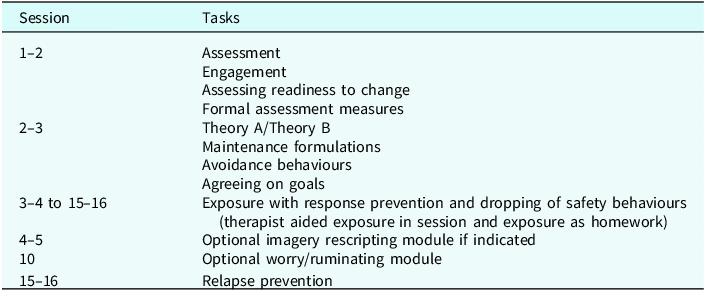
The tasks in treatment, from assessment to relapse prevention, are listed in Table 1.
Structure of therapy

Table 1. Long description
A table with two columns and sixteen rows. The columns are labeled Session and Tasks. The table outlines the tasks in therapy sessions from assessment to relapse prevention. Row 1: Session 1-2, Tasks Assessment. Row 2: Session 1-2, Tasks Engagement. Row 3: Session 1-2, Tasks Assessing readiness to change. Row 4: Session 1-2, Tasks Formal assessment measures. Row 5: Session 2-3, Tasks Theory A/Theory B. Row 6: Session 2-3, Tasks Maintenance formulations. Row 7: Session 2-3, Tasks Avoidance behaviours. Row 8: Session 2-3, Tasks Agreeing on goals. Row 9: Session 3-4 to 15-16, Tasks Exposure with response prevention and dropping of safety behaviours (therapist aided exposure in session and exposure as homework). Row 10: Session 4-5, Tasks Optional imagery rescripting module if indicated. Row 11: Session 10, Tasks Optional worry/ruminating module. Row 12: Session 15-16, Tasks Relapse prevention.
1. Assessment
After diagnosing a SPOV, a detailed assessment and longitudinal formulation are required. The first step is to obtain a developmental history. A suitable interview for exploring the developmental history is provided in the Supplementary material. A meta-analysis of published studies suggested that the pooled mean age of onset was 10 years (Meule et al., Reference Meule, Seufert and Kolar2025). It is a chronic condition with a mean age of 29 years at the time of presentation for seeking help (Meule et al., Reference Meule, Seufert and Kolar2025). Individuals may or may not report early aversive experiences of vomiting (or at least one experience that requires emotional processing) (Veale et al., Reference Veale, Murphy, Ellison, Kanakam and Costa2013b). Emetophobia develops from a variety of factors, including genetics (Van Houtem et al., Reference Van Houtem, Laine, Boomsma, Ligthart, van Wijk and De Jongh2013), general anxiety-vulnerability factors (Boschen, Reference Boschen2007), increased disgust sensitivity (Verwoerd et al., Reference Verwoerd, van Hout and de Jong2016), and a tendency to somatise anxiety and uncertainty as gastrointestinal distress (Boschen, Reference Boschen2007). During the assessment, we might say, ‘The cause of emetophobia is not entirely understood. Being prone to anxiety or being more sensitive to disgust may be inherited from one’s parents. You may also be more prone to experiencing anxiety in your stomach, with a feeling of uncertainty or not knowing whether you will vomit. You might also have been influenced by some difficult experiences of vomiting during childhood that have stuck in your mind’. We also use a compassion-focused therapy approach to understand how humans have evolved a tricky brain and that it is not their fault to develop an anxiety disorder (Gilbert, Reference Gilbert2020). This involves education about how our evolved brain can not only go to the moon and be very creative, but also worry about and imagine the threat of vomiting. This can easily trigger our old brain to activate the fight-or-flight system that keeps us safe from danger. This means that it is used automatically in situations that do not require a threat response.
2. Engagement
Engagement is the next step in the treatment of emetophobia. This implies that the problem is taken seriously and that the experience of emetophobia has been validated. People with emetophobia have often been told, for example, ‘Well, no one likes vomiting’, ‘Being sick is not that bad’, and ‘You’ll feel better once you are sick’. Any psychoeducation needs to be delivered with care, with a focus on building a therapeutic alliance and knowing that their therapist ‘gets it’. For example, most people with emetophobia often ‘know’ that they need to be sick to get rid of toxins to survive. This is irrelevant if one prefers to die rather than be sick. Therapists may find it difficult to understand that people with emetophobia may not articulate any feared consequences of vomiting (other than how it feels physically, not knowing whether they will vomit, or not being in control) (Davidson et al., Reference Davidson, Boyle and Lauchlan2008). Therefore, it is important to validate their experiences and recognise the problem. The message is that emetophobia is treatable but requires much courage to overcome it.
We would provide a suitable rationale for CBT with exposure by saying, ‘For whatever reason, vomiting has become associated with fear and excessive disgust. You now find it difficult to tolerate the sensation of vomiting and “not knowing” whether you will vomit or how long it will last. The best evidence for treating emetophobia involves exposure to learning to tolerate feelings of uncertainty, anxiety, and bodily sensations and testing your expectations. Exposure must involve gradually dropping your safety behaviours that prevent testing your assumptions (for example, you might have a belief “If I feel nauseous, and I think about vomiting, then I am 100% likely to vomit or that it could go on forever”). Therefore, trying not to think about being sick is a safety behaviour as it prevents you from finding out whether feeling sick and thinking about it will make you vomit. Another example is the use of a baby monitor to check whether your child is sick, which prevents you from learning to tolerate not knowing whether your child is sick or not. Alternatively, you can use public transport but avoid crowded times to reduce the risk of Norovirus infection. These are safety behaviours that prevent you from learning that you can tolerate not knowing. A key issue is giving up control, as your body will make you vomit if it needs to. You cannot influence whether you vomit or not, and the more you try to control your mind or your body, the more out of control you will be. By facing up to your fears, the aim is to break the cycles of strengthening your worst fears and fuelling your preoccupation and distress. By no longer following its rules, will mean you can have a normal daily life’.
We are aware of how difficult it is to give up all safety-seeking behaviours, and for many people, this will need to be done gradually. We would however always highlight how safety behaviours interfere with exposure tasks and prevent learning and progress. We would inform our clients that the most common outcome of therapy is a shift from phobia to a fear of vomiting, which is not marked or excessive, does not cause any significant distress or interfere with life. We emphasise that there are no surprises and that clients are never forced to perform exposure tasks. Testing expectation violation does not mean proving to the person that they will not vomit during exposure. This is very important. Being sick can occur by chance or due to bad luck.
3. Assessing readiness to change
Individuals with emetophobia are usually highly motivated to seek help and engage in therapy. However, they may lack hope because of their previous negative experiences with therapy. Some may attempt to negotiate ways to cope with these safety behaviours. Some may drop out if they are not yet ready to change or are unable to tolerate emotional distress during the exposure tasks. Some may seek help from relatives or seek medication alone.
4. Use formal assessment measures
The Specific Phobia of Vomiting Inventory (SPOVI; Veale et al., Reference Veale, Ellison, Boschen, Costa, Whelan, Muccio and Henry2013a) is a self-report outcome measure for the treatment of individuals with emetophobia. It is designed to measure the frequency of cognitive processes and behaviours associated with emetophobia. It consists of 14 items, with each item scored between 0 and 4, with a range of 0–56. A diagnosis of emetophobia is likely to have a cut-off score of ≥10. It is sensitive to change, and the reliable change score is ≥7 points. There are two subscales (avoidance and threat monitoring), each consisting of 7 items (range 0–28). It can be used weekly. The SPOVI may not be useful for those who are mainly focused on worrying about others vomiting (rather than themselves).
The Emetophobia Questionnaire (EmetQ-13) overlaps with the SPOVI but measures different constructs (Boschen et al., Reference Boschen, Veale, Ellison and Reddell2013). Thus, EmetQ may be less sensitive to changes than SPOVI. It consists of 13 items, with each item scored on a 1–5 scale, for a total score ranging from 13 to 65. A diagnosis of emetophobia is likely to have a score of >22. The EmetQ has three subscales: (1) avoidance of travel and places where no help is available, (2) themes of dangerousness in exposure to vomit, and (3) avoidance of others who may vomit. Observer-rated measures for OCD, such as the standard Yale-Brown Obsessive-Compulsive Scale (Y-BOCS; Goodman et al., Reference Goodman, Price, Rasmussen, Mazure, Fleischmann, Hill, Heninger and Charney1989), can be used; however, this is biased with 5 items toward compulsions. A longer version of the Y-BOCS measures the severity of avoidance in 1 item. A behavioural avoidance test for vomiting can also be used, especially in research studies (Boschen et al., Reference Boschen, Veale, Ellison and Reddell2013).
5. Theory A/Theory B
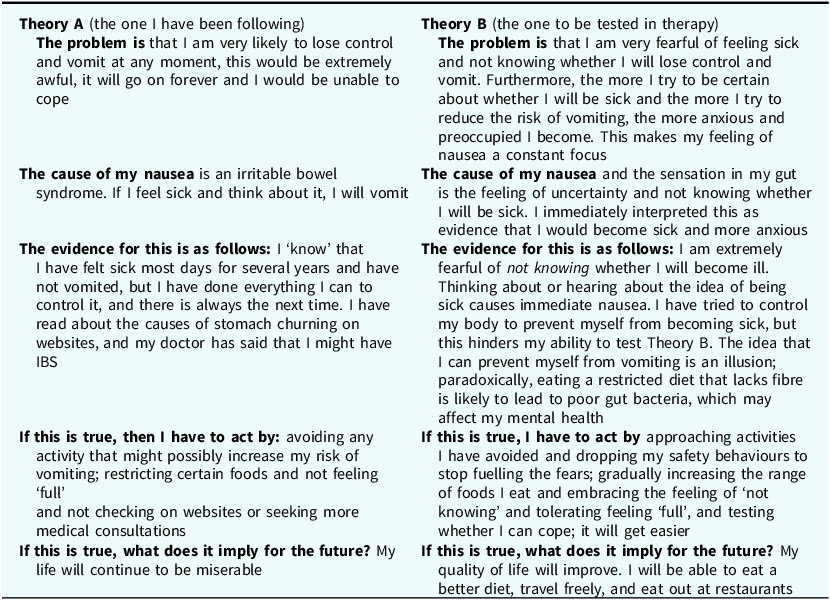
Developing an alternative explanation of the problem (Theory B) compared with Theory A can be helpful when there is ambivalence around change or when people are reluctant to approach even the smallest risk of vomiting. An example in Table 2 is an alternative understanding of the problem (Salkovskis and Warwick, Reference Salkovskis and Warwick1985)
Theory A/Theory B

Table 2. Long description
A table comparing two theories about nausea and vomiting. The table has two columns and four rows for each theory. Column headers are ‘Theory A’ and ‘Theory B’. Row labels are ‘The problem is’, ‘The cause of my nausea’, ‘The evidence for this is as follows’, and ‘If this is true, I have to act by’. Row 1: Theory A, The problem is that I am very likely to lose control and vomit at any moment, this would be extremely awful, it will go on forever and I would be unable to cope; Theory B, The problem is that I am very fearful of feeling sick and not knowing whether I will lose control and vomit. Furthermore, the more I try to be certain about whether I will be sick and the more I try to reduce the risk of vomiting, the more anxious and preoccupied I become. This makes my feeling of nausea a constant focus. Row 2: Theory A, The cause of my nausea is an irritable bowel syndrome. If I feel sick and think about it, I will vomit; Theory B, The cause of my nausea and the sensation in my gut is the feeling of uncertainty and not knowing whether I will be sick. I immediately interpreted this as evidence that I would become sick and more anxious. Row 3: Theory A, The evidence for this is as follows: I know that I have felt sick most days for several years and have not vomited, but I have done everything I can to control it, and there is always the next time. I have read about the causes of stomach churning on websites, and my doctor has said that I might have IBS; Theory B, The evidence for this is as follows: I am extremely fearful of not knowing whether I will become ill. Thinking about or hearing about the idea of being sick causes immediate nausea. I have tried to control my body to prevent myself from becoming sick, but this hinders my ability to test Theory B. The idea that I can prevent myself from vomiting is an illusion; paradoxically, eating a restricted diet that lacks fibre is likely to lead to poor gut bacteria, which may affect my mental health. Row 4: Theory A, If this is true, then I have to act by: avoiding any activity that might possibly increase my risk of vomiting; restricting certain foods and not feeling ‘full’ and not checking on websites or seeking more medical consultations; Theory B, If this is true, I have to act by approaching activities I have avoided and dropping my safety behaviours to stop fuelling the fears; gradually increasing the range of foods I eat and embracing the feeling of ‘not knowing’ and tolerating feeling ‘full’, and testing whether I can cope; it will get easier.
Here, it can be useful to consider the long-term costs of continuing to live with untreated emetophobia and that most people accept a small risk of vomiting every day to live a meaningful life. Theory A/B may be adapted if a client believes that they have a specific theory for the cause of their nausea, such as a condition like irritable bowel syndrome (IBS) (rather than fear). Information on emetophobia and its treatment can be found on the charity website www.emetaction.org, and in a self-help book (Keyes and Veale, Reference Keyes and Veale2021).
6. Develop a maintenance formulation
A semi-structured interview may be used to elicit the key processes involved in developing a maintenance formulation. Two key scenarios may exist in which separate formulations may be helpful for the same client: the first scenario may occur when there is uncertainty about whether vomiting will occur (Fig. 1 shows an example of seeing someone who looks unwell or feels nauseous). The second scenario was panic (Fig. 2 shows an example of being convinced that the individual or someone else is about to vomit).
Uncertainty about vomiting.

Formulation for being convinced of being about to vomit.

First, we would develop the inner ‘problem maintaining circle’, which is experienced as the pre-occupation and distress of emetophobia in anticipation of vomiting. This process is governed by associative conditioning. We would then explore ways of coping with uncertainty governed by operant conditioning (e.g. checking, seeking reassurance). These have the unintended consequences that strengthen the inner circle of preoccupation and distress about vomiting.
(a) Formulation of uncertainty regarding vomiting
Can you think of a recent example in which you suspected a possible risk of vomiting, but were not sure (for example, someone looked a bit pale, or you thought you might have eaten something questionable)?
-
(1) Physical sensations: Did you have a gut feeling of not knowing? Did you feel nauseous or experience your stomach churning or somewhere else in your body?
-
(2) Imagery: Did you experience an image or a felt impression of yourself or someone else vomiting? Is it linked to a past memory of yourself or someone else vomiting? What was your age at the time? Alternatively, did you experience an image of the worst-case scenario or a flash-forward of vomiting? (Price et al., Reference Price, Veale and Brewin2012)
-
(3) Beliefs: What went through your mind when you felt uncertain? What answers were you seeking? (e.g. Not knowing whether or when you are going to vomit, how long it will last, what it will feel like, how you will react emotionally or practically, or if it will make your emetophobia worse? How strongly do you believe that you could control or prevent yourself from vomiting?)
What do you believe is the worst aspect of not knowing whether you or others will vomit? OR What are the most awful aspects of vomiting that you are trying to prevent?
-
(4) Emotion: What were the main emotions that you experienced? For example, was it anxiety, disgust, shame, or something else (or a combination of emotions)?
Reacting to the uncertainty about vomiting
When you thought there was a risk of you (or someone else) getting sick, how did you react? For example:
-
(1) Hypervigilance: Were you watchful of others who may have been sick or of other cues related to vomiting?
-
(2) Self-monitoring: Were you watchful of how you felt in your gut?
-
(3) Reassurance: Were you seeking reassurance from others that you or others would not become ill?
-
(4) Self-reassurance: Were you trying to reassure yourself that you or others would not become sick?
-
(5) Checking others: Were you checking whether others looked ill or felt unwell? Do you smell excessively or check the sell-by dates of food items?
-
(6) Checking memory: Did you mentally review your actions (e.g. what you ate)? Or whether you had touched something dirty?
-
(7) Washing: Do you have the urge to wash your hands, use special measures (e.g. antibacterial soap or very hot water), or wash them for an extra long time?
-
(8) Compulsions: Did you engage in any other repetitive actions or counting to prevent yourself from vomiting?
-
(9) Worry: Did you worry about and mentally plan how to protect yourself from getting sick or how to cope with someone else being sick?
-
(10) Medication: Did you take any anti-nausea medication, antacids, or mints to prevent vomiting?
-
(11) Avoidance and escape: This requires a detailed enquiry (discussed below).
For each way of responding, it is helpful to identify the intentions about the strategy and the unintended consequences that strengthen the pre-occupation and distress (for example, the motivation to worry might be an assumption ‘I can work out how to stop it happening’, or for reassurance ‘I can get more certainty that someone is not going to be sick’, or for avoidance ‘I can make sure I never vomit’ or ‘I can reduce the feeling of not knowing whether I am going to vomit’). The following questions may be suitable for this purpose.
‘What was your motivation or intention behind this coping method? What are the unintended consequences of this approach? Does it increase your pre-occupation with and distress from vomiting? Does it make you more or less convinced that vomiting will occur? Does it make it feel more or less likely that you would be able to cope if it did? If it makes you feel less anxious in the short term, have you noticed that your fear has worsened? What might be the longer-term consequences of trying to prevent yourself from vomiting in this way?’
7. Avoidance behaviours
It is important to obtain a comprehensive list of all situations that one is avoiding related to vomiting (or only doing so with safety behaviours). Some of these may be motivated more by not tolerating uncertainty, while others may be motivated by not tolerating anxiety or wanting to risk the feared consequences of their actions. This is discussed in more detail in the Supplementary materials. These could be situations (e.g. a hospital, doctor’s surgery, pub, or aeroplane) with people (e.g. adults or children who are ill) who could be at risk of vomiting; situations that could transmit a stomach-related illness (e.g. public toilet seat; buttons pressed by others); or specific reminders about vomiting (e.g. certain words, films, sounds or smells). Each situation should be rated in terms of the degree of anxiety or SUDs that one anticipates experiencing without using any safety behaviour (e.g. the use of gloves, the use of a monitor to hear whether a child is sick, removing sick bags, or not reciting a phrase to keep oneself safe). Exposure tasks that involve over-learning should be added to the hierarchy, such as planned exposure to sensory stimuli, such as sounds and smells of vomit, or role-playing vomiting (see below).
8. Maintenance formulation for panic about vomiting
In the second scenario, the person is convinced that there is an immediate threat of vomiting in themselves or others and panics about it. If a person avoids a great deal, this scenario may occur infrequently; however, it is still important to identify how they might respond to planned exposure.
‘Can you think of a recent example where you were convinced you were going to vomit (but didn’t) or convinced that someone else was about to vomit?’
-
(1) Physical sensations: Did you feel sick, sweaty, dizzy, or hot, like in a panic attack? (were there any other sensations?)
-
(2) Imagery: Did you experience an image or felt impression of yourself or someone else vomiting? Did you get an image of a worst-case scenario or a flash forward?
-
(3) Beliefs: Were you convinced that you would vomit? If you had the choice, would you prefer to die rather than vomit? How confident are you that you can cope with vomiting? How confident are you that you will cope with others’ vomiting?
-
(4) Emotion: What were your main emotions? For example, was it panic? shame? disgust? anger? Or another emotion?
Responding to panic
‘When you strongly believed that you (or someone else) were about to vomit, how did you react?’
-
(1) Self-focused attention: Were you inwardly focused on checking your bodily sensations? (what did you monitor?). Did you focus on the movements of the person you thought would become ill?
-
(2) Escape: Did you try to escape the situation, or were you looking for an escape route? Are you looking for people to help you, or do you want to be alone? (If another person or child is ill, do you try to get them to leave the room?)
-
(3) Safety-seeking behaviours: Why do you think you did not vomit? (for example, did you pray, reassure yourself, or move very slowly?)
-
(4) Experiential avoidance: Did you try to distract yourself or suppress thoughts or images related to vomiting? Did you try to reassure yourself that you or another person would not vomit?
-
(5) Control: Did you try to control your vomiting (and how did you do so)? Do you believe that you can control your vomiting? How does that work?
9. Agreeing on goals
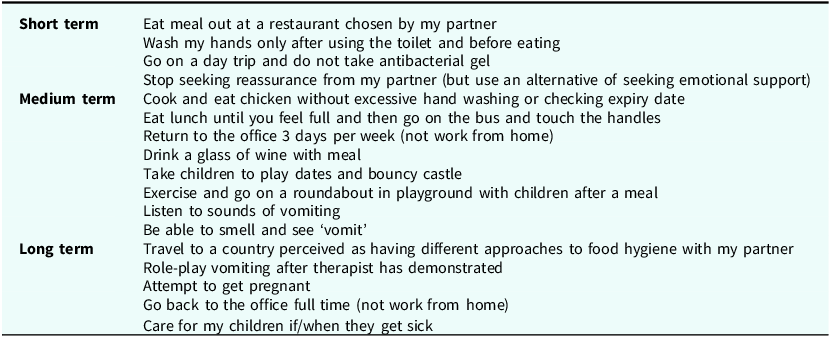
It is important to have realistic expectations and SMART (specific, measurable, achievable, realistic and within a time frame) goals that have motivational attunement (Holtforth and Castonguay, Reference Holtforth and Castonguay2005). These may be short-, medium-, and long-term goals that are consistent with their values (Table 3). The most common outcome for most people is a transition from phobia to a fear of vomiting that is not marked or excessive and is not significantly distressing or interfering with their lives. Thus, goals should primarily be behavioural in terms of what the individual will do differently without safety behaviours. This may lead to an exposure hierarchy in which tasks are the means to achieve one’s goal.
Goals

Table 3. Long description
A table listing short, medium, and long-term goals. The table has three columns labeled Short term, Medium term, and Long term. Each column lists specific goals. Short term: Eat meal out at a restaurant chosen by my partner, Wash my hands only after using the toilet and before eating, Go on a day trip and do not take antibacterial gel, Stop seeking reassurance from my partner (but use an alternative of seeking emotional support). Medium term: Cook and eat chicken without excessive hand washing or checking expiry date, Eat lunch until you feel full and then go on the bus and touch the handles, Return to the office 3 days per week (not work from home), Drink a glass of wine with meal, Take children to play dates and bouncy castle, Exercise and go on a roundabout in playground with children after a meal, Listen to sounds of vomiting, Be able to smell and see ‘vomit’. Long term: Travel to a country perceived as having different approaches to food hygiene with my partner, Role-play vomiting after therapist has demonstrated, Attempt to get pregnant, Go back to the office full time (not work from home), Care for my children if/when they get sick.
10. Developing an exposure program
For an exposure program, one chooses tasks with the client that are external cues for vomiting without using safety behaviours; for example, (i) situations that have been avoided in the past or endured only with safety behaviours (for example, sitting in an accident and emergency waiting room or using public toilets without closing one’s eyes and holding one’s hands over one’s ears); (ii) activities that are valued but given up because of fear (e.g. going on holiday abroad; eating seafood); and (iii) activities that involve over-learning (e.g. deliberately touching surfaces that look ‘risky’ and then touching one’s mouth). An example of an exposure that has been avoided, valued, and involves overlearning is a parent with emetophobia who has avoided taking their children to soft-play areas. This is a valued activity as their children enjoy it. Parents can encourage their children to interact with other children as much as possible and help them touch surfaces, use public toilets, and eat without washing their hands.
Some exposure tasks will focus more on learning to tolerate uncertainty (for example, exposure to eating a meal not cooked by oneself and dropping safety behaviours by not seeking reassurance about whether someone could be ill). Eating a diverse and greater amount of food without safety behaviours (e.g. not overcooking food, eating food that has been cooked by others, eating when one ‘feels’ nauseous) is an important component of any exposure program.
Exposure might include internal cues (e.g. past memories of vomiting, thoughts and images associated with vomiting, and sensations such as nausea, indigestion, and burping) or sensory cues for vomiting (e.g. the smell or sound of vomiting), which are described below: a good assessment combines all these tasks into a treatment plan. They can be grouped in terms of easy, moderate, and hard (and rated by the degree of anticipated SUDs, as well as short-, medium-, or long-term goals. All homework tasks should be recorded, and the data brought to the therapy sessions (see Supplementary material).
It may be important to warn some clients that the emotion of disgust is slower than anxiety in responding to extinction. Furthermore, it may reduce in intensity but not completely diminish, as it may be understood as a somewhat adaptive response to vomiting. Attentional avoidance is the most characteristic feature of disgust (Knowles et al., Reference Knowles, Jessup and Olatunji2018). Therefore, exposure tasks must focus on stimuli eliciting disgust and experiencing the emotion of disgust. We would also try to focus on the pursuit of their values (e.g. caring for their children) and check whether that is more important than avoiding the emotion of disgust.
11. Response prevention
Response prevention refers to stopping all compulsions or repetitive behaviours, such as reassurance seeking, in response to the fear (Meyer, Reference Meyer1966). Like safety-seeking behaviours, these need to be done early in treatment, or they will interfere with the exposure tasks. Try to identify any problematic termination criteria for a compulsion, such as finishing washing when it feels comfortable or ‘just right’. In general, it is far better to spoil compulsions (e.g. touching a perceived contaminant that is believed to make one sick and transferring one’s hand to one’s face, rather than gradually reducing the frequency of a washing compulsion). Delaying a compulsion, such as washing, may help, but only if it is a means to an end. Spoiling mental compulsions, such as self-reassurance (e.g. that one is not going to vomit), can include trying to wish oneself to vomit or imagining vomiting. It is important to focus clients’ attention externally rather than on bodily sensations or imagery and to broaden their attention rather than on the potential threat of others. Relatives or close friends may be taught through role-play how to provide emotional support but not reassurance (e.g. respond to questions whether they are feeling ill). They may also be checking and seeking reassurance in emetophobia forums or with AI, which the person may find difficult to change.
11a. Starting exposure
Before commencing an exposure program, they must be able to explain the process, have a prediction to be tested, or an alternative understanding of the problem (Theory B). Decide on the location, time, and resources needed, and check whether they can repeat the tasks in different contexts. The panic formulation may have identified various safety-seeking behaviours during exposure (e.g. the desire to escape, being self-focused, keeping one’s eyes closed, and trying not to experience thoughts and images of vomiting). Here, it is important to help the client drop their safety-seeking behaviours, be externally focused, and ground themselves in external senses (what they see, hear, and feel in textures) rather than monitoring their nausea and gastrointestinal sensations.
11b. Exposure to bodily sensations
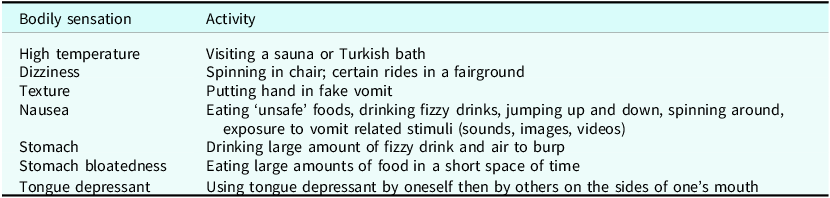
Some bodily sensations are cues for vomiting and feelings of uncertainty, which can be recreated as exposure tasks (Hunter and Antony, Reference Hunter and Antony2009). For some people, this needs to be combined with thoughts or images of vomiting to strengthen the theory that thinking or wishing to vomit and feeling nauseous do not lead to actual vomiting. Table 4 lists the suggested tasks.
Possible exposure tasks for bodily sensations

Table 4. Long description
A table with two columns and seven rows. The first column is labeled ‘Bodily sensation’ and the second column is labeled ‘Activity’. The table lists various bodily sensations and the activities that can be used to recreate these sensations. Row 1: High temperature, Visiting a sauna or Turkish bath. Row 2: Dizziness, Spinning in chair; certain rides in a fairground. Row 3: Texture, Putting hand in fake vomit. Row 4: Nausea, Eating ‘unsafe’ foods, drinking fizzy drinks, jumping up and down, spinning around, exposure to vomit related stimuli (sounds, images, videos). Row 5: Stomach, Drinking large amount of fizzy drink and air to burp. Row 6: Stomach bloatedness, Eating large amounts of food in a short space of time. Row 7: Tongue depressant, Using tongue depressant by oneself then by others on the sides of one’s mouth.
Care is required in the autistic spectrum, where sensory distress is part of the formulation; the aim is to decrease sensitivity to gastrointestinal sensations before specific cues are associated with fear. However, it is important to acknowledge that decreasing sensory distress may not be possible in some cases of ASD.
11c. Exposure to pictures of vomit or vomiting
Viewing pictures and videos of others vomiting is a common stimulus for the treatment of emetophobia. In our experience, pictures and videos may be a weak stimulus compared with the sounds and smells of vomit. This may be because many clients do not find the images realistic or distance themselves from them. A client ‘knows’ that she will not vomit from seeing a picture or watching a film, which may not be helpful for exposure therapy. There is an argument for using virtual reality to watch oneself vomit. Ideally, a therapist will role-play vomiting, perhaps using fake vomit.
11d. Exposure to sounds and smells of vomit
The sounds and smells of vomiting are often more effective than images or videos. Resources for exposure to pictures and sounds can be found here: https://emetophobia.net/adultexposure/. There is also an app for the sounds of vomiting, and websites from which they can be downloaded. Sounds and smells of vomit are more effective if the person can play the role of herself pretending to vomit with the therapist using a plastic washing-up bowl with fake vomit (without any safety behaviours). The rationale for this is that clients are likely to vomit at least once during their lives. If she can fully accept this, it is preferable to prepare and increase their self-confidence (as we do when we prepare for a fire drill). It is very important not to escape when others are actually vomiting but to keep all senses open and not to use any safety behaviours (e.g. use of bowls, vomit bags).
11e. Exposure to fake vomit
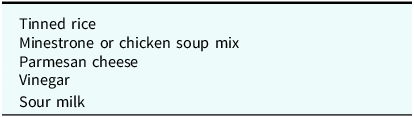
A common recipe for fake vomit is provided in Table 5 (McFadyen and Wyness, Reference McFadyen and Wyness1983). It may also be important to customise the recipe to resemble a previous experience (e.g. adding diced carrots) or to use a washing-up bowl of the same colour. Ideally, the sample should be warmed to body temperature and stored in a thermos flask. Butyric acid is responsible for the smell of vomit, and this odour can be purchased from online joke shops. It is also naturally found in rancid butter and in Parmesan cheese. The natural smell of vomit can be detected in casualty departments in the early evening (especially in the children’s area).
A recipe for fake vomit

Table 5. Long description
A table listing ingredients for a common recipe for fake vomit. The table has five rows and one column. Row 1: Tinned rice. Row 2: Minestrone or chicken soup mix. Row 3: Parmesan cheese. Row 4: Vinegar. Row 5: Sour milk.
11f. Exposure to self-induced vomiting
Inducing vomiting for planned exposure is extremely rare, and no case reports on this topic have been published yet. This might be justified if the individual has never vomited; however, it should be used with caution and with specific predictions. Öst (personal communication) has told us about the successful use of ipecac syrup in cases of one-off exposure to vomiting at home. Other methods include the use of the gag reflex or drinking warm salt water. However, we have no personal experience with this technique. Instead, we are evaluating the use of virtual reality in which the participant vomits in a virtual bathroom.
12. Imagery rescripting
In selected cases, there may be experiences of vomiting in oneself or others with intrusive imagery that has not been emotionally processed (Price et al., Reference Price, Veale and Brewin2012). If they are emotionally linked to the current imagery of vomiting, it may be helpful to use imagery rescripting to update the memory and specific predictions around vomiting with information we know now that was not available at the time, and to one in which the older self can meet the expressed needs of the younger self (Arntz and Weertman, Reference Arntz and Weertman1999). This is likely to be helpful only when there is a clear aversive memory emotionally linked to current imagery. An updated imagery rescripting protocol has been published (Arntz, Reference Arntz2025) which suggests that the optimum timing for the intervention is at the beginning of therapy and that rescripting should start when the hotspot is reached so that the needs of the younger self can be provided (e.g. to be told that the vomiting will not last long and that they will not be abandoned).
13. Worry rumination
The content of worry is whether the individual or others will vomit and how to prevent it. Typically, it might involve ‘what if’ statements about the probability of future vomiting and illness, the awfulness of the experience, and low ability to cope. Worry thoughts are often abstract, catastrophic, and difficult to disengage from. It may be helpful to introduce techniques to reduce worry as an additional standalone session if worry is frequent or debilitating. It can be formulated as a way of trying to obtain certainty and ‘figuring out’ whether she or others will vomit. We may first offer psychoeducation regarding the process of worry as a biased mental habit that leads to negative and catastrophic outcomes. We may differentiate the process of worry from adaptive problem-solving and initially aim to increase awareness of when individuals engage in worry and its impact. One approach is the worry tree, which aims to reduce the time spent worrying by engaging in activities that are valued. We may first increase attentional bias toward different possible outcomes, including neutral and/or positive associations with vomiting (e.g. ‘I might vomit, but I will be able to cope, or people will be around to help me’). However, it is important that this is not used when worry occurs because it can become a form of self-reassurance and can be counterproductive. If the worry aims to eliminate doubt, then the task is to mentally lean into ‘not knowing’ whether vomiting will occur and the visceral sensations of uncertainty are experienced. Typically, individuals reassure themselves and make rational statements about their health. This will create further doubts; therefore, it is more helpful to bridge the gap with a coping statement. For example, ‘This is tough, but I can bear it. I cannot be sure whether or not I will be sick today; if I vomit, then I do not know if it will go on forever’.
14. Relapse prevention
We recommend that a therapy blueprint and relapse prevention plan be developed at the end of therapy. This promotes the consolidation of learning from therapy and supports clients in considering the practical steps required to continue applying CBT principles, tools, and techniques independently after the therapy ends. The plan may include a summary of your shared understanding of what keeps emetophobia going, the main therapy goals, the most helpful exposure and behavioural experiments completed in sessions, and the main learning derived from each experiment. It may be helpful to consider the next steps to continue to maintain the gains made and how to keep moving forward towards longer-term goals. For example, clients can be encouraged to protect their own weekly ‘therapy time’ to review goals, set themselves homework, and problem-solve any obstacles. It may also be helpful to consider more challenging scenarios that could trigger setbacks, such as vomiting or children getting sick. Here, one can devise a ‘good enough’ coping plan for such events that maintains the importance of responding to scenarios in a ‘Theory B’ way. Clients can be reminded to revisit therapy or self-help resources, the therapy blueprint, and temporarily increase their exposure to relevant cues if necessary. If available and resources allow, clients may benefit from a period of follow-up after the end of therapy to discuss the maintenance of gains and problem-solve any challenges or setbacks with the support of their therapist or other relevant professionals involved in their care.
Medication
Currently, there is no evidence that emetophobia can be treated with medications. We have previously described how some individuals with emetophobia share processes similar to those of individuals with OCD. In moderate-to-severe cases, offering an SSRI (such as fluoxetine or sertraline) at the maximum tolerated dose for at least 12 weeks may be justified (National Institute of Health and Care Excellence, 2005). However, this needs to be evaluated in a randomised controlled trial that excludes the true co-morbidity of OCD. It is usually only offered if an individual fails an adequate CBT trial and as a way to augment another CBT trial. Because nausea is a possible temporary side-effect of SSRIs, it may be rejected. This can be minimised by taking it after food, starting treatment at a lower dose, and gradually increasing the dose.
Some experimental work has been conducted for a specific phobia of spiders, in which a beta-blocker, propranolol, is administered after an intensive session of exposure (Soeter and Kindt, Reference Soeter and Kindt2015), which is thought to augment learning overnight before the next session. However, this has not been evaluated in controlled trials. Regular use of beta-blockers, such as propranolol or atenolol, is not beneficial for emetophobia or anxiety disorders (Archer et al., Reference Archer, Wiles, Kessler, Turner and Caldwell2025).
Anti-nausea medications (e.g. prochlorperazine, cyclizine, and domperidone) are often requested by individuals with emetophobia and prescribed by their family doctors. They are not recommended because they are used as safety behaviours with the illusion that they may prevent vomiting. They are placebos or weak anxiolytics that make the person ‘feel’ more in control. Eventually, these must be discontinued.
Key practice points
-
(1) Treating emetophobia requires a good understanding of the psychopathology and maintaining factors.
-
(2) People with emetophobia need a strong and supportive rationale to approach the problem differently.
-
(3) Principles of inhibitory learning can be applied to make exposure most effective (e.g. frequency, intensity, layering of exposure cues).
-
(4) Goals of treatment are about reducing pre-occupation and distress, learning to better tolerate uncertainty rather than finding out whether vomiting will occur or not.
Supplementary material
To view supplementary material for this article, please visit https://doi.org/10.1017/S1754470X26100841
Data availability statement
There are no research data in this paper.
Acknowledgements
None.
Author contributions
David M Veale: Conceptualization-Lead, Writing - original draft-Lead, Writing - review & editing-Lead; Alexandra Keyes: Conceptualization-Supporting, Writing - review & editing-Supporting; Kathryn Price: Conceptualization-Supporting, Writing - review & editing-Supporting.
Financial support
This study presents independent research part-funded by the National Institute for Health Research (NIHR) Biomedical Research Centre in South London, the Maudsley NHS Foundation Trust, and King’s College London.
Competing interests
The authors declare that they have no competing interests.
Ethical standards
The authors have abided by the Ethical Principles of Psychologists and Code of Conduct as set out by the British Association for Behavioural and Cognitive Psychotherapies (BABCP) and the British Psychological Society (BPS). This article is an empirically grounded clinical guidance paper and does not report original research involving human participants, the collection of new participant data, or the use of identifiable clinical material. As such, formal research ethics approval was not required.




 Open access


Comments
No Comments have been published for this article.