Native people don’t understand why your people put their houses where they know the water is going to come.
—Marilyn Dempsey, language arts teacher, Navajo Nation School, in the talkback (July 2011) after a screening of Spike Lee’s When the Levees Broke: A Requiem in Four Acts (2006)
“Se habla dreams” (Spanglish for “dreams are spoken here”) is essayist Andrei Codrescu’s concise way of summing up the special language in which New Orleanians rationalize their proud history of repeating high-risk behaviors (Codrescu 2006:59). For 300 years they have been learning from their mistakes, so much so that they can repeat them faithfully. The word repetition best describes this local phenomenon because in French it means “rehearsal.” The year 2020, for example, marked the tercentennial of the “Mississippi Bubble,” the collapse of financier John Law’s colonial pyramid scheme, which proffered pipedreams of a place called the “Isle of Orleans” to lure speculators. Law spoke the language of dreams fluently. A monetary theorist way ahead of his time, he thought that people could be persuaded to believe in paper money even when it wasn’t backed by precious metal. History has proven him right, at least for the time being, but the United States did not cancel the international convertibility of the dollar to gold until 1971. Law further argued, presciently but prematurely, 70 years before Adam Smith, that credit would increase wealth by speeding its circulation as capital (Law Reference Law1705). As sometimes happens to dream-speakers, success came quickly, and disaster followed apace. When creditors discovered that nothing more solid than deltaic swamplands backed Law’s bank notes and shares, the ensuing panic broke the French national bank, ruined the investors in the Compagnie des Indes (popularly known as the Mississippi Company), and marooned in their flooded huts the wretched colonists of New Orleans, many of whom had been transported there as punishment, which meant that at least something worked out as planned.
Law’s hypothecation cannot be blamed for everything. A French Canadian naval officer and adventurer named Jean-Baptiste Le Moyne, Sieur de Bienville, selected the site for the city. The Native American guides who showed him the portages between the Mississippi River and Lake Pontchartrain knew better than to locate anything more permanent than a fishing camp there, but Bienville persisted. The consequences of his gamble still resonate in the titles of recent histories that probe his varied motives of geopolitical strategy and landholding self-interest: Craig E. Colten’s An Unnatural Metropolis: Wresting New Orleans from Nature (2005), Richard Campanella’s Bienville’s Dilemma: A Historical Geography of New Orleans (2008), Lawrence Powell’s The Accidental City: Improvising New Orleans (2012), and Jason Berry’s City of a Million Dreams: New Orleans at Year 300 (2018). Unusually for a city founder, Bienville got a second chance. When the Great Hurricane of 1722 destroyed most of whatever remained after the flood of 1719, he passed up this historic opportunity for innovative rethinking and doubled down. Whereas the colonists at Mobile had moved 27 miles inland to safer ground, New Orleanians rebuilt on the original site, developing a plan for a rigid grid of streets known today as the French Quarter, or Vieux Carré, but opening up an apparently unbounded space to dream and drown in.
In the fullness of time, experience strengthens the natural bonds between fatalism and desire, nurturing a seemingly jocund predisposition to embrace risk as a way of life. Before he persuaded Philippe, Duc d’Orléans, to appoint him Controller General of Finance, Scottish expat John Law played for high stakes at the gaming tables of Europe. Before he founded New Orleans, Bienville, taking command of a canoe, bluffed the captain of an armed English corvette into retreating back down the Mississippi from a bend in the river still known today as the “English Turn.” Once in office, neither Law nor Bienville stopped rolling the dice, and a number of those who followed them have likewise found how dangerously habit-forming tempting fate can become. Born on a bubble just before it burst, the commodity-trading entrepôt of New Orleans eventually grew large enough to participate fully in later boom-and-bust panics, from the cotton crisis of 1837 to the oil-price collapse of the 1980s. More precarious still, the long-term environmental odds of its location have always favored the house, geographically speaking, with a grim potential downside for the players over time. Meteorological history documents no fewer than 80 severe tropical storms that made landfall in Louisiana between the Hurricane of 1722 and Hurricane Katrina in 2005 (Roth Reference Roth2010). The most illuminating book yet written about Katrina, Andy Horowitz’s Katrina: A History, 1915–2015, explains the many ways in which this devastating catastrophe did not constitute an event, but rather, like a Greek tragedy, an incrementally unfolding process in linked episodes, a performance of hubris in the face of antagonistic forces in a production that is still running. Gravity has its say: water runs downhill; but long-term policy, especially the underregulated extraction of gas and oil that blights Louisiana with the “resource curse,” contains a tragic flaw that precipitates its ruin (Horowitz Reference Horowitz2020).
Nor has tropical weather alone wreaked havoc on the low-lying “Crescent City,” so called because of its situation on a curving bend along the munificent, dangerous Mississippi River. Spring floods come back to town as reliably as the hummingbirds, which arrive along with mosquitos for which they can plausibly be mistaken. In the 19th century, yellow fever raged endem- ically, with recurring mass-casualty outbreaks, the last in 1905, while cholera, smallpox, and malaria took a steady annual toll (Olivarius Reference Olivarius2019). Due to natural and human-made subsidence, the land on which the city and its surrounding communities stand, some of which is below sea level already, has been sinking at a rate of up to two inches per year (NASA 2016). Measured against the geological time it took for the Mississippi to silt-up its vast mouth, that’s quicker than a falling soufflé when the oven door slams. As sea levels rise, the Gulf of Mexico finds more ways to pour itself into the deepening bowl. The question remains open about how much time, if any, coastal restoration and levee-strengthening initiatives will buy for New Orleans, but the initial wager of 50 billion dollars is already on the table (Schleifstein Reference Schleifstein2017). Meanwhile, the Gulf encroaches on the once-fecund bayous, despoiling by saltwater incursion the habitats not already poisoned by the petrochemical conglomerates discharging their toxins into the air and water along the 85-mile stretch of the river known as “Cancer Alley.” Recent years have brought new scourges now so familiar as to be known by their acronyms: PVCs, PVBs, CC (not “carbon copy”), STDs, HIV- AIDS, FEMA, BP, the GOP, COVID, and PTSD.
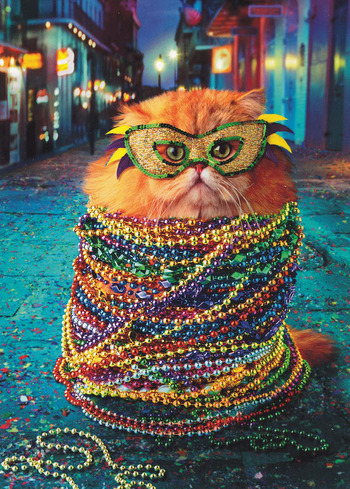
Paradoxically, the very fragility of life in this insalubrious place has worked to engender its legendarily indulgent attitudes toward pleasure (seize the day) and abstinence (that can wait). As tangibly real as any place can be—ask anyone who has lived there—New Orleans is at the same time a fantastic advertisement for its most exquisitely curated addiction, which is doom. Caveat visitor. Debauched masquerades of dancing skeletons augur your fate, vamping you with what Tennessee Williams embraced as the charm of the defeated, while even just remembering the food can make you gain weight. Other sobriquets by which New Orleans is known, such as “The Big Easy,” and “The City that Care Forgot,” appear in epitomized form on a tourist-oriented birthday greeting card that shows a feline reveler on Bourbon Street “beaded down” and “masked up” for Mardi Gras (fig. 2).
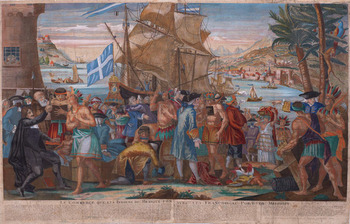
Dreaming New Orleans. François-Gérard Jollain, “Le Commerce que les Indiens du Mexique Font avec les François au Port de Missisipi. ” Between 1719 and 1721. Copperplate engraving with watercolor. (Courtesy of the Historic New Orleans Collection, 1952.3)

“Anything worth doing is worth overdoing!” Birthday greeting card from Bourbon Street, New Orleans. (Scan of greeting card courtesy of Joseph Roach)
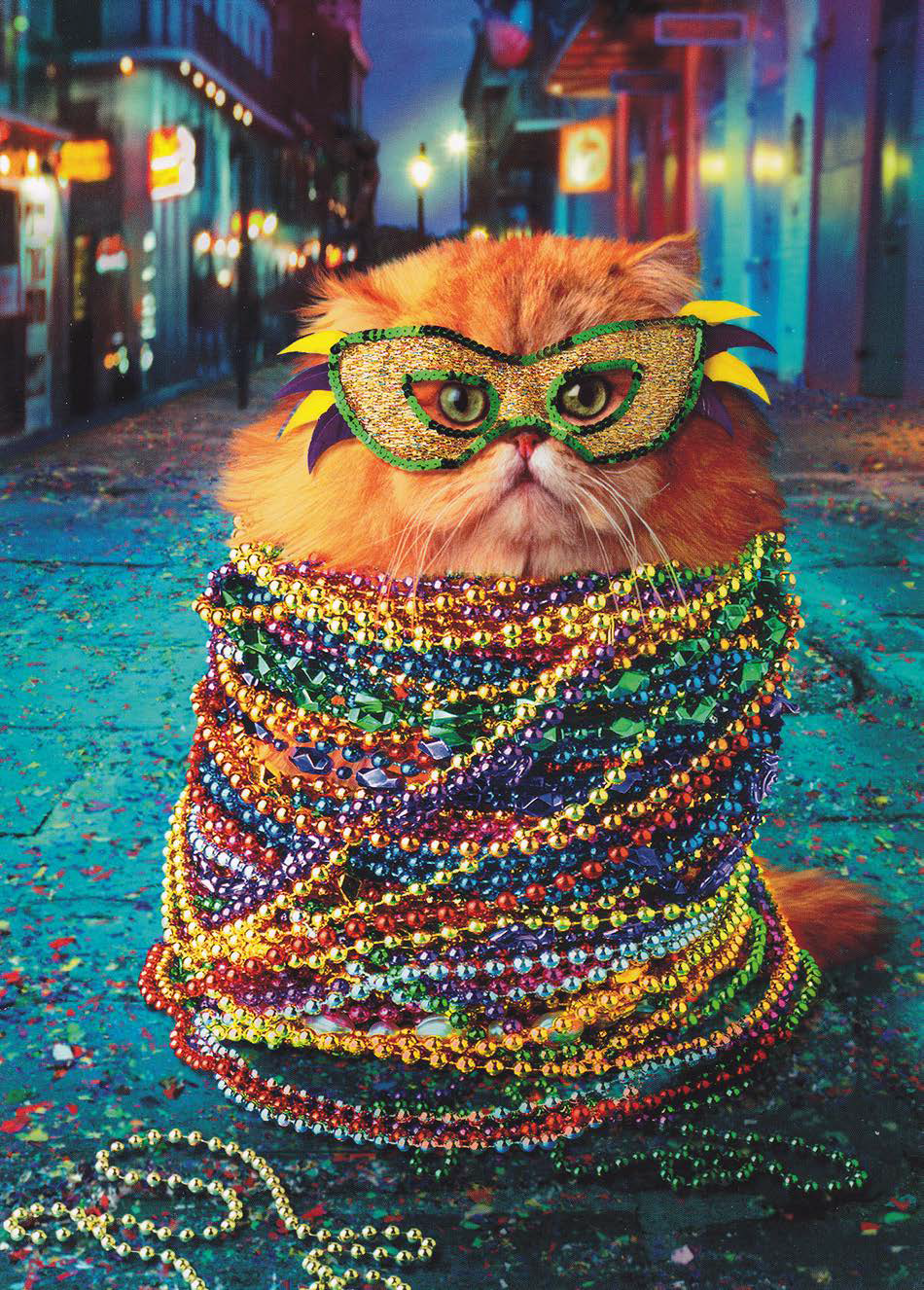
This anthropomorphic dandy, standing in extravagantly for the most ambitious “bead whores” of exhibitionist carnival, enables the susceptible beholder to entertain warm thoughts about excess, wrapping regrets, if any, in Fat Tuesday’s exculpatory cloak of licensed debauchery. Other NOLA blowouts line up like beads on a string: St. Patrick’s Day, Jazz Fest, the Tennessee Williams Festival, the Essence Festival, Southern Decadence, Sugar Bowl Weekend, and many more besides. These very different events express a common predisposition in search of a ludic occasion, generating revenue by marketing conviviality inspired by a proud tradition of utilitarian hedonism. In the bead economy of carnival, a simulacrum of high-stakes capitalism, values inflate and collapse faster than John Law’s paper money. But something keeps the high rollers rolling. The intangible payoff they’re betting on includes the crazy thrill of the shifting odds. Superseding the cliched Laissez les bon temps rouler (Let the good times roll), the greeting inside the birthday card puts in the mouth of the bling-bling pussycat an even more explicit pitch, “Anything worth doing is worth overdoing!”; for which the unstated but locally understood dream-speak rejoinder, urging acceptance of ritualized repetition’s efficacy, ups the stakes by inviting re-bookings: “Anything worth overdoing is worth doing over.”
As the island-city that has earned its cultural identity as the northernmost Caribbean capital, the Crescent City’s performance of its past, present, and possible futures makes the case for “why New Orleans matters” (Piazza Reference Piazza2005; Adams, Bibler, and Accilien Reference Adams, Bibler and Accilien2007; Sublette Reference Sublette2008; Simon and Overmyer Reference Simon and Overmyer2010–Reference Simon and Overmyer2013). Why it matters to tourists remains vitally important—the hospitality industry is an economic driver—but it could not matter to visitors in the beguiling way that it does unless it mattered to natives like no other place. The cost to the locals shows up on the loss side of the cultural balance sheet as exoticization, dooming them to perform “authenticity” to fit the needs of corporate urban branding (Gotham Reference Gotham2007). The benefit to them registers as the gratification of overdoing what they’re doing over. The genius of utilitarian hedonism resides in its capacity to extract novel pleasures from routine necessity, such as at Igor’s Bar, Restaurant, Game Room, and Laundromat on St. Charles Avenue, open 24/7, where patrons can do their laundry while enjoying the signature Igor Burger and Bloody Mary as they shoot a game of eight ball with their new friends instead of sitting alone and watching their underwear cycle through spin and tumble dry. Another greeting card encapsulates the topophilia that such native eccentricities inspire by quoting a local character from Tom Robbins’s Jitterbug Perfume (1984): “Madame Lily Devalier always asked ‘Where are you?’ in a way that insinuated that there were only two places on Earth one could be: New Orleans and somewhere ridiculous.”
In the face of massive social problems and existential threats, such unheeding attitudes and practices can be hard to defend or even explain. Deploring the local culture’s excesses as dereliction, some critics call New Orleans “The City that Forgot to Care.” Performance studies, however, can complicate this ethically elevated but dreary critique by foregrounding the generative role that dream-speakers play in a society worthy of having its problems solved. Foregrounding the historical antecedents that dreams can speak of most eloquently through performance offers opportunities that scholars can pursue to their advantage. The most urgent of those opportunities is pushing back against the growing presentism of the field of performance studies. The past need not be remote to count as history. Shane Vogel, for instance, has brilliantly illuminated an episode of popular culture in Stolen Time: Black Fad Performance and the Calypso Craze by revisiting the post-WWII moment when white America, discovering a new sonic world across the Gulf from its Third Coast but tuning out its calypsonian critique, appropriated Afro-diasporic Caribbean music as a soothing middlebrow alternative to bebop and rock ’n’ roll (Vogel Reference Vogel2018). But the past also still asserts itself compellingly across longer arcs of time. Christian DuComb’s exemplary Haunted City: Three Centuries of Racial Impersonation in Philadelphia shows how parades begin much earlier than their assembly at the annual starting point. They line up over decades and even centuries, predicated on their self-referential recurrence (DuComb Reference DuComb2017). As dream-speech, parades expose the otherwise invisible risks of both continuity and change, testing their relative value by catching them, flagrante delicto, in their uncensored acts of self-definition, poised on the sociocultural threshold between what has been and what might be. Perhaps more important still, dream-speech invites further questions about what ought to be. In New Orleans, where dreams are spoken in the streets at more frequent intervals than anywhere else in North America, otherwise intangible possibilities become all the more sensuously visible, audible, and touchable.
This much is fundamental, and New Orleans makes it plain: none of the many definitions of performance escapes the paradox of iteration; that is, no performance happens solely for the first time, yet no performance happens exactly the same way twice. Performance historians, like historians generally, tend to valorize moments and agents of change, innovation, and revolution; but at the same time, the language in which they describe performance necessarily tends to acknowledge the importance of repetition. Phrases and keywords such as “restoration of behavior” (Schechner Reference Schechner1985), “surrogation” (Roach Reference Roach1996), “ghosting” (Carlson Reference Carlson2001), “scenarios” (Taylor Reference Taylor2003), and “remains” (Schneider Reference Schneider2011), while acknowledging that the past can be reenacted but never wholly duplicated in performance, favor transmission over invention. In Race and Performance after Repetition, Soyica Diggs Colbert, Douglas A. Jones Jr., and Shane Vogel assemble a collection of essays that explore “complex temporalities that are often too quickly glossed as repetition at the expense of a more nuanced temporal vocabulary” (2020:6). Indeed, Afrocentric theories of performance offer such a vocabulary: “repetition with revision” (Gates Reference Gates1988; see Drewal Reference Drewal1992), “improvisational necessity” (Moten Reference Moten2003), and “Afro-fabulation” (Nyong’o Reference Nyong’o2019). Jazz improvisation, so important in the musical life of New Orleans, highlights the inventive side of the paradox of iteration. To be sure, improvisation is an art of memory, recombinant of its received materials, in which musicians craft even their accidents, calling them “ghost notes,” in reciprocal understanding with the other players in the ensemble; but because accidents are crafted does not mean that they are predestinated; even a solo riff negotiates between the necessary presence of what has gone before and the revelation of what is coming into being for the first time at that moment (Fertel Reference Fertel2019).
Improvisations figured in the inception of the field that came to call itself performance studies, which, like the spontaneously propulsive musical style first named “Jass” by white folks (Nola.com 2018), traces its roots to multiracial New Orleans. Finishing his PhD in theatre in the summer of 1962 at Tulane University with a dissertation on the drama of Eugène Ionesco, Richard Schechner stepped in to replace his mentor Robert Corrigan on the faculty. Schechner also took over the editorship of the Tulane Drama Review and the teaching of “Trends in Modern Theatre,” Corrigan’s seminar that Schechner himself had taken as a student just the year before. But New Orleans in the 1960s offered an alternative drama curriculum in the streets, lunch counters, and federal courts (Schechner Reference Schechner2015:45). NOLA public schools began forced integration on 14 November 1960. Led by four African American schoolgirls escorted by federal marshals through gauntlets of screaming and spitting white people, the courageous action inspired Norman Rockwell’s iconic The Problem We All Live With (1964). Tulane University remained segregated until 1963. Directing shows off campus as well as on, Schechner joined John O’Neal and Gilbert Moses as the third producing director of the Free Southern Theater (FST), which performed biracial productions on tour in Mississippi in the summer of 1965, just when the Voting Rights Act was signed into law, one year after the violent “Freedom Summer” when the Civil Rights Act was signed. For the Afrocentric FST, Schechner directed Ossie Davis’s Purlie Victorious (1965); for the avantgarde New Orleans Group, he directed Ionesco’s Victims of Duty (1967), the dispersed setting for which was designed (installed) by Jerry Rojo, improvising the style soon to be known as “environmental theatre.”
Meanwhile, back in the “Trends” seminar, the canon of modern drama and theatrical theory quickly gave way to new syllabi exploring the interdisciplinary literature on ritual, play, and the practice of everyday life. The readings featured Johan Huizinga’s Homo Ludens (1938), Gregory Bateson’s “The message, ‘this is play’” (1956), Erving Goffman’s The Presentation of Self in Everyday Life (1956), Roger Caillois’s Man, Play and Games (1958), and Eric Berne’s Transactional Analysis (1961) (Emigh Reference Emigh, Harding and Rosenthal2011:169). Two of Schechner’s ostensibly separate engagements with the category of the social in New Orleans, therefore—through the performing arts and through the behavioral literature — converged and diverged improvisatorially in phrasings known to jazz musicians as “riffs” or “licks.” As the Black Power and Black Arts movements intensified, the integrationist agenda of FST morphed into Black separatism, and Schechner resigned as a producing director becoming the chair of FST’s board before ceding the leadership entirely as he left Tulane for NYU in the summer of 1967 (Dent and Schechner Reference Dent and Schechner1969). The writing inspired by the contingencies of these oft-extemporized engagements and disengagements, however, appeared in the pages of the Tulane Drama Review, including “Dialogue: The Free Southern Theatre” (Moses et al. Reference Moses, O’Neal, Nicholas, Levey and Schechner1965:63–76) and “Approaches to Theory/Criticism” (Schechner Reference Schechner1966:20–53), communicating to the growing readership of the journal the polyphonic energies of play-by-ear activism, avantgarde performance, and rhizoid theorizing of the New Orleans years. That readership came to encompass a diverse array of constituencies in the arts and human sciences, each with its own stake in the meaning of the word performance.
What too easily slips out of the grip of these variously generative conceptions of performance is the source of the prompt that reinitiates and guides the behavior, perhaps because there is no specific term for that source. A basic question ought to come up more often in performance studies than it typically does and be answered more rigorously than it usually is: What is it exactly that is being restored, surrogated, ghosted, plotted, remaindered, revised, improvised upon, or fabulated? This phenomenon might be called “predication,” an antecedent that not only comes before the performance but also acts on it continuously. In that sense, a “predicate,” like its grammatical analogue, is an action verb in both the present and the future tenses. Often the predicate asserts itself in obvious ways, but in its most interesting form, it operates furtively. In that case it has become a “phantom predicate.” Not all predicates are phantoms: urgent contingencies prompt clearly motivated responses. As the subjectivity of the behavior increases, however, so too does the elusiveness of its predicates. But just because they’re fugitive doesn’t mean they aren’t there. Sinking deep into the social unconscious, a predicate might be forgotten, but it is not gone. At its most consequential the phantom predicate antecedes the behavior of a social group. Sometimes it is obvious. Sometimes it is hiding in plain sight. At other times it remains invisible or at most unnoticed until it reveals itself through the language of public dreams.
Phantom predicates work with special importance in New Orleans because they underlie the grammar particular to its distinctive dream-speech. For example, an immediately obvious predicate of behavior in a declivity surrounded by water, facing the seasonal risk of catastrophic dispossession, is aleatory: to live in New Orleans is to bet against not only the wind and water, but also the state and federal governmental-industrial complex in thrall of the petrochemical lobby. The phantom predicate, however, asserts itself in the constant subliminal anxiety that such a risk engenders, with anxiety defined as the longing for what is most to be feared. Living on borrowed time means that the bigger the risk, the bigger the rush. As John Law could have told his progeny, habitual gambling addicts, and gambling on credit addicts absolutely. When there’s no reliable stash of gold to back up the note, something else of value has to be imagined to take its place as collateral, if only to sublimate the anxieties of all the players, creditors and debtors alike, engaged in the deepest of deep play (Geertz Reference Geertz1973). In creative economies especially, that thing of value may be nothing more — and nothing less — than a good story.
In his selective pantheon of magical places, Codrescu locates the unique value of New Orleans in the stories it dreams up: “There are certain cities and certain areas of certain cities where the official language is dreams. Venice is one. And Paris. North Beach in San Francisco. Wenceslas Square in Prague. And New Orleans, the city that dreams stories” (2006:59). Dreaming New Orleans, therefore, requires a knowledge of its stories, some of which are historical, some fictional, and most somewhere in between (Gayarré Reference Gayarré1885). Transposed into performances, these stories disclose how the Big Easy’s self-promoted predisposition to risk confers on it unique status among North American cities. They convey its cultural mystique, its peculiar colonial history, its troubled assimilation into Anglo-North America, its tortured racial politics, its natural and built environment, its spirit-world practices, its hypervisible deathways, its raucous festive life, its eccentric characters, its food, its music, its queer vibe, its punctually arriving ruinations, and finally its capacity for re-invention, which is very much like repetition but more fun.
The singularity of New Orleans has been well narrated by stories interpreting the subjective reactions of new arrivals. No gob-smacked grammarian of the local dream-speech, however, surpasses Tennessee Williams. He came to the city for the first time in 1938 when he was 27 years old, and he returned to live there on and off for the next 40 years. He never forgot the impression his first 24 hours in the French Quarter made on him: “The shock of it against the Puritanism of my nature had given me a theme which I never ceased exploiting” (in Goodman Reference Goodman2020). Those recurring themes sprang from the thrill of the new risks that he took, personal as well as artistic. Three plays in particular, A Streetcar Named Desire (1947), Suddenly Last Summer (1958), and Vieux Carré (1977), parse the phantom predicates of New Orleans with a dramatic poet’s ear for evocative phrases, honed in service of creating “subtext,” or the characters’ unspoken thoughts.
In Williams’s New Orleans triptych, precise locales insinuate atmospheric subtexts predicated on their imperfectly remembered histories. In fact, each of the three plays takes place in a distinctive neighborhood, following the division of 19th-century New Orleans into three semi- autonomous municipalities. The First Municipality, consisting of the Vieux Carré and Faubourg Tremé ( faubourg = “false city” or suburb), and the adjacent Third Municipality, which was downriver of the French Quarter and included the Faubourg Marigny, contained the predominantly French-speaking population of the city. Williams sets Vieux Carré at 722 Toulouse Street in the heart of the First Municipality among the Bohemians of the 1930s French Quarter. The Second Municipality, stretching upriver from the French Quarter above Canal Street, comprised the rival “American Section.” For the duration of the 19th century, English-speaking New Orleanians moved steadily “Uptown” (meaning upriver), one posh neighborhood of which became known as the “Garden District,” where Suddenly Last Summer takes place. The story Williams tells in this long one-act, originally paired with Something Unspoken under the general title of The Garden District, parallels those of two other important literary works set in white, Uptown New Orleans: Walker Percy’s The Moviegoer (1961) and John Kennedy Toole’s A Confederacy of Dunces (1980). Each involves a suffocating matriarch (respectively, Violet Venable, Emily Cutrer, and Irene Reilly), an eccentric scion (Sebastian Venable, Jack “Binx” Bolling, and Ignatius Reilly), and an unhinged ingénue (Catherine Holly, Kate Cutrer, and Myrna Minkoff). This psychosexual triangle is as good an introduction as any to a hothouse society predicated on the self-cannibalizing endogamy of its kinship networks enforced by a social season of debutante balls (Snedeker Reference Snedeker2006). That Toole’s louche characters fit the paradigm imperfectly reflects an adjustment for their class standing, not, as Isabel Wilkerson would put it, their caste (Wilkerson Reference Wilkerson2020). The more ethnically complicated Third Municipality provides the setting for A Streetcar Named Desire. This beloved, problematic play lucidly diagrams the dream-speech pertaining to three magical New Orleans destinations especially—Desire, Cemeteries, and Elysian Fields — as the following account of them, profiling their salient characteristics, will show. Within these precincts, Williams predicates his story of desire, excess, and risk on the fear of dispossession, which he dramatizes as a kind of social death, abandoned to an exile of loneliness more frightening than death itself.
Desire
“Flores? Flores para los muertos?” ventures the Mexican flower-seller in A Streetcar Named Desire, going door-to-door with her flowers for the dead, delivering the contradictory symbolism of forget-me-not ephemerality, arriving and departing exactly on cue across the threshold between lust and catastrophe (Williams Reference Williams1951:119). As Blanche DuBois goes, so goes New Orleans. Like the playwright himself, she’s a dream-speaker, preferring magic to realism, but her predicament shines a cruel light on the world. She is a refugee seeking asylum but finding it all too literally at an existential dead end. Evicted by the foreclosure of the last loan by the last possible bank, she takes the protagonist’s role in a play that updates the 19th-century genre of the “mortgage melodrama” epitomized by Dion Boucicault’s The Octoroon, or Life in Louisiana (1859). Dependent on the kindness of strangers, she remains at extreme risk, falling into the clutches of a predator who can justify his brutality as entitlement by quoting “the Napoleonic Code” (Williams Reference Williams1951:34–35, 40).
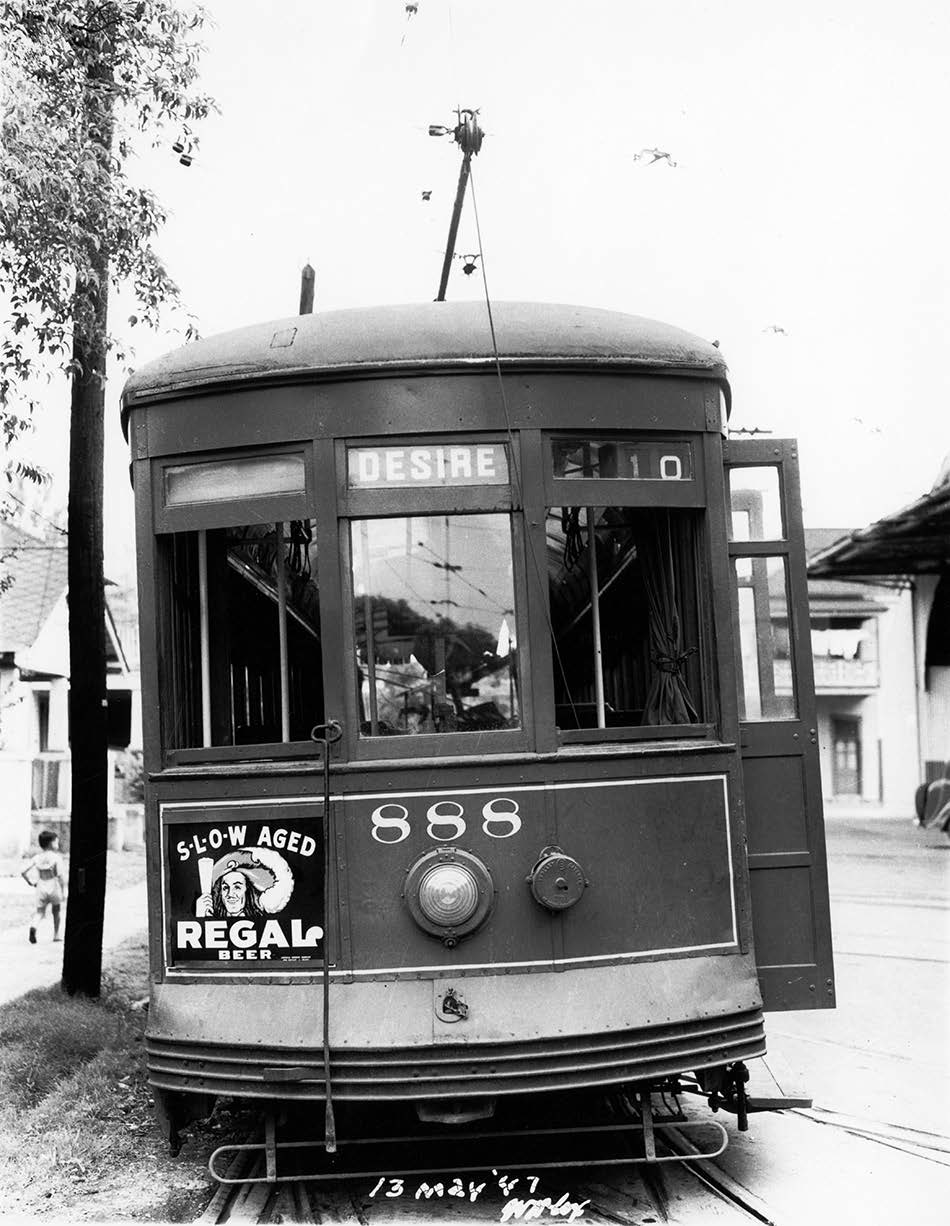
Blanche’s inbound itinerary to New Orleans, making up an emotional map of the city, still works as a kind of unofficial tour guide. That’s especially true if the traveler adopts a version of the subtext suggested by Williams’s demanding stage direction for the delivery of her first line, “with faintly hysterical humor.” The fragile belle famously introduces herself by recounting her public-transportation odyssey, which the playwright analogizes to a moth’s fatal flight to the flame: “They told me to take a street-car named Desire, and then transfer to one called Cemeteries and ride six blocks and get off at—Elysian Fields!” (15). As a female English teacher fired for sexual improprieties, Blanche appreciates irony. Even though a motorbus replaced the streetcar on the old Desire route in 1948 (fig. 3), the three stops she names refer to actual routes or street names in New Orleans. They are also at the same time metaphoric or metonymic placeholders, poetically conjured by the playwright. Tragically, the same is true of Blanche’s outbound route to an institutionalized “vacation,” which everyone knows is the end of the line (135). Meanwhile, back at the never-ending card game — one of Williams’s early titles for A Streetcar Named Desire was The Poker Night, another was The Moth — the men put their chips down on the table, as if for fun, while the stakes, like water levels after a levee breech, keep getting higher. As Mitch, riskaverse sidekick to the rapacious Stanley puts it, speaking “ sadly but firmly ”: “Poker should not be played in a house with women” (59).
Desire streetcar. (Photo courtesy of The Charles L. Franck Studio Collection at The Historic New Orleans Collection)

The acts of gendering New Orleans as feminine and then rendering “her” sexually available as the Big Easy trade on a popular stereotype of erotic abjection. Locals tend to turn their noses up at such rank teases as touristy, only to perfume them all over again when they write guidebooks themselves. Thus Carolyn Kolb, a New Orleans-born alumna of H. Sophie Newcomb Memorial College of Tulane University, begins New Orleans: An Invitation to Discover One of America’s Most Fascinating Cities by pimping out her hometown:
A corpulent hostess, patted and powdered and daubed with rouge, New Orleans reclines along the banks of the wide river, straining her corsets of convention and drawing her admirers to her with a languid gesture. A feminine city—not in the girlish sense, but like an aging coquette, a little too perfumed, a bit jaded—New Orleans fascinates the senses without taxing the mind. Once you know her you can’t help liking her, even if some of her habits may annoy you or some of her past is a trifle shady. (1972:xi)
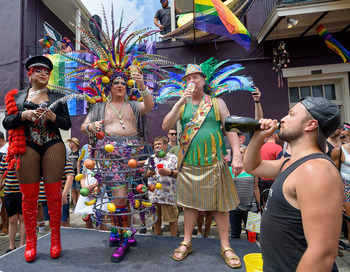
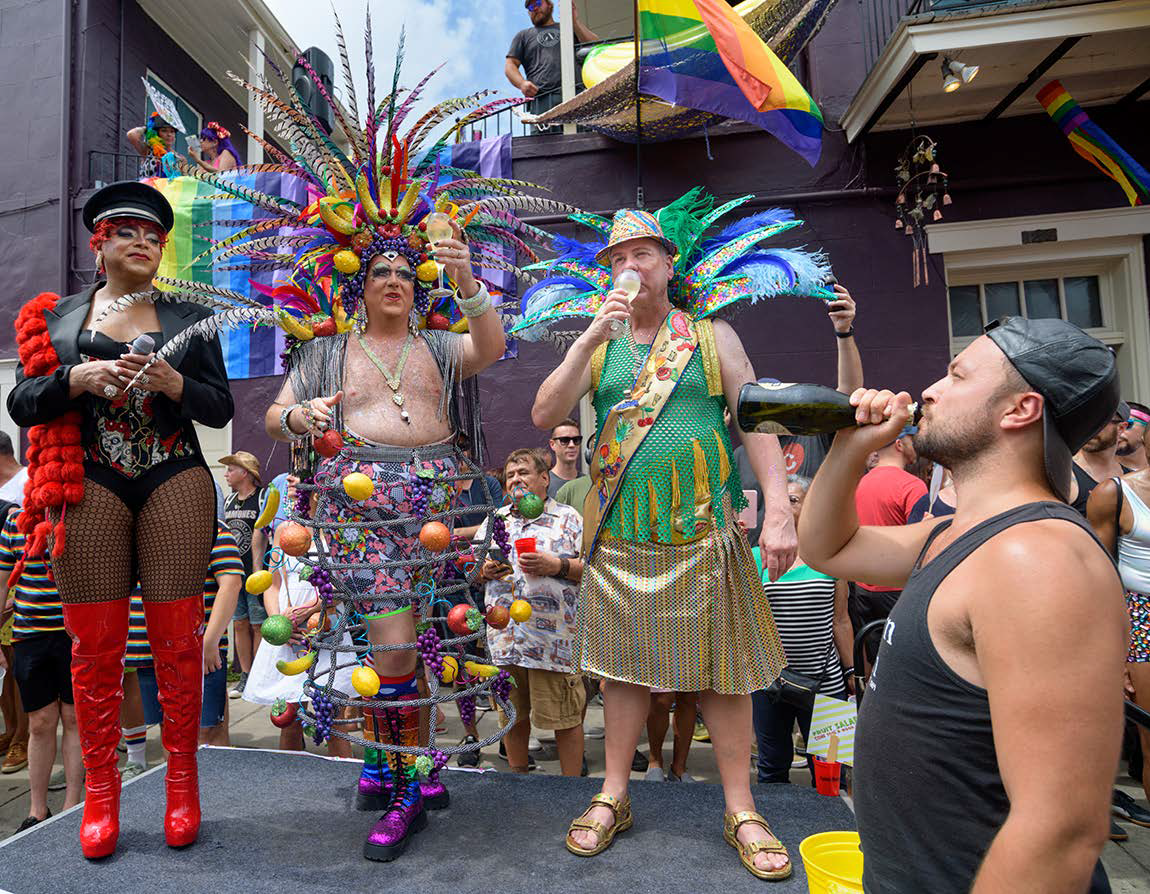
The imputation of advanced age to the decadence of the city disregards the surprising speed of its degeneration. The newest of the Caribbean capitals (Havana, for instance, was founded in 1515), New Orleans was already so sufficiently jaded when Georges Clemenceau, the future premier of France, visited as a young journalist after the American Civil War that he came away with this general conclusion: the United States was the only civilization in world history to have passed directly from barbarism to decadence without an intervening classical or golden age (Clemenceau Reference Clemenceau1991). What he could not have foreseen is the extent to which this nouveau funkiness would become a point of pride. Local connoisseurs savor the rot along with the remoulade (Sexton and Delehanty Reference Sexton and Delehanty1993), while the annual six-day bacchanalia known as “Southern Decadence” offers the most exuberant of gay-pride festivals (fig. 4). Southern Decadence started in 1972 at a small house in the Tremé neighborhood shared by some hard-partying gay men who named their humble domicile “Belle Reve” (Beautiful Dream) in honor of Blanche DuBois’s mythologized plantation home.
The 2019 Southern Decadence Walking Parade with the 45th Grand Marshals of Southern Decadence, Countess C. Alice (second from left) and Will Antill (second from right). French Quarter, New Orleans, 1 September 2019. (Photo by Matthew Hinton)
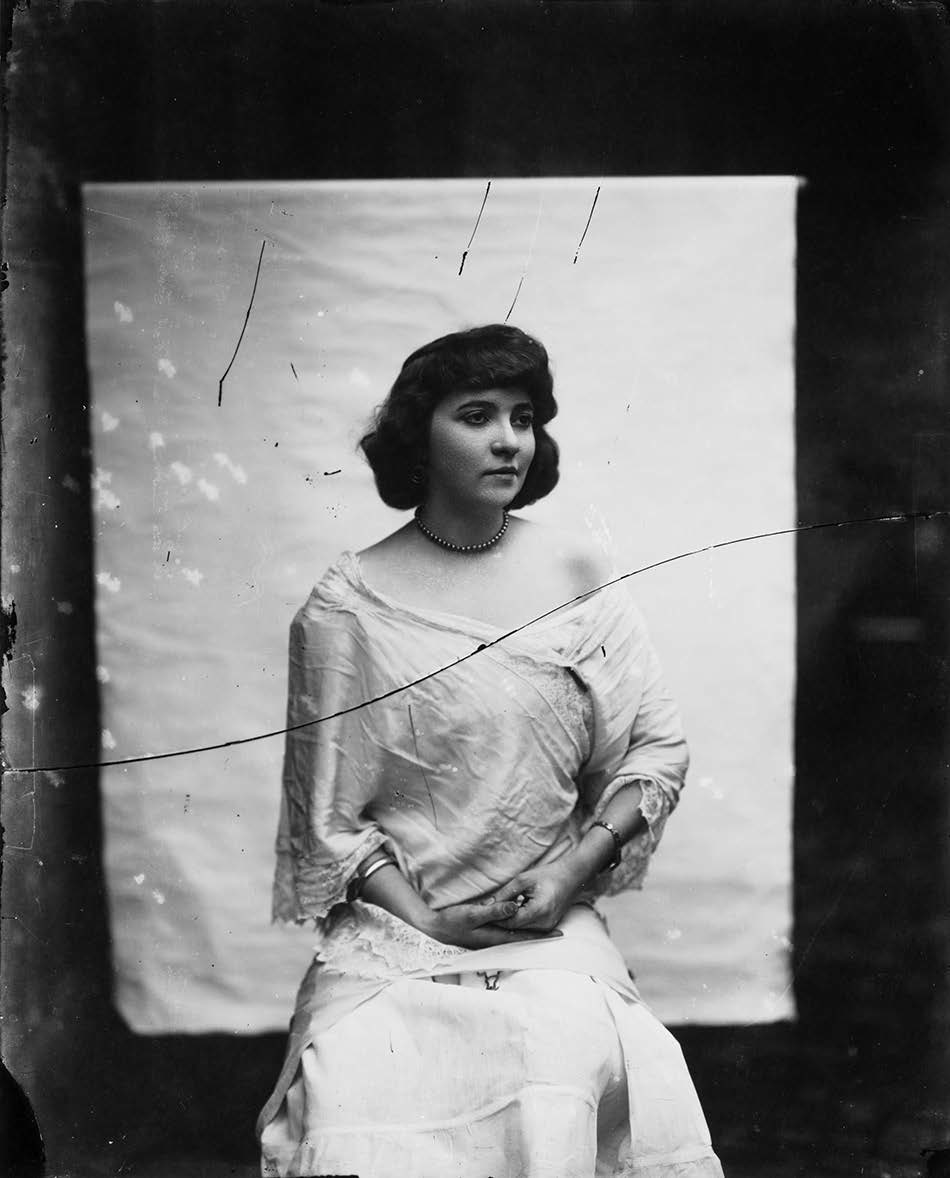
Plantations are not the only houses with evocative names. Kolb’s insinuation of prostitution winks at a darker history, one famously echoed by the old folk ballad first recorded as “The Rising Sun Blues” (Ashley and Foster Reference Ashley and Foster1933). New Orleans’s role as a flesh market remains part of both the city’s self-promoted image and the reality of its past. Even before the official founding of the notorious red-light district called Storyville in 1897, the city had earned its reputation as the place to go for “brothels, depravity, and abandoned women” (Schafer Reference Schafer2009). Storyville, which was a legislatively sanctioned enclave of utilitarian hedonism that eventually acquired its own train stop in 1908, keeps earning its name by the number of tales it generates. Natasha Trethewey’s luminous Bellocq’s Ophelia (2002), for instance, puts into poetic soliloquies the dreamed-up voice of a prostitute who was one of the many in Storyville famously photographed by E.J. Bellocq (fig. 5). A light-skinned person of color, Ophelia confesses that she has taken arsenic “to keep me fair, bleached white as stone” (Trethewey Reference Trethewey2002:20). Her fragility, however, would be misattributed to her pallor. Her genetic makeup differs from that of another sexually compromised woman who introduces herself by explaining, “Blanche means white” (Williams Reference Williams1951:54–55). Trethewey makes it clear that Ophelia got her light skin from her father; but her vulnerability comes from her mother’s side:
Storyville, ca. 1912. (Image by E.J. Bellocq, © Lee Friedlander, courtesy Fraenkel Gallery, San Francisco)
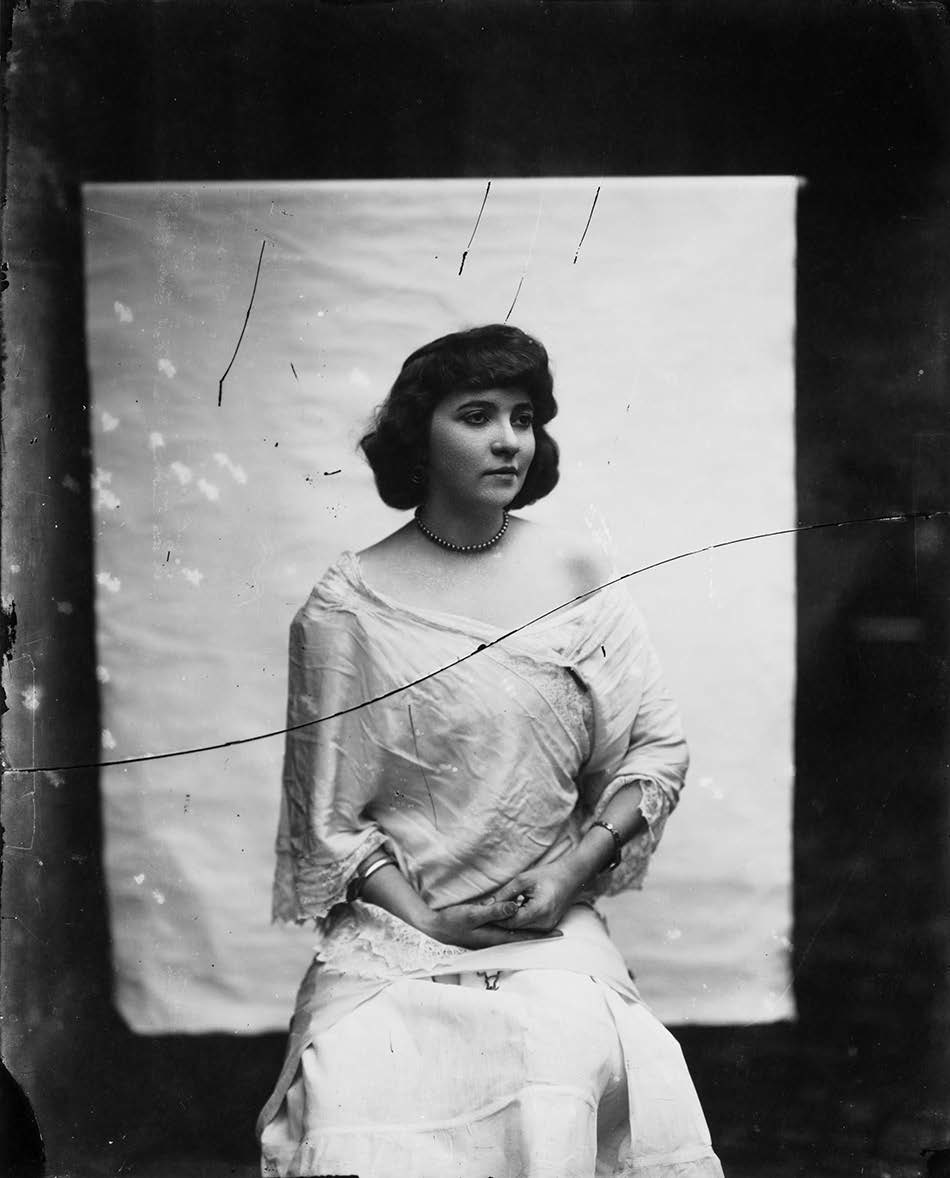
Bellocq thinks I’m right for the camera, keeps coming to my room. These plates are fragile, he says, showing me how easy it is to shatter this image of myself, how a quick scratch carves a scar across my chest. (2002:42)
As she waits for the photograph to tell her who she is, she might be accepting Blanche’s mantra as her own: “a woman’s charm is fifty percent illusion” (1951:41). Indeed, Storyville’s “Octoroon Parlors” such as “Mahogany Hall” run by madam Lulu White gained popularity by featuring mixed-race women who could pass for white. This pointed attraction connected these specialized brothels to the surge of “Lost Cause” revivalism of the late 19th century, marked by the unveiling of the Robert E. Lee Monument in 1884 (removed in 2017) and the opening of the Confederate Memorial Hall Museum in 1891 at what locals still know as “Lee Circle,” a featured stop on the St. Charles streetcar line. Nostalgic sympathizers could thus restore a broad spectrum of the behaviors and values of the antebellum South, guided by the phantom predicates of the “tragic mulatta” and the “gallant officer,” by enacting them at well-appointed venues of sexual and martial fantasy. In that sense, Ophelia’s body itself was a monument, but one with “rape-colored skin” (Williams Reference Goodman2020). Brothel “Circuses” included auctioning off young, putatively virginal women to the highest bidder (Rose Reference Rose1974:149–50), a performance that quoted the “fancy girl auctions” of quadroons and octoroons from the time that New Orleans was the center of the North American slave trade (Roach Reference Roach and Pollock1998). Storyville closed down in 1917, and all but a few of the houses associated with it were razed in 1940 to make way for the Iberville Projects, a public housing complex that was part of the New Deal initiative to provide decent, affordable housing to the “one third of a nation” that lacked it. Malign predicates of race-hatred and white supremacy, however, haunted this legislative exercise in dream-speech from the get-go: at their opening the Iberville Projects accepted white tenants only, while Black New Orleanians, who waited longer, got far less than what they bargained for, ultimately watching their dreams of uplift turn into a nightmare.
When New Orleans natives old enough to remember the last century encounter the word “Desire” (with a capital D), they will not necessarily think first of the eponymous streetcar.
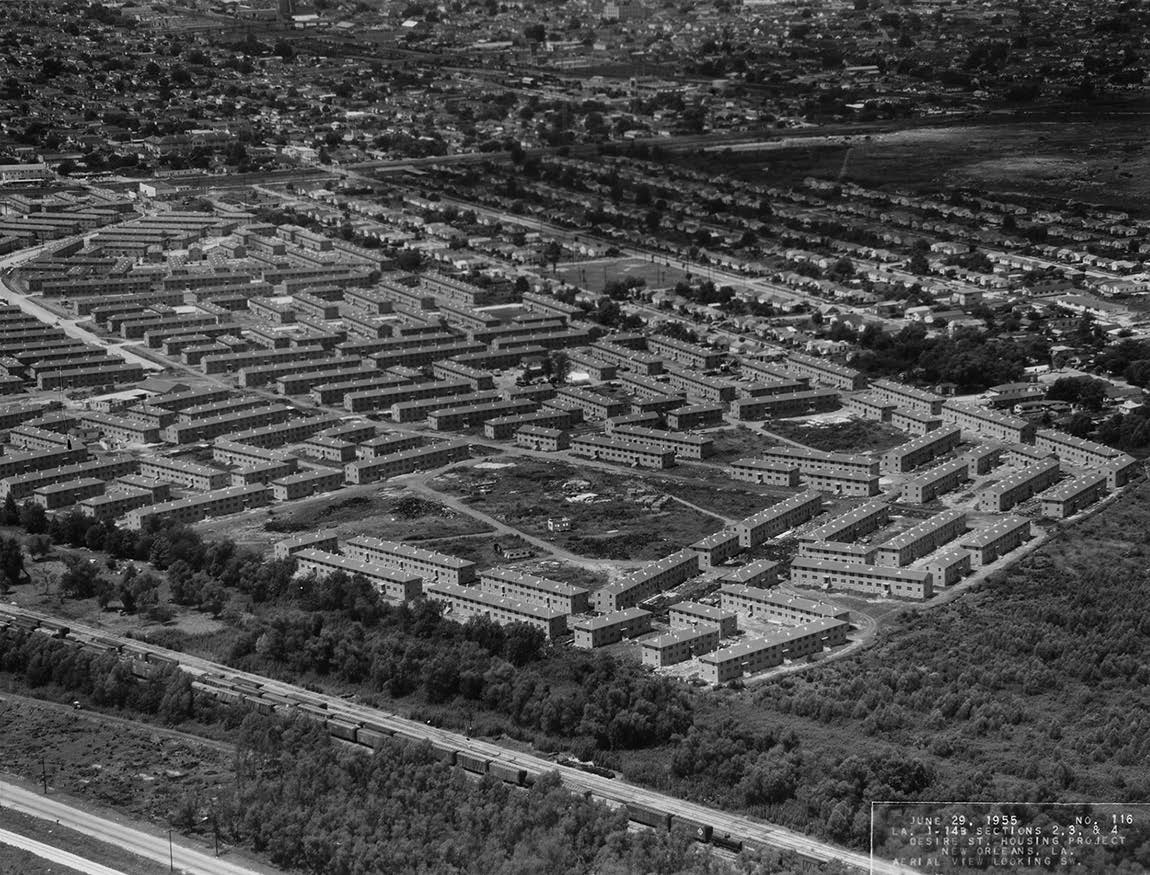
Desire was a notoriously mismanaged public housing complex located in the Ninth Ward neighborhood of the same name. The Desire Projects, or “Dirty D” for short, opened in 1956 (fig. 6). The largest of the complexes managed by HANO (another dreaded acronym, standing for “Housing Authority of New Orleans”), Desire was also the most poorly planned and shoddily constructed. Built out of wooden frames with brick cladding on the unstable ground of a swampy former landfill, it was walled off by two railroad tracks and the Industrial Canal. At its peak, Desire housed over 10,000 African Americans, many of them displaced from their former neighborhoods in the name of urban renewal. In an irony worthy of a satire by Jonathan Swift or George Orwell, the Desire Projects, a food desert and the poster child for demolition by neglect, were traversed by streets named “Pleasure,” “Abundance,” and “Agriculture.”
The Desire Housing Projects, 1955. (Courtesy of the Historic New Orleans Collection, Gift of Edwin Hoffa in memory of Jimmy and Ruth Hoffa, 2006.0025.15)

The 1,850 units of the Desire Projects represented just a small number of the chips tossed on the national table in the biggest gamble of social engineering ever wagered by the federal government. In city after city, Uncle Sam crapped out. By the 1950s the racist predication of US public housing led to an apartheid-like ghettoization of its urban populations, exacerbated by whites’ flight to the redlined suburbs facilitated by the racially targeted FHA loans for which they, and only they, were eligible (Rothstein Reference Rothstein2017). These federally authored and locally stage-managed mortgage melodramas played out with special poignancy in New Orleans. Nineteenth-century life patterns distributed the African American population in small pockets across the arc of the Crescent City, as enslaved persons tended to live in close proximity to their masters but not necessarily under the same roof with them, and the large number of free people of color further diversified the neighborhoods, even as wave after wave of European immigrants arrived to complicate the mix. The de jure segregation of public housing, however, which remained the policy until the Fair Housing Act of 1968, changed the historic residential map of New Orleans fundamentally and perhaps irremediably in the time remaining to the city.
Yet the residents of Desire, especially in the early years, made homes there and linked them into a community. Faced with thousands of children expected by the master planners to share three swings on a single cramped playground, for example, the neighbors blocked off the streets and declared them a roller-skating rink. Front stoops encouraged sociability on hot nights better than air conditioners, which were not allowed anyway. The Spiritual Churches and Social Aid and Pleasure Clubs, organizations distinctive of the African American experience in New Orleans, offered the potential of matching affinities and aspirations. Tellingly, the Free Southern Theater set up its headquarters in the Desire Projects. Such improvisatory magic held out for a while, but the social fabric eventually frayed along with the poorly maintained buildings, especially after Hurricane Betsy in 1965 surged six feet of water into the already disintegrating units. In 1970, the Black Panthers, protesting unlivable conditions under the banner of the New Orleans Committee to Combat Fascism, fought a storied gun battle there, which prompted the NOPD to bring in a tank. Drugs proliferated in the 1980s and 1990s. In 1993, NOPD Officer Len Davis, also known as the “Desire Terrorist” or “Robocop” for his brutality, arranged for the assassination of a witness, a mother of three, who was prepared to testify against him. He might have escaped conviction had not the FBI wiretapped him. Dilapidated beyond repair, the Desire Projects were demolished by stages in 1996, 1998, and 2001, displacing successive waves of residents in the name of “revitalization”—again—even before Hurricane Katrina struck. For many who came back and for many others who left for good in the post-Katrina diaspora, dispossession remains the meaning of Desire.
“You done the right thing, the only thing you could do,” says Eunice, the sympathetic neighbor in A Streetcar Named Desire, reassuring Stella, while they wait on the front porch as the authorities prepare to evict Blanche: “She couldn’t stay here; there wasn’t no other place for her to go” (Williams Reference Williams1951:141). Mandatory evacuation is an experience well known by many New Orleanians, and it continues to worry all thoughtful ones: they know the odds because they know the fear of forced dependence on the kindness of strangers. Stories of dispossession compete in the literature, performances, and living memories of the city. A Streetcar Named Desire probes the trauma of dispossession by revealing the sources of desire in an aching sense of loss, either past or pending, which excites the libidinous impetus, whether defiant or fatalistic, to assume risk. Every risk, in turn, brings on the urgent manifestations of its deepest phantom predicates, the principal one of which is love—Eros, or the life instinct. Everybody knows what the other one is.
Cemeteries
A head-scratching aphorism attributed to Bob Dylan shows up on another New Orleans greeting card: “The past doesn’t pass away so quickly here. You could be dead for a long time.” Indeed, here time does not flow; it percolates. Moreover, a sense of mortality joins with a sense of history to exert a steady ambient pressure, like the weight of the Louisiana air, on natives and visitors alike. This is in part because of the high visibility and greater durability of aboveground burials and in part because of remorse due to overindulgence. Lafayette Cemetery No. 1, for instance, stands opposite one of the great haute-creole restaurants, and tables located by the second-floor windows afford good views of the neatly organized rows of raised masonry tombs so that diners can contemplate the ephemerality of life while they linger over their bread pudding soufflé with whiskey sauce. But a postprandial moonlight stroll among the graves allows the doomed gourmet a chance to imagine a renegotiated mortality and a new, thinning diet: novelist Anne Rice entombed Vampire Lestat in Lafayette No. 1, and she staged her own mock funeral there in order to research the dead part of the undead experience.
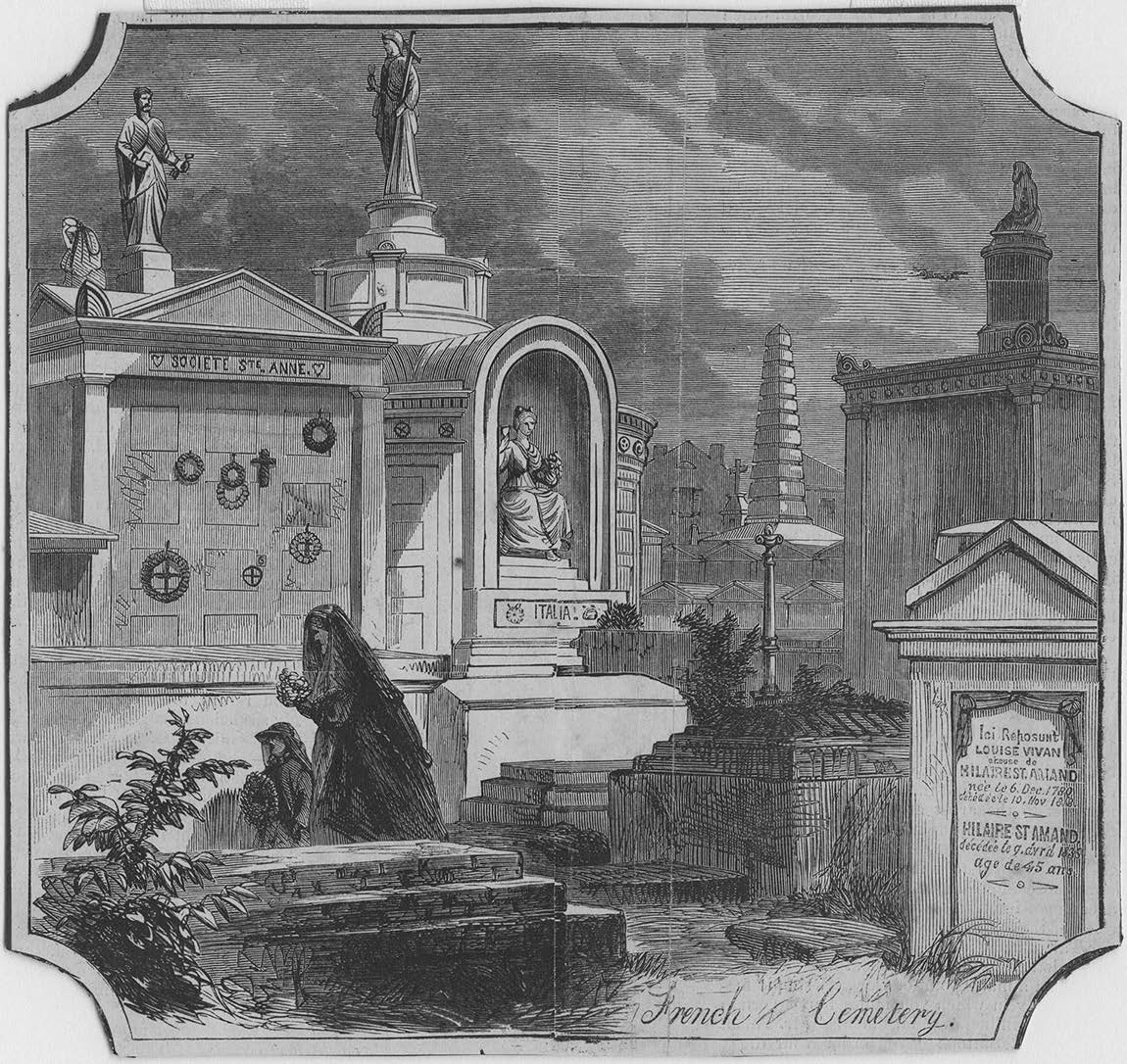
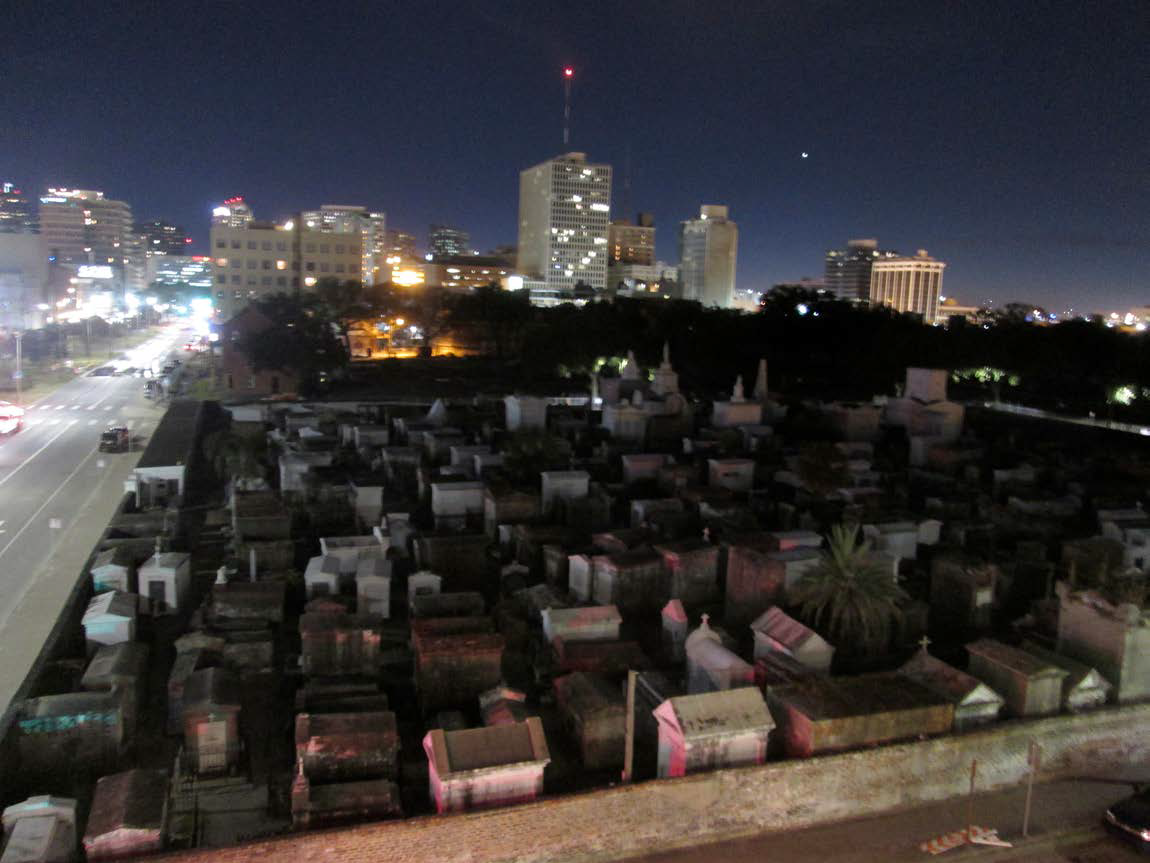
Close by their own streetcar stops, the famous “Cities of the Dead” of New Orleans attract large numbers of the living. The “Cemeteries” route mentioned by Blanche DuBois refers to the extension of the Canal Street line that serves the Mid-City cemeteries of Cypress Grove and St. Patrick’s, but the most frequently visited necropolis is St. Louis No. 1 (figs. 7 and 8). The chief attraction here is the supposed tomb of Marie Laveau, herbalist, midwife, and revered priestess of spirit-world practices. Even though she has been dead for a long time, she still casts her spells, some of which are curses, as does the haunted location itself. Another notable tomb in St. Louis No. 1 belongs to Homer Plessy. The Justices of the Supreme Court of the United States cursed him and many more besides by the decision they handed down, voting 7-1, with only Justice John Marshall Harlan dissenting, in Plessy v. Ferguson (1896). Establishing segregation as the law of the land until 1954, Plessy filled up a hex bag of maledictions so corrosively poisonous as to recall those attributed to the semi-mythical “Voodoo Queen” herself, bad gris gris in her term of art, “separate but equal” in theirs.
St. Louis Cemetery No. 1, wood engraving, 1867. (Courtesy of the Historic New Orleans Collection, 1974.25.6.410)

Basin Street Station, New Orleans. View towards St. Louis Cemetery 1 and Canal Street skyline, 28 January 2015. (Photo by Infrogmation, New Orleans; courtesy of Creative Commons)
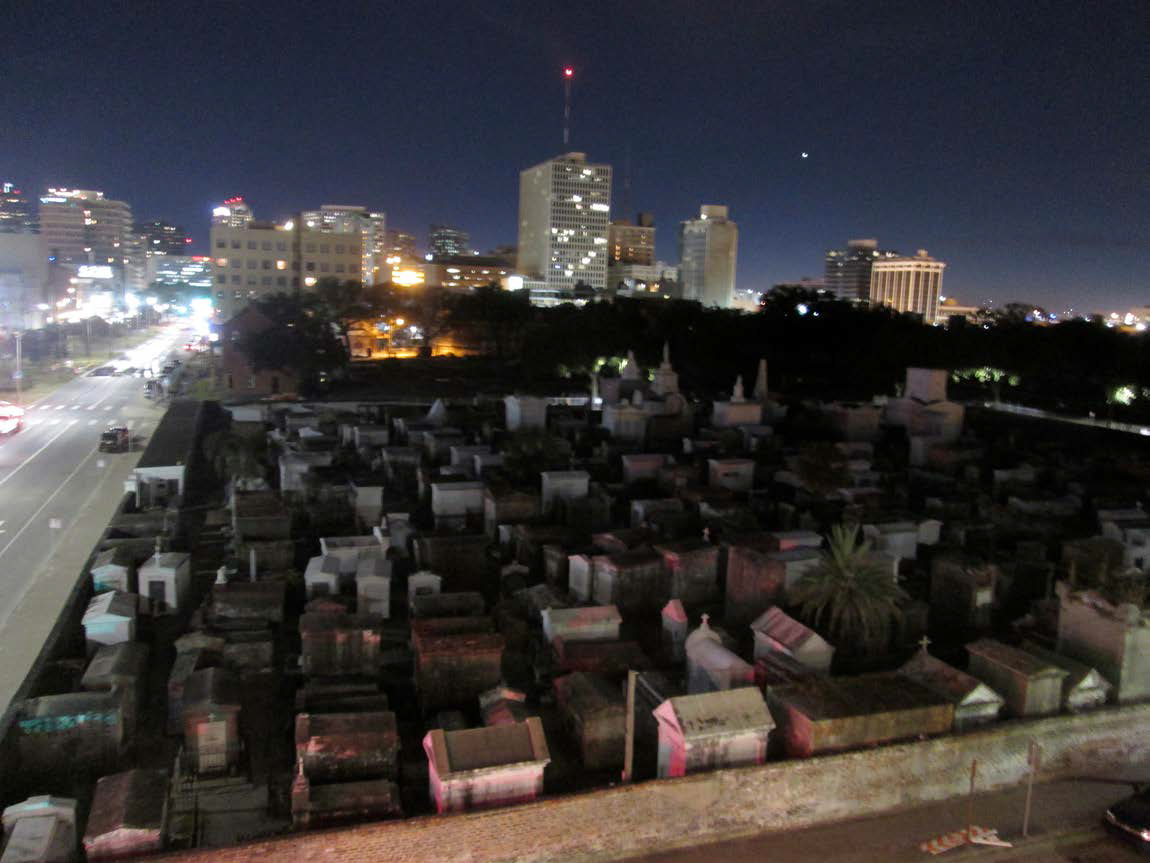
The idea of segregating the dead in walled cities of their own was still a novelty in 1721 when military engineer Adrien de Pauger drew up plans for what became the French Quarter. Nevertheless, he provided for a bounded square marked cimitiere, not in the churchyard of what became St. Louis Cathedral in the middle of the plan, which would have followed long-standing tradition, but outside the boundary of the city walls. The fortified city walls themselves weren’t completed — Rampart Street marks a line of proposed battlements that were never built, just as Canal Street occupies the rightof-way for a shipping channel that was never dug—but St. Louis No. 1, successor to de Pauger’s original cimitiere, became a landmark. St. Louis No. 1 is a ghostly predicate for its successor cemeteries and the historic plan of the city itself. Guides often assign the practical motive for burying the dead in above-ground tombs to the high water table in New Orleans, which is only two feet below the surface, and they are right to do so. But the local practice participated in a larger revolution in thanatology. The segregation of the dead from the living constituted a great transnational project of the Enlightenment, even as the walling off of the socially dead remains its most enduring failure (Patterson Reference Patterson1982). The two are materially as well as metaphorically related. As the cemeteries expanded and multiplied along with the colonial city itself, custom separated people—rich from poor, Protestant from Catholic, slave from master, free person of color from slave—in the grave as it increasingly did in life. Sometimes the enslaved were buried near their masters, but not with them. More often they ended up in low-lying potter’s fields, where shallow earthen graves and make-do cerements put their corpses at risk of disinterment by scavengers or floods.
Poet Brenda Marie Osbey tells her version of this New Orleans story, predicated on its funerary practices, in “Faubourg,” a poem from her collection All Saints:
the dead must be mourned and sung
over and prayers told them to carry to the other side
the dead must be chanted and marched to their tombs
and the tombs then tended and the dogs kept away. (Osbey Reference Osbey1997:37)
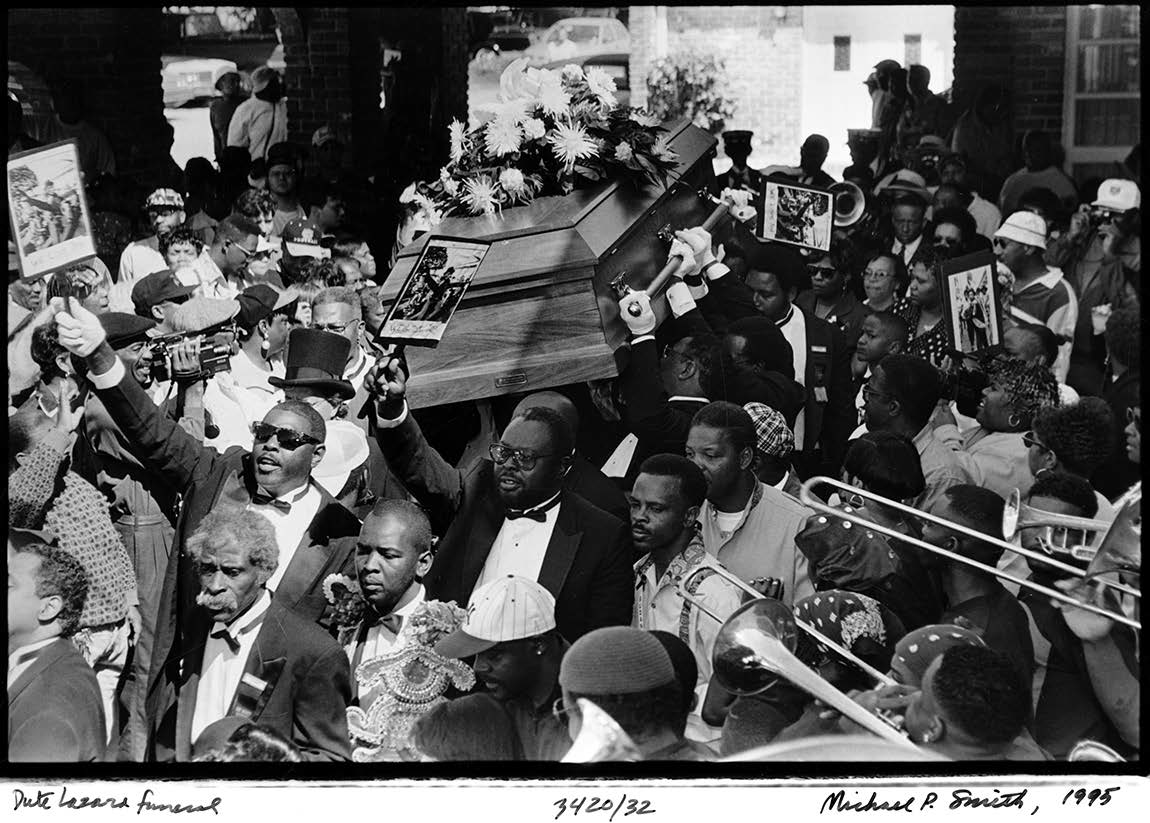
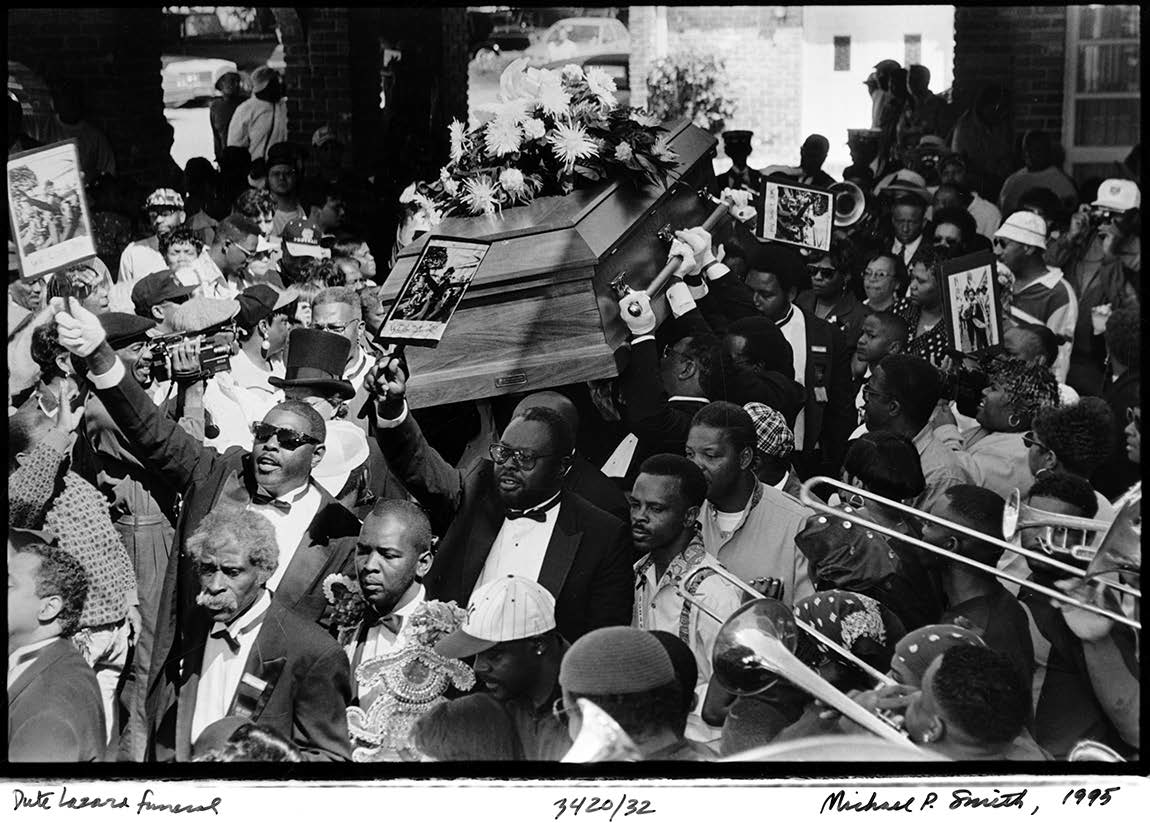
Osbey’s words evoke the vibrant tradition of Afrocentric burials in New Orleans. In these venerable rites, death is not an event but a process: folks pass, but no one passes away. A proper performance to mark the passing is cenotaph enough. Now popularly known under the portmanteau “jazz funeral,” such vernacular rituals of mourning and celebration, conducted by the social clubs and Second Line parading organizations (Keber Reference Keber2018), afford even the most humble of the deceased memorable transitions to the esteemed status of ancestor. When Alfred “Dute” Lazard passed during Mardi Gras season in 1995, for instance, his imposing funeral procession stopped the floats of Endymion, one of the predominantly white krewes (fig. 9). Mr. Lazard worked his whole life as a porter in a bank, but his off-hours affiliations included membership in the Money Wasters, the Black Men of Labor, and service as Grand Marshal for the Dirty Dozen Brass Band (Regis Reference Regis and Ray2003). The vitality of such a life-affirming passing contests the silence of the walled enclaves and standalone mausoleums that perfect the segregation of the dead. This perfection, tragically, models an influential version of what the city of New Orleans and many other cities have become. Modern planners at their drawing boards need not consciously have taken their inspiration from Cities of the Dead in order to have felt their influence in unacknowledged partnership. That’s exactly how a phantom predicate works.
Alfred “Dute” Lazard’s Funeral, 1995. (Photo by Michael P. Smith; courtesy of the Historic New Orleans Collection, 2007.0103.2.200)
Funerary and other commemorative monuments do not honor the dead alone. Their builders intend them not only to remember the past but also to predicate the future. Sometimes the predicates dominate the present with an efficacy that makes them obtrusively undead. Former Mayor of New Orleans (2010–2018) Mitch Landrieu encountered the vampirism attached to this kind of statuary in 2015–2017, when he led the bitter but ultimately successful effort to rid the city of monuments to Confederate notables, namely Robert E. Lee, Jefferson Davis, and Pierre Gustave Toutant- Beauregard, the Louisiana Creole general who started the Civil War when he ordered the first shot fired at Fort Sumter. Ahead of other cities, New Orleans bravely drove a stake through their hearts, but not without an unholy uproar. Protracted litigation, armed protest, death threats and social ostracism, sabotage by extortion, and a firebombing punctuated the mayor’s efforts, first urged on him by dream-speaker Wynton Marsalis, to slay these blood-sucking remnants of the “Cult of the Lost Cause” once and for all (Landrieu Reference Landrieu2018:165).
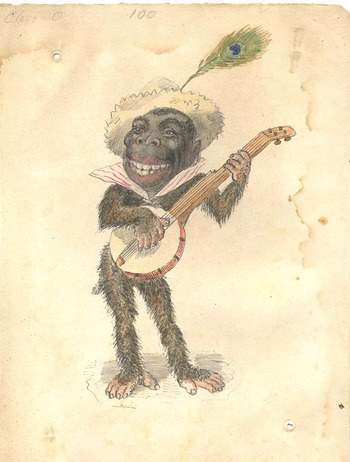
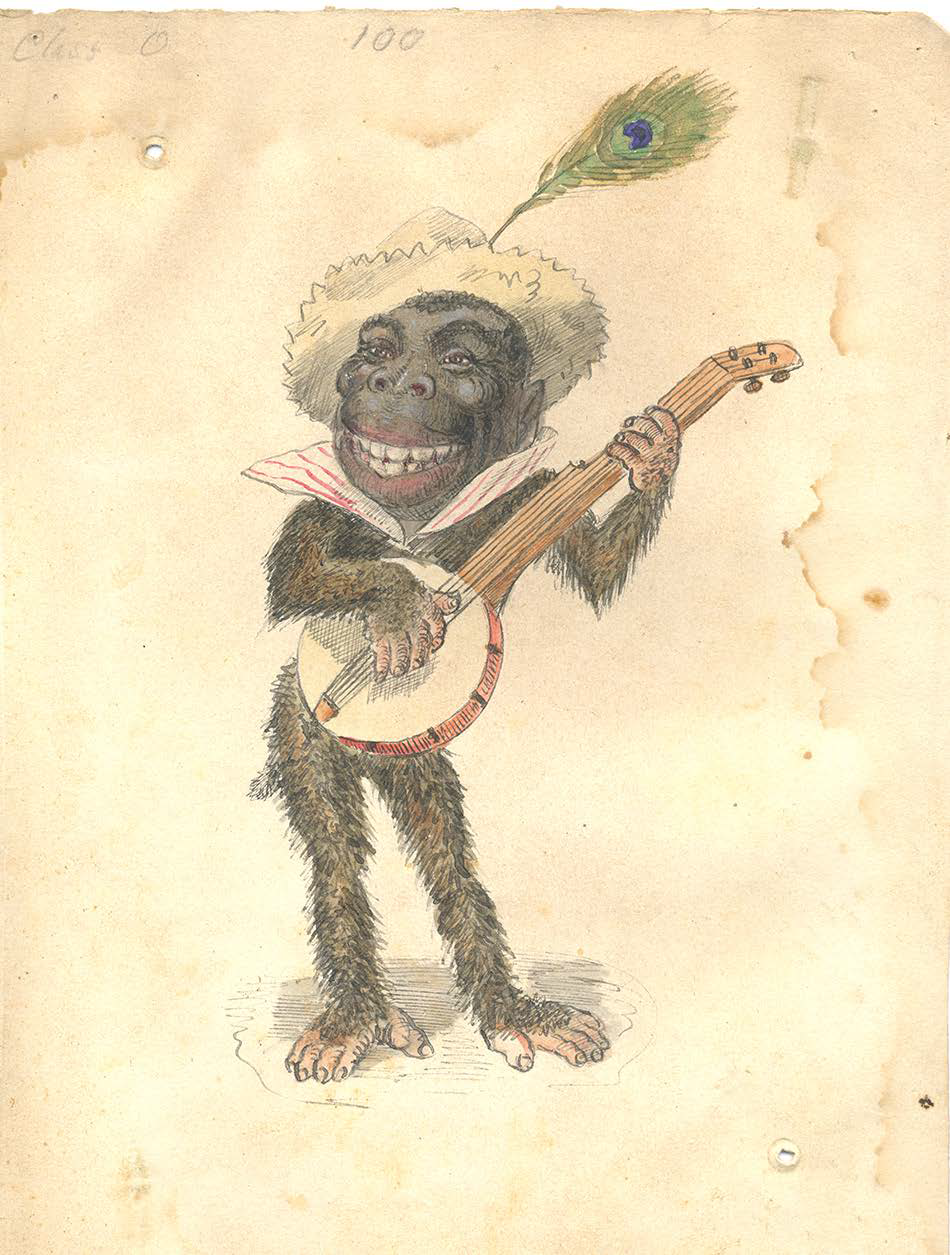
The curtain-raiser for the struggle to remove the Civil War-themed statues was the fight over the Liberty Place Monument, which the city had previously removed in 1989, only to put it back up in a new location in response to a lawsuit in 1992/1993. This resurrection pleased the “Friends of the Liberty Monument” and their avatar, white supremacist David Duke. The 20-foot-high granite obelisk commemorated the bloody street battle of 14 September 1874, in which an organized militia of armed insurrectionists called the Crescent City White League overthrew the Republican governor of Louisiana and his racially mixed administration. Carnival provided the phantom predicate (Vennman Reference Vennman1993). The White Leaguers were led by the secret membership of the Mardi Gras krewes, who had acted out their seditious intentions on the street and in ballrooms the preceding year by caricaturing public officials, including Lieutenant Governor C.C. Antoine (“The Gorilla”) as “The Missing Links of Darwin’s Origin of Species ” (fig. 10). The paramilitary commander of the coup d’etat and principal author of the “Platform of the Crescent City White League,” Frederick Nash Ogden, proclaimed in advance of the anticipated victory of Social Darwinism what he called “that just and legitimate superiority in the administration of our State affairs to which we are entitled by superior responsibility, superior numbers, and superior intelligence” (Ogden Reference Ogden1874). When Ogden died in 1886, the Liberty Place Monument was first conceived as a memorial to him. When it was erected on a prominent site at the foot of Canal Street in 1891, however, it was dedicated to the White Leaguers who died in the uprising (fig. 11). Lest the salient details fade from memory, a plaque was added in 1932 to proclaim the victory for white supremacy won at the Battle of Liberty Place. In its original location, the obelisk spatially anchored the positioning of the Lee, Davis, and Beauregard statues on boulevards and intersecting streets that formed strategic nodal points across the city. New Orleans, which surrendered quickly in 1862 and spent the war occupied by Union troops, thereby enlarged the footprint of its statuary-studded cemeteries to present itself to its inhabitants and to the world as a city of the Confederate dead.
Mardi Gras costume for the Mystick Krewe of Comus parade and ball, “The Missing Links of Darwin’s Origin of Species,” 1873: Lt. Governor C.C. Antoine as “The Gorilla.” (Courtesy of the Howard-Tilton Memorial Library, Tulane University Special Collections)
Battle of Liberty Place Monument, Canal Street. Illustration in promotional booklet “Winter in New Orleans season 1912–1913.” Issued by General Passenger Department, Southern Pacific-Sunset route. (Public domain)

Except in the sense that the Civil War has not yet ended, no one could ever legitimately claim that this tribute to the armed terrorists of the White League was a war memorial. But it was demonstrably a milestone along the road to the triumph of Lost Cause nostalgia and revanchist white supremacy, coinciding with the incremental disenfranchisement of African Americans and the imposition of Jim Crow in the post-Reconstruction era, which remains ongoing in so many ways to this day. As long as they stood, the monuments served the purpose of setting white entitlement in stone, forgetting that the pulling down of statues put up to honor tyrants is as American as apple pie from the American Revolution (Bellion Reference Bellion2019) to Black Lives Matter. The very fabric of the built environment of New Orleans proudly proclaimed that the traitorous perpetrators of warfare on behalf of slavery served nobly in a just cause, authorizing the violence of the plotters who reinstated it under other names. Conversely, it delivered the message to every beholder that perpetual subordination is the lot of the disentitled. For a long time, the strategy of thus naturalizing injustice by eternalizing phantom predicates as “heritage” succeeded. Like physical death, social death proceeds in stages, the last one of which is acceptance (Wilderson Reference Wilderson2020).
Fatalism under these circumstances is understandable, however defeatist. Dramatic theory has been faced with a similar predicament since Aristotle, elevating tragedies of discovery and narrowing down the choices in tragedies of decision: the protagonist has a flaw, so catastrophe is inevitable; the dirty deed is already done; the die is cast, the cast must die. The problem arises that in both tragic drama and social psychology, blame tends to fall upon the victim, a criticism from which A Streetcar Named Desire cannot be exempted. Just before he rapes Blanche, Stanley asserts her complicity, exploiting her feeling of guilt that she has anxiously longed for what she fears. He says, “We’ve had this date with each other from the beginning!” (Williams Reference Williams1951:130). Many audience members tend to agree, especially if they focus on the hamartia of what she was wearing: fleeing her fate in her lingerie, she finds it waiting for her in Stanley’s silk pajamas. Predicated on this spurious but ancient code, the socially as well as psychologically and physically abused are supposed to be asking for it.
The most compelling critique of the preordination imposed by such manipulative dramatic construction comes not from a critic but from a production: a radical adaptation of Streetcar performed as a backstage thriller called The Method Gun (2008) by the Rude Mechanicals of Austin, Texas. In the 2010/2011 season of the No Boundaries series produced by the World Performance Project at Yale in partnership with the Yale Repertory Theatre, the “Mechs” put on one of the several iterations of their cut-down version of Williams’s tragedy (Roach Reference Roach2012; Bernstein Reference Bernstein2012). Their adaptation delivers an object lesson in the morbid attraction of repetition as rehearsal. The Method Gun imagines the sadomasochistic final dress of a company of actors abandoned by their guru director and acting teacher after she has kept them at work on A Streetcar Named Desire for seven years. Pseudonymously named Stella Burden, the AWOL director might be thought to evoke Stella Adler, of Method acting fame, and Chris Burden, the performance artist who had himself shot in the arm with a .22-caliber rifle. The Method Gun version of Streetcar omits the characters of Blanche, Stanley, Stella, and Mitch. That is but one of a number of innovations well calculated by Ms. Burden to induce a crisis of homicidal rage in any acting ensemble, foreshadowed by the bit of expository dialogue explaining that she has planted a loaded gun backstage.
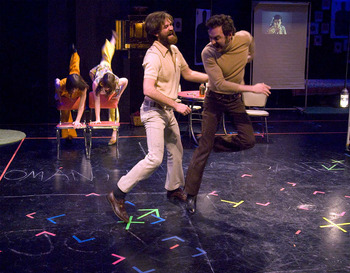
Stella Burden’s show never opens, but the can of worms she left behind does. For the next 60 minutes, the Rude Mechs’ production seems to amble casually through a disorganized rehearsal of the scenes that require the minor characters to walk on and do their bits, “Flores para los muertos” and “This game is seven card stud” — and the like. Absent the main text, subtext takes over. The planted gun never goes off as such, defying the most frequently cited law of the well-made play, but the cast of The Method Gun prepares a harrowing denouement of their own. They find a way to put themselves at risk with every move they make, or don’t make. As potentially lethal as the fifth act of any Elizabethan revenge play, the final moments are dominated by a jerry-rigged but fully practical pendulum machine (as in pit and pendulum). As the actors mechanically perform their isolated lines from A Streetcar Named Desire, they time their motions to walk in, around, and straight through a scary gauntlet of swinging work lights that crisscross the stage synchronously. A mistimed step or wrong turn risks the violent intersection of moving object and unprotected skull. The rhythm of the pendulum approximates a beating heart, accelerating with fear, as the actors find their way through a kinetic maze that changes its openings and obstacles in microseconds. At any moment, a weighty force and a fragile carapace might try to occupy the same confined space at exactly the same time, with tragic results—not unlike Stanley and Blanche. Indeed, The Method Gun foregrounds the gendered conflict of violence and vulnerability (fig. 12), and a pre-planted weapon does go off for real after all, pointed right at their heads, making the audience worry that even seven years of rehearsal might not be enough.
Rude Mechs’ The Method Gun. From left: Hannah Kenah, Lana Lesley, Thomas Graves, Jason Liebrecht. Humana Festival of New American Plays, 2010, Actors Theatre of Louisville. (Photo by Kathi Kacinski)

The Method Gun exports from A Streetcar Named Desire not only its tragic fatalism, violence, and fear of abandonment, but also the obstinacy of its principals in the face of risk. Absent from the stage of The Method Gun, the incautious leading characters haunt its subtext as phantoms nonetheless. Giddy and extravagant, Blanche covers a bare bulb with a Chinese lantern, as she flutters precariously among the dangers of the Kowalski household. This folly the Rude Mechs stylized in the form of swinging lamps covered by lethal-looking metal armature instead of shades. These scything pendula might remind weather-watching New Orleanians of fast- forwarded tracking charts during hurricane season, following the storms as they line up off the coast of Africa and gain momentum as they cross the Atlantic aimed at the Caribbean and the Gulf of Mexico. The fact that the cast members have been at this madness for years already suggests that they can’t make themselves stop what they’re doing. In fact, they overdo it, and then they do it over. No stranger to self-destructively repetitive behavior, Williams put the intensity of this kind of addiction at the heart of Streetcar. Stella stays on in spite of the beating she takes: “But there are things that happen between a man and a woman in the dark—that sort of make everything else seem—unimportant” (1951:70). After all is said and done, Blanche too would stay if she could, and she must be persuaded to go quietly. So in the end, the victims end up choosing magic over realism, knowing what they know of the risks, and yet still preferring New Orleans to somewhere ridiculous.
Elysian Fields
Elysian Fields Avenue, formerly known as the Champs-Elysees after the Parisian original, runs from the Mississippi River to Lake Pontchartrain through the heart of the Faubourg Marigny, a neighborhood in the Third Municipality developed by francophone Creoles after the Louisiana Purchase. According to ancient myth, Elysium welcomed the blessed to eternal happiness, an allusion that makes Blanche laugh. Williams complicates the irony. As profiled in his opening stage direction, the neighborhood is run-down, polyglot, multiracial, pungent, and very musical, setting the scenic and aural atmosphere of A Streetcar Named Desire:
The exterior of a two-story corner building on a street in New Orleans which is named Elysian Fields and runs between the L & N tracks and the river. The section is poor but, unlike corresponding sections in other American cities, it has a raffish charm […]. You can almost feel the warm breath of the brown river beyond the river warehouses with their faint redolences of bananas and coffee. A corresponding air is evoked by the music of Negro entertainers at a barroom around the corner. In this part of New Orleans you are practically always just around the corner, or a few doors down the street, from a tinny piano being played with the infatuated fluency of brown fingers. This “Blue Piano” expresses the spirit of life which goes on here. Two women, one white and one colored, are taking the air on the steps of the building. The white woman is Eunice, who occupies the upstairs flat; the colored woman a neighbor, for New Orleans is a cosmopolitan city where there is a relatively warm and easy intermingling of the races in the old part of town. (1951:13)
These particulars offer a dreamy interpretation of 20th-century Faubourg Marigny but not a baseless fantasy. Jazz greats Jelly Roll Morton (born Ferdinand Joseph LaMothe) and Sidney Bechet resided there, and its history verifies the “intermingling of the races” that Williams emphasizes, although not exactly in the way he meant it.
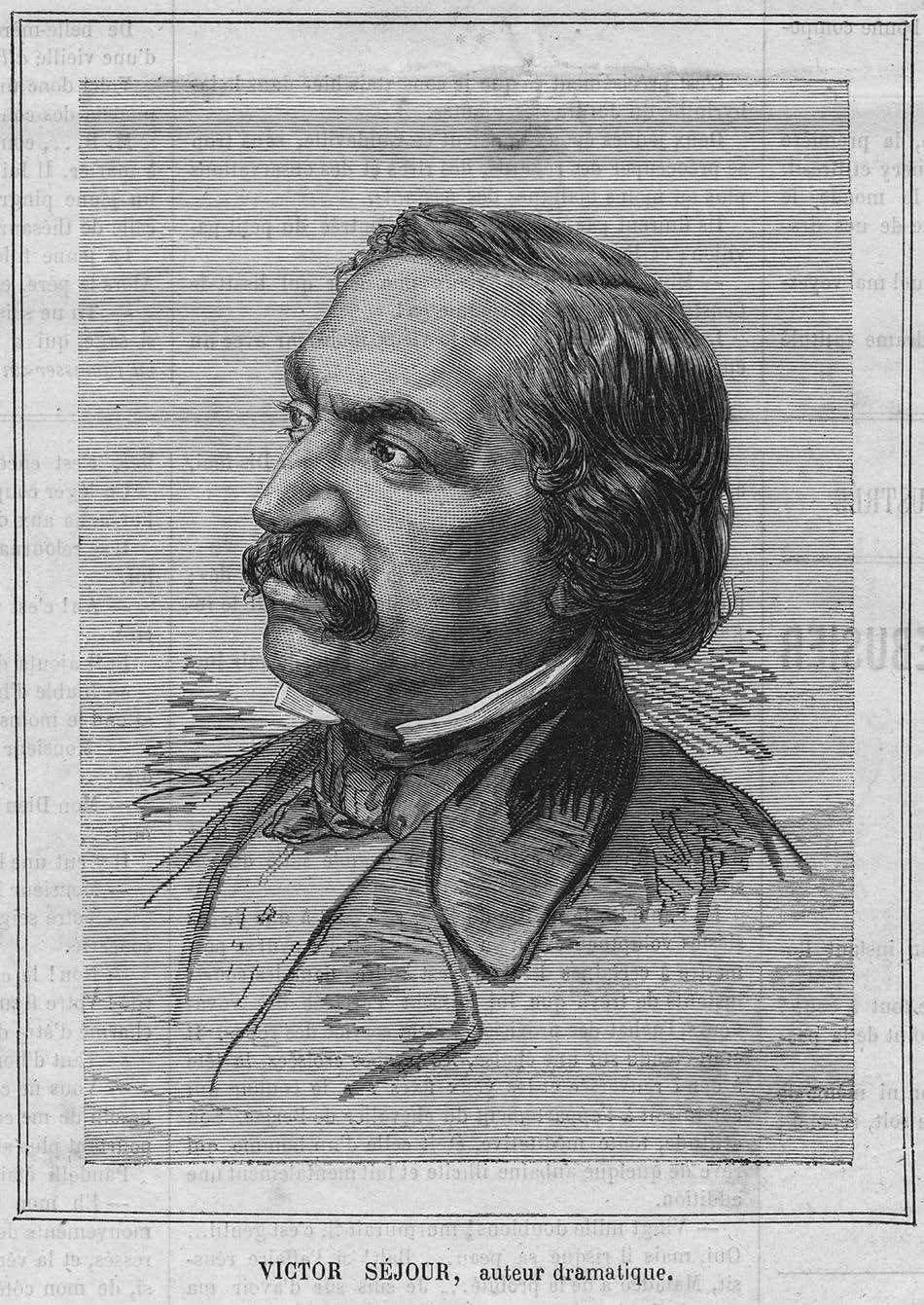
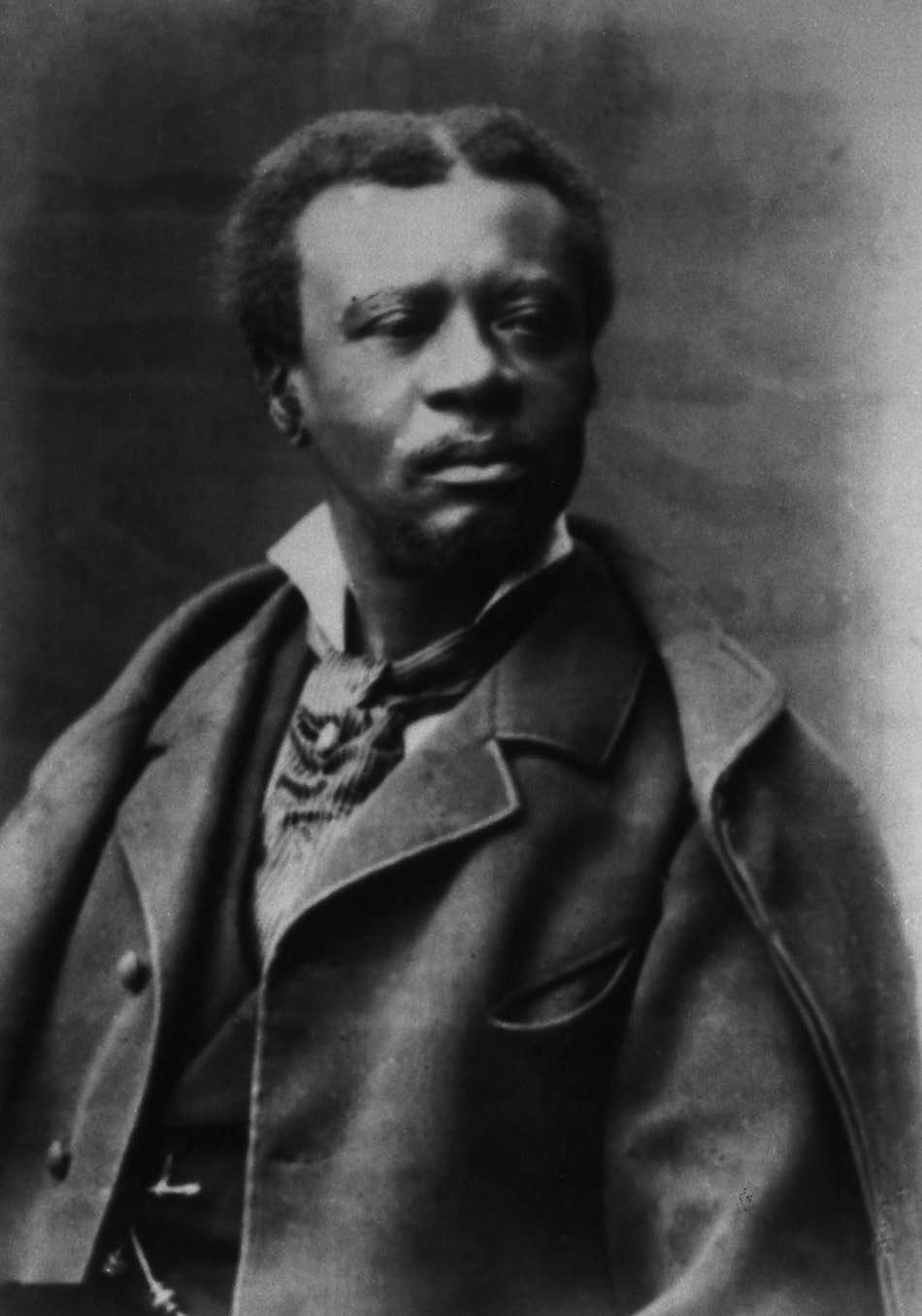
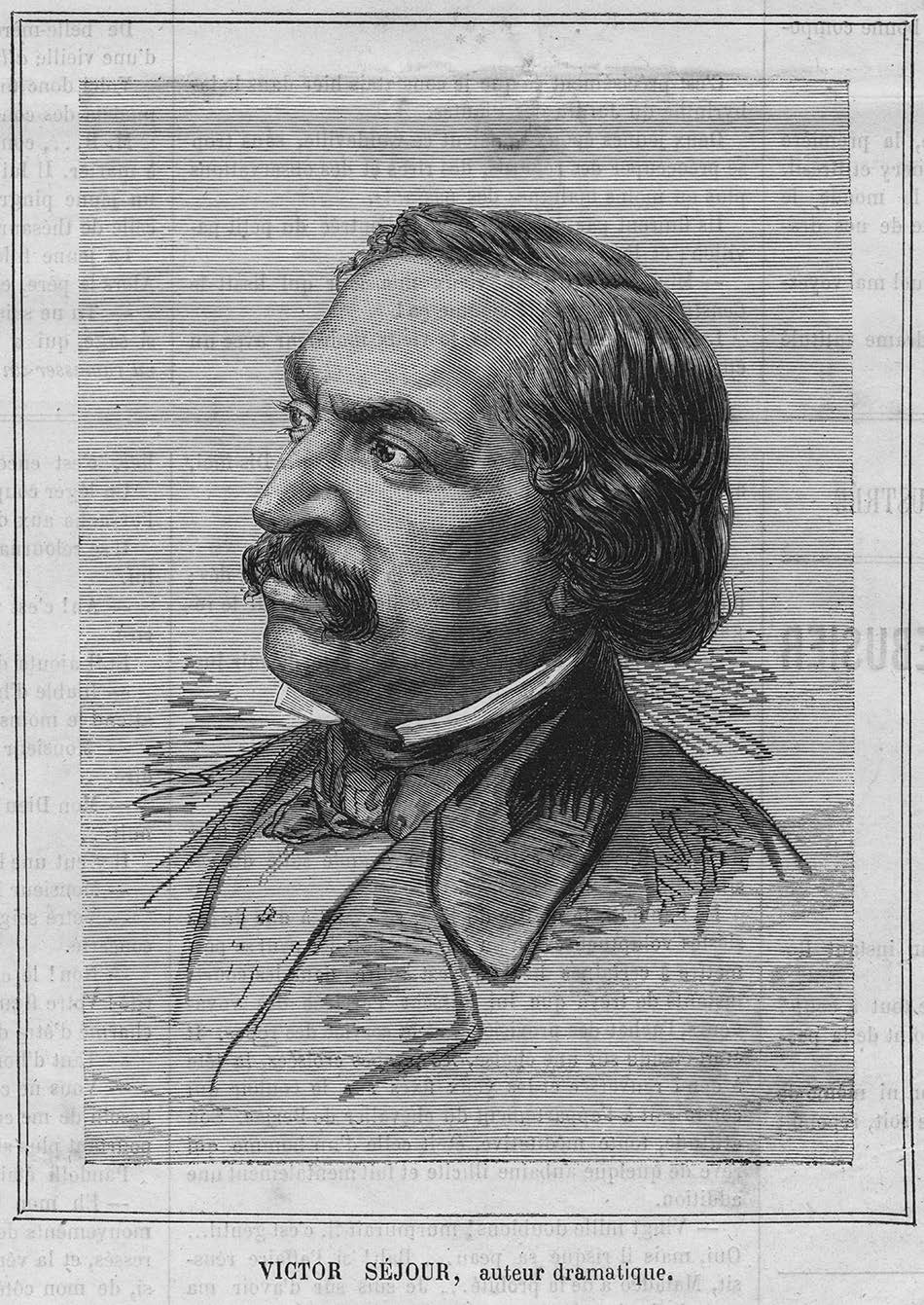
Like Tremé (see Logsdon and Elie Reference Logsdon and Elie2008), the Faubourg Marigny was a residential and commercial center for the gens de couleur libres, the free-Black francophone population of New Orleans. Their creolized society represented the multiracial, three-caste system of the Latin Caribbean, consisting of the enslaved, the whites, and the free people of color, who could and did own slaves themselves. Intricate kinship networks, acknowledged or unacknowledged, linked the three castes, producing a crazy-quilt of phenotypes so multifarious that it could have — and should have—undone forever the concept of race as meaningful category of human difference (Thompson Reference Thompson2009). Before the United States took over in 1803, first France, then Spain, and then briefly France again governed Louisiana. French and especially Spanish slave codes offered loopholes rare in the English-speaking South, including manumission by self-purchase, third-party purchase, or military service (Hanger Reference Hanger1997). Custom also permitted slaves to earn money by working for hire or selling produce. Along with free people of color displaced by the Haitian Revolution and immigrants from the Spanish-speaking Caribbean, especially Cuba, many French-speaking citizens of mixed race, manumitted or born free in Louisiana, settled in Marigny and Tremé. They and their descendants, working against prejudice and envy, developed a thriving local culture of their own. At one time the Faubourg Marigny supported two French-speaking theatres located along the broad boulevard of the Champs-Elysées. Both the Théâtre Marigny and the Théâtre de la Renaissance catered to the gens de couleur, but they admitted white audience members and employed mixed-race and white actors (Braun Reference Braun2019). Out of this milieu came a distinguished assembly of authors and other notables. Seventeen poets of color published their works in Les Cenelles: Choix de poésies indigènes (1845), for example, the first collection of poems by African Americans. Ever more oppressive laws enacted to impose binary segregation, however, drove a number of the most ambitious or fortunate artists of color into exile. The expatriates included Victor Séjour, homme de couleur libre, the son of a Haitian octoroon father and Louisiana quadroon mother, who ranks high among the most important American-born playwrights of the 19th century; or he would have done had he written his 22 plays in English instead of in French for the Comédie Française and other major theatres in Paris (Perret Reference Perret1983). They also included symphonic, balletic, and operatic composerconductor Edmond Dédé, who became a major figure in the musical life of the city of Bordeaux (McKee Reference McKee2017) (figs. 13 and 14).
Victor Séjour, 10 October 1874. (Courtesy of the Historic New Orleans Collection, MSS 588.1)
Edmond Dédé. Louisiana Music Collection, 1165409. (Courtesy of the Amistad Research Center, New Orleans, LA)

Another important French-speaking free person of color from New Orleans made no memorable departures from the Crescent City except for a short train ride. He was the aforementioned Homer Adolphe Plessy of Plessy v. Ferguson (1896). Performing his “race,” Plessy easily pulled off a double pass—first as white, then as nonwhite — on the same fateful outing. Going undercover on behalf of the Citizens Committee, a New Orleans civil rights organization that opposed the segregationist Separate Car Law (1890), Plessy boarded the East Louisiana Railroad with a first- class ticket in the whites-only car. He then announced himself to the conductor as an octoroon (one-eighth “African blood”) but refused to go to the car designated for “nonwhite” people. A planted detective arrested Plessy as planned, creating the test case that the Citizens Committee appealed all the way up to the Supreme Court of the United States. On one hand, the plaintiffs argued that the question of race, legally considered, is impossible to decide absent readily applicable statutory definition (good luck with that); and, on the other hand, even if whiteness can be proven to exist and satisfactorily defined, then enforcement of the Separate Car Law deprived Homer Plessy of his seven-eighths share of it on a conductor’s say-so without due process of law. In fact, Plessy and his supporters knew that their case represented a huge gamble, risking a precedent-setting rejection of their logical attack on the legality of the very concept of race. To the indelible shame and protracted agony of the nation, the predicate supplied by the Supreme Court in upholding the lower courts by rejecting Plessy’s case—“which must always exist as long as white men are distinguished from the other race by color”—proved to be no phantom even though it had no basis in substance either.
The pain of Plessy sharpens in view of the alternative predicates of a postracial Elysian Fields. What Caryn Cosse Bell calls the “Afro-Creole protest tradition in Louisiana” began in the colonial era, strengthened during the revolutionary period of the early 19th century, and culminated with the Louisiana state constitution of 1868. A high watermark of progressive legislation in the Reconstruction period, it enfranchised Black voters, guaranteed equal protection of the laws for all, and ended segregation in public accommodations, transportation, and schools, while mandating universal public education (Bell Reference Bell1997). It also ushered in the briefly established government that the White League overthrew in 1874, as the deadly pendulum swung back swiftly and violently, shattering the reforms with the weight of Jim Crow. The free-Black society that imagined such a new order, however, one based on equality in the midst of racial diversity, was itself predicated on ancient but consequential phantoms of the law. In 1685 Louis XIV proclaimed the Code Noir, consisting of laws to regulate slavery in the French islands of Martinique, Guadeloupe, and Saint-Domingue (Haiti) and later, with revisions made in 1724, in the colony that bore his name. The Code Noir of 1685, grandly addressed “to all present and to come,” allowed for and even encouraged the racial mixing of the three-caste system (Code Noir [1685] 1940: preamble). The Code provided for the manumission of slaves (articles 55–58), the emergence of a free-Black society (article 59), and the marriage of slaves and slaveholders (article 9). These provisions drew upon the policies developed by First Minister Jean-Baptiste Colbert, predicated under the rubric of “one blood,” to populate the vastness of Canada with French-speaking Catholics, regardless of race, by encouraging marriages between white colonists and Native Americans (Johnson Reference Johnson, Hirsch and Logsdon1992). The revised Code of 1724 rolled back these articles, but the predicate had been set.
Envisioning slavery as a temporary expedient, the original Code Noir had looked forward to a new society subsumed under an ancient polity, the subjects of which, united in one blood, would be ruled by the one king, one law, and one faith (un roi, une loi, une foi). The unassimilable —Jews and Protestants — were banished by law; but all slaves were to be baptized, catechized, and at an unspecified but anticipated future date, freed and made equal under the law:
Article LIX. We give to the enfranchised the same rights, privileges, and responsibilities enjoyed by free-born persons, so that the merit of an acquired freedom might produce in them, for their persons as well as their possessions, the same benefits that the happiness of natural freedom gives to our other subjects. (Code Noir [1685] 1940)
What happens in New Orleans, unlike what happens in Las Vegas, doesn’t necessarily stay there. Mayor Landrieu led the way for other US mayors, but first Wynton, like Joshua, blew his horn, and the statues all came tumbling down. Dream-speech tends to have an infectious rhythm, and the cadence of some of its better tunes, like the jazz riffs that revolutionized world music, can still set toes tapping even in translation:
Constitution of the United States: 14th Amendment, Section 1. All persons born or naturalized in the United States, and subject to the jurisdiction thereof, are citizens of the United States and of the State wherein they reside. No State shall make or enforce any law which shall abridge the privileges or immunities of citizens of the United States; nor shall any State deprive any person of life, liberty, or property without due process of law; nor deny any person within its jurisdiction the equal protection of the laws. (Adopted 9 July 1868)
Moreover, to resolve any possible ambiguity in the minds of the refractory or the obtuse:
15th Amendment, Section 1. The right of citizens of the United States to vote shall not be abridged by the United States or by any State on account of race, color, or previous condition of servitude. (Adopted 3 February 1870)
The outcome was not, and is not, inevitable; but the predicate has been set, challenging the fatalism of ineluctable inequality; and like the Code Noir of Louis XIV, it is addressed to all present and to come. The music of dream-speech resounds across space and time, reinventing itself even as it repeats. In An Octoroon (2014), Branden Jacobs-Jenkins’s re-visioning of Boucicault’s mortgage melodrama about “life in Louisiana” in the 19th century, two enslaved women, Dido and Minnie, the Rosencrantz and Guildenstern of this postmodern update, receive a version of the late-arriving emancipatory message, and they resolve to catch the next boat out, leaving the plantation at its foreclosure: “Help me finish packing,” Minnie reassures the uncertain Dido, “get a little catnap, put on your nice slave tunic, and get ready for your life to change” (Jacobs-Jenkins Reference Jacobs-Jenkins2015:58). The delayed exposition that the plantation still might be saved tempers their resolve, but not the phantom predicate that motivates them to risk everything they have ever known on a promise that is still a dream in the making.
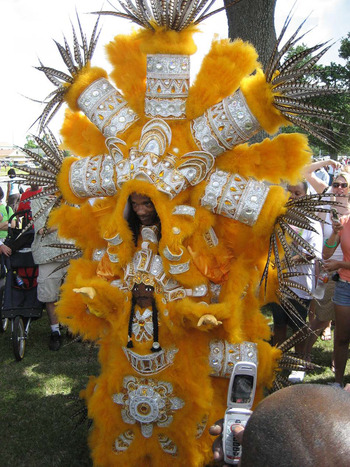
From the beginning, dreaming New Orleans involved fantasies of race, assumptions of risk, and visions of excess. François-Gérard Jollain’s colorful image of an imaginary city, engraved on a hand-colored copperplate and produced between 1719 and 1721, depicts the dream colony as John Law first promoted it under the aegis of his royally chartered Mississippi Company (fig. 1). Jollain’s background of the picturesque mountains in which the spired and crenelated city nestles is an especially mendacious flourish, for Law spread the word that Louisiana was rich in gold. Identifying the Native Americans with Mexico, as Jollain’s come-on does, further insinuates that trade with the bullion-rich Spanish colonies likewise beckons from just around the corner. Identifying the Amerindians with heaps of produce, game, and pelts signifies ample sources of sustenance and trade as well as a potentially captive labor force. Identifying the natives as grateful converts suggests easy pacification, while the first consignment of enslaved Africans arrived punctually in 1719. But in the neighborhoods of New Orleans today, a related but alternative imagery appears in the fabulous handmade suits of the Mardi Gras Indians or Black Masking Indians, African Americans who appropriate Native American iconology and choreography (Katzman Reference Katzman2007; Just 2017). Some of them claim Indian kin; not all Native Americans honor their claims, but others embrace the affinities, which date from colonial times, when outlaw bands of “Maroons,” consisting of intermixed families of Amerindians and escaped slaves, united as one blood, defied their oppressors. Swathed in feathered or beaded hand-sewn suits (styles of rival tribes differ), which are now offered up competitively as substitutes for what once were high-risk confrontations, today’s Mardi Gras Indians repeat and revise histories of diaspora and dispossession that are too different to conflate yet too similar to be separated (fig. 15). What collateral value backed up Law’s dream? The hinted possibility of intercultural amity within an economy of abundance suggests that lingering somewhere within the promotional hyperbole and racist presuppositions of the very first picture of New Orleans may lurk the wispy vision, shimmering at the uttermost perimeter of the future where horizon becomes mirage, of a truly postracial society the like of which the world has yet to see. Meanwhile, there is still an extraordinary place, one like no other. Once it is gone, nothing can take its place. Now overwhelmed by existential threats, it remains burgeoning with potential for the future. As New Orleans goes, so goes Planet Earth: for as long as it lasts, dreams are spoken here.
Mardi Gras Indian Big Chief Darryl Montana, with suit depicting his father, the late legendary Big Chief Tootie Montana. New Orleans “Super Sunday” 2007. (Photo by Infrogmation, New Orleans; courtesy of Creative Commons)