Alternative Approaches to Virtuosity
As performing arts scholar Susan Melrose recently observed, “mastery in performance making — along with expertise, professionalism and discipline — despite its status as constitutive of expert performance practices across the full range of performance making in the public sphere, is relatively speaking under-theorized in performance studies” (2018:157). While some scholars have theorized the production modes within contemporary dance (Kunst Reference Kunst2015; Cvejić 2015), their work rarely invokes the array of skills that comprise the labor of the contemporary dance artist as a performer. Footnote 1
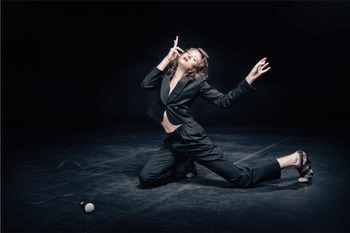
Dani Brown as her hyperindividual self in her solo How Do You Imagine the Devil? Kampnagel, Hamburg, 2012. (Photo by illlit)

A speculative reason for this gap in research may be that the performative skills a contemporary dance artist has to master in the 21st century are generally not recognized as skills. Or, to paraphrase Ramsay Burt: contemporary dance performances often do not look like dance and do not present conventional dance movement as such. Instead, they are concerned with presenting “alternative approaches to virtuosity” (2017:59). In other words, sometimes dance appears to be akin to the “ways in which we all are working” (Kunst Reference Kunst2015), a significant departure from dance practices seen as “extra-daily” (Barba and Savarese [Reference Barba, Savarese and Fowler1991] 2006). The attributes of post-Fordist workers of all stripes — polyvalence, flexibility, and adaptability — are certainly necessary for producing works of contemporary dance in Europe, our geographical area of study (Van Assche Reference Van Assche2020). These attributes have also engendered a very specific way of being within contemporary performance situations, which we introduce here as flexible performativity. The proposed notion encompasses several characteristics that have become requisite for those appearing in contemporary dance and performance work: the ability of performers to negotiate proximity with their audiences, to direct in real time the dramaturgy of the performance, to navigate between a plurality of techniques and performative actions, and to do all of this with a unique stage presence. These skills are taken for granted as necessary for the labor of contemporary dancers.
Flexible performativity and the rather playful bodies that have adopted this performative arsenal trouble notions of virtuosity developed within dance in close correlation to discipline and (Fordist) labor processes. This line of inquiry echoes the question posed by Melrose: “Might [we] admire and engage with performance mastery itself, on its own terms? And if so, what is it that invites a spectator’s affective binding-in?” (2018:155).
Expanded Methodology
Kareth Schaffer coined the term flexible performativity in a lecture performance she created at the beginning of her career as a dancer in 2013. She developed this notion as a way of responding to what was consistently being asked of her as a performer, using the term to depict a performative disposition that navigates among various modes, depending on the situation, and which is in part constituted by the manifold demands of working and dancing in the field of contemporary performance. Schaffer has continued to use flexible performativity in her practice as a choreographer, performer, and scholar of contemporary dance (Schaffer Reference Schaffer2013, Reference Schaffer2020). As a qualitative researcher, participant-observer, and experienced spectator of contemporary dance performance, Annelies Van Assche has theorized the phenomenon of flexible performativity on the basis of extensive fieldwork in the Brussels and Berlin dance scenes as a particular set of skills that today’s dancers have to master, including the ability to adapt to the demands or expectations of each choreographer or collaborator, but also in response to audiences, locations, and situations (see Van Assche Reference Van Assche2020:200).
We depart from the common ground that, despite its omnipresence in contemporary dance performance today, flexible performativity still goes largely unrecognized, not least because the highly individualized subjectivities it produces are crafted to appear effortless. In other words, the labor involved in the production of subjectivity is often eclipsed in the act of performance: it is both invisible and obviously highly visible labor.
As Melrose has observed, “processes of rapid and experimental engagement, in the expert practitioner, are largely invisible to the present non-participant onlooker, but tend to be wholly invisible even to expert spectating and critical engagement with outcome” (2018:158). We believe that this blind spot, shared by many “expert spectators,” need not remain such. Our complementary experiences of producing and performing in contemporary dance and of conducting qualitative research into the working conditions of contemporary dancers allow us to filter the attributes of post-Fordist working conditions through the multidimensional flexibility they necessitate at the level of producing contemporary dance works. In the selection of performances we analyze, the contemporary dancers demonstrate very pronounced aspects of flexible performativity. Homing in on descriptions of the specific labor involved for performers within these performances elicits details of what their efforts contribute to the artwork as a whole.
Contemporary Dance
“But, they are not dancing?”
In our post-Fordist, neoliberal, capitalist society, the multifaceted, oscillating, fragmented, shifting, ludic subjectivities produced on stages by contemporary dancers have been a matter of deep ambivalence for both dance spectators and dance scholars. This ambivalence is often expressed with the objection “But, they are not dancing” (see Andersson Reference Andersson, Andersson, Edvardsen and Spångberg2017). When connected to discourses of virtuosity and technical skills, this sentence might also be understood as “But, they are not working.” That the very act of being present onstage at a specific time and place, at the behest of (paying) audience members, is indeed a form of labor is apparently incommensurate with certain notions of what type of labor dancers should be doing in performance. Footnote 2
The Italian neo-Marxist philosopher Paolo Virno has greatly contributed to a shift in the understanding of virtuosity that can also be applied to contemporary performance. In his A Grammar of the Multitude (2004), he analyzes the communicative nature of labor in the post-Fordist regime, particularly regarding virtuosity and its connection with politics. He maintains that virtuosos — a term he uses generally for all sorts of performing artists, including dancers — produce an activity that, performed in the presence of others, is its own fulfilment; there is no product of a performance once it is finished. Art, labor, and speech are all considered performances by Virno, as they institute the publicly organized space that traditionally belongs to the realm of the political. “Virtuosity” thus becomes a term connected to all such activities that serve to create a common sphere, particularly linguistic, discursive, or communicative activities. Bojana Kunst (Reference Kunst2015) has already done the groundwork in connecting Virno’s concept of virtuosity with art-making. Focusing especially on the performance of dance, this approach to virtuosity expands beyond a purely technical demonstration of the performer’s dance skills: it might relate to the performer’s unique presence onstage and their capacity to attract attention; their skill in interacting with the audience; and/or their ability to embody the artistic intention of the choreographer in a specific way, while at the same time radiating something very individual as a dancer.
Already in the 1990s, Susan Leigh Foster suggested that independent choreographers, whose aesthetic visions stemmed from the American 1960s period in which choreographic investigation challenged the boundaries between dance and everyday movement, “require a new kind of body, competent in many styles,” which she called a “hired body” (1997:253). She observed that, against the backdrop of the neoliberal economy and the post-Fordist labor market, choreographers started to experiment with eclectic vocabularies and new interdisciplinary genres of performance. Foster proposed that this experimentation circumvented the distinctiveness of the dancing body: instead of developing new and unique dance techniques, independent choreographers “encourage[d] dancers to train in several existing techniques without adopting the aesthetic vision of any” (1997:253). Also, dancers’ socioeconomic position as independent workers led them to be occupied with entrepreneurship and “hireability” rather than refining a single technique. Today, the contemporary dance artist is usually equipped with manifold movement techniques, some commonly labeled under the umbrella term of somatics, which are not based on a movement vocabulary but rather on principles and instructions. The contemporary dance artist is also often able to draw on other fields requiring bodywork, such as sports or martial arts, but also on skills from other artistic disciplines such as the visual arts, music, and literature. In the context of neoliberal ideals of lifelong learning and self-development, this corporeal archive — or body capital — is considered to be ever-expanding, even when the aging process inevitably limits the physical body’s athletic abilities.
In postmodern dance practices in the US as well as contemporary dance practices in Europe we thus see resilient bodies onstage, bodies that continuously learn and unlearn. These bodies are able to cope with a heterogeneous catalogue of techniques, skills, styles, and forms; and they are able to respond to the dynamic demands of the volatile labor market of contemporary dance. This polyvalence is as much an imperative as it is (sometimes) a desired form of self-expression and self-development: many contemporary dance artists want to explore this corporeal potential in the development of their movement practice (Van Assche Reference Van Assche2020:194). This may at least partly explain why some contemporary dance artists join dance companies only temporarily — or why many seem to leave dance companies notwithstanding the income security and opportunities to become more skilled at a given technique or style.
However, the versatility expected of today’s dancers has broadened far beyond what Foster describes. Her notion of the “hired body” suggests a polishing away of individual differences, which have in fact become increasingly important in navigating a career in contemporary dance. In that respect, a Brussels-based dancer from Van Assche’s study into the precarious working conditions in European contemporary dance describes himself as a performer as follows:
I’m kind of a very weirdly specific performer and not a blank… I’m not a tabula-rasa kind of guy. Not that anyone else really is, but I’m less than any other dancers I know. (in Van Assche Reference Van Assche2020:202) Footnote 3
This US-born professional dancer relocated to Europe about a decade ago and has been active throughout Europe as well as in the United States as a performer in prominent work ever since. Expanding on what the cited self-definition implies for his career, he testifies that:
Fortunately, I’m able to find work that, I believe, is more about this complete package, harnessing my full person, or that requires me to check multiple boxes in terms of modes of expression and capacity for embodiment. (202)
In other words, dancers such as the above emphasize the highly individual nature of their talents. As such, we deem it necessary to think of a shift in the discourse from postmodern dancing bodies to contemporary dancing subjectivities, drawing on the work of Bojana Kunst (Reference Kunst2015), Bojana Cvejić (Reference Cvejić2015), and others on the production of subjectivity within the performing arts. Maurizio Lazzarato, one of Virno’s colleagues with the Italian neo-Marxists, has been of major importance for this discourse as he was among the first to point out that “subjectivity is capitalism’s biggest output. It’s the single largest commodity we produce, because it goes into the production of all other commodities” (2010:14). Since the 1990s, performing artists in Europe have been producing artistic work in which entrepreneurial subjectivity and its implications for the notion of virtuosity are questioned (see esp. Kunst Reference Kunst2015, drawing on Virno). Much of the characteristics of Foster’s hired body are still true in the 21st century. However, current dancing subjectivities not only master a great adaptability, they also provide a performativity that brings to the work a personal movement style and a unique presence on the stage. This triumvirate of the contemporary dancer has been testified to by the same Brussels-based dancer who claimed that being somewhat of “an amateur in everything” is actually one of his strengths:
Working as a professional dance artist, I’ve always preferred to think of myself as an amateur. I try to be a little bit good at everything, at many kinds of movement, but I am not really an expert in any one thing except for being myself. (in Van Assche Reference Van Assche2020:195)
Since at least the 1990s, the ideal contemporary dancer in Europe has come to exhibit traits that appear to contrast with the “multipurpose” hired body’s attempts to “subsume and smooth over difference.” Instead, cultivating and highlighting difference may actually be key to success, or at least pivotal in order to be employed. Footnote 4 Thus, we can distinguish a shift from postmodern dance’s emphasis on de-individualization to contemporary dance’s attention to individualism, which indicates a new dance historical paradigm that aligns with the neoliberal subjectivity of the 21st century.
Flexible Performativity
Flexible performativity is characterized by an ability to navigate between different performative registers, to create complicity with the audience, and in general to adapt one’s performance to the specific audience, location, and situation, although this does not preclude the development of an often highly charismatic onstage presence. This is not to say that dancers performing predefined movement sequences that can be experienced through their synchronicity (with other dancers or music) or technical fidelity no longer account for the pleasure people derive from watching (and performing) dance. Footnote 5 However, the formats and novelty of some contemporary performances suggest other skills have become equally important. This tension points to a shift in the understanding of virtuosity: the dancer negotiates different kinds of (technical, dance, discursive, affective) skills and different expectations of audience members in the moment of performance. Four characteristics of contemporary dance of the 21st century strongly differentiate it from previous movements within the dance field: hyperindividualism, hyperreferentialism, autodramaturgy, and negotiating proximity. These aspects of flexible performativity have been distilled empirically through the observation of contemporary dancers at work in performance.
Hyperindividualism
On 12 January 2013, US-born, Germany-based dance-maker Dani Brown stalks the aisles of Sophiensaele, the go-to venue for independent dance and theatre in Berlin. She wears a tuxedo jacket with sparkling lapels and greets the audience with a slight British accent. Although her words are obviously aimed at the audience (“I am very excited to see you tonight…”), Brown herself first walks upstage, facing away from the audience. She turns around slowly as she haltingly ponders: “I do however wonder how far you, and I, might get…tonight.” Voice sultry, she suggests that some of the audience might want to touch her, and wonders aloud if she has created the conditions that would allow this to occur as she moves into the shadows at the edge of the stage. This wondering aloud continues until, barely four minutes into the piece, she asks what would happen if “I really wanted to kiss…one of you. Won’t you please come up and kiss me?” With this opening monologue of her solo piece How Do You Imagine the Devil?, Brown directly addresses the audience as both herself (by concretely referencing the performance situation that everyone is in) but not herself — the British accent suggests that not all is as it seems for the subjectivity of this US American choreographer. Furthermore, by inviting an audience member to kiss her — and going through with it when the occasion arises — Brown is negotiating a proximity to the audience that goes far beyond any fourth wall.
Dani Brown’s identity, aside from her physical labor, is at stake in this performance: her offstage and onstage persona intermingle in an extreme form of individualization. Footnote 6 This fixation on the individual has a long history in the tradition of Western dance, where a central aesthetic mode might be characterized as “dance’s foundational emphasis on the person and on the praising of the dancer as one of its main aesthetic traits” (Lepecki Reference Lepecki2016:11). Postmodern dance, with its focus on everyday movements and impersonal scores, was pivotal for questioning this synthesis of body, personhood, and genius: it favors “neutral” bodies. In Singularities (2016), Lepecki describes contemporary dance works that have explored and expanded this line of thought, up to and including the literal erasure of human bodies onstage — into darkness, thingness, or animality.
However, in his analysis Lepecki does not ignore the labor of dancers, even when this labor (and indeed, even the bodies of the performers) are invisible.
As both producers and objects of their own labor, dancers reveal dance as a system where creativity and corporeality fuse in and as work. This offers dance an opportunity for an urgent and embodied critique of neoliberal idealization of, and demand for, conformed and profitable creative labor. (2016:17)
However, there appears to be a tension at stake between the imperative to make a living as a dancer by pursuing job opportunities predicated on a unique stage presence and individual character, and this aspiration to question or struggle against the hegemonic status quo, even to find the “unintegrated life” (Povinelli Reference Povinelli2011:109) within it. On the one hand, some dance works are designed to explicitly exclude notions of individuality and the self. On the other hand, there are works that are nearly indistinguishable from the deeply personal and unique personalities being presented onstage — as in Brown’s How Do You Imagine the Devil? Particularly this latter notion has gained even greater momentum in the first decades of the 21st century. We refer to this characteristic of flexible performativity as hyperindividualism.
Dancers rarely dance characters such as Esmeralda on the contemporary dance stage — doing so would almost certainly be an eyewink towards the narrative structures of ballet, for example in Artifact (2017) by William Forsythe. Instead, as mentioned above, performers onstage will usually be somewhere on a spectrum between performing their own “selves” and embodying an absence of identity as nameless, “neutral” performers — oftentimes within the space of a single performance. The former happens, for example, in Happyology (2017) by Dragana Bulut and the latter in Low Pieces (2015) by Xavier Le Roy. Performing one’s “self” requires presenting within a work some iteration of what the audience could conceivably project to be the performer’s subjectivity “in real life,” offstage. However, dance’s grounding in corporeal practice — its exploration of the ever-unstable materiality that makes up the body — has lent itself to the performance of unstable, fragmented, and even duplicitous selves. For example, who exactly Dani Brown is performing — herself, a variegated cast of characters, or perhaps the devil — is very much what is at stake in How Do You Imagine the Devil? She changes accents, costumes, and movement qualities in nearly every scene. Since Brown speaks in the first person throughout, no matter the traits of the person/persona presented onstage, it seems like this should be Dani Brown…yet the essence of this performer is constantly shifting, ungraspable.
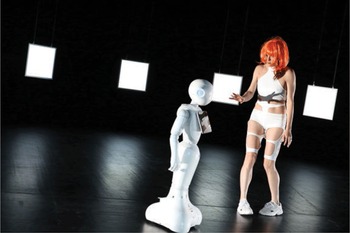
This constant oscillation among characters while remaining uncannily recognizable has become a hallmark of Brown’s work, also in performing for others. In Water Will (in Melody) (2018), by choreographer Ligia Lewis, Brown’s delivery of the opening monologue (an approximation of the Grimm fairytale “The Willful Child”) is halting, repetitive, and punctuated by the slow expansion and overstretching of her limbs. At times she interrupts herself with a “fast-forward” mode of speaking: “thisisnotamonologue…” she declares. Who else is speaking? In English and in German, the words are a struggle: they are often repeated and frequently interrupted by silence or abrupt changes in register. Especially vocalizations of US American female stereotypes (the Valley girl, the Southern belle) undermine any impression that what is on offer is a monologue: the performer is rather speaking in tongues; she is speaking as “the multitude.” In Future Fortune (2020) by choreographer Dragana Bulut, Brown’s versatility is again on display as she seamlessly switches between a postmodern rendition of a robot from the 1921 play R.U.R., a talk-show host, Milla Jovovich’s character Leeloo from the movie The Fifth Element, and — last but not least — “herself” when she interrupts the show to offer pointed criticism of Bulut’s use of an onstage robot. It bears pointing out that all three of these pieces squarely inhabit the realm of contemporary dance, despite their liberal use of narrative and discursive elements. Moreover, Brown remains utterly recognizable throughout all three works: her hyperindividualism is indeed what makes her an attractive collaborator. However, it also raises the question of replaceability: even though it may be technically possible to replace Brown in these roles, it would be interesting to examine the ways in which this affects the work. Would it at all be possible to find the same performer to replace Brown in all the roles she has performed?
Dani Brown referencing Leeloo from the film The Fifth Element (1997) in Future Fortune by Dragana Bulut. Hebbel am Ufer Berlin, 2020. (Photo by Dorothea Tuch)

However, as large parts of dance education and training still rely on an orientation towards purportedly neutral bodies, dancers are aware that they produce their onstage subjectivities; they do not emanate from a modernist inner essence. The hyperindividualist construction of subjectivities in the service of a contemporary dance performance might serve to establish common ground with the audience, to provoke admiration, or to construct identities that are highly different from the audience. It requires the willingness and ability to perform or distort one’s own or a group’s identities, to articulate feelings and sensibilities, to move and be moved from deeply personal experiences and convictions, and to do all of this onstage for the edification of an audience who will largely remain anonymous. These abilities of course lie at the core of theatricality in general, and as such also belong to the repertoire of actors and other performers, as well as dancers. However, this entrenched hyperindividualism departs from modernist connotations of an essential “genius” as much as from postmodern dance’s shift of focus from trained bodies to the inclusion of ordinary bodies: it is both technically and discursively virtuosic.
When thinking about hyperindividualism as a characteristic of flexible performativity, it is relevant to consider whether this characteristic is an inherent quality or a learned skill. From our combined 20+ years of work experience in the European dance scene as performer, choreographer, producer, and dance researcher, it appears that many contemporary performers have experience in multiple arts disciplines, which would afford them a unique repository of skills from which to draw onstage (see Hoogterp Reference Hoogterp2020). A contemporary dancer is not a “tabula rasa.” Each dancer comes with their own cultural background. For example, many contemporary performers share the experience of being an immigrant by the very nature of their jobs and the training necessary for it (see esp. Hesters Reference Hesters2004; Poláček 2007; Van Assche Reference Van Assche2020). As the working language of contemporary dance in Continental Europe is largely English, the majority of contemporary performers are at least bilingual (Van Assche and Laermans Reference Van Assche and Laermans2016, Reference Van Assche and Laermans2017). However, this might be true for many fields — academia, IT, or government as key employers of the “dance cities” of Berlin and Brussels come to mind. Hyperindividualism must thus also be an acquired performative skill, not only the result of a specific biography but an expert play with affect, in which a navigation among and experimentation with both unique and ungraspable subjectivities highlights the fundamental instability of our “selves” and the potential for transformation that this implies. As opposed to discourses on the “authentic” and the “natural,” the hyperindividual acknowledges that the fragmented subjectivities onstage are constructed, are performed: falling out of “character,” acknowledging subtext, and continuously utilizing self-referentiality are strategies deployed by performers to point to the ambiguity of the material they present. Other than the already mentioned work by Dani Brown, a glimpse into the work of performing artists Anja Müller (La Mula, 2014), Ivo Dimchev (X-on, 2011), Moya Michael (Coloured Swan I: Khoiswan, 2018), Jeremy Wade (The Clearing, 2019), Eleanor Bauer (BIG GIRLS DO BIG THINGS, 2009), and many others demonstrates our case in point: who exactly these artists are performing in their work — a version or multiple versions of themselves, a variegated cast of characters, a persona — is very much entangled with their offstage, private selves.
Hyperreferentialism
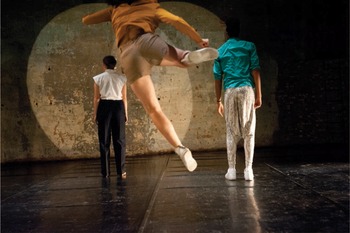
The movement material of Liz Kinoshita’s performance VOLCANO (2014) is clearly inspired by 1930s and ’40s tap dancing, despite the fact that none of the performers are explicitly professional tap dancers. In Silvia Gribaudi’s Graces (2019), performers dance ballet, sing arias, and complete calisthenic workouts onstage. For Monument 0: Haunted by Wars (2014) by Eszter Salamon, the dancers perform war-like dances from around the world, from the Balinese Baris to crumping. What this presupposes for dancers performing in such works is their ability to learn and then embody an incredible range of movement techniques and materials. The sheer number of possible movement references has exploded in the 21st century, not least influenced by the enormous volume of physical practices that have been made at least visually available through platforms like YouTube and Instagram. As a significant portion of contemporary choreography is in fact “videography” (Laermans Reference Laermans2015:195), contemporary performers might well spend large parts of their training and research process citing dances seen in videos.
The professional life of a contemporary dancer entails learning and unlearning a variety of techniques for specific shows and, in many cases, combining several of these techniques within the span of one show — from ballet and release to somatic techniques. We define this constant (re-)combination of different performative skills and techniques within contemporary dance works — a (re-)combination that can also serve to highlight the hyperindividualized subjectivity onstage — as hyperreferentialism.
To “refer” implies making a connection to something that is not present, beyond the undeniable concreteness of the body. Yet how does one do such a thing within a practice of embodiment? When neurological pathways and muscle memory coalesce to perform a movement, is it possible that this movement is also of the performing body, even when the history of the dancer and of the movement are different and the movement is no longer in its “original” context? Contemporary performance works — and thus necessarily the performers of these works — deal transparently with this tension between appropriation Footnote 7 and embodiment through primarily two strategies. On the one hand, “dance’s inescapable corporeality constantly demonstrates to dancers and audiences alike concrete possibilities for embodying-otherwise” (Lepecki 2012:15). To “embody-otherwise” is to engage with an embodied practice as a fiction; the one who embodies acknowledges that the practice both does and does not belong to them. On the other hand, Kinoshita mentions in an interview with Rita Natalio on the work VOLCANO that although her dancers are not professional tap dancers, “we can do it well enough” (2014). Strategies of hinting, of mastering techniques “well enough” to evoke their contexts without allowing the audience to switch to the evaluative grid implied by codified dance techniques are finely balanced skills of contemporary performers. In other words, for a long time it has been assumed that contemporary choreographers can have access to any kind of material and that together with their dancers they recharge that material with their artistic input, with or without a reference to the context from which it came.
Salka Ardal Rosengren, Liz Kinoshita, and Justin F. Kennedy tap-dancing “well-enough” in Liz Kinoshita’s VOLCANO. Monty Kultuurfaktorij, Antwerp, 2014. (Photo by Giannina Urmeneta Ottiker)

In recent years, this core idea of contemporary dance has increasingly been challenged as it raises a number of questions since the contemporary dance artist located in Europe is still usually a white artist with the resources at their disposal to study nearly any kind of dance (see Janssens et al. Reference Janssens, Leenknegt and Hesters2019; and Van Assche Reference Van Assche2022 for data on the Flemish artistic context). As such, the European contemporary dance market reproduces the extractivist logic of a colonial economy. In this vein, the use of the notion “contemporary dance” becomes problematic when, for example, some Western European gatekeepers, critics, or even dance scholars do not recognize present-day dance performances from particular geographical dance scenes as contemporary, but rather describe them as “old-fashioned” (Barba Reference Barba2016:46). In their text on “The Local Prejudice of Contemporary Dance,” Fabián Barba reflects on several dance works they have created in which they drew from their dance education in both Quito and Brussels. In so doing, Barba foregrounds a struggle with the globalized notion of contemporary dance, which they analyze as monocultural, or differently put, as a neocolonial expansion of a predominantly Western practice (2016:49).
In a similar vein, in Twenty Looks or Paris Is Burning at the Judson Church (2009), Trajal Harrell asks the question, “What would have happened in 1963 if someone from the voguing ball scene in Harlem had come downtown to perform alongside the early postmodernists at Judson Church?” (2009). This question points directly to the blind spots — particularly surrounding racial exclusion — of the postmodern paradigm: while open to the potential of “ordinary bodies” and “pedestrian movement,” new forms of dance originating in the very same geographical location were ignored and did not make it into dance history books. As Rebecca Chaleff has argued, the Judson Church choreographers (most likely unintentionally) favored an aesthetic that “preserved and perpetuated the whiteness of high modernism by twisting the trope of racial exclusion from a focus on trained bodies to a focus on ordinary bodies” (because the Black body was seen as “extraordinary” and “spectacular”) (2018:72). Apparently not any body is ordinary. Twenty Looks or Paris Is Burning at the Judson Church is actually a series of five works in different “sizes,” from extra-small (XS) to extra-large (XL), in which Harrell, together with several collaborators, seeks an answer to his question by offering the audience an experience that was not possible at either the balls in Harlem nor the Judson Church in Greenwich Village. While the differences between postmodern dance and vogue culture could not be greater, they share a similar quest for deciphering notions of authenticity and realness. Both scenes were responding to social and political values of the ’60s and deployed the transformative power of the body as a site of resistance. In the “medium” episode, (M)IMOSA (2011), Harrell reverses his proposition and performs alongside François Chaignaud, Marlene Monteiro Freitas, and Cecilia Bengolea in a competitive battle, in which all four try to outdo each other to prove they are the real Mimosa Ferrara. Still huffing and puffing from her ecstatic dance, Freitas is the first to introduce herself as the supposedly notorious Ferrara. She is wearing only black jodhpur boots and pants sagging very low on her hips. Similar to a voguing ball, the performers pose as a multitude of characters, changing social and gender identities through movement and costumes, each claiming to be Ferrara. A creepy androgynous otherworldly creature skitters around on hot-red stiletto heels. Cecilia Bengolea as Kate Bush performs Wuthering Heights quite poorly yet with confidence and passion in her iconic red dress from the music video. Chaignaud, posing as one of the many characters in (M)IMOSA, sings “You never know who’s who here” as they push their fake breasts a little higher (Harrell et al. Reference Harrell, Bengolea, Chaignaud and Monteiro Freitas2011). Hyperindividualism and hyperreferentialism intermingle in the performance and function as devices to comment on heteronormativity, racial exclusion, dance history writing, political correctness, performance etiquette, and more. The stage, much like a Harlem dance hall, becomes a space where fictitious and real identities can meet. In contemporary dance performances like (M)IMOSA, references are drawn upon to highlight or reconstruct the multiple allegiances and lineages of the performing self: references contribute to the creation of a unique subjectivity while embracing and redefining forms of identity that may have been excluded in postmodern dance.
In the sense invoked here, referring evokes both Lepecki’s “embodying-otherwise” and Kinoshita’s dancing “well enough.” There are a couple of caveats: first, hyperreferentialism leads to necessary conversations on who may claim “ownership” of (a) movement; second, extensive hyperreferentialism is often performed as or interpreted as frivolous. This approach to embodiment within contemporary performance work eclipses the fact that the dancers referencing, for example, tap dancing onstage have obviously acquired the skills necessary for tap dancing. Hyperreferentialism not only allows the dancer to point out such a reference to the audience without allowing them to apply the norms associated with it, but also to rapidly shift between references while pointing to various other realms of life or movement experience.
Finally, such demonstrations of hyperreferentialism within contemporary dance work are often achieved not just through movement, but particularly through vocalization. The discursive nature of some dance performances echoes Virno’s description of the communicative nature of labor in the post-Fordist regime and at the same time expands the range of possible references beyond a dancer’s physical abilities (e.g., most people can evoke the movement of a “pirouette” just by saying the word — even if they cannot do one).
Autodramaturgy and Negotiating Proximity
Contemporary dance unfolds in very different performative situations and very different spectator relationships. In particular, two formats have been influential for contemporary dance in the first two decades of the 21st century: the “precarity solo” (Van Assche Reference Van Assche2020) and the “dance exhibition” (Bishop Reference Bishop2018). Skills honed in these two ubiquitous forms have carried over into a broad spectrum of other dance performance formats: because many if not most contemporary dancers will have created a solo with minimal means, and dance exhibitions provide steady work for many dance artists, it is to be expected that the strategies developed within such formats would become a part of the movement repertoire of these dancers. The term “precarity solo” describes a solo work, made and performed by a single artist, that because of its minimal tech requirements and labor can be easily toured and performed: How Do You Imagine the Devil? is an example of such a solo. Juggling multiple projects over months is part of professional life for many dancers, and a solo work can fill gaps between group projects and paid work. The conditions for producing work within the field of contemporary dance led to an (over-)production of precarity solos, and their omnipresence makes it essential that they are considered here (see esp. Van Assche Reference Van Assche2020:106–12). Michael Helland’s RECESS: Dance of Light (2016) is another noteworthy precarity solo. Footnote 8 In this piece, Helland offers his audience a theatrical spa experience: an hour with him to slow down in response to the accelerated time regime of late modernity. Wearing a bathrobe and slippers, Helland is performing a ribbon dance as the spectators walk into the space. As they take their seats, Helland interacts with them while continuing the dance. He explains how he has created his props himself and then welcomes his audience more formally with a short monologue. Throughout the remainder of the performance, Helland establishes a very particular relationship with his audience by directly engaging them; he acknowledges that there is a “we” in the space. He is always quick to react to anything happening in the audience and adapts his prepared words as well as his stance to the situation that presents itself. Throughout the solo, he conjures iconic bodies from art history, demonstrating his multiple movement skills. Using a white sheet only, he seems to reenact canonic dances such as Loie Fuller’s serpentine dance and Martha Graham’s Lamentation, and teaches the audience several Gurdjieff movement exercises, inviting them to join him onstage for a closing ritual. Footnote 9 Playing upon hyperindividualism and hyperreferentialism, he hosts a situation in close proximity with his audience while deploying a real-time dramaturgy. Since Helland generally does not tend to make his own work, this solo project could be perceived as a literal recess from his turbulent life of performing with, and for, other people.
Precarity solos are of course artistic works in themselves but can also serve as living business cards or show reels that, particularly through hyperreferentialism, highlight the manifold talents of the performer. Having a solo in their pocket has become a survival tactic for many contemporary dance performers. While juggling different jobs and projects, as Michael Helland himself once put it, “you really have to have something that you can just pull out of your hat and there’s nothing like that besides an hour-long site-responsive solo” (Helland Reference Helland2016).
Another particularly relevant format in contemporary dance, that of the “dance exhibition,” often features dancers performing for the duration of a museum’s opening hours (Bishop Reference Bishop2018). This has provided an important new sphere of employment for contemporary dancers, albeit one with rather specific demands on the performer. An example here is Tino Sehgal’s This Variation (2012), which is usually not announced by a sign or exhibit label in the museum. Instead, visitors must take the plunge of walking through an empty doorway leading into a darkened room. Visitors to the room cannot see when they enter the space, although they will likely be able to hear the performers speaking, singing, or chanting in the few minutes it takes for their eyes to adjust. For large sections of the piece, the performers present in the room mainly sing or beatbox together while intermingling with the spectators. Some of this singing is improvised, and during such parts a performer may also start spontaneously dancing to the music. Additionally, eight set songs replete with choreographies can be performed by the entire group. Two discursive games round out the performative elements of the piece: a talking game, played by many of the performers; and a confessional, improvised by one performer. Rather than following a set or looped order, a cuing system called or sung by the performers sets performative elements in motion, or stops these elements from continuing.
Of course, a large part of the spectator experience of This Variation is dictated by the circumstances of near darkness (although there are times when the lights go on and then off). The vulnerability this implies foregrounds dancers’ skills in communicating with the spectators and negotiating their proximity in the space in various haptic, aural, and visible ways. The darkness, the sheer number of cast members, and the frequently quite intimate scenarios at times evoke the sensation of a multitude; at others, deeply personal stories and anecdotes evoke intimacy. The subjectivities in This Variation never seem quite graspable, as the cast members change seamlessly from moving to singing, from singing to speaking, from speaking to literally embracing audience members. For the dancers, performing this work demands an openness to supporting the ideas of others, as well as a constant reflection on their own role in creating an experience for the spectator. In other words, collaboration and reflexivity, always prized in post-Fordist working structures, are imperative here as well: in This Variation dancers perform their own production modes and different forms of immaterial labor that are increasingly required in neoliberal post-Fordist work regimes on the European continent (see Kunst Reference Kunst2015). Footnote 10
Both precarity solos and dance exhibitions have been pivotal in allowing and/or requiring contemporary dancers to draw on their personal movement repertoires and stories in the creation of the work: these formats require dancing subjectivities. In this move from dancing bodies to dancing subjectivities, many contemporary dancers uphold one of the myths of The Entrepreneurial Self (Bröckling Reference Bröckling2016) within contemporary performance: that of autonomy. This is particularly underlined in those performance works where the dramaturgy of the piece is in the hands of the performers themselves, and in works where a personal relationship with the audience is expected from performers. Such works require the skills, on the performers’ part, of autodramaturgy and of negotiating proximity.
Maaike Bleeker, writing on the function of the dance dramaturg as part of the creative process, describes a “dramaturgical mode of looking” in creating a dance work (2015:71). While all participants in a creative process contribute to this mode of looking, the dramaturg, in her freedom from the constraints of authorship and her view of the totality of the production, is in a particularly suitable position to keep track of the thoughts that emerge in the creative process, those thoughts that are enacted in a practice between various actors and as such are “no-one’s thought” (69). Accounting for “no-one’s thought” allows the dramaturg to develop an awareness of “how what is being created addresses the audience,” and of “how this very address triggers the audience to think along with the performance” (75).
What has become apparent since the widespread experimentation in postmodern dance with game structures, improvisation, and scoring is that, through the implementation of such structures on the stage, performers are often called upon to employ a dramaturgical mode of looking in situ, as the performance unfolds. In the moment of improvised performance, performers must base their actions on “an understanding of the directions in which this creation could potentially proceed” and an awareness of “the implications and complications of the material being created” (68) — which is what, according to Bleeker, a dramaturg does within the rehearsal processes. In pieces where different outcomes are possible and different constellations of elements arise in unforeseeable ways, performers’ choices affect the dynamics, tempos, rhythms, levels of physical interaction, and affective intensity of the piece. In This Variation, for example, performers decide when to cue certain songs. The ability to make such choices, to sustain, support, diverge from, or radically shift what is happening in performance — and to negotiate these choices with other performers, the audience, and the theatrical apparatus — is tantamount to the work of the contemporary performer.
Whereas, for Bleeker, the dramaturg’s labor is primarily executed offstage, the performer has the specific responsibility of embodying the logic of the performance onstage; their labor straddles the visible and invisible realms. Of course, performers’ decisions during a performance will usually be conditioned by the elements and structures developed beforehand in rehearsals: however, one cannot account for the specificity of dramaturgy for live performance without expanding a dramaturgical mode of looking to include choices made during the performance itself, by the performers, in an act of what we call autodramaturgy. Footnote 11 Thus, performances cannot only be seen as the result of choices made during the creation process, but also as the result of choices made during the performance. As rehearsal times have shortened, performers’ skills in autodramaturgy allow for an outsourcing of traditional notions of choreography to the performers: the author of a work will determine a few parameters within which performers must create the movements that, together with performers’ physical bodies, are what the spectators identify as the work. The undeniably collaborative nature of this process is frequently made explicit in program notes that list works as “by and with” or “choreography and performance by” the performers, whereas the author lists their responsibility for the “concept.” In this respect, Jose Reynoso has studied a number of contemporary dance practices that embody neoliberal notions of freedom, ideologies of liberal democracy, and the logic of global capitalism by striving to be more egalitarian, especially in his critical discussion on the notions of symbolic capital, ownership, collaboration, and credit in his examination of works by Yvonne Rainer, Xavier Le Roy, and Tino Sehgal (Reynoso Reference Reynoso2019).
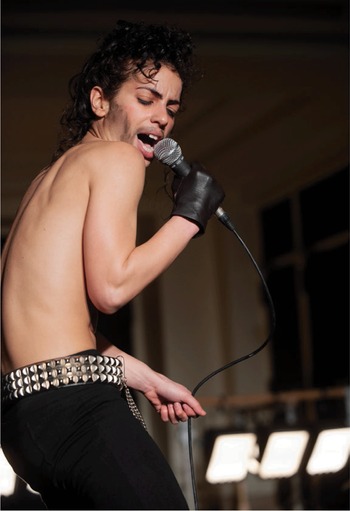
Erika Fischer-Lichte has described the redefinition of the relationship between spectator and performer as definitive for the performative turn within the theatre (2008:20), analyzing Richard Schechner’s Dionysus in 69 (1968) to examine how this redefinition breaks down multiple binaries associated with dramatic theatre (subject-object, observer-observed, and spectator-actor) in the attempt to instead constitute a “community of co-subjects” (40). Interestingly, this negotiation of the relationship between spectator and performer continues to be at stake in many performances today, as Bishop notes (2018). For example, in the “dance exhibitions” of the early 21st century, “behavioral conventions are not yet established and up for negotiation” (Bishop Reference Bishop2018:38). Because this “irruption of the real” (Lehmann 2006:99) has been such a mainstay of all kinds of contemporary performance, it is worthwhile to examine what this means for the labor that contemporary dance performers must execute within dance performances. In performances where behavioral conventions are not established, the structural imbalance in the types of knowledge possessed by performers and spectators is even larger than in traditional performances. Performers usually have at least a premonition of what will (or should) happen in a performance; audience members do not. Performers therefore, instead of relying on the apparatus to establish the “rules of behavior,” must do this themselves. As the parameters of a performance are thrown open, audience members may begin behaving in ways that are unexpected. They may move around, touch performers, undress, climb on the stage, question, contradict, or boo performers, organize other audience members to join them, etc. Flexible performers must engage with audience members as people, as coproducers of an experience that can also touch on the boundaries of consent for both parties. Footnote 12 They must take the experience and response of audience members into account and change their actions in real time to adjust — indeed, even when the performance format collapses completely. We refer to this characteristic of flexible performativity as negotiating proximity, taking into account that the proximity might be affective or spatial in nature. Recall for example Dani Brown kissing a member of the audience when the situation allowed for it in How Do You Imagine the Devil? or Marlene Monteiro Freitas, dressed as Prince with her breasts uncovered, giving an unsolicited lap dance to a front row spectator in (M)IMOSA.
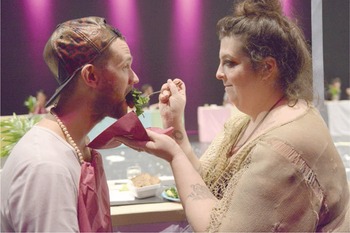
Together Forever (2014), directed by Jeremy Wade with Igor Koruga, Jared Gradinger, Liz Rosenfeld, and Michiel Keuper, is an experiment with proximity. During this performance, the audience experiences an evening in the theatre space that could be described as a happening, a performance ritual, or a communal event. The spectators start the evening from their ordinary position in the audience area. They are looking at themselves in a giant mirror onstage and the performers are revealed to be seated among the spectators as they direct questions to themselves, to each other, and to the audience. Each night, the performance proceeds slightly differently depending on who chooses to respond to a question (= autodramaturgy). Eventually, the spectators are encouraged to become very active participants as they are invited to partake in a meal behind the mirror on the stage. After a ceremony in which all participants spit into a bucket, the dinner guests are asked to sit next to someone they have not met before. The hands of every second guest are tied, thereby creating a situation in which proximity is negotiated during dinner — not only by the performers but also by the guests: strangers must feed their neighbors.
Marlene Monteiro Freitas as Prince in (M)IMOSA/Twenty Looks or Paris Is Burning at the Judson Church (M) by Cecilia Bengolea, François Chaignaud, Trajal Harrell, and Marlene Monteiro Freitas. Théâtre National de Chaillot, Paris, 2011. (Photo by Laurent Paillier)

In addition to different locations outside the theatre where contemporary dance may be performed, performers may appear on the stage or in the audience, above or below the spectators. The pandemic has only accelerated experiments with the location of performers in relation to their audiences; they may not physically share space at all, their presence mediated by a panacea of (digital) technologies. Whereas many dance techniques have been developed with an eye to the form of the body when seen from a distance, works that renounce this fixed distance between performers and spectators require that performers come close enough to be touched. Negotiating proximity is thus increasingly a part of the dancers’ job — the shifting boundaries of this proximity might be intended to provoke, to initiate intimacy, or simply to be present, in close quarters, with someone else. Closeness to the audience requires physical awareness and control — i.e., the ability to judge when full extension of a movement would be a literal slap in an audience member’s face — a trained disregard for personal and social boundaries that usually dictate space and interactions with strangers, as well as empathy for how this might affect spectators. Not everyone might welcome a lap dance by a bare-chested female dancer dressed as Prince, or being spoon-fed by a complete stranger. Initiating physical or emotional closeness with audience members may seem strange, exciting, or stressful for spectators, and thus part of the labor of performance might be the performer guiding spectators through the experience in specific ways. These instructions may be more or less explicit, and can include (or ignore) verbal instructions or touch cues, reassurances, or direct orders.
Liz Rosenfeld negotiating proximity with an audience member in Together Forever by Jeremy Wade, Liz Rosenfeld, Michiel Keuper, Igor Koruga, and Jared Gradinger. Hebbel am Ufer, Berlin, 2014. (Photo by Gerhard Ludwig)

Clearly, both autodramaturgy and negotiating proximity as performance skills have roots in the postmodern dance and performance scene. However, what has crystallized in the decades since is that these skills contribute to the perception of dancers not as dancing bodies but as dancing subjectivities. Both skills pair well together, but are not necessarily co-present in dance performance. What has occurred since the “performative turn” in the theatre since the 1970s is not so much that every performance work attempts to create a “community of co-subjects” with performers and spectators: rather, they encounter each other at a variety of different distances, and this variety invites choreographic play. Footnote 13 This play, especially as it has been at stake for a few generations of contemporary performers, has created several layers of meaning when moments of proximity arise: such gestures can even become references to postmodern dance. The hyperreferencing, hyperindividual performers, well aware that their own — and their audiences’ — subjectivities are produced, tend to create intimacies that are less naive than 1960s experiments. They are aware that these intimacies are moldable and unstable, threatening to topple over. The shift between different psycho-social distances is what is at stake, rather than, for example, a consistent ideological thrust towards a stable or unchanging mode of being together.
When the dramaturgy of the performance lies in the hands of the performers, these performers are perceived as autonomous, individual subjects. They could be, for that matter, considered the entrepreneurs of the performance, the ones who organize, manage, and assume the risks of the performance. With an entrepreneurial spirit, performers liberate themselves from the conventions associated with the theatre. As part of the autodramaturgy the performer may negotiate proximity with the audience, calculating risk and perhaps breaking intimate boundaries. While physical proximity may be accredited to postmodern dance, discursive, affective, or psychic proximity marks 21st-century dance: performers and spectators may get to know each other’s darkest secrets.
The range of examples from contemporary dance performances we have studied as spectators and as performers, as well as self-descriptions by contemporary dancers who describe what they are doing, have outlined the four characteristics of flexible performativity. This form of performativity dovetails with a new way of knowing about movement in the 21st century: in other words, with the advent of flexible performativity, we can define a fourth kinestheme of dance, after the well-known developments of the classical, the modern, and the postmodern.
Heralding the Fourth Kinestheme
The labor of dancers is currently organized around producing specific kinds of subjectivity within the frame of a cultural performance through corporeal practice — an organization that substantially (and necessarily) mirrors the underlying movement logic of the current moment. In his book Knowledge LTD: Toward a Social Logic of the Derivative, Randy Martin employed dance analytics to sketch the terms of a historical conjuncture and to examine what he proposed as a “de-centered” social kinesthetic (2015:143). Martin argued that the history of Western concert dance is linked to different currency reigns (or sovereignties) privileging one body (or bodily technique) over others. In doing so, he described the trivium classical dance, modern dance, and postmodern dance as kinesthemes, or kinesthetic epistemes, clarifying that “if an episteme describes a way of knowing that frames what will count, will be valued, and will direct the trajectory of further knowledge, social kinesthetics form kinesthemes, or embodied forms of sovereignty of rule” (158). By way of three exemplary choreographic instances (that are a rather restricted conception of dance that takes place on the Western proscenium stage, as Martin himself notes [160]), Martin illustrates how “dance makes tangible these means of moving together, the larger social kinesthetic of which a concrete performance is the particularization” (158).
In the classical kinestheme, Martin refers to La Sylphide, the iconic romantic story ballet in the early 19th century, to expose how ballet became an “architecture of [these] visual hierarchies” (163). In the tale of ballet’s origin, King Louis XIV is believed to have employed ballet to reinforce his dominant position of sovereignty. He would insert himself in the place of God, using the vertical axis (long lines and elevations) in his movement, and the corps would move according to a vocabulary over which he had command, thereby following his steps and imitating his positions. As such, the dance vocabulary from which a choreography is composed exists prior to a particular dance and thus generally remains unaffected by the specific composition. In modern dance, Martha Graham would come as close to being in a position of hegemony as Louis XIV was for ballet, as Martin points out (164). For the modern kinestheme, the relationship between choreography and technique relied on an active dialectic: at the core of both dance performance and dance training was the contraction, an internal spiral movement that distinguished itself radically from the vertical axis. This movement represented the idea that what you are comes from the depths of your own body. According to Martin, this idea is much in line with the sociological convention that describes the advent of modernity: how status comes to be understood as achieved (crafted from within) rather than ascribed (written on the body) (163). The modern artist was self-made, and as such, a capitalist (166).
As a reaction to the idea that dance movement can only be created by (ascribed or achieved) geniuses and that only great critics can validate this movement as genuine dance, the postmodern turn was set off by favoring the pedestrian. Martin argued that this essentially marked a movement away from the center, because postmodern dance broke with specialized movement and reorganized hierarchies to the horizontal axis. In brief, postmodern dance refused limitations on what can count as dance, favoring instead audience reciprocity, collectivity and de-individualization, stylistic heterogeneity, movement technologies, and scoring devices, among other things.
Now that we have reached the second decade of the 21st century, we propose that there might be a fourth kinestheme to supplement Martin’s trivium, at least when taking contemporary dance and its features in the (Western) European context into consideration. As Martin put it, his book stages a scene “set in the United States but gazing out at the rest of the world” (2015:8). However, we believe that since the 1980s the ideas surrounding postmodern dance crossed the Atlantic and another kinestheme began to unfold on the European continent, moving away from the de-individualized dancing body to a highly individualized dancing subjectivity. This is, of course, not the only kinestheme at work in the 21st century: Martin pointed out that “various social kinesthetics can exist at the same time or even in the same place” (2015:158). We hesitate to use the term “contemporary” to denote this new kinestheme, even though it is commonly used as the (rather dissatisfying) fourth term following classical, modern, and postmodern art. For one, the term “contemporary” is already contested for its blurriness, referring as it does both to topicality as well as the amalgam of nearly 60-year-old techniques such as release or contact improvisation that were developed within postmodern dance (see esp. Cvejić 2015; Laermans Reference Laermans2015; Barba Reference Barba2016). In line with Martin’s suggestion that social kinesthetics create “embodied forms of sovereignty of rule,” with Jon McKenzie we argue that performance as a highly normative phenomenon “produces a new subject of knowledge, though one quite different from that produced under the regime of panoptic surveillance,” one that is “constructed rather than unified, de-centered rather than centered, virtual as well as actual” (2001:18). In other words, McKenzie’s performative stratum is definitive of the current dominant social kinesthetics. We therefore refer to this particular kinesthetics as the performative kinestheme.
In McKenzie’s performative stratum, the widespread cultural imperative to perform is announced by the vaguely menacing admonishment to “perform — or else!” When we consider the social media–supported compulsion to share even the most mundane tasks with an audience, all citizens are now performers, cocreating decentering movements for potentially millions of tiny theatres that overexpose their spectators to blue light. It is becoming almost unthinkable that a participant in the public sphere should not want to perform, to be seen. As such, decentered movement could be thought to return to a narrower definition of the performative, i.e., willfully producing movement for an audience. Footnote 14 For example, contemporary choreographer and drag performer Olympia Bukkakis has defined performance as “existing with intention for a specific period of time” (2020).
The broader social dynamics of the performative kinestheme have also made a mark on the field of what Burt has described as “new European experimental dance performances” (2017:3), as well as the dancers who navigate their careers through the field. Here, the performative kinestheme encompasses the fusing of discursive and technical virtuosity (in its expanded understanding) and a willingness to overcome public/private boundaries of a bygone era; in a word to share everything while simultaneously making this “everything” palatable to one’s specific audience. However, dance and dancers have always both resisted and embodied the dominant social modes of control: questioning the imperative to perform is also a core part of producing contemporary dance performances (see, for example, Van Assche Reference Van Assche2020). The contemporary dancer within the performative stratum must be flexible, playful, and resilient. With McKenzie, they “shuttle quickly between different evaluative grids, switching back and forth between different challenges to perform” (2001:19). Whereas the ballerina might be said to be the prototypical dancer of the classic kinestheme, in which discipline was the primary governing ontohistorical formation (17), the flexible performer is paradigmatic of European contemporary dance practices of the 21st century.
Dancing through the Performative Kinestheme
The prototypical dancer for the performative kinestheme embodies the characteristics of flexible performativity. A dance performance is not only the outcome of a contemporary dance artist’s production process; it also constitutes the pinnacle of the dance artist’s labor, because presenting the product in live performance is the moment in which we see the dance artist at work. An unexpected similarity arises here between classical and contemporary dance: both the classical ballerina and the contemporary dance performer somewhat paradoxically eclipse their labor in the very act of performance: they make it look easy. Recognition for the ballerina’s labor comes from the fact that most people realize they are physically unable to mimic what they are seeing onstage. In other words, the labor that goes into a ballet performance is obvious, because there is a common knowledge of how to acquire the technique and how many years it takes to master it. However, because flexible performativity moves between different paradigms of virtuosity, and not least because it is not easy to define what makes an “interesting” subjectivity (Van Assche Reference Van Assche2020:201), the labor that goes into such performances is much more intangible. Nonetheless, the dance performer displaying flexible performativity is able to navigate among a plurality of techniques and performative actions, to seek distance and closeness to spectators, to make real-time decisions of what should happen when in performance, and while doing all of this to also draw on their unique, hyperindividual subjectivities. Put differently, often when we see contemporary dance performers at work, we are seeing playful subjectivities who mask the fact that they are working, too.
A career in contemporary dance requires “resilience to the state of not-knowing,” as one dancer put it (Van Assche Reference Van Assche2020:197). This applies to both the offstage as well as onstage labor of the contemporary dance artist. Much like in the world of finance, as Martin observed, dance artists deal with constant risk. They are highly skilled in managing this — both as producers but particularly also as flexible performers of contemporary dance. Understanding the multitude of skills required of flexible performativity gives us deeper insight into the “expert performance practices” (Melrose Reference Melrose2018) that are definitive of contemporary dance within the performative kinestheme. The notion of flexible performativity can thus serve to reassess the aesthetics of contemporary dance performance departing from the intricately constructed yet playful subjectivities of the performers themselves.