Widely regarded as the most prestigious art exhibition in the world, the Venice Biennale combines art history, politics, and cultural power in a dizzying spectacle. Growing more or less steadily since 1895 (with brief respites for wars and pandemics), the 60th Venice Biennale, on view from 20 April to 24 November 2024, is the largest ever assembled.Footnote 1 The chief curator, Adriano Pedrosa, artistic director of the São Paulo Museum of Art in Brazil, selected more than 330 artworks made by collectives and artists for the two main galleries, the Giardini and the Arsenale, while 86 teams of curators and artists created exhibitions for the national pavilions, most of which are clustered around the two primary exhibition halls. Additionally, the biennale anchors 30 official “collateral events,” as well as numerous local galleries, museums, and special projects—all aiming to attract the attention of the vast audiences who come to Venice to see art between April and November.Footnote 2
Given the sheer size of these exhibitions, the Venice Biennale risks incoherence, even seeming chaotically diffuse. But the last two have avoided that charge. The 2022 exhibition, curated by the Italian-born, New York–based curator Cecilia Alemani, became unofficially known as “the feminist show” because women and gender-nonconforming artists outnumbered men by a factor of nine to one. The 2024 rendition might best be dubbed “the performance show” because it establishes performance’s dominant role in contemporary art. This is not a claim about numbers; I’m not saying that there was literally more performance than painting at the biennale. Rather, it is a claim about the force and appeal of performance across the full range of contemporary visual art. Sometimes invoked metaphorically, sometimes documented on video and film, and sometimes staged in live events, performance illuminates the primary themes and politics of the full exhibition.
Performing Strangeness Strangely
The official theme of the 2024 Venice Biennale, “Stranieri Ovunque,” both welcomes and alienates. Translated into English as “Foreigners Everywhere” in the official public relations materials and signage, but often translated as “Strangers Everywhere” in reviews and conversations, the phrase sets off a knotty cluster of meanings. Moreover, it immediately sets up challenges, both rhetorical and political. Who (or what) is foreign to whom? The Italian word stranieri evokes both strangers and strangeness, the latter adding emotion to the noun. Pedrosa’s exhibition invites attention to migrants and refugees, to outsiders and queer artists, to Indigenous collectives and to singular artists who often live far from their countries of origin. The multiple ways of becoming foreign as well as the multiple feelings foreignness produces in always shifting local contexts are all part of the exhibition’s ambitious aim.
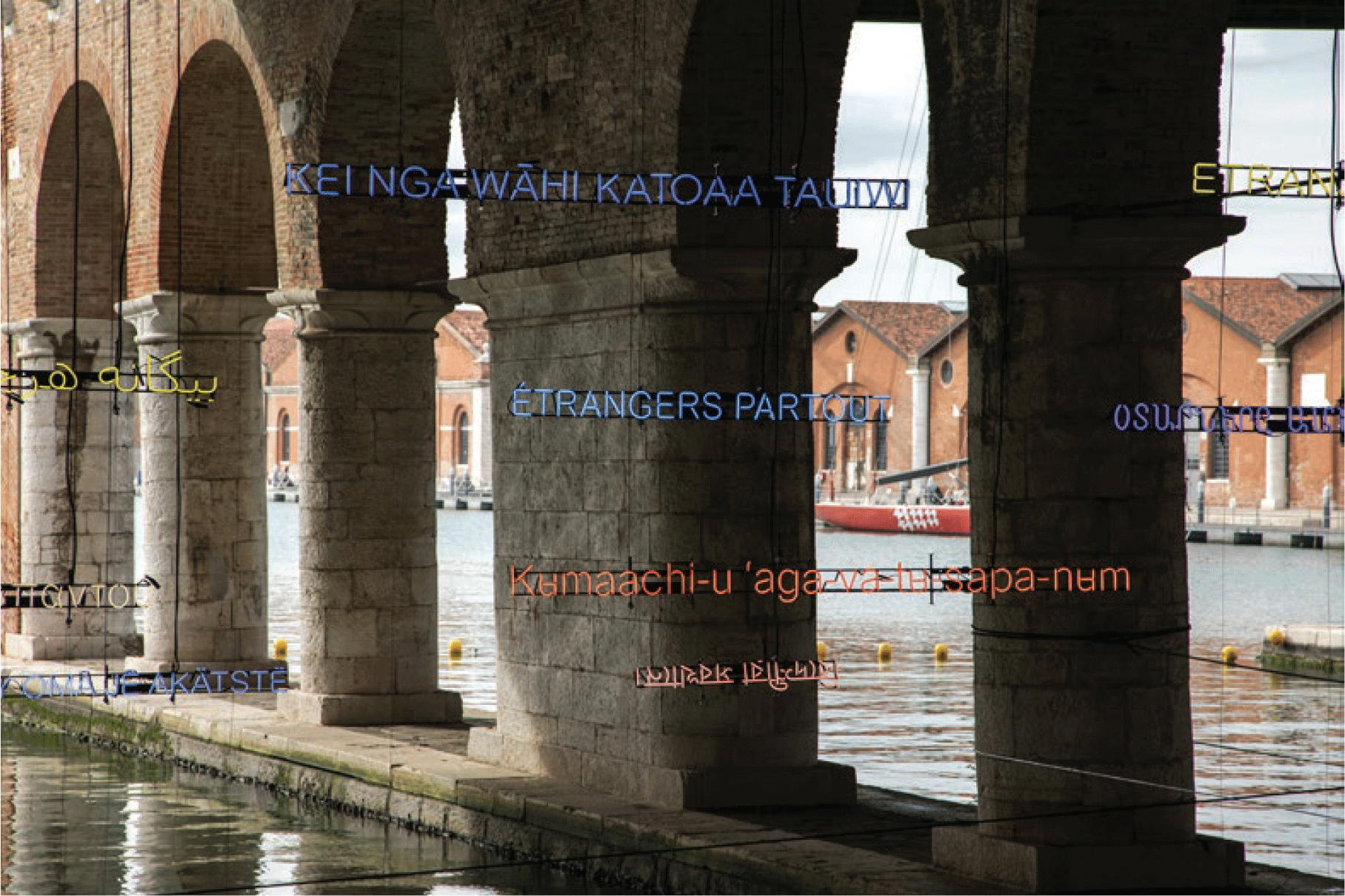
A neon sculpture spelling out “Stranieri Ovunque” in 53 languages, by the Palermo-based collective known as Claire Fontaine,Footnote 3 hangs above the murky waters of the Arsenale’s dockyards (fig. 1). The watery ground of the sculpture connects the biennale’s theme and its conceptual underpinnings to the European refugee crisis during which far too many “strange foreigners” have drowned while seeking havens that were not offered. In one such tragedy in February 2023, more than 90 migrants from Afghanistan, Pakistan, and Iraq drowned off the southern coast of Italy when their small wooden boat crashed into the rocks near Calabri.Footnote 4 On one level, then, Pedrosa’s curatorial embrace of foreigners critiques the anti-immigrant rightward lean of Italy and much of Europe, even as the biennale itself shores up and adds cultural, economic, and political capital to Europe generally and to Italy specifically. Thus, the plethora of translations that make up Claire Fontaine’s sculpture works as a performative utterance in J.L. Austin’s sense: as viewers encounter the “foreignness” carried by the 53 translations, they experience the estrangement that the phrase “Stranieri Ovunque” names. The porosity of the term suspended above the canal also suggests the centrality of water to refugee crises, forecasts of climate disasters, and global political policies responding to the effects of climate change, which the 2024 Venice Biennale examines. Many national pavilions feature references to water or in some cases actual water: broken or salvaged boats, to great effect in the Nordic and Lebanon pavilions; water from garden hoses in Japan’s pavilion; and in the Arsenale, Daniel Otero Torres’s Aguacero uses recycled materials and stilt architecture to highlight the situation of the Emberá, the Indigenous people of Colombia, who live along the banks of the Atrato River. The river runs through Colombia’s Pacific northwest rainforest and provides rich rainfall, however, illegal gold miners pollute the river, depriving the Emberá of their clean water source. Despite having won a legal case giving them “biocultural rights” to the river in 2017 (see Gonzalez Reference Gonzalez2023), the Emberá’s ongoing struggle to access potable water persists. Torres’s Aguacero pays tribute to the Emberá’s determined ingenuity and laments that it must continue.
Claire Fontaine. Foreigners Everywhere/Stranieri Ovunque. Sixty suspended, wall- or window-mounted neons, framework, transformers, cables and fittings, dimensions and colors variable. 60th International Art Exhibition – La Biennale di Venezia. (Photo by Marco Zorzanello; courtesy of La Biennale di Venezia)

Pedrosa’s exhibition also paradoxically produces and critiques the local force of the biennale itself: art and art lovers from April to November swamp the Floating City every two years and art becomes as ubiquitous as canal water during these seven months. In 2022, more than 800,000 people visited the Venice Biennale. Given that Venice itself has only 258,000 permanent residents, the local response to the arrival of so many (often wealthy) guests can be vexed, as can their response to the artworks. For example, when the Spanish artist Manolo Valdés created 12 bronze sculptures of Reina Mariana and installed them behind a larger Infanta Margarita derived from Velázquez’s 1656 painting, Las Meninas, in front of the Doge’s Palace in San Marco Plaza from April to June, the Venetian Heritage group, Nostra-Venezia (Our Venice), objected to the work, which it described as “black effigies.”Footnote 5 The group issued a statement declaring: “This extemporaneous use, or exploitation, of the city is part of a phenomenon that has taken hold for decades now: the ‘biennialisation of the city’ … Not everything is for sale in Venice and especially not our cultural heritage, which has made us who we are, and is our identity” (in Harris Reference Harris2024).
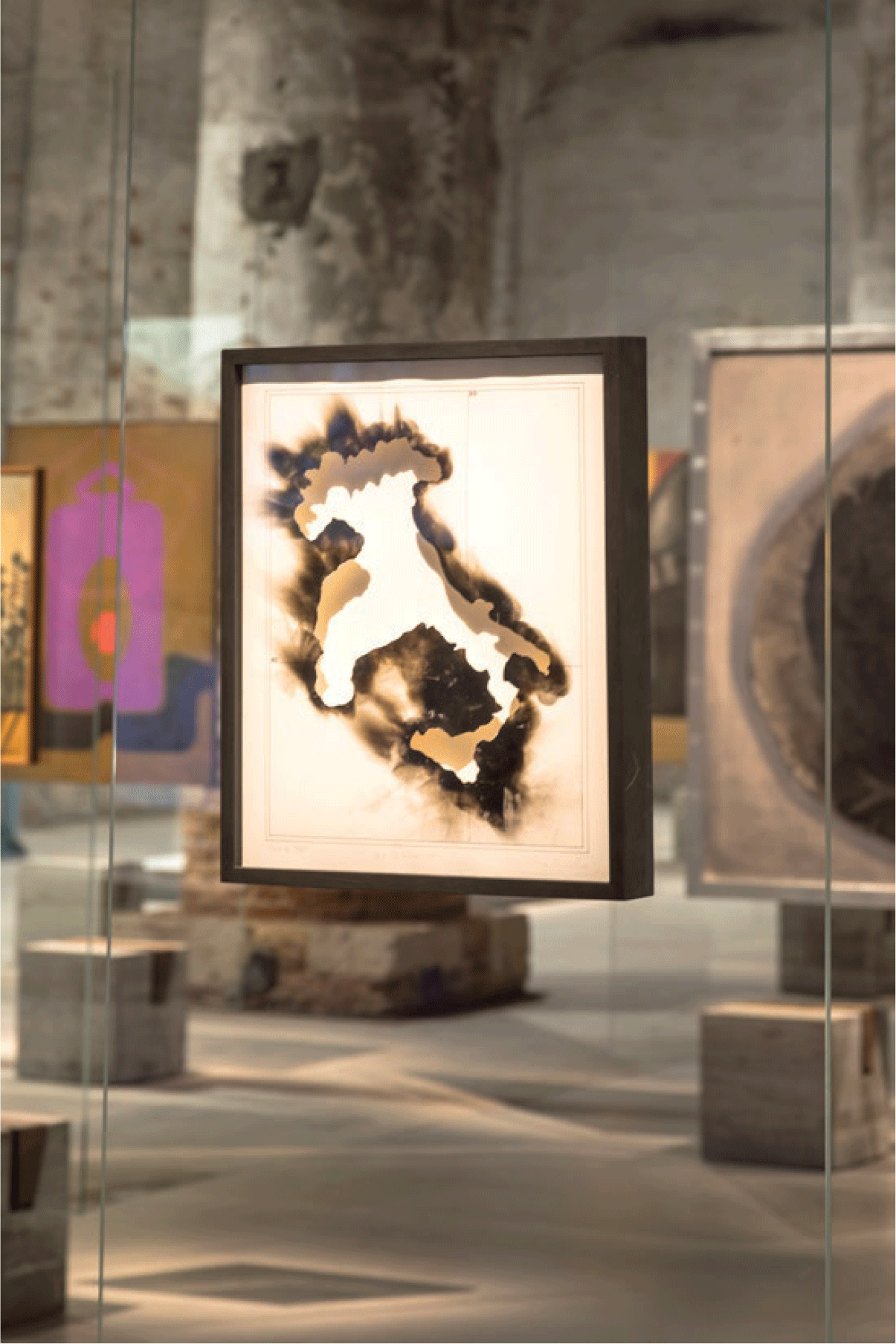
The 2024 biennale, however, aims to question the security and stability of this identity. A section of the exhibition, “Italians Everywhere,” foregrounds Italian artists whose art was and is made outside the country. One of these artists, Anna Maria Maiolino, who has lived in Brazil since she was 18, currently in São Paulo, was awarded the Golden Lion for Lifetime Achievement. Her series, Mental Maps (1972–1999), sometimes deploys maps of Italy; the one selected for this biennale is scorched on its perimeter, leaving it curiously empty in the center and alive with feeling at the edges. Italy in Maiolino’s work seems both an actual place and a state of mind (fig. 2). Braiding together the interior feelings and attachments that arise from considering a place as home, and the exterior political performances of nation-states that define and name that home, the 2024 Venice Biennale asks how to inhabit the strangeness of national identities. However, while much of the art on view critiques and questions the performances of nation-states, the organizing structure of the national pavilions enforces their power. This contradiction is everywhere exposed but nowhere resolved.
Anna Maria Maiolino. Anno 1942, from Mapas. Mentais series, 1973–99, Gouache on ink, transfer type, and burn marks on paper, 50.5 × 42.3 cm. Cavaletes de vidro: based on the original design by architect Lina Bo Bardi – 1968. Reproduction authorized by the Instituto Bardi. (Photo by Marco Zorzanello; courtesy of La Biennale di Venezia)

Financial Facts and Figures
While the grand immensity of the exhibition is astoundingly clear, financial facts are vague and obscure. The budget for the two central exhibitions in 2024 is often cited as 19 million Euros, but I have not been able to discover how much comes from Italy, how much from Venice, and how much from the EU (Morris Reference Morris2024). Nor have I been able to find any reliable accounts of the revenue generated by the biennale, although the 2022 show sold 800,000 tickets (Goldstein Reference Goldstein2022). I can report that hotels and restaurants were packed while I was there in July, and the galleries and the pavilions were full every day. Some of this information will be tallied after the exhibition closes in late November of course; nonetheless I found it odd that there was so little attention to these issues in the press.
The most comprehensive account of the widely varying national pavilion budgets I found is Redazioni’s (2024); that essay also discusses why there is so much secrecy about funds, making the important, albeit unsurprising point, that grotesquely uneven national budgets determine the selection and exhibition of art on display, rather than artistic excellence. In recent years, commercial galleries, auction houses, and other for-profit entities have funded select national pavilions. For example, the Ghana-born British filmmaker, John Akomfrah, who created a dazzling installation of video art in the British Pavilion, received funds from the British Council, Burberry, Christie’s, and the Frieze art fair, even though it is unlikely that these videos will produce commercial sales. However, an alignment with a Ghanian-British artist whose work calls attention to global environmental crises may well help these entities burnish their own reputations.
When selecting Jeffrey Gibson for a solo exhibition in the US Pavilion, the State Department allocated $375,000 toward exhibition costs. But the total estimated cost of Gibson’s exhibition is $5,700,000. Once the selection was made, the Mellon Foundation contributed $1,000,000 and $1,100,000 came from the Ford Foundation. Additionally, Sotheby’s agreed to sell 60 Gibson-designed blankets for $7,500 each (Carrigan Reference Carrigan2024a). It is unclear where the other $2,000,000 came from, although Gibson’s New York gallery, Sikkema Jenkins & Co, probably absorbed most of it. In October, Gibson also joined the mega global gallery, Hauser & Wirth.
The watch company Swatch receives credit as “the main partner of the Biennale Arte 2024” on the Venice Biennale’s website and promotional material. Swatch also exhibits the work of seven artists, including the Mexican sculptor Juan Pablo Chipe. His sculptural fusion of Marge Simpson and Frida Kahlo, made from recyclable material, gives a comic touch to the sometimes hagiographic approach to Kahlo’s life and work, while also enhancing the cultural capital of Marge Simpson. Chipe hopes to install his fiberglass life-size sculpture somewhere on the Mexico-US border to create “a more positive feeling” about border politics (in Madrid Reference Madrid2024).
Chipe’s interest in making art that crosses borders aligns with Pedrosa’s ambition to revise the borders between art history and contemporary art. The Giardini displays the Nucleo Storico and the Arsenale exhibits the Nucleo Contemporaneo, but the art itself fails to stay confined to one side of the art-historical border or the other. Indeed, “Foreigners Everywhere” seeps and oozes beyond the curatorial borders the exhibition navigates.
Nucleo Storico and Nucleo Contemporaneo
Walking in the crushing heat and humidity of Venice in July for miles each day was disorienting, especially the first few days when I was jetlagged and fatigued from a recent bout of Covid-19. The exhibition divides art history and contemporary art installed in the two central exhibition halls: the Giardini, a large public park at the north end of the Grand Canal created during Napoleon’s reign; and the Arsenale, located in a former dockyard, which joined the biennale in 1999. When I first arrived in the Giardini, the jubilant mural painted on the walls of the Central Pavilion by the MAHKU Collective, Aboriginal artists from Brazil, lifted my spirits. A feast of brightly colored flora and fauna, the mural gives testimony to the vitality of myth, nature, and spirit (see Bittencourt Reference Bittencourt2024). The vibrant energy of the mural made me feel immediately optimistic about the show itself. Once inside the exhibition hall though, as I read the introductory signage describing the show’s aims and ambitions, I sank into a state of dread and disappointment. I thought, “Oh please not another show telling us to decolonize museums! And here, of all places?” Whatever else the biennale enacts, it exposes the performance of power, wealth, and nation-building central to both art history and contemporary art. And this exhibition somehow plans to unravel all of that? Ludicrous, I assume, growing cranky at the hubris and the belatedness.
Within minutes though, I am swept up by the quality and range of the art and the critical argument it performs. Primarily focused on artists who worked in the 20th century in Africa, Asia, Latin America, and the Middle East, Pedrosa’s Nucleo Storico at the Giardini dramatically complicates what Euro- and Anglo-Americans call modernist painting, and radically expands what counts as abstraction and portraiture. Moreover, by including textiles and fabric as primary mediums, Pedrosa’s exhibition deftly erases the usual hierarchical distinctions between high art and low craft, deftly intervening in the gender politics of traditional Western art history. Women’s “craft” work—intricately patterned sewing and subtle dye variations in weaving in particular—gains enormous prestige when seen alongside the color palettes and patterns of abstract canvases. Additionally, the exhibition’s focus on Indigenous materials and philosophy raises important questions about Western art history’s celebration of paint, marble, bronze, and copper rather than the aromatic and tactile properties of soil, herbs, fruits, leaves, and trees. Nonlinear, circular forms, particularly in the “Abstractions” section, quickly displace teleological narratives of linear progression and power that Western art history emphasizes. Even basic assumptions about what counts as a finished work are thrown into doubt by mesmerizing fabric art that shows threads dangling and canvases with large blocks of “empty” space. Additionally, works made by collectives, family members, and a variety of temporary and long-lasting communities undermines the too-simple narrative arc of much Western art history, in which a sequence of single heroic artists working alone in studios creating masterpieces advances human civilization and culture.
In brief, then, the 2024 Venice Biennale seeks to slay the cornerstones of 20th-century and contemporary Western art history and does so with aesthetic and political panache. The sheer scale of the exhibition makes it difficult to assess in convincing detail; however, performance emerges as a supple yet rigorous medium for addressing colonialism, climate change, queer/trans identity, and war.
In the Arsenale’s Nucleo Contemporaneo, two large rooms dedicated to riveting video displays of collective and individual performances take pride of place. Excerpts from the Disobedience Archive, produced by the Italian curator Marco Scotini, highlight 40 videotapes documenting significant political interventions. The videos, created by 56 artists, are arranged in the shape of a Zoetrope, a 19th-century circular machine designed to show motion prior to the invention of the projector. While the signage in the Arsenale makes much of this techno-history, I find it unconvincing, even banal. To me, the shape resembles a giant conch shell, a spiraling circle that creates a dim roar of voices, languages, histories. (No headphones are provided, resulting in audio bleeds. I usually dislike this distracting arrangement but lacking the fortitude required to watch and hear all 40 performances, I appreciate hearing snatches of arguments, debates, and declarations.) On the outer wall, grouped under the title Gender Disobedience, videos document the story of feminism and gay rights; while projected on the inner wall are videos documenting the struggle for migrant rights globally under the heading Diaspora Activism. The grouping amplifies the accelerated history of the accommodation of feminism and queer rights in contradistinction to the utter stagnation, if not absolute regression, of migrant rights.
Disobedience Archive abuts an excerpt from Bouchra Khalili’s The Mapping Journey Project. While Disobedience Archive gains its power from accumulation and cacophony, Khalili’s work takes the opposite approach. Each of the eight videos focuses on a single map and a single speaker in an uninterrupted shot. Holding a black marker, the speakers draw their perilous journeys, while describing often absurd trips from their homelands to various new and often temporary “aways.” Their new locations rarely seem like final destinations. Khalili’s camera focuses exclusively on the maps and the hands drawing their journeys; the faces of the speakers are not shown. This choice likely stems from the need to protect the identities of the speakers but it underlines the circuitous zigzagging routes each speaker has traveled. Khalili, who grew up in Casablanca, avoids dwelling on the political-economic situations that motivate the speakers’ departures, and the speakers do not say much about the emotional toll of leaving. (One speaker travels repeatedly from Ramallah to East Jerusalem to see his lover, but Israel’s shifting checkpoints and the rough terrain he crosses receive emphasis, not the wonder of love.) By leaving the usual tropes of the migrant’s journey out of these stories, Khalili’s art dramatizes the strange mix of luck, money, political theatre, and personal drive that determined each journey. Some speakers pick their destinations based on chance or childhood dreams. A few wind up in places they never intended to go but found work there and so stayed.
Listening to these dispassionate, matter-of-fact speakers recount their journeys—“I asked what bus I could take that day with the money I had, and the only route available took me to Holland”; or, “I was stopped at the border and put in prison for another seven months”—I was struck by the utter caprice and the near-constant transformations in border policies globally. On the rear wall adjoining the videos, Khalili adds two additional pieces from her Constellation Series. On a floor-length blue silkscreen, Khalili reinscribes the earthly locations into cosmic stars. She renders the immigrants’ physical journeys back into dreams of a way out. The second piece abstracts and elongates the journeys further by tracing the looping lines between destinations on blueprint paper. Absent the maps though, the destinations float against the blue ground, unmoored figures in a limitless sky. These Constellations suggest the otherworldly aspect of these migrant journeys; if taken by plane or train, most would only take a few hours. But when one must climb mountains to avoid border surveillance, or walk only at night, the same trip can take years. One speaker wanted to get to Rome from Skopje, but his circuitous journey to Italy took him through Dhaka and Dubai.
Performance Highlights from the National Pavilions
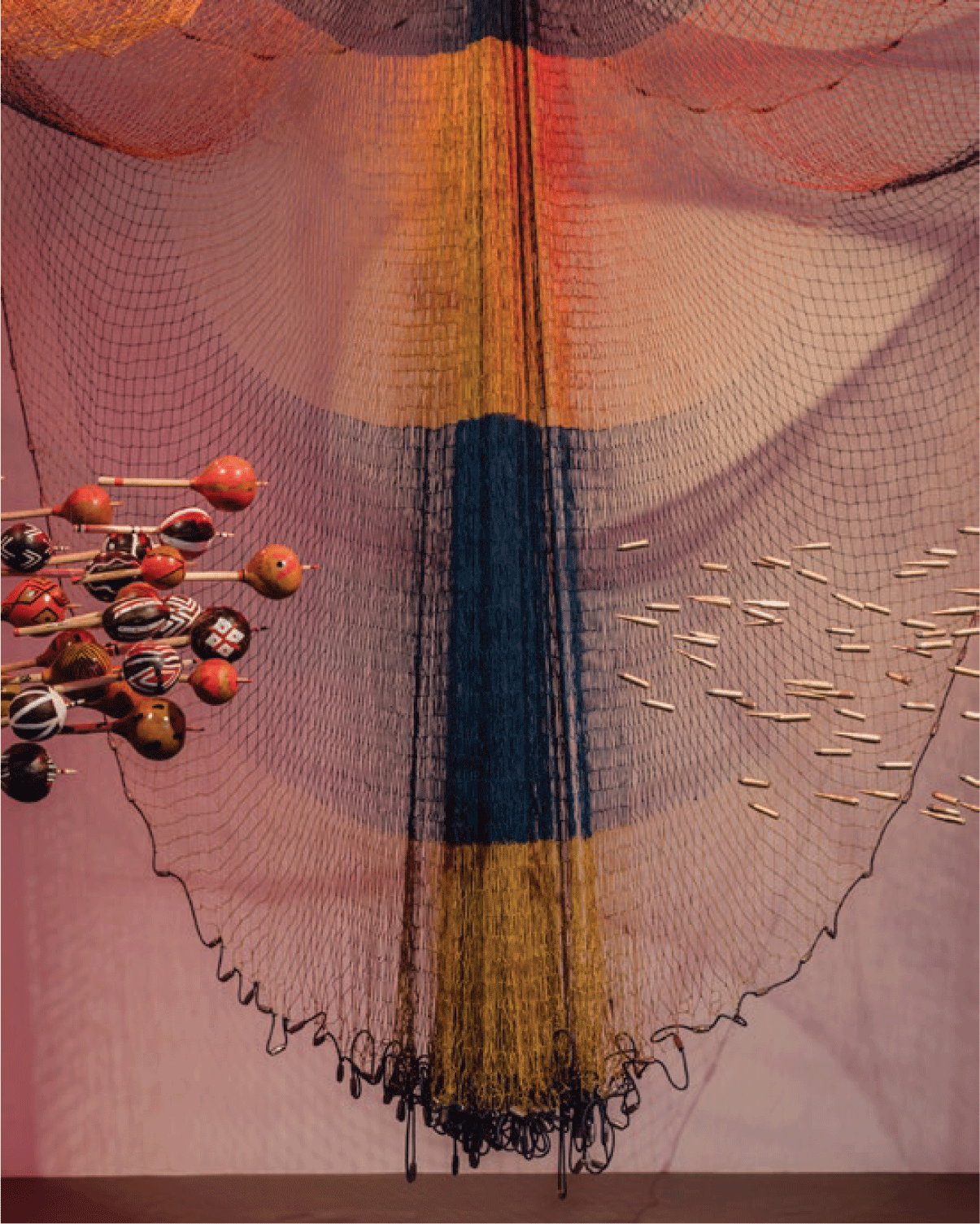
The large contradictions between the politics of decolonialization that the central exhibition espouses, and the apparatus of national pavilions dedicated to showcasing the aesthetic achievements of each nation-state, necessarily pose steep challenges for the guest curatorial and selection teams. For example, Brazil’s pavilion features the work of Indigenous artists and curators from Bahia and the interior who do not use the term Brazil (or Brasil). Hence, the façade of the pavilion bears the name Hãhãwpuá Pavilion, which means Ancestral Great Land Pavilion in the Patxohã language. Featuring the work of Glicéria Tupinambá, Olinda Tupinambá, and Ziel Karapotó, and the Tupinambá Community of the Serra do Padeiro and Olivença villages in Bahia, the exhibition displays Karapotó’s Cardume (School of Fish, 2023), composed of fishing net, gourd maracas, and replicas of fired cartridges (fig. 3). Glicéria Tupinambá views her work as activism designed to highlight Indigenous knowledge; her video installation, Dobra do tempo infinito (Fold of Infinite Time), documents how the Tupinambá community sees seeds and nets as a reflection on how the past and the present flow into each other. She also documents how the Tupinambá have been engaged in restoring art taken from them and displayed in European art museums without the consent of the Tupinambá. Olinda Tupinambá’s video installation Equilíbrio (Balance), which is perched atop a mound of dirt, examines the effects of climate change, especially fire, on Caramuru Indigenous land. The cumulative effect of this strong exhibition raises agonizing questions about the staying power of Pedrosa’s interventions. Will the Hãhãwpuá name be erased from the Pavilion in 2026? Will invitations to Indigenous artists and curators be renewed? Or will this important amplification of Indigenous ways of knowing be erased by the desire for the new in 2026?
Ziel Karapotó. Cardume (2023), part of Ka’a Pûera: we are walking birds. Fishing net, gourd maracas, replicas of fired cartridges. Pavilion of Brazil. 60th International Art Exhibition – La Biennale di Venezia. (Photo by Matteo de Mayda; courtesy of La Biennale di Venezia)

The Danish Pavilion features an Indigenous artist from Greenland for the first time in the biennale’s history: Inuuteq Storch, a photographer whose images capture both contemporary Indigenous life and reference the history of photography in Greenland. Jeffrey Gibson (Chocatow-Cherokee) is the first Indigenous artist to have a solo exhibition in the United States’ pavilion. Additionally, Kathleen Ash-Milby, a member of the Navaho Nation, is the first Native American to serve on a curatorial team at the Venice Biennale. These interventions in the usual assumptions about who should represent a nation are important, but the ideological, architectural, and historical power of the national pavilions are, I fear, likely to erase the remarkable work done in the 2024 exhibition. Indeed, my time at the “art Olympics” overlapped with the preparatory events for the sporting events in Paris and exposed the implicit competition that marked the press coverage of the Venice Biennale: almost every major art magazine in English published a “top ten” or “top five” list of national pavilions not to be missed between April and November 2024 (see Greenberger Reference Greenberger2024; Johnson and Lesser Reference Johnson and Lesser2024; Mazzoli Reference Mazzoli2024; Watlington Reference Watlington2024).Footnote 6
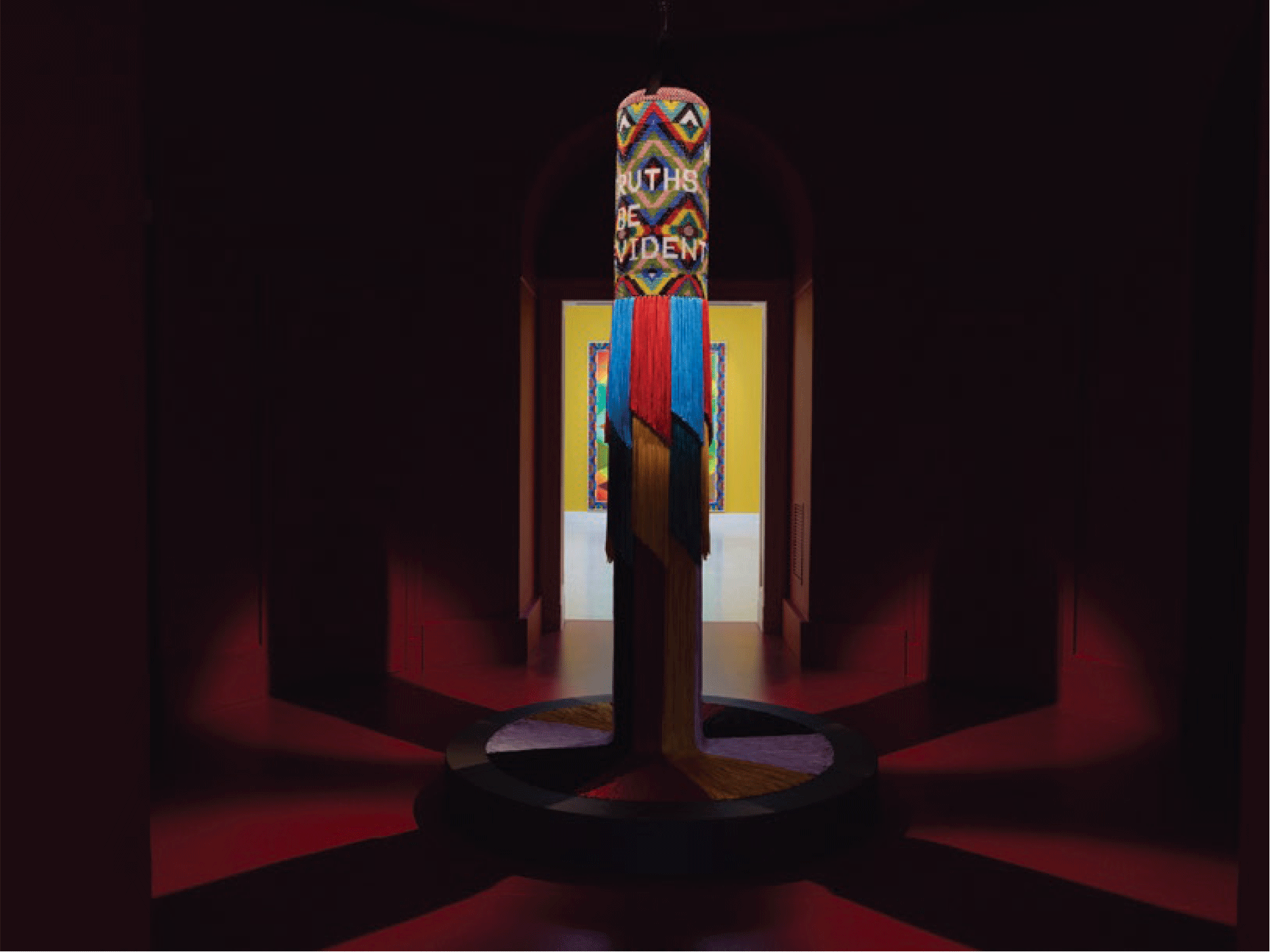
Gibson’s exhibition, the space in which to place me, has received a mixed critical response. Some commentators dismiss the show as Native American kitsch, or to use Jackie Wullschläger’s dismissive phrase, “gaudy bead-encrusted sculptures alluding to Native American traditions and stories” (Wullschläger Reference Wullschläger2024). Others contend it is an important celebration of Native American art that has been too long delayed (Barry Reference Barry2024; Farris Reference Farris2024). I admire the exhibition; the bead work in the sculptures creates a vibrant medium for small chip-like shapes, and intense color (figs. 4 and 5). Gibson, an important heir to Warhol, embraces a refreshing range of neon color and his queer sensibility opens promising avenues for both Warhol studies and Native American art scholarship.
Jeffrey Gibson. the space in which to place me. Pavilion of the United States of America. 60th International Art Exhibition – La Biennale di Venezia. (Photo by Matteo de Mayda; courtesy of La Biennale di Venezia)

Jeffrey Gibson. the space in which to place me. Pavilion of the United States of America. 60th International Art Exhibition – La Biennale di Venezia. (Photo by Matteo de Mayda; courtesy of La Biennale di Venezia)

However, like much work in the Venice Biennale, Gibson’s the space in which to place me suffers from being over-stuffed. Drawing on texts from Martin Luther King Jr., James Baldwin, and historical and legislative documents exposing the violent history of colonialism and racism in the United States, Gibson places quotations drawn from these sources in already complicated paintings and sculptures. Caught between the honor and the burden of being the first Native American selected for a solo show in the US Pavilion, Gibson understandably decided to go big. But the decision to include so many texts by others suggests a failure of confidence in the visual and political force of his art, which these texts unwittingly undermine. I found much of the citational energy distracting, even misplaced. In making this assessment, I realize I may be enacting the very thing that the exhibition calls out in its title: the space in which to place me. But my aim is not to confine Gibson’s work; rather my argument is that Gibson’s work does not need the authority of Baldwin or MLK to make its claims. On the contrary, it is the nontextual and performance aspects of Gibson’s work that help it evade the snark of “gaudy” beadwork that Wullschläger decries.
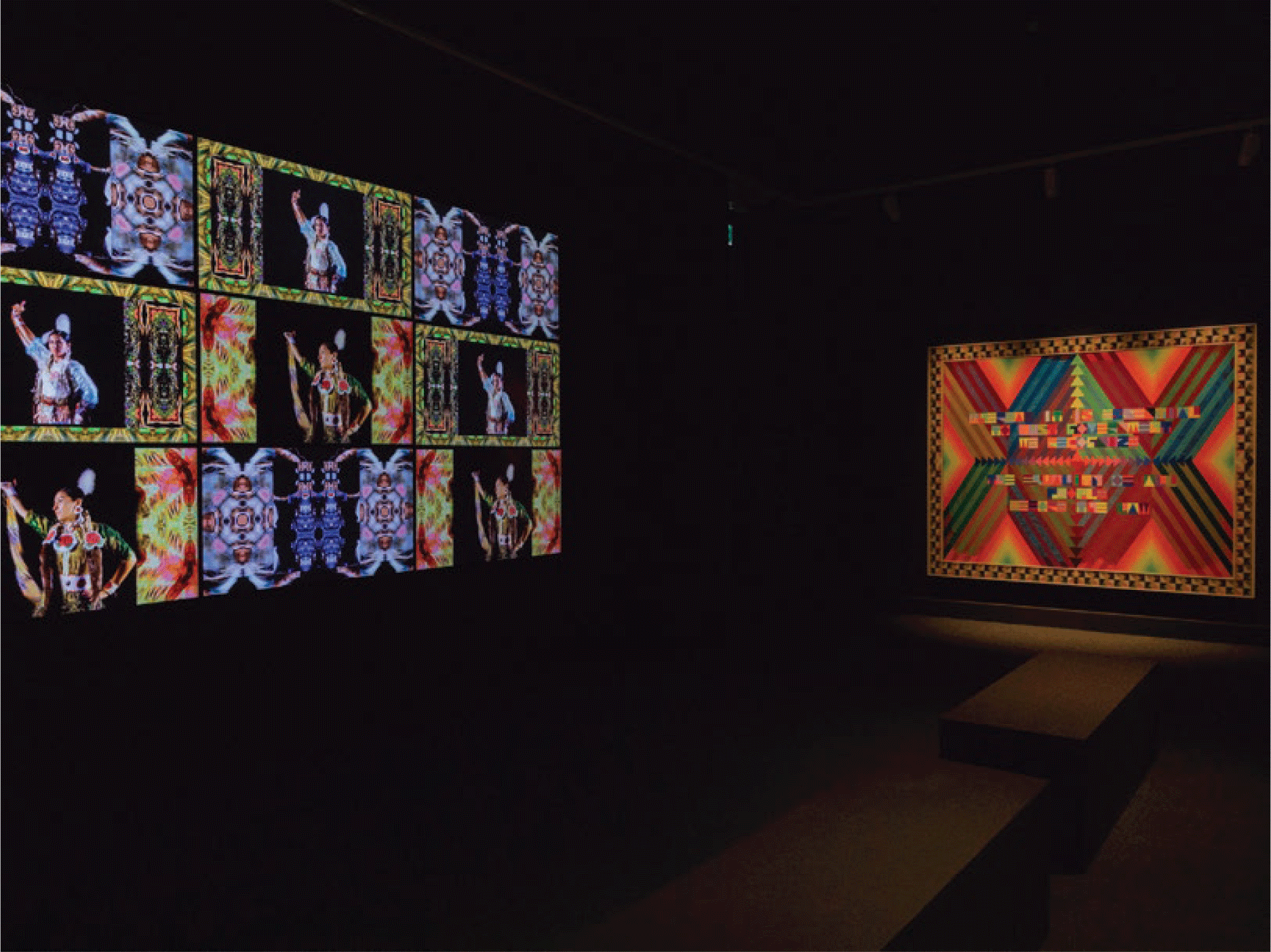
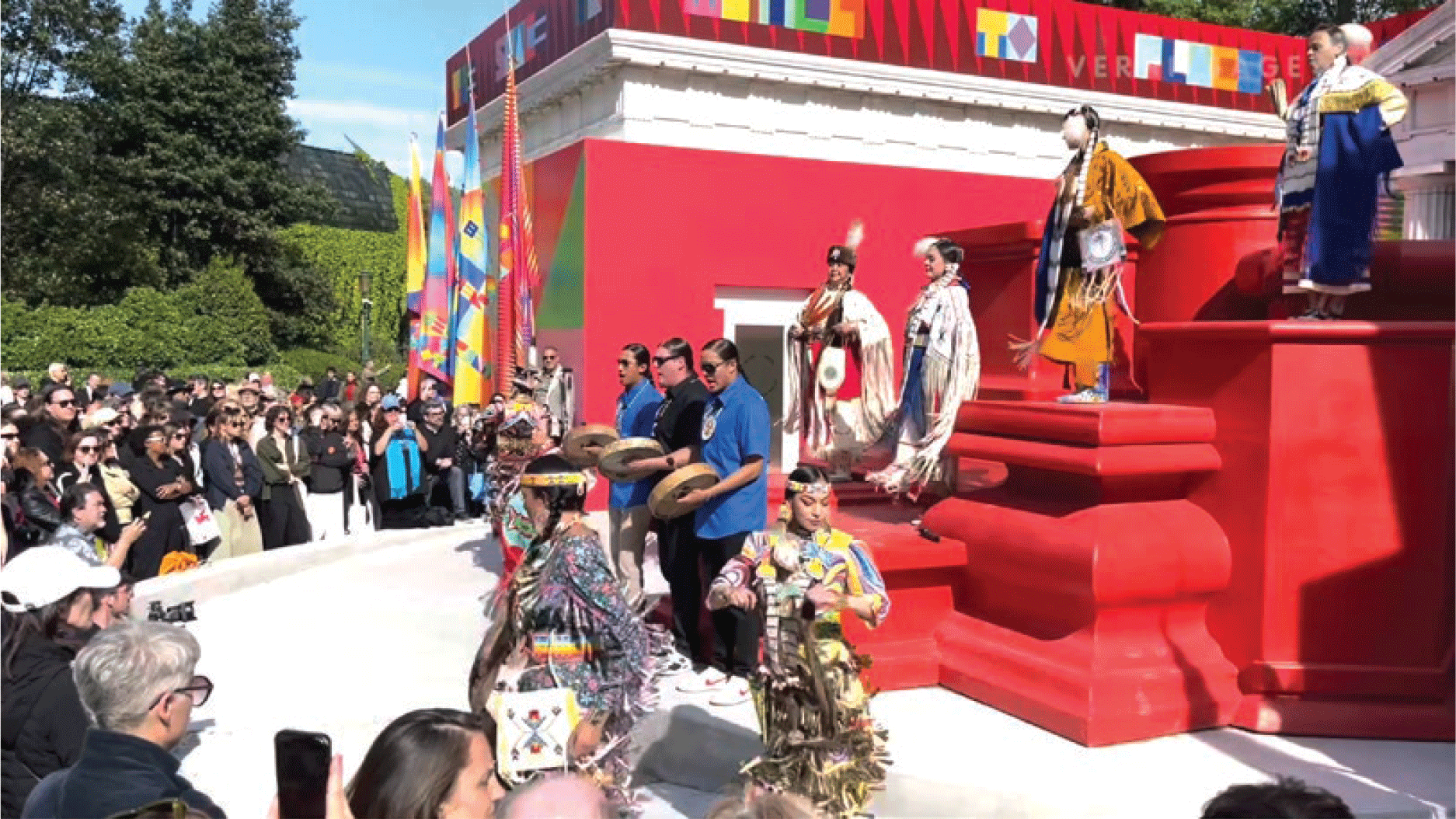
During the Biennale’s opening celebrations, Gibson invited dancers and musicians from the Oklahoma Fancy Dancers and Colorado Inter-Tribal Dancers to perform on 19 April 2024. The musicians and the dancers performed jingle dress dances on a vibrantly painted bright red, multitiered stage in front of the US Pavilion (fig. 6).Footnote 7 After that formal ritual, the bright empty stage with its blood-red vibe served as an appropriately ghostly entryway into the space in which to place me. The ephemeral nature of the performance serves as a metaphor for the lost vitality of Native American culture more broadly. Gibson’s exhibition closed with a spectacular nine-channel video of Sarah Ortegon HighWalking dressed in several different beautiful jingle dress dance costumes, performing the dance to “Sisters,” an upbeat 2013 score by The Halluci Nation, featuring Northern Voice. The video editing and arrangement of the nine screens evoked the speedy bounce of a slot machine, alluding both to the contemporary perception of Native Americans as casino operators and to the Warholian multiple so crucial to contemporary art in the United States.
Jingle Dance Program featuring dancers from the Oklahoma Fancy Dancers and Colorado Inter-Tribal Dancers, 19 April 2024. “Jeffrey Gibson/US Pavilion at Venice Art Biennale 2024/Performance,” Dailymotion. (Screenshot courtesy of TDR; www.dailymotion.com/video/x90zw9e)

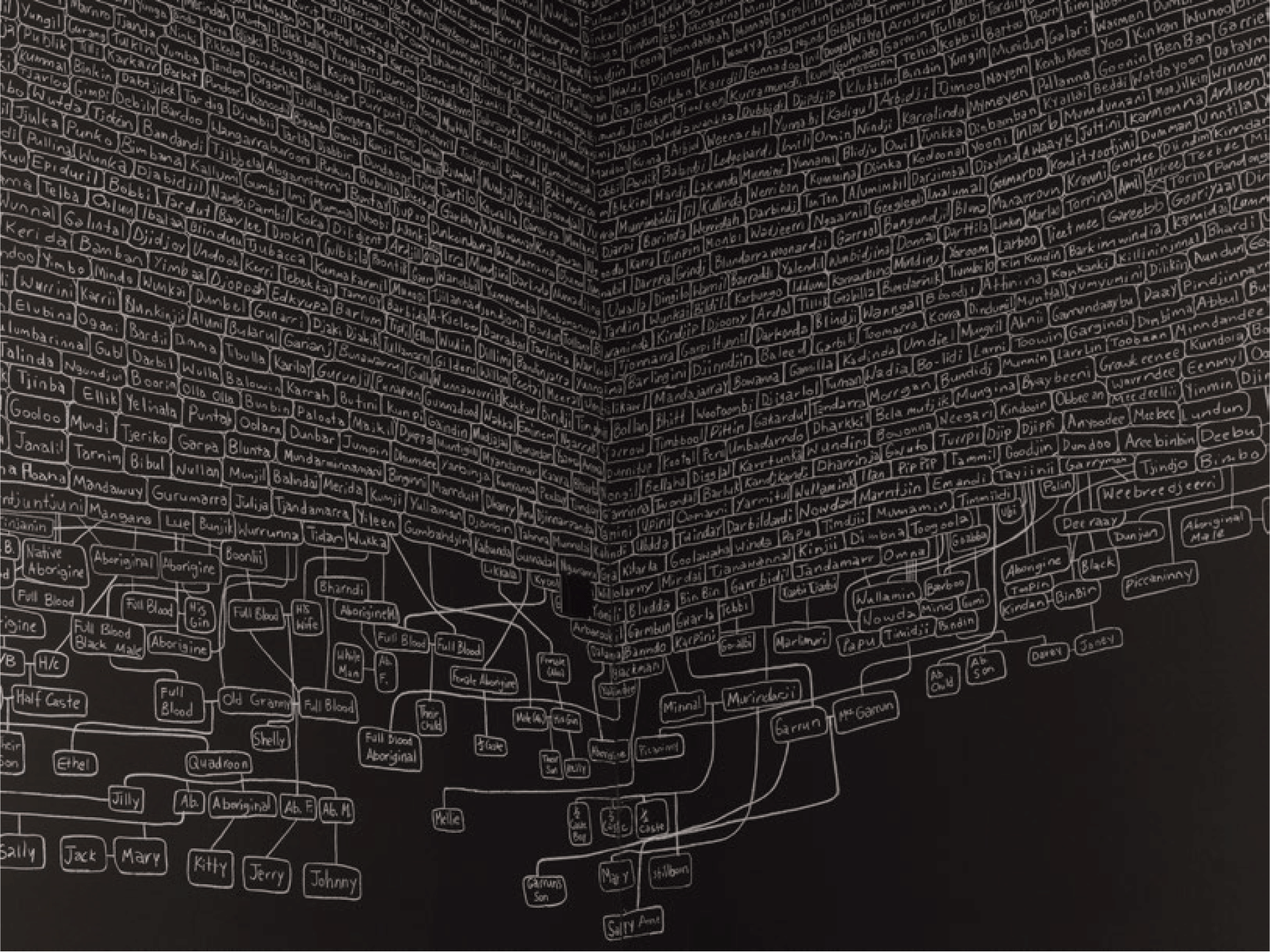
The Aboriginal Australian artist Archie Moore won the Golden Lion for the best exhibition at the biennale. Entitled kith and kin, the exhibition consists of two pieces, whose connection only gradually emerges for the viewer. The first is a chalk-drawn family tree, tracing 65,000 years of his family’s history (fig. 7). Moore is a descendant of Bigambul and Kamilaroi people on his mother’s side and Scottish and British people on his father’s. Moore arrived in Venice some two months before the opening and with the help of two assistants drew the enormous genealogical tree on the walls of the exhibition space, working six days a week for five weeks. Moore had made the chart on his kitchen table at 1:3 scale, which he then digitized and tweaked to fit into the Venice show. The names are hard to read, not only because there are more than 3,400 of them, but also because the chalk drawing extends across all four walls of the exhibition space and crawls onto the ceiling. The chalk drawing includes smudges, blanks, and the occasional first name followed by a question mark; these uncertainties occur on his mother’s side more frequently than his father’s. They mark the history of violence and erasure that define Aboriginal Australian history. Moore’s genealogical line snakes and soars as it intertwines his Aboriginal and British heritage, suggesting connections and ruptures as it moves. On the back wall, below the squares inscribed with the name of his mother, Jennifer Cleven, and his father, Stanley Moore, he writes “me.”
Archie Moore. kith and kin (detail). Pavilion of Australia. 60th International Art Exhibition – La Biennale di Venezia. (Photo by Matteo de Mayda; courtesy of La Biennale di Venezia)

In an interview with Vivienne Chow, Moore emphasizes that kith and kin “highlights how we are all part of one larger family and should be living in peace [globally]” (in Chow Reference Chow2024). However, this optimism is countered by the second object in the exhibition, which casts a darker shadow. In the center of the room, a large plinth-like table, encircled by a narrow moat of water, holds thousands of pages documenting the death in police custody of more than 557 Aboriginal Australians since 1991. Most of the documents are coroners’ reports drawn from the Royal Commission into Aboriginal Deaths in Custody, an investigation established in 1987 and entered into Australia’s National Archive in 1991. Stacked in uneven piles at a remove from the viewer, but with title pages visible, the redacted names of the victims take on the force of a remote ghostly library. A testament to the history of police violence, the piles also resemble a graveyard rife with headstones commemorating redacted names. Moore asks the viewer to draw a line, indeed, to make a connection, between those redacted names and the occluded Aboriginal and British family history written in erasable chalk on the walls. Histories and futures, Moore’s exhibition suggests, are subject to erasure. Moore’s laborious performance of documentation, collection, and inscription testifies to the demanding work of ensuring historical connections amid precarious, uncertain futures.
The Performance of Politics: War and Art
In September 2023, Israel selected Ruth Patir for a solo exhibition in the Israel Pavilion. In February 2024, a letter sent by the Art Not Genocide Alliance (ANGA) signed by about 8,700 artists and art professionals, demanded that the biennale cancel Israel’s invitation. (The biennale had refused to host Russia’s pavilion in 2022 and so there was recent precedent.)Footnote 8 But the biennale confirmed the invitation to Patir. She and her curatorial team installed the show they had proposed, (M)otherland. However, by the time of the opening events in April, they decided not to open it. Instead, they posted a sign saying that the pavilion will open when “a ceasefire and hostage release agreement is reached.”Footnote 9 At various times during my visits to the Giardini in July, I saw Venice police officers guarding the entrance, but more commonly the pavilion was unattended. On 17 April, the ANGA group protested in front of the pavilion and also assembled on the red plinths in front of the US Pavilion. They also distributed flyers in the front of the pavilions of Germany, France, and England. Since Palestine is not recognized as a nation-state by Italy, it does not have a national pavilion in Venice. However, in ANGA’s manifesto they argue that “Palestine is the World in its Future Tense” and suggest that a national pavilion is not their goal at all.Footnote 10
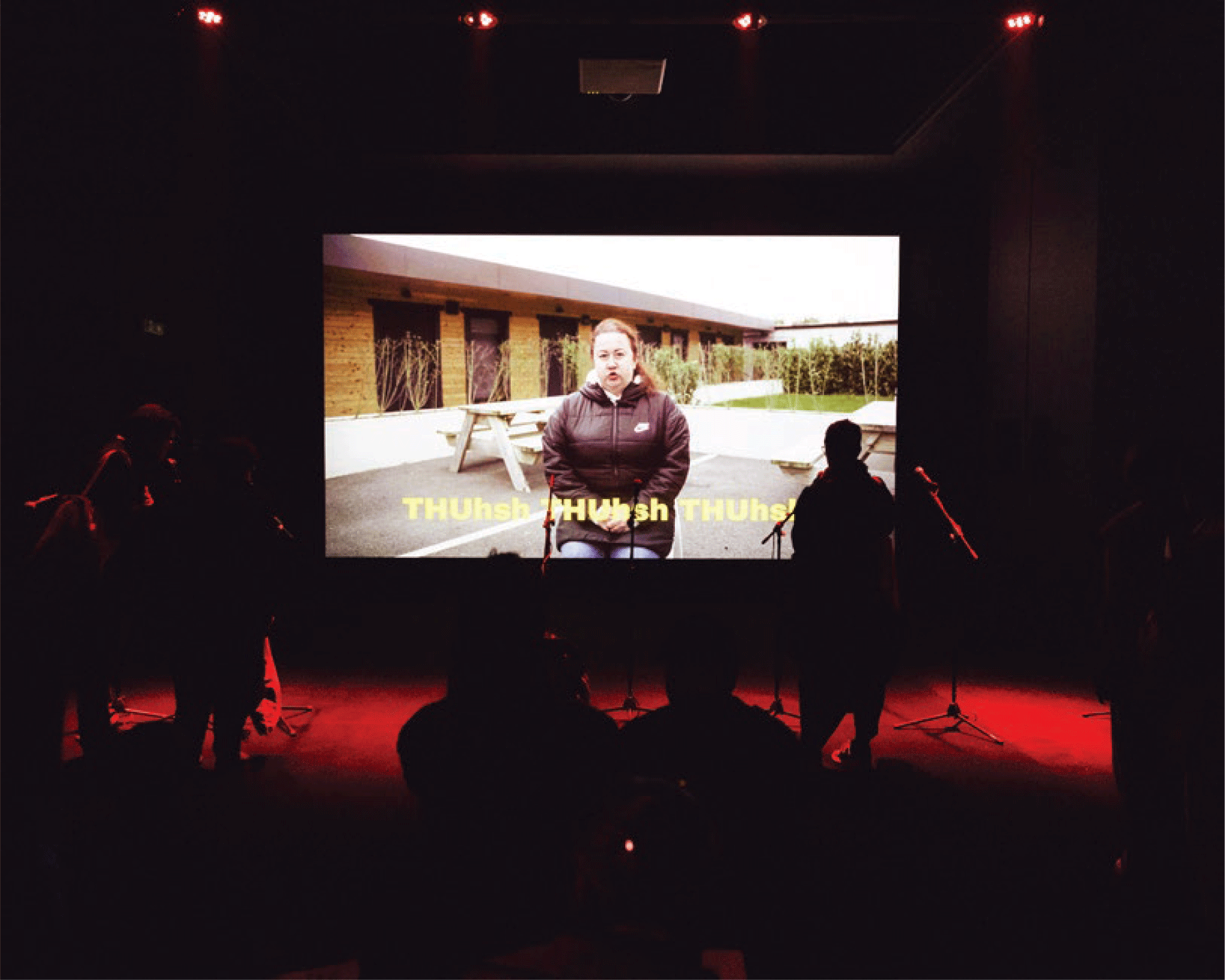
The Poland Pavilion show features the work of the Open Group, three Ukrainian-born Polish residents: Yuriy Biley, Pavlo Kovach, and Anton Varga. Last minute replacements for the “anti-European” painter Ignacy Czwartos (Greenberger Reference Greenberger2023), the Open Group’s work centers Ukraine’s recent civilian refugees as survivors and haunted performers. Their collective exhibition, Repeat after Me II, features two wall-length video screens on opposite sides of the space. In front of each video wall, microphones, arranged in the style of a karaoke bar, await new performers (fig. 8). On one wall, Ukrainians living in a displaced persons camp outside of Lviv in 2022 mimic the sounds of the war machines that drove them from their homes. These sounds—aural ejaculations of spit and sputter that are not words—function as the lyrics, phonetically spelled out on the screen in the manner of a karaoke bar’s screen. On the opposite wall, the same witnesses return in video portraits made in 2024. They are now all living outside of Ukraine, mainly, but not exclusively, in Poland. The civilian refugees, recorded outside in open green fields, appear free; they have the relief of survivors in their smiles. But when asked to repeat the sounds that haunted them in 2022, the heartbreaking accuracy of their perfect repetition makes clear that the witnesses are not at all free. Rather, the sounds of the war machines have become a kind of internal music, a haunting that suggests the long recovery that awaits Ukraine, regardless of the war’s outcome.
The Open Group. Repeat after Me II. Pavilion of Poland, 60th International Art Exhibition – La Biennale di Venezia. (Photo by Matteo de Mayda; courtesy of La Biennale di Venezia)

I went to the exhibition four or five times, but only once did I see any viewers accept the invitation to perform. On this afternoon, a group of schoolchildren, about seven or eight years old, stand at the microphones doing a decent imitation of the sounds on the screen. Watching them perform, with giggling bravado and waving hands, I see that Repeat after Me II offers a new kind of transmission for the civilian refugees’ haunted memories. The children playfully repeat the sounds but divorce them from the weight of the source. The children can convert the aural violence of war machines into song precisely because they understand that they are performing.
In Ukraine’s pavilion, another collective of artists that includes Katya Buchatska, Andrii Dostliev, and Lia Dostlieva created an exhibition with literal and metaphorical net-making, video portraits of “acceptable” refugees, and remarkable contributions from 15 neurodiverse artists who responded to a simple request to offer “Best Wishes.” The net-making has actual fishing nets, but the verb net-making refers to both the camouflage fabrics designed to elude drones in the current war and the metaphorical secret connections that we might call networking in English. The drawings and captions for “Best Wishes” are improvisations from an exercise designed to allay anxiety. By focusing on creating a good wish for someone else, the wisher can prevent spiraling anxiety. Among these wishes are: “I wish everyone to dry their hands with a towel,” written below a drawing of a single, sad, yellow washcloth; “I wish everyone to wash the floor with shower gel,” below a drawing of a wet-looking, slippery bottle of gel; and, “I wish everybody to see the haze,” below a rendering of a raw red blob resembling a distant conflagration or a setting red sun. These creative wishes perform as talismans, offering hope in the face of the war’s attack on hope altogether.
What I liked most in the Ukraine Pavilion was Comfort Work by Andrii Dostliev and Lia Dostlieva. It centers performance itself as both a medium and a burden. The artists hired five European actors to perform the parts of “acceptable refugees,” and asked actual Ukrainian refugees to come to the studio to help direct the actors’ performances. These rehearsals are displayed on a small screen slightly to the side of the video portraits that emerged from the rehearsals. The rehearsal video is hard to follow. But the five actors’ video portraits, shot in close-up with high production values, include the scripts used to formulate the stereotypical “acceptable” refugee and appear in English. The video portraits anchor the exhibition. These well-produced, carefully rehearsed performances of Ukrainian refugees suggest that Biennale viewers prefer to look at these performed portraits rather than the rawer, unedited footage of the actual survivors. The Ukrainian survivors advise actors on performances that may be more appealing than they themselves are. By framing the exhibition around these performances, the artists expose our own “comfort” in viewing war and its consequences from the safety of our screens.
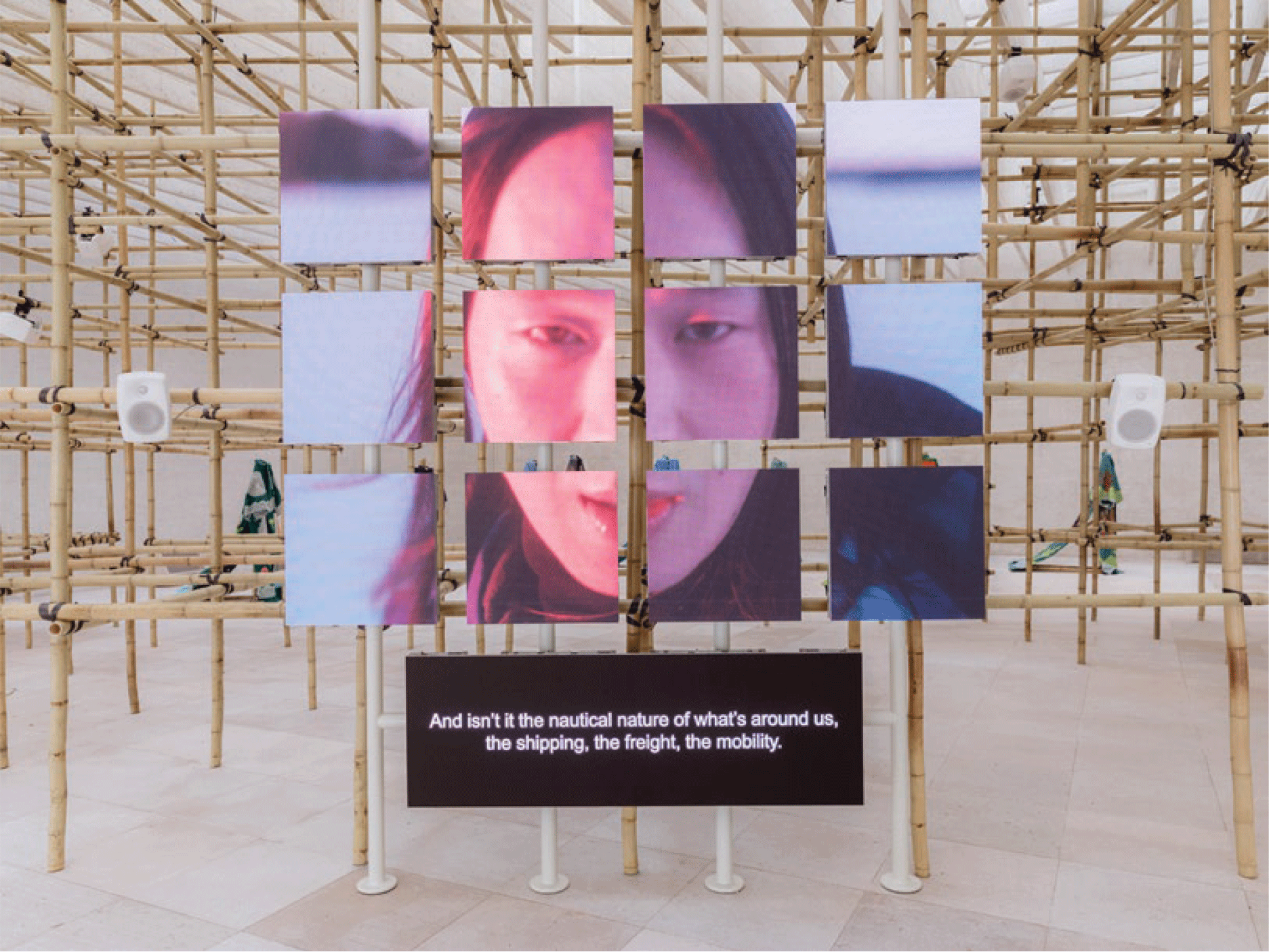
The Nordic Pavilion is created by artists from three nations: Sweden, Finland, and Norway (fig. 9). Their exhibition, The Altersea Opera, an opera conceived and created by the Swedish-born artist Lap-See Lam, features beautiful kimonos made by the Finnish textile artist, Kholod Hawash. The opera, recorded on video and playing on a loop inside the pavilion, recounts a mythological story about Lo Ting, a half-man/half-fish bound up in a quest to return to Fragrant Harbor. The experimental, ethereal score, the work of Norwegian composer Tze Yeung Ho, draws on tropes popularized by 19th-century traveling Cantonese Opera companies, which used bamboo to erect light but sturdy sets. Overall, the Nordic Pavilion resembles what one might expect to see in a Chinese pavilion. This is accentuated by the large scaffolding of bamboo poles that holds the video of the opera and the smaller bamboo frames over which the costumes are hung, undermining the implicit national separatism fostered by the ideology of singular national pavilions.
Lap-See Lam, Kholod Hawash, and Tze Yeung Ho. The Altersea Opera. Pavilion of Nordic Countries (Sweden, Norway, Finland). 60th International Art Exhibition – La Biennale di Venezia. (Photo by Matteo de Mayda; courtesy of La Biennale di Venezia)

An enormous wooden dragon’s head and tail taken from a three-story ship designed as a Chinese restaurant sits directly outside the Nordic Pavilion. The ship traveled from Shanghai on a tour of European port cities, arriving in Guttenberg in 1991. The restaurant ship failed to gain traction and stayed in port in Guttenberg until 2018, when its owner, Johan Wang, brought it to Stockholm for use by an amusement park. While Lam was an art student in Stokholm, she saw the boat and began to imagine it as a setting for her work. Lam’s parents owned a Chinese restaurant (on land) that they had inherited from Lam’s grandmother who moved from Shanghai to Stockholm in the 1970s. Reflecting on her family’s business, Lam noticed: “It was this projected image of Chineseness—and people had to perform that. Still, since I had this very personal relationship to it, I understand it as a real place […] I use these contradictions in my work” (in Voon Reference Voon2023).
Other notable performance-centered national pavilions include Egypt’s and Lebanon’s. The multidisciplinary Egyptian artist Wael Shawky investigates the history of the Arab world, making elaborate performances and films that suggest counternarratives rooted in human emotion that destabilize the official historical record. For the Egyptian Pavilion, Shawky created a 10-part video, Drama 1882, that crosses opera and musical traditions. Focused on Egypt’s Urabi revolution (1879–1882) against imperial rule, Shawky begins the story with a café fight about the labor and care of a mule. That fight eventually erupts into national riots that lead to the bombardment of Alexandria by British forces and the historic Battle of Tel El Kebir, which installed the British as colonizers through 1956.
While some of the witty details captivate and others remain elliptical, the overall performance reminds us to be suspicious about too-neat national histories. Moreover, the scale of the project, which was filmed in an open-air theatre in Alexandria, required more than 400 participants, many of whom were students. Amid the backdrop of the current violence in the Middle East, Drama 1882 inspires robust skepticism about official accounts of historical revolution, which often repress the personal and/or corrupt motivations of those who plot and perform them.
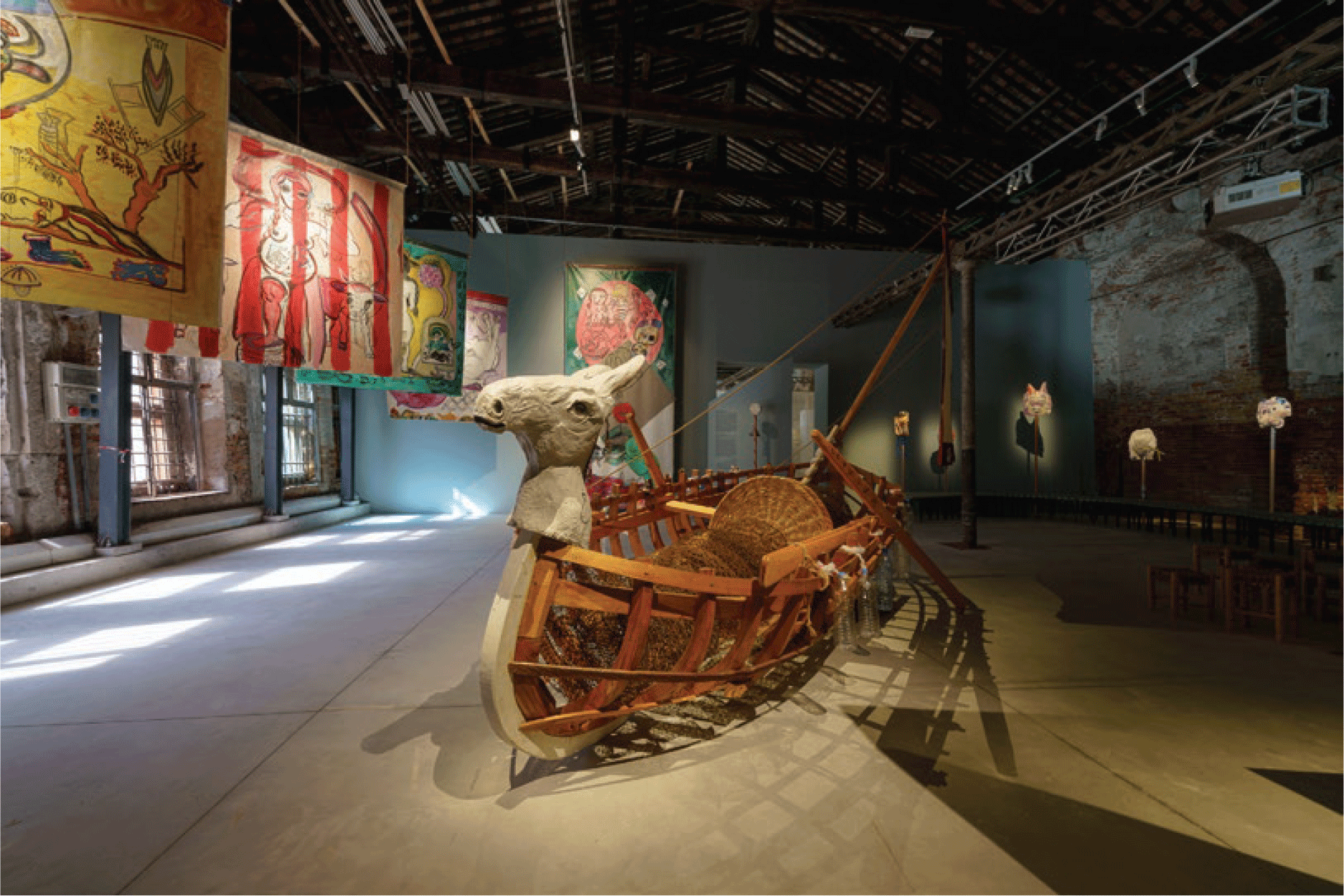
The Lebanon Pavilion, one of several that include a broken boat, features the exuberant feminism of the painter and video artist Mounira Al Solh (fig. 10). Her multimedia installation, A Dance with Her Myth, combines painting, drawing, sculpture, embroidery, and video to retell the myth of Europa. That myth, taken up by painters such as Titian and Veronese, posits that Zeus, disguised as a white bull, abducts the Phoenician princess Europa. Rather than assuming the young princess is passive, Al Solh gives her enormous agency. She is strong, sexy, and very funny. (“I looked for a bull, but I only found a goat.”) While much of the retelling resembles the 1970s Western feminist revisions of patriarchal history, Al Solh’s comedic joy in the retelling is irresistible. The video flickers on a white sheet hovering above the broken boat, in the manner of a sail. Al Sohl’s 12-minute video animates the drawings and paintings that cover the circumference of the pavilion, underlining how the repetition of myth animates the present far beyond the original circumstances the myth sought to explain. While much of the video mocks and puns on the myth of Europa, the energy spent deconstructing it across drawings, paintings, and videos made by a Lebanese woman artist for a show in Venice in 2024 reminds us of the power of these myths on the current global stage.
Mounira Al Solh. A Dance with her Myth. Pavilion of Lebanon. 60th International Art Exhibition – La Biennale di Venezia. (Photo by Andrea Avezzù; courtesy of La Biennale di Venezia)

Queer Art
Pedrosa, the first openly gay curator of the Venice Biennale, links the forced travel of refugees and migrants to the queer artist “who has moved within different sexualities and genders, often being persecuted or outlawed” (in Thomas Reference Thomas2024). Overall, the exhibition in the Arsenale does a lot to amplify the work of queer and trans artists globally, but it is difficult to make a direct, causal alignment between political refugees and queer artists.Footnote 11 And the exhibition does not allay the ever more frequent erasure of lesbians and lesbian art even as it embraces queer and trans art. Yet, some of the strongest work in the show was made by queer artists. I especially liked Puppies Puppies’Footnote 12 Electric Dress (Atsuko Tanaka) (2023) because in addition to paying tribute to the Japanese feminist artist’s revolutionary Electric Dress from 1956, the sculpture also honors those killed in 2016 at the Orlando, Florida, gay club, Pulse (figs. 11 and 12). A black mannequin wearing a tutu adorned with LED lights that change colors as they spell out PULSE in the rainbow hues of the Pride flag almost counters the fire that flew from the gun of that mass shooter.
Puppies Puppies (Jade Guanaro Kuriki-Olivo). Electric Dress (Atsuko Tanaka). LED-dress made from textile and plastic, draped on mannequin, 12 lithium-ion batteries in cases in textile pockets, Madrix programmed micro SD-card, 81 × 66 × 63 cm, Hartwig Art Foundation. 60th International Art Exhibition – La Biennale di Venezia, Stranieri Ovunque – Foreigners Everywhere. (Photo by Andrea Avezzù; courtesy of La Biennale di Venezia)

Puppies Puppies (Jade Guanaro Kuriki-Olivo). Electric Dress (Atsuko Tanaka) (detail). LED-dress made from textile and plastic, draped on mannequin, 12 lithium-ion batteries in cases in textile pockets, Madrix programmed micro SD-card, 81 × 66 × 63 cm, Hartwig Art Foundation. 60th International Art Exhibition – La Biennale di Venezia, Stranieri Ovunque – Foreigners Everywhere. (Photo by Andrea Avezzù; courtesy of La Biennale di Venezia)

On a lighter note, I found Evelyn Taocheng Wang’s dialog with the minimalist painter Agnes Martin extremely funny and very sharp. Wang, who was born in China, educated in Germany, and now lives in Rotterdam, calls her exhibition Do Not Agree with Agnes Martin All the Time. Wang adds floral figures to Martin’s famous Zen-like grids and translates some of Martin’s gnomic titles into Chinese characters that she adds to the surface of her paintings. These responses in their arch wittiness both respect and dispel the often somber tone of Martin’s canvases. I have no idea what Wang’s sexuality is but her add-on figural art, like Martin’s pink pastels, helps to queer minimalism in a joyful way.
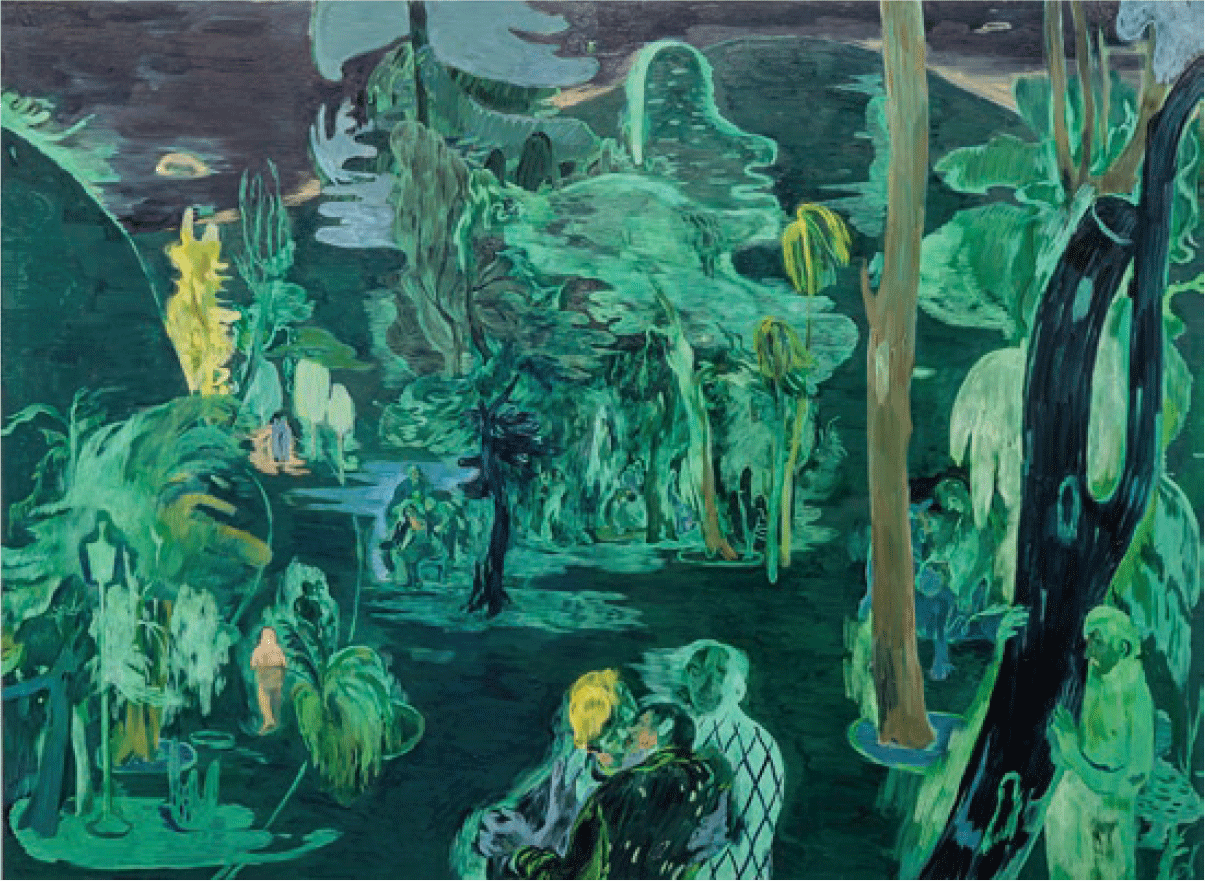
Another queer artist, Salman Toor, makes large dream-like canvases evoking both sexual fantasies and specific realities of family, ritual, and social life (fig. 13). The Pakastani artist’s paintings remind me, increasingly, of Nicole Eisenman’s best paintings. For both of them, painting ensembles of queer communities gathering and socializing expands notions of what and who counts as queer. But more than simply adding to a stockpile of queer imagery, Toor navigates the blurring of fantasy and reality in a manner that makes critical distinctions between realism and the baroque seem ill-fitting. While logically this blurring implies a similar skepticism about sexual and other identity borders, so far Toor’s paintings often depict brown and black men engaged in specifically gay male sex acts, reminding us of the racism involved, and sometimes fetishized, in both queer and straight communities.
Salman Toor. Night Grove. Oil on panel, 195.6 × 267 cm. 60th International Art Exhibition – La Biennale di Venezia, Stranieri Ovunque – Foreigners Everywhere. (Photo by Andrea Avezzù; courtesy of La Biennale di Venezia)

Labels such as “queer artist,” and “outsider artist,” are capaciously vague descriptors, but the stunning achievement of Madge Gill’s 1936 10-feet-long ink on calico tapestry, Crucifixion of the Soul, makes these terms especially useless (figs. 14 and 15). Across the expanse of the tapestry, a repeating figure of a woman’s face dances. I do not know if it is a self-portrait, a narrative of a Pilgrim’s Progress presaging World War II, or a spiritual novena responding to sacred scripts that eludes me altogether. While Gill was routinely described as an outsider artist during her lifetime (1882–1961), her achievement remains almost impossible to categorize. She did not exhibit her work until she was 50 and she did not sell any of it during her lifetime, claiming that it all belonged to her spirit guide, Myrninerest. Thus, mysteries upon mysteries surround the work. But I do know that standing in front of Crucifixion of the Soul is dizzying and enthralling, an experience of immersive strangeness. Stranieri Ovunque indeed.
Madge Gill. Crucifixion of the Soul (detail), 1936, colored inks on calico, 147.3 × 1061.7 cm, London Borough of Newham, Heritage and Archives. 60th International Art Exhibition – La Biennale di Venezia, Stranieri Ovunque – Foreigners Everywhere. (Photo by Matteo de Mayda; courtesy of La Biennale di Venezia)

Madge Gill. Crucifixion of the Soul, 1936, colored inks on calico, 147.3 × 1061.7 cm, London Borough of Newham, Heritage and Archives. 60th International Art Exhibition – La Biennale di Venezia, Stranieri Ovunque – Foreigners Everywhere. (Photo by Matteo de Mayda; courtesy of La Biennale di Venezia)

Direct Performance
Issues of performance pervade the 2024 Venice Biennale and actual performances are part of the program. The Swiss Italian dancer and choreographer Cristina Caprioli, the recipient of the Golden Lion for Lifetime Achievement in Dance, created a short outdoor piece, The Bench, that advanced the political dimension of the 2024 biennale in a rich way. Developed for the 16 dancers enrolled in the Biennale College, a three-month study program that coincides with the biennale’s focus on dance from 18 July to 3 August, The Bench was performed multiple times during the exhibition. Curated by Sir Wayne McGregor under the title We Humans, the dance program examined AI as a tool for choreography, issues of durational performance, and two works created by the African American artist Trajal Harrell, the winner of the Silver Lion for advancing the possibilities of dance.
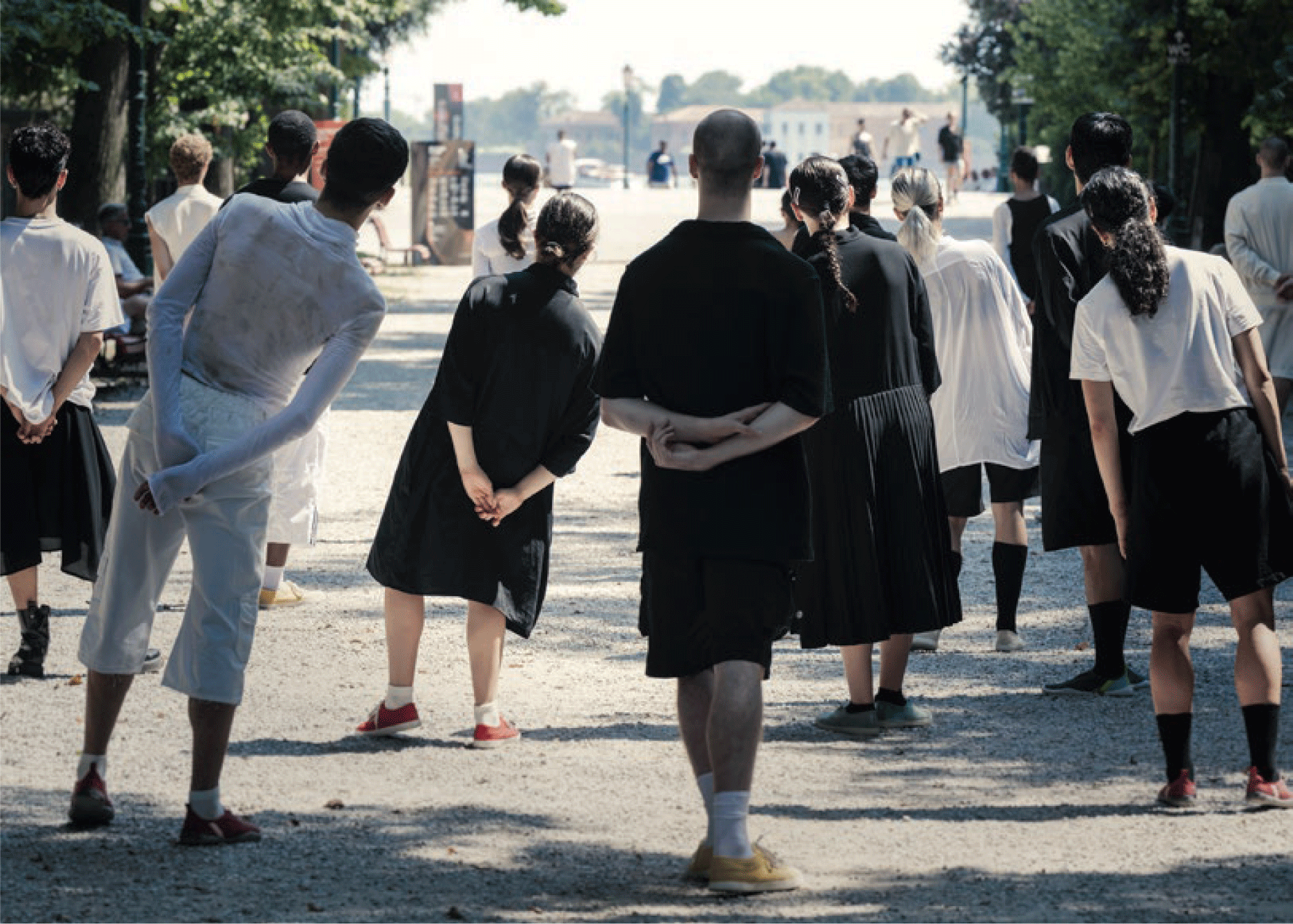
In Caprioli’s The Bench, staged in the Via Garibaldi, the central pathway of a park adjacent to the Arsenale, the dancers, dressed in black and white, begin by assembling in roughly the center of the pathway and stand largely still for the opening minutes (fig. 16). Then the dancers begin to turn and tilt, leaning in different directions while remaining a coherently recognizable group. The turns, made at the same moment, produce varied postures, allowing the dancers opportunities to “strike a pose” (à la voguing). After a few minutes, one of the dancers walks north, extending the geometry of the group. Shortly after, another dancer moves south, transforming the initial loose circle of the dancers’ ensemble into an oblong rectangle. The dancers’ movements allude to various performance traditions, encompassing gestural details from the runway strut of contemporary fashion, to the exuberance of late 19th- and early 20th-century promenades, and even to 15th- and 16th-century royal progresses, in which a large retinue of the powerful strode around in gardens and the countryside. Some more dramatic movements reference the queer runways of Harlem balls documented in Jennie Livingston’s Paris Is Burning (1990), and made popular for mainstream audiences by Madonna’s Vogue (1990) and updated in Ru Paul’s television hit Drag Show (2009–).
The Bench by Cristina Caprioli/ccap. Biennale Danza 2024 in Venice. (Photo by Thomas Zamolo)

As Caprioli’s choreography continues, several dancers move to the benches that line the pathway, most of which are already populated by spectators (fig. 17). As the dancers silently attempt to wedge themselves into vacant but tight spaces, they encounter a range of responses from viewers. Some stand up and abandon the bench to the dancers. One man refuses to move at all, but most viewers make room by leaning a bit while remaining seated, in much the same way the dancers leaned while standing in the opening minutes of The Bench. Thus, the initial assembly of dancers expands to include viewers in a participatory chorus and the performance blurs the distinction between viewers and dancers, observers and movers. Additionally, various passersby, unaware that they are traversing a performance space, amble down the pathway. As they do, they appear as both everyday walkers and as movement-performers in the manner of the Judson Dance Theater of the 1960s and ’70s. In Steve Paxton’s Satisfyin’ Lover (1967) for example,Footnote 13 he demonstrated how everyday walking is enormously expressive of character. In Caprioli’s The Bench, these casual strollers, rendered Duchampian readymades within the framework of the dance, remain unaware of their resonant performances.
The Bench by Cristina Caprioli/ccap. Biennale Danza 2024 in Venice. (Photo by Thomas Zamolo)

The benches themselves also took on a range of associations, from England’s backbenches to the line of seats for athletes waiting to get into the game. These associations made me newly sensitive to the silence of Caprioli’s dancers; the aim of the Parliament backbenchers is to call out and debate, while athletes on the bench will yell encouragement to their teammates. The sound score for The Bench is not the work McGregor had in mind when he named the dance festival We Humans. Rather, hundreds of cicadas raise a din that varies in intensity and length. At moments, the cicadas’ song is low, a soft humming, while other moments it is a deafening screech. Unable to follow the pattern or logic governing the modulation, I turn my attention back to the dancers. I notice that while the dancers crowd the viewers sitting on the benches, not one of those who came to see the performance enter the space of the dance. In other words, the dancers skillfully enter the viewer’s space, but viewers do not approach the performers, exposing the limit of the promising expansion in the opening minutes of The Bench. Both the viewers and the dancers seem willing to allow wedging and tilting, but viewers may not be quite ready to become cocreators and equal partners in the dance’s unfolding.
Caprioli’s The Bench invites both viewers and dancers to observe what joining a collective assembly such as a democracy requires. We are strangers; we are caught unawares; someone else places us in a script we cannot follow; we find ourselves flat-footed, unknowing participants in a stage set controlled by others. But in the fleeting instances in which viewers and dancers tilt, wedge, and lean, a glimpse of new ways of assembling came into view. It is awkward and uncomfortable but necessary, even urgent, as we witness political and ecological disasters that make the future ever more foreign.