Edwin Forrest, then a not-yet-famous actor, spent the summer of 1825 living in the greater New Orleans area among the Choctaw. It has been alleged that he spent these months with his friend Choctaw chief Pushmataha. From this relationship, Forrest learned how to play “Indian,” acquiring knowledge that informed his later interpretation of the title character in John August Stone's 1829 play Metamora; or, The Last of the Wampanoags.Footnote 1 Accounts of Forrest's time with Pushmataha appear in biographies of the actor and critical assessments of his acting. In none of these texts is the fact of their relationship disputed.
In the following pages, I challenge the widely, though sometimes hesitatingly, accepted assertion of Pushmataha's friendship with and influence on Edwin Forrest. Forrest was not a friend of Pushmataha. In fact, it is doubtful that the two men ever met. A review of nineteenth-century documents, including land deeds, treaties, educational records, legislative acts, trading-post accounts, newspaper obituaries, and baptismal records, reveals that the story of Forrest's friendship with Pushmataha was probably a strategic mythmaking invention designed to bolster his reputation. Spotlighting Forrest's false claim creates an opportunity to appreciate how the “Indian” figures in the crafting of American theatre history and how that history is legitimized by the appearance within it of Native Americans.Footnote 2 In this article, I examine this error in the Forrest historiography in order to draw attention to the centrality of the Indian not only in the professional development of the famed tragedian but also in theatrical scholarship.
Forrest and Pushmataha
Pushmataha has been connected to Edwin Forrest in scholarly works of biography, history, and analysis since the late nineteenth century. The reported relationship between the two has been routinely employed throughout the Forrest historiography to support descriptions of his portrayal of Metamora as accurate and authoritative, as well as virtuosic. None of these materials directly challenge the veracity of Forrest's claims regarding the Choctaw man. The only evidence supporting Forrest's claims of friendship with Pushmataha appears in biographies of him. Forrest's biographers trace the friendship to his time working at the American Theatre in New Orleans during 1824–5. According to a twentieth-century Forrest biographer, Richard Moody, during this time he developed several friendships, including with Jim Bowie (of Bowie knife fame) and Pushmataha.Footnote 3 His friendship with Pushmataha is usually a minor note in biographies of Forrest. Most mention it briefly in order to include an anecdote or connect his time in New Orleans to his later success in New York and around the country. Forrest was the original source of these stories about his time among the Indians. Many of his nineteenth-century biographers included phrases such as “Mr. Forrest told the writer” when explaining the provenance of the information.Footnote 4 Scholars then cited these earlier biographies when citing information about Forrest's Indian friendship. However, no corroborating evidence of the friendship is offered from a Choctaw perspective or from anyone who knew both men in New Orleans. None of the published Choctaw histories from the nineteenth century (all of which were written by Euro-Americans) mention Edwin Forrest.Footnote 5 They do, however, speak of Pushmataha. Twentieth- and twenty-first century histories of the Choctaw nation and Pushmataha also lack information on Edwin Forrest.Footnote 6
However, the circumstances surrounding Forrest's time with Pushmataha during the summer of 1825 remain unclear. We know that Forrest worked in New Orleans. We know he left the theatre during the summer of 1825 at the age of nineteen. And we know that he claims to have spent the summer among the Choctaw with his friend Pushmataha. Exactly when and why he was there is unknown. Forrest's biographers have proposed several theories. Montrose Moses tells how Forrest fell in love with Jane Placide, an actress, and issued a challenge to a rival over her. His challenge was ignored, and he left the theatre and the city because of unrequited love.Footnote 7 Richard Moody offers a professional rather than personal reason for Forrest leaving the theatre for a summer with the Choctaw: disagreements with the theatre manager over casting.Footnote 8 Still another biographer, William Alger, names the desire to study “Indian character, life, and manners,” along with the financial advantage of not having to pay anything for food and lodging, as motivation for Forrest to leave New Orleans during the summer of 1825.Footnote 9 For whatever reason or reasons, Forrest left the theatre in New Orleans and spent a summer with a Choctaw friend. Forrest told the story of his friendship with chief Pushmataha “just six years his senior” to many people over the years.Footnote 10 His biographers believe he and his young friend lived together for almost two months.Footnote 11
William Alger's two-volume biography of Forrest, published five years after Forrest's death, provides the most detailed account of this experience. Alger's work was reviewed in 1877 in Appleton's Journal: “It is the most brilliant and imposing literary monument ever erected to the memory of an actor.” The review praises the “painstaking narrative of Forrest's private and professional life.”Footnote 12 Indeed, Alger's research appears to have been thorough. He lists his sources, which include conversation and correspondence with Forrest as well as with friends of Forrest. He also mentions six separate biographies of Forrest, magazine articles, newspaper advertisements and reviews, and the letters and papers of Forrest accessed after his death. Like many of Forrest's biographers, Alger was a fan of his subject. He recalls seeing the actor perform when he, the biographer, was a boy of ten. Because of the care with which Alger prepared his biography and the public acknowledgment of it as a thorough work, its account of Forrest's friendship with Pushmataha ought to illuminate exactly what the nature of that friendship was. But even here, exactly what transpired while Forrest lived among the Choctaws can only be guessed at on the basis of anecdotes and broad claims.
Alger claims Forrest absorbed Indianness by participating in their practices during his time with the Choctaw and was later able to draw upon this latent knowledge in his performance of Metamora. Alger writes that “he [Forrest] adapted himself to their habits, dressed in their costume, and, as far as he could, took part in all their doings, their smokes, their dances, their hunts, their songs.”Footnote 13 The time spent among the Choctaw offered Forrest the opportunity to witness Native American life and to participate in it. He took part in their daily life, acquiring food through hunting, wearing their clothes, attending their social gatherings and possibly ceremonies, and sleeping in their homes. According to Alger, the actor physically embodied the visible characteristics of the Indian. He acted like an Indian, looked like an Indian, and sounded like an Indian. Forrest “played Indian.”Footnote 14 From this, Alger claims, Forrest received “accurate knowledge of the American Indian, alike in his exterior and his interior,” which prepared him for the future role of Metamora, a Wampanoag chief.Footnote 15 Alger, recalling Forrest's performance as Metamora, asserts, “He was completely transformed from what he appeared in other characters, and seemed Indian in every particular, all through and all over, from the crown of his scalp to the sole of his foot.”Footnote 16
Alger's claims about the accuracy and authenticity of Forrest's performance rest upon the problematic assumption that knowledge of the Choctaw equates to knowledge of the Wampanoag. This ignores the fact that Native American identity is tribally and nationally based. The Wampanoag were a confederation of allied tribes living in what is now Massachusetts and Rhode Island.Footnote 17 In contrast, the Choctaw were a confederation of tribes that lived across modern-day Mississippi, Alabama, Louisiana, and Florida.Footnote 18 The Wampanoag speak an Algonquin language. The Choctaw speak a Muskogean one. They have different tribal histories and traditions, origin stories and practices, governing structures and kinship systems. In short, they do not share a generic “Indian” identity: they are two separate nations and peoples. Alger's understanding of Choctaw and Wampanoag as essentially identical reveals not only misconceptions about the uniformity of Native American culture but also the prevalence in American culture of a singular idea(l) of an Indian.
References to Forrest's time spent with the Choctaw and assertions of a relationship with Pushmataha are not limited to nineteenth-century accounts. Jill Lepore's The Name of War, a fascinating history of King Philip's War and how its telling and retelling participated in the creation and recreation of American identity, dedicates a chapter to Stone's play Metamora. She discusses possible influences on Forrest's costuming choices, how appropriating Indianness onstage distinguished him from his rival English actors by creating something distinctly American, and how Metamora’s vanishing Indian story implicitly supported the US government's Indian removal policies.Footnote 19 She briefly addresses the alleged relationship between Forrest and Pushmataha, describing it as “curiously physical and romantic if not sexual.”Footnote 20 She traces the relationship between Forrest and Pushmataha to the “broader attraction the idealized Indian held for Americans” and more specifically to the “unfettered masculinity” imagined to inhere in the naked body of Pushmataha that functioned as a signal of both virility and liberty.Footnote 21 Lepore, like Alger, effaces the specificity of Pushmataha's national identity, letting his Choctawness sink into the indistinct category of Indianness.
More recent scholarship also identifies Pushmataha as a resource who informed Forrest's staging of the character Metamora. Matthew Rebhorn, in a 2006 article, writes that “what needs underscoring is the fact that Forrest did spend a significant amount of time getting to know Push-ma-ta-ha, the young Choctaw chieftain, who was both the specific model” for Forrest's character and the person from whom Forrest “appropriated the basic ‘language’ of the Indian” he would use onstage.Footnote 22 Rebhorn contends that Forrest's time with Pushmataha “did nothing less than impel the young actor to articulate a new grammar of performance” that “transcended the elocution revolution.”Footnote 23 While not possessing Alger's clear personal fondness for and admiration of Forrest, Rebhorn makes a strong case for Forrest's elocutionary powers and innovative performance techniques. And perhaps unsurprisingly he does so by grounding Forrest in a relationship with not just any Indian but with a specific (Choctaw) man, Pushmataha.
Cristina Stanciu, also in a 2006 article, suggests that Forrest used his relationship with Pushmataha as cultural capital to further his professional career but that he did not demonstrate an active investment in or concern for Native Americans. Stanciu is decidedly skeptical about Forrest's relationship with Pushmataha, saying that “several accounts suggest” Metamora was “probably modeled” after Pushmataha.Footnote 24 Though she asserts “there is little evidence about Forrest's research for his role” she assents to the factuality of his presence in New Orleans in the summer of 1825 and his lack of political activism on behalf of Indians during the Removal era. Stanciu is not entirely convinced of Forrest's intimate knowledge of Pushmataha, but neither does she completely dismiss it. Stanciu implies that Forrest used Pushmataha only to further his career and never became a political champion of Native Americans, which suggests his relationship with Pushmataha was not as deep or meaningful as he purported.Footnote 25
In Karl Kippola's 2012 book Acts of Manhood, Pushmataha is very clearly presented as the inspiration for Metamora. According to the author, Forrest's portrayal of Metamora was one of several hypermasculine characters he held in his repertoire. He notes that Forrest did protoethnographic research and “incorporated observations from life into his acting” specifically mentioning his time with Pushmataha in relation to Metamora and time spent in an insane asylum to inform his portrayal of Lear.Footnote 26 Admittedly, Kippola qualifies Forrest's claim to friendship with Pushmataha with the word “reportedly.” Nevertheless, his scholarly skepticism does not prevent him from spotlighting the influence of the Choctaw chief, and therefore from keeping the myth inaugurated by Forrest's claims alive.
Forrest and Fact
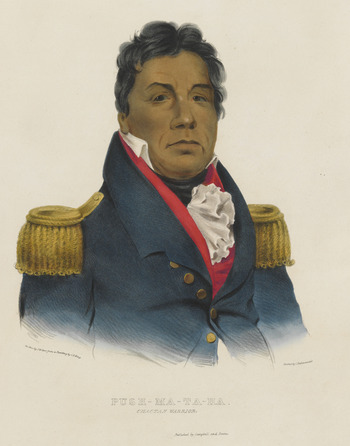
The Choctaw chief Pushmataha could not have been a source for Forrest's interpretation of Metamora onstage. Archival records tell a different story than the one perpetuated by the Forrest historiography. Pushmataha was indeed a well-known chief from the Choctaw nation, which during the early nineteenth century resided largely in modern-day Mississippi.Footnote 27 Born around 1764, he was one of three principal chiefs who presided over the nation's three districts.Footnote 28 He regularly participated in treaty making with the United States as a representative and negotiator for his nation and traveled to Washington, DC in this official capacity. Near the age of 60 in 1824, he was in DC when Charles Bird King painted his portrait (Figure 1). How could an elderly man (by nineteenth-century standards) be accidentally (or intentionally) mistaken for a 24-year-old Choctaw friend of Edwin Forrest? In carefully disentangling fact from fiction in this historical friendship it becomes clear that Forrest's claims to know Pushmataha were fictitious.
An 1837 lithographic copy by John William Gear of a Pushmataha portrait painted in 1824 by Charles Bird King. Image courtesy of the National Portrait Gallery, Smithsonian Institution.

Pushmataha died in Washington, DC on December 24, 1824, more than six months before Edwin Forrest left New Orleans allegedly to spend the summer with him.Footnote 29 His life was recorded in a handful of biographies, including a brief version published in Appleton's Journal in 1870, a short book by Gideon Lincecum first published in 1906 but written decades beforehand, and a 1959 book by Anna Lewis. H. B. Cushman's History of the Choctaw, Chickasaw and Natchez Indians, first published in 1899, also includes some information about the famous chief.Footnote 30 These biographies state that his parents’ identities and exact date of birth were unknown. His biographers claim he told the following story about his birth, though they disagree on exactly when and to whom he first told it: On a sunny day a long time ago, a violent storm, replete with tornado, torrential rain, lightning, thunder, and strong winds, rolled through a plain dotted with trees. Lightning struck one of these trees, a red oak, and completely destroyed it.
Not a vestige remained to mark the spot where once stood that towering tree. Not even a snag of the stump remained. The object of its creation was accomplished. … Equipped and ready for battle, holding in his right hand a ponderous club, standing erect on the place of the demolished red oak, was your dauntless chief, “Apushimataha.”Footnote 31
Pushmataha's early life is less veiled but equally unverifiable. Lincecum recounts his successes as a hunter and warrior in his early years, specifically in travels west of the Mississippi River, that earned him respect and fame among the Choctaw. He took part in a bear hunt, volunteered for a war party, astoundingly escaped death, rescued fellow Choctaw trapped in a cave, and fought valiantly against the Muscogee (Creek). With a résumé such as that, it apparently mattered little who exactly his parents were. His fame and influence grew in the Choctaw nation, and by 1802, around the age of 38, he was a signatory to a treaty among the Choctaw, the Chickasaw, and the United States.Footnote 32 Lewis notes that he signed several more treaties as a leader among the Choctaw, including treaties in 1805, 1816, and the 1820 Treaty of Doak Stand. Because of his death in 1824 his name is noticeably absent from the 1826–8 Choctaw Council meetings that codified national laws and procedures for the Choctaw nation, providing it with its first constitution.Footnote 33 His signature is, of course, also absent on the 1830 Treaty of Dancing Rabbit Creek that began the Choctaw Removal to Indian Territory sometimes called the Trail of Tears.
Pushmataha was widely known and respected by Euro-Americans, who saw him as a “civilized” Indian, by the time of his death in December 1824. The Alexandria Gazette printed his obituary on 4 January 1825, stating that “He was an extraordinary man” who had attained his position of authority and power through “his powers of oratory and military prowess.”Footnote 34 The newspaper attributed his death near midnight on Christmas Eve to the croup (which is labeled in more recent accounts as pneumonia). He received military honors at his funeral because of his service as a brigadier general in the US Army during the War of 1812.Footnote 35 He was noteworthy in American culture precisely because he had fought on behalf of the United States, even against other Native Americans, thus proving his loyalty and his value to the United States. The obituary originally printed in the Washington National Journal describes Pushmataha's funeral in Washington, DC as a combination of a military burial, Christian ceremonies, and a processional of more than two thousand people.Footnote 36 The obituary also notes that General (later President) Andrew Jackson paid his respects to his old acquaintance and fellow military officer, Pushmataha.
Pushmataha was buried in the Washington Parish Burial Ground now known as the Congressional Cemetery in Washington, DC, which has been in existence since 1807 and was designated a National Historic Landmark in 2011.Footnote 37 The internment records of the cemetery list his name as “Push-Ma-Ta-Ha, Chief” and indicate that he was buried on December 25, 1824 at the age of sixty.Footnote 38 Both his death and his age contradict descriptions of Pushmataha in the Forrest mythohistoriography. Alger floridly describes Forrest's twenty-four-year-old friend in 1825 as “in the bloom of opening manhood, erect as a column, graceful and sinewy as a stag … his form one of faultless proportions.”Footnote 39 Even if the chronology of events in Forrest's life was a year or so off, it is clear that Forrest could not have lived with or even known Pushmataha.
New Archival Evidence
It is clear from the historical records that Forrest never knew the actual Pushmataha. More likely, Forrest knew a Native American man, perhaps a Choctaw, during his time in New Orleans. This friend became a canvas on which Forrest painted a picture of a noble, brave, and beautiful Indian chief, and to which he gave the name of a Native American known and admired by Euro-Americans. Forrest turned his friend into an Indian by eliding a real and specific identity and a fictionalized one. This Indian friend became the foundation for theatrical mythmaking about the Indian. It seems very likely that Forrest did intentionally mislead the public about his connection with a specific, legendary figure. His claims to friendship with Jim Bowie during his time in New Orleans raise similar questions about fact and fiction. Forrest claimed Bowie gave him his famous knife “as a token of his love.”Footnote 40 The timing and location of Forrest's work and Bowie's well-known exploits do not bolster this claim. Forrest left New Orleans in August 1825, worked at the Albany Theatre in the fall, appeared in Philadelphia in May 1826, and in November began a yearlong engagement as part of the company at the Bowery Theatre.Footnote 41 By the end of 1827 he was a sought-after actor and worked steadily until 1834, when he took a two-year trip to Europe.Footnote 42 Meanwhile, Bowie's knife did not become famous until after the Sandbar Fight in September 1827, more than a year after Forrest had left New Orleans.Footnote 43 Bowie moved to modern-day Texas in January 1830 and died at the Alamo in 1836. The window in which Forrest might have possibly received the knife, between early 1828 and January 1830, was filled with theatrical engagements usually in New York and the Northeast, including the opening of Metamora in 1829. Forrest could not have had the Bowie knife before he left New Orleans and very likely did not encounter Bowie after he left the city. The suspect provenance of this “token” of Bowie's affection, like Forrest's claim about Pushmataha's identity, throws further doubt, were any needed, upon the friendship.
Alger offers a possible explanation for the misidentification of Forrest's friend. He is the only biographer, historian, or scholar to claim that Forrest's friend Pushmataha was in fact the son of the elder chief, also named Pushmataha, who died in Washington, DC. All others simply record the name of the friend as Pushmataha with no explanation or qualification. Alger claims “Push-ma-ta-ha was a natural orator of a high order. He inherited this gift from his father, for whom he had a superstitious veneration, claiming that the Great Spirit had created him without human intervention.”Footnote 44 Though Alger seems to provide an easy solution to the problem of Forrest's friend's actual identity, the historical record does not support this conclusion.
Pushmataha (the elder) was widely known to have children, though the exact number and gender are disputed. There are no birth or death certificates available in Euro-American or tribal records with which to verify communal knowledge of them. Cushman states that Pushmataha had two wives but does not mention children.Footnote 45 The Appleton's Journal biography mentions five children but does not indicate their sex.Footnote 46 Lewis says he had children but omits number and gender.Footnote 47 The legal record of Choctaw treaties and contracts provides little help in determining whether Pushmataha had a son. The 1830 Treaty of Dancing Rabbit Creek, which ceded the remainder of Choctaw land east of the Mississippi to the United States and began the removal of the Choctaw to Indian Territory in what is now Oklahoma, mentions land reserved in Mississippi for “the widows of Pushmitaha, and Pukshenubbee … and for their children.”Footnote 48 However, it is unclear from the wording whether each of the men listed had one or more wives and how many children they had. The written record provides few direct facts about Pushmataha's offspring.
There is one legal document that suggests there was at least one son, and many amateur genealogists believe there could have been two. One theory is he had a son, James Madison, who was born around 1805 and died in approximately 1826 at the age of 21.Footnote 49 Those amateur sleuths who support this claim say Alabama state papers from 1818 provide proof of the existence of this son. However, records from the Alabama Legislature from the First Territorial Session in early 1818 and the Second Territorial Session in November 1818 do not include mention of James Madison, Pushmataha, or any Choctaw for that matter.Footnote 50 Acts passed by the Fifteenth US Congress do not include any mention of a Choctaw James Madison during 1818 either.Footnote 51 Additionally Mississippi legislature records from its first session, spanning 1817–18, do not mention a James Madison.Footnote 52 No legislative records affirm a James Madison to have been Pushmataha's son. The 1830 Treaty of Dancing Rabbit Creek does specifically mention a James Madison and describes him as the son of Mushulatubbee, another principle Choctaw chief.Footnote 53 If Forrest knew this James Madison and told others he was Pushmataha, he would have been using the incorrect name, incorrect age, and possibly the incorrect parentage for his close friend.
A decidedly better evidenced theory is that Pushmataha had only one son, or at least only one son who survived him. Both Cushman's history of the Choctaw and Lewis's biography of Pushmataha identify Johnson Pushmataha as the chief's only son. Cushman states that Johnson Pushmataha was an attorney in Indian Territory after moving west with his people.Footnote 54 Lewis says he moved west to modern-day Oklahoma in 1832. Documented evidence of a Johnson Pushmataha exists in the records of the Choctaw Nation as well as in US records. A land deed from Holmes County Mississippi dated 13 January 1834 records the sale of land by the widow of Pushmataha and her three children to a man named Charles Land.Footnote 55 In the deed Pushmataha's widow is referred to by three different names: Jamesachikako, Imaghoka, and Lunnabaka.Footnote 56 It also lists “Hachalahurtibbi, the only surviving son … and the only heir at law of Pushmataha” as one of her three children (the daughters are listed as Martha and Betsie).Footnote 57 This land sale was possible because of the land reserved in Mississippi specifically for Pushmataha's widow and children. Hachalahurtibbi did not sign the document. Instead, a guardian, Rene Logan, signed on his behalf. It is conceivable that a legal guardian was required because Hachalahurtibbi may have been a child at the time.
Further evidence from the Choctaw Nation supports the surviving son's young age in 1834. In 1840 an “Indian youth” named J. Pushmataha was enrolled in the Choctaw Academy in Scott County, Kentucky.Footnote 58 Because the boy's parents are not listed we cannot be certain there was not more than one person with that name, but the likelihood of it being the Johnson Pushmataha mentioned by Lewis and Cushman is quite high. The majority of Choctaw did not use surnames during and in the immediate aftermath of Removal, and those with surnames were almost always the result of intermarriage with Euro-American settlers. Thus names like Smallwood, LeFlore, and Pitchlynn abound whereas Choctaw-language surnames do not.Footnote 59 A boy underage with a guardian in 1834 could very easily be old enough to attend a boarding school six years later. However, a man of 24 in 1825 would be highly unlikely to attend a school or be characterized as a “youth” at the age of 39. Moreover, if he was underage in 1834 and at school in 1840, he most certainly could not have been Forrest's friend referenced in biographies.
In any case, additional evidence supports both Cushman's and Lewis's claims that Johnson Pushmataha lived in Indian Territory, and would not have been in the vicinity of New Orleans at the same time as Forrest. Records from the Choctaw Nation compiled by the Oklahoma Genealogical Society include documents from the Philadelphia Baptist Church in Blue County, Choctaw Nation during 1848–1907.Footnote 60 From these church records Johnson Pushmataha can be located only nine years after his likely enrollment in the Choctaw Academy. On October 28, 1849 “at a camp meeting held at Ramsey, the following persons were received and baptized … Johnson Pushmataha and his wife, Anna. …”Footnote 61 Johnson Pushmataha most definitely resided in Indian Territory in adulthood. The sale of land in Mississippi, youthful education in Kentucky, and adulthood in Indian Territory evidenced in the textual, historical record places Johnson Pushmataha precisely where Pushmataha's biographers indicate and strongly support the conclusion that he was neither the correct age nor in the right place to be Forrest's Choctaw friend.
There is further evidence regarding the location of chief Pushmataha's home that also challenges Forrest's assertions. Both Cushman and the Appleton Journal biography locate Pushmataha's home circa 1810 as being close to St. Stephens, near the Tombigbee River in modern-day Alabama. This places him in the Six Towns region, one of three Choctaw regions, as seen on an 1826 map of Choctaw districts, and confirms the common assertion of his leadership of the Six Towns district.Footnote 62 Lewis's biography and twenty-first-century scholars agree that he led the Six Towns, or Southern, district.Footnote 63 Records from the Choctaw Trading Post in St. Stephens, Mississippi Territory held by the National Archives verify Pushmataha's presence near the town. Between 1807 and 1822 “Mingo Pooshemattaha” carried debt at the trading post. He is listed regularly in the ledgers as an “account remaining.”Footnote 64 The various spellings of Pushmataha's name in these ledgers and in the various sources consulted for this article are commonplace, given that nearly all documents recorded by Euro-Americans were made by people who had no access to the written form of the Choctaw language. Standardization in spelling and notation of his name did not occur until well after Pushmataha's death.
Because Pushmataha lived in the Six Towns region near modern day St. Stephens, Alabama, Forrest would have had to have traveled approximately two hundred miles to spend the summer with his son—if Forrest actually knew the chief's son.Footnote 65 The cost of transportation on a river-going vessel from St. Stephens to New Orleans was thirty dollars in 1809 (or $560 in 2017 USD).Footnote 66 Forrest made eighteen dollars a week while working in New Orleans.Footnote 67 Forrest supposedly went to his Choctaw friend “when his spirits were low or he felt the fever about to strike.”Footnote 68 Two hundred miles and a substantial financial investment would perhaps be challenging for a sick man to face. Because Pushmataha's home was not close to New Orleans where Forrest lived and purportedly first met Pushmataha it is even more unlikely that Forrest knew anyone in Pushmataha's family.
Neither James Madison nor Johnson Pushmataha is a compelling option for the young Choctaw chief Forrest claimed to know. If Forrest did not know Pushmataha or a Pushmataha “Jr.,” whom did he know? It is uncertain. No available record suggests a better option. However, there is no reason to believe that Forrest did not meet or even get to know Native Americans while living in New Orleans. It seems that he only had to change the name and embellish a few events to establish himself as an authority on Indians.
Mythmaking
Of the four biographies published in the wake of Forrest's death in 1872, three were written by his friends or acquaintances, three mention his time spent with Indians, and two mention Pushmataha by name. Given the personal relationship most of these biographers had with their subject, and given that they report that he regularly told stories of his time with the Indians, it is likely that the authors are repeating accounts told by Forrest himself or popularly circulated stories. The reasons Forrest told stories about himself and his Choctaw friend are likely as numerous as they are opaque to twenty-first-century readers. For example, Alger suggests the Indian stories reveal his fascination with Indians and devotion to a natural masculinity that contrasted with “fashionable men … made up” with fancy clothes and accessories.Footnote 69
Because the brief descriptions of Forrest's time with the Choctaw nearly all appear in anecdotal form, Jacky Bratton's articulation of the role of anecdote in biography can shed light on the mythmaking work of these Indian stories. Bratton argues that anecdote “purports to reveal the truths of the society,” not directly, but through “some ineffable ‘essence’, rather than … proven facts.”Footnote 70 Furthermore, she suggests that anecdotes told by their subject serve as both self-exposing and self-protecting acts. By telling his Indian stories Forrest exposed the time he had uncharacteristically withdrawn from white, American society but also protected that time from questions about his own wildness or irresponsibility by framing it as character research and virtuous participation in “natural” manhood. Forrest used Pushmataha to create a myth about his own essential nature.
Forrest also accumulated prestige by demonstrating his relationship with a famous and well-regarded Choctaw chief rather than a lesser-known, anonymous Indian. Pushmataha was known among the Choctaw for his prowess in war as well as recognized by Euro-Americans for his service in the War of 1812.Footnote 71 In addition to social position and military prowess, Pushmataha also represented a nation categorized by Euro-Americans as “civilized” and therefore accepted and respected by the United States. The Choctaw are one of the Five Civilized Tribes from the Southeast region that were so called because they adopted or adapted aspects of Euro-American culture, business, or government.Footnote 72 They repeatedly created treaties with the United States ceding land, primarily in modern-day Mississippi, for land west of the Mississippi River and eventually were removed to modern-day Oklahoma. They did not fight removal legally or militarily as other nations did. The Choctaw complied with the United States’ desire for land and the separation of Indians from Euro-Americans after providing military resources in support of the country that paternalistically confined and restricted it. The Choctaw were not “rebellious,” and Pushmataha was undoubtedly interpreted as an ally rather than a threat because of that. Forrest's connection with him bestowed on the actor the qualities of a warrior ally and a noble chief. Forrest, the son of a Scottish immigrant, had mixed with a leader of another nation and easily learned its culture and lifestyle. Gaining qualities ascribed to an Indian chief was essential in the construction of Forrest's public persona.
Forrest's claim to Indianness, his connection to fame, and the expertise with which he portrayed Metamora are only a few of the reasons the Indian experience serves to bolster the legend of Forrest as a star actor. Pushmataha also serves to embellish Forrest's reputation for eloquence. Alger describes Pushmataha (the younger) as “a natural orator of a high order” who had inherited the gift from his father, the famous chief Pushmataha; he follows this claim not with an example of Pushmataha's oratory, but with a story of his father's dying words, which were “a fine specimen of his eloquence.”Footnote 73 This anecdote within an anecdote participates in the myth of Pushmataha the elder as a great and eloquent man. These final words and an earlier suggestion of his supernatural origin connect Alger's account to well-known accounts of Pushmataha's death in Washington, DC as well as to the unusual story of his birth. In this myth Forrest's friend possessed an untrained oratorical talent that had been passed down from his father. Through playing Indian this talent was passed on to Forrest. The eloquence of the original Pushmataha in the anecdote works to remind the reader of Forrest's own oratorical strengths, and to emphasize that they came, as it were, naturally. Forrest's vocal volume, power, and range were adored by his fans and disparaged by his critics. One reviewer gushed over his voice, saying that it “surged and roared like the angry sea; as it reached its boiling, seething climax … it was like the fall of Niagara … it was a whirlwind, a tornado, a cataract.”Footnote 74 In contrast a parody of Metamora was called Metaroarer because of Forrest's loud interpretation of the Wampanoag chief.Footnote 75 Drawing attention to Pushmataha's oratorical skills draws parallels between the two untrained men. Both from backgrounds without access to elite forms of art, the two natural orators are alike in possessing speaking skills from the outset rather than acquiring them.
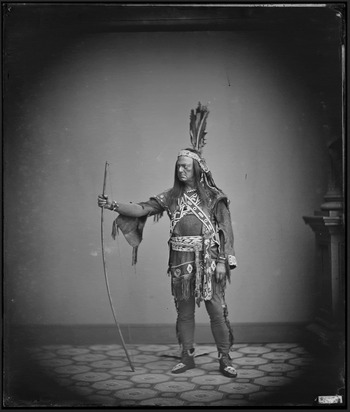
In addition to the oratorical skills of Pushmataha the Indian anecdotes also highlight his physical perfection. Just as, like the Indian, Forrest speaks eloquently and effectively without formal training, his body, like the Indian's, is a paragon of masculinity. Alger describes Pushmataha's appearance in great detail, spending time on his posture, eyes, carriage, musculature, hair, skin, and proportion. “Push-ma-ta-ha was indeed a striking figure and an interesting character.”Footnote 76 When describing Pushmataha in the nude in the firelight, Alger calls him “a living statue of Apollo in glowing bronze.”Footnote 77 In doing this Alger connects this particular Indian with a classical and European idea of manhood as an instantiation of divine perfection. Pushmataha is like Apollo, just a different shade. Since exceptional masculinity can be found in a natural state away from “civilization,” surely it can also be recognized when it appears within civilization as well. Forrest's own perception of himself as an enviable specimen of masculinity is hinted at by one of his biographers. Moody claims that Forrest was drawn to playing an Indian onstage not just because he admired their alleged qualities of “physical vigor and passionate expression” but that the “scanty, tribal regalia would permit a provocative display of his calves and biceps” (Figure 2).Footnote 78
Edwin Forrest in Metamora costume, photo taken by Mathew B. Brady in 1861. Image courtesy of the National Portrait Gallery, Smithsonian Institution.

Above all the assets Forrest gained through the Indian anecdotes none is more problematic than the claim of authenticity/authority by proximity—that Forrest's performance was accurate because he had spent time with a real Indian. “So deep and thorough was his study of the Indian mind and heart,” reveals Harrison, “that he could not fail to present a perfect portraiture of the highest type of the native Indians of the Western Continent.”Footnote 79 He went on to assert that Forrest had observed so carefully while with the Indians that “he even caught the very manner of their breathing, the lifting and throwing out of the chest from the small ribs up to the collar bone.”Footnote 80 Not only did he look and sound like an Indian, he even breathed like one. Harrison equates interaction and relationship with Native Americans to thorough knowledge of physicality, thoughts, and values/emotions. Moody furthers this claim by explaining how Pushmataha turned Forrest's “attention to moral and spiritual matters,” and from his friend Forrest learned the “simple values that governed the life of the red man”: revenge and devotion.Footnote 81 According to these biographers, knowing a Native American and spending two months as his roommate is sufficient for learning complete practical, physical, moral, and spiritual knowledge of Indians. The scope of this claim is even larger when one considers there is no evidence Forrest knew Chahta Anumpa, the Choctaw language.Footnote 82 The problematic nature of this claim to authority through proximity can be traced across racial, ethnic, and religious lines throughout the twentieth and twenty-first centuries and is too complex to address here. Let it simply be noted that the argument for thorough knowledge of a race through physical or relational proximity to a specific member of that race is troublingly essentialist and doggedly persistent.
In Harrison's account Forrest was essentially an ethnographer, an artist who chose to be a participant observer living among another people with the sole purpose of translating Indian culture to the American stage. His performances as Metamora were not only moving but also factually accurate, because he had an Indian friend. Never mind the fact that Harrison spoke of Forrest's acquaintance with the “peculiar characteristics of the American Aborigine” rather than that of the Choctaw nation.Footnote 83 The biographer extrapolated from a specific relationship with a specific tribal nation to knowledge of all Native Americans. Forrest's mastery of an Indian character stemmed from his mastery over an entire racial category, the Indian.Footnote 84 His biographers built a case for him as a conscientious actor who put in the labor required to research properly a character dissimilar to him. The Indian anecdotes speak of Forrest's artistic acumen, the seriousness of his intellectual process in creating a character, and his authority to interpret an Indian character onstage. His interpretation was celebrated as accurate and honest because he had known a Choctaw man. The role of his biographers in helping to build this personal mythology reveals their own complicity in the construction of the fictional racial category of the Indian.
The Indispensable Indian
If it is true that Forrest's friendship with Pushmataha was widely known, widely accepted, and patently false, and also true that his friendship with Pushmataha secured certain benefits for him personally and professionally, what might be true of the historiographical record regarding this friendship? How might we better understand the role of theatre history and theatre historians in this practice of turning away from or never noticing the Native American in this story? What work does attending to the details of Pushmataha do for the historical record and for contemporary scholarship? In answering these questions, we can better understand how we came to misunderstand the role of Pushmataha in Forrest's life, and how we came to miscommunicate the importance of Native Americans in theatre history.
Forrest's stories show that his character in Metamora had to be understood as authentic in order to carry its cultural weight. He needed to prove that he was accurately embodying a living Indian. He embellished or invented a connection with real Native Americans in order to do just that. His prowess as an actor rested not on his own powers of creativity but on his powers of observation and mimesis. His portrayal of Metamora was assessed against criteria his audiences and biographers shared, criteria that purportedly relied upon accurate knowledge of Native Americans and that could be trusted to determine the authenticity of Forrest's performance. The accuracy of that knowledge was doubtful, but the legitimacy it promised ensured a common understanding of Indians; and that understanding had to be connected to actual Native Americans. Forrest needed legitimacy, inspiration, and authenticity, and he could find those things only in a Native American. Moreover, just as Forrest needed a real Native American to ground his mythic Indian performance, theatre history needs Native Americans to ground its myth of American theatre's development.
Forrest's Indian friend as articulated in the various biographical anecdotes reflected a Euro-American conception of the Indian as a vanishing, noble savage. Forrest's Pushmataha was young, strong, a renowned warrior and chief, oratorically gifted, and unencumbered by the constraints of Euro-American society. The fact that Forrest so easily and readily named the Native American he actually knew Pushmataha shows the interchangeable nature of the Indian in Euro-American culture. One Indian is the same as any other. A young Choctaw man is an appropriate inspiration for a Wampanoag chief. The differences in regional home, language, culture, national affiliation, age, marital status, and parental status, not to mention temporality, were obviously unimportant to Forrest or his biographers. They perpetuated the perception of the Indian as a singular and uniform figure rather than as discrete individuals with specific and varied identities, affiliations, and social and cultural environments. Theatre historians who rely upon Pushmataha to explain Forrest's portrayal of Metamora unwittingly participate in the perpetuation of this problematic idea. In claiming Forrest's source material as a Choctaw man and not delineating the differences between Pushmataha and the historical Metacomet, scholars essentialize the Indian in American theatre history.
Both the Forrest historiography and theatre history interact with Native Americans as if they are extraneous or distinct from the core identity or mission. In fact Native Americans are essential in understanding the core of Forrest's Metamora and American theatre history. Theatre history benefits from both the mythic Indian and the Native Americans upon which it hangs. The Indian presence in the historiography of Metamora allows scholars to analyze politics, nationalism, federal policy, race, acting, theatrical business practices, genre conventions, masculinity, American identity, and economics.Footnote 85 Using this generic figure disguised as the historical person Pushmataha, scholars were able to approach and understand such topics as Forrest's artistic practices, projects of national formation, the relationship between cultural products and governmental policies, and the economics of popular culture institutions. They created and provided complex understandings of how American theatre creates, interacts with, and modifies American culture and society. They did so by employing a presumably unconscious understanding of the Indian as an interchangeable, nonspecific figure. Their conscious efforts often highlighted the racist nature of the character of Metamora and the play's cooperation with federal policies of removal during the period. They did not hide from the problematic portrayal of Native Americans or the problematic treatment of them. But they did fail to address how Forrest's relationship with Pushmataha was also problematic and used to give him permission to portray a Native American. In essence, Pushmataha authorized Forrest's Metamora. Forrest needed an Indian in order to create a character onstage. Theatre history needed an Indian in order to create an analytical narrative of itself, the character of American history that is publicly viewed and accepted. American theatre is entangled with both the mythic figure of the Indian and actual Native Americans.
Neither Forrest nor American theatre history acknowledges the foundational nature of Native Americans to its conception, analysis, and interpretation of its own work. Yes, the mythic Indian can be used as a window through which to see other things, such as American politics or theatrical business practices. Much good work has been written in that vein. What has yet to be acknowledged is that the mythic Indian always relies upon the legitimizing presence of a Native American. The Indian always stands upon or in contrast to the Native American in American history. Philip Deloria's seminal work Playing Indian illustrates how, through the enactment of Indianness by Euro-Americans, Native Americans are a constant in the perpetual project of nation building in the United States.Footnote 86 Native American presence authorizes Euro-American use of the mythic Indian. Forrest knew Pushmataha so he could perform the mythic Metamora. American theatre history can measure Indian characters and their impact and import only when there is a Native American presence with which to compare or contrast it. American theatre needs the Indian to conceptualize and communicate itself. By extension American theatre needs Native Americans to secure its own authority to speak and record.
This article is not the first to advocate for the necessity of recognizing Native American contributions to theatre history. Twenty years ago Rosemarie K. Bank recognized the need for “recentering ‘the Indian’ in the theatrical historical narrative.”Footnote 87 Five years later S. E. Wilmer provided an example of this by foregrounding Lakota (sometimes called Sioux) influence on configuring the American nation.Footnote 88 Joseph Roach, in his highly influential work Cities of the Dead, briefly described a moment in mid-twentieth-century American theatre history where the field was being pushed open to include Native American performance traditions. This possibility was then foreclosed by some scholars, who narrowly defined the “canon” of American drama using their preferred aesthetic and formal conventions. Roach mentions Barnard Hewitt and Walter Meserve as leading voices for this call to focus on “our theatre” rather than Native American performances that “do not belong in the history of American drama.”Footnote 89 In contrast, Roach called for a reopening of theatre history and suggested “an alternative historical model … based on performance … more resistant to the polarizing reductions of manifest destiny and … the temptations of amnesia.”Footnote 90 He recognized a need for a significant shift in how Native American performance was perceived and understood as constitutive of American theatre and performance history. Roach's idea was not widely taken up by theatre scholars; nor does the recent work on Metamora cited in this article reflect a radical shift in the conceptualization of Native Americans in theatre history. This article continues a decades-long project of naming what is missing in American theatre history to advocate for a more robust, complex, and—though the term is justly and well-critiqued elsewhere—inclusive model of theatre history. Native Americans have been routinely regarded as peripheral even as Indians onstage are regularly acknowledged to have a “paradoxically central role in the formation of a self-consciously national drama.”Footnote 91 Forrest's relationship with Pushmataha is an exceptionally clear example of this phenomenon.
By delving into the identity and specificity of Pushmataha we are able to see not only his physical and personal distance from Edwin Forrest but also his persistent and necessary presence in Forrest's career. When American theatre and theatre history takes the time to examine closely Native Americans obscured but present in its past, new lines of inquiry appear. Looking at Native Americans’ contribution in American theatre allows us to see the mythmaking acts of theatre practitioners and theatre historians. By separating the facade of Pushmataha from Forrest's friend we see how Forrest employed the myth of the noble savage in communicating the Indian anecdotes. We also see how his biographers and scholars have relied upon essentialist myths of Native Americans to uphold his career as exceptional. We see how Native Americans are at the heart of the mythic telling of American theatre history.
Another line of inquiry that invites investigation reveals epistemological problems related to power, access, and perception. How do we know Forrest knew an Indian? He said so. How do we know the Indian he claimed to know was in fact Pushmataha? Theatre historians have neglected to challenge this knowledge and the process through which it was learned up until now. The relationship of Forrest to Pushmataha and its persistence in the historiography of Forrest was the result of the activities of specific people, biographers, historians, and scholars. These people had unique access to archives, interviews, discussion, and analysis. Their unique access, coupled with their public and institutionally certified reputations for detail, thoroughness, and objectivity, meant that the knowledge they regarded and presented as self-evidently true was not questioned by those outside or within the academy. In understanding how the simple and easily verifiable fact of Pushmataha's death could be omitted from decades (over a century!) of historical recording and analysis reveals not laziness but systems of knowledge production and transmission within American theatre history. Indians, even when central to a narrative, can be overlooked with ease. However, Forrest shows us that Indians and the Native Americans who are inevitably veiled by them are not absent or unimportant in American theatre history. They are profoundly present and formative: in fact, they are indispensable.