 E
 E





1 Introduction
 $\mathcal{E}$
rgoAI is an open-source knowledge representation and reasoning (KRR) system oriented toward scalable reasoning about hybrid knowledge in a dynamically changing environment.
 $\mathcal{E}$
rgoAI is the successor to and replacement for the well-known
 $\mathcal{F}$
lora-2 KRR system Yang et al. (Reference Yang, Kifer and Zhao2003); Kifer (Reference Kifer2022), which is no longer maintained.
 $\mathcal{E}$
rgoAI includes many features either not in, or much improved from those in
 $\mathcal{F}$
lora-2.Footnote
1
The language of
 $\mathcal{E}$
rgoAI is based on HiLog (higher-order syntax) Chen et al. (Reference Chen, Kifer and Warren1993) and Frame logic (abbr. F-logic) supporting objects, types, inheritance Kifer et al. (Reference Kifer, Lausen and Wu1995) set within a strong dynamic module system. In addition,
 $\mathcal{E}$
rgoAI cleanly integrates general formulas with the exists and forall quantifiers; user-defined functions; defeasible reasoning in the LPDA style Wan et al. (Reference Wan, Grosof, Kifer, Fodor and Liang2009); transactional updates Bonner and Kifer (Reference Bonner and Kifer1994) with integrity constraints and alerts; bounded rationality Grosof and Swift (Reference Grosof and Swift2013); Riguzzi and Swift (Reference Riguzzi and Swift2014); and dynamic subgoal reordering.
 $\mathcal{E}$
rgoAI has been designed so that these extensions fit together hand in glove, allowing for a high degree of coherence both in language and semantics.
 $\mathcal{E}$
rgoAI treats applications written in other languages, such as Prolog, Python, and C, simply as special modules, which enables tight integration. For instance,
 $\mathcal{E}$
rgoAI can use knowledge available in Python, such as vector embeddings, in combination with traditionally structured knowledge. Due to space limitations, this paper covers only some of the aforesaid paradigms.
Unlike KRR systems, such as ASP solvers and description logic provers,
 $\mathcal{E}$
rgoAI is based on the well-founded semantics (WFS) van Gelder et al. (Reference van Gelder, Ross and Schlipf1991) which has low-order polynomial data complexity. By choosing a weaker logic,
 $\mathcal{E}$
rgoAI gains several advantages. For instance,
 $\mathcal{E}$
rgoAI evaluations do not need to be grounded: as will be shown, even non-ground negation is soundly evaluated. The lack of need for grounding allows
 $\mathcal{E}$
rgoAI to use unrestricted logical terms as data structures – a use that distinguishes
 $\mathcal{E}$
rgoAI from Datalog systems. However
 $\mathcal{E}$
rgoAI shares with Datalog (and Prolog) the ability to evaluate queries in a relevant, top-down manner.
Although
 $\mathcal{E}$
rgoAI programs are compiled into XSB Prolog Swift and Warren (Reference Swift and Warren2012),
 $\mathcal{E}$
rgoAI relies on its own reader, optimizing compiler, and runtime libraries.Footnote
2
At the same time,
 $\mathcal{E}$
rgoAI relies heavily on XSB’s tabled evaluation and directly benefits from XSB’s close connection with Python through the Janus interface Swift and Andersen (Reference Swift and Andersen2023).
 $\mathcal{E}$
rgoAI demonstrates that a variety of new logical features can be incorporated into a fast, robust, and scalable system. For instance, in
 $\mathcal{E}$
rgoAI all predicates and frames support HiLog by default, so that the functor of a term or predicate can be any (not necessarily ground) term, as opposed to an atomic functor, as in Prolog. Similarly, although Prologs such as XSB, SWI, Ciao, and YAP support tabled resolution, they use SLDNF resolution as a default. In
 $\mathcal{E}$
rgoAI the default resolution method is SLG resolution for WFS, extended with (R)eactive incremental tabling, and with optional bounded rationality through subgoal and answer (A)bstraction, a resolution method we term SLGR(A). If desired though, a predicate
 $P$
can be declared as non-tabled if
 $P$
contains side effects, or for other purposes.
The journey from Flora-2 to
 $\mathcal{E}$
rgoAI began in 2013 when a small group formed Coherent Knowledge Systems to develop Flora-2 into a more robust, commercially supported system.
 $\mathcal{E}$
rgoAI extends Flora-2 in having an IDE, explanation capabilities, full reactive tabling, instantiation delay, termination support, and tripwires, as well as many smaller features. However, perhaps the most effort was spent to make
 $\mathcal{E}$
rgoAI more robust and scalable both in
 $\mathcal{E}$
rgoAI’s runtime libraries and at the XSB level. As a result of
 $\mathcal{E}$
rgoAI’s features and stability, the system is being used for research and commercial applications in software assurance Bloomfield (Reference Bloomfield2024), financial compliance, tax accounting, and legal reasoning.Footnote
3
In addition, it is currently being used in the DARPA CODORD project as a target language for the generation of executable logic from English text CODORD (2024).Footnote
4
This paper describes a few of
 $\mathcal{E}$
rgoAI’s logical extensions at a technical but accessible level. The first group of non-monotonic extensions includes defeasible inheritance, the use of default and explicit negation, and argumentation theories that are adjoined to programs to provide different flavors of defeasibility. Non-monotonic features make use of the truth value u, which represents truth values that are either undefined in WFS or that are unknown due to the use of bounded rationality. The second group of dynamic capabilities includes reactive tabling that automatically updates inferences when data changes, along with integrity constraints that signal and take actions whenever updated inferences fulfill specified conditions. These dynamic capabilities work within the framework of transaction logic to ensure that each update is semantically meaningful. A third query evaluation group (1) minimizes floundering of unsafe goals (including negation) through instantiation delay and (2) supports sound termination of any program through a type of bounded rationality called restraint.
The paper is structured as follows. Section 2 provides background on WFS and SLGR(A),
 $\mathcal{E}$
rgoAI’s tabled resolution method. Sections 3 and 4 describe the base language of
 $\mathcal{E}$
rgoAI: frame-logic with inheritance and HiLog.Footnote
5
Section 5 overviews
 $\mathcal{E}$
rgoAI’s module system, which allows code files to be associated with modules in a completely dynamic manner. Section 6 describes
 $\mathcal{E}$
rgoAI’s default argumentation theory for defeasible reasoning and Section 7 its approach to soundly evaluate unsafe goals. Section 8 discusses
 $\mathcal{E}$
rgoAI’s approach to KRR in a dynamically changing environment, while Section 9 discusses
 $\mathcal{E}$
rgoAI’s approaches to termination including sound termination through bounded rationality. Section 10 provides a summary of
 $\mathcal{E}$
rgoAI’s architecture. Finally, Section 11 provides results on scalability along with comparisons of
 $\mathcal{E}$
rgoAI’s speed and memory consumption to that of Prolog.
When reading the following sections that describe
 $\mathcal{E}$
rgoAI features (Sections 2–9) users may wish to refer to Section 10, which provides a high-level summary and diagram of
 $\mathcal{E}$
rgoAI’s architecture.
2 Preliminaries: The WFS and tabling
In the late 1980s the semantics of negation in logic programming was an active topic of research from which two main semantics emerged: the stable model semantics Gelfond and Lifshitz (Reference Gelfond and Lifshitz1988) and WFS van Gelder et al. (Reference van Gelder, Ross and Schlipf1991). These semantics are related, as the well-founded model of a program
 $P$
is contained within the intersection of every stable model of
 $P$
Przymusinski (Reference Przymusinski1990) and so is a total stable model in the case of programs with stratified negation, and a partial stable model otherwise. The stable model semantics has given rise to the important field of Answer Set Programming (cf. Marek and Trusczyński (Reference Marek and Trusczyński1999)). WFS however, remains important despite the fact that it is a weaker logic than that of stable models. WFS provides a semantics for any program including those with function symbols or those that have no stable model. WFS also has a low-polynomial data complexity van Gelder (Reference van Gelder1989). This lower complexity means that (1) programs do not need to be grounded to be evaluated;Footnote
6
and (2) when tabled evaluation (tabling) is used, a query
 $Q$
can be evaluated in a top-down manner using only relevant clauses.
Before describing WFS, consider first the behavior of SLDNF (cf. Lloyd (Reference Lloyd1984)), the resolution method used by Prolog. If negation is not used, SLDNF resolution is simply Horn Clause resolution with a fixed literal selection strategy, which in Prolog is always left to right.Footnote
7
SLDNF also supports a type of negation as failure via the Prolog operator + (called ∖naf, in
 $\mathcal{E}$
rgoAI syntax). However, SLDNF will not terminate for the query “?- s.” to any of the programs in Figures 1 or 2, all of which contain positive and/or negative loops.
In contrast to SLDNF,
 $\mathcal{E}$
rgoAI fundamentally relies on SLGR(A) resolution, which evaluates WFS via tabled SLG resolution Chen et al. (Reference Chen, Swift and Warren1995); Chen and Warren (Reference Chen and Warren1996) extended to provide Reactivity to updates, and – optionally – Abstractions for bounded rationality. In this section we focus on SLG, which
 $\mathcal{E}$
rgoAI uses to support WFS as well as to adjoin argumentation theories to a program (Section 6). Reactivity of tabling is discussed in Section 8, while tabling with bounded rationality is discussed in Section 9.
In fact,
 $\mathcal{E}$
rgoAI automatically uses tabled evaluation for queries to any predicate not marked as transactional.Footnote
8
The formal operational semantics of SLG has been presented in numerous papers (cf. Swift and Warren (Reference Swift and Warren2012) for an overview); in this paper we present tabling informally, in order to maintain focus on
 $\mathcal{E}$
rgoAI. SLG resolution includes three mechanisms necessary to evaluate queries according to WFS: loop detection, incremental completion for sets of mutually dependent subgoals, and an adaptive literal selection strategy.Footnote
9
We illustrate loop detection through evaluation of the query reachable(1,?Node) to the definite Datalog program P
 $_{reach}$
in Figure 1. P
 $_{reach}$
is in
 $\mathcal{E}$
rgoAI’s predicate syntax, a subset of its HiLog syntax, as explained in Section 4.
 $\mathcal{E}$
rgoAI program to illustrate positive recursion handling in tabling.

This syntax is similar to that of Prolog except that variables in
 $\mathcal{E}$
rgoAI are denoted by identifiers that begin with ? rather than with an upper case letter.
Whenever SLG evaluates a subgoal
 $S$
, it checks whether a variant of
 $S$
is already present as a table entry.Footnote
10
If not, as when
 $S$
is the top-level goal, a table entry for
 $S$
is created, program clauses are used for resolution, and any derived answers will be added to the table entry for
 $S$
. Otherwise, if a table entry already exists, as when the goal reachable(1,?Z) is encountered as a body literal, the evaluation sets up a consumer subgoal for
 $S$
, and uses the tabled answers to resolve against
 $S$
. By guaranteeing that all answers for a subgoal
 $S$
are returned to all consumer subgoals for
 $S$
, tabling’s loop detection is sufficient to ensure correctness for queries to programs like P
 $_{reach}$
that have no negation, but do have the bounded term size property in which all subgoals and answers have a bounded size.
 $\mathcal{E}$
rgoAI programs to illustrate WFS and SLG.

For programs that contain negation such as P
 $_{unfounded_1}$
in Figure 2, goal-directed evaluation of a query such as s also requires incremental completion. To support incremental completion, XSB’s tabling engine implicitly maintains a dependency graph,
 $G_{dep}$
, among active subgoals.
 $G_{dep}$
is a signed, directed graph in which there is an edge from subgoal
 $S_1$
to subgoal
 $S_2$
: if
 $S_1$
(directly) depends on
 $S_2$
: that is if there exists a substitution
 $\theta$
for a rule
 $R$
in a program
 $P$
where
 $S_1$
is a variant of the head of
 $R\theta$
and
 $S_2$
is a variant of the underlying subgoal of a literal
 $L$
in the body of
 $R\theta$
. The edge is signed as positive or negative depending on whether
 $L$
is a positive or negative literal. A strongly connected component (SCC) in
 $G_{dep}$
indicates a set of mutually dependent subgoals. In the evaluation of P
 $_{unfounded_1}$
, the set of mutually dependent subgoals, p,q,r forms an SCC. A tabling engine with incremental completion detects when all tabling operations have been performed for all subgoals in an SCC as well as for all dependent subgoals. At completion, the status of the subgoals in the SCC (p,q,r) is changed from active to complete and the SCC is removed from
 $G_{dep}$
. Since no subgoal in this SCC has any answers, and since all dependencies within the SCC are positive, the subgoals form an unfounded set.Footnote
11
Their truth values are set to false, after which the subgoals
 $\mathtt {\backslash }$
naf p,
 $\mathtt {\backslash }$
naf q and
 $\mathtt {\backslash }$
naf r can all be resolved leading to the success of s. Since P
 $_{unfounded_1}$
has a 2-valued well-founded model and since all unfounded sets can be discovered using a fixed ordering of a literal selection strategy, P
 $_{unfounded_1}$
is fixed order dynamically stratified Sagonas et al. (Reference Sagonas, Swift and Warren2000).
The next two programs in Figure 2, P
 $_{undefined}$
and P
 $_{unfounded_2}$
, demonstrate the importance of SLG’s flexible literal selection strategy. P
 $_{undefined}$
is the same as
 $P_{unfounded_1}$
except that all positive literals have been removed from rule bodies. In this case, evaluation of the goal s again discovers that p, q, and r form an SCC with no answers derived for any of the goals. However, because there are negative dependencies among these subgoals, they do not form an unfounded set as before. In such a case, SLG delays evaluation of literals involving the negative cycle (
 $\mathtt {\backslash }$
naf p,
 $\mathtt {\backslash }$
naf q, and
 $\mathtt {\backslash }$
naf r). Delayed literals are conceptually represented using a bar (|) in a partially evaluated rule body. Literals to the right of the bar have been delayed, while literals to the left of the bar have not yet been evaluated. The state of a tabled evaluation can be partially represented by the trees for each active subgoal. Since p,q, and r are all active, and since each active subgoal has a single rule, the state of the evaluation after these delays can be schematically represented as:
 \begin{align*} \texttt {p:- } \backslash \texttt {naf q|}. \qquad \texttt {q:- } \backslash \texttt {naf r|}. \qquad \texttt {r:- } \backslash \texttt {naf p|}. \end{align*}
At this state, there are no other applicable operations for any of the three active subgoals, so SLG adds the answers below to the tables of the subgoals. In the operational semantics of SLG, answers like these that have a non-empty set of delayed literals correspond to atoms that are undefined in WFS with truth value u.
The third program, P
 $_{unfounded_2}$
changes the order of positive and negative body literals from P
 $_{unfounded_1}$
. In this case, p, q, and r will again form an unfounded set, but each occurs to the right of a negative literal. As in P
 $_{undefined}$
, SLG handles this by delaying negative literals for the goals in the SCC. The state after these delays is represented by the partially evaluated clauses:
 \begin{align*} \texttt {p:- } \backslash \texttt {naf q|r}. \qquad \texttt {q:- } \backslash \texttt {naf r|p}. \qquad \texttt {r:- } \backslash \texttt {naf p|q}. \end{align*}
Once the literals have been delayed, the evaluation continues, discovering the unfounded set. At this stage no operations are available for these subgoals, and they are completed. Since they are completed with no answers, SLG marks them as false, leading to the success of the goal s as in P
 $_{unfounded_1}$
.
Our purpose in this section is simply to review some aspects of SLG that are used later in the paper. Several complete descriptions of SLG can be found in the literature (cf. the references in the discussion of tabling in Swift and Warren (Reference Swift and Warren2012)). While the programs in Figure 2 might seem contrived, they represent the types of evaluations
 $\mathcal{E}$
rgoAI must perform for its argumentation theories (Section 6). Finally, we note that
 $\mathcal{E}$
rgoAI also uses extensions of SLG to evaluate transaction logic statements (Section 8) and to ensure sound termination of queries to programs with function symbols via bounded rationality (Section 9).
3 Frame logic
Frame Logic (abbreviated F-logic) Kifer et al. (Reference Kifer, Lausen and Wu1995) offers a number of benefits for representing knowledge using a style that is both object-oriented and ontology-oriented. Although
 $\mathcal{E}$
rgoAI can make use of external knowledge represented in nearly any format, a pure
 $\mathcal{E}$
rgoAI program consists of rules and facts formed from a mixture of HiLog predicates and F-logic frame formulas or frames. In this section we highlight frames along with classification predicates to denote a hierarchy of classes and instances and then describe how the two together provide structural and behavioral inheritance for a program. We should note here that the syntax used in
 $\mathcal{E}$
rgoAI differs from the original F-logic Kifer et al. (Reference Kifer, Lausen and Wu1995) in many respects. That original syntax was first improved by the
 $\mathcal{F}$
lora-2 system Yang et al. (Reference Yang, Kifer and Zhao2003); Kifer (Reference Kifer2022) and then further extended in
 $\mathcal{E}$
rgoAI.
Throughout this paper,
 $\mathcal{E}$
rgoAI features are illustrated using a set of examples motivated by the US DARPA AIDA project.Footnote
12
In 2021–2022, the AIDA project constructed sample problems centered around tracking misinformation about the COVID-19 virus NIST (2022). To address these problems, various natural language inputs were analyzed, and the results represented as a set of knowledge graphs over which various types of reasoning and hypothesis generation were performed.Footnote
13
 $\mathcal{E}$
rgoAI instance frames with a fragment of a classification hierarchy.

3.1 Frames and inheritance
Figure 3 shows two
 $\mathcal{E}$
rgoAI frames, each with an object-id, such as person(’Bunky Muntner’) or claim(13355), followed by a list of attribute–value pairs of the form
 $\langle attr \rangle$
 $\texttt{->}$
 $\langle val \rangle$
. For instance, the types of the claim attribute values include atoms, an RDF XSD date type instance, another frame expression representing the semantic frame of a statement, and even the reference to a Python object. Figure 3 also shows a fragment of the classification hierarchy for the program, where the infix operator ::/2 represents the subclass relation and :/2 indicates that an instance is a member of a class. Since their object-ids identify instances, these frames are called instance frames. Both ::/2 and :/2 can be specified either by facts or rules. For instance, the non-ground fact on line 14 indicates that any frame with an object-id that unifies with claim(?) belongs to the class Claim.Footnote
14
Figure 4 shows
 $\mathcal{E}$
rgoAI class frames that specify signatures for subclasses and instances, default values for instance attributes, as well as attribute values of the class itself. When an attribute value is a type, the attribute–value relation is designated via
 $\texttt{=>}$
/2 and the inheritance is termed structural; otherwise
 $\texttt{->}$
/2 is used to designate default object values, and the inheritance is termed behavioral. Both type and object values are inheritable if they occur within
 $[|\ldots.|]$
. but otherwise are non-inheritable. For instance, in the Claim frame in Figure 4, all attribute values are inherited except for author, which pertains to the Claim class itself, and has the object Ingrid B. Baird as its value. Also in the frame for Claim the attribute dateTime is specified to be required and functional through a cardinality constraint, which indicates the minimum and maximum number of values an instance may have for a given attribute. The Claim frame also denotes the default object value X for the attribute medium. Finally, an
 $\mathcal{E}$
rgoAI rule on line 12 propagates to person instances values of claimed from claimer attributes of claims.
 $\mathcal{E}$
rgoAI class signatures.

The instances in Figure 3 inherit these attributes in various ways:
-
• Direct behavioral inheritance. Because the instance ’Bunky Muntner’ is a Person, it directly inherits politAffil
 $\texttt{->}$
Independent.
-
• Behavioral overriding. The claim object claim(13355) states explicitly that medium
$\texttt{->}$
NewsSite (in Figure 3), overriding the default medium
$\texttt{->}$
X inherited from the class Claim. -
• Monotonic structural inheritance. claim(13355) is a member of both the class Claim, from which it inherits the default documentType as PublicWebDocument, and of class NewsReport where documentType has the type WebNewsArticle. Unlike behavioral inheritance of attribute values, structural type inheritance is not overridable. Instead, it works monotonically, by accumulation. In our example, the class WebNewsArticle is said to be a subclass of PublicWebDocument in Figure 4, so the two types would be considered consistent for nearly all applications. In general, if
$\mathcal{E}$
rgoAI derives different types for an attribute of an object, the types are not taken to be contradictory. This viewpoint is similar to that of formal ontologies in which two concepts are not taken to be disjoint unless a relevant exclusion axiom causes them to be. In
$\mathcal{E}$
rgoAI, similar constraints can be enforced either by type checking or by integrity constraints (see Section 7). The paper Yang and Kifer (Reference Yang and Kifer2003) gives rigorous treatment to the semantics of inheritance in
$\mathcal{E}$
rgoAI. -
• Monotonic behavioral inheritance. While behavioral inheritance is defeasible by default in
$\mathcal{E}$
rgoAI, there are cases when monotonic inheritance is preferred. In our example the people described by the knowledge base are assumed to speak English, but they may speak other languages as well.
$\mathcal{E}$
rgoAI allows behavioral inheritance to be set as either monotonic or non-monotonic at the module level. Figures 3 and 4 and the attribute language illustrate this point. The default strategy for behavioral inheritance is non-monotonic and thus the language (or languages) stated at Bunky Muntner’s object level in Figure 3 overrides the inheritance of language from class Person specified in Figure 4. If, however, the module were told to use the monotonic semantics for behavioral inheritance (say, by inserting the directive :- setsemantics{inheritance=monotonic} then language
$\texttt{->}$
English would be inherited monotonically from class Person: that isit would be added to the statement language
$\texttt{->}$
Spanish specified directly inside the object for Bunky Muntner. Thus a query such aswould unify ?Language with both English and Spanish, as desired.


3.2 Attributes defined via rules
Attributes can be defined by
 $\mathcal{E}$
rgoAI rules, facts, or both. As an example we show how
 $\mathcal{E}$
rgoAI can represent and maintain contemporary knowledge sources such as statement embeddings used by language models (LMs).
Both LLMs and small LMs such as Phi-3 (2024) and Google’s Universal Sentence Encoder Cer et al. (Reference Cer, Yang, Kong, Hua, Limtiaco, John, Constant, Guajardo-Cespedes, Yuan, Tar, Strope and Kurzweil2018) are usually written in Python and C
 $^{++}$
and so are easily accessible by
 $\mathcal{E}$
rgoAI through the Janus interface Swift and Andersen (Reference Swift and Andersen2023). For instance, suppose embeddings were obtained using a version of Universal Sentence Encoder, whose Python API loads a model, and then calls it with different textual inputs. The model object is created by the goal.
 \begin{align*} \texttt {Py_func(tensorflow_hub,load}(\lt model_url > )\texttt {,?PyObj)} \end{align*}
The predicate Py_func/3 allows
 $\mathcal{E}$
rgoAI to call a Python function, in this case
 \begin{align*} \texttt {tensorflow_hub:load}(\lt model_url > ). \end{align*}
The return of this call unifies the
 $\mathcal{E}$
rgoAI variable ?PyObj with a Python object reference of the form pyObj(ObjectReference). After asserting the object reference as a currentModel/1 fact, a rule for Claim objects can be written as

where ?Vector will be instantiated to a list of floating point numbers. Unlike this explanatory example, in practice it is usually best to keep information such as embedding vectors as attributes of Python objects, which can be accessed and manipulated through Janus in much the same manner as
 $\mathcal{E}$
rgoAI objects.
3.3 Type checking
A type in
 $\mathcal{E}$
rgoAI can be any class in the classification hierarchy. Remembering that the class membership (the :/2 relationship), the class hierarchy (the ::/2 relationship), and the properties (the
 $\texttt{->}$
/2 relationships) can be defined via logic rules, it is no wonder that
 $\mathcal{E}$
rgoAI types are powerful and expressive but also that fully static type checking is not possible. Dynamic type checking is possible. While dynamic type checking cannot be guaranteed to terminate and may be slow in complex cases, it is often a highly useful aid to program development. To perform dynamic type checks, one can easily express different type violation as queries that return type violations as counterexamples to type correctness.
Although the semantics needed for signatures is sometimes program-specific, many type inconsistencies are common, including (1) that an object has an attribute value inconsistent with the inferred type for that value; (2) an object has an attribute that is not in any of its inherited signatures; or (3) the number of values for a given object and attribute are not consistent with cardinality constraints declared in an inherited signature. Type checking can be particularly important when complex objects are inserted in a dynamic setting, as will be discussed in Section 8.
Here is an example of type violations expressed as a query that identifies attributes and values for instances that violate properties 1 and 2 above.

To save the user the trouble of writing type constraints for common cases of type violations,
 $\mathcal{E}$
rgoAI provides the ∖typecheck module that supports the above type checkers so that the user can simply query:

Details can be found in the
 $\mathcal{E}$
rgoAI user’s manual.
3.4
$\mathcal{E}$
rgoAI frame compilation

The compilation of
 $\mathcal{E}$
rgoAI frames into Prolog predicates follows the general design of Kifer et al. (Reference Kifer, Lausen and Wu1995) and consists of two parts: (1) frames are translated into Prologs; and (2) closure rules are added to support the object-oriented semantics of frames. In this section, we describe a few aspects of
 $\mathcal{E}$
rgoAI compilation to give the reader an idea of the compilation process.
Both instance and class frames are translated into Prolog in a similar manner, so we take as an example the following instance frame, which is to be added to
 $\mathcal{E}$
rgoAI’s knowledge base. The frame is complex because it has multiple attribute–value pairs, because its identifier includes an inheritance predicate (: /2), and because it has a set-valued attribute.

As described in Kifer et al. (Reference Kifer, Lausen and Wu1995), frame compilation begins with translating complex frames (like the above) into a conjunction of atomic frames. As part of this process, attribute values that are sets are split into a conjunction of singletons, and the membership statement for Mary is factored out of the frame:

These atomic frames are then translated to Prolog facts that are asserted to the XSB database as tries Ramakrishnan et al. (Reference Ramakrishnan, Rao, Sagonas, Swift and Warren1999).

The wrapper predicate mvd/3 (which stands for multi-valued data) is used for the translation of attributes with behavioral inheritance. Query frames must undergo the same translation as program frames for resolution to work properly. For instance the query

would be translated to

yielding two solutions, one with {?Class=employee,?Kid=Leo} and another with {?Class=employee,?Kid=Tim}.
 $\mathcal{E}$
rgoAI’s compiler mangles the names of the wrapper predicates to include the module of the file or query.
 $\mathcal{E}$
rgoAI rule frames must be encoded in a more complex manner than fact frames and require generation of closure rules to:
-
• Compute the transitive closure of :: /2 in a manner that supports runtime warnings about cycles in the subclass hierarchy.
-
• Compute the closure of : /2 with respect to :: /2, that is if X : C and C :: D then X : D.
-
• Perform inheritance. In particular, monotonic inheritance must detect and propagate multiple type values while non-monotonic inheritance must detect and override object value conflicts.
-
• Provide an infrastructure to treat undefined methods as exceptions. Unlike Prolog, undefined predicates in
$\mathcal{E}$
rgoAI do not throw errors by default. However when checks for undefinedness are turned on, code to raise appropriate errors is injected into the closure rules.

The above closure rules are specified statically in special files that get included in the compiled Prolog code after the appropriate preprocessing that makes the files compliant with
 $\mathcal{E}$
rgoAI’s dynamic module system.
4 HiLog
The previous section showed how complex frames, called frame formulas, can be constructed and used, but the examples also contained logical terms such as the object id claim(13344) and the occurrence of py_func/3 in the body of a rule.
 $\mathcal{E}$
rgoAI fully supports HiLog Chen et al. (Reference Chen, Kifer and Warren1993) which gives a higher-order syntax to Prolog-style resolution. The idea behind HiLog can be explained easily. For instance, the HiLog fact

is schematically translated to Prolog as:

where every non-list compound term
 $T$
is translated into a term with functor apply/n and
 $T$
as its first argument. By similarly translating a query such as

to

the query can be resolved against the fact with either tabled or non-tabled Prolog-style resolution. To be more specific, a HiLog term is defined as follows and this semantics is equivalent to the model-theoretic view of HiLog Chen et al. (Reference Chen, Kifer and Warren1993).
Definition 1.
A
 $\text{HiLog atomic constant}$
is an atom. A
 $\text{base HiLog term}$
is a HiLog atomic constant, a list, a variable, or an arithmetic expression.
A
 $\text{general HiLog term}$
is a base HiLog term, or has the form
 $T(\overline {Args})$
where
 $T$
is a general HiLog term, and
 $\overline {Args}$
is an argument list of general HiLog terms.
HiLog is sometimes said to have a higher-order syntax but a first-order semantics. Specifically HiLog semantics is based on a translation into Prolog.
Definition 2.
The
 $\text{HiLog transform}$
 $tr_H$
is defined as follows.
If
 $Term$
is a base HiLog term, then
 $tr_H(Term) = Term$
. Otherwise if
 $Term = Term_1(\overline {Args})$
then
 \begin{equation*}tr_H(Term) = apply(tr_H(Term_1),tr_H(\overline {Args}))\end{equation*}
where
 $tr_H(t\overline {Args})$
simply applies
 $tr_H$
to each argument in the sequence.
It can easily be seen that by applying
 $tr_H$
to a HiLog term produces a Prolog term. As a result, if
 $tr_H$
is applied both to HiLog programs and goals in a program
 $\mathcal{P}$
, the model of
 $\mathcal{P}$
coincides with the model of its translation. Operationally, we refer informally to resolution of translated goals as HiLog resolution.
Since variables can appear nearly anywhere in HiLog terms, HiLog is useful for exploring the structure of knowledge bases. Another use case is traditional higher-order programming. Suppose we need to transitively close many different binary relations, like flight/2, edge/2, parent/2. Some of these needs may arise in the future and not be known at present. Instead of writing the usual 2-rule definition of the transitive closure in each such case, we could write just one pair of rules for all current and future needs:

Note the implicit reliance on tabling for the second, left-recursive rule. Now, to compute the transitive closure of flight/2 and of edge/2 we can simply pose these two queries:

Avoiding name clashes: In systems that are implemented via a translation to a target system, name clashes with other components of the target system become a concern. This consideration applies not only to the HiLog wrapper predicate apply but also to frame wrappers mvd/3, isa/2, etc. (cf. Section 3.4). Such unintended interactions are usually hard to detect and debug.
 $\mathcal{E}$
rgoAI addresses this problem by salting (also called mangling) the wrapper predicates with strings of characters that are unlikely to occur under normal circumstances. Thus, instead of apply, mvd, etc., the salted versions of these wrappers are used:
 $\texttt{'}{\textit{salt}}\,$
^
 $\texttt{apply}\texttt{'}$
,
 $\texttt{'}{\textit{salt}}\,$
^
 $\texttt{mvd}\texttt{'}$
,
 $\texttt{'}{\textit{salt}}\,$
^
 $\texttt{isa}\texttt{'}$
, etc., where salt denotes the string that includes rare characters such as the quotes, $, and various others. For instance,
 $\mathcal{E}$
rgoAI uses ’_$_$_ergo’ to salt the wrapper predicates used in HiLog/F-logic-to-Prolog translations.
5 The module system of
$\mathcal{E}$
rgoAI

In HiLog and F-logic, the number of unique predicates used for the Prolog translations is small. As a result, it is easy to write a goal that backtracks through all clauses in the program, a behavior that can lead to inefficiency. The salting technique of the previous section prevents unintended resolutions between
 $\mathcal{E}$
rgoAI’s wrapper predicates and similarly named predicates from other XSB programs that may be used in conjunction with
 $\mathcal{E}$
rgoAI in the same XSB process. Without salting there could be name clashes between the mvd and apply wrappers discussed in previous sections and mvd or apply used in other XSB programs (if XSB predicates are in the default usermod module). But there is another problem: the separation of namespaces among the wrappers within the
 $\mathcal{E}$
rgoAI system. Such separation is necessary to enable component-wise construction of large knowledge bases and to reduce the chances of inadvertent interactions. As in most languages,
 $\mathcal{E}$
rgoAI’s module system addresses these and similar issues.
 $\mathcal{E}$
rgoAI’s module system was designed to be dynamic and to support a number of other unique features. Modules can be created “on the fly” at run time, and rules and data can be loaded into them, inserted, or deleted at run time as well. Calls from one module to another may also be constructed at run time. At the same time, any module can prevent unwanted calls by encapsulating itself. Encapsulation can happen at compile time or dynamically, via the executable export/1 directive (e.g., export{?[abc
 $\;\;\texttt{->}$
?], pqr(?)} or even export{?[abc
 $\;\;\texttt{->}$
?], pqr(?)}
 $\texttt{>>}$
module1,module2). Furthermore, modules need not be instantiated within a goal; for instance one can query the modules and argument values for which p/1 is true:

Some of the above features exist in various logic programming systems, but others (variables over modules, support for non-predicate-based languages like HiLog and F-logic) are unique to
 $\mathcal{E}$
rgoAI.
The implementation of
 $\mathcal{E}$
rgoAI modules elaborates on the idea of salting the wrappers such as apply/n and mvd/3. The goal is that when wrappers] used in different modules are translated using different salted wrappers. For example, the statements John[age
 $\texttt{->}$
11] and Mary[age
 $\texttt{->}$
12] that appear in the same module would be related to each other because they would be encoded using the same set of salted wrappers: like
 $\texttt{'}{\textit{salt}}\,$
^
 $\texttt{mvd}\texttt{'}$
,
 $\texttt{'}{\textit{salt}}\,$
^
 $\texttt{isa}\texttt{'}$
, or
 $\texttt{'}{\textit{salt}}\,$
^
 $\texttt{apply}\texttt{'}$
. In contrast, these same statements in different modules would be encoded using different salted wrappers.
5.1 Module-aware salting
Thus, the basic idea underlying the implementation of
 $\mathcal{E}$
rgoAI modules is that in the end, all HiLog and F-logic wrapper predicates are translated with respect to a particular module, and the module symbol is used only in the outermost functor of the translated wrapper predicates. This restriction is made because ultimately the system determines the truth values of the instances of the wrapper predicates only. For instance, the module-specific version of HiLog’s apply/n is ’
salt^modname^apply’ /n + 1. Functors at inner levels become arguments to the outer wrappers – after the HiLog and F-logic transforms, inner functors are no longer treated as predicates, have no truth values, and their salting does not involve modules. As a result, the arguments conceptually play the role of shared object identifiers about which logical assertions (facts and rules) are being made. Assertions made in one module about a set of objects do not interact with the assertions about that same set of objects in another module unless one module explicitly queries the other.
For example: suppose a database table named p/1 exists both in module foo and module bar. A priori we do not know of any relationship between these two tables so their contents should be considered to be unrelated. However, if we learn that module foo has a rule of the form

then the version of p/1 in foo must necessarily have all the tuples that the version of p/1 in bar has.
Admittedly, salting only the outer functor of a term means that we distinguish between p(?X) that appears as a call and p(?X) that appears as an argument, which makes meta-programming noticeably less elegant. This trade-off is well known and analogous to choosing between a Prolog with a predicate-based module system and a Prolog with a functor-based module system (e.g., Ciao Prolog vs. XSB).
Because assertions are module-specific, queries are issued from a particular module, although they may involve querying another module. For instance,

translates into a query of the form

Similarly, the wrapper predicates ’ salt^modname^mvd’, ’salt^modname^isa’, etc. are used to separate translations of the frame statements into different modules. For rules, the translation is similar:

becomes

Note that after the compilation of the above query, the module-part of the first outermost wrapper predicate, salt^modname^apply’/4, remains generic, that is, it is not replaced with a real module name. Similarly, in the above rule, the module parts of the wrappers salt^modname^apply’/2 and ’salt^modname^sub’/2 remain generic. As may be guessed, this happens because the above goal p(?X)(….) does not have any module reference (@mod); likewise, neither hd(…) nor foo::?Y in the above rule has such references. So, what is the module in those cases and how would the compiler obtain that module’s name? In
 $\mathcal{E}$
rgoAI, the answer is that the module in question is the “current” module, a concept closely tied to the dynamic manner in which rules and modules are created and associated with each other during the course of a computation.
5.2 Loading versus adding
Normally the user creates a file that includes facts, rules, and queries. Then the user loads or adds that file to a module (the module may or may not exist at the time), which causes the file to be compiled for that module and the queries executed. The user might pose additional queries, load, or add additional files into new or existing modules, or perform other operations.
For concreteness, suppose we have a file called myProgram.ergo that contains the query and the rule just discussed plus some data facts (i.e., bodiless rules). We can load the file into some explicit module, for example mainRules, or into the current module:

The first form will create the empty module mainRules, if it did not exist before, compile myProgram.ergo for the module mainRules causing compiled salted Prolog rules to appear in XSB’s memory. (If the module existed prior to the command, it is emptied out of its old contents first.) In the second version of the load command, myProgram.ergo will be compiled for the current module but the rest is the same as we just explained.
The current module dynamically changes during an
 $\mathcal{E}$
rgoAI session. When
 $\mathcal{E}$
rgoAI starts up, it automatically creates the module main which is the first current module. If either of the above load commands executes next, it executes with main as the current module. During the compilation of myProgram.ergo using the first option, the current module will be mainRules rather than main. With the second version of the load command, the current module will not change, of course, and will still be main. If myProgram.ergo includes another loading command, like ?- [myStuff
 $\;\;\texttt{>>}\;\;$
miscRules], then when this command is executed, myStuff.ergo will be compiled with miscRules as the current module.
Loading wipes out any existing contents of the target module, so loading two different sets of rules into the same module is rarely meaningful unless the first set of rules and data has become obsolete. Such scenarios arise when dealing with streaming data, but are unlikely in cases where working knowledge of an application evolves. For such applications,
 $\mathcal{E}$
rgoAI provides the add command, for example,

Using the add command resembles loading except that it does not erase beforehand the contents of the module (mainRules in the first form, the current module if the second form). The overall result of
 $\mathcal{E}$
rgoAI’s dynamic creation of modules, loading, and adding is that any given file can either be loaded into any module or added at any time.Footnote
15
5.3 Compiling dynamic module references
Until now, we remained silent about how the placeholder for the current module, modname, gets replaced with the actual name of that module within the context of a given execution. This is accomplished with the help of the GPP preprocessorFootnote
16
a core program used by XSB as well. GPP is similar to the CPP preprocessor used by C and C++, but includes features needed by
 $\mathcal{E}$
rgoAI that CPP does not support such as the ability to change syntax on the fly and to perform macro evaluations inside quoted strings.
Because code files may be dynamically loaded or added into modules,
 $\mathcal{E}$
rgoAI does not compile into the XSB Prolog syntax directly but rather into a syntax where HiLog and frame wrappers are enveloped with suitable GPP macros. For example, instead of compiling the apply/n wrapper into ’salt^bar^apply’(q,_X) and
‘salt^modname^apply’(’salt^apply’(p,_X),a,’salt^ apply’(f,b),[3,_X]) directly, we could use these GPP macros:

and compile our HiLog terms into these more structured and compact expressions:

There are several interesting things to note about these macros. First, the last three macro definitions refer to other macros such as #PREFIX, and these referenced macros appear inside quoted strings.Footnote 17 The #mode save/restore commands above order GPP to temporarily stop interpreting single quotes as string delimiters, which enables GPP to compute all those macros as we intended. Second, notice that CRNT_MODULE is undefined as a macro, but it is clear from the name that we somehow want it to evaluate to the current module name (which recall, changes depending on the context where the reference to the current module appears). In our example, the current module can be main or mainRules and this becomes known only at the time of loading. Fortunately, GPP can be forked from its parent process and can take a directive to add a new macro

where module-being-loaded is the module name known to the loader. In other words, the problem of passing the name of the current module is solved because we can pass that name to GPP under the guise of the CRNT_MODULE macro.
As a final point,
 $\mathcal{E}$
rgoAI’s module system also extends so that Prolog modules are called in a manner similar to
 $\mathcal{E}$
rgoAI modules. For instance, the
 $\mathcal{E}$
rgoAI goal that invokes the Prolog predicate member/2, which lives in the XSB module basics, is:

This is implemented simply by compiling member/2 without any salting whatsoever. Since the core of XSB is written in C, C routines appear as regular Prolog calsl, so in
 $\mathcal{E}$
rgoAI they also can be accessed the same way, via the @
 $\mathtt {\backslash }$
prolog idiom. In principle, this idiom could also be extended to other languages so that, for example, Python modules would be accessible via @
 $\mathtt {\backslash }$
python or @
 $\mathtt {\backslash }$
janus, if Janus is used.
6 Rules and defeasibility
As mentioned in Section 2,
 $\mathcal{E}$
rgoAI’s default negation (∖naf) is based on
 $WFS$
. In Section 3 we also described how
 $\mathcal{E}$
rgoAI supports both defeasible behavioral inheritance and monotonic inheritance of signatures (i.e., types). At this point we turn our attention to
 $\mathcal{E}$
rgoAI’s support for explicit negation and several versions of defeasible reasoning in the LPDA style Grosof (Reference Grosof1997); Wan et al. (Reference Wan, Grosof, Kifer, Fodor and Liang2009), each defined by its own argumentation theory. In fact, any properly defined argumentation theory for
 $\mathcal{E}$
rgoAI can be enabled in a user module, and different such theories can be active at the same time as long as they are in different modules.
An argumentation theory in
 $\mathcal{E}$
rgoAI acts behind the scenes, providing the ability to extend the base SLGR(A) resolution strategy of the system in a well-defined, declarative way.
 $\mathcal{E}$
rgoAI’s default argumentation theory is Generalized Courteous Logic Programming (GCLP) introduced in Grosof (Reference Grosof1997); Wan et al. (Reference Wan, Grosof, Kifer, Fodor and Liang2009), which
 $\mathcal{E}$
rgoAI further extends with cancellation along with other refinements developed in the 15+ years since those publications. A typical argumentation theory in
 $\mathcal{E}$
rgoAI is visible to a user through three predicates: ∖opposes, ∖overrides, and ∖cancel. It is through this interface that a user can control how defeasibility is handled by the reasoning system. We first describe the overall effect of defeasibility on
 $\mathcal{E}$
rgoAI’s inference through an example, next examine the above predicates for defeasibility control, and then we discuss their semantics.
A fragment of a belief logic.

Figure 5 shows a fragment of a set of beliefs about claims that we assume are loaded into the module Belief. The directive :- use_argumentation_theory at the top ensures that
 $\mathcal{E}$
rgoAI’s default argumentation theory will be activated when this fragment of the knowledge base is loaded into a module. The LPDA support enhances the syntax of
 $\mathcal{E}$
rgoAI with the ability to optionally attach rule descriptors to each rule. In our example they are colored in shades of green and appear as
 and
 constructs. The
 portion of the descriptor assigns a unique rule id and provides meta-data about the rule; if no rule Id is explicitly associated with a rule by the author, one is created automatically. The
 portion of the rule descriptor, is a rule tag, which makes the rule defeasible (as opposed to strict, i.e., non-defeasible). These tags are used heavily in defeasible reasoning.Footnote
18
Rule descriptors provide meta-data for rules by means of frames that can be used much in the same way as other
 $\mathcal{E}$
rgoAI frames. In Figure 5, the rule descriptors have attributes such as author and comment that resemble those of other rule systems. However, by querying rule descriptor frames using the construct @!{…}, a rule can be linked into a classification hierarchy in which, for example,

One easy way to do this is by adding the following rule to the Belief module:

Rule tag descriptors  are used by
 $\mathcal{E}$
rgoAI’s argumentation theories. In general, a tag descriptor can contain any valid frame or HiLog term. The rule with the tag Potency(High,?Per,?V) says that a person believes the potency of a virus is High if the person has made a public claim that their local schools should be closed. The rule with the tag Potency(Low,?Per,?V) serves as a default rule.
The syntax ${
 $\ldots$
} – seen for instance in the body of the low potency rule – reifies logical formulas such as frames into objects that can be used as values of attributes or as arguments of HiLog terms and predicates. In this example, reification allows the representation of the beliefs of different voters about school closing.
The three defeasibility control predicates in the middle of Figure 5 extend the GCLP argumentation theory to be domain-specific. ∖opposes /2, provides conditions for (resolvable) contradiction beyond the implicit contradiction that always exists between an atom A and its explicit negation ∖neg A. In this example the opposition statement enforces the semantic constraint that a rational person should not believe that the same virus has different overall potencies. In addition to marking rules as defeasible, the rule tags of Figure 5 are also used for prioritization via ∖overrides. In our case, the ∖overrides /2 fact ensures that, for a given person and virus, any other potency rule overrides the Low potency rule. Note that by using the tags, argumentation predicates can be coded to apply to precise sets of rules or derived heads. Finally, the ∖cancel rule ensures that all potency rules are disregarded by the belief logic unless there is an exogenously defined state of a pandemic.
At this point, it is instructive to try to understand at an intuitive level what defeasibility of the first two rules in Figure 5 has given us. If we ask the query shown as the last statement in that figure:

we get:

which seems an answer we intuitively expect. However, if we focus on just the rules and the base facts, while ignoring the defeasibility control predicates, then our knowledge base appears to imply two beliefs:

where the first fact is derived via the first rule in the figure (with Id pr1) and the second fact by the second rule with Id dr1. On the other hand since person(’Bunky Muntner’): Person and ECM: Virus,

is also derived, so that the above two belief statements cannot both be true. The ∖overrides statement says that the derivations made via rule pr1 (high potency) are more important than derivations made by rule dr1 (low potency-low). As a result, the answer of the belief in low potency above gets discarded and our knowledge base returns only the first (high-potency) answer.
As an experiment, one could try to comment out the defeasibility control predicates and pose the same query again. Now we get two answers, consistent with what the normal derivation in
 $\mathcal{E}$
rgoAI yields (sans defeasibility).

So, clearly defeasibility control predicates have an effect. This effect is the result of
 $\mathcal{E}$
rgoAI augmenting the knowledge base with an argumentation theory that specifies what to do if one kind of rule overrides the other, one kind of derived face conflicts with another, etc. During normal operation, the argumentation theory is applied behind the scenes and is completely transparent to the user.Footnote
19
6.1 The GCLP argumentation theory
Pseudo-code for GCLP,
 $\mathcal{E}$
rgoAI’s default argumentation theory is shown in Figure 6. The actual code in
 $\mathcal{E}$
rgoAI is more complex due to optimizations and debugging support.Footnote
20
That code also exports a number of query points that let the user investigate why certain rules were defeated, refuted, or rebutted; why there is a conflict between some rules; etc. As mentioned,
 $\mathcal{E}$
rgoAI supports several argumentation theories other than GCLP that differ in how rules are defeated, and in the generality of opposition. For instance, some argumentation theories allow ∖opposes /2 rules to specify when a set of three or more different rules must succeed for opposition to happen.
Regardless of the argumentation theory, a defeasible rule:

is translated to

where AT is the
 $\mathcal{E}$
rgoAI module that contains the desired argumentation theory. Observe that this simple cross-module calling scheme enables different
 $\mathcal{E}$
rgoAI modules to use different argumentation theories at the same time. A defeasible rule with variable bindings for which Body succeeds is called a candidate.
It can be seen from Figure 6 that a given rule, say
 $R_{t}$
with tag Tag (denoted
 $R_{t}/Tag$
, is defeated if it is refuted or rebutted by some non-defeated rule, or if
 $R_{t}/Tag$
is disqualified. Rebuttal requires that an opposing rule, say
 $R_{o}$
, with tag OppTag (denoted
 $R_{o}/OppTag$
) succeeds as a candidate, and that
 $R_{o}/OppTag$
is neither canceled nor refuted. Refutation, on the other hand, also requires an appropriate ∖overrides /2 statement to be present. Thus in GCLP if two undefeated rules rebut each other but neither is overridden, both fail. Otherwise the overrides statement causes either one rule to succeed and the other to fail, or both to succeed with truth value
 $u$
in the case of mutual overriding. Rule sets like that in Figure 6, when optimized for performance, implement
 $\mathcal{E}$
rgoAI’s argumentation theories.
We should note that the literature is rife with flavors of defeasible logic Prakken (Reference Prakken1993); Nute (Reference Nute1994); Gelfond and Son (Reference Gelfond and Son1998); Brewka and Eiter (Reference Brewka and Eiter2000); Sakama and Inoue (Reference Sakama and Inoue2000); Wang et al. (Reference Wang, Zhou and Lin2000); Dung and Tran (Reference Dung and Tran2001); Zhang et al. (Reference Zhang, Wu and Bai2001); Delgrande et al. (Reference Delgrande, Schaub and Tompits2003); Eiter et al. (Reference Eiter, Faber, Leone and Pfeifer2003), each slightly different from the next. It is argued in Wan et al. (Reference Wan, Grosof, Kifer, Fodor and Liang2009, Reference Wan, Kifer and Grosof2014) that argumentation theories, like those in
 $\mathcal{E}$
rgoAI, can simulate and approximate a number of other approaches, and the dozen or so argumentation theories supplied with
 $\mathcal{E}$
rgoAI testifies to the power and flexibility of that approach.
6.2 Argumentation and paraconsistency in
$\mathcal{E}$
rgoAI

The following example highlights a property of
 $\mathcal{E}$
rgoAI’s GCLP argumentation theory: the failure of rebutted rules.
Simplified pseudo-code for GCLP,
 $\mathcal{E}$
rgoAI’s default argumentation theory.

Example 1 (Explicit Negation in GCLP)
Given the preceding discussion, it is useful to consider the semantics that GCLP assigns to the opposition of defeasible atoms A and
 $\mathtt {\backslash }$
neg A in Program
 $P_{eneg}$
 \begin{align*} \mathbf{P_{eneg}} : &\\ &\texttt {:- use_argumentation_theory} \\ &\texttt { @\{tag1\} A. } \qquad \texttt { @\{tag2\} } \backslash \texttt {neg} \texttt {A}. \end{align*}
Here
 $A$
and
 $\mathtt {\backslash }$
neg
 $A$
are both facts and thus candidates. Since they have tags, they are defeasible. GCLP and many other LPDA-style argumentation theories make an implicit assumption that A and
 $\mathtt {\backslash }$
neg A always oppose each other. Due to the use of GCLP in Program
 $P_{eneg}$
the defeasibility transformation ensures that every defeasible rule
 $R$
is made to guard against being defeated (i.e., the literal
 $\mathtt {\backslash }$
naf
 $\text{defeated(RuleTag}_R,\text{Head}_R\text{)@AT}$
is added to the body of
 $R$
). Therefore, by the refutes/4 rule in Figure
6
, they conflict. By the rebuts/4 rule in Figure
6
we see that A and
 $\mathtt {\backslash }$
neg A rebut each other. Since neither of these facts is refuted, they are both defeated, so that both A and
 $\mathtt {\backslash }$
neg A are false.
GCLP’s \treatment of explicit negation is the same as most of
 $\mathcal{E}$
rgoAI’s argumentation theories, but it differs from approaches like WFSX Alferes et al. (Reference Alferes, Damásio and Pereira1994) in which both A and
 $\mathtt {\backslash }$
neg A would have the truth value undefined. The fact that GCLP sets their truth value to false makes it arguably more useful for paraconsistent reasoning based on frame logic with argumentation. If the truth value of opposing literals were set to undefined then the truth values of literals that depend on these opposing literals would also be set to undefined.
Although some logics use a four-valued lattice to distinguish unknown from incompatible truth values, like those in
 $P_{eneg}$
, handling inconsistency purely within WFS requires mapping inconsistency to an existing truth value: true, false, or undefined. Viewed in this way, WFSX conflates the inconsistency of a literal with a literal’s being undefined/unknown (u) while GCLP conflates it with false. In fact,
 $\mathcal{E}$
rgoAI users have suggested a way to support a four-valued truth lattice semantics based on an argumentation theory that acts like GCLP except that it has no concept of rebuttal. This argumentation theory, RefuteCLP, is included with
 $\mathcal{E}$
rgoAI. In RefuteCLP, if one rule refutes another, any inferences drawn by the second rule are defeated. However, if two rules rebut (but do not override) each other then neither inference is defeated and it is possible to infer that, in a pair of opposing facts, both are true. Therefore, if
 $P_{eneg}$
in Example1 used RefuteCLP instead of GCLP, both A and
 $\mathtt {\backslash }$
neg A would have been true.
 $\mathcal{E}$
rgoAI does not provide direct support for the fourth truth value, inconsistent, but user-built rulebases can treat such situations as localized inconsistency. Localized inconsistency is similar to paraconsistency in Annotated Logic Blair and Subrahmanian (Reference Blair and Subrahmanian1989); Kifer and Lozinskii (Reference Kifer and Lozinskii1992), and sophisticated users can employ meta-interpreters or similar techniques to detect and take advantage of paraconsistency in
 $\mathcal{E}$
rgoAI knowledge bases.
7 Flexible search strategies for unsafe subgoals
As mentioned in Section 2
 $\mathcal{E}$
rgoAI does not require a program to be ground to be evaluated, a major factor in its scalability. However, this freedom can give rise to unsafe queries that do not satisfy a required instantiation pattern. Given
 $\mathcal{E}$
rgoAI’s reliance on well-founded negation within non-monotonic inheritance and argumentation, unsafe negation must be addressed. In addition,
 $\mathcal{E}$
rgoAI’s use of external knowledge may also give rise to unsafe queries that must be addressed.
 $\mathcal{E}$
rgoAI’s approach to unsafe queries uses instantiation delay together with the WFS u truth value. Instantiation delay is different from the SLGR(A) delay presented in Section 2, although the two mechanisms do bear some resemblance. As discussed, SLGR(A) delay is invoked on a ground negative literal
 $G_T$
when the tabling completion operation encounters a loop through negation involving
 $G_T$
. Afterward,
 $G_T$
is never re-evaluated, but instead simplified away when further evaluation of goals upon which
 $G_T$
depends determines it to be true or false. On the other hand, instantiation delay occurs when a goal
 $G_I$
is not instantiated enough to be evaluated; afterward, any time a variable in
 $G_I$
is instantiated,
 $G_I$
is rechecked to determine whether it satisfies an instantiation property (such as nonvar or ground) and evaluated if so.
In this section, we first show how
 $\mathcal{E}$
rgoAI automatically uses instantiation delay to address unsafe negation, and then how it can be invoked by the user to handle safety requirements imposed by external knowledge sources, or for other reasons, such as improving query performance.
7.1 Unsafe negation in
$\mathcal{E}$
rgoAI

Consider the resolution of the goal p(?X) using the set of rules and facts in Figure 7. Since by default
 $\mathcal{E}$
rgoAI uses a left-to-right literal selection strategy, the literal selected in Step 1 of the resolution is q(?X), which is then resolved using a program rule to produce the subgoal
 $\mathtt {\backslash }$
naf q2(?X). Since
 $\mathtt {\backslash }$
naf q2(?X) is an unsafe literal,
 $\mathcal{E}$
rgoAI attempts to delay the literal’s evaluation in the hope that ?X will be grounded later on in the evaluation – for example, the grounding of ?X might happen after resolving r(?X) later in the rule for p(?X).
Schematic evaluation of non-ground default negation.

The postponement is done using a modified version of the when/2 predicate found in XSB and other Prologs, which in this case delays the goal
 $\mathtt {\backslash }$
naf q2(?X) until ?X becomes ground. This is shown on line 3 of the evaluation. The predicate when/2 is based on attributed variables, which underlie the evaluation of logical constraints in Prolog systems. In the next step,
 $\mathtt {\backslash }$
naf s(?Y) is selected and postponed, as shown on lines 4–5. Next, r/1 is resolved with the third rule and then with r2(2), which finally binds ?X to 2, grounding the negative subgoal
 $\mathtt {\backslash }$
naf q2(?X) to
 $\mathtt {\backslash }$
naf q2(2). This is shown on lines 6–8. Since
 $\mathtt {\backslash }$
naf q2(2) is true, we remove it, reaching line 9. Note that grounding of
 $\mathtt {\backslash }$
naf q2(?X) was requested on line 3 but did not happen until line 8, after r2(?X) was resolved. The two terms involved in this interaction,
 $\mathtt {\backslash }$
naf q2(?X) and r2(?X), do not even occur in the same rule. Moreover, when
 $\mathtt {\backslash }$
naf q2(?X) was delayed, it was not known whether ?X would ever become ground. The point is that the algorithm for subgoal delay is automatic and involves inter-rule interaction and run-time analysis.
Resolving t(?Z,?Y) leaves a non-ground subgoal
∖∖ $\mathcal{E}$
rgoAI via a runtime switch.
Our discussion above considerably simplifies
 $\mathcal{E}$
rgoAI’s actions; for instance the ∖naf operator also handles variables in quantified subgoals, based on extensions of Lloyd and Topor (Reference Lloyd and Topor1984). Furthermore, it is generally accepted that
∖∖ $\mathcal{E}$
rgoAI also uses this inference when grounding ∖naf -negated subgoals. We note that many aspects of
 $\mathcal{E}$
rgoAI’s approach to ∖naf could be adopted by Prologs that implement WFS, such as SWI and XSB itself. In fact, nu-Prolog Naish et al. (Reference Naish, Dart and Zobel1989) implements subgoal reordering for Prolog negation, although it does not assign the truth value undefined to non-ground negative subgoals, nor does it handle explicit negation or quantifiers.
7.2 Delay quantifiers
The delay quantifiers wish/1 and must/1 cause dynamic reordering of subgoals that do not fulfill argument binding requirements. These quantifiers check conditions on variables in a subgoal and delay that subgoal if these conditions fail. For example, the subgoal

contains the delay quantifier must/1, and evaluation of the subgoal delays evaluation of ?X[foo
 $\texttt{->}$
?Y] until either ?X is ground or ?Y is partially instantiated. If the desired instantiation is unachievable, a runtime error results. The wish/1 quantifier delays its subgoal in the same manner as must/1, but the subgoal is executed after no more delay is possible, and no error is raised.
8 KRR in a dynamic setting
Most real-world knowledge changes over time. A Claim object, like that in Figure 3, may be added or modified. New rules expressing beliefs, like those in Figure 5, may be designed by a knowledge engineer or learned. Knowledge must also adapt to changing circumstances. For instance, if polls show that a viral pandemic is not a high concern of voters, a number of rules may be canceled in the sense of defeasible logic (Section 6).
In
 $\mathcal{E}$
rgoAI, every rule and fact is treated as dynamic information, so that any rule or fact may be inserted, deleted, enabled, or disabled.Footnote
21
The changes made possible by such flexibility can give rise to different issues. A new claim may need to be added transactionally so that either all necessary elements must be added or none may be. Adding or canceling a rule can have complex consequences especially when argumentation theories are used or when a change is made to a program’s classification hierarchy. As a result, assurance may be needed that certain conditions hold or do not hold after an update.
 $\mathcal{E}$
rgoAI addresses such issues through Transaction Logic Bonner and Kifer (Reference Bonner and Kifer1994) extended with integrity constraints.Footnote
22
Returning to our running example about claims and beliefs, it may be useful to distinguish between two classes of people who frequently make claims: politicians and journalists. In fact, we might like to ensure that no person is both a politician and a journalist within the time frame covered by our knowledge base. It is easy to write a rule to check for this:

How can this constraint be enforced? One might try defeasible reasoning, as in Section 6, and set the two occupations in opposition, but that could result in such persons having no occupation whatsoever (depending on the argumentation theory). In such cases, it is usually better to impose database-style integrity constraints via this command:

This activates a database constraint that tells
 $\mathcal{E}$
rgoAI to check the query

after each transaction. In logic programming, such a constraint is considered to be violated if this query returns any answers: such answers are treated as objects that violate the constraint. In our case by executing

the above query returns a Person object that has journalist and politician both listed as occupations thereby violating the constraint. Various options are available to handle such cases – from simple warnings to transactional rollbacks to callbacks to routines for handling the constraint violation.
Transactional rollbacks happen automatically, if updates are written using Transaction Logic Bonner and Kifer (Reference Bonner and Kifer1994). At the practical level, this means that the user must use transactional update operators, that is t_insert, t_delete, t_enable, t_disable, etc., instead of insert, delete, enable, disable, etc. For instance,

Operationally, one can think of such updates as backtrackable, which provides the rollback functionality. Transactional updates are committed when a goal returns to the interpreter level, or when commit@
 $\mathtt {\backslash }$
db is executed. A transactional update may be part of a complex query that relies on extensive tabling. To address this, whenever a transactional update is executed or rolled back (i.e., backtracked over), any inferences that have been made are reactively adjusted via
 $\mathcal{E}$
rgoAI’s SLGR(A), which uses incremental tabling (cf. Swift (Reference Swift2014)), ensuring view consistency of inferences with respect to updates.
As a second example, consider a toy
 $\mathcal{E}$
rgoAI program for graph coloring:

P
 $_{color}$
colors a graph by recursively picking a node
 $N$
, picking a color for
 $N$
, and then ensuring that
 $N$
is not adjacent to a node of the same color. If the adjacency constraint cannot be satisfied, the program backtracks to find a new color, or to recolor a previous node. In the latter case, updates to colored/2 will be rolled back as necessary for the search to continue. (Of course, graph coloring is most efficiently done by a constraint system or SAT-checker.) Within
 $\mathcal{E}$
rgoAI, backtracking through updates is more expensive than normal backtracking, which is performed efficiently by XSB’s engine. However, the paradigm of using backtrackable updates together with incremental tabling can be useful for problems where the search space is highly complex and not well understood, such as analysis of malicious object code Schwartz et al. (Reference Schwartz, Cohen, Duggan, Gennari, Havrilla and Hines2018).Footnote
23
At the theoretical level, Transaction Logic is a higher-order logic with a model and proof theory. Specifically, it treats elementary updates, like insert and delete, as oracles, so that the approach can be applied to first-order logic with belief revision as well as to WFS with fact or rule updates. In either case, satisfiability is defined over path structures consisting of a sequence of program states separated by update operations. Thus semantically, finding a solution for a goal to P
 $_{color}$
amounts to finding a path structure that is a model for the program and goal.Footnote
24
The result is that data updates can be used in an
 $\mathcal{E}$
rgoAI program like P
 $_{color}$
without compromising
 $\mathcal{E}$
rgoAI’s logical semantics.
 $\mathcal{E}$
rgoAI’s support for management of changing knowledge has a number of other features such as bulk transactional updates and rule updates. In fact, from the user’s point of view,
 $\mathcal{E}$
rgoAI handles transactional updates of rules in nearly the same manner as facts, supporting transactionality, view consistency, integrity constraints and other features. However there is one difference. Because some
 $\mathcal{E}$
rgoAI rules are compiled into static Prolog code that cannot be updated,
 $\mathcal{E}$
rgoAI gets hold of the rules not by their syntax but rather through their rule ids (cf. Section 3). For this purpose, it provides two predicates, t_enable{
RuleId
} and t_disable{
RuleId
},
9 Termination and bounded rationality in
$\mathcal{E}$
rgoAI

As discussed in Section 2
 $\mathcal{E}$
rgoAI’s use of SLGR resolution ensures termination and produces the correct well-founded model for programs with the bounded term depth property. This termination class includes Datalog and is far larger than the termination class of Prolog using SLDNF. However, assuming queries are side-effect free, runtime
 $\mathcal{E}$
rgoAI options can guarantee correct termination for any query to a program that has a finite model, and sound termination on any query to any program.
9.1 Termination on programs with finite models
Section 2 provided examples of SCCs of mutually dependent subgoals that correspond to unfounded sets in WFS. Another type of unfounded set is an unfounded chain, which can be illustrated by the simple
 $\mathcal{E}$
rgoAI program:

Using
 $\mathcal{E}$
rgoAI’s default resolution method, SLGR, the goal p(a) to
 $P_{FinModel}$
produces an infinite chain of goals, p(f(a)), p(f(f(a))), p(f(f(f(a)))), and so on. This is because SLGR creates a new table entry for any goal that is not a variant of a goal already in the table (cf. Section 2).
 $\mathcal{E}$
rgoAI can address such situations via subgoal abstraction, in which subgoals are abstracted once they reach a maximum size. In
 $P_{FinModel}$
, abstraction with subgoal depth 2 or more would rewrite any goal that unified with p(f(f(?X))) to p(f(?X)), ensuring that the evaluation will create only a finite number of subgoals.
The use of subgoal abstraction guarantees powerful semantic properties. Let us represent a three-valued well-founded model
 $M$
in terms of two sets: the set of atoms that are true in
 $M$
and the set of atoms that have truth value u in
 $M$
. Since the well-founded model of
 $P_{FinModel}$
has no atoms with truth value true or u, its three-valued model is finite. In Riguzzi and Swift (Reference Riguzzi and Swift2014), it is shown that if SLG is extended with subgoal abstraction then it correctly terminates for any program with a well-founded model that is finite under the above definition.
In
 $\mathcal{E}$
rgoAI, subgoal abstraction can be requested with the help of the goalsize restraint in the setruntime directive. Loading into
 $\mathcal{E}$
rgoAI the small fragment below,

produces the following answers and terminates:

Without subgoal abstraction (i.e., if the directive

is commented out) the above program will not terminate and will return no answers. In our case, however, the goalsize parameter tells the query subsystem to abstract subgoals larger than size 4, which forces termination.Footnote 25 Subgoal abstraction is implemented by XSB’s tabling subsystem. Whenever a tabled goal is encountered, a ’subgoal check/insert’ operation traverses the goal in order to determine whether an existing table may be used or a new table must be created. The declaration for subgoal abstraction activates an engine-level hook that abstracts the goal as part of the traversal Riguzzi and Swift (Reference Riguzzi and Swift2014).
9.2 Sound termination on programs with infinite models
A different source of non-termination arises from programs with infinite three-valued models, as when the query p(?X) is made to the following program.

Sound termination for WFS is possible using restraint Grosof and Swift (Reference Grosof and Swift2013) a type of answer abstraction that sets the truth value of abstracted answers to u. For instance, when using restraint at term depth greater than or equal to two, the query p(?Y) posed to
 $P_{InfModel}$
would produce p(a) and p(f(a)) both as true answers, along with p(f(f(?X))) with truth value u. In this way, an informationally sound approximation to the goal p(?Y) is provided. Specifically, when using restraint to evaluate a query to a program
 $P$
, all atoms proved true or false by
 $\mathcal{E}$
rgoAI are true or false in the well-founded model of
 $P$
. However some atoms that are true or false in the well-founded model may be u in
 $\mathcal{E}$
rgoAI. Through restraint,
 $\mathcal{E}$
rgoAI supports a fully semantic approach to bounded rationality.
Answer abstraction can be requested with the help of the answersize restraint in the setruntime directive. Loading into
 $\mathcal{E}$
rgoAI the small program below,

produces the following answers:

Without the answer abstraction (i.e., without the setruntime directive), the above query does not terminate.
9.3 Tripwires
From the viewpoint of
 $\mathcal{E}$
rgoAI, both subgoal abstraction and restraint based on answer abstraction are instances of tripwires. A tripwire allows a developer to specify that a property of an evaluation should cause some intervention from the system. The intervention may be an automatic change in the resolution method, such as with call abstraction or restraint; or the intervention could throw an error; or suspend the computation for debugging.
 $\mathcal{E}$
rgoAI also supports a max answers tripwire that allows a user to set a limit on the number of answers a given subgoal
 $S$
may have. If this limit is reached, a new answer
 $A_S$
is added that is a variant of
 $S$
, the truth value of
 $A_S$
is set to u and
 $S$
is completed. Afterward, queries to
 $S$
will return all of the derived answers for
 $S$
, as well as
 $A_S$
. The effect is to change the closed-world assumption for
 $S$
from using false as default to using u as default. Another kind of tripwire is the ability to time out a goal
 $G_{costly}$
that may either call
 $\mathcal{E}$
rgoAI or an external system. The tripwire can be set either to add an answer
 $A$
that is a variant of
 $G_{costly}$
with truth value u, or to throw an exception. Finally, as mentioned in Section 7, a negative subgoal that cannot be ground via delaying its execution can be given the truth value u instead of throwing an error.
In each of these types of tripwire a developer can weigh the benefit of a bounded execution time against the possibility of deriving a set of answers that are informationally sound but not complete. It is because of such uses that we denote the third WFS truth value as u, since it can mean unknown in addition to undefined.Footnote 26
10 Architectural summary
Figure 8 illustrates the high-level architecture related to the features presented in previous sections.
 $\mathcal{E}$
rgoAI is compiled into tabled Prolog code that is executed by the XSB engine, along with
 $\mathcal{E}$
rgoAI’s runtime libraries. Optionally Janus (Section 3.2) can load a Python engine into the same process, leading to extremely efficient calls between the
 $\mathcal{E}$
rgoAI and Python. Direct interfaces to Java, C, SQL databases, SPARQL, and direct connectors to XML, JSON, and RDF are also available.
A schematic architecture for
 $\mathcal{E}$
rgoAI.

More specifically, the
 $\mathcal{E}$
rgoAI compiler performs the HiLog and frame transformations of Section 4 and compiles them (Section 3) first into GPP macros and then, at load time, further into Prolog. The first of these steps is performed by the
 $\mathcal{E}$
rgoAI compiler and the second by the GPP preprocessor. Most of these macros provide a convenient way to specify how module-dependent salting is to be done.
Inheritance and other background theories, such as typing, are implemented using
 $\mathcal{E}$
rgoAI builders of GPP-enhanced Prolog as an intermediate language. In addition, the compiler performs transformations in support of several aspects of defeasible reasoning (Section 6.1). This includes handling rule tags and other rule descriptors as well as adding a defeasibility check to each defeasible rule. The resulting Prolog code makes use of SLGR(A) tabling (Section 2), attributed variables for instantiation and ∖naf delay (Section 7) and tripwires for bounded rationality (Section 9).
11 Scalability and performance
Because
 $\mathcal{E}$
rgoAI is based on WFS it can be expected to be more scalable than KRR systems such as ASP or description logic solvers on transitive closure and other WFS-style queries. Indeed, a recent paper benchmarks transitive-closure queries, comparing XSB’s tabling both to the ASP solver Clingo and to the Datalog system Soufflé, showing excellent performance by tabling over a variety of graphs Liu et al. (Reference Liu, Stoller, Idogun and Tong2025). One reason for this is that XSB, like
 $\mathcal{E}$
rgoAI, does not require grounding, which is inefficient for large graphs. On the other hand, while ASP problems such as Hamiltonian path and graph coloring can be directly coded in
 $\mathcal{E}$
rgoAI in a declarative manner,
 $\mathcal{E}$
rgoAI’s search strategy will perform worse than that of Clingo or other ASP systems.
Building on these results, we compare
 $\mathcal{E}$
rgoAI’s scalability and performance to that of XSB’s tabling. We demonstrate that despite the overhead of HiLog, frames, instantiation delay, support for dynamic KRR, and other features,
 $\mathcal{E}$
rgoAI remains within an order of magnitude of tabled Prolog.Footnote
27
We begin with a benchmark of Petri Net reachability that indicates the general scalability of
 $\mathcal{E}$
rgoAI. We then separately benchmark tabled and non-tabled programs. A contains code for all benchmarks.
11.1 Performance comparison for petri net reachability
Our first benchmark addresses the problem of reachability in 1-safe Petri Nets, to which the central problems of liveness, deadlock-freedom, and the existence of home states can be reduced (cf. Rozenberg and Engelfriet (Reference Rozenberg and Engelfriet1998)). The benchmark, from Marques et al. (Reference Marques, Swift and Cunha2008), combines tabled and non-tabled code,Footnote 28
A 1-safe Petri Net is a digraph of places and transitions: in Figure 9 the set of places is {p1,p2,b1,b2,c1,c2} while the set of transitions is {t1,t2,t3,t4}. Transitions are represented as facts such as:

indicating that if tokens are in places b1 and c1, then transition t1 can fire, placing tokens in b2 and c2. The state of a given Petri Net is represented as a list of the places that contain a token: for example, in Figure 9 the state is represented as [b1,c1,p1].
Illustration of a 1-safe petri net.

Figure 10 compares
 $\mathcal{E}$
rgoAI and XSB for reachability queries to various sizes of generated Petri Nets. Note that both the time and space for
 $\mathcal{E}$
rgoAI scale nearly linearly to a net with 8 million states, after which point RAM contention becomes an issue. XSB’s elapsed times are 4.7–6.0 times faster than
 $\mathcal{E}$
rgoAI’s, while XSB’s space is 4.0–4.7 times smaller than
 $\mathcal{E}$
rgoAI’s.
 $\mathcal{E}$
rgoAI /XSB elapsed time and space for petri net reachability.

11.2 Performance comparison for tabled resolution
Left-recursive transitive closure is a good benchmark for tabling, since tabling performs nearly all computation apart from accessing the graph edges. Figure 11 shows tests over a chain, a cycle, and a chain in which all vertices have a self-loop. For
 $\mathcal{E}$
rgoAI, measurements are performed for left-recursion over both HiLog predicates and frames. In these evaluations, left-recursion in frames incurs a 20–40% time overhead over predicates in
 $\mathcal{E}$
rgoAI. This is because a frame query Id[Attr->?Val] must check for answers through inheritance in addition to those obtained through transitive closure. For predicates,
 $\mathcal{E}$
rgoAI’s speed is consistently 3–4 times slower than XSB. The reason is that the table space used by
 $\mathcal{E}$
rgoAI is itself 3–4 times that of XSB due to
 $\mathcal{E}$
rgoAI’s explanation structures.Footnote
29
CPU time scales linearly up to graphs with 100–200 million edges on this platform. Elapsed time has more variance, especially when the memory needed for table space by
 $\mathcal{E}$
rgoAI becomes nearly the size of RAM (e.g., 14.5 Gbytes required out of 16 Gbytes available).
CPU time/elapsed time in seconds, and space for left-recursive transitive closure.

Test predicates to compare non-tabled resolution.

11.3 Performance comparison for non-tabled resolution
General programming in
 $\mathcal{E}$
rgoAI supports an open approach to knowledge formats, communicates with other components in a software stack, drives user interfaces, and enables much other functionality.
 $\mathcal{E}$
rgoAI is well equipped to support general programming because it does not need to ground the entire program to evaluate a query and because it supports data structures through logical terms. We use two simple predicates to benchmark general programming: makelist/2 to construct a list, and iter/2 to iterate through a loop (Figure 12). Both predicates perform structural recursion and do not need tabling.
The
 $\mathcal{E}$
rgoAI declaration :- prolog{f/n} causes a predicate to be compiled without tabling, although f/n is compiled with
 $\mathcal{E}$
rgoAI features such as the ability to be disabled (Section 8) and with two explanation arguments.
We call such rules quasi-Prolog rules. As noted previously
 $\mathcal{E}$
rgoAI can also call and be called from XSB Prolog, which provides another means to execute gemeral programming tasks.
Figures 13 and 14 compare these
 $\mathcal{E}$
rgoAI execution methods with both static and dynamic Prolog code, where static code undergoes a deeper compilation process than dynamic code, but unlike dynamic code cannot be modified. Figure 13 compares these execution methods on makelist/2. All methods are able to scale to lists with ten million elements.
 $\mathcal{E}$
rgoAI calling static XSB code takes about the same time as XSB calling static XSB code. These methods are faster than both
 $\mathcal{E}$
rgoAI quasi-Prolog rules and XSB dynamic code. However
 $\mathcal{E}$
rgoAI quasi-Prolog rules do not scale linearly for makelist/2. Analysis showed that non-linearity is due to the creation on the heap of explanation structures that contain large lists. Indeed, when XSB’s heap garbage collection is turned off,
 $\mathcal{E}$
rgoAI quasi-Prolog rules scale in a nearly linear manner. As confirmation, Figure 14 shows linear scaling for quasi-Prolog rules on iter/1 which does not create large structures.
Elapsed times in seconds to create lists of varying lengths using makelist/2.

Elapsed times in seconds for varying iterations using iter/1 in
 $\mathcal{E}$
rgoAI and/or XSB.

11.4 Comparison of internal data stores
 $\mathcal{E}$
rgoAI can access large factual knowledge bases in several ways, including:
-
• As full HiLog facts, loaded directly into
$\mathcal{E}$
rgoAI’s internal knowledge store or accessed from external databases; or -
• As Prolog facts, loaded into XSB’s internal knowledge store; or
-
• As Prolog terms, accessed via Python connectors through Janus

As a scalability experiment, a KG of 11,847,275 triples from the DARPA AIDA project (cf. Section 6) was loaded into the knowledge stores of
 $\mathcal{E}$
rgoAI and XSB.
-
• Loading the KG as
$\mathcal{E}$
rgoAI HiLog facts. Using
$\mathcal{E}$
rgoAI’s fastload the KG was loaded at a rate of about 59,000 facts per second of elapsed time.
$\mathcal{E}$
rgoAI’s fastload uses trie indexing Ramakrishnan et al. (Reference Ramakrishnan, Rao, Sagonas, Swift and Warren1999). -
• Loading the KG directly into Prolog. Using XSB’s dynamic loading, the KG was loaded with full indexing on each fact (7 indexes) at a rate of about 137,000 facts per second of elapsed time.


Of course,
 $\mathcal{E}$
rgoAI also has its own interfaces for SQL, SPARQL, XML, RDF, and other data sources. For knowledge in virtually any other format,
 $\mathcal{E}$
rgoAI can access Python libraries through the high-speed Janus interface (Section 3.2).
To summarize the overall performance and scalability results,
 $\mathcal{E}$
rgoAI is nearly as fast and scalable as tabled Prolog, while providing numerous sophisticated KRR features. For many applications these features are well worth the cost in terms of expressiveness, ease of maintenance, and updatability. Put another way,
 $\mathcal{E}$
rgoAI is a KRR system with scalability and performance similar to a programming system.
12 Discussion
 $\mathcal{E}$
rgoAI is a multi-paradigm logic programming system that makes radically different choices from virtually all other logic programming systems. We have presented a few of these features, including frames and inheritance for object-oriented logic programming based on a solid semantics; HiLog predicates and terms integrated into a powerful module system; argumentation theories, the handling of unsafe queries, logical approach to updates and management of change, along with support for termination and bounded rationality. We have not covered in detail important features such as explanation; non-termination analysis; user-defined functions; quantified logical formulas in rule bodies and heads; typed variables and type constraints; and many other features of the
 $\mathcal{E}$
rgoAI language.
 $\mathcal{E}$
rgoAI is a significant system in itself, but also a testbed for features that may be suitable for Prologs or other logic programming paradigms. For instance, the implementation of HiLog (Section 4) may extend well to Prologs like SWI, whose just-in-time indexing can adapt to the extra indexing burden required by the HiLog and frame transforms (Definition2). Transaction Logic (Section 8) with non-recursive update rules can be implemented in Prolog via backtrackable dynamic code with hooks to call integrity constraints. Indeed the implementation of
 $\mathcal{E}$
rgoAI has shown that backtrackable updates can be implemented on top of regular assert/1 and retract/1 quite efficiently. However, a more complete implementation of Transaction Logic requires tabling of the execution traces of transactions. This remains difficult to implement efficiently, although Fodor and Kifer (Reference Fodor and Kifer2010) is a good step in this direction. The F-logic frames and classification hierarchies, whose compilation into Prolog was outlined in Section 3.4 mainly requires compiler and reader extensions rather than engine modifications, particularly in Prologs with strong tabling and indexing.Footnote
30
As mentioned in Section 1,
 $\mathcal{E}$
rgoAI has proven useful in domains such as financial compliance, tax accounting, and legal reasoning. More recently, in the DARPA CODORD project,
 $\mathcal{E}$
rgoAI code is generated from natural language narratives and policy documents by five different automated systems based on LLMs, ILPs, semantic parsing and other techniques. Our near-term work includes continued improvements in
 $\mathcal{E}$
rgoAI’s speed and robustness, as well as improvements in explanation generation. Longer-term objectives include supporting fuzzy and probabilistic reasoning techniques for HiLog predicates. The approach under design uses techniques from the PITA Riguzzi and Swift (Reference Riguzzi and Swift2011) system. PITA, which was originally implemented for XSB, is based on a source-level transformation followed by execution that uses tabling and BDDs. An initial extension to
 $\mathcal{E}$
rgoAI’s HiLog predicates requires reimplementing PITA’s source-code transformation within the
 $\mathcal{E}$
rgoAI compiler.
Appendix A Code used for benchmarks in Section 11
A.1 Code used to benchmark 1-safe petri nets
Tabled prolog program for reachability in a 1-safe petri net.

The tabled Prolog program for Petri Net reachability (Figure A1) was introduced in Marques et al. (Reference Marques, Swift and Cunha2008) and is available in the XSB distribution under the path mttests/benches/petri. Both the Prolog and the
 $\mathcal{E}$
rgoAI version (Figure A2) perform left-recursive transitive closure in which the base case backtracks through states to which there is a direct transition from the input state. Because a state of a Petri Net is represented as a list of the places that contain a token, determining the new states requires a small amount of list manipulation. The
 $\mathcal{E}$
rgoAI version differs in small ways from the tabled Prolog version. In particular, predicates that are not to be tabled (called transactional predicates) have names that begin with % Because there is a small overhead to transactional predicates in
 $\mathcal{E}$
rgoAI, some predicate unfolding has been done in
 $\mathcal{E}$
rgoAI compared to the tabled Prolog version. Note, however that XSB list library predicates such as member/2, flatten/3, and sort/2 are called directly, using module qualification. Also note that aggregation predicates like Prolog’s setof/3 have a different syntax in
 $\mathcal{E}$
rgoAI.
 $\mathcal{E}$
rgoAI program for reachability in a 1-safe petri net.

A.2 Code used for benchmarking tabled resolution
 $\mathcal{E}$
rgoAI code for transitive closure over large cycles.

Figures A3 and A4 show the code used in benchmarks for transitive closure. Note that the
 $\mathcal{E}$
rgoAI transitive closure code calls the Prolog edge/2 predicate (Section 11.2). The code is shown for cycles only; code for chains and chains with self-loops is similar.
Prolog code for transitive closure over large cycles.

A.3 Code used for benchmarking non-tabled resolution
 $\mathcal{E}$
rgoAI quasi-prolog rules. In a module for which production mode is on,
 $\mathcal{E}$
rgoAI quasi-prolog rules are declared via ?- prolog{/1}, which causes compilation to omit the HiLog transformation and ensures that the rule is not tabled. For these experiments, subgoal delay was manually turned off for these rulesFootnote
31
but extra arguments, used for explanation, are added to the compiled version of the predicates.
 $\mathcal{E}$
rgoAI quasi-prolog rules used for benchmarking.

 $\mathcal{E}$
rgoAI rules that call XSB. Calling XSB from
 $\mathcal{E}$
rgoAI is shown below.


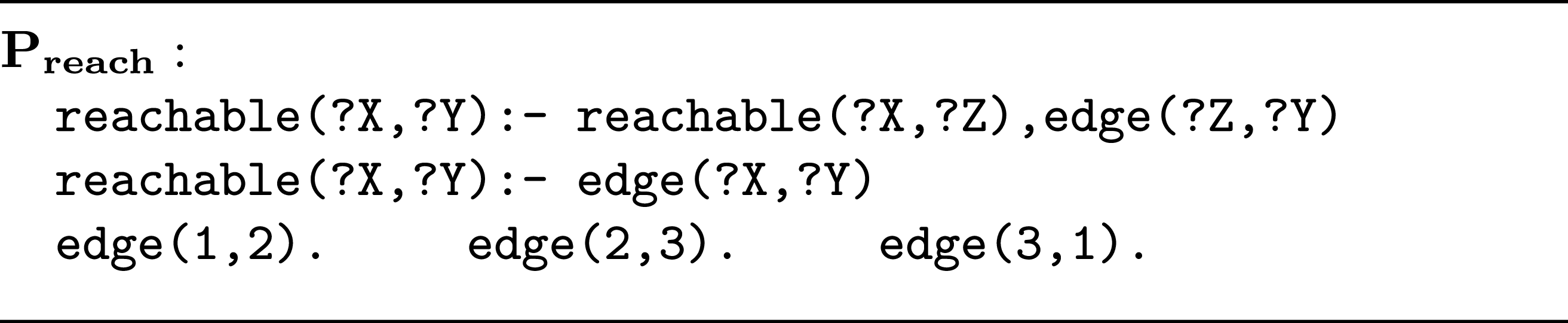
 E
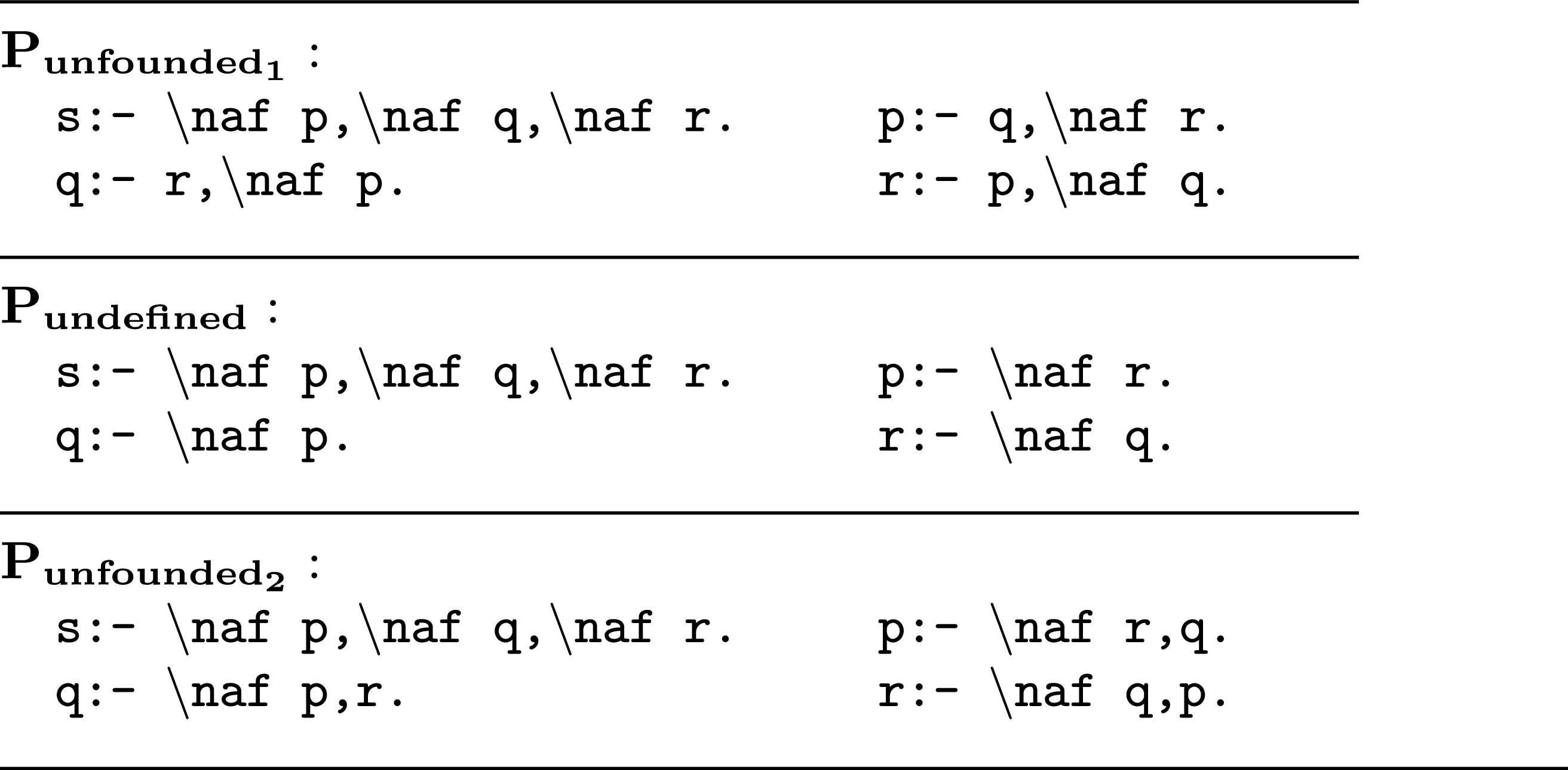
 E
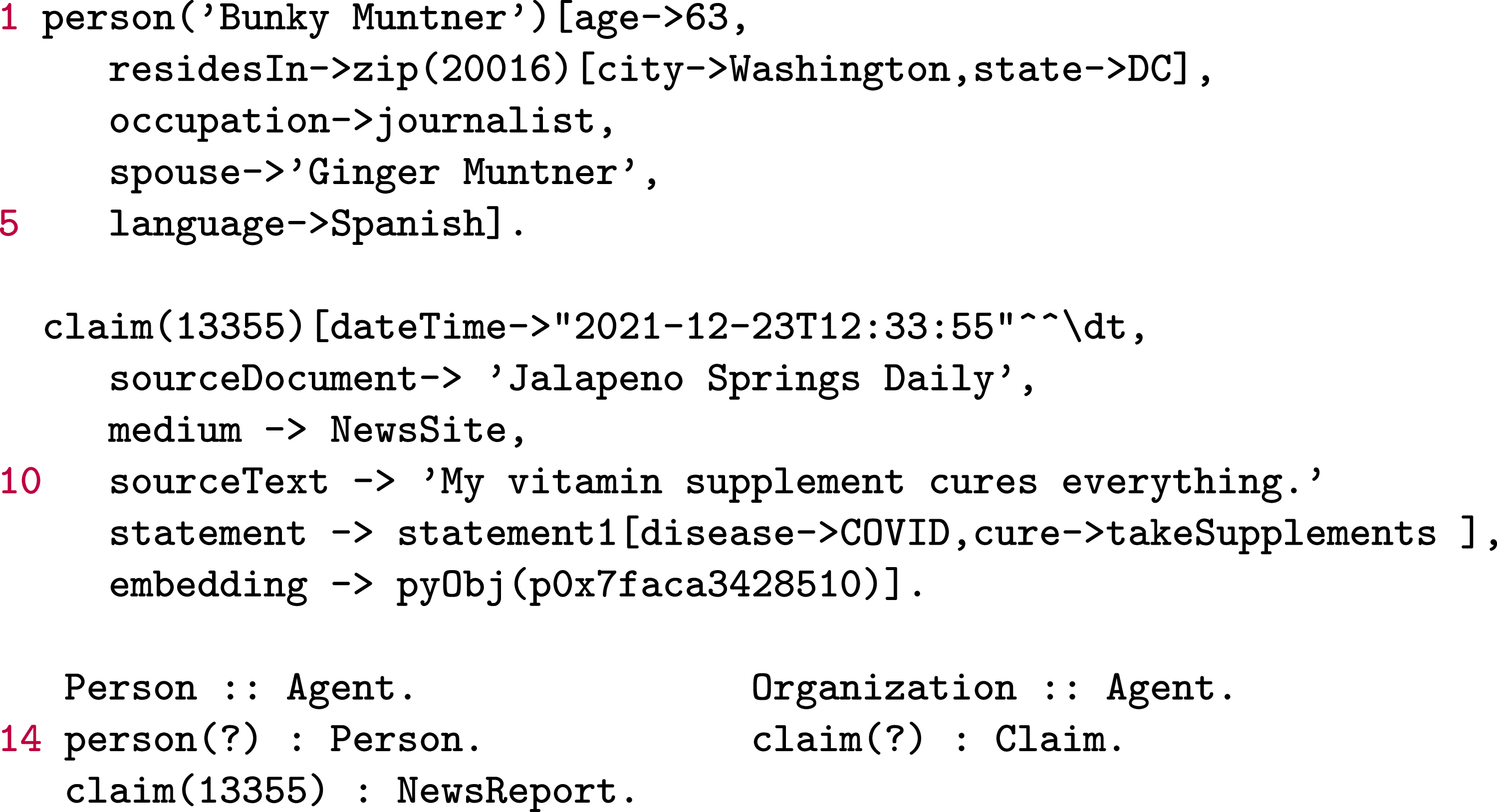
 E
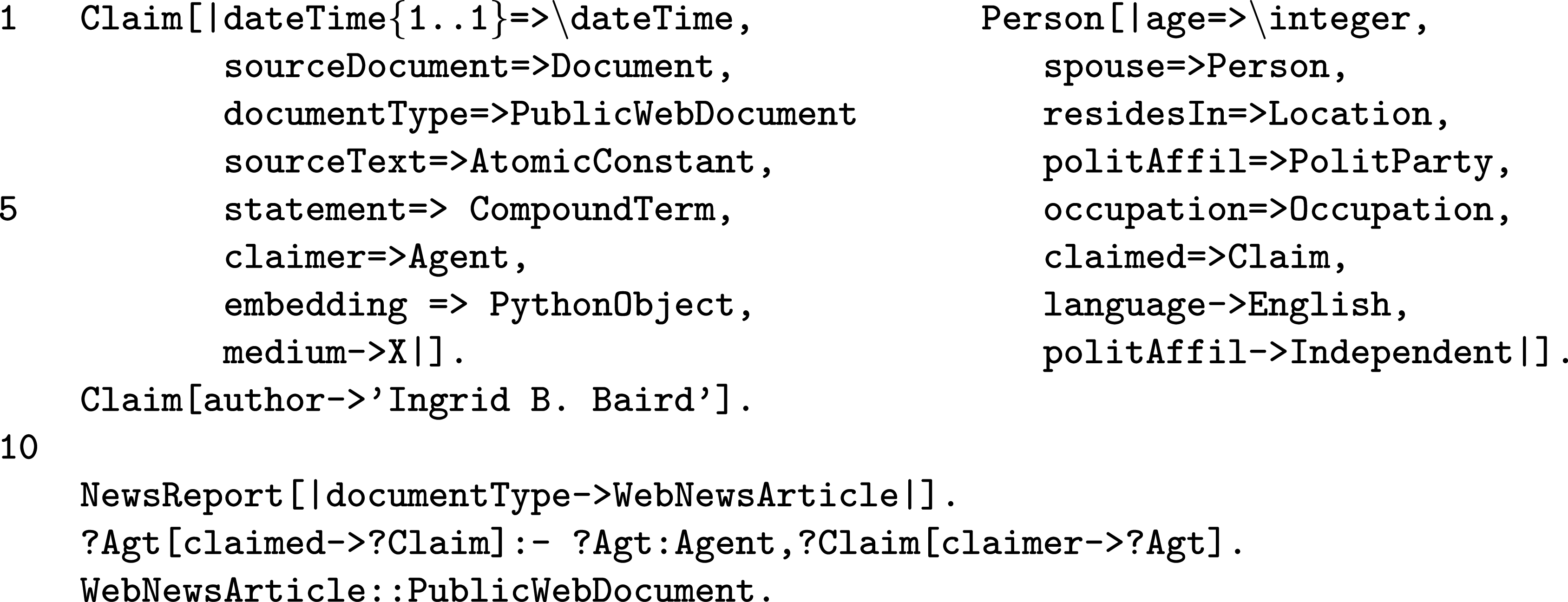
 E


 E
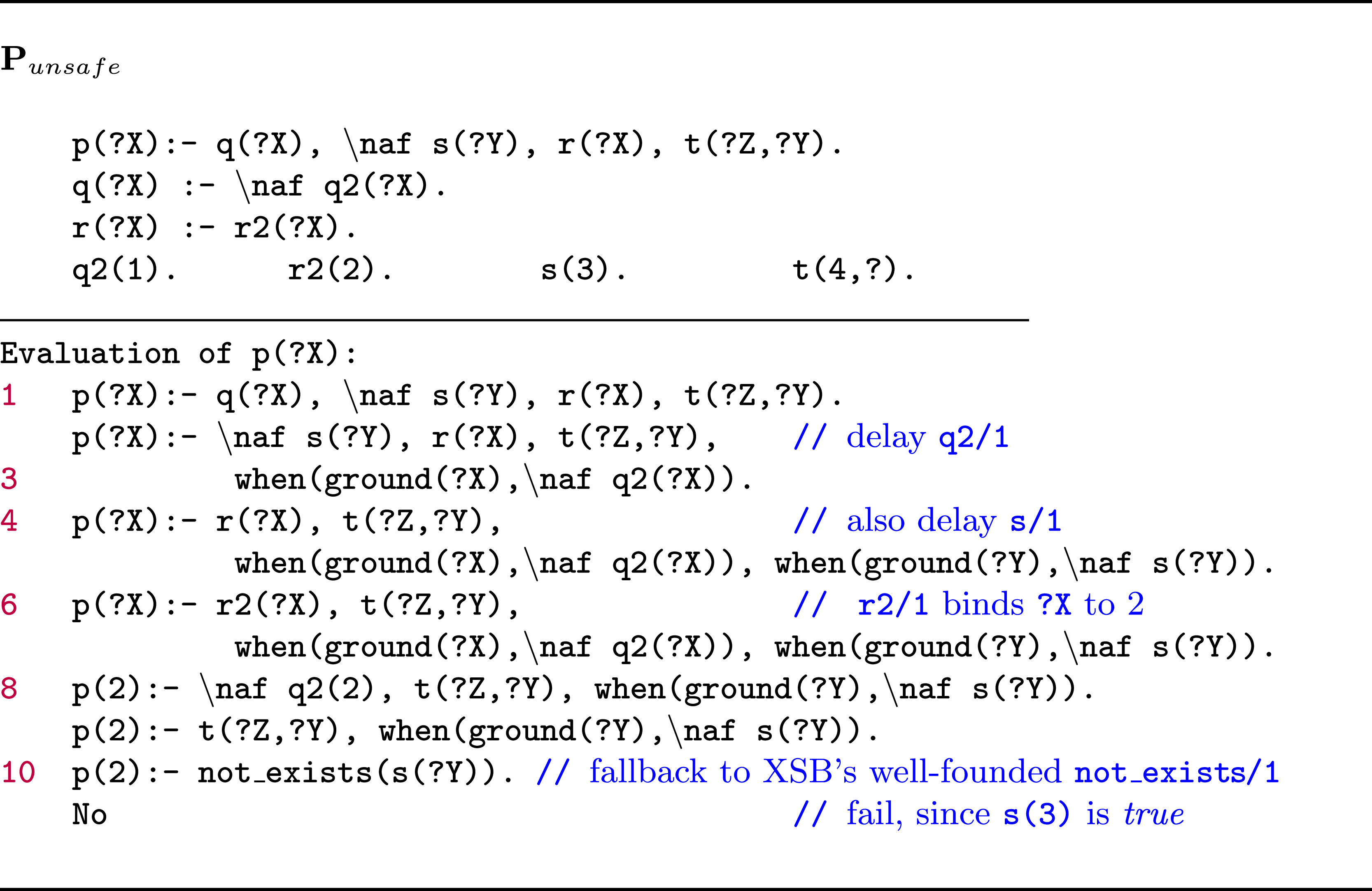

 E
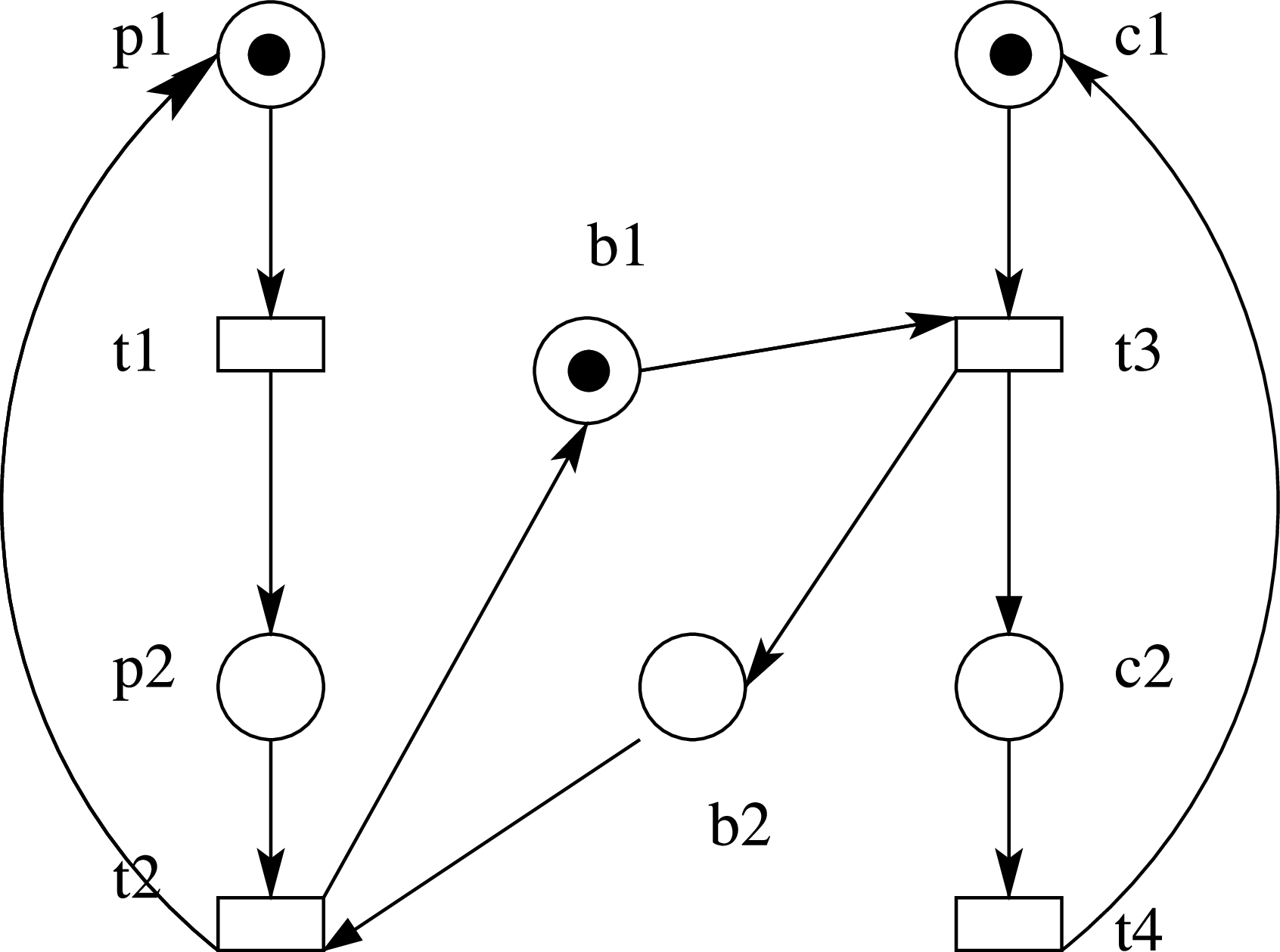
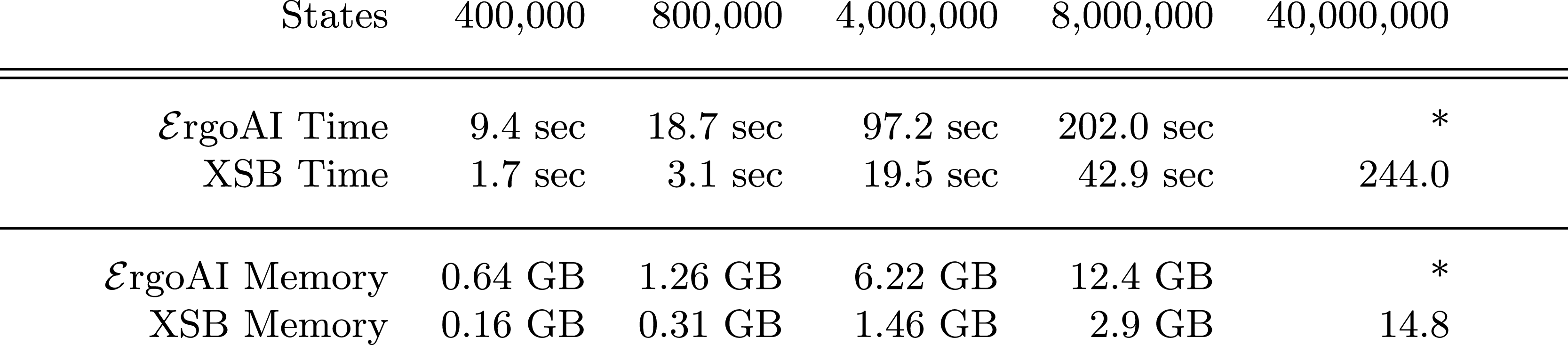
 E


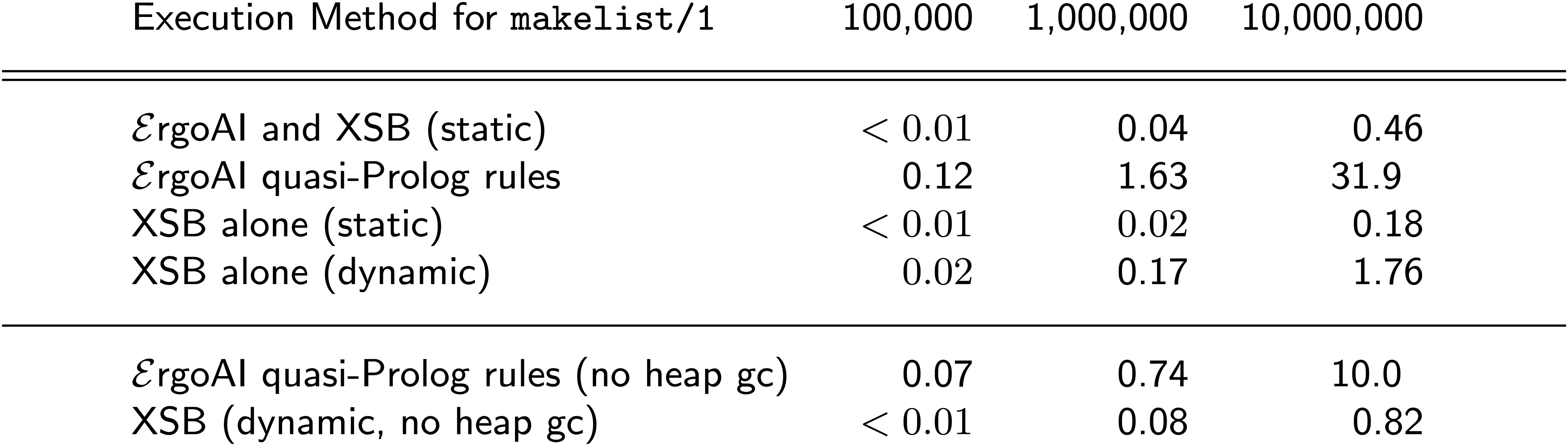

 E


 E
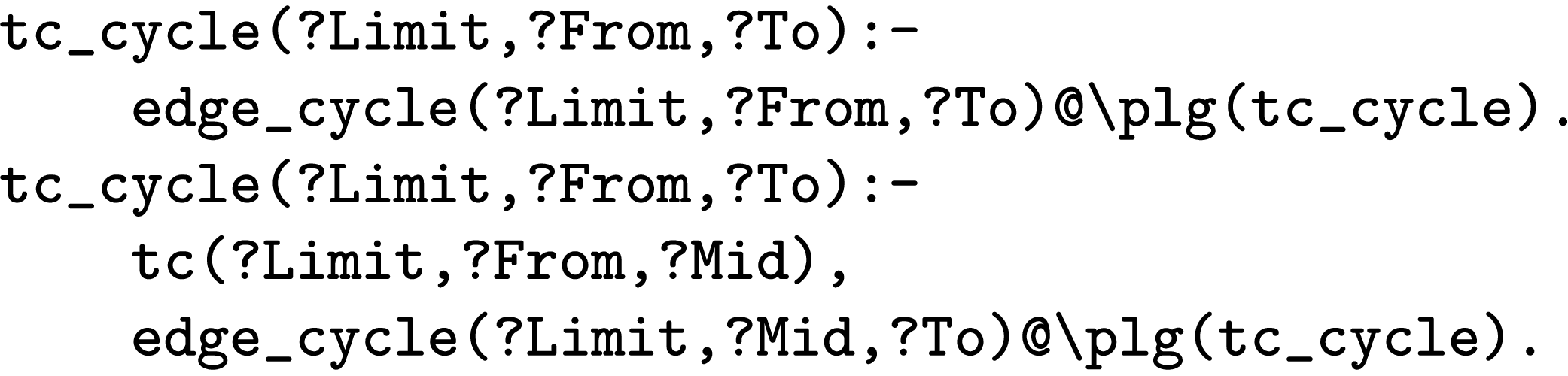
 E
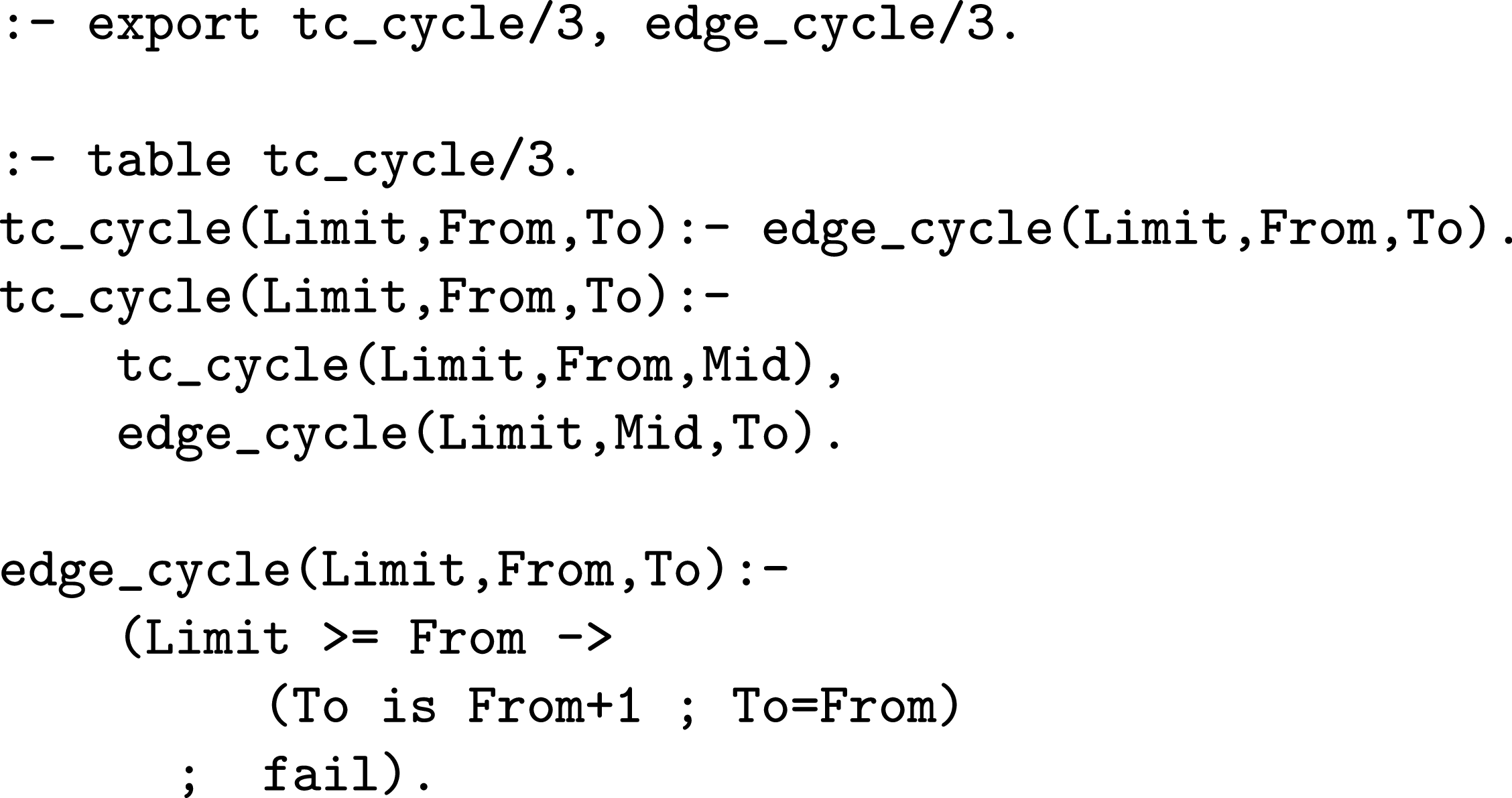
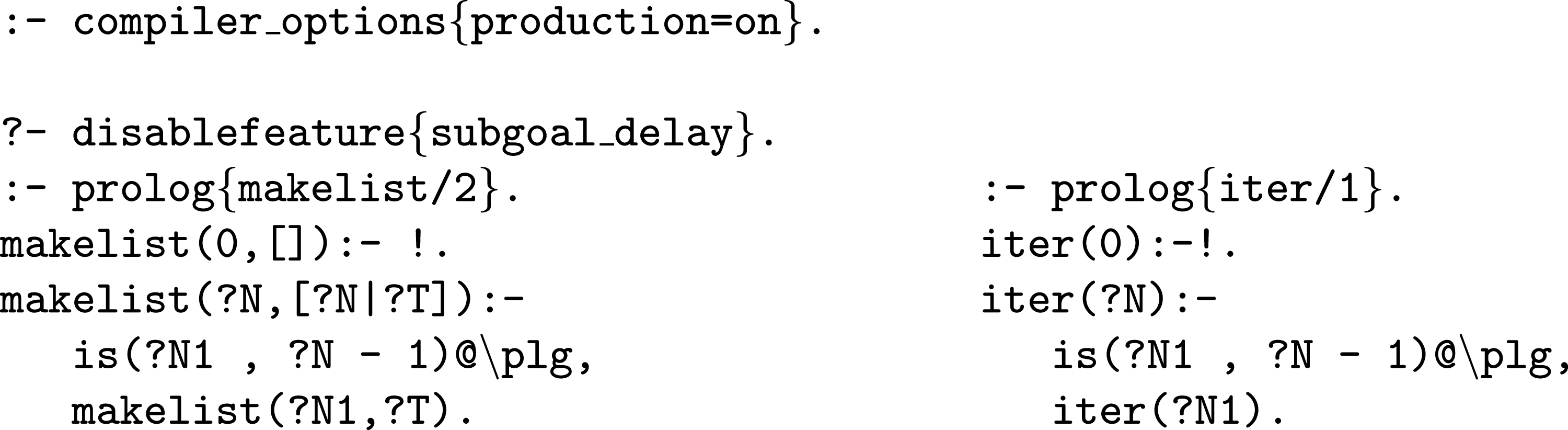
 E

 Open access

