


1. Introduction
The certainty, urgency, and extent of the climate crisis have been very clearly articulated in the numerous Intergovernmental Panel on Climate Change (IPCC) reports over the years.Footnote 1 More recently, the obligations of states to counter climate change were highlighted by the advisory opinion of the International Court of Justice (ICJ) issued in July 2025.Footnote 2 The insufficient response of governments to the climate crisis has led to various reactions. As mentioned by Newell, ‘we can expect the continued and expanded use by civil society groups of all tools and resources available to them: legal and non-legal, national, regional and international, liberal and critical, constructive and coercive’.Footnote 3 An example of such reaction is illustrated by the mass protests or direct actions frequently organized by the climate movement in Europe since 2018. This recurrence of activism and dissent has led to a state reaction with numerous occurrences of criminal prosecution following climate protest actions in Europe.Footnote 4 The 2020 report of the Grantham Research Institute on Climate Change and the Environment confirms an increase in criminal trials related to climate activism, notably in France, Switzerland, and the United Kingdom (UK).Footnote 5 In the UK, Extinction Rebellion and other environmental groups were categorized as a key threat by counterterror police in 2020,Footnote 6 and regulations were toughened in 2023 to allow for the criminalization of noisy protests.Footnote 7 Similar criminalization dynamics can be observed in France, Switzerland, and Germany, with mentions of ecoterrorism by politicians and the media,Footnote 8 serious charges brought against climate activists with severe sanctions – elements that can create a chilling effect on the movements.Footnote 9
In this context of criminalization of activism, it is relevant to study the internal dynamics of criminal courts, as there is a gap in research regarding the criminal justice process that involves activists. The gap is especially severe with regard to what happens following arrest, in the courtroom, and until a verdict is reached. This is why further research on the subject has been encouraged in several contributions.Footnote 10 For instance, Doherty and Hayes wished to ‘stimulate further interest in the relationships between social movements and criminal justice, arguing that it is a vital area of collective action which has been curiously neglected in the literature until now’, especially in the literature on climate change litigation.Footnote 11 Similarly, Barkan mentions that as protest movements have had a significant role throughout history, and criminal prosecution is often an unavoidable consequence of protest movements,Footnote 12 a better understanding of the ‘dynamics and outcome of the prosecutions [and] their attempts at political, economic, and cultural change’ needs to be studied.Footnote 13
There are several explanations for the small number of studies about criminal prosecutions following protest action. Firstly, the subject lies at the intersection between legal studies, social movement studies, and criminology. Each discipline focuses on a specific aspect (i.e., the legitimacy of unlawful actions for political expression, the repertoire of actions, their impact, and form of criminalization) but not necessarily on the entirety of the criminal justice process (from the act to arrest and to the criminal proceedings). Secondly, social movements and legal studies have not always been explored in conjunction, which has prevented a full understanding of the subject in the literature. Footnote 14 Thirdly, in social contestation studies, collective actions are separated between those of an institutionalized nature (i.e., litigation) and those considered at the ‘margins’ (i.e., street protest).Footnote 15 The prosecution of activists following a collective action is at the crossroads between the two. Finally, when addressing the subject of criminalizing activism, the notion of civil disobedience is frequently raised. It has been developed mainly by political scientists, philosophers, and social scientists,Footnote 16 but not so often in the legal literature.Footnote 17 However, confining the discussion to this literature can be restrictive as it often focuses on the conditions that create the legitimacy and/or justification for breaking the law as a political form of expression. The limitation can have an impact on the number and type of legal cases that are studied under this category, Footnote 18 creating a double-blind spot in research, as systematic and comparative analyses of the legal process are even rarer.Footnote 19
The approach proposed in the following sections seeks to bring together the various strands of literature on the criminalization of activism and dissent.Footnote 20 With a legal angle, this article aims to fill the literature gap in socio-legal scholarship by undertaking a review of legal cases across four jurisdictions in which climate activists have been subjected to criminal prosecution. This allows the criminal prosecution of activism to be studied as an entire process, from the collective action to arrest, and through the subsequent criminal proceedings. I argue that the concept of ‘reactive litigation’ can encompass all kinds of criminal prosecution of activism, which broadens the number of cases that can be studied, and allows for a more comprehensive understanding of this form of criminalization and repression of activism. This ‘expansive’ formulation of reactive litigation also encompasses the use of the law by the state and by social movement actors to advance their cause in reaction to their prosecution.
The article offers a systematic content analysis of 13 climate reactive cases in four jurisdictions: France, Germany, Switzerland, and the UK.Footnote 21 Through the analysis of the different cases, the article aims at opening avenues for future research by highlighting several categorizations of reactive cases and trends. The study is based on four key elements: (i) the targets of the actions; (ii) the charges brought against activists; (iii) how activists seek to defend themselves; and (iv) the outcomes of the criminal proceedings.
This contribution is structured in five sections. Section 2 presents a review of the literature addressing the usefulness of adopting the reactive litigation terminology It then delves into the concept of judicial opportunity as a theoretical framework. Section 3 details the methods employed for the empirical analysis of the selected cases, outlining the systematic content analysis approach used to collect and process the data. Section 4 provides summaries of the 13 reactive litigation cases selected for this study, while Section 5 offers a critical commentary on the 13 cases analyzed.
2. Prosecution of Climate Activists as Reactive Climate Litigation
Over the years, there has been a growing trend in using the law as a strategic tool to prompt action from states and corporations towards mitigating climate change.Footnote 22 Climate legal activism is one manifestation of the juridification Footnote 23 of the climate cause, evidenced by the increase in climate litigation since the 2000s, as cases almost quadrupled over two decades.Footnote 24
A distinction among the various types of legal activism and litigation was presented by Harrow and Rawlings in 1992:
[a] reactive group, by way of contrast [to proactive], is one which has litigation forced upon it, leaving the group to react by a variety of tactics which may range from orthodox legal defences to highly unorthodox courtroom drama or political speeches from the dock.Footnote 25
In other words, proactive litigation is actively initiated by non-governmental organizations (NGOs) or individuals against states or corporations, while reactive litigation can be defined as a criminal legal action initiated by the state against activists who have allegedly broken the law.Footnote 26
There has been a multiplication of studies on proactive climate litigation over the last 20 years, with systematic reviews, reports, and databases created on the subject.Footnote 27 Special attention has been given to the strategic element of climate litigation, which is brought to the court with the intention of ‘exert[ing] bottom-up pressure’ on governments or corporations.Footnote 28 These types of case aim to achieve social change outside the court and create an impact that goes beyond the claimants themselves.Footnote 29 The relevance and influence of proactive strategic litigation cases have been recognized multiple times by research institutes and international institutions.Footnote 30 For instance, the 2022 IPCC report dedicated a whole section on how climate change litigation is ‘shaping climate governance’.Footnote 31
However, as mentioned in the Introduction, there has been less focus in the literature on the prosecution of climate activists. The distinction between proactive and reactive litigationFootnote 32 allows us to single out the criminal prosecution of activists as a form of litigation. It is, therefore, a useful way to conceptualize the prosecution of activism as a self-standing phenomenon, which helps us to understand how both the state responds to activism and how activists react once they become defendants in criminal cases. In the following section I detail the theories around judicial opportunity to set out the research questions of this article (Section 2.1), before delving into the conceptualization of reactive litigation and mapping the different kinds of prosecution of activists (Section 2.2).
2.1. Judicial Opportunity as an Analytical Tool
This section will highlight how judicial opportunity has been built on literature on political and legal opportunity,Footnote 33 and notably in relation to the prosecution of environmental and climate activists.Footnote 34 Let us consider political opportunity first. This literature is considered an attempt to understand how social movements emerge, evolve, and the way in which they achieve their goals, as well as their relative ‘successes’ and the reasons behind their choices of tactics.Footnote 35 Building on political opportunity, legal opportunity was adapted to better fit the context of legal activism.Footnote 36 This literature is particularly interested in the claims or grievances that can be raised with regard to legal activism and its level of success, which depend on a number of structural conditions specific to the use of the law. For example, in this regard De Fazio highlighted three dimensions that emerge when looking at what ‘legal opportunity’ entails (i) accessibility to courts, (ii) availability of justiciable rights, and (iii) receptivity of the judiciary towards a social movement’s claims, including ‘both structural and procedural issues’.Footnote 37
In 2009, Hilson used legal opportunity to discuss civil disobedience cases in the UK.Footnote 38 He highlights that international law arguments were not received in the same way in different types of court throughout the proceedings.Footnote 39 This fact hints at the relevance of judicial opportunity to analyze court-based opportunities. Indeed, judicial opportunity looks more closely at how specific judicial cultures, prosecution practices, and sentencing trends create opportunities or constraints for social movement actors. This is also revealed in research by Hayes and Doherty on social movement campaigns against genetically modified organisms (GMOs) in France and the UK, showing that while judicial opportunities matter for understanding prosecution outcomes, the actual tactical choices of movements are better explained by movement ideas, cultures, and traditions rather than judicial calculations solely.Footnote 40 This suggests that the judicial opportunity structure works together with other factors like political opportunity and internal movement dynamics, rather than being a determinative factor on its own. This finding has been confirmed in the UK context by Ellefsen’s 2016 study regarding the repression of the organization Stop Huntingdon Animal Cruelty (UK),Footnote 41 which used judicial opportunity to show how opportunities change throughout the life of the movement. Such a view ‘better captures the legal closure and level of threats’,Footnote 42 and it shows that opportunity alone cannot explain the full extent of activists’ choices, but it provides key elements to understand the decision of the activists in the judicial arena. These elements also include, as Ellefsen listed, the different facets encountered during the criminal proceedings, and notably ‘[t]he chances of being prosecuted, convicted and punished, as well as by the severity of those sanctions’.Footnote 43
Drawing from this list, the following research questions will guide my analysis and help to identify key trends in criminal proceedings against climate activists:
-
1. What kinds of action are criminalized? Who are the targets of these actions?
-
2. Under which offences are the activists usually prosecuted?
-
3. Which defences are employed in the proceedings?
-
4. What sanctions are imposed by the courts?
The next section will present the different types of reactive litigation, a classification that helps in answering these questions and selecting relevant case law for analysis.
2.2. Reactive Litigation: A Typology
Criminalization of social movements has been described ‘as an inevitable consequence’ of collective action.Footnote 44 This is why activists often react to their prosecution, and can sometimes even welcome it. From the civil rights movement in the United States (US) to the suffragette movement in the UK or the anti-nuclear power movement worldwide, prosecuted activists make use of their trial to speak about their cause.Footnote 45
As mentioned above, in reactive litigation cases the state initiates the procedure in response to an allegedly unlawful act of protest, as the state holds the exclusive power to initiate and conduct criminal proceedings. However, this does not exclude the possibility that a third party can press charges, or that the activists can act with the intent to be arrested and prosecuted. As developed in the following paragraph, this means that in reactive litigation arrest can be anticipated or unanticipated, and prosecution wanted or unwanted by the activists. This distinction can be paralleled with the strategic categorization of its proactive counterpart.
In this context, ‘anticipated reactive litigation’ means that the activists knew that they might be arrested and prosecuted. However, two subcategories of anticipated reactive litigation are observable: the arrest and the prosecution might be wanted or unwanted. If the litigation is anticipated and wanted, activists will actively seek arrest and prosecution as ways to express their cause before a tribunal to call for changes beyond the case itself.Footnote 46 There are many reasons that can explain the decision of a movement to turn to anticipated reactive litigation. For instance, deliberate law-breaking with the aim of being prosecuted can be linked to a lack of financial resources available to social movement actors to pursue other means of contestation, including proactive litigation.Footnote 47 In such cases, the activist might plan their defence strategies before the protest action takes place or once they are arrested. In the UK, most prosecutions were anticipated, which naturally follows from the fact that collective actions are very unlikely to be spontaneous and, therefore, the possibility of an arrest must, at least, have been discussed before the action took place.Footnote 48
In the case where an arrest is anticipated, in the sense that arrest is foreseeable although unwanted, activists can actively plan their action to avoid arrest and prosecution. For instance, they might try to avoid arrest based on the movement’s ideology or strategy, and they will therefore undertake direct action during the night or favour forms of protest that are not likely to be criminalized.Footnote 49 If arrested, they might also have other strategies in place, such as fleeing before the police arrive or refusing to disclose their identity.
However, prosecution is not an outcome that is always anticipated. If that is the case, the prosecution process is unforeseeable, which can occur for several reasons. The first factor may be unclear boundaries around what is considered lawful in terms of protest action, boundaries that often change through time and across jurisdictions.Footnote 50 Indeed, sometimes the interpretation of the law is revised or extended to include new types of behaviour, and situations that were initially considered as admissible forms of protest might become criminalized.Footnote 51 In the UK, similar dynamics have been observed regarding the availability of defences, as detailed in Section 5. A further factor contributing to ‘unforeseeable cases’ is the lack of knowledge on the inner workings of the criminal system by members of the movements that resulted in the non-anticipation of reactive litigation cases. When a movement has little experience or does not know how the police and justice system will react to a new kind of activism, prosecution can also be unforeseeable.Footnote 52
Unanticipated reactive litigation can become strategic after the arrest, for instance, when discussing defence strategies with lawyers or legal teams. In addition, depending on the experience of the movement, or its longevity, more knowledge about the criminal prosecution process is gained and, therefore, the collective action and reaction to prosecution might be adapted respectively. This is why sometimes unanticipated reactive litigation can become strategic, just like its proactive counterparts.
In sum, reactive litigation can be anticipated or unanticipated, which will have an impact on the strategy and decisions around the type of action and the defence strategies presented during the prosecution of activists following protest action (Table 1).
Reactive Litigation Typology

Table 1 Long description
A table categorizing reactive litigation typology. The table has three rows and three columns. The row labels are Arrest, Prosecution, and Strategizing possibilities. The column headers are Anticipated, Unanticipated, and Wanted, Unwanted, Unforeseeable, Pre- and post-arrest, Post-arrest. Row 1: Arrest, Anticipated, Unanticipated. Row 2: Prosecution, Wanted, Unwanted, Unforeseeable. Row 3: Strategizing possibilities, Pre and post arrest, Post-arrest.
To conclude, I argue that using the concept of reactive litigation to study the prosecution of activists allows for the inclusion of all forms of criminal prosecution without filtering the cases based on the type of collective action. This view expands the object studied and focuses on the study of the legal action itself, and on the dynamics that take place during the criminal proceedings.
3. Methods
Building on the typology and on the research questions, the following section details the case sample selection process and the creation of the analytical grid for the analysis.
3.1. Case Selection and Filtering
Following the typology proposed above, I collected data on reactive litigation cases to examine trends between the criminal process against climate activists across four jurisdictions.
To carry out the case selection, I used the Sabin Center Climate Change Litigation Database (Sabin Center Database), which records climate change litigation around the world.Footnote 53 In the database, climate litigation cases are classified according to the focus of the litigation. One of the branches of classification is entitled ‘suits against protesters’, which I used as it best corresponds with our proposed definition of reactive litigation cases.
In addition, as the database separates US case law from that of the rest of the world, I decided to include only cases inside the European continent, in order to build on the existing literature on the subject. This is also a way to limit the number of cases studied to test the typology presented above, and it enables the finding of trends across the selected cases. Therefore, I used the ‘Global’ litigation section of the database.
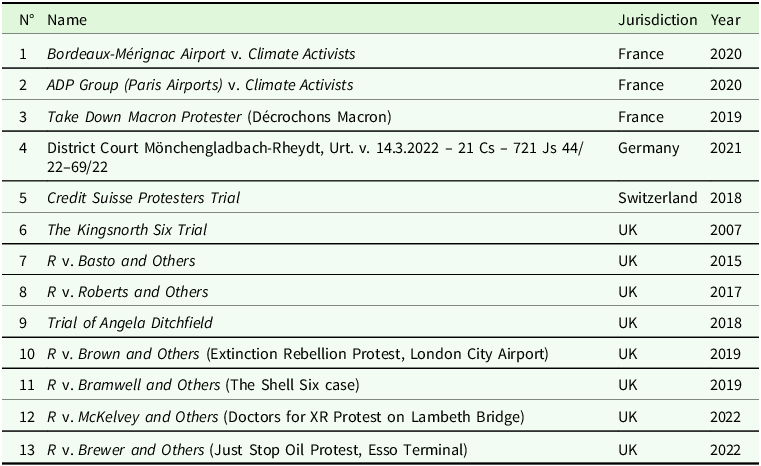
Among the 21 cases recorded in the databaseFootnote 54 (status as in July 2024), those that belong to these three categories were removed: (i) jurisdictions outside the European continent (n=4): Police v. Hanafin;Footnote 55 EH v. Queensland Police Service; GS v. Queensland Police Service;Footnote 56 Trans Mountain Pipeline ULC v. Mivasair;Footnote 57 Director of Public Prosecutions v. Fraser and O’Donnell;Footnote 58 (ii) cases that are not directly against protesters (n=3): Attorney General v. Crosland;Footnote 59 Shell v. Greenpeace;Footnote 60 Heathrow Airport Ltd. and Another v. Garman and Others;Footnote 61 (iii) duplicate entry of a series of 15 cases: Take Down Macron Protester Cases. Footnote 62 Thus, 13 cases remain for the analysis.
This approach encompasses limitations that need to be acknowledged. Firstly, because of the rapidly evolving number of cases in the database, this article represents a snapshot of cases from 2015 to 2022, based on the database status in July 2024. It is also important to acknowledge that cases in the database are recorded by national reporters, which means that their accounts are not always comprehensive.Footnote 63 This study, therefore, is a snapshot at a point in time that provides an exploratory study. Finally, and consequently, the results and discussion of this article are limited to the cases studied and cannot be generalized. However, they may uncover general dynamics that can be identified beyond the present casesFootnote 64 (Table 2).
Case Selection

Table 2 Long description
A table listing legal cases involving climate activists in Europe from 2015 to 2022. The table has 13 rows and 4 columns. The columns are labeled Nº, Name, Jurisdiction, and Year. Row 1: Nº 1, Name Bordeaux-Mérignac Airport v. Climate Activists, Jurisdiction France, Year 2020. Row 2: Nº 2, Name ADP Group (Paris Airports) v. Climate Activists, Jurisdiction France, Year 2020. Row 3: Nº 3, Name Take Down Macron Protester (Décrochons Macron), Jurisdiction France, Year 2019. Row 4: Nº 4, Name District Court Mönchengladbach-Rheydt, Urt. v. 14.3.2022 – 21 Cs – 721 Js 44/22–69/22, Jurisdiction Germany, Year 2021. Row 5: Nº 5, Name Credit Suisse Protesters Trial, Jurisdiction Switzerland, Year 2018. Row 6: Nº 6, Name The Kingsnorth Six Trial, Jurisdiction UK, Year 2007. Row 7: Nº 7, Name R v. Basto and Others, Jurisdiction UK, Year 2015. Row 8: Nº 8, Name R v. Roberts and Others, Jurisdiction UK, Year 2017. Row 9: Nº 9, Name Trial of Angela Ditchfield, Jurisdiction UK, Year 2018. Row 10: Nº 10, Name R v. Brown and Others (Extinction Rebellion Protest, London City Airport), Jurisdiction UK, Year 2019. Row 11: Nº 11, Name R v. Bramwell and Others (The Shell Six case), Jurisdiction UK, Year 2019. Row 12: Nº 12, Name R v. McKelvey and Others (Doctors for XR Protest on Lambeth Bridge), Jurisdiction UK, Year 2022. Row 13: Nº 13, Name R v. Brewer and Others (Just Stop Oil Protest, Esso Terminal), Jurisdiction UK, Year 2022.
3.2. Data Collection and Analysis
To study the 13 cases in a systematic manner, I processed relevant information into an analytical grid, inspired by the literature on proactive climate litigation.Footnote 65 The creation of the grid corresponds to a systematic content analysis approach, which aims to ‘collect a set of documents, such as judicial opinions on a particular subject, and systematically read them, recording consistent features of each and drawing inferences about their use and meaning’.Footnote 66
I created two sets of variables. The first is a set of identification variables, such as case name; name of the court and the country of jurisdiction; status of the case (pending/decided), and year of the collective action. The second set of variables reflects the research questions mentioned above: organizations or activist groups; summary of the collective action; number of defendants/arrests; offences charged; maximum sentence; presence of experts at the hearing; defence, reception by the judge the jury; verdict; date of verdict; sources.
The data collection process encompasses information from the database and information available online, including news reports, because the available data within the Sabin Center Database was not sufficient, and primary sources (i.e., court documents) were not always accessible. The data collected considered only the conviction and charges brought at the highest instance reached. Once the data was collected, it was recoded and reframed to consider not only the cases but also each defendant prosecuted.
The cases selected and presented in this contribution include cases from four jurisdictions: Germany, Switzerland, France, and the UK. As the aim of the articles is to identify trends across jurisdictions, generalizations might be made on the variables analyzed. Indeed, as mentioned above, the rest of the contribution will identify key trends in the actions criminalized, the targets of these actions, the offences with which they are charged, their defences, and the outcome of the proceedings. For instance, offences with different names but that prohibit the same behaviour are recorded together, similarly for the defences. Furthermore, the difference between common law and civil law will be acknowledged but is not at the centre of discussions in the article, as the aim was to focus on the criminal proceedings per se.
4. Case Presentation
This section provides brief summaries of each case, organized chronologically within jurisdictions, which are then listed alphabetically.Footnote 67
4.1. Bordeaux-Mérignac Airport v. Climate Activists (France, 2020)Footnote 68
On 3 October 2020, in Bordeaux (France) seven activists entered an airport tarmac area, without causing any damage to the fence, and proceeded to stop air traffic by standing on the tarmac with a banner and a smoke flare. The action was part of a wider national campaign against aviation’s greenhouse gas (GHG) emissions, targeting 18 airports led jointly by Alternatiba, Extinction Rebellion (XR), and ANV-COP21.Footnote 69 The activists were prosecuted for malicious activities (actes de malveillance) under Article L6372-4(4) of the French Transport Code,Footnote 70 which imposes a maximum sentence of five years’ imprisonment and a €18,000 fine. During the trial in the Criminal Court of Bordeaux, in March 2020, the prosecutor requested a suspended fine of €500,Footnote 71 the defence of necessity was used,Footnote 72 and Didier Swingedouw, a geographer and IPCC expert, was invited to testify.Footnote 73 The judge rejected the necessity defence, notably because the defendants’ action did not have a direct impact on climate change. However, he took into consideration for sentencing the defendants’ characters and the brief nature of their action, ultimately imposing lenient sentences on the activists.Footnote 74 The final sentencing for the seven activists was a suspended fine of €500 pronounced on 29 March 2020.Footnote 75
4.2. ADP Group (Paris Airports) v. Climate Activists (France, 2020)Footnote 76
This action was part of the same wider national French campaign against aviation GHG emissions (Section 4.1). On 3 October 2020, 84 activists stood on the tarmac in front of a parked plane, after cutting the fence to gain entry; they were arrested and convicted with an administrative fine of €750 imposed on each. On the criminal side, seven activists were prosecuted and tried in the Court of First Instance of Bobigny (Tribunal Correctionnel) in November 2021.Footnote 77 They were prosecuted under Article L6372-4(4) of the French Transport Code,Footnote 78 the maximum penalty for which is five years in prison and a fine of €18,000.Footnote 79 Furthermore, two activists were cumulatively charged under Article 322-1 of the French Criminal CodeFootnote 80 for serious damage caused by cutting the fence. They also argued the necessity defence but mainly justified their act under freedom of expression. The seven activists were acquitted on 16 September 2021, as the judge recognized that their aim was to raise awareness of the effect of climate change and their actions were therefore covered by freedom of expression. The two activists prosecuted for property damage were convicted and fined €500 each, with their actions reclassified as light damage.Footnote 81
4.3. Take Down Macron Protester (Décrochons Macron) (France, 2019)Footnote 82
This action was part of a national coordinated campaign by ANV-COP21 across France – notably in Paris, Strasbourg, Bonneville, Auch, Lyon, and Bordeaux – with the aim of taking down the official photograph of President Emmanuel Macron from government buildings. This summary focuses on one of the actions of 2 February 2019 in Lyon. Ten to 15 activists entered the city hall, removed the photograph, and left with it.Footnote 83 Two activists were arrested and prosecuted for organized theft (vol en réunion) under Article 311-4 ch° 1 of the French Criminal Code,Footnote 84 which can incur a penalty of up to five years’ imprisonment and a maximum fine of €75,000. The activists argued the defence of necessity in their first instance proceedings, and called upon a former French minister to testify to the proportionality of their action. At first instance, the activists were acquitted,Footnote 85 but the appeal decision set aside the necessity defence, convicted the two activists and fined each €250.Footnote 86 The highest French criminal court (Cour de Cassation), on 22 September 2021, confirmed that the necessity defence was not available for climate activists, although the Court left the door open for such actions to be justified on grounds of freedom of expression. Footnote 87 In July 2025, the European Court of Human Rights (ECtHR) confirmed that the actions were within the scope of Article 10 of the European Convention of Human Rights (ECHR),Footnote 88 although the penalty of the suspended fine was considered to be proportionate.Footnote 89
4.4. District Court Mönchengladbach-Rheydt, Urt. v. 14.3.2022 – 21 Cs – 721 Js 44/22–69/22 (Germany, 2021) Footnote 90
This action was led by a group called Lebenslaute (Sound of life), who played a concert with 52 musicians inside a lignite mine in Germany in August 2021. The decision analyzed here concerns only one of the 52 defendants. The activist was charged with trespassing under Section 123(1) of the German Criminal Code,Footnote 91 the sentence for which is up to one year of imprisonment or a fine.Footnote 92 The defence relied on freedom of conscience, assembly, and expression.Footnote 93 The Court acquitted the defendant in March 2022, applying the following reasoning. Climate change is an issue of ‘paramount importance’ and lignite mining was recognized as an environmental problem, which creates a ‘moral’ dilemma; this allows for climate-related protest that targets climate-damaging action to be covered by freedom of conscience.Footnote 94
4.5. Credit Suisse Protesters Trial (Switzerland, 2018)Footnote 95
In November 2018, around 30 activists from an activist group called Lausanne Action Climat, entered the lobby of the bank Credit Suisse in Lausanne (Switzerland) and mimicked a tennis game. The aim of the action was to denounce the investments of the bank in fossil fuels by calling upon Roger Federer’s fame to mediatize their action further, as he was sponsored by the bank at the time. Of the 13 activists arrested for refusing to leave the premises once the police arrived,Footnote 96 12 were charged with unlawful entry under article 186 of the Swiss Criminal Code.Footnote 97 The maximum sentence is a three-year prison term or a fine.Footnote 98 They were charged with additional offences of failing to request authorization for the protest, and refusing to obey the police when asked to leave.Footnote 99 In January 2020, the first instance court acquitted the activists of all charges after they invoked the necessity defence.Footnote 100 In September 2020, this decision was appealed against by the prosecutor, and the acquittal was overturned.Footnote 101 In November 2020, the case reached the Supreme Court of Switzerland, and the conviction was confirmed. The case was sent back to the cantonal court for sentencing,Footnote 102 which convicted the defendants to a monetary penalty of CHF (Swiss francs) 10 daily penalty units of CHF 20 per day, suspended for two years, and a CHF 100 fine.Footnote 103 An appeal to the ECtHR was filed in November 2021.Footnote 104
4.6. The Kingsnorth Six Trial (UK, 2007)Footnote 105
On 8 October 2007, in Kent (UK), six climate activists entered the premises of a coal-fired power station and climbed and painted the name of the Prime Minister on the chimney, shutting down the station for a day. The cost of rectifying the damage was estimated at £30,000.Footnote 106 They were charged with causing criminal damage under section 1(1) of the Criminal Damage Act 1971,Footnote 107 the maximum sentence for which is 10 years’ imprisonment.Footnote 108 The activists and their lawyer presented lawful excuse,Footnote 109 arguing the prevention of property damage,Footnote 110 including nearby houses that would be swept away by sea-level rise.Footnote 111 They invited numerous expert witnesses, including Jim Hansen, Geoff Meaden, Zac Goldsmith, Jennifer Morgan, and Aqqaluk Lynge to support their claim.Footnote 112 On 8 September 2008, the activists were acquitted by a juryFootnote 113 and The New York Times ranked the use of this defence as one of the ‘Ideas of the Year 2008’.Footnote 114
4.7. R v. Basto and Others (UK, 2015)Footnote 115
On 12 July 2015, 13 activists from Plane Stupid cut the perimeter fence surrounding Heathrow Airport in London (UK) and occupied the northern runway for a number of hours to oppose the proposal to build a third runway.Footnote 116 The 13 activists were charged with aggravated trespass under section 68(1)(3) of the Criminal Justice and Public Order Act 1994Footnote 117 and entering a security-restricted area of an aerodrome without permission under section 21C(1)(a) of the Aviation Security Act 1982.Footnote 118 The first offence carries a maximum sentence of three months’ imprisonment and/or a fine, and the second a fine.Footnote 119 All defendants pleaded not guilty to both charges and described their action as necessary.Footnote 120 On 24 February 2016, the activists were convicted and given a sentence of six weeks’ imprisonment, suspended for 12 months, and between 120 and 180 hours of unpaid work (depending on the previous convictions of each defendant).Footnote 121 The judge wrote in the decision that ‘[t]he fact that you are principled and hold strong views about what is in the best interests of the public does not mean you are entitled to break the law’,Footnote 122 and said their disruption was too important (delays and 25 flights cancelled) to fit the definition of an act of civil disobedience.Footnote 123 In addition, they had carefully planned their action; consequently, the judge considered that both the culpability and the financial harm were of a high level.Footnote 124
4.8. R v. Roberts and Others (UK, 2017)Footnote 125
In July 2017, while activists were protesting against the licence granted by the British Oil and Gas Authority to explore for shale gas by fracking in Lancashire (UK), four activists partially blocked a road for about three days after they climbed on trucks that were carrying drilling equipment.Footnote 126 The four activists were charged with the common law offence of public nuisance.Footnote 127 One activist pleaded guilty and was given a suspended sentence;Footnote 128 three others were convicted of imprisonment as the judge at first instance determined that they had crossed the ‘custody threshold’ necessary to pronounce imprisonment.Footnote 129 The defendants appealed against the decision, notably referring to the freedom of expression granted by Article 10 ECHR.Footnote 130 On 6 December 2018, the Court of Appeal accepted that an immediate custodial sentence was excessive and that the three defendants should have been sentenced to a community order with unpaid work; however, as they had already served three weeks in prison, they were given a conditional discharge for two years.Footnote 131 The reason advanced for this decision was that the ECtHR considered the importance of proportionality in sentencing when a crime is committed during a peaceful protest, especially when the defendants show remorse.Footnote 132
4.9. Trial of Angela Ditchfield (UK, 2018)Footnote 133
The action took place on 15 December 2018 in the city centre of Cambridge (UK).Footnote 134 The defendant in the case walked through the city in a peaceful protest. She then spray-painted the council doors with the XR logo and the acronym ‘RIP??’ – the resulting damage was estimated at around £800. The defendant was charged with the statutory offence of destroying or damaging property under section 1(1) of the Criminal Damage Act 1971,Footnote 135 the maximum sentence for which is 10 years’ imprisonment. The defendant pleaded not guilty and pleaded lawful excuse, arguing prevention of property damage under section 5(2b) of the Criminal Damage Act 1971.Footnote 136 Following acquittal at first and second instance,Footnote 137 the appellate court quashed the acquittal and the defendant was convicted and given a 12-month suspended prison sentence and ordered to pay £650 by way of compensation.Footnote 138
4.10. R v. Brown (Extinction Rebellion Protest, London City Airport) (UK, 2019)Footnote 139
The action took place on 10 October 2019, during a nationwide protest led by XR. Ten activists launched a protest at London City Airport (UK). One of the activists, who was paralympic champion James Brown, glued himself to a commercial passenger aircraft to draw attention to the climate crisis.Footnote 140 In the first instance judgment, he was charged with the common law offence of public nuisance.Footnote 141 He defended himself, saying he needed to do something spectacular to receive the attention of the media.Footnote 142 He was convicted and given an immediate custodial term of 12 months’ imprisonment.Footnote 143 The decision was appealed against on several grounds. Firstly, abuse of process was claimed because the defence team considered that, instead of public nuisance, he could have been charged with aggravated trespass, which has a maximum sentence of three months, less than the twelve-month term given in the first instance judgment. It was also argued that his action was protected by the human right to freedom of thought, freedom of expression, and freedom of assembly and association.Footnote 144 On 14 February 2022, the appeal against conviction was dismissed, but allowed against sentencing, as the sentence was considered too severe.Footnote 145
4.11. R v. Bramwell and Others (The Shell Six Case) (UK, 2019)Footnote 146
During a two-week nationwide mobilization of XR in April 2019, several activists gathered in London (UK). On 15 April 2019, the Shell headquarters building was the target of an action when activists spray-painted slogans, broke windows, and climbed onto the roofs.Footnote 147 Seven activists were charged with causing criminal damage under section 1(1) of the Criminal Damage Act 1971,Footnote 148 the maximum sentence for which is imprisonment for a term not exceeding 10 years.Footnote 149 One activist pleaded guilty and received a conditional discharge before the trial, while the other activists represented themselves and used different approaches to their defence. Five defendants used the defence of necessity, accusing Shell of contributing directly to climate change, arguing that their action was proportionate and necessary; one activist mobilized lawful excuse, arguing consentFootnote 150 under the Criminal Damage Act 1971.Footnote 151 On 23 April 2021, all six activists were acquitted by a jury at Southwark Crown Court, even though the judge had warned the jury that only the activist who pleaded consent had a defence recognized by law.Footnote 152
4.12. R v. McKelvey and Others (Doctors for XR Protest on Lambeth Bridge) (UK, 2022)Footnote 153
On 10 April 2022, around 30 persons from the group Doctors for Extinction Rebellion blocked Lambeth Bridge in London (UK) and displayed a banner with the following sentence ‘For Health’s Sake. Stop Financing Fossil Fuels’.Footnote 154 A group of seven activists, all health professionals, remained on the bridge at the end of the protest and were arrested and charged with breach of section 14 of the Public Order Act 1986.Footnote 155 This offence allows the police to formulate conditions for a public assembly, and if the conditions are not complied with it becomes an offence to join the protest.Footnote 156 The seven defendants pleaded not guilty and presented evidence to the court, referring to the right to protest.Footnote 157 They were all acquitted on 15 November 2022 at the City of London Magistrates’ Court. Judge Robinson found that the procedure to apply section 14 had not been respected and mentioned that he was ‘impressed by the integrity and rationality of their beliefs’ and ‘their evidence was highly moving’.Footnote 158
4.13. R v. Brewer and Others (Just Stop Oil Protest, Esso Terminal) (UK, 2022)Footnote 159
The action took place on 3 April 2022, where seven protesters from Just Stop Oil prevented the operations at an Esso fuel terminal in Birmingham for 12 hours by blocking the access road. They demanded that the government stop its support of new fossil fuel licences and projects.Footnote 160 Nine activists were arrested and charged with aggravated trespass under section 68(1)(3)) of the Criminal Justice and Public Order Act 1994,Footnote 161 the maximum sentence for which is three months’ imprisonment and/or a fine.Footnote 162 By way of defence, the activists explained their motives; however, in response District Judge Wilkinson said: ‘You are good people with admirable aims. However, if good people with the right motivation do the wrong thing, it can never make that wrong thing right’.Footnote 163 On 16 February 2023, seven of the nine activists were convicted, given a 12-month conditional discharge and ordered to pay the procedural costs of the Crown Prosecution Service.Footnote 164
5. Discussion: Trends in Reactive Climate Litigation
In this final section, I extract data and interpret it through the theoretical framework of reactive litigation and judicial opportunity presented above. To do so, I have analyzed the data collected for each defendant in the 13 cases. I created a typology, first for the targets of the action; then, for the actions themselves, the offences, the defences, the outcomes of the procedure, and established patterns between them.
5.1. Protest Action and Targets, and Types of Offence
The 13 actions could be grouped into three main categories based on the subject-matter targeted: fossil fuels-related, the aeronautic industry, and government buildings. Most of the cases analyzed are tied to fossil fuel activities; indeed, seven cases target fossil fuel-related industry such as a mine, a coal-fired power plant, an Esso terminal, and the Shell headquarters.Footnote 165 The occupation of the bank also falls in this category, as the main claim of the protestors revolved around the financial investment made by the bank in fossil energy.Footnote 166 Another important target is air traffic and airport expansion, with four actionsFootnote 167 that took place on a runway. Finally, in the last two cases,Footnote 168 the city hall was taken as a target to highlight the inaction of the authorities and compel them to act. Similarly, the blockage of a bridgeFootnote 169 aimed to call out the government and requested action to mitigate the impacts of the climate crisis with their banner. A consistent trend that can be observed across all cases is that they all appealed to governments for their inaction or to the accountability of private companies. Indeed, protestors were either directly calling upon the responsibility of the airport and fossil fuel companies, or highlighting the governments’ (in)action in accepting an airport extension or granting licences to exploit land for extraction or energy production. This trend is similar to proactive litigation cases, as government and fossil fuel industries were the actors most often targeted in strategic proactive climate litigation. Finally, in our case sample, and looking at the different types of action, most cases can be classified as the anticipated reactive litigation type.Footnote 170
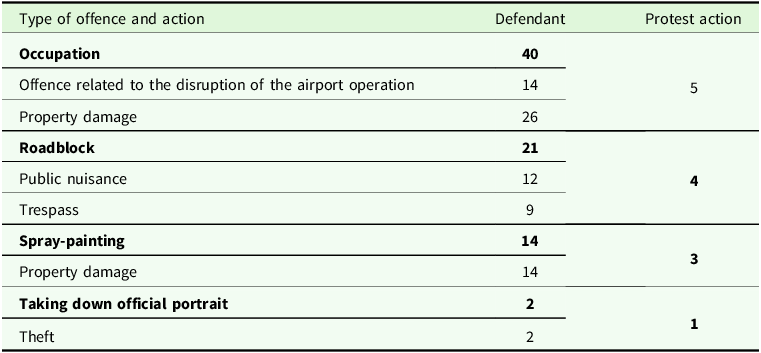
Secondly, I regrouped the protest actions into three main types: (i) occupation (i.e., bank, airport),Footnote 171 (ii) roadblocks,Footnote 172 (iii) spray-paintingFootnote 173 and theft.Footnote 174 Occupation is the most used mode of action in the cases analyzed across the four jurisdictions. This subdivision shows that similar collective actions are not always charged with the same offence. Actions based on occupation have been charged with an offence related to the disruption of the airport operation, public nuisance, and trespass. Roadblocks have been charged with public nuisance and trespass. Theft (taking down the presidential portrait) and property damage (spray-painting) have been charged for the remaining cases.
Finally, looking now at the offences brought against the activists, it was possible to identify three main categories of offence across the four jurisdictions: (i) property damage, (ii) unlawful entry, and (iii) offences related to the disruption of airport operations.
Starting with the severity of the offence, UK property damage is the most serious offence with a maximum penalty of a ten-year prison sentence. Trespass, on the other hand, is the least serious offence in the UK, with a maximum prison sentence of three months. However, for similar offences the sentence can go up to three years in Switzerland, and a maximum of one year in Germany. The maximum penalty is an important feature as it will have an influence on the duration of the criminal record in France, Germany, and Switzerland, whereas in the UK the penalty depends on the conviction or the age of the defendant, which can affect the social movement mode of action.Footnote 175
We saw above that an action such as occupation and roadblock is not always charged with the same type of offence, which can be an indication of the discretionary power of the prosecutor. It can lead to a lack of options in planning a defence before the arrest and therefore restrict judicial opportunities. The qualification of the offence charged by the prosecutor can sometimes be a point of contention. A concrete example of the discretionary power in such cases is that in the UK, if the damage exceeds £5,000, defendants can elect to be heard by a jury. This has led to situations in which activists would claim to have caused a higher level damage in terms of monetary value than the offence with which the prosecutor would otherwise have charged them.Footnote 176 Furthermore, as developed in the next subsection, the charges can also restrict the availability of a defence, although there was no evidence of this pattern in our case selection.
5.2. Types of Defence
I regrouped the different defences into four categories: fundamental rights, lawful excuse, defence of necessity, and others. I will here discuss the various defences in terms of their efficiency and aim. Lawful excuse in the UK is linked to specific statutes, such as section 5(2b) of the Criminal Damage Act 1971,Footnote 177 which enables activists to develop their defence to justify their actions.Footnote 178 In contrast, the use of a public nuisance chargeFootnote 179 for disruptive ‘blockade’-style protests effectively deprives defendants of recourse to either lawful excuse or the defence of necessity, leaving them with little opportunity to present a legal defence to justify their action and explain their motives before the court.Footnote 180
In the UK, one reason to explain this choice is that lawful excuse defences have a far wider scope, and include human rights-based defences. In addition, this distinction is important in the context of climate activism, as judges have consistently ruled out the necessity defence, which is the most used defence in our sample. The Court of Appeal has now systematically made it unavailable in all protest cases in the UK.Footnote 181 Similarly, in France and Switzerland, the necessity defence is not available for climate activists. Indeed, in the Take Down Macron Protester Case and Credit Suisse Protesters Trial,Footnote 182 the relevant Supreme Courts excluded the use of the necessity defence in the context of climate protest, which shows a restriction of judicial opportunities, in terms of defence, for reactive litigation in the four jurisdictions.
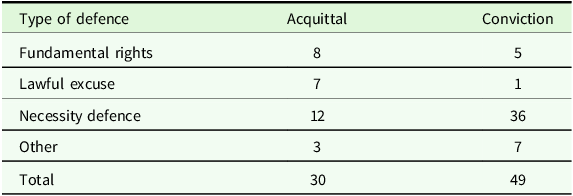
The highest acquittal rate occurred with the use of a fundamental rights-based defence, such as freedom of assembly or expression protected by domestic constitutions as well as the ECHR; as mentioned above, this type of defence is often drawn from lawful excuse in the UK. These defences are relatively successful in that they led to three acquittalsFootnote 183 and, in two cases, the reduction of a prison sentence.Footnote 184 This is an interesting defence for protecting the fundamental right to protest, precisely because it is often restricted. As Demay argues, it is legal argumentation with clear and established criteria, which can make it easier for a judge to apply in cases related to protest action.Footnote 185
Finally, some defences called upon experts to testify in court. Out of our 13 cases, I found that expert testimony was mobilized in only three cases,Footnote 186 notably because judges sometimes argued that the court was not a political forum and, therefore, testimony linked to climate change should not be presented to the court. The presence of experts has been recognized generally as significant in environmental and climate activist trials, as well as in all climate-related litigation. It plays an important role in the communication of the grievance, as well as disseminating the available science relating to the contested issue to the judge, jury, and wider public.Footnote 187
5.3 Outcomes of the Procedures and Composition of the Court
In the 13 cases analysed, 79 defendants were prosecuted, with 30 acquittals and 49 convictions. This means that there is a 62% conviction rate in the criminal proceedings of the case sample (Table 4).
Types of Action and Offences Charged

Table 4 Long description
A table comparing types of defence and their outcomes in criminal proceedings. The table has five rows and three columns. The column headers are Type of defence, Acquittal, and Conviction. The row labels are Fundamental rights, Lawful excuse, Necessity defence, Other and Total. Row 1: Fundamental rights, Acquittal, 8; Conviction, 5. Row 2: Lawful excuse, Acquittal, 7; Conviction, 1. Row 3: Necessity defence, Acquittal, 12; Conviction, 36. Row 4: Other, Acquittal, 3; Conviction, 7. Row 5: Total, Acquittal, 30; Conviction, 49.
Type of Defence and Outcomes

Table 3 Long description
A table categorizing types of actions and offenses charged, listing defendants and protest actions. The table has 3 columns and 9 rows. The columns are labeled ‘Type of offence and action’, ‘Defendant’, and ‘Protest action’. Row 1: Occupation, 40, 5. Row 2: Offence related to the disruption of the airport operation, 14, blank. Row 3: Property damage, 26, blank. Row 4: Roadblock, 21, 4. Row 5: Public nuisance, 12, blank. Row 6: Trespass, 9, blank. Row 7: Spray-painting, 14, 3. Row 8: Property damage, 14, blank. Row 9: Unhanging official portrait, 2, 1. Row 10: Theft, 2, blank.
Regarding the type and the level of conviction of the 49 activists, most received a suspended fine (20 individuals), 11 received an immediate fine or financial penalty, 13 received a suspended prison sentence, and four had an immediate prison sentence imposed. Only four defendants were convicted with an immediate prison sentence of four months. Three defendants were released by the higher court on conditional discharge after three weeks in prison. Fines ranged from €250 to €500, and most suspended prison sentences were for a maximum of 12 months; 13 activists were also sentenced to 120 to 180 hours of unpaid work.
Finally, the analysis found that the composition of the court can play a vital role in the verdict, at least in the UK. Differentiating the acquittals handed down by a jury and a judge is interesting in addressing the receptiveness of judges or juries to the arguments presented before them.Footnote 188 In respect of jury trial, Barkan highlights that a hung jury or an acquittal will often as a consequence have strong and positive media coverage of the activists. Footnote 189 This, in turn, will also galvanize the members of the movements and can contribute to an increase in their financial and operational resources.Footnote 190 Furthermore, it has been highlighted that ‘because of the unpredictability of juries, the authorities have often been keen to keep cases away from the Crown courts wherever possible’.Footnote 191 This is confirmed in the UK context as Hayes highlights that juries tend to be more sympathetic to defendants and may be more willing to deviate from strict legal interpretations, ultimately of benefit to activist defendants.Footnote 192
6. Conclusion
The present study was designed to give an overview of 13 climate reactive litigation cases, involving 79 defendants across four European jurisdictions (France, Germany, Switzerland, the UK). The cases were cross-analyzed to determine the trends that can be established between them. Through the analytical lens of reactive litigation and judicial opportunity, the discovered trends reveal both how states respond to climate activism through the criminal justice system and how activists react to their prosecution.
Reactive climate litigation provided useful frameworks to analyze the phenomenon of the prosecution of protest actions and dissent across the four jurisdictions. Ultimately, the study offers insights into the conceptualization of reactive litigation and the types of action that are predominantly criminalized. It also further highlights the relevance of judicial opportunity to reveal how the criminal justice system (i.e., the selection of charges, defences, and court composition) creates varying opportunities and constraints for defendants. Future research might refine the typology with a broader sample of cases.
The research undertaken in this article has led to several findings. Firstly, the analysis demonstrates that most prosecutions can be categorized as anticipated and desired reactive litigation, where activists deliberately engage in actions that are likely to result in arrest and prosecution as a strategic tool for advancing their cause. These findings can be paralleled with the findings regarding proactive litigation, where the number of strategic cases is growing by the year. This means that defendants consistently transformed their courtroom appearances into opportunities to articulate their motivation and educate both judicial actors and the broader public on the urgency of the climate crisis. Secondly, in terms of the type of action, the predominant forms of protest that were criminalized include occupation, roadblock, spray-painting of buildings, and theft.
Thirdly, the use of the concept of judicial opportunity revealed several trends. To begin with, prosecutorial practices in terms of charge selection reveal a trend in the restriction of judicial opportunities for activists in the UK. Prosecutors increasingly select charges that limit available defences, where public nuisance charges (which have no possibility of mobilizing the lawful excuse defence) are preferred over charges relating to property damage. Furthermore, charges were sometimes considered to be too severe in relation to the defendant’s action. This trend suggests a reduced tolerance of protest and dissent in the public space and can be seen as a broader restriction of the right to protest. Future research on this question with a larger case sample could focus on this question to explore whether a similar trend in fact exists in each jurisdiction. It could also be beneficial to bring a deeper analysis of different national contexts to gain a more comprehensive understanding of the phenomenon, both as a tool of repression for the state, as well as a tool used voluntarily by social movements to express their cause.
Defence strategies show that fundamental rights-based arguments (freedom of assembly and expression) achieve the highest success rates for acquittal, while the defence of necessity has been systematically excluded by the Supreme Court in France, Switzerland, and the UK. The limited use of expert testimony also indicates judicial reluctance to engage with climate science in criminal proceedings. In addition, jury trials in the UK demonstrate greater receptivity to the activist arguments compared with judge-only proceedings, suggesting that court composition significantly influences case outcomes. Indeed, in the UK, acquittals were more likely when cases reached jury trial compared with magistrates or judge-only proceedings. Fourthly, with regard to the conviction rate, 38% of the cases ended in an acquittal. With this number, it seems that the criminal process itself could also be seen as a punitive measure, as it is often lengthy and the activists are unaware of the outcome of the case in advance.
To conclude, even though the scope of this study is limited in terms of sample size, this article provides the conceptualization of reactive litigation as a valuable conceptual framework for a better understanding of the criminal prosecution of protest action and dissent. In addition, the systematic content analysis approach of the study provides a replicable methodology for comparative analysis of prosecutions for protest, opening several avenues for future inquiry, which could produce interesting findings that account for more cases and create an in-depth analysis of the dynamics present in the criminal system.
Acknowledgements
I extend my deepest gratitude to the TEL reviewers for their enriching comments and suggestions on the earlier version of this manuscript. I wish to thank Sophie Serrano, Camille Montavon, Anna Galmiche, Steven Cammiss and Elizabeth Perry for their suggestions and advice during the revision of this article.
Funding statement
Not applicable.
Competing interests
The author declares none.


 Open access

