Personal recollections of Béla Bartók almost invariably mention his passionate interest in nature, describing his fondness for identifying plants and trees, his tendency to deliver impromptu lectures on soil erosion or the behaviour of woodpeckers, and his constant quest to add to his insect collection.Footnote 1 While this interest certainly overflowed into the musical mimesis of natural imagery, such as the calls of the fire-bellied toad in the fourth movement of Out of Doors (1926) or the song of the eastern towhee in the second movement of the Third Piano Concerto (1945), I believe there is a deeper and more intimate connection to nature in Bartók's music. Several decades ago, Bence Szabolcsi claimed that ‘organic unfolding through change, the process of creation, was undoubtedly Bartók's characteristic means of organization’ and – even though ‘a direct connection between experience and work can be established only extremely rarely’ – that Bartók incorporated his personal understanding of nature into his music in the ‘deepest sense’.Footnote 2 He supports this idea with a passage from Bartók's often-quoted 1907 letter to Stefi Geyer, in which the composer confesses that if he were to cross himself, ‘it would be in the name of nature, art, and science’.Footnote 3 For Bartók, it seems, these three ‘aspects’ were comparable to the Christian trinity – separate but united, each sharing the attributes of the others – and Szabolcsi writes that ‘this basic position, this three-fold unity, determines not only Bartók's musical lifework, but also his scientific activity and his human, ethical attitude’.Footnote 4
Indeed, when Bartók's son Peter, commenting on his father's insect collection, notes that ‘specimens were carefully arranged’, and that ‘there were examples from each part of the world he visited’, he could just as easily be describing the composer's collections of folk tunes.Footnote 5 This is no coincidence, for as Bartók explains in ‘A Magyar Népdal’ (The Hungarian Folk Song) (1924), he did in fact believe folk music to be a ‘natural phenomenon like the various forms of animal and vegetable life’, elsewhere going on to detail how it ‘evolves with the organic freedom of other living organisms in nature’.Footnote 6 By ‘evolution’, then, Bartók does not mean development in an everyday sense, but a process modelled specifically on biological evolution, a process that can even explain the creation of entirely new tunes. In an edition of Bartók's Hungarian Folksongs, Sándor Kovács – likely responding to Bartók's characterization of folk tunes as having older or newer forms, as being constantly and endlessly varied, and as being capable of changing gradually over time – interprets him in just this way, concluding that Bartók ‘tried to explain history on the basis of the theory of evolution’, attempting ‘to fill the gap between historically proven (or seemingly proven) facts with an evolutionary, logical construction’.Footnote 7 So, returning to the ‘organic unfolding through change’ Szabolcsi heard within Bartók's music, I understand this unfolding, and the ‘process of creation’ it engenders, as the resonance of the composer's evolutionary model of folk music within his own compositions.
The model
The evolutionary analogy
If Bartók's evolutionary speculations about folk music form the basis for a deep connection between his interest in nature and his own compositions, this immediately raises a problem of individual agency: how could folk music evolve independently of the wills and creative capacities of the musicians who made it and handed it down from one generation to the next? Bartók addresses this problem by asserting that folk music arises from the ‘transformative work of a natural force operating unconsciously in peoples not influenced by urban culture’, a force that ‘spreads’ throughout an entire class, serving as an ‘instinctive expression of the peasants’ musical feeling’.Footnote 8 The musical sentiment expressed, that is, is not an individual person's, but a collective impulse that individuals instinctively channel. Following this logic, Bartók then asserts that individual peasants do not compose entirely new tunes, but only improvise variations on existing ones – they achieve personal expression through the process of variation.Footnote 9 He didn't view peasants as unintelligent or uncreative, however; on the contrary, for Bartók, their naive and unselfconscious creativity was uniquely capable of approaching musical ‘perfection’. In his view (which few would probably share today), it simply wouldn't occur to peasants to compose entirely new tunes.
In an essay on ‘Hungarian Peasant Music’ (1933), Bartók depicts the workings of this natural force in greater detail:
Peasant melody is a very elastic material; its external form, being without an essential basis, is unstable even in the case of one and the same individual. When one hears any given melody sung several times in succession by the same person, one will generally notice certain slight alterations in the rhythm, sometimes even differences in pitch. It is a fair assumption that some of these unessential changes have become established in the course of time, or even that alterations of an essential character have been standardized by use. To these are later added, by other individuals, further essential or unessential variations of a similar nature, and so on and on, so that the last link in this chain-like evolution possesses a form far different from the original one.Footnote 10
Here the composer speculates that series of variations, in the form of quantitative changes, accumulate over time, resulting ultimately in a categorical change. And he seems more interested in these accruing changes or alterations than in comparing each variation to a supposed original. In fact, given his definition of peasant melody as ‘elastic’, which – since it is also ‘without an essential basis’ – I take to mean ‘flexible’ or ‘pliable’ rather than ‘tending to regain an original shape’, such an original version cannot exist. Each performance is instead unique, and the individual variations accrue in the musical material until an entirely new folk song is born.
The alterations that survive this process, it seems, are simply better equipped to express a particular facet of the peasants’ feeling or experience. In other words, these alterations are retained because of a communal selection, a selection forming a precise analogue to Darwin's revolutionary interpretation of natural selection. Just as Darwin argued that variation itself is not a creative force, Bartók argued that peasants do not individually compose new folk songs, an idea that would be equivalent to ‘saltation’ in biology, the theory that new species are created by giant leaps in variation. While biological tradition had viewed natural selection as a force for stasis, Darwin insisted on the opposite: that natural selection itself was the creative force, the engine of evolution. Bartók follows a similar tactic: rather than suggesting that his communal force acts to fix and retain folk songs, to keep them from changing too much from their original forms (the traditional view), he writes that ‘when the psychic disposition of the individual peasants in a given district . . . shows a typical affinity, it is quite natural that an evolutionary transformation should result’.Footnote 11
In the passage from ‘Hungarian Peasant Music’, however, Bartók qualifies the scope of this model, stating that it applies only to a melody's ‘external form’, which suggests that they must also have an ‘internal form’. Apparently, when determining whether a change is ‘essential’ or ‘unessential’, or when comparing one folk tune to another, it is these internal forms – communal ideas of particular folk songs existing more abstractly than their external counterparts – to which one must look. In biology, one example of ‘internal forms’ is the idea of species, which are classified at a higher taxonomical level than individual organisms (the external forms), making them more stable and less subject to variation. But since the internal forms of folk songs are susceptible to the constant and endless variation that characterizes Bartok's entire conception, they cannot be absolutely stable: qualitative change in an internal form, after all, would herald the creation of a new folk song. For Bartók, what seems to differentiate internal forms is not that they are stable originals, but that – unlike surface variations in external forms, which are intuitively created by their performers – the transformations of internal forms are instead a consequence of the communal, natural force Bartók proposes.Footnote 12
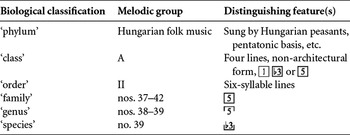
The surface variations, however, are not incidental, but crucial, for they form the basis of his entire organic analogy. In Serbo-Croatian Folk Songs (1941–2) Bartók writes: ‘Everyone will agree that each individual of every living species of animals or plants is a unique phenomenon. The same is true concerning folk melodies – a given performance of a folk melody has never occurred before and will never occur again in exactly the same way.’Footnote 13 Here he makes explicit the parallels between (1) individual organisms and musical performances and (2) species and what we may assume to be the ‘internal form’ of a folk melody: what is performed as distinct from particular performances. These parallels are summarized in Table 1. Just as in biological evolution, then, quantitative changes accumulate to create qualitative change, which is registered by a new internal form: a nascent species or folk song. The analogy with biological species, however, brings with it all the difficulties associated with the so-called ‘species problem’, such as the debate over whether species actually exist or the confusion created by the many ways scientists have devised to determine how to best define them. An example of one such difficulty can already be seen in the problem that Bartók's denial of stable forms creates for his classification of folk tunes:
Bartók's biological/musical parallels.

In such a long [evolutionary] chain of melodies, in which . . . neighboring melodies can be considered beyond any doubt and at first sight as a variant of the other, and the first one in the row is so entirely different from the last one that it should not be called a variant, one has to break up these melodies into two or more separate groups. Where shall one group end, where shall the new group begin? Which of the more or less similar melodies shall be considered variants; which not?Footnote 14
Lifting terminology from Table 1, Bartók's question becomes: As the external form of a folk song changes, at what point does its internal form undergo change? Or are internal forms also unstable, constantly changing? Part of Bartók's consternation seems to arise because he does view internal forms as constantly changing. As I have already suggested, it is consistent with his model to understand internal forms such as biological species: not static, but perpetually changing, only at a slower rate. When he categorically states that ‘I cannot say that a certain melody is as I notated [it] on the spot, but only that it was such at the moment I notated it’, that is, we should assume such instability not only in folk music's external forms, but also in its internal forms as well.Footnote 15
Taxonomy
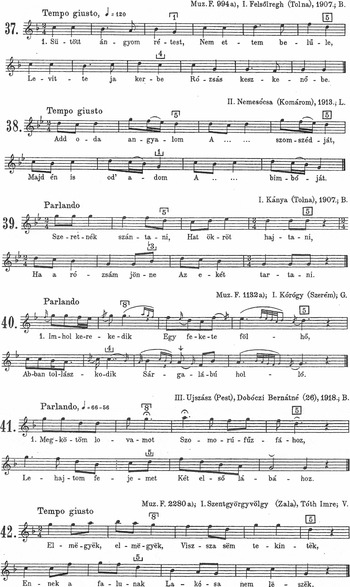
Bartók's solution to such problems was to create a genetic system of classification modelled after those in comparative linguistics, the branch of linguistics which aims to discover genealogical relations between languages through the comparison of their grammatical features. He explicitly likens ‘comparative music folklore’ to comparative linguistics by describing how the aim of the former is also to reveal ‘kinships’ or ‘relations’, only between folk musics rather than languages.Footnote 16 Example 1 reproduces a page from ‘A Magyar Népdal’ (1924) that gives transcriptions of six folk tunes, three of which are familiar from Bartók's own compositions.Footnote 17 Since he always aims to group ‘all melodies belonging to the same family, or being of similar structure and representing the same style, as near each other as possible, and presents all members of the variant groups together’, we can conclude that these six melodies are very closely related.Footnote 18 In terms of Bartók's evolutionary analogy, they would be closely related species, genealogically related internal forms varied in individual performances. It is important to note, however, that these numerically labelled forms are not ideal representatives created by Bartók, but merely the most typical or characteristic of the many variants he and others collected. This is consistent with the view that internal forms are constantly changing and therefore cannot be represented by some abstract, ideal form.Footnote 19
Nos. 37–42 from A Magyar Népdal (1924).

One can investigate the genealogy of these six tunes by beginning at the most general level – Hungarian folk music as a whole – and working towards the particular. While Bartók speculates about which features of Hungarian folk music are probably the oldest – ‘parlando-rubato’ metre, pentatonicism, etc. – the only real criterion he gives for determining if a folk tune is Hungarian is that it must be sung by Hungarian peasants whose expression is free from outside influence. More specific criteria come to the fore only when he divides Hungarian folk music into groups. He begins by dividing it into three ‘classes’: A, B, and C. Class A, to which nos. 37–42 belong, is made up of what he calls ‘old-style’ Hungarian folk tunes; Class B is made up of ‘new-style’ tunes; and Class C is a miscellaneous class, containing tunes that do not fall easily into either of the others.Footnote
20
More specifically, Class A tunes are distinguished by having (1) ‘four isometric [metrically regular] text lines’, (2) either 1, ♭3, or 5 as the final pitch of the second text line, what Bartók calls the ‘main caesura’, and (3) no reprise of the first text line's music.Footnote
21
A glance at Example 1 confirms that each of these tunes does indeed have four text lines in equal (or ‘isometric’) metre, 5 at its main caesura (which Bartók designates
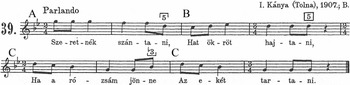
 ), and no reprise. As shown in Example 2, Bartók's label for no. 39’s form would be ABCC: the first three text lines are musically different, the last two are the same, and A does not return.
No. 39’s ABCC form.

Following his stated steps of classification – (1) divide tunes based on the number of lines, (2) divide tunes based on the main caesura pitch, and (3) divide tunes based on the number of syllables in each line – Bartók then further divides Class A into six subclasses by classifying the tunes according to the number of syllables in each line of text. He labels these subclasses with roman numerals: A.I through A.VI.Footnote
22
Since every tune in Class A has the same number of lines (four) and the same main caesura pitches (either 1, ♭3, or 5), syllable count becomes the next lower level of classification.Footnote
23
Nos. 37–42 in Example 1 thus all belong to A.II, which contains the eleven tunes in Class A with six syllables per line.Footnote
24
Continuing on, he further classifies tunes according to the pitches at the end of each text line, beginning with the main caesura (the end of the second). A.II, for instance, is divided into four subclasses defined by
 ,
 ,
, and
 , nos. 37–42 making up the group sharing
 . Bartók then divides those groups into subgroups based on the pitches at the end of the first line, marked by the symbol
 (
 thus indicates that the pitch at the end of the first line is 1). Nos. 37–42 – the subclass of Class A defined by
 – divide into three groups: no. 37 (defined by
 ), nos. 38–39 (defined by
 ), and nos. 40–2 (defined by
 ). Finally, he makes even further divisions by comparing the pitches at the end of the third line, marked by the symbol
 . Nos. 38 and 39 are distinct because the former has
 and the latter has
 .
In short, once tunes have been placed into subclasses based on the number of syllables in each line of text, Bartók further divides them based on a weighted or hierarchical consideration of the pitches at the end of the second, the first, and the third lines, in that order. The pitches at the ends of these three lines make up what Bartók calls a ‘fixed formula’, a framework on which tunes are improvised;


 , for example, is the fixed formula for a tune having ♭3 at the end of the first line,
 at the end of the second, and
 at the end of the third. Some tunes, such as nos. 41 and 42 in Example 1, have exactly the same fixed formula, so Bartók compares their overall compass (the distance between their lowest and highest notes): no. 41’s is slightly smaller, so given that ‘tunes whose compass is small may be considered as more primitive than tunes with a bigger compass’, it must (according to Bartók) be older than no. 42.Footnote
25
Similarly, he believes the oldest fixed formula for Hungarian folk music is


 , which would make no. 39 the oldest tune in the group. Still another metric that Bartók employs within each subclass is the distinction between parlando-rubato and tempo-giusto metres; he suggests that parlando-rubato tunes are probably older than tempo-giusto tunes, which would make nos. 39–41 older than nos. 37, 38, and 42.
Of course, such determinations of relative age have no particular taxonomic consequences, and Bartók provides no clear means of determining which of these metrics to privilege: metre, fixed formula, compass, or some other attribute. He even concedes that some of the tempo-giusto tunes may actually be older than the parlando-rubato tunes, for their rhythms could possibly derive from the measured rhythms of labour, the ultimate source, he believes, of all melodic rhythm.Footnote 26 More specifically, the ‘various stages of the evolution of rhythm’, according to Bartók, are (1) simple tempo-giusto rhythms derived from labour and dancing, (2) parlando-rubato rhythms that have become disconnected from the body and are therefore more relaxed, and (3) more complex tempo-giusto rhythms formed from the solidification of earlier parlando-rubato rhythms. The oldest tunes in The Hungarian Folk Song belong to the second category, for the original tempo-giusto tunes have apparently, like most other folk songs, been lost to history.
In any case, what becomes clear from this exercise is that particular metrics only allow for determinations of age to be made and that none of them allow Bartók to exactly determine descent, to place tunes within a precise lineage. One could not, that is, construct a detailed family tree including all tunes, but one could construct a taxonomical classification for a single tune, such as the one for no. 39 shown in Table 2. No. 39 belongs to Class A because it has four lines, lacks a reprise, and has a pentatonic basis (G–B♭–C–D–F). It belongs to ‘Order’ A.II because it has six-syllable lines: ‘Sze–ret–nék szán–tan–i’, and so on.Footnote
27
Note how, despite being as closely related as possible, nos. 38 and 39 are actually quite different in their surface appearances: no. 38’s characteristic lower-neighbour and quaver/two-semiquaver motives, for example, do not occur at all in no. 39. They are closely related, rather, because they share the same number of syllables and, more importantly, have nearly identical fixed formulas. Furthermore, given
and its parlando-rubato metre, no. 39 would appear to be older. Yet we cannot deduce that no. 38 is descended from no. 39 – there's simply no way to make that determination based on the metrics at hand. Such separation of species is an inevitable consequence of the incompleteness of the collection. Only a complete series of transitional forms could prove such determinations, but of course Bartók only had access to those tunes existing in his own historical present – tunes no longer sung are lost forever. Since very little of this music was ever written down, there are no ‘fossil’ tunes.
A taxonomy for no. 39.

So, Bartók created categories based on genetic, internal similarities (fixed formulas and so on) that relate tunes quite different in their external forms, seemingly creating a system of classification more genealogical than morphological.Footnote 28 Much like the fact that both birds and bats have wings is of little use in biological classification, motivic or textual similarities, which concern a tune's outward appearance, are of little use here. One problem, however, is that Bartók's fixed formulas are based on observable external qualities: unlike DNA, internal qualities are internal only because they belong to what Bartók considers a deeper, more stable, and older level of a hierarchical organization and thus undergo less variation and a slower rate of change. Since he represents internal forms as ‘classical’ categories – categories defined, that is, by a particular list of observable properties – Bartók's system of classification might appear to resemble the essentialist or phenetic species concept, which compares organisms based on morphological similarity irrespective of the organisms’ places in a historical lineage. But his insistence on genealogy and constant variation suggest that this systemization is merely a concession to the needs of what he considers a ‘scientific’ study of folk music.Footnote 29 In any case, since he does postulate evolutionary relationships between the elements of his observable properties – parlando-rubato rhythm being older than tempo-giusto rhythm, the pitch level of a tune's second caesura being older and thus more stable than its first, and so on – Bartók is able to use these observations to create a taxonomy, if not a fully formed family tree of tunes.
Tendencies and stages
Despite the impossibility of attributing direct relations of descent between tunes, Bartók, as we have already seen, felt perfectly comfortable making conjectures about the specific mechanisms that influence how folk tunes evolve – the general sequences they follow and the forces or goals that guide their evolution. Beginning with the overarching forces that create national folk musics, he notes: ‘We have to attribute the origin of homogenous stylistic forms . . . to the impulse for variation by a human mass set in the same direction and working unconsciously, a human mass . . . in close contact with each other and yet more or less isolated from the outside world.’Footnote 30 So Bartók believes that a collective, unconscious force (an ‘impulse’) can create a distinct musical style – defined by traits such as fixed formulas of phrase endings – if the class of people within which it works is immune to external influence. This belief is nearly identical to the idea of ‘geographic speciation’ in the theory of biological evolution, in which geographic isolation prompts the formation of distinct groups of organisms. In this case, the isolation of indigenous communities leads to the formation of national musical styles. But if these are the conditions for the genesis of a unique style, how does such a style actually evolve?
In ‘A Magyar Népdal’, Bartók lays out what he calls the ‘distinct evolutionary steps’ that determine the historical development of Hungarian folk music: (1) ‘short, one or two-bar motives’ evolve towards periodic forms; (2) these more periodic forms evolve into longer ‘three-line or four-line closed-form tunes without a more definite architecture’ (as in Class A); (3) these tunes finally evolve into ‘four-line tunes with clearly recognizable architectural structure’ (as in Class B). He also delineates similar tendencies for individual musical parameters: short text lines evolve into longer text lines, symmetrically divided lines evolve into asymmetrical lines, smaller melodic compasses evolve into larger compasses (as we saw in relation to nos. 41 and 42 in Example 1), and pentatonic tunes evolve into diatonic tunes, which then evolve into chromatic ones. Each course of development moves overall from simple to complex forms, though Bartók seems to have been wedded to this principle only on more global levels of evolution, where complexity can only be explained as having arisen from simplicity. But even at the most global level he qualifies the idea, noting that in some cases ‘the primitive may have come into being earlier than the less primitive’.Footnote 31
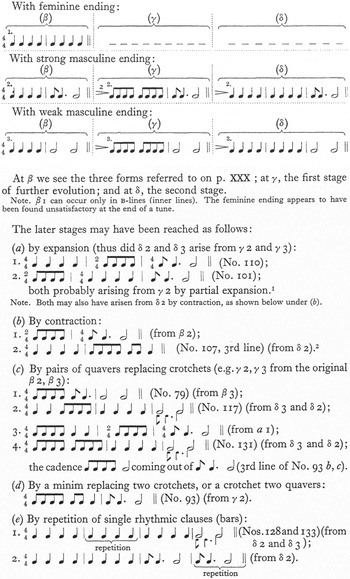
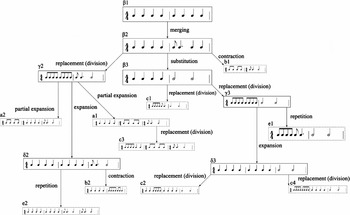
At more local levels, Bartók describes the operation of evolution as being more open-ended. Figure 1, for instance, reproduces his summary of rhythmic features in Class B melodies. He begins by presenting the three most basic rhythmic schemata inherited from Class A: β1, β2, and β3, shown on the left in Figure 1 under the headings ‘With feminine ending’, ‘With strong masculine ending’, and ‘With weak masculine ending’.Footnote
32
In β1 the form is made up of two 4/4 bars of crotchets. These three forms already have a supposed evolutionary relationship, for in his original discussion of Class A, Bartók asserts that β2 evolved from β1 and that β3 evolved from β2, but also admits the possibility, in connection with β2 and β3, that ‘perhaps the evolution took place in the opposite order’, in the other direction.Footnote
33
Whatever the chronology of derivation, β2 and β3 have each evolved into γ (gamma) forms, which then evolved into δ (delta) forms; Bartók indicates such derivations by the symbol
 . Following this exposition, Bartók lists the forces controlling how these seven forms may have ‘evolved further’, including (a) expansion, (b) contraction/replacement – either by (c) division into smaller parts (felaprózása) or by (d) ‘concentration’ (összevonás) – and (e) repetition.Footnote
34
He presents examples of such further-evolved forms for each impulse and labels them based on which force created them rather than from which of the seven basic forms they are derived. The examples in b1 and b2 (listed under the heading ‘By contraction’ in Figure 1) are thus grouped together not because they descend from the same basic form – Bartók in fact believes that b1 is descended from β2 and b2 from δ2 – but because they both result from contraction. Inherent to this constellation of tendencies is the possibility of moving contrary to Bartók's stated global courses.
Developmental tendencies in the rhythms of Class B tunes.

Figure 2 visualizes Bartók's conjectures in the form of a genealogical tree. While it would not be possible to create similar trees for the tunes themselves, such a tree is implicit in Bartók's description of the derivational relations between rhythmic schemas – all I have done is arrange them on the page. In Figure 2, β1, β2, and β3 are represented as the main vertical trunk and are connected by solid arrows labelled with Bartók's derivational descriptions. We see that β2 derives from β1 through ‘merging’, the final two crotchets of β1 being ‘drawn together’ (vonták össze) into a single minim. And β2 and β3 are related through ‘substitution’, the quaver and dotted crotchets being ‘exchanged’ (váltotta) for a minim.Footnote 35 Both of these descriptions are equivalent to force d – concentration – from Bartók's overview of Class B tendencies.Footnote 36 The other four of the seven basic schemata are offshoots from β2 and β3: the γ forms derive from the β forms through division, and the δ forms derive from the γ forms through expansion. Finally, the further-derived forms (a1 through e2) are shown within dashed boxes connected by labelled arrows. The rhythm of a particular line from a Class B tune may thus be placed within this diagram of durational tendencies, but since the diagram is only a vastly more detailed version of the individual tendencies described above, it likewise cannot be used to determine relations of descent between tunes. The implication that the global trajectory towards complexity may be contradicted at more local levels, however, is crucial, for the main quality towards which folk music aims, according to Bartók, is simplicity. Complexity is not a goal of the evolution of folk music, because Bartók views ‘genuine’ folk music as aiming – free from corrupting urban or foreign influences – towards ‘artistic perfection’.Footnote 37 They are models ‘of the way in which a musical idea can be expressed with utmost perfection in terms of brevity of form and simplicity of means’ and ‘of how to express an idea musically in the most concise form . . . briefly yet completely and properly proportioned’.Footnote 38 Unlike the universal evolutionary tendency of progressing from simple to complex, Bartók understands individual folk tunes as driven towards an efficiency of means in expressing a single specific musical idea.
A genealogical tree of Class B rhythms.

Given that it strives only towards a general state – ‘artistic perfection’ – rather than a specific preconceived form, such a drive towards perfection is plastic, pliable. Artistic perfection thus seems to be, for Bartók, akin to reproductive fitness in biological evolution, and for this reason varies from people to people and from style to style; the notion of fitness, after all, varies according to environmental conditions, so artistic perfection must vary according to cultural conditions, even within a single national or geographical locale. And for this reason, Bartók supposes that folk music evolves in multiple streams rather than in a single line: ‘The rise of a new style does not immediately eclipse the old style, which can continue to exist alongside the new one. Thus it may happen that in peasant melodies still existing among any nation a whole series of layers, representing different styles, is to be found.’Footnote 39 His use of the word ‘layers’ evokes the idea of geological strata containing sedimented musical material, but unlike some of his contemporaries Bartók did not view older layers as being necessarily more primitive, seemingly existing solely to explain the origins of more recent, more advanced, and in the end better forms. Rather, newer styles are for Bartók often degraded, not only by the sullying influence of unassimilated foreign elements, alienating modernity, or corrupting capitalism, but also by the intentions of individuals who nearly always fail at achieving the naïve perfection of nature. Figure 2 may thus be taken as a microcosm of Bartók's larger view: different lineages of folk music coexist, but rather than being the most highly evolved and therefore ‘best’ examples, each is one among many particular adaptations that achieve some local goal.
At this point, we can summarize Bartók's evolutionary model of folk music by listing the following tendencies: (1) folk tunes undergo variation at every level, and as these small differences accrue, qualitatively new forms (or ‘species’) arise; (2) as a result, there are no original versions of tunes; (3) the evolution of folk music is guided by an unconscious, communal force that works through an entire class of people; (4) folk tunes branch out like a bush or tree rather than evolving in a single line, thus making later forms not necessarily better or more advanced than earlier ones; (5) while there is an overall statistical movement from simple to complex, individual tunes or groups of variants are free or more indeterminate in their development, sometimes even evolving from complex to the more simple; (6) the evolution of folk music has no goal, except for the localized and plastic quality of ‘artistic perfection’; and (7) whereas complete novelty can only be the result of individual, subjective decision, the evolution of folk music is continuous and gradual.Footnote 40
An analytical/interpretive method
Kovács writes that Bartók's system for classifying folk music ‘reveals the most, more than any document, about the scientific – and, indirectly, artistic – views and thinking of the composer’.Footnote 41 To this we might add Edward Gollin's more recent assertion that, in addition to shedding light on his style and aesthetics, Bartók's ethnomusicological work can offer ‘specific analytical insights’.Footnote 42 Elsewhere, I have traced such insights by developing an interpretative method that can shed light on evolutionary processes working both through and within Bartók's own music, a method involving the elaboration of two ideas: (1) a conceptual shift from a relatively historically static major/minor tonality to a more multivalent, evolving one; and (2) the reconceptualization of motives or themes as having no single or original forms, but rather as being related genetically, as somehow evolving in their own right.Footnote 43 Since there is only room here to briefly demonstrate the outlines of such a method, what follows is a short analysis approaching one piece – the fifth of Bartók's Eight Improvisations on Hungarian Folk Songs (1920) – from both perspectives.
Tracing a harmonic evolution
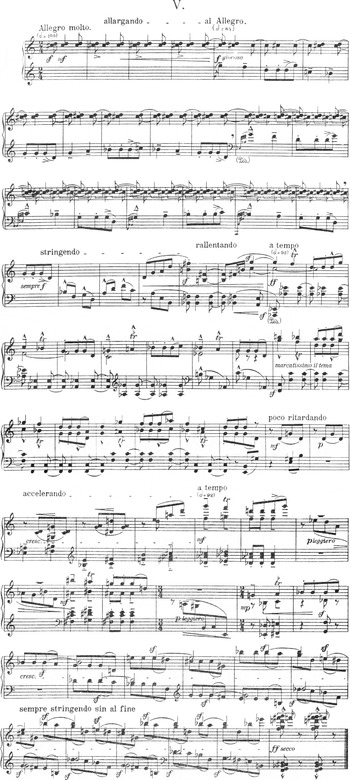
Example 3 presents the score for the Fifth Improvisation, which begins with a statement of a pentatonic tune contrasted with a syncopated ostinato: the dyad C♯–D. Such minimal accompaniments are, of course, typical for Bartók. He discusses this technique in multiple places, most succinctly in the second of his Harvard lectures: ‘Pentatonic melodies are very well imaginable with a most simple harmonization, that is, with a single chord as a harmonic background.’Footnote 44 The Improvisation's syncopated ostinatos, however, are hardly ‘simple harmonizations’. At first, they may seem to contrast with the tune: rather than complementing it, emphasizing the ‘background’ quality of such repeated sonorities, they appear to be a chromatic canvas on which the tune is painted. Adding to this contrast is the strumming accompanying the second statement (beginning in b. 13). Perhaps there is a different way to understand these chromatic ostinatos – not as a mere chromatic backdrop, but as derived from sonorities in some way genetically related to a more traditional triadic accompaniment.
The Fifth Improvisation (1920).

Any explanation of the dyad's relationship to a more conventional harmonization would have to begin by tracing its history or genealogy, and according to Bartók, the most natural chord for harmonizing a pentatonic melody is the seventh chord containing four of the melody's five pentatonic pitches: G–B♭–D–F, in this case.Footnote 45 But if G–B♭–D–F can function as a kind of ‘ancestor’ chord from which variations issue, how do we arrive at C♯–D? ‘The Folk Songs of Hungary’ (1928) – in which Bartók actually describes several derivations of harmonies from folk tunes – provides a possibility:
A principal motive in my [Second Suite (1905)] is as follows:

The final chord of the movement is
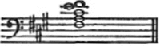 , which is a simultaneous resonance of all four (or five) tones of the motive: a condensed form of the same, to a certain extent, a vertical projection of the previous horizontal form . . . The incentive to do this was given by these pentatonic melodies.Footnote
46
He continues:
Rumanian and Slovak folk songs show a highly interesting treatment of the tritone:

These forms [are] brought about by the free use of the augmented fourth, the diminished fifth, and of chords such as:

Through inversion and by placing these chords in juxtaposition one above the other, many different chords are obtained.Footnote 47
Since the minor seventh chord forms the final chord of the third movement of his Second Suite (1905), Bartók understandably connects it to one of the piece's motives, but he also comments on how pentatonic folk tunes were his initial ‘incentive’ for doing so. Arpeggiations of minor seventh chords (minor triads with minor sevenths), moreover, are to be found everywhere in Class A Hungarian folk tunes. More interesting, for our purposes, is Bartók's derivation of chords containing augmented fourths or diminished fifths.
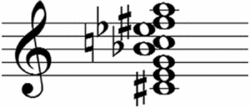
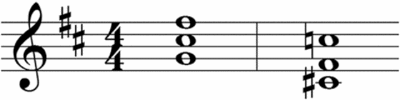
The first chord he presents – the diminished triad B–D–F – may not seem particularly unusual, but we must remember that what Bartók is proposing is that this chord, like minor seventh chords, can stand alone as an independent harmony, and may even be able to function in some circumstances as a kind of ‘tonic’. He suggests that by juxtaposing such chords, ‘many different chords are obtained’, and juxtaposing diminished triads creates what Lendvai called ‘alpha’ harmonies, such as the one shown in Example 4.Footnote 48 But Bartók's second chord – G–C♯–F♯ – opens up even more possibilities. As shown in Example 5, it has a distinct inversional form in the same way that major and minor triads, while inversionally related, nevertheless constitute distinct forms. One can characterize these chords as a perfect fifth (F♯–C♯) with a third pitch (G or C♮) lying a tritone from either of its other constituent pitches.
One of Lendvai's ‘alpha’ harmonies.

Bartók's second chord and its ‘inversion’.

Both versions of this trichord could be labelled (016), but since this label severs such harmonies from their origins, I hesitate to do so. Bartók, after all, considered both of his folk tune examples in ‘The Folk Songs of Hungary’ (1928) to be in a ‘lydian mode’ with a G final. In the first tune, C♯ lies an augmented (or lydian) fourth above G, which, combined with the seventh F♯, creates Bartók's verticalized harmony. But while C♯ originates here as 4 in G lydian, once verticalized it begins to take on a new, harmonic valence. In the second tune, by the time C♯ appears in the penultimate bar, C♮ has already been established as 4. In this case, C♯ could either be heard as an alternative prime to C♮ – the caesura pitch of the first half of the tune – or as an alternative fifth to D, the fifth of the final G. Thus, depending on context, C♯ can be interpreted as a melodic ♯4, as a harmonic alternative fifth to D (especially if spelled D♭), or as an alternative prime to C.Footnote 49 This tendency towards simultaneous alternative primes and fifths is, of course, analogous to Bartók's famous use of simultaneous major and minor thirds in triads. Continuing his use of Greek letter names, Lendvai labelled a chord containing the prime, fifth, and an alternative prime (such as C♮–C♯–G) as a ‘beta’ chord and a chord containing the prime, fifth, and an alternative fifth (such as G–D♭–D) as a ‘delta’ chord.Footnote 50 These chords – both of which belong to set class (016) – are found so frequently in Bartók's music that he felt they deserved their own names.
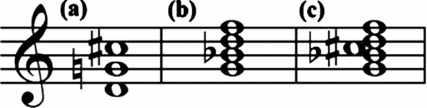
Example 6 presents a possible genealogy for the C♯–D dyad in the Fifth Improvisation based both on Bartók's second chord from ‘The Folk Songs of Hungary’ and on the ‘expected’ minor seventh ancestor chord described above. First of all, we must understand the second chord from ‘The Folk Songs of Hungary’ as a demonstration of a certain tendency, not simply as a particular isolated harmony. This tendency may then be applied in various musical contexts. Example 6a presents the particular inversion of the chord found in the Fifth Improvisation. It is the G final combined with the dyad C♯–D (as in b. 12, the final bar of the first statement): prime G, perfect fifth D, alternative fifth C♯. Applying the tendency described above to Example 6b – the expected or ‘most natural’ G minor seventh chord G–B♭–D–F – is simple: one adds C♯, and the resultant ‘new’ harmony, shown in Example 6c, becomes a harmony from which the dyad C♯–D might be derived: G–B♭–C♯/D–F, a textbook example of one of Lendvai's ‘delta’ chords. Crucially, G–B♭–C♯/D–F is not ‘just’ a G minor seventh chord with an added C♯; it is an entirely ‘new’ harmony genetically related to a G minor seventh chord by a particular tendency Bartók discovered in folk music – a subtle but vital distinction. This view is satisfyingly validated by the final sonority of the piece: the chromatic trichord F♮–F♯–G in b. 68 rests atop this very chord.
A possible genealogy for the C♯–D dyad: (a) as an ‘inversion’ of Bartók's second chord; (b) as Bartók's ‘ancestor’ minor seventh chord; (c) as a new ‘tonic’ harmony.

The difficulty in describing or labelling this harmony or the G–B♭–C♯/D–F ‘tonic’ of the Fifth Improvisation arises precisely from the fact that ‘(01469)’ and ‘altered G minor seventh chord’ are equally unacceptable descriptions, for the first severs the sonority from its genealogy and the second denies its status as an independent, new harmony. Importantly, G–B♭–C♯/D–F could also function here analogously as a kind of ‘tonic’, so the ‘key’ of the Fifth Improvisation is not merely G minor with some added or altered pitches, but a new, independent expression of key, a ‘key variation’ belonging to the G minor species. ‘G minor’, that is, could be understood as a tonal species, and the key of the Fifth Improvisation – which, following Bartók's ‘phrygian-coloured C major’, his famous designation for the First Bagatelle (1908), we might label ‘lydian-coloured G minor’ – could be a particular individual belonging to that tonal species.Footnote 51 Just as each performance of a particular folk song is, for Bartók, a unique realization of an abstract, communal idea – an ‘internal form’ – so each of his compositions can be understood as elaborating an individual key that realizes the communal idea of a key species.
Tracing a motivic evolution
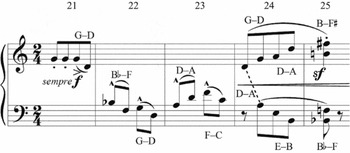
When one thinks of evolutionary processes in music, an evolution specifically of tonal resources is probably not what first comes to mind. One usually imagines, rather, some kind of internal motivic process that develops and evolves over the course of a piece. We can hear the Fifth Improvisation as an exemplar of such a process. After the first statement of its tune (beginning at b. 5), the Improvisation presents three more complete (if variously accompanied) statements of this tune, after which it scatters, sequences, and juxtaposes the tune's motivic material. Two passages, however, are not occupied by statements of the tune: the first four bars, which introduce the C♯–D dyad, and bb. 21–7, which act as a transition between the second and third statements. This latter brief episode is remarkable, for it foreshadows the motivic isolation and manipulation that follows. First of all, the final two pitches of the tune (G and D) are isolated: in b. 21 the accompaniment abruptly ceases, and rather than repeating the tune a third time repeats its final G–D perfect fourth alone an octave higher. As shown in Example 7, this perfect fourth, hardly enough to be called a motive, is then transposed: in b. 22 the repeated G–D in the right hand moves to B♭–F and G–D in the left and then to D–A (shifted so that the emphasis is on A, the lower pitch) and F–C in b. 23. In b. 24, this single succession bifurcates: each hand continues to break perfect fourths but follows a different path.
The succession of the perfect fourth motive and its bifurcation.

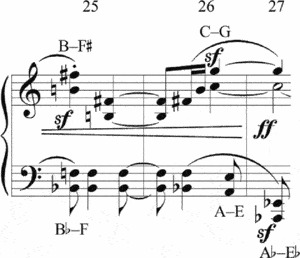
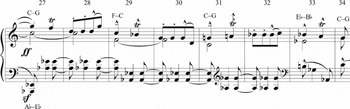
The right hand begins an ascending series of ascending perfect fourths while the left hand begins a descending series of descending perfect fourths. D on the downbeat of b. 24 could be said to be the final pitch of the single succession or, given that it is shared by two statements of the perfect fourth motive (D–A and G–D), the first pitch of the bifurcation. The hands then expand chromatically – even ineluctably – towards the beginning of the third statement of the tune at b. 27. Example 8 presents bb. 25–27, where B–F♯ in the right hand ascends to C–G while B♭–F in the left hand passes through A♮–E♮ to A♭–E♭. As shown in Example 9, the left hand's syncopated perfect fifths (on A♭–E♭) in b. 27 become an ostinato accompaniment, while the right hand, in addition to stating the tune, harmonizes the pitches of the tune on the downbeat of every other bar with pitches lying a perfect fifth below: C below G on the downbeat of b. 27, F below C in b. 29, and so on. The isolated perfect fourth from the tune thus turns – or evolves – into its own accompaniment.
The chromatic expansion of the perfect fourth motive.

The third statement of the tune and its perfect fifth accompaniment.

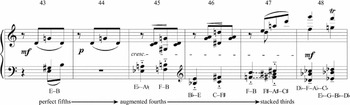
The significance of this passage, however, only really becomes clear in context, by observing how it is framed within the rest of the Improvisation. The first twenty bars are expository, providing a baseline measure on which we can form expectations or make judgements about what follows. In the first two statements, the tune is contrasted with a syncopated ostinato: our C♯–D dyad in the first statement (bb. 5–12), to which C♮ is added in the second (bb. 13–20). After this exposition, the episode in bb. 21–7 seems even more remarkable. Coming after the sharp contrast between tune and ostinato in the first twenty bars, the subsequent transmutation of a segment of the tune into a version of the ostinato is shocking: the boundaries between two seemingly self-contained, polarized categories are effaced. Yet an interval-size gap remains between this new perfect fifth ostinato and the earlier chromatic ones. The process is not yet complete, but rather continues, at least in the left hand: the harmonic perfect fifths that begin in b. 27 carry on the transpositional process, moving from A♭–E♭ in b. 27 to F–C in b. 35 and then on to E–B at b. 42.2. In b. 45, however, a meta-process begins: rather than just continuing to transpose an unchanging model (perfect fifths), the model itself begins to change. As shown in Example 10, the parallel perfect fifths now contract to become parallel augmented fourths, beginning with E♭–A♮ at b. 45.1. In b. 47.2, this process of contraction continues, the augmented fourth F–B becoming the major third F♯–A♯ (shown with dashed lines in Example 10), which launches a passage of parallel chords made up of stacked thirds: D♭–F–A♭–C♭ in b. 48, and so on.
The new process of contraction in bb. 43–8.

This new meta-process also reveals the possibility that the chromatic ostinatos of the first two statements and the ostinato on perfect fifths (beginning in b. 27) could be related by a continued contraction, by minor thirds contracting into minor seconds. The major thirds over the bass – D♭–F and E♭–G in b. 48 – contract to minor thirds in b. 55 as E♭–G moves to F♯–A in the outer voices, setting off a long passage (bb. 56–67) that elaborates the fully diminished seventh chord G–B♭–D♭/C♯–E, made up entirely, of course, of minor thirds. While minor thirds never directly contract into minor seconds in the Improvisation, the final harmony (G–B♭–C♯/D–F) is, as noted above, topped by the trichord F♮–F♯–G. The chromatic ostinatos from the opening, then, can be heard not only as the result of some historical evolution of tonal resources, but as the result of a process internal to this particular piece: the contraction of perfect fifths into minor seconds. We can hear the episode beginning in b. 21 as the launching of an evolutionary sequence whereby a segment of the pentatonic tune (melodic perfect fourths) becomes not only its own accompaniment (the perfect fourths inverted to perfect fifths and verticalized), but also its own unlikely chromatic accompaniment (perfect fifths ultimately contracted into minor seconds), revealing a genetic connection between objects that were ostensibly opposed.
The best way to describe such processes is not immediately clear. The most obvious way would be to adopt a transformational approach, and there are several recent precedents – analyses by David Lewin, Edward Gollin, and John Roeder in particular – that demonstrate its usefulness for Bartók's music.Footnote 52 These analyses focus on short, largely pedagogical works or etudes that do not treat motivic material in the same way as, for example, a large-scale sonata or dramatic work. Edward T. Cone describes this as a distinction between (1) ‘textural’ motives that are ‘global and stable’, permeate a piece, and undergo ‘varied reiteration’, and (2) ‘thematic’ motives that are ‘local and transient’ and undergo true transformational development.Footnote 53 The Scherzo from Bartók's Suite Op. 14 (1916) (discussed by both Gollin and Roeder) and the second of his Études Op. 18 (1918) (discussed by Gollin), for example, present surfaces very similar to the C major Prelude from the first book of the Well-Tempered Clavier, Cone's exemplar of ‘textural’ motives.Footnote 54 These pieces repeat and transmute the same basic arpeggiated figure over large sections, a perfect substrate for investigating transformations on a reiterated, stable object.Footnote 55
For the most part, however, my interests lie elsewhere, in those motivic relationships Cone calls ‘thematic’, for these kinds of relationships can better be understood as being ‘genetic’.Footnote 56 The opportunities for applying standard transformational theory to Bartók's works are relatively rare, due in large part to the self-consciously evolutionary nature of his motivic technique. The construction of a generalized interval system, after all, involves equivalence (and equivalence classes), but the concepts of perpetual variability and the concomitant interpenetration of categories preclude any strict application. What defines a motive as belonging to a category is determined by its relationships with other motives, just as what defines an organism as part of a species is its relationships to other organisms – not its individual, isolated attributes or properties. The only way to determine the nature and degree of such relatedness would be to construct some kind of genealogical tree (just as we did with Bartók's ‘Class B’ rhythms) in which a generator or root form is the common ancestor of all subsequent motive forms. It is also just as likely that we would discover that there is no generator, and that each form is one among many and gains prominence through repetition and by its contextual articulation.
Let us return to the Fifth Improvisation. The evolutionary process described above reveals, first of all, that in Bartók's music Cone's textural and thematic relationships are not necessarily distinct categories: in this piece, a thematic motive of a melodic perfect fourth becomes a textural motive of chromatic accompaniment through a process of inversion, verticalization, and contraction. But while this process is linear, it is, as we'll see, also part of a larger, blossoming tree of motivic forms, albeit a rather small one. Figure 3 presents this linear process as a series of nodes representing motivic forms connected by generic transformational descriptions. All the transformations within the nodes of Figure 3 can be understood simply as transpositions: all the melodic perfect fourths are related by transposition, all the harmonic perfect fifths are related by transposition, and so on. In evolutionary terms, each transformational community would be a species (each element equivalent by being a member of that species) and the stream itself an evolutionary process of transmutations by which new species are formed.
The linear process in the Fifth Improvisation.

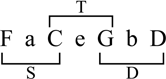
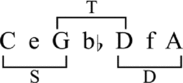
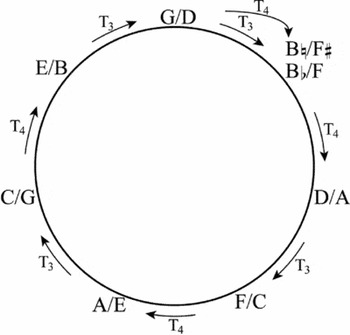
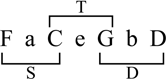
Most interesting is the transpositional pattern within the initial ‘melodic perfect fourths’ node and its sudden transmutation into the ‘harmonic perfect fifths’ node in bb. 21–5. The transpositions of the perfect fourth motive initially seem to outline a minor seventh chord, G–B♭–D–F, following an alternating minor third/major third pattern. After this succession bifurcates in b. 24, the left hand continues this pattern.Footnote 57 So rather than thinking of this process as outlining a particular chord, it might be more fruitful to view it as simply cycling through minor and major thirds. Such cycles recall the key representations first devised by Moritz Hauptmann in Die Natur der Harmonik und der Metrik (1853) and later picked up and expanded by countless others.Footnote 58 In modelling major and minor keys as a series of interleaved fifths and thirds, Hauptmann wraps these cycles around on themselves, creating circles. This comes up in his discussion of diminished triads, for diminished triads are only possible in a series of minor and major thirds if one views the series as wrapping around on itself: ‘We can picture the idea of something passing into itself by thinking of a finite straight line bent into a circle with its beginning and end united.’Footnote 59 In Figure 4, Hauptmann thus models C major in terms of a cycle of alternating major and minor thirds. The brackets group the tones into tonic, dominant, and subdominant triads. Figure 5, now, portrays the G ‘dorian’ of the Fifth Improvisation in similar terms. Given its appearance in bb. 21–5, I have chosen E♮ rather than E♭ to fill out the figure. The tune itself only has six pitch classes: the G minor pentatonic scale and A (G, A, B♭, C, D, F).
C major.
G dorian.
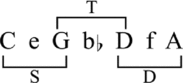
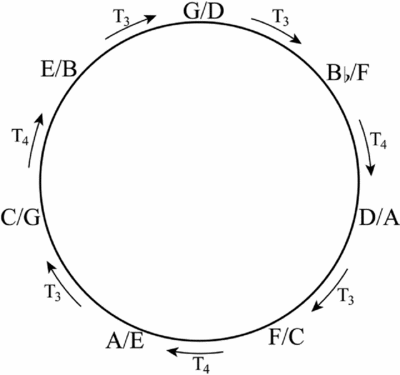
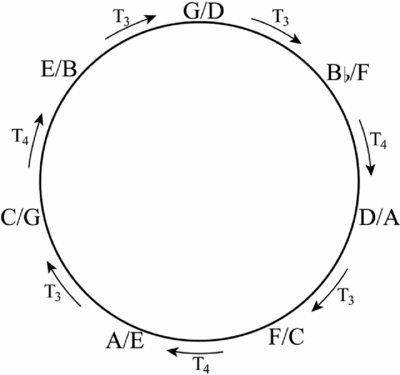
Figure 6 organizes the series of major and minor thirds in Figure 5 as a circle with each pitch accompanied by its perfect fifth. The initial transpositions in the Improvisation (bb. 21–3) are shown as beginning at the top and progressing clockwise. In b. 24, when the hands part ways, the left hand continues clockwise, stating A–E and then an overlapping E–B: the gravitational pull towards the downbeat of b. 25 seems to speed up the process, allowing the left hand to skip C–G altogether. The right hand, however, moves in the opposite direction, in terms of both the circle (retreating counter-clockwise from F–C to D–A) and the register (ascending rather than descending). In b. 25 these conflicting trajectories clash, but it is not simply a matter of hands moving in opposite directions around the circle and meeting head-on: B♮–F♯ actually leaves the circle by continuing the cycle of major and minor thirds (the circle necessarily contains a kink of two consecutive minor thirds – here E–G and G–B♭ – native to any diatonic collection) and bringing the circular representation into conflict with a linear one, which can continue in one direction indefinitely. Figure 7 visualizes this idea of ‘leaving’ the circle. The sonority on the downbeat of b. 25, B♭–B♮–F♮–F♯, is a product of the conflict between the two representations, which is so apparently jarring that it forces the motive, through inversion and verticalization, into a different motivic community.Footnote 60 Labelling it as an (0167), say, would be to ignore its role as an unstable intermediary, a by-product of a process.
A circular representation of the space traversed in bb. 21–4.
Leaving the circle and the resultant harmony in b. 25.

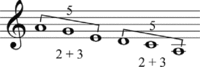
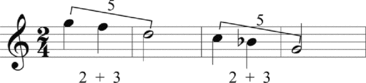
As noted above, the process proceeding from melodic perfect fourths to harmonic seconds is only a small part of a larger tree of motivic forms. The rest of the motivic forms, however improbable it might seem, derive from the ‘soprano’ descant in bb. 35–42, which is a grotesque or deformed version of the Improvisation's tune. The fact that the melodic perfect fourth motive isolated in b. 21 is not merely the final two pitches of the tune but the materialization of an idea that forms the entire basis for the tune gives this passage particular import. Example 11 presents what Lendvai called the ‘3/2 pattern’, which he believed to be a manifestation of the ‘golden section’.Footnote 61 However one characterizes this pattern (for the golden section remains controversial), it is prevalent within Bartók's pentatonic-based ‘Class A’ tunes. No. 42 in Example 1, for instance, descends through B♭–G–F–D in just such a 3/2 pattern. Example 12 simplifies the rhythms of the first four bars of the tune from the Fifth Improvisation. This tune constitutes an even better example of the 3/2 pattern, being an exact transposition of the first part of Lendvai's example. It consists of two descending 2+3 segments, each descending by a perfect fourth overall. This pattern forms the skeletal structure of the tune, made up of the pitches on the downbeat of each bar: (G–D–C–G).
Lendvai's ‘3/2 pattern’.

The 3/2 pattern in the first half of the Fifth Improvisation's tune.

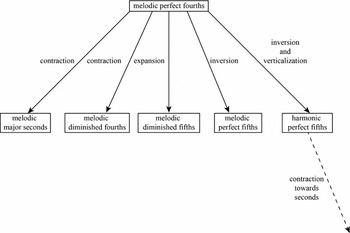
Example 13 parses the entire tune in terms of this skeletal 3/2 pattern, yielding a series of first disjunct, then conjunct perfect fourths. The most important result of such a hearing of the tune is that the final descending perfect fourth – the one isolated in b. 21, which begins the evolutionary process described above – is not simply the last two notes of the tune, but a representative of its most basic and pervasive structural interval. Example 14 presents the ‘deformed’ descant from bb. 35–42 and labels its altered perfect fourths. The descending perfect fourth between b. 1 and 2, for example, is contracted into a major second, and the perfect fourth between b. 3 and 4 is contracted into a diminished fourth. While these mutations may seem trivial, they represent a typical Bartókian practice: taking a theme or motive and compressing or stretching it. Figure 8 organizes all these motive forms into a genealogical tree that identifies the ‘melodic perfect fourth’ as the common ancestor. On the far right is the beginning of the linear process diagrammed in Figure 3, which is merely one branch. While the nodes themselves can be said to be defined by pitch equivalence, by transpositional transformations within each node, the transmutations between nodes cannot be understood in this way. They constitute, rather, the drives or tendencies that propel the perpetual variation, and each is labelled with a term borrowed from Bartók's writings: expansion, contraction, inversion, and so on.
Perfect fourths in the Fifth Improvisation's tune.

The ‘deformed’ version of the tune (bb. 35–42).

A motivic tree for the Fifth Improvisation.

Concluding thoughts
The Fifth Improvisation is a short piece and as such only reveals a glimpse of the pervasive motivic transmutations or expressions of multiple variations on ‘key species’ to be found in Bartók's larger works. But this small demonstration, I hope, reveals some of the possibilities inherent in the composer's evolutionary model: that it can serve not only as a potent source of new perspectives on Bartók's own compositions, but also as a potential corrective for understanding Bartók in terms of what Alain Badiou has called the ‘antagonistic scissions’ that characterize the twentieth century.Footnote 62 Bartók, for instance, rejected atonality as a category because he believed we always hear individual pitches and relations between them in tonal terms. While for Bartók there may be historical discontinuities in early twentieth-century music, continuities nevertheless remain at some level – the break is not absolute. And inherent to any view that posits an irreparable rupture in music history is a strict dualism between, or ‘scission’ of composers who realized the necessity of this break and those who did not.
Bartók's music, however, traditionally occupies an ambivalent position within this narrative. Adorno, for example, described Bartók as seeking to ‘reconcile Schoenberg and Stravinsky’, but falling neatly into neither camp.Footnote 63 This led him to some rather paradoxical descriptions of Bartók's music: while Bartók was one of the ‘most progressive composers’, certain of his pieces sounding as ‘heralds of the threateningly eruptive’, he was also ‘under the compulsion of origin and tradition’ and therefore ‘unable to get away from tonality’.Footnote 64 Adorno thus had to interpret Bartók as a composer who, while he initially took radical steps, retreated to conservative tradition in the end. And this led him – seemingly to avoid the task of having to label some of Bartók's pieces ‘progressive’ and others not – to retroactively denounce the very works he had previously praised. But what if Bartók's music were both radical (participating in this ‘eruption’ of the new) but also connected to tradition? What if, following his evolutionary model, we understand Bartók's music as belying any such ‘nondialectical juxtaposition’ of tonal and atonal music, or any strict separation between ‘motive X’ and ‘motive Y’?Footnote 65 As we have seen, in just the sixty-eight bars of the Fifth Improvisation, barriers between what we might think of as separate motives or even between harmony and melody as categories are quickly dissolved.