There are likely to be as many varied approaches to formulating an understanding of music that is indeterminate in its notation as there are interpretations through performance. Yet commentators seem curiously resistant to engaging with such works in ways that move much beyond a description of the scores and their function. This observation is surprisingly true of John Cage's Solo for Piano (1957–8), discussions of which have tended to focus on its notational idiosyncrasies. But just as valuable, in order to understand these works as evolving artefacts and as conduits of fresh musical experience, would be to take into account the process of performer realization and the resultant sound – both sounds past (through recorded performances) and sounds present (through the continued possibility of new realizations). In this article I seek to present and reflect primarily upon the latter, drawing upon my own experiences of performing the Solo for Piano.Footnote 1
Research on the performance of experimental music remains in its early stages. However, recent attempts have proved the worth of such approaches.Footnote 2 The studies of James Pritchett and especially John Holzaepfel on the performances of David TudorFootnote 3 are significant not only on account of Tudor's historical importance – as the first performer of most of the great ‘classic’ works of indeterminacy, including the Solo for Piano – but also in the way in which they depict a performer wilfully stretching the parameters suggested by many of the scores. Tudor's at times almost perverse approach to interpretation/realization in itself stands as a useful corrective to any attempt to fashion an orthodoxy regarding the performance practice of such music. The approach that I adopted when making a realization of the Solo for Piano was inevitably influenced as much by what I knew of Tudor as by what I knew of Cage. However, the analyses of Holzaepfel and Pritchett arguably tell us more about Tudor than they do either about Cage or, specifically, about the Solo for Piano.
Further study of the performance issues pertaining to this repertoire seems increasingly vital if our understanding of the works themselves is to develop. John Rink argues that ‘good performers are continually engaged in a process of “analysis”’ and that ‘each performance is an act of analysis’,Footnote 4 though he firmly roots such a position within the context of traditional Western notated music and associated concepts of ‘structural hierarchies’, ‘structural hearing’, and ‘communication’. Discussion of the performance of indeterminate music cannot follow those traditional routes that have sought to articulate through performance the formal, melodic, harmonic, and motivic relationships to be found in the music.Footnote 5 Instead it is the choices performers make – the possibilities they include and those that they exclude – and the methodology behind those choices that must form the basis for further study. In outlining here some of those choices as they affect large- and small-scale decisions, it is my intention to distinguish between, on the one hand, what can be defined as being true and consistent of the work and, on the other hand, those components that are subject to infinitely varied interpretative approaches. The practical ways in which performers must negotiate the openness of Cage's notations, translating from hypothesis to sounding reality, and the creative questioning of the realization-making process, necessarily lead to a deep analytical engagement with the work.
Interpreting the Solo for Piano
The Solo for Piano is the pinnacle – though not necessarily the most radical – of Cage's indeterminate notations. It could be said to represent both a summation of the explorations of the previous five years and a catalyst for the radical rethinking of the composer's traditional role that he undertook during the 1960s. In common with the preceding works it has partially defined parameters (instrumentation, certainly, and some pitch content), but at the same time it points towards the more open scores of the next ten years, notations that serve either as templates for creating a score or as descriptions of a musical event that may guide future realizations.
The Solo for Piano has been described in detail elsewhere, along with the work with which it forms a whole, the Concert for Piano and Orchestra, so only a brief summary is necessary here. The sixty-three pages of score feature a total of eighty-four notational types, each with an alphabetical assignation (A–Z, followed by AA–AZ, BA–BZ, and finally CA–CF), though a very few of these are duplicates of previous notations. These notations – which will henceforth be referred to as distinct pieces (even when they re-occur in the same form) – come in different sizes and lengths, many stretching over a number of pages, with the result that each page consists of up to ten different pieces and three pages include no pieces at all.Footnote 6 Cage consulted the I Ching in order to ascertain whether a notation would represent an entirely new method, or a duplication or variation of an earlier notation.Footnote 7 Hence many of the earlier notations are used a number of times throughout the score (most notably notations A and B, which are used six times each, and G, I, M, and O, which are used between four and five times each). Meanwhile, from AE onwards notations are used only once or twice (with the sole exception of BK, used three times), and from BN onwards each notation features only once (with the exception of BX, which is used twice on the same page). It follows also that the earlier notations are more closely related to methods used in the 1950s – specifically in the Music for Piano series (1952–6) and Winter Music (1957), as well as one notation derived from the time-specific pieces 34′46.776″ and 31′57.9864″ (1954) – while the later notations tend to use more obscure methods, related to Variations I (1958) and Variations II (1961).
Although the instructions for each notation type vary in their range of specificity and/or ambiguity, pianists are given no instructions concerning how to navigate their way through and around the score, nor of how to construct a performance of any given duration. There are no indications as to preferred density of sound, rate of movement, or the number of pieces to perform, whether in a single durational unit or concurrently; nor are there suggestions of how to ‘compose’ a realization; in other words, that is, Cage articulates no preferred methodological approach. It would be entirely feasible to give a performance that had not been ‘realized’ in advance (i.e. renotated in a manner other than that of Cage's score) if the pianist were carefully to select those pieces that allow for a relatively traditional reading of the musical notation (namely moving from left to right). But it is more likely that the pianist will make some form of realization, of certain notations at least, in advance. The ways in which these pieces are then ordered might vary from an improvisatory selection in performance to an entirely fixed sequence (possibly involving pieces being superimposed or cut up) or a mixture of these polarized approaches.
Two contrasting interpretations, both recorded, demonstrate the range of possibilities. Steffen Schleiermacher's recording of just the solo piano part represents a relatively straightforward approach, interpreting a selection of single pieces in isolation. The recording allocates a track to each piece; thus many of the pieces he selects for his interpretation can be readily identified from the score, uncluttered by superimposed or fragmented readings.Footnote 8 In complete contrast, David Tudor's approach in his second realization, as documented by John Holzaepfel, is an entirely surprising and disruptive one, which makes any attempt to trace the sounding result back to the score virtually impossible, with the occasional exception of a few isolated chords.Footnote 9 Tudor used only those notations that can be interpreted as single attacks (single notes, noises, chords, etc.), as distinct from those that suggest a connected succession of notes. Having made content realizations for each of his selected pieces, Tudor meticulously allocated to each sound a precise moment of occurrence within a ninety-minute time-frame. The precise location of each sound was deduced by relating the position of the event within the length or area of the selected piece as indicated proportionately to the total length of time (90 minutes, or 5,400 seconds). Tudor's final step before notating his working version was to select just 472 of the total 789 events to use in the final piece.Footnote 10 This last step suggests a feeling on Tudor's part that to use all the events – which would mean superimposing 789 ninety-minute pieces – would create too dense a realization.Footnote 11
Tudor's version makes clear that a large proportion of the work lends itself to realizations that are defined by distinct single events in time. Such a realization would align the Solo for Piano with immediately preceding works in Cage's output, such as Music for Piano and Winter Music. While the notation frequently makes these associations transparent, there is also much within the score that looks considerably more gestural, at times even flamboyant. Tudor's realization either ignores such pieces through omission, or defines them in such a way that they conform to the aesthetically bounded and highly refined collections of single sounds that characterized the experimental music of the 1950s to such a degree.Footnote 12 In so doing, he establishes a performing tradition (or, at least, a reference point) that is not only symptomatic of the time but also, paradoxically, a subversion of the piece. If the score for the Solo for Piano could be said to be a direct response (and possibly a challenge) to the creativity of Tudor,Footnote 13 Tudor's response to Cage's score transcends the expectations it projects, foreshadowing the even more radical approach that Tudor adopted with Cage's Variations II a few years later.Footnote 14
In contrast, other recorded interpretations would seem to position themselves somewhere between the extremes of Schleiermacher and Tudor. In general, interpretations are characterized by a blurring of the divide between pieces, making any specific piece difficult to recognize immediately. But occasionally identifications are possible, such as those of notation F from page 2 in Joseph Kubera's recording, or notation B from pages 34–6 in Marianne Schroeder's recording.Footnote 15
Tudor's version represents a very calculated realization, one which takes its cue from Cage's own methods in that, once the parameters of any given piece have been decided upon, the subsequent internal decisions (essentially those that affect the detail or content) are given over to chance – or, in this case, measurements. Other pianists may adopt a considerably less automated methodology. Joseph Kubera, for instance, has talked about moving between realizations of pieces that he has fixed and others that he might read from the score and realize afresh.Footnote 16 Likewise his approach to the ordering and pacing of pieces is more intuitive, and takes account of the very different sense the piece acquires when performed with orchestra.
My own approach in respect of the Solo for Piano has been to use chance procedures to determine most aspects of a realization, a realization which then becomes fixed. This general approach is typical of my realizations of Cage's post-1951 scores; in particular, I have worked this way in performing Music for Piano, Variations II, and Songbooks (1970), as well as in certain works by Earle Brown and Christian Wolff. It is my intention to accept the results of the chance procedures even when they seem to produce impossible combinations, taking my cue from Cage's instruction in Music of Changes that in such cases ‘the performer is to employ his own discretion’.Footnote 17 Though I enjoy and frequently practise improvisation, through chance procedures I find that I am able to learn more about my instrument and my technique.
Before I outline my approach, it is important to stress that it represents my preferred method, one that in many ways reflects my own personal tastes and curiosity. As mentioned earlier, Cage offers no indication of a preferred or correct methodology. I have thus far made two realizations, both following more or less the same procedure, though the first realization was for a forty-five-minute performance and the second for a twenty-minute performance. My choices in part reflect Tudor's abstract approach to the work, combined with an interest in creating a complex web of smaller pieces throughout the total time-frame. I use chance to determine:
1 which page to realize (numbers from 1 to 63, repetition of pages already used allowed at any time);
2 whether or not the page should be realized over the entirety of the forty-five-minute duration (following Tudor), or whether it should be realized within a more limited time-frame succeeding the previous event;
3 the duration of each time-frame;
4 whether any piece on a page should be omitted (allowing for the possibility of all pieces on a page to be omitted);
5 whether the pieces should be notated in succession or superimposed, each lasting the duration of the time-frame;
6 whether the page is to be read vertically or horizontally;
7 whether all the material of each piece is to be used or whether the pieces may be fragmented or played in part only;
8 whether or not dynamics and/or ways of playing, if not already determined, should be determined for each event.
Once this process had been established, crucial to the outcome was the loading of chance involved for each decision. My inclination regarding certain decisions changed between my first and second realizations of the Solo, partly as a result of the different durations of the two versions and partly as a result of my experience with the first realization, which affected my decisions regarding the second in particular ways (this will be discussed below in relation to density).
Although I have made two fairly substantial realizations, there remain a number of pieces that I have yet to make use of (i.e. that were not selected by the chance procedures in step one above). This highlights the wealth and abundance of material that Cage's Solo makes available to the pianist. In many ways it should be considered less as a score and more as a resource or a portfolio from which material may be generated; indeed, my own forty-five-minute realization has itself acted as a source of material for subsequent performances in different contexts. No single interpretation is likely to represent all the material available, and the multiple possibilities open to the interpreter within just a single piece make the Solo for Piano a work that is uncontainable: it resists definition, and at micro- and macro-levels the score can be only the beginning of a process, a prompt for action rather than a description of sound. Given the considerable freedoms described above, the remainder of this article is a brief attempt to examine what can be regarded as characteristic of the work, thus providing a clearer framework for its study than has hitherto been proposed. Broadly, one can identify three interpretative areas that significantly shape the identity of any given performance. These are: 1) duration (macro-level and micro-level); 2) structure and density; 3) sounding content. These will now be discussed before attention is turned to micro-level decisions regarding individual pieces.
Duration (macro-level)
Generally speaking, the total duration of any performance of the Solo for Piano is likely to be decided upon in advance, whether on the basis of a pre-prepared realization or a programming decision. This is especially true when it is performed with an ensemble as part of the Concert for Piano and Orchestra. The conductor's score for the Concert allows for a twenty-minute realization, but the first performance, as documented by George Avakian on the classic recording (Tudor 1958), lasted twenty-six minutes. Antic Meet, the Merce Cunningham Company piece that is danced to the Concert for Piano and Orchestra, lasts approximately thirty minutes. Of nine existing recordings of the Solo with (some form of) ensemble, interpretations last between 8′ and 28′, with most lasting between 20′ and 28′. Recordings of the solo version alone, however, last between 21′ and 39′. Somewhat exceptionally, the recording on the famous Indeterminacy album (Tudor 1959), featuring Tudor's performance of the Solo for Piano combined with elements of Fontana Mix (1958–9) along with Cage's reading of a succession of minute-long anecdotes, lasts ninety minutes. This recording aside, my recent forty-five-minute full ensemble version would appear to be significantly lengthier than other ensemble performances.Footnote 18 The most probable reason for the twenty-five-minute average, beyond the historical precedent, is that the instrumental parts offer much less material than does the solo part, and specifically do not allow for the repetition of material. And while one could imagine an ensemble performance that was more pared down and ‘minimal’ than the usual interpretations, it would require a particular kind of ensemble (and possibly audience) to engage in a Wandelweiser-style long-duration interpretation.
The conductor's role involves essentially mimicking a clock, moving the arms faster or slower and thus changing both the pace of time and the duration of the realization overall. The preface to the score for the Solo for Piano suggests (in brackets) that the determined length of time for any performance may ‘be altered by a conductor when there is one’,Footnote 19 yet it is generally accepted that in performances with orchestra the pianist works independently of the conductor, creating a realization (or sequence of realizations) of necessarily limited duration so as to be compatible with the ensemble material. Petr Kotík, who has performed the work numerous times, including in the composer's presence, insists that Cage intended the pianist to have that independence,Footnote 20 and such a view is supported by Tudor's realization. As a solo work, however, the Solo offers limitless possibilities, especially if the repetition of pages is allowed for, and one can imagine a situation in which the pianist continually adds realizations to an ever-expanding portfolio.
Duration (micro-level)
The durations of individual pages and pieces within a page are on the whole unprescribed. The pianist may interpret them freely in the performance moment, possibly guided by the proportional relationships between pieces, or may ascribe a duration to an individual piece or page in advance, either by chance or other means. As mentioned above, I decided to use chance to determine the duration of a single page, and subsequently either stretched all the pieces on that page across that duration (superimposing them) or laid them out successively, dividing the duration equally according to the number of pieces on the page. (I also allowed for the possibility of a single page being stretched over the total duration of the work.) In my first realization, I used durations of between fifteen seconds and two minutes, in fifteen-second increments, which reflected the fifteen-second divisions of time in the conductor's part, but resulted (predictably) in some extremely dense and difficult configurations. For the second realization, I used time-frames of between thirty seconds and four minutes, again in fifteen-second increments, which resulted in a less dense realization overall, though still with sections of considerable difficulty. In both I paid no regard to the size and length of the piece, so that frequently an extended piece, spread across a number of pages, is compressed within a shorter time-frame than a much smaller piece.
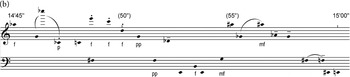
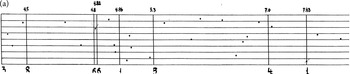
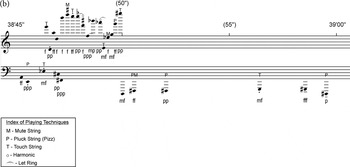
Having decided on a duration for each page, and thus for each piece on the page, I was able to make measurements such that units of space (in millimetres) were equal to units of time. This method is a straightforward matter for notations that are to be read left to right (which is by far the majority). Other notations, though, require a more abstruse reading, possibly circular rather than linear (see notation A, Example 1a). Here, given that the relations between notes are temporal (the pianist moves from one position in opposite directions in the proportions given, resulting in a Nancarrow-like counterpoint), my choice was to divide the allocated time space equally in order to reflect the proportions given (Example 1b).Footnote 21

John Cage, Solo for Piano: (a) notation A; (b) author's realization.

Some pieces contain within them a time division, such as F in which the numbers placed above the stave indicate ‘seconds or other time units’ (emphasis added). In this piece the numbers are spaced equally on the page but are unequal in terms of their number distribution. Thus (if the numbers are read as seconds) two equal graphic spaces may have very different sonic outcomes as a result of being read at a different temporal rate. This technique is derived from Music of Changes, in which the page is divided equally in terms of bars (each bar being equal to ten centimetres) but the tempo indication is in a continual state of flux. Notations Y, AQ, and others also use this technique, though the instructions specify time units of seconds. As a rule, though, the freedom accorded the performer concerning the durations of individual pieces means that there is very little that can truly be regarded, and agreed upon among performers, as being definitive of the work. A single piece might, if the pianist were to so choose, last an hour. Alternatively it might last a few seconds. Even in the case of a more traditionally notated piece, the duration accorded it might affect the way it is perceived by the listener and cause it to be unrecognizable as the same piece from one performance to another.
Structure and density
Arriving at a method by which to structure a performance is perhaps the most fundamental interpretative issue in the Solo for Piano. Even with an approach like mine, which utilizes chance processes to determine the majority of features, it is in the broader interpretative choices concerning structure that the performer's aesthetic judgements come to the fore. Issues to be considered include: the balance of activity/non-activity (intentional sound/silence); the degree to which any piece is projected in a clear, linear fashion, in contrast to a fractured, interrupted projection (as in Tudor); and density of activity (superimposition of pieces, rapidity of juxtaposition, etc.).
Clearly, Tudor's radical approach is an extreme one, not only typifying Pritchett's notion of the score as a ‘tool’ but also perverting the idea that the score is a collection of pieces.Footnote 22 Doubtless there are other equally radical approaches to making a realization, serving a variety of performance contexts. However, for now I wish to focus on the issue of density and rate of activity, which was a formative issue for me as I prepared my realizations. It is with judgements such as these that the pianist is forced (knowingly or otherwise) into the role of composer, as opposed to merely the interpreter of Cage's notations. The degree and rate of activity in any performance significantly shapes the way in which the work is perceived and understood. It is a compositional variable similar to Cage's decision to use between one and eight layers of activity in the Music of Changes or to allow for up to twenty pianos in any given performance of Winter Music. Likewise, the decision to include an equal number of units of silence to sounding events in the compositional procedure of Music of Changes represents an aesthetic decision – a matter of compositional judgement – by Cage.
These kinds of essential aesthetic decisions were at the core of Cage's compositional technique of chance, namely the posing of the right questions. In 1990, when asked by Steve Sweeney-Turner whether he had stipulated any time restrictions in the performance of Scottish Circus, Cage rather casually hinted at these fundamental properties: ‘One-third music and two-thirds silence, or half and half, something like that. But then if you, say, had 20 people doing that, you'd want less music on the part of each one. Probably, the thing to do would be to find what seems to be the right density.’Footnote 23 The level at which Cage's aesthetic judgement operated is revealed candidly in these remarks even though, at the same time, he frequently insisted that he always accepted the outcome of chance procedures:
I have never used chance operations to arrive at a preconceived goal. In other words, I've never been in the situation of not liking, and because I didn't like, changing the answers I received. I have sometimes renounced the questions that I've asked. I have thrown away some work, seeing that it was trivial, since I had not found the proper questions. But I've never thrown away the answers to the questions that I've considered to be useful questions to ask.Footnote 24
These ‘questions’ – a term that Cage often used – may as likely be musical as philosophical: questions as to density, duration, and other parameters set the framework within which chance operations subsequently function. Whatever the approach taken by the pianist – whether intuitively journeying through the score/realizations during performance or using a fixed notated version – the amount of material played at any point in time and within any time-frame is entirely a matter of judgement. There are no rules in the score to guide the pianist's approach, unlike the rules for interpreting individual pieces. Thus Tudor's interpretation resulted in a succession of generally single events (or, rather, single actions, which may result in a complex sonic configuration). In contrast, my first realization resulted in some passages of extreme density, at times resembling pages from Michael Finnissy's English Country Tunes (1977).
The possibilities for the superimposition and fragmentation of pieces are likely to be dependent upon the overall approach to making realizations. If the pianist makes realizations of individual pieces singly (either in advance or during the performance moment), drawing upon these in some fashion during the performance, it is likely that the density of events will be relatively low, depending upon the amount of material within that single piece. However, if a realization is prepared in which each page is treated as a single system (as the preface states), then it is possible to combine, fragment, stretch, and implode pieces in more creative ways. These two entirely valid performance approaches yield significantly different results. My process resulted in stretches of inactivity alongside other passages of frenetic activity, interspersed with periods of sporadic sound (as in Tudor's realization). In my first realization, due to its length and the number of elements given over to chance, there were considerably fewer moments free of sound and activity. (As my process of realization continued, there were more and more occasions on which a page was stretched over the entire duration of the piece, thus gradually filling up any empty spaces there might otherwise have been.) Greater experience of working with chance processes informs aesthetic judgements concerning the parameters and workings of any given piece. I have become more confident in my judgement on these matters over the past five years.Footnote 25
Sounding content
John Holzaepfel describes a photograph in the New York Times (11 May 1958) of Cage and Tudor preparing the piano for the first performance of the Concert for Piano and Orchestra:
A ‘slinky’ toy is stretched from the piano frame to the raised lid on Tudor's right. To his left, an unidentified object resembling a bottle with stopper is visible. Numerous other preparations, mostly screws, are visible between the piano strings. Tudor is reaching for the ‘slinky’ with his right hand; with his left, he is holding an unidentified object (perhaps a bass drum beater).Footnote 26
Tudor's recordings certainly bear out this evidence of a ‘noisy’ approach to the work, which itself hints at the pianist's later change of direction to become a composer of electronic music. It is also clear from the above quotation that Tudor prepared the piano, which is not a requirement of the work (nowhere in the score are preparations mentioned). Indeed, it came as something of a surprise when I set about making my first realization how infrequently noise elements are specifically called upon. Only ten of the eighty-four different notational types (totalling only sixteen of the 146 pieces) specifically require the use of noise elements and only eleven notational types (totalling twenty-six pieces) require the use of inside-piano techniques (plucking, muting, etc.). The majority of the pieces, taken at face-value, are decidedly ‘pitchy’. However, many of the notations could be interpreted to involve noise/inside-piano sounds, and there is nothing to suggest that the piano should not be prepared.Footnote 27
As mentioned already, a characteristic of the work, typical of the period, which unites its pitch and noise elements, is the emphasis upon single events. Of the 146 pieces, at least half could be said to be related to the notations of Music for Piano, Winter Music, or Variations I. Additionally, many other notations that lack these resemblances to earlier works lend themselves to being realized as single events. Tudor's realization, then, much as it might suit his particular perspective, is all the same not untypical of the nature of the work. There is clearly not going to be the recognition that one event should follow another in Tudor's performances; despite this, the portrayal of the work as a succession of single events corresponds with much of the work's content and with other recorded performances. Despite the many and varied notational types, the graphic extravagances very often reflect the composing means or simply increasingly abstruse and surprising means of generating sound. Their realization in sound invariably results in relatively straightforward single events. However, other notations allow for or suggest series of events, such as arpeggiations, groupings, counterpoints, textural masses, and so on.
It is perhaps surprising how many of the pieces have a high degree of fixity. Indeed, the graphic complexity of many of the pieces disguises a comparatively straightforward method of realization. If such pieces are performed in a normative mode – in other words, uncluttered by superimposed readings of other pieces, with notes played on the keys rather than inside the piano, with no application of preparations, and within a relatively short duration (so that the continuity between one sound and the next is not unusually disrupted) – then they lend the work a strong sense of individual identity, and hence provide the sort of reference points that might highlight commonalities, or at least enable meaningful comparison, between different performances.
The remainder of this article examines a few notations, not to demonstrate how they are often or typically performed but instead to suggest what, if anything, can be agreed upon in terms of their realization. An inventory of all notation types is beyond the scope of this article, and so a few pieces have been selected as illustrative of the main points. Three types of piece will be discussed: 1) pieces whose content is determined to an apparently high degree; 2) pieces that have a moderate degree of determinacy or that might be defined in terms of certain consistent properties; and 3) pieces that are mostly or entirely indeterminate.
Mostly determined
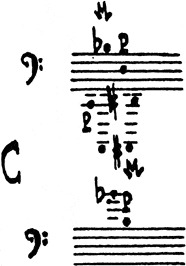
The numerous derivatives of the Music for Piano notations are fixed in terms of their pitch and their sequence (being read from left to right). Ways of playing are specified: notes are played ‘normally’, plucked, or muted. However, in Music for Piano Cage suggests that plucked notes might additionally be muted, and muted notes might also be plucked; and of course notes may be plucked at different points on the string, with nail or flesh, and may also be muted at different points on the string (resulting in varying degrees of pitch content, for instance using harmonics, or else no discernible pitch content at all). Additionally the following are not specified: articulation, dynamics, the duration of individual notes, and the duration of the piece as a whole. The use of pedal is occasionally indicated but mostly not. Thus notation C at the far right of page 1 (Example 2) might, if all notes are played clearly, last any duration beyond a minimum of two or three seconds. It would be reasonable to assume that the degree of fixity of this piece would enable it to be identified if performed within a timescale of between three seconds and, say, one to two minutes, but if stretched any longer the sequence of events is likely to be less readily discernible. However, if, for example, the low muted A♯ were to be played as a harmonic (an E4, for example) and the B♭ were muted using a large area of flesh (a fist or palm, for example), resulting in more noise than pitch, and the subsequent plucked B were to be muted similarly, then the seemingly fixed components that make up the sounding content of this piece would be eroded and this constellation of eight events would be less readily identifiable as notation C from page 1.
Cage, Solo for Piano, notation C.

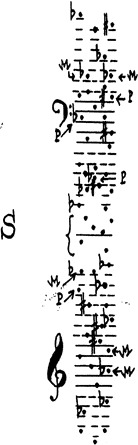
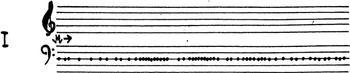
As so many of the pieces can be reduced to single events, it is not surprising that these Music for Piano-influenced pieces are ultimately likely to merge with other pieces and notational types. As someone who has spent a considerable time practising many of the pieces, my experience of listening to recordings is that at various points in any performance the pitch sequences come to the fore in my memory and recognition, only to dissolve once more into a murky entanglement of isolated notes, recognizable piano sounds (whether ‘normal’, plucked, or muted), and noises. The density of events too might affect the recognition of pieces: depending on the time-frame allocated to it, notation S on page 34 (Example 3) would be harder to recognize than other pieces that use the same notation due to its high density of events, while notation I on page 29 (Example 4) is possibly the single most readily identifiable piece in Solo for Piano, consisting of fifty-seven iterations of a single muted D, spaced variably.
Cage, Solo for Piano, notation S.

Cage, Solo for Piano, notation I.

Pieces that appear to group events tend to be more easily recognizable, though again this depends upon the time-frame within which they are contained, as well as the use of preparations, alternative ways of playing, dynamics, and so on. Notation E across pages 2–4, for example, consists of eight distinct phrases (the musical term seems perfectly appropriate here) read left to right (Example 5). Pitches are fixed and in fixed relationship to one another. Their spacing on the stave is suggestive of a temporal relationship, which is likely to be relatively consistent from one performance to another. Each note is allocated to either left hand or right hand, resulting in a degree of disruption as the hands cross each other in order to attain the furthest reaches of the keyboard. The freely drawn shapes that connect notes are entirely a function of the compositional method and bear no relation to the interpretation of the music: the pitches are simply read graphically, as they appear. This notation, which appears three times (again on page 20, as a single phrase, shorter than any of those on pages 2–4, and pages 49–50), is one of the most determinate and normative notations in the score.
Cage, Solo for Piano, notation E.

Partly determined
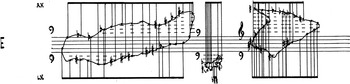
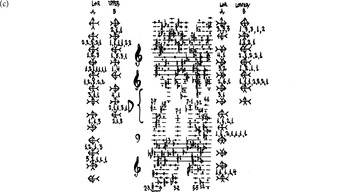
Almost as common a feature of the work as the Music for Piano notations are those that derive from Winter Music. Of the twelve pieces that either match or are derived from the Winter Music notations, two are fixed in terms of their pitch content, and the remaining ten are indeterminate in some way, mostly through the use of ambiguous clefs according to which a specified number of pitches should be read in one clef and the remainder in another. There are minor differences from Winter Music, such as specified numbers of notes to be taken as harmonics (silently depressed notes). Thus notation AG on pages 20–21 (Example 6a), which requires the pianist to omit any two notes from each chord, is almost as fixed as the Music for Piano notations. Likewise, notation B on pages 23–5 (Example 6b) will be almost entirely consistent in terms of its pitch content from one performance to another due to the proliferation of clefs matched to each chord and cluster chord (only one three-note chord is ascribed ambiguous clefs). In contrast, the dense notation D on page 37 (Example 6c) will be far more varied, given both the possibilities for arpeggiations in different configurations and the fact that approximately half the chords have ambiguous clefs. Furthermore, in many of these notations the possibilities for creating harmonics by silently depressing any number of the pitches of a chord mean that any number of notes (from many to just one) will be articulated as attacked events, with remaining notes creating varieties of after-resonance. These notations add a vertical dimension to the Music for Piano notations, resulting in a sonic texture that foregrounds distinct notes/noises and chords (or, as Cage describes them, ‘aggregates’), which include clusters.Footnote 28


Cage, Solo for Piano: (a) notation AG; (b) notation B; (c) notation D.

In addition to those discussed above, there are many pieces that will result in single events but whose definition is less prescribed. Notation Y, for example, is a point-based notation in which the points fall within (or between) eight vertically stacked spaces (Example 7). These are extended horizontally and are thus read left to right, matching space to time. However, the rate at which one reads the horizontal space will change, rather as in Music of Changes, so that, for example, the first division lasts 4.5″ in contrast to the second division, which is nearly three times the measured length of the first but only lasts 0.8″ seconds. Perversely, one of the divisions lasts 21.5″ (7.43–28.93) and includes only six events, while the division that precedes it lasts 0.87″ and includes five events (a situation reminiscent of Christian Wolff's newly developed notations of 1957, as pioneered in the Sonata for three pianos and Duo I for two pianists). In terms of pitch content, the possibilities are numerous: Cage allocates each space a number of adjacent chromatic notes so that, for example, the first division has three notes per space, meaning that the pitch range available is any two-octave span on the keyboard (from the lowest two octaves to the highest). The following division is grouped in units of eight adjacent notes, so that the total pitch range available is sixty-four chromatic notes. Thus the lowest note available could be anywhere between A0 and G2. It is not possible to improvise this piece: a certain amount of calculation is necessary to plan a performance of it. Once the prerequisite measurements have been made, however, the piece is likely to be indistinguishable in sound from any of the Music for Piano derivatives. While it is a pitch-based piece (no noises permissible in terms of the instructions), it may, of course, allow for notes to be plucked, muted, prepared, and so on.

Cage, Solo for Piano: (a) notation Y; (b) author's realization.

Notation Y typifies much of the content of the Solo for Piano, favouring isolated sounds in varying temporal relationship to one another. Despite these characteristics, which may be said, at a macro level, to typify much of the work, there are still many unpredictabilities, through the use of noise elements, the superimposition of material, silence, and so on. In both my realizations, the possibilities for repetition within pieces have taken me by surprise. Notation X features a notational direction that allows for the repetition of ‘something (or all, or any amt.) [sic] played before, but changing amplitude’, a device that could allow for considerable playfulness or (as in my realization, which utilized chance to determine how often and when to repeat material) a certain dadaistic quality. Likewise, notation M (and its derivative, Q) instructs that at intersections the direction of reading may change ‘if desired’, allowing (as Q makes explicit) for a sudden change from left-to-right to right-to-left. Again, using chance to determine the direction at each intersection, my realization of these pieces resulted in occasional tremolo effects, as pitches alternated repeatedly backwards and forwards (Example 8).

Cage, Solo for Piano: (a) notation Q; (b) author's realization.

Radically indeterminate
Finally, there are those notations that pre-empt the radical and open notations of the coming years. Though some of these require a no less rigorous approach to their realization than those discussed above, others are among the most open notations Cage ever wrote. Of the former, notations BB (pages 45–6 and 53), BJ (page 50), BV (page 53), and BW (pages 53–4) anticipate those used in Variations I (1958) and Variations II (1961). Again, however, once realized (the calculations necessary to realize these pieces are beyond the scope of this article) the sonic outcome matches many of the more determinate notations, in that it results essentially in a succession of single events with a worked-out amplitude, pitch (or noise), and duration (the ‘overtone structure’ referred to in the score, when applied as here to a piano, could refer to the way of playing, and/or varying degrees of resonance). Likewise, notation CC (page 57) anticipates (and is as good as contemporaneous with) the score for Fontana Mix (1958), requiring multiple measurements to arrive at a defined succession of events.
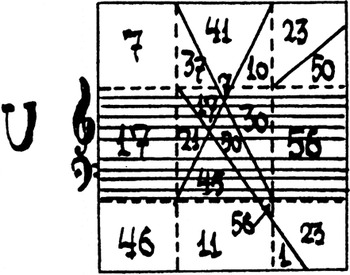
More surprising perhaps are those notations that allow for considerable freedom in their execution. Examples include notation U on page 16 (Example 9), which, as long as the number of notes is accurately accounted for, allows for them to be played in any manner and at any time; notation BX (used twice, both on page 56), which, despite a large number of specific pitches, has the instruction ‘All at once like a moment of a plant’; notation BT (page 54), which, like Cornelius Cardew's later Memories of You (1964), specifies where notes are to be played in relation to a silhouette of a grand piano; and, most surprising of all, notations AR and AV (pages 31 and 37–8 respectively), which bear the instruction ‘Play in any way that is suggested by the drawing’ – I cannot think of a comparable notation in all of Cage's output (Example 10).Footnote 29 Since its sole restriction is that it is to be performed on the piano, this graphic could be interpreted either by means of a single gesture or in terms of a free improvisation lasting several minutes, much as in another work by Cardew, Treatise (1963–7) – though such an approach would hardly fit a traditional Cageian performance perspective.
Cage, Solo for Piano, notation U.

Cage, Solo for Piano, notation AR.

The variety of notational types and the varied degrees of fixity obfuscate any attempt to define categorically the sonic characteristics of the Solo for Piano. Performers – who will generally have an intimate relationship with the score, having brought its ‘incompleteness’ to temporary completions time and again – seem well placed to aid our understanding of this complex work, since they will have had to ask the important questions discussed above. Having embarked on a realization, the performer is forced to consider crucial aesthetic decisions regarding density and texture, continuity and pacing, noise and pitch. Such decisions may be made apart from performing traditions, or, as Judy Lochhead describes it, the ‘musical community’ of the 1950s experimental music movement,Footnote 30 but it is more than likely that the place this work holds in the narrative of Cage's compositional development will exert some influence.
However, my emphasis in this article has been on how the work may be approached and understood in the present, distinct from notions of recreation or of reading the work through the prism of 1950s and 60s performance practice. There is clearly plenty of scope for difference even among performances that attempt to position the Solo within Cageian performance practice. My own interpretations differed significantly from Tudor's in their density, the dominance of pitch, the grouping of events, and the literal mapping of certain events from score to realization. Beyond this, the score holds open the possibility of both very short and very long realizations, of realizations of immense complexity and of drastic reduction, and of interpretations that either foreground noise elements and extended techniques or are exclusively pitch-oriented.
Instead of advocating approaches or proposing sounding models that are more or less ‘Cageian’, or even centred specifically on Tudor's practice, I would like to argue for an approach to the study of indeterminate music that examines the degrees of conformity within notations that are seemingly open, and likewise the potential for variation within notations that are more obviously closed. It is not unreasonable to argue that even the most radical of Cage's indeterminate works, such as the Variations series (1958–78), contain within themselves properties that are consistent from performance to performance. As David Miller notes, ‘Any specific set of instructions and symbols must necessarily constrain one's subsequent choices, even if this constraint happens at a very high level of generality.’Footnote 31 Both the heart of the work and the clues to understanding it lie in the relationship between this constraint and resultant performance action.
So in what ways can this score be engaged with or understood beyond a general aesthetic level? Certainly a detailed study of the individual notations, something that is beyond the scope of this article, might reveal further commonalities between notational types, and lead to an increased understanding of issues of pitch, noise, and density. But the study of performance would seem to be a more revealing and useful arena for future study. Recorded performances harbour much potential for future analysis, and would undoubtedly be a fruitful, if complex, line of inquiry. Alongside recorded data, some form of archive collection of sketches, realizations, and documentation from pianists would serve both to expand the range of interpretative possibilities and to trace a narrative of performance practice in relation to Cage in general and the Solo for Piano in particular. The ‘sound-ideal’ proposed by LochheadFootnote 32 in relation to the community of musicians active in the 1950s and 60s must now extend to include subsequent performances that may be far removed from such a historically based understanding of performance practice. Cage's endorsement of Tudor's performances should be interpreted less as a model of sounding behaviour and more as a model of creative – even subversive – engagement with the score. The notational limits discussed above should be tried and pushed against – and, pace Tudor, interpretations that opt complacently for a straightforward or face-value realization should be questioned. Contemporary aesthetic values align with Cage's notations to create and recreate a music that reflects both Cage's concerns and different artistic preferences. In this way, as Christian Wolff suggests, the score is ‘one element in a conversation’.Footnote 33
The study of indeterminate music will be at its most stimulating when pursued through the analysis of this middle ground, upon which the practical work of translating sign to sound is done. It is to be hoped that much more research of this nature will be undertaken in the future. More than fifty years after its composition, the Solo for Piano is still in the infancy of its performing life, and many more interpretations of varied kinds will serve to develop and, with any luck, confound our understanding of this iconic work.